

Training Data
Chapters
Both Sonya Huang and Vahdat see the AI infrastructure buildout he leads as unprecedented even by the standards of human history.
Read the chapter- Sonya Huang notes that Google is expected to spend more than $200 billion on capex this year, mostly on data centers, and that Vahdat was named head of its AI infrastructure at the end of last year.
- Vahdat says nothing like it has been seen at Google, or perhaps in human history.
The concrete, electrical yards and cooling are the same; the difference is specialization for the hardware.
Read the chapter- A data center used to be built for 25–30 years and planned around many generations of hardware that lasts about six years.
- A storage rack draws 10–40 kW, an AI rack hundreds of kilowatts, possibly megawatts within a couple of years, and networking differs just as much.
- A fully fungible building would be too big and overbuilt, so AI data centers are co-designed with the hardware, down to cooling and power distribution.
- A photo of Vera Rubin racks for Ineffable Intelligence became one of Google's most popular posts ever, thanks to the "fractal" fiber.
Google holds itself to goodput, the useful work a workload actually gets under real failure conditions, not to peak FLOPS.
Read the chapter- FLOPS is a chip's theoretical maximum, but what matters is the performance a workload gets, which rarely depends on a single chip and much more on how thousands of accelerators, CPUs and the network work together.
- If a failure forces you back to a checkpoint to recompute, you have throughput but no goodput, no useful progress toward the answer.
- At 100,000 accelerators something fails several times a day, perhaps several times an hour, so failures have to be detected and recovered from in near real time.
- There is no common cause, Vahdat says: it is networking, bleeding-edge hardware, and bugs in the compiler, runtime, model and operating system.
What has to double every six months is token-generation capability, and models and software contribute at least as much to it as hardware.
Read the chapter- Vahdat calls Nvidia a whole-systems company with a very strong reference stack; TPUs have one too, but many customers tailor it.
- What has to double every six months is effective capacity, the ability to generate tokens, and software contributes as much as hardware or more.
- The gains come from dozens or hundreds of model and runtime optimizations, and most of the improvement in intelligence per watt comes from models.
- Google's key metric is goodput per watt, and hardware is a multiplier that doubles performance or more year after year.
The 2013 bet on a custom chip against Moore's law turned out, in Vahdat's words, to be massively successful, and in 2026 the TPU was split in two for the first time because inference had become a large share of the market.
Read the chapter- In 2013 the wisdom was that you don't build a custom accelerator for one workload when Moore's law exists, but some of Google's workloads would have needed an unimaginable amount of CPU.
- The first chip was for inference (language translation and voice recognition), the second for training, then came transformers, recommender systems and ads, and generative AI.
- The TPU 8i and 8t exist because by 2026 inference could be 30–60% of the market over a chip's lifetime; at 2–5%, one general-purpose chip would have done.
- Each of the two chips can run the other's workload; otherwise Google would have to guess six years ahead how much of each it needs.
- There is no need to burn in the transformer: linear algebra primitives are already in hardware, and the next level would be specializing for a particular model, which some companies are exploring.
Abstraction layers let you run anywhere with no lock-in, but every layer boundary costs performance, and that is the case for co-design.
Read the chapter- Abstraction layers let you run on any hardware, software and network and grab new capacity overnight.
- Each pair of layers can lose 10%, 20%, even 2x, and multiplied together the losses add up to a big difference in goodput per watt.
- Vahdat declines to speculate on why OpenAI and Anthropic ended up with what are rumored to be very different model architectures.
Being one company lets Google's engineers and DeepMind's researchers change a chip's architecture shortly before tape-out.
Read the chapter- When DeepMind comes up with an optimization that needs hardware support, the teams sit together for days or weeks and find a compromise ("that gives you 98%, us 90%"), and sometimes the tape-out slips.
- Five or six stages run at once: chips in production, in bring-up, about to tape out, in design and in concept.
- Changing a chip's architecture in flight across company boundaries would be, in Vahdat's words, "somewhere between hard and impossible."
- Google already uses Gemini to design hardware for future Geminis.
- At a medium level of detail, the TPU architecture hasn't changed since TPU v1: matrix multiply units, SparseCore, remote memory over ICI.
With no human in the loop, demand on CPUs, networking and storage shoots up.
Read the chapter- A person takes seconds to read and think about a response, while an agent fires off the next request right away, so the gap shrinks to milliseconds.
- Parsing responses and gathering context from DRAM, SSDs and hard drives happens on CPUs, so demand for traditional processors, networking and storage is soaring too.
- CPU racks next to TPUs keep a building from being specialized, while separate buildings need expensive networking between them and add hundreds of microseconds of latency.
Optical circuit switches steer light with mirrors without touching the bits, which lets Google swap a failed TPU rack for a spare in milliseconds.
Read the chapter- 15–16 years ago Google was among the first to bring wavelength-division multiplexing and optical circuit switches into the data center, steering light with MEMS mirrors without touching the bits.
- The switches originally had two goals: optical shortcuts between clusters that talk a lot, and reconfiguring the network spine without moving fiber.
- In a TPU torus, a failed rack can be replaced by a spare one by redirecting the light in milliseconds.
- Without fiber, Vahdat explains, you'd get attenuation, a collapse in bandwidth and nearly impossible beam aiming across a big building.
Power is the most fundamental constraint, and Google would rather spend years planning with utilities than build its own generation.
Read the chapter- There are many constraints and all are hard, but the others have known solutions, while power is a long-term problem.
- A gigawatt is planned with the utility years in advance, and Google pays for the transmission lines and substations itself so other customers' rates don't rise.
- If the utility can deliver 700 MW instead of a gigawatt on time, Google can wait or generate part of it itself, then give the surplus back to the grid in peak weeks.
- Its own generation at 99.99% reliability would take two gigawatts for every one, while statistical multiplexing over the shared grid lets everyone win.
- Data centers range from a single rack at an ISP to hundreds of megawatts and close to a gigawatt for training, and all of Google's needs can't fit in one place.
Old training clusters can't cover inference, old TPUs are still fully used, and Google bets on open standards instead of forcing JAX on customers.
Read the chapter- Old training clusters aren't enough for inference, and training is concentrated on one continent, so inference clusters get built around the world, smaller and not necessarily cheaper.
- Seven- and eight-year-old chips are at 100% utilization; they are replaced after roughly six years of depreciation, a whole pod at a time, for example 9,600 chips.
- Customers who love PyTorch run their models on TPUs through TorchTPU, and Vahdat compares open standards to IP, the "narrow waist" of the internet.
- Hardware engineers use AI as much as software engineers do, and the time to tape-out and bring-up is shrinking.
Vahdat sees no fundamental showstoppers for orbital data centers and pictures the rack of 2036 as a factory-built module drawing several megawatts.
Read the chapter- Google calls orbital data centers a moonshot: in space, solar power is 1.4 times stronger, and in a sun-synchronous orbit the panels are lit almost all the time, 3–4 times as many hours as on the ground.
- Cooling and repairs are harder in space, but redundancy and free-space laser links will help, and there are no fundamental showstoppers.
- The rack of 2036, Vahdat predicts, will have almost no fiber, be built in a factory, hold hundreds or thousands of accelerators and draw several megawatts, so all that's left is to hook up water, power and fiber.
- Vahdat doesn't rule out launching such racks straight into orbit and plugging them in with a robotic arm.
Quotes
On why failures in 100,000-accelerator clusters can't be fixed all at once
“If there were a common failure reason, we would have figured it out and fixed it. It is a long tail of constant discovery.”
Amin VahdatRead from 10:54On how Google and DeepMind negotiate chip changes
“We couldn't quite do what you wanted, but we can do this other thing. And then maybe you can change your model architecture in this other direction. That gives you 98%. That gives us 90% of what we're looking for.”
Amin VahdatRead from 26:49On AI in TPU design
“We're using Gemini to design hardware for future Geminis as well.”
Amin VahdatRead from 30:27On how TPUs survived generations of models
“The stunning thing is that the TPU architecture, at a medium level of detail—not at a super high level of detail, at a medium level of detail—hasn't really changed since TPU v1.”
Amin VahdatRead from 32:54On how agents differ from chat for a data center
“Now, in long-horizon agents, there's no human in the loop that is going to naturally rate-limit how quickly requests are going to go to the model. So what went from seconds, maybe tens of seconds, in terms of interaction time is now going into perhaps milliseconds.”
Amin VahdatRead from 34:38On why Google doesn't build its own generation
“If we need to have a gigawatt of power—let's say we wanted to have that with 99.99%-plus reliability—that means we have to build two gigawatts of power.”
Amin VahdatRead from 46:33On the useful life of AI chips
“I said that our seven- and eight-year-old TPUs are still at 100% utilization.”
Amin VahdatRead from 52:16On the supercomputer of 2036
“We don't know exactly how, but in 2036, we get to imagine things could be multiple megawatts in a single rack. And now you bring water and you bring power and you bring fiber, right? You wheel that rack in, you plug those three things in, and you're off to the races.”
Amin VahdatRead from 1:01:40
Summary
Amin Vahdat, head of Google's AI infrastructure, explains how an AI data center differs from a conventional one. Buildings used to be put up for 30 years and whatever hardware came along; now they are designed together with the hardware, because an AI rack draws hundreds of kilowatts, soon megawatts, while a storage rack draws tens. The metric Vahdat cares about is not peak FLOPS but goodput: the useful work a workload actually gets once failures are accounted for. At the scale of 100,000 accelerators, something breaks several times a day, perhaps several times an hour, and there is no common cause, just a long tail of network, hardware and software issues.
Then comes the history of the TPU: a 2013 bet against Moore's law and conventional wisdom, a first chip for inference, a second for training, then transformers and recommender systems. In 2026 the line split for the first time into the TPU 8i and 8t, because inference had grown into a large share of the market, though each chip can still do the other's job. The TPU's basic primitives have barely changed since the first version. Google's engineers and DeepMind's researchers sit in the same rooms and can change a chip's architecture before tape-out, and Gemini is already helping design the hardware for future Geminis.
Long-horizon agents take the human out of the loop: requests to the model arrive milliseconds apart, while parsing responses and gathering context fall to CPUs, networking and storage, so demand for those is soaring too. Vahdat describes optical circuit switching, which redirects light to a spare rack in milliseconds, and explains why power is the most fundamental constraint: Google would rather spend years planning with utilities and pay for new transmission lines than build a gigawatt of its own generation. Seven- and eight-year-old TPUs are still at 100% utilization, open standards matter more to Google than a walled garden, orbital data centers are a real project, and the rack of 2036, Vahdat predicts, will draw several megawatts and need only water, power and fiber hooked up.
Mentioned
 Google00:59capex and AI infrastructure
 Ineffable Intelligence04:27the Vera Rubin cluster from Google Cloud
- NVIDIA Vera Rubin04:27the racks for Ineffable whose photo social media loved
 NVIDIA11:52a reference stack and a whole-systems company
Show 14 more mentionsShow fewer mentions
- Tensor Processing Unit15:32the program's history and the split into 8i and 8t
- The Bitter Lesson16:16"the bitter lesson of chips"
- Attention Is All You Need16:50transformers reshaped the TPU program
- TPU 8i18:50a TPU tailored to inference that can also train
- TPU 8t18:50a TPU tailored to training that can also serve
 OpenAI25:34a homogeneous compute stack
 Anthropic25:34a heterogeneous compute stack
 Google DeepMind26:11co-designing chips and models
 Koray Kavukcuoglu29:34Vahdat talks to him several times a week
 Demis Hassabis29:34Vahdat talks to him several times a week
 Google Gemini30:27helps design the hardware for future Geminis
 JAX54:22Google's framework, not forced on customers
 PyTorch54:22runs on TPUs through TorchTPU
- TorchTPU54:22PyTorch models run on TPUs unmodified
Transcript
01The biggest buildout in history
Both Sonya Huang and Vahdat see the AI infrastructure buildout he leads as unprecedented even by the standards of human history.
Thrilled to welcome Amin Vahdat1Amin Vahdat — networking researcher who joined Google in 2010, first as technical lead for networking, then in charge of all its systems infrastructure (networking, compute and storage) and Google's custom chips. Before that he was a professor at Duke University and UC San Diego; he was elected to the U.S. National Academy of Engineering in 2023. Wikipedia. to the show. Amin, thank you for joining us today.
It's really exciting to be here. I'm really looking forward to it.
Source: Alphabet annual reports (10-K); 2026 is the midpoint of the $195–205 billion guidance from the Q2 report (The National)
I am very excited for today's topic, because we are in the middle of the biggest CapEx buildout2Capex (capital expenditures) — money spent on long-term assets: land, buildings, equipment. Unlike operating expenses, it isn't charged against profit all at once but gradually, through depreciation. in human history, and you are in the middle of it. Google alone is expected to spend more than $200 billion on CapEx this year, most of which is going into building data centers.3Alphabet's capex guidance: in July 2026 the company raised its 2026 forecast to $195–205 billion (from $180–190 billion). The National. You're at the center of it all. You were named the head of Google's AI infra4Chief Technologist for AI Infrastructure — a role created for Vahdat in December 2025, reporting directly to Google CEO Sundar Pichai. Before that he led Google's machine learning, systems and cloud AI team. TechCrunch. at the end of last year, so you are the man spearheading the efforts of one of the most capital-intensive buildouts in human history. I am really excited to get into it with you today.
It's a huge year, for sure—across the industry, including at Google. I don't think we've ever seen anything like this, honestly. Certainly not at Google. But as you said, I think in the history of humanity, in terms of the buildout and the pace of transformation, it's really unbelievable.
02How an AI data center differs
The concrete, electrical yards and cooling are the same; the difference is specialization for the hardware.
Before we get into it, maybe just a crash course for the audience. What is an AI data center, and how is it different from a non-AI data center?
It's a very good question, in that an AI data center and a non-AI data center do have a lot of similarities, actually. They're not radically different. It consists of concrete, an enclosure. It consists of electrical yards, mechanical yards, cooling. You have row after row of power being distributed. There's a huge amount of network infrastructure there—in other words, we connect large amounts of compute to one another. A fair amount of storage infrastructure goes in there.
I think the big difference that we're seeing with AI infrastructure is specialization. In the past, when we were building a data center, it really was a 25-, 30-year building investment, and we were thinking about how it's going to be evolving over that 25-, 30-year period. You might have servers go into it, you might have networking, storage, you might have some accelerators—GPUs,5GPU (graphics processing unit) — a processor with thousands of simple cores that compute in parallel. Built for graphics, it became the main accelerator for neural networks; Nvidia dominates the market for AI accelerators. TPUs,6TPU (tensor processing unit) — the neural network accelerator Google designs for itself; it has been available to rent on Google Cloud since 2018. whatever they might be—going into it. But it's a 25-, 30-year planning horizon, and the lifetime of the hardware might be six years. So there are many generations that we have to plan for.
An AI data center oftentimes is going to be more purpose-built. In other words, we are oftentimes co-designing the building with the hardware that might go into it. We might be saying, "You know what, actually, we're not going to put a lot of storage into this building." Why? Because a storage rack7Rack — a standard person-high cabinet holding servers, switches and power supplies; data center equipment is counted in racks. might have 10, 20, 30, 40 kilowatts of power. You put that next to a TPU rack or a GPU rack that easily is hitting hundreds of kilowatts today, and might hit megawatts8A megawatt per rack — for scale: the average American home uses about 10,500 kWh a year, roughly 1.2 kW on average. A 100 kW rack is like 80 such homes, a megawatt rack like 800.—people are talking about that in the next two years. Designing a building that might take 30 storage racks in a row versus one or two AI racks in that same row is a very, very different design. Just think of it in terms of the size. Think of it in terms of the power and how that would be distributed across the building. Networking would be the same: the amount of networking that you would need for a storage rack is tiny, especially if it's hard drives, compared to an AI rack.
So if you're trying to make it fully fungible,9Fungible — an economics term for something interchangeable without loss, like money or oil. In computing it describes capacity that can be put to any task. you'll probably make it too big and too overbuilt—fungible over, certainly, a 30-year period. An AI data center likely is going to be much more purpose-built, co-designed with the hardware, even to the point of cooling and power distribution. So a lot more co-optimization.
You all delivered a big Vera Rubin cluster to one of my portfolio companies, Ineffable Intelligence,10Ineffable Intelligence — a London AI lab founded by David Silver, who led the AlphaGo project at DeepMind. It came out of stealth in April 2026 with a $1.1 billion seed round at a $5.1 billion valuation, with Sequoia among the lead investors, and chose Google Cloud as its infrastructure partner. Vera Rubin is the Nvidia platform that succeeded Blackwell: the Vera CPU and Rubin GPU are named after the astronomer Vera Rubin. TechCrunch. and I saw the photographs of it as it went out. That is a thing of beauty.
It is. It is.
It's one of those things where, similar to looking at the biggest construction projects in human history, you look at that data center and it's like, wow, that is a monument to what mankind can do.
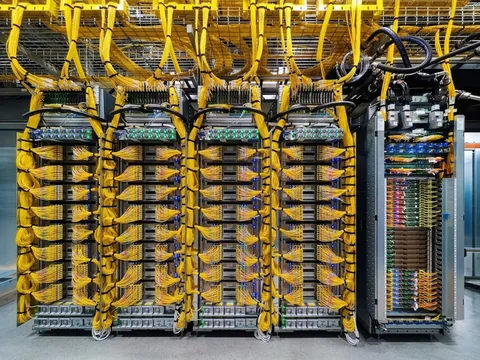
We've got a nice picture of it. And this is just a couple of racks. The cabling, the fiber distribution for it, is really beautiful. Beauty is in the eye of the beholder, but for folks like me and probably yourself and others in the audience as well, it is a thing of beauty. We put this picture up on social media, and people love the fact that it's Ineffable—they're huge fans of what they're doing, fantastic team—and that got a lot of attention. "Okay, great rack for Ineffable." But actually, people just loved seeing the pictures of the fiber and the sort of fractal nature of the fiber. One of the most popular posts that we've ever had, actually, was around that. So yeah, absolutely, we're really, really excited about that.
03Goodput instead of FLOPS
Google holds itself to goodput, the useful work a workload actually gets under real failure conditions, not to peak FLOPS.
Yeah, I had goosebumps seeing the picture. How do you measure and hold yourself accountable in the middle of this big buildout? We were talking right before the show about how FLOPS11FLOPS (floating-point operations per second) — the standard measure of a chip's peak performance, which manufacturers quote for ideal conditions. is a vanity metric12Vanity metric — a number that grows nicely but says little about the business, like sign-ups instead of paying customers. The term comes from Eric Ries's lean startup methodology. and you prefer an alternate metric. Can you say more?
Yeah. So one thing to note is that whether it's FLOPS or your other favorite chip-centric metric, these are in theory. In other words, under some conditions, for whatever chip you have, this is the maximum amount of FLOPS that you can deliver. What we really care about in the end is the performance delivered by workload.13Workload — the job the hardware does: training a particular model, inference, search, a database. It is the key word of this conversation: both chips and buildings are designed around workloads. That's what we're looking at. And it happens, but actually relatively rarely, that that performance is determined by a single chip—its FLOPS, its HBM,14HBM (high-bandwidth memory) — stacks of DRAM dies placed in the same package as the compute die. SRAM is the fastest memory, located right on the chip. its SRAM capacity. Those are all super important, but it might be how two, four, eight, 16, 1,000, 10,000 or more of these chips compose together—not just the accelerators, whether TPUs or GPUs, but then the CPUs that might feed them the data, the network that connects them all together. So what is the workload that you're running, and what is the performance of that workload?
One measure that is interesting is your FLOPS utilization.15FLOPS utilization — the share of peak performance a job actually achieves; in model training it is called MFU (model FLOPs utilization). Google reported 46.2% MFU for training PaLM in 2022. So, for example, for a particular workload, if you have in theory a teraflop or petaflop16A teraflop is a trillion (10¹²) operations per second, a petaflop a quadrillion (10¹⁵). For scale: the peak performance of Ironwood, Google's seventh-generation TPU, is about 4.6 petaflops. Tensor Processing Unit. capable for your workload, what fraction of that are you delivering? Now, that's a measure of goodput.17Goodput in networking has long meant useful throughput: application data delivered per unit of time, excluding headers and retransmissions. For machine learning, Google Cloud described an ML Productivity Goodput metric in 2024, made up of three factors: the share of time a job has all the resources it needs, the share of time it makes progress without failures and rollbacks, and the share of the hardware's peak performance the program extracts. Goodput, Google Cloud blog. What is goodput? You can think of throughput,18Throughput — how much work a system does per unit of time, whether useful or not. Goodput is only the useful part of it. which is a well-known term. That's the throughput that is possible. But now let's consider some other considerations. One is the slowdown of the workload—again, just inherent to the workload. But other aspects of it that really hit are reliability.
So in terms of how we hold ourselves accountable: if we have a chip failing for a synchronous workload19Synchronous workload — thousands of chips moving in lockstep: in training, for example, they exchange results after every step and wait for each other. So one failed or lagging chip stops them all.—and many of these workloads, whether training or serving20Inference — running an already trained model to answer users' requests; Google often calls it serving. Training is fitting the model's weights on data. or agentic workloads, are synchronous—there are many, many components that are working together simultaneously. Now, if you have, let's say, 1,000, 10,000, 100,000 of these components working together simultaneously, and they really need to coordinate at microsecond and millisecond granularity, one of them fails, and it might actually bring the whole thing to a stop. Because everyone is counting on everyone else to do their part of the job in order to come up with the answer to a really tough question. One of them stops. Okay, now we have to figure out what happened. Which one stopped? What's a checkpoint that we have of the computation at some previous state and time? How do we restore that checkpoint? How do we restart? Worst case, we have to restart from the beginning. That would be really bad, but that can happen in certain cases, especially more on the inference side.
The point here is that if you then have to go back and redo a bunch of computation, if you have to pause and wait to figure out what happened with the failure, all that work is work. It's not actually helping you get the answer. Let's say that you're working out a problem on paper. Step one, step two, step three, step four. If you have to go back to step one because you made a mistake, yes, you're still doing work. That's throughput. You're doing work. But what is the goodput in delivering your answer? It's basically the total amount of time it took you to solve the problem. That's what matters. And if you have failures, if you have failure recovery, if you have whatever it is that's interrupting your work, that's part of the issue.
So how do we hold ourselves accountable? It's delivered goodput. It's not theoretical benchmark throughput, or goodput in theory, but actually, for a workload, for real failure conditions, what's happening. And the unfortunate reality is that at 100,000-accelerator scale—
I was going to say, at that scale something's failing all the time, right?
All the time. And each one of these chips, as you're aware, is a wonder of nature. They're at the very bleeding edge of what's possible to manufacture. To me, it's stunning. And now, actually, these chips aren't just one chip. They're packages made up of, in many cases, two, four, eight, maybe more chiplets21Chiplet — a small die; several are assembled in one package to form a single processor. This gets around limits on die size and wastes less on defects, since a flaw ruins a small die rather than a huge one. that are composing together. And then of course HBM off to the side, network connectivity, maybe things like co-packaged optics.22Co-packaged optics (CPO) — optical transceivers in the same package as the chip, so the signal turns into light right next to the die rather than in a separate module at the edge of the board. Not a criticism—lots of things can fail. And if you've got 100,000 of them, something is going to fail. You have to be prepared for that. Detect that in near real time, recover from that in near real time. Doing all that—the telemetry problem is massive. It's like finding a needle in the haystack continuously, across certainly seconds and minutes, but for some of these jobs, hours and days and even weeks. Just continuous and online. How we hold ourselves accountable is the goodput that we deliver for the workloads that actually matter in the data center.
Is "goodput" a Google term, or is it an industry term?
It's a Google term.23Fact-checkVahdat calls goodput a Google term, but the word has long been used in computer networking for useful throughput, application data excluding headers and retransmissions; it is defined, for example, in RFC 2647 (1999) (Wikipedia, "Goodput"). Google carried the term over to machine learning. But I think more and more people across the industry are starting to pick it up.
And then just to calibrate me, at 100,000-accelerator scale, are we talking it's going to fail once a minute, once a day? How often?
100,000 accelerators. Let me see. I think it is definitely going to be, at that scale, multiple times a day, and perhaps, depending on the exact configuration, multiple times an hour something is going to fail.
And what are the most common failure reasons?
This is the problem, actually. It's a very good question. If there were a common failure reason, we would have figured it out and fixed it. It is a long tail of constant discovery.24Long tail — a distribution with no handful of common cases but a great many rare ones that together make up a large share. There is no single main cause to fix; each one has to be tracked down. Whenever we have a new product that's being introduced, there's going to be something that hits us—in many cases, frankly, because it's at the very bleeding edge. It might be network-related. It might be how we connect these things together at super high speed. That might be something to do with the hardware. Those things we work through. But then a lot of the issues could be software.
So this is the other aspect of how we hold ourselves accountable. The chip might be capable of a certain level of FLOPS, but if you have a compiler bug, a runtime bug,25Compiler and runtime: for TPUs, the XLA compiler first translates a model into machine instructions, and the runtime executes them on the hardware, allocating memory and launching computation and data exchange between chips. a model issue, an operating system issue, it doesn't matter—that's going to impact the end-to-end system performance. So you might have perfect hardware, fully reliable, but then you might have software issues that hurt you.
04Doubling capacity every six months
What has to double every six months is token-generation capability, and models and software contribute at least as much to it as hardware.
Is there a standard reference stack26Reference stack — a manufacturer's validated system design around its chips: servers, networking, cooling, software. A customer can build exactly to it or adapt it. from the accelerator companies—from Nvidia or from the TPU team—of "here is the optimal system to build around our accelerators, and as long as you build to that system, you're good"? Or how much of your own data center design do you have to do above and beyond what the semiconductor companies give you?
Right. So there's a reference stack. And I would say that Nvidia is an incredible whole-systems company.27Nvidia sells not only GPUs but whole racks such as the GB200 NVL72, networking gear (which grew out of Israel's Mellanox, acquired in 2020) and the CUDA software platform. They are obviously a semiconductor company, but they're not just a semiconductor company. They give you a really, really strong reference stack. But the way I'd put it is, most of our customers leverage that reference stack, but many also specialize. In other words, they might find that, as natural for their particular use case, they have an optimization opportunity or something different that they need to do, and they're going to do that. Similarly, for the TPU side, we have a reference stack. Most people will leverage that, but many will specialize it as well.
Got it. And then in terms of overall capacity, you've told your teams that Google has to roughly double the serving capacity every six months or so.28Doubling every six months: Vahdat said this at an all-hands meeting on November 6, 2025; his slides, reported by CNBC, read: "Now we must double every 6 months… the next 1000x in 4-5 years," at roughly the same cost and power. Google later clarified that this referred to growth in demand for compute, not a literal doubling of hardware. Gizmodo. Is that right?
Well, to be clear, this is in terms of effective available capacity. The way in the end that we look at it, from a serving perspective, is token generation capability.29Token — a piece of text, usually part of a word: models read and write in tokens. Inference performance is measured in tokens per second. So capacity—and this is where I would say it's a combination of software and hardware. The hardware might have some, quote unquote, inherent level of FLOPS. What I'm saying here is not necessarily that you have to double the number of FLOPS every six months. That's one path. You have to double the capability of that hardware to generate tokens every six months. And as much or more of that is going to come from software as it is from hardware. In other words, it could be a model optimization that delivers that. It could be some runtime optimization that delivers that. It's really probably going to be dozens or hundreds of individual optimizations that are just landing again and again and again to make it all possible. But yes, the rate of capacity improvement is incredible.
We've had a few years of data center buildout now and a few years of model progress and software progress. What has been the empirical breakdown of how much capacity—maybe as measured by intelligence per watt—how much capacity increase has come from the silicon itself versus the models versus other software, and any other kind of big components?
Yeah, it's a really good question. I don't have the exact breakdown, but I would say that in our experience, most of the benefits come from model-side improvements, in terms of intelligence per watt. And by the way, intelligence per watt is a fantastic metric, really focusing. For us, it's goodput per watt, and we can come back to why the watts need to be the denominator. Goodput could well be a measure of the intelligence delivered per watt—in other words, goodput as a workload-specific metric.
But I would say most of the gains often come from the model side, the software system. Quite a bit. Why? Because they're able to actually make sure that the hardware that you have is being used effectively. And then the hardware—it is pretty stunning. In other words, we're living in a world right now where 2x or more year-over-year performance improvement is absolutely possible. And so the hardware does support it. It's, if you want, a free multiplier—not free, but everyone else above it30The stack — the layers of a system: hardware and networking at the bottom, compilers and runtimes above them, models and applications above those. "Above it" means everything running on top of the hardware. can count on it in terms of that being a multiplier that lifts everyone else up year over year.
05The TPU bet: from 2013 to 8i and 8t
The 2013 bet on a custom chip against Moore's law turned out, in Vahdat's words, to be massively successful, and in 2026 the TPU was split in two for the first time because inference had become a large share of the market.
I'd love to talk a bit about the TPU program and co-design.31Co-design — developing hardware, software, models and even buildings together and fitting them to each other, rather than assembling a system from off-the-shelf general-purpose parts. Google started building custom silicon more than a decade ago. It was a contrarian call at the time. How has the TPU program evolved?
Quite a lot. When the program started in 2013,32The first TPUs ran in Google's data centers from 2015; the company described them publicly in May 2016. TPU v2 (2017) was the first generation that could train models; the same year, Google researchers proposed the transformer architecture in "Attention Is All You Need." Tensor Processing Unit. it was really a contrarian call. And I think that at the time—it's hard to put yourself back into the moment—2013 conventional wisdom, all the smartest, wisest people would say, you don't build a custom-built accelerator for a single workload. Why? Because Moore's Law is there.33Moore's law — Intel cofounder Gordon Moore's observation that the number of transistors on a chip doubles about every two years. The "18 months" figure was a 1975 prediction for chip performance by his Intel colleague David House. Moore's law. Doubling of performance every, whatever it is, 18 or 24 months is there. You get to leverage standard programming models, all your C++ code, Java, Python, whatever it might be.
The bitter lesson of chips.34"The Bitter Lesson" — Richard Sutton's 2019 essay: over 70 years of AI research, general methods that scale with computation have repeatedly beaten approaches built on knowledge of the specific problem. Huang applies it to chips: general-purpose processors that get cheaper with Moore's law beat specialized ones. Essay.
Yes, exactly. The bitter lesson of chips is that specialization never wins. But in this particular case, we had this one application, or a few, a small number of them, that would benefit tremendously, and that would require an unimaginable amount of general-purpose CPU to support. So really, in 2013, it was a bet. And there were quite a few people, even within the company, I would say, who were not sure that it would work out. So it was a bet. It turned out to be a massively successful bet.
The first chip was all about inference. The second chip was, hey, actually, we can take the same idea and build a training chip. From there, it got picked up for more and more use cases. Around the time the second chip came out, transformers were invented.35Transformer — a neural network architecture based on attention, proposed by Google researchers in 2017; almost all modern language models are built on it, including GPT, Gemini and Claude. This was a major, major moment, and that actually completely shifted the TPU program. We of course learned that recommender systems36Recommender systems — models that decide which video, product or ad to show a person; at Google they power YouTube recommendations and ad serving. could run really, really well on the TPUs, and so ads and related use cases came along.
So I would say that the evolution has been one of expansion in scope and impact. In other words, it started with a really impactful use case of a couple of applications for inference serving—this was language translation primarily, and voice recognition—to then training, to then transformers, recommender systems, and continuing to generalize as the GenAI moment took hold, to ever larger, ever more scalable systems as well.
You mentioned the moment the transformer came through being a major moment, and I'm curious to explore—the TPU was a specific architecture, but it wasn't specific to the transformer. How do you straddle the fine line of how specific you want your chip to be for the workload?
This is a great question, and I think it really comes down to the applicability of the chip to a particular workload. In the end, we've been thinking about this for every generation: would we further specialize? The question that we were facing, let's say two years ago or a little bit more, was: in 2026, should we have two chips or one? We could have one chip that could do inference and training simultaneously and do both quite well. Or we could have two chips, one that was further specialized for inference and a second one that was further specialized for training.
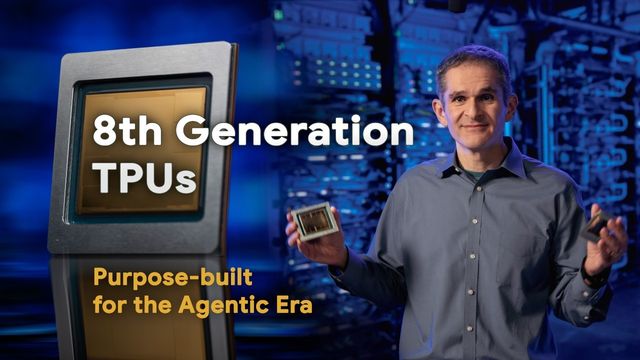
This analysis and this work led to the release of two chips this year: TPU 8i for inference, TPU 8t for training.37TPU 8t and TPU 8i were unveiled on April 22, 2026, at Google Cloud Next: the first time the TPU line split into two chips for different workloads. Google blog. And in the end, what we realized is that it wasn't the case necessarily a couple of years ago, but by '26 we saw inference and serving really taking off. And so having a chip that would be significantly faster for serving—that we thought might be 30, 40, 50, 60% of the market in its lifetime—started making a lot of sense for us. Relative to, if we projected inference to be 2% or 5% of the market, even if that specialized chip is, let's say, 2x faster, it might not make sense, right? Because you'd actually go for the one general-purpose chip that's not fully optimized, but that's okay, because you now have the uniformity.
So really it does come down to a calculus question of: okay, would you further specialize? How big is that workload? How big is that workload projected to be in a couple of, three or four, years? Is this sustained growth for a particular workload? In hardware, as you know, there is this opportunity where the more you specialize to a particular workload, the less flexible it is, but the faster and the more power-efficient the hardware is going to be. So it is this art, and it's this projection of what you're designing to and how persistent that workload is. In other words, if it's going to go away after a month or two months or three months, even if it's big for those three months, you've got a really narrow window to intercept it. So it has to be somewhat durable, and you have to be able to project exactly what you can get for specializing to it.
So the rough tradeoff is there's a large fixed cost to support a new program—
Yes.
—and you basically have to think that there's going to be enough demand for that specific program to justify the cost.
Exactly. And to some extent—for example, for our 8i and 8t chips, both chips can do the other workload. This is also key. If 8i could only do inference and couldn't do training at all—in other words, it had zero performance for training—and then vice versa, if 8t was amazing at training and had zero performance for inference, that would have also been a key limitation. Why? Because we would have to predict ahead of time, over a six-year period, the lifetime of the hardware, exactly how much we need of each. In this case, it was nice because both chips are better at what they're specialized for, but if you had leftover capacity in one place or the other, both can actually do the other's job. Depending on the specialization you do, you might get so specialized that you actually limit yourself from being flexible, fungible.
And if the rough tradeoff is the size of the program—on the other end, it seems to me that so much of the modern AI market is transformer-based. So maybe just to ask a provocative question, why not just burn the transformer architecture into the chip?38Burning the transformer into a chip has been tried by Etched, among others: its first chip, Sohu, was designed for transformers only. The company later added support for other architectures; in July 2026 its round was led by Sequoia, Sonya Huang's firm.
Yeah. So I think it's transformer-based, but then the next level of question would be: transformers, in the end, are about vector and matrix multiply operations, and a softmax.39Softmax — a function that turns a set of numbers into probabilities summing to one; a transformer uses it to compute attention. There's a range of essentially linear algebra primitives. We have those, and others do as well, roughly baked into the hardware. It's all transformer-based, but then there's your model architecture. Okay, how many layers do you have? How do you go through the layers? How do you go across the layers? For each dimension, what exact shape of matrices and vectors are you applying? You could go further and specialize to not just the transformer but your model. That's the next level of specialization. I think there are a number of companies out there that are thinking about that. I think it's a very, very interesting direction as well.
Okay. So at this point in time, do your customers view TPU and GPU as roughly fungible equivalents, or is there a certain set of problems that is better suited for one or the other?
There's for sure a set of problems that are better suited for one or the other. GPUs are more general-purpose than TPUs, for one. That is clear. They're incredible products. At Google and Google Cloud, we sell a lot of GPUs. We use GPUs internally. But I think it really then comes down to the specifics of your problem. There is overlap between the two, but our customers then evaluate the workload and evaluate their options. What we like to do at Google is give our customers choice. In other words, we want to have the right solution for their needs, and of course provide the solution that best meets their needs for them.
06The case for and against co-design
Abstraction layers let you run anywhere with no lock-in, but every layer boundary costs performance, and that is the case for co-design.
What is the case for co-design, from the chip to the network to the software? And then what is the case against co-design?
Yeah. So there are huge optimization opportunities with co-design. What you can imagine is that if you have an N-layer stack and you want to be able to pick and choose whatever component you want—let's say you're running across many clouds, or you're running across many pieces of hardware, many pieces of software—you could design abstraction layers that would basically say, I can run on any hardware, I can run on any software, I can run on any network topology, any amount of network that you give me, no problem. And my system is going to be fully adaptive.
So now you have a great capability. You can move anywhere. New capacity becomes available overnight, and you're up and running, because you've designed your system that way, to actually be able to take advantage of anything. You have not hard-coded or specialized at all to anyone's particular infrastructure. The downside is you probably leave a lot of performance on the table if you become fully fungible, fully flexible to anybody's hardware, software, network, storage, compute stack.
So the case for co-designing is that between each one of those layers, there's a big impedance mismatch40Impedance mismatch — in electrical engineering, a mismatch between the impedance of a source and a load that causes part of the signal to be lost. Engineers use the term for any losses at the boundary between poorly matched systems. if you try to get full generality. There might be 10%, 20%, 2x across each of these layers. You start multiplying those optimization opportunities through, and all of a sudden you're left with a big end-to-end opportunity in terms of, whatever you want to say, intelligence per watt or goodput per watt, that you can leverage—all the way down to power delivery and power availability, software optimizations, et cetera. So the pros are you can run anywhere, anytime. You have no lock-in.41Vendor lock-in — when switching to another vendor is so costly that a customer stays even when it's against their interest. The cons are you're leaving, in all likelihood, significant amounts of performance on the table.
So my understanding is that if you take OpenAI and Anthropic, OpenAI was primarily building on a homogeneous compute stack, and Anthropic was building a roughly more heterogeneous compute stack.42Anthropic trains and runs its Claude models on three platforms: Google's TPUs, Amazon's Trainium and Nvidia GPUs. In October 2025 it agreed with Google on access to up to a million TPUs. Anthropic. Do you think that co-design is part of the reason why they converged on what is rumored to be very different architectures for their models?
I don't want to speculate in terms of what OpenAI and Anthropic are doing. It's one possibility, but without knowing the details of what they're doing, I would imagine that there could be many reasons for why they wind up with different architectures.
07Shoulder to shoulder with DeepMind: changing chips in flight
Being one company lets Google's engineers and DeepMind's researchers change a chip's architecture shortly before tape-out.
Well, what about for Google, then? I'm curious what the working relationship looks like between your team and DeepMind.43Google DeepMind — Google's AI lab. Google bought London-based DeepMind in 2014 and merged it with its Google Brain unit in April 2023; Gemini is developed there. Wikipedia. Who's in the room at what stage of model development, and how are you making decisions together on co-design?
It's one of the most fun and frankly gratifying parts of being at Google: the opportunity to work really shoulder to shoulder with the DeepMind team in terms of co-design of our hardware and models. There's a third element to it, in that we also get to extend that with the consumer services and Cloud. I'll put that aside for a moment; I can come back to it. But with respect to DeepMind, it really is a deep partnership.
From the past, I can give you examples where they have come up with model optimizations, let's say to transformers or to particular math that they might want to do, and we might have a chip in progress, not quite done. But then they say, "Oh my gosh, if we had hardware support for this, our end-to-end training or serving might get significantly faster, more efficient. What would it take to actually change the hardware definition that we're in execution on to accommodate this?" And this then leads to our engineers and their researchers getting together intensely in the same room for a few days, a week, two weeks, saying, "Okay, yes, we can do this." More likely: "We couldn't quite do what you wanted, but we can do this other thing. And then maybe you can change your model architecture in this other direction. That gives you 98%. That gives us 90% of what we're looking for." And yes, we can then go back and intercept the hardware. Or we can say, "You know what? We're going to delay the tape-out44Tape-out — the point at which a chip design is finally sent to the fab to make photomasks. The name dates from when the data was delivered on magnetic tape. After tape-out, any change costs months of work. Tape-out. by a week or two weeks, because wow, for this level of benefit, it's totally worth it."
Similarly, when we're projecting our roadmap out—we have many generations of chips that are essentially in progress at any point in time. We have the chips that are in production. That's one. We have the chips that we're working on getting into production; they're already back from the manufacturer,45The manufacturer — Google designs its TPUs with Broadcom, and they are made, like Nvidia's GPUs, by Taiwan's TSMC. Tensor Processing Unit. and we're debugging them, making them work. We have the chips that are in implementation that are about to tape out and go to the manufacturer. We have the chips that are in design phase. And then we have the chips that are in concept phase. So it's really this five-, six-stage, many-year pipeline from introduction to end of life.
The collaboration with DeepMind for in-production is significant, because we get to work together in maximizing delivered intelligence, or delivered goodput, per watt. We know exactly what's happening in the model, and we know exactly what's happening in the hardware and everything in between. We also get to collaborate deeply on the chips that are just about to tape out. Why? Because we can intercept, and we can make changes to the chip—literally the chip architecture—in flight, which would be somewhere between hard and impossible to do if we were working across company boundaries. Not impossible, but it would be much harder for us to say, "Oh my gosh, we're a few weeks or a few months away from getting this chip done, and now let's get in the same room, shoulder to shoulder, and figure out if we should disrupt the program." It's possible, but harder, is what I would say.
And then of course, for the chips that are in design, we have many architectures we can evaluate together. We can ask our colleagues in DeepMind, where do you see model architectures going in two or three years' time? Here's the Pareto of things46Pareto frontier — the set of best trade-offs: options that can't be improved on one parameter without getting worse on another. It is named after the Italian economist Vilfredo Pareto. that we can do. Here's the Pareto of where model architecture is going. We actually have deep and significant simulation infrastructure that can predict how the workloads are going to map to different hardware architectures. Deep and fast iteration. It really isn't the teams working separately. It's in the same building, same rooms, many times. Deep daily interaction. I talk to, whether it's Koray or Demis,47Koray Kavukcuoglu — DeepMind's former CTO and, since June 2025, Google's Chief AI Architect. Demis Hassabis — cofounder and CEO of Google DeepMind. multiple times a week. So it really is a super fun aspect of the work.
That's awesome. And eventually their models will help with chip design.48AI for chip design existed at Google before Gemini: Google Brain built AlphaChip, a reinforcement learning method for placing blocks on a die. It was used in designing TPUs, described in Nature in 2021 and open-sourced. AlphaChip.
We're using Gemini49Gemini — Google DeepMind's family of models; Google introduced the first version in December 2023. to design hardware for future Geminis as well.
That's really cool. I want to come back to that a little bit later. On the collaboration itself—is there an impedance mismatch still? I figure the cycle times are probably just slower when you're dealing with hardware than your DeepMind folks get to deal with on the software side. And I figure your planning cycles are much further ahead. So how much room do you actually have to adjust?
Yeah, it's a really good question. We are planning hardware two, three, four, five years in advance, no question. In other words, we talked about TPU 8i and 8t that we just announced, but you can imagine that 9, 10, and maybe some others are in concept, in execution, in something else, and they might be years out. If you're working with model architecture, by default you're not going to be thinking years out.
But I think this is also the great thing about how the company has grown up together. In other words, Google Research and DeepMind and transformers being invented—all of this was happening in these overlapping rooms as well. So there's a whole generation of researchers who've grown accustomed to being able to influence the hardware, and knowing that the hardware is operating on multi-year cycles. They also know that, look, if they have a small tweak that's going to deliver 1% or 0.5% or something like that for a chip that's about to tape out, they're probably not going to come to us, because they know enough to know that it's not like software, where you can just do a change list50Change list (CL) — Google's name for a batch of edits submitted for review and to the shared repository, the equivalent of a pull request. and it's going to ship to production in two weeks' time. Stopping a tape-out is a big deal. But they also know if they've got a really good opportunity, yes, we're absolutely going to work together to figure out if we can get it in there.
So as I said, it's multiplicative in terms of where the benefits come from. The hardware does lift all the tides, right? And so significant portions of the DeepMind team—and we're so grateful for it; it's an amazing team—significant portions of it are thinking about, how do I influence the roadmap? Because it's actually a pipeline. The idea I had two years ago is in production now, and it's helping all the workloads at Google go faster. That's a good feeling.
Totally. It seems like an impossible task, though, to predict in five years what workloads will be most common and what algorithmic breakthroughs will have occurred. Doesn't it seem like an impossible task?
I hear you that it would seem like an impossible task. But here's the awesome thing—and actually, we're working on writing this up in great, great detail, and it's a lot of fun to do it. The stunning thing is that the TPU architecture, at a medium level of detail—not at a super high level of detail, at a medium level of detail—hasn't really changed since TPU v1.
One way to look at it is the instruction set architecture51Instruction set architecture (ISA) — the list of instructions a processor understands, such as x86 or ARM: load from memory, store to memory, add, branch. A program written for an ISA runs on any chip that implements it. for a CPU. You've got loads and you've got stores and you've got adds and you've got subtracts and branches. And yet what has the software on top of it done over that period of time? Same thing with TPUs. We have some fundamental instructions and fundamental primitives. Of course we've extended it—it's not like the instruction set hasn't changed at all—but the primitives are there, in terms of specializing the numerics52Numerics — how many bits are used per number. For TPUs, Google Brain invented the bfloat16 ("brain floating point") format: 16 bits with the same range as ordinary 32-bit numbers but less precision, which is enough for neural networks. bfloat16. to very big, very large matrix multiply units;53Matrix multiply unit (MXU) — the heart of a TPU: a systolic array through which data flows in a wave across a grid of multipliers. In the first TPU it was a 256 × 256 grid, 65,536 multipliers. a SparseCore54SparseCore — a TPU unit for embeddings, the huge sparse tables that recommender systems run on. ICI (Inter-Chip Interconnect) is the TPU's own network, linking chips directly within a pod. that manages vector operations and scatter-gather operations. There are five or six things that really define it. Remote load-store—that's another one, actually. We can read and write remote memory through our ICI network. The fundamentals have been there, and they've extended to many generations of models, many generations of even deep neural network algorithms and model structures.
08Long-horizon agents reshape the data center
With no human in the loop, demand on CPUs, networking and storage shoots up.
Okay. Speaking of shifting workloads, it seems like one of the biggest changes in workloads over the last year or so—I think it really started at the beginning of this calendar year—was the rise of the long-horizon agent.55Long-horizon agent — an AI agent that carries out a multistep task for hours on its own, without a person at every step: writing and running code, searching for information, calling tools.
Yes.
And I would guess that's a very different shape of workload than the quick-turn LLM conversations56LLM (large language model) — a model such as GPT, Gemini or Claude. of years past. What does that mean in terms of data center needs?
Yeah. So I think there are two huge aspects to this. One is it's no longer human-to-accelerator interaction. In other words, when you are typing at a prompt in a web browser or on your phone or whatever, of course in response to your prompt there's going to be a bunch of work that happens. But then when the response comes back, you've got to read it. You've got to think about it. And then maybe you have a follow-up. That's going to be multiple seconds of interaction time. Now, in long-horizon agents, there's no human in the loop57Human in the loop — a setup in which a person checks or makes the decision at every step. An agent has none, so nothing throttles the stream of requests. that is going to naturally rate-limit how quickly requests are going to go to the model. So what went from seconds, maybe tens of seconds, in terms of interaction time is now going into perhaps milliseconds. As soon as I get a response back, I can parse it, I can reason about it perhaps a bit, and I can figure out what my next request is going to be. So that's big change one.
Big change two is all that reasoning and all that parsing is going to probably happen on a CPU, and that CPU is then going to have to think about, okay, what other state do I need to go gather before making my next prompt back into the model? In other words, I've learned something from this response. I'm going to take another step, but I actually need to go grab some context—maybe from DRAM local to me,58DRAM — main memory, the fastest after on-chip memory. SSD — a flash-based solid-state drive: roughly a thousand times slower than DRAM in latency, but cheaper and persistent without power. HDD (hard disk drive) — slower and cheaper still. maybe from someone else's DRAM on another CPU, maybe on SSD, or maybe on HDD somewhere else. So now a huge amount of orchestration has to take place as well. So the design actually is changing pretty significantly, where the demand for accelerated compute is going up, but the demand for CPU and networking and storage—traditional data center CPU—is also going through the roof.
So does that mean you're putting more CPUs alongside your GPU racks, then?
GPU, TPU racks—this is the key question, going back to this question of optimization and specialization. If we start putting lots of CPU racks—and it is a question—next to the GPUs and TPUs, that means that actually we can't fully specialize to the density and network requirements, let's say, of a TPU rack relative to a CPU rack. A TPU rack is going to be more dense than a CPU rack. It's probably going to need more networking than a CPU rack. So in other words, now our building design is going to change.
Another option is to maintain your uniformity. Put your GPUs or TPUs all in one building, and in the building next door, maybe put your CPUs. And maybe, by the way, the hard drives have to be in another building on the other side, because they have yet another set of requirements. Now you need networking between these buildings at a pretty significant level. Once you leave a building, the networking complexity goes up significantly, from a reliability perspective, from a cost perspective. Latency goes up—probably acceptably, but still, now you might go to hundreds of microseconds,59Hundreds of microseconds — for scale: light covers a kilometer of fiber in about 5 microseconds, so the latency comes less from the distance between buildings than from switches and queues. potentially more, with queuing between the components. So the considerations do change in pretty interesting ways.
Your job is hard.
It's fun. Yeah.
09Optical circuit switching
Optical circuit switches steer light with mirrors without touching the bits, which lets Google swap a failed TPU rack for a spare in milliseconds.
What's happening on the networking side? I've heard that Google's always been at the forefront of the newest in networking, including optical. Can you say a word on the state of optical networking?
We at Google, this was probably 15, 16 years ago, were among the first to bring essentially what's called wavelength-division multiplexing60Wavelength-division multiplexing (WDM) — sending several signals down one fiber at once on different wavelengths, like beams of different colors.—where you could put multiple signals on a single fiber—within the data center. And we actually leverage that for all of our communication between racks. At the same time, we introduced a technology, along with the wavelength-division multiplexing, called optical circuit switching.61Optical circuit switching (OCS): Google calls its system Apollo and the MEMS-mirror switch itself Palomar. A 2022 Google paper described Apollo as the first large-scale production deployment of optical circuit switches in data center networks. Mission Apollo. Essentially what optical circuit switching does, in contrast with traditional electrical packet switching,62Packet switching — data is cut into packets with an address in the header, and each switch decides where to forward the next packet; this is how the internet works. Circuit switching sets up a path between two points in advance and holds it as long as needed, like the old telephone network. is it transmits and moves data entirely in the optical domain.
Let me describe the technology that underpins it. In a packet switch, you would take a packet. It has a header. You would look at it in the electrical domain, figure out where the packet is headed. In its header, it might have an IP address that says, okay, where am I headed? You look up, for that destination, in a table: what port do I forward it along? So basically billions and billions, perhaps trillions, of packets coming through at super high speed per second, and you're forwarding them along. Optical circuit switching says, I'm not touching these bits in the electrical domain. What I'm going to do is figure out, for an input port, which output port to send the light to. There are multiple ways to do this. The one that we started with is called MEMS switches63MEMS (microelectromechanical systems) — micron-scale moving parts on a silicon chip. In an optical switch, it is an array of micromirrors that tilt in response to an electrical signal.—micro-electrical motors that basically control mirrors in 3D. So we can now programmatically take a box that might have, you pick, 128 ports, 256 ports, some number like that, and we can configure every input port for a fiber that comes into it, map it to an output port, and then change the rotation of mirrors, where the light literally shines down on these mirrors and gets reflected to the right output port.
Initially, the reason we did this was twofold. One was to create locality between groups of racks. Let's say I had a compute cluster and a storage cluster, and both of them were in support of—again, making it up—search. We knew that these two clusters would talk to each other a lot, so we would configure the mirrors to create shortcuts, purely optically, between those two clusters of racks. That was reason number one. Reason number two was we wanted to be able to expand the network and contract the network without actually moving any fiber. Without going into the details—I could draw this on a board—the optical circuit switch would allow you to actually reconfigure the spine of the network,64Spine — the top tier of a data center network: every rack switch (leaf) connects to every spine switch, so the path between any two racks passes through one spine switch. to expand it or shrink it, without a human being having to do anything other than be, literally, a controller that would manage that.
ExplainerWhy a TPU supercomputer needs optical switches
The 4,096-chip TPU v4 supercomputer is built from 4 × 4 × 4 cubes of 64 chips: inside a cube the chips are wired directly, and the cube faces are connected by fiber to optical circuit switches. By reconfiguring the mirrors, the system can assemble free cubes into a slice of the right shape for a given job in milliseconds, route around a failed cube and even change the topology, for example to a "twisted" torus that speeds up data exchange for some jobs. Because the switch never converts light into an electrical signal, it doesn't care how fast the data is moving: according to Google, the Apollo network has already worked with four generations of optical transceivers. According to the TPU v4 paper (2023), the switches and optics account for less than 5% of the system's cost and less than 3% of its power. TPU v4.
Now fast-forward to TPUs. A TPU has a torus topology65Torus — a topology in which each chip connects directly to its neighbors in every dimension, with the edge chips wrapped around to each other as in a ring; recent TPU generations use a 3D torus. In the TPU 8i it was replaced by a new topology, Boardfly, while the TPU 8t stayed with the 3D torus. Techzine. that connects all the TPUs to one another directly. I talked about throughput and goodput earlier. One of the things that we can do is, if we have a TPU rack that fails, we can replace it with another TPU rack without moving any fiber. Again, I'd have to wave my hands or draw on the whiteboard, but essentially we can say we have a spare rack available at all times, and when a rack fails, we redirect the light to that new rack. And that can be done in milliseconds.
Why do you have the fiber at all, then?
As opposed to fully free-space?66Free-space optics — sending data by laser beam through air or vacuum, without fiber. One company working on it is Taara, spun out of Alphabet's X lab in March 2025. Taara. Yeah, it's a very good question. Attenuation loss, and bandwidth would drop dramatically. Furthermore, across the range of a very large building, aiming everything without the benefit of fiber to connect it all together in 3D would be challenging to possibly impossible. We've talked about it, actually, and there have been some really interesting discussions. But yes, it's mostly in fiber. But then when they hit the optical circuit switch, essentially the light then literally shines down on these tiny chips. So that's one big direction of networking, but there's a lot. I would say networking is exploding in terms of its capabilities and need, frankly, in the data center.
So cool. We could do an entire conversation.
Yes, it is very, very cool.
Even going back to the picture from Ineffable, it was all the cables that—
Exactly. Yeah. And those cables eventually, some of them, wind up at optical circuit switches, which in our data centers makes sense.
10Power is the binding constraint
Power is the most fundamental constraint, and Google would rather spend years planning with utilities than build its own generation.
Okay. I want to flip to talking about power. You've been talking about goodput per watt and other units per watt. It makes me think per watt means power is kind of the binding constraint,67Binding constraint — an optimization term for the constraint that actually limits the outcome. Relax it and the result improves; relaxing the others does nothing. or the scarce constraint, or the expensive constraint in some way.
So I get asked this question: what is the biggest constraint that we face? And the reality is there is no single biggest constraint that we face. They're all constraints. They're all super hard, and they shift continuously. But if I had to answer fundamentally, I would say that power is the single most fundamental constraint that we face. Everything else, it seems like we know how to solve them, and it's a question of solving them over some period of time. Power—I think the way that you put it is really nice. It's a binding, long-term issue. We do not have a—I mean, nuclear, perhaps nuclear68Nuclear power: Google has a power purchase agreement with Kairos Power, which is developing small modular reactors. In April 2026 Kairos began building Hermes 2, a 50 MW reactor in Tennessee for Google's data centers. Kairos Power. is going to—abundant clean energy would solve a lot of problems, for sure, when that happens. And when it happens at scale is still unknown.
And so how does it work in practice? You're standing up a new data center. It needs a gigawatt of power.69A gigawatt — roughly the output of one large nuclear reactor; at average American consumption, about 800,000 homes. I imagine you can't just call PG&E70Pacific Gas and Electric (PG&E) — California's largest utility, serving the north and center of the state, including the San Francisco Bay Area. Wikipedia. and say, "Hey, please send a gigawatt of power." So what does provisioning power actually look like? And are you having to vertically integrate all the way down to doing your own turbines?71Your own turbines — gas turbines right at the data center. xAI did this, for example: its Colossus supercomputer in Memphis was initially powered by temporary gas turbines, and local residents protested over air pollution. How do you solve the power bottleneck?
Yeah, it's a big question, an important question. Our preferred model at Google is always to be utility-connected, to be grid-connected. So it's the equivalent of calling your—
Oh, so you can just call PG&E?
Exactly. You call, very politely, your favorite utility wherever it is that your data center is. And of course you give them many, many years of notice. In other words, if we're talking about gigawatt scale, it's not something that you can say, "Hey, I need a gigawatt tomorrow. When can you start billing me?" It's something that we plan together.
For us, it's something that we also take very seriously, from the perspective of ensuring that when we work with these utilities, the costs of putting that infrastructure in place—and we could get into a long conversation just on this topic as well—that we cover those costs. Because with the way that billing works, it actually could be that by the act of the utility building out capacity for us, let's say, other people's rates could go up, in theory. What we ensure is that actually, let's say the transmission lines that have to be built or upgraded, additional utility base stations, et cetera—that we pay for those as well.
So there's a long planning process. It can absolutely be the case that—let's say that we need a gigawatt in, I'll make up a date, 2028, and the utility can get us a gigawatt in 2029. They can get us, let's say, 700 megawatts in 2028. So now we might be left with a question of how we cover those 300 megawatts. Well, one answer is just wait. Another answer is to say, okay, well, would we figure out how we generate some subset of that power ourselves? Maybe that would be with solar cells, or with batteries as backup. Would it be from other sources? So then we again work with the utility. It might also be a combination, where we might maintain some power generation local, and have the capability, even when the utility comes online fully—let's say at the gigawatt scale—where we could actually provide power back to the grid, so having that when they need it as well. One way to look at it is there might be the two weeks of the year—maybe it's the hottest two weeks of the year—where there's a huge amount of residential demand. If we have some local generation, we can then provide that back to the grid as well. So it really is working over multiple years with the utilities, for us.
Why is your preference to work with the utilities, as opposed to vertically integrating yourselves?
The main reason is flexibility and uplift on both sides. One way to look at it is statistical multiplexing,72Statistical multiplexing — a networking term: when many users' peaks come at different times, a shared resource can be far smaller than the sum of their peaks. In the same way, a regional grid smooths out Google's peaks, so it doesn't have to build reserves on its own. or, if you want, the law of large numbers. If we need to have a gigawatt of power—let's say we wanted to have that with 99.99%-plus reliability73"Four nines" — 99.99% reliability, no more than 53 minutes of outages a year; "five nines" (99.999%) is about five minutes.—that means we have to build two gigawatts of power. At that level, 99.99 or 99.999, you have to have one-plus-one redundancy.741+1 redundancy — for every working unit of capacity there is an identical one in reserve, which is why a gigawatt of load means building two. That gets expensive. And then making sure that that's going to be ideally a clean energy source, probably right next to our data center—that can also be challenging.
Now, if we partner with [a utility], again, maybe we have some amount of that that we can bring ourselves, that we can give to the grid when they need it, and when we need it less, we can take their power. In other words, by leveraging that statistical multiplexing over a much larger base, actually everybody wins. We win, the grid wins, residences win. We prefer that. In rare, rare cases, we will do it behind the meter.75Behind the meter — generation on the customer's own site that feeds it directly, bypassing the public grid. But even then, we're doing it under the assumption that we're going to work with the utility, where it might be a year later that we want to be connected to the grid. Again, it's an uplift for us. It's an uplift for the grid.
Makes sense. How do you decide how big to make a data center?
Yeah, that's an art, and it's a source of significant debate. At some point—I remember even 10-plus years ago, 15 years ago—there was a big debate at Google: should we just put everything into one data center? Back then, it was going to be a gigawatt, which was—
Simpler times.
Yeah, different times. 10, 15 years ago, we were going to have a gigawatt data center. So one obvious concern there is single point of failure, right? If you're looking at things from a 30-year perspective, that's a huge concern. On the other hand, if you're talking about training workloads today, bigger is better. In other words, from a networking perspective, you want to have things concentrated in as small a distance as possible. But then again, two issues: single point of failure, but then also now power availability. While a gigawatt was huge 10 or 15 years ago, it was imaginable. There's no way anywhere in the country or the world we're going to get the total requirements of Google built in one place. It's just not going to be possible.
So now, what's the optimum size? Again, we have models for this, simulators, et cetera. But it also depends. Look, in some places we're going to be at the edge of the network,76Edge — sites closer to users rather than big central data centers. Google, for example, places Google Global Cache servers inside internet providers' networks. or we're going to be in-country—that might be tens of megawatts. We actually partner with ISPs; that might be a rack, literally. It could be a rack. For a training cluster, maybe that's going to be closer to a gigawatt. Some other sites might be hundreds of megawatts.
11Training and inference clusters, old TPUs and open standards
Old training clusters can't cover inference, old TPUs are still fully used, and Google bets on open standards instead of forcing JAX on customers.
I'd love to understand how you think about portfolio lifecycle management. My guess would be that the biggest, newest clusters are used for training the latest frontier model,77Frontier model — the most capable model of its time, at the limit of what's possible; hence "frontier AI" in the episode title. and then you recycle the older stuff and run inference on it. Is that a fair framework? Are you also standing up inference-specific clusters? How does that all work?
It's a very reasonable framework that you're thinking about, and I think it makes a lot of sense. But I would say that the demand for inference is such that we can't just rely on whatever older training clusters that are no longer being fully used for training as the basis for inference. And also, if you think about it, we might centralize, again, in a particular year, into a small number of large sites, our training clusters, and there is benefit to keeping the network distance between them small. So wherever they're located in the world, they're probably going to be, let's say, on the same continent, or they might even be in the same portion of a continent in a particular year. So now you might be left with not enough serving capacity on the other continents. So then, okay, actually we have to go build the specialized inference elsewhere across the world. I think your intuition is spot-on, but not wholly. In other words, yes, the training clusters probably are going to be used for serving in some number of years. But then we're also having to build the serving clusters as well.
And your serving clusters, are they different than the training clusters? Are they smaller? Are they cheaper per megawatt?
Not necessarily cheaper, actually, because for serving there is more need to co-locate compute, networking and storage. And so then we get to the inability to specialize. For training, you actually have this big, dense, uniform deployment. Whereas for serving, you're going to have to have the mix of storage, compute and accelerators. Furthermore—and it's a very interesting aspect of this that we could go into more detail on as well—for serving, you actually don't want to have too much in one place. You want to be serving your workloads from all over the planet. But now we wind up having individual model endpoints, and that actually can be variations of models. So now we have to spread these models out across the world, also accounting for locality. So they will be smaller. They'll actually be less vertically integrated, probably, on the inference side.
Super interesting. So if you made a data center five years ago—the state-of-the-art accelerator five years ago was very different, vastly less efficient than the ones that are being made today—do you actually go back and swap out the chips in those old data centers? And this relates to an ongoing debate, I think, of what is the actual useful life of a chip?
ExplainerThe debate over the useful life of AI chips
Companies expense their spending on servers through depreciation, and the useful life they assume drives profits: the longer it is, the smaller the annual expense. In the 2020s the biggest cloud companies lengthened it: Microsoft in 2022 from four years to six, Alphabet in 2023 also to six, and Meta has used 5.5 years since 2025. Amazon went the other way in 2025, cutting the life of some servers and networking gear from six years to five, citing the rapid pace of AI. Skeptics, most famously the investor Michael Burry, argued in November 2025 that big tech companies would understate depreciation by about $176 billion over 2026–2028, because Nvidia releases new GPUs every year and the old ones quickly become obsolete. Vahdat's point about fully utilized seven-year-old TPUs is an argument for the other side: as long as demand for compute outstrips supply, there is work even for old chips.
Yeah. So I've been on record as saying this—I was surprised by how much pickup this had—but I said that our seven- and eight-year-old TPUs are still at 100% utilization.
Wow.
And—
I think I saw this. I didn't realize this.
Yeah. I didn't mean for it to be a meaningful statement, but it was a meaningful statement, apparently. So our older TPUs—GPUs too, but our older TPUs—are seeing significant utilization. We do replace them in the end. There's a question of, okay, the depreciation lifetime78Depreciation — capex is expensed not at once but in equal installments over the asset's useful life. Since 2023 Alphabet has used a six-year useful life for servers. is approximately six years. So once they're fully depreciated, and given the power efficiency of newer generations, it does make sense to replace them and upgrade them.
We do replace the chips, but it's really the systems. In other words, we think in terms of pods. A TPU pod might be 9,600 chips,79Pod — a group of TPUs linked by the fast ICI network into a single machine. 9,600 chips is the size of a TPU 8t superpod; the previous generation, Ironwood, had 9,216-chip superpods. ITPro. and it might be 140-something, 152 racks. So then we would say, okay, we're going to pull out that pod and we're going to replace it with a, whatever it is, TPU 12 or 13 or 14 pod. It might not be a perfect fit. The new pod's footprint might not be a perfect fit for the old pod's vacancy. We then just have to account for that and figure out how we would retrofit. We can't plan that, because we don't know what that many generations of TPUs are going to be. So then it's again a bit of an art to figure out how we would—and it's actually hard work—figure out how we would decom and then replace, as quickly as possible, with new TPUs.
You've written publicly about open standards. Can you say a word on that?
Yeah. So we talked about this interoperability question. For us, while we support vertical integration, and we make it possible to extract just as much performance as you want, it's really important to not force lock-in, and not force a sort of walled garden in terms of how the system works.
I'll give one example. At Google, we've developed a model development framework called JAX.80JAX — Google's Python library for accelerated computing and machine learning; it compiles code through XLA for CPUs, GPUs and TPUs. JAX. We like it a lot. We think it's really, really good, and we use it extensively internally. Many of our customers like PyTorch.81PyTorch — a popular open-source deep learning library created at Meta (then Facebook) and now developed under the Linux Foundation. PyTorch. So one thing we could say is, "Hey, if you want to run on TPUs, you've got to use JAX. It's the best." I'm being facetious a little bit—but maybe it is, maybe it isn't. We think it's the best, and that's your only choice because it's so great. Or we could say, look, if you like JAX, we like JAX. If you like JAX, you can use it. But if you like PyTorch, we have TorchTPU,82TorchTPU — a PyTorch backend for TPUs that Google develops with Meta: models move over with almost no code changes. It opened to some customers in April 2026 and was open-sourced on October 20, 2026. PyTorch blog. where your unmodified models can run.
And we've seen this throughout history with many, many examples. I've used the example of IP. Why did the Internet Protocol win? There were actually many competing protocols83The Protocol Wars — the 1970s–1990s fight over which protocol computer networks should be built on, culminating in the battle between TCP/IP and the OSI standards in the 1980s and early 1990s. Protocol Wars. to IP. This is ancient history, in the '70s and early '80s. Why did IP win? It was because it was an open standard, and it was this narrow waist of the hourglass,84The Internet Protocol is specified in RFC 791 (1981), and on January 1, 1983, ARPANET switched over entirely to TCP/IP. The "narrow waist of the hourglass" is a well-known metaphor for internet architecture: many applications above and many network technologies below meet in a single protocol. where anything could run on top in terms of software, and anything could run underneath it in terms of hardware. Open, standard, interoperable. Anyone who brought IP could plug into a router port and become part of the internet. It was beautiful. And that's what allowed the internet to explode in its growth and reach across the world.
So we really do believe in those open standards in terms of plug-in points. Now, if you want to plug in something highly specialized, you can. If you think that you've got a better thing to plug into our framework, you absolutely can. But we want to really support open standards, ideally open source around it as well.
It's too big and too important a buildout to be any one vendor's closed, proprietary stack.
We really believe that. And it's got to be one of choice. That's also why, for example, we fully support and have TPUs, GPUs, other accelerators, et cetera.
How has day-to-day life for your team changed with AI? Where is it changing your function the most?
So I think the easiest answer is on the software engineering side, where it's been documented externally quite a bit. We at Google, and my team, are using it to great effect in terms of our software development capabilities, but also, frankly, test rollouts, even helping with design. But on the hardware side, which has maybe gotten less external coverage, there's also been significant change. My hardware engineers—I was just looking at the numbers earlier today, in fact—are using AI. Using whatever the token counts, if you want—not the best metric, but it's still a metric—our hardware engineers are using AI as much as the software engineers are. And productivity has gone up. Time from design kickoff to tape-out is shrinking. Time for bring-up is shrinking. So productivity is going up significantly.
But then other, maybe less expected, changes: how we do data center design has changed significantly. How we evaluate—you mentioned, hey, do we do a gigawatt building or a 100-megawatt campus or 200-megawatt campus? In the past, this would be a very detailed, very spreadsheet-driven, human-driven process. And it still is to some extent, but there's a lot of AI now involved that really streamlines the process in terms of planning and development as well.
Interesting. So, like, reasoning models,85Reasoning models — models that "think" through a long chain of steps before answering; the first was OpenAI's o1 in September 2024. OpenAI o1. or—
I wouldn't say quite yet reasoning models. It's not replacing human judgment, but it's making it much easier to bring the necessary information together in one place and basically put the right information in front of the humans making the decisions.
12Orbital data centers and the supercomputer of 2036
Vahdat sees no fundamental showstoppers for orbital data centers and pictures the rack of 2036 as a factory-built module drawing several megawatts.
Okay, I'm going to bring us home with two kind of out-there, fun questions. Question number one: orbital data centers. I've seen that Google is thinking about this quite seriously, and you don't need to comment on that. But does the fact that people are seriously running the numbers on orbital compute mean that there are serious binding constraints on Earth? And what do you think of orbital data centers?

Yeah, it's an exciting direction. We are actually pursuing it, and we've referred to it, with no tongue in cheek, as a moonshot86Project Suncatcher — announced by Google in November 2025 as a research moonshot, Google's term for risky projects with breakthrough goals. The idea is solar-powered satellites carrying TPUs, linked by lasers; Google plans to launch two prototypes with Planet by early 2027. Google Research blog.—as one of our big efforts that we're excited about investing in. It goes back to the earlier part of the conversation, where you raised, I think correctly, that in terms of fundamental constraints, energy and energy production is a key, key challenge.
So the bottom line is, from a fundamentals perspective, in space you have something like 40% more power8740% more: above the atmosphere, about 1,361 W of solar radiation reaches each square meter (the solar constant), while at the surface it is about 1,000 W even at a clear noon. Solar constant. available, because of lack of attenuation in the atmosphere. In other words, it's just more solar capacity: 1.4x. So that's one part of it. But in a sun-synchronous orbit,88Sun-synchronous orbit — a near-polar orbit whose plane turns with the Sun, so the satellite passes over each point at the same local time. If the orbit follows the terminator line ("dawn-dusk"), the satellite is almost always in sunlight. Suncatcher's calculations assume an orbit at about 650 km. you have 98 to 100% coverage of sunlight on your solar cells, relative to 28, 30, maybe 35% on land. So just this enormous amount of power. You take the 1.4x and you take the 3 to 4x in terms of number of hours per day, you remove batteries more or less from the equation, and now you have the potential for something that can really—and of course, carbon-free—lots of benefits.
Lots of challenges. Lots and lots of challenges. So, okay, now what about cooling? Naively, you might think cooling in space is easier. It's actually harder.89Cooling in space: in a vacuum there is no air or water to carry heat away, only radiation. So orbital data centers need large radiators. Reliability—we talked about how these things fail sometimes. So repairs become harder. Not impossible, but harder in space.
You’ll send a little robot up with the cluster?
Exactly. So perhaps there'll be—this model is a promising direction. Redundancy will probably be your friend. Your earlier question on free-space optics is now going to become reality. We're probably not going to be stringing fiber between these components. So it will actually be free space, and we're going to have the lasers pointing at the receivers and calibrating in real time. There are no showstoppers here, no fundamental showstoppers.
Okay. Last question. I've had this image of the Ineffable supercomputer that you built them in my head this whole time. So here's the question: 10 years from now, what will the most frontier supercomputer look like?
Oh my gosh. Yeah. So 10 years is right at that edge where—I would say, in all sincerity, probably some people are thinking about what the 2036 computer looks like. We might have a few thinking that far ahead, but wow, the cone of uncertainty there is way, way too wide.
If you look at the trends, the level of integration is going to be tremendous. We saw the beautiful fiber in the VR200 racks90VR200 — Vahdat's name for Nvidia's Vera Rubin racks. The numbers that follow come from Nvidia's lineup: the Vera Rubin NVL72 rack combines 72 GPUs, and the Rubin Ultra NVL576, promised for the second half of 2027, 576. that we put together for Ineffable. My guess is it's going to be more integrated, less fiber. I won't say no fiber in 2036, but I think that from a rack perspective, the rack will look much more tightly integrated, and the amount of fiber—there'll be maybe a small fiber bundle coming out of the rack. One view you might have, from a modular manufacturing perspective, is these racks in 2036 are likely going to be manufactured centrally. So whether they have 72 or 144 or 288 or probably more—576, 1,152, pick your favorite multiple—of GPUs, since we're talking about the Ineffable case, but it'd be the same for the TPUs: deeply integrated into a rack. What would a rack be? Multiple megawatts. We don't know exactly how, but in 2036, we get to imagine things could be multiple megawatts in a single rack. And now you bring water and you bring power and you bring fiber, right? You wheel that rack in, you plug those three things in, and you're off to the races.
Okay, so it's not going to be a big alien orb off in space, then?
By 2036, I wouldn't say it's not possible for it to be directly launched into space, and then maybe taken by a robotic arm at some space station and plugged into the right module. Yeah, maybe that for 2036. Fun, fun, fun to think about.
I really enjoyed this conversation. This is the most intense, biggest CapEx buildout in history. But I also think it's a technology revolution that is a thing of beauty. And I think you have such a grasp over the beauty of the technology and the binding constraints and how to balance it all. Google is in good hands. Thank you for taking the time to share what you're doing.
A ton of fun. We get to live through this, and we get to define it. So thank you very much. This was a great conversation.
Thank you.
Thanks.


