


MTS
Chapters
Bose separates two uses: a person is wowed by what the model produces, while an enterprise needs it to finish a workflow that runs through many people and teams.
Read the chapter- Bose says Claude picked up whiteboards, sheets and slides over the last month or so, and the quality one person can produce has jumped.
- Enterprises are building teams of people and agents, and the value arrives only when AI runs the whole workflow, which looks different at FedEx, COS and the UAE laundry service Washmen.
- FedEx, Bose says, is launching marketing campaigns nine times faster.
- Washmen photographs every incoming garment and lets AI route high-value items to special handling, which has cut its claims by 90%.
- What models lack, in Bose's view, is a system that knows the company's quality bar rather than one employee's taste.
Bose puts the bottleneck in alignment rather than intelligence: somebody has to decide what context an agent gets and whose instructions it follows.
Read the chapter- Metadata about who does what by when and how, along with sharing rules, is what lets an agent do high-quality work again and again.
- Asana built its alignment system for human collaboration, and Bose has found that it works very well for agents too.
- An agent is given a role and persona, and not every employee should be setting the brand standard or defining what counts as a high-value garment.
Every task in Asana ladders up to a goal, which is measurable; the hard part is that people state their goals badly.
Read the chapter- In Asana's system the smallest unit of work still drives one company goal forward, and that can be measured.
- Thinking through what the objectives and key results actually are is, Bose admits, something people are not great at.
- AI, he suggests, could ingest and analyze more data and interview the people setting the goals so the targets come out sharper.
At FedEx the bottleneck turned out to be intake from sales, and AI cleared it by turning free-form ideas into projects and tasks.
Read the chapter- Intake used to run through a form, and requests arrived unstructured, in a shape no campaign could be built from.
- Now the requester describes the idea in detail, and AI splits the text into the projects and tasks work can start from.
- The target was chosen by climbing the pyramid of clarity to the key result, time from idea to launch, which made the constraint visible.
- KW Automotive, a supplier of suspension parts for German cars, runs processes with hundreds and thousands of subprojects, but Bose says the principle is the same.
Bose is direct: he does not expect full automation, he expects people to be elevated to the next constraint.
Read the chapter- The paper on a self-driving organization was written by Asana's CEO at the time, and Bose read it before he joined.
- When a job gets automated, the person working on it moves to the next outcome rather than out of the process.
- Asked whether self-driving organizations are close, Bose says that as we enter 2027, it is going to happen.
- Left to humans, Bose says, are the goal, the budget behind it including token costs, and the conviction that the key result is achievable.
Asked about Jevons paradox, Bose answers with his own plans: more people, but a different kind.
Read the chapter- Asana's R&D team will be bigger next year than it has ever been, because the company's ambitions are bigger than ever.
- Bose looks for entrepreneurial, self-driven people without limiting beliefs who are unhappy with the status quo.
What is left to a product leader is the thing data does not hold: the customer conversation.
Read the chapter- Research and telemetry are not enough to be a tastemaker, so Bose and the senior members of his team are becoming far more customer-facing.
- His leadership team is made of founder-minded product managers who love first calls and run the initial sale of an incubation product.
- Ideas can be prototyped in minutes, so, Bose says, product, engineering and design roles are melding.
Bose expects products to become super personalized, with many of them delivering the kind of aha moment people get from Tesla's Full Self-Driving.
Read the chapter- The rate of innovation at any successful company, he predicts, will skyrocket.
- His benchmark is Full Self-Driving: if the job is getting from one place to another, nothing else meets the same bar.
Over the next few months Asana is investing in a product for engineering teams and in a bridge from a project plan to action in hundreds of downstream systems.
Read the chapter- Command is the product for aligning engineering, product and design teams, now led by Trevin, who joined the company two days before the interview.
- Bose explains that coding agents have gotten so good that alignment is the bottleneck left.
- Asana used to hold all the project details while the actual actions happened in ERP, inventory management and support systems.
- Stack AI's co-founders visited a few days earlier, and Asana is building all of Stack AI's integrations into its core product so a project plan can trigger actions in more than 500 downstream systems.
Quotes
What the model alone cannot do
“They need AI to complete end-to-end workflows to see real productivity gains.”
Arnab BoseRead from 02:00Whose quality bar
“You have to be able to sort of say this is good versus this is unacceptable at a company level, not just at an individual level or individual taste.”
Arnab BoseRead from 03:26Where the bottleneck sits now
“And so in my opinion, the bottlenecks are now around humans and agents being able to align.”
Arnab BoseRead from 04:45Why the company will not be fully automated
“Some of these jobs to be done, as they get automated, what'll happen is the people working with them will get elevated to think about the next level of outcome, the next bottleneck, the next optimization, the next differentiation.”
Arnab BoseRead from 12:10Who gets hired now
“You want people who are more entrepreneurial, who are more self-driven themselves.”
Arnab BoseRead from 15:18Why product managers sell
“The more entrepreneurial product managers are also great sellers because they want to be like founder minded.”
Arnab BoseRead from 16:32
Summary
Asana's chief product officer Arnab Bose argues that the bottleneck for enterprise AI is no longer model intelligence but alignment: who sets an agent's goal, its context and the quality bar it works to. He points to FedEx, which Asana says now launches campaigns nine times faster, and the UAE laundry service Washmen, where every garment is photographed and AI routes high-value items to special handling.
Bose expects self-driving organizations to arrive in 2027, but not to shed people: humans keep the goals, the budget (token costs included) and the customer conversations, and Asana itself is growing its R&D team next year.
Mentioned
 Asana00:31Bose leads product here and uses its customers to show what AI already does inside enterprises.
 Anthropic00:42Its Nasdaq debut on the day of the recording is Dew's cue to ask what is changing inside companies.
 Claude01:30Bose cites it for how far the output of one person working with a model has come.
 FedEx02:38Its marketing runs campaigns in Asana and reports ninefold faster launches after intake was rebuilt.
Show 6 more mentionsShow fewer mentions
 Washmen02:38The Dubai laundry photographs every garment so AI can route the valuable ones to special handling.
- KW automotive10:29Bose offers the German suspension maker as the case where the same reasoning spans thousands of subprojects.
 Dustin Moskovitz11:43Asana's co-founder and former CEO, whose memo on a self-driving organization Bose read before joining.
 Tesla18:03Bose treats the Full Self-Driving aha moment as the bar other products should reach for.
- Compound Engineering19:02The new Command product lead worked on this project before joining Asana.
 Stack AI19:34Bought by Asana in May 2026; its integrations are being built into core Asana so project plans trigger actions in ERP and inventory systems.
Sponsors of the episode
 Lovable08:04Application development.
 ElevenLabs20:44Voice technology.
 Neon20:54Database platform.
 Kong21:07Connectivity platform.
 Larridin21:17AI spend measurement.
 MongoDB21:25Atlas data platform.
 Chargebee21:44Billing infrastructure.
 ClickHouse21:50Analytics database.
 Horizon3.ai22:03Enterprise security.
 Blitzy22:16Enterprise software development.
 AdQuick22:23Outdoor advertising.
 Arena22:30Model evaluation.
 VCX22:35Closing sponsor.
Transcript
01Why enterprises want something different from AI
Bose separates two uses: a person is wowed by what the model produces, while an enterprise needs it to finish a workflow that runs through many people and teams.
Hello, everyone and welcome back to MTS. Today I am joined by Arnab Bose, the chief product officer at Asana. Arnab, welcome to MTS.
Sophia, thanks for having me.
Thank you for joining. I mean, last time we talked, it was at the big Asana conference and summit in New York City. And now you get to officially join us at the studio during Anthropic’s IPO.1Anthropic's IPO. Anthropic began trading on Nasdaq as ANT on November 19, 2026, after pricing its shares at $83, above the $70–78 range, for a valuation of about $1.5 trillion. The Next Web It's a very historic day, so I'm excited for our conversation.
Yeah, big day for technology.
Yeah. Yeah, huge day for technology. I think what makes you really interesting, I mean, being chief product officer at a company that's kind of, I would argue, at the forefront of how enterprises are using AI, you get to really understand the trends that are happening, how companies are adopting this technology. So I wanted to get your perspective on this historic IPO launch day. What do you think is unique about how enterprises are adopting AI in production that maybe the mainstream audience doesn't totally recognize the scale of yet?
Yeah, I think for the average consumer, when you think about intelligence and AI, it's the amazing work output that you can get out of models. When you're using Anthropic’s Claude, the rate at which it's improving every day, every month has been insane. And the quality of the output you can create, whether it's a game you're building yourself or a presentation you're creating, that's just gotten so much better. All of these cool things, whiteboards, sheets, slides, etc., from Claude over the last like month or so, mind blowing.
But when I speak with enterprises, the challenge that they have is they are building human agent teams and they need AI to complete end-to-end workflows to see real productivity gains. So we have a variety of enterprises across large names in the US you'd recognize like FedEx, to high street stores like COS2COS. Bose pairs it with FedEx as a customer from an entirely different industry, retail, running the same kind of end-to-end process. It is the H&M group's higher-end clothing label. in Europe, to a company called Washmen in the UAE that run a laundry service. And each of these companies have unique end-to-end business processes3End-to-end workflow. This is Bose's dividing line: a single user is wowed by a model's slides or prose, but an enterprise needs AI to carry a chain of work across departments, from a sales request to a launched campaign. that need AI to be aligned with multiple human beings, company level goals, company level context to deliver real results.
So FedEx is running their marketing operations programs on Asana and using our AI capabilities, which also use Anthropic models under the covers, but plugged into the work graph, they're seeing a 9x improvement4Nine times faster is Asana's own case-study figure for FedEx's marketing and sales enablement teams, after free-form AI-parsed intake replaced a form (see the explainer below). Asana case study in the rate at which they can complete marketing campaign launches. Washmen is a super interesting story, super complicated logistics and claims process. So they run in the UAE. They're a laundry service, and their biggest liability is actually claims caused by damage to high-end garments. So what they have is they take pictures of every garment coming in and they run it through Asana AI to route it correctly to say if it's a high value garment or not and then that goes to special handling. And that's helped them reduce the number of claims they have by 90%.5Fact-checkNot so: in Asana's case study the 90% refers not to the number of claims but to the time to resolve them, down from 2–3 days to six hours on average. On claims themselves, the case study says the AI flagged 15 high-risk garments before they entered production. Asana case study
So in order to run these things you require a system that can actually coordinate across human beings, multiple agents, know what the quality bar is, you have to be able to sort of say this is good versus this is unacceptable at a company level, not just at an individual level or individual taste. And I think that's the big unlock that I'm looking forward to enterprises being able to achieve going forward.
Yeah. No, this is really interesting because it feels like most people are just thinking about model capabilities and the next benchmark that it might solve. But a little bit about what you're sharing here is that it's not just about how smart a model is, rather, it's everything around it. It's the workflows, it's how it's actually being integrated into production software that influences what it can do. And so do you think how we're thinking about the frontier of intelligence as an industry is maybe slightly overhyped.
I mean, the intelligence is insane and it's mind blowing. So I don't think you should be sort of underwhelmed by it by any means. But maybe the place where we need to focus on as an industry is how do you unlock the impact of that intelligence for these real world outcomes.
02Who sets an agent's context
Bose puts the bottleneck in alignment rather than intelligence: somebody has to decide what context an agent gets and whose instructions it follows.
And so in my opinion, the bottlenecks are now around humans and agents being able to align. The bottlenecks are around who gets to set the right level of context for those agents and how do you get human and agent workflows to work end to end. So when I think about product strategy for Asana, you know, we've been building alignment and collaboration software for over a decade and it's built on this like very specific system of work that we call the pyramid of clarity,6Pyramid of clarity. Bose keeps climbing it, from a task up to the question of what outcome he actually wants. It is Asana's framework linking a company's mission to daily work through goals and projects. Asana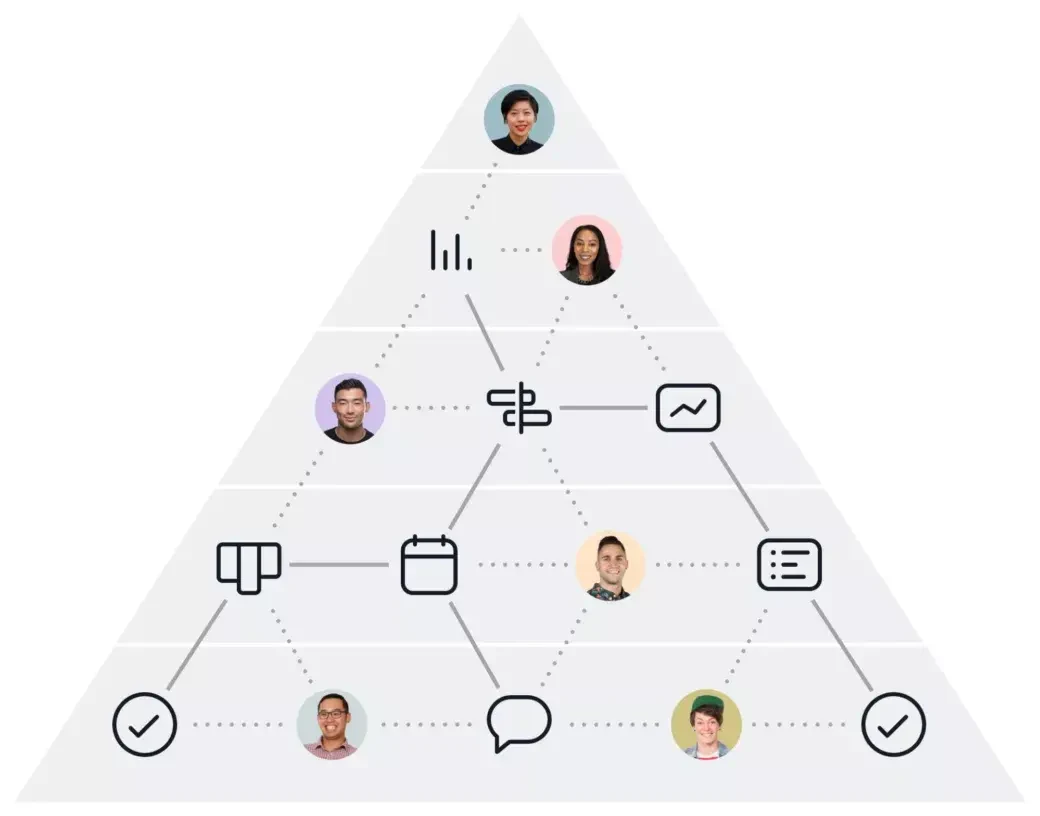 which is encoded in our data model that's the work graph.7Work Graph. This is where, in Bose's account, an agent learns a task's place in the company — who owns it and why it exists — not just its text. It is Asana's data model linking tasks to owners, projects and goals.
We've got a lot of investment in that to ensure there's sharing rules and you can codify these business critical workflows for human beings to align. And what I've seen is that alignment system we've built for humans actually works very well for agents because that metadata8Task metadata. Bose uses it to explain why a system built for people turned out agent-ready: owner, due date, project and editing rights tell an agent whose instruction to take and who gets the result. about who does what by when and how is something that agents can use to repeatedly do good high quality work. And it's also a way where you can assign agents a real role and persona and control who gets to set the context for them, who gets to give them memories that they reuse versus who are just users of the agents because perhaps those employees are not subject matter experts in terms of setting that bar, in terms of setting what the brand should look like, in terms of setting what the quality bar should be for identifying that high value garment, whatnot. So big area of focus for me is how do I unlock human agent workflows at scale and how do I set the right context for enterprises.
03How to measure productivity
Every task in Asana ladders up to a goal, which is measurable; the hard part is that people state their goals badly.
It's really interesting talking to you because you're the chief product officer building a product about how to build better products for all companies. It's like the ultimate meta, meta, meta layer about what's happening. But you brought up a really important point about the alignment issue. And this happened before AI was the case. You had to get your team, your whole job as a company or as a CEO or as a head of product is to get the engineers, the sales teams, the designers all aligned on what the goal is. And now that's being amplified by intelligence that if you're not clearly aligning what's the case, you're not going to be able to use AI at its best capabilities. And so I just wanted to get your perspective on how do you properly measure what productivity means in this age.
It's a really good question. We've been thinking about this at Asana for years now. And the system we've got is there is a way to set company level goals with clear key results. And then every task that is the smallest unit of work that happens in the company within our system ladders up to driving one of those goals forward and you can measure that. It does require the individual or the company who's like setting it up to think deeply about what their objectives and key results actually are. And this is a place where human beings are actually not great.
And I think one of the interesting unlocks I'm excited about going forward is not only how do we provide a system for this, but how do we help our customers achieve the right level of goal setting? Because now with AI, you can ingest a lot more data, analyze it, and have this sort of interview-based conversation with the people who are setting those goals to help them create the right goals going forward.
AdLovable
I want to shout out our sponsor Lovable. You know the app you've been meaning to build the internal tool side project or product you'd otherwise lose a weekend to? With Lovable, you get software you can ship today. That includes an editable code base you can inspect and change, plus two-way GitHub sync. Lovable also handles the back end and infrastructure, including managed Postgres, auth, storage, hosting, payments, and more so you don't have to wire it all up yourself. And through Lovable's MCP server, you can create and deploy your project directly from the agents you already use. Turn ideas into software people love with lovable. Lovable.dev.
Now on to the episode this is really interesting. So it's almost like proactively helping you as the human figure out what you want rather than the human trying to just work closer with the AI to get the AI to be more aligned with what they want. How from just maybe a macro perspective, how have you seen companies and teams become smarter recently?
04Inside a FedEx campaign request
At FedEx the bottleneck turned out to be intake from sales, and AI cleared it by turning free-form ideas into projects and tasks.
So let's take a look at one of these examples like FedEx. So again, like this there was a process they were using to go ahead and run their marketing operations and launch campaigns. The process involved like aligning on the campaign, talking about it with a team of human beings and setting into process by codifying who does what in Asana. Now, the big challenges were getting intake9Intake. At FedEx the bottleneck was how other departments handed work to marketing: a form with required fields flattened requests, and free text couldn't be turned into tasks until AI did the parsing. from the sales or other teams who are downstream of them who wanted them to run the campaigns in a format that would make it easy for them to then get that alignment.
So when you start codifying these systems and you and you think about your workflow and how do you make that business critical workflow work, you actually drive yourself further up to the top of the pyramid of clarity, right? You ask yourself the question about what do I really want to drive over here? Maybe what my key result is is reducing the time from idea to the campaign launching. And the bottleneck I'm facing right now is that the ideas are coming in an unstructured way and I don't know how to correctly parse them out. So a thing that they did was they really focused on their intake process and how would they leverage AI to take a longer form content that wasn't just a form, was something where the person requesting it could be more detailed in their description and AI would help them split that up into the right projects and tasks, et cetera to get them going.
ExplainerWhat sped up at FedEx
According to Asana's case study, the bottleneck for FedEx's marketing and sales enablement teams was intake. Requests arrived through a form with required fields; marketers chased the requesters for details and broke each idea into projects and tasks by hand.
Now the requester describes the campaign in free text and an Asana AI agent breaks it into projects and tasks and assigns them. The reported outcomes:
- 9x faster speed to market — Bose's "9x";
- intake admin effort down 88%, more than 1,288 hours a year;
- more than $200,000 a year in avoided operating costs.
These are Asana's figures about its own customer and haven't been independently verified.
It's a fairly simple use case. There's way more complicated ones that we've encountered where people are designing like manufacturing processes for complex like suspension parts for German automobiles. Like there's a customer of ours called KW Automotive10KW Automotive is Bose's harder case than FedEx: every car model is its own project, adding up to thousands of linked subprojects. It is a German suspension maker from Fichtenberg (coilovers, springs, dampers). who does that. They're a supplier. Those get into like hundreds and thousands of different subprojects and streams, but the macro concept is the same in terms of efficiency. Like thinking about the outcome helps them find the real bottleneck and then iterate on it and hill-climb and get better as a group.
Yeah, no, I love that specific example. So on one end, we're getting better at just telling AI the overall context about our businesses, getting it more clear about aligning on what the objectives are. But the other thing you alluded to is being able to accomplish a task from an end-to-end workflow. And so from the very beginning, let's use sales as an example from discovering who you might want to talk to then doing the follow-up, understanding the product needs, maybe improving some areas of the product and getting them to pay and sign a contract for that. So let's pretend in this hypothetical world, these end-to-end workflows get really good. Are we close to a future of a fully AI-driven business?
05What people still decide
Bose is direct: he does not expect full automation, he expects people to be elevated to the next constraint.
Yeah, so one of the papers that I read before I joined Asana, the CEO at the time11The CEO at the time — Dustin Moskovitz, co-founder of Facebook and Asana, who ran Asana until Dan Rogers took over as CEO in 2025. had written this for the company. He had a vision of building a self-driving organization, which we were all very invested in and we are excited about bringing to reality. And what we mean by self-driving is we'd love to elevate human beings and the human team members to more and more higher level like outcomes and input and tastemaking.
And so I don't think the answer really is that it's a fully automated company, because some of these jobs to be done, as they get automated, what'll happen is the people working with them will get elevated to think about the next level of outcome, the next bottleneck, the next optimization, the next differentiation. And I think you'll start seeing like an abundance of output and outcomes from that, that end-to-end process. That's at least our thinking and our rationale. Because what we're seeing is yes, you can, you can, you can make a particular process go faster because you've identified a bottleneck and you're using AI, but that will just reveal the next step of growth for you as a company, as a business. And that's that's pretty exciting.
But in theory, can't you then apply it again and again and again? And so are we close to self-driving organizations?
I think so. I think like as we enter 2027, it's it's gonna happen, yeah.
What will that look like?
What will that look like? It's I think it's pretty hard to imagine. There's just like a constant improvement. But my sort of ideal would be you could set goals that are hyper-ambitious, that break the ceiling of what was previously possible, and then push yourself and your team, and you'll probably see them materialize much faster than you can ever imagine. And that's the kind of reality we'll start living in going forward.
All right, if we were to just make that really clear and concrete, can you give me an example of how you envision a self-driving organization in 2027 playing out? Like what does that actually look like? Are you picturing maybe a small indie hobbyist, one person entrepreneur building a self-driving organization? Or do you see a giant enterprise like FedEx at that scale building self-driving organizations?
I think it would be possible for a giant enterprise like FedEx to build a self-driving organization. And I would say, like as Asana, like I'm a leader at Asana, I would want Asana to be a self-driving organization, right? Like we would want to be in a world where any individual in my R&D team could come up with a big hairy audacious goal. They could set it and it's a maybe a budget decision we'll have to make. There's still tastemaking over there, like okay, how much do you want to spend on R&D, token costs,12Token costs. Bose puts them in an initiative's budget next to R&D, sales and marketing: agentic work comes with a compute bill someone has to approve. sales and marketing for that initiative, and how much conviction do you have on the goal?
That is an interesting place of human alignment. If you have enough conviction on setting resources against a goal and you believe the KR, the key result is achievable.
06Why Asana is hiring
Asked about Jevons paradox, Bose answers with his own plans: more people, but a different kind.
Yeah. Yeah. Okay, what does this look like in terms of the makeup of the company? Do you see the input of humans, maybe the team sizes get a lot smaller, or is it a Jevons paradox13Jevons paradox. Dew asks whether AI will do to headcount what efficient engines did to coal; Bose says his R&D team will grow. In 1865 William Stanley Jevons noticed that the more efficiently steam engines burned coal, the more coal was burned in total. that now you can accomplish more, these companies are just going to balloon?
We are growing our size as a company. I'll just use us as an example. Like our R&D team will be bigger than it has ever been going into next year. And that's because our ambitions are bigger than they've ever been because we see the future of what's possible. So my thesis is that you'll you'll find a Jevons paradox, the profile and the mindset of the people that you want in the company will change.
You want people who are more entrepreneurial, who are more self-driven themselves. And that's the profile I think that's going to succeed going forward because you can't have limiting beliefs. You have to be a person who's willing to push and you have to be a person who's like unhappy with the status quo. I think if that's the mindset you have, those are the folks who'll be super, super successful in the world going forward.
07What a product lead learns from buyers
What is left to a product leader is the thing data does not hold: the customer conversation.
So I want to get your perspective as a CPO and just how the role of the product lead has changed in general over the past year. I mean, traditionally, you're writing, you know, product requirement documents, you're managing a bunch of different teams and doing all these logistics. If in theory, Asana gets so good at this that you're able to do more of that self-driving organizational flow from the beginning to end, what is that taste making role of the product officer?
So I would, I would say it applies to me and also to like the senior members of my team. We are becoming way more customer facing and customer obsessed because in order to be the tastemakers, not only do you have to consume all of the research and the telemetry data14Telemetry. Bose says it isn't enough: it shows where users stop but not why, which is what he goes on early customer calls to find out. that you can get, but you also need that human interaction with real world customers, buyers to find that alpha.
So again, in that spirit of like finding more entrepreneurial people, the more entrepreneurial product managers are also great sellers because they want to be like founder minded. That's the profile on my leadership team. There are folks who love talking to customers, love being on first calls, love doing the initial sale of the incubation product. So that's one big change.
The other thing is again like the tools have gotten so great. Like the ideas you can have can be prototyped in minutes. So for folks who are capable of adopting that mindset and then going ahead and building the first version themselves and having a builder mindset, that's like the other side of the coin, right? You've got leaders who are customer obsessed, customer oriented and can bring those insights back. And then you've got other folks on the team who are who are just basically straight up builders and the product engineering and design roles are kind of like melding a bit in that in that day and age.
Now you brought up a really important point about what it takes to find that alpha. I love that because this is something that AI will never replace. And as innovators, as entrepreneurs, you always have to be on the cusp of like, okay, sure, we'll have AI who can now find some research and do X, Y, and Z, but they can't do alpha finding, which is going to be understanding your user and then figuring out how to better solve their problem. And so if we were to just zoom out high level, what do you think this looks like for the future of products in general?
08Products get personal
Bose expects products to become super personalized, with many of them delivering the kind of aha moment people get from Tesla's Full Self-Driving.
Oh, I mean, I would imagine that products would get like super, super personalized. The rate of innovation that you see from any company interact with that's successful will just like skyrocket. I mean, people have this kind of aha moment with like Full Self-Driving15Full Self-Driving. Bose cites it not as autonomy but as a product people won't go back from. It is Tesla's paid driver-assistance package that steers through city streets under supervision. in Teslas. Like there's, there's a whole movement where if you're, if you need a vehicle to like drive, like get you to one place to another and it's a, it's a specific job to be done, there's really nothing else that's meeting that's that same bar. Now, I think you'd probably see many other products like that achieve a similar, a similar kind of aha moment to similar sort of experience because people will be pushing themselves to innovate and to sort of deliver that level of experience. That's, I think the world that we live in, right? That is an exciting world.
All right. One last question I have for you before we go, what is next for Asana? What can people expect to see come from the company over the next few months?
09Command, Stack AI and downstream systems
Over the next few months Asana is investing in a product for engineering teams and in a bridge from a project plan to action in hundreds of downstream systems.
A couple of things I'm very excited about. One is we're investing heavily in our R&D product called Command,16Asana Command. Bose lists it first because agents now write code fast, raising the cost of decisions made out of alignment. It is Asana's product for engineering teams, tracking work in flight and dependencies. which is something that I'm using daily. Command's all about helping engineering, product and design teams align and remove that bottleneck of alignment because coding agents have gotten so great. We just onboarded our like head of product for command recently. He joined the company two days ago. He was working on a pretty interesting like project called Compound Engineering.17Compound Engineering is where Command's new head of product came from, and a natural fit: both are about working when agents write the code. It is Every's method and Claude Code plugin: plan, work, review, and record the lessons so each task gets easier. So I'm excited to get Trevin, the GM in place and drive forward on that.
And then there's a whole host of updates coming on our core product. Like we've been investing a lot in our AI teammates and Dash18AI Teammates and Dash are among the core-product updates Bose has coming. AI Teammates are Asana's 30-plus prebuilt role-specific agents; Dash, launched on June 4, 2026, is pitched as a personal AI chief of staff that reads across projects, meetings, Slack and email, flags what needs attention and hands routine work to AI Teammates while the human keeps approval. SiliconANGLE capabilities. And I think the Stack AI co-founders19Stack AI is what lets Bose promise actions in "500 plus downstream systems." Asana bought the no-code enterprise agent builder in May 2026, reportedly for about $75 million, and its founders joined Asana; its value is hundreds of connectors to ERP, inventory and support systems. TechCrunch were here a few days ago. So we're taking all of the integrations that Stack AI has and building it into core Asana. So Asana used to, you know, used to be this amazing place where you had all of your project details in one place, but the actual actions were probably taking place in your ERP system and your inventory management system and your in your support system. Stack AI is going to be that glue that allows you to like imagine how to run your project and the actions will just happen in 500 plus downstream systems. So 100% pretty cool.
Well I really wanted to thank you for joining us today on MTS. It's really exciting getting to talk to someone who's leading the chief product officer at the meta layer of what it means to build products in this age and you really get to understand what's happening with enterprise, what things like Anthropic’s big IPO means for the future of businesses and enterprises and how they're planning to use intelligence in the future. So such an interesting conversation and really wanted to thank you for joining us today.
Thank you so much for having me.
AdMTS
A huge thanks to MTS sponsors. ElevenLabs AI that communicates at human level across every channel and modality. Elevenlabs.io slash MTS.
Scale your startup on Neon. Millions of developers and startups have already chosen Neon for their back end. Start on the free plan or get up to $100,000 in credits for your startup at neon.com slash MTS.
Special thanks to our sponsor Kong, the AI connectivity Platform. Connect APIs, LLMs, agents, and systems with serious security and governance. Konghq.com.
Finally prove what your AI investment is worth. With Larridin, head to Larridin.com today to start measuring your AI's bottom line.
MongoDB, trusted to run critical applications by 75% of the Fortune 100, the intelligent data platform for the era. Apply today for access to up to $15,000 in Atlas credits, dedicated technical support, and exclusive events and go-to-market opportunities. MongoDB.com.
Chargebee, billing and monetization infrastructure for the AI era. Chargebee.com.
ClickHouse is the real-time database built to keep up with every query your apps and agents send its way, and it now runs Postgres, observability, and AI tooling on one platform. Learn more at clickhouse.com.
You ship fast. So do attackers. Don't assume you're secure. Prove it. Horizon3. Go hack yourself with AI. Visit horizon3.ai slash node zero.
Blitzy, Autonomous Software Development for Enterprise Codebases. Ship 5X faster. Blitzy.com.
AdQuick, make your brand a billboard out of home advertising as easy to scale as digital. AdQuick.com.
Arena, measuring AI performance in the real world. Arena.ai.
Support for the show comes from VCX, the public ticker for private tech. The U.S. Stock market started history's greatest wave of wealth creation. From factory workers in Detroit to farmers in Omaha, anyone could own a piece of the great American companies. But today, our most innovative companies are staying private longer, which means everyday Americans are missing out. Until now, introducing VCX, a public ticker for private tech. Visit getVCX.com for more info. That's getVCX.com. Carefully consider the investment material before investing, including objectives, risk, charges, and expenses. This and other information can be found in the Innovation Fund Prospectus at getVCX.com. This is a paid sponsorship.


