

MTS
Chapters
Berdichevsky says Sila is changing the chemistry inside the lithium-ion cell itself, and the Panasonic deal takes it to the mass market.
Read the chapter- Sophia opens Friday's stream with the week's big news, Anthropic's IPO and a Riemann proof announced that morning, before bringing on her guest.
- Sila makes a silicon-based anode material that sharply raises a lithium-ion cell's energy density and lets it charge and discharge faster.
- Two days before the interview, Sila announced a major offtake agreement with Panasonic that puts its material into vehicles, data centers and anything else Panasonic supplies.
Berdichevsky left Tesla for chemistry because lithium-ion progress had stalled, and anode breakthroughs come once a generation.
Read the chapter- At Tesla from 2004 to 2008 he worked on the Roadster's battery system and already saw that the 15 years of lithium-ion improvement that made Tesla possible had largely run out.
- With his co-founder from Georgia Tech, he spun out the technology that became Sila to break through the limits of conventional lithium-ion chemistry.
- He says the last anode adopted worldwide, graphite, was invented in 1991 and won a Nobel Prize.
- A battery has to be as small as possible and store as much energy as possible to give an EV range and a low cost per mile; Tesla spent 20 years on better packaging, while the chemistry turned out to be "insanely hard."
- Sila spent seven years as a science project, synthesized 50,000 variants of its material, then spent seven more years scaling from a gram at a time to a ton at a time, a million-fold increase.
Berdichevsky calls China's grip on graphite worse than its grip on rare earths and says the Panasonic deal and a federal loan are how Sila will break it.
Read the chapter- Graphite, he says, is more concentrated in China than rare earth metals are.
- Without it the US has no sovereign supply chain for robots, drones, satellites, EVs and the grid batteries that will power data centers.
- In August 2026 the Office of Strategic Capital announced a $1.4 billion loan commitment to scale up Sila's anode production.
- Together with the Panasonic offtake, Berdichevsky says, that loan will let Sila displace Chinese graphite in lithium-ion batteries.
Berdichevsky argues that a defense supply chain only stays competitive if it also builds for civilian buyers.
Read the chapter- Sophia calls sovereign supply chains and capital flowing into a defense industrial base two of the big themes of 2026.
- Berdichevsky calls this America's "Freedom's Forge moment": to keep the peace, the country has to build its own industrial capacity.
- Defense demand is too small on its own; a company that builds only for the military freezes its technology and can't reinvest in R&D.
- He says Washington and investors have shifted to the view that you have to build for the mass market, in the US.
Berdichevsky sees the biggest demand for lighter batteries wherever AI goes into the real world without a cord.
Read the chapter- A much lighter battery lets a delivery drone carry two burritos instead of one, or fly farther and serve more communities.
- The federal government has banned bipeds and quadrupeds from China, so robot supply chains are being built in the US, but the batteries still come from overseas.
- Almost all of Sila's business is EVs, the grid and untethered applications like these.
Berdichevsky lays out a year-by-year rollout and admits Sila is still a sliver of an enormous market.
Read the chapter- Sila has long supplied small consumer electronics and is already in millions of wearables, because its production capacity used to be tiny.
- Its new factory is about 100x bigger: phones, laptops and drones within a year, satellites being qualified for flights in the coming year, and EVs the year after.
- Sila's capacity is still under 0.1% of the global battery market, and spreading through every target industry will take five to 10 years.
- He puts the global battery market at $200 to $300 billion and the anode market for batteries consumed in the West at $20 to $40 billion in 2030.
Berdichevsky names electric aviation as the biggest new industry better batteries will unlock and expects it within a couple of years.
Read the chapter- Sophia asks which new industries and products will adopt batteries once they get cheaper and less dependent on China.
- Air taxis have other technical problems to solve, but payload comes down to batteries; the same goes for delivery drones and home robots that can't be bulky or run to the charger every hour.
- EVs, he says, are phenomenal cars that still cost a bit too much and lack range, and new chemistry addresses both.
- eVTOL companies are making fast progress, and a 19-passenger plane in China just made its first test flight; regional aviation will go electric, long-haul will not.
Berdichevsky says the uses of new batteries are hard to predict, but he is sure about electric transportation and near-instant charging.
Read the chapter- Sophia ties human progress to our ability to harness energy and asks Berdichevsky to paint the future Sila is building toward.
- He notes that when Sony put the first lithium-ion battery into a Handycam in 1991, nobody imagined it would lead to Tesla 13 or 14 years later.
- Oil and gas have dominated for over a century, and everything is moving toward solar, wind and storage; in 10 to 30 years, he says, all ground transportation will be electric.
- He expects robots in new form factors and batteries that recharge so fast you can just tap a device and go.
Quotes
On hardware
“So we've gone through a million-x scale-up. And as anyone who's ever worked in hardware will tell you, you think invention's hard, try manufacturing.”
Gene BerdichevskyRead from 04:19On dependence on China
“So graphite is more concentrated in China than rare earth metals are.”
Gene BerdichevskyRead from 05:19On the defense industrial base
“And as I like to say, if you want a military industrial supply chain, if you want a military industrial base, you need to have an industrial base. You need to manufacture for the mass market.”
Gene BerdichevskyRead from 06:45On lighter batteries
“You know, with a battery that's much lighter, your delivery drone can deliver two burritos instead of one.”
Gene BerdichevskyRead from 08:49On the future of aviation
“I think regional aviation can go electric, long distance will not, but certainly kind of anything regional, we'll get there.”
Gene BerdichevskyRead from 13:00On unpredictable uses
“I think the world of possibilities is really vast, and it's hard for me, even though I'm at the frontier of batteries, to have any idea of how people will ultimately use it.”
Gene BerdichevskyRead from 15:38
Summary
Sila co-founder and CEO Gene Berdichevsky tells Sophia Dew how his company spent seven years turning a silicon anode from a science project into a working material and seven more scaling it from grams to tons. Fresh off a Panasonic offtake deal and a $1.4 billion loan commitment from the Office of Strategic Capital, Sila now aims to push Chinese graphite out of lithium-ion batteries. His core argument: a military industrial base only survives on top of a mass-market civilian one.
Berdichevsky expects phones, laptops, drones and satellites with Sila material within a year, EVs the year after, and electric regional aircraft in a couple of years; further out, he sees fully electric ground transportation and devices that recharge almost instantly.
Advice
Budget more time for manufacturing than for invention: in hardware, scaling a technology from grams to tons is harder than coming up with it.
If you build technology for defense, design your production for the civilian mass market: military demand alone is too small to fund R&D and keep you at the leading edge.
Mentioned
 Anthropic00:21Sophia opens the stream with the week's news, Anthropic's IPO and a Riemann proof announced that morning.
- Riemann hypothesis00:21Sophia flags the fresh proof as one of the day's big stories, to be covered later on the stream.
- Sila Nanotechnologies00:45Berdichevsky's company, whose silicon anode is meant to push Chinese graphite out of lithium-ion batteries.
 Panasonic01:17Berdichevsky announces its offtake deal, which will put Sila material into batteries for cars and data centers.
Show 7 more mentionsShow fewer mentions
 Tesla02:21Berdichevsky worked there from 2004 to 2008 and saw even then that lithium-ion chemistry had stopped improving.
- Tesla Roadster02:21Tesla's first car, whose battery Berdichevsky worked on; Sophia asks what problems he spotted back then.
- Gleb Yushin02:21The Georgia Tech co-founder whose research, Berdichevsky says, Sila spun out.
- Office of Strategic Capital05:19Berdichevsky cites its $1.4 billion loan commitment, alongside the Panasonic deal, as the way to displace Chinese graphite.
- Freedom's Forge06:45Berdichevsky calls the current revival of American manufacturing "our Freedom's Forge moment."
 Commercial Aircraft Corporation of China13:00Berdichevsky points to its 19-seat electric plane as a sign that the race to electric aviation is already on.
- Sony14:14Berdichevsky recalls that Sony launched the first lithium-ion battery and nobody then expected it to lead to Tesla.
Sponsors of the episode
 Lovable07:57Building apps with an editable codebase and two-way GitHub sync.
 ElevenLabs16:46Voice AI for every channel.
 Neon16:46Postgres backend for apps and agents.
 Kong16:46Connectivity platform for APIs, models and agents.
 Larridin17:17Measuring the return on AI investments.
 MongoDB17:17Data platform and Atlas credits for startups.
 Chargebee17:43Billing and monetization.
 ClickHouse17:43Real-time database.
 Horizon3.ai18:03AI-driven security testing.
 SRS Acquiom18:15Shareholder representation, payments and escrow in M&A deals.
 Blitzy18:39Autonomous enterprise software development.
 AdQuick18:39Out-of-home advertising.
 Arena18:39Evaluating AI models on real-world tasks.
 VCX18:57A public ticker for investing in private tech companies.
Transcript
01The Panasonic deal and a silicon anode
Berdichevsky says Sila is changing the chemistry inside the lithium-ion cell itself, and the Panasonic deal takes it to the mass market.
Hello, everyone. Welcome to MTS. Today is Friday, November 20th. Lots of big announcements this week with Anthropic's IPO1Anthropic's IPO. The company sold 980 million shares at $83 and raised $81.3 billion, the largest IPO ever. Trading on Nasdaq under the ticker ANT opened on November 19, 2026, the day before this interview, at $111.50, 34% above the offering price. CNN and the latest big Riemann proof2The Riemann proof. On November 20, 2026, Anthropic mathematician Levent Alpöge posted a short statement saying he believes that, working with Claude, he has proved the Riemann hypothesis, one of the seven Millennium Prize Problems. Independent experts have not yet checked the proof. SiliconANGLE that they were able to do this morning that we'll talk about later today. So big day today, and we have some amazing guests who are joining us. Up next, we're bringing on Gene Berdichevsky.
He is the CEO and co-founder of Sila,3Sila — the California company Berdichevsky founded in 2011. Its Titan Silicon material replaces graphite in the anode of a lithium-ion battery. and we're gonna talk about the future of energy, batteries, and learn all from him. So exciting day today, and we're excited to introduce you to the first day of Friday on MTS. All right, let's bring up our first guest of the day, Gene. Welcome to MTS.
Hey, thanks for having me, Sophia.
Gene, welcome. I know you guys had a big announcement just a few days ago. And so would you mind introducing yourself? What are you guys building at Sila? What did you guys announce?
Yeah, so I'm co-founder and CEO of Sila. We are building the next generation of battery technology. And what that looks like is the chemistry that goes inside the lithium-ion cell. We make a silicon-based anode material4Anode — a battery's negative electrode, where lithium ions are stored during charging. Nearly all lithium-ion batteries use graphite anodes; silicon can hold far more lithium. that dramatically increases the energy density you can get out of a lithium-ion cell. It also increases the speed at which you can recharge and discharge the battery. And just two days ago, we announced a major offtake agreement5Offtake agreement — a long-term commitment by a buyer to purchase a plant's future output, which makes it easier for the producer to finance factories. Sila announced the Panasonic Energy deal on November 18, 2026: multi-year and potentially worth more than $1 billion, with material from Sila's Moses Lake plant going into cells Panasonic makes in the US. Manufacturing Dive with Panasonic that allows our batteries to go into the mass market: vehicles, data centers, and anything else that they supply.
02From the Roadster battery to new anode chemistry
Berdichevsky left Tesla for chemistry because lithium-ion progress had stalled, and anode breakthroughs come once a generation.
Wow, that is pretty exciting. And I know two days ago we were supposed to have you on. I'm glad that we're getting to have you on again. Gene, one of the areas I wanted to talk to you about specifically is your background. You've spent your whole career working in batteries. And I would say now in 2026 are when batteries are going mainstream. People are talking about them more than ever. So if you could just take us back to when you were working at Tesla, what were you identifying back then that led to what you're building now at Sila?
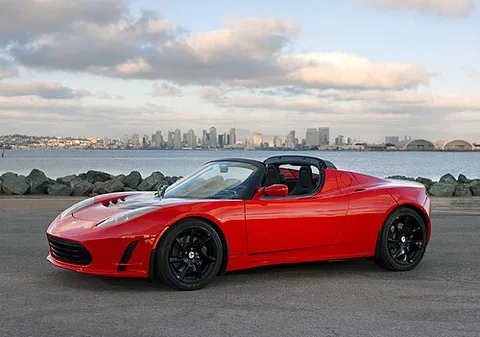
Yeah, so I was at Tesla from 2004 to 2008, I worked on the battery system for the Roadster.6Roadster — Tesla's first car, an electric sports car sold from 2008. Berdichevsky joined Tesla in 2004 as its seventh employee and was the technical lead on the car's battery system. And even at that time, you could already see that the chemistry, the technology was slowing down, the performance was slowing down. The 15 years of, like, lithium-ion improvement that led to the founding of Tesla had largely stalled out. And so I really wanted to go and work on the layer deeper, not the battery packs, but the battery chemistry. And, you know, met up with my co-founder at Georgia Tech,7His co-founder at Georgia Tech — Gleb Yushin, a materials science professor there. His research on silicon-carbon composites became the basis of Sila's technology, where he is chief technology officer. and we spun out a lot of technology he had been working on to build Sila in order to kind of break through the chemistry limits that conventional lithium-ion has. It took a very long time.
These are sort of once-in-a-generation technology breakthroughs. You know, the last time someone invented an anode used worldwide was 1991, the graphite anode of the lithium-ion battery, and, you know, they won a Nobel Prize8Fact-checkNot quite: the 2019 Nobel Prize in Chemistry went to John Goodenough, Stanley Whittingham and Akira Yoshino for the lithium-ion battery as a whole, not for the anode. Sony's first commercial cells in 1991 used a carbon anode made from petroleum coke; graphite became standard later in the 1990s. Nobel Prize for it. So these are generational chemistry changes, and we're thrilled that we're getting it to the mass market now.
So what were the big problems, if you just had to break it down, get into a bit more details here? When you were designing the battery for the Tesla Roadster, what were you identifying, and why in 2026, why is it possible to solve some of those issues?
So the challenge was you always wanted the battery to be as small as possible and store as much energy as possible, because you get these benefits of the smaller the battery pack, the more efficient the vehicle, you can get more range for any given amount of chemistry. And the cost was also quite high. And again, the more energy you could store in the battery, the lower the cost per mile would be. So really driving performance was the way to make EVs more mainstream. And you could do that by packaging them better, which is what Tesla has done for 20 years, but you could also do that by improving that chemistry. Turns out the chemistry part is just insanely hard.
ExplainerWhy silicon instead of graphite
When a lithium-ion battery charges, lithium ions move from the cathode to the anode and are stored there. A graphite anode needs six carbon atoms for every lithium ion, so a gram of graphite can in theory hold about 372 mAh.
Silicon binds almost four lithium atoms per atom and holds nearly ten times as much by weight, about 3,600 mAh per gram. That is why even partly replacing graphite with silicon noticeably raises a cell's energy density.
The catch is that silicon swells three to four times in volume as it takes up lithium. Particles crack, fresh surfaces eat up electrolyte, and the battery quickly loses capacity. For years silicon was therefore added to graphite only in small amounts.
Sila hides silicon inside a porous carbon scaffold: the silicon expands into the pores while the particle's outer size barely changes. The resulting powder can be swapped in for graphite on existing cell production lines.
And so what we had to go out and do is, and we spent seven years as a company basically as a science project. This was really very likely not to work when we first started, and we just kept pushing through. Eventually we synthesized 50,000 variants of this material that we make today. And, you know, then over the last seven years, we've scaled it up. We've gone from making this technology one gram at a time to making it one ton at a time. So we've gone through a million-x scale-up. And as anyone who's ever worked in hardware will tell you, you think invention's hard, try manufacturing.
03Chinese graphite and a $1.4 billion loan
Berdichevsky calls China's grip on graphite worse than its grip on rare earths and says the Panasonic deal and a federal loan are how Sila will break it.
Man, I think one of the big areas that I want to emphasize to the audience or anyone's watching this is right now, most of our batteries are dependent on graphite. And as you mentioned, the graphite right now is mainly controlled by China. And so I wanted to get your take. What does it mean if China is controlling the US's ability to manufacture and use graphite in batteries?
So graphite is more concentrated in China9Graphite in China. According to Sila, China controls more than 90% of anode material processing and more than 80% of global battery cell production. Charged EVs than rare earth metals are. We've talked about rare earths10Rare earths — 17 elements essential for the permanent magnets in electric motors, wind turbines and missiles. China processes about 90% of the world's supply and restricted exports in 2025, which made the dependence a Washington talking point. for a long time. And that represents a problem if we want to have our own sovereign supply chain for things like robotics, for drones, for satellites, for electric vehicles, for grid batteries, to power all the data centers that we want to be building. So that control is really problematic. And, you know, that is also why the Office of Strategic Capital11The Office of Strategic Capital — a unit of the US military department that lends to companies in critical technologies. On August 7, 2026, it announced a conditional loan of up to $1.4 billion to Sila to expand its Moses Lake plant and build a new battery cell plant; Sila gets the money once it meets financial, legal and technical conditions. Charged EVs in August of this year announced a $1.4 billion loan commitment for us to scale up this anode technology. And so this Panasonic offtake coupled with that $1.4 billion loan commitment is what's going to allow us to displace Chinese graphite in the lithium-ion battery and ensure that America has a sovereign supply chain for this critical technology.
04Defense needs a mass market
Berdichevsky argues that a defense supply chain only stays competitive if it also builds for civilian buyers.
A sovereign supply chain, I would say that's one of the big takeaways of 2026. This is something that we're hearing a lot more of. And another big theme that we're seeing is that capital is going into rebuilding the industrial base for defense, that is trying to onshore a lot of this existing manufacturing pipeline. And so I want to get your take about what's happening at a macro level for maybe people who are unfamiliar. How has this year changed how government and commercial capital are getting more involved in what it means to manufacture these things at home?
So I think this is our Freedom's Forge moment.12Freedom's Forge (2012) — historian Arthur Herman's book about how American industry retooled for war production and won World War II. Berdichevsky likens today's US push to rebuild manufacturing to that moment. You know, if we want to have a peaceful world for the future, we have to control our own destiny and we have to build our own industrial capacity. One thing to think about, though, with things like batteries and other technologies is it's not enough to just make, you know, these core technologies for the defense sector, because that defense sector is really, really small in demand. And as I like to say, if you want a military industrial supply chain, if you want a military industrial base, you need to have an industrial base. You need to manufacture for the mass market. If you don't manufacture for the mass market, you will never stay at the leading edge of technology. You will sort of freeze your technology for a minute. You might be really good in that moment, but then you can't reinvest in the R&D needed. And so it's critical that we don't just build the supply chain we need for our military. It's really critical that we build a supply chain we need for all civilian industries, so that we can call on it in a time of need. And that, I think, has been a mindset shift that we've seen in DC, that we've seen with investors, that you have to build for the mass market right here in the US.
AdLovable
I want to shout out our sponsor Lovable. You know the app you've been meaning to build, the internal tool, side project or product you'd otherwise lose a weekend to? With Lovable, you get software you can ship today. That includes an editable codebase you can inspect and change, plus two-way GitHub sync. Lovable also handles the back end and infrastructure, including managed Postgres,bPostgres (PostgreSQL) — a popular open-source relational database. "Managed" means the provider runs it for you. auth, storage, hosting, payments, and more. So you don't have to wire it all up yourself.
And through Lovable's MCP server,cMCP (Model Context Protocol) — an open protocol Anthropic introduced in November 2024 that lets AI models and agents connect to outside tools and data. An MCP server gives an agent access to a specific service. you can create and deploy your project directly from the agents you already use. Turn ideas into software people love with Lovable. Lovable.dev. Now on to the episode.
05Drones, robots and physical AI
Berdichevsky sees the biggest demand for lighter batteries wherever AI goes into the real world without a cord.
You mentioned that batteries are not just needed for defense. It matters for the entire tech stack. I'm imagining drones for sure, robots, anything in the physical AI world.13Physical AI — AI that acts in the material world: robots, drones, autonomous vehicles. Berdichevsky stresses that such devices are untethered, running on batteries rather than a cord. Tell me a little bit about these industries that you guys are working with.
Yeah, so we think, you know, we see a huge amount of pickup for our technology in what we would call the physical AI space. You know, with a battery that's much lighter, your delivery drone can deliver two burritos instead of one. And that matters, like double the payload, or, you know, the ability to fly a longer distance that allows you to sort of service more communities with a delivery system. Robotics, right? The federal government recently banned bipeds and quadrupeds from China. So now people are building that supply chain here in the US, but the batteries are still coming from overseas. And so for all of these applications where AI is going out into the real world and it's untethered, you really, really want a good battery to be able to deliver, you know, a great product to the market. And so we're seeing a tremendous amount of pickup there. You know, almost all our business is either electric vehicles, grid, or these kind of applications; that's really what's driving the business forward.
06When Sila batteries reach the market
Berdichevsky lays out a year-by-year rollout and admits Sila is still a sliver of an enormous market.
Are you able to give me any timelines? When can I expect to see these batteries go out to market? When will we start to see future industries rely and build with these batteries?
So we've been in consumer electronics and small consumer electronics for many years. We're in millions of small devices, wearables,14Wearables. The first commercial product with a Sila anode was the Whoop 4.0 fitness band, released in 2021. things like that, because the production capacity we had was quite small. This latest factory we just turned on15The latest factory — Sila's plant in Moses Lake, Washington, which started operating in fall 2025. Its initial capacity is material for about 2 GWh of batteries a year; the company plans to eventually grow it to hundreds of gigawatt-hours. is about 100x the scale. And so in the next year, you know, cell phones, laptops, some other technologies like that, but also drones. We're working to get this technology qualified16Qualified — put through the customer's and the industry's test regimes; without that sign-off, no satellite or car maker will put new cells in its products. for satellite applications that'll fly in the coming year. EVs, you'll probably see it sort of the year after. And so little by little you'll start to see this technology diffuse.
And then we have to massively scale. Today, sort of the capacity we have represents less than 0.1% of the global battery market, because it's so big. And so it's going to take us five, 10 years to really diffuse throughout all of the industries that we want to be in.
Wow. How big is this market?
So the market for batteries worldwide is probably $200 to $300 billion right now. And this is one of the most important components. Just the anode needed for Western batteries, batteries sort of consumed in the West, will be somewhere between 20 and 40 billion dollars in 2030. And obviously today that's all graphite, and it's a lot of work to displace that. So we're not going to displace all of that by 2030, but we're going to start to make a real dent in it.
07Electric flight in a couple of years
Berdichevsky names electric aviation as the biggest new industry better batteries will unlock and expects it within a couple of years.
What's really interesting when you see new technology, it's not just, say, even if you're able to replace a lot of the existing market share: if batteries get easier or cheaper, or you're not, like, dependent on China to produce these types of batteries, potentially you open up new market opportunities. So people and industries and products that didn't rely on batteries before, now that just becomes the norm. Do you have any predictions on how you see this evolving, any new types of industries or products that will start to adopt batteries in their tech stack?
This is one of the most important technologies to enable electrified flight. So as we start to see kind of these air taxis, there's a lot of other technical problems they have to solve, but, you know, if you want to have a decent payload, it's going to be about batteries. You know, drone delivery, robotics that are really, really good in your home. They can't be too big. They can't be, you know, running to the charging station every hour. So I think we're going to see anything that flies, and continued innovation in consumer devices, so smaller consumer devices. This will be one of the most important technologies for that. And of course electric vehicles. Like, electric vehicles are phenomenal cars. They just, they cost a little too much. The range is not quite good enough. And this is, again, the most important technology to bring down that cost and extend that range.
How close are we to electric flight?
Probably a couple years, I would say.
Really? That's not bad.
Yeah. A lot of the kind of eVTOL17eVTOL (electric vertical take-off and landing) — an electric aircraft that takes off and lands vertically, the "flying taxi" category of companies like Joby and Archer. companies are making amazing progress. And, you know, actually, I think there was an article just the other day: in China there's a 19-passenger plane that just did their first test flight.18Fact-checkNot quite: COMAC's 19-seat CE-25A electric plane first flew on February 2, 2026, with nobody on board. On November 14 it flew with a crew for the first time: two pilots and an engineer stayed aloft for 16 minutes 38 seconds and covered 60.4 km. Electrek So we're, you know, we're in a race. I think regional aviation can go electric, long distance will not, but certainly kind of anything regional, we'll get there.
08A world where energy is easy to store
Berdichevsky says the uses of new batteries are hard to predict, but he is sure about electric transportation and near-instant charging.
That is so exciting. I think one of the reasons energy is just a topic that I'm particularly passionate about: if you map out humans' progress, and you, like, try to map out how we've progressed as a species, it's almost directly correlated to our ability to harness energy. And so we're having this big unblock in how we're actually able to harness energy because of batteries. What that might enable, I don't think we can even picture what that looks like, but I do want to put it on you, since you're at the frontier, you kind of have to picture what that has to look like for your company. Just paint that picture for me. What do you think is this future you're building towards, now that you're able to harness energy in this way?
Yeah, I mean, just to make your point even stronger, if you go back to 1991, I don't think when Sony put out the first lithium-ion battery in the Handycam,19Handycam — Sony's camcorder line. In 1991 Sony became the first company to produce lithium-ion batteries, and its camcorders were the first to get them. for anyone old enough to remember those, they thought that that would spark something like Tesla, right? And that was, you know, 14, 13 years downstream of that.20Fact-checkNot quite: Tesla was founded in July 2003, 12 years after Sony's first lithium-ion battery, and the first Roadster reached customers in 2008, 17 years after it. Wikipedia So not that long afterward. So I think there are some things that will be hard to predict, but ultimately, you're right, sort of energy is this foundational layer of society where everything that we can build is built on the science of energy. And oil and gas have been the marquee energy source for society for, you know, well over 100 years now. And we can all see that it's all going towards solar, towards wind, and towards storage.
And so I think in the world, you know, 10, 20, 30 years from now, all ground transportation will be electrified. We already know we'll have robotics because of the AI revolution we're going through, but I think you're going to have more and more form factors, and in ways you've never imagined, because you can make things smaller, you can make them sort of interact with you in really compelling ways. The other thing that people aren't paying attention to is I think you'll have batteries that can recharge insanely quickly. And silicon anode technology enables that as well. So you'll have different use cases. You might have a device that, you know, maybe doesn't run all day, but you basically tap it and it recharges and you go.
I think the world of possibilities is really vast, and it's hard for me, even though I'm at the frontier of batteries, to have any idea of how people will ultimately use it. Again, I don't think the folks at Sony making the first lithium-ion battery could have ever imagined that, you know, we'd come along and make electric cars that go zero to 60 in, you know, two seconds,21Zero to 60 in two seconds — the Tesla Model S Plaid does it in about two seconds, and the second-generation Roadster was promised at 1.9 seconds. and they fly. All enabled by the extraordinary energy systems that we've developed.
Couldn't agree more. The possibilities are so vast. I don't think we can even fathom what they might be like. But Gene, I really wanted to thank you for joining us today. I mean, really big deal what you guys were able to do with the Panasonic deal. And this is just the start. I'm sure we'll start to see Sila everywhere, and what batteries will enable, and being able to use silicon as well in our batteries. Like you mentioned, we can't even imagine the vast amount of possibilities that will be in the future. But Gene, really wanted to thank you for joining us today on MTS.
Yeah, thank you for having me. Thank you.
AdElevenLabs, Neon, Kong, Larridin, MongoDB, Chargebee, ClickHouse, Horizon3.ai, SRS Acquiom, Blitzy, AdQuick, Arena, VCX
A huge thanks to MTS sponsors.
ElevenLabs, AI that communicates at human level across every channel and modality. elevenlabs.io/MTS. Scale your startup on Neon. Millions of developers and startups have already chosen Neon for their backend. Start on the free plan or get up to $100,000 in credits for your startup at neon.com/MTS. Special thanks to our sponsor Kong, the AI connectivity platform. Connect APIs, LLMs, agents, and systems with serious security and governance. Konghq.com.
Finally prove what your AI investment is worth with Larridin. Head to larridin.com today to start measuring your AI's bottom line. MongoDB, trusted to run critical applications by 75% of the Fortune 100, the intelligent data platform for the era. Apply today for access to up to $15,000 in Atlas credits, dedicated technical support, and exclusive events and go-to-market opportunities. MongoDB.com.
Chargebee, billing and monetization infrastructure for the AI era. Chargebee.com. ClickHouse is the real-time database built to keep up with every query your apps and agents send its way, and it now runs Postgres, observability, and AI tooling on one platform. Learn more at clickhouse.com.
You ship fast, so do attackers. Don't assume you're secure. Prove it. Horizon3. Go hack yourself with AI. Visit horizon3.ai/nodezero.
The key ingredient in today's M&A:dM&A — mergers and acquisitions. SRS Acquiom. Learn why their shareholder rep, payments, and escrow solutionseEscrow — an arrangement in which a third party holds deal money and releases it once conditions are met. In M&A deals, part of the price is often held this way against claims on the seller. have been used by 96% of top global PE firms and 88% of top global VCs at srsacquiom.com/MTS. That's S-R-S-A-C-Q-U-I-O-M dot com slash MTS.
Blitzy, autonomous software development for enterprise codebases. Ship 5x faster. Blitzy.com. AdQuick, make your brand a billboard, out-of-home advertising as easy to scale as digital. Adquick.com. Arena, measuring AI performance in the real world. Arena.ai.
Support for the show comes from VCX, the public ticker for private tech. The U.S. stock market started history's greatest wave of wealth creation. From factory workers in Detroit to farmers in Omaha, anyone could own a piece of the great American companies. But today, our most innovative companies are staying private longer, which means everyday Americans are missing out. Until now. Introducing VCX, a public ticker for private tech. Visit getVCX.com for more info.
That's getVCX.com. Carefully consider the investment material before investing, including objectives, risks, charges, and expenses. This and other information can be found in the Innovation Fund's prospectus at getVCX.com.
This is a paid sponsorship.


