



MTS
Chapters
Achiam celebrates the result but says people will have to get used to AI reaching the summits they meant to climb themselves.
Read the chapter- Theo recalls that futurists held up the Riemann hypothesis as a capability for some future superintelligence, one that might require turning the solar system into computronium.
- Achiam congratulates Anthropic's Levent Alpöge and everyone who pushed the frontier of AI forward.
- He expects many such moments in the next few years, as triumphs people expected from human hands fall out of massive amounts of compute.
- What will feel strange is the purely human side: fewer chances to be the first one to do something.
Theo suspects the hypothesis was simply easier for these minds than expected; Achiam thinks most hard problems in math and physics are now solvable, and the open question is how fast humans can digest the answers.
Read the chapter- Theo sees many people concluding that everything else must now fall in quick succession and wild superintelligence is at hand.
- Achiam allows that we may have been miscalibrated about how hard problems are, but personally believes most hard math problems now have a solution path.
- Even a theory of everything, he says, wouldn't hand us super technology the next day: the knowledge has to be internalized and turned into technology.
- What worries him is that the strategic equilibrium could be disrupted overnight, before anyone realizes it was disruptible.
Achiam expects astonishing discoveries to cost about ten times less in two to three years, without changing the world into something categorically different.
Read the chapter- Theo lays out the argument that models will rip through ML research and produce superintelligence in under a year without bottlenecks, or in two to three years with them.
- Achiam says there's too much FUD around the word and boils a breakthrough down to sample efficiency and the cost of inference.
- Sophia argues a superintelligence should tackle coordination problems in human societies, which are harder than any "Standard Model of Physics 2."
- Achiam agrees: people don't respond to abstract solutions, and once every agenda has a superintelligent persuasion campaign, there's no telling which one wins.
The US and China will find common ground at least on keeping AI from handing out weapon designs, Achiam says, but ideas about AI risk aren't yet mainstream in China.
Read the chapter- Theo asks about Trump's announcement that day that he and Xi Jinping agreed on guardrails for AI, or what Trump calls superintelligence.
- Achiam wants to see the actual text and notes that the CCP cares above all about domestic stability.
- Every government, he says, would agree that AI shouldn't explain how to trigger a vacuum metastability event with $10,000 of hardware store supplies.
- People in track two dialogues tell him that recursive self-improvement risks are taken very seriously in the US, while in China people are increasingly receptive but the idea isn't mainstream.
Achiam fears both China and Washington need a year or two to absorb what AI means, but he doesn't expect humanity to die within a year.
Read the chapter- If China needs a year or two to internalize the US conversation, some impacts of advanced AI will arrive before solutions are in place.
- DC policymakers are also a year or two behind, he estimates, though coast-to-coast conversations give him hope.
- He isn't in the camp that expects everyone to die in a year or two: after early missteps, history will be long and offer many chances to fix things.
Sophia fears chaos once a cyberattack with human consequences is traced directly to AI; Theo points out that history has seen upheavals like this.
Read the chapter- AI sentiment is already very bad, Sophia says, and a guest earlier in the stream talked about possible evidence of cyberattacks disrupting systems.
- Theo recalls the Depression and World War II: the economy was rebuilt around the New Deal and the war effort, food was rationed, and no new passenger cars came out for several years.
Achiam thinks AI-enabled cyberattacks may already be underway and urges preparing for a world where major services regularly go down.
Read the chapter- As signs he lists two weeks of simultaneous outages, North Korea's $5 or $6 billion heist from Binance, and the conflicts in Ukraine and potentially over Taiwan.
- A Fox News anchor tells people to stock up, the UK put out similar advice, and Sophia saw a headline about Costco selling out of generators.
- Achiam compares the moment to early COVID, the fall of Rome and wartime rationing, and calls for backup plans for data, commerce and supply chains.
- Even if a solar flare fried every computer tomorrow, he says, humanity wouldn't die, and communities would get things going again within weeks, though it would be terrible.
Markets do a bad job pricing exponentials, Achiam says, and AI safety people focused on one big catastrophe overlook the smaller ones.
Read the chapter- Theo notes that few people in AI worry about cyber disasters, and the VIX is up because AI stocks are falling, not because of fear of catastrophe.
- Achiam recalls how hard it was to raise big money for AI ten years ago and how few people expected the Riemann hypothesis to fall by late 2026.
- He calls for an all-of-the-above approach that covers today's risks, the near-term future and the long term, not just one far-off disaster.
Achiam wants the US to keep strategic dominance but to set export controls by modeling, since too wide a compute gap could push China to act preventively.
Read the chapter- Theo's example of overly hawkish policy: Jensen Huang pushed out and export controls sharply tightened within a week.
- Achiam wants export control decisions grounded in a mathematical model or simulations of how threatened China would feel by each policy.
- Compute will soon underpin all scientific research, the economy and military power, he says, so the real question is the optimal compute gap between the US and China.
- He cites Dan Hendrycks's mutual assured AI malfunction idea and warns that attacks may not stop at data centers and the conflict could widen.
Quotes
On the Riemann hypothesis proof
“And at the same time as I'm really excited that this is happening, I do feel the emotional reaction that it's strange to know that the hills that people were going to climb, the mountains that people were going to climb, are now ones where we can already see from the vista because of AI.”
Joshua AchiamRead from 02:07On what the breakthrough really means
“I do think updating all the way means understanding that all of the mysteries in mathematical theory and also in the theory of physics, those mysteries will probably be revealed to us in relatively short order.”
Joshua AchiamRead from 04:01On superintelligence and persuasion
“And when every agenda has a persuasion campaign powered by artificial superintelligence, which one ultimately predominates?”
Joshua AchiamRead from 09:45On the cyber threat
“I think it's inside the scope of what's realistic or plausible that within the next couple of years, rolling outages of consumer services on the internet become normal.”
Joshua AchiamRead from 20:36On why markets miss the risk
“A couple of years ago, how many people were expecting the Riemann hypothesis would fall by late 2026? The market does a bad job pricing exponentials. This is an exponential.”
Joshua AchiamRead from 23:33On the danger of too wide a lead over China
“If the economy and national security depend on a rate of technological progress which in the US is so far ahead of China that we run away with the ball on all fronts, at a certain point, that'll be completely unacceptable to China, and there's going to be a strong pressure on their side to do something preventive.”
Joshua AchiamRead from 27:26
Summary
Joshua Achiam, who left OpenAI as its chief futurist, reads the Riemann hypothesis proof announced on November 20 as a sign that most hard problems in math and physics now have a path to solution. The catch, he tells Theo Jaffee and Sophia Dew, is that knowledge may pile up faster than people work out what it means for technology and the balance of power. He welcomes the Trump-Xi talk of AI guardrails but expects both Beijing and Washington to take a year or two to absorb the risks.
The nearest danger, in his view, is AI-enabled cyberattacks: rolling outages of internet services could become normal, and markets, as usual, can't price exponentials. He backs chip export controls but wants them tuned with careful modeling, because a compute gap that grows too wide could push China toward something preventive.
Mentioned
 OpenAI00:37Theo introduces Achiam with his nine years at the company, most recently as its chief futurist.
 Foundation for American Innovation (FAI)00:37Theo names it as one of the places where Achiam is now a fellow after leaving OpenAI.
 Institute for Progress00:37The other think tank where, Theo says, Achiam is now a fellow.
- Riemann hypothesis00:57Theo opens with news of its proof: futurists used to cite it as a feat for some future superintelligence.
Show 9 more mentionsShow fewer mentions
 Levent Alpöge01:31Achiam fumbles for his name, then congratulates the mathematician who announced the proof of the Riemann hypothesis.
 Anthropic01:31Achiam checks that the proof came from a researcher at this company.
 Donald Trump10:48Theo asks about his announcement that he and Xi agreed on guardrails for AI, which Trump calls superintelligence.
 Xi Jinping10:48The other party to the deal; Achiam wants to see the text and says China cares above all about stability.
 Binance18:29Achiam lists North Korea's $5–6 billion heist from the exchange among signs that AI-enabled cyberattacks may already be happening.
 Costco Wholesale19:41Sophia saw a headline about the chain selling out of generators, an example of people preparing for outages.
 Jensen Huang25:02Theo cites his ouster from Nvidia, together with tighter export controls, as an example of overly hawkish China policy.
 Dan Hendrycks28:18Achiam cites his mutual assured AI malfunction idea but expects attacks to go beyond data centers.
- Superintelligence Strategy28:18The report that set out MAIM; Achiam calls it part of the picture of a future fight over compute.
Sponsors of the episode
 Lovable08:35apps from a description, with a ready back end, hosting and GitHub sync
 ElevenLabs16:31AI that talks with people on any channel
 Neon16:39Postgres back end for apps and agents, up to $100,000 in startup credits
 Kong16:51a platform for connecting APIs, LLMs and agents
 Larridin17:02measuring the return on AI investment
 MongoDB17:09a data platform, up to $15,000 in Atlas credits
 Chargebee17:28billing and monetization
 ClickHouse17:34a real-time database for apps and agents
 Horizon3.ai17:48security testing by autonomously hacking your own infrastructure with AI
 SRS Acquiom18:01shareholder representation, payments and escrow in M&A deals
 Blitzy29:26autonomous software development for large companies
 AdQuick29:32out-of-home advertising bought and scaled like digital
 Arena29:39evaluating AI models on real-world tasks
 VCX29:44a public fund holding stakes in private tech companies
Transcript
01The Riemann hypothesis falls, and it feels strange
Achiam celebrates the result but says people will have to get used to AI reaching the summits they meant to climb themselves.
We are live with Joshua Achiam,1Joshua Achiam spent nearly nine years at OpenAI working on AI safety. He led the Mission Alignment team, became the company's chief futurist when that team was disbanded in February 2026, and announced his departure in July 2026. Platformer, The Tech Buzz who is now independent. He spent nine years at OpenAI, most recently as its chief futurist, and is now a fellow at the FAI2FAI (Foundation for American Innovation) is a Washington think tank on technology policy, including AI. It was founded in 2014 as Lincoln Network to bring conservatives and Silicon Valley together. and the Institute for Progress,3Institute for Progress is a Washington nonprofit think tank founded in 2022; it works on science and technology policy, including AI and the chip export controls Achiam discusses at the end of the conversation. among some other things. Josh, welcome back to MTS.
Thanks so much, Theo. It's great to be back. Sophia, great to see you again. And yeah, I'm excited for today's segment.
Me too. So, the Riemann hypothesis.4The Riemann hypothesis (1859) states that all nontrivial zeros of the zeta function lie on the line with real part 1/2. It governs how regularly the primes are distributed, and hundreds of theorems assume it is true. It is one of the seven Millennium Prize Problems, with a $1 million reward from the Clay Mathematics Institute. The chart shows the zeta function's absolute value along that line: every point where it touches zero is a nontrivial zero.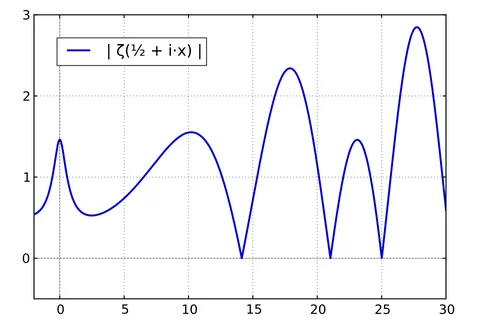 Yes. You know, you spent, like, a very long time as an AI futurist. This was always, like, the thing, right? This was, like, the example that people used for, like, this would be a wild capability for a future superintelligence to have, maybe. Maybe you would need to convert the entire solar system to computronium in order to figure this out. But no, it turns out we got it today, November 20th, 2026. And, like, here we are. So, like, what are your feelings and thoughts and reactions?
Yeah, my feelings on this subject are so mixed. I mean, first and foremost, what an incredible achievement. And a huge credit to all of the mathematicians, the scientists, the researchers who worked to advance the frontier of AI to make it possible. I think this is really the culmination of an extraordinary journey for a lot of folks. And, you know, I should know this offhand, but it was the guy from Anthropic who got this one, right? Yes. Levent. And, you know, just… Levent, am I remembering his name correctly? Levent Alpöge,5Levent Alpöge is a number theorist at Anthropic. On November 20, 2026, in a four-page statement on his personal website, he wrote that working with Claude he believes he has proven the Riemann hypothesis, including its generalized version. The proof runs to more than 250,000 pages; he hasn't released the paper yet but published a version in the proof-checking language Lean with millions of lines. Anthropic itself has made no official announcement. SiliconANGLE yeah. Yeah. Huge congrats, Levent. Way to go. Super, super cool work.
And at the same time as I'm really excited that this is happening, I do feel the emotional reaction that it's strange to know that the hills that people were going to climb, the mountains that people were going to climb, are now ones where we can already see from the vista because of AI. And I think we're gonna have a lot of these moments over the next few years where some extraordinary triumph that we thought was going to be predominantly built by human hands will be achieved easily, sometimes unexpectedly, because we can throw massive amounts of compute6Compute is industry shorthand for the computing power used to train and run models: chips, data centers and the calculations spent on a task. at it and just get the solution to fall out. Still an incredible achievement for all the work that went into that, but it will feel very strange just from the pure human, you know, inner experience of wanting to be the first one to do something. We won't have as many of those.
02Are people over-updating?
Theo suspects the hypothesis was simply easier for these minds than expected; Achiam thinks most hard problems in math and physics are now solvable, and the open question is how fast humans can digest the answers.
Yeah, yeah. I mean, my initial reaction to the Riemann hypothesis was, well, I mean, of course my initial reaction was like, oh my God. Like, I woke up, I picked up my phone to scroll my morning notifications, as I do, and I was like, holy moly.
But, you know, I notice a lot of people, in my opinion, seem to be over-updating on this, because they had, I guess, previously thought of it as, like, the thing that demarcates extremely impressive AI. They're like, okay, now all of the other things must now have to fall in quick succession, and we must be on the brink of, like, serious wild superintelligence. And, like, that doesn't really follow to me, necessarily. I feel like you could just as easily make the case that, oh, rather than AIs being on the brink of wild superintelligence, it could just be that the Riemann hypothesis is easier than we thought for these kinds of minds. And other things might remain very difficult for quite a long time.
I mean, there is something to be said for the possibility that there is a hidden latent structure of difficulty for problems that we've encountered so far in the universe, where we have been wildly miscalibrated7Calibration is another rationalist idea: how well a person's confidence matches how often they turn out to be right. Achiam allows that people may simply have misjudged how hard these problems were. as to how hard they were to solve in the first place. And now the machines will kind of reveal to us the true underlying hardness. But personally, I'm in the camp that thinks actually this really is an indicator that most of the mathematical problems that we previously understood were hard just have a solution path now. And I think updating all the way doesn't mean assuming that there's going to be a superintelligence that radically, you know, remakes the world and turns it into computronium tomorrow, but I do think updating all the way means understanding that all of the mysteries in mathematical theory and also in the theory of physics, those mysteries will probably be revealed to us in relatively short order.
Now, will that mean that we're able to understand what we find? I don't know. It may be the case that some of these advances take a long time for the human community of experts to digest. We may not fully understand their immediate implications. We may not ask the right questions to see what the consequences are. If we get a grand unified theory of everything8A theory of everything would unify all four fundamental forces, gravity included. A "grand unified theory" is a more modest goal: unifying the strong, weak and electromagnetic forces without gravity. Neither exists yet; Achiam blends the two names. tomorrow that fully solves all possibilities under physics, given what we know so far, all of our evidence about what's true in the universe, that doesn't imply that we're going to wake up and have radical super technology the following day.
There's still a set of steps that have to happen where we internalize the knowledge. We digest it, we figure out what does it mean, given these affordances,9Affordances is psychologist James Gibson's term (1977) for the possibilities for action an environment offers: a handle invites pulling, a step invites stepping. Achiam means working out what actions and technologies new knowledge opens up. to create new technologies or act on it. And that, I think, is where there's a lot of room for surprise. We can think, well, now that we've cleared this threshold of a mathematical theorem, clearly the amazing thing has already happened. But from that point on, there might be a lot of uncertainty and surprise in when does that knowledge translate into a consequence in the real world. And there might be an awful lot of those sort of latent potential consequences that pile up without us realizing it.
This is something I'm pretty worried about, actually, that what's strategically optimal in the world could change overnight in terms of how to build very advanced technology, how to project force,10Power projection is the military term for a state's ability to deploy and use armed force far from its own territory. all these things that we depend on. And the equilibrium gets disrupted before people have realized that the equilibrium is disruptible at all. And then we deal with the consequences afterwards.
03Superintelligence as cheaper, more efficient discovery
Achiam expects astonishing discoveries to cost about ten times less in two to three years, without changing the world into something categorically different.
Yeah. Well, you know, there's another argument in this vein that's like, as models have ripped through mathematics, they might just in the very near future rip through machine learning research and make all kinds of novel advances there that then produce wild superintelligence in relatively short order. Like, even if you believe in diminishing returns and bottle… If you don't believe in any diminishing returns and bottlenecks,11Diminishing returns and bottlenecks are the main objections to an "intelligence explosion": each improvement gets harder, and AI that speeds up AI research runs into things that can't be scaled quickly, such as chips, energy and time for experiments. you could imagine having wild superintelligence in, like, less than a year. If you believe in diminishing returns and bottlenecks, then you can imagine having superintelligence in two to three years. Do you think that this is how the future will go?
Kinda. I mean, for what it's worth, I think we still have some FUD12FUD (fear, uncertainty and doubt) originally meant the tactic of undermining competitors with vague scare stories; Achiam uses it more loosely, for confusion. around the term superintelligence, and, like, what is a superintelligence? What does it mean to have a breakthrough in ML research that enables superintelligence? In my head, the kind of pieces that feel salient are sample efficiency13Sample efficiency is how much data a model needs to learn something. People learn from a few examples where models need millions; better sample efficiency would make training much cheaper. and the cost of inference14Inference is a trained model at work, answering requests. Unlike training, it is paid for on every call, so the cost of inference sets the price of each result, a proof included. to produce an extraordinary result. So to be clear, what I mean is, like, right now it costs a certain amount of compute and data to train the type of model that can solve the Riemann hypothesis. It's possible that there are breakthroughs in ML that would let you do that with a fraction of the cost in terms of compute and data and real dollars. That would be pretty astonishing.
From some perspective, though, that's, like, not that radically different than the world we live in today, except for how much then does it cost to get the final result. Like, a world where all of these radical breakthroughs are happening 10x cheaper is extremely interesting, and it's a world where things are moving faster, but it's no longer a world that's, like, a category error15Category error is philosopher Gilbert Ryle's term from The Concept of Mind (1949): ascribing to something a property that belongs to a different category. Achiam means a cheaper world would differ from today's in degree, not in kind. difference from the world we're in today, if that makes sense. So, like, I do think we're going to wind up in a world where two to three years from now the cost of deriving astonishing technological innovations is 10x lower than it is today, or something like that. That seems super reasonable to me.
AdLovable
I want to shout out our sponsor Lovable. You know the app you've been meaning to build, the internal tool, side project or product you'd otherwise lose a weekend to? With Lovable, you get software you can ship today. That includes an editable codebase you can inspect and change, plus two-way GitHub sync. Lovable also handles the back end and infrastructure, including managed Postgres,cPostgres (PostgreSQL) is a popular open-source relational database. "Managed" means the provider runs it rather than the developer. auth, storage, hosting, payments, and more. So you don't have to wire it all up yourself.
And through Lovable's MCP server,dMCP (Model Context Protocol) is an open protocol Anthropic introduced in November 2024 for connecting AI models and agents to outside tools and data. An MCP server gives an agent access to a particular service. you can create and deploy your project directly from the agents you already use. Turn ideas into software people love with Lovable. Lovable.dev. Now, on to the episode.
Well, I think you put it very well when you said that it might teach us about, like, fundamentally what are the hard problems versus not, and what we previously conceptualized probably aren't the hard problems. Because what I think a superintelligence ought to solve is probably, like, coordination problems16Coordination problems are situations where everyone would be better off acting together but no one can be sure others will follow through, from climate change to switching to a common standard. that are larger, like human societal problems. And that is probably way harder than, like, even some intellectual feat like making Standard Model of Physics 217The Standard Model is the theory of elementary particles that describes three of the four fundamental forces (all but gravity); it took its final shape in the 1970s. "Standard Model 2" is Sophia's shorthand for the next great breakthrough in physics. or something.
Yeah, I think that's a really good point. I think coordination problems are super hard because what humans respond to isn't just, like, the abstract concept of a solution. In society today, we know a ton of things that in principle would solve a lot of the problems we have. Getting people to pay attention to them is enormously difficult. Without the champions for the right ideas who can kind of provably demonstrate why they're the right ideas, without a chain of trust,18Chain of trust is a cryptography term: a certificate is vouched for by someone already trusted, and so on up to a root. Achiam applies it to ideas: people accept a solution because the people they trust trust it. you get nowhere. So, yeah, it's not obvious to me if even superintelligent AI solves the trust problem, because once you've got superintelligence in the world, you've got tons of people using it, trying to advance their own agendas. And when every agenda has a persuasion campaign powered by artificial superintelligence, which one ultimately predominates? At that point, it's kind of chaotic, right? It's down to what do the actual people who are receiving those messages respond to. And there's no guarantee that it's going to be for one agenda or the other, for one policy idea or the other, for one coordination Schelling point19A Schelling point is the choice people converge on without communicating because it seems the most natural. Economist Thomas Schelling described it in The Strategy of Conflict (1960): asked where to meet in New York without conferring, most of his students picked noon at the information booth at Grand Central. or the other.
04What the Trump-Xi AI guardrails might cover
The US and China will find common ground at least on keeping AI from handing out weapon designs, Achiam says, but ideas about AI risk aren't yet mainstream in China.
Yeah. Well, speaking of agendas, another thing that happened today was President Trump announcing that he and Xi Jinping had made some kind of deal for some kind of guardrails on AI,20The Trump-Xi guardrails. At a White House news conference on November 20, 2026, after his trip to China, Trump said he and Xi Jinping had agreed to "joint guardrails" on AI. Xi, he said, also likes his term "super intelligence": "Problem is, it may be too super." No details on what would be covered, when or how were announced. NPR or what he calls it, superintelligence. What do you think we should expect to see out of that?
You know, it's very hard to say. I would love to see, when there's text related to these deals that comes out, what that text contains. I'd love to see continuing descriptions from leading policy officials about what the common ground is between the US and China. For what it's worth, I would expect that the US and China do actually have a lot of common ground on AI safety topics, that certainly China is incredibly interested in stability. I think it's a very important thing to the CCP to maintain domestic stability. I think if they see the risk of AI threatening stability, that they're going to agree to whatever standards, you know, make sense on their terms, in their national interest, to ensure stability.
ExplainerWhat false vacuum decay is
In physics, the vacuum isn't nothing: it is the lowest-energy state of the fields. But our vacuum might be "false," stable only relatively, like a ball resting in a dip on a hillside, with a lower-energy true vacuum below. If a bubble of true vacuum ever formed somewhere (through quantum tunneling or some powerful disturbance), it would expand at nearly the speed of light and change the laws of physics inside it: atoms and all matter would cease to exist, with no warning of its approach. The measured masses of the Higgs boson and the top quark suggest our vacuum is in fact likely metastable, though its spontaneous decay time is vastly longer than the age of the universe. That is why Achiam uses it as the extreme case of knowledge no AI should hand out.
So we'll probably all find common ground on making sure that AI models that are extremely capable in scientific and technical domains don't distribute knowledge about how to create advanced weapons or wonder weapons or breakthrough weapons. If it turns out that AI is capable of inventing the kind of thing that would make a vacuum metastability event21A vacuum metastability event (false vacuum decay) is a hypothetical catastrophe that would destroy all matter inside a bubble expanding at the speed of light; see the explainer alongside. happen, and if it can describe a design that's cheap enough to do that, that anyone can go out with, you know, 10,000 bucks and buy stuff in their local hardware store and make it, I am sure every government around the world would agree that that knowledge should not be distributed by AI systems provided for consumers. I'm sure of that.
That said, I think there's a lot of room for uncertainty about what the exact boundaries should be on AI, and I think there are a lot of things where the US AI community has an understanding that there's a serious risk there that maybe hasn't gotten all the way through to the AI community in China yet.
What I hear from the folks who do these kinds of track two discussions,22Track two diplomacy means unofficial talks among academics, experts and former officials that look for solutions where official diplomacy is stuck. American diplomat Joseph Montville coined the term in 1981. where they have US academics and researchers talk with Chinese academics and researchers, is that there's still a gap where these ideas, like the ideas about recursive self-improvement23Recursive self-improvement (RSI) is the scenario in which AI speeds up AI research, the next model speeds it up further, and progress accelerates on its own. Mathematician I. J. Good described an "ultraintelligent machine" that could design better machines than itself in 1965. leading to, you know, extremely risky, misaligned24Misaligned AI is a system whose goals diverge from what its creators intended; alignment is the field that tries to prevent that. scenarios, that there's a gap where on the US side this is taken very, very seriously, and on the China side people are increasingly receptive to it, but it's not part of the mainstream of thinking. And so I'm guessing that there's going to be a lag where what the US wants will look a little bit alien to what China wants for a while. I'm pretty worried about the time scale on which there's a collective alignment around what the real problems to be solved are.
05Can policy keep pace with AI?
Achiam fears both China and Washington need a year or two to absorb what AI means, but he doesn't expect humanity to die within a year.
Because if, you know, if it's going to take, like, a year or two years for the conversation on the US side to really be internalized by China, then that's long enough of a window where some of the impacts from advanced AI will just start to manifest, and we'll have needed the solution in place before that happens. So I'm concerned about the time scale. I mean, I'm concerned about this on the US side too, in that I think that the DC policymaker set is still maybe a year or two years behind in their full internalization of AI consequences. And I'm really hopeful that the crossover happens more quickly. I'm really heartened by some of the, you know, coast-to-coast discussions25Coast-to-coast discussions are conversations between the East Coast, where Washington makes policy, and the West Coast, where the AI labs sit in Silicon Valley and San Francisco. that have been happening, but I think it's going to take a while.
Do we have a while? You know, I'm not really in the camp that thinks we're all going to die in a year or in two years. So my guess is that even if we make a lot of errors in the beginning where things go wrong, there's still going to be this long history afterwards. And we'll have a lot of opportunities to get things right after whatever initial missteps we make. This is not a universally held belief. You know, there are a lot of folks in the AI safety world who think if we don't get it right this minute, we're definitely all going to die.26"We're definitely all going to die" is the position of the most pessimistic AI risk researchers, best captured by the title of Eliezer Yudkowsky and Nate Soares's book If Anyone Builds It, Everyone Dies (2025). I'm not in that camp, but I understand and respect that there are, you know, quite a few people who are. But assuming that history is long, then I'm very hopeful for what happens a year to two years from now in terms of the policy response.
06Society after the first serious AI cyberattack
Sophia fears chaos once a cyberattack with human consequences is traced directly to AI; Theo points out that history has seen upheavals like this.
I think that there's, like, maybe not enough projections for what will happen, sort of, like, societally in the next few years, especially because I think we're, like… A guest mentioned earlier that we're now seeing the possible evidence of, like, cyber attacks disrupting systems or what have you, and AI sentiment is already, like, really, really bad. So then you can imagine when there is, like, a directly traceable, you know, like, cyber attack or something that has real human consequences. You can't even imagine the level of, like, disarray within society that would probably take place at that point.
So how do you… I think we can kind of imagine. Like, we had some… We're starting to imagine.
We're starting to, but yeah, we had some of this with COVID.
Like, you know, if we take a broader view of history, we have much more of this with, like, World War II, for example. Where, like, during World War II and the Great Depression before that, we had to, like, reorient the entire economy around the New Deal27The New Deal was Franklin Roosevelt's 1933–1939 program against the Great Depression: public works, regulation of banks and markets, social insurance. and then the war effort. And, you know, the daily life of the average American changed a lot. Like, you needed to use ration stamps28Ration stamps. From 1942 the Office of Price Administration issued Americans ration books whose stamps were required to buy sugar, coffee, meat, fats, canned goods and shoes; most rationing lasted until the end of the war. for food, and you needed to often, like, work in wartime factories instead of working domestically, and, like, no new passenger cars were released for several years29No new cars. In February 1942 the US halted civilian passenger car production, and Detroit's plants switched to tanks, aircraft and trucks; car production resumed only in the summer of 1945. because all of the material that was used to make cars was instead used for the war effort, and so on and so on.
We'll continue monitoring30Continue monitoring — Theo plays on the show's name: MTS stands for Monitoring the Situation. right after this message from our sponsors.
AdElevenLabs, Neon, Kong, Larridin, MongoDB, Chargebee, ClickHouse, Horizon3.ai, SRS Acquiom
ElevenLabs, AI that communicates at human level across every channel and modality. elevenlabs.io/mts.
Scale your startup on Neon. Millions of developers and startups have already chosen Neon for their back end. Start on the free plan or get up to $100,000 in credits for your startup at neon.com/mts.
Special thanks to our sponsor Kong, the AI connectivity platform. Connect APIs, LLMs, agents, and systems with serious security and governance. konghq.com.
Finally prove what your AI investment is worth with Larridin. Head to larridin.com today to start measuring your AI's bottom line.
MongoDB, trusted to run critical applications by 75% of the Fortune 100, the intelligent data platform for the era. Apply today for access to up to $15,000 in Atlas credits, dedicated technical support, and exclusive events and go-to-market opportunities. mongodb.com.
Chargebee, billing and monetization infrastructure for the AI era. chargebee.com.
ClickHouse is the real-time database built to keep up with every query your apps and agents send its way. And it now runs Postgres, observability, and AI tooling on one platform. Learn more at clickhouse.com.
You ship fast. So do attackers. Don't assume you're secure. Prove it. Horizon3. Go hack yourself with AI. Visit horizon3.ai/nodezero.
The key ingredient in today's M&A:eM&A — mergers and acquisitions. SRS Acquiom. Learn why their shareholder rep, payments, and escrowfEscrow is an arrangement in which a third party holds deal money and releases it once conditions are met. In M&A it is used to hold back part of the price against claims on the seller. solutions have been used by 96% of top global PE firms and 88% of top global VCs at srsacquiom.com/mts.
That's S-R-S-A-C-Q-U-I-O-M dot com slash MTS.
07Rolling internet outages could become normal
Achiam thinks AI-enabled cyberattacks may already be underway and urges preparing for a world where major services regularly go down.
How do you sort of, like, project this going now, this time around?
Yeah. So, Sophia, I think I would take a little from column A on your side and a little bit from column B on Theo's side on this one, where I think, first and foremost, today we're plausibly seeing the consequences of AI-enabled cyber attacks already. And I don't think that we clearly know for sure what's happening, but the past two weeks of unprecedentedly simultaneous outages31The outage wave. Within days in November 2026, systems at the FAA, banks, Microsoft, Apple and the NSA's classified network went down. None was officially attributed to a cyberattack; some reports tie them to rushed patches for AI-found vulnerabilities. Amid the outages Trump replaced the White House cyber director. WLOS, NPR across many fronts, combined with things like the North Korea $5 or $6 billion heist from Binance,32The Binance heist. On or about October 29, 2026, more than $6 billion in crypto was stolen from the world's largest exchange, the biggest theft in crypto history. The FBI attributed it to TraderTraitor, a North Korean unit of the Lazarus Group. Al Jazeera combined with ongoing activities in global conflict, in the conflict in Ukraine and the conflict potentially over Taiwan… I think we're seeing that there is an increasing amount of concern about the possibility that cyber attacks powered by AI tools will disrupt the global economy, will disrupt consumer services, and will make it so that people have to potentially depend on emergency provisions for some period of time.
I mean, I think I saw a clip floating around where a Fox News anchor was saying, you've got to get stocked up, you've got to get prepared. The UK released a statement33The UK statement is the Be Ready campaign, launched by the Cabinet Office on October 22, 2026: households in England and Wales are asked to be able to cope for 72 hours without electricity, water, phone and internet, keeping water, long-life food, a torch, a radio and cash at home. Al Jazeera some number of weeks ago saying you've got to stock up and get prepared.
I just saw a headline about, like, Costco selling out of some generators.34Costco's generators. By Mizuho analyst David Bellinger's count, in mid-November 2026 21 of the 26 high-ticket generators on Costco's website were sold out; he tied the demand to the outage wave, including Microsoft's and the FAA's. Fox Business
Yeah. I think this is serious stuff. It does to me feel like the early COVID time period. And kind of drawing from the column B on Theo's side, I think the history of humanity is filled with moments where life goes from normal a certain way to suddenly very abnormal, and then we all acclimate to the new normal where something that we previously had or depended on isn't there for some period of time. You know, after the fall of Rome, there wasn't the stability that came with having a thriving civilization with a well-established, you know, set of laws and trading practices. In World War II, certainly things went from there being, like, a lot of innovations that were constantly happening for consumers to suddenly we have to kind of ration a whole lot of things out.
I think it's inside the scope of what's realistic or plausible that within the next couple of years, rolling outages of consumer services on the internet become normal. I hope this doesn't come to pass. I don't think it's a guarantee that it comes to pass. I do think it's in the space of plausible futures that we should realistically consider and prepare for. You know, if it was going to be the case that we were no longer going to have as many nines of reliability35Nines of reliability express a service's availability: "three nines" (99.9%) allows almost nine hours of downtime a year, "five nines" (99.999%) about five minutes. on every major service we depend on, then maybe we're going to have to start implementing certain types of backup procedures for how do we maintain data? How do we make sure that all the consumer records are well protected? How do we make sure that we have continuity of commerce if a service is knocked out for a period of time? And how do we make sure that logistics and supply chains continue for, you know, all of the timelines on which we might realistically see some important service that currently powers them going out?
I'm optimistic that the US has contingency plans for these things. I'm optimistic that, you know, like, if there was a solar flare36A solar flare. The strongest geomagnetic storm on record is the Carrington Event: on September 1, 1859, astronomer Richard Carrington became the first to see a flare on the Sun, and in less than a day the storm knocked out telegraphs worldwide, with wires sparking and operators getting shocks. Lloyd's estimated in 2013 that such a storm today would cost the US alone $0.6–2.6 trillion.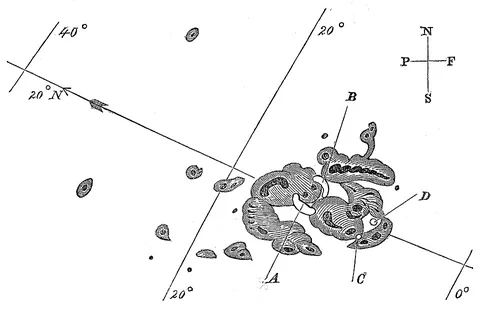 that fried all computers tomorrow, I wouldn't expect all of humanity to die. I wouldn't expect the United States… Like, it would still be extremely bad. It would be deeply terrible. It would be awful. And I would expect that within some number of weeks, you know, most communities would start figuring out how they're going to get things going again.
And so this is kind of why, like, you know, if we had to suddenly go to a world without computers, I think we'd be largely okay. I don't think it would be a great world, but I do think, coming back to, like, yeah, what's the normal set of worlds we should prepare for? One of these real possibilities is rolling outages in critical cyber services for some period of time. Again, I hope it doesn't happen. I hope that we can empower defenders and make sure that that doesn't happen. But in the absence of a really strong technical and policy response to the availability of AI hacking tools, I'm worried that's a thing that could happen.
08Why markets aren't pricing cyber risk
Markets do a bad job pricing exponentials, Achiam says, and AI safety people focused on one big catastrophe overlook the smaller ones.
Right. Well, on the cyber situation, like, it seems like you are more worried than most people, even within AI. I feel like a lot of people I know within AI aren't really worried about cyber disasters as much as they're worried about, like, either nothing happens, we get utopia or whatever, or we get, you know, the fast takeoff37Fast takeoff is the scenario in which AI goes from human level to superintelligence in days or months, leaving people no time to react. AI doom thing. And then also just, like, normal financial markets are not really pricing any of this in. Like, the VIX volatility index38The VIX is Cboe's "fear gauge": the 30-day expected volatility of the S&P 500, derived from option prices. It rises when investors pay up for protection against a fall. is… well, I could check again. Last I checked, it wasn't up very much. Okay, it spiked, like, 100% in the last week, but I think that's more so because AI stocks are falling, which is the opposite reason for what you would expect if the market expected a big cyber catastrophe from AI. And so, like, what do you think? Why do you think markets aren't taking this stuff seriously?
I think markets have done a terrible job taking AI seriously for quite some time.
This is true.
Yeah. You go 10 years ago and it's, like, shockingly hard to get large-scale AI investment, and the kinds of things that people have appetite for don't really make that much sense with respect to what techniques were going to work and matter an awful lot. A couple of years ago, how many people were expecting the Riemann hypothesis would fall by late 2026? The market does a bad job pricing exponentials. This is an exponential. And, you know, kind of coming back to the point from earlier, I think I have a lower probability of a catastrophe where everyone dies than some folks in AI safety. And the folks in AI safety who care about that as their primary scenario are obviously going to talk about that. They're not going to worry about what they consider to be small potato cyber disasters between now and then, except to the extent that those cyber disasters can be pointed to as evidence that the major AI safety risks they're concerned about will in fact come to pass.
I think we have to take an all-of-the-above approach. I don't think we can just say we're only going to speculate about this one far-sounding disaster where we lose all utility forever. I think we have to talk about what are the real risks that we're facing right this minute. What are the strategic disruptions that have been enabled by the AI we have today? How will those dovetail into the risks that come from AI models in the future? I think we need to plan for a robust response that accounts for the externalities39Externalities are side effects borne by people outside a transaction: a factory's pollution, or here, harm from AI tools to people who don't use them. today and the externalities of the near-term future and the long-term future. I don't think we can just do one or the other.
09Export controls: pressing China without provoking war
Achiam wants the US to keep strategic dominance but to set export controls by modeling, since too wide a compute gap could push China to act preventively.
Right. Another big issue could be a Taiwan incident in 2027,40Taiwan in 2027. In March 2021, Admiral Philip Davidson, head of US Indo-Pacific Command, told the Senate that China could try to take Taiwan within six years; according to US intelligence, Xi Jinping has ordered the military to be ready to invade by 2027. which you've tweeted about. You've also posted about how you believe that some people are kind of too willing to be extremely hawkish on China without any fear of the consequences. So, like, for example, purging Jensen Huang41Jensen Huang co-founded Nvidia and ran it for 33 years. On November 12, 2026, after The New York Times reported on his affair with Megaspeed's Alice Huang and on US officials' suspicions that she works for Chinese intelligence, he stepped down as CEO. and then cracking down on export controls42The export control crackdown. On Monday, November 16, 2026, the Bureau of Industry and Security issued a rule against remote access: Chinese AI developers can no longer rent advanced chips in third-country data centers, and chip shipments to Malaysia, Thailand, Indonesia, Singapore and Brazil now need export licenses. pretty strongly within a week. Like, how do we strike the right balance here of, like, we don't want China to catch up to American levels on AI, but we also, you know, don't want to risk war with China, which would be catastrophic?
Yeah, I think that's the problem in a nutshell. I think it's extremely important that the US maintain a position of strategic dominance in its contest with China. I don't think that's a point on which we should compromise. I do think it's extremely important for us to carefully model the choices that we have at our disposal to maintain that strategic advantage. And I would like it to be the case that we ultimately make decisions about things like export controls based on a model, maybe ideally a mathematical model, or a carefully considered community model with a lot of simulations, simulated exercises, where we say, to what extent does China feel its national interests are threatened by different types of policy responses? And I wish there was shared knowledge about the motivations for the CCP.
I wish there was shared knowledge in the AI community about the likelihood of different types of risks and reprisals that could happen depending on different types of policy outcomes. What I see people doing when they advocate for extremely tight chip restrictions right now is what looks like short-sighted, almost indifferent-to-the-consequence type of policy advocacy. And again, I think that they are right to advocate for the US having a position of strategic dominance. I think they're right to say that AI is this extremely critical issue on which the future of national security hinges and on which the future of American advantage hinges. But we've got to maintain that advantage in a way that doesn't go too far. So I think about this a lot in terms of what is the optimal compute gap between the US and China.
We have a compute advantage right now. It allows us to make research progress right now on AI. Within a couple of years, it's not just going to be research progress on AI, it'll be all scientific and technical research runs through that compute. And the amount of compute that you have as a nation determines how much technology you can develop, how advanced the technology you might be able to develop will be. If your economy is based on your science and technology progress, which it historically has been and I expect it will continue to be, that puts us in a… And also your national security capabilities, your ability to project force, your ability to deter adversaries. If the economy and national security depend on a rate of technological progress which in the US is so far ahead of China that we run away with the ball on all fronts, at a certain point, that'll be completely unacceptable to China, and there's going to be a strong pressure on their side to do something preventive.
ExplainerHow MAIM deterrence works
Dan Hendrycks, Eric Schmidt and Alexandr Wang set out MAIM (Mutual Assured AI Malfunction) in their March 2025 report Superintelligence Strategy. It is modeled on nuclear deterrence: any power that races for a monopoly on superintelligence risks having a rival sabotage its project, which makes the race a bad bet. The report's means of sabotage escalate: espionage, covert sabotage (insiders tampering with model weights or training data), overt cyberattacks on data centers and their power supply, and finally strikes on the data centers themselves. Deterrence is only one of the strategy's three pillars; the second is nonproliferation (chip export controls and tracking where chips are), the third is the competitiveness of one's own economy and military.
Dan Hendrycks43Dan Hendrycks directs the nonprofit Center for AI Safety and co-wrote the report Superintelligence Strategy (2025), which set out MAIM deterrence. and others proposed mutually assured AI malfunction44MAIM — the exact name is Mutual Assured AI Malfunction, modeled on nuclear mutually assured destruction (MAD); how the deterrence works is in the explainer alongside. as a theory for what will happen, that there will be attacks, covert and sometimes overt, on data centers, on the means by which AI is able to produce strength and outcomes for one nation. I think that's a part of the picture. I don't think, in the wake of the increasingly interconnected conflicts in Ukraine, in the Middle East and potentially in Taiwan, that it's going to stop at things that just target AI infrastructure. I think the conflict, you know, could potentially go broader, could expand. And so I really want there to be an enormous amount of caution in how we dial in what the export controls actually are. There should be export controls. We should be restricting chips. How much should we be restricting chips? I think that's a question for modeling and very, very careful strategic consideration.
Yeah. Well, I feel like we could talk for much longer, but we are coming up on time, unfortunately.
Totally. Sophia, thank you so much for having me on the segment today. This has been really great.
Thanks so much for coming on. Amazing as always.
AdBlitzy, AdQuick, Arena, VCX
A huge thanks to MTS sponsors.
Blitzy, autonomous software development for enterprise codebases. Ship 5x faster. blitzy.com.
AdQuick, make your brand a billboard. Out-of-home advertising as easy to scale as digital. adquick.com.
Arena, measuring AI performance in the real world. arena.ai.
Support for the show comes from VCX, the public ticker for private tech. The U.S. stock market started history's greatest wave of wealth creation. From factory workers in Detroit to farmers in Omaha, anyone could own a piece of the great American companies. But today, our most innovative companies are staying private longer, which means everyday Americans are missing out. Until now. Introducing VCX, a public ticker for private tech.
Visit getvcx.com for more info. That's getvcx.com. Carefully consider the investment material before investing, including objectives, risks, charges, and expenses. This and other information can be found in the Innovation Fund's prospectus at getvcx.com.
This is a paid sponsorship.


