

MTS
Chapters
Chau says every allegation used to push Huang out has already been knocked down, and he expects him back.
Read the chapter- According to Chau, the claim that Alice Huang was a Chinese spy was made up by The Wall Street Journal, and Singapore has called it fabricated.
- He says the intelligence was misrepresented, which members of the administration and lawmakers from both parties have acknowledged.
- What was called chip smuggling, Chau argues, was legal renting of capacity in Malaysia, which the hawks failed three times to ban in the Senate, in 2023, 2024 and 2025.
- New media, he says, debunked the lies in a week, while the WMD story took years to unwind.
- Theo notes that Kalshi puts Huang’s return at about 10%, which Chau thinks is far too low.
Chau says doing business with Megaspeed was legal: the attempt to blacklist it failed and the investigation found nothing.
Read the chapter- A 2024 proposal to put Megaspeed on the restricted entities list failed, Chau says, so deals like Nvidia’s were deliberately left legal.
- When Theo points out that Megaspeed was under investigation, Chau replies that doing business with a company under investigation isn’t a crime.
- He compares the hawks to the CCP’s treatment of Jack Ma, calls them a traitor class and puts the damage to Nvidia at more than half a trillion dollars.
Chau argues that the people pushing a hard line on China want to make America more like China.
Read the chapter- The question that kills the hawks’ ideology, Chau says, is why America is doing better than China and got to AI first; capital controls, he argues, have starved China’s best founders of money and opportunity.
- Export controls, a centralized regulator and surveillance of all GPUs, in his view, make America poorer and less free.
- The average Chinese person, Chau says, is poorer than the bottom fifth of Americans.
- The same people, he argues, pushed the same policies before China was a threat, citing al-Qaeda or weapons of mass destruction.
Chau blames a board with no real financial stake that doesn’t understand what made Nvidia succeed.
Read the chapter- Theo asks why Huang survived the spy story but fell after a second affair, with an Nvidia executive.
- Chau doesn’t think the second affair decided it: Huang resigned, he says, right after a board meeting that had been scheduled in advance.
- Many directors' stakes are tiny, Chau says, and not one has publicly explained their position.
- Newer companies, starting with Facebook, protect founders with super-voting shares; Nvidia, like Uber before it, had no such protection.
- Chau calls the press pressure an organized campaign but says he doesn’t know whether directors were threatened.
Chau says Trump has always seen China as a trade problem, while the hawks lead toward war.
Read the chapter- Chau was heartened to hear that Trump wants Huang back.
- Theo thinks Trump, who pioneered China hawkery, has become almost pro-China; Chau counters that Trump always wanted a better trade deal, not a war.
- A war with China, Chau says, would be far more devastating than the wars with Iran or Iraq.
- Chau and Theo agree the last war fought on American soil was the Civil War; the Battle of Attu in 1943, Theo says, doesn’t really count.
Chau says the Nvidia affair showed the tech industry how far the Washington foreign policy establishment will go.
Read the chapter- He calls the protests at Google against military technology and the attacks on Palantir counterproductive: using technology in war isn’t wrong.
- David Sacks, Balaji Srinivasan, Amjad Masad and Paul Graham saw it early, he says.
- In the long run Chau expects this awakening to improve US foreign policy.
Recursive self-improvement, Chau says, has always existed, and every technological boom eventually slowed.
Read the chapter- Theo cites David Sacks, who called Anthropic’s pursuit of RSI very dangerous.
- Chau’s historical example is microscopes, which helped make lenses for better microscopes; in software, it goes back to Alan Turing.
- Every scientific field, he says, has an explosion of discoveries and then slows, from over-regulation or because the low-hanging fruit runs out.
- Overestimating progress, he argues, leads to costly mistakes like the restrictions on nuclear power, only now being reversed under Trump, 50 years later.
Chau thinks existing antitrust law is enough to deal with concentrated power at Anthropic.
Read the chapter- He cites an allegation that Anthropic targeted employees of an AI financial assistant startup to learn how its product worked.
- Nvidia, Palantir and others, he says, have restricted Anthropic’s models because they doubt it honors zero data retention.
- Bankman-Fried, a major Anthropic investor, was lobbying in Washington before FTX collapsed for a bill that Chau says would have given him a regulatory monopoly.
- Chau sees the effective altruist logic of "just keep flipping the coin" as part of Anthropic’s worldview.
Quotes
On how fast lies get debunked now
“Because in the world before new media, the lies would just get around the world completely and dominate policy before the truth was even putting on its shoes.”
Brian ChauRead from 03:38On the hawks and Huang
“They are the CCP at home, and they are trying to do to Jensen what the CCP in China did to Jack Ma.”
Brian ChauRead from 07:29On arguing with China hawks
“This is the question that completely kills the China hawk ideology: why is America actually doing better than China? Why did America come up with AI first?”
Brian ChauRead from 09:12On founder protections
“I think Nvidia is kind of a company from a different era, because companies that are founded in our era, most famously starting with Facebook, have much more of an appreciation for the founder.”
Brian ChauRead from 16:03On a war with China
“I think almost nobody alive in America today remembers what real war is like.”
Theo JaffeeRead from 23:03On RSI having always existed
“Let me give you a very clear example of recursive self-improvement: microscopes.”
Brian ChauRead from 26:01On Bankman-Fried
“He was going up to US senators and saying, ‘Mr. Senator, we have the most safe, most compliant, most trustworthy crypto exchange.’ And literally a week later, this safe, you know, trustworthy crypto exchange went bankrupt and turned out to be stealing customer deposits.”
Brian ChauRead from 31:48
Summary
Effort founder Brian Chau tells Theo Jaffee that Jensen Huang’s exit from Nvidia was a coup. In his telling, China hawks who failed to get Congress to ban renting chips through third countries such as Malaysia pushed a story about a spy and chip smuggling through the press, and a weak board with little money in the company gave in. Trump, by contrast, looks consistent to him: he wants better trade with China rather than war, and he wants Huang back.
In the last part Chau argues against banning recursive self-improvement. Such loops have happened before, from microscopes to software, and every boom eventually slowed, while panic leads to costly mistakes like the restrictions on nuclear power. Existing antitrust law, he says, is enough to deal with Anthropic, which he compares to Sam Bankman-Fried.
Mentioned
- Brian Chau00:22The guest, founder of Effort: he argues Huang was pushed out of Nvidia on false allegations and takes on RSI bans and Anthropic.
 Jensen Huang00:22The episode’s subject: Chau calls his exit a coup, explains why the board let him go and hopes he returns.
 Alice Huang00:43Chau calls the claim that she was a Chinese spy a fabrication and Nvidia’s dealings with her company legal.
 The Wall Street Journal00:43Chau accuses the paper of inventing the spy and chip-smuggling stories and then backtracking.
Show 22 more mentionsShow fewer mentions
 Bureau of Industry and Security (BIS)03:08Chau cites statements from the Commerce Department, which oversees the bureau, as proof that Nvidia complied with export controls.
 Kalshi04:11Theo cites its roughly 10% odds of Huang returning; Chau thinks that’s too low.
 Megaspeed05:04Chau says dealing with it was legal because it was never blacklisted; Theo points out it was under investigation.
- Jack Ma07:29Chau compares the CCP’s crackdown on him to what he says the hawks did to Huang.
 NVIDIA07:29Chau says the campaign against Huang has already cost the company more than half a trillion dollars in market value.
 The New York Times09:52Chau counts the paper among "the CCP at home," who he says are pushing America toward Chinese-style policies.
 Kimberly Powell12:03Theo asks why Huang fell only after the second affair, with an Nvidia executive, even though that allegation was weaker.
 Facebook16:03Chau’s first example of a newer company that protects its founder from the board.
 Mark Zuckerberg16:03Chau points to his super-voting shares as the protection Huang lacked.
 Uber16:03Chau calls its founder’s ouster unjust and the culmination of an era when boards regularly pushed out founders.
 Donald Trump20:49Chau welcomes Trump’s wish to bring Huang back and argues with Theo over whether Trump has turned pro-China.
 Xi Jinping21:04Theo cites Trump’s friendliness with Xi as a sign that Trump has softened on China.
 Google23:41Chau calls the employee protests against military technology there counterproductive.
 Palantir Technologies23:41Chau thinks the attacks on the company are unfair since it’s mostly a B2B SaaS company; later he notes Palantir restricted Anthropic’s models.
 David Sacks24:41Chau names him as the first to see how far the Washington establishment would go; Theo cites his warning that Anthropic’s pursuit of RSI is dangerous.
 Balaji Srinivasan24:41Chau names him among those who spotted "the CCP at home" before the rest of Silicon Valley.
 Amjad Masad24:41Chau names him among those who saw early how far the Washington establishment would go.
 Paul Graham24:41Chau names him among the few in Silicon Valley who woke up before the Nvidia affair.
 Anthropic25:44Theo asks how to keep power from concentrating there; Chau lists the allegations against it and compares it to Bankman-Fried.
- Alan Turing26:48Chau dates software that helps write software, recursive self-improvement in code, back to Turing.
 Sam Bankman-Fried31:11Chau notes that he led Anthropic’s Series B and sees the same logic at the company.
 FTX31:11Chau’s example of an exchange its founder sold to senators as the most trustworthy, a week before it collapsed.
Sponsors of the episode
 Lovable08:22App building with an editable codebase and GitHub sync.
 ElevenLabs18:56Voice AI across every channel.
 Neon18:56Postgres backend for apps and agents.
 Kong19:09Connectivity platform for APIs, models and agents.
 Larridin19:26Measuring the return on AI investment.
 MongoDB19:26Data platform with Atlas credits for startups.
 Chargebee19:26Billing and monetization.
 ClickHouse19:57Real-time database.
 Horizon3.ai19:57AI-driven security testing.
 SRS Acquiom20:15Shareholder representation, payments and escrow for M&A deals.
 Blitzy33:23Autonomous enterprise software development.
 AdQuick33:23Out-of-home advertising.
 Arena33:40Measuring AI performance in the real world.
 VCX33:45A public ticker for investing in private tech companies.
Transcript
01Why Chau calls the case against Huang a fabrication
Chau says every allegation used to push Huang out has already been knocked down, and he expects him back.
And we are back. We are live with Brian Chau,1Brian Chau writes about AI policy and argues against heavy-handed regulation; in 2024 he founded Alliance for the Future, a Washington nonprofit, and led it as executive director. who is the founder of the aptly named investigative journalism effort, Effort,2Effort — Chau’s outlet, listed in the episode notes as Effort News; Theo is playing on the name, since he calls it an investigative journalism "effort." to talk about the Jensen situation.3The Jensen situation — the exit of Jensen Huang, the Nvidia co-founder who ran the company for 33 years. On November 12, 2026 he stepped down as CEO and director after the scandal over his affair with Alice Huang of Megaspeed. Brian, welcome, welcome back to MTS.
Yeah, it is an exciting time to be alive.
Absolutely. So tell us, like, about the Jensen situation. What happened here exactly?
ExplainerHow Jensen Huang lost Nvidia
On October 29, 2026, The New York Times, citing people briefed on US intelligence, reported that American officials believed Alice Huang, in 2023 a managing director of Singapore’s Megaspeed, was a Chinese intelligence asset, and that surveillance of her had revealed her closeness to Jensen Huang.
On November 7 the Financial Times reported that the relationship was romantic. On November 8 Huang admitted to infidelity in a note to employees without naming the woman, and Nvidia’s board opened an independent investigation.
On November 11 the Times reported his relationship with Kimberly Powell, an Nvidia vice president who reported directly to him. The board held an emergency meeting that day and accepted his resignation, which the company announced on November 12. CFO Colette Kress became interim CEO, and the board got its first chair, Harvey Jones.
On November 17 Huang posted on X that he would return if the board decided that was best; the same day Jones said the board did not intend to reinstate him. The allegations against Alice Huang have not been publicly proven, China denies them, and Attorney General Todd Blanche said the Justice Department had reached no conclusion about her. Wikipedia
So it is now definitively proven that all of the allegations that were used to force out Jensen were essentially false. That essentially the only basis for this coup was like TMZ-type tabloid headlines, because at first there was this claim that this lady4This lady — Alice Huang (Huang Le), a Chinese businesswoman who in 2023 was managing director of Singapore’s Megaspeed, a major buyer of Nvidia chips. She is no relation to Jensen Huang. was a Chinese spy. This was based on entirely fabricated statements that the Wall Street Journal5Fact-checkNot quite: the report that US officials suspected Alice Huang of working for Chinese intelligence came first from The New York Times, on October 29, 2026. The Wall Street Journal reported on October 30 that authorities in Singapore and Taiwan had separately investigated her ties to China; the next day Singapore’s Ministry of Home Affairs said neither the government nor its officials had said this and that no such investigation of her had been conducted. Singapore had investigated her as Megaspeed’s head over possible false declarations in server purchases and brought no charges. Wikipedia essentially made up, that the Singapore government has now said were completely fabricated. Then there were the misrepresentations from the IC community, or the intelligence community, and both members of the administration as well as elected, both Republicans and Democrats, who have access to that intelligence have now said that was completely misrepresented.6Fact-checkOverstated: there has been no general statement that the intelligence was misrepresented. On November 12, 2026, CNN reported that some officials in the Office of the Director of National Intelligence considered calling her a spy overstated and that CIA officials weren’t convinced she had knowingly passed information to China; Democrat Jim Himes said after a classified briefing that he wasn’t sure. But on November 13 the Times reported that people who had seen the intelligence were confident about her contacts with Chinese intelligence, and the FBI’s counterintelligence investigation continues. Wikipedia And now there's been all of these false claims that Jensen was smuggling chips, when in fact he was completely compliant with export controls.
And the Wall Street Journal has essentially, like, backtracked on that and said, by what we mean by smuggling is actually complying with the law in this way that we don't like and that we failed to pass a bill to stop in 2023, 2024, 2025. So what it came down to was actually something very scary: that many of these so-called China hawks, which are really just the CCP at home, everything they do is communist, whether it's trying to have a centrally planned economy, whether it's censoring Americans, whether it's trying to coup the CEO of the world's most successful company, they're all essentially communists. They tried to pass a bill. They fucking failed. They failed three times. They were voted down with a Democratic majority Senate in 2023 and 2024 and by a Republican majority Senate in 2025.7Fact-checkWrong: the Senate never voted such bills down; it never took them up. The Remote Access Security Act, which extends export controls to renting chips remotely, passed the House in September 2024 and again on January 12, 2026 (369–22), and both times stalled in the Senate Banking Committee. Congress.gov Nobody liked them.
What bill are you referring to?
ExplainerHow China got Nvidia compute without importing the chips
Since October 2022 the US has barred the sale of Nvidia’s most powerful AI chips to China. But the rules covered shipping the chips, not renting the computing: a company in Malaysia or Singapore could legally buy the chips and rent capacity to Chinese customers over the cloud.
That was Megaspeed’s business. Together with its Malaysian subsidiary Speedmatrix, the Singapore company bought more than $4 billion of Nvidia chips. According to The New York Times, Alibaba was its customer and financial backer, and Speedmatrix ran Nvidia chips for Alibaba at a data center in the Malaysian state of Johor. Singaporean and US authorities also suspect some servers were shipped on into China itself, which would be smuggling.
The remote-access loophole was closed only by a Bureau of Industry and Security rule issued on November 16, 2026, and in force from November 19: advanced chips now need a license to go to Singapore, Malaysia, Thailand, Indonesia and Brazil, and overseas data centers that supply significant computing power to China-headquartered companies have 90 days to get licenses. Wikipedia
The restrictions on Malaysian data centers. So this is what came out in the Wall Street Journal. This is when they essentially, like, revealed the reason for their lie: that in 2023, 2024, 2025, these people tried to pass a law to ban, like, Malaysian data centers. Not just Malaysia, but essentially, like, Americans doing business with third countries, and those third countries, or companies in those third countries, were doing business with, like, Chinese customers. And this was completely legal. And they tried to call this chip smuggling.
They tried to use this to accuse Jensen of chip smuggling. And then they just came out with like proof, including statements from Commerce, which oversees the BIS,8BIS — the Commerce Department’s Bureau of Industry and Security. It runs export controls, including the ban on selling advanced Nvidia chips to China, and keeps the Entity List. which oversees export controls in the United States, that actually Nvidia was completely complying.9Fact-checkOverstated: Commerce made no finding that Nvidia fully complied. In a joint statement on November 16, 2026, the Commerce and Justice departments said Commerce had been investigating Megaspeed since 2024, asked Nvidia in May 2025 for records of sales to it, that Nvidia put Megaspeed on its no-sell list in June, and that Justice is leading a criminal investigation. According to the Times, Megaspeed’s Malaysian subsidiary kept receiving Nvidia technology through third-party server makers for eight months afterward; Nvidia says Commerce allowed it to ship repair parts. Nvidia itself faces inquiries by the SEC and the California attorney general. Wikipedia And so every single basis for the national security claim turned out to be completely and deliberately fabricated by these legacy journalists, which is why it's so important for us to experience this now, and for us to be here and actually be talking about this.
Because in the world before new media, the lies would just get around the world completely and dominate policy before the truth was even putting on its shoes.10"A lie can travel halfway around the world while the truth is putting on its shoes" is often attributed to Mark Twain or Winston Churchill, but neither is known to have said it; a similar line appears in Jonathan Swift (1710): "Falsehood flies, and the Truth comes limping after it." We've gone over the entire policy cycle of some of these great fabrications, like, you know, WMDs or whatever. Those fabrications tend to take years to reverse. We've now completely knocked down all of these false claims in just like a week. And I'm optimistic that Jensen will be able to come back.
It's at like 10% on Kalshi,11Kalshi — a US prediction market where people trade contracts on the outcome of events; a contract’s price reads as a probability. On November 20, 2026, after Trump’s "second chance" remarks, Kalshi traders put Huang’s chances of returning as Nvidia CEO at 10%. Kalshi News last I checked.
Yeah, this is not financial advice, but I think that's very underrated.
02Megaspeed and export controls
Chau says doing business with Megaspeed was legal: the attempt to blacklist it failed and the investigation found nothing.
Interesting. So, like, what is the case that has been made that Jensen knowingly violated US law on export controls? Like, why is it wrong?
So it's been essentially, like, completely fabricated. So at the very beginning there was this spy claim. Of course, this was very quickly debunked. And the original versions were just made, like, without evidence. And then there began to be these, like, fabricated claims about intelligence sources and so on. And we now know, based on statements by both American officials as well as some other governments, like the government of Singapore, that these were just completely false. So that's how this whole story started, was this entirely fabricated claim against Jensen.
So everything else that came after was just excuses. It was just moving the goalposts. And number one, we should be very conscious of that. The thing that came after, which was later knocked down, was this idea that by doing business with Megaspeed,12Megaspeed — a Singapore cloud company that became the largest buyer of Nvidia chips in Southeast Asia; US and Singaporean authorities suspect it of diverting AI chips to China, which it denies. Alice Huang ran and controlled it; the company says she left in August 2025. this company that Alice Huang was an executive at, Jensen was violating export controls. There was a proposal in 2024 to put Megaspeed on the restricted entities list,13The Entity List — the Commerce Department’s blacklist: American technology can go to companies on it only under a special license. Megaspeed was never added. On November 13, 2026, Treasury Secretary Scott Bessent told CNBC that several agencies had favored listing it "for months," but the decision rested with the Bureau of Industry and Security. which is the list that governs whether you can or cannot do business under US export controls. And that proposal failed. In other words, there was an explicit attempt to make this deal, or deals like it, illegal. And that attempt failed. So not only was it not specifically, you know, designated a crime, but actually it was specifically designated not a crime. It was specifically made a US policy decision to make it not a crime for Jensen to do business in this way.
Well, Megaspeed was under investigation for subverting export controls, though. So they were…
Not Nvidia.
Separately from Nvidia, but Megaspeed, right?
So the authority that governs whether you can do business with a company under US export controls is this authority called the restricted entities list. And it doesn't matter if something's under investigation independently. It's not a crime to do business with an organization that's under investigation. I mean, obviously, that's why they're separate lists. And secondly, that investigation found nothing. That investigation did not find evidence of misconduct for Megaspeed.14Fact-checkWrong: the Megaspeed investigations aren’t closed. In the US, the Justice Department is running a criminal investigation. In Singapore, police found in February 2026 that there wasn’t enough evidence against Alice Huang herself but gave her a stern warning and barred her from the country, and the investigation into Megaspeed and six other people continues. Wikipedia
And you'll realize, bit by bit, and with the Jensen story and with this coup all at once, right, in a matter of days, that so many of the proponents for this coup and for the policies surrounding this coup, that their case is just all made up. That they don't just stretch the truth, right? I know some policy people, they will kind of have a bias, or they will misinterpret things in a way that suits their worldview. That's like a normal level of maybe not even lying, just being mistaken.
And for a long time, I think that is what tech leaders had, that's how tech leaders thought of the so-called China hawks. And now we're realizing that that's not what they're like. They try to pass these policies, they fail, and then they subvert democracy by weaponizing state assets in order to launch this coup on entirely fabricated premises. They are the CCP at home, and they are trying to do to Jensen what the CCP in China did to Jack Ma.15Jack Ma — the founder of Alibaba. In October 2020 he publicly criticized China’s financial regulators, and in November the authorities halted the IPO of his fintech company Ant Group two days before trading, a listing set to be the largest ever; Ma then disappeared from public view for months. And they are an overt traitor class to the American people. And they've caused already more than half a trillion dollars of damage to Nvidia alone,16The damage to Nvidia. At the close on November 20, 2026, Nvidia was worth about $2.7 trillion less than at its October 6 peak, a drop tied both to the scandal and investigations and to a wider sell-off in chip stocks. Wikipedia and consequently to all of the American people and their livelihoods.
AdLovable
I want to shout out our sponsor Lovable. You know the app you've been meaning to build, the internal tool, side project or product you'd otherwise lose a weekend to? With Lovable, you get software you can ship today. That includes an editable codebase you can inspect and change, plus two-way GitHub sync. Lovable also handles the back end and infrastructure, including managed Postgres, auth, storage, hosting, payments, and more. So you don't have to wire it all up yourself. And through Lovable's MCP server, you can create and deploy your project directly from the agents you already use.
Turn ideas into software people love with Lovable. Lovable.dev. Now, on to the episode.
03Why Chau calls the hawks "the CCP at home"
Chau argues that the people pushing a hard line on China want to make America more like China.
Well, I do want to talk about China hawks, but…
The term is CCP at home.
Yes, CCP at home. I don't really like "China hawks." I don't like "CCP at home." But one…
Yeah, and the reason they're like this is because they actually don't share any American values. This is the question that completely kills the China hawk ideology: why is America actually doing better than China? Why did America come up with AI first? So on. All of the capital controls17Capital controls — Beijing’s limits on moving money out of China: an individual can convert no more than $50,000 a year into foreign currency, and companies need approval for investments abroad. in China have completely fucked over their investor market. It's this tragic thing. It's very sad, the amount of founder quality that is in China and cannot have access to good capital, cannot have access to good opportunity, because the government has fucked up the market so badly.
And every single policy that the CCP at home advocate for, all these people in the Wall Street Journal, in the New York Times, in various government agencies advocate for, whether it's export controls, whether it's a centralized government regulator, whether it's surveillance of all GPUs,18Surveillance of GPUs. Congress is considering the Chip Security Act, introduced in May 2025 by Senator Tom Cotton, which would require exported advanced chips to carry location verification so they can’t be quietly diverted to China. all of this makes America more like China. Because their theory is, in order to beat China, we have to be more like them. That we have to be less free, that we have to have more surveillance, that we have to have governments that coup their own business leaders. It's ridiculous.
And if you just look at the GDP numbers, if you just look at the plain fact that, you know, the average Chinese is poorer than, like, the bottom fifth of Americans,19The average Chinese person. According to the World Bank, GDP per capita in 2024 was about $13,300 in China and about $85,800 in the US, 6.5 times higher. World Bank then you'll realize that this is not a strategy for beating China in any way. That it's a strategy for making Americans more and more poor and more and more less free. And the reason that they don't understand this, the reason that they continue to advocate for policies that have failed over and over and over and over again, is because they do not share our values. That's why they're the CCP at home. That's why this is an accurate term to describe them.
So why do they hate the CCP in China so much?
The reality is that they would go back and they would retroactively make arguments for, just like they're doing in the Jensen coup case, for authoritarian policies, no matter what time it is. Before China was even a threat, many of these people advocated for the same policies because of, oh, because of Al-Qaeda, or, oh, because of, you know, weapons of mass destruction in Libya,20Fact-checkWrong: the weapons of mass destruction argument was made for invading Iraq in 2003. Libya gave up its WMD programs voluntarily that same year, and NATO’s 2011 intervention was justified as protecting civilians. Wikipedia whatever. It actually did not matter to them. They're unconditional traitors, unconditional authoritarians. And this latest fantasy of, you know, these spy accusations, whatever, are part of a long pattern of lying Americans into bad policy based on false pretenses. Because at heart, their goal is to make America a less free and poorer place.
04Why Nvidia’s board pushed Huang out
Chau blames a board with no real financial stake that doesn’t understand what made Nvidia succeed.
Well, I mean, given the nature of the accusations that the China hawks have thrown at Jensen, like, I find it kind of notable that he survived the initial round. He survived the affair accusations, he survived even espionage allegations. And Nvidia didn't remove him until the second affair21The second affair. On November 11, 2026, The New York Times, citing five Nvidia employees, reported Huang’s relationship with Kimberly Powell, Nvidia’s vice president of healthcare, who reported directly to him; Nvidia’s code of conduct prohibits such relationships. Neither Huang, Powell nor the company confirmed it. came out, that he was allegedly, you know, having an affair with an Nvidia executive, which was, you know, against the company's code of conduct. So why is it that he survived the first round of attacks and he fell at the second one, which I think was weaker?
I don't really agree with that causal story, because there was, essentially, there was a board meeting scheduled,22Fact-checkNot so: according to The Information, the November 11 board meeting was an emergency session, with some directors joining remotely, and it was called because of the news about Powell. The board accepted Huang’s resignation the same day. Wikipedia right? It takes some time to schedule. And what it appears like, we don't have definitive evidence of this, but what it appears like is that shortly after that board meeting, the board essentially pressured Jensen to resign. We know he resigned shortly after this board meeting, that we know for sure. And that fact pattern suggests that this pre-scheduled board meeting that took time to arrange led to the Jensen, you know, pressured resignation. So I don't really agree with the argument that it was only the second story that did him in. I think it was kind of a culmination.
Well, then, you know, if the allegations against Jensen were completely baseless, then, you know, Jensen's obviously integral to the success of Nvidia, and the board knows that. So why did the board move to oust him so quickly, before they'd even finished their investigation?23The board’s investigation began on November 8, 2026, run by the law firm Wachtell, Lipton, Rosen & Katz and former acting US attorney Joon Kim. It had not finished at the time of recording. And why did Jensen agree to resign instead of fighting?
If you look at many of the board's positions in Nvidia, they're incredibly small.24Directors' stakes. Not all are small: Tench Coxe, on the board since 1993, and Mark Stevens became billionaires through their Nvidia shares. Chau concedes a moment later that it isn’t true of everyone. They do not have financial alignment. So I think that's a very clear case. And the even more suspicious thing is that none of them have articulated their reasoning. No individual board member has actually said, "Here I am, this is why I'm for Jensen," or even "This is why I'm against Jensen."25Fact-checkNot so: board chair Harvey Jones told an all-hands meeting on November 18, 2026, that the board had accepted the resignation because of Huang’s personal conduct and "lack of candor." Wikipedia It's all done completely hidden from shareholders and from the public. And that is incredibly suspicious and, quite frankly, just like an incredibly immoral thing to do.
Yeah, but, like, why would they not do that?
So in the specific case of why would they not come out with their specific reasoning, it puts the magnifying glass on them, right? It's kind of whoever breaks first. I think maybe if they're in favor of Jensen, then that's kind of like a positive thing, then actually they could get, you know, a lot of positive support for that. But if they're opposed to Jensen, then it's, like, in their favor to keep things secret. So that's like one kind of narrow explanation for this specific case.
But the broader explanation, I think, is that, quite frankly, and Jensen bears some responsibility for this, the board was poorly selected. And that's not every single person on the board, but many people on the board did not have significant financial alignment, did not have any kind of track record of even, like, understanding the company or understanding what makes Nvidia successful in the first place. But we don't necessarily have evidence that it's anything other than, you know, basically incompetence and kind of, like, rushing to conclusions. Maybe that's true, but I'm not going to jump to conclusions. I'm not going to make assumptions when there's not the evidence to prove it out. Right.
I mean, I still just don't understand. Like, I do understand that the board was not maximally financially aligned with the interests of the company. This, however, is not sufficient to explain why they would choose to so quickly remove its integral, you know, founder.
I think Nvidia is kind of a company from a different era, because companies that are founded in our era, most famously starting with Facebook, have much more of an appreciation for the founder. It has much more of a financial structure as well. Of course, you have Mark's super-voting shares26Mark’s super-voting shares. Mark Zuckerberg’s Class B shares carry 10 votes each, giving him about 60% of the voting power at Meta, so the board can’t remove him. that make something like this more difficult. And so there have been fewer of these founder coups over the years, both because of the culture and because of investors, in a way, yes, but also because of more precautions against it. And Nvidia, being a company that was actually founded further back, lacked those protections. And there was an entire era, most famously culminating with Uber27Uber. In June 2017, after a string of scandals, Uber’s biggest investors, led by Benchmark, demanded that co-founder Travis Kalanick step down as CEO, and he resigned. and what I believe to be a completely unjust ousting there, where this was a semi-regular phenomenon.
And especially when there's this wide of a clearly fabricated attack by every legacy media outlet against Jensen, it's actually not surprising to me that boards that don't know what time it is, don't understand, are not monitoring the situation…28"Know what time it is" — tech-right slang on X for understanding what’s really going on. "Monitoring the situation" is a nod to the show itself: MTS stands for Monitoring the Situation. Why they would make this kind of mistake, I don't know.
Like, to me it just seems like so much greater than just a mistake. Do you think they were pressured into doing so externally?
So they were certainly pressured by false claims, and they were certainly pressured, basically, like, by the press, which was in no way acting in accordance with any kind of ethical standard, was actively fabricating information, specifically in the case of the Wall Street Journal. And that's completely proven now. And so there was this massive PR campaign, and that's all in the public. So we know there is an organized campaign against Jensen, and we know there's an organized campaign in order to pressure the board to remove Jensen. This was explicit in the case of many editorials in all of these same papers. It was this very explicit, like, I don't want to say conspiracy, but, like, all of these people advocating for the same thing, all these people arguing for the same thing, was clearly organized.
Were there additional, either, threats, either, you know, personal attacks, threats of either negative media coverage, violence against the individual board members? I don't know. Quite frankly, that's something that's completely up in the open. I wouldn't put it in one direction or another, but that's just not something that we can definitively confirm right now.
Right. We'll continue monitoring right after this message from our sponsors.
AdElevenLabs, Neon, Kong, Larridin, MongoDB, Chargebee, ClickHouse, Horizon3, SRS Acquiom
ElevenLabs, AI that communicates at human level across every channel and modality. Elevenlabs.io/MTS. Scale your startup on Neon. Millions of developers and startups have already chosen Neon for their backend.
Start on the free plan or get up to $100,000 in credits for your startup at neon.com/MTS. Special thanks to our sponsor Kong, the AI connectivity platform. Connect APIs, LLMs, agents, and systems with serious security and governance. Konghq.com.
Finally prove what your AI investment is worth with Larridin. Head to larridin.com today to start measuring your AI's bottom line. MongoDB, trusted to run critical applications by 75% of the Fortune 100, the intelligent data platform for the era. Apply today for access to up to $15,000 in Atlas credits, dedicated technical support, and exclusive events and go-to-market opportunities. MongoDB.com. Chargebee, billing and monetization infrastructure for the AI era.
Chargebee.com. ClickHouse is the real-time database built to keep up with every query your apps and agents send its way. And it now runs Postgres, observability, and AI tooling on one platform. Learn more at clickhouse.com. You ship fast. So do attackers.
Don't assume you're secure. Prove it. Horizon3. Go hack yourself with AI. Visit horizon3.ai/nodezero. The key ingredient in today's M&A?
SRS Acquiom. Learn why their shareholder rep, payments, and escrow solutions have been used by 96% of top global PE firms and 88% of top global VCs at srsacquiom.com/MTS. That's srsacquiom.com/MTS.
05Is Trump consistent on China
Chau says Trump has always seen China as a trade problem, while the hawks lead toward war.
So President Trump seems to have taken a position roughly of US-China détente. You know, his visit…29Trump’s visit. Trump flew to Shenzhen for the APEC summit; on November 18, 2026, Xi Jinping greeted him personally at the plane, and the two leaders held talks on November 19.
So Trump wants Jensen back.30Trump wants Huang back. On November 20, 2026, Trump said he would love to see Huang given a second chance: "I’d like to see Jensen make a big apology and go back." On November 16 he had said he saw no national security risk in the affair. Bloomberg That's something that really gave me hope, seeing that this morning.
Right, right. But, you know, Trump has been, like, very amicable with Xi Jinping. He's been almost, like, pro-China. He's like, "We want China to do well. You know, we compete with them, but we don't want a war." In other words, you know, even though he kind of pioneered China hawkery in American politics a decade ago,31Trump’s China hawkery. In his 2016 campaign Trump said America couldn’t keep allowing China to "rape our country," and in 2018 he started a tariff war with Beijing. he's much more on the dovish side now.
I would contest that, because Trump's orientation towards China has always been economic. He's never wanted war with China. But his theory, and there are problems with this, but also a grain of truth in it, is that, you know, China was ripping us off, you know, you need to bring the jobs back. And actually there was merit to that, in part. And so Trump wanted to renegotiate the trade deals, he did renegotiate the trade deals,32Renegotiated trade deals. In his first term Trump replaced NAFTA with the USMCA (2020) and signed a "Phase One" trade deal with China (January 2020), in which Beijing promised to buy an extra $200 billion of American goods over two years; it delivered about 58% of that. and at least part of that, I think, has been a success. So his theory is actually, you know, sometimes people will say Trump is not coherent.
In this case it's actually very coherent: that, okay, we want a better deal, but just because we think that there's been an unfair deal, number one, doesn't mean that we can't fix that. Number two, doesn't mean we're going to, like, nuke someone, right? Of course. And that's very different from the institutional, like, CCP at home position, where what you need to understand is that it is the most accurate, predictively, thing to model them in order to just predict that, like, they will just do the thing that creates a war. They will just do the thing that, like, imposes this consequence on, quite frankly, not even on them, they're completely unaccountable, but on the American people, on the American economy, and on the American soldiers who would die in such a war. And of course the war with China would be utterly devastating, much more so than Iran,33The war with Iran — since February 28, 2026, the US and Israel have been at war with Iran and its allies in the region. much more so than even Iraq.
Yeah, I think almost nobody alive in America today remembers what real war is like. And literally no one alive in America today, at least not, you know, people who were living in America at the time, remembers what a home front war is like, if it ever came to that.
Yes. What was the last, like, home front war? The Civil War? Was there anything after? Was there anything? I mean, you can count, like, the Battle of… the Battle of, like, Attu…34The Battle of Attu (May 1943) — the only land battle of World War II fought on American soil: US forces retook an island at the western end of the Aleutian chain from Japan, when Alaska was a US territory. The Japanese garrison was almost entirely wiped out.
In the Aleutian Islands in World War II, but that, like, doesn't really count. I mean, like, the last time most or much of the American homeland was embroiled in war at home was the Civil War.
06How Silicon Valley woke up to Washington
Chau says the Nvidia affair showed the tech industry how far the Washington foreign policy establishment will go.
Yeah, and it gets to… that's a very good point, and it gets to the nature of the foreign policy establishment in DC, because I think this has been something that has actually caught Silicon Valley off guard. And there was a time when there was, like, an instinctively correct reaction to this, where there were kind of, like, leftist protests against, like, using technology in war. And there's nothing inherently wrong about using technology in war, right? There are these, like, completely counterproductive protests at Google35The protests at Google. In 2018 thousands of Google employees signed a letter against the company’s work on Project Maven, a Pentagon program using AI to analyze drone footage, and Google declined to renew the contract. and many of these other companies, this, like, opposition to, like, Palantir,36Palantir — the data analysis company co-founded by Peter Thiel and Alex Karp that sells software to intelligence agencies, the military and corporations; it has long been criticized for its work with the Pentagon and ICE. even though Palantir is mostly just, like, a B2B SaaS company, and so on. And a very correct assessment that actually, you know, in terms of production, in terms of physical production, much of that technology needed to be recreated and redeveloped in America.
And I think that because of that coincidence… not all, I mean, I think David Sacks37David Sacks — venture investor, All-In co-host and the White House adviser on AI and crypto. On November 12, 2026 he posted on X that "the spy narrative is collapsing already" and called for an investigation into the leaks. has been really early on this. I think Balaji,38Balaji Srinivasan — investor, former Coinbase CTO and Andreessen Horowitz partner, and author of The Network State; a longtime critic of the American press and the Washington establishment. certainly, I think Amjad,39Amjad Masad — CEO of Replit. According to The Verge, he joined Sacks and Tim Sweeney in questioning the reporting on Alice Huang and the timing of Huang’s resignation, and he is listed among the signatories of the Stand With Jensen open letter. Wikipedia certainly, but there were many: Paul Graham. But as a whole, Silicon Valley did not recognize the degree to which many of these policy establishment, like, CCP at home type people would go, and how much damage they would cause, how little they cared about the truth. And because of the Nvidia coup, they're waking up to that. And I think that in the long run, that's something that speaks very positively to how America's foreign policy trajectory will develop.
07Why Chau opposes banning RSI
Recursive self-improvement, Chau says, has always existed, and every technological boom eventually slowed.
So I wanted to close out with a different topic, which is recursive self-improvement.40Recursive self-improvement (RSI) — AI building the next, stronger versions of AI, with each step speeding up the next. AI safety advocates see it as the most dangerous scenario.
Let's do it. Yeah, you know, a lot of people… I think we're recursively self-improving. The show's gotten a lot better.
Thank you. Well, a lot of people are talking about banning recursive self-improvement. David Sacks on the All-In podcast,41Sacks’s remarks. On the November 14, 2026 episode of All-In, Sacks called recursive self-improvement "the most dangerous thing anybody can be working on in AI" and faulted Anthropic for racing toward it and pitching it to investors ahead of its IPO. like, a couple days ago said Anthropic's pursuit of recursive self-improvement is very dangerous. So do you think the government should ban RSI or anything?
No. And I think that there's often this motte-and-bailey42Motte-and-bailey — an argumentative trick named after a type of medieval castle: the open courtyard (bailey) is pleasant but hard to defend, while the tower on the mound (motte) is easy to hold. The arguer defends a bold claim and, when challenged, retreats to a modest, uncontroversial one as if that were the point all along. The philosopher Nicholas Shackel coined the term in 2005. that's played with the term RSI, where they both want to pretend it's never happened before, but they want to pretend it's, like, believable. Let me give you a very clear example of recursive self-improvement: microscopes.43Microscopes are Chau’s example of self-improvement from the past: they were used to grind and check lenses for better microscopes. The first compound microscopes appeared in the Netherlands around 1600, and in 1665 Robert Hooke described the cells of cork in Micrographia after studying them under a microscope of his own.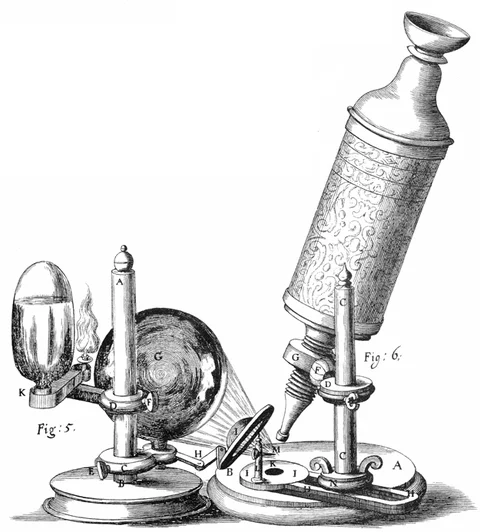 So not only did microscopes lead to a ton of new drugs, a ton of new, good, correct medical theories, and so on, stuff that's made both of you, both of us, you know, more healthy today, but it also led to better refinement of lenses. Literally, you know, having a microscope that could, you know, look at the microscope lenses made it easier to make more microscope lenses, and so on. And that isn't even to get into the whole history of software, where software that makes it easier to write software, or even software that automates part of the process of writing software…
That's been there since the beginning. That's been there since Alan Turing.44Alan Turing — the British mathematician who described a universal computing machine in 1936 and the "imitation game," now called the Turing test, in 1950. Chau dates software that helps write software back to him. And despite this, I think it's a very hard thing to imagine that you can have this burst of growth. You can be, you know, it's like, it's so over, we're so back, we're so back,45"It’s so over" / "We’re so back" — an X meme about the tech world’s mood swings: after every bad headline it feels like the end, after every good one like a new boom. and it feels like we're going to be back forever, but then it's so over again. And we see the cycle in economics. This has been the case for literally every single scientific field that has ever existed.
There's not been a single exception to this, ever: that initially, when you have major discoveries in the field, you have this scientific explosion. And this is genuinely, like, a miraculous thing. This is, like, a positive thing. You know, I don't want to underrate the economic or kind of, like, you know, real positive effect on lives. Not saying it doesn't matter, not saying that AI will hit a wall, but there's a big middle space there, where, yes, technologies will continue to improve, technologies will rapidly improve, and actually, even compared to previous technologies, commercialize much faster. But I think that, number one, if you look at all of these precedents throughout history, every single time, eventually, either because of over-regulation or just because the low-hanging fruit runs out, the technology slows down. Whether that's, you know, electrical circuits, whether that's, you know, plastics, whether that's other material sciences, whether that's vaccines, so on.
And there is this unfortunate and very counterintuitive tendency in history for technology to explode in this way, for it to seem like, oh, the utopia is finally here. You know, people expected we would have flying cars in 20 years.46Flying cars were a symbol of the future in 1950s and 1960s America. Peter Thiel later summed up the disappointment: "We wanted flying cars, instead we got 140 characters." And this is the key point: to overreact in the other direction, to take that progress for granted, to say, well, you know, even if we slow down a bit, we'll get, instead of, you know, 200% progress, we'll get 100% progress, and assume that will go on forever. And that tendency in American history has led to some of the greatest policy mistakes, that are continuing to make us poorer, that are continuing to make energy prices higher, by restricting, for example, nuclear energy production,47Restrictions on nuclear power. US regulation of nuclear plants tightened sharply in the 1970s, and after the Three Mile Island accident in 1979 no new reactors were started for decades: the first construction license since 1978 was granted only in 2012. In May 2025 Trump signed executive orders calling for US nuclear capacity to quadruple by 2050. something that only is beginning to be reversed in the Trump administration, like, 50 years after the initial restrictions, and so on and so forth. This is a mistake that has been made, and it's a very costly mistake.
08The case against Anthropic and the Bankman-Fried playbook
Chau thinks existing antitrust law is enough to deal with concentrated power at Anthropic.
So how should the government, if at all, go about preventing concentration of power in Anthropic specifically? It seems like Anthropic's mission48Anthropic’s mission, in the company’s own words, is to ensure that the world safely makes the transition through transformative AI. is to build recursively self-improving superintelligence and then use it to effectively take over the world.
Anthropic specifically has all sorts of anti-competitive practices. There was recently an allegation that they had explicitly targeted the employees of a competing, or, like, a related, like, AI financial assistant company,49The AI financial assistant is Silvia, a "personal AI CFO" from investor Anthony Pompliano. On November 5, 2026, when Anthropic launched Personal Finance in Claude, Pompliano posted on X that since April people from Anthropic had approached Silvia’s engineers, "fishing for details on how we built our product." Decrypt in order to essentially, like, steal information from that company and reverse engineer their product.
And so on and so forth, where they appeared to be taking a very risky approach, we should say, with their customers' data. And this is something that, of course, you know, whether it is a crime is something for courts and for investigators to decide. I'm not saying that it's definitely a crime, but, for example, Nvidia, Palantir, some other companies have restricted the use of Anthropic's models because they believe that Anthropic is not actually abiding by zero data retention policies.50Zero data retention — a condition for enterprise API customers that prompts and outputs aren’t stored after processing. In September 2026 The Information and Reuters reported that Nvidia had limited Anthropic’s models to less sensitive work and that Palantir wanted an irrevocable zero-retention commitment, after Anthropic began keeping some logs for up to 30 days to investigate attacks and misuse. FinanceFeeds Or they may be, you know, there's some… this is all just kind of, like, based on public reporting… other ways where they may be kind of, like, circumventing that rule and reusing that data anyway, in a way that may formally not violate the agreement, but in ways that these companies would still want to restrict access, you know, restrict access that Anthropic would have to their internal data.
In other words, there are plenty of, I think, existing laws that deal with this antitrust element, and of course deal with the antitrust problem itself, right? There are existing antitrust laws as well, even excluding other potential investigations. It goes to this kind of Sam Bankman-Fried51Sam Bankman-Fried — the founder of the crypto exchange FTX. In April 2022 he led Anthropic’s $580 million Series B; after FTX collapsed, the stake went to creditors and was sold in 2024. strategy, right? Of course, Bankman-Fried was one of the largest investors in Anthropic, led their Series B. And do you remember the thing that Bankman-Fried was doing right at the point when he got arrested? Or right at the point when FTX blew up?
I don't. Remind me.
So he was in Washington, DC, trying to pass a bill52The bill — the Digital Commodities Consumer Protection Act, which Bankman-Fried lobbied hard for in 2022: it would have put crypto exchanges under the Commodity Futures Trading Commission, and critics said it mainly suited FTX. In November 2022 FTX went bankrupt and it emerged that it had spent customers' money; Bankman-Fried was arrested in the Bahamas in December and sentenced to 25 years in 2024. that would grant him a regulatory monopoly on crypto exchanges. He was going up to US senators and saying, "Mr. Senator, we have the most safe, most compliant, most trustworthy crypto exchange." And literally a week later, this safe, you know, trustworthy crypto exchange went bankrupt and turned out to be stealing customer deposits.
And that same ideology very explicitly is part of Anthropic's founding, like, business model, and founding idea, founding concept of what they want to do with AI: that effective altruist mentality of, like, you know, you just keep flipping the coin,53Flipping the coin. Effective altruism is a movement that urges spending money and effort where they do the most good, treating good almost as an expected value; Bankman-Fried was its best-known funder. In a 2022 interview with Tyler Cowen he said he would keep playing a game in which the world doubles with 51% probability and vanishes with 49%. Anthropic’s early investors also included other people close to the movement, such as Jaan Tallinn and Dustin Moskovitz. you just keep flipping the coin, that's how you maximize utility. I think that that is an explicit, you know, that's stated in many of their interviews and public statements, explicitly part of their worldview.
Right. Well, we're coming up on time, but this has been very interesting, actually. Hopefully Jensen will find some way… you know, hopefully Jensen will pull through. Brian, thanks so much for coming on MTS.
Great to be here. And you are really doing God's work. It is because of people like you that we can, as a society, learn the truth so quickly.
Much appreciated. You too.
AdBlitzy, AdQuick, Arena, VCX
Thank you. A huge thanks to MTS sponsors. Blitzy, autonomous software development for enterprise codebases. Ship 5x faster. Blitzy.com. AdQuick, make your brand a billboard, out-of-home advertising as easy to scale as digital. Adquick.com.
Arena, measuring AI performance in the real world. Arena.ai.
Support for the show comes from VCX, the public ticker for private tech. The U.S. stock market started history's greatest wave of wealth creation. From factory workers in Detroit to farmers in Omaha, anyone could own a piece of the great American companies. But today, our most innovative companies are staying private longer, which means everyday Americans are missing out. Until now. Introducing VCX, a public ticker for private tech.
Visit getVCX.com for more info. That's getVCX.com. Carefully consider the investment material before investing, including objectives, risks, charges, and expenses. This and other information can be found in the Innovation Fund's prospectus at getVCX.com.
This is a paid sponsorship.


