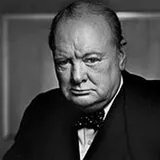
Winston Churchill
British statesman, soldier and writer (1874–1965), prime minister of the United Kingdom in 1940–1945 and 1951–1955, who led the country through the Second World War.
Born into the aristocratic Spencer family to an American mother, he served in the army in India and Sudan and went to the Boer War as a correspondent: in 1899 he was captured by the Boers and escaped, which made him famous. In Parliament from 1900, he switched parties twice: in 1904 from the Conservatives to the Liberals, and back in 1924. In the First World War, as First Lord of the Admiralty, he was responsible for the disastrous Dardanelles campaign, resigned and spent six months fighting on the Western Front; in 1925, as Chancellor of the Exchequer, he returned the pound to the gold standard, which hurt the economy. In the 1930s, his "wilderness years," he almost single-handedly demanded rearmament against Nazi Germany, and in May 1940 he replaced Chamberlain at the head of a wartime government; his speeches, with their promise of "blood, toil, tears and sweat," became the symbol of British resistance. In 1945 the Conservatives lost the election, and in 1946 in Fulton, Missouri, Churchill gave his speech about the "iron curtain" that had descended across Europe. In 1953 he received the Nobel Prize in Literature for his historical and biographical writing and his oratory. Historians rank him among the greatest British prime ministers, though his imperialism, his views on race and decisions like carpet bombing are still criticized.
In the episodes
3- October 26, 2026#438 James Garfield's Extraordinary RisementionedFounders
- 01:10the subject of Hero of the Empire
- September 9, 2026Jared Diamond on Leaders, Luck, and IrreplaceabilitymentionedConversations with Tyler
- 10:10both did things and prevented them
- May 2, 2026RolexmentionedAcquired
- 1:49:06the 100,000th Rolex chronometer