

Founders
Chapters
Candice Millard's book, as Senra describes it, is about Garfield's early life, his assassination and the fact that with modern medicine he would have survived.
Read the chapter- At 44 Garfield, a former professor of ancient languages, literature and mathematics, was a congressman who had just published an original mathematical proof.
- Candice Millard is one of Senra's favorite writers, and he has already covered her books on Theodore Roosevelt and the young Churchill.
- Garfield was the 20th president of the United States for just 199 days before he was assassinated.
- The book's other key figure is Joseph Lister, who traveled the world trying to convince doctors that their dirty hands and instruments were causing infection.
One idea runs through Garfield's life from the log cabin to the White House: education was his salvation.
Read the chapter- Garfield became a teacher, a college president, a Civil War general, a congressman and, against his will, president.
- Education lifted Garfield out of poverty, and Senra recalls Steve Jobs saying early in his career that books saved his life.
- For 28 years Garfield wrote down every evening how his day had gone, which is why the book is full of his words.
- Garfield felt he might owe a salute to any ragged boy in the street, since who knows what possibilities are buttoned up under his coat, and Senra recalls Jay-Z vowing to find and sign whoever is gunning for his spot.
Garfield grew up in desperate want but refused to romanticize it, saying "Let us never praise poverty," and understood early that learning was his only way out.
Read the chapter- His father died a few months after his 33rd birthday, leaving a widow with four children, and James was not yet two.
- James didn't get his first shoes until he was four, but he inherited an innate dignity from his mother.
- As a boy Garfield told his mother that no one would ask what coat he wore while studying, and if they did, he wouldn't be ashamed to say it was a ragged one.
- At 16 he left home to work on a canal boat, nearly drowned, caught malaria, and back home took the $17 his family had saved for his schooling, "as well as the advice."
Garfield pays for school by sweeping floors and quickly outpaces everyone.
Read the chapter- Senra compares Garfield to Will Hunting: in exchange for tuition he swept floors, hauled wood, rang the school bell and never hid his poverty.
- Garfield wrote of the "slumbering thunder" in his soul: his days ran from 5 a.m. to nearly midnight, any rival was a personal challenge, and his fiercest competition was himself.
- Within a year Garfield was an assistant teacher, at Williams College he resolved that 37 of his 42 classmates would soon be behind him, and by 26 he was president of his old school.
Politics and war ended Garfield's academic career, and a three-pronged ruse turned an inexperienced colonel into a general.
Read the chapter- In 1859 Garfield was offered the seat of an Ohio state senator who had died unexpectedly, and he won the election by a wide margin.
- Lincoln had to have Kentucky, and the hopelessly inexperienced Colonel Garfield was sent to win it back.
- Attacks from three directions convinced General Marshall that a huge army had surrounded him, and Garfield was made a brigadier general.
- Seeing dead soldiers, Garfield lost his "sense of the sacredness of life," yet he stayed a firm supporter of the war and an abolitionist.
Garfield goes to Congress at Lincoln's request and refuses to seek office for himself.
Read the chapter- Garfield took his seat in Congress only when Lincoln told him he needed men who knew what the army needed.
- Senra argues that the best leaders are often the ones others compel to lead, and Garfield is a case in point.
- Garfield never sought an appointment or promotion, and presidential fever, he wrote, destroys or impairs the usefulness of its victims.
At his party's convention, the hall chose not the man Garfield came to nominate but Garfield himself.
Read the chapter- Garfield's speech for Sherman was so strong that a cry of "We want Garfield!" rose from the crowd and kept growing.
- "They will ruin me," Garfield told his friends, and he protested votes cast for him without his consent.
- Garfield received 399 votes, 20 more than needed, and to congratulations he replied, "I am very sorry that this has become necessary."
Garfield never sought the presidency and barely campaigned, and he felt his victory as the loss of his old life with his books, his farm and his children.
Read the chapter- "This honor comes to me unsought," Garfield wrote, and he all but refused to go out campaigning.
- Garfield's books filled every room of his house, and in his free time he worked his fields and dreamed of studying agricultural chemistry.
- The presidency felt to Garfield not like an achievement but like "a bleak mountain," and on the eve of his inauguration he expected "the broadside of the world's wrath."
Senra sees Garfield as a genuinely good man in a corrosive environment he never sought: enemies, crowds of office seekers and a White House open to anyone.
Read the chapter- Garfield called himself a poor hater and held no grudges, but he was a very good fighter, which his opponent Conkling failed to grasp.
- Job hunters prowled the White House like "beasts at feeding time," while Garfield would rather have been reading in the Library of Congress.
- Anyone could walk into the White House and, after a long enough wait, often talk to the president.
Nobody protects the president, and he can't shake thoughts of an early death.
Read the chapter- Garfield's future assassin followed him around Washington many times, to church and on walks.
- Assassination, Garfield wrote, can no more be guarded against than death by lightning, so it's best not to worry about it.
- Lincoln's son, Garfield's secretary of war, told him about his father's prophetic dream of a coffin in the East Room.
- The cheerful Garfield had long felt he would die young and couldn't shake it.
American doctors brushed off Lister's antisepsis because they couldn't see germs and didn't believe in them.
Read the chapter- Bell's invention caught on at once, while Lister's discovery was dismissed.
- Deaths among Lister's surgical patients fell sharply, yet his theory was called absurd and harmful, and many respected scientists still mocked the idea of germs.
- In a cruel irony, the surgeon Frank Hamilton, who would one day hold Garfield's life in his hands and who preferred to leave wounds open, sat in Lister's audience.
The wound wasn't fatal; the treatment was.
Read the chapter- The bullet broke two ribs and grazed an artery but missed the spinal cord and the vital organs.
- On the floor of the train station Dr. Townsend stuck an unsterilized finger into the wound and almost certainly caused an infection.
- Dr. Bliss hunted for the bullet with an unsterilized probe, which got stuck between fragments of a broken rib, and then went into the wound with his little finger.
Had he been shot a few years later, Garfield would have lived.
Read the chapter- Garfield knew he was dying and, remembering his own fatherless childhood, tried to talk to his wife about the children, but she begged him not to speak of death.
- As a young man Garfield wrote that "great ideas travel slowly," and it came true for him: in other parts of the world Lister's ideas were already accepted.
- Fifteen years later an X-ray would have found the bullet, and today Garfield would likely spend no more than a few nights in the hospital.
- The bullet had become encased and was harmless, and hundreds of Civil War veterans lived with bullets in them because they got little or no treatment.
Garfield died at 49, and even then the country was slow to protect its presidents.
Read the chapter- Garfield worried not about himself but about the people he loved, and only to his wife did he admit he wondered whether the fight was worth "the little pinch of life" he would get.
- A journalist wrote that Garfield's stern face in his White House portrait couldn't tell visitors how he loved his sons, poetry and his friends.
- The Secret Service began guarding presidents only after McKinley's assassination in 1901, and Robert Todd Lincoln was present at three of the four presidential assassinations.
Quotes
Why Garfield respected ragged street kids
“I never meet a ragged boy in the street without feeling that I may owe him a salute, for I know not what possibilities may be buttoned up under his coat.”
David SenraRead from 04:02Student Garfield in his diary
“I am resolved to make a mark in the world. There is some of the slumbering thunder in my soul, and it shall come out.”
David SenraRead from 09:21On reluctant leaders
“Some of the best leaders are the ones who don't want to lead. They are compelled by others to lead, and that is definitely a case for Garfield.”
David SenraRead from 14:31How Garfield was nominated for president against his will
“Concerned friends spoke to Garfield in confidence. 'General, they are talking about nominating you.' Garfield replied, 'My God, I know it, I know it, and they will ruin me.'”
David SenraRead from 16:53Garfield on his political enemies
“Of course I detest war, but if it is brought to my door, the bringer will find me at home.”
David SenraRead from 23:35What the first doctor did to the wounded president
“As the president lay on the train station floor, one of the most germ-infested environments imaginable, Townsend inserted an unsterilized finger into the wound in his back, causing a small hemorrhage and almost certainly inducing an infection that was far more lethal than the bullet.”
David SenraRead from 29:41A line Garfield wrote as a young man that came true for him
“Great ideas travel slowly, and for a time noiselessly, as the gods whose feet were shod with wool.”
David SenraRead from 32:22Why the bullet didn't kill Garfield
“Even had Garfield simply been left alone, he almost certainly would have survived.”
David SenraRead from 33:03
Summary
James Garfield, the 20th president of the United States, held office for just 199 days. David Senra walks through Candice Millard's Destiny of the Republic, mostly in her words and in those of Garfield himself, who kept a diary for 28 years, and admits that before the book he knew almost nothing about a man with one of the most astonishing life stories in American history.
Garfield was born into poverty in a log cabin in Ohio and lost his father before he was two. Education was his way out: a former canal boy who nearly died of malaria became the school janitor, a year later one of its teachers, and by 26 its president. Then came the Ohio state senate, the Civil War, where a three-pronged ruse made him a general, and 17 years in Congress. He never wanted to be president: at his party's convention he was nominating someone else when the hall chose him instead. Senra draws two lessons: education is salvation, and the best leaders are often the ones others compel to lead.
The real tragedy, as Senra tells it, is that the bullet didn't kill Garfield; his doctors did. They dismissed Joseph Lister's antisepsis and probed the wound with unsterilized fingers and instruments, and 79 days later the president died of infection, even though the bullet itself had become encased and harmless. Had he been shot 15 years later, X-rays and antiseptic surgery would have saved him. And American presidents got a permanent guard only after William McKinley was assassinated in 1901.
Advice
Don't wave off the hungry newcomers who want your spot: Jay-Z, already running a record label, said he would find that kid and sign him; better to bring a future rival onto your side than to fight him later.
Mentioned
 James Garfield00:00the subject of the episode
- Destiny of the Republic: A Tale of Madness, Medicine and the Murder of a President00:44the book the episode is based on
 Candice Millard00:44the author of the book
- The River of Doubt: Theodore Roosevelt's Darkest Journey01:10Millard's book, Founders episode 175
Show 13 more mentionsShow fewer mentions
 Theodore Roosevelt01:10the subject of The River of Doubt
- Hero of the Empire: The Boer War, a Daring Escape, and the Making of Winston Churchill01:10Millard's book, Founders episode 319
 Winston Churchill01:10the subject of Hero of the Empire
 Joseph Lister01:32tried to convince doctors of the value of antisepsis
 Steve Jobs02:50books saved his life
 Jay-Z04:02"I'm going to find him and I'm going to sign him"
- Good Will Hunting08:39a self-taught janitor, like Garfield
 Abraham Lincoln12:01Kentucky, the request to take a seat in Congress, the prophetic dream
 Roscoe Conkling23:04Garfield's opponent
 Robert Todd Lincoln25:16Garfield's secretary of war, said to have been present at three presidential assassinations
 Alexander Graham Bell27:12his telephone caught on at once, unlike Lister's discovery
 Doctor Willard Bliss30:23searched for the bullet with an unsterilized probe
 William McKinley36:36after his assassination the Secret Service began protecting presidents
Sponsors of the episode


Transcript
01A president for 199 days
Candice Millard's book, as Senra describes it, is about Garfield's early life, his assassination and the fact that with modern medicine he would have survived.
"At just 44 years of age, he had already defied all odds. Born into extreme poverty in a log cabin1Log cabin — since the early 19th century, the symbol of humble origins in American politics: at least seven US presidents were born in one, including Andrew Jackson, Abraham Lincoln and Garfield. In 1840 the Whigs made the cabin the emblem of William Henry Harrison's campaign, though he himself was not born in one. This engraving of Garfield’s Ohio cabin appeared in Appletons’ Cyclopædia of American Biography in 1892.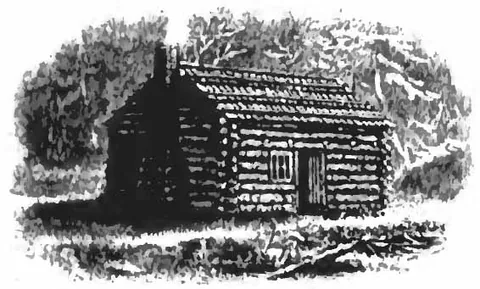 in rural Ohio and fatherless before his second birthday, he had risen quickly through the layers of society, not with aggression or even ambition, but with a passionate love of learning that would define his life. Garfield was a former professor of ancient languages, literature, and mathematics who had paid for his first year of college by working as a janitor. Garfield's interest and abilities were as deep as they were broad. In fact, so detailed was his interest in mathematics that he had recently written an original proof that the New England Journal of Education had published just a month before. The journal was astonished that a member of Congress had written it.2Garfield's proof — Garfield was 44 in 1876, when he was a congressman from Ohio. On April 1, 1876, the New England Journal of Education printed his proof of the Pythagorean theorem: the area of a right trapezoid made of three right triangles is calculated in two ways. Wikipedia."
"In Garfield's experience, education was salvation. It had freed him from grinding poverty. It had shaped his mind, forged paths, and created opportunities where once there had been none." So that is an excerpt from the book that I want to talk to you about today, which is Destiny of the Republic: A Tale of Madness, Medicine, and the Murder of a President.3Destiny of the Republic: A Tale of Madness, Medicine and the Murder of a President (2011) — a book by the American writer and journalist Candice Millard about James Garfield, his assassination and the doctors who treated him. And it was written by Candice Millard. Candice Millard is one of my favorite authors.
She wrote this book called The River of Doubt, which I covered all the way back on episode 175.4The River of Doubt (2005) is less a biography of Roosevelt than the story of one expedition: in 1913–1914, after his presidency, he and the Brazilian explorer Cândido Rondon traveled down the uncharted River of Doubt in the Amazon jungle. The river is now called the Roosevelt. It's about Theodore Roosevelt. It's a biography of Theodore Roosevelt. And then she also wrote a biography of the first, I think, 25 or 26 years of Winston Churchill's life. It's called Hero of the Empire, and that is episode 319.5Hero of the Empire (2016) — a book about the young Churchill in the Boer War: in 1899, as a war correspondent, he was captured by the Boers and escaped, which made him famous. And so before picking up this book — and I picked it up because Candice wrote it — I did not know much about James Garfield.
He was the 20th president of the United States. He was only president for 199 days6199 days — Garfield took office on March 4, 1881, was shot on July 2 and died on September 19, 79 days after the attack. The 199 days are his whole time in office, those weeks included. before he was assassinated. So the book is about his early life, the assassination, and then the fact that he would have survived if he had access to modern medicine. So there's another guy in the book that plays a prominent role, a guy named Joseph Lister.7Joseph Lister (1827–1912) — British surgeon and the founder of antisepsis: in 1867 he proposed disinfecting wounds, instruments and surgeons' hands with carbolic acid. He's the one that went across the world trying to educate doctors that you need to wash your hands, that you're actually infecting — that infection — you're putting your dirty, unsterilized — the equipment that you use to maybe operate on your patients, that is what's actually — you're inducing infection, that's what actually is killing the people. So this is exactly what happened to James Garfield.
02Education as salvation
One idea runs through Garfield's life from the log cabin to the White House: education was his salvation.
But what was more remarkable — again, I didn't know much about him before I picked up the book. So I'm just going to give you a brief overview of his life before I jump back into the book. It is incredible. So it says, "He was one of the most remarkable self-made figures in American presidential history. He was born into poverty in a log cabin in Ohio. He became a teacher, a college president, a Civil War general,8The American Civil War (1861–1865) — the war between the Northern states and the Southern states that had seceded to preserve slavery. It ended in the North's victory and the abolition of slavery nationwide. a congressman, and eventually president."
And wait till we get to the part — he becomes president against his will. He did not want to run for president. He was called to lead. He's born in extreme poverty, he educated himself out of that poverty. There's also another — what I think is one of the most fascinating parts of the story is that it says, "Garfield's rise was extraordinary even before he became president."
"He went from working as a school janitor to leading the very institution where he had studied, then became a general and a national political leader. His death also raises a remarkable historical question: would Garfield have survived if his doctors had understood modern infection control?" Which, of course, by the end of the book, that becomes obvious. But I wanted to talk about that, because this is what jumps out — obviously, you and I talk about a lot of these characters in these stories that are in these biographies — is the fact that education was salvation. Steve Jobs said early in his career that he thought books saved his life.
You would hear that over and over again. But I want to read this part to you again: "In Garfield's experience, education was salvation. It had freed him from grinding poverty. It had shaped his mind, forged paths, and created opportunities where once there had been none." So one of the most remarkable parts of the book is there's a bunch of direct quotes from Garfield's own writing, because for 28 years, he sat down every night and essentially recounted his day and his thoughts in his diary. And so as a result of the fact that he wrote in his diary and his journal for 28 years, we get all these great quotes from things that he wrote. And in this quote, he's describing somebody else, but this is a great example — you can't take the boy out of the man.
"I never meet a ragged boy in the street without feeling that I may owe him a salute, for I know not what possibilities may be buttoned up under his coat." And so I've heard Jay-Z say something one time that I really liked. And he was talking about — you know, he's already really successful, and at that point he was running a record label9Jay-Z cofounded the label Roc-A-Fella Records in 1995 and was president of Def Jam Recordings from 2004 to 2007. — and he talked about the fact that, you know, he goes, "There's somebody out there. There's somebody at the table right now, sitting, eating cereal, looking at the back of the cereal box, and they're writing rhymes, and they want my spot." And then Jay-Z says something that's really interesting. He goes, "I'm going to find him and I'm going to sign him. I don't want any trouble."
And so what he's talking about is, it's like, I know that's the case because I — 10, 15, 20 years — I was that person. And so when I read this, this is what I really think: he's just like — he was a ragged boy in the street. And just like James Garfield says, I owe him a salute, because I know not what possibilities may be buttoned up under his coat, into his future. There's no way Garfield could have predicted when he was a young man, being born in poverty into a log cabin, that his life would turn out the way it did. And so let's go into his early life.
03A childhood in poverty
Garfield grew up in desperate want but refused to romanticize it, saying "Let us never praise poverty," and understood early that learning was his only way out.
It says, "James Garfield's father died just a few months after his 33rd birthday. He would die in a log cabin that he had built four years earlier. It consisted of one room, three small windows, and a rough wooden plank floor. The gaps between the logs were filled with clay in a futile attempt to shut out the brutal Ohio winters. His father's death left his mother, Eliza, with four children to feed. Their youngest son, James, was not yet two years old."
And then we see an example of just how great a writer Candice Millard is. "There would come a time when the story of James Garfield's early life would be widely admired. His extraordinary rise from fatherlessness and abject poverty would make him the embodiment of the American dream. Garfield refused to romanticize his childhood. He said, 'Let us never praise poverty.' Garfield was raised in desperate circumstances."
"His mother, left with debts she could not hope to pay after her husband's death, was forced to sell much of their land. What was left, she farmed herself with the help of her oldest son, James's 11-year-old brother Thomas. James did not have a pair of shoes until he was four years old. Although Garfield understood clearly that he was poor, he had inherited from his mother an innate dignity." And listen to what he says to his mother as a young boy when he asks to go to school. Again, there's something that he just understood — that education, the "I have to learn my way out of this." "If I ever get through a course of study, I don't expect anyone will ask me what kind of coat I wore when studying."
"And if they do, I shall not be ashamed to tell them it was a ragged one." And so he doesn't think he can go to college. He has to support himself, he has to work, so he leaves home at 16 years old and he becomes a canal man.10Canal man — Garfield drove the mules that towed a canal boat; after six weeks, illness forced him to return home. It's a very — essentially you're driving boats on a canal. And this describes the people he was working with: "He had the lowliest position among a group of rough and violent men." And so they're on cold bodies of water, and when he's a very young man — he's still a teenager — he falls into the water and almost drowns, and then contracts malaria and almost dies.
So he returns home after his near drowning, "a changed man, but also a very sick one. He had contracted malaria on the canal, and by the time he reached his family's log cabin, he could barely walk. For two months, he was bedridden, and no one would know if he would survive. Since James had been gone, his mother and older brother had managed to save $17, and they hoped that he would use it to go to school. 'I took the money,' Garfield wrote, 'as well as the advice.'"
AdRamp
Before we get back into this, I want to tell you about the presenting sponsor of this podcast, Ramp. I have been reading a lot about SpaceX lately. SpaceX is one of the most valuable businesses in the world, and one of the main themes in the history of SpaceX is constantly attacking and questioning your cost. Ramp helps many of the most innovative businesses in the world do exactly that. And they do this by using first principles thinking.aFirst principles thinking — breaking a problem down to basic facts and building the solution from scratch rather than by analogy with what others do. In business the approach was popularized by Elon Musk, including with the example of SpaceX's rocket costs. The median company running on Ramp cuts their expenses by 5%. And one thing that SpaceX has demonstrated is that a religious dedication to controlling your cost helps increase revenue, because you can pursue opportunities you couldn't otherwise.
And we see that in the Ramp data too. The median company running on Ramp also grows their revenue by 16%. So when you're running your business on Ramp and your competitors are not, you have a massive competitive advantage that compounds over time. Ramp is the only platform designed to make your finance team faster and happier. Many of the top founders and CEOs that I know run their business on Ramp. I run my business on Ramp, and you should too.
Go to ramp.com today to learn how they can help your business save time, save money, and grow revenue. That is ramp.com.
04From janitor to head of the school
Garfield pays for school by sweeping floors and quickly outpaces everyone.
This is the changing point of his life. It reminds me — if you've ever seen the movie Good Will Hunting11Good Will Hunting (1997) — Gus Van Sant's film, written by Matt Damon and Ben Affleck. Its hero works as a janitor at MIT and secretly solves the hardest math problems. — reminds me of Will Hunting. "Garfield had transformed from a rough canal man into a passionate and determined student. Unable to afford tuition, he convinced the school to allow him to work as a janitor in exchange for his education."
"He swept floors, hauled wood, and made fires, and he never tried to hide his poverty from his fellow students. As he walked to the tower every morning, having left the first lecture of the day early so he could ring the school's enormous bell, his tread was 'firm and free,' he wrote. Garfield quickly realized that he was an extraordinarily talented student, and the more he learned, the more ambitious he became." And he's just a fantastic writer. He says — he's writing this, again, in his diary — "The ice is broken."
"I am resolved to make a mark in the world. There is some of the slumbering thunder in my soul, and it shall come out." "His day began at 5 a.m. and it continued unabated with studying, classes, work, and more studying until just before midnight. No one worked harder, and if they came close, Garfield took it as a personal challenge." Direct quote from Garfield:
"If at any time I began to flag in my effort to master a subject, I was stimulated to further effort by the thought that some other fellow in the class will probably master it." "As determined as Garfield was to outpace his fellow students, his fiercest competition was with himself. He had a great desire and settled purpose to conquer, to master all lessons, to prove superior to every difficulty, to excel all competitors, and to conquer and surpass himself. So vigorously did Garfield apply himself during the first year that by the second year, the school had promoted him from janitor to assistant professor." Now do you see what I mean? Like, I'm somewhat embarrassed.
I didn't know. He's the 20th president of the United States, and had no idea of this remarkable — one of the most remarkable lives ever lived — and the fact that it was cut short by this coward and psycho,12Charles Guiteau — the man who shot Garfield: a failed lawyer and preacher who had tried in vain to get a consulship from the new administration. He was hanged in 1882. which, again, is a huge part of the book, is so — it's just unbelievably sad. Goes from janitor to assistant professor in a year. "Along with the subjects he was taking as a student, he was given a full roster of classes to teach, including literature, mathematics, and ancient languages." And then eventually he does so well at the smaller school he gets to go to a better school. So, "In 1854, Garfield was accepted to Williams College,13Williams College — a private liberal arts college in Williamstown, Massachusetts, founded in 1793; one of the most prestigious in the US. where the competition was greater than he had ever experienced, and this stirred in him an even fiercer ambition."
The direct quote from Garfield: "There is a high standard of scholarship here, and very many excellent scholars, those that have had far better advantages and more thorough training than I have," he wrote to a friend. "I have been endeavoring to calculate their dimensions and power, and I have determined that out of 42 members of my class, 37 shall stand behind me within two months." You ready for this? This is crazy. By the time he was 26, he was that school's president.14That school is not Williams College but the Western Reserve Eclectic Institute in Hiram, Ohio (now Hiram College). Garfield enrolled there in 1851 and worked as a janitor; in 1854 he transferred straight into the junior class at Williams College in Massachusetts, graduated in 1856, returned to Hiram to teach, and in 1857 became head of the institute.
05Politics and war
Politics and war ended Garfield's academic career, and a three-pronged ruse turned an inexperienced colonel into a general.
That is incredible. "But then two things ended Garfield's academic career: politics and war. When an Ohio state senator15The Ohio Senate — the upper house of the Ohio legislature, not the US Senate. Garfield would reach Congress later, in the House of Representatives. died unexpectedly in 1859, Garfield was asked to take his place in an upcoming election. Two months later, he won the election by a wide margin, quietly beginning a career that in the end would lead him to the White House. A year after Garfield entered politics, the country was plunged into civil war. Garfield was anxious to join the battlefield."
"He was made a lieutenant colonel in the Union Army.16The Union — in the Civil War, the federal government and the states loyal to it. It fought the Confederacy, the 11 Southern slave states that had left the United States; Northerners called the Confederates rebels. Soon after, at 30 years of age, he was promoted to colonel." At this point, Abraham Lincoln is still alive. Abraham Lincoln famously said, "I hope to have God on my side, but I must have Kentucky."17"I hope to have God on my side, but I must have Kentucky" — there is no reliable source for this line. What does survive is Lincoln's letter to Orville Browning of September 22, 1861: "I think to lose Kentucky is nearly the same as to lose the whole game." So Garfield was actually sent to win Kentucky for the Union Army. "Although he was hopelessly inexperienced, outmanned, and outgunned, Garfield accepted the assignment."
"After he received his orders, he worked through the night, hunched over a map of eastern Kentucky. By morning, he was ready to set out. Garfield created a military strategy that some would call brilliant and others would call audacious." His idea was to do this: "He divided his already small regiment into three even smaller groups. The plan was to attack the rebels from three different sides, thus giving the impression of a regiment that was much larger and better equipped than his."
"Incredibly, Marshall" — who's the person, the general he's fighting18Marshall — Confederate brigadier general Humphrey Marshall. This is the Battle of Middle Creek, January 10, 1862: Garfield had about 2,100 men, Marshall about 2,500. — "believed everything Garfield wanted him to and more. When Garfield's first detachment attacked the Confederates, as expected, they confidently rushed to meet them. Then a second force fell upon the rebels from a different direction, throwing them into disarray and confusion. Just as they were beginning to figure out how to fight on two fronts, Garfield attacked on a third. Convinced that a mighty army had surrounded him, Marshall ordered his men to retreat, leaving Kentucky solidly in Union hands. This battle made Garfield famous and resulted in his swift promotion to brigadier general."
"When the fighting had ended and when his gamble had paid off, Garfield learned the truth about war. Stepping into a clearing, he saw what at first he took to be soldiers sleeping. He would never forget how they looked. The impression of peace and tranquility that had formed in his mind was replaced by the sickening realization that the young men before him were not resting but dead. It was in that moment, Garfield would later tell a friend, that something went out of him that never came back: 'the sense of the sacredness of life and the impossibility of destroying it.' As painful as it was for Garfield to witness the death of his young soldiers, he remained firmly committed to the war, determined that it would end in Confederate defeat."
06Immune to presidential fever
Garfield goes to Congress at Lincoln's request and refuses to seek office for himself.
He wrote, quote, "By thundering volley must this rebellion be met, and by such means alone." Garfield was an ardent abolitionist.19Abolitionism — the movement to end slavery. In the US, slavery was finally abolished by the 13th Amendment to the Constitution, ratified in 1865. Ten months after this battle, Garfield was elected to the U.S. Congress. Garfield would not take his congressional seat until more than a year later, when Abraham Lincoln asked him to. Up until that point, he refused to leave the battlefield.
He wrote, "I have resigned my place in the army and have taken my seat in Congress. The president told me he dared not risk a single vote in the House, and he needed men in Congress who were practically acquainted with the wants of the army. I did not feel a right to consult my own preference in such a case." And then the book goes into detail about all these different causes that Garfield would fight for. And I want to read you this section, though, because I do think there's an element to — you know, some of the best leaders are the ones who don't want to lead. They are compelled by others to lead, and that is definitely a case for Garfield.
"Inexplicably, it seemed that the only cause for which Garfield would not fight was his own political future. In an early-adopted eccentricity that would become for him a central law of life, he refused to seek an appointment or promotion of any kind. 'I suppose I am morbidly sensitive about any reference to my own achievements,' he admitted." And then this is going to give us a preview of the fact that he did not want to become president. And again, him becoming president against his will causes him to lose his life 199 days after he was inaugurated. "When it came to the presidency, Garfield simply looked the other way."
"He had spent 17 years in Congress, and he saw men whose desperate desire for the White House ruined their careers, their character, and their lives. 'I have so long and so often seen the evil effects of the presidential fever upon my associates and friends that I am determined it shall not seize me,' he wrote. 'In almost every case, it impairs, if it does not destroy, the usefulness of its victim.'" And so every chapter starts with a quote written by Garfield, and this is one of my favorite ones. It says, "Quiet is no certain pledge of permanence and safety. Trees may flourish and flowers may bloom upon the quiet mountainside, while silently the trickling raindrops are filling the deep cavern behind its rocky barriers, which, by and by, in a single moment, shall hurl to wild ruin its treacherous peace."
07The unwilling nominee
At his party's convention, the hall chose not the man Garfield came to nominate but Garfield himself.
And that is the quote that begins the chapter where he goes to the convention,20The Republican convention met in Chicago on June 2–8, 1880. Garfield nominated Treasury Secretary John Sherman; the main contenders were former president Ulysses S. Grant, backed by the Stalwarts under Senator Roscoe Conkling, and Senator James Blaine. Garfield was nominated on the 36th ballot, when Blaine and Sherman urged their supporters to vote for him. hoping to elect a nominee for his party, and gives a speech so compelling that the crowd decides that he should be the nominee. And so at the end of the speech, something happens that Garfield does not want to happen. "Garfield asked a simple question: 'And now, gentlemen of the convention, what do we want?' From the midst of the crowd came an unexpected and, for Garfield, unwelcome answer: 'We want Garfield.'"
What starts out as just one person saying something starts to build on itself, build on itself, build on itself. And then his friend comes to him. "Concerned friends spoke to Garfield in confidence. 'General, they are talking about nominating you.' Garfield replied, 'My God, I know it, I know it, and they will ruin me.'" He said simply, "I am going to vote for Sherman, and I will be loyal to him. My name must not be used."
He was giving a speech trying to nominate Sherman, and he was so good at it and had such a profound way of speaking and leading that the convention starts to ditch Sherman and every single other nominee, and against his will, start to vote for Garfield. And this goes over several pages, and you see stuff like this, and you hear things like this from Garfield: "The announcement contains votes for me. No man has a right, without the consent of the person voted for, to announce that person's name and vote for him. Such consent I have not given." Few pages later, he could not stop what was happening.
"The last state was called, and Garfield was left with 399 votes, 20 more than was needed to win. Having never agreed to become even a candidate — on the contrary, having vigorously resisted it — he was suddenly the nominee." A friend comes up to him and says, "General, we congratulate you." Garfield replied, "I am very sorry that this has become necessary." And then just another banger line from his journal: "Theologians in all ages have looked out admiringly upon the material universe and demonstrated the power, wisdom, and goodness of God."
08The bleak mountain
Garfield never sought the presidency and barely campaigned, and he felt his victory as the loss of his old life with his books, his farm and his children.
"But we know of no one who has demonstrated the same attributes from the history of the human race." And so then the book goes into the story of this presidential contest that Garfield is now, against his will, engaged in. Another line from his journal at the beginning of this chapter: "This honor comes to me unsought. I have never had the presidential fever, not even for a day." And so he almost somewhat refuses to go out and campaign.21A front-porch campaign — that is how Garfield ran in 1880: he barely left home and received delegations and reporters at his farm in Mentor, Ohio.
Some reporters go to his house — it's a very modest house — and they notice... Again, something I admire most about him is the fact that he said, hey, I was born into a very bad position, there's only one way out, and that is through the salvation of education. So he's a voracious reader. "Garfield's books filled every room. 'You can go nowhere in the general's home without coming face to face with books.'" And when he wasn't reading, he liked to cultivate his land.
"Happily left to his own devices, Garfield poured his time and energy into his farm. He worked in the fields, planting, hoeing, and harvesting crops." He said, "I long for time to study agricultural chemistry and make experiments with soils and forces." This goes back to the idea that some of the greatest leaders are the ones that are compelled to lead. They do not — they did not seek their positions for the sake of themselves. "Garfield could not shake the feeling that the presidency would bring him only loneliness and sorrow as he watched everything he treasured — his time with his children, his books, and his farm — abruptly disappear."
"He understood that the life he had known was gone. The presidency seemed to him not a great accomplishment, but," quote, "'a bleak mountain' that he was obliged to ascend. Sitting down at his desk in a rare moment to himself, he tried to explain in a letter to a friend the strange sense of loss he had felt since the election." And this is what he wrote: "There is a tone of sadness running through this triumph, which I can hardly explain." And then another great line about — those on the margins often come to control the center: "To a young man who has in himself the magnificent possibilities of life,"
"it is not fitting that he should be permanently commanded. He should be a commander." And so this is what he writes to himself the day before he's going to be inaugurated. He says, "Tonight I am a private citizen. Tomorrow I should be called to assume new responsibilities, and on the day after, the broadside of the world's wrath will strike. It will strike hard. I know it, and you will know it."
AdAppLovin, Vanta
And before we get back into this, I want to tell you about AppLovin. One of my all-time favorite quotes is from the book Zero to One.bZero to One (2014) — Peter Thiel's book, written with Blake Masters from notes on the startup course Thiel taught at Stanford in 2012. In that book, Peter Thiel writes — he says, "The single most powerful pattern I have noticed is that successful people find value in unexpected places, and they do this by thinking about business from first principles instead of formulas." And that is exactly what AppLovin has done with their advertising platform. AppLovin connects you with over a billion potential new customers in mobile games.
AppLovin allows you to capture undivided attention. AppLovin ads are full-screen videos that are watched for an average of 35 seconds. That is retention that blows other ad platforms out of the water, and you can launch on AppLovin in minutes. You set the goal, and AppLovin achieves it. No complex setup, no expertise needed. And AppLovin scales quickly.
They can put your ads in front of over a billion potential customers. Other businesses have seen immediate results, scaled to hundreds of thousands of dollars of spend per day, and increased their revenue by millions. So you want to get started quickly, before all of your competitors are on AppLovin. And you can do that by going to applovin.com. That's applovin.com.
And then I want to tell you about Vanta. Vanta, Vanta, Vanta. Vanta helps your company prove you're secure, so more customers will use your product or service. Vanta is an AI-powered security expert that scales with you. The more your business grows, the more complex your security needs get, and that complexity turns into chaos. Vanta tames that chaos for you.
Vanta automates compliance,cCompliance — meeting laws, industry standards and security requirements. For software companies it mostly means audits like SOC 2, which large customers demand before signing a contract. continuously monitors your controls, and gives you a single source of truth for compliance and risk. So whether you're a fast-growing startup or an enterprise company, Vanta fits easily into your existing workflows. Many companies won't sign contracts unless you're certified, and this is causing you to lose out on sales. That is why the average Vanta customer reports a 526% return on investment after becoming a Vanta customer. Automate your compliance, security, and trust with Vanta. Vanta will help you win trust, close deals, and stay secure faster and with less effort.
Go to vanta.com/founders and you'll get a thousand dollars off. That is vanta.com/founders.
09A good man in a corrosive place
Senra sees Garfield as a genuinely good man in a corrosive environment he never sought: enemies, crowds of office seekers and a White House open to anyone.
And so a huge part of the book before he's shot is just — you have this, what I feel is like a truly good man in this unbelievably corrosive, almost like evil environment. One that he did not seek, one that he did not want. And so there's just a bunch of descriptions of him dealing with this environment and the new responsibilities that come with being the president of the United States, obviously. And I think there's just, like, some descriptions that give you an indication of, like, what kind of person he was.
So it says, "He never rose to the bait, nor was Garfield capable of carrying a grudge, a character trait that neither Conkling nor Blaine22Roscoe Conkling (1829–1888) — senator from New York and leader of the Stalwarts, the Republican faction that clung to handing out government jobs to its supporters. In May 1881 he resigned from the Senate in protest against Garfield's appointments in New York. James Blaine (1830–1893) was Garfield's secretary of state and his ally. could begin to understand." So these are some of the people that he's having, you know, these battles with, and that were trying essentially to work against him. "Garfield said, 'I am a poor hater.' He shrugged. What Conkling did not understand, however, was that while Garfield was a poor hater, he was a very good fighter. He had never before walked away from a fight, and he was not about to do so now."
And so Garfield writes, "Of course I detest war, but if it is brought to my door, the bringer will find me at home." His days are now filled with people asking for favors, seeking office;23Office seekers — a product of the spoils system, in which the winning party handed out federal jobs to its supporters. Garfield's assassin was one such office seeker. After the assassination, in January 1883, Congress passed the Pendleton Act: most federal jobs were now to be filled on merit rather than party loyalty. he's having to play politics. What he really wanted to do was actually sit in the Library of Congress and read. And so when he — remember, he was in Congress, I think, for 17 years before he was president — and there's this great description of Garfield by the librarian of the Library of Congress, who knew Garfield well and said he would rank him among the most diligent researchers he had ever met.24The Librarian of Congress from 1864 to 1897 was Ainsworth Rand Spofford. He was friends with several Ohio congressmen, Garfield among them, and privately bought books for them. There's also a bunch of lines from Garfield being excessively worried about the damage that him being president could do to himself and his family. He writes, "Whatever fate may await me, I am resolved, if possible, to save my children from being injured by my presidency."
"For Garfield, who treasured time not just to work but to read and think, the situation was untenable. 'My God,' he wrote after a day spent wrestling with office seekers, 'what is there in this place that a man should ever want to get into it?' So voracious were the people who prowled the halls of the White House searching for a job that they sounded like nothing more than," quote, "'beasts at feeding time.' 'These people would take my very brains, flesh, and blood if they could.'" And so one of the most remarkable things about this time in history that's very different from the world that you and I live in is the fact that, you know, you could just walk into the White House and say, "I need an appointment with the president."
10No guards, dark premonitions
Nobody protects the president, and he can't shake thoughts of an early death.
And if you waited long enough — sometimes you wait all day and he wouldn't get to you — but in many cases he would just talk to you. And this is what he's talking about, these office seekers. And then there's no such thing as — there's no presidential protection. You know, this is after Lincoln was assassinated. They don't even have presidential protection even after Garfield was assassinated too. And so he's walking around Washington, D.C.
ExplainerCharles Guiteau: the office seeker who became an assassin
In the summer of 1880 Guiteau wrote a speech called "Grant against Hancock", and when Garfield became the Republican nominee he swapped in the new name almost mechanically, producing "Garfield against Hancock". He delivered it twice at most, but handed out printed copies and convinced himself that he had won Garfield the election.
As his reward he wanted a consulship, first in Vienna, then he was willing to "settle" for Paris. From March 5, 1881, the day after the inauguration, he haunted the White House and the State Department; on May 13 he was banned from the White House waiting room, and Secretary of State Blaine told him never to speak to him about the Paris consulship again.
Guiteau then decided that a higher power was commanding him to kill the President. With $15 he had borrowed he bought a British Bulldog revolver (he wanted the ivory grip because it would look better in a museum) and spent all of June following Garfield around Washington. After the shooting he shouted: "I am a Stalwart of the Stalwarts! Arthur is President now!"
At the trial his defense argued insanity, while Guiteau himself declared: "The doctors killed Garfield, I just shot him." The jury found him guilty on January 25, 1882, and he was hanged on June 30.
all the time, and his would-be assassin winds up, you know, following him many, many times — at church and on walks with other people in his cabinet — and, you know, essentially just, like, would follow him around the city. And so people were obviously fearful of this because multiple presidents had been shot.25Presidents had been shot at before, but before Garfield the only US president killed by a gunman was Lincoln, in 1865. In 1835 a man tried to shoot Andrew Jackson at point-blank range, but both his pistols misfired. And Garfield wrote this: "Assassination can be no more guarded against than death by lightning, and it is best not to worry about it either." But in many cases he did worry about it. So there's something that he shares in common with Lincoln: they both had premonitions of an early death. In fact, Garfield's secretary of war was Abraham Lincoln's oldest and only surviving son.26Robert Todd Lincoln (1843–1926) — the only one of Abraham Lincoln's four sons to live to adulthood. He was secretary of war under Garfield and Chester Arthur from 1881 to 1885.
And he told this story to Garfield, that his father had a prophetic dream shortly before his assassination. And it says, "After he'd fallen asleep one night, Abraham Lincoln had a dream in which 'there was a death-like stillness about me,' he said. Within the stillness, however, he could hear subdued sobs. Leaving his room, he searched the White House for the source of the weeping, but every room he entered was empty. Finally, stepping into the East Room,27The East Room — the largest room in the White House residence, used for receptions and ceremonies. In April 1865 the coffin of the assassinated Lincoln lay there. he saw a coffin that was guarded by soldiers. 'Who is dead in the White House?'"
"he asked. 'Why, don't you know?' one of the soldiers replied. 'The president had been assassinated.' Lincoln had believed deeply in dreams, seeing in them omens that he dared not ignore."28Lincoln's prophetic dream is known from the memoir of his friend Ward Hill Lamon, Recollections of Abraham Lincoln (1895): according to Lamon, Lincoln told of it shortly before his death. We see Garfield had premonitions about this as well. "His own death was often on Garfield's mind."
"Although he was by nature a cheerful and optimistic man, he had long felt that he would die an early death. When his friends tried to talk him out of this grim conviction, his only answer was that 'the thought seemed to him as foolish as it does to you.' Nonetheless, he could not shake it. 'I do not know why it haunts me,' he said. 'I feel it so strong upon me that the vision is in the form of a warning that I cannot treat lightly.'" And so then, before you and I get to where Garfield is shot, I need to go back in the book and introduce a character named Joseph Lister.
11Lister, unheard
American doctors brushed off Lister's antisepsis because they couldn't see germs and didn't believe in them.
Candice does a great job of weaving Garfield's story with his assassin, with Joseph Lister, and with Alexander Graham Bell,29Alexander Graham Bell (1847–1922) — the inventor who patented the first practical telephone. In the summer of 1881 he tried to locate the bullet in the wounded Garfield with an induction-balance metal detector he devised for the purpose, but failed: the bullet was lodged too deep. and how they're all related around this assassination of James Garfield. And so at the time where Alexander Graham Bell is inventing the telephone, it says, "While Bell's technological innovation caught fire in an instant of understanding, Joseph Lister's discovery, one of the most important advances in medical history, was dismissed." Lister was British. It says, "The British surgeon struggled to convince his audience,30Lister's lecture — this was in 1876, when Philadelphia celebrated the centennial of American independence. That summer Bell showed his telephone at the Centennial Exhibition, and in September, in the same city, Lister spoke at the International Medical Congress, where he presided over the surgery section. a collection of the most experienced and admired physicians and surgeons in the United States, of the critical importance of antisepsis, preventing infection by destroying germs. Almost none of them seriously considered putting his theory into practice. At this time, many well-respected scientists still scoffed at the idea of germs."31Germ theory — the idea that infectious diseases are caused by microorganisms. Lister built antisepsis on the work of the French chemist Louis Pasteur, who showed that fermentation and putrefaction are caused by living organisms. In the 1882 engraving, the sprayer on the left bathes the surgeon’s hands and the wound in a mist of carbolic acid solution.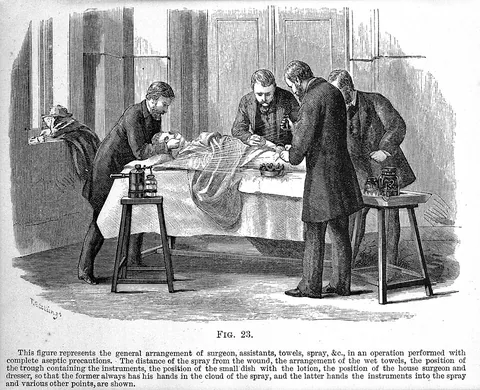
"Lister's time-consuming and complicated system for destroying them seemed ridiculous. Lister, however, knew that the difference between his method and the old method was the difference between life and death. Although the results were dramatic — the death rate among Lister's surgical patients immediately plummeted — antisepsis had provoked reactions of deep skepticism and even fury. Lister had been forced repeatedly to defend his theory against attacks from enraged doctors. 'The whole theory of antisepsis is not only absurd,' one surgeon seethed, 'it is a positive injury.' Another charged that Lister's methods would be 'a return to the darkest days of ancient surgery.'"
"Most American doctors simply shrugged off Lister's findings, uninterested and unimpressed." And this is why: "The dangers that Lister described could not be seen by the naked eye, and many of the doctors in the audience did not believe that they existed." And in a cruel twist of fate, as Lister is giving this lecture, it says, "Seated in the audience, listening to Lister, was Dr. Frank Hamilton,32Frank Hastings Hamilton (1813–1886) — surgeon, a Union army doctor in the Civil War, professor of surgery at Bellevue Hospital Medical College in New York and author of a popular treatise on fractures and dislocations (1860). a highly regarded surgeon who would one day quite literally hold James Garfield's fate in his hands. Hamilton preferred to use methods that were quite different from antisepsis. Among them was the open-air treatment, in which 'no dressings whatsoever are employed and the wound is left open.'"
12A finger in the wound
The wound wasn't fatal; the treatment was.
"Lister tried in vain to persuade men like Hamilton that without antisepsis, they risk killing their patients." And so with that background, we get to the point where Garfield is shot.33The shooting — Garfield was shot on July 2, 1881, at the Baltimore and Potomac Railroad station in Washington. The first bullet grazed his arm, the second hit him in the back. In the July 1881 newspaper engraving, Secretary of State James Blaine supports the wounded president on the right, while the crowd seizes the gunman, Charles Guiteau, on the left.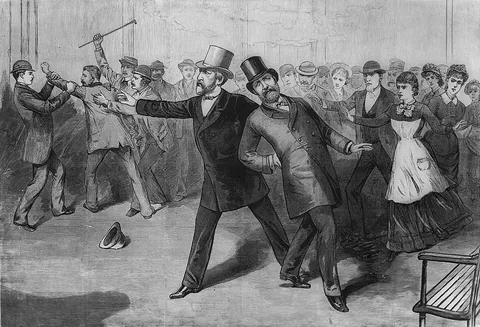 "The injury he had sustained from the gun was not fatal. The second bullet had entered his back. It had broken two of Garfield's ribs and grazed an artery, but it had missed his spinal cord and, more important, his vital organs." Just five minutes after the shooting, they called a doctor, this guy named Dr. Smith Townsend.
"What Townsend did next was something that Joseph Lister, despite years of traveling the world, proving the source of infection, and pleading with physicians to sterilize their hands and instruments, had been unable to prevent." As the president — he gets shot in a train station. So first of all, they leave him on the train station floor. "As the president lay on the train station floor, one of the most germ-infested environments imaginable, Townsend inserted an unsterilized finger into the wound in his back, causing a small hemorrhage and almost certainly inducing an infection that was far more lethal than the bullet." And it is this infection that 79 — I think it's 79 days later — is actually going to kill Garfield. We're going to go into some of the detail here.
Now they call in another doctor, a guy named Bliss.34Willard Bliss (1825–1889) — the Washington doctor who took charge of the president's treatment. His first name was actually Doctor: his full name was Doctor Willard Bliss. "Bliss had very little respect for Joseph Lister's theories on infection and even less interest in following his complicated methods for antisepsis. With nothing to even ease the pain, Garfield lay silent as Bliss searched for the bullet inside him, pressing the unsterilized probe downward and forward into the wound. Bliss did not stop until he had reached a cavity three inches deep in Garfield's back. At this point, he decided to remove the probe, but found that he could not. 'In attempting to withdraw the probe, it became engaged between the fractured fragments of the end of the rib.'"
So, okay, hold on. There's nothing for pain. The wound is open. You have dirty fingers being stuck in this, unsterilized probes going back and forth against broken ribs, where it would have been obvious, if this happened today, where the bullet was. Once the wound is sealed, you could even leave the bullet in there. He would not have died from this.
"He finally had to press down on Garfield's fractured rib so that it would lift and release the probe." His unsterilized probe got stuck in there. Could you imagine the pain that this guy is in? "Bliss immediately" — oh my goodness. "Although the probe was finally out, Garfield had no respite. Bliss immediately began to explore the wound again, this time with the little finger on his left hand. He inserted his finger so deeply into the wound that he could feel the broken rib."
13The wrong time
Had he been shot a few years later, Garfield would have lived.
Explainer79 days: how the President was treated
- The wounded Garfield was carried back to the White House. Willard Bliss took charge of his care, pushing aside the President's own physician.
- The doctors probed for the bullet again and again with unwashed fingers and instruments, on the right side, where Bliss was sure it had lodged, and cut a false channel that filled with pus.
- Alexander Graham Bell built an induction-balance metal detector for the search. He failed to find the bullet: the metal bed frame threw off the device, and Bliss let him search only on the right.
- To fight the Washington heat, Navy engineers rigged up an early air conditioner: fans blew air over a big box of ice, cooling the sickroom by about 20 °F.
- Garfield could barely eat and was kept alive partly with nutrient enemas; over the summer his weight fell from about 210 to 130 pounds, and abscesses spread through his body.
- On September 6 he was taken by train to the seaside at Elberon, New Jersey, where he died on September 19. The autopsy showed the bullet lay on the left, behind the pancreas: all summer they had searched on the wrong side.
And so not only is his death going to be induced by the very people that were supposed to care for him, he knows he's dying. He has many weeks. And it's one of the most devastating parts of the book when he's talking to his wife, who, again, will not accept that fate. And so he's looking at it not through, like, his eyes, through his own life. He's looking at it through the eyes of his children. "The memory of his own fatherless childhood weighed heavily on his mind, and he tried to talk to her about plans for their children if he were to die."
"She said firmly, 'Please do not speak again of death.'" And then the fact that in different parts of the world, Lister's ideas were not only already known but accepted. And so as this continues on and this infection starts to spread, the chapter that goes into that detail — we have another line from Garfield's journal early in his life, and it's just devastating because it winds up being true for him: "Great ideas travel slowly, and for a time noiselessly, as the gods whose feet were shod with wool." And then this is the point I was trying to make earlier — the fact that, you know, it's just, like, the wrong time in history. Just a few years later and Garfield would have survived. He could have still been president.
He could have survived long enough to see his kids grow up. "Had Garfield been shot 15 years later, the bullet in his back would have been quickly found by X-ray images35X-rays were discovered by Wilhelm Röntgen in November 1895, 14 years after Garfield's death." — which didn't exist at the time — "and the wound treated with antiseptic surgery. He might have been back on his feet within weeks. Had he been able to receive modern medical care today, he likely would have spent no more than a few nights in the hospital." This is devastating. "Even had Garfield simply been left alone, he almost certainly would have survived."
"Lodged as it was in the fatty tissue below and behind his pancreas, the bullet itself was no continuing danger to the president. 'Nature did all she could to restore him to health,' a surgeon would write just a few years later. 'She caused a capsule of thick, strong, fibrous tissue to be formed around the bullet, completely walling it off from the rest of the body and rendering it entirely harmless.'" And then what's devastating about this — it goes, again, to the idea that, like, this is complete malpractice and mistakes on the doctors' part. They knew — first of all, sticking the finger in there and the instruments, okay? They rejected Lister's ideas, but they knew that you didn't have — they kept doing that because they thought they wanted to remove the bullet.
But this is after the Civil War, and the author makes a great point. It's just like — but this was already known. There's tons of people walking around America with bullets still in them. Let me read this paragraph to you. "Garfield's doctors did not know where the bullet was, but they did know that it was not necessarily fatal. Just 16 years after the end of the Civil War, hundreds of men were walking around with lead balls inside of them."
"Many of the soldiers had sustained wounds that seemed almost impossible to survive. For the better part of his life, the man who delivered Garfield's assassin to jail had a bullet in his brain, a wound also sustained during the Civil War, and he appeared to be none the worse for it. The critical difference between these anonymous men and Garfield was that they had received little, if any, medical care. Instead, Garfield was the object of intense medical interest from a group of physicians, each with their own theories and ambitions, and each acutely aware that he was treating the president of the United States." And so then we get to the final days of Garfield's life. "Garfield had no illusions about his chance of survival."
14The last days and after
Garfield died at 49, and even then the country was slow to protect its presidents.
"When asked if he knew that he might not live, he had replied simply, 'Oh yes, I have always been conscious of that.' What worried him now was not his own death, but the suffering it would bring to those he loved most. The last letter he would write was to his mother, in the hope that he could bolster her spirits, if only for a short time. Taking a pen, he began writing in a thin, shaky script that slipped down the page. Only to his wife did Garfield admit his weariness. 'I wonder,' he told her one night, 'if all this fight against death is worth the little pinch of life I will get anyway.'"
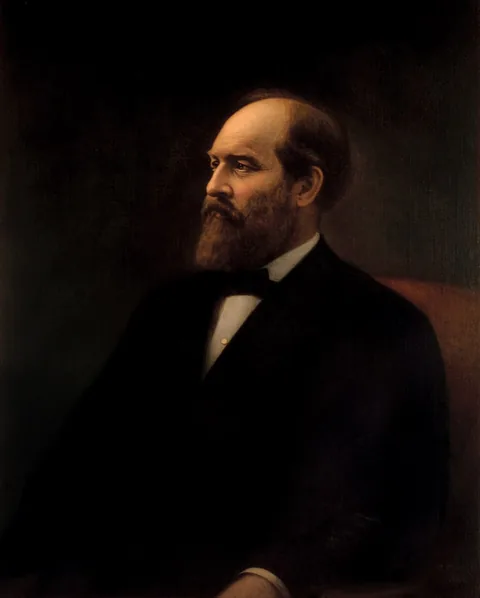
And so Garfield passes away at just 49 years old.36Garfield's death — he died on September 19, 1881, in Elberon, New Jersey, exactly two months before his 50th birthday. And I want to go to the epilogue of the book, which goes into what happens after his death. "A few years after Garfield's death, a reporter gazing at a formal portrait of him that hung in the White House wrote, 'I fear coming generations of visitors who pass through this grand corridor will see nothing in the stern, sad face of Garfield to remind them that here was a man who loved to play and romp with his sons, who read Tennyson and Longfellow37Alfred Tennyson (1809–1892) — English poet, Poet Laureate under Queen Victoria. Henry Wadsworth Longfellow (1807–1882) — American poet, author of The Song of Hiawatha. at 50 with as much enthusiastic pleasure as at 20, who walked at evening with his arm around the neck of a friend in affectionate conversation, and whose sweet, sunny, loving nature not even 20 years of political strife could warp.'" "Out of this common sorrow grew a fierce resolve to prevent such a tragedy from ever happening again."
"Americans did not believe, however, that Garfield had been assassinated because he had walked into the train station, just as he had traveled everywhere since the day of his election, wholly unprotected. Even after losing two presidents to assassins, the idea of surrounding them with guards and so distancing them from the people they served still seemed too imperial, too un-American. In fact, Secret Service agents38The US Secret Service was founded on July 5, 1865, under the Treasury Department to fight counterfeiters. Congress gave it the job of protecting the president only after McKinley's assassination. would not be officially assigned to protect the president until after William McKinley was shot in New York on September 6, 1901. He would die from his wounds eight days later.39William McKinley — the 25th president of the United States. He was shot at the Pan-American Exposition in Buffalo and died on September 14. The Secret Service took on the full-time protection of the president in 1902. The day McKinley was shot, Robert Todd Lincoln was once again standing with the president, thus earning the dubious distinction of being the only man to be present at three of our nation's four presidential assassinations."40Fact-checkThe quote has Robert Todd Lincoln standing with McKinley and present at three presidential assassinations, but in fact he witnessed a shooting only in 1881, at the train station. He wasn't at Ford's Theatre in 1865 and came to his dying father afterward, and in Buffalo in 1901 he was at the exposition but outside the building where McKinley was shot, and didn't see it (Wikipedia, "Robert Todd Lincoln"). The four presidential assassinations are those of Lincoln, Garfield, McKinley and Kennedy. And that is where I'll leave it.
You got to read the whole book. The writing in this book is incredible. The way Candice Millard weaves all these stories together — it's a remarkable story, a remarkable book about a remarkable man that I hope more people take the time to understand and to educate themselves about the life that he lived. That is where I'll leave it. That is 438 books down, 1,000 to go,41"438 books down, 1,000 to go" — Founders' signature sign-off: Senra counts the episode number as the number of books he has read for the podcast, and by his count he has another thousand ahead of him. and I'll talk to you again soon.


