
Founders
Chapters
Morris's book turns out to be not a biography of four tycoons but an account of how their careers built the economy that modern business rests on.
Read the chapter- Carnegie pushed prices down and scaled up, Gould was a provocateur of the stock market, Rockefeller a visionary of distribution, and Morgan the regulator who hated ruinous competition.
- Morris uses the tycoons' careers to explain the explosive growth of the US economy after the Civil War.
- Senra likens a young, hungry America to a startup and rich Europe to the incumbent, and quotes Lincoln saying Americans invent faster than any European nation.
- Senra likes that the book has photos of the tycoons at 25 or 30 rather than the familiar portraits of old men.
Morris calls Carnegie the most irritating and least honest of the tycoons, but shows how his obsession with speed made him rich by 30.
Read the chapter- When Lincoln died, the former bobbin boy Carnegie was turning 30 and already rich, Gould was 29, Morgan 28, and the 26-year-old Rockefeller ran one of the largest refineries in the country.
- At 17 Carnegie went to work for Tom Scott, one of the great railroad executives of the day, and through the stream of telegraph traffic inhaled the railroad business.
- As a division superintendent Carnegie burned stalled cars to clear the lines, a classic Carnegie move: focus on the objective and cut through every convention.
- The steel magnate issued pro-labor manifestos while cutting his workers' pay.
Carnegie was cruel even to his most loyal associates, and his only match was Rockefeller, who won by paying a fair price for what he took.
Read the chapter- Carnegie took credit for his underlings' successes and tried to cheat Henry Frick, who helped build his empire, out of his stake.
- The 25-year-old Rockefeller outbid his partners for the refinery at $72,000, and the next year it had $1.2 million in sales.
- Asked by Senra who the greatest entrepreneur of all time was, Charlie Munger answered that it was obviously Rockefeller.
- Rockefeller opened his books to a target and paid a fair price, waged total war on holdouts, and still offered the fair price once they capitulated.
Gould, the tycoon Senra understands least, had the darkest reputation of the robber barons, and railroads, with their insatiable thirst for capital, were the perfect battlefield for his financial mind.
Read the chapter- One competitor said that "Jay Gould's touch is of death," and Senra can't recall anyone getting the better of him: Gould outmaneuvered Morgan, Rockefeller and Daniel Drew alike.
- Railroads were the first large investor-financed public corporations, and their hunger for capital gave Gould's financial mind the perfect field.
- Gould's father left him at 13 at a school in a nearby town with a bundle of clothes and 50 cents, and Gould stood barely five feet tall.
- Gould felt the urge to expand in every direction at once, left a trail of battered partners and got back up after every defeat.
Morgan was raised for his trade by his father, and his genius was that of a disciplinarian, not a creator: he detested destructive competition.
Read the chapter- Morgan spent his school vacations working in his father's counting house, but Senra thinks Junius was the more impressive man.
- A powerful intellect and forceful personality made Morgan, nicknamed Jupiter, the biggest gravitational force in finance.
- The last of the great merchant bankers, Morgan detested "bitter, destructive competition."
Ambitious 19th-century inventors needed America, which embraced machines, rather than Europe, which resisted them.
Read the chapter- The technologists of the day were machine geeks who automated physical labor, and Senra asks what today's version of that is.
- Ambition, the book argues, has to be expressed in an environment that gives it room.
- According to Alfred Hobbs, British workmen sabotaged machines, and sawyers burned down the new sawmills in 1825.
In the fight for the Erie Railroad, the young Gould outplayed the richest man in America with a supple mind and a real strategy.
Read the chapter- To a clever young trader like Gould, 1870s Wall Street looked like sheep lined up to the horizon, asking to be sheared.
- Gould, barely in his 30s, and Fisk wrested the Erie from Vanderbilt while hiding from his men in a Jersey City hotel.
- Vanderbilt slashed cattle rates to a penny a head, and Gould cornered the cattle market and profited from his losses.
- Unlike other operators, Gould wanted to run railroads, and he went after the western connections while the Pennsylvania was selling its stakes in them.
How minor efficiencies at many points added up to Standard Oil's crushing advantage.
Read the chapter- His own hauling, his own barrel plant and his own piping supplies meant Rockefeller overlooked not a nickel of margin.
- Kerosene was arguably the first global consumer product, and Rockefeller bought pipelines, storage farms and terminals.
- Senra recalls The Aviator, where Hughes insists on a smooth fuselage, and says Rockefeller did the same to his entire company.
- After the Cleveland Massacre, 24 acquired refineries were consolidated into six modern ones, and Rockefeller gladly overpaid for speed.
Carnegie dropped his other businesses for steel, which he saw as the biggest opportunity of his era, and became unbeatable through his own relentless pressure.
Read the chapter- In England in 1872 Carnegie saw the scale of steelmaking, and his life plan for the next 30 years suddenly became clear.
- If you believed in railroads, you believed in steel, the book explains, and Senra compares Carnegie to Jensen and the shift from CPUs to GPUs.
- The company's real advantage, in Morris's account, was Carnegie himself: a war chest, the newest equipment, tracking every cost and keeping the plants full.
- Managing from Scotland let Carnegie criticize freely, and the book says he might have been easier to live with otherwise, but a less successful tycoon.
Gould and Rockefeller built their empires quietly and fast: Gould assembled dozens of railroads single-handedly, and Rockefeller bought the strongest competitors first and let them keep their names.
Read the chapter- The Union Pacific was laid through blizzards, solid rock and bottomless chasms, and the book calls it one of the most heroic engineering feats of the age.
- Gould, a competitor said, was "a one-man power": he consulted no one, quietly assembled dozens of railroads and did the work himself, unlike Morgan with his staff of partners.
- Rockefeller bought the strongest competitors first, and the rest fell in line.
- Acquired companies kept their names and bought up their neighbors in their own name, and to Rockefeller speed mattered more than price.
- Carnegie crushed his best men, while Rockefeller recruited even former enemies.
The tycoons' infrastructure gave rise to businesses its builders never imagined, and with them to mass consumption.
Read the chapter- Ivory, Procter & Gamble's soap that floats, became one of the first national brands, and logging, machinery and steam plants followed in its wake.
- The bankers who poured billions into railroads and steel never thought about selling scented ladies' soap.
- Mass production created mass consumption and department stores, which rode on infrastructure someone else had already paid for.
Companies nearly the size of countries needed new ways to finance themselves, and Morgan became for private companies the peacemaker the Rothschilds had been for European rulers.
Read the chapter- Rockefeller and Carnegie grew mostly on their own profits and jealously guarded their independence from bankers.
- Morgan was among the first bankers whose clients were mainly private corporations rather than governments.
- The great banking houses like the Rothschilds detested war, and Morgan headed off wars among companies: different players, same game.
Quotes
On Carnegie's business mantra
“Cut costs, take share, gain scale. Profits would take care of themselves.”
David SenraRead from 00:45On how Rockefeller absorbed his rivals
“When the target capitulated, and they always did, the fair price offer would still be available, often with an offer to join the Rockefeller team. It was industrial conquest on the efficiency principle.”
David SenraRead from 13:52On 1870s Wall Street through Gould's eyes
“And to a clever young trader like Gould, they looked like so many sheep lined up to the horizon, asking to be sheared.”
David SenraRead from 25:28On how Gould beat Vanderbilt's price war
“And he was laughing victoriously as his trains filled up with steers, until he discovered that Jay Gould had cornered the cattle market and was making a fortune from his shipping losses.”
David SenraRead from 27:20On the secret of Standard Oil
“The accumulation of minor efficiencies at so many points gradually amassed into a crushing profitability advantage.”
David SenraRead from 33:06On why Carnegie managed from afar
“By staying clear of operating responsibilities, he was free to criticize and harass without worrying about possible shortfalls in his own performance.”
David SenraRead from 41:40A rival on Jay Gould
“Gould is a one-man power. Consults no one, advises with no one, confides in no one, has no friends, and wants none. Gould is bold.”
David SenraRead from 42:57On what technology really does
“It's not just that the average person had more money, but that technology creates entirely new classes of products while radically reducing the cost of products once available only to the elite.”
David SenraRead from 51:16
Summary
David Senra walks through Charles R. Morris's The Tycoons, which turns out to be less a biography of four men than a history of how the economy that modern business rests on grew up in the United States after the Civil War. Carnegie, Rockefeller and Gould, in Morris's phrase, "came with flaming swords" and tore up the comfortable order of their industries, while Morgan spent his career reining in "ruinous competition."
Morris's Carnegie is the most irritating of the tycoons: tireless, cruel to his associates and hypocritically posing as a friend of labor, yet armed with the simplest of mantras ("cut costs, take share, gain scale"), cost accounting down to the cent and a habit of plowing every dollar back into the newest plants. Rockefeller is the greatest manager of them all: he took enormous risks calmly, paid a fair price for acquisitions and unleashed total war on holdouts, and his minor efficiencies at countless points added up to a crushing advantage. Gould, the tycoon Senra says he understands least, was a genius of financial maneuver who beat Vanderbilt and quietly assembled dozens of railroads.
Senra closes on the book's central idea: the tycoons built not just huge companies but a platform of railroads, telegraphs and steel on which businesses no banker imagined could grow, from Ivory soap to the department store. And Morgan, who financed the giants, played the role the Rothschilds had played in Europe, keeping the peace among warring powers, only now the powers were private companies.
Advice
Find the single most important thing in your business and spend your time removing the bottlenecks around it, as Carnegie, Rockefeller and Gould all did.
If you have big ambitions, put yourself in an environment that lets you express them: 19th-century Europe held inventors back, while America helped them.
Pay for speed: Rockefeller deliberately overpaid for acquisitions so he could close the deal and move on to the next one.
Keep a war chest and invest in the newest equipment even in bad times: when prices fall, the most efficient player loses the least.
Know your costs to the cent: Carnegie's accounting showed what every product and process cost, while his competitors had no idea what was going on inside their own companies.
Hire the ablest people, give them room to run and turn former rivals into allies instead of crushing people: that is how Rockefeller kept his best executives for their whole careers.
Mentioned
 Andrew Carnegie00:00one of the book's four tycoons, the steel magnate
 John D. Rockefeller00:00one of the book's four tycoons, founder of Standard Oil
 Jay Gould00:00one of the book's four tycoons, the railroad magnate
 J. P. Morgan00:00one of the book's four tycoons, the banker-regulator
Show 25 more mentionsShow fewer mentions
- The Tycoons: How Andrew Carnegie, John D. Rockefeller, Jay Gould, and J. P. Morgan Invented the American Supereconomy02:07the book this episode covers
 Charles R. Morris02:07the book's author
 Abraham Lincoln02:46Americans invent faster than Europeans
 Henry Clay Frick05:46the partner Carnegie tried to cheat of his stake
- Meet You in Hell: Andrew Carnegie, Henry Clay Frick, and the Bitter Partnership That Transformed America05:46a book about the Carnegie–Frick partnership
 Thomas A. Scott06:30the young Carnegie's mentor
 Elon Musk07:33the emphasis on speed and bottlenecks
 Pennsylvania Railroad08:31where Carnegie got his start
 Carnegie Steel Company10:34Carnegie's steel empire
 Charlie Munger12:46called Rockefeller the greatest entrepreneur
- The House of Morgan: An American Banking Dynasty and the Rise of Modern Finance19:16a history of the Morgan banking dynasty
 Junius Spencer Morgan19:16Morgan's father and mentor
 Alfred C. Hobbs24:37British workmen sabotaged machines
 Jim Fisk26:01Gould's partner in the Erie war
 Cornelius Vanderbilt26:01Gould's opponent in the Erie war
 Erie Railroad26:01the railroad Gould and Vanderbilt fought over
 Standard Oil30:24Rockefeller's company
- The Aviator31:44Hughes smoothing his plane's fuselage
 Howard Hughes31:44the hero of The Aviator
 Jeff Bezos31:44gave the same advice about the product
 Jensen Huang37:32the Carnegie of our day
 NVIDIA37:32where everyone buys their GPUs
 Union Pacific Railroad42:10a heroic build through the mountains
 Procter & Gamble47:47Ivory soap
 John Wanamaker49:34low prices, variety and quality
Sponsors of the episode


Transcript
01The founding fathers of an industrial superpower
Morris's book turns out to be not a biography of four tycoons but an account of how their careers built the economy that modern business rests on.
Andrew Carnegie,1Andrew Carnegie (1835–1919) — a Scottish immigrant who started at the very bottom and built Carnegie Steel, the largest steel company of its day. After selling it in 1901 he gave away most of his fortune, funding thousands of public libraries. John D. Rockefeller,2John D. Rockefeller (1839–1937) — founder of Standard Oil, which at its peak controlled about 90% of US oil refining; he is considered one of the richest people in history. Senra has devoted around ten episodes to him. Jay Gould,3Jay Gould (1836–1892) — railroad magnate and stock market operator, the most hated of the robber barons of his day. He controlled the Erie, the Union Pacific, the Missouri Pacific and the telegraph company Western Union. and J.P. Morgan4John Pierpont Morgan (1837–1913) — the most powerful American banker at the turn of the century: he reorganized railroads, created General Electric and U.S. Steel, and in the Panic of 1907 all but single-handedly rescued the US financial system. were all in their late 20s or early 30s, all on the first rungs of their careers in the waning days of the Civil War.5The American Civil War (1861–1865) — fought between the North and the seceding slave states of the South. It ended in a Union victory and the abolition of slavery, and was followed by rapid industrialization. In an age of outsized business leaders, no others played so great a role in shaping and channeling the American boom. They forced the pace, drove the transition to ever-larger scales, and imposed personal stamps on the national economy that persisted well into the 20th century. They were quite different people. Carnegie, Rockefeller, and Gould tapped into the national predilection for speed, the obsession with moving ahead, the tolerance for experimenting to create one of history's purest laboratories of creative destruction.6Creative destruction — economist Joseph Schumpeter's term (1942) for the way capitalism advances as new technologies and companies destroy old ones.
Most businessmen of the time believed in orderly markets and gentlemanly, fair profits, but these three came with flaming swords. That's a great line. Morgan was the regulator, always on the side of reining in what he called ruinous competition,7Ruinous competition — a phrase of the era for price wars in which rivals cut prices below cost and bankrupt one another. It was used to justify cartels, pools and mergers. most especially of the kind regularly unleashed by the other three. The American steel industry was settling into a comfortable cartel8Cartel — an agreement among independent companies on prices, output quotas or market shares, so they don't have to compete. when Carnegie commenced his career of disruption. Carnegie's plants were always the biggest, the most automated, the most focused on pushing prices down. He had the simplest of business mantras. Cut costs, take share, gain scale. Profits would take care of themselves.
Jay Gould was a provocateur, a master of public security markets as no one before him, and few since, always attacking, always pushing the possible to precarious new heights. Gould's arena was railroads and the telegraph, the critical infrastructure of his period. Rockefeller may have been the greatest visionary and the supreme manager. He took over world oil markets so quickly that it was over before most people noticed. He taught the world its first lesson in the power of large-scale distribution. These four are the founding fathers of the American industrial superpower.
That was an excerpt from the preface of the book that I'm going to talk to you about today, which is The Tycoons: How Andrew Carnegie, John D. Rockefeller, Jay Gould, and J.P. Morgan Invented the American Supereconomy. And this book was written by Charles R. Morris.9Charles R. Morris — American writer, lawyer and former banker, the author of books on economic history, including The Trillion Dollar Meltdown about the 2008 crisis. So originally when I picked up this book, I thought I was going to read a biography about four tycoons. What the book is really about is using the life and career of these four tycoons to explain this massive expansion and growth in the American economy that occurred after the Civil War. And then the author makes the case that these four tycoons played a role in building out the economy on which all of modern businesses actually rest.
And so I want to... He has a few good quotes here, right before Lincoln dies.10Abraham Lincoln — the 16th US president, who led the country through the Civil War. He was assassinated in April 1865, a few days after the main Confederate army surrendered. And it really sets up the difference between, what I think about, like, almost like a startup and like an incumbent. America at the time is obviously younger, hungrier, way less money than most of Europe. And Abraham Lincoln talks about the difference in the mindset that Americans had at this point. Obviously all four of the people that we're going to talk about today had this mindset as well. And it really reminds me of one of my favorite maxims, which is that belief comes before ability. And so Abraham Lincoln says, "We here in America think we discover and invent and improve faster than any European nation." So they do a good job of contrasting throughout the book the way that Americans were thinking about building their economy, creating and inventing new technology, building companies compared to their counterparts in Europe.
And so what the author does here is throughout this entire book, you know, he kind of weaves in these stories of, again, the young version. What I love is there's pictures in the book of, like, Carnegie, J.P. Morgan, Rockefeller and Gould. And I was thinking about them as, like, the older pictures that you see, that are way more prevalent online, when they were maybe 50, 60, 70 years old. And there's actually pictures in there where they're like, no, this is Carnegie when he's 30. This is Rockefeller when he was 25.
So I pulled out a couple, basically what I thought was most interesting, these, like, short descriptions of who they were as people and how they ran their business. And then the author does a great job of comparing and contrasting. You know, Carnegie built one of the most successful companies of all time. Rockefeller built one of the most successful companies of all time. There's some ideas that they shared, but there's also vastly different approaches, and I think that's one of the most valuable things of reading the book, and hopefully you're getting out of this episode.
02Carnegie: speed at any cost
Morris calls Carnegie the most irritating and least honest of the tycoons, but shows how his obsession with speed made him rich by 30.
So we're going to jump right into Carnegie. When Lincoln died, Andrew Carnegie was turning 30 and was already wealthy, although he'd been a factory bobbin boy11Bobbin boy — a boy who changed the bobbins of thread in a cotton mill. Carnegie took such a job at 13, soon after his family emigrated from Scotland, for $1.20 a week. hardly a decade and a half before and had yet to even settle in on a career. John D. Rockefeller was only 26, but his Cleveland oil refinery was one of the largest and most profitable in the country, and he may have already formed his design of taking over the entire industry. Jay Gould was 29 and was trying his hand as a railroad turnaround specialist. J.P. Morgan was 28, quietly learning his trade within his father's banking network.
These four would become the greatest of a generation of outsized business leaders. By their sheer intelligence, their ambition and their forcefulness, they laid down the channels that other people followed. They were never friends. Carnegie, Rockefeller, and Gould personified the unlimited entrepreneurial opportunities suddenly opened by America's vast resources and its freedom from constraints of class. For the man of fierce business ambition and massive talent, it was the one place and perhaps the one time where he could push as far as he could possibly go. Morgan stood apart from the others. He was not only born wealthy, but he defined his career in reaction to the great entrepreneurs. So it does a great job of contrasting the difference between the financiers and the entrepreneurs building the products, building the businesses.
Andrew Carnegie was the most irritating of tycoons. So this is going to come up a lot. I like reading about Carnegie. I've read his autobiography,12Carnegie's autobiography was published in 1920, after his death. I think, twice. There's this great biography of the partnership that he had with Henry Clay Frick13Henry Clay Frick (1849–1919) — Pennsylvania's "coke king," Carnegie's partner and chairman of Carnegie Steel. His New York mansion and art collection are now the Frick Collection museum. that's called Meet You in Hell.14Meet You in Hell — Les Standiford's 2005 book about the partnership and feud between Carnegie and Frick. I've done an episode on that. This author definitely thinks that Carnegie... Well, he just called him the most irritating. He also would make the case that Carnegie was a compulsive liar, which he'll bring up multiple times.
But this is a great overview of Carnegie and where he's at when he's rather young. So, he's the most irritating of tycoons. He was a petite five foot three. He was a tireless bundle of bouncing energy. He was quick in apprehension of anything that would advance his interests. He was as relentless in self-improvement as in everything else.
So he talks about, he would read voraciously. He spent all his free time when he's not working learning new skills. When he is 17, he actually starts working for this guy named Tom Scott.15Thomas A. Scott (1823–1881) — a senior executive and, from 1874 to 1880, president of the Pennsylvania Railroad. He hired Carnegie as his telegrapher and personal secretary and became his mentor. Tom Scott was one of this time period's greatest railroad executives, and Tom Scott kind of changed Carnegie's life. And this is where Carnegie is learning the technology of his day, the communication technology of his day, which is telegraph, which you have to learn how to program, right?16Senra's joke: the telegraph operator was the programmer of his day. Carnegie was one of the few operators who could read Morse code by ear, without the paper tape. Since Scott did so much work by telegraph, he and Carnegie shared an office, and the flow of messages allowed Carnegie almost to inhale the essence of the railroad business.
It is very fascinating to think about the different path that Carnegie could have taken. He definitely took the more ambitious path, but he was already entrenched, and he's being mentored by one of the most successful railroad executives of all time. He could have just been building railroads or even working for them. From a relatively young age, he's promoted to be the superintendent of the Western division.17The Western Division of the Pennsylvania Railroad, based in Pittsburgh, was put under Carnegie in 1859, when he was about 24. And this is where now he's not just an assistant, he's also running one of the lines.
And we see a trait of his, and a trait I would argue of all of them, maybe not Morgan: their emphasis on speed and on essentially identifying the single most important thing in the business and spending all their time essentially removing bottlenecks for this. This sounds a lot like Elon.18Elon — Elon Musk. Senra often brings up his habit of finding the "limiting factor" and throwing everything at it. The core challenge for the railroad was to keep traffic flowing. Shortly after his appointment, he shocked his fellow executives by burning stalled cars to clear lines. It was the classic Carnegie technique. Focus on an objective, then cut brutally through any conventions, competitors or ordinary people who stood in your way. Car burning was soon a standard method for clearing stalled trains.
And this is something Carnegie would do over and over again. He wasn't really concerned about the opinions of other people. If he thought something was right, he would just act on it. And again, when they describe one of his techniques, one of his MOs: focus on an objective, then cut brutally through any conventions, competitors or ordinary people who stood in your way.
By the early 1860s, Carnegie was already a rich man. In an age when conflicts of interest were routine, Scott had carefully steered him to investments in companies doing business with the Pennsylvania Railroad,19The Pennsylvania Railroad — a Philadelphia railroad company that by the late 19th century was one of the largest corporations in the world. which is the one that they're running, like a sleeping car company and a railroad bridge builder,20Theodore Woodruff's sleeping car company and the Keystone Bridge Company, which built railroad bridges. These investments were the start of Carnegie's fortune. often advancing him the purchase money to buy the stock.
ExplainerCarnegie, the unions and Homestead
The contradiction Morris describes is clearest in one story. In 1886 Carnegie published articles in Forum magazine defending workers' right to organize and condemning strikebreakers. In 1892, at his steelworks in Homestead outside Pittsburgh, his manager Henry Clay Frick locked out the workers to break the Amalgamated Association union while Carnegie himself was on holiday in Scotland.
- Frick ringed the plant with a fence topped with barbed wire and hired Pinkerton detectives; on July 6, 1892, their barges were met by armed workers, and in the shootout seven workers and three Pinkertons were killed.
- The governor of Pennsylvania sent several thousand National Guard troops, the plant reopened with strikebreakers, and the union was broken at Carnegie's mills.
- On July 23 the anarchist Alexander Berkman burst into Frick's office and wounded him with a pistol and a knife; Frick survived.
Carnegie kept his distance in public but backed Frick in his letters, and Homestead ruined his reputation as a "friend of labor" for good.
The core fact about Carnegie was the drive to dominate at all costs. This is again where he talks about him being kind of like a bundle of contradictions. I would just basically say the author thinks that Carnegie was unscrupulous and would just lie if it was in his benefit. And here's an example. For some reason, although Carnegie was among the hardest of men, he always insisted on parading as a humanitarian idealist, as if his businesses were some kind of social welfare project. So when he was the world's greatest steel magnate, he loved to issue pro-labor manifestos, even as he steadily ratcheted up the demands on his workers and cut their pay.
AdRamp
Before we get back into this, I want to tell you about the presenting sponsor of this podcast, Ramp. I have been reading a lot about SpaceX lately. SpaceX is one of the most valuable businesses in the world, and one of the main themes in the history of SpaceX is constantly attacking and questioning your costs. Ramp helps many of the most innovative businesses in the world do exactly that. And they do this by using first principles thinking.aFirst principles thinking — reasoning up from basic facts rather than by analogy with how things are usually done. Elon Musk popularized the phrase. The median company running on Ramp cuts their expenses by 5%. And one thing that SpaceX has demonstrated is that a religious dedication to controlling your costs helps increase revenue, because you can pursue opportunities you couldn't otherwise.
And we see that in the Ramp data too. The median company running on Ramp also grows their revenue by 16%. So when you're running your business on Ramp and your competitors are not, you have a massive competitive advantage that compounds over time. Ramp is the only platform designed to make your finance team faster and happier. Many of the top founders and CEOs that I know run their business on Ramp. I run my business on Ramp, and you should too.
Go to ramp.com today to learn how they can help your business save time, save money, and grow revenue. That is ramp.com.
03Rockefeller: the auction and the fair price
Carnegie was cruel even to his most loyal associates, and his only match was Rockefeller, who won by paying a fair price for what he took.
Carnegie was often pointlessly cruel, even to his most loyal associates. There's a reason why one of the biographies written about Carnegie is called Meet You in Hell. It's Henry Clay Frick, who was his partner, who in many cases, I would argue, is actually the managerial genius behind Carnegie Steel.21Carnegie Steel — Carnegie's Pittsburgh steel company, the largest in the world by the end of the 19th century. In 1901 Morgan bought it and made it the core of U.S. Steel. That "meet you in hell" is because Frick felt Carnegie screwed him over, and that's one of the last things he ever said to him.22The oft-told story: late in life Carnegie proposed that they meet and make peace, and Frick told the messenger, "Tell Mr. Carnegie I'll see him in hell, where we both are going." He manipulated his underlings shamelessly, harping obsessively on their smallest failures and taking the credit for their every success. When Henry Frick retired, Frick, who had contributed as much as anyone to building his empire, Carnegie applied all of his trademark energy and obsessiveness to cheat him of his stake.23In 1899–1900, after falling out with Frick, Carnegie tried to buy him out at book value, far below market, under the partners' "Iron Clad Agreement." Frick sued, and the dispute ended in a settlement.
Over a long career, the only fellow tycoon who fully matched up with Carnegie in a business setting was the man that he liked to call "Reckafellow." And so then we go into a short overview of the early days of Rockefeller's career. Obviously, I think he's one of the most important. If you could only study one person from business history, right, I'm talking 100, 200 years in the past, I would definitely pick Rockefeller, where I've done, I don't know, 10 episodes on him.
So it talks about Rockefeller running his first refinery. For the first time, Rockefeller could demonstrate his extraordinary ability to combine headlong expansion with fanatical attention to efficiency and cost. Under Rockefeller's management, still talking about the refinery, it was also the most consistently profitable. A few traits of Rockefeller pop out. He wanted to be in control. He's got these partners. He has an idea. He's like, hey, we're going to take on debt. We're going to rapidly expand. He wants to impose organization on this chaotic industry, which is the early days of the oil industry.24The US oil industry began in 1859, when Edwin Drake drilled the first commercial well in Pennsylvania. Rockefeller went into refining in 1863. And so it gives this brief overview of Rockefeller essentially breaking up with his partners and then outmaneuvering them.
As the frictions grew, the Clarks25The Clarks — Maurice Clark, Rockefeller's partner in a produce firm, and his brothers; Samuel Andrews was the chemist who knew how to refine oil. In February 1865 Rockefeller bought the refinery at auction for $72,500. made frequent threats to dissolve the partnership. On one such occasion, Rockefeller disingenuously asked them if they really meant it, which they confirmed. The next day, to their shock, they read a notice of dissolution in the local newspaper. They were doubly shocked to find that Andrews, one of their other partners, had thrown in his lot with Rockefeller. And then, after they had agreed to an auction to settle the ownership of the refinery, were again shocked to find themselves coolly outbid by the 25-year-old Rockefeller. So this is one of the craziest things. Bidding for this oil refinery hit $72,000. Once it hit that, they're like, this is too much money.
Rockefeller is probably the greatest business manager of all time. When I had dinner with Charlie Munger,26Charlie Munger (1924–2023) — Warren Buffett's longtime partner and vice chairman of Berkshire Hathaway, a famous student of business history. I asked him who he thought was the greatest entrepreneur of all time. Obviously it's a question near and dear to my heart. I think he knew more about business history than anybody else I've ever met, and he says it was obviously Rockefeller. That's what Munger said.
And here's a great example. So his partner's like, oh, it's $72,000, that's too much. Here, you can have it. The next year, that refinery had total sales of $1.2 million. This is in the 1860s. This is insane.
From the very start of his business career, he took enormous risks, but so calmly and matter-of-factly as to make them seem perfectly ordinary. Even during his first years in refining, the characteristic Rockefeller methods were on full display. Move with shocking speed and minimum fanfare, act with total confidence, but turn on a dime if new facts warrant. March in service of a sweeping vision, but pay obsessive attention to details. This is just great writing. This next paragraph is excellent. I think it gives you really good insight into Rockefeller.
Although he often played very rough, he was surprisingly free of vindictiveness. When he took over another man's business, he genuinely paid a fair price. Indeed, he often overpaid. A typical ploy was to open his books to the target. Any sensible man would understand that competition was hopeless and make a deal. If a target was especially stubborn, rejecting all reasonable offers, a switch would finally turn and Rockefeller would suddenly unleash total blazing warfare on every front. Price, supplies, access to transportation, land use permits, whatever created pain. When the target capitulated, and they always did, the fair price offer would still be available, often with an offer to join the Rockefeller team. It was industrial conquest on the efficiency principle. He was simply better at the business than anyone else.
04Jay Gould, whom no one got the better of
Gould, the tycoon Senra understands least, had the darkest reputation of the robber barons, and railroads, with their insatiable thirst for capital, were the perfect battlefield for his financial mind.
That is just an incredible overview. And so then we go to Jay Gould. I've read, I think, two biographies of Jay Gould. I would say out of everybody, maybe everybody I studied on the podcast, he's the one that I understand the least, on how he actually did what he did. And so here's a couple, like, other people that were working with him and against him talking about him. Says, of the robber barons,27Robber barons — the nickname for late-19th-century American magnates who made their fortunes by ruthless methods. It comes from the medieval lords who preyed on merchants traveling by road and river. none had as dark a reputation as Jay Gould. One of his competitors said that Jay Gould's touch is of death.
J.P. Morgan, who in his early career was also outmaneuvered by Gould, was always torn between keeping him at a wary distance and chasing after his business. And so I can't think of a single example where somebody else got the better end of Jay Gould. Talks about he did this with Rockefeller, he did this with J.P. Morgan, he did this with Daniel Drew,28Daniel Drew (1797–1879) — a former cattle drover turned stock speculator and treasurer of the Erie Railroad. He fought Vanderbilt alongside Gould and Fisk, later suffered from their maneuvers himself and died broke. it just happens over and over again.
Source: Wikipedia, History of rail transportation in the United States
Gould had one of the supplest business minds of his or any age. His career coincided with the great epoch of American railroads. Why is that important? Because these businesses were the first large, investor-financed, publicly traded corporations ever. And why did that create an opportunity for financiers, or for... He also operated businesses, but maybe like a stock manipulator, I don't even know how you would describe him, because he's not the financier like a J.P. Morgan was, but finance was his weapon and stock was his weapon.
But the reason the railroads created this opportunity for him is, one, it's pretty wild how big railroads got. I think at one point they were 80% of the entire market cap of the stock market, that one industry. But this sentence describes why. The railroads' thirst for capital was insatiable. This was the playing field Gould was born for. His subtle intelligence could flicker through every crevice and corner of the most convoluted financial constructions and divine exactly the points of leverage, the strategic positions that could make him, by a few purchases, master of the entire enterprise. This is why it's so confusing what he did. And then he'd also do what Rockefeller did, he would hide his maneuvers so you wouldn't know what he was buying. In many cases he did the same thing Rockefeller did, he had the secret ownership of companies, which we'll get to later.
It is very, very confusing, but also really surprising, because there's no other robber baron that came from where he came from. Because, you know, J.P. Morgan came from a very rich family, he inherited this giant merchant bank. But Jay Gould, you know, was essentially abandoned by his dad. So the weapon he used to build his wealth was understanding financial markets, I guess, is what I'm trying to tell you. Railroads became the center of Gould's interest early in his career, and more than anyone else, he created the national railroad map that prevails to this day.
Gould had a strange streak of self-destructiveness. More than once, after a string of victories had left him in possession of the field, he would launch some new, seemingly pointless depredation that laid waste to everything he'd worked for, as if launching stock wars was simply what he did. He was a superb financial engineer, took a close interest in operational details and usually outstrategized his competitors. Gould was barely five feet tall, even smaller than Carnegie. Burning ambition more than made up for Jay's lack of physical strength. He was essentially on his own from age 13, when his father registered him in a high school in a neighboring town and left him with a pile of clothes and 50 cents.
And then we have another paragraph that just gives this great overview of how he worked. This event highlighted the characteristics Gould would display his entire career: the ability to tackle any endeavor, master any field, and despite his frail constitution, to work all the time; the constant pushing against boundaries and restraints; the impulse to expand in every direction at once. That idea right there, the impulse to expand in every direction at once, is something that's repeated over and over again throughout this book and the biographies of Jay Gould. It's very important to understand. Sometimes beyond all reason; the unfortunate habit of leaving a trail of dazed and battered partners in his wake; and the sharp reading of legal documents. One scholar has called him probably the most successful litigant in American history.
Most extraordinary was Gould's ability to sustain reverses that would crush another man, then to pull himself off the floor and carry on, learning more, working harder, never complaining, just looking for his next chance.
05Morgan: a disciplinarian, not a creator
Morgan was raised for his trade by his father, and his genius was that of a disciplinarian, not a creator: he detested destructive competition.
And then we go into a brief overview of J.P. Morgan. On this page, there just happen to be these four pictures of these tycoons when they were young. I have to say, out of all four of them, J.P. Morgan's the one that aged terribly. He was a handsome young man. I don't know what happened when he got older.29In later life Morgan developed rhinophyma, a skin condition that left his nose red and swollen. He hated being photographed, and his pictures were often retouched. Says, J.P. Morgan was already an experienced banker at the time of Lincoln's death. Few young men had been as carefully brought up for their trade.
So I read this book, I think it's probably like a 600 or 700 page history of the Morgan family. I think it's called The House of Morgan,30The House of Morgan — historian Ron Chernow's 1990 book about the Morgan banking dynasty, which won the US National Book Award. Chernow also wrote the Rockefeller biography Titan. if I remember correctly. And, you know, most people focus on J.P. Morgan. He's by far the most famous member of his family, but I actually thought his dad, Junius,31Junius Spencer Morgan (1813–1890) — an American banker in London, head of J.S. Morgan & Co., which channeled British money into American railroads. He was famous for his loan to France during the Franco-Prussian War of 1870. was by far the more impressive man.
And so when they say, you know, no one's ever been as carefully brought up for their trade as J.P. Morgan, it means the tutelage and the mentorship from his father, Junius. J.P. had Junius's flair for numbers and loved to spend his school vacations working in the counting house. The counting house is just the back office of a bank. But he also had a raffish streak, with an eye for the ladies and an appetite for risk that occasionally alarmed the very buttoned-down Junius. J.P. was clearly well prepared. He was endowed with a powerful intellect, great financial insight, and enormous personal forcefulness. In fact, his nickname later was Jupiter, because, like the gravity, he was essentially the largest gravitational force in the entire finance industry.
He was praised for conducting a first-rate business, and one of his mottos was that gentlemen pay their debts. Morgan's genius was that of the disciplinarian, not of the creator. He was the last of the great 18th- and 19th-century merchant bankers,32Merchant bank — a bank that finances trade and underwrites securities for governments and companies rather than taking deposits from the public. rather than the pioneer of a new dispensation. He did what his father and other bankers had always done, but in broader strokes and on a bigger canvas. His fundamental drive was towards order and control, and he was appalled by the storm of creative destruction at the heart of this long American boom. He detested, and this is a direct quote from him, "bitter, destructive competition" that always led to "demoralization and ruin."
Carnegie, Rockefeller, Gould, and Morgan would have risen to the top in any age, but in post-Civil War America, business had acquired the sense of excitement and purpose that men had once associated with great feats of statecraft or conquest.
06A culture of invention
Ambitious 19th-century inventors needed America, which embraced machines, rather than Europe, which resisted them.
And so then throughout the book, they also discuss a bunch of other businesses and entrepreneurs and inventors and engineers. I'm going to skip over most of them. I want to focus just on the main four to be the center of our discussion. But I think this is really important, because again, when I'm reading something about the 1800s or the railroads, I'm thinking, well, how does this echo the time that you and I are in?
And so it makes sense: if you were a classic nerd or a technology geek at this point, that means you were a machine geek. And your version of inventing new technology would usually try to automate some kind of physical aspect of labor. So in one case, this is a guy who's growing up on a farm. He says, told to clear a field of stones, he was apt to mumble that it was a proper job for a machine, then spend his time designing one instead of digging up stones. The most talented young men perceived that a flair for machinery could be a fast track to financial independence. So it's really interesting. It's like, if I'm alive today, I'm a young man or woman, I'm ambitious, what is that version for me? What would I want to focus on?
AdAppLovin, Vanta
And before we get back into this, I want to tell you about AppLovin. One of my all-time favorite quotes is from the book Zero to One. In that book, Peter Thiel writes, he says, "The single most powerful pattern I have noticed is that successful people find value in unexpected places, and they do this by thinking about business from first principles instead of formulas."
And that is exactly what AppLovin has done with their advertising platform. AppLovin connects you with over a billion potential new customers in mobile games. AppLovin allows you to capture undivided attention. AppLovin ads are full-screen videos that are watched for an average of 35 seconds. That is retention that blows other ad platforms out of the water, and you can launch on AppLovin in minutes. You set the goal, and AppLovin achieves it.
No complex setup, no expertise needed. And AppLovin scales quickly. They can put your ads in front of over a billion potential customers. Other businesses have seen immediate results, scaled to hundreds of thousands of dollars of spend per day and increased their revenue by millions. So you want to get started quickly, before all of your competitors are on AppLovin. And you can do that by going to applovin.com. That's applovin.com.
And then I want to tell you about Vanta. Vanta helps your company prove you're secure, so more customers will use your product or service. Vanta is an AI-powered security expert that scales with you. The more your business grows, the more complex your security needs get.
And that complexity turns into chaos. Vanta tames that chaos for you. Vanta automates compliance, continuously monitors your controls, and gives you a single source of truth for compliance and risk. So whether you're a fast-growing startup or an enterprise company, Vanta fits easily into your existing workflows. Many companies won't sign contracts unless you're certified, and this is causing you to lose out on sales. That is why the average Vanta customer reports a 526% return on investment after becoming a Vanta customer.
Automate your compliance, security and trust with Vanta. Vanta will help you win trust, close deals and stay secure faster and with less effort. Go to vanta.com/founders and you'll get a thousand dollars off. That is vanta.com/founders.
And then another important point from this book is, if you do have that ambition, make sure you're in the environment which actually allows you to express that ambition. And so again, it goes back to what was happening in Europe at the time and contrasting it with America: America was embracing new technology, trying to invent new things, and Europe in large part was trying to stop the technological progress. Obviously it's futile.
And so then we have a quote from somebody that's now working in America that had previously worked in England. Alfred Hobbs had33Alfred Hobbs (1812–1891) — an American locksmith who, at London's Great Exhibition of 1851, picked the famous "unpickable" Bramah and Chubb locks and then spent several years making locks in England. experience manufacturing in England and was convinced that British workmen were a major productivity obstacle. This is a direct quote from Alfred Hobbs: "In America, they might set to work to invent machines, and all the workmen in the establishment would, if possible, lend a helping hand. But in England, it was quite the reverse. If the workmen could do anything to make the machine go wrong, they would do it."
There really does seem to have been a culture of invention in America. There were hundreds of water-powered sawmills in Massachusetts by the end of the 18th century, when they were still relatively rare in England. Why? In part because of opposition from the sawyers, the British woodcutting trade. Sawyers, that's the people working the woodcutting trade, that's what they're called. Sawyers actually burnt down the new sawmills in 1825.
07Gould versus Vanderbilt
In the fight for the Erie Railroad, the young Gould outplayed the richest man in America with a supple mind and a real strategy.
And so then, as the book progresses through time, the author does a great job of weaving in these little vignettes or anecdotes about all the four tycoons. So there's a great chapter that's called "Bandit Capitalism," which I thought was a funny line. It starts talking about what Jay Gould was doing, and says the greedy moneyed classes were irresistibly drawn to Wall Street in the 1870s. That is where Jay is setting up shop. And this is an incredible line to think about Jay Gould. And to a clever young trader like Gould, they looked like so many sheep lined up to the horizon, asking to be sheared.
And so then it gives a brief overview of this war that Jay Gould is engaged in, him and his partner, Jim Fisk,34Jim Fisk (1835–1872) — stock speculator and showman nicknamed "Diamond Jim," Gould's partner. In 1872 he was shot dead by a rival in a romantic and business quarrel. with Cornelius Vanderbilt.35Cornelius Vanderbilt (1794–1877) — "the Commodore," who made his fortune in steamships and then railroads; he built the New York Central and was the richest man in America in his day. Keep in mind, at this time, Jay's in his early 30s, Vanderbilt's probably in his 70s. Vanderbilt is probably the most famous and definitely the wealthiest person in America. And again, Jay Gould just never backed down from anybody. They're fighting over control of the Erie Railroad.36The Erie Railroad — a line from New York to Lake Erie, one of the main routes west and a perennial target of stock market schemes. And says, Gould and Fisk had been forced to repair to the rigors of a Jersey City hotel, because they were in the process of extracting one of the country's largest railroads and biggest companies from Cornelius Vanderbilt.
So one of the reasons they fled New York and were on the lam in Jersey is because when Cornelius Vanderbilt would have a business dispute, he would not, you know, resort to just business tactics. He would not just sue you. He literally sent hitmen. He put prices on Jay Gould and Jim Fisk's heads. That is not an exaggeration. This is what he did.
Says the episode was all the more shocking since it was masterminded by Jay Gould, still in his early 30s and a virtual unknown on Wall Street, while Vanderbilt was the richest and arguably the most powerful man in the country, with long experience of financial markets. Still, it was Gould who would emerge with the prize. Of our four fledgling tycoons, Jay Gould and John D. Rockefeller were the first to make their presence felt in the years immediately after the war.
And so I just want to give you an insight into this, like they said, the supple mind of Jay Gould. So basically, when they're competing, let's say Vanderbilt owns a railroad and Jay Gould owns a railroad. To steal traffic and to try to economically hurt one railroad, you drop the prices, right? And some people might drop by 10%, 50%. Cornelius Vanderbilt would drop it down to like a penny. And then you see Jay would constantly respond to what was actually going on on the board. And says, once during an Erie and New York Central37The New York Central — Vanderbilt's railroad from New York via Albany to Buffalo, the Erie's main rival. price war on cattle shipping, Vanderbilt slashed rates to an absurd penny a head, so a penny for every head of cattle, right? And he was laughing victoriously as his trains filled up with steers, until he discovered that Jay Gould had cornered the cattle market and was making a fortune from his shipping losses.
ExplainerThe Erie war
In 1868 Cornelius Vanderbilt, who owned the New York Central, set out to buy control of the Erie Railroad, his main rival for the route west from New York. He was opposed by the Erie's directors: treasurer Daniel Drew, Jay Gould and Jim Fisk.
- While Vanderbilt bought shares on the exchange, they secretly issued new ones, converting bonds into stock and selling it to him. The more he bought, the more shares appeared.
- A New York judge allied with Vanderbilt banned the issue and ordered the directors arrested. They fled across the Hudson to Jersey City with millions of dollars in proceeds and dug in at a hotel the papers dubbed "Fort Taylor."
- Gould went to the state capital, Albany, and with lavish bribes pushed a law through the legislature that legalized the issue after the fact.
- In the end the two sides settled: Vanderbilt was compensated for most of his losses, Drew stepped back, and the Erie went to Gould and Fisk.
The press nicknamed the Erie "the Scarlet Woman of Wall Street," and Gould went from an obscure operator to the best-known stock market player in the country.
And so that's a great example of this supple and dynamic mind that Jay Gould had. And also, another difference of him is, there were a lot of financial shenanigans in financing railroads. They would water the stock,38Watering stock — issuing new shares beyond the real value of the assets, diluting existing shareholders. The phrase comes from drovers who watered cattle before a sale to make them weigh more, a trick attributed to Daniel Drew. they would do hostile takeovers,39Hostile takeover — buying a controlling stake in a company against the wishes of its management, usually by buying up its shares on the market. but many of the people engaged in that kind of stuff did not actually want to run the business. Jay Gould wanted to run the railroads. So it says, Jay Gould was actually interested in running the Erie. More importantly, he had a strategy. Even in its gravely wounded state, the Erie was the platform he needed to set about teaching the rest of the Northeastern roads, including Vanderbilt's, what their business was really about.
The economics of railroads are the same as for airlines.40Railroads, like airlines, have mostly fixed costs (track, rolling stock, interest on debt), while carrying one more load costs almost nothing. That is why such industries tend toward price wars and consolidation. And Jay Gould grasped that more quickly and clearly than anyone else. Gould decided to go after all four western legs of the railroad at the same time. So it goes back to the idea that his MO was total warfare in every direction, all at once, at the same time. And what he understands is, like, I need to own more of this to have more control, to have more efficiency. You have all these smaller jurisdictions, the ownership is broken up, they may only be able to serve a tiny part of the country. And so he's going after every single thing.
And it compares and contrasts that a strategy that might have worked a few years ago might be the exact wrong strategy you need to use today. This paragraph will hopefully make that clear. Strikingly, although their Western connections were crucial for both the Pennsylvania and the New York Central Railroad, neither had taken any steps to defend them. This is what Jay is going after. The Pennsylvania had actually been divesting its ownership interest in its Western connections. Gould's strategy is exactly the opposite. If I own all of them, I will be in a much more powerful position. And he thought it was the only way he would survive.
Its executives prided themselves... Still talking about the people who, instead of owning what is going to be more valuable and going deeper, are actually selling, which, again, Jay's going to prove is the exact wrong strategy at this point. And it talks about why the people on the other side had the wrong strategy. Its executives prided themselves on keeping debt low, extending lines cautiously and conserving cash. In the pre-Jay Gould days, this was the epitome of good management. The railroad bosses were like peacetime generals who would keep the troops fed and the equipment working, but they didn't have a clue about strategic maneuver or positional advantage like Jay Gould did.
08Rockefeller squeezes out every nickel
How minor efficiencies at many points added up to Standard Oil's crushing advantage.
And then a few pages later, it shows how Rockefeller had a lot of these same ideas. Just hyper-competence, ruthless efficiency and operational excellence is the way to think about this page. Rockefeller pressed on every front to reduce costs, cut waste, and sell more byproducts. No opportunity to pick up a nickel of margin was overlooked: creating his own hauling operation, building his own barrel plant, purchasing his own piping supplies. He was also obsessed with control. So that makes it a good economic decision, but it also was completely in line with his personality. Even the most anti-Rockefeller muckrakers41Muckrakers — the crusading investigative journalists of the early 20th century. The most famous attack on Standard Oil was Ida Tarbell's The History of the Standard Oil Company (1904). conceded the high quality of operations at Standard Oil.42Standard Oil — Rockefeller's oil company, founded in 1870. In 1911 the US Supreme Court broke it into 34 companies, which grew into Exxon, Mobil and Chevron, among others.
Rockefeller also may have been unique among oil executives for his understanding of distribution. Kerosene, again, this is what the oil industry is at the time in Rockefeller's career. This is before the invention of the mass-produced automobile. So kerosene is used for lighting at this point, okay?43Kerosene — the main refined product of the 19th century, burned in lamps. Gasoline was then seen as an almost worthless byproduct. Kerosene was arguably the first global consumer product. Rockefeller pursued tightly integrated marketing and distribution operations from the earliest days, rapidly moving from contractual relationships to outright purchase and merger. His network acquisitions from the late 1860s through the first half of the 1870s included pipelines, crude gathering facilities, tank storage farms, tank loading facilities, domestic and overseas wholesale shipping and distribution operations, and coastal assemblage and ship loading facilities.
This is just... I have a weird thought that came to mind when I was reading this. Okay, so have you ever seen the movie The Aviator?44The Aviator (2004) — Martin Scorsese's film about Howard Hughes, starring Leonardo DiCaprio, which won five Oscars. The Aviator is about Howard Hughes,45Howard Hughes (1905–1976) — American billionaire, film producer, aircraft designer and record-setting pilot who lived as a recluse in later life. right? And in that, he's trying to build this plane, and it's this beautiful silver plane, I don't remember what it's called, but it has all these rivets, and he was just pushing his team. He's like, we want the fuselage, I guess is the word, to be as smooth as possible, right? And so in the movie, he is literally putting his hands over the fuselage. He's like, it has to be less, just shave these down, eliminate this drag as much as possible.46The plane Senra is thinking of is the Hughes H-1 racer (1935). It had a smooth skin of flush rivets, and in 1935 Hughes set a world speed record for landplanes in it, about 352 mph. The Hughes H-1 survives in the National Air and Space Museum in Washington.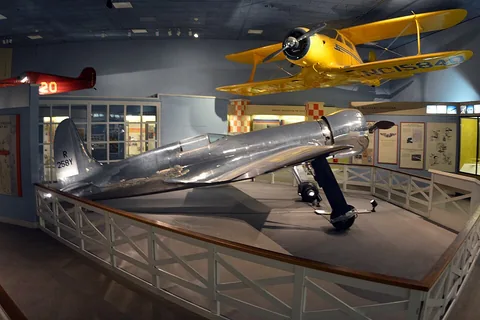 I read this book on Jeff Bezos where he said he would give that advice inside of Amazon: that you have to essentially do exactly what Howard Hughes, played by Leonardo DiCaprio in The Aviator, was doing, to the product. You just look at every single thing, you try to shave everything down. Bezos obviously was a lot more eloquent than what I was just there, but hopefully you get the point.
That's what I feel. Not that Rockefeller did that about his product, he did that about his entire company. His entire company. It's so rare. The Standard was therefore the only company positioned to balance refinery output, transportation and distribution, and squeeze marginal increments at every stage. That's why he's doing it. This advantage is going to compound, because he knew he was going to be in this business for the rest of his life. It's going to compound decade after decade. There's just no way you were going to catch him once he started doing this.
Since the Standard's distribution services were used by other shippers, competing refineries also contributed to the burgeoning Standard cash coffers. The accumulation of minor efficiencies at so many points gradually amassed into a crushing profitability advantage. I double underlined that sentence, it is so important. I'm going to read it to you again. The accumulation of minor efficiencies at so many points gradually amassed into a crushing profitability advantage.
At one point, Rockefeller purchased a fleet of wide-gauge tank cars from the cash-strapped Erie Railroad. Naturally, the Standard got the first dibs on the cars, paid a lower freight rate for their use, and collected rent when the railroads used them for other refineries. His competitors are making him stronger and harder to compete with over time. I would not want to compete with that dude.
He did this thing called the Cleveland Massacre.47The Cleveland Massacre — what came to be called the events of February–March 1872, when Rockefeller, armed with secret railroad rebates under the South Improvement Company scheme, bought 22 of his 26 Cleveland competitors in a matter of weeks. I've covered it in way more detail on other podcasts I did about Rockefeller. I'm going to give you really just two sentences here that I think are most important. Essentially, in the span of, I think, a few weeks, he consolidates 25 or 26 refineries in Cleveland, does it rapidly, emerges on the other side of this massacre as, I think, the largest refiner in the world, and he's, you know, in his mid-20s.48Fact-checkIn 1872 Rockefeller was not in his mid-20s but 32: he was born in July 1839 (Wikipedia, "John D. Rockefeller"). But I think this is an important point to convey, and this lesson I think is easy to understand. Most of the newly acquired businesses that Rockefeller bought were sold for scrap, as a total of 24 refineries were consolidated into six large, state-of-the-art installations designed from the outset for efficient production of the full range of oil byproducts. See how that connects with the previous story on Rockefeller, right?
From that point, Standard Oil was a money printing machine. And then a few pages later, this is again a really smart idea. He would overpay for control and speed. Rockefeller regarded almost all of his acquisitions as highly inefficient and made no secret that he was going to shut them down. He thought it was gracious to pay anything at all. He did so primarily to save time, for he was marching to an insistent drummer. The quicker and cleaner the restructuring, the faster he could move on to the next arena. He was intolerant of slowness, is the way I would think about that. And then this is a great description of Rockefeller on the next page. He won because he was faster in apprehension and more deadly in execution than any of his contemporaries.
09Carnegie bets everything on steel
Carnegie dropped his other businesses for steel, which he saw as the biggest opportunity of his era, and became unbeatable through his own relentless pressure.
And then it goes into Carnegie, which we'll talk about more later as well. He really benefited from traveling around and constantly searching for the newest technology, the best methods of operating, the most efficient ways to run any kind of manufacturing, but then he obviously applied those ideas to the manufacturing of steel. And at this time, I think he's around 30 years old. He's, you know, relatively rich, at least on paper, but he's spread thin. He's got a bridge company, he's got investments in working with the railroad, and he's got some stock and some other stuff. And then, you know, he thought maybe he would retire and be a gentleman of leisure. I don't know if that would ever be the case. He seems super ambitious to me. But it's on one of these trips that he's like, oh wait, I need to mass-produce steel, and he found the technology to do so when he was in England.
So it says, Carnegie found his new religion during a bond-selling trip to England in 1872. He had visited the giant new steelworks at Birmingham, and here was an industrial scale that made his heart leap.49Carnegie was taken with the Bessemer process, patented in 1856 by the Englishman Henry Bessemer: blowing air through molten pig iron turned it into steel in minutes and made steel many times cheaper. On his return, Carnegie began building the Edgar Thomson steelworks near Pittsburgh. Carnegie's life plan for the next 30 years was suddenly clear. And then here's that line that I already mentioned earlier that just blew my mind. This was a time when railroads accounted for about 80% of total stock market capitalization.
And then this is just a banger line describing Andrew Carnegie, John D. Rockefeller, and Jay Gould. It says, most businessmen reacted with fear at the violent disruptions of the 1870s.50The disruptions of the 1870s — above all the Panic of 1873: the failure of Jay Cooke's bank, overextended in railroads, crashed the stock market and set off a long depression. Top-of-the-food-chain feeders saw only a world ripe with opportunity. And then the author calls Carnegie, Rockefeller and Jay Gould apostles of progress.
And then here's a brief description of why Carnegie decided to close off every other business and focus on steel. He thought it was the biggest opportunity of his age. He says, if you believed in America, you believed in railroads. And if you believed in railroads, you believed in steel. It was the insatiable demand for steel rails by American railroads that made steel a mass-production business and led to its gradual supplanting of iron for most industrial purposes. So essentially you could think about this as every single business is going to convert from iron to steel.
Kind of reminds me of what's going on in today's age, where you have essentially Jensen being51Jensen — Jensen Huang, cofounder and CEO of Nvidia, the leading supplier of AI chips. the Carnegie of his day. Everything's going from CPUs to GPUs.52CPU — the central processor, a computer's general-purpose "brain"; GPU — the graphics processor, which runs thousands of simple operations in parallel and so became the main chip for training and running neural networks. Well, who are you buying the GPUs from? You're buying it from Jensen's company. Who are you buying the steel from? You're buying it from Carnegie's company.
And this was the economic picture of Carnegie at this time. On paper, Carnegie was a wealthy man. His personal balance sheet showed $2.1 million in assets and a net worth of $1.7 million, but it was almost all in stock, most of it illiquid securities in his own companies, with railroad-related shares the next largest category. His cash balance was under $5,000.
And so maybe up until this point, the author has presented kind of a negative view on Carnegie. He's obviously worthy of you and I studying. At the time that he sells his steel company to J.P. Morgan, I think this is like 1905, I think he has the world's largest liquid fortune. I think he had like 250 million in cash in like 1905.53Fact-checkThe sale was in 1901: Morgan bought Carnegie Steel for about $480 million, and Carnegie's share, about $226 million, was paid in bonds of the new U.S. Steel rather than cash (Wikipedia, "Carnegie Steel Company"). He was obviously a very good operator, very good at investing in technology, very good at recruiting top talent. He essentially acqui-hired Henry Clay Frick.54Carnegie bought into Frick's coke company in the early 1880s and in 1889 made Frick chairman of his firm.
But now the author is starting to give us some overview of why Carnegie was such a formidable individual, and why he said at the very beginning the only person that could match Carnegie in this era was Rockefeller. Its great capital resources enabled it to keep pressure on during good times and bad. It's talking about Carnegie's steel plant. He always had a huge war chest, just like Rockefeller. When demand slumped, the firm with the newest equipment, which was Carnegie's... Again, he insisted on investing in the newest technology every single time, and a lot of the people he was competing with were older and they didn't understand why that was important. So Carnegie's company found that its losses were the least of its rivals when it had to reduce its prices so it could run the factory fully occupied. With the purchase of the Frick Coke Company, Carnegie Steel enjoyed a dominant position in coke,55Coke — the fuel for blast furnaces, made by baking coal without air. Frick's company in the Connellsville district was the largest coke producer in the US. and its acquisitions of vast Lake Superior ore reserves56Lake Superior — near its shores, above all on Minnesota's Mesabi Range, the largest iron ore deposits in the US were found in the 1890s. Carnegie Steel gained access to them in 1896 through a deal with Rockefeller, who owned much of the range. gave it a near-overwhelming advantage in high-quality ore. Which, again, he needed coke and ore, the raw materials for his product, right? He wanted to control those sources.
The company's competitive advantage, it appears, was mostly Carnegie. His relentless pressure, his hounding to reduce costs, his instinct to steal any deal to keep his plants full, his insistence on always plowing back earnings into ever bigger plants, the latest equipment and the best technologies. Other companies went through cycles of rise and decline as founders got comfortable, shareholders demanded payouts, or good times allowed workers and managers to cruise a bit, as almost the entire British steel industry did after the great rail boom of the 1880s. But for 25 years, Carnegie never let up.
Carnegie also insisted on railroad-style cost accounting. So his competitors were actually ignorant of their costs. This is something that appears in every book that you'll read about Carnegie.57Carnegie's motto: "Watch the costs and the profits will take care of themselves." Hence the mantra at the start of the episode. So he insisted on railroad-style cost accounting, with impressive results. His monthly reports carefully spread labor costs over each product and process, tracked all raw material inputs and percentage of waste and scrap, as well as defective manufactures and returns, uptimes, and idling of major plant components like furnaces and converters. His competitors literally had no idea what was going on inside their own company.
ExplainerWhy it pays to run full
For railroads and steelworks, most costs are fixed: furnaces, rolling mills, track and interest on debt cost money even when they sit idle. Variable costs (raw materials, fuel, part of the labor) per ton of steel or per car are well below the full cost.
- The higher the output, the more tons the fixed costs are spread over, and the cheaper each ton becomes. This is the "absorption of fixed costs" Morris writes about.
- So any order priced above variable cost brings in money toward the fixed costs, even if it loses money on a full-cost basis. Hence Carnegie's line about running the works full even at a profit of $2 a ton.
- The flip side: when everyone reasons this way, price wars break out and prices fall to variable cost. Carnegie's competitors and the railroads answered with pools and cartels; he answered by cutting his own costs faster than anyone.
Carnegie also understood the subtle absorptions of fixed costs that improve margins as production is pushed further. As he put it, "Two courses are open for a business like ours. First, stand timidly back, afraid to break the market. Second, to make up our minds to offer certain large customers low figures, which will command orders. For my part, I would run the factory full next year, even if we made but $2 per ton."
Since Carnegie traveled more than anyone else in the company, he was constantly on the lookout for new technologies. He was among the best-informed people within the company on technical developments.
And then here's an interesting point that is related to the fact that he would work hands-on and then he would disappear, and he'd come back and work. He's much more like a sprinter than a grinder. Carnegie always displayed an approach-avoidance58Approach-avoidance — psychologist Kurt Lewin's term for the inner conflict when the same thing both attracts and repels. relationship with his enterprises. When he had to, he could throw himself into the work, but one suspects it was a massive exercise of will, for his instinct was always to recoil from the gritty reality and from ordinary workers. He usually stayed well removed from Pittsburgh, preferring to manage through written reports and correspondence. In many cases, he was sending written reports and correspondence from, like, Scotland.59Carnegie spent long stretches in his native Scotland: for years he rented Cluny Castle for the summer, and in 1898 he bought Skibo Castle.
It may have made him more effective. This is the interesting point. This may have made him more effective. By staying clear of operating responsibilities, he was free to criticize and harass without worrying about possible shortfalls in his own performance. Had he been more involved, with more to account for, he may not have been so unreasonable, so unwilling to understand how there could be a defective shipment or a budget overrun or an unplanned furnace downtime. He might have been easier to live with, but he would have been a less successful tycoon.
10The secret empires of Gould and Rockefeller
Gould and Rockefeller built their empires quietly and fast: Gould assembled dozens of railroads single-handedly, and Rockefeller bought the strongest competitors first and let them keep their names.
And then the book also talks about the development of a bunch of other businesses. This is not really related to any of the four tycoons that you and I are speaking about, but it really goes to show... The building of this Transcontinental Railroad60The first transcontinental railroad was built from 1863 from both ends: the Central Pacific east from Sacramento, the Union Pacific west from Omaha. The tracks met on May 10, 1869, at Promontory, Utah. Laying the last rail of the first US transcontinental railroad, Promontory Summit, Utah, May 10, 1869.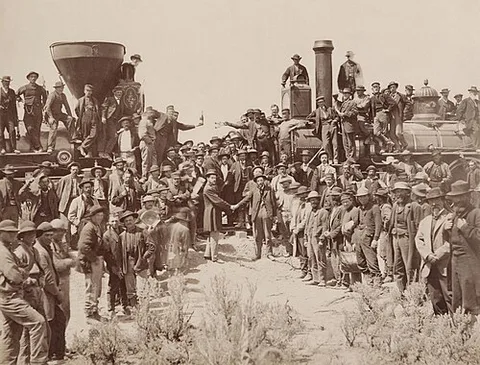 is one of the greatest engineering feats in human history. So listen to this paragraph. This is building the Union Pacific Railroad61The Union Pacific — a railroad chartered by Congress in 1862; Gould was later its dominant shareholder for years. Today it is one of the largest freight railroads in the US. through these mountains. This was one of the greatest and most heroic engineering feats of the age. Mules fought through blizzards to haul rails up the Rocky Mountains. Tunnels of extraordinary length were blasted through solid rock, and bridges flung over nearly bottomless chasms. Workers were killed by Indians, were taken by grizzlies and cougars, and died from falls or from exposure after becoming separated from their party in this trackless wilderness.
And then a few pages later we have Jay Gould's MO. His response had been to attack on every front, against all his competitors, all at the same time. And then we get an overview of how Jay Gould was operating at this time, when he's trying to build his presence in railroads. We're going to see the secret ownership, like Rockefeller did with Standard Oil. But before I get there, I have this great description from somebody that had to compete against Jay Gould. Says, "Gould is a one-man power. Consults no one, advises with no one, confides in no one, has no friends, and wants none. Gould is bold."
Jay Gould did not think like most railroadmen. Like Carnegie and Rockefeller, he regarded pools62Pools — agreements among competing railroads to share traffic or revenue by quota instead of fighting on price. The courts wouldn't enforce them and they were constantly broken; the Interstate Commerce Act of 1887 banned them. as refuges for the weak, although useful for masking his predatory intentions. The solution for the fragmented state of the railroads was to consolidate, not to negotiate elaborate paper compacts. Roads that were willing to join his network would find him a fair purchaser. This sounds like Rockefeller. Holdouts would find themselves under attack in the securities market. Since railroads' enormous capital requirements could be met only by wide distribution of securities, even the strongest roads were vulnerable.
Gould chose his battles with discretion and never engaged in pointless warfare with men as capable and as determined as himself. By 1883, Gould had become the dominant owner of, or controlling shareholder in, literally dozens of railroads. He moved so quickly and so silently that competitors who thought they had a truce with him would be shocked to find themselves under siege by Gould, discovering much too late that Gould was acting for the Kansas Pacific or the Missouri Pacific63The Kansas Pacific and the Missouri Pacific — western railroads controlled by Gould. He merged the Kansas Pacific into the Union Pacific in 1880, and the Missouri Pacific became the core of his southwestern railroad empire. or any number of unnamed railroads. So that's comparing Jay Gould and John D. Rockefeller.
This is comparing Jay Gould and J.P. Morgan. Unlike J.P. Morgan, who built an impressive staff of senior partners to work on his railroad restructurings in the '90s,64After the Panic of 1893 about a quarter of US railroads went bankrupt. Morgan reorganized them, writing down debt, consolidating lines and putting his own people in control, a process nicknamed "Morganization." Gould did most of the work himself. The heavy lifting on strategy and analytics was all his. At the same time, he somehow stayed actively involved in the strategic management of his primary roads, restructured their finances, launched major construction and extension programs, and reassured his investors. Like Rockefeller, Jay Gould never jeopardized a good deal by trying to squeeze out the last penny of advantage.
And then a few pages later, it describes the business that Rockefeller is building as a machine. Rockefeller's initial targets were the most powerful and technically advanced in the industry. So he's talking about the fact that when he would, let's say, move into a new territory and want to buy up all of his competitors' refineries, he would start with the most competent, the best of his competitors. Because if you start by taking out the top two, three, four, five, by the time you get down that list, everybody just falls in line. So it says, the most powerful and technically advanced in the industry. Their executives had each won the top dog role in an important region of the country and were not used to taking orders. Yet they all seem to have bought into his quiet insistence that consolidation was the path to salvation, that the Standard Oil would be the only entity that survived the mergers, and that he was the man to lead them.
ExplainerStandard Oil's secret roll-up and the trust
In the mid-1870s Rockefeller bought up the leading refiners of Pittsburgh, Philadelphia and New York, including Charles Pratt's firm, where Henry Rogers, later one of Standard's key men, worked. The deals were kept secret: the acquired companies kept their names and management, did business as if on their own and bought up their neighbors in their own name. Competitors and railroads long had no idea they were dealing with Standard.
- By 1880 Standard controlled about 90% of US oil refining.
- State laws made it hard for one company to own the stock of others, so in 1882 the shareholders of about 40 companies exchanged their stock for certificates of the Standard Oil Trust, run by nine trustees led by Rockefeller. This arrangement gave American antitrust law its name.
- In 1890 Congress passed the Sherman Antitrust Act; in 1892 an Ohio court dissolved the trust, and in 1911 the US Supreme Court broke Standard Oil into 34 companies.
One of his targets' sons recalled that his father was invited to examine the Standard Oil's books and was astonished at its profitability, and that guy agreed to be acquired for stock. The roll-up65Roll-up — a strategy in which one company buys up many smaller competitors in an industry and merges them into one. was also managed with great stealth. An express condition of the first round of acquisitions was that they were to be kept secret. All of the acquired companies retained their management teams and their names. Each of them pursued a regional acquisition strategy in its own name, with its own stock or cash. Once the first couple of deals were done, the momentum for joining became irresistible.
And then the author asks, did this secrecy give the Standard an unfair advantage? Without question. To Rockefeller, speed was more important than price. He reported a deal almost every other day.
And then this next section, I think, is again the core value of reading this book, because you have this constant comparing and contrasting of all these different tycoons. Carnegie's drive to the top of the steel industry feels almost hormonal: boundless energy, aggression, and ambition, fortunately channeled into something constructive. Rockefeller's seems much more a matter of sheer intelligence in pursuit of an ever larger scale of elegance and order. Carnegie pushed and badgered, shamelessly playing executives against each other, and too frequently crushed his best men. Rockefeller's management style, by contrast, was quiet and reasonable, even though, unlike Carnegie, he never held a majority stake in the Standard. If he had the final word, it was because his very talented executives believed in their hearts that he was smarter than everyone else.
He always reached out for the ablest executives he could find, gave them plenty of running room and support, and kept most of them bound to him for the rest of their careers. For such an aggressive company, the relative lack of vendetta in takeover battles and the willingness to bring former enemies into the fold are further evidence of the consistently high order of intelligence at the company's center. Rockefeller's style was not to destroy good men or good companies, but to enlist them in his cause.
11The soap the railroads were built for
The tycoons' infrastructure gave rise to businesses its builders never imagined, and with them to mass consumption.
And then one of the main points of the book that the author is making is that these people did not just build massive businesses and invent new technology. They essentially created platforms for other businesses that, without their inventions, could not exist. So I want to talk about this quick story on P&G, Procter & Gamble,66Procter & Gamble — founded in Cincinnati in 1837 by candle maker William Procter and soap maker James Gamble. It now owns Gillette, Pampers, Tide and other brands. right? This is a business that could not exist without the other technology that was invented by these other tycoons. This is very interesting.
So it says, there was a lucky accident, this is Procter & Gamble now, that happened in 1879. A worker left a soap churn on for too long, and that produced a soap that floated, which they dubbed Ivory.67Ivory — P&G's soap, made since 1879 and advertised with the slogans "99 44/100% pure" and "It floats." After risking $11,000 on an advertising campaign, P&G found themselves with one of the first blowout national consumer brands. Within a decade, they were hawking more than 30 brands of soap, sales had quadrupled, and they were jockeying with Colgate and Palmolive68Colgate and Palmolive were then separate companies, one from New York and one from Wisconsin; they merged as Colgate-Palmolive in 1928. for first place in the hearts and pocketbooks of Americans. None of the Morgans or any of the other bankers they name, who shoveled billions... This is the whole point of this section. Who shoveled billions of dollars into American railroads and telegraphs and steel mills and iron and coal mines, thought about selling wrapped and scented ladies' soap. But that, it emerged, was what all the infrastructure was for.
P&G used tree resin instead of animal tallow for the fatty acids in their soap. So Ivory's booming sales entailed big logging operations, wood processing and transport, steel machinery for soap making, coal-fed steam generators and heating plants, and increasingly mechanized cooling, cutting, wrapping, storing, and shipping operations. Again, you never can predict how the technology you're building is going to be used by others, and how it can enable businesses that could not exist without you first inventing the technology. This is incredible.
Then there were small armies of drummers to fill the order books, and legions of clerks and bookkeepers to track orders, send invoices, register payments, and monitor production. Delivering low prices, greater variety and consistent quality, as Wanamaker69John Wanamaker (1838–1922) — the Philadelphia merchant behind one of the first American department stores. He was among the first to use fixed price tags and money-back guarantees, and is credited with the line "Half the money I spend on advertising is wasted; the trouble is I don't know which half." was promising...
So then it talks about: P&G invented this, right, on the back of all these other inventions, right? Then the product gets more successful, that causes an increased demand for the raw materials that they need for the product. And then who's going to sell the product? Then you have this new invention, which has never been invented in history before, called department stores.70Department store — a large store with many departments under one roof. The first appeared in the mid-19th century: Le Bon Marché in Paris, and in the US Macy's, Marshall Field's and Wanamaker's. Because there's this proliferation of consumer goods now, you need a place to sell this in the most efficient manner. And that's what they're talking about here.
So: as Wanamaker was promising, with a pleasing shopping environment to boot, became possible only at scale, and big retail operations entailed even bigger scales all the way back through the line.
And then this is one of my favorite paragraphs, tying this entire section together. They're talking about these retail businesses that are now popping up because they're serving this exploding middle class. When you're building these giant companies, it wasn't that they just increased and enabled mass production. They enabled mass consumption, which in turn created even more businesses. All of these businesses, again, these are the retail businesses serving the exploding middle class at this point in American history, all of these businesses operated below the radar screen of mega-capitalists like J.P. Morgan. Their primary capital expenses were for real estate and inventory, which could be financed by traditional mortgages and bank working capital lines. But that was true only because they could externalize the cost of all the shipping infrastructure that Morgan had already paid for.
And then this is a great way to think about it. It's not just that the average person had more money, but that technology creates entirely new classes of products while radically reducing the cost of products once available only to the elite.
12Morgan, peacemaker among giants
Companies nearly the size of countries needed new ways to finance themselves, and Morgan became for private companies the peacemaker the Rothschilds had been for European rulers.
And that brings us to the final point in the book. Again, the subtitle is How Andrew Carnegie, John D. Rockefeller, Jay Gould, and J.P. Morgan Invented the American Supereconomy. Now the size and the scale of businesses had never been this large. They are almost country-level in size and therefore need new ways to finance the founding of and the growth of the company. So this is on financing these new companies at this point in history. And again, it is going to relate all the way back to why Morgan was able to be so powerful.
For a long time, railroads had been virtually the only businesses that raised capital on semi-public markets. A new rail line, especially in the West, had to shell out millions for track and rolling stock before it earned a nickel. When Rockefeller went into oil refining, by contrast, he and a few friends could swing the cost of an oil refinery by themselves and get it online and churning out profits within a few months. Almost all of his growth from that point was financed internally. Rockefeller borrowed aggressively from banks, but these were mostly cash flow loans that were quickly repaid, not long-term capital investment. Bridges and coal mines were usually financed with bonds, but investors treated them, reasonably enough, as railroad financings. Carnegie sold bonds to Junius Morgan to finance some of his biggest plants, but that was the exception.
For the most part, Carnegie guarded his independence from investment bankers and security markets as jealously as Rockefeller did. J.P. Morgan was among the first generation of bankers whose clients were primarily private corporations instead of governments. This is the scale at which they're operating. His mediations among the tycoons were very much in the tradition of the financial and diplomatic service operated by the Rothschilds71The Rothschilds — the banking dynasty founded in Frankfurt by Mayer Amschel Rothschild, whose five sons opened banks in Frankfurt, London, Paris, Vienna and Naples. In the 19th century they were the biggest lenders to European governments. and the Barings72The Barings — Barings, the London banking house founded in 1762; among other things it financed the Louisiana Purchase in 1803. It collapsed in 1995 after the losses of trader Nick Leeson. in mid-century Europe. Despite their occasional huge profits from war finance, the great banking houses detested war. The business disruptions were simply not worth it.
The lead partners were in close touch with all the main ministries of the Continent and regularly called upon the royal families, and while they never exercised the near-dictatorial powers of legend, they could withhold finance from rulers and occasionally even brokered trades of ports or railroads to head off a fight. Morgan played much the same role his entire career, with the difference that he was heading off warfare among competitive private companies. Different players, same game.
And that is where I'll leave it. Highly recommend reading the book. If you buy the book using the link that's in the show notes, you'll be supporting the podcast at the same time. That is 437 books down, 1,000 to go,73Senra ends every episode with this line; the number of books matches the episode number. and I'll talk to you again soon.


