

Conversations with Tyler
Chapters
No leader in history has been irreplaceable, Diamond argues, because things even out in the long run, and many leaders' success came down to circumstances such as the weather.
Read the chapter- Had Christ died at birth, Diamond says, one of the half dozen other prophets in the Roman Empire mentioned in the New Testament could have taken his place.
- Cowen counters that even with a 40 percent chance of a substitute, Christ still made a big difference in expected-value terms, as did Muhammad, without whom the Middle East might have stayed a patchwork like the Caucasus.
- A religion, in Diamond's account, needs a charismatic founder, an organizer and often a general: for Christianity those were Christ and St. Paul, while the Mahdi in Sudan and Muhammad filled all three roles.
- The wettest time on the steppes in 2,000 years, Diamond says, came around Genghis Khan's birth, and born 200 miles away and 20 years earlier he would be unknown, whereas we have no weather data for Muhammad's Arabia.
A book about individual leaders doesn't contradict Guns, Germs, and Steel, Diamond explains, because it answers a different question on a different timescale.
Read the chapter- Why we speak English on Native American land is explained, in Diamond's view, by the domesticable plants and animals of the Fertile Crescent, while why Amazon is what it is comes down to one man, Jeff Bezos.
- Asked whether the new book is in essence the error term for Guns, Germs, and Steel model, Diamond says it is simply a different book.
- Many methods for evaluating business leaders, he notes, were developed by business school professors using sports, where there is a game every week, everyone plays by the same rules and results are replicable.
Constructive leaders who changed the 20th century outnumber destructive ones, Diamond says, but Hitler made the biggest difference of all.
Read the chapter- In tables of leaders who made a difference in the 20th century, Diamond says, the constructive list is if anything a bit longer than the destructive one.
- He agrees with Cowen that replacing Roosevelt and Truman would have mattered far less than having no Hitler, in whose shadow he grew up after being born in 1937.
- What made Hitler so destructive, in Diamond's account, was his charisma as a speaker, his skill at deceiving Chamberlain, his generals and fellow Nazis, and his habit of betting everything: France and the Rhineland paid off, Stalingrad and the Ardennes did not.
Individual leaders barely matter in Papua New Guinea because the country was never unified, and those who prevented disasters are easy to overlook.
Read the chapter- The closest thing to a leader who mattered in PNG, Diamond says, was its founding president, who could have made a big mess and didn't, but was no success story like Seretse Khama in Botswana.
- PNG wasn't unified before the Australian colonial era, it has something like 700 languages by his count, and its premiers tend to be loyal to their tribe and clan.
- Diamond names Churchill, who kept Hitler from conquering England, Cowen suggests Khrushchev may have prevented World War III, and Diamond calls Kennedy's handling of the Cuban Missile Crisis the most important thing he did.
- Diamond declines to opine on AI, explaining that his most advanced device is a cell phone his sons and wife made him get.
Carson launched the environmental movement about a decade early, Diamond argues, because she was a scientist who could write for everyone, while Cowen doubts she changed much.
Read the chapter- Cowen cites the environmental Kuznets curve: countries turn much greener at around $28,000 per capita income anyway, so Carson should have been easy to replace.
- Diamond calls Silent Spring and Darwin's Origin of Species the two most influential books by scientists in the past century, and says that the day after Carson's book came out a senator, Ribicoff he thinks, announced an investigation into toxic chemicals.
- Back then scientists who wrote for the public were seen as washed up and selling out, and Diamond says Paul Ehrlich and Carl Sagan only found popular success about 20 years after Carson.
- Carson's advantages, in his telling, were that she wasn't a professor, was a woman and a poet who read her texts aloud, and stayed calm on a crucial show while a chemical company spokesman pounded and screamed.
One family built America's pomegranate juice industry because no farmer or corporation would have invested for years without profit, and Botswana's future, Diamond says, is unknowable.
Read the chapter- Pomegranates were domesticated 5,000 to 6,000 years ago, but juice from a hard rind and tiny seeds couldn't be made at scale, and today it takes a three-story tower that squeezes the whole fruit.
- In 2002 the US had about 22 pomegranate growers, Diamond says, and Lynda Resnick poured in $150 to $200 million and waited 18 years for a profit, which neither small farmers nor Coca-Cola and Nestlé would have done.
- Botswana was Africa's poorest country at independence in 1966 and for most of the 60 years since has been its richest or second richest, but what the next 60 years hold, Diamond doesn't know.
- Cowen worries that lab-grown diamonds will wipe out the value of the country's main resource; Diamond replies that natural ones are still popular, since his own son just bought his fiancée a natural diamond.
Wooden won titles less by recruiting stars than through practice, conditioning and psychology, Diamond tells Cowen.
Read the chapter- Wooden won national championships with Alcindor and Walton but also without them, so Diamond calls recruiting the least of his talents.
- He spent two and a half to three hours planning each practice, drilled plays "faster, then faster still" until they became automatic, and taught his 6-foot-4 players to outjump Duke's 6-foot-9 players.
- Noticing that he only practiced in fives, so substitutes hadn't trained with the lineup, Wooden switched to groups of seven.
- Bill Walton said Wooden meant more to him than anyone except his mother and father, because for Wooden basketball was a metaphor for life.
Others have written about the themes of Guns, Germs, and Steel, Diamond concedes, but the role of domestic animals in epidemics and the importance of continental axes are his contribution.
Read the chapter- Diamond admits his bias and notes that others also argued that success depended on the distribution of domesticable plants and animals and on continental axes.
- European diseases, he says, killed most Native Americans, who had none of their own to return because epidemic diseases come from domestic animals and their only big one was the llama.
- The idea that animals, people and inventions spread easily east to west, at the same latitude and day length, came to him from a botanist.
- Distance from the equator explains little, in his view: Europe's crops, writing, metal tools and states arose in the Fertile Crescent, and the New World's most advanced societies, the Maya and the Incas, lived close to the equator.
The most important lesson for anyone who wants to matter is to learn to talk to people face to face, Diamond says.
Read the chapter- New Guinea villagers, Diamond recounts, outmaneuvered Chevron's international lawyers from Switzerland, who thought they had a deal after one day only to be told the next morning that new negotiators would take over.
- Over recent decades, he says, the social, writing and speaking skills of UCLA students have deteriorated because communication has become mediated.
- AOC, whom Cowen describes as favored for the Democratic nomination, is famous thanks to social media, Diamond says, but not politically or socially skilled.
- He won't judge leaders still in office, but names Jobs, Musk, Bezos and Zuckerberg as business leaders who made a difference, crediting Bezos with an online store that puts the customer first.
New Guineans are on average more curious and smarter than Westerners, Diamond argues, because they were selected by a hard environment and warfare rather than by epidemics.
Read the chapter- He formed that impression over 60 years in New Guinea, he says, and some people hate him for saying it.
- In Europe survival depended on resisting infectious diseases like smallpox, TB and measles, while in New Guinea it depended on coping with a difficult environment and constant warfare.
- Cowen cites a recent Nature paper finding genetic evidence that West Eurasians have become somewhat smarter since the Stone Age; Diamond hasn't seen it and says such a claim can't be proven.
- Diamond guesses that the great leap forward of about 80,000 years ago, when inventions sped up, may have come from changes in the larynx that made complex language possible.
Diamond explains England's Industrial Revolution by geography: an island, democracy and the Atlantic coast, not genes or ideas.
Read the chapter- Answering Greg Clark's hypothesis about breeding for patience, Diamond says an island didn't need standing armies, which let democracy develop, and its Atlantic coast opened the way to the world.
- He doesn't know Deirdre McCloskey's work, but links the Enlightenment to the same democracy: England chopped off its king's head in the 1600s and parliament grew strong.
- The Netherlands followed because it looks across the sea at England and became a democracy early.
- Diamond admires Acemoglu and Robinson, though they give institutions more credit than geography, and says Robinson taught him the method of natural experiments that underlies the new book.
Diamond is more optimistic than he was 20 years ago, 51 to 49, thanks to corporations and young people.
Read the chapter- Twenty years ago he would have called big corporations the most destructive force, but now, he says, Walmart and Unilever lead on sustainability and Chevron turned out to be extremely careful in Papua New Guinea.
- Young people are far more interested in the environment now: his own sons marched with their class to save the rainforest at age six.
- Cowen thinks solar-powered desalination will solve Australia's problems, and Diamond replies that it hasn't happened yet.
- The most important thing, Diamond says, is not to look for the most important thing: a happy marriage takes getting 37 things right, and the world has to handle climate change, inequality and nuclear risk.
Talks among the nuclear powers reduce the risk of nuclear war, Diamond argues, and keyboards don't change because of accumulated investment.
Read the chapter- After the Cuban Missile Crisis, Russia and the US talked continuously, and Diamond sees North Korea as today's main danger and calls for talks among all nine nuclear states.
- Diamond says we have too much invested in the Dvorak keyboard to switch, even though another layout would be more efficient, and that it's investment rather than inertia.
The best birds are in New Guinea, all of Diamond's books grew out of one, and in the evenings he listens to Bach instead of working.
Read the chapter- Diamond has logged 189 species on Stone Canyon Road in Los Angeles, where he lives, but nothing compares to New Guinea, with its birds of paradise and bowerbirds that build bowers up to nine feet tall.
- Chapters of The Third Chimpanzee from 1991 grew into Guns, Germs, and Steel, Collapse and Why Is Sex Fun?, and the leaders book grew out of growing up in Hitler's shadow.
- Until the 1980s, he says, he was the world's expert on the gallbladder, but after his twin sons were born in 1987 he realized their future would depend on history and geography.
- Instead of working in the evening he listens to one Bach cantata a week, including Gardiner's recordings, is up to number 57 and sleeps well.
His father led Diamond to science, his mother to languages and music, and the "genius award" pushed him toward big subjects.
Read the chapter- His father, a hematologist and pediatrician, steered him toward medicine and physiology, while his mother, a linguist and concert pianist, taught him to read at three, went through his Latin lessons with him every night for a year and gave him his love of languages and music.
- The MacArthur Fellowship brought on the only week of depression in his life, because it told him great things were expected of him while he was studying gallbladders.
- Turning 89 next month, Diamond has two goals for the coming decade: get to know all 200 Bach cantatas and synthesize 60 years of work on the birds of New Guinea's ten remote mountain ranges, explaining why some species colonized every range and others none.
Quotes
On the least replaceable leader in history
“Frankly, my answer is none. There has been no unreplaceable leader in human history because over a long time, things wash out.”
Jared DiamondRead from 01:16On why Genghis Khan built the empire
“He was born at exactly the right time at the right place. If he had been born 200 miles further away and 20 years earlier, we wouldn’t know anything about him.”
Jared DiamondRead from 03:43On why Lynda Resnick built the pomegranate juice industry
“The big companies like Coca-Cola and Nestlé, they never would have permitted a branch of their industry to sink $150 million and not make a profit for 18 years.”
Jared DiamondRead from 17:20On the main lesson for an ambitious 25-year-old
“The main lesson is learn to talk to people face-to-face and put away your indirect means of communication.”
Jared DiamondRead from 25:20On how New Guineans negotiated with Chevron's lawyers
“The next morning, the New Guineans said, ‘Oh, no, that agreement, we are forgetting that agreement. The people who made that agreement, they don’t count. Here are some different negotiators.’”
Jared DiamondRead from 26:10On the planet's future
“I would say the chances are 51 percent that we will have a good outcome and only 49 percent that we will have a bad outcome.”
Jared DiamondRead from 38:46On the secret of a happy marriage
“When a couple who are about to get married asks me, ‘What is the single most important thing for happy marriage?’ My answer is the single most important thing is not to look for the single most important thing. Because for a happy marriage, you need to get 37 things right. If you get 36 things right, and you disagree about sex or you disagree about religion, the marriage will fall apart.”
Jared DiamondRead from 40:27On why the "genius award" upset him
“When I got the MacArthur Fellowship, I thought I would have been excited. Instead, I was depressed for a week. Why? Because the news of the MacArthur Fellowship told me, ‘Jared, people expect big things of you, and you haven’t delivered. You’ve been working on the gallbladder. You can do better things than that.’”
Jared DiamondRead from 48:46
Summary
Tyler Cowen talks with Jared Diamond — biologist, geographer and author of Guns, Germs, and Steel — about his new book, Profits, Prophets, Coaches, and Kings, which asks when leaders actually matter. Asked who is the least replaceable leader in history, Diamond answers: nobody. Christ could have been replaced by another prophet — the Roman Empire had half a dozen of them — and Genghis Khan, he says, was simply lucky to be born when the steppes had their wettest stretch in 2,000 years. Cowen pushes back: in expected-value terms Christ and Muhammad changed a great deal, the 20th century without Hitler would look different, and Rachel Carson, if anyone, is the easy one to replace, since countries turn green anyway as they get richer.
Diamond holds his ground. The new book is not a correction to Guns, Germs, and Steel but an answer to a different question on a different timescale: geography explains why we speak English on Native American land, Jeff Bezos explains why Amazon is what it is. Carson sped up the environmental movement by a decade or so, Lynda Resnick built a pomegranate juice industry no corporation would have risked, and John Wooden won less through recruiting than through practice and psychology. Along the way: why individual leaders count for so little in Papua New Guinea, why we undervalue the people who prevented things, like Kennedy in the Cuban Missile Crisis, and whether Botswana's success will last.
His main advice to an ambitious 25-year-old is to learn to talk to people face to face: New Guinea villagers once outmaneuvered Chevron's international lawyers. New Guineans, in Diamond's experience, are more curious and smarter than Westerners, selected by a hard environment and constant warfare rather than by epidemics. He explains England's Industrial Revolution by its being an island, its democracy and the Atlantic, not by genes à la Gregory Clark or ideas à la Deirdre McCloskey, and credits James Robinson with teaching him natural experiments. Since Collapse he has grown more optimistic — 51 to 49 — thanks to corporations and young people, and his one remedy for nuclear risk is conversation among the nuclear powers.
The end turns personal: 189 bird species on his own street and the bowerbirds of New Guinea, one Bach cantata a week, a hematologist father and a linguist mother, a week of depression after the MacArthur "genius award" that made him trade the gallbladder for big books, and plans for the decade after his 89th birthday: finish all 200 cantatas and sum up 60 years of work on the birds of New Guinea's mountains.
Advice
Learn to negotiate with people face to face rather than by message and phone: someone who has spent a lifetime negotiating in person will outplay a professional used to communicating at a distance.
Mentioned
- "Profits, Prophets, Coaches, and Kings: (When) Do Leaders Matter?"00:26Diamond's new book and the occasion for the conversation
 Jesus Christ01:16another prophet could have taken his place, Diamond argues
 Muhammad02:06founder, organizer and general of Islam
 Genghis Khan03:43born in the wettest era on the steppes
Show 26 more mentionsShow fewer mentions
- Guns, Germs, and Steel04:46geography versus leaders; Diamond's own contribution
 Amazon05:15the "everything store" one person built
 Jeff Bezos05:15a leader who really did make a difference
 Adolf Hitler07:30the destructive leader who changed the 20th century most
 Winston Churchill10:10both did things and prevented them
 John F. Kennedy10:49prevented nuclear war in the Cuban Missile Crisis
 Rachel Carson12:12launched the environmental movement about a decade early
- Silent Spring12:43one of the two most influential books by scientists in a century
 Lynda Resnick15:50created the US pomegranate juice industry
 John Wooden19:25the UCLA coach who won through practice and psychology
 Bill Walton19:25Wooden mattered to him more than anyone but his parents
 Chevron25:45negotiations with New Guinea villages and environmental caution
 Alexandria Ocasio-Cortez27:03well known because of social media
- Ancient DNA reveals pervasive directional selection across West Eurasia30:40the Nature paper on selection in West Eurasians
- The Third Chimpanzee32:18the Great Leap Forward; the book his later books grew out of
 Gregory Clark32:59the hypothesis that the English "bred" themselves into patience
 Deirdre McCloskey34:10ideas and liberty as the cause of the Industrial Revolution
 Daron Acemoglu35:13extractive versus inclusive institutions
 James A. Robinson35:24taught Diamond natural experiments
- "Collapse: How Societies Choose to Fail or Succeed"36:40the book Cowen found too pessimistic
 Walmart37:30a leader in sustainable products
 Johann Sebastian Bach45:47200 cantatas, one a week
 Masaaki Suzuki46:44Bach cantata recordings; a past Conversations with Tyler guest
 John Eliot Gardiner46:44one of the cantata cycles Diamond listens to
 Louis K. Diamond47:09Diamond's father, a hematologist
 John D. and Catherine T. MacArthur Foundation48:46the "genius award" that left Diamond depressed for a week
Transcript
01There are no irreplaceable leaders
No leader in history has been irreplaceable, Diamond argues, because things even out in the long run, and many leaders' success came down to circumstances such as the weather.
Hello, everyone, and welcome back to Conversations with Tyler. Today, I am greatly honored to be speaking with Jared Diamond.1Jared Diamond (b. 1937) — American physiologist, ecologist and geographer. His best-known book is Guns, Germs, and Steel (1997), which won the 1998 Pulitzer Prize. Jared studied physiology at Harvard and Cambridge and became initially a leading expert on the gallbladder.2The gallbladder: Diamond's Cambridge dissertation, defended in 1961, was on the physiology and biophysics of gallbladder membranes — how the organ concentrates bile. He is also an ornithologist, anthropologist, sociologist, evolutionary biologist, ecologist, and environmental historian with a working knowledge of archaeology, genetics, and the epidemiology of human diseases. On top of all that, he is professor of geography at UCLA.3UCLA — the University of California, Los Angeles. Diamond started there as a professor of physiology at the medical school and later became a professor of geography. He has a new and notable book out called Profits, Prophets, Coaches, and Kings: (When) Do Leaders Matter?4Profits, Prophets, Coaches, and Kings was published on September 1, 2026, by Mariner Books, and in the UK by Allen Lane. Jared, welcome.
Thank you. It’s a pleasure to be with you.
Who do you think is the least replaceable leader in human history?
Wow. Wow. The least replaceable leader in human history. Frankly, my answer is none. There has been no unreplaceable leader in human history because over a long time, things wash out. A candidate, of course, would be Jesus Christ, but there were half a dozen other prophets in the Roman Empire at that time discussed in the New Testament.5Other prophets: the Acts of the Apostles mentions Theudas, who had about four hundred followers, Judas of Galilee (Acts 5:36–37) and "the Egyptian" who led four thousand men out into the wilderness (Acts 21:38). The historian Josephus writes about them too. If Christ had died in childbirth, one of those other prophets might have taken over. I would say that in the long run, there is no leader that has made a difference.
Well, you say “might have taken over,” but that’s probabilistic, right? Say with a 40 percent chance, someone else would have taken over. It still seems in expected value terms,6Expected value — the average outcome weighted by the probabilities of all possible outcomes. If there's a 40 percent chance someone else would have replaced Christ, then in the other 60 percent history goes differently, and on average his contribution is still enormous. Christ made an enormous difference.
Certainly, his religion made an enormous difference. Christ himself was the charismatic founder, but a religion needs three things: It needs a charismatic founder, it needs an organizer, and often it needs a general because new religions often face opposition. The organizer for Christianity was St. Paul.7St. Paul (d. c. 64–67) — a Jew from Tarsus who persecuted Christians and then became their chief missionary: he founded communities across the eastern Mediterranean, and his letters make up 13 of the 27 books of the New Testament. In the case of the Mahdi’s religion of the Sudan in the late 1800s,8The Mahdi — Muhammad Ahmad (1844–1885), who in 1881 proclaimed himself the Mahdi, the redeemer Muslims await, and raised a revolt against Egyptian rule in Sudan. His forces took Khartoum in 1885; the state he founded lasted until 1898, when the British crushed the Mahdists at Omdurman. the Mahdi was the charismatic founder, and he was the organizer, and he was the general. In the case of Islam, Muhammad was the founder and the organizer and the general. Religions may have three roles, some of which are sometimes played by the same person.
Without the figure of Muhammad at exactly the time he came along, is it not quite easy to imagine a Middle East not unified under Islam, not unified with the common language of Arabic? In some ways, maybe a bit more like the Caucasus,9The Caucasus is one of the most linguistically diverse regions in the world: people there speak languages of three native families — Kartvelian, Northwest Caucasian and Northeast Caucasian — as well as Indo-European and Turkic languages. which remains a crazy quilt of different patterns. Thus, Muhammad is one of the three or four most consequential leaders ever.
That’s possible. That’s a big question. It’s harder to become clear about Muhammad than it is about Christ, because we don’t know what the weather was like in Arabia at that time. Weather makes a big difference. If it was rainy, that would mean lots of plant growth for lots of babies and for feeding an army. We just don’t have information on the weather in Arabia at that time.
A counter-example is Genghis Khan, who developed the largest land empire in world history,10The Mongol Empire — the largest contiguous land empire in history: at its peak, in the 1270s, about 24 million km². The Mongols reached Poland on raids — in 1241 they defeated a Polish-German army at Legnica — but Polish lands never became part of the empire. all the way from China to Poland. Why did Genghis Khan do it when there were other steppe leaders like Attila the Hun and Timur the Turk?11Attila (d. 453) — leader of the Huns who led devastating campaigns against the Eastern and Western Roman Empires. Timur, or Tamerlane (1336–1405), was the Central Asian conqueror who built a vast empire with its capital at Samarkand. We’ve learned recently that the wettest time on the steppes in the last 2,000 years was around the time of Genghis’s birth.12Fact-checkDiamond puts the wettest time on the steppes in 2,000 years around Genghis Khan's birth. In fact, the climate was reconstructed from the tree rings of Siberian pines in central Mongolia over 1,112 years (Pederson et al., PNAS, 2014), and the longest wet spell turned out to be 1211–1225: 15 straight years of above-average rainfall and lush pasture for horses. That was the time of the great conquests, while Genghis Khan was born around 1162, half a century earlier. Paper. He was born at exactly the right time at the right place. If he had been born 200 miles further away and 20 years earlier, we wouldn’t know anything about him. In the case of Muhammad, we just don’t know whether the time of his birth was a particularly propitious time to found a religion in that area or not.
02Ideas, geography and leaders
A book about individual leaders doesn't contradict Guns, Germs, and Steel, Diamond explains, because it answers a different question on a different timescale.
The very notion that the two first names we’re talking about, they’re both religious leaders, right? They’re not kings. They’re not inventors. Do you think that suggests a vision of the world where it’s ideas that really matter and somewhat at variance with your own geography-based theories?
My own geography-based theories, people often say, “Jared, have you changed your mind? Here’s this book about individuals. Your other books, Guns, Germs, and Steel, and so on, are about whole societies for 10,000 years.” No, I haven’t changed my mind. It’s that I’m asking different questions. For questions such as, why is it that you and I are now speaking the English language, and you and I, evidently of European background, but we’re standing on the land of Native Americans. That’s long-term history.
The explanation is not individual leaders, but it has to do with plants and animals available for domestication in the Fertile Crescent13The Fertile Crescent — an arc of fertile land from the Persian Gulf through Mesopotamia and Syria to the Levant. Wheat, barley, sheep and goats were first domesticated here more than 10,000 years ago. versus in the New World. That’s a question whose answer does not depend upon individual leaders. Whereas, if you want to know why Amazon is now the largest everything store,14"The everything store" — a nickname for Amazon, which started in 1994 as an online bookstore. It's also the title of Brad Stone's 2013 book about Amazon and Jeff Bezos. a store that cares so much about individual customers and doesn’t care about paying dividends to its investors, that has everything to do with one person, Jeff Bezos.
Is it correct to think of your new book, again, Profits, Prophets, Coaches, and Kings, as, in essence, the error term15Error term — the random error, or residual, of a regression model: the part of the outcome that the factors in the model don't explain. for Guns, Germs, and Steel?
No, I would just say it’s a different book about a different question on a different timescale.
There is some larger model that ties it all together, right, in your mind?
Certainly, my current book—yes—is looking at leaders not just in the sphere of politics, which is where I first got interested in this subject, but also in the business world and in the sports world, sports coaches, and in the world of religion. It turns out that there are common questions and common methods used for studying leaders in these different spheres.
For example, I hadn’t realized before I got into this area that much of the research on sports coaches has been done by business school professors because the questions of leadership that business school professors ask can be answered more easily in sports. In sports, there’s a game every week. All the teams play by the same rules. There may be 24 teams in the same league. It’s reproducible. Business is not so reproducible. Much of the work about the methods for assessing leaders in business have been developed by business school professors testing their methods and developing the methods in the world of sports.
03Hitler and destructive leaders
Constructive leaders who changed the 20th century outnumber destructive ones, Diamond says, but Hitler made the biggest difference of all.
In politics, do you think destructive leaders matter more than constructive leaders just because it’s easier and cheaper to destroy?
No. When one looks at tables of leaders who made a difference in the 20th century, the list of constructive leaders is, if anything, slightly longer than the list of destructive leaders.
Say we had not had Roosevelt and Truman,16Franklin Roosevelt — US president from 1933 to 1945, who led the country through the Great Depression and most of World War II. Harry Truman — his successor (1945–1953), under whom atomic bombs were dropped on Japan and the Cold War began. but we had other presidents, that seems to be a much smaller difference than if there had been no Hitler.
That is true. Hitler is certainly the destructive leader who made the biggest difference in the 20th century. I was born in 1937, so I grew up in the shadow of Hitler. Hitler made a difference. Why? Because he was ultra-charismatic as a speaker, unfortunately, because he was a very skilled manipulator and deceiver. He deceived not only Neville Chamberlain17Neville Chamberlain — British prime minister from 1937 to 1940. In 1938 he signed the Munich Agreement with Hitler, handing Czechoslovakia's Sudetenland to Germany, and declared that he had brought back "peace for our time." and other politicians. He deceived German generals, and he deceived his fellow Nazis.
He was a big risk-taker. He was not willing to wait. He was convinced that he would die early, and so he took big risks. He threw everything on a single cast. Sometimes his risk paid off, as in his invasion of France18The invasion of France: in May and June 1940 the Wehrmacht defeated France in six weeks, sending its tanks through the Ardennes around the Maginot Line. or in sending German troops into the Rhineland when it was unprotected.19The Rhineland: in March 1936 Hitler sent troops into it even though the Treaty of Versailles had demilitarized it. France and Britain did nothing to stop him. Sometimes his gamble didn’t pay off, most notably when he did not pull back the German army surrounded at Stalingrad,20Stalingrad: in November 1942 the Red Army encircled Friedrich Paulus's Sixth Army at the city. Hitler forbade it to break out, and on February 2, 1943, it surrendered — the first of Hitler's field armies to do so. or when he threw his last tank armies into the Battle of the Bulge.21The Battle of the Bulge (December 1944 – January 1945) — the Wehrmacht's last major offensive on the Western Front, launched through the Ardennes. Hitler was a very distinctive person.
04New Guinea and the preventers
Individual leaders barely matter in Papua New Guinea because the country was never unified, and those who prevented disasters are easy to overlook.
Do you think there are any individual leaders who have really mattered for the history of Papua New Guinea (PNG)?
For the history of Papua New Guinea, really interesting question. I would say no. The closest one to it was the founding president of Papua New Guinea,22Fact-checkDiamond says "founding president," but Papua New Guinea has no president: since independence from Australia in 1975 it has been a Commonwealth realm with the British monarch as head of state. Its first prime minister was Michael Somare (1936–2021), often called the father of the nation (Wikipedia, "Michael Somare"). who could have made a big mess. He didn’t make a big mess. On the other hand, he wasn’t as spectacularly successful as Seretse Khama, the founding president of Botswana.23Seretse Khama (1921–1980) — Botswana's first president (1966–1980). Under him the former British protectorate of Bechuanaland, one of the poorest countries in the world, began mining diamonds and became one of the world's fastest-growing economies.
What’s your underlying model for why, in PNG, the leaders matter so little? Is it that geography is so important there, or that it’s never been unified, or that it’s so poor?
Good question. PNG was not unified until the Australian colonial era,24The Australian colonial era: Britain handed the southern part of the country, Papua, to Australia in 1906, and Australia occupied German New Guinea in the north in 1914. The two were administered as a single territory only after World War II. and even today, PNG has something like 700 different languages.25Fact-checkDiamond says about 700 languages; according to Ethnologue, Papua New Guinea has 840 living languages, more than any other country. Our World in Data. The premiers of PNG tend to be devoted to their tribal group, even to their clan, or to their group of tribes. PNG has never had a national unity, and it’s had a struggle to build a national unity today.
How do you identify leaders who simply prevented events? There’s no great legacy to their name, but they stopped some very bad or maybe very good things from happening. They’re just a footnote to history, but they mattered a great deal.
Leaders who prevented events. One can say that Winston Churchill26Winston Churchill — British prime minister in 1940–1945 and 1951–1955. In the summer of 1940, after the fall of France, he refused to make peace with Hitler, and the RAF's victory in the Battle of Britain wrecked the German invasion plan. prevented events. He prevented the conquest of England by Hitler. He then joined with Roosevelt to overcome Hitler. Other leaders who prevented events. Most of the leaders that we think of are the leaders who did things rather than prevented things from happening.
We undervalue the preventers. Churchill was very active. He both did things and prevented things. Maybe Khrushchev27Nikita Khrushchev — first secretary of the Soviet Communist Party from 1953 to 1964. He was the one who put missiles in Cuba, and also the one who agreed to remove them, which let the Cuban Missile Crisis end without war. prevented World War III. We don’t quite ever see that in the data in any obvious way, but he might have been extraordinarily consequential.
Yes, John Kennedy. What was probably the most important thing that John Kennedy did? It was the handling of the Cuban Missile Crisis. I remember it very, very well. I was at a dinner when Kennedy made his speech announcing the crisis.28The Cuban Missile Crisis: Kennedy announced the Soviet missiles in Cuba and a naval "quarantine" of the island in a televised address on October 22, 1962. On October 28 Khrushchev agreed to withdraw the missiles in exchange for a US pledge not to invade Cuba, and under a secret understanding the US also removed its missiles from Turkey. For a week, it was touch and go whether the world would have ended up in nuclear war.
In fact, after the crisis was over and the Russians and the Americans began to talk to each other, we realized how close we and they had come. There was a Russian submarine whose captain wanted to launch a nuclear missile. It was the other officers on the crew who prevented the captain, so it was a close call.29Fact-checkDiamond says the captain wanted to launch a nuclear missile; it was actually a nuclear-tipped torpedo. The submarine was the Soviet B-59: on October 27, 1962, as US destroyers dropped signaling depth charges to force it to surface, its commander Valentin Savitsky decided to use the torpedo. That required the consent of three senior officers, and the flotilla chief of staff, Vasily Arkhipov, refused (Wikipedia, "Vasily Arkhipov"). Kennedy handled the discussions in the Cuban Missile Crisis brilliantly. We could say, yes, the most important thing that Kennedy did was to prevent nuclear war.
With the onset of powerful artificial intelligence, will political leaders matter less or more?
Interesting question. I’m pausing because my sons, if they heard this conversation, would say, “For heaven’s sakes, don’t ask our father about artificial intelligence because he is the least competent person technologically we know.” I will now show you the most advanced device I have. It is a cell phone. My sons and my wife forced me to get the cell phone.
That’s enough.
Therefore, I’m not competent to express any opinion about artificial intelligence.
05Was Rachel Carson irreplaceable?
Carson launched the environmental movement about a decade early, Diamond argues, because she was a scientist who could write for everyone, while Cowen doubts she changed much.
Now, in some of your particular explanations in the book, I’d like to push on a few of those. I read you as arguing that Rachel Carson mattered a good deal. I’m not sure that’s true because it seems there’s a lot of countries that when people get to something like $28,000 per capita income that they just turn much greener, and they clean up their air. We sometimes call that the environmental Kuznets curve.30The environmental Kuznets curve — the hypothesis that pollution first rises with income per capita and then, past a certain threshold, starts to fall. It's named by analogy with Simon Kuznets's curve for inequality and became known through the work of Gene Grossman and Alan Krueger in the early 1990s. The fact that there’s a broad class of those countries, doesn’t that mean Rachel Carson probably didn’t matter that much?
At minimum, Rachel Carson jumped out of the environmental movement about a decade before it would have been jumpstarted. Yes, an environmental movement was starting in the United States then, but it had not gotten a great deal of attention. Her book, Silent Spring,31Silent Spring (1962) — marine biologist Rachel Carson's book about the harm pesticides, above all DDT, do to birds and all of nature. DDT was banned for agricultural use in the US in 1972. that book and Darwin’s Origin of Species32On the Origin of Species (1859) — Charles Darwin's book setting out the theory of evolution by natural selection. are probably the two books by scientists that have had the biggest impact in the last century.
When her book was published, the very next day, it was Senator, I think, Ribicoff of Connecticut, who announced the next day that he was launching a US government investigation into toxic chemicals.33Abraham Ribicoff — senator from Connecticut. He announced hearings on environmental hazards the day after a CBS program about Carson aired in April 1963, and on June 4, 1963, Carson testified before his subcommittee. She certainly caused the environmental movement to develop earlier than it would have developed afterwards. You’re correct: The environmental movement would have developed perhaps later and more slowly.
It seems if anyone is relatively easily substitutable, it was her. It might have come a year later, but there are plenty of people writing and thinking about the environment. It seems odd to suggest that Jesus is just one of many prophets of his time, he would have been substitutable, but that Rachel Carson had this unique role.
Well, this is interesting. When Rachel Carson wrote Silent Spring, she was a scientist,34Carson the scientist: until 1952 she worked as a biologist at the federal Bureau of Fisheries (later the US Fish and Wildlife Service), and by the time of Silent Spring she had already written a bestseller, The Sea Around Us (1951), which won the National Book Award. and she was respected by other scientists. When she asked questions, they answered her questions. At that time, there was no professional scientist writing books for a broad public. Yes, I remember it well because I was getting into science in those days. In those days, the belief among scientists, professional scientists, was that if you write for the public, it’s because you’re washed up as a scientist. You’re prostituting yourself.
In fact, the first scientists who achieved success in writing for the public, Paul Ehrlich and Carl Sagan,35Biologist Paul Ehrlich became famous with The Population Bomb (1968), astronomer Carl Sagan with the TV series Cosmos (1980) and the book of the same name. Carson's first bestseller, The Sea Around Us, came out in 1951, Silent Spring in 1962. did not achieve their success until about 20 years after Rachel Carson. Rachel Carson had some advantages compared to the scientists who later became famous. She was not a university professor, so nobody could say she was prostituting herself. She was a woman. She wrote beautifully. She was a poet. She read back her texts to listen to them. Even the best writers today, Richard Dawkins,36Richard Dawkins (b. 1941) — British evolutionary biologist, author of The Selfish Gene (1976), one of the best-known popular science books. they don’t write as beautifully as did Rachel Carson.
What else? A woman, not a university professor. She was a mild-mannered person, not a vigorous arguer like Carl Sagan. But as a mild-mannered person, when she was put on a crucial show where she and the spokesman for a chemical company squared off against each other,37The CBS Reports episode "The Silent Spring of Rachel Carson" aired on April 3, 1963. Carson's main opponent on it was biochemist Robert White-Stevens of American Cyanamid, who called her "a fanatic defender of the cult of the balance of nature." the spokesman for the chemical company pounded and screamed and basically looked embarrassing, whereas Rachel Carson responded calmly and convincingly. I would say, thinking about it now, that it was another 20 or 30 years before the first scientists became famous for writing for the public.
06Pomegranate juice and Botswana's diamonds
One family built America's pomegranate juice industry because no farmer or corporation would have invested for years without profit, and Botswana's future, Diamond says, is unknowable.
Now, this is the podcast where we talk about the pomegranate juice industry. I’m well aware of the proximate influence of the Resnick family,38Lynda and Stewart Resnick — California billionaires who own The Wonderful Company (pistachios, almonds, citrus, Fiji Water). They launched POM Wonderful pomegranate juice in 2002. but when I look around the world, I see India, Iran, Turkey, China, Egypt, Spain, South Africa, Azerbaijan, Italy. They all have a pomegranate juice sector. It’s hard for me to believe that without the Resnicks, the US would not have gone the same path a little while later, but inevitably so, no?
No, because pomegranates have been domesticated about 5,000 to 6,000 years ago. The pomegranate juice market consisted of a salesperson squeezing a single glass of juice at a market. It’s difficult to make pomegranate juice. Orange juice is easy to make. You cut the orange in half, and it’s soft inside. Much of the value of the pomegranate is in its very hard rind, and the contents of pomegranates is not a mush like orange juice, but it’s these tiny seeds.
The way that pomegranate juice is now made on a large scale consists of a three-story tower that squeezes the entire pomegranate, including the rind. It’s much more difficult than making orange juice. There was no pomegranate juice industry for 5,000 years around the world. In the United States, there was no industry until 2002. In 2002, there were about 22 pomegranate growers in the United States.
They were all in California. 21 of them were small farmers without much money, without the motivation to invest huge amounts of money. Lynda Resnick got interested in the medical value of pomegranates. She sank huge amounts of money, a couple of hundred million dollars. It took her 18 years to start making money on pomegranate juice. None of those 22 other farmers had the $150 million to pour in or would have waited 18 years. The big companies like Coca-Cola and Nestlé, they never would have permitted a branch of their industry to sink $150 million and not make a profit for 18 years.
Are you convinced that the relative success of Botswana will endure? Their current politics seems much more personalized, much more corrupt. With artificial diamonds,39Lab-grown diamonds are made under high pressure and temperature or by deposition from a gas; chemically and physically they are identical to natural ones. In recent years they have become much cheaper and are dragging down the prices of natural stones — and diamonds are the backbone of Botswana's exports. the value of their most important resource is headed to some very low sum. Won’t they just revert to mean, and it won’t have been an enduring success?
What one can say is that Botswana became independent in 1966. It’s now 60 years later. Botswana, when it became independent, was the poorest country in Africa. Now, Botswana, for most of these 60 years, has been either the richest or the second-richest country in Africa. For 60 years, they’ve got a great track record. What will happen in the next 60 years, I don’t know.
It’s only, I think, two million people or so. I’m not sure of the number, and one resource. You divide up the value of the resource, and they do well. The value of the resource goes away, and they’re like Namibia,40Namibia — Botswana's western neighbor. It mines diamonds too, but its income per capita is noticeably lower. no?
ExplainerBotswana's diamonds
In 1967, a year after independence, De Beers geologists found the Orapa kimberlite pipe. Seretse Khama's government didn't nationalize mining; instead it set up a joint company with De Beers — the future Debswana, owned by the two in equal shares since 1975 — and year after year bargained for a bigger share of the revenue. The Jwaneng mine, opened in 1982, is considered the richest in the world by the value of the stones it produces. Diamonds make up about four-fifths of Botswana's exports and roughly a third of government revenue; since 1994 part of the proceeds has gone into the Pula sovereign wealth fund.
The threat Cowen describes has already arrived: lab-grown diamonds are chemically identical to natural ones and cost a fraction as much, and in 2024 they accounted for more than half of engagement rings sold in the US. Natural stones have fallen in price, De Beers's sales have dropped, and in 2024 Botswana's economy shrank by 3 percent.
Yes, they have three million people. The value of the diamonds is divided among only three million people instead of divided among the 100 million people, as in the case of Nigeria.41Fact-checkDiamond says three million people in Botswana and 100 million in Nigeria; in fact, Botswana's 2022 census counted about 2.4 million people, and Nigeria, by UN estimates, has more than 200 million (Statistics Botswana, 2022 Population and Housing Census; UN World Population Prospects). We’ve had artificial diamonds for quite a while now. Despite that, natural diamonds are still very popular. I know this firsthand because my son, one of our two sons, has just gotten engaged. What he bought for his fiancée was a natural diamond, not an artificial diamond.
07John Wooden: more than a recruiter
Wooden won titles less by recruiting stars than through practice, conditioning and psychology, Diamond tells Cowen.
You have a section on John Wooden, the former basketball coach at UCLA. When I think of his success as a coach, I’m most inclined to think his great talent was as a recruiter, not as a coach per se. What’s your view on that? He gets Lew Alcindor, later Kareem Abdul-Jabbar, and Bill Walton, among others, to come to UCLA to play. Isn’t it all about recruiting?
Yes, that’s recruiting, but recruiting was the least of his talents. He won national championships with Walton and with Alcindor, but he also won national championships without them.42John Wooden: under him UCLA won 10 NCAA championships in 12 seasons (1964–1975), seven of them in a row. Lew Alcindor (Kareem Abdul-Jabbar from 1971) brought the 1967–1969 titles and Bill Walton those of 1972 and 1973, while UCLA won in 1964, 1965, 1970, 1971 and 1975 without them. He was distinctive in many ways. He spent two and a half, three hours planning his practices. When he ran the practices, his players said, “We ran a play,” and then he would say, “Do it faster, and then do it faster,” with the result that his players could do things almost subconsciously.
He also insisted on his players being in top-rank condition. There was a year when UCLA played against Duke.43UCLA vs. Duke: in the 1964 NCAA final, UCLA, with no starter taller than 6'5", beat Duke 98–83, even though Duke had two 6'10" players. It was the first of Wooden's ten titles. The Duke players were 6’9”, and the UCLA players were 6’4”, but John Wooden trained his players to jump higher than the [Duke] players. He was a great psychologist also; he understood his individuals. He understood teamwork. One of his decisive moves was that in a year when UCLA didn’t do very well, he wondered why is it. He figured out that he was practicing his players just in groups of five, which meant that if one player had to take a rest and another player was brought in, the other player hadn’t worked out with that group. He trained his players in groups of seven rather than five.
Then, finally, his players themselves, when they talked about John Wooden, they didn’t talk about him as a basketball coach. They talked about him as a person. Bill Walton said this. He said, “John Wooden made more difference in my life than anyone other than my mother and father.” Because for him, basketball was not a sport. Basketball was a metaphor for life.
08How much does Diamond himself matter?
Others have written about the themes of Guns, Germs, and Steel, Diamond concedes, but the role of domestic animals in epidemics and the importance of continental axes are his contribution.
If you think of your own model of the intellectual world, how consequential a figure are you? Would Guns, Germs, and Steel, in some other way, have been written, rewritten 10 years later if you hadn’t done it, or it just would have been a vacuum?
I have some prejudices in that.
That’s fine. Let’s hear them.
All right. There are other books about the theme of Guns, Germs, and Steel, which is why societies in different parts of the world had different successes. My argument and the argument of others is that it depended upon the distribution of domesticable plants and animals around the world. It also depended upon the axes of the continents,44The axes of the continents — one of the central arguments of Guns, Germs, and Steel: places at the same latitude share climate and day length, so plants, animals and inventions spread easily east and west across Eurasia, and only with difficulty north and south through the Americas and Africa. Eurasia being east-west, the New World being north-south.
Contributions that I made were the role of domestic plants, domestic animals, in the development of infectious diseases. What killed the most Native Americans was not European swords and horses; it was European infectious diseases. Why did Native Americans not have their own infectious diseases to give back to Europeans? The reason is that the epidemic infectious diseases of the modern world come from domestic animals.
The Fertile Crescent had the most domestic animals, five big domestic animals.45Five big domestic animals: in Guns, Germs, and Steel Diamond singles out the "major five" large domesticated mammals: the sheep, goat, cow, pig and horse. The New World's only large domestic animal was the llama, domesticated in the Andes. The New World had only one big domestic animal, the llama. The llama is not cuddly. We haven’t gotten any infectious diseases from llamas. I was a professor at a medical school. My brother-in-law was an expert on infectious disease. I did make a contribution in the importance of infectious disease, and the reason why infectious diseases developed especially in the Old World.
Also, the importance of continental axes, the rapid spread east-west of domestic animals and the people and inventions, which were always at the same latitude and same day length. That was something that a botanist told me, but it’s not something that students of history were aware of. I got that message from the botanist, and I put it in Guns, Germs, and Steel. The fact is Guns, Germs, and Steel has made a difference. I’m prejudiced.
What do you think of the people who say, if you take all the variables, put them in a cross-country regression,46Cross-country regression — a statistical comparison of many countries at once: for example, how income per capita depends on geography, institutions and education. that it’s really distance from the equator that dominates and that that’s the one factor? That would have been discovered, say, eight years later.
The answer to that is it’s not distance from the equator at all of the centers of agriculture around the world. There are people who say Europe and the temperate zones, distance from the equator helped Europe. Well, the domestic plants and animals of Europe and the writing of Europe and the metal tools of Europe and the centralized political governments of Europe were not developed in Europe.
They were developed in the Fertile Crescent in Mediterranean latitudes. In the New World, the most advanced societies were not at high latitudes. Most advanced societies were the Maya of the Yucatán and the Incas close to the equator. Distance from the equator, no; it’s not been a major factor in world history. Except that if you get too far from the equator, the Inuit and Siberians, you don’t have agriculture there.
09Advice for an ambitious 25-year-old
The most important lesson for anyone who wants to matter is to learn to talk to people face to face, Diamond says.
What is it you think that a typical, highly ambitious 25-year-old most misunderstands about becoming consequential?
What is it that a 25-year-old most misunderstands about being consequential?
They come to you as a consultant, and they say, “Jared, I’m just dying to be consequential in human history. What is it that I should know? What should I do? What should I change? What can you teach me? What’s the main lesson?”
What’s the main lesson? The main lesson is learn to talk to people face-to-face and put away your indirect means of communication. Traditionally, in New Guinea, there were no telephones. All communication was face-to-face. New Guineans are very skilled at communicating face-to-face. Particularly, in the last 40, 50 years, I’ve seen the deterioration of social skills. It’s very striking in New Guinea.
I was an environmental consultant for the Chevron oil fields in New Guinea. There was an occasion where Chevron wanted to develop a new oil well, so they brought their international lawyers out from Switzerland to New Guinea to negotiate with New Guinea villagers who had never been out of their villages. The international lawyers thought, “This is going to be a piece of cake. These people don’t have experience at negotiating.”
In fact, New Guineans had far more experience at negotiating. They had far more negotiating tricks than did the international lawyers. The lawyers expected to be out of there with their agreement in a day. In fact, at the end of the first day, the international lawyers thought they had an agreement with the New Guineans. The next morning, the New Guineans said, “Oh, no, that agreement, we are forgetting that agreement. The people who made that agreement, they don’t count. Here are some different negotiators.”
New Guineans had a wide range of negotiating skills because they spent their lives negotiating face-to-face. Nowadays, particularly in the last 20 years, I’m shocked at the deterioration of social skills in the generation of my children, who are 39 years old, because most communication nowadays is not face-to-face, and so we don’t understand people.
Aren’t a lot of current political leaders, especially in America, highly skilled at social media? If I look at AOC,47Alexandria Ocasio-Cortez (AOC) — a member of the US House of Representatives from New York since 2019 and one of the most prominent figures on the Democratic Party's left. as we’re speaking, she’s favored to win the Democratic presidential nomination. She may or may not win the election, but she’s basically well known because of social media, or no?
Well known, yes. Politically skilled and socially skilled, no. Why not politically skilled? Because people today have spent so much time dealing indirectly. You and I are now talking indirectly. The telephone was the first indirect communication—telephone and radio. Then in came computers. Because I teach at UCLA, I’ve seen the shocking deterioration of writing skills and speaking skills in UCLA students in the last several decades. Why? Because the internet communication is indirect now, and they’re not developing the social skills.
Who are the people that you think are highly effective, whether or not you agree with them, but highly effective as leaders because of their direct face-to-face social skills?
Highly effective as leaders. First of all, I won’t pass judgment on leaders who are still active today because premature. We can’t yet judge how Angela Merkel,48Angela Merkel — chancellor of Germany from 2005 to 2021; she left office in December 2021, so Diamond is presumably talking about recent leaders (Wikipedia, "Angela Merkel"). Donald Trump will look sometime from now. Leaders in the business world, Steve Jobs, and Elon Musk, and Jeff Bezos, and Mark Zuckerberg, they made a difference. Each of them. None of them created his sphere. Without Jeff Bezos, we would have had an everything store. There already was an everything store, namely eBay.49Fact-checkDiamond says an everything store already existed before Bezos — eBay. In fact, Amazon was founded in 1994 and eBay later, in September 1995, and it began as an online auction where users sell to each other (Wikipedia, "Amazon (company)", "eBay"). Jeff Bezos developed a distinctive sort of everything store, an online store that prioritized the customer. Those in the business world are some of the leaders who made a difference.
10Are New Guineans smarter?
New Guineans are on average more curious and smarter than Westerners, Diamond argues, because they were selected by a hard environment and warfare rather than by epidemics.
Now, I’ve never been to Papua New Guinea, but should I think that the people there are smarter or possibly even genetically smarter?
I will answer yes, and I will tell you that there have been people who hate me for saying that.
You won’t get canceled here. Don’t worry.
Because I’ve spent 60 years out there, my impression is that New Guineans are more curious. On the average, they’re more curious. They’re smarter than Westerners. Why is that? Think of how natural selection operates in New Guinea and how natural selection has operated in Europe in the last 10,000 years. In Europe, survival depended especially on surviving infectious diseases.
It didn’t depend so much on how smart you were, but it depended on whether you overcame the main causes of death, the infectious diseases like smallpox and tuberculosis and measles. In New Guinea, the main causes of death are dealing with this very difficult environment and dealing with other New Guineans because warfare is constant there. I think this explains why my impression that New Guineans are more curious and smarter than Westerners.
I think this explains why it happened. I must say, when I tell Americans or Europeans that New Guineans are, on the average, I think smarter, they really hate to hear that. The usual view is that they’re dumber because they had stone tools, and they didn’t have metal tools. Well, they didn’t have metal tools because their agriculture was much less productive.
There was a recent piece in Nature,50The Nature paper — Ali Akbari, David Reich and colleagues, "Ancient DNA reveals pervasive directional selection across West Eurasia," April 2026. Using the DNA of almost 16,000 West Eurasians who lived in different eras, the authors found that over the past 10,000 years natural selection shifted hundreds of genetic variants; among other things, combinations of variants that in people today predict cognitive test scores became more common. The authors caution that these links were measured in modern industrial societies and it's unclear what traits they corresponded to in the past. I think, a few months ago that argued there’s genetic evidence that West Eurasians, since the Stone Age, have become somewhat smarter through whatever mechanisms of interbreeding. Do you think that’s also true? You could imagine protecting yourself against infectious disease does require a lot of smarts. You’ve got to provision food. You’ve got to know what’s coming. You have to build social alliances, or maybe treat people the right way to whatever extent you can. Can’t that also have been a positive mechanism for selection?
The fact is that particularly European scientists went to great efforts for the last century, ever since the IQ test,51IQ tests: the first test of mental development was devised by Alfred Binet and Théodore Simon in France in 1905; the notion of an "intelligence quotient" was introduced by the German psychologist William Stern in 1912. to demonstrate that Europeans have higher IQs than do other people. There’s no evidence whatsoever for it. There are lots of people who try. I’ve not seen this particular Nature paper. For more than a century, eugenicists52Eugenics — the doctrine of "improving" the human race by selective breeding; the term was coined by the British scientist Francis Galton in 1883. It underpinned forced sterilization laws in the US and the racial policies of Nazi Germany. have been trying to argue that Europeans are smarter. There’s just no evidence that they’re smarter.
This paper doesn’t show Europeans are smarter than other people. It just shows they’re smarter than they were 25,000 years ago.
Oh, how on earth would we demonstrate that Europeans are smarter now than they were 25,000 years ago? There’s no way that you could demonstrate that. We know that 25,000 years ago, Europeans and Indonesians were making great art, the great art of Lascaux.53Fact-checkDiamond says the great art of Lascaux was made 25,000 years ago; in fact, the paintings in the Lascaux cave in southwestern France are, by current estimates, 17,000–22,000 years old (Wikipedia, "Lascaux"). And in Indonesia, on Sulawesi, cave paintings more than 45,000 years old have been found. We know that about 80,000 years ago, there was a takeoff in human societies with much more rapid inventions, inventions gradually of finer stone tools and inventions of clothing and sewn clothing.
What happened 80,000 years ago? This is something that I argued in my book, The Third Chimpanzee. My guess is that the great leap forward54The Great Leap Forward — Diamond's term in The Third Chimpanzee for Upper Paleolithic humans' sudden shift to modern behavior: fine tools, art, complex culture. It shares its name with Mao's Great Leap Forward campaign of 1958–1960. of 80,000 years ago might have been associated with the development of complex human language. Human language requires a complex voice box. Chimpanzees can produce about four vowels and consonants, but the voice box of chimpanzees cannot produce complex spoken language. My guess is that it might have been changes in the voice box 80,000 years ago that resulted in the great leap forward that then resulted in art and much finer stone tools.
11Why the Industrial Revolution began in England
Diamond explains England's Industrial Revolution by geography: an island, democracy and the Atlantic coast, not genes or ideas.
Are you familiar with Greg Clark55Gregory Clark — economist at the University of California, Davis. In A Farewell to Alms: A Brief Economic History of the World (2007) he argues that in preindustrial England the rich had more surviving children, and along with their descendants patience, thrift and hard work spread through society.’s hypotheses and economic history that the English in particular, possibly also the Dutch, that they interbred themselves into lower rates of time preference,56Time preference — how much a person values having something now over having it later. The lower the rate, the more patient the person: more willing to save and invest. more savings, more investment, more patience, and that that’s why the Industrial Revolution came to England? Do you have a view on that?
Why did the Industrial Revolution come to England? England is an island. England did not need standing armies, England did not constantly get invaded. In fact, the last successful invasion of England was 1066.571066 — the Norman Conquest: William, Duke of Normandy, defeated the Anglo-Saxons at Hastings and became king of England. Some historians count the landing of the Dutch stadtholder William of Orange in 1688, which began the Glorious Revolution, as the last successful invasion of England. England being an island allowed England not to need an army, gradually to develop democracy. Democracy is a productive form of government. Also, England is on the Atlantic coast. England and the Netherlands, and for Spain and Portugal, they were the countries that spread around the world because they were on the Atlantic coast.
Also, Spain was on the Mediterranean, but the Mediterranean was the testing ground for developing ships and navigation that were then used across the Atlantic. I’d say that it was geography that accounts for England’s predominance.
Deirdre McCloskey58Deirdre McCloskey — economist and historian; in her Bourgeois Era trilogy (2006–2016) she explains the unprecedented enrichment of the last two centuries not by capital or institutions but by a change in ideas: society came to respect trade and innovation and granted ordinary people liberty and dignity. attributes the differences to ideology, individualism, ideas of liberty, enlightenment, and maybe to some extent, Christianity. What do you think of her work?
I don’t know her work, but the idea that it has to do with the Enlightenment, that’s related to what I was just telling you, that in the case of England, not having an army meant that England could develop a democracy. It was in the 1600s that England chopped off the head of its king,59Charles I: the English king was executed on January 30, 1649, after a civil war between the king and Parliament. and then parliament became powerful in England. Democracy, as Winston Churchill said, is the worst form of government except for all other forms of government that have been tried.60Churchill's line: he said it in the House of Commons on November 11, 1947, noting that he was repeating someone else's words: "it has been said that democracy is the worst form of Government except for all those other forms that have been tried from time to time." With democracy, you can suggest an idea, and there’s not a dictator who will tell you to shut up.
Also, in the case of Netherlands, why did the Industrial Revolution begin first in England? Democracy didn’t have a standing army, and why did it next spread to the Netherlands? Partly because the Netherlands faces England, but also the Netherlands was a democracy early.61The early Dutch democracy: in 1581 the northern provinces of the Netherlands renounced the Spanish king Philip II, creating the Republic of the Seven United Provinces, governed by the States General. The Industrial Revolution on the Continent, however, began not there but in Belgium and France.
Do you have a view on the historical theories of Daron Acemoglu that it’s fundamentally about whether or not you have extractive institutions versus inclusive institutions?62Extractive and inclusive institutions: in Why Nations Fail (2012) Daron Acemoglu and James Robinson divide institutions into extractive ones, which let a narrow elite siphon wealth from the rest of society, and inclusive ones, which protect property rights and open the economy and politics to everyone.
Yes, I do know Daron and Jim Robinson, who shared the Nobel Prize together,63The Nobel Prize in economics for 2024 — Acemoglu and Robinson shared it with Simon Johnson "for studies of how institutions are formed and affect prosperity." particularly Jim Robinson. I’ve had more to do with Jim Robinson. I’ve learned more from Jim Robinson in the last 20 years than from any other individual. It was Jim who taught me the power of natural experiments.64Natural experiment — a comparison of cases that differ in some important condition by the accident of history or nature rather than by a researcher's design. In 2010 Diamond and Robinson published a collection, Natural Experiments of History, on such comparisons. My career was as a laboratory scientist, as a gallbladder scientist, who did manipulative experiments in the laboratory.65Manipulative experiment — an ordinary lab experiment: the researcher changes one condition, say removing a species or adding a substance, and compares the result with a control. On people, we can’t do manipulative experiments. We can’t go around experimentally killing people and seeing what happens.
ExplainerHow a natural experiment works
In a laboratory the researcher changes one condition and compares the result with a control group. You can't do that with societies, so researchers look for cases where history seems to have run the experiment itself: similar neighbors that one circumstance sent down different paths.
- Haiti and the Dominican Republic share an island, but Haiti is the poorest country in the Western Hemisphere and has far less forest left than its neighbor; Diamond works through the comparison in Collapse.
- Nogales: Acemoglu and Robinson open Why Nations Fail (2012) with a city cut in two by the US–Mexico border: the same people, climate and culture, but different institutions — and different wealth. Another of their examples is North and South Korea.
- Do leaders matter: economists Benjamin Jones and Benjamin Olken compared countries whose leader died suddenly in office of illness or accident with the rest (2005), and successful assassinations with failed ones (2009).
- Birds: in the 1970s Diamond himself, comparing the islands of the Bismarck Archipelago, described "checkerboard" distributions — pairs of closely related species that almost never live on the same island: a natural experiment about competition.
In my work in New Guinea studying New Guinea birds, I can’t go around exterminating New Guinea birds. I had to develop techniques of natural experiments, comparing mountains that did or did not have a competing bird species. My natural experiments were relatively crude. Jim Robinson and Daron are masters of natural experiments. My current book on leaders uses natural experiments to ask questions about political leaders, then business leaders, and sports coaches. I admire Daron and Jim a lot. I think that they give less credit to geography and more credit to institutions than I do, but they are great scientists and great writers.
12Cautious optimism after Collapse
Diamond is more optimistic than he was 20 years ago, 51 to 49, thanks to corporations and young people.
Now your book on environmental Collapse,66Collapse: How Societies Choose to Fail or Succeed (2005) — Diamond's book about how societies from Easter Island to the Norse settlers of Greenland destroyed themselves by wrecking their environment. that one seemed too pessimistic to me. Have you become more optimistic since then?
In some ways, yes. I’m more optimistic now than I was 20 years ago. One might say, for heaven’s sake, why? Because now there are more people, we have more destructive power, and there’s less time left before we risk going over the cliff. In the last 20 years, there have been two developments that make me cautiously optimistic. One is what has happened in the world of big businesses. Twenty years ago, I would have said that the most evil, destructive forces in the world are big businesses. It was true that 20 years ago, big businesses, for the most part, were not much interested in the environment.
Within the last 20 years, big businesses have been increasingly interested in the environment; Walmart, for example.67Walmart — the world's largest retailer. In 2005 its CEO Lee Scott announced the company's environmental goals: cut emissions and waste and eventually run entirely on renewable energy. Walmart has taken a lead in sustainable products. Unilever68Unilever — British consumer goods maker, including frozen fish. In 1996, together with the World Wildlife Fund (WWF), it founded the Marine Stewardship Council, which certifies sustainable fisheries. has taken a lead in sustainable fishery. Even oil companies. I was sent out by World Wildlife Fund in 1999 to do environmental studies in the oil fields that Chevron managed in Papua New Guinea. I went out expecting that they would be awful. I learned, in fact, that Chevron is and was ultra-cautious in the oil fields because they knew that if they made a mess, New Guineans would sue them. If they made a mess, they would not get contracts for developing the Norwegian oil fields.
One thing that makes me optimistic is that I’ve learned that at least some big companies care a lot about the environment. The other thing that makes me optimistic is the increased role of young people. Twenty-five years ago, young people were not much interested in the environment. Now they’ve got a lot interested in the environment. My own sons, at age five and six, I remember them and their class at age six, marching to make a plea for protecting the rainforest. I’m cautiously optimistic.
I would say the chances are 51 percent that we will have a good outcome and only 49 percent that we will have a bad outcome. I’m more optimistic now than I was 20 years ago, particularly for those two reasons: the development of environmental concerns among some big businesses and the much more increased interest of young people in the environment and in our future.
Are you more optimistic about Australia?69Australia gets a chapter of its own in Collapse: Diamond describes a country with poor soils and scarce fresh water that undermines its ecology through mining, land clearing and soil salinization. Won’t water desalination just solve their major problems?
Water desalination requires energy.
They have solar energy, right? Batteries will get better. Maybe it costs them 2 percent of GDP. That’s one year’s growth. They give up a year’s growth, and they have all the water they need.
We shall see. It has not happened yet. Fortunately, there is development of sustainable forms of energy, particularly wind energy and solar energy, which now account for, what, 10 percent or 15 percent of energy production in the United States. Nuclear energy: About 85 percent or 90 percent of the energy in France comes from nuclear energy.70Fact-checkDiamond says 85–90 percent of France's energy; that can only refer to electricity, and nuclear plants generate about two-thirds of it: around 67 percent in 2024, the highest share in the EU (Eurostat). In total energy consumption the nuclear share is lower still. There’s work on getting energy from tides. There’s work on getting energy geothermally from heat in the ground. We shall see.
What do you think is the single biggest environmental problem at the macro level for the world? Is it climate change? Is it biodiversity? Is it water? Is it something else?
I’m laughing because welcome to why interviewers find interviewing Jared Diamond so frustrating. When they ask me a question, “What is the single most important thing?” My answer is always the single most important thing is not to look for the single most important thing, because the world is complicated.
When a couple who are about to get married asks me, “What is the single most important thing for happy marriage?” My answer is the single most important thing is not to look for the single most important thing. Because for a happy marriage, you need to get 37 things right.71The Anna Karenina principle — Diamond made it famous in Guns, Germs, and Steel, generalizing the first line of Tolstoy's novel, "Happy families are all alike; every unhappy family is unhappy in its own way": success requires many conditions to line up, while one is enough for failure. Here he applies it to marriage literally. If you get 36 things right, and you disagree about sex or you disagree about religion, the marriage will fall apart.
To go to your question, what is the most important thing in the world today? There are many things that we have to get right. The most important things that we have to get right are climate change, inequality, and the nuclear risk, the risk that we will have nuclear war and that we will have nuclear winter.72Nuclear winter — the hypothesis that soot from fires after a massive nuclear war would block out the sun and cool the planet for years, destroying harvests. It was popularized in 1983 by a group of scientists that included Carl Sagan. I didn’t give you one answer, but I gave you three answers.
13Nuclear risk and the Dvorak keyboard
Talks among the nuclear powers reduce the risk of nuclear war, Diamond argues, and keyboards don't change because of accumulated investment.
Do you have ideas on what we should do to limit nuclear war risk?
What should we do to limit nuclear war risk? Yes, conversations. Sure, it’s obvious. Conversations between the countries that have nuclear weapons. There have been such conversations. After the Cuban Missile Crisis, Russia and the United States had uninterrupted conversations73The hotline: after the Cuban Missile Crisis, in 1963, Moscow and Washington were connected by a direct communication link. It wasn't the "red telephone" of the movies but a teletype. because Russia and the United States saw how close we had come to blowing up the world. China and the United States have not come that far, but we’re at least having conversations.
The big danger player today is, of course, North Korea. Our current president has made an effort and now says that he’s going to make another effort to get conversations going with North Korea.74Trump's attempts: in his first term Donald Trump met Kim Jong Un three times — in Singapore (2018), in Hanoi (2019) and in the demilitarized zone between the two Koreas (2019) — but no deal on North Korea's nuclear disarmament was reached. In short, my answer to your question, what do we need to avoid a nuclear war? Conversations among the nine countries that have nuclear weapons.75The nine nuclear states — the US, Russia, China, Britain, France, India, Pakistan, North Korea and, by general consensus though it doesn't acknowledge it, Israel.
Do you still type using the Dvorak keyboard layout?
I’m pausing here. I’m looking at my wife’s computer here, which is the Dvorak keyboard.76Fact-checkDiamond calls the Dvorak layout the standard we're "invested in"; in fact the standard layout is QWERTY (1874), and the Dvorak layout, patented in 1936 by August Dvorak and William Dealey, is the more efficient alternative that never caught on (Wikipedia, "Dvorak keyboard layout"). In "The Curse of QWERTY" (Discover, 1997) Diamond himself argued that QWERTY survives only by inertia. The Dvorak layout (1936): the most common English letters, vowels on the left and consonants on the right, sit on the home row under the fingers.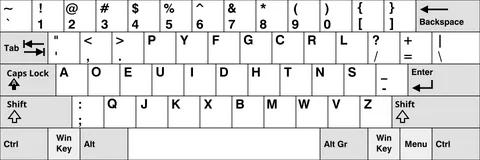 I would say that we’re invested in the Dvorak keyboard. Yes, another keyboard would be much more efficient, but we’ve got the Dvorak keyboard, so I don’t see any movement toward replacing the Dvorak keyboard.
Do you think there’s too much inertia in the world of standards77The inertia of standards: QWERTY is economists' textbook example of path dependence: according to Paul David's "Clio and the Economics of QWERTY" (1985), an inferior standard got locked in because everyone was already used to it. Stan Liebowitz and Stephen Margolis replied in "The Fable of the Keys" (1990) that Dvorak's superiority had never been proven. then?
I wouldn’t say it’s inertia. I would say we just got too much investment in the Dvorak keyboard. Young people learn how to use the Dvorak keyboard. Yes, another keyboard would be more efficient, but they learn the Dvorak keyboard, and it works. There are other things that they care about rather than getting a different keyboard.
14Birds, books and Bach cantatas
The best birds are in New Guinea, all of Diamond's books grew out of one, and in the evenings he listens to Bach instead of working.
Where’s your favorite place to go birdwatching?
My favorite place to go birdwatching is the street where I live in Los Angeles, Stone Canyon Road. My list of species for my street is 189 species. I go birdwatching on my street every Saturday and every Sunday. That’s my favorite place to go birdwatching in the United States. Of course, my favorite place to go birdwatching in the world is New Guinea, no close second. New Guinea has the birds of paradise,78Birds of paradise — a family of 44 species living mostly in New Guinea, as well as in eastern Australia and the Moluccas; the males of most species are famous for their long, brilliant plumes. the world’s most beautiful birds.
New Guinea has bowerbirds, the animals that build the most complex structures other than us humans.79Bowerbirds — a family of birds of New Guinea and Australia. The males build "bowers" of twigs and decorate them with bright objects to attract a female; the bower isn't a nest — the female builds that separately. Outside the bower of twigs in the mountains of New Guinea, the male has sorted fruit and flowers by color. The bower of a bowerbird—a bird this size, about the size of a jay—a male builds a bower that may be nine feet tall and is decorated with hundreds of blue fruits and red flowers and orange mushrooms. It has dozens and dozens of pounds of stuff, of shells, of pandanus leaves. Once you’ve been to New Guinea, the rest of the world is boring. That’s the only disadvantage of being in New Guinea.
Panama, Costa Rica, Santa Marta, Colombia,80The Sierra Nevada de Santa Marta — an isolated mountain range on Colombia's Caribbean coast with about 440 bird species, some 20 of them found nowhere else. are they worth going to for birds?
They’re worth going to, but they’re second to New Guinea.
Now, you’ve written quite a fair number of books that one could call big picture or big idea books. In terms of your method, how does each one come about? An idea comes to you in the shower, or you start writing out many ideas, and you abandon most of them? What would you say is your method for a thing that you do and very few people have done in the quantity that you’ve done it?
Well, I’m interested in lots of things. I’m interested in languages, genetics, human evolution. It means that until the 1980s, I was the world’s expert on the gallbladder. Then my twin sons were born. Our twin sons were born in the year 1987. I realized that the future of my twin sons was not going to depend upon gallbladders. It was going to depend upon history and geography. There were many major questions in history and geography.
My first book, The Third Chimpanzee, had chapters on things that then ended up in other books. One chapter of my book, The Third Chimpanzee, my book from 1991, got expanded into Guns, Germs, and Steel. Another chapter of my book, The Third Chimpanzee, got expanded into Collapse. Still another chapter got expanded into Why Is Sex Fun?81Diamond's books: The Third Chimpanzee (1991) is about human evolution; Why Is Sex Fun? (1997) is about the evolution of human sexuality. My current book about leaders is a subject that has interested me for a long time as a result of being born in 1937 and growing up in the shadow of Hitler and wondering whether World War II and the Holocaust would have achieved the form they did if it hadn’t been for Hitler.
What’s your most unusual successful work habit? You get a lot done, right? You’re extremely productive in multiple areas.
Do I have a single unusual work habit? Once again, welcome to Jared Diamond. No, I don’t have one work habit. My work habits are that I’m comfortable sitting down at a desk and working at the desk. I’ve learned to take off time in the evening instead of working on my book in the evening. In the evening now, I listen to music, the composer, Johann Sebastian Bach. I’ve sung. I play the piano. I play the organ. I play the viola. Bach wrote 200 cantatas.82200 cantatas: about 200 of Bach's sacred cantatas survive; he wrote most of them in Leipzig in the 1720s, when he composed a cantata for almost every Sunday. I’ve been telling myself—I sang in 20 of them—I would like to get to know all Bach cantatas. A year and a half ago, the time arrived. I’m now going to listen to Bach cantatas at the rate of one per week. I’m now up to cantata number 57.83Cantata number 57: Bach's cantatas are numbered by the catalogue of his works, the BWV (Bach-Werke-Verzeichnis); number 57 is "Selig ist der Mann," written for Christmas 1725. It means that in the evening, I’m relaxed and I’m not fretting. I’m not wasting my time getting anxious. I’m instead listening to Bach cantatas. I get good sleep.
Are you listening to the Suzuki recordings or the Harnoncourt, or which ones? Gardiner?84Three famous complete Bach cantata cycles: Nikolaus Harnoncourt and Gustav Leonhardt (Teldec, 1971–1990), the first complete recording of the sacred cantatas; Masaaki Suzuki and Bach Collegium Japan (BIS, from 1995); and John Eliot Gardiner, who in 2000, for the 250th anniversary of Bach's death, performed all his sacred cantatas in a single year on the Bach Cantata Pilgrimage.
I have three recordings. Gardiner is one. Although I listen to them every night, I can tell you Gardiner, but I can’t tell you the names of the other Bach cantata recordings that I listen to every night. I just listen to them.
We once had Suzuki on as a guest.85The episode "Masaaki Suzuki on Interpreting Bach" came out in February 2024. Episode. He was great.
15Parents, the MacArthur and what's next
His father led Diamond to science, his mother to languages and music, and the "genius award" pushed him toward big subjects.
Your father, Louis Diamond, he was a great benefactor in hematology.86Louis K. Diamond (1902–1999) — American pediatrician at Harvard and Boston Children's Hospital, called the founder of pediatric hematology. In 1932, with Kenneth Blackfan, he described hemolytic disease of the newborn, and later developed exchange transfusion to treat it. How did that shape your life?
My father and my mother shaped my life. They were different people. Dad was a hematologist and a pediatrician, a children’s doctor. The result was that growing up, whenever people asked me, “What do you want to do when you grow up?” My answer was, “I want to be a doctor like my father.” Dad also did scientific research. When I went to college, initially, I was pre-med. I thought I would be a doctor like my father. Then I realized that what really interests me is science, including medical science. I went into physiology, which is a medical science. Dad shaped my career in that direction.
My mother was a linguist and a teacher. Mom taught me to read when I was three years old. When I started learning languages in school, my first language was Latin. I didn’t realize that it was my first foreign language. I didn’t realize that you had to learn grammar. I just memorized vocabulary. After a month, I was way out of shape with Latin because I hadn’t learned the grammar. My mother then sat down with me every night for a year, and we went through my Latin lessons. From Mom, I developed my love of languages. Mom was a concert pianist, so I developed my love of music. I gained different things from Mom—languages and music particularly—and from my father, science.
Do you think your own shift away from studying the gallbladder shaped the lives of your children?
Yes, not because I taught them not to study gallbladders, but because the birth of my children made me realize that I better do something more important for the world than studying gallbladder. In fact, I’m an optimistic person. I don’t get depressed, usually. The one time in my life that I was depressed for a week was when I learned that I was awarded one of these MacArthur Fellowships, the so-called genius awards.87The MacArthur Fellowship — a large five-year grant with no strings attached, nicknamed the "genius award" by journalists. Diamond received it in 1985. When I got the MacArthur Fellowship, I thought I would have been excited. Instead, I was depressed for a week. Why? Because the news of the MacArthur Fellowship told me, “Jared, people expect big things of you, and you haven’t delivered. You’ve been working on the gallbladder. You can do better things than that.”
On top of that, my sons, their future is not going to depend upon gallbladders. It’s going to depend upon history and geography. The combination of the birth of my sons, and the MacArthur Fellowship caused me to switch from medical physiology into writing books on big subjects, such as why you and I are now speaking English rather than speaking bilingual.
Before my last question, let me just plug your book again. It is called Profits, P-R-O-F-I-T-S, Prophets, P-R-O-P-H-E-T-S, Coaches, and Kings: (When) Do Leaders Matter? That’s Profits, Prophets, Coaches, and Kings: (When) Do Leaders Matter? Final question. Other than Bach cantatas, what is it you hope to learn about next?
I’ll be 89 years old next month, so maybe a decade ahead of me. What I want to do in the next decade, I have two goals on the next decade. One is to get to know all those 200 Bach cantatas. I’m only up to number 57 last night. The other thing is that I’ve been working in New Guinea for 60 years. I personally explored all of the 10 outlying mountain ranges of New Guinea. For some of them, I’m the only person who explored them, but I haven’t synthesized what I’ve learned.
I want to compare the bird faunas of those 10 mountains of New Guinea to understand why some birds are better colonists than other birds. The questions that one can ask about New Guinea birds are broad questions one can ask about other animals, but birds are the easiest of all animals to observe. The other thing that I want to do with my remaining decade, besides listening to Bach cantatas, is to synthesize my work on New Guinea birds and to publish an account of why some New Guinea birds have colonized every one of those outlying New Guinea mountains while other New Guinea birds have colonized none of them.
Those are my two main intellectual goals. Then my biggest goal, of course, is to continue to contribute to the happiness of my wife and children.
Jared Diamond, thank you very much.
Thank you very much. You are really interesting to do an interview with.
Thanks.


