

The Tim Ferriss Show
Chapters
Tim devotes his 888th episode to the number eight and to whether luck can be built into things.
Read the chapter- 888 is triple eight, so Tim decided on "a rabbit hole of epic proportions" instead of a regular interview.
- He considered a live I Ching casting but put that idea off.
- Tim promises an expensive phone number, disappearing hotel floors, a casino room built around one person's birthday and a car company that changed its name partly for good fortune.
- The big question is whether luck can be built into a skyscraper, a brand name or a license plate, and what happens when both the casino and the customer want the room to make the money.
Eight means wealth because "ba" sounds like the "fa" in a wish for riches, and the East loves money as much as the West.
Read the chapter- Of the languages in the episode, Tim's strongest is Japanese, then Mandarin, then very weak Korean, and his Cantonese is nonexistent.
- "Ba" (eight) resembles the "fa" in the New Year greeting "gōngxǐ fācái," "may you prosper," and in Cantonese the match is even closer.
- The belief in eight goes back a long way, but it was supercharged in the 1980s, especially in Hong Kong.
- Tim laughs at the myth of the unmaterialistic East: read proper translations instead of mistranslated Lao Tzu and it turns out everyone loves money, and three eights are "linguistic compound interest."
Because customers believe in eight, they pay for it: in phone numbers, license plates, an Olympic date, skyscraper floors and apartments.
Read the chapter- In 2003 Sichuan Airlines paid 2.33 million yuan, about $280,000, for the hotline number 8888-8888; Tim allows that the PR halo around the purchase may have paid off too.
- In February 2025 the registration mark "88" sold at a Hong Kong government auction for HK$11.4 million, roughly US$1.5 million.
- The Beijing Olympics opening ceremony started at 8 p.m. on August 8, 2008, and Beijing registered 15,646 marriages that day.
- Shanghai's Jin Mao Tower has 88 stories, an octagonal core and eight main superframe columns, and in Chengdu apartments on floors ending in eight resold at a premium of about 7% and in new buildings sold about a week faster.
"Sì" and "sǐ" differ only in tone, and East Asia avoids floors with a four.
Read the chapter- "Four" and "to die" share the same consonant and vowel; only the tone differs.
- In Tim's 1996 Chinese class, 32 students dwindled to 12 or 14 within two weeks, because tones, like weight training, demand trained throat muscles.
- Just as US buildings may skip floor 13, buildings in East Asia, and in Vietnam too, often have no floor numbers with a four.
For casinos, designing luck is an art form: Sands Macao swapped 777 for 888 and flew its designs to a feng shui master.
Read the chapter- Designing a place that feels lucky is an art form of its own and a very important part of certain casino plans.
- In 2004, Time reported, Sands Macao replaced the classic winning 777 on its slot machines with 888.
- Las Vegas Sands executive William Weidner described designers putting 3D views of their plans on DVDs and flying them to a feng shui master in Kowloon.
- A consultant decided a sharp corner of the Sands Macao would deflect good qi coming in from the northeast, so the corner was rounded off.
Casinos design luck around a single high roller, and even the US Bureau of Engraving and Printing cashes in on eights.
Read the chapter- Architect Paul Heretakis described a private gaming room at the Venetian that a feng shui expert designed around an unnamed high roller's birthday and zodiac sign.
- Caesars VIP villa numbers began with eight, and Wynn properties skipped floors 40 through 49.
- Casino architect Paul Steelman said buildings need good feng shui for both the player and the casino owner.
- In 2015 the US Bureau of Engraving and Printing sold uncut sheets of eight $2 bills with serial numbers starting with 8888, at $58.88, limited to 16,888 sheets.
Chinese script didn't fit Japanese as is, so Japan kept the kanji and added two syllabaries.
Read the chapter- Tim went to Japan as an exchange student at 15, which changed his life, and being a manga otaku and a crammer kept the language alive.
- Chinese has no verb conjugation for tense, while Japanese does, so it needed phonetic script for the leftover sounds.
- Katakana grew out of Buddhist monks' annotations and hiragana out of the cursive of Heian-period women, and each set has 46 characters, Tim thinks.
- To be basically literate you have to know the Jōyō kanji, of which there were 1,945 when Tim was there.
In Japan eight stands for prosperity that widens over time: in the shape of 八, in the name Toyota and in Shikoku's 88 temples.
Read the chapter- The character "hachi" looks like two strokes spreading apart, and widening toward the end, "suehirogari," suggests prosperity that grows over time, like an opening fan.
- The founding family's name was Toyoda, but the company became Toyota because in katakana that name takes eight strokes.
- The Shikoku pilgrimage circles 88 Buddhist temples associated with Kūkai; Tim mentions his friend Craig Mod, probably the person who has walked more of Japan than anyone alive.
Korean eight doesn't sound like wealth, but it became the word for fate.
Read the chapter- In the Chinese-derived set of Korean numbers, eight is "pal," which sounds like no word for getting rich.
- One type of Korean fortune telling uses a birth chart called "saju palja," "four pillars, eight characters": year, month, day and hour of birth, each written with two characters.
- The shorthand "palja," literally "eight characters," is the everyday Korean word for fate, your lot in life.
- "Four" and "death" can both be read "sa" here too, and some Korean elevators replace the fourth floor number with an F.
666 is the number of the beast from Revelation, but the metal horns aren't three sixes, they're Dio's grandmother's charm.
Read the chapter- 666 as a sign of evil comes from the Book of Revelation, chapter 13, verse 18.
- Internet conspiracy theorists see three overlapping sixes in the horns, but it's the mano cornuta, an ancient Mediterranean charm against the evil eye.
- Ozzy Osbourne flashed the peace sign at concerts, and Ronnie James Dio, who joined Black Sabbath in 1979, borrowed the gesture of his superstitious Italian grandmother, which made the horns the sign of heavy metal.
In China six promises a smooth road, and 88 means "bye-bye."
Read the chapter- "Liù" (six) sounds like the words for "smooth" and "road," hence the wishes "liùliù dàshùn" and "yílù shùnfēng," and the sums in red hóngbāo envelopes are sometimes made of sixes.
- Whether a number is lucky depends on which word it sounds like, and that varies even between dialects within China.
- In Chinese internet shorthand, 88 is "bye-bye," and "ba ba liu" is "bye-bye la."
- Tim closes by recommending the Wikipedia page on Chinese numerology and promising to come back to the I Ching casting someday.
Quotes
On the East and money
“If you squint a little bit and look at some actual proper translations or the original text, man, everybody loves money. And that certainly includes China.”
Tim FerrissRead from 04:02On three eights
“Eight, eight, eight, three eights, three doses of good fortune — that's linguistic compound interest.”
Tim FerrissRead from 04:02On a 2.33-million-yuan phone number
“This is an extraordinary amount of money to spend before anyone has even said ‘your call is important to us.’”
Tim FerrissRead from 04:40On a room built for a high roller
“So having a favorite chair is one thing. Maybe you have a favorite type of chocolate they put in your room, but having a casino build you a room based on your birth information is an entirely different level of customer service slash seducing of whales.”
Tim FerrissRead from 12:35On feng shui in the casino
“The player wants the room to be lucky for the player. The house wants the room to be lucky for the house.”
Tim FerrissRead from 13:18On the Korean word for fate
“The shorthand, palja, literally eight characters, is the everyday Korean word for your fate, your lot in life.”
Tim FerrissRead from 22:37
Summary
For his 888th episode, Tim Ferriss dusts off his college major, East Asian studies, and takes listeners on a tour of the number eight. In Mandarin, "ba" (eight) sounds like the "fa" in the New Year greeting "gōngxǐ fācái," "may you prosper," which is how eight became a symbol of wealth. People pay real money for it: Sichuan Airlines bought the phone number 8888-8888 for 2.33 million yuan, the license plate "88" sold in Hong Kong for HK$11.4 million, the Beijing Olympics opened at 8 p.m. on August 8, 2008, and apartments on floors ending in eight in Chengdu resold for about 7% more.
The flip side is four: "sì" (four) sounds almost exactly like "sǐ" (to die), and across East Asia buildings often simply have no fourth floors. Casinos go furthest of all: Sands Macao replaced the winning 777 on its slot machines with 888, designs are sent to feng shui masters for review, and at The Venetian a private gaming room was built around one high roller's birthday and zodiac sign. Even the US Bureau of Engraving and Printing sold sheets of $2 bills with serial numbers starting with 8888.
In Japan, eight is "hachi": the character 八 widens toward the bottom like a fan, which is "suehirogari," prosperity that spreads over time; that's also why the Toyoda family name became the eight-stroke brand Toyota, and the Shikoku pilgrimage circles 88 temples. In Korea, eight is fate itself: "palja," the "eight characters" of a birth chart, is the everyday word for one's lot in life. At the end, Tim explains why the heavy metal hand sign isn't a devilish 666, why six is lucky in China, and signs off in Chinese internet slang: 88, "bye-bye."
Mentioned
- I Ching00:51Tim thought about doing a live casting
- Wall Street03:25Gordon Gekko and "greed is good"
 Sichuan Airlines04:40bought the phone number 8888-8888
- Jin Mao Tower07:0488 stories and eight columns
Show 14 more mentionsShow fewer mentions
 Adrian Smith07:04the architect of the Jin Mao Tower
 Las Vegas Sands09:46888 on the slots and feng shui at Sands Macao
 William Weidner09:46designs on DVD for a feng shui master
 Caesars Entertainment12:35VIP villa numbers starting with eight
 Wynn Resorts12:35floors 40 through 49 skipped
 Paul Steelman13:29feng shui for both the player and the casino owner
 Bureau of Engraving and Printing13:52$2 bills with serial numbers starting with 8888
 Toyota18:35eight strokes in the name
 Craig Mod19:27Tim's friend who has walked Japan on foot
 Kūkai19:27the pilgrimage to Shikoku's 88 temples
- Book of Revelation23:44where "the number of the beast" comes from
 Ozzy Osbourne25:22the peace sign at Black Sabbath concerts
 Ronnie James Dio25:22the horns from a superstitious grandmother
- 5-Bullet Friday28:41Tim's Friday newsletter
Sponsors of the episode

Transcript
01Episode #888: can you design luck?
Tim devotes his 888th episode to the number eight and to whether luck can be built into things.
IntroThe Tim Ferriss Show intro
Optimal minimal. At this altitude, I can run flat out for a half mile before my hands start shaking. Can I ask you a personal question?
Now would have seemed an appropriate time.
What if I did the opposite? I'm a cybernetic organism, living tissue over metal endoskeleton.
Alrighty. Hello, boys and girls, ladies and germs. This is Tim Ferriss. Welcome to another episode of The Tim Ferriss Show. This episode is a special one. It is number 888.
That's triple eight. San ge ba.1San ge ba (三个八) — Mandarin for "three eights." We're going to talk about it. This is going to be a rabbit hole of epic proportions, and it's going to get nerdy. It's going to get very bizarre. And that's the point of the show, is I can kind of do whatever I want to do.
So I wanted to do something special for 888. I thought about doing some live casting of the I Ching,2The I Ching, or Book of Changes — an ancient Chinese divination text and philosophical classic; you consult it by tossing coins or yarrow stalks to arrive at one of 64 hexagrams. the oldest of the Chinese classics. It's a long story. Maybe we'll come back to that, but let's talk about luck. If you know anything about the Chinese ideas around luck, there is one number that stands out, and I couldn't resist. So we're going to talk about a very expensive phone number, disappearing hotel floors, a casino room designed around one person's birthday, a car company whose name was chosen, or I should say changed, partly for good fortune, and it spans across East Asia.
We're going to dig in. Underneath all of it is one question. How do you design luck? Can you build it into a skyscraper, a brand name, a license plate? Well, a lot of people would seem to think so. And what happens when a casino and the customer both want the room to make the money?
02Why eight means wealth in China
Eight means wealth because "ba" sounds like the "fa" in a wish for riches, and the East loves money as much as the West.
Well, let's dig in. So it starts with a sound. In Mandarin, the sound is ba. That is eight, the number eight. And I'll say right up front that of the languages we're going to touch upon, my strongest is going to be Japanese, then Mandarin, then Korean, which is going to be very weak. I studied it for one year in college, like 30-plus years ago.
And then my Cantonese is non-existent.3Cantonese (Yue) — the language of Hong Kong, Macau and Guangdong province. Mandarin speakers can barely understand it by ear, and it has more tones, usually counted as six. So basically ignore everything I say about Cantonese. In theory, it'll make sense, but my pronunciation is going to suck. But back to Mandarin. So eight is ba. Now the word fa shows up all over the place, and you'll find it in, for instance, a common New Year greeting, which is gōngxǐ fācái.4Gōngxǐ fācái (恭喜发财) — the traditional Chinese New Year greeting, "congratulations, may you prosper." 发 (fā) means "to get rich, to prosper," and it sounds like 八 (bā), "eight." Gōngxǐ fācái.
Gōngxǐ fācái is like congratulations, may you prosper. It's the fā, is like to emerge or come out. So departure is like chūfā. And then the cái, the second tone,5Tones — Mandarin has four tones plus a neutral one: the same syllable said level, rising, dipping or falling means different words. cái — gōngxǐ fācái — is riches, wealth, prosperity, all that good stuff. So in a sense, the fācái, to find riches, prosperity, to have all of this emerge into your life, gets represented by the fa, which then corresponds to bā. So there you have it.
That's where eight becomes lucky. It's the resemblance. Now in Cantonese, the match is even closer. I'm not going to try to say it because Cantonese is hard AF, even if you speak Mandarin. But you will recognize some similarities because the writing system is the same. And also Japan and Korea borrowed their writing systems at one point in time from China.
And we can dig into a lot of the later developments, but you'll hear, for instance, gōngxǐ fācái in Mandarin is going to be something like gung hei fat choi,6Gung hei fat choi (恭喜發財) — the Cantonese reading of the same greeting. In Cantonese "eight" is "baat" and "to get rich" is "faat," so the sound-alike is even closer. gung hei fat choi, something like that in Cantonese. It's the same characters. So that's the sound connection and why eight is such a popular prosperity symbol in Chinese-speaking communities. And this goes back a long, long ways. However, it was supercharged, it seems, in the 1980s, and especially in Hong Kong, and then it kind of expanded from there. And Gordon Gekko,7Gordon Gekko — the financier in Oliver Stone's "Wall Street" (1987), played by Michael Douglas, who won an Oscar for the role. His line "Greed is good" became a catchphrase. man, greed is good.
Let's get after the money. And I always have to laugh because some folks who are reading these texts, or translated, usually mistranslated texts from Lao Tzu8Lao Tzu — a semi-legendary ancient Chinese thinker credited with the "Tao Te Ching," the central text of Taoism and one of the most translated books in the world. or whoever it might be, talk about, "Oh, the East," you know, "if you could only look at the contrast outside of the materialist West." And I'm like, you know, if you squint a little bit and look at some actual proper translations or the original text, man, everybody loves money. And that certainly includes China. So eight, great news. Eight, eight, eight, three eights, three doses of good fortune — that's linguistic compound interest. They love it.
03What people pay for eights
Because customers believe in eight, they pay for it: in phone numbers, license plates, an Olympic date, skyscraper floors and apartments.
Now, look, not everyone believes this, not everyone believes it equally, but if a customer prefers it, well, guess what? Interesting things happen to prices. So as an example, in 2003, Sichuan Airlines paid 2.33 million yuan, about 280,000 US at the time, for the phone number 8888-8888. So that's eight 8s for a customer hotline. This is an extraordinary amount of money to spend before anyone has even said "your call is important to us," but look, they explained it. The number is easy to remember and it would make customers happy.
Why? Because, well, eights are good luck, like we already talked about. And for those language nerds out there, Sichuan — you might run into this in, say, the US, there are Chinese restaurants that specialize in this particular type of cuisine. Some think of it as spicy. Sichuan means literally four rivers.9Sichuan (四川) — the characters do mean "four rivers," but historians consider that a folk etymology: the name is short for the "four circuits" the region was divided into under the Northern Song dynasty, and 川 here means "plain." Sì — yī, èr, sān, sì — Sìchuān.
It's actually an abbreviation related to administrative districts, but that gets to sound too bureaucratic. So let's just stick with four rivers. Sichuan. In any case, this is the perfect intersection of superstition and marketing, right? Buying a number like this. Now there are two benefits, I should add, by the way, because not only do you get the benefit of whatever the eights mean to the customer, but you also get possibly the benefit of the PR halo and amplification around you buying the number. So I don't automatically assume that it was a bad decision, but who knows?
My last conversation with Sichuan Airlines was a while ago. Anyway, license plates: in February 2025, the registration mark 88 sold at a Hong Kong government auction for 11.4 million Hong Kong dollars. That's roughly 1.5 million US. Then we get to the calendar. All right, Beijing Olympics, when are we going to have the opening ceremony? Well, of course, the opening ceremony should start at 8 p.m. on August 8th, 2008.
That's a lot of eights, right? On a global stage. Just so happens on that same date, Beijing registered 15,646 marriages. So there you have it. Next we have taking this number, this abstraction — I mean, we could get into where math lives, but that's a whole separate convo. Maybe we should bring in Michael Levin.10Michael Levin — a biologist at Tufts University who studies the bioelectric signals that guide tissue development and regeneration. He was a guest on episode #849. In any case, let's talk about eights being put into the physical world.
All right. The part that really gets interesting is when you stop buying lucky numbers and start building them. For instance, Shanghai's Jin Mao Tower,11Jin Mao (金茂, "golden prosperity") — a 420.5-meter skyscraper in Shanghai's Pudong district, opened in 1999. 88 stories. This is going to be very common around Asia. The architect, Adrian Smith,12Adrian Smith — an American architect who designed the Jin Mao Tower at Skidmore, Owings & Merrill and later Dubai's Burj Khalifa, the tallest building in the world. had said that the client wanted that number because eight was auspicious, and it doesn't stop at floor count. The building also has an octagonal core and eight main superframe columns.
So eight is doing double duty. You got the cultural symbolism and then the actual structural work. Shows up in ordinary apartments as well. Economists studied apartment sales in Chengdu from 2004 to 2006. Apartments on floors ending in eight resold at a premium of about 7%. In the new apartment market, where pricing was uniform, those floors didn't cost more, but they sold about a week faster instead.
And not shockingly, buyers with more eights in their phone numbers were more likely to buy the lucky floors. Yeah, well, if you like eights, you like eights. And now we can also look at the flip side, though. If eight is lucky, right — that's the whole premise. Well, it's not really the premise. It is the topic we're exploring in this episode.
04Four is death: where the floors go
"Sì" and "sǐ" differ only in tone, and East Asia avoids floors with a four.
ExplainerNumbers that sound like words
Mandarin has only about 400 syllables if you ignore tones, so almost every number sounds like some word, and some of the matches have become omens:
- 8 (bā) — like fā, "to prosper";
- 6 (liù) — like "to flow" or "smooth": the wish "six six, great luck" means everything will go smoothly;
- 9 (jiǔ) — like "long-lasting," which is why nines are popular at weddings;
- 520 (wǔ èr líng) — close to wǒ ài nǐ, "I love you," so May 20 has become a day for declarations of love in China;
- 4 (sì) — like "to die," hence the skipped floors and numbers.
The same logic works in Japan, where 4 (shi) sounds like "death" and 9 (ku) like "suffering," so hospitals often have no rooms with those numbers, and in Korea, where elevators often show the letter F (for four) instead of a "4" button.
What is the flip side? The flip side is four. So now it's not because half of eight is four, although we could talk about that, but we're going to turn towards something a little more morbid, and that is death, because in Mandarin, four is sì and to die is sǐ. That is a fourth tone and a third tone, respectively. So you have like sī, sí, sǐ, sì. Those are four different things.
So four is, as we covered already, sì — Sìchuān — sì, sì. To die is sǐ: same consonant, same vowel, different tone. This is where heads explode if you're doing Chinese 101. Way back in the day, before Chinese was super cool — this was in, God, 1996, I guess — and we started with a class of something like 32 students, and within two weeks we were down to like 12 or 14. People's heads just exploded.
And it will make your throat sore. It doesn't matter how good you are at memorizing, if you haven't developed the musculature to make some of these sounds and tones and stuff, you just can't do it. So it is actually like weight training in a sense. But let's talk about four. Well, in the US, you might not see a floor 13. Well, guess what?
05Feng shui in the casino
For casinos, designing luck is an art form: Sands Macao swapped 777 for 888 and flew its designs to a feng shui master.
In East Asia, all over the place, you will frequently not see floor numbers with a four. That's also true in places like Vietnam, by the way. But let's talk about casinos, where designing a place that feels lucky is practically its own art form. It isn't practically, it is its own art form. This is a very, very important aspect of certain casino architectural plans.
And in 2004, Time reported that Sands Macao13Macau — a former Portuguese colony, since 1999 a special administrative region of China and the only place in the country where casinos are legal. Sands Macao, opened in 2004, was the first American-owned casino there.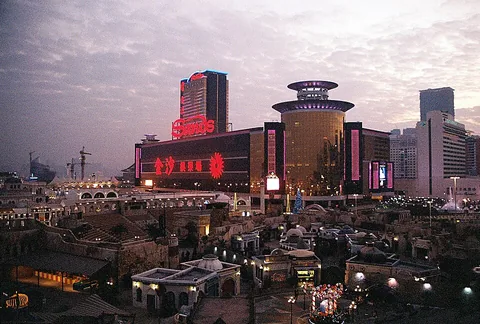 replaced the slot machines' classic winning 777 with 888. Then you have feng shui masters. Why not bring in feng shui masters? The design process can get very elaborate. In a 2005 interview, Las Vegas Sands executive William Weidner — sorry for mispronouncing that, not sure of how that's Americanized — Weidner described designers making 3D views of their plans, putting them on DVDs, and flying them to a feng shui master in Kowloon,14Kowloon ("nine dragons") — the mainland part of Hong Kong, across the harbor from Hong Kong Island. Hong Kong.
High-tech architecture software followed by an international trip to get the energy reviewed. So feng shui, another language sidebar. Feng shui, a lot of people have heard this. Fēng shuǐ, fēng shuǐ — that's a first tone and a third tone, if you're interested. That literally means wind water, feng shui, feng shui. So if some of you are wondering where the word typhoon comes from,15Typhoon — the English word came together from several sources: Chinese "tai fung" ("big wind"), Arabic "ṭūfān" ("storm"), which arrived through Portuguese "tufão," and Greek "typhōn," after the monster Typhon. pretty interesting.
So in Chinese, you would say táifēng, táifēng. And then there is false cognates. That's a whole thing. So it turns out that in fact we didn't get it directly from Chinese. There was this convergence of people calling typhoons the exact same thing. Basically you had Greek-informed languages, then Arabic, and the Chinese all somehow mysteriously converged on the same label for the same thing.
So it became this international global expression used by those involved with the maritime arts. But I digress. Feng shui literally means wind water. But within the context of architecture, you know, a consultant for feng shui might review colors, shapes, entrances, exits, you know, where might you place mirrors? Where should things be hard-edged or sharp corners versus rounded corners, all of that stuff. So for instance, at the Sands Macao, a sharp corner got rounded off — had to be done — because the consultant believed the point would deflect good qi,16Qi (气) — in Chinese philosophy, the life energy that flows through the body and through space; feng shui tries to steer its currents in the right direction. pronounced "chi," coming in from the northeast. So if you've ever seen the word spelled Q-I in Chinese, people contort it into all sorts of stuff.
That is qi. It's not exactly the same character, but like qi is car or vehicle.17Qì and qìchē: energy-qi is written 气, while 汽 (qì, "steam") is part of 汽车 (qìchē), "car." Both are read in the fourth tone. Same pronunciation. Qì. That is fourth tone. All right, so the corner of the building became a business decision about where good fortune might go, get trapped, move — you get it.
06A room for a whale, and lucky dollars
Casinos design luck around a single high roller, and even the US Bureau of Engraving and Printing cashes in on eights.
Now, then there's the custom version of this. So that's designing a casino for a populace that you hope to attract to gamble. But what if you're a high roller? What if you're a whale? Because whales get flown in from, say, Vegas on private jets. They've got millions of dollars spent on them in some cases, because they will spend potentially 10 million plus in a single stay, right?
Well, architect Paul Heretakis — hope I'm getting that right — described a private gaming room his firm designed at the Venetian18The Venetian — Las Vegas Sands' Venice-themed casino resort in Las Vegas, complete with canals and gondolas; the company has a resort of the same name in Macau. in 2012. It's a private gaming room for an unnamed high roller. A feng shui expert used the gambler's birthday and zodiac sign to shape the room's design. So having a favorite chair is one thing. Maybe you have a favorite type of chocolate they put in your room, but having a casino build you a room based on your birth information is an entirely different level of customer service slash seducing of whales. The same 2016 reporting described Caesars VIP villas with numbers that began with eight and Wynn properties that skipped floors labeled 40 through 49.
Remember number four. Death, that whole similarity. People don't like it. Which brings back the question from the top of the show. The player wants the room to be lucky for the player. The house wants the room to be lucky for the house.
So who gets the good energy? Well, I guess both of them do. You know, these players, if you can blow 10 million dollars on a trip to Vegas, chances are you got a lot more where that came from. Casino architect Paul Steelman,19Paul Steelman — an American architect and founder of the Las Vegas firm Steelman Partners, which designs casinos and resorts in the US, Macau and elsewhere in Asia. who has designed resorts all over Asia, put it plainly in 2015: the buildings have to be designed for good feng shui for both the player and the casino owner. Now it might be surprising to hear that even Uncle Sam got in on the action with all these eights.
This enthusiasm reached the people who print our dear American money. One could argue we print too much of that American money, but let's not get into all that. In 2015, the U.S. Bureau of Engraving and Printing20The Bureau of Engraving and Printing — the US Treasury agency that prints paper money; it also sells uncut sheets of bills to collectors. offered an uncut sheet of eight $2 bills, all with the serial numbers starting with 8888. Face value, $16. Retail price — can be yours for $58.88. And the production limit: 16,888 sheets.
07How Japan adapted Chinese writing
Chinese script didn't fit Japanese as is, so Japan kept the kanji and added two syllabaries.
Now let's go to Japan. Near and dear to my heart. I went there as an exchange student when I was 15, changed my life, and haven't really formally studied Japanese since, but turns out if you are manga otaku21Otaku (オタク) — Japanese for an obsessive fan, most often of manga and anime. and gariben,22Gariben (ガリ勉) — Japanese slang for a grind, someone who studies relentlessly. you can retain a lot of it. So the character for eight is the same. So Japan brings over the Chinese writing, which they call kanji — hanzi.23Kanji (漢字) and hanzi (汉字) are the same word, "Han characters," that is, Chinese characters; Han is an ancient Chinese dynasty and the name the Chinese use for themselves. But there is a problem.
Chinese does not quite work for Japanese 100%. It's kind of a force fit, because if you look at, say, Chinese, the grammar is very, very, very simple. So you can say any number of things. The word order is kind of the same as English. "I go to school" would be "I go school," for instance, and there are exceptions. You could say "wo dao xuexiao qu" or something like that.
But suffice to say, the grammar is really simple. Chinese doesn't have conjugation as you might think of it. So past, present, future with verbs, as in the English of "I went, I go, I will go," that type of thing — doesn't really exist in Chinese, but it does exist in Japanese. So what do you do with those leftover sounds? Because the ideograms from Chinese each have a meaning.
But if you're just trying to force-fit Japanese, you need a way to use something phonetic, just like the alphabet in English. And so over time, over centuries — and that involves Buddhist monks and scholars using something called katakana24Katakana and hiragana — the two Japanese syllabaries. Angular katakana is now used for loanwords and sound effects, flowing hiragana for grammatical endings and words without kanji. to annotate different texts, and it involves Heian-period Japanese women25The Heian period (794–1185) — when Japan's capital was Heian-kyō, today's Kyoto; the golden age of court literature, including Murasaki Shikibu's "The Tale of Genji," written in hiragana. using cursive script, there's a lot that goes into it — but the Japanese figured out, also wanting to promote literacy in the country, two different syllabaries, which are kind of like alphabets. So they are referred to as syllabaries because they're syllables. Instead of A, B, C, D, E, it is ka, ki, ku, ke, ko, ma, mi, mu, me, mo, that type of thing. They are syllables.
And there are two sets of 46, I think, because it's been 35 years, that basically allow Japanese people to write Japanese words that don't transfer well or don't allow Chinese characters to be overlaid very easily. And they're used for all sorts of other stuff, like sound effects in comic books or foreign words, etc., etc. But they still retained a lot of the Chinese characters. And to be basically literate in Japanese, you have to learn the fundamental characters, which are the Jōyō kanji. And at least when I was there, there were 1,945.26Jōyō kanji (常用漢字) — the official list of characters for general use: it held 1,945 characters from 1981 to 2010, when it was expanded to 2,136. So you still got to do some heavy lifting.
08Eight in Japan: a fan, Toyota and 88 temples
In Japan eight stands for prosperity that widens over time: in the shape of 八, in the name Toyota and in Shikoku's 88 temples.
Now the character for eight in Japanese is read hachi. So instead of ba, it's hachi. And there are multiple ways to pronounce this in Japanese, but I'm going to do a little visualization exercise. So imagine the capital letter A. Okay, take out the crossbar in the middle. Now you're left with this upside-down V. At the very apex of that — let's call it pyramid — create a little gap, just erase the very tip.
So there's a little gap. Now it looks kind of like a mustache. Two strokes that spread apart towards the bottom. Now that widening shape suggests prosperity that grows over time. There's actually a word for this in Japanese. Of course there is, just like they have komorebi,27Komorebi (木漏れ日) — literally "sunlight leaking through trees"; often cited as a Japanese word with no one-word translation. like dappled light through trees.
They've got a lot of good words. This one is suehirogari.28Suehirogari (末広がり) — "widening toward the end," that is, well-being that only grows with time. That's why a folding fan is also called a "suehiro" and given as a gift on festive occasions. So sue, hirogari. So sue is like the end or the future, and hirogari is expanding. And this was originally — I shouldn't say originally, but long ago used to refer to something like a Japanese fan. So as it sort of extends, it widens or spreads.
And that can be applied in a lot of different places. But suffice to say, there's an auspicious widening towards the end, looking out into the future. That character, for the nerds out there who like Japanese, sue is also matsu. So you could have, for instance, shūmatsu is weekend, literally week end, shū matsu, shū matsu, or like nenmatsu, end of the year,29Sue and matsu: the character 末 can be read both "sue" and "matsu": 週末 (shūmatsu) is "weekend," 年末 (nenmatsu) is "end of the year." and on and on and on. All right, I'm going to stop that there because I could go on forever. But let's talk about Japan and eight.
ExplainerHow Toyoda became Toyota
The company grew out of Sakichi Toyoda's loom business: the automobile department at his Toyoda Automatic Loom Works was started by his son, Kiichiro. The first cars of 1936 were sold as Toyoda, but that same year the company held a public contest for a new emblem and received about 27,000 entries. The winner was the katakana spelling トヨタ, "Toyota." In "Toyoda" (トヨダ) the last character ダ is タ with two voicing marks, so the word takes ten strokes, and without them, eight. Besides the lucky number, "Toyota" was said to sound crisper and to separate the business from the family name. In 1937 the car business was spun off as the independent Toyota Motor Co., Ltd.
Eight's still a big deal. One of the biggest brands in the world had a lucky eight story hiding in its name, still has it hiding in its name. All right, the founding family's name of this company is Toyoda, Toyoda. Okay? That's with T-O-Y-O-D-A, with a D. You can probably guess that company became Toyota, Toyota, because in katakana, which is one of those syllabaries I talked about, Toyota, Toyota is eight strokes.30Toyota — the company took its name from the founding family, Toyoda (豊田). In 1936 the brand was changed to "Toyota" because in katakana, トヨタ is written with eight strokes.
In other words, you're putting pen to paper for eight lines, keeping it simple, that create this name Toyota instead of Toyoda, or Toyoda, Toyoda. Anyway, you get the idea. The eight strokes are associated with wealth and good fortune. So they changed their family name to a company name that embodied the eight strokes. But we can go way further back. Japan also has the Shikoku pilgrimage.31The Shikoku pilgrimage — a loop of about 1,200 km around Shikoku, the smallest of Japan's four main islands.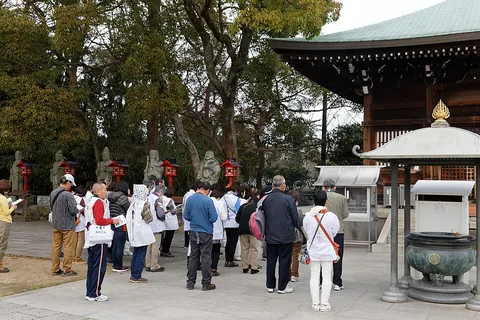
We can ask my friend Craig Mod,32Craig Mod — an American writer and photographer who lives in Japan; he takes multiday walks along Japanese roads and writes books about them, such as "Kissa by Kissa." probably the person who has walked more of Japan than any living human. In this case, the Shikoku pilgrimage is a circuit of 88 Buddhist temples associated with the Kūkai, also known as the Kōbō Daishi.33Kūkai (774–835) — a Japanese Buddhist monk who founded the Shingon school; Kōbō Daishi is his posthumous honorific title, "the great teacher who spread the Dharma." And it just goes on and on, guys. The eights are everywhere. The temple count has its own religious history, but it's a lovely numerical detour. 88 can take you from casino villas to a pilgrimage around an island, and obviously doesn't end there.
AdAG1
This episode is brought to you by AG1, which I have taken for more than a decade. Man, it's coming up on close to 15 years, I would say. Longtime listeners have heard me call it my nutritional insurance, and that is exactly how I use it. The news today is they just launched AG1 Pro, designed for people focused on performance and longevity. I'll be traveling soon. I'm actually packing today and I'm throwing a bunch of these in my bag to cover my bases while I'm on the road.
And I have noticed, perhaps some of you have, that it is harder and harder to put on muscle and to keep on muscle. I am a young 48 years old and I've noticed that change. So past a certain age — you may be that age — maintaining lean muscle becomes priority number one, and AG1 Pro is formulated to support exactly that. It includes HMB, a clinically studied compound that supports protein synthesis and helps reduce muscle breakdown, plus zinc carnosine to support the gut lining. So remember, training is only half the equation.
You have to feed the machine, and as you get older, there are certain things that can help turn the dials just a bit in your favor. Recovery is where the work compounds, and AG1 Pro is built to support it. It's NSF Certified for Sport, so what's on the label is what's in the pouch. Get your free AG1 Pro Yeti shaker in the welcome kit at drinkAG1.com/Tim. That's drink AG1, the number one.
So D-R-I-N-K-A-G, the number one, dot com slash Tim.
09Korea: the eight characters of fate
Korean eight doesn't sound like wealth, but it became the word for fate.
Let's talk about Korea. This is where I'm going to make all sorts of mistakes. So my apologies to the Koreans who may be listening. I would love a language lesson. I think it is such a cool language and would love to improve my Korean. But here's the connection.
So the Korean language has two sets of numbers,34Two sets of numbers in Korean: native Korean (hana, dul, set…) and Sino-Korean (il, i, sam…). Sino-Korean numbers are used for dates, money and numbers, native ones for counting objects. and one of them was borrowed from the Chinese centuries ago. In that set, eight is pal, pal. So kind of like P-A-L, P-A-H-L. And unfortunately, pal doesn't sound like any word for getting rich. So the Chinese prosperity pun doesn't survive the trip to Korea. But Korea ties eight to something even bigger: fate.
All right. So Korean fortune telling is built on your birth chart. And I'm sure there are multiple types of Korean fortune telling, just like in Japan. You'll see them at train stations and other places, like uranaishi. So people sitting at a table, and they'll have paper in front — this is uranaishi,35Uranaishi (占い師) — Japanese for "fortune-teller." which is fortune-teller. In any case, I'm sure there are multiple types, but one type of Korean fortune telling is built on your birth chart, which is called saju palja.36Saju palja (사주팔자, in Chinese 四柱八字) — "four pillars, eight characters."
So saju palja is pulled from the Chinese characters. There are four characters, which mean four pillars, eight characters. And just to explain that, the four pillars are year, month, day, hour you're born. And then in the traditional Chinese calendar, each of those is written with two characters.37Heavenly stems and earthly branches — in the traditional Chinese calendar, every year, month, day and hour is designated by a pair of signs: one of 10 "stems" and one of 12 "branches." Together they form a 60-year cycle. So four times two is eight, and boom, those eight characters map out your whole life. Now, coming back to why this contortion is helpful, the shorthand, palja, literally eight characters, is the everyday Korean word for your fate, your lot in life.
So in Korea, eight isn't just the sound of getting rich. It's built right into the word for destiny. And surprise, surprise, four's dark side makes the trip too. So in the same set, four and death can both be read sa. So four is not going to be selling on license plates for very, very high prices. And just like you might replace or omit the 13th floor in a place like the US, some Korean elevators replace the fourth floor number with the letter F, for four.
10666, the horns and Ronnie James Dio's grandmother
666 is the number of the beast from Revelation, but the metal horns aren't three sixes, they're Dio's grandmother's charm.
All right, one last thing, because I was looking this up myself. 666. Uh-oh. Yeah, we're going to talk about 666. So 666 is thought of as the sign of evil or the number of the beast in the West. And that comes from the Book of Revelation, chapter 13, verse 18.
And that is related to challenging the reader to calculate the number of the beast, stating it is the number for a person: its number is 666.38Revelation 13:18 (King James Version): "Here is wisdom. Let him that hath understanding count the number of the beast: for it is the number of a man; and his number is Six hundred threescore and six." So generally, boo, 666, not a good thing in the West. Now, to dismiss one commonly held misbelief, or however you want to put it — as someone who has listened to a lot of heavy metal in his life, there is a hand signal that a lot of people use at heavy metal concerts, which is the ring and middle finger bent towards the palm, thumb wrapped over, pinky and index up in the sky. Now there are some internet conspiracy theories that claim the curled fingers and extended pinky, index, etc. form three overlapping sixes. But guess what?
This is not true. This heavy metal gesture, so to speak, is actually the mano cornuta, the horned hand, which is an old way of warding off the evil eye, an ancient Mediterranean protective symbol that has been used for centuries in southern Europe and Italy. And boom, you can ward off the malocchio, the evil eye, or bad luck, or you can use it to protect yourself from somebody with bad vibes, negative energy. You get the idea. So how did this get connected to heavy metal? Well, here we go.
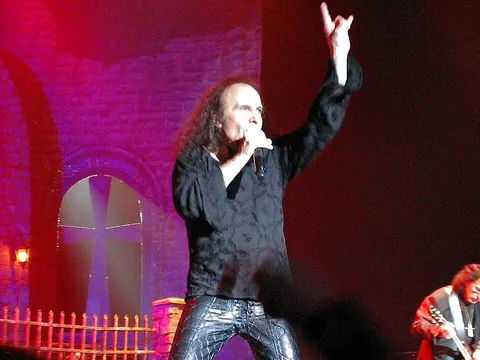
Black Sabbath,39Black Sabbath — a British band formed in Birmingham in 1968, widely considered the originators of heavy metal. one of my favorite bands of all time — you might recognize the frontman, Ozzy Osbourne,40Ozzy Osbourne (1948–2025) — Black Sabbath's original singer, later a solo star and the center of the reality show "The Osbournes." from back in the day. He was famous for throwing up a peace sign during and after concerts. Well, when they got a new vocalist, Ronnie James Dio,41Ronnie James Dio (1942–2010) — an American singer who fronted Rainbow before Black Sabbath and his own band, Dio, after. when he joined the band in 1979, he wanted a signature gesture. He wanted something he could use, but he didn't want to copy Ozzy. So what did he do? Well, Dio grew up in an Italian American household, and his very superstitious Italian grandmother used to use that hand signal, the mano cornuta, to protect herself from sketchy people or some oddball who she thought might be casting bad luck.
11Lucky sixes and a parting "88"
In China six promises a smooth road, and 88 means "bye-bye."
So guess what? He borrows grandma's hand signal and starts using it at concerts. Boom, Black Sabbath becomes associated with that, and then, bada bing, bada boom, there you have it: heavy metal. All right, why am I getting into all this 666? Well, because 666 is not bad news or bad luck everywhere. In fact, in Chinese, 66 can sometimes be good luck. You have liùliù dàshùn, which is similar to something like yílù shùnfēng, which is like a bon voyage.42Liùliù dàshùn (六六大顺) — "may everything go smoothly"; yílù shùnfēng (一路顺风) — "may the wind be at your back." 六 (liù, "six") sounds like 流 (liú, "to flow") and 路 (lù, "road").
May you have the wind at your back and smooth sailing on your journeys. And this six sounds like it could be liù, like smooth, but it could also be lù, like a road, a path. So when, on Chinese New Year, people get these little packets of money in these red envelopes called hóngbāo,43Hóngbāo (红包, "red envelope") — an envelope of money given at Chinese New Year, weddings and other celebrations; red is the color of luck in China. sometimes the amounts will be in sixes. So 600, 666, whatever it might be. So that is just to say that whether a number is good or bad luck really depends on where you are. And actually there's a lot of disagreement even within China — you look at different dialects and how things can be pronounced — it comes down oftentimes to just what that sound is similar to across the board.
All right, so let's sign off. There's one last eight-related detail; also has a six in it. So in Chinese internet shorthand, 88 can be bye-bye, because ba ba sounds a lot like bye-bye. You'll hear that a lot in China, in Taiwan. Bye-bye, which you can write in Chinese characters. So after an entire episode about prosperity, fate, and very expensive numbers, I get to sign off with a cheap version, and that is 88: bye-bye.
So ba ba, but you can say bye-bye la, ba ba liu.44886 in Chinese internet slang reads as "bài bài lou" (拜拜喽), "okay then, bye." All right, I'm going to leave it at that, guys. Hope that was nerdy enough for you. I can't imagine there are going to be show notes on this, but who the hell knows? Maybe we'll create some show notes. So thanks for indulging.
This is the first time in my life that I've been able to actually pull out some of the East Asian studies45East Asian studies — Tim's major at Princeton, from which he graduated in 2000. stuff from the dinosaur age when I was in college. So thanks for listening, and as always, until next time, be just a bit kinder than is necessary — to others, also to yourself. And you know what? Embrace your weird self. If you're into all this bizarre stuff like I am, you know, hop into Chinese numerology on Wikipedia, check out that page. And maybe I will come back to that I Ching live casting, because that is a weird book — if you can even call it a book. That'll be my cliffhanger. Until next time, thanks for tuning in, guys.
Hey, guys, this is Tim again. Just one more thing before you take off, and that is 5-Bullet Friday.465-Bullet Friday — Tim's free Friday newsletter: five short items, from books and articles to gadgets and other finds of the week. Would you enjoy getting a short email from me every Friday that provides a little fun before the weekend? Between one and a half and two million people subscribe to my free newsletter, my super short newsletter called 5-Bullet Friday. Easy to sign up, easy to cancel. It is basically a half page that I send out every Friday to share the coolest things I've found or discovered or have started exploring over that week. It's kind of like my diary of cool things.
It often includes articles I'm reading, books I'm reading, albums perhaps, gadgets, gizmos, all sorts of tech tricks and so on that get sent to me by my friends, including a lot of podcast guests. And these strange esoteric things end up in my field, and then I test them, and then I share them with you. So if that sounds fun — again, it's very short, a little tiny bite of goodness before you head off for the weekend, something to think about. If you'd like to try it out, just go to tim.blog/friday. Type that into your browser, tim.blog/friday, drop in your email, and you'll get the very next one. Thanks for listening.


