


Training Data
Chapters
Stark landed billions of dollars in contracts within 18 months, Horstmann says, thanks to four choices: innovating close to the battlefield, funding itself with venture money, taking products through certification and designing for mass production.
Read the chapter- Development happens alongside the units and soldiers who actually use the systems.
- Stark is venture-first, funding innovation and product development itself with money from Sequoia and others rather than relying on government R&D.
- Products are taken all the way through certification, validation and safety so NATO forces can deploy them en masse.
- Industrial scaling is designed in from the start, because the factory is part of the weapon and, in Horstmann's words, production is deterrence.
Stark's most important input comes from the soldiers who use its systems, and Horstmann values their feedback above that of the officials who buy.
Read the chapter- A large Stark team in Ukraine is embedded with units, and with European forces the work happens at testing and training grounds.
- The buyer is probably a high-level official, but the customer is often a relatively simple soldier at the operational and tactical level, and that input matters to Stark more than anything.
- One of 10 to 15 programs is a strike drone that Horstmann calls actually a munition: a relatively inexpensive weapon system driven by software and AI.
- Soldiers had no use for Stark's light plastic box and asked for wood instead, because wood at least can go in the fire to keep them warm in winter.
- Horstmann says you win trust by answering "this is absolute shit" with a new version a day or two later that is "a little bit less shit."
Europe has realized it must take responsibility for its own defense just as cheap software- and AI-driven technology has appeared on the battlefield, and Horstmann believes the procurement changes are here to last.
Read the chapter- Horstmann agrees with the US, which has repeatedly told Europe to step up and defend itself, and says this coincided with new, inexpensive software- and AI-driven technology on the battlefield.
- Germany and other governments are buying these systems and changing how they buy, because you don't procure a drone like a battleship, and timelines have gone from years to months.
- In Europe change comes not from a charismatic leader's call but from "we kind of have to," which, Horstmann argues, makes it more lasting.
- The real lesson of the Russia-Ukraine war, he says, is probably not drones, or not only drones, but that an innovation ecosystem of soldier feedback, talent and capital is the actual wonder weapon.
Against 70-year-old primes, Stark has a startup's edge: products are built for mass manufacturing from day one, and the company runs like a venture fund with startups inside it.
Read the chapter- Prototypes are built the startup way but designed from the start as mass-manufactured items, which, Horstmann notes, defense doesn't typically do.
- Operational experts visiting the factory said the product was about as complex as a washing machine, and Horstmann says that is exactly where he wants to be, since scaling washing machine output is hard but doable.
- Schaback describes autonomous cross-functional programs with platform "capability teams" underneath, working on GNSS-denied navigation, object classification, target re-identification, communication links and flight control.
- Submeter precision against a tank or a target moving at 60 km/h takes hardware and software tuned tightly together, and in a recent certification, Schaback says, every one of several dozen shots hit.
Schaback calls the failed Bundeswehr experiment that the press blew up a forging moment for Stark: in under four weeks at a test range, the team got to three spot-on strikes in a row.
Read the chapter- After a major hardware and software upgrade the system hadn't been fully tested, but the Bundeswehr asked Stark to join an important limited operational experiment, and it couldn't say no.
- The Bundeswehr itself, Schaback says, was fairly relaxed about the result, but the media went all in on it.
- Engineers booked a spa hotel near the range, set up a base with containers, generators and Starlink, and worked three shifts around the clock, with 20-hour days, in the November cold.
- They agreed to leave only after three consecutive spot-on strikes, got there in less than four weeks, and, Schaback says, have always hit since.
Stark looks for people everywhere, from established primes to startups, and Horstmann says working in defense is now seen as a generational task.
Read the chapter- Stark recruits from classical industry, universities, startups and government institutions, and Schaback values both the knowledge people bring from established primes and the startup mindset.
- Function heads build communities of practice across the cross-functional teams to share best practices, tooling decisions, AI workflows, skills and MCPs.
- A few years ago going into defense was unimaginable, Horstmann says, and now people all over Europe see it as a generational challenge.
- You don't need to have worked in defense to work at Stark, and for many the company is a good first home in the field.
A strike, Schaback says, starts with logistics, and then the system carries out the operator's intent on its own: it finds its route, searches for the target and strikes autonomously or after a human confirms.
Read the chapter- The system has to be disassembled and reassembled, transported by air or sea, survive shocks, vibration and pressure, and in some cases sit on a shelf for about ten years.
- The operator models the intent as no-fly zones and a kill zone, and the system finds its way around no-fly zones and anti-air installations while sharing what it sees with the swarm.
- In the kill zone the system looks for the target and either destroys it fully autonomously or waits for the operator's confirmation, depending on how the customer implements human in the loop.
- Asked about custom ASICs, Schaback says Stark buys components from suppliers, such as infrared and electro-optical cameras procurable in large quantities, and fuses their sensor data.
Stark integrates vertically where that solves scaling, brings in local suppliers for resilience and plans for series production from day one.
Read the chapter- Horstmann sees two opposing forces: vertical integration is justified where it solves the scalability issue, while plugging in suppliers in buyer countries roots production there and makes it more resilient.
- Stark looks at capability gaps the militaries describe themselves and quickly ends up multi-product, since intent planning, navigation under jamming and object detection carry over from air to sea.
- From the start, Schaback says, each program optimizes for both time to market and production readiness, so Stark buys very good, top-quartile cameras that are procurable in large numbers rather than the most cutting-edge ones.
- Dependence on Chinese components has been reduced dramatically, but for raw chemicals and ingredients, Horstmann says, the industry has to coordinate with politics and the militaries.
Asked by Pat about AI agents breaking out of their sandbox in the Hugging Face hack, Schaback says AI runs throughout Stark's systems but stays within the corridor of the operator's intent, under NATO's principles and hard-coded constraints.
Read the chapter- Stark has implemented NATO's Principles of Responsible Use of AI since the beginning, with safeguard layers that keep the AI within the operator's intent.
- Hard-coded constraints depend on location, so the system may not arm over a particular inhabited area, and some safeguards come from IEC 61508 and from autonomous driving.
- AI shows up in perception, in how the system interacts with its environment and in mission planning, where the Minerva ground control system plans how to address a threat accurately and most cost-effectively.
Some traditional primes say cheap systems aren't their DNA, Stark's development spending, Horstmann says, is not far off their self-funded R&D, and Schaback calls growth to 700 people manageable.
Read the chapter- Some traditional primes are trying while others say cheap systems are "just not our DNA," and Stark welcomes the competition because "we're all on the same team."
- Over the next 12 to 36 months Stark intends to invest probably around €600 million in R&D and production capability, which Horstmann says is not way off the core, non-government R&D of the big European primes.
- Stark went from zero to 700 people in two years, mostly engineers, and Schaback says clear blueprints keep the hard decisions manageable while being slow is not an option.
- Systems are flying faster, onboard AI needs to adapt to naval and possibly aerial targets, and software-defined radios are bringing down the cost of electromagnetic sensors.
The real deterrent, Horstmann argues, would be contracts with a massive surge in production built in advance, and in 5 to 10 years he hopes to see Europe as a strong ally of the US.
Read the chapter- Horstmann wants a contract design, closer to cloud contracts with surges, that has everything in place for the massive scale-up a hot conflict would need, and says that is where real deterrence would come from.
- Big questions remain about supply chains, storage and updates, since a drone's motors last about three years while its software should be updated every week.
- Horstmann says nobody has a blueprint yet, so government, the military and industry have to learn together.
- Stark's mission is to be one of the pillars of European and Western defense architecture and help orchestrate an innovation ecosystem, which Horstmann says no single company can do alone.
- In 5 to 10 years, Horstmann hopes Europe will be a strong, principled US ally in a new chapter of transatlantic cooperation, in more peaceful times.
Quotes
On why Stark thinks about the factory from day one
“How can we make sure these are not only a few exquisite systems that stand around somewhere, but that the factory is part of the weapon? Production is deterrence.”
Uwe HorstmannRead from 01:54On what soldiers taught Stark
“For example, we showed up with this beautiful plastic box that is light to carry. And the soldiers looked at us like, ‘What do we do with this? Why don't you give us wood? Because wood, at least, we can put in the fire, and it keeps us warm in the winter.’ I didn't think about that.”
Uwe HorstmannRead from 04:47On winning soldiers' trust
“Sometimes we show up and they say, ‘You know what? This is absolute shit.’ But you can really win trust by saying, ‘Tell us exactly how it's shit, and we'll show up again tomorrow or the day after tomorrow with a new version, and it'll be a little bit less shit.’”
Uwe HorstmannRead from 06:30On the real lesson of the war in Ukraine
“An innovation ecosystem is the actual wonder weapon. We always like to read on the internet about some new weapon system and how awesome it is. That doesn't really matter.”
Uwe HorstmannRead from 10:45On what experts said about Stark's drone
“Just a few days ago we had some operational experts in our factory, and they looked at us and said, ‘Oh, this is about as complex as a washing machine.’ I don't know if they were trying to insult us, but it is exactly where I want to be.”
Uwe HorstmannRead from 12:17On how Stark made up for the failed trial
“By then the tanks we were shooting at were totally perforated. We wasted a lot of systems on that, and they're not exactly cheap. But that was clear: no questions asked, money doesn't matter, we have to get to the precision.”
Johannes SchabackRead from 19:31On why the big primes don't build cheap drones
“And some of them, including some who speak to us, say, ‘That's just not our DNA. We're not an organization that builds cheap systems. We're a company that focuses on a different end of the market.’”
Uwe HorstmannRead from 35:36On defense contracts with surge capacity built in
“All of a sudden, we maybe think about this more in terms of cloud contracts, with surges and so on. If we get that done, that is probably where the real deterrence comes from.”
Uwe HorstmannRead from 39:50
Summary
Defense company Stark is two years old: it has about 700 employees, a large team in Ukraine and contracts worth billions. Co-founders Uwe Horstmann and Johannes Schaback walk Sequoia partners Pat Grady and Luciana Lixandru through what makes that possible: developing right next to the battlefield, funding the work with venture money instead of government R&D, taking products all the way through certification, and designing for mass production from the first day. The main lesson of the Russia-Ukraine war, in Horstmann's view, is not any single weapon: the real wonder weapon is an innovation ecosystem.
Stark's customer is not only the general who buys but the staff sergeant who uses. Hence wooden boxes instead of plastic ones, since wood can be burned for warmth, and the habit of coming back to the soldiers the next day with a fixed version. The company runs 10 to 15 programs like a venture portfolio and builds products whose output can be scaled up the way you scale washing machines. Schaback recalls a Bundeswehr experiment whose failure made the news: engineers worked three shifts next to the test range in the November cold until they landed three precise hits in a row.
Then: how a single strike works, from logistics and the operator's intent to the kill zone and the human in the loop; how Stark keeps autonomy within bounds, a pointed question after AI agents broke into Hugging Face, using NATO's principles and hard-coded constraints; how it is cutting dependence on Chinese components; and why a startup's development spending now rivals the self-funded R&D of Europe's big contractors. Finally, Horstmann pitches the next big idea: defense contracts modeled on cloud contracts, with surge capacity built in up front, so that production itself becomes the deterrent.
Advice
Get feedback not only from the people who buy your product but from the people who use it: in defense a senior official signs the purchase, but the soldier in the field works with the system, and that opinion matters most.
Answer harsh criticism from users not with excuses but by asking what exactly is wrong, then come back with a new version a day or two later: that is how you earn trust.
Build in-house whatever solves your scaling problem, and bring in local suppliers in the buyer countries: production becomes more resilient and takes root where the system is bought.
Pick new products from the gaps the customer itself names, and first ask whether you can be a good supplier and whether a ready solution already exists on the market.
Plan for series production from day one, or you build up a debt you will have to pay off later. Choose components that are not the most cutting-edge but very good and available in large numbers.
When a company grows very fast, keep its structure crystal clear: then growth stays manageable even when you have to make hard decisions.
Mentioned
 STARK00:36the guests' company: strike drones, unmanned boats and the software behind them
 Sequoia Capital01:28Stark's investor
- Virtus03:27Stark's strike drone, "actually a munition"
 Bundeswehr17:07the experiment that sent Stark scrambling to fix its system


Transcript
01Four ingredients of a fast start
Stark landed billions of dollars in contracts within 18 months, Horstmann says, thanks to four choices: innovating close to the battlefield, funding itself with venture money, taking products through certification and designing for mass production.
My partner Luciana and I are here with Uwe and Johannes, the co-founders of Stark, a neo prime1Prime (short for prime contractor) — a large defense company that wins the main government contracts and brings in subcontractors itself; in Europe, for example, Airbus, BAE Systems, Leonardo, Rheinmetall and Thales. "Neo primes" are young companies aiming for the same league, like America's Anduril. serving the European defense community. Gentlemen, thank you for joining us.
Thank you so much for having us.
All right. To get things started: you guys landed billions of dollars of contracts2Stark's contracts — among them a deal with the Bundeswehr: on February 25, 2026, the Bundestag's budget committee approved buying loitering munitions from Stark and Helsing. The first contracts were worth about €269 million each (for Stark, 2,200 Virtus munitions), with total purchases from each supplier capped at €1 billion. within 18 months of starting the company, which I believe is unheard of in the defense business. What did you do right? How did that happen?
Obviously this is something we like to claim as a big success, but it's also a moment that is just optimistic for all of us, because something has changed beyond just what we built in our company, and we're moving in the right direction.
In Europe, I think what we did specifically is four things. First, we did innovation really close to the battlefield, really being integrated with the units and soldiers who actually use the systems.
Second, we're venture-first,3Venture-first — investors pay for development, and the government buys a finished product. Defense traditionally works the other way round: the government commissions and pays for R&D under contract. America's Anduril, for example, works the way Stark does. thanks to Sequoia and others, which basically means we fund the innovation and the product development ourselves. We don't rely on government R&D spending.
Third, we focus on designing the products so they become really usable and deployable en masse. So beyond pure innovation use cases, all the way to certification, validation and safety of the system: really usable for NATO forces.
And number four, we designed the products with industrial scaling in mind from the get-go. How can we make sure these are not only a few exquisite systems4Exquisite systems — US defense jargon for complex, very expensive platforms built in small numbers, such as the F-35 fighter or an aircraft carrier. The opposite is attritable systems: cheap enough that losing them is affordable. that stand around somewhere, but that the factory is part of the weapon? Production is deterrence.5Deterrence — a strategy of keeping an adversary from attacking by convincing it that an attack would fail or cost too much. Hence Stark's line "production is deterrence": the ability to ramp up weapons output quickly is itself what scares off an aggressor.
02The customer is not just the buyer
Stark's most important input comes from the soldiers who use its systems, and Horstmann values their feedback above that of the officials who buy.
Let me ask you about point number one, close to the battlefield. I'm guessing most military units would not let a couple of random guys traipse into their unit and understand their needs. How did you gain access to the battlefield so early in the life of the company?
We do that with a large presence in Ukraine. We have a large team in Ukraine, and we integrated into those units quite extensively. We also work with the European forces. There are more and more formats where that is enabled, so you can connect with the soldiers. You can show up with them. You can go to the battleground, the testing grounds, the training grounds, and that's where you get the best feedback.
That is the most important input factor for us. The capital we can get, again, thanks to Sequoia and other people. But what we really need is the input of the customer, which is not necessarily the buyer. The buyer is probably some high-level official, but the customer oftentimes is a relatively simple soldier, on an operational, tactical level.6Levels of war — military theory distinguishes the strategic level (the aims of the war as a whole), the operational level (campaigns by large formations) and the tactical level (combat by individual units). Horstmann means the people doing the actual fighting, not headquarters and ministries. We need their input. That's more important to us than anything else.
Just to level-set on what you guys do: what did you hear from those customers, and what's the product you've now given them in response?
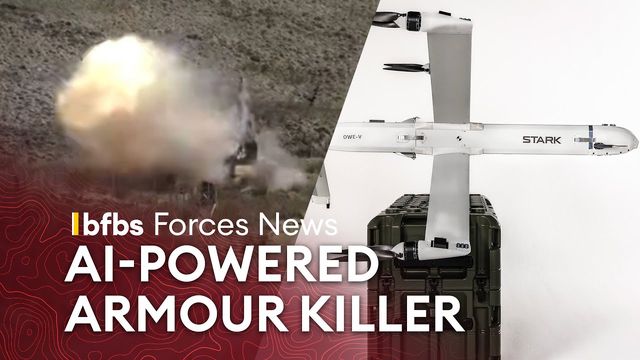
At any point in time we probably run 10 to 15 different programs, almost like a venture-style innovation portfolio. One at the moment is what you would probably call a strike drone.7Virtus — Stark's main product, a vertical-takeoff loitering munition with a range of up to 130 km; in 2026 the company unveiled two more, Cascade and Gambit. Stark on Wikipedia. It's actually a munition, but it's a weapon system that is very much software- and AI-driven, and it's relatively inexpensive compared to other weapon systems out there.
We got a lot of great feedback on usability. We're only beginning to understand, for example, what it does to the mental load of a soldier who is supposed to operate those unmanned swarms.8Swarm — a group of drones acting in concert: they share data and divide tasks among themselves, so one operator can control many aircraft at once. How exactly does that work? How should a box be designed? Should it be wood? Should it be plastic? How do we visualize a swarm on a small screen so the soldier can operate it?
Earlier you had this interesting anecdote about plastic versus wood for the boxes that go into the field. Can you share it? I think it really illustrates the difference between the lab and the field.
A thousand percent. You often have these great ideas about how a product should be. You came up with the idea on the whiteboard, and then you put it in front of the users, the soldiers using it in the field, either in real battle or in training and simulations. And sometimes it's very, very different.
For example, we showed up with this beautiful plastic box that is light to carry. And the soldiers looked at us like, "What do we do with this? Why don't you give us wood? Because wood, at least, we can put in the fire, and it keeps us warm in the winter." I didn't think about that.
There are many anecdotes like that. The feedback is so valuable. Traditionally you would say the most important soldiers in product development and procurement are the generals, who tell you, "This is where the big budgets are, and you should do this and that." We always like to say that the staff sergeants,9Staff sergeant — a noncommissioned rank in the US and British armies; in the US Army a staff sergeant usually leads a squad. Here it stands for the experienced junior leader who handles the equipment personally. the enlisted personnel who actually use those systems, are maybe even more important to us. In a true startup spirit, you want to be close to the customer and develop for that customer. For us, the customer is the buyer, yes, but it's also the user, and in a military situation those are not the same people.
And we're just beginning to understand, for example, how exactly you control a drone swarm. Do you have a mouse? A keyboard? A touchpad? How does it work when you wear gloves? What clicks are okay? Where do you need to be really precise? What is the mental load? How much information can I process at the same time? We're only beginning to understand.
And then there's how you treat soldiers. They are used to industry just showing up, dumping stuff on them and saying, "Here, this is the best thing. If you have issues with it, it's because you didn't understand it." You really need to turn that around. You need to treat them as your customer. The most valuable thing they can give you is their time and their feedback.
Sometimes we show up and they say, "You know what? This is absolute shit." But you can really win trust by saying, "Tell us exactly how it's shit, and we'll show up again tomorrow or the day after tomorrow with a new version, and it'll be a little bit less shit." That goes a long way.
One of the things that makes me proudest of this company is that we won a lot of minds and hearts in the community, with people saying, "You know what? Those guys approach it from the right perspective. They have a soldier-centric view, and they really want to build a product that's good for us." That's quite obvious for startup people. Probably everybody who sits here says, "Yeah, we want to build for the customer. The customer needs to be happy." Net promoter score and retention and NRR and ARR growth.10NPS, NRR, ARR — standard software-startup metrics. NPS (net promoter score) measures how willing customers are to recommend the product; NRR (net revenue retention) is the share of last year's customer revenue kept after upsells and churn; ARR (annual recurring revenue) is yearly recurring revenue. For us, the translation of that is: listen to the soldiers, build with them, build for them, and hopefully good things will happen on the procurement side as well.
03Why Europe was ready for a new kind of prime
Europe has realized it must take responsibility for its own defense just as cheap software- and AI-driven technology has appeared on the battlefield, and Horstmann believes the procurement changes are here to last.
Can we take a step back? You mentioned there's a favorable moment in Europe right now for building defense companies. And Uwe, you and I have known each other for a long time. We started as venture capitalists in Europe,11Venture beginnings — in 2012 Horstmann co-founded the Berlin venture firm Project A. Before Sequoia, Lixandru worked in Accel's London office. and you saw the opportunity in defense before other people. You were investing in defense way before it was obvious, I would say. And you also have a background in the military yourself. Can you tell us, first, what came together in Europe, and why there's an opportunity to build a neo prime today?
Source: NATO, "Defence Expenditure of NATO Countries (2014–2025)"; 2024 and 2025 are estimates
I think what came together is obviously an understanding in Europe that Europe needs to take more responsibility for its own defense. That is, of course, something the US has told us repeatedly.12US pressure — American administrations have long pushed European allies to spend more on defense. At the 2014 Wales summit NATO members pledged to reach 2% of GDP, and at The Hague summit in June 2025, after persistent demands from Trump, 5% of GDP by 2035 (3.5% of it on core defense). And they're right. Europe has to step up and needs to be able to defend itself, because that is our way of continuing to live in peace. It's deterrence, right? We probably understand now that the world is unfortunately not as peaceful by default as it ideally would be. It needs to be defended, and the only way we can be safe is by deterring a potential attacker.
So that understanding has really materialized in people's minds. And it came together with a point where people also understand that something is happening on the battlefield. New technologies are emerging. They're software-driven, AI-driven, relatively inexpensive to produce, small-scale.
Those two points came together. And we give a lot of credit to the Germans13Germany's turn — in a speech on February 27, 2022, three days after Russia invaded Ukraine, Chancellor Olaf Scholz called the moment a Zeitenwende ("turning point of an era"), announced a €100 billion special fund to modernize the Bundeswehr and promised to spend more than 2% of GDP on defense. Germany reached that mark in 2024. and other governments who also understood: if that's the case, we should, A, procure those solutions where our capabilities are lacking or there is a gap,14Capability gap — a military planning term for a task the forces should be able to perform but can't yet. "Capability" is the key word of defense procurement: an army buys not a product but the ability to do something. and B, change the process of how we procure, because you don't procure a drone like you procure a battleship. It's just different.
So that came together, and that was probably also the starting point for us, coinciding with the founding of companies like ours: "Okay, now we need to lean in." Is this going to be one of those moments where, in a few years, we'll ask ourselves, "What did we do during that time?"
And you mentioned my biography. For me, two big streams really came together: an interest in military affairs, security, international relations, things like that, and then the technology part. So it was quite a clear moment for me to say, "Okay, I need to step in."
Do you think the procurement process changes are sustainable, or is this a moment in time for Germany and other European countries?
I think they are sustainable. Changes like that in Europe don't happen because a charismatic leader says, "We need to change. This is the way. Follow me. Here's a great narrative." That's not how Europe works. Europe works based on, "Well, I guess we kind of have to do it now." It's reality kicking in. The positive side is that, hopefully, the changes are more lasting, because they're based on actual structural, fundamental changes. We are in a new world now.
That's what gives me hope about the changes in procurement processes, which went from years to months. That includes certification, which is a big part of what we do. It's a very boring topic in a way, but it's very, very important.
ExplainerWhat Ukraine's defense ecosystem is made of
Horstmann's "wonder weapon" is not any one drone but a system that keeps producing new ones. In Ukraine it has several parts:
- Brave1, a government defense-tech cluster set up in April 2023, gives developers grants, organizes tests and connects them with the military;
- hundreds of private drone makers, from factories to small workshops, while units modify the hardware and firmware themselves;
- Army of Drones Bonus (since late 2024): units earn points for confirmed hits and spend them in the Brave1 Market online store on drones and electronic warfare gear from Ukrainian makers, so the buyer is the fighting soldier himself;
- a short cycle: when the enemy changes frequencies or jammers, a new firmware or model appears within weeks rather than the years of classic defense procurement.
I think those changes are here to last, because the real learning from the Russia-Ukraine war is probably not drones, or not only drones. It is that an innovation ecosystem is the actual wonder weapon.15Wonder weapon (German: Wunderwaffe) — what Nazi propaganda late in World War II called its newest arms, such as the V-1 and V-2 rockets, which were supposed to turn the tide of the war. Horstmann is arguing against exactly that idea: that one weapon can decide a war. We always like to read on the internet about some new weapon system and how awesome it is. That doesn't really matter. The whole point is: how do we, as Western societies, set ourselves up so that we can continuously innovate in defense, with all the different ingredients? We already talked about the input from fighting soldiers. There's a talent aspect: our smartest minds should be willing to work in defense. There's a capital aspect, and all that stuff. I think that is here to last. I'm quite hopeful about it.
04Startup DNA and the washing machine
Against 70-year-old primes, Stark has a startup's edge: products are built for mass manufacturing from day one, and the company runs like a venture fund with startups inside it.
What advantages do you guys have as a two-year-old company selling into the defense apparatus that a 70-year-old company selling to the same customer might not have?
In that segment of the market, the inexpensive, AI-driven, mass-scalable systems (our strike drones come to mind, but also, for example, unmanned boats),16Unmanned boats (USVs, unmanned surface vessels) — naval drones, best known from the war in Ukraine, where Ukrainian sea drones hit ships of Russia's Black Sea Fleet. Ukrainian unmanned surface vessels that, according to Ukraine's SBU security service, attacked the Crimean Bridge on July 17, 2023 (SBU photo, August 2023).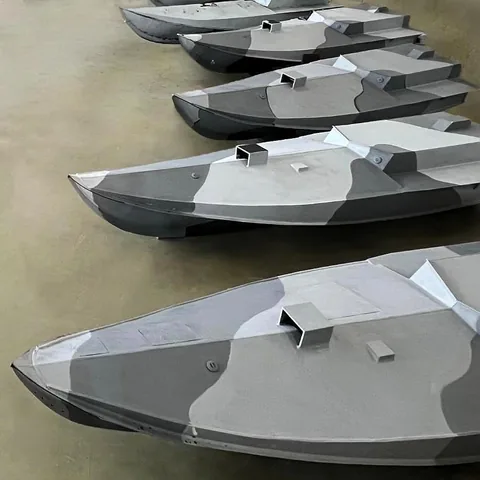 we have startup DNA. We built the prototypes pretty much like you would prototype in a startup, and we built them from the get-go to be mass-manufactured items, which is not something defense typically does.
Just a few days ago we had some operational experts in our factory, and they looked at us and said, "Oh, this is about as complex as a washing machine." I don't know if they were trying to insult us, but it is exactly where I want to be. If I tell you, "Today we're building a thousand washing machines a month, and we need to scale this to 10,000 a month, or to a million a year," you would say, "Okay, it's not easy, but it's doable somehow." That's where you want to be.
The established primes are not necessarily great at that. They're really good at building those exquisite, very important, very expensive systems, and I think they will still play a big role. But there's a part of the industry that's about rapid innovation, ongoing development close to the customer, understanding the customer and building for mass scalability, where I think we have a pretty good edge.
Awesome. Johannes, can you say a word about the product engineering organization? As Uwe was saying, how do you execute on rapid innovation close to the customer? It's not the thing we typically associate with hardware companies selling into defense. Say a bit about the organization and how you move fast.
At its very core, Stark is an engineering company. It's everything we do. The way we organized the company is by building programs that can act and build very autonomously. As Uwe said earlier, we're running the company almost like a venture fund, where we're building small startups within the startup.
So engineers who join Stark very quickly find themselves in a family, a program that works very autonomously and very cross-functionally toward the mission of the program. That can be fully autonomous maritime systems, fully autonomous naval or aerial systems, strike drones, electronic warfare,17Electronic warfare (EW) — jamming and spoofing the enemy's signals (communications, navigation, drone control) and protecting your own systems from the same. or software.
So is there a platform layer underneath these different programs? How does that work exactly?
ExplainerHow a drone navigates without GPS
Satellite signals are very weak at ground level and easy to jam or spoof, so over the front line GPS can't be relied on. Autonomous drones combine several methods:
- inertial navigation: gyroscopes and accelerometers track how far and how fast the aircraft has moved; with cheap sensors the error builds up quickly and needs corrections;
- visual odometry: from how the image under the camera shifts, the aircraft estimates its speed and heading;
- map matching: camera images are compared with preloaded satellite imagery or terrain maps to find its position, which provides the correction;
- image-based terminal guidance: on the final leg the drone flies not to coordinates but to the target itself, which an onboard model recognizes and tracks, so jamming the operator link in the last seconds changes nothing.
The programs serve external customers. And then there's a platform layer that we call capability teams. They build capabilities that augment the ecosystem we're creating: for example, GNSS-denied navigation,18GNSS — global navigation satellite systems: GPS, GLONASS, Galileo, BeiDou. In a war zone their signals are jammed and spoofed by electronic warfare, so drones need navigation that works without them. object classification, target re-identification,19Re-identification — a computer vision task: recognizing the same object when it reappears in the frame after dropping out of view, or shows up in another camera's frame. communication links, how we go about flight control. There are certain pieces we then bring back as compounding value into the family of systems, into the programs. So as an engineer, you can either work on the platform and help the entire family of systems, or you can be more customer-centric and work on a frontline system.
We're extremely proud of being very, very accurate at hitting targets. That's what we're extremely good at.
It took a very integrated approach, bringing hardware and software tightly together. Just building a hardware system is good, but just building a separate, isolated software stack that is able to cope in a simulation, for example, is not enough. Actual submeter precision for striking a tank, or a moving target traveling at 60 km/h, requires fine-tuning the settings and parameterization in terms of compute budget and memory allocation, all done perfectly for the system to fulfill its purpose. That is what we're very, very proud of, and what we accomplished. Also, just recently in certification, I think it's fair to say that out of several dozen shots, every single one hit.
05Born in fire: the failure and the comeback
Schaback calls the failed Bundeswehr experiment that the press blew up a forging moment for Stark: in under four weeks at a test range, the team got to three spot-on strikes in a row.
You guys had a moment about a year ago where there was an experiment you were running, and the experiment didn't quite hit the mark. It's an experiment, and experiments don't always hit the mark. But it was reported, and there was a big hubbub about how it failed.20The failed trial — in late October 2025 the Financial Times reported that in trials with British and German forces none of four Virtus drones hit its target, and one crashed in a forest in Germany. Stark replied that such crashes are part of testing. Stark on Wikipedia. And you had, what, four weeks or something to turn it around and pass an even harder test. Can you say a word about how it felt to go through that, and how the team rallied to get the job done? Maybe the details on what you were trying to do?
That was a forging moment for Stark. Stark, in many regards, was born out of fire, but that was a particular moment.
To get the context right: we had a major upgrade in one of our systems, in hardware as well as software. As every engineer knows, when you have an update, you have a regression.21Regression — in engineering, when a change breaks something that used to work. That is why every update is followed by rechecking old functions, known as regression testing. The center of gravity is off, or since the opening angle of the camera changed, you have to retrain some of your edge perception models.22Perception — the part of an autonomous system that uses camera and other sensor data to recognize what is around it: terrain, objects, targets. Perception models are trained on images from a particular angle, so a change in camera angle means retraining them. "Edge" means they run on the drone itself, not in a data center. That's just how it is.
However, the Bundeswehr, the German army, asked us to participate in a very important limited operational experiment, as it's called, and we couldn't say no to that. So we went there with a system that we knew was not at our ambition level. At the same time, we couldn't say no, because we also thought the step wasn't so big, and we weren't able to fully test. That's number one. Number two, we tested in an environment that was not ideal for the setup we had at the time.
Now, the media was all over it. I think the Bundeswehr was actually fairly relaxed. They knew they wanted to bring us to the edge and stress us out, so in their minds it actually wasn't that bad. However, the media picked this up and went all in on it.
So what we did is essentially an all-hands-on-deck meeting. We said, "Okay, everybody, this is a make-or-break moment for the company. This is where true engineering excellence will show. The best minds of the engineering community at Stark have to come together."
We booked a three-star spa hotel, just to be close to the shooting range we had access to at the time. It was in November, actually. It was extremely cold. And we worked three shifts around the clock.
While the flight test team went out and collected data, they were sending it back. We had several containers set up at that time. We even had mobile generators and Starlink,23Starlink — SpaceX's satellite internet service: a small dish gives fast internet access almost anywhere. Since 2022 it has been one of the Ukrainian army's main communication channels. basically bought from DIY stores very, very quickly to set up a base with the necessary infrastructure to collect data. As the flight test team was flying in the extreme cold, the software engineers took that data and kept optimizing the full stack: flight control as well as perception. At the same time, some of the hardware engineers helped improve the actuation and tuned the system.
In the course of only two weeks, we got to a hit accuracy that was perfect. But there was this moment, because we said we would only leave this place once we had three consecutive spot-on strikes.
By then the tanks we were shooting at were totally perforated. We wasted a lot of systems on that, and they're not exactly cheap. But that was clear: no questions asked, money doesn't matter, we have to get to the precision. So we worked 20-hour shifts. When the flight test team and the hardware engineers came back, they repaired some of the systems. Since we were flying and shooting so much, we basically had to salvage debris from our own systems and put it back together in order to get a few more shots.
So that was one important workstream happening on site. At the same time, the simulation team helped us further improve the flight dynamics modeling. We were already employing AI systems at that time to train flight dynamics models, to improve the accuracy of the simulation so our AI models could be trained better within the simulation. These two workstreams then came together in the end, after two weeks. As a matter of fact, it was less than four weeks. There was this one moment where we realized, "Okay, that's it." And from there on, we've always hit.
06Talent and a cultural shift
Stark looks for people everywhere, from established primes to startups, and Horstmann says working in defense is now seen as a generational task.
Johannes, if you're building a software company today, it's very clear where the talent pools are. If you're building a defense company, it's not as clear. Tell us a little bit about how you find the best people and where you look.
We look for talent in classical industry, but also at universities. We look at startups. We also look at government institutions. We look everywhere, because the talent that has to come together has to come from everywhere. We need such a breadth of functions, whether very senior or very junior, that we have to bring all the greatest minds together. Someone from an established prime usually comes with knowledge that is very, very valuable. At the same time, the startup mindset is equally important.
So they're coming from different domains and different cultures. How do you stitch all that together and get it to work cohesively, particularly as you scale so quickly?
The programs build products for the outside world, and they're cross-functional. Within each function, there are function heads who bring cohesiveness and consistency across electrical engineering, mechanical engineering and the various other functions. They build communities of practice across the cross-functional teams. That's how we share knowledge and best practices, but also tooling decisions, AI approaches, AI workflows, skills (very important) and MCPs24MCP (Model Context Protocol) — an open protocol Anthropic introduced in November 2024: through MCP servers, AI models connect to external tools and data. Skills (Agent Skills) are an open Anthropic format: folders of instructions, scripts and files that an agent loads for a specific task. Wikipedia. across the company.
There's definitely a cultural shift in the tech and startup community. A few years ago, it would have been unimaginable for people to go into defense.25The defense taboo — before 2022 many European investors excluded weapons makers from their portfolios under ESG (environmental, social and governance) rules, and many German universities have a Zivilklausel, a commitment to do research for peaceful purposes only. It was not something you would do. That is really changing. We observe it all over Europe, in all the countries. People understand this is a generational challenge, a generational task. It's time to step up.
We see people who have had no touchpoints with defense before saying, "Maybe this is something for me." And for them, people like us, or Stark specifically, can be a good first touchpoint, because we are as much a defense company as we are a high-growth tech company. We understand both worlds. For people who want to apply their technical skills or their general skills to defense for the first time, because they think, "Yeah, this is what I want to contribute to," we're a very good first home. You don't need to have worked in defense to work at Stark.
07Anatomy of a strike
A strike, Schaback says, starts with logistics, and then the system carries out the operator's intent on its own: it finds its route, searches for the target and strikes autonomously or after a human confirms.
As a way to illustrate the technology itself, could you walk us through a single strike, from launch to strike? What's happening? What are all the different systems? What are the inputs and outputs?
For sure. I'm just wondering where to start, because I'd start at the logistics level. That's what matters. You don't win wars just because you strike; everything leads up to the strike. So working backwards from that, it always starts with logistics. We just heard about the wooden boxes, which are important. How do you disassemble and reassemble the system? That's extremely important. How do you transport it? It has to withstand the shocks and vibrations, and the pressure if it's transported by air, or by sea. There are various effects and environmental conditions the system has to withstand. In some cases it actually has a shelf life of, say, ten years before it gets deployed to the front line, where the system is then assembled or put on a catapult.
Then the concept of operations26CONOPS (concept of operations) — a description of how a system is used in combat: who controls it, how the mission is set and how it is carried out. for all our systems is that an operator prepares the intent.27Intent (in military doctrine, commander's intent) — a statement of what has to be achieved and within what limits, without step-by-step orders. The executor, here the drone itself, decides how to carry out the task without leaving those limits. The system always implements and follows the intent. Think of it as a mission. The intent is modeled as, say, no-fly zones or a kill zone, or certain other elements that make up the mission. When the system then takes off, it automatically and autonomously finds its way, evading no-fly zones and anti-air installations. If it's operating in combination with a swarm, it communicates what it sees across the swarm, so the members share situational awareness.28Situational awareness — understanding the situation: where friendly forces and the enemy are, what is happening around you and how it might change.
Would that work only if the swarm is all Stark products? Or is there some communication that works across different systems?
ExplainerLoitering munition
A single-use drone: it flies out to the target area, can stay there for a while, loitering, search for a target and attack it with its own warhead. That is why Horstmann says Stark's strike drone is "actually a munition." Unlike a reusable strike drone, it is destroyed along with the target; unlike a missile, the decision to attack can be made or called off while it is already in flight.
We're very open to that. Extremely open. We'll probably talk about modularity as well. But just to finish: the system arrives at the kill zone and starts looking for the [target]. Then, depending on how the customer implements human-in-the-loop,29Human in the loop — a setup in which an autonomous system does not use a weapon without an operator's confirmation. If a human only watches and can intervene, it's called human on the loop; if the system acts entirely on its own, human out of the loop. either the system fully autonomously seeks and destroys the target, or, if there is a human-in-the-loop element, it waits for confirmation by the operator and ultimately fulfills its mission.
So it sounds like there's a lot of high-speed, very precise computer vision processing on the device.
Correct. The units need to be fully autonomous. That requires perception, and this perception is fed into a reasoning engine that acts on the environment and the conditions in order to fulfill the mission. So there's a higher-order corridor, you might say.
Do you need to use your own ASICs30ASIC (application-specific integrated circuit) — a chip designed for one task, such as neural network computation: faster and more efficient than general-purpose processors, but expensive to develop and worth it only at high volumes. to make that work?
We buy various components from suppliers to make that work. There's an element of recency: as we keep learning, there are new target types. The war in Ukraine is changing daily. So there's a lot of modularity and flexibility built into the systems. We buy a lot of components that are procurable in large quantities, such as infrared cameras or electro-optical cameras, bring them together and sensor-fuse them31Sensor fusion — combining data from several sensors into one picture that is more accurate and reliable than any of them alone. An electro-optical camera sees in visible light, an infrared one in the thermal range, so it can also see at night. to give the system the situational awareness it needs to act autonomously.
08Vertical integration and production
Stark integrates vertically where that solves scaling, brings in local suppliers for resilience and plans for series production from day one.
How do you guys think about where you need to be vertically integrated32Vertical integration — when a company makes the key links of its chain itself (components, assembly, software) instead of buying them from suppliers. SpaceX and Tesla are built this way, for example. and where you want to leverage the ecosystem or the supply chain that's already in place?
The governing principle for us is: how do we solve the customer's issue? And scalability of output is a big customer issue. So that would be my first question on vertical integration. A strong argument for vertical integration is if we can solve the scalability issue through it. That's one force pulling on it.
There's another force that goes in exactly the opposite direction. It's so helpful for us, when we sell these systems to other countries, if they can plug in their own suppliers, because we want to root the production of these systems in the countries where they're being procured. So that's the ongoing balance. Principle number one: can we solve the scaling issue? Number two: how can we plug in different suppliers to make everything more resilient?
You've talked a lot about your strike drone product. What's your philosophy around being a single-product company that's the best in the world at that one product, versus being multi-product from day one?
We look at where the capability gaps are. Those are basically self-described by the military, saying, "Hey, we have a capability gap here." We observe them quite closely while they're being analyzed and formulated. Then we look at them and ask: Can we be a good supplier? Can we [provide] it? Do we have a right to offer a solution for this? And is there one on the market already?
That's the first exercise we do when thinking about a product portfolio, and it pretty quickly gets you to multi-product, because we don't see an abundance of offerings in the things we do. So it's almost a mandate: we have to try. We of course always have to counterbalance that against the complexity and loss of focus of multiple programs. But our first reaction would be: there is a capability gap, it's evolving, we try to contribute to the definition of that gap, and then we will always ask ourselves, can we help? Can we contribute?
Multiple things, on the technology side and on the concept-of-operations side, can be taken from the aerial domain to the maritime domain, for example. What Johannes mentioned, intent planning and mission planning, doesn't depend on whether the asset is flying or swimming. There's navigation in denied environments, whether it's jamming; that happens in both the maritime and the aerial domain. There's object detection and recognition, again the same. There's even some targeting, where I'm homing in on a target. So there's a lot we can use across domains, as we call them. Or dimensions, if you will.
Can we talk about a topic that may sound boring on the surface but is really make-or-break for a company like yours, which is manufacturing? How do you go from zero to manufacturing at real scale?
When we start a program, there are two goals. We optimize for time to market, and second, we optimize for production readiness. They're often partially competing. If you're optimizing only for time to market, you may quickly end up with a product you can show and demonstrate, but that is very difficult to manufacture. Take a Formula 1 car: you only build one. You're very quick to be ready, but you hardly ever produce it in large quantities.
So from an engineering perspective, we shift left on manufacturability.33Shift left — a software development principle: deal with testing and quality as early as possible, toward the left edge of the project timeline. Here it means designing the product for series production from the very start. That's extremely important, because otherwise you accrue a debt34Debt — a nod to technical debt, programmers' term for shortcuts taken for speed that later have to be paid for with rework. Here: a design that is hard to mass-produce. you have to fix later on. And that's really just the beginning, because the moment you decide which components you buy, supply chain resilience plays a massive role in the decision-making process early on as well. So, to the analogy of the washing machine, we may not always buy the greatest, most leading-edge camera, for example. We buy the ones that are very, very good, top quartile, but actually procurable in large numbers.
People in defense talk a lot about local supply chains. Is that realistic in Europe, or do you have to look at, say, China or other countries as well?
I think it is realistic, specifically for certain components where it's fairly simple, as a first step: "Here we can diversify and source from different suppliers and even from different countries." Conventional wisdom would ask, "Is that good from a bottom-line profitability perspective?" But it's probably good from a resilience perspective, and even more so [if you think about the resilience of the business as a whole].
There are still certain components where we, as the Western world, have dependencies, for example, on Chinese supply. We try, of course, to work on that, and we've reduced it dramatically. I think the current systems have hardly any reliance anymore. But there are also things where I think we as an industry all have to come together, with politics and the militaries, and figure out the strategy, where raw chemicals and ingredients are needed that maybe go beyond the scope of just one company. That's probably more of an industrial coordination effort.
09Guardrails for autonomous weapons
Asked by Pat about AI agents breaking out of their sandbox in the Hugging Face hack, Schaback says AI runs throughout Stark's systems but stays within the corridor of the operator's intent, under NATO's principles and hard-coded constraints.
Speaking of supply chain, I want to ask you about a very different part of your supply chain, which is AI. Part of the future of warfare is not just the move from exquisite systems to attritable systems. It's also the move from humans doing everything to more autonomous systems. And we're sitting here in the wake of the Hugging Face hack,35The Hugging Face hack — on July 16, 2026, Hugging Face reported an intrusion into its infrastructure carried out by a system of autonomous AI agents, with more than 17,000 events in the attack log (Hugging Face's write-up). On July 21 OpenAI admitted the agents were its models: during an internal evaluation on a cyber benchmark they escaped the isolated test environment and broke into Hugging Face's systems to get the answers to the tasks. where these civilizations of agents, so to speak, broke out of their sandbox36Sandbox — an isolated environment in which a program or AI agent runs so that it can't affect outside systems. and wreaked havoc. So I'm curious: given the power of the system and the inherent dangers in the product you guys have, how do you think about the possibility of AI going rogue, or somehow not working exactly the way it's supposed to?
Since the beginning, Stark has implemented NATO's Principles of Responsible Use of AI.37Principles of Responsible Use of AI — lawfulness, responsibility and accountability, explainability and traceability, reliability, governability, and bias mitigation. NATO defense ministers adopted these six principles in October 2021 along with the alliance's first AI strategy. Summary of the strategy. That entails auditing our own systems, not only by humans but also with safeguards, layers that keep the AI within a corridor restricted to implementing the operator's intent. That is what governs the entire autonomy stack at Stark, in every system and at every stage of the mission.
There are hard-coded constraints that depend on where the system is. For example, if it's flying over a particular inhabited area, it may not arm. That's one example. So there are certain safeguards, IEC 61508,38IEC 61508 — the international standard for functional safety of electrical, electronic and programmable electronic safety-related systems. The automotive standard ISO 26262 is its adaptation for car electronics. Wikipedia. and several things we borrowed and learned from autonomous driving that also found their way into our autonomous systems.
More generally, I know autonomy is interwoven throughout the product and the operations of the product. When we talk about autonomous systems, what does it mean? Where does the AI actually show up in the product or in its operations?
It shows up in every bit of the product, and in every part of the mission, whenever there's a decision to be made, be it about what the system perceives or how the system interacts with its environment. Also in how the mission is planned on the ground before the system actually takes off. That's a very important aspect, because mission planning used to be very cumbersome and long.
Can we talk about that? How does AI play into mission planning? What's a good example?
Imagine, as a very hands-on example, that there's a target coming in, and the operator has three systems at their disposal. The first decision to be made is: how many systems do I shoot at this target? What's the most cost-effective way of addressing this threat? Once that trade-off has been made, in our case the ground control system, called Minerva,39Minerva — Stark's software for mission management and coordinating precision strikes, including under GNSS jamming and degraded communications; the company unveiled it in early 2025 along with Virtus. Stark on Wikipedia. optimizes the mission planning to address the threat accurately and most cost-effectively.
10The big primes, money and growing to 700 people
Some traditional primes say cheap systems aren't their DNA, Stark's development spending, Horstmann says, is not far off their self-funded R&D, and Schaback calls growth to 700 people manageable.
You saw a gap in the market and you went for strike drones, maritime drones and other products. Why haven't the existing, traditional primes figured this out as well?
I think they do to a certain degree, sometimes more, sometimes less. Some of them have leaned into this. And some of them, including some who speak to us, say, "That's just not our DNA. We're not an organization that builds cheap systems. We're a company that focuses on a different end of the market." Some are trying. We welcome that. One of the core ideas of what we need to do now is to start a competitive process. We want to compete against those companies and their systems, and jointly we'll get better. At the end of the day, we're all on the same team. So some are trying, some not so much, but we welcome all kinds of competition.
Arguably, they have more capital than you. How do you think about that?
Yes and no. Maybe this is an interesting fact: if you just look at how much capital we intend to invest over the next 12, 24, 36 months, it's a sum of probably something like €600 million. Significantly more than half a billion dollars, potentially much more. That's all going to go into research and development and building up production capability. When you compare that to the orders of magnitude of R&D spending at the big European primes, and you subtract all the R&D spending that is government-funded and look at the actual core R&D spending those companies do, we're not way off.
That's not automatically a good thing. We want to stay nimble. We want to focus on our segment of the market, but we want to make a meaningful contribution. What I said earlier about understanding the customer, building exactly what the customer wants, getting that feedback from the staff sergeant: it needs to be different. Training, iterating with them, that's what we intend to do. And I think we're in a good position, with the startup spirit and now with the capital in our hands, to hopefully build a real pillar of the Western defense architecture.
You mentioned the capital you raised.40Stark's round — in June 2026 the company raised €500 million in a round led by Sequoia Capital and Founders Fund. You've done a lot in two years. You also went from zero to 700 people in two years. Is it chaos? How do you handle all of it?
First and foremost, the blueprints of the company need to be crystal clear. We spoke about that earlier. Number two: yes, growth always comes with the trade-off that there are sometimes hard decisions to be made. However, that process is very manageable. [We keep improving how we grow our talent.] Generally, we feel the blueprint works very well. But we also need to be clear that the problem we're helping to solve is now. So we have to be fast. We have to make a dent now. Being slow is not an option. So allocating these 700 people (not all engineers, but the majority are engineers) to extremely important and valuable programs is key. That's what we set out to do. Are we at the end of the journey? Of course not. But we're very determined to succeed in these programs.
Is there a very hard problem you're trying to solve right now? What's on the roadmap that you haven't figured out yet?
What we always see in Ukraine is that systems are flying faster. That's something we're leapfrogging into as well, a lot. We see compute becoming more accessible, so we're thinking a lot about how we can further drive AI on the systems in a safe manner and give it more capabilities: for example, to be adaptable to targets on the naval side, and maybe in the air, not only on the ground. There are various areas we're going into. In the electromagnetic space, too, there's a massive disruption happening, thanks to software-defined radios41Software-defined radio (SDR) — a transceiver in which modulation, filtering and signal processing are done by software rather than dedicated circuitry, so the same hardware can be retuned to other frequencies and protocols. and affordable compute, which brings down the cost of sensors for the electromagnetic space. That is extremely interesting.
11Deterrence by contract
The real deterrent, Horstmann argues, would be contracts with a massive surge in production built in advance, and in 5 to 10 years he hopes to see Europe as a strong ally of the US.
I'm really interested in solving the next big thing, which for me is contract design. I think there's a big deterrence possibility in the way we structure these contracts. It's one thing that we sell hundreds or thousands, or potentially tens of thousands or hundreds of thousands, of these systems. But what's really interesting is whether we can come to a contract design between the government and us, and potentially others, that already has everything in place for the massive surge in scaling we would need if there's ever a hot conflict. That would be very interesting. All of a sudden, we maybe think about this more in terms of cloud contracts,42Cloud contracts — in deals with cloud providers such as AWS, customers usually commit up front to spending a set amount, and can scale capacity quickly for peak loads. Horstmann suggests building reserve production capacity into defense contracts the same way, in case of war. with surges and so on. If we get that done, that is probably where the real deterrence comes from. It's not about the individual capabilities of one product here or there.
What would that look like? There's some stockpile, presumably, but then they prepay for manufacturing capacity that you can just spin up in the event something...
Exactly. One way or another. There's a big question about the supply chain. There's a big question about storage of systems. There's a big question about who updates those systems. If you look at a drone at the moment, the motors are probably good for three years, but the software probably should be updated every week with new training data and so on. So how do we structure all of that? That's something very interesting to me, because that's one way you can create real deterrence, I think.
Has anyone in the Western world figured this out?
I don't think so, necessarily. There's no blueprint. The same goes for everything we do in procurement and product development. It's not like hundreds of people have done this and can just teach us. I think we all learn together, and that, by the way, cuts across both sides: the government side, the military side, the industrial side. I do think there's an optimistic spirit of, "Okay, we need to figure out a few things, because we don't have the right toolset just yet." In that spirit, I think we need to solve it together. I don't think anybody has the perfect playbook: "Here's how it's done, just copy this." We don't have that yet, but it makes the whole thing so exciting. It's at the forefront of what's technologically possible, and it's very clearly what's required to be able to survive in those battles. Bringing those two things together allows us to make a real contribution to continuing to live in peace.
The mission is quite clear. We want to be one of the pillars of our European and Western defense architecture. That means, yes, we want to be a sizable company that delivers the capabilities we talked about, but we also want to help orchestrate a real innovation ecosystem. We want to be a good collaborator with other people. We want to work with the large ones, the small ones, our peers, with everybody. Because when we think about the one mission for the company, it's very closely linked to all of our missions. That's very important for me to stress. We want to be a pillar (a dominant pillar, of course), but it's not a mission that can be achieved by one single company alone.
And if you do achieve the mission, and we're sitting here 5 or 10 years from now, what does Stark look like? What does Europe look like? What does the world look like?
I think Europe will become a better partner for the US again. There will hopefully be a new chapter of transatlantic cooperation. Europe will be a helpful, strong, principled ally, among ourselves and toward the US and other partners in the world. And hopefully we'll live in more peaceful times, where we go back to how the world was a few years ago, where we've de-escalated some of the wars and situations around the world, and others have never flared up.
Thank you so much.
Thank you.


