

Whoa, Vol. 3: Humanmaxxing
Chapters
Optimism without rose-tinted glasses: we're at a fork, and what's in our way is us, not the tech.
Read the chapter- Winterson thinks humanity is at a "survive or nosedive" cusp point with no middle ground, but we've always pulled back from the brink.
- What worries her is that it all belongs to a very narrow band of guys who don't think much outside their own box.
- Whoever invented the power loom could have shared the profits instead of putting seven people out of work, and AI, she says, is another chance to get rid of bullshit jobs.
- Her worst case is Elysium: a Wi-Fi-enabled Noah's ark floats off with the rich tech bros while everyone else drowns.
- Fixating on doomster Terminator scenarios takes us there, so the stories we tell and what we imagine matter.
Reading taught Winterson that she could change her own story, and visionaries have always changed the world by selling a new one.
Read the chapter- She left home at 16, lived in the back of a car and in a tent, then got herself a scholarship to Oxford.
- Reading showed her a world that didn't exist for her, and she realized she could imagine herself out and change the story, because "I am the story."
- Getting past the literal, she says, is how Gandhi, King, Marx, Jesus and Muhammad worked: they saw it differently and sold that story to billions.
- Alex jokes that Jesus and Buddha were amazing marketers, and Jeanette adds that they had what tech bros lack, infinite compassion.
People are afraid because AI looks like a few powerful fiefdoms, and its story should be told by people who actually care.
Read the chapter- Everyone's sick of Musk, nobody trusts Altman, Google has become a terrible place, and the smaller players with a different vision barely get press, Winterson says.
- Technologists needn't be great communicators, but instead of a PR firm they should bring in people like her who really care.
- Winterson would love to walk into every boardroom and ask whether shareholder value is really all they care about.
- She calls Andreessen's claim that successful people don't have or need an inner life ridiculous and says you don't know where to start in "the vast deserts of his ignorance."
- She's fed up with men saying silly things in serious voices and wants to tell them "No, bro," while Alex notes it's always backed by money.
Meaning can't be found, only built, by living day after day in a way you respect.
Read the chapter- A life, in Winterson's image, is built like a 3D print, layer by layer, until suddenly you see you've made a rocket ship.
- She has stayed true to her values, with money and without, so she wouldn't be worried if she died right after the interview.
- She told kids in Barcelona to respect themselves every single day, play by their own rules and decide who they'd like to be, not what job they want.
- Schools, she thinks, should tell kids there's more to life than getting and spending, money and power.
Winterson's core value is to do no harm, and honest conversation, an evening review and small kindnesses keep her from thinking it's all bullshit.
Read the chapter- Her primary value is the simple Buddhist "do no harm," which Google once echoed with "Don't be evil," and it quickly raises questions about investments, food and clothes.
- Writing set her free, and she wants to give people back their imaginative superpower so they don't live someone else's story.
- Since childhood Alex has suspected everyone is lying, and he doesn't know how to believe in anything.
- Every night Jeanette spends about a quarter of an hour on what went wrong and what went right, and it reminds her most people are pretty kind.
- She has an old lady from her village over to supper every fortnight, smiles at strangers and refuses to pretend no one else is there.
Winterson doesn't know if God exists, but she sees AI as a new attempt to invent one and the pull toward the spiritual as part of human nature.
Read the chapter- As she's got older she has learned to say "I don't know," about God and about ghosts, even though she has a haunted house in London.
- There may be a much bigger intelligence we've called God at various points in history, and with AI we are inventing God again.
- A Pentecostal upbringing can't be repudiated, only worked with, she says, so she has a strong spiritual sense.
- Ever since someone put a stick in the fire and drew an animal on a cave wall, symbolic culture in every civilization has expressed itself religiously.
- Humans, in Winterson's phrase, are shit-shovellers and stargazers: made of meat yet with minds, and that absurdity drives us to posit something spiritual.
Relationships with non-biological beings aren't new; only their makers are.
Read the chapter- Winterson asks whether tech bros, small of spirit and with goals as narrow as AI's, are looking for something bigger, or whether AI will be a bridge to discovering it.
- All people have believed in angels, devils, pixies, elves and other beings that aren't human, and billions still have their most profound relationship with their sky god.
- To those who say you can't have a relationship with something non-human, Jeanette suggests a trip to the mosque, the synagogue or the cathedral.
- People talk to fish and dogs, so a little bot in the kitchen asking about her day is fine by her.
A god we built ourselves turns the usual roles around, and what's scariest, to Winterson, isn't AI the helper but a coming overarching deity, though she isn't afraid of it herself.
Read the chapter- Alex points out that in Christianity we're God's children, while AI is our child, and it may be more powerful than us.
- AI won't have a limbic system, so, Winterson says, it can have the thought without feeling that the Enlightenment dreamed of and neuroscience ruled out for humans.
- That leaves humans the feelings, which Jeanette says Andrew Tate and co will hate and Alex says he'll love.
- For now AI is like a rain god or a patron saint, but an overarching deity that will "sort out your life and everybody else's" looks far scarier to most people.
- Jeanette isn't scared because she was raised with the idea of a deity, the way a girlfriend raised in the outback grew up unafraid of snakes.
The tech world's secularism, Winterson argues, feeds the fear of AI, and religious people feel better once reminded that a relationship doesn't need biology.
Read the chapter- Many physicists and mathematicians in tech, she says, haven't thought through the God problem or noticed that humans have always lived with non-biological entities.
- Jeanette says that if you can talk to your guardian angel, you can talk to your AI, while Alex admits he isn't comfortable talking to a guardian angel or to God.
- Winterson has said this to very religious people around the world, and their fear eases when she points out that things don't need to be made of meat.
- Alex starts talking to God when one of his kids gets hurt, and Jeanette sees the power of the mind at work: you think you got a powerful drug, and you get better on an aspirin.
People are scared because for the first time humanity can wipe itself out, and for the same reason it has its first chance to fix things.
Read the chapter- The world once lived in real terror of nuclear war, and now, Winterson says, a few crazy guys with tremendous power could ruin it in 24 hours.
- Despite Ecclesiastes, there is now something new under the sun: we can self-destruct, and AI has no lessons from the past to learn from.
- Yet for the first time we also have a chance to fix things for most people and the planet, which she calls the wow moment.
- Just as a writer forces a plot away from the obvious, pushing water uphill, people need to find the will.
A writer, in Winterson's view, plays with a story early on, then takes control and brings it back where she wants it.
Read the chapter- Alex thought of himself as the story's shepherd who lets it go where it goes, but Jeanette tells him to be the sheepdog, chase it and bring it back.
- Early on you need the playful self that turns "what is" into "what if."
- When you're stuck, your problems are your best friends: ask what they're telling you, but in the end you decide.
- Being in charge, she says, doesn't make you an autocrat spraying everything gold like a tomcat with a urinary infection.
- As with a director, the work comes together into its final form, and there's sadness in that.
In the lightning round Winterson urges curiosity and skepticism toward an AI messiah and names grief as the feeling AI will never give her.
Read the chapter- Responding to a parable about an AI messiah, Winterson says we're always looking for a messiah, but Rachel is right: be curious, but skeptical.
- When Jeanette feels too much like a machine, she cooks.
- Something she can't prove but knows to be true is love.
- She was going to say joy, but decided the feeling AI will never give her is grief.
- Against people's advice she left home and lived in a car, and the last thing that made her say whoa was the invitation to this podcast.
Quotes
On Andreessen and the inner life
“And you just don't know where to start in the vast deserts of his ignorance.”
Jeanette WintersonRead from 14:17On male self-assurance
“I get really fed up of men saying silly things in serious voices.”
Jeanette WintersonRead from 15:02How meaning is made
“You can't go out and say, ‘I will find meaning.’ You build a life incrementally, layer by layer by layer, and then all of a sudden you think, ‘Oh, I made a rocket ship.’”
Jeanette WintersonRead from 16:36On relationships with non-biological beings
“right now billions of people are having their most profound relationship with a non-biological entity that they call their sky god.”
Jeanette WintersonRead from 32:48How AI differs from us
“But of course, AI can have a thought without a feeling, because it can't have a feeling. So this is very interesting too. We're creating what we wish we were, because we've never been comfortable.”
Jeanette WintersonRead from 37:15How to handle your story
“You go chasing after that story. You're the sheepdog. Just get after that story and bring it back where you want it.”
Jeanette WintersonRead from 50:16On the feeling AI can't give
“The feeling that AI will never give me is grief.”
Jeanette WintersonRead from 56:55
Summary
British novelist Jeanette Winterson is calm about AI, but not out of naivety. Humanity, she says, is at a "survive or nosedive" moment, and what stands in the way isn't the technology but our refusal to share: AI could free people from bullshit jobs, the way the Industrial Revolution could have if the owners of power looms had shared the profits. The real problem is the story being told about technology, written by doomers and tech bros like Thiel, Musk and Andreessen, who care neither for democracy nor for an inner life. Winterson, who grew up in a Pentecostal cult and was saved by reading, believes the story can be changed, because "I am the story."
The second half is about God. In building AI, Winterson argues, we are inventing a deity again: humans have always lived alongside non-biological beings, from angels and saints to spirits, and billions still have their most profound relationship with a "sky god." So a bot in her kitchen doesn't frighten her, and religious people, in her experience, feel better once reminded that a relationship doesn't require something made of meat. AI is the first thing to realize the Enlightenment dream of thought without feeling, which leaves humans the feelings.
Toward the end Winterson tells Alex Dobrenko why a writer isn't the shepherd of her story but the sheepdog: early on you play with the work, turning "what is" into "what if," but then you take control and bring the plot back where you want it. Humanity, she says, has to wrench its own story around the same way, pushing water uphill. In the lightning round she admits that when she feels too much like a machine she cooks, and that grief is the one feeling AI will never give her.
Advice
Don't hand the story of your technology to a PR firm or ad people who don't care: find people who share your vision and can turn it into a true story that others will follow.
Mentioned
 Sana Labs02:29Winterson's keynote at the Sana AI Summit
 Ezra Klein04:22AI could bring abundance
 David Graeber04:22bullshit jobs AI could get rid of
- Bullshit Jobs: A Theory04:22Winterson invokes David Graeber when imagining how AI might free people from work they see as pointless.
Show 19 more mentionsShow fewer mentions
- Power loom04:22its inventor could have shared the profits
- Elysium05:33the rich float off, everyone else eats cat food
 Peter Thiel06:51"so lousy," because democracy matters
 Mahatma Gandhi09:13visionaries who sold their story
 Martin Luther King Jr.09:13"I have a dream"
 Jesus Christ09:13an "amazing marketer" with infinite compassion
 Muhammad09:13Winterson includes Muhammad alongside Jesus and Gandhi as examples of people who changed how others saw the world.
 Sublime11:00the company behind Whoa
 Elon Musk11:00everyone's sick of him
 Sam Altman11:00nobody trusts him
 Google11:00once "Don't be evil," now "this terrible place"
 Donald Trump13:08not interested in ordinary Americans
 Marc Andreessen14:17"successful people don't have an inner life"
 The New York Times24:03still has some fantastic journalists
 The Atlantic24:03
 Al Jazeera24:03"not so bad"
 René Descartes37:15the dream of thought without feeling
 Andrew Tate37:48going mental as humans are left with feelings
- Ecclesiastes46:13"nothing new under the sun"
Sponsors of the episode

Transcript
01Why Winterson isn't afraid of AI
Optimism without rose-tinted glasses: we're at a fork, and what's in our way is us, not the tech.
I'm in the middle of nowhere. If for any reason we cut out, I'll try and come straight back in.
Okay, sounds good. I like that there's a little risk of that happening.
I think that surely is. But we got a plan, so that's good. And you won't think, "Where's she gone? She hates me, she's left," you know.
That's good, because I'm generally worried about people hating me. So I appreciate us both getting ahead of that.
Yeah, yeah. That happened to me once. Somebody asked me quite a difficult question, but I was prepared to answer it. And then the whole system crashed, whether it was me— and this poor woman at the other end, I felt so bad for her. I think she thought I just walked out of the room. So I always say ahead of time now, if there's a problem likely.
Do you remember what that question was, the difficult question?
Yeah. It was about— it was soon after I'd split up with someone I kept good friends with. And she said, "But, you know, can you really be good friends with somebody that you've split up with? You know, is it just a myth?" And I was about to go in there, and then the whole system crashed.
That's good. That's good. Well, cool. I'm excited that you're game to do this. I've been reading a lot of your stuff, and I've become a huge fan, and I'm just really excited to chat.
Well, it's great for me because, as you know, my stick is that we just need more people from different disciplines in the conversation.
And then that will allow all of us— all of us in humanity, part of humanity— to get a better picture of how we want to go forward.
Yes, yes. I mean, that's sort of a good place to start. I feel like— so this, the zine that we're doing, you know, it's all about AI, but not the normal stuff. You know, we're trying to very much avoid the sort of doomerism, or like, "How do you use it?" You know, that all feels very kind of dated already.
It's true, it's true.
Yeah, and there's something about it being like a mirror that reveals our humanity.
Yes, yes, yes.
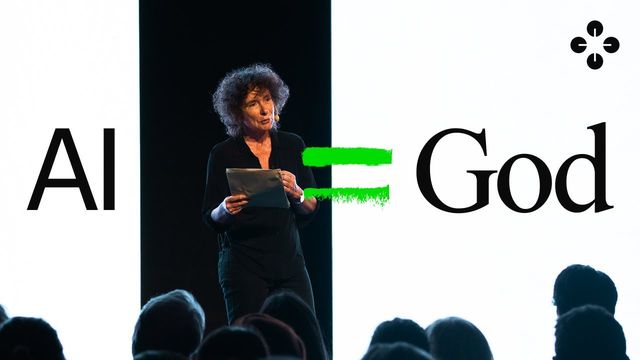
And I felt that a lot reading all of your work, and also especially the recent talk you did with Sana.1Sana — the Swedish AI company Sana Labs, owned by Workday since 2025. At its Sana AI Summit in Stockholm in May 2024, Winterson closed the program with a talk on the parallels between AI and religion. And I think what I want to start with is just— what I'm really kind of in awe of with you is how you seem to be pretty chill about it all. Like, you don't seem stressed out. And I feel like there's just a real grounded self to you, where you're just like— I don't know, you don't seem that worried about these external things hurting humanity, specifically AI. Is that read correct? Am I right in that?
You are right. I mean, I think my optimism in life generally is my greatest strength and my greatest weakness, you know. But it's both because, although I'm not Pollyannaish, it's not magical thinking. I realize, or I believe, that we are at a cusp point on the human journey, that this is survive or nosedive. I don't think there's going to be much in between. And I am aware of that.
But at the same time I'm optimistic, you know, because we are the success story. We've always pulled out of this before. We've always managed to come back from the brink, just with, you know, enough ingenuity, enough common sense, enough compassion, enough humanity, and hey, we're still here. So that part of me thinks, you know, yeah, we can do this. And then the other part of me thinks, but it belongs to a very narrow band of guys who don't think much outside of their own box. And obviously that's scary.
So I think there's room to be hopeful, room to be optimistic. You know, I agree with Ezra Klein2Ezra Klein — New York Times columnist and host of The Ezra Klein Show. In 2025 he and Derek Thompson published Abundance, which argues that progressive politics should go back to building and creating plenty rather than dividing scarcity. that this could bring about incredible abundance, that this could be a point where we get rid of all, you know, David Graeber's bullshit jobs3David Graeber (1961–2020) — American anthropologist. In Bullshit Jobs (2018) he wrote about positions whose own holders admit they are pointless. and McJobs and all the things that nobody wants to do, and that we've got another chance at the strengths of the Industrial Revolution. You know, that happened in my hometown, where I was born, in Manchester.4Manchester — in the 19th century the center of the world's cotton industry, nicknamed Cottonopolis. The city became a symbol of the Industrial Revolution: factory wealth alongside the poverty of workers' districts. And I'm thinking to myself, hey, you know, if you invent a power loom,5Power loom — patented by Edmund Cartwright in 1785. In the first half of the 19th century power looms displaced handloom weavers, ruining whole weaving towns. you don't need to put seven people out of work and take all the money. You could share the profits. You know, we got it so wrong.
We do get it wrong because we don't like sharing. We don't like distribution. We don't like anything that looks like equality. We really don't. And we need to get past that. And that isn't to do with tech. That's to do with something which is about us as human beings. If we can learn to share, just to spread the love, then we've got the most fantastic chance facing us, you know, the most astonishing future. The only thing that's in our way is not the tech, it's us.
Yes, yes. Which has always been the case, right?
Always been the case, you know, but somehow we sort of get through. But this feels like a big one, because it could disenfranchise most of us and just leave this Wi-Fi-enabled Noah's ark to float off with the rich tech bros while the rest of us are all drowning. You know, be like that movie Elysium:6Elysium (2013) — Neill Blomkamp's science fiction film starring Matt Damon: the rich live on a luxurious orbital station, everyone else on an overcrowded, ruined Earth. we'll all be eating cat food, and they'll all be living on some gorgeous planet where everything works. We don't want that. And that's what worries me. And look, you know more about this than I do, because you're in the game. You know that this really could be the most beautiful and gorgeous primrose path into the sunlit uplands,7Primrose path and sunlit uplands — two quotations in one phrase. The "primrose path" comes from Hamlet, where Ophelia uses it for the easy road of pleasure. The "sunlit uplands" come from Churchill's "Finest Hour" speech (June 1940): if Britain held out, the world could move forward "into broad, sunlit uplands." or it could be an absolute dystopia.
And the reason I don't want to go too far down the dystopia road is because, you know, it's like if you ride a motorbike: where your head goes, your arse follows.8"Where your head goes, your arse follows" — a motorcyclists' rule: the bike goes where the rider looks, so in a turn you look at the exit, not at the obstacle. You've got to keep balanced.
Yeah.
So I'm thinking to myself, if we get all this doomster Terminator stuff all the time, that's where we'll go.
Yeah, right, right. It's a self-fulfilling prophecy, right? It's like we decide with our stories, you know, what we make of this, like how we interpret it.
Yeah, it really does matter how we think, the language we use, what we envisage for ourselves, because I believe the human superpower is our imagination, because everything starts there. Nothing that's been built, nothing that's been invented, no ideology, no technology starts anywhere except in the mind. You know, it's a group of people, or it's somebody, and they have this idea, and it's invisible, it doesn't exist, and then they bring it down into reality. And that superpower of our imagination— which obviously anybody who works in the arts knows: the thing doesn't exist, and you make it exist. And so what we've got to do is find a future that we want to live in, you know, that we can mostly agree on. That's where Peter Thiel9Peter Thiel — co-founder of PayPal and Palantir and Facebook's first outside investor. In his 2009 essay "The Education of a Libertarian" he wrote: "I no longer believe that freedom and democracy are compatible." is so lousy, because democracy does matter. It's not just a question of asking the tech bros and the machines what the future should look like. Excuse me, we're in it. So it's that sense of how can we empower people imaginatively to realize that this could be the greatest thing ever, not the thing to fear, but that we need to be part of it.
02A culty childhood and reading as the way out
Reading taught Winterson that she could change her own story, and visionaries have always changed the world by selling a new one.
Yeah. I mean, where does that optimism and hope come from for you? Because, like, you had a rough childhood, I think. I mean, it was weird, lousy, culty, and a lot of weird God stuff. And, you know, like, how do you come out of that optimistic?
ExplainerJeanette Winterson's childhood
Winterson was born in Manchester in 1959 and adopted as a baby by John and Constance Winterson of Accrington, Lancashire. Her adoptive mother was a devout Pentecostal who raised her to be a missionary: Jeanette preached as a child and learned to read from the Bible.
There were almost no secular books in the house. Jeanette hid hers under the mattress, and when her mother found them, she burned them. At 16 Jeanette fell in love with a girl, the church community tried to exorcise her, and she left home: she lived in a car, took whatever work she could find, and then got into Oxford, at St Catherine's College.
She turned this story into her first novel, Oranges Are Not the Only Fruit (1985), which won the Whitbread Award for best first novel, and told it without fiction in the memoir Why Be Happy When You Could Be Normal? (2011). The memoir's title is the question her mother once asked her.
Well, I survived and I thrived, you know. I left home at 16, I was living in the back of a car, I was living in a tent, got myself a scholarship to Oxford,10Oxford: Winterson read English at St Catherine's College. pushed on from there. The thing is, there was no hope for me in those days. I was just a kid who had nothing going for her, adopted, and it was reading, which is really a gateway into the imagination, that made me realize at that point that I could change the story, because I am the story.
And I thought, "Jeanette, if you can imagine yourself out of this, you can do it," because everything you read shows you a world that doesn't exist for you, but does exist somewhere. And so you could do that. And it was just that understanding: not to get too lost in the literal. You know, look at us now. We're so lost in the literal. Everyone's at each other's throats.
And if you can get past the literal, then you have a real chance, you know, at changing not just your own situation, but also the much larger political situation. And that's how visionaries have always worked anyway, whether it's Gandhi or Martin Luther King, whether it's Marx— you know, it doesn't matter who it is, whether you're on their side or you're not. Again, we're back to this idea of somebody says, "No, I have a dream, we're going to do it like this." And people say, "Oh, yeah." You know, the same with Jesus, it's the same with Muhammad. Somebody comes along, and they see it differently, and then they sell it. They sell that story to millions, billions of others.
And that's what we got to do now, you know, where we are now with the AI revolution. We got to get a good story and sell it.
Yes. I joke sometimes about how Jesus was an amazing marketer, you know. Like, he was really good at— and Buddha too. I mean, like, you know, it was like the Eightfold Path.11Eightfold Path — in Buddhism, the path to the end of suffering in eight parts: right view, intention, speech, action, livelihood, effort, mindfulness and concentration. They were very, like, internet sales-y: there's a clear path, I can show you how to get there. I like that idea of, like, they knew how to sell it, you know, they knew how to pitch it.
Yeah, yeah. And they understood how human nature works, what people are attracted by, what we're repelled by. But I guess they had what the tech bros don't have, which is infinite compassion.
You know, they really cared about the little people. They, you know, weren't thinking in some hierarchy or pyramid. They were just thinking, this is humanity.
Yeah.
And that's where we're not right now.
03The story technology needs
People are afraid because AI looks like a few powerful fiefdoms, and its story should be told by people who actually care.
So how do we get there? What's the pitch?
What's the story?
Let's hear it, Jeanette. Save us all.
Well, what's great— when I was looking into your company12Sublime — Sari Azout's company, which makes an app for collecting inspiration and produces the interview series Whoa. and reading about things like that, it's the same as I feel with Sana. I really think it's going to be everybody: every kind of startup, every person who's working in tech, everybody who has a more inclusive vision of where we could go. You can get this thing sold and, you know, get away from the kind of doom-laden mega rhetoric that the big guys are coming out with. You know, everyone's sick of Elon Musk. Nobody trusts Sam Altman.13Sam Altman — CEO of OpenAI. In November 2023 the board fired him, saying he had not been "consistently candid" with it; five days later he was back. You know, Google's just become this terrible place.
So of course people are afraid. You know, these just look like powerful fiefdoms. People don't know much about the smaller people in the frame who are trying to do things differently and trying to build a better future. They don't really get much publicity out there. They don't get much press. And with respect to a lot of you guys working in your fields, you're not the best communicators.
Good point. Yeah.
And that's okay. Why should you be? Why should you be? And that's why, you know, don't go to some PR firm. You know, don't go to people who don't actually care, advertising guys who just want to sell stuff, who have got no skin in the game. That's why I think it's important to bring in people— yeah, it is people like me, who really do care, but can work out a story which is true to the vision and get it across to other people so that they will come with you.
And that's why, when I look around, I just think, my God, you know, the thinking is so narrow. There's no culture, there's no understanding of history, there's no sense of how religion's feeding into this, there's no recognition of people's genuine and real fears. And we got to start talking about it differently. I mean, obviously it's the same in government, but for tech in particular, we know what men like Thiel and Musk think. They don't care about talking to anybody. They just think they can go in and do whatever they want. And that's a conversation that really has— well, it's a non-conversation, but that's a position, I think, that has to change.
Now, what you do when you've got Trump in the White House, I do not know, because he's not interested in ordinary Americans. He's not interested in the lives of people who are actually going to be affected by any of this stuff. And that is problematic. But I know keeping your values, being sure of what matters to you, what you want— yes, for yourself, for your family, for your loved ones, but also for the wider world.
What's wrong with a vision? What's wrong with beyond the bottom line? What's wrong with something bigger than shareholder value,14Shareholder value — the principle that a company's chief purpose is returns to its shareholders. Its manifesto is usually taken to be Milton Friedman's 1970 article "The Social Responsibility of Business Is to Increase Its Profits." for God's sake? I mean, is that all we can do? It's pathetic. So it is important.
You know, I would just love to get into every boardroom and say, "Surely you guys"— because they are guys— "care about more than this. And how can we bring something along that will make you proud?" You know, we seem to have lost that conversation about thinking, I could do something for humanity that would really help people. I could be proud of myself. I could be somebody, you know, people will respect, because of values that matter, you know, like compassion, like kindness, like consideration, like thinking of others— all of those things that, you know, are supposed to be for little people.
And, you know, you probably heard Marc Andreessen15Marc Andreessen — co-founder of Netscape and the venture firm Andreessen Horowitz. In spring 2026, on David Senra's podcast, he said he has "zero" introspection and that 400 years ago it would never have occurred to anybody to be introspective: in his telling, Freud and the Vienna school invented it. not so long since— I can't remember which awful bro podcast it was— where he was saying that successful people don't have an inner life. They don't need one, they don't ask questions. He seemed to think that Freud had invented the inner life, you know, and the rest of us are out there just ready to kill ourselves, saying, "Have you never heard of Socrates?16Socrates — according to Plato's Apology, at his trial he said that "the unexamined life is not worth living." The Western tradition of introspection is usually traced to him, not to Freud." And, you know, answer: no. And you just don't know where to start in the vast deserts of his ignorance.
But there we are. And that's the kind of crap that we're dealing with. And it really matters. It matters to say, you know, "This is a ridiculous position. It doesn't make you strong, brave, radical or maverick. It just makes you look like an idiot."
And if I were on the podcast, that is exactly what I would say. Because you can't— you know, I mean, listen, this is the feminist me, but it's true: I get really fed up of men saying silly things in serious voices.
That's good.
I just want to go, "No, bro, no, no, no. What you just said is silly, and this is why it's silly." And, you know, we don't want to be cruel to anybody, but they cannot be allowed to sit there in that reverential way and spout absolute garbage as though it were true.
Well, it's always backed by money, right? Like, it's important because that guy's rich.
Right? Like, you're like, "Oh, I guess he knows what he's doing, he's rich." That's always the— as if that's a good definition or a good validation point. But I get tricked into it all the time. You know, it's a hard— it's an active thing, I feel like, you have to not fall into, right? Or for me.
04Meaning, layer by layer
Meaning can't be found, only built, by living day after day in a way you respect.
Yeah, you do. And you have to keep, you know, your mind sharp and absolutely not be lulled and soothed by all of this stuff. It does matter. And I think, you know, again, it's something we need with our kids, especially with young people, who are so lost and can't find any meaning. They're not finding meaning. And nobody's telling them that meaning— you know, it's like having a 3D laser printer.
You can't go out and say, "I will find meaning." You build a life incrementally, layer by layer by layer, and then all of a sudden you think, "Oh, I made a rocket ship." And that's kind of— when you say to me, how am I like this? It's because everything that I've done layer by layer, I've stayed true to my values. Sometimes I've made a lot of money, sometimes I haven't made any money, but I've done what I've wanted to do in the way that I've wanted to do it, and I've done some good in the world. And that's why I feel now, if I were to die after this interview, I'm not worried, because I've lived a life that I respect.
And so when, you know, kids say to me— I was just in Barcelona, and some kids said to me, "You know, how do you find meaning in your life?" And I was talking to him, and I just said, "Look, you have to start by respecting yourself, and then go on respecting yourself every single day." You know: what was I like today? And some days we're a jerk, and some days we don't get it right. But you don't have to play by anyone else's rules, but you have to play by your own, and to decide who you'd like to be— you know, not what job you want to do, not where you want to be in 30 years. It's not all this outward-facing stuff, but how can you live with yourself, you know?
And I think we could get back to a point— it will be getting back, I guess, as well as going forward— where we're saying to kids, "Look, there's more to life than getting and spending,17Getting and spending — an echo of William Wordsworth's sonnet "The World Is Too Much with Us" (1807): "Getting and spending, we lay waste our powers." than making money, than having power over people." There's nobody in history who's come out happy with any of those outcomes, actually. So what are we going to do so that you, whoever you are, rich or poor, from a good family or poor family— how are we going to get some meaning into your life? And in schools, these would be good things to talk about.
05Do no harm, and don't believe everything
Winterson's core value is to do no harm, and honest conversation, an evening review and small kindnesses keep her from thinking it's all bullshit.
I want to get into, like, religion and its role, but first— you mentioned it a couple times. So what are your values? Like, what are they?
Primarily, it is the very simple Buddhist value, which Google used to have a version of, which is: do no harm.18Do no harm — in Buddhism, the principle of non-violence, ahimsa; the first of the five precepts for lay followers is to refrain from taking life.
Yeah.
You know, they used to say, "Don't be evil."19"Don't be evil" — Google's unofficial motto, which opened its code of conduct from the 2000s. In 2018 it was dropped from the opening, surviving only in the last line. But you go through life— I mean, so you try not to do harm, that's the very least of it. And then, so, what do I do? Do my investments harm others? What about the food I eat? What about the clothes I wear?
What about the work I'm doing? You know, it gets quite complex quite quickly. You know, you think you're a good guy, and then you think, "Oh, maybe not." So, you know, there's a lot of self-awareness, self-reflection, curiosity, knowledge, information that goes into all that. But for me, I always wanted to make a difference through my writing, because it's what got me free, it's what set me free. And so for me, I'm always trying to offer people a route back into their own imaginative superpowers, so that they can see their way out of their own small situation, so that they can develop, yeah, cognitive skills, language skills, imaginative skills that allow them to approach the world without fear, but without arrogance either, just with that quiet confidence where you think, "Oh, this is interesting."
"Do I know anything about it? No, I'll find out." So you have a mind that's strong enough, flexible enough, powerful enough to be able to approach anything and think, "I could learn about that if I don't know anything, or I've got something to offer if I do know something." And that's what matters, you know, because I see people endlessly with no imaginative capacity at all. They just believe what other people tell them. They believe the story of their own life.
And, you know, somebody's always going to tell you a story, Alex. It could be your family, it could be your church, it could be your community, it could be something you believe about yourself. But is it your story?
Yeah.
Yeah. And giving people the chance to tell their own story, to take control of their own narrative— not in a kind of me-first, late-capitalist,20Late capitalism — a term from the Marxists Ernest Mandel and Fredric Jameson; today it's applied ironically to every absurdity of modern consumerism. mad way, but just in a sense of, well, who am I? Because when you get underneath the clichés, most people have no idea who they are.
Right. Right. Yeah, I mean, I feel like for me and a lot of people, I've gone too far the other way, where I don't believe anything. You know, I'm like, it's all bullshit. I think I felt that as a kid. I was like, people are lying.
Everybody's lying. And it's like now I'm trying to— it's hard to get away from that to, like, well, how do I believe something? And how do I know that I'm not bullshit? You know, that's my biggest thing.
I mean, look, we're having an honest conversation, right? I'm speaking from the heart, you're speaking from the heart. We're not lying to each other. You know, why would we? We're just not. And so everything like that is both a start and it's a reassurance.
And, you know, at the end of every day, I really do do this thing where I think, okay— not for long, maybe a quarter of an hour— I think, what went wrong? Why? Why is it bothering you? And then I think, what went right? And it might be, yeah, I had a really great talk with Alex, or, you know, there was that nice guy at the gas station who helped me— never see him again, but that was a nice little exchange.
I just try to remember things. So I do deal with, you know, the negative stuff, but I also purposefully try to remember what went well, or what I enjoyed, where it felt okay. Because actually most people in their interactions are pretty kind, pretty decent. You know, you see somebody in the store, you say, "Can I help you with that?" Or, you know, they may say it to you. And I think doing those things reminds us that actually most people are not at each other's throats and just out to scam everyone. You know, we're just trying to get through the day.
So I'm kind of quite helpful in my community. You know, tonight— there's an old lady in the village, I have her over to supper every fortnight. I do her shopping. I don't think she's got any clue really about who I am or what I am. I just keep a nice kitchen and cook. But there's things you can always do, and then that reminds you what humanity is.
It's not that I'm a great person. It's just that I live in a village. There's an old lady— what's my duty? Obviously. So I think the problem for people who live in cities is it can be very atomized. Everyone feels alone, everyone feels solitary.
And I think you got to get out of that. I know really whatever is the simplest way of getting out of that feeling of "I don't know anybody, nobody knows me"— that does matter.
It does.
Yeah, it does. And you mustn't sit there thinking, you know, "Oh God, I can't believe anybody, and I can't even believe myself," because that is not true. That's the one thing— it's not true.
Yeah, I think I know that too. I think I'm definitely getting there.
You got people who love you, right?
Oh, yeah. I got a family, I got kids. I got a wife, I got a lot of friends. I do, yeah.
Yeah. Well, that's fantastic. And you can have real conversations, and you can disagree but stay friends.
Yeah.
You know, that's important. There's still some fantastic journalists out there, you know, in the New York Times, the Atlantic, who are just trying to do a good thing. Even Al Jazeera21Al Jazeera — an international news network based in Doha, founded in 1996 with money from the Emir of Qatar. In the West it has often been accused of bias, hence the "even." is not so bad. But we just do our best. And if we read something, we think, "I like three quarters of this, but I'm not sure about the last 25%," then we go and find out. Partly because we all make mistakes. You know, you've done things, I've done things, where we've got it wrong.
We were not out to bullshit anybody, but we got it wrong.
Yeah.
And so, you know, you think, well, other people are going to get it wrong too, but it may not be because they're evil. So that's what I mean about— sometimes you just have to give a bit more and think, "All right, but I'm not going to let this bring me down, pull me down, smash me." Because if that happens, Alex, we're useless.
Yes. Right.
You know, that means whatever the demon is, it's got us. We can't live our own lives, and we can't help anybody else. And that's no good.
Yeah. Like, "What good is that for other people?" is a good question to ask.
Yeah. Yeah. Yeah. And even simple stuff. You know, people are terrified of making eye contact or smiling or saying hi. I always do those things.
Even though people obviously think, "Oh, she's a crazy cat lady, never mind." But I do. Because I just think, I'm not going to live in this place where we all pretend that there's no one else here when there's thousands of us on the same street. Again, it's just in your own right and in your own life saying, "I'm not going to live like this."
Yeah. Yeah.
AdGranola
Al, can I talk about GranolaaGranola — an AI notepad for meetings and the presenting sponsor of the Whoa series: it records the call and fills out the user's notes from it. for a sec? One of the themes of this year's series is that the best technologies do not make us less human. They give us room to be more human, more present, and more focused on the parts of the work that require us. This is exactly how Granola, the AI meeting notetaker, feels to me. I want to thank Granola for being the presenting sponsor of this series. Granola takes notes for me during meetings without sending an awkward bot into the call.
During or after the call, I can chat with my notes, pull out next steps, or ask Granola to help me draft a follow-up email. I use it for daily team meetings, where the notes automatically get shared into Slack,bSlack — a workplace messaging app. so everyone has the takeaways in one place. I use it for customer calls, where the most important feedback gets added into Linear.cLinear — a tool for managing tasks and product development. And I use it for one-on-ones with my team, which helps me track what people are telling me over time. My favorite feature is "What did I miss?" Sometimes I'm in a meeting and briefly space out.
With one click, Granola catches me up on what just happened. We ran Granola during today's conversation, so you can see how great the notes are yourself. You can read a summary or chat with the conversation using the link in the description below. And if you're new to Granola, you can get three months free at granola.ai/sublime.
06God, ghosts and symbolic culture
Winterson doesn't know if God exists, but she sees AI as a new attempt to invent one and the pull toward the spiritual as part of human nature.
So to jump into the religion stuff. I want to talk about that— the God, let's do God. I mean, first off, simply, and maybe most importantly— well, not important— but do you believe in God? What is your relationship to God?
I don't know. And I mean that. One of the things that I've learned as I've got older is that I have to be able to say "I don't know," and to live with that discomfort, or to live with people thinking, "Well, that's a bit silly." It's like people say to me, "Do you believe in ghosts?" I say, "I don't know." You know, I live in London, I have a haunted house, which is very awkward, because these things are not supposed to exist. So what I mean is, you live with things that you can't explain, but you sense around you in some way.
So if— all of my friends would say no, they don't. I'd say, maybe. I just think we don't know how to talk about that yet. All I mean is, there might be a much bigger intelligence.
Sure. Right.
That through various points in history, for very good reasons, we've called God. And I suspect this because obviously we're inventing God again with AI. And that would suggest either that we are desperately in need of a God, or we know that there is something out there, and this is what we keep trying to reach. I don't know. But what we're doing in AI is very interesting. And of course, for me— brought up in a Pentecostal cult,22Pentecostalism — a Protestant movement centered on baptism in the Holy Spirit, speaking in tongues, healing and prophecy. learning to read from the Bible, having the Bible read out loud every day, all of that—
I'm saturated in it. And once something is so significant in your past, in your developmental past, the thing that has made you, you either repudiate it and deny it, and that leads to all kinds of difficulties, or you say, "Yes, this has made me. I got to work with it." Because there's no point trying to repudiate it and deny it. So the me that is me, of course, has a strong spiritual sense that I cannot get away from, and I never will. So, you know, it's part of my baseline.
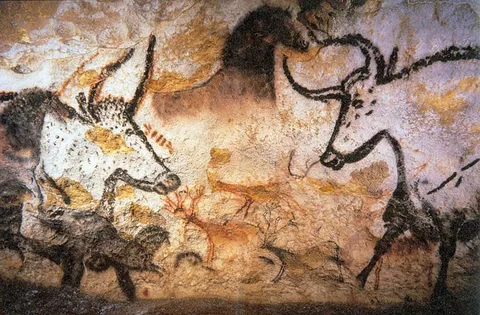
Do I think we might have been telling the story backwards? Yeah. And all because we always knew we'd get here? Well, that will be very interesting, because ever since people have been able to express themselves at all— look, 300,000 years,23300,000 years — the age of the oldest known Homo sapiens remains, found at Jebel Irhoud in Morocco (the dating was published in 2017). a salami slice of space-time, Homo sapiens. And since we started symbolic culture— by which I mean the moment somebody puts a stick in the fire, turns it into charcoal, and draws an animal on the cave wall,24An animal on the cave wall — the oldest known scene with an animal, a pig and three human figures in the Leang Karampuang cave on the Indonesian island of Sulawesi, was painted at least 51,200 years ago (the dating was published in 2024). that's symbolic culture, and that's fantastic. Because at that moment you say, "I'm more than predator and prey. Look, I got an imagination."
"Look what I can do." And this huge leap, which I think of as symbolic culture, is one that across history, across all civilizations, across all time, has expressed itself religiously.
There are no exceptions. And so you think to yourself, okay, what is this? Well, yes, it's reverence for the earth, it's some ritualistic respect for us— you know, burying the dead, wanting to believe that there is a passage elsewhere. All of that's true. But at the same time, it might be true that humans need— because we're hybrid, you know, we're just shit-shovellers and stargazers. We're made of meat, but we have this mind. It's terrible.
It may be that this hybrid nature of us means that we always have to posit something entirely spiritual outside of the bounded, made-of-meat condition that we experience every day, because it's absurd. You know, it's absurd to you, it's absurd to me. How can we be made of meat? But we are. And so I think to myself, well, okay, humans have always done this. It doesn't matter whether it's true in the factual sense.
07From angels to a bot in the kitchen
Relationships with non-biological beings aren't new; only their makers are.
What's interesting is that we've always had religious experience, religious sensibility, religious understanding, and it still hasn't gone away. And right now it's in a rather terrifying renaissance. You know, the rearmament of the religious right25Religious right — conservative Christians, above all American evangelicals, who since the 1970s have been a pillar of the Republican Party. is terrifying. But it's real. So what do we do? We stand outside curiously, and we think, well, we put this next to AI, and we ask, what is this telling us? Is it telling us that these tech bros— because they're so small of spirit, you know, they're not very large people at all, they're not expansive.
ExplainerWinterson on AI: from Frankissstein to 12 Bytes
In recent years Winterson has written a great deal about AI. Her novel Frankissstein (2019) braids the story of Mary Shelley writing Frankenstein with present-day plots about transhumanism, cryonics and sex robots; it was longlisted for the Booker Prize.
The essay collection 12 Bytes: How We Got Here. Where We Might Go Next (2021) is twelve pieces on how we arrived at AI and where we might go from here, from the Industrial Revolution and Ada Lovelace to love for bots and transhumanism.
One of the book's central ideas is the same as in this conversation: humans have always lived alongside invisible non-human minds — gods, angels, spirits — so the religious imagination long ago prepared us to share the world with non-biological intelligence. Winterson prefers to call AI not artificial but "alternative intelligence."
They have just narrow goals, like the bloody AI. So is this telling us that they're looking for something bigger, and are they going to make it? Or is it telling us that this will be a bridge to discovering actually what is bigger? I mean, look, if we start living alongside non-biological entities with whom we have relationships, that's entirely new to history, yeah, because we've invented those non-biological entities. But it's not entirely new to our cultural or mythological life, because, again, all people in all places have said there's angels, there's devils, there's pixies, there's elves, there's my dead auntie. I mean, there's all kinds of beings living on different levels which are not human beings. All people have always believed that, and still do.
And, you know, right now billions of people are having their most profound relationship with a non-biological entity that they call their sky god. That's just how it is. So when people start freaking out and saying, "Oh, you can't have a relationship with something that's not human," I'm thinking, "Dude, you know, just hold on. Have you been to the mosque? Have you been to the synagogue? Have you been to the cathedral?" Yes, yes, you can. It does not have to be human. So we need to forget that bit.
There is no need to be made of meat, right, in order for us to have a relationship with you.
Right.
So to me, I just find all this, somehow, with this confluence now, completely fascinating. Well, I would, wouldn't I?
I mean, it's crazy, right? It's crazy. It's crazy and it's fascinating, right?
It so is.
Yeah. Yeah. Yeah.
Yeah, so that's why, you know, of course, I'll be thrilled when I come home and I have my, you know, my little bot in the kitchen that says, "Hi, Jeanette," and I'll say hi, and they'll say, "How's your day?" And I'll say, "Not so good." It's fine by me, partly because, you know, people talk to fish in the fish tank, you know, everybody talks to their dog. Talking to your partner is often, you know, really the least fun thing you can do all day. So, you know, if you're going to come home and the little bot's going to say hi, that's fine by me. But beyond the fact that it's just tech is this other level that we're really just beginning to explore and to approach, which is to say, well, we never really felt comfortable, did we, saying it's just about human beings.
We actually felt better when we thought there were other layers of non-biological life flying about. You know, we knew that, we felt good. You could go and pray to the Virgin Mary, you could ask an angel to protect you. Many people still do. You could visit your dead grandma, or she could visit you. And it felt okay.
And every myth and legend in every culture is about piercing the veil to other worlds: finding yourself in another place by accident, the portal opens, you go through, they come through. That, again, is cross-cultural and across time. So what's that all about, you know? And here we are, we're going to do it again, except it's going to be a little bot on your kitchen counter.
08Is AI our child or our god?
A god we built ourselves turns the usual roles around, and what's scariest, to Winterson, isn't AI the helper but a coming overarching deity, though she isn't afraid of it herself.
Right. Well, it seems like through history too, like, gods and deities and all of it, they have been created in order to help us understand that which we do not, right? Like the rain gods.26Rain gods — almost every ancient religion has one: Tlaloc for the Aztecs, Chaac for the Maya, Indra in Vedic India. We didn't know how weather worked, so we made a rain god, you know, and we prayed to it. Hopefully there would be rain, because we needed rain. Now it's like we kind of understand that, or claim to.
So, you know, it's like— I don't know, it's like this moving conversation, it seems, right? But I'm trying to understand how to position the AI God in that. Because the inversion— well, I guess it's not an inversion— but what's interesting about, like, Jesus, God, and, you know, the religions, especially Christianity, but all of them, is like, in that one, we are God's children, right? Like, we are the children of God. With this, AI is sort of our child. Like, we created it.
Yeah. And that's what I don't yet know how to model or understand in my brain: what that means, when we made the God and we know we did, but it's more powerful than us, maybe. You know what I mean?
Yeah. And I think it may be— I mean, we don't know whether AI will become— we don't even know how to talk about consciousness, do we, in any useful way, except that it's an emergent property,27Emergent property — a property of a whole that none of its parts has. On one hypothesis, consciousness arises this way from the activity of neurons, though no single neuron is conscious. because you can't find it; it happens. So to me, there's no reason why it would not happen. I mean, and I use that word specifically: I can't see why it would not happen with AI when the right conditions are reached. But of course, AI won't have a limbic system.28Limbic system — a group of brain structures (the amygdala, hippocampus, hypothalamus and others) involved in emotion, memory and motivation. It has a neural highway, and that's odd for us, because we know you can't have a thought without a feeling.
ExplainerThought without feeling: from Descartes to Damasio
In the 17th century Descartes split the human being into a thinking soul and a mechanical body, and treated the passions as something reason must master. On that footing the Enlightenment built its ideal of cool, dispassionate judgment.
In Descartes' Error (1994) the neuroscientist Antonio Damasio described patients with damage to the ventromedial prefrontal cortex. Their logic, memory and intelligence were intact, but their emotions were blunted, and they could no longer manage the simplest decisions: one spent nearly half an hour weighing which of two dates to pick for his next appointment.
Hence the somatic marker hypothesis: bodily signals we experience as feelings prune bad options in advance, and without them reason stalls. A language model has neither a body nor such a system, which is why Winterson says AI is the first thing to realize the dream of thought without feeling.
And, you know, the Enlightenment project has fallen apart, because from Descartes onwards, everybody wanted there to be thoughts without feelings. You know, feelings were suspect, and— yeah, that was the dream. And then the neuroscientists came along and said no, and now it's like, "Ah, what should we do?" But of course, AI can have a thought without a feeling, because it can't have a feeling. So this is very interesting too. We're creating what we wish we were, because we've never been comfortable.
Which sort of leaves for humans just the feelings.
Yes. They're going to hate it. It's why Andrew Tate29Andrew Tate — a British-American online influencer and former kickboxer who preaches an aggressive "alpha masculinity." He faces charges of human trafficking and rape in Romania and the UK, which he denies. and co are going mental at the minute, because it's really not going their way.
Totally, totally. I mean, I personally am like, great, I love my feelings, you know, I love feelings. I think that's going to be nice.
I think it's going to be nice. So, you know, we're going to be like the cuddly ones, and then there'll be AI, who's the stern taskmaster out there saying, "No, you can't." But I guess we don't know how it develops. But you're right that we are creating this, and we know we are creating it, but there's also a sense of, "Oh, this is going to get out of control, and we won't be able to control it." You know, it'll be beyond us then.
Partly because perhaps we want that helplessness. Perhaps we don't feel comfortable, because it's a strange thing to create something which is likely to be smarter than you.
Yes. Does that freak you out?
And it's going to be that merger, as you say. So the AI is specific because it's a tool. So there's the rain god AI, you know, and there's the sun god AI, because it just does specific things for us if we ask it to, and it delivers, and that's lovely. But then we're also building this overarching generative AI, which will not be about something, but which will be something. And that's the bit that we're not ready for.
How do you mean? How do you mean?
I mean, because at the minute it's quite goal-specific. I mean, as with your analogy of "here's the rain god," you know, here's the snow god, here's the storm god. So you can have specific gods, like they still do in the Hindu religion,30Gods in Hinduism — many have their own "portfolios": Ganesha, the "remover of obstacles," is invoked at the start of any undertaking, Lakshmi for wealth, Saraswati for learning and the arts. you know, there's one for if your car breaks down or you lose your keys. And the Catholics do it with saints,31Patron saints — in Catholicism each has a specialty: Saint Anthony of Padua is prayed to for finding lost things, and Saint Christopher is the patron of travelers and drivers. you know, it's the same idea. They've all got their little jobs, and we'll go to them, you know, if we need a bit of help. And we can do that with AI, you know: "AI, write me some code so I can get through next week."
So it's great for that. But then that's never going to be its real job, is it? Just helping us out with these things. It's not going to be your PA, it's not just going to be "book my holiday, little AI god." It's going to be "I am now going to sort out your life and everybody else's," which is, you know, the big overarching deity. But it is, for most people, looking much scarier.
And is that scary for you, or you're still pretty chill?
But it won't be, will it? Because I've been brought up to— whether I like it or not, somewhere in me is the feeling that's okay.
Yeah.
To have a big overarching deity. So I'm not frightened of it. You know, it's like if you've got a kid in the outback— you know, I used to have a girlfriend who was brought up in the outback. And, you know, you just thought she couldn't even cross the road by herself. Put her near a tarantula or a snake— you know, anyway, we went traveling. And my God, she knew exactly what to do.
She wasn't frightened, because she'd been brought up with deadly venomous snakes and insects. So it was nothing to her. You know, I was a gibbering wreck, and she'd be chopping tarantulas in half and picking up snakes by their tail and grabbing their head and throwing them away. So in that sense, no, I'm not scared, because I've been brought up with the idea of it as being a good thing. Doesn't mean I shouldn't be scared.
09Secular technologists and praying over a hurt child
The tech world's secularism, Winterson argues, feeds the fear of AI, and religious people feel better once reminded that a relationship doesn't need biology.
No, but that's fascinating, which kind of implies that a lot of us have not been brought up with that.
I don't know. And that's an issue, because a lot of people, certainly who work in tech— you know, physicists, mathematicians— a lot of them are really secular and haven't thought through the God problem and all the ramifications, or the fact that most humans for most of life on earth have lived happily with non-biological entities, or at least imagined they existed, and what this says about what we need. You know, we only invent things that we need. So what's going on here? So yeah, it does worry me, because I think at this moment that secularization and the lack of the wider cultural understanding is partly what's pushing the doom-laden talk and the fear and all the ridiculousness about how you can't relate to this, it'll just be a fantasy, it'll just be a delusion. Well, it won't, and that needs talking about. You know, if you can talk to your guardian angel, you can talk to your AI.
But we don't— we're not comfortable with talking to your guardian angel or to God.
Well, you might not be. Now, I am.
Right, right.
But also a lot of people are. And weirdly, if you talk to them about AI— I know this because I've done it, I've done it to some really religious people, because I go all around the world talking to people— and then when I say to them— you know, they're quite fearful— and I say, "But listen, you don't need things to be made of meat. You don't need things to be biological, do you?" And you can see this kind of astonishment go across their face, and they think, "No." And then they start to feel better.
Honestly, I know this sounds stupidly simple, but it works.
Well, I'll tell you, like, I believe in God when, like, one of my kids gets hurt and I start praying, you know.
Yeah, I'd be with you. I'd be kneeling right next to you.
And it's not even— I don't even think about it. It's just like, God— I just start talking to God, right? It's like—
Yeah. And that's spontaneous, and, you know, I respect that. It doesn't mean you're a stupid, superstitious, crazy person. We go to that deep place. And we also know— because there have been a lot of experiments done on this, haven't they?— that suddenly having that state of mind, that frame of mind that something can change or will change, allows it to happen. You know, it's the nocebo effect,32Fact-checkNocebo effect — the flip side of the placebo: expecting harm itself brings on symptoms and side effects. What Jeanette describes is the placebo effect — getting better on a dummy pill because you believe in the drug. Source: Encyclopaedia Britannica. isn't it? You think you've been given a powerful drug, and suddenly you get better, and you just got an aspirin. So, you know, what is it?
Is it that humans know that the only way they can harness the massive power of their mind is by projecting it onto a superpower god, and then that suddenly works in some sort of relationship? Or is it that somehow we know that there is some intelligence there, that the universe is alive and does hear us? I mean, this is why it would be great to stay around, wouldn't it? Because we're going to get some really cool answers if we go on with AI for longer. We're going to find things out. All of these mysteries, you know, we can start to approach them very differently, using AI to help us.
Yeah.
I mean, we don't know if there's anything out there, but maybe, maybe, maybe there is, and maybe we're going to find out.
And I think, regardless, like, the playful attitude is sort of the key, right? Which it feels like you have— or, like, a very curious, playful, like, "Who the fuck knows?" You know, like, who knows?
I mean, if there is, I'd love to know. I mean, when I'm gone, I don't mind either way. I mean, if I've gone, that's that, so I won't know anything about it. If there's anything beyond this, it would be very interesting, wouldn't it?
Yeah.
Of course. So either way, it's a win-win, right? And that's why there's no point hanging about on earth, you know, full of fear and anxiety, because we know for sure we haven't got that long. So I think there's a way of just living to your uttermost, with the best energy you can, which gives you in any case a better quality of life.
10Fear, and a first chance in history
People are scared because for the first time humanity can wipe itself out, and for the same reason it has its first chance to fix things.
Well, why do you think people are so scared?
Well, people are scared of everything now, aren't they? I mean, we've come to a very fearful place. You know, I was only— well, how old was I when the Bay of Pigs happened?33Fact-checkBay of Pigs — the failed landing in Cuba by CIA-trained Cuban exiles in April 1961, when Winterson was a year and a half old. The world came to the brink of nuclear war later, in the Cuban Missile Crisis of October 1962, after Soviet missiles were discovered in Cuba. Source: Encyclopaedia Britannica. The reconnaissance photograph near San Cristóbal was taken on November 1, 1962, as the Soviet missiles were being dismantled. But I remember, you know, talking to people older than me later and just saying, look, with the Bay of Pigs and all that, you know, when people really thought it was going to be a nuclear end to the world, that was real terror.
Yeah.
Because it looked like it might happen. And I guess now we're at a point where, you know, we've got a few crazy guys with tremendous power in the world who could ruin it in the next 24 hours for all of us. And we all realize that. So, you know, when we're talking about what's completely new— you know, it says in the Book of Ecclesiastes,34Ecclesiastes — a book of the Old Testament: "The thing that hath been, it is that which shall be; and that which is done is that which shall be done: and there is no new thing under the sun" (Ecclesiastes 1:9). doesn't it, that there's nothing new under the sun. And that's been true for a long time, but it's not true now, because what's new is that we can self-suicide, you know, that we can wipe ourselves out, all of us. And that's never been possible before without any Mother Nature intervention.
That's completely new. And obviously this artificial intelligence is completely new. We've got nowhere to look. We've got no lessons from the past to help us here. And I think that's scary, because humans learn by repetition, we learn by analogy, we learn from what's gone before, we look to history to help us, and we can't. We know that we are the generation facing something now that no generations have faced.
Yeah.
And that's strange, that's scary, but it's also this incredible opportunity. I mean, wow, what a privilege, really, to live now, when we could face it down, when we could say no to the suicide option, no to the death cult, no to the dystopia, when we could say we have a chance now, for the first time ever, to fix it for most of the people and the planet. And that is actually in our power, and there isn't enough being said about that. You know, this is the wow moment, this really is. And that's why I do see it as an evolutionary leap: if we carry on as we are, we will self-destruct, the world will become a horrible place to live in all sorts of ways. But that is not the story we have to tell.
And, you know, when you're a writer and you're writing something, you get overwhelmed with certain ideas about the way things will go, and you have to force the narrative into a different shape. Nobody who's ever created a narrative hasn't come across this. It starts to get its own momentum, and you have to say, "No, listen, I'm in charge of this story. No." And pull it back. And that's where humanity is. Yeah, always, always. Because your unconscious is built on clichés, assumptions, things that you know, the way things work out, things that are obvious. And then your story, your book starts going this way, and you think, "No, I'm not doing that." And then it's hard, because for things to be obvious, gravity's on your side. You know, it's like water running downhill.
For things to be not obvious, to be different, to change, to be new, to be other, you're pushing water uphill. You're using all your strength, all your power, all your energy, all your imagination, but up it goes. And we can do that. And that's why I'm optimistic. We have the power, we have the technology. The question is, do we have the will, the human will, to take this moment or not?
That's what I'd be standing up and saying if you gave me a soapbox. So that's why I'm not anti-tech. I don't want to be out there saying, you know, "Let's turn away, let's turn the clock back." No, no, no, you can't do that anyway. What I'm really saying is: this is fabulous. What are we going to do?
11The writer as her story's sheepdog
A writer, in Winterson's view, plays with a story early on, then takes control and brings it back where she wants it.
Yeah. I love that idea about the story. Because often, you know, I write stuff, and often I feel like, well, I'm a shepherd of the story, right? Like, if it goes, you know, let it go. Like, who am I to stop it?
Oh, you got to give that up.
Tell me more. Teach me, because I didn't know I could.
You go chasing after that story. You're the sheepdog. Just get after that story and bring it back where you want it.
But I thought that it was in charge, though. Like, I guess I always was like, "Oh, it has a mind of its own." I'm, you know, obviously dancing with it, but if you impose too much, you suffocate it, I thought.
But you're saying that's true. I think in the early stages, you obviously don't want your executive function35Executive function — in psychology, the abilities that let us plan, hold a goal in mind, monitor and restrain ourselves; a kind of inner manager. in there. You want your playful, creative self to— because what are you doing always? You're turning what is into what if, aren't you? Because that's what I'm doing with creative work. You know, we take what is, and we say, okay, what if?
What if this? And so we're playing with all the ideas, and we're having a humble dialogue with the thing, which does have a life of its own, and we're talking about it, and then we're working with it. But I think there comes more than one point, as you're going along, where you really think, "No." And then you have to say, well, what is happening here? It's like, you know, when you get stuck— your problems are your best friends. You know, if there's a point where it isn't working out, you're saying, well, what is this telling me?
And why? Is it the story? Is it me? What's going on here? This is interesting— everything to be approached with interest. But also I think it has to be what you wanted it to be.
And there is a point where you take control and say, "No, you know, we've had great conversations, and we've listened to one another. This is the theoretical. But now this is what I want to do." And this is me talking to my unconscious: "I want you to come with me." And then if it starts running off down some other route, we listen again. But then, in the end, you're the writer, you're the one. So you could shepherd it, but it might just have run off for all kinds of reasons, and you might just have to bring it back home.
I love going from what is to what if.
Yeah. Yeah. Because we take what we know. Again, we take the thing— whatever exists is what is. And the creative work is what if. And then, you know, obviously, then that becomes what is.
So we're always adding to the pile of what is, but our job isn't the what is. Our job is the what if.
So, you know, this beautiful invisible world where nothing seems to be happening. And then you've made it, and of course something has happened. So I think it's a balance between absolutely not imposing too much in the early stages, but then being prepared later to use everything that you know— all your skills, all your wisdom— and to bring the thing in.
And that's where the values seem really important, right? Like, as a place to return to, to be like, "No, that's not what happens here."
I say, I decide. You know?
Yeah. And it doesn't turn you into a sort of anti-democratic autocrat, spraying everything gold, you know, like a tomcat with a urinary infection. The opposite, yeah, because you're— yeah. Right. It just means that in the end somebody's in charge, I guess.
Right. Right.
Because it's like anything else. You know, with the director, whether it's film or whether it's stage, the thing is going to come together as an ensemble, and that's going to be its final word. It could have gone a different way, but it didn't. It's this.
And there's a heaviness to that. Or there's a weight to that.
There is, and there's sadness, because then this is its form. Yeah.
Sadness is a good word.
Yeah. But then, of course, we've done what we can, and then we can move to the next thing. Because, you know, we did our best with this. It's alive, and hopefully it will go out in the world and do something there.
12Lightning round: the Messiah, grief and life in a car
In the lightning round Winterson urges curiosity and skepticism toward an AI messiah and names grief as the feeling AI will never give her.
I think that's a good place. We have a final quick round of questions. It's a fast and slow round, so I'm going to do some quick questions, and you can answer just really quickly to all of them, except one you can choose to answer longer. How does that sound?
Okay, let me pull them up, one second. This has been amazing, by the way. I really appreciate this conversation.
No, well, we've had a great talk.
Yeah.
We were both 100% present.
So I want to start with reading you a quick parable, and I just want to know what it brings up for you. So here it is. A man climbs a mountain, and he blows a horn. "The Messiah has come," he shouts, "and the Messiah is AI." Rumors race through the streets: "The Messiah is here, the Messiah is here."
Word gets to Rachel, the wisest woman in the land. Upon hearing the news, Rachel opens her window and sniffs the air. She goes for a walk, she sits, she plays around on her phone with the AI. Finally, she calls a meeting and says, "The Messiah has not yet come." What does that bring up for you?
We're always looking for the Messiah. It's a default position for human beings. But Rachel's right. Well, we should be curious, but we should be skeptical. And do we need a messiah? Probably not.
So, the next one: what do you do when you feel too much like the machine?
I cook.
What's something you can't prove but you know to be true?
And what is a feeling AI can't give you?
I guess— no, but that's not true. Because it might— sorry, what was it? Something. I was going to say joy, but I realize that I get so excited about certain things the more I read. It won't— no, it isn't that. I guess that, you know, it's on the other side of that.
The feeling that AI will never give me is grief.
That's really good. What is a hunch you've followed against people's advice?
Oh, leave home and live in a car.
And then the last one: what's the last thing that made you say whoa?36Whoa — the name of the interview series itself, and of a regular feature in Sublime's newsletter about things that make you go "whoa."
Oh, when I got the email from you guys saying, "Would you like to come on our podcast?"
Good answer. Is there anything I haven't asked that you want to talk about?
No, I think it's been a great conversation.
Me too. This was awesome. Thank you so much, Jeanette. Seriously.
Thanks, Alex. Thanks for having me on. Bye-bye.
All right. Have a good day. Bye-bye.
Bye-bye.


