

The 3b1b Podcast
Chapters
Dianna loved math from childhood, and she credits her curiosity to parents who met every question with "let's find out."
Read the chapter- In sixth grade Dianna pushed for a placement test and placed into Algebra 1, at the time ninth-grade math, and by freshman year her tiny school made a calculus class for her and three seniors.
- Math was the same for her as the logic-puzzle board games her family played, Dianna says, and these days it's the puzzles in Zelda.
- Grant recalls her post about her mom teaching her alongside her older sister, just as his dad taught him with his older brother: the younger kid ends up ahead of peers, enjoys being good at it, and the flywheel gets going.
- In first grade she asked her dad what atoms are made of and came back with "protons and electrons," and she urges parents to do what hers did: answer kids' questions with "let's find out" or "let's look it up together."
Dianna thinks many teachers fail to encourage students, while Grant thinks the profession lacks respect and students lack the chance to learn at their own pace.
Read the chapter- Tutoring a classmate, Dianna looked for what the girl already knew and built on it to fight past "I'm just not good at this," the kind of encouragement she feels many teachers were missing.
- Grant sees the core problem as weak incentives to become a teacher: in Japan, he's heard, teacher salaries aren't that different from America's but the job carries far more respect, and culture doesn't require reallocating a budget.
- In Hawaii a teacher's salary doesn't match the cost of living by the ocean, so many of Dianna's best teachers were almost retirees, and Grant's best high school teacher in Park City was a former investment banker teaching Chinese.
- Grant is sold on self-paced math, where a student doesn't move on until they understand, but admits experiments like the Khan Lab School are hard to read, since their students come from exceptional circumstances.
Math and physics come alive when they answer a question you asked yourself, and a small handful of such questions is enough to make students trust their classes.
Read the chapter- Their mutual friend Jabril told Grant he was in love with the arctan function, because it translated between the angle of a line and its slope in a game he was programming.
- Rainbow dots from orange-peel oil on a mud puddle got Dianna wondering about surface tension and fluid dynamics.
- Neutron stars amazed her only because classes had taught her that atoms are mostly empty space, which is why, Dianna says, questions and classes need each other.
- Grant suspects five genuine questions a year would be enough for a student to trust that math and science classes are giving them tools worth having.
Dianna's first weeks at MIT crushed her: she was surrounded by olympiad winners and kept being told she was there for diversity.
Read the chapter- Her classmates had been coding since they were five and winning International Physics and Math Olympiads, and Dianna cried a lot the first week and called home saying she couldn't do it.
- People kept asking why she thought she got in, and having been taught to be humble, she'd offer that maybe it was because she was a woman from Hawaii, and they would readily agree.
- Nobody had taught her to study from old exams, and her high school habit of just doing the homework didn't work at MIT.
- Grant recalls Stanford's "duck syndrome": everyone floats calmly on the surface while paddling like heck underneath.
Dianna is searching for values beyond grades, awards and subscriber counts, and doubts that standing out is worth anything in itself.
Read the chapter- Certificates and grades are useless for finding purpose as an adult, Dianna says, and now subscriber numbers have taken their place.
- What drew her to physics was her high school teacher saying there aren't many women in physics and the ones who do it are awesome: she wanted to be different.
- Among artistic science communicators like Grant, Derek and Simone she can't stand out anymore, and at 32 she's started asking why she always wanted to.
- What she really values, she says, are the friends, the interesting experiences and the learning, while the urge to stand out may just be neutral.
Dianna wanted to combine science and media long before her channel, but she says her instincts only came after about 30 videos.
Read the chapter- She was inspired by Neil deGrasse Tyson, Kiki Sanford's podcast This Week in Science, Carl Sagan and Bill Nye, and had already made a science video series in high school.
- Before the channel came science communication classes, a video for the Cambridge Science Festival and an application to be a presenter at Boston's science museum.
- The channel started with goofy skits, down to a video of her walking in a parade as a pooper-scooper behind a horse; commenters told her to stick to science, and she agreed.
- Her instincts came after two or three years and about 30 videos, so Dianna tells beginners not to hunt for the perfect topic and just start making videos.
Dianna and Grant each took down an early video they felt could do harm: hers reinforced a stereotype, his could discourage beginners.
Read the chapter- In the first video of her "what to do with a physics degree" series, Dianna played a ditzy airhead blonde and decided it fed the stereotype that women aren't good at science.
- Grant pushes back that people watch early videos out of curiosity about origins, and that it honestly shows her sense of humor at the time; Dianna says it's not going back up.
- After his video on e to the pi i, Grant made an even denser, faster follow-up on complex derivatives.
- A narrator who calls something incomprehensible "easy," Grant explains, hurts the self-esteem of an unconfident student, so he unlisted that video.
Dianna took a while to find her own on-camera style, and Grant has learned that her kind of enthusiasm is genuine.
Read the chapter- Every new YouTuber pattern-matches someone, Dianna says; for her it was probably Derek, and her favorite YouTuber now is Simone Giertz.
- Viewers complained she was too bubbly, so she toned it down, especially in a video with Alan Guth, who intimidated her, and then came back up like a damped sine wave.
- Grant has learned that Dianna's and Michael Stevens's enthusiasm is real: the first time he met Stevens, he skipped the pleasantries and launched into how much of a sphere you can see from different distances.
Dianna advises filming genuine curiosity in the moment or honestly retelling it, and found her own style by explaining things to real people.
Read the chapter- Film while you're learning something, or honestly retell the discovery as a story, Dianna says, rather than reenacting the excitement for the camera.
- Asked for a "Grant word for wordy," Grant offers "vociferous" and then calls himself a deipnosophist, someone exceptionally good at dinner conversation.
- She's weaker alone in front of a camera than explaining to people, so she now explains news, like a measurement of how much a muon wobbles in a magnetic field, to her team on camera.
- It took Dianna five years to recognize how she explains best and build a style around it.
Dianna scripts her talks closely and makes them interactive, because audiences tune out easily.
Read the chapter- Unlike a conversation with her team, a talk gets heavily scripted, Dianna says, since people tune out even at concerts and movies they paid for.
- She brings people on stage, does experiments, and asks the audience to vote or discuss a question among themselves.
- Grant hates remote talks, while Dianna loves them because she explains things to her production team in the room and watches answers fly by in the chat.
- Grant shares a "terrible but hilarious" idea: buy brand-recognition ads on your own channel to ask viewers quiz questions.
Grant dreams of a branching video where the viewer finds their own proof, and buys a Schrödinger's cat plushie mid-conversation.
Read the chapter- Unlike Bandersnatch, with its single plot line, Grant wants to show how many decisions you make while trying to prove something.
- The Pythagorean theorem has around 300 proofs, one by President James Garfield, and Grant imagines a video with 16 to 30 meaningfully different endings.
- Grant buys the cat from Physics Girl's DFTBA shop and recalls that Dianna bought his pi plushie at VidCon and sent him a selfie with it and John Green.
The two-sided cat plushie becomes a "dead or alive" segment, and Dianna explains she left PBS because of constant guilt over missed deadlines.
Read the chapter- Dianna rules TikTok alive, Snapchat and reaction videos dead, and long-form explainers "alive, but I wish they were dead," though Smarter Every Day makes killer ones.
- PBS sponsored her videos on a schedule she set herself, and she left because she felt constant guilt pushing deadlines back, even though nobody there ever minded.
- With no deadline, the video about a mud puddle moving across the desert took a month, time she used for a creative refresh she'd never given herself under the PBS schedule.
Dianna has rediscovered storytelling in science videos and wants to structure them like detective stories.
Read the chapter- Early on Dianna liked Veritasium more than Vsauce, but now she's blown away by how Michael Stevens weaves science, history, philosophy and wordplay together.
- Grant admits Vsauce weirded him out at first, until he saw how carefully the videos are constructed from start to end.
- Her series Everyday Mysteries works like a murder mystery built on clues, such as why you can't sing the resonant frequency of a tube; Grant was in that video, which Dianna had forgotten.
Dianna wants to show how scientists of the past answered questions with very little to go on, and recalls Hubble, while Grant recalls the Greeks' argument against a moving Earth.
Read the chapter- As Dianna tells it, Hubble took a bright star for a supernova, realized it was a variable star and wrote "VAR!" on the plate, meaning it was much farther away and other galaxies exist; she admits she's fuzzy on the details.
- Grant explains that the ancient Greeks rejected a moving Earth because they saw no parallax: otherwise the stars would have to be insanely far away, which is how it turned out.
- The Greeks worked out how far away the moon was without an accurate value of pi or sewage systems, Grant notes, and Dianna feels she's "cheating" by comparison whenever she googles.
- Dianna regrets not studying mechanical engineering, which she once thought too easy compared to physics, because she now sees engineers as far more creative.
Quotes
On falling in love with arctan
“Have you ever seen a math student in high school or anywhere, when they're coming across inverse trig functions, who sees, like, the arctan and says not just ‘I tolerate that,’ not just ‘I'm able to answer questions,’ but ‘I'm in love with the arctan function’? That never happens.”
Grant SandersonRead from 17:14On student duck syndrome
“At Stanford there was this common sentiment that we called— oh, what did we call it— duck syndrome, I think, or duck phenomenon, where everyone looks like they're floating so gently on the surface, placid and peaceful, and below the surface they're paddling like heck.”
Grant SandersonRead from 26:59On subscribers as the measure of success
“But now I'm served on a silver— or I guess gold, I don't know where my gold play button is— but a golden platter: here's the measure of your success, and it's in the numbers of your subscribers. Thanks, everyone.”
Dianna CowernRead from 28:58On why beginners should just start
“But, like, until you're doing that much research translated into a script, translated into a video of visuals, you just don't get a sense for how to do that until you've done it for a while.”
Dianna CowernRead from 39:19On explanations that call themselves easy
“Like, what does that do for your self-esteem if you're coming in without the most confidence in the first place?”
Grant SandersonRead from 47:45On meeting Michael Stevens
“I just walk in there, and he's like, ‘Oh hey, I was just thinking about how much of a sphere you can see depending on how far away you are,’ and we just went at it for, like, an hour before, like, exchanging any pleasantries, because that's just him.”
Grant SandersonRead from 52:11On googling
“Like, how much am I cheating? That I, like, have a question, and I freaking pull up the knowledge of the entire world of seven billion people. I'm cheating so hardcore.”
Dianna CowernRead from 1:22:55
Summary
Grant Sanderson talks with Dianna Cowern, an MIT-trained physicist and host of the YouTube channel Physics Girl. She grew up in Hawaii loving math, pushed her way into ninth-grade algebra in sixth grade, and credits her curiosity to parents who answered every question with "let's find out." That leads into school: Dianna thinks teachers often fail to encourage students, Grant thinks the profession lacks respect and that math is best learned at your own pace. Both agree that learning runs on questions you ask yourself: a friend of Grant's fell in love with arctan when he needed it for a game, and Dianna was hooked by rainbow swirls of orange oil on a puddle and by neutron stars.
The second theme is values. Dianna cried through her first week at MIT, surrounded by olympiad winners and asked whether she got in for diversity. The urge to stand out drew her into physics and science media, but now, among equally artistic science communicators, she wonders whether standing out is worth anything. Both recall videos they took down: hers, a skit where she played a ditzy blonde with a physics degree; his, a second video so fast and dense it could put off an insecure student.
Then comes practice: it takes around 30 videos to develop instincts; real enthusiasm is best filmed in the moment of discovery or honestly retold; and Dianna explains things better to live people, so she now teaches her team on camera. Grant dreams of a choose-your-own-adventure video with dozens of proofs of the Pythagorean theorem, and a Schrödinger's cat plushie gives birth to a "dead or alive" segment. At the end Dianna explains why she left PBS and came to love Vsauce's storytelling, and recounts, admittedly fuzzy on the details, how Hubble wrote "VAR!" on a photographic plate; Grant adds the ancient Greek argument against a moving Earth: the missing parallax.
Mentioned
- Physics Girl00:00Dianna's YouTube channel
- The Legend of Zelda04:26puzzle games Dianna got hooked on during the pandemic
 Public Broadcasting Service05:50the network that carried Physics Girl and that Dianna left
 Khan Lab School15:54a school where students learn at their own pace
Show 33 more mentionsShow fewer mentions
 Massachusetts Institute of Technology22:03where Dianna studied physics
 International Mathematical Olympiad23:17the olympiad Dianna's classmates had won
 Stanford University26:59where Grant studied and where students talk of duck syndrome
 Derek Muller30:26the science communicator Dianna pattern-matched on
 Simone Giertz30:26Dianna's favorite YouTuber
 Neil deGrasse Tyson36:26inspired Dianna to go into science media
 Kiki Sanford36:26host of a science podcast Dianna listened to
- This Week in Science36:26a science news podcast
 Carl Sagan36:26a model science communicator
 Bill Nye36:26a model science communicator
- Euler's identity46:20the subject of Grant's first video
 Alan Guth50:59the physicist around whom Dianna was too shy to be herself
 Michael Stevens52:11the Vsauce creator whose enthusiasm is real
- Niland Geyser54:28the moving mud puddle Dianna made a video about
- Muon g−257:07the experiment whose result Dianna explained to her team
- Black Mirror: Bandersnatch1:03:37Netflix's interactive film
- Pythagorean theorem1:04:19the example for a choose-your-own-adventure proof video
 James Garfield1:04:33the president who came up with his own proof of the Pythagorean theorem
 DFTBA Records1:05:29the merch store that sells the Schrödinger's cat plushie
 VidCon1:05:41where Dianna bought the pi plushie
 John Green1:05:53the novelist in Dianna's selfie for Grant
 Aisling Bea1:07:39the comedian Dianna adores
 TikTok1:08:20"alive"
 Snapchat1:08:39"dead"
 Destin Sandlin1:09:10maker of great long-form videos
- Smarter Every Day1:09:10Destin Sandlin's channel
 Vanessa Hill1:09:10maker of the video about Times New Roman
 David Blaine1:10:47the magician Dianna worked with on a YouTube Original
- Vsauce1:13:14the channel Dianna underrated at first
- Veritasium1:13:14Derek Muller's channel
- Mount Wilson Observatory1:18:20the observatory where Hubble discovered other galaxies
 Edwin Hubble1:18:20his "VAR!" plate is the story Dianna retells
- Andromeda Galaxy1:18:40where Hubble found the variable star
Sponsors of the episode

Transcript
01Math in Hawaii and "let's find out"
Dianna loved math from childhood, and she credits her curiosity to parents who met every question with "let's find out."
Welcome to the 3b1b podcast. Today my guest is Dianna Cowern,1Dianna Cowern is an American science communicator with a physics degree from MIT; since 2011 she has hosted the YouTube channel Physics Girl. whom many of you may recognize as the host of the YouTube channel Physics Girl.2Physics Girl is Cowern's channel about experiments, physics and astronomy; for several years it was part of the PBS Digital Studios network. In this conversation, we talk about a number of things, ranging from her time at MIT3MIT, the Massachusetts Institute of Technology in Cambridge, Massachusetts, is one of the world's leading technical universities. when she was studying physics, to her experience over the last decade in science communication4Science communication (or "sci comm") covers everything that explains science to people outside it: popular science videos, books, talks, museum programs. broadly, including starting the YouTube channel, what she's doing with it now, advice to people who want to get started with this kind of thing. And Dianna has become famous for her almost infectious enthusiasm about what she does and about science in general, and I really think that shines through here. Where I want to cut into the conversation, though, is in talking about her relationship with math, especially when she was growing up in Hawaii. So for context, we've been chatting about a couple things leading up to that, but I think that's the natural place to kick things off here.
Before diving in, though, a brief word from today's sponsor.
AdBrilliant
This episode of the 3b1b podcast is brought to you by Brilliant,aBrilliant is an online platform of interactive courses in math, science and programming, founded in 2012 and a longtime sponsor of 3Blue1Brown. a website and app where you can learn various topics in math, computer science, and physics, among other things, through solving problems, rather than just watching or reading lessons. Honestly, I love Brilliant. Back before they were doing promos on YouTube or podcasts or things like that, I was working on a series about calculus,bThe series Essence of Calculus came out on 3Blue1Brown in 2017. and I reached out to them to see if getting into this game of sponsoring an episode or two was something they might be interested in doing, since I was and am a big fan of the do-it-rather-than-watch-it approach to learning. I also have an appreciation for how hard it is to write effective questions with solid explanations, since that used to be part of my job, and I've always thought that they executed it well. Brilliantly.
Recently, they've been upping their game on the interactivity, letting you really touch the math and get a feel for it. You can try it for free if you go to brilliant.org/3b1b, and by following that link, you'll have the option to get 20% off should you choose to get an annual subscription to access their full catalog of courses. Really, if you're in a position to do so right now while you're listening, pop open a new tab and go to brilliant.org/3b1b just to try a problem or two and take a look at the courses available.
Actually, can we roll back a little bit farther than that and talk about your history with math when you were growing up?
Oh, sure. Yeah. I mean, I loved math. I loved math so much that I would come home from school and I would, like, practice piano or do my math homework, and that was, like, the first thing I did.
And, like, what age are we talking here?
I mean, like, most of my school years.
Well, it's like a little six-year-old Dianna coming and happily adding numbers.
I don't remember when I was that old, but, like, imagining, I don't know, middle school through high school, I just loved math, and I pushed really hard to advance in math at my school. It was a tiny private school, and I really, really wanted to take the advanced math classes. So in sixth grade I pushed hard to take, like, a placement test, and I placed into Algebra 1, which at the time was ninth-grade math, when I was in sixth grade. And my school was preschool to 12th, so they had the teachers for it and they had kids, but they were like, we would have to send her to the high school to take this class, and that was a big deal. And I remember the teacher, like, had a parent-teacher conference, was like, "I'm not sure how to teach your daughter, because she's a middle schooler, like, she's a sixth grader, first-year middle schooler, and I'm teaching a high school class." And my mom was like, "Teach her like any other student."
And then I ended up— like, I was not good at history. I was not good at language arts. I was not good at, like— I lost the spelling bee on, like, the first word. "Sabbath." Who can spell that? Two damn B's. But I was an A student, you know, so B's were not my thing.
The fact that you still remember that speaks volumes. Also, I'm skipping over your pun because it's just too terrible.
It's pretty bad. But, yeah, I really wanted to— I wanted to skip ahead in math. So I pushed for that really hard, and then I worked my way up to doing calculus by the time I was a freshman, but they didn't have that at my school, so they had to make a class for, like, three of the seniors and me, for freshman year, when I was— yeah, I loved math.
Why do you think that was? What sort of set you on that path?
I mean, I think partially, like, I guess I was good at it. Like, that's part of it. Like, I feel like the puzzle brain is something that I always had. I was just decently good at math, but I also really enjoyed that kind of thinking. Like, we played a lot of board games where you're having to, like, solve puzzles and do little, like, sort of logic mysteries and things like that. I wish that I had been allowed to play video games, because now that I've gotten into it, I've been playing Zelda.5The Legend of Zelda is Nintendo's action-adventure series, running since 1986; the dungeon puzzles at its core are what Dianna has in mind.
Do you play any video games, Grant?
I'm not much of a gamer.
But it's so fun. I'm so into video games. Here I am.
I know, I don't doubt I would like it. If you came and you were like, "Would you like this cocaine?" I'm like, it's not that I don't think I would like it. That's exactly the problem.
It's so addictive. I could talk about the most depressing part of the pandemic, which involved a lot of video games, but also sprained ankles. So, you know, they went hand in hand. But, yeah, I think the thing that I love about the Zelda games are all the puzzles. So it's exactly the same. Like, you're just solving these little logic puzzles that sometimes have geometry pieces to it. And math was exactly the same for me as a kid.
Do you think younger siblings have more of an advantage when it comes to math?
I've never considered that, but I—
Well, the reason I ask is I was reading a blog post that you wrote, I think for PBS6PBS is the American nonprofit public television network. Its division PBS Digital Studios produced educational YouTube channels from 2012 on, Physics Girl among them. or something like that, where you were talking about your mom tutoring both you and your older sister— not so much tutoring, just kind of being engaged— and how it was just easier to teach you both the same lesson. So she would teach what was for your older sister to you, which meant by default you're a couple years ahead. What was funny is that actually resonated a ton with me, because my dad would do a similar thing with me and my older brother and just kind of teach us the same thing, because, you know, you're all there and you're not going to separate the lessons for the two kids.
Yeah. And so by default, I would just be learning the same things that he was. And then that gets you in this positive feedback loop where, like, you're better than your peers, not because you're smarter, but just because you happened to be doing it at home. Right. And then because you're better at it, you kind of like it, because kids like to be good at things. And then you get that flywheel going, and before you know it, you're in sixth grade, you know, testing into high-school-level math.
Yeah, data set of two. I think right here we've determined that younger siblings have an advantage.
Well, maybe a better part of the question would be, do you feel like that feedback cycle was part of why you were running with it, or was it pure... back then?
Probably. Although I think— I don't know, it's hard to say what exactly it was about my upbringing that was so encouraging to get into math and science. Because my dad's a tree farmer and my mom owned a bed and breakfast. She had a background in accounting, so she's good at math, but, like, we weren't raised around, like, really techie, science-y stuff. They would take us to science museums, but they also took us to art museums and put us in tennis and took us snorkeling all the time, because I grew up in Hawaii. Obviously we were at the beach most of the time.
But I think I remember going into my first-grade class and telling my teacher— I think we were learning about atoms, actually. Like, we were learning, like, what we're made of in first grade, which is cool. It's pretty early. We were like, you're made of cells, and those are made of something called molecules, those are made of something called atoms. Like, I think we got to there.
And then I was like, "What are atoms made of?" And I went home, asked my dad, and he was like, "Well, there are subatomic particles. There's something called an electron that goes around the nucleus with the protons and the neutrons." And I was like, "Say them again." And I remember, like, learning the names, going back to school and telling my teacher, "Did you know atoms are made of protons and electrons?" And fortunately my teacher wasn't like, "Okay, you little know-it-all brat."
She was like, "Oh, good job." Because I could have gotten— I think a lot throughout my childhood I could have gotten the attitude, like, "Okay, you know-it-all brat." I think I was very much like that as a kid. But, yeah, I don't know exactly when it happened, but I do think that if anyone's a parent out there: just encouraging curiosity in your kids when they ask questions. And even if you don't know— my parents were always like, "Let's find out. Let's look it up together. Let's see if we can ask somebody else." And that, I think, more than anything encouraged me to want to go learn a lot more. Just my parents being like, "Good question. I like it." It's good. I like the idea of asking questions.
02Encouragement, respect for teachers and learning at your own pace
Dianna thinks many teachers fail to encourage students, while Grant thinks the profession lacks respect and students lack the chance to learn at their own pace.
So if you were with, like, a ninth grader or 10th grader right now who had fallen a little bit behind in math and science, or for whatever reason is like, "You know, I just don't like this stuff," the thing that you would do would be to try to evoke questions from them and really positively reward good questions? Or would you tell them, like, "Hey, you've got to sit back and sometimes just drill on this stuff so that you can catch up to feeling good with it"?
I used to tutor a lot of my peers, actually. And I think that, like, that could have been a very awkward dynamic. I remember a girl in my class, her mom asked if I would tutor her in math. And I was like, "Absolutely. I love her, she's great." And they kept wanting to pay me— this is a totally irrelevant detail of the story, but I remember we needed community service credits at my school. So I was like, "I'll take community service credits."
But I remember, like, the dynamic that I had with her was always, like, finding the places where she did know something and being like, "See, you know that. Like, you already know this piece of it," and encouraging that, and, like, really fighting past this feeling of "I'm just not good at this, like, I don't know anything. It's so hard." But finding the places where they do know something, it's like, oh, you already knew— like, you didn't know the Pythagorean theorem, but, like, you were able to apply similar concepts, like, you just need a little more memorization of what the equation is. And that just— it sucks that math is taught that way. But, like, there were just really encouraging ways of teaching that I think a lot of teachers were missing. Not all of them, some teachers are fantastic, but some teachers just didn't know how to encourage when students actually did know some stuff. And that's what I found worked the best when I was tutoring, working with my peers.
Is that a solvable problem, in your mind? Like, if you could wave a magic wand and do a little bit of different teacher training or something like that, is there a thing you imagine could be changed? Or is it just a function of a non-one-on-one environment, where teachers have a billion things to deal with, and sometimes you can't evoke those individual questions from that one student who's in the back, who's not self-identifying as liking it right now?
Are you asking me to sin right now and criticize teachers?
Like, we need to hear thoughts. Sometimes there's low-hanging fruit, sometimes there's fundamental problems. What category do you think this falls in?
I mean, I think teachers have so many challenges on their plate that, like, you or I could never even understand, because we're not in the classroom every day with these kids. And now that I'm an adult and I know how much I can't even handle my own problems, I cannot imagine being in a classroom with so many hormones. I cannot fathom. But I do think that more encouragement and more positivity could go a long way from teachers. I think that oftentimes there's a lot more focus on the material itself, rather than, like, these human beings that you're helping shape, and how much they really need encouragement, and sometimes to be challenged, sometimes to be, like, disciplined, sometimes, like, other things. But I think that in my experience tutoring and, like, doing some of this remedial stuff where stuff was missing, the tutees, the students that I worked with the best, were the ones where, like, I was able to encourage them and make them feel a little bit better and have more confidence in their own math skills, and then they were able to help themselves work better on the material.
Hold on one second. I have to plug my computer in, which I totally forgot to do.
By all means.
Now I've really made it, like, a Zoom call, because—
Oh yeah, technical issue, technical issue. One of us goes out. I'll just leave it all in so it's authentic.
Yeah. What do you think? Is there something specific that you would wave a magic wand and change about math teaching?
Oh man, I asked the question and I don't even have a good answer in my own mind. I mean, okay, so kind of a fundamental issue is that there's not great incentives to become a teacher in the first place. And the people who do become teachers are often awesome. And it's actually incredible how awesome teachers can be, given how few incentives there are to go in that direction. And there's a couple ways you could have the incentives. One is resources, also just cultural recognition.
You know, I've heard that in Japan the salaries of teachers aren't that different than in America, but culturally it's got a lot more oomph to it to say that you're a teacher, and a lot more respect that that carries. And, you know, culture is— I was going to say culture is cheap, but it's actually sometimes much harder to change. But it doesn't mean reallocating a budget. It can just mean that teacher praise actually goes a long way. What you want is that a parent feels extremely proud when their child wants to be a teacher, right? They say, "What do you want to be when you grow up?" They're like, "I want to be a teacher." They're like, "That is the best thing you could have said."
Yeah.
One of my interns right now is so talented at web development and, like, could easily just, like, start a company or get employed wherever he wants and stuff. But one of the most— I don't want to say heartwarming, because that's almost condescending, but it genuinely is— one of the most heartwarming things that comes out when you talk to him is that he says, "I will become a math teacher. Like, I just really want to be an elementary school math teacher. That's definitely what I'm going to do at some point."
Amazing.
Yeah, so how do you get it such that there's more people like that? That's not a tactical answer, because, okay, sure, you want to say, you know, get a stronger talent pool, or people who are genuinely passionate about math being the ones that are in the math classroom. But then what do they actually do? I think it's kind of cutting to your point, which is that it's often less about the material itself and more about the relationship that the explainer up there has with the material.
I feel like a lot of the best teachers I had— well, since I grew up in Hawaii, a lot of, you know, the salary of the teachers didn't match the cost of living so well there. So a lot of the best teachers that I had were almost like retirees. And that's what I could sort of imagine for myself, is I just don't think the lifestyle that I enjoy and want— I love living near the ocean and getting to surf all the time. It's not cheap living near the ocean. So having a teacher's salary wouldn't allow something like that, unless, you know, I were in retirement age and already sort of had my life established where I want to be.
That's so true. One of the best teachers in my high school, he had basically his retirement gig after doing investment banking. Yeah, moved to Park City,7Park City is a mountain resort town in Utah known for its ski slopes and the Sundance Film Festival. and he's like, "I'm just going to, like, live in the mountains, teach Chinese every other day." Like, everyone loved him.
That's not the subject I expected from an investment banker, but you know what? People surprise you.
Do business travel and things like that.
True, true. Good point.
I mean, I will move on more to you and your story, but just because it was in my mind, of, like, what magic wands should be waved for education. I mean, I'm really bought into the idea that if you could have self-paced math education,8The idea of mastery learning (not moving on until a student has learned the previous topic) dates back to the 1960s and the psychologist Benjamin Bloom. Khan Academy is built on it. that, like, a student doesn't move past a point until they actually understand it, rather than saying, "Through this year you will go through third-grade math, through this year you will go through fourth-grade math," and just kind of pushing them all in one cohort. I don't know how to do it. I mean, there's schools that experiment with it, like the Khan Lab School.9Khan Lab School is an experimental private school in California opened in 2014 by Khan Academy founder Sal Khan, with mixed-age groups where each student moves at their own pace. It's so hard to read from those experiments, though, because there's so many different factors that determine what kind of students are enrolled in them, that they're sort of destined for success because of how exceptional their circumstances are, that their parents are trying out this weird thing.
03Falling in love with arctan: the questions you ask yourself
Math and physics come alive when they answer a question you asked yourself, and a small handful of such questions is enough to make students trust their classes.
But in principle, like, if we could somehow get it such that classrooms are genuinely flipped,10A flipped classroom has students watch lectures at home and spend class time on problems, projects and questions for the teacher. such that you actually have a more project-driven— like, you're doing things based on the pace that you're determining as a student, rather than what lesson happens to be there today. I'll give you a perfect example, actually, because it relates to a mutual friend of ours, Jabril, your former editor,11Jabrils is an American YouTuber who makes videos about game programming and machine learning; he hosted Crash Course Artificial Intelligence (2019). both of our friends. There was one day that Jabril came to me and was like, "Grant, I have to tell you, I am in love with the arctan function."12Arctangent is the inverse of the tangent: given the tangent of an angle, it returns the angle. The tangent of a line's angle is its slope, so arctan turns a slope into an angle. Game programmers usually reach for its two-argument cousin, atan2. I'm like, "What?" He's like, "I just— I'm just so in love with the arctan function."
That seems like something he would say.
I'm like, explain more, like, why? And basically, because he was programming a game and needed to translate between the angle of a line and the slope of the line, and it was doing that translation. Have you ever seen a math student in high school or anywhere, when they're coming across inverse trig functions, who sees, like, the arctan and says not just "I tolerate that," not just "I'm able to answer questions," but "I'm in love with the arctan function"? That never happens.
He's like— he's like Tom Cruise going to jump on the couch,13In May 2005 Tom Cruise, declaring his love for Katie Holmes on The Oprah Winfrey Show, leapt onto the couch and bounced on it. The moment became shorthand for over-the-top enthusiasm. but he's professing his love for the arctan function?
This was the gleam in his eyes as he was telling it to me. I felt a sort of warmth that I hadn't felt before.
I see exactly what you're saying, which is you find that thing where math applies— like, not only applies in a situation that's really relevant to what you're working on or what you're interested in, but also makes things easier, like, legitimately solves a problem for you. Yeah, yeah, yeah, that's really cool.
And the way that's happening is because he's working on his own project that he has a sense of ownership over, he wants to get done, and, like, math is coming to the aid.
ExplainerWhy orange peel paints rainbows on a puddle
Orange peel is full of tiny glands of essential oil, mostly limonene. When you bend the peel, the glands burst and spray oil, and the droplets reach the water.
The oil is lighter than water, barely mixes with it and has lower surface tension. So a droplet spreads across the water into a film a fraction of a micron thick: the water, with its higher surface tension, pulls the film's edge outward. Differences in surface tension between places with more and less oil drive currents across the surface (the Marangoni effect), which explains the swirls Dianna noticed.
The rainbow is thin-film interference, as in a soap bubble or gasoline on wet asphalt. Light reflects off both the top of the film and its lower boundary with the water; the two reflections add up, reinforcing some wavelengths and canceling others. Which color wins depends on the film's thickness, so unevenly spreading oil shimmers in colored patches.
Physics is exactly the same, Grant. Like, the most interested I've ever gotten in physics is when I come up with a question myself. So, for example— okay, I was peeling an orange the other day, and these rainbow dots showed up on a mud puddle. I was outside, it had been raining, as Hawaii always rains. Peeled an orange, these rainbow dots showed up on the mud puddle, and I was like, "That's beautiful. It's so cool looking. What is going on there?" And then I realized, obviously, there's oil spraying from the orange peel. But then I was like, why? Like, I don't know, there's just, like, a question about how it was swirling. Like, I wanted to know more about fluid dynamics in that situation. I would never ask about, like, the effect of orange oil, or of oil on the surface of water, or, like, a surface tension sort of connection. I would never really want to know about that until a situation like that.
So physics is exactly the same, where you have a situation, you have a question, then you're like, I want to know about, like, which has a higher surface tension, oil or water, and how do they interact when the oil lands on the water? Why does the oil spread out? Why does that happen? But I always tell people, like, the most interest that I ever got in astronomy was when I found out what neutron stars were.14A neutron star is what's left of a massive star after a supernova: about one and a half solar masses crushed into a ball some 20 km across. A teaspoon of it would weigh billions of tonnes. So I feel like you need a little background to understand why this is interesting. And that's why classes are important.
Okay, so I found out— like, when you hear about atoms, you're like, all right, so there's protons, neutrons, electrons. And then you find out that it's, like, 99.999999— I don't know how many nines— percent empty space.15An atom's nucleus is about 100,000 times smaller across than the atom itself, so it takes up roughly a quadrillionth (10⁻¹⁵) of the atom's volume. The rest is the region where the electrons are "smeared out." Like, most of it is just not matter. It's empty space. I mean, then eventually you get to, like, the fact that these are probability clouds, and there's the whole thing. But if you think of them as particles, then most of an atom is empty space.
But then you talk about a neutron star, and actually all the neutrons are so close that they're effectively touching. It's not quite touching, because they can't be in the same— it's a whole thing. They can't be in the same state.16This is the Pauli exclusion principle: two identical particles with half-integer spin (fermions, such as neutrons) cannot occupy the same quantum state. It gives rise to the degeneracy pressure that stops a neutron star from collapsing further. It's more of a math thing than it is a physical thing, but they're essentially touching. And that blew my mind. But I needed to get to the point of understanding that most of atoms is empty space first.
Like, you have to take the classes first to get to a certain understanding, to then asking more questions. So I guess I've sort of contradicted myself, where you go explore the real world and you find really interesting things to ask about and you want to learn science that way, but then also you get some really cool tools through taking classes and through getting further in science. So you have to have this sort of back and forth.
And I don't think you have to have a hundred percent of the questions you ask in a science class be motivated because you were outside peeling oranges by a mud puddle. I think, yeah, really you just need a small handful, such that, like, you as a student kind of trust that that's what your science and math classes are doing for you. They're giving you the tools to understand genuine questions. I mean, you could probably just have five genuine questions in a year, and that's going to be enough to fuel the motivation to, like, actually want to learn what they're teaching you in the science class, what they're teaching in the math class.
I mean, the number of rabbit holes people go down on the internet because they find one question that motivates all these others. Like, I think, yeah, I think that you hold on to one deep question and it can motivate learning for quite a long time.
04MIT: tears, sexism and duck syndrome
Dianna's first weeks at MIT crushed her: she was surrounded by olympiad winners and kept being told she was there for diversity.
So let's fast-forward a little bit. You're young Dianna, you do really well in your small high school. We can talk all about, like, whether being at a small, kind of off-on-an-island environment might have been better than if you were, like, in a big city, but you do well, you end up at MIT, you're studying physics. Is studying physics at MIT scratching that same itch of kind of answering questions of how the world works? Does it have you excited? Is it more of a slog than you expected? Like, what was that experience like?
Whew. MIT was so— it was so hard. It was so soul-crushing and so inspiring all at the same time. Like, you're around the smartest people you've ever been around. And I came from a small school. I was not even the valedictorian of my school. So I wasn't the smartest kid, but I was, like, you know, as far as—
Salutatorian?
I was salutatorian.
So was I.
Yes. I was very sad about it at the time too. But—
My condolences.
I've moved on. I've moved on.
Clearly.
But, yeah, I think, like, I was used to a competitive spirit in academics, I was used to, like, you know, being the top in my math class and so forth. And then I got to MIT and I was like, "Oh my God, these kids are so advanced. They know so much. They're so smart." Like, I took my first coding class at MIT, but, like, the kids there had been coding since they were five. Everyone was really advanced. They'd been winning, like, the International Physics Olympiads17The International Physics Olympiad (IPhO) is an annual physics competition for high school students, held since 1967. and International Math Olympiads.18The International Mathematical Olympiad (IMO) is the oldest of the international school olympiads, held since 1959; national teams have up to six students. So it's all of those kids, and then me. And I cried a lot the first week, and I, like, called home, and I was like, "I can't, Mom, I can't do this."
There was this— because the coursework was especially challenging, the people around you seemed intimidating?
There were a lot of factors, I think, that went into it. Like, I think people don't believe— still some people don't believe that sexism exists, but there were, like, multiple times the first few weeks of MIT where people were like, "Oh wow, yeah." Like, people used to love to ask, "Why do you think you got in?" It's a terrible question. Like, I don't know, I got in because I deserved to be here and I put in a good application. But people would always ask that, and I was always taught to be humble, so I was like, "I don't know, like, you know, maybe because I'm from Hawaii and I'm a woman." So, like, I would kind of offer that too, because people would really agree, when they're like, "Oh yeah, you've got a lot of, like, the checkboxes: like, you're a woman, so they want more of those, and you're from a small town, so they want more of those."19Selective American universities assess applicants "holistically," looking at their background as well as grades and test scores, and aim for a diverse class, including by gender and where people come from. Hence the classmates' unpleasant question, implying she got in for reasons other than merit.
And, like, I think that there were a lot of times when I was made to feel, or made myself feel, perpetuated the feeling, like I didn't belong there and I was just there because they needed a little more diversity of some sort. So that was one thing. So, like, really not feeling the confidence that I could actually survive there. Another thing was you don't know how to do tests until you get to college and you're, like, doing a physics course or something like that. Testing is just its own beast. Knowing how to study for exams, like going back and, like, looking up all the old exams and specifically studying those types of problems. I was used to high school, where I would just, like, study the problems we had done, and I just did my homework, and then I would take the exam and I was fine, but it was not the same at MIT. And did you have the same experience in college when it came to exams? Or were you one of the— you were the International Math Olympiad winner?
I was not an IMO participant. Okay, I won't lie, it wasn't, like, an incredibly hard experience for the first couple years. So I did have a little bit of maybe good fortune in that way. Like, definitely it's hard, and you're, like, working all the time, but I think I kind of came in with a little bit of a gung-ho, "I'm just, like, so nerdy," and, like, genuinely wanted to learn the math. And the math classes that I was taking were, like, for the people who are, like, really nerdy about it and, like, going to be math majors. And so there were, like, other IMO participants in there, that at first is really intimidating, because they solve problems and I don't know how to solve those problems.
Yeah.
But there was maybe something encouraging about the fact that a lot of the kids that really seem like, "Oh, look at me, like, look at what I can do," when you peel back a little layer, you realize they're struggling just as hard.
Yeah, yeah.
At Stanford20Grant Sanderson graduated in mathematics from Stanford University in 2015. there was this common sentiment that we called— oh, what did we call it— duck syndrome,21Duck syndrome is a phrase credited to Stanford students: on the surface a duck glides calmly, while underwater it paddles frantically. It describes a culture where everyone pretends to cope effortlessly while hiding stress. I think, or duck phenomenon, where everyone looks like they're floating so gently on the surface, placid and peaceful, and below the surface they're paddling like heck.
Yeah.
And somehow just, like, the acknowledgement of that, and saying, like, "Oh, everyone's paddling like heck. Okay, I guess that's just how you have to operate." Well, at a place like MIT, also, you have a lot of people who self-identify as being the best. I mean, you come out of your school and you self-identify as being one of the best, probably the best, if it was measured properly, I'm sure, and everyone else coming there has that same feeling. And especially when you're a kid and, like, all the adults around you seem to be praising you or, like, measuring your worth based on things like academic success. Sort of shattering to the identity, to have to find a different value system just within these first couple weeks of living away from home.
05Why stand out: a different value system
Dianna is searching for values beyond grades, awards and subscriber counts, and doubts that standing out is worth anything in itself.
I am still struggling with that. And I think that's one of the things I wish that my academic community and my parental— whoever raised me, my parents did, but, like, also all the adults around me— I wish that they had taught me to come up with a value system that wasn't the default given value system. It wasn't, "Oh, good job, you got an A." Like, "Oh, here's a certificate for, like, the highest grade on the math test for the year." Here's, like, all the academic awards that they gave, all the grades that they gave— that's useless for me finding my own purpose and enjoyment in life now. And I think— whoo— that's my biggest struggle these days, and what I wish I had gotten more—
It's interesting you point that out as a struggle, because, like, clearly, demonstrably, you actually did shake free of that set of value system, because you ended up starting this YouTube channel and doing a weird, different thing that was based on intrinsic motivation, something a little bit more artistic. Yeah. Definitely not fitting into that classic academic mold. So—
But now I'm served on a silver— or I guess gold, I don't know where my gold play button22The Gold Play Button is YouTube's award for channels that reach a million subscribers, a gold-plated play button in a frame. The silver one marks 100,000. is— but a golden platter: here's the measure of your success, and it's in the numbers of your subscribers. Thanks, everyone.
But that didn't exist when you were deciding to pursue that. Like, at some point between your freshman year as a physics grad and then when you're actually starting Physics Girl and saying, "I'm going to pursue this seriously," at some point your value system must have shifted to appreciating a more uncarved path in life.
I think that I always— I always wanted to be different. I'm a bit of a strange person, but, like, I think I valued doing something different. Like, I don't know where that came from either, but I remember my high school physics teacher saying, like, "There are not that many women in physics, and women who do physics are so awesome." And I was like, "I want to be awesome." You know, teenage insecurity. I remember him saying that had a really big impact on me. So that's one of the main reasons why I went into physics. But, like, dig deeper: it wasn't just the encouragement for physics, it was, like, "There are not that many women." And I was like, "Oh, well, then I could be different," like, stand out a little bit.
I also really liked— you know, I got into physics and I was like, "But I have all these other interests in photography and in film, or in art and music." And that made me stand out a little bit within the physics department, and I liked sort of, like, being a little different from whatever community I was in or whatever thing that I was doing. And I think that's why I'm struggling so much now, because I've sort of found my people, like Grant, who's a math person who's also very artistic, and, you know, Derek23Derek Muller is the creator of the popular science channel Veritasium, one of the best-known science YouTubers. and Simone,24Simone Giertz is a Swedish inventor and YouTuber who became famous for videos of deliberately useless robots. and they all have this sort of interest in science, science communication, film, art. A lot of them have an interest in music. Shocking how many of the science communicators are into music. Yeah, little side note there.
But now that I'm, like— all these people are really good at these things that I like and I'm good at, and then I'm like, "Ah, I can't stand out anymore." And now I'm starting to be like, why did I ever want to stand out? Like, I'm starting to question that feeling I had since going back to when I was in middle school. Like, why did I want that all along? Why have I wanted to stand out all along? Why have I wanted to be different? And starting to be like, wait, there's nothing really intrinsically valuable about standing out. What I really value is, like, the friends you make along the way— like, the cool people I get to work with, and the interesting experiences I get to have, and the stuff that I get to learn. And I'm working more on a value system for my life and myself that has to do with, like, enjoyment of things, rather than, like, are you achieving high? Are you standing out? Are you exceptional? Like, does that make sense?
It does. In fact, I'm going to go tell my subscribers to unsubscribe from your channel instead, because I now understand that you have a separate set of value systems. So if you could—
If you could have them— if you could have them send me suggestions for really interesting experiences to have. That's what I want. And cool people to meet and learn from.
Why do you think it's the case that you had this drive to be different?
I have no idea.
Because I— that's meaningfully different from the drive that other people had around you. Like, did everyone else seem more standard by comparison?
I think a lot of people wanted to, like, sort of fit in when they were younger. Like, you don't want to stand out and be weird. And I did want to stand out. And honestly, this is, like, a newer realization. You think you get to age 32 and you're like, "I've got it all figured out," and now I'm starting to realize these things about myself that are just, like, what you're raised with, the way that you're raised, and then they start driving a lot of the things you've done throughout your entire life, and you're like, "Whoa, I don't like that."
I don't know. I think what I've realized even now, like, watching people who are super famous— if you're doing things just for the fame, I've always thought, "Oh, that's, like— I don't approve of that." But now I'm like, well, I don't care if people want to do things just to make them famous. I don't think there's anything intrinsically wrong with that. If I'm now looking at "I want to do things to stand out," I'm like, do I think that's something to look down upon, or is it just fine? Like, it's whatever. There are other drivers in my life. Like, I love teaching, I love learning, I love sharing experiences, I love meeting really cool people, learning about them. Like, there are other things that I do have a sense of, that I think feel more wholesome. This is getting really philosophical, as do all such conversations: what are your values in life? Values, the good. Yeah. But I think there's, like— it feels more intrinsically morally right, or whatever, to learn, or to do things for the purposes of learning, or to give back to your community, or things like that. But then you come to something that's like, "I want to do things because I want to stand out," and then you're like, well, is that good or bad? I don't know. Maybe it's just kind of neutral.
06How Physics Girl began
Dianna wanted to combine science and media long before her channel, but she says her instincts only came after about 30 videos.
Well, do you think that that was a necessary personality quirk that led you to starting Physics Girl?
Yes. Absolutely.
Well, so, talking about starting: what do you consider to be the very beginning? Was it the first video that you made? Were there projects that preceded it? Was it kinds of outreach that you were doing ahead of time?
Yeah. And I should clarify— like, I feel like I'm getting so self-conscious now. I'm embarrassed. Like, I didn't start my channel because I wanted to stand out. I—
Understood. I feel the same thing. I mean, you kind of want to do something different. You want to carve your own path. That's not a problem at all.
I think that's more what it is, is, like, I saw the scientists doing, like, science, and then I saw, you know, people making media doing media, and I was like, "I want to do science media," which I saw some people doing, but really not that many. And I saw that as something different, like a combination of two things. And then I guess I was also like, "Well, I could probably succeed in a thing that not many people are doing." So that felt enticing. It's really hard to become the American Idol, because so many people want to be that, but if you want to be, like, a top science communicator, when I started, not that many people wanted to do it.
You've talked about, though, how, like, when you first started the channel, it was less about science comm per se, and you were just kind of having fun with little skits and—
That's true, that's true.
Almost a comedy routine. So did it take, like, a couple videos before you landed on—
Yeah, before I got into science? Yeah. But, so, there was, like, a couple things going on in parallel. So I had made a science video series in high school. Like, I was already into science media. I watched a DVD series with Neil deGrasse Tyson.25Neil deGrasse Tyson is an American astrophysicist, director of the Hayden Planetarium in New York and host of popular science TV, including Cosmos: A Spacetime Odyssey (2014). I listened to this podcast with Kiki Sanford called This Week in Science,26This Week in Science is a weekly show about science news that began on a California college radio station in the late 1990s. Kiki Sanford, its host, is a neurophysiologist by training. that's still going on, but she's been doing this forever. And I was really inspired by them to look at this career, this idea of, like, "Oh, there are people who popularize science." Carl Sagan,27Carl Sagan (1934–1996) was an American astronomer who wrote and hosted the TV series Cosmos: A Personal Voyage (1980), the defining popular science series of its time. Bill Nye,28Bill Nye is an American engineer and host of the children's show Bill Nye the Science Guy (1993–1998), which a generation of American schoolchildren grew up on. like, they really make science a little more cool, a little bit more accessible. And I liked that idea.
So even back then I was interested in science communication. And then I took a couple science communication classes, did, like, some blog posts. I helped the Cambridge Science Festival29The Cambridge Science Festival was an annual science festival in Cambridge, Massachusetts, run by the MIT Museum from 2007. work on a video for their promotion of, like, a science competition. I was talking to— I can't remember the name of it, but, like, a Boston media production company about doing a science series, but they couldn't hire me because I wasn't in school anymore. So I couldn't get an internship because of science credits. I applied for a job at the science museum in Boston30That is Boston's Museum of Science, one of the largest science museums in the US, where presenters run demonstrations and shows for visitors. as, like, a presenter. So being a science communicator was something I really wanted. But then when I started the YouTube channel, I was just doing that as, like, just for fun, making videos. I think one of the videos I made that I eventually took down was me walking in a parade as a poop— as, like, a pooper-scooper behind a horse. It was so questionable, Grant.
It was also one of the videos where the commenters were like, "You should stick to the science videos." And I was like, "You know, you're right." And I took that—
I will say, though, I actually think this says something very important about the kind of people who get started with this, where, okay, sure, maybe you had this, I don't know, set of videos that you would later in life want to take down, and evidently have. But the fact that you were just posting it anyway, and you're not saying, "Oh, I have to really make sure this is perfect, I'm going to make sure that this is going to be, like, the next Carl Sagan sequence, and before I post anything, I have to make sure it's perfect." You're just doing it. And more than that, you were doing it having had a pretty strong background— evidently, I didn't even realize this— doing science communication in other venues—
"Pretty strong" is generous, but sure.
A lot more than most people. There's a lot of people that just start making YouTube videos, but they don't necessarily have a sense of, like, actual in-person interaction with one of the potential audience members. Right? Like, you probably built up instincts for what works, like what actually inspires people.
I don't think I built up those instincts until I had been doing this for, like, two or three years.
Oh, really?
Yeah, because I think at that point I had made probably 30 videos, and I think it took me about that long to get some kind of understanding and instincts. And before that I had made, like, a couple blog posts and one video in high school, and, like, I'd done probably a total of, like, six or seven science communication projects. I don't think that's enough. If someone comes to me and they want to make a science series and they ask for advice, they're like, "I just don't know what to make it about. Like, I don't know how to get started," if I get the sense that they've never done anything before, then I'm like, "You're not going to pick the perfect thing. You might as well just start making videos." Because, like, it took me that long. It took me about 30 videos, and maybe it's less if your videos are longer— mine were, like, two to three minutes. But, like, until you're doing that much research translated into a script, translated into a video of visuals, you just don't get a sense for how to do that until you've done it for a while.
07Deleted videos: the "airhead" and the video that was too fast
Dianna and Grant each took down an early video they felt could do harm: hers reinforced a stereotype, his could discourage beginners.
So why did you take down your poop-scooping videos then, if it's kind of reflective of this— oh, I see the embarrassment on your face, maybe that's why. But you know what I'm saying: it's an authentic explanation for, like, how you got to where you are now. If someone's curious, they're like, "Wow, I want to be the next Physics Girl, let me look at her early videos and see what that's like."
There are some early videos— I think that I've taken down a couple of early videos. There are some that are, like— the very first one that I made, I actually recently took down, and I debated it for a while. But it was this video where I was talking about what to do with a physics degree, and I thought—
This one, yeah. I like this video.
I like it too, but I have a problem with it that I didn't have until recently. So, it's so silly. Like, it's cringy silly. I loved it, it was great, but it was, like, I was just talking about what to do with a physics degree. And coming back around to the whole reason I started this series: I thought of this original series as relating with other students who have just graduated with a degree and don't know what to do with it, which I think a lot of people can relate to.
So that's why the whole series was meant to be, like, "I've just graduated with a physics degree, I don't know what to do with it. I'm actually going to use my physics degree to do 101 things that are not physics," or maybe some of the things that are, like, science communication. But my point there, my underlying point, was, like, I want to try a lot of things. I feel like I've just been focusing on physics for a long time. Also, I feel like physics degrees are actually kind of useless— not physics degrees specifically, but degrees. Like, they don't give you necessarily the practical skills to go into a specific job in that field.
Yeah, so those were my points in the series, but then I went about it in a way that was like— it's not that funny. It's very cringy. It was slow editing. I didn't have any experience making any videos that were anything but science videos. So I took them down. They were bad.
The reason that I took down the "what to do with a physics degree" one is that I was playing this character that I saw as sort of, like, silly and goofy. And what it really came off as was kind of, like, ditzy airhead blonde. And, like, my friends and I would play the ditzy airhead blonde character to each other all the time. Like, we would just talk to each other and be like, "What do you want to do today?" "I don't know." Like, as girls, we would talk like that. We thought it was funny, but now, looking at that video, I'm like, there's such a stereotype of women as being that. And also there's a lot of stigma in different circles of women not being good at science, to then play the ditzy airhead in a video talking about being a physicist and, like, getting a physics degree— it just didn't— like, I watched it recently and I was like, I don't like— you want to represent something better.
I'm just going to push back a little bit, and it's totally hypocritical, because I have removed videos too, so I'll say that up front. But I wonder if the typical person looking back at your early content— it's not that that video is, like, floating around as one of the, like, skits that people are watching for the intrinsic comedy. It's probably people who know you as you are now, have the respect that would come from just, like, seeing what you've accomplished, and they're curious about the origins. Do you think that, you know, the fact that your sense of humor back then was this kind of, "Oh, we'll, like, play into the ditzy Valley girl stereotype to, like, run this skit," is just a little bit more of an honest reflection of, like, "Yes, this was a kind of sense of humor that I had at the origins. Read into that what you will about what that might have said about my views of women in science or what have you, but that was me then, this is me now. Draw your own conclusions"?
I think there were, like, specifics, Grant, that were, like, a little cringy. I was like, "I don't really have any skills. Like, I can sing a high C. I can make paper." Like, it was almost, like, insulting to me. Like, it wasn't true. Like, I have skills. They're very different than the skills that I had back then. But it was— I don't know. I think that there are other videos. Like, you can go see the video where I put on a top hat and a mustache and I teach you how to pull a clicky-pen spring out of a clicky pen, and it's very silly and goofy. It has the same sense of humor. It's just not, like, offensively ditzy.
I think there's just some things that are, like— I know there are other YouTubers who have left the platform for offensive videos that they've put up and they're regretting. Mine's not to that level. Like, I don't think there's anyone specific who would go watch that and would be like, "I'm offended." Like, no particular group is going to be like, "This was offensive to us." I think it's more— it was almost just, like, offensive to me and other women in physics, that are like, we're just as capable, we're just as smart, and I was playing up, like, "I don't have any skills." What I meant to be playing up was, like, you get out of a physics degree and you don't have any practical skills. But I think what ended up getting played up— like, I wasn't an actress, I'm not an actress still. Even if I made that video today, I don't think it would be any better. It's just, like, it was— no, it's not going back up.
I'm not saying that it should. The broader point, though, is that the kind of person who just gets started with these things evidently puts up stuff that later they might not feel proud of. So if that's a barrier to someone, they feel like it has to be perfect— like, knowing that that's the origin— I have removed the second video that I made. Like, I put up the first three videos, and one—
Why did you remove the second one, but not the first one?
Okay, so the first one I made, it was, like, this intuition for why e to the pi i equals negative one.31This is Euler's identity, e^(iπ) + 1 = 0, an equation linking five of mathematics' most important constants. A video explaining it was among the first on 3Blue1Brown in 2015. And I've spoken about this elsewhere, but I basically pattern-matched in a way that was wrong off of existing YouTube, where I spoke really fast. And so I worked hard to, like, tighten the script to be the most information-dense, like as a satisfying puzzle, just this information-dense core of what I wanted to say. And then I spoke through it probably a little bit faster than is the natural sound of speech. And I also had a lot more that I wanted to say on it, so I had a follow-on video that was about complex derivatives, the derivatives of complex functions,32The derivative of a complex function is defined like an ordinary one, except the limit must be the same from whichever direction you approach the point in the complex plane. That is a much stronger condition than differentiability for real functions. that, like, hammered down the details of what was a vague intuition in that video.
And I continued doing the same thing. Now, the problem was the first video, which I have left up, it's, like, fast, and it's kind of uncomfortable because it's hard to know what's going on and whatnot. The one after it is basically so terrible in terms of being able to understand what's going on that I thought it might actually do more harm than good for someone, especially later on, when I started making videos that were more targeted at, like, "Oh, I'm doing a series on calculus that maybe someone who's taking a calculus class would find helpful," or "I'm doing, like, a series on such-and-such that a student there might find helpful." If— hopefully they do find it helpful— let's say they're poking around the channel. And it's hard to know, when you're consuming math as a lesson, whether it's supposed to be hard or easy.
And if you have someone where the narrator is talking to you as if it's easy, like, "Oh, look, this is the easy way to understand, like, complex derivatives," or, like, "the easy way to understand e to the pi i," and you're like, "You're literally incomprehensible." Like, what does that do for your self-esteem if you're coming in without the most confidence in the first place?
I do not like that person. And I know that it's not a personality trait or a person specifically, but the people who are like, "This is so easy"— and I know so many of them within physics— but I know that's not you, so I get why you would not want that—
My point was, I think it sort of maybe was a little bit more so than I wanted it to be. And so, you know, it's unlisted, and, like, I could throw a link to it somewhere as, like, "Here's the backstory, if someone wants to know how terrible things are when you start." What I want to avoid is that someone lands on it as a genuine student genuinely wanting to know something, and just has this terrible experience, because there's so many of those in math already, and it felt like that was contributing to the problem.
08Pattern-matching, a damped sine wave and real enthusiasm
Dianna took a while to find her own on-camera style, and Grant has learned that her kind of enthusiasm is genuine.
I think that makes sense. I also— like, when you mentioned pattern-matching to the other YouTubers that are around, like, that happens a lot. I think that's something everybody goes through when they start a channel. And not only that— oh, absolutely, I don't even know who— probably Derek. I think he was my favorite YouTuber at the time. Well, I didn't really know any YouTubers when— I'm kidding. I don't know, I would say Simone's my favorite YouTuber now. She's been my favorite for a while. It's going to be hard to push her off the throne. But, you know, Simone Giertz, we all know, the literal queen.33Giertz is known as the "queen of shitty robots" for machines that deliberately do their jobs badly, such as an alarm clock that slaps its owner or a robot that feeds you soup and spills it. Yeah, the literal queen.
So, yeah, I did that, I pattern-matched. But more than that, I actually, like, started off kind of being a little more myself. Like, I was very weird, I was very bubbly. Very, like— I think that I was a better conversationalist than I was a speaker or performer. Like, I would go up and just ask a lot of questions. Like, if I were to meet you today, Grant— if me at age 22 or whatever were to meet you today, I'd be like, "Oh my gosh, it's so cool to meet you! Like, can I ask you a question? Like, how did you get started with your channel? I just really want to know." Like, it would come off like that, and my videos were a little bit more like that. They were very excited and very bubbly, but people did not like that. They were like, "This is just not serious enough for my taste for science content." So then there's some videos you can see where I'm so subdued. It's like an oscillating, like, dampening function.34A damped oscillation is one whose amplitude shrinks over time, like a swing nobody is pushing anymore. Its graph is a sine wave squeezed inside a decaying exponential. I would love— okay, I wish I could pull this up ahead of— I mean, before you started filming.
I would love to be able to pull this up for an example, but it's a video, like, "Why the universe is flat,"35A flat universe has zero spatial curvature: parallel lines neither converge nor diverge. Measurements of the cosmic microwave background show our universe is flat to within a fraction of a percent; Alan Guth's theory of inflation explains why. or something like that.
It was also more like "Why Dianna's personality is flat."
"Why Dianna has lost all personality." No, God. I wish that— I also was very self-conscious, because I was filming a video with Alan Guth,36Alan Guth is an American theoretical physicist at MIT who proposed cosmic inflation in 1980: an ultra-fast expansion of the universe in its first instants. who's a very famous physicist that I was really intimidated by. So I was like, "Oh, I don't want to come off too, like— I want to be serious here. I want him to take me seriously. I want him to know that I'm not just, like, some random bubbly girl making a video." So that video is so subdued. And then I watched it later. I was like, "Oh my God, that is not me." Like, it's so boring, and it feels a lot more just, like, kind of trying too hard to be mystical and mysterious, and, like, a deeper voice. And so I was like, okay, come back up. And I just did this sort of damping, dampening, like, sine wave function.
Sure.
Until I sort of arrived at, I think, what's more me.
Well, the thing about, like, authentically you is that you are absurdly enthusiastic. Like, this is one thing I feel like I have to learn over and over again about people who I, like, see on YouTube and then I meet in person in some way: they're not faking it. Like, that is who they are.
Yeah.
I remember this with Michael Stevens,37Michael Stevens created the popular science YouTube channel Vsauce (since 2010) and the psychology series Mind Field. for example, where, like, you watch his videos and you think, "Okay, this guy can't be for real," right? He's got this very quirky way of, like, explaining things very deeply, but also in this kind of bizarre— like, no one is that sincerely curious about how much of the Earth you can see. But he is. The very first time I ever met him, there was no, like, "Oh hi, I'm Michael," "I'm Grant," or something. I just walk in there, and he's like, "Oh hey, I was just thinking about how much of a sphere you can see depending on how far away you are," and we just went at it for, like, an hour before, like, exchanging any pleasantries, because that's just him.
And similarly with you, like, I mean, it's such a positive quality: you're just actually that enthusiastic about questions of curiosity when they come up. So I imagine, like, what ends up being the sincere point of that sine wave dampening— like, it would be very easy for someone looking on to think that that was, like, you're trying too hard for some—
Yeah, yeah.
And therefore that if you give the advice, like, "Oh, just be yourself," right, "be yourself on camera," that it comes across as, I don't know, like, not being true in your case. But it is. And that's the funny part.
09Advice: film the discovery, explain to real people
Dianna advises filming genuine curiosity in the moment or honestly retelling it, and found her own style by explaining things to real people.
I think what I would do differently— here's an advice moment— I think what I would do differently is that, actually, I'm not like that at all times of day, in all moments. In fact, I was very subdued two weeks ago when I was experiencing some Mexican food from Mexico. So, for example, at a moment like that, I was not bubbly.
But I think what I would do is try to show the enthusiasm and express it in one of two ways. So either I would try to film in the moment of learning something, or in the moment of discovering something. Like, if at all possible, film it in the moment, feel like, "Oh my God, I saw this thing," and you're getting the genuine curiosity. Or I would recall, like, being honest: "I saw this thing last week," like, retelling the story. And I think that's what I didn't quite get at the beginning of my videos: I was trying to recreate for the camera exactly what I was going through in that moment.
So, like, that first version where you're like— what's something that I've discovered recently? Well, there's the mud puddle. Mud puddle, yeah. Mud puddle's moving across the desert.38This is the Niland Geyser, a mud spring near the Salton Sea in Southern California. Since 2016 it has been creeping southwest, threatening a railway and a highway. Dianna made a video about it, "World's Only Moving Mud Puddle." Like, rather than being like, "There's a mud puddle moving across the desert," I would tell it a little bit more like, "Grant, do you know that there's a mud puddle— I discovered this, I had no idea, I was looking up this thing, it blew my mind." Like, telling it as a story of the past, or filming in the moment, like being, like, grab your phone and be like, "Yo, I'm on the internet right now, I'm researching this thing, like, I want to go there, I don't believe this, I'm going to try to go," like, documenting the experience of learning. Versus— yeah, I think that's a piece of advice I would have for trying to capture the genuine enthusiasm that you might have.
Or if you're more like Grant, who's just, like, very level and logical, and—
I'm enthusiastic!
You certainly are, but you're also very eloquent and very— what's a Grant word for wordy?
Vociferous.
I feel like you're very— you have a good way with words.
I'm a deipnosophist.39A deipnosophist is a master of dinner-table conversation, from the Greek for "sophist at dinner." The word comes from Athenaeus's Deipnosophistae, a third-century work framed as learned guests talking over a meal.
Yeah, this is what I'm talking about.
I'm not a very good deipnosophist.
I would never— I don't even know what that means, Grant.
So very few people do. It refers to someone who is exceptionally good at dinner conversation.
I don't know that many of those. I think I dated one of those, actually, for a while. He wasn't good at other stuff, but he was good at dinner conversation.
Any other advice that you would give to someone? So authenticity, and, like, making it so that you're not trying to fake the moment of learning— if you're doing this kind of discovery journalism, that either you've actually documented it or you're telling the story of doing it. What else do you wish you had done?
I wish I had recognized my strengths a little bit better, which is not being alone in front of a camera. I don't think— well, it's hard, I'm trying, I'm working on this, Grant. I'm working on saying "I'm not good at this thing," or "I could use practice at." Or I think it's not my top strength to be in front of a camera alone. But I think I'm pretty good at explaining something to people. So more of our videos these days are me, like, pulling my production team, actually physically bringing them into the studio with me and telling them about something.
ExplainerThe muon anomaly: why g − 2 isn't zero
The muon is the electron's heavy cousin: the same negatively charged particle, only about 207 times heavier and living about 2.2 microseconds. It has spin and a magnetic moment, so in a magnetic field its axis precesses, wobbling like a top. The rate of that precession is set by a number called g.
The Dirac equation gives exactly g = 2. But virtual particles constantly pop in and out of existence around the muon, and they nudge g slightly. The Standard Model predicts the quantity a = (g − 2)/2 to a fraction of a part per million, including the contributions of every known particle. If the measurement disagrees with the calculation, something not yet discovered is "humming" in the vacuum.
The Muon g−2 experiment at Fermilab sends muons around a superconducting ring about 15 meters across, inherited from Brookhaven National Laboratory. In April 2021 it announced its first result: combined with the earlier Brookhaven measurement, the gap with theory stood at 4.2 sigma. Particle physics calls 5 sigma a discovery, which is why Dianna stresses that "it's not a discovery." Later, new lattice calculations by theorists brought the prediction closer to the measurement.
So I explained a recent news announcement— I almost said discovery, but it's not a discovery, because it doesn't have enough significant figures.40Dianna misspeaks: the issue is statistical significance, not significant figures. Particle physics counts a 5-sigma deviation as a discovery, meaning the odds of a fluke are below about one in three million; the muon result in 2021 stood at 4.2 sigma. But a recent announcement about an experimental result that indicates there's more physics we don't know about. It has to do with a muon going through41The muon is the electron's heavy cousin: same charge, about 207 times the mass, and a lifetime of about 2.2 microseconds. a magnetic field and how much it wobbles. It's a very specific measurement. So I brought my team into the office and I explained it to them, and I was like, "Do you know what muons are?" And they were like, "Nope." And I was like, "Oh, great, awesome, we'll start there." And I think it was really cool, because it gave me that immediate feedback for what other people do and don't know about certain topics, people outside of physics. And it was fun, because it was a fun challenge to try to explain something in the moment. So there's, like, these moments of, like, me legitimately not knowing how to explain something and figuring that out.
So that's kind of interesting to watch. That's different than usual. So I wish I'd recognized that that's okay to do. Like, if that's my strength, which is more explaining to people in person, then I can do that on video. I don't have to do it the way most people do it. I wish I were trying to be proper, like Grant, with my speech.
I don't know what the hell I'm saying most of the time. You're looking at me—
I wish I were a little bit better at just presenting, almost like an actor would, these topics, but I'm just not. I think I'm better at explaining to a person. And I think it's okay to recognize how you best explain and lean into that. And it's taken me five years to figure this out, and now try to create a style that works for that.
10Talks, Zoom and interactivity
Dianna scripts her talks closely and makes them interactive, because audiences tune out easily.
I think that's such good advice. I mean, I say this over and over: if someone's creating things, try to let actual explanation to people play some role in that. So the idea of just filming it, that seems like the most direct form, which, frankly, there's no good reason I don't do that. But at the very least, even if it's happening off camera, yeah, it's such a huge benefit. Do you think your experience giving a lot of talks— because I know that's been a big part of your life in the last half decade— does that feel like the same kind of thing, or does giving talks just feel like a completely different skill set?
I feel like they're starting to cross over, now that I've been giving talks and I'm explaining stuff in front of the camera for my team. But I think giving talks is quite different, because I script it a lot. Like, I want it to be fast-paced and move. And what I'm doing with my team in here is having a conversation with them. I know they're here, I know they're engaged. With a talk, like, there's a whole audience, people might be on their phone, they might— like, I think a lot of people are used to disengaging during a talk, or even in a concert, or even in a movie, where they've paid money and they, like, want to see it. Like, you just tune out for a little bit. But that's not the same thing as here.
Do you ever try to do things to make talks interactive, like actually get something—
Oh, I do. I do, yeah. I mean, I'll have people come up, and I'll ask them if they've heard of a thing, and I do a lot of experiments. I'll ask the audience to vote on things. I will often have people— like, I'll ask an open-ended question, I'm like, "I'm pausing my talk. I know, like, I'm getting paid for this, but I'm going to turn it on you and make you guys discuss amongst yourselves and then give me some answers." So I'll do things like that. Obviously I don't even know what kind of questions I ask, because I haven't been able to do a talk like that in a while.
Have you done remote talks during the pandemic, or have you just kind of put a halt on it? Yeah, it's so awkward. I hate it.
I love it.
Oh God, no.
Actually, you know why I love it? Because I have my production team in here, and I sort of interact with them.
And you just talk with them. That's so genius. Oh, maybe I should do that. I think giving remote talks— I'm giving one tomorrow morning, which actually will be fun. But by and large, it's so awkward, because you, like, say— it can be like, "Did that land?" You ask a question of the audience, and very few people respond. Very hard, I felt like, in a Zoom context. Like, calling someone out, what do you do? Like, scroll through the names, and you're like, "Zarine, like, what do you think of this?" Like, that just somehow feels really awkward.
That's why I hired people, Grant. Like, I mean, they, you know, do other things full time, like Levi films for me and he edits my videos, but I'll repurpose them.
But for your remote talks, then, do you interact with the audience, or do you kind of let it be a live-streamed lesson with your own production?
No, no, no. I try to interact with the audience as much as I possibly can. There are some situations where we've had, like, live questionnaires going on. Some situations where I could get, like, answers coming in. So I'm like, "What do you think is going to happen, A or B?" And then I'll see, like, A's and B's flying by in the chat. I think that, you know, we all know, interaction is so key when you're trying to get someone to learn, to be curious, to be engaged. So if you can do that— I've been thinking, like, I want to— maybe we should brainstorm after this. How can I make my YouTube videos more interactive?
I would love that. I heard the greatest idea for this. It's a terrible idea, but it's the most hilarious terrible idea I've ever heard.
I was going to tune in real hard, but now I'm just going to laugh at it. Go for it.
Okay, you know how some ads on YouTube— it's the kinds that show up at the very end that are, like, brand recognition ads. So, like, Nike might buy a spot. It's like, "Which of these shoes do you recognize?" Buy ads on your own channel that ask a quiz question at the end, and then use the data gathered from that.
I love it.
And, like, use that as a means of— because they've built the interactivity for the ad platform, but they haven't built, like, you know, built-in quizzes for the actual video. So just twist it behind its back.
Oh, that's so good. That's so good. I mean, Derek did some stuff like this, where he's like, "Which do you think is going to be—" like, click to this video or this video. And then it's multiple— it's like choose-your-own-adventure kind of videos.
Oh, yeah, I have a vision, actually, of, like, a full choose-your-own-adventure video mess. That would be quite the project.
Kind of like the Netflix one. I forget what the—
Bandersnatch.42Black Mirror: Bandersnatch (2018) is an interactive Netflix film: viewers choose what the hero does, and their choices lead to one of several endings. Yeah.
Is that what it was? I never watched it.
11A choose-your-own-adventure proof and a Schrödinger's cat plushie
Grant dreams of a branching video where the viewer finds their own proof, and buys a Schrödinger's cat plushie mid-conversation.
I never watched it either. So I will say, I actually think— so the complaint people have about that sort of Netflix thing is that you've got, like, a single plot line that you're basically going to stick to, and there's maybe some deviations away from it, but you sort of know that you have to get back on it. What I would love to do is try to, like, authentically show the creative nature of a proof, right? Take some fact that you want to prove, and rather than it being like, "Here's the start, here's the end, here's the path in between," be like: while you're trying to prove this, there are so many decisions you could make. And they actually might lead to different—
So the creative path— not, like, a proof? It's been a long time since I've touched math proofs.
So, let's say, like, the Pythagorean theorem,43The Pythagorean theorem: in a right triangle, the square of the hypotenuse equals the sum of the squares of the other two sides. The Babylonians knew the relation long before Pythagoras. I think, would be a beautiful example.
Are you talking about, like, just step-by-step walking through a proof, how they would have in a classroom? Or you're talking about, like, "I'm Pythagoras, I'm trying to come up with this proof for the first time"?
Yeah, like, "Dianna, I want you to come up—" There's, like, 300 proofs of the Pythagorean theorem.44Elisha Loomis's book The Pythagorean Proposition (1927; second edition 1940) collects 367 proofs of the Pythagorean theorem. President James Garfield came up with his own proof of the Pythagorean theorem.45James Garfield, later the 20th US president, published his proof in 1876, while still a congressman, in the New England Journal of Education. It builds a trapezoid out of three right triangles and computes its area two ways. In Garfield’s diagram, two copies of the original triangle and a right isosceles triangle fill the trapezoid.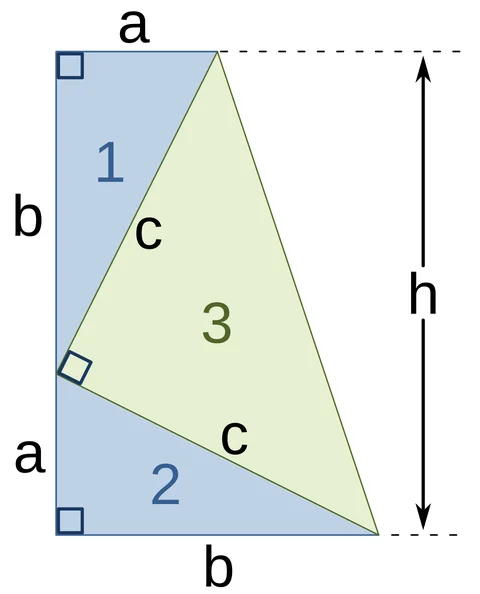 If James Garfield can do it, you can do it. Like, let's sit down right now, see if you can come up with your own proof of the Pythagorean theorem. I think you could do a choose-your-own-adventure that has, you know, you could probably have, like, 16 to 30 leaf nodes46Leaf nodes are the endpoints of a tree, the nodes with no branches. Here, the endings of the choose-your-own-adventure video, each with its own proof. on there that are, like, meaningfully different proofs. But then hopefully also communicate that you didn't have to stick with the videos here. Like, you could have gone on a completely different path, and, like, the fact that these 16 led to an interesting place, like, yours might too.
Yeah, that's a lot of work, though.
It would be a lot of work.
But those are the fun kinds of projects to work on. Like this.
Yes, the Schrödinger's cat plushie.47Schrödinger's cat is Erwin Schrödinger's 1935 thought experiment: a cat in a sealed box, whose life hangs on the decay of a radioactive atom, is by the rules of quantum mechanics "both alive and dead" until the box is opened. Can I buy that right now?
Yes, absolutely. It's on Physics Girl— or I could just send you one.
No, I'm going to go ahead, as we speak— Physics Girl on DFTBA.48DFTBA is a company that sells merchandise for YouTubers, founded in 2008 by Hank Green and Alan Lastufka. The name is the motto of the Green brothers' fans: Don't Forget To Be Awesome.
Because you sent me a pi, so I owe you one, is really what's going on. Or did I buy that? I can't remember anymore.
No, you did, you bought it. I remember this. You bought that pi plushie from the stand DFTBA was running at VidCon.49VidCon is an annual conference for online video creators and their fans, founded in 2010 by brothers Hank and John Green.
That's right. No, yeah, you can go ahead and buy this then. Yeah, go ahead.
And then you sent me, like, a selfie of you and the pi creature50Pi creatures are the cartoon π-shaped characters in 3Blue1Brown videos, who look surprised, ask questions and exchange glances. Plush versions are sold in the channel's store. and John Green,51John Green is an American novelist, author of The Fault in Our Stars, who with his brother Hank runs the channel Vlogbrothers and co-founded Crash Course and VidCon. because we had, like, just met, and I don't know—
Yeah, yeah, yeah.
There's a recent text history. And it was, like, the highlight of my life, because I'm, like, a big John Green fan. I'd never met him. I see this creature that I had designed—
He's a big fan of yours too, so there you go.
Yeah. And so, like, that was actually a very memorable— so we have proof, in my memory at least, circumstantial evidence that you bought it. So I'm just going to add this to the cart now.
That sounds familiar. Oh my gosh, you're buying it right now. That's adorable. I wonder if it's still— if I just, like, click the info of our text messages. Oh my gosh, there it is. You're so right. Because we haven't sent many— oh my gosh, we haven't sent many texts to each other. So there's John Green.
Oh man.
Me and the pi character.
As if that's not already my phone background. Like, you need to send it to me again.
You have one of those, like, digital photo frames? Even a digital photo frame. Oh, yeah, it's just me.
Just out of shot right now. Just you and John Green. Yeah, that's pretty much how it goes.
I'll take a picture of me. Who are you a fan of these days?
Oh, honestly, Derek has been killing it.
Okay, I'll take a picture of me with my cat and Derek, and we'll send that to you.
Great. No, no, we've got to do a full circle, where I, like— who do I— do I find Simone and, like, get a picture with the cat? Like, who are you a fan of? Who are you a fan of who you've never met, actually? That's going to be a much harder question.
I mean, not a YouTuber, but there's this comedian, this, like, Irish comedian named Aisling Bea,52Aisling Bea is an Irish stand-up comedian and actress, creator and star of the sitcom This Way Up (2019–2021). who I am just in love with. I think she's so funny.
12"Dead or alive" and leaving PBS
The two-sided cat plushie becomes a "dead or alive" segment, and Dianna explains she left PBS because of constant guilt over missed deadlines.
Actually, while I've deviated from substantive questions about your history and creation and things like that—
I don't know if this conversation was going to be interesting to anyone. This has been really fun for us, but that does not mean interesting for the audience. But I've really enjoyed myself.
This is why we edit things.
I give this— out of dead or alive, I give this conversation alive.53Hence the game "dead or alive": the Schrödinger's cat plushie from the Physics Girl store is reversible, alive on one side and dead on the other.
Oh, this— oh, great. This is a whole new feature on the podcast, then, at the very end: dead or alive.
Very different. How are you feeling?
All right, Dianna: TikTok, dead or alive?
TikTok?
Yeah, we're on a new segment.
Oh, wait, what— a dead TikTok?
As a platform, as a technology, as a—
Oh, I get it, I get it, I get it. Alive. Yeah, I get it, I get it.
Snapchat, dead or alive?
Oh, dead. Yeah.
Reaction videos, dead or alive?
Dead.
Long-form videos, like explainers that are 25 minutes or longer?
I mean, I wish dead, but, like, I'm going to put halfway, because, like, they're alive, but I wish they were dead.
Your relationship with—
Wait, is that— did you just— because you actually make long-form, like, 25 minutes—
No, no, genuine question, actually. Like, what— I mean, like, what do you think?
Some people make really good 25-minute-long explainer videos. Destin makes a killer— Smarter Every Day54Smarter Every Day is the YouTube channel of Alabama engineer Destin Sandlin, about the physics of everyday things, often filmed with high-speed cameras. makes a killer explainer video. I saw— it wasn't 25 minutes, but Vanessa Hill55Vanessa Hill is an Australian science communicator, creator of BrainCraft, a psychology channel that was part of PBS Digital Studios. made a video recently on fonts, I think it was Times New Roman being dead.56Times New Roman is a serif typeface created in 1931 for the London newspaper The Times under Stanley Morison; for decades it was Microsoft Word's default font. Like, she's like, "Stop using Times New Roman." It was so good. But I think that most people who are doing those, like, 25-minute-long, like— oh, shit. Anyway. My relationship with PBS—
For those who are not watching, she just flipped to the dead side of the cat.
I'm going to say alive for my relationship with PBS, because though I left them, we still have a good relationship.
I actually reached out to PBS, believe it or not, when I was sort of starting things and trying to look for— a little bit of a long story, but when I was trying to look for ways that I might be able to make it work.
I will say, so the videos were sponsored by PBS. So that gave me the stability of knowing, like, here we agreed on a set schedule for when the videos would be done and go out. I often pushed it back, because either something was going on in my life I couldn't handle, or I needed to hire a new editor, or another thing, another opportunity came up. So that's honestly why I left: because I had this set schedule with them, and it was, like, I made the schedule, they agreed, they were always so flexible. I'm like, "Okay, this is the schedule." They're like, "Sounds good, sign." But then I was like, "I want to actually stretch and drag it out and push some videos back." And I just felt like this constant guilt.
Like, I keep pushing back the video deadlines, and, like, nobody ever cared. Everybody was so cool to work with there. But I felt like if a big opportunity came up— I worked on another YouTube Original57YouTube Originals were series and shows that YouTube commissioned and paid for itself, unlike videos by ordinary creators. last year with David Blaine,58David Blaine is an American magician and endurance performer. In September 2020, live on YouTube, he rose to about 7.5 km under a bunch of helium balloons (the show Ascension). which was crazy and so fun. But that was happening toward the end of the PBS series. And so I just had to scramble to finish a video on the deadline there too, and I probably turned it in late. I don't remember. But there was a constant, like, me being like, "Ah, can we push back the deadlines?" And then being like, "Well, we'll see if we can work it out," and then usually being very, very accommodating.
Do you think now that you're more independent, you're going to miss deadlines?
I still have them.
Okay, great. For a sponsor. Question answered. Yeah, fair point. Fair point.
Yeah.
So, well, okay: do you think it's healthy to have deadlines? Do you enjoy that that's a forcing function to get things done? Do you wish you could live a life with zero deadlines?
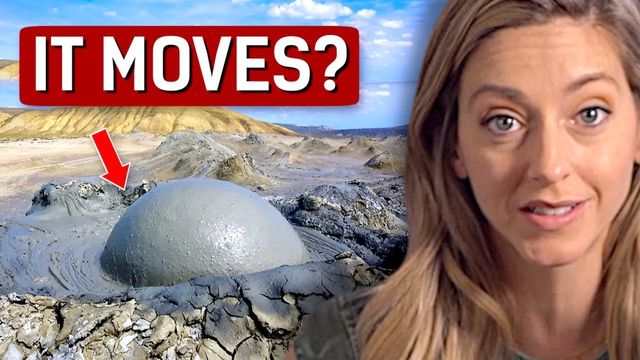
I did not have any deadlines for the mud puddle video, and I loved working on that video. And we took quite a while to make it. Like, it took a month, and it shouldn't take me a month to make that video. But I think that one of the things I feel like I'm catching up on right now is, like, creative refresh, or just, like, looking at how I've made videos in the past, or redoing the style. And I think that that's something I didn't give myself time to do within the schedule of PBS. And I mean that when I say I didn't give myself time to do it: like, I set the schedule, and then I had to stick to it, because it was deadlines for them.
13Storytelling: Vsauce, Veritasium and Everyday Mysteries
Dianna has rediscovered storytelling in science videos and wants to structure them like detective stories.
So what insights have come out of this creative refresh? What do you find yourself wanting to change about future videos that wasn't part of the past?
There's so many interesting ways to approach storytelling, and, like, science communication through telling a story, that I just would love to play with and explore. And I never valued that. I know that sounds crazy, but when I first started making these videos, I was like, "Oh, a short explainer, that's it. That's all there is. Like, that's what I want to do." And I'm going to be honest, there's some video— should I say?
Yes, you should.
I think he'll never hear this, but I didn't like Vsauce's videos59Vsauce is Michael Stevens's popular science channel: videos start from a simple question ("how much of the Earth can you see?") and wander into philosophy, history and wordplay. as much as I liked Veritasium's videos60Veritasium is Derek Muller's popular science YouTube channel, running since 2011. early on, because I was like, "Well, Veritasium is just explaining the topics better," and that's all I saw there was. Like, I just saw explaining a topic well. Like, that's what there was, and that's what I wanted to do. Now I see Michael's videos and I'm like, "Oh my God, they're so good." I feel like that was okay to say, that I just didn't like them before, but—
What you're asking is whether it's okay to say that you now love a certain kind of video. No, no, that's really fair. I actually have the same relationship with Vsauce. Like, I actually remember being really weirded out by it at first. I'm like, "What is this, like, weird way of talking, and, like, this some sort of inside joke that I'm not in on?" And it took a little bit before I, I guess, was bought in. And then once you're in the world and you, like, actually see how he's thinking about constructing something start to end, and taking there, you're like, "Holy crap, this is an incredibly well-written piece of work."
And I think I was, like, coming in with my own judgments and expectations of the videos, and I was looking for a normal science communication video, which before that I saw as just, like, kind of some of, like, Derek's older stuff, where he's explaining angular momentum or something. And you just explain it. If you explain it well, you use good demonstrations to explain it, that's a good video. But now— I mean, Derek is making incredible videos now as well, and I think he's improved and changed his storytelling, and I'm very impressed. But what I see now with Michael is that he plays with wordplay, with philosophy, with history, with science.
Like, he just kind of incorporates it all, and it's so impressive to have that wealth of knowledge and pull different ideas from different places and weave it all together. And I've just been blown away by it. And I didn't get it at first, and I wasn't impressed. I, like, almost didn't respect it, which speaks only to me and my limited idea of what I thought was good. But I think that, yeah, that's more what it is. Like, could I add more wordplay, or more storytelling? Yeah.
When you say storytelling, and you're thinking of that in your future videos, what does that mean to you? Does that mean putting yourself in there as a character of the story? Does that mean making it not just about the physics, but broader, like historical context?
Yeah, I think what we'll see in the next couple years— I think that I started exploring this when I started a series that I would love to keep going with, but have not been, but I would like to continue, called Everyday Mysteries, where I find some little phenomenon. So, for example, one of the Everyday Mysteries was blowing into a tube and discovering— or singing into a tube, sorry. You sing into a tube, and you discover that if you try to sing the resonant frequency of the tube,61The resonant frequency is the frequency at which a system vibrates most readily; for a tube it is set by the length, which must fit a whole number of half- or quarter-wavelengths of the standing wave. you just cannot. I tried this with you.
Oh, you did. Yeah, it was a very weird—
Oh, you were in the video, weren't you?
I think, yeah. I don't remember if you—
I think you remember being— you were in the video, because you were there filming at my house. That's right. Oh my God, I'm, like, explaining this to you. This is how bad my memory is. I told you, and then I proved it so hardcore— explaining this experiment to you that you're literally in the video for. Anyway, explaining it to the audience—
I'm not offended in the slightest.
I've already forgotten that I purchased your plushie. How do you remember these things?
Like I said, it was much more memorable for me than it should have been to anyone there.
I should have remembered that I edited your face into my video, and, like, people were like, "That's—"
You probably hired an editor for that.
I think I was working with Jabril at that time. So, callback to Jabril. So, Everyday Mysteries, and the idea for it— the idea I had for that is, like, you discover this thing, and then you want to learn about science through it almost like you would a murder mystery. You look for clues, and you find what's going on through the clues. So I think, like, that's a way of storytelling. And I think you could also look back at the way we've discovered everything we know in that way as well.
14Hubble's "VAR!" and the ingenuity of early scientists
Dianna wants to show how scientists of the past answered questions with very little to go on, and recalls Hubble, while Grant recalls the Greeks' argument against a moving Earth.
So I'm working on a video right now about the universe expanding.62That galaxies recede faster the farther away they are was shown by Georges Lemaître (1927) and Edwin Hubble (1929); since 2018 the International Astronomical Union has recommended calling it the Hubble–Lemaître law. So rather than just talking about the amazing things we know about the universe expanding, I went to the observatory.
Sorry, terrible jokes. "Tell me, why are you expanding? Describe your childhood."
I did some acid. I asked the universe why it's expanding. I did not do that. I did some acid, and I switched this cat back and forth. I also did not do that. Anyway, you're distracting me.
So I went to the observatory63This is Mount Wilson Observatory near Los Angeles: with its 100-inch Hooker telescope Hubble found a Cepheid in Andromeda in 1923, and later discovered the recession of galaxies. where they discovered not only that the universe is expanding, but they discovered that there is a universe. So we didn't know that there were galaxies outside of our galaxy until the early 1900s, and Hubble discovered that.64Edwin Hubble (1889–1953) was the American astronomer who proved that spiral nebulae are separate galaxies and discovered the expansion of the universe.
Wow, I didn't really realize that. I guess, yeah. How did they discover it? Just a close enough look at Andromeda?65The Andromeda Galaxy is the nearest large spiral galaxy, about 2.5 million light years away and visible to the naked eye as a faint smudge. Until the 1920s many astronomers took it for a nebula inside the Milky Way.
No, it was actually looking at a super bright star, and they thought it was a supernova, I think. I filmed all this stuff for this video, like, a month and a half ago. So they were looking at what they thought was a supernova, but it turned out to be a variable star, because they're taking, like, continual pictures of the sky, and this thing got really bright and then dimmed, and they were like, "Okay, a supernova." And then you see this super famous plate, like photographic plate, from Hubble, where he crossed it out and he wrote "VAR," V-A-R, exclamation point, and he wrote it directly on the photographic plate. That's why it's so famous, because he realized in that moment: this is not a supernova, it's a variable star.66Fact-checkHubble took the star not for a supernova but for a nova, a star that briefly flares up; he marked three such flares on the plate with an N. Comparing it with older plates, he realized it was a Cepheid, crossed out the N and wrote "VAR!" This was in October 1923. Source: Carnegie Science. Beside the “VAR!” on the 1923 plate is the same star, V1, photographed by the Hubble Space Telescope nearly 90 years later.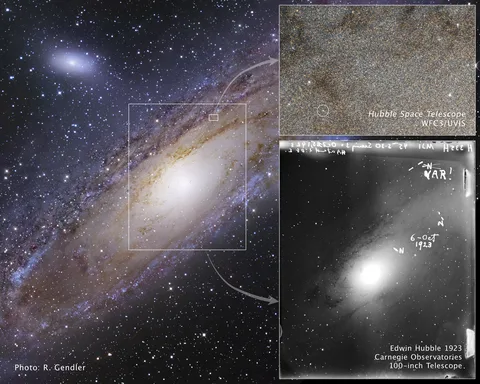
ExplainerHow a variable star measured the distance to Andromeda
In 1908–1912 Henrietta Leavitt at Harvard College Observatory studied Cepheid variable stars in the Small Magellanic Cloud and noticed that the brighter a Cepheid, the more slowly it pulsates. All those stars are roughly the same distance from us, so differences in apparent brightness meant differences in true luminosity. The result was the period–luminosity relation: measure the pulsation period and you know how much light the star really emits.
The rest is simple arithmetic: compare the true luminosity with how faint the star looks and you get the distance, since brightness falls off with the square of distance. That made Cepheids "standard candles."
In October 1923 Hubble photographed the Andromeda nebula with the 100-inch telescope at Mount Wilson and marked three stars he took for novae with the letter N. Comparing with older plates, he realized one was a Cepheid with a period of about 31 days, crossed out the N and wrote "VAR!" Its period and brightness gave a distance of about 900,000 light years, far beyond the Milky Way: even Harlow Shapley, who believed our galaxy was huge, put its diameter at 300,000 light years. So the "nebula" was a separate galaxy. Today its distance is put at about 2.5 million light years: in the 1920s no one knew that Cepheids come in two types.
And what that meant was that the luminosity that we were getting, so, like, how bright the star was, was wrong, which meant it was way further away than they thought it was.
So, wait, so, like, a variable star has a much brighter—
I don't know, I'm getting some of the details wrong, because now that I'm thinking about it, I'm thinking the same thing as you. Don't ask too many questions, Grant. I haven't made the video yet, so I don't remember. I think it was that he thought it was a super— maybe it was that he thought it was a nebula, but it turned— I don't know. I don't remember what he thought it was, but I know eventually he discovered that it was a variable star, not whatever they thought it was before. So therefore it was further away than they originally thought. I can't remember what they thought it was, so I can't help you with the logical step there to figure out why.
Just pulling this out of thin air.
I mean, this is why I've got to finish the video, because I don't remember the details. So that meant that there are obviously things way further away than we originally thought, which means they must be outside of our galaxy, which means there must be other galaxies. They didn't know that before.
Interesting. That loosely reminds me of, like, arguments that the ancient Greeks made for why the universe had to— or the world, whatever you want to call, like, the extent of the cosmos— had to be geocentric. Like, it was actually a lot more sophisticated than I thought, where, you know, you would think, "Oh, those dumb ancients, they just thought that the Earth is the center because it feels like it's holding still, and, like, that's the only reasoning." But there are people who were heliocentric, that tried to argue for the fact that the Earth was orbiting around the sun, among the ancient Greeks.67The first known heliocentrist was Aristarchus of Samos (3rd century BC). His book is lost; we know his idea from Archimedes' Sand Reckoner. But the counterargument is actually really sophisticated. Basically, they said the constellations would then change because of parallax.68Parallax is the apparent shift of a near object against distant ones when seen from different points, the way a finger in front of your face jumps when you close one eye and then the other.
Like, when the Earth is, in the summer, on one side of the sun, then it moves such a far distance to be on the other side of the sun, you would be in a different position. So you'd see the stars from a different angle, and the constellations should look a little different because of parallax. And essentially they said: to not see parallax, the stars would have to be, like, so, so far away. It would be insane how far away they'd have to be. Therefore it must be geocentric. Of course, it turns out that the stars are just insanely far away, but it was so much farther than seemed reasonable at that time.69Stellar parallax was first measured by Friedrich Bessel in 1838, for the star 61 Cygni. It came to about a third of an arcsecond, putting the star more than 10 light years away. And so, like, those sorts of realizations, where it's actually hard to tell how far something is, but one clever bit of logic tells you how far it must be— like, the fact that that can echo through history to the point where Hubble is, like, scribbling his insight that is based on that significance on the plate.
I didn't know that story. That's super interesting. I'm just stuck thinking about, like, the distance between stars in the sky, like, the distance away from us, and just how incredibly far away they must be. And I can imagine being one of those scientists. I think that's the kind of storytelling I'm interested in these days: put yourself in the shoes, like in the mindset, of these people living hundreds and hundreds of years ago, the limited amount of knowledge that they had— not that they were dumb, just, like, they didn't have the instruments that we have. They didn't have the—
They figured out how far away the moon was,70The ancient Greeks estimated the distance to the Moon from the geometry of eclipses: in the 2nd century BC Hipparchus got about 60 Earth radii, very close to the truth. and they didn't even have an accurate value for pi. But, yeah, much less— they didn't have clean water or sewage, like— and yet they still know, like, the radius of the moon, and, like, that's insane to me.
Yeah. It's incredible. It's incredible. So, like, I think that is also really interesting and really fascinating: showing the process of curiosity for all of these people. Not just us now, us looking at something, like, "How does that work?" and then discovering it through, like, my Googling. Like, how much am I cheating? That I, like, have a question, and I freaking pull up the knowledge of the entire world of seven billion people. I'm cheating so hardcore. So I should be showing the stories of these people— I wish there were more women that I could show— but I should be showing the stories of these people who are working with way less knowledge and are so creative in their solutions, because I think that's the most interesting thing about science.
I think I regret not getting a degree in mechanical engineering. And the reason I didn't take mechanical engineering classes was because I thought that they were too easy compared to physics. But now I recognize mechanical engineers are just way more creative. They just take all the science and stuff and they turn it into cool ideas and solutions. And I think that is what I admire these days. That's what I like, the stories I like telling these days: the creative solutions to things. And that's what you did as an early scientist: you're just super creative in coming up with a solution for how to answer a question.
Well, if that's the kind of ethos that's going to underlie the rest of your content, I feel like the rest of us can just look forward to it.


