

All-In
Chapters
Getting tased is terrifying while it lasts but leaves you fine the second it stops, Smith says, and a body cam TV business is for someone else: Axon is too pro-police for it.
Read the chapter- Five seconds under a Taser feels like a very long time, Smith recalls, because you lose control of your body, but when the current is off you're right back to normal.
- Friedberg sees a great entertainment business in body cam footage, and Smith recalls Live PD, the live new version of Cops, which got canceled after George Floyd.
- Axon itself ran Axon Studios for a while, but Smith admits a big, pro-police corporation wasn't going to do the edgy things that business needs.
Smith took up the Taser because bullets seemed like an outdated technology even in 1993, and he talked its inventor into starting over in his garage.
Read the chapter- European grad school classmates were afraid to visit America because of gun violence, and when Smith added it up, he knew five or six people who had been shot and killed.
- If we had Captain Kirk's phaser, Smith reasoned, people would choose not to kill each other because they'd have a more civilized way to stop a threat.
- Smith found the Taser's inventor, a NASA scientist living in Tucson, through his patent filings and convinced him to come out of retirement.
- The 23-year-old Smith and the 73-year-old inventor built the first prototype in 30 days from Ace Hardware parts.
For seven years consumers wouldn't buy the Taser, and the company survived only by pivoting to police on a last $1 million from Smith's father and a friend.
Read the chapter- The original Taser used gunpowder and counted as a firearm, while the new one used compressed air, so people like Smith's mom could buy it.
- Consumers kept asking why the police weren't using it if it really worked, and in late 1999 the company pivoted to the police market.
- After two failed launches, Smith's father, personally on the hook for about $2 million owed to Silicon Valley Bank, put in his last $500,000, and investor Bruce Culver matched him.
- Like MacArthur to the Philippines, Smith vows to return to the consumer market within the next five years.
Taser went public because banks needed deals after the dot-com bust, and police sales took off once the Taser could actually stop someone.
Read the chapter- An investment bank liked that Taser wasn't internet: it made a physical product and had real revenue, and it went public at about a $12 million valuation.
- Early Tasers couldn't stop focused, aggressive people, as in the Rodney King case, so the company tuned the nerve stimulation until it would paralyze.
- With no money for ads, a former Marine drove the country in a Winnebago, offering cops $100 if they could take a hit.
- Purchase orders followed the trainer, Hans, across the country, and within a year the company hit cash flow break-even.
After four years of explosive growth, a short attack and an SEC investigation crushed Taser's stock, and Smith fought back by helping the investigators himself.
Read the chapter- After going public in 2001, the company tripled every year for four years, and in 2004, Smith says, it was the number one performing stock in the world on one- and three-year returns.
- Smith's personal assistant turned out to be a mole, sending internal documents to short sellers who passed them to The New York Times.
- In 2005 the stock fell from $33 to $7 and the market cap from about $2 billion to about $100 million, and police customers stopped buying while the company was under federal investigation.
- Ignoring his lawyer's advice, Smith walked into the SEC's San Francisco office with boxes of documents to help close the investigation quickly.
The company survived hundreds of lawsuits by refusing to give plaintiffs a dime whenever it believed it was right.
Read the chapter- The SEC closed its probe with no findings, but by then the company had gone from zero lawsuits to hundreds, from shareholders and from anyone shot with a police Taser.
- When its insurer wanted to settle the first case for about $2 million, the company threatened to sue it, took the cases to trial itself, won twice and even made money.
- Today Axon has zero litigation for the first time in decades, Smith says, because if you sue it where it thinks it's right, it digs in "like religious fanatics."
Smith credits his college friend Hadi Partovi with saving the business: he helped build a software company inside a weapons company, move it to the cloud and rename it.
Read the chapter- Around 2010 the body camera software business was a disaster, so Partovi joined the board and for about five years was effectively Smith's part-time CTO.
- After a near-catastrophic outage that almost lost all customer data, Partovi talked the company out of running its own data center, and it moved to AWS and then Azure.
- Partovi called Taser a "sledgehammer brand" that just means electric weapon, and pushed for the new name, Axon.
- The Taser is now a small part of the business, and Axon, Smith says, manages more video every day than YouTube: over a million officers upload two hours a day.
The body camera was invented so juries could see what officers saw instead of hearing their dry testimony.
Read the chapter- At a trial over a death in custody, the family kept showing Mr. Heston's graduation photos, while an officer who had faced his meth-fueled rage could only speak in careful, professional language.
- The employee building the first camera quit in the middle of the night and launched his own a week later, and Axon later bought his company back.
- For seven years cops refused to wear cameras, calling them Big Brother, and the company made a double bet on the cloud, since otherwise 18,000 departments would each have to run video servers.
Cops who feared the cameras later wouldn't go on patrol without one, because the camera protects them from false allegations.
Read the chapter- A police union leader told Smith that no cop wants to wear a body camera until they've worn one for 90 days, and after that they won't go on patrol without it.
- A woman under arrest in Phoenix threatened to accuse the officer of rape, then calmed down once he told her everything was being recorded.
- After the shooting of Michael Brown in Ferguson, his family and the police union both demanded cameras, demand surged, and the cloud bet paid off.
- Some civil liberties groups now say the cameras are broken because they aren't exposing many bad cops, but Smith thinks they've proven that most officers do a good job and are falsely accused.
Cameras are already everywhere, Smith says, so the real question is the rules for data access that guard against abuse.
Read the chapter- There's no going back to the 1950s: there are more cameras than people, and the question is when those feeds should be shared with the government.
- People find it morally offensive when an officer searches cameras for an ex-girlfriend or tracks everyone, but most see tracking a stolen car or plates near a violent crime scene as reasonable.
- Smith backs Senator Hawley's bill with criminal penalties for officers who misuse the systems, and vendors like Axon and Flock will require a valid case code and a second officer's key for searches.
- After the Super Bowl ad backlash, Smith says, Ring put good safeguards in place, and through its partnership with Axon, homeowners decide whether to share video with police.
Axon's mission is to protect life, and after the Taser and the body camera, its next step is Skydio drones that reach a call before the police.
Read the chapter- The Taser, Smith says, reduces the times police have to shoot and kill someone, and the camera reduces excessive force and protects officers from false accusations.
- Skydio's autonomous docks let a drone fly from, say, a fire station anywhere in a city and reach the scene in seconds, sometimes before the 911 operator finishes entering the call.
- Agencies can share their mission profiles with the public and fly drones only to calls, not on patrol, and some people have even surrendered to drones.
Friedberg fears an all-seeing state, and Smith replies that the people who most want policing technology live in poor, high-crime neighborhoods.
Read the chapter- The benefit of more safety, Friedberg says, isn't felt as acutely as the threat to privacy and the Orwellian fear of being arrested before committing a crime, as in Minority Report.
- Smith notes that most concerns come from wealthy neighborhoods, while people dealing with gun violence every day cheer when the police show up.
- The best deterrent to crime, Smith argues, isn't long sentences but a high probability of being caught and prosecuted.
- Friedberg admits that after three speeding tickets from San Francisco cameras he wanted them gone, which he calls a "luxury belief," in Rob Henderson's term.
Advisers quit in 2022 over the Taser drone, but Smith is continuing the project because he thinks a non-lethal weapon on a drone beats another gunfight.
Read the chapter- Today an active shooter is met by more people with guns, and Smith wants to send a drone or robot with a non-lethal weapon instead, since no cop will take a non-lethal weapon up against a gun.
- Many board members, Smith says, privately agreed with him but, after George Floyd, were afraid of getting canceled.
- The board was reconstituted as the Equity and Ethics Advisory Council and now has more voices from the communities most affected by policing.
Smith believes robots and drones will make policing safer, because force decisions will involve several people and everything will be recorded.
Read the chapter- Every decision to use force will be made by a human, and a non-lethal weapon on a drone or robot can require real-time approval from an administrator.
- Axon bought almost half of Skydio, kept it independent so it could move at startup speed, and secured exclusive rights to sell its drones in the markets it cares about.
- If a robot goes into a house, a team will run it, not one officer on adrenaline, a mistake will mean a Taser hit rather than a bullet, and the whole thing will be recorded.
- Smith doesn't want police showing up in a '74 Chevy while everyone else has robots and AI, and says laws and oversight have to evolve along with the technology.
Defunding the police would be catastrophic, Smith says, but democracies recover, and he expects a near-utopia in 10–20 years.
Read the chapter- Smith recalls that in what he thinks was 1968, the Montreal police went on strike over pay and the city went crazy, and Steven Pinker uses this "Night of Terror" to show that police are the glue that holds society together.
- After some states effectively decriminalized shoplifting, downtown San Francisco got abandoned, but Smith thinks the city has already begun to swing back.
- Smith believes that in 10–20 years technology will cure many diseases, and that police must help keep order through the transition.
Quotes
On why Smith couldn't shut Taser down after two failures
“And my dad looked at me and he said, well, you know, it would have been nice to figure that out a couple of years ago, because we owe Silicon Valley Bank about $2 million. I have $500,000, and I'm on the hook. So if we shut down, the bank is taking everything.”
Rick SmithRead from 08:16On how Taser convinced cops of its power
“And we would offer them $100 if they could come and take it. And we'd hit them, they would fall down, they'd dust themselves off and go, oh my God, that was way more powerful than I was expecting. Some would try again.”
Rick SmithRead from 12:10On how Axon fights lawsuits
“Like, now, if we did something wrong, we're going to be rational and we will settle it. We're reasonable people. But you sue us on something where we think, you know, we're in the right, we dig in like religious fanatics to defend our belief system.”
Rick SmithRead from 16:31On how cops get used to body cameras
“However, once — actually, a police union leader told me famously, said, no cop wants to wear a body camera until they've worn one for 90 days, and then they will not go on patrol without it.”
Rick SmithRead from 24:32On guarding camera searches against abuse by officers
“There's two-key systems where you've got to have collaboration before you're running searches. So if you're searching for your ex, you're gonna have to find another officer who's willing to put their career at risk before you can do that, right?”
Rick SmithRead from 34:40On what really deters crime
“Like, the best deterrence to criminal behavior is not long sentences. It's a high probability that you will get caught and prosecuted.”
Rick SmithRead from 40:36Friedberg on his own "luxury beliefs" about cameras
“I'm driving through San Francisco and I got three speeding tickets. I'm like, get rid of those damn cameras.”
David FriedbergRead from 41:17On why police need robots and AI
“I don't want to live in a world where everybody else has robotics and AI, and the police are showing up in a '74 Chevy, you know, with an old radio.”
Rick SmithRead from 50:29
Summary
Rick Smith founded Taser in 1993 in the Tucson garage of the Taser's inventor, struck that at the end of the twentieth century people were still killing each other with bullets. For seven years the company failed to sell Tasers to consumers and lived on family money; it took off only after pivoting to police, offering cops $100 if they could take a hit. Taser went public in 2001 at a valuation of about $12 million, and in 2004 its stock was, by Smith's account, the best performer in the world. Then a short-selling attack, an SEC investigation and hundreds of lawsuits knocked its market cap down to $100 million.
The body camera saved the company. Smith came up with it after watching juries tune out officers' dry testimony, and his college friend Hadi Partovi helped turn a weapons company into a software company, move it to the cloud and rename it Axon. For seven years cops refused to wear the cameras, until after Michael Brown's death in Ferguson both his family and the police union demanded them. Today, Smith says, Axon takes in more video every day than YouTube.
The second half is about the price of safety. David Friedberg, who calls himself more of a libertarian, presses on the fear of a surveillance state: the backlash against Flock cameras, Ring's Super Bowl ad, and the Taser drone that led members of Axon's ethics board to resign in 2022. Smith's answer is that cameras are already everywhere and the real question is the rules for accessing the data: criminal penalties for abuse, a case number for every search, "multiple keys" before a drone uses a weapon. He is betting on Skydio drones and argues that a robot with a non-lethal weapon, run by a team, is safer than an officer with a gun and a surge of adrenaline. Defunding the police, he says, would end in catastrophe, like Montreal's "Night of Terror."
Advice
If customers don't believe your product works, prove it to the professionals first: consumers kept asking why police didn't carry the Taser, and the company took off only when it pivoted to cops.
Don't overcomplicate going to market: if the product solves a real problem, simple demos are enough. Instead of an ad campaign, Taser sent one trainer around the country to let cops feel the shock for themselves.
Don't settle when you're sure you're right: pay out on the first lawsuit and you'll be buried in new ones. Where you really are at fault, settle.
Don't spend effort on hard problems that aren't worth it: after an outage that nearly cost all its customer data, the company took Hadi Partovi's advice, dropped its own data center and moved to the cloud.
Don't cling to the name the company grew out of: Taser meant only a stun gun, the business had become much broader, and renaming it Axon proved right.
Bring in critics at the very start of design: before launch, their concerns can be built into the product; after launch, all that's left is to argue.
Mentioned
- Live PD00:38the live police patrol show canceled after George Floyd's death
- Cops00:48the police series that Live PD updated
 Axon Enterprise02:22Smith's company: Tasers, body cameras, the cloud and drones
 Jack Cover03:51the Taser's inventor, with whom Smith started in a garage
Show 16 more mentionsShow fewer mentions
- TASER03:51the stun gun Smith's company began with
 The New York Times14:10got the company's internal documents from short sellers
 Hadi Partovi17:09board member who helped build the software business
 Amazon Web Services18:35the cloud where the company moved customer data from its own data center
 Microsoft Azure18:35Axon's second cloud after AWS
 YouTube20:01Smith's comparison: Axon handles more video a day
 Flock Safety28:46Friedberg: cities are rejecting its cameras over fears of a surveillance state
 Benn Jordan30:53Smith calls him a thoughtful critic of license plate cameras who wants guardrails, not a ban
 Josh Hawley31:25Smith backs his bill against camera abuse
 Ring31:47Friedberg recalls the backlash to its Super Bowl ad; Smith on its partnership with Axon
 Skydio35:49the drone maker Axon invested in
- Minority Report39:16Friedberg: the film about arrests for crimes not yet committed captures what people fear
 Rob Henderson41:17Friedberg admits his irritation at cameras is what Henderson calls a "luxury belief"
 Steven Pinker51:51per Smith, cites the Montreal police strike as an argument for functioning police
- The Better Angels of Our Nature: Why Violence Has Declined51:51the Pinker book Smith names
 Elon Musk54:37Smith believes in his idea of universal high income but expects a rough transition
Sponsors of the episode

Transcript
01What it's like to get tased
Getting tased is terrifying while it lasts but leaves you fine the second it stops, Smith says, and a body cam TV business is for someone else: Axon is too pro-police for it.
AdAppLovin
AppLovin started with an $8 domain, no VC funding, and became one of the largest ad platforms in the world. Now that same engine powers AppLovin Ads for e-commerce. Your ads run inside mobile games, reaching over a billion people with full-screen, distraction-free attention. The platform finds buyers and optimizes for profit. You set the target, it does the rest. One cookware brand went from 4 million to 16 million, turned profitable, and is on pace for 80 million this year.
Visit applovin.com/allin to launch your first campaign today.
02A garage in Tucson
Smith took up the Taser because bullets seemed like an outdated technology even in 1993, and he talked its inventor into starting over in his garage.
Rick Smith, CEO of Axon, welcome to the All-In interview.1All-In — a podcast hosted by four investors and entrepreneurs: Chamath Palihapitiya, Jason Calacanis, David Sacks and David Friedberg. Besides the weekly episodes with all four, it runs interviews hosted by one of them.
It's awesome to be here. Thanks.
I'm glad we could make this work out. I know we had talked about having you come out to the Summit2All-In Summit — the All-In podcast's annual conference, held since 2022. and got delayed, missed that window, but I'm really glad that this has worked out. You know, your business history is fascinating.
I would love, if you're okay with it, maybe to go back a little bit to the beginning of the business. Your company used to be called Taser. I think we all remember the original Taser name and product. But maybe you could take us back, like, we could do a real quick recap of how the company got started in the early days.
Yeah, so we started in the early '90s. So this is the only job I've ever had. Started in '93 in a garage in Tucson. The sort of lead-up to that is I was in graduate school in Europe, and a bunch of the European students were saying they were afraid to come to America because of all the gun violence they were seeing on TV. And I would tell them, like, you know, look, not everything is like what you see on the news. And one of them asked me if I knew anyone who'd been shot and killed.
And it just struck me. I was like, wow, actually, I do. There were these two guys that played on my high school football team that were shot and killed in a road rage incident, and we knew a couple friends of the family. By the time I added it up, it was like maybe five or six people. And the thing that struck me was, why is it that, like, bullets are still a thing in 1993, much less 2026? And what I mean is, like, it's a pretty old technology, right?
I mean, bullets have been around for many centuries. And the simple insight was, if we had Captain Kirk's phaser,3Phaser — the weapon from Star Trek that can be set to stun. Captain James T. Kirk commands the starship Enterprise. like, people would choose not to kill other people because they'd have a more civilized way to stop somebody who's threatening them. And one thing led to another. I discovered this device called the Taser had been invented back in the 1970s by a NASA scientist who lived in Tucson, Arizona.4Jack Cover (1920–2009) — an American physicist who worked on NASA's Apollo program. In 1974 he patented a stun gun that fires electrodes on wires. TASER is an acronym for Thomas A. Swift's Electric Rifle, after the boys' adventure novel Tom Swift and His Electric Rifle (1911). I found him through his patent filings. And one thing led to another.
I just called him up and I said, hey, man, whatever happened to this tech? It seems to me like this is something the world could use. And shortly thereafter, he invited me down to his house, and here I am, this 23-year-old kid, and this 73-year-old man. It sounds like, I don't know, a comic book sort of plot, but we started in his garage to build new Tasers. And I can tell you, at the beginning, everybody thought I'd lost my mind. In fact, I have a great video of Emil Michael,5Emil Michael — Uber's senior vice president of business development in 2013–2017 and, since May 2025, US Under Secretary of Defense for Research and Engineering. In September 2025 a Trump executive order gave the Department of Defense a second name, the Department of War. who was one of the leaders at Uber, he's now the Under Secretary of War, came to visit me when he was 23, and they filmed a spoof video making fun of me, of just how crazy this idea was that I was going to go make electrical weapons.
So you found the inventor of the Taser device through a patent filing, go and visit him and buy it or license it and form a company around it?
Yep. In fact, I convinced him to do it with me, to come out of retirement and sort of show me the way. So we were building the first Tasers in his garage from parts from Ace Hardware, because the first thing we had to do was to get federal government approval that the new Taser would not be considered some sort of illegal weapon, and that would require a regulatory approval.6Regulatory approval was needed because Cover's original Taser fired its electrodes with a gunpowder charge, so in 1976 the Bureau of Alcohol, Tobacco and Firearms (ATF) classified it as a firearm, and under the National Firearms Act of 1934 as an "any other weapon," in the same category as sawed-off shotguns, requiring registration and a tax. The Air Taser the company released in 1994 fired with compressed nitrogen. As I look back, you just, you don't realize how fast you move when you're a startup relative to the rest of the world. Like, we built our first prototype in 30 days from go. You know, now I've got 6,000 people.
What year was this?
It was '93. '93.
And you started a company right away and built the first prototype with your own money?
Yeah, it was friends and family. My dad was a serial entrepreneur, and he had had one successful company in Silicon Valley. So he knew a lot of the VCs, but no VC would touch us, right? We weren't the internet in the late '90s. It was right in the peak internet boom.7The internet boom (the dot-com bubble) — the surge in internet stocks in the second half of the 1990s. The Nasdaq peaked in March 2000 and by October 2002 had fallen nearly 80%. And again, everybody thought we were this sort of oddball thing.
And I'm actually pretty proud now that we've seen enough success that, and with the changes in the world, that defense and policing technology8Defense tech became a hot area in the 2020s for Silicon Valley venture investors who had long steered clear of weapons. The best-known example is Palmer Luckey's Anduril, valued at $30.5 billion in June 2025. is now much more mainstream than it was back then.
03Seven years of failure
For seven years consumers wouldn't buy the Taser, and the company survived only by pivoting to police on a last $1 million from Smith's father and a friend.
But this was a handheld Taser device. What was the market initially? Was it to sell into police forces? How did you think you were going to go to market, and what was your first sale?
Yeah, no, our first market was consumers. So, you know, police could buy the original Taser, but basically the original Taser was a firearm, but it looked like a flashlight, that puts it into this category two, which is like a sawed-off shotgun, which effectively makes it illegal, very hard to buy, but police could still buy them. So our theory was, if we made this new Taser weapon using compressed air instead of gunpowder, it would not be a firearm. And then people like my mom could go buy it to defend herself. And she had recently bought a gun around that same time. So we started in the consumer market and we struggled and we didn't really succeed.
And what we heard from consumers was, hey, if this thing, you know, really works, why aren't the police using it? And so we basically realized we need to go prove this works in policing. So after seven years of struggling and failing, we pivoted into the police market in late '99. And that's when the business took off. But, like MacArthur to the Philippines,9Douglas MacArthur — the American general who in March 1942, on Roosevelt's orders, left the Philippines under Japanese siege, promising "I shall return." In October 1944 he landed in the Philippines with US forces. I will return to the consumer market once we have proven with police that the Taser is as effective or even more effective than a gun. And that will happen in the next five years.
And so you spend seven years developing the market, trying to find product-market fit,10Product-market fit — the point at which a product finds a market that truly needs it: buyers come on their own and come back. Marc Andreessen popularized the term in a 2007 essay. all off of friends and family money. What was keeping you in it? Was there a point where you said, hey, I'm going to throw the towel in, we should go do something else with my life? I mean, this is kind of a classic entrepreneur, you know, how-many-times-are-you-willing-to-pivot11Pivot — a sharp change in a startup's strategy: a different market, customer or product. Eric Ries popularized the word in The Lean Startup (2011). Taser pivoted when it moved from consumers to police. question.
Yeah. So we had two failed product launches. And then in 1998, I was visiting some of my friends up in Silicon Valley who'd taken jobs, you know, at companies with dumb names like Yahoo.12Yahoo — one of the major web portals of the 1990s, founded in 1994; it went public in 1996, and within two years its stock had risen 600%. And of course, they were all making money hand over fist. It was the internet gold rush. And here I just failed on my second product.
And I remember going to my dad — it was him and one of his friends that were funding this — and I said, look, I think we should just shut it down. You know, we failed twice. And my dad looked at me and he said, well, you know, it would have been nice to figure that out a couple of years ago, because we owe Silicon Valley Bank13Silicon Valley Bank — the California bank that served startups and venture funds; it failed in March 2023. about $2 million. I have $500,000, and I'm on the hook.14Personal guarantee — the company takes the loan, and the guarantor promises to repay it from their own assets if the company can't. That is why shutting Taser down would have ruined Smith's father. So if we shut down, the bank is taking everything.
So we have no choice. I'm putting my last 500,000 in. And the other investor was a guy named Bruce Culver.15Bruce Culver — one of the company's first investors, he sat on the board of TASER International. Shout out, Bruce, if you're watching. Bruce matched him. And so that was going to be the last $1 million we would ever get.
We would have to survive on it. And with that, we managed to design, tool, manufacture, and launch the police Taser and then shoestring it along to cash flow break-even,16Cash flow break-even — the point at which the cash coming in covers all current spending, so the company no longer needs to raise money to stay alive. and eventually an IPO two years later.17IPO (initial public offering) — a company's first sale of shares to the public on a stock exchange.
04An IPO after the dot-com crash
Taser went public because banks needed deals after the dot-com bust, and police sales took off once the Taser could actually stop someone.
So you go public around the end of the dot-com boom, right? So the market's kind of tanking generally, and there's an opportunity because you guys now have revenue. You're selling into what, police forces? That's the primary market at that point.
Yeah, it was. And actually, looking back on it, it was just an alignment of the fates. So yeah, the internet bubble popped in 2000, and in late 2000, an investment bank came to one of our training events, and they basically were like, oh my gosh, you're not internet. You guys make a physical product, you have real revenue. We're taking you public. So we went public specifically, I think, because banks needed deals and we were not internet.
And we went public at a massive, about $12 million valuation.
Wow. And that was a big outcome, though, right? I mean, you guys owned 100% of the company. You didn't have VCs or institutional guys on the cap table.
That's right. Yeah, I mean, we were a tiny, tiny market cap to go public, but because of that, you know, we ended up being the highest return, I think, that investment bank, Paulson out of Oregon,18Paulson Investment Company of Portland, Oregon, underwrote TASER International's IPO on Nasdaq in May 2001. ever had. And for us, like, I'll tell you, for me, it was just such a relief that we were able to raise enough money to be able to pay off some shareholder notes so that I knew my dad wasn't going to end up in the poorhouse. That was to me the biggest relief, is not destroying your family. And then everything from there has been gravy.
How do you cross that chasm,19Chasm — a nod to Geoffrey Moore's Crossing the Chasm (1991): between a new technology's early enthusiasts and the mass market lies a gap that many startups fall into. those early days? You show up to a police force, you've got this handheld device that shoots out these electrodes that go into someone's skin and zaps them, and they fall to the ground, they get incapacitated. What was the way that you kind of got these guys, who had never heard of or seen anything like this before, to make those first POs? How do you start to get those orders to come in?
And was there a moment where suddenly enough police forces had this, where everyone's like, we all got to have this? And then the market just kind of took off.
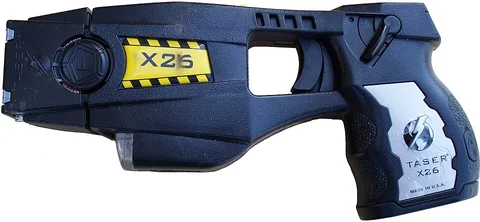
ExplainerHow a Taser stops a person
A Taser uses compressed nitrogen to fire two barbed probes that stay connected to it by thin copper wires. The probes travel at about 55 m/s (180 ft/s); police cartridges reach up to 11 m (35 ft), consumer ones up to 4.6 m (15 ft). To complete the circuit, both must catch in clothing or skin at least 10 cm (4 in) apart. Peak voltage is about 50 kV, but only around 1,200 V reaches the body, at an average current of about 1.9 mA: short 100-microsecond pulses, 19 times a second.
Early stun guns worked through pain, which a determined or intoxicated person can push through. The M-series models the company released in 1999 are built for neuromuscular incapacitation: the current makes the muscles contract involuntarily, and the person cannot control their body while the cycle lasts. Pressed against the body without firing (drive-stun mode), a Taser only causes pain and does not incapacitate.
Yeah. So, I mean, this is one of those things where, look, you just don't overcomplicate life. We didn't have enough money to do anything fancy. And the main thing was we had solved a real problem. So the early generation Tasers were not powerful enough. Like, Rodney King20Rodney King: in March 1991, Los Angeles police officers arresting him fired a Taser at him twice and then beat him with batons; a bystander caught the beating on video. The officers' acquittal in April 1992 set off the Los Angeles riots. was shot with an LAPD Taser and it did not work.
And they went to the batons, with catastrophic consequences. So Taser had a terrible reputation in the late '90s. And it was deserved, because I'd seen several demos of our first-generation product that also didn't stop somebody who was focused and aggressive. They could fight through the pain. So the thing we had done was we had basically done some animal testing to go tune the amount of nerve stimulation so that it would actually paralyze somebody. Once we did that, the launch was pretty simple.
We didn't have money for a big ad campaign. We hired a former Marine and put him in a Winnebago going around the country with a $100 bill, and he'd go into a police department, explain to them what we're doing. And up until then, non-lethal weapons21Non-lethal weapons (police increasingly say less-lethal) — weapons designed to stop a person without killing them: Tasers, pepper spray, rubber bullets. Deaths from them are rare but possible. were seen as kind of snake oil, like, yeah, pepper spray hurts, but you can fight through it. We had the first weapon that could actually stop somebody. And cops are an interesting crowd. You know, there's a fair amount of bravery, shall we say.
And so they weren't afraid. They're like, okay, you think this would work? Fine, let's give it a try. And we would offer them $100 if they could come and take it. And we'd hit them, they would fall down, they'd dust themselves off and go, oh my God, that was way more powerful than I was expecting. Some would try again.
And then immediately they saw the value. I mean, I can't tell you how many times I've had cops tell me, my gosh, like, this would have prevented me from shooting someone or getting in a knock-down, drag-out fight with a very dangerous person. So the value prop was so simple. We just had to convince them it worked, and we did that with very simple demos. And from that, you could see suddenly purchase orders started coming in, and we could track where Hans was going across the country, our trainer. And, you know, within a year, we hit cash flow break-even.
05Short sellers and the SEC
After four years of explosive growth, a short attack and an SEC investigation crushed Taser's stock, and Smith fought back by helping the investigators himself.
And then you had like a decade where the stock kind of stayed in the same range, didn't it? A lot of people think, like, okay, you go public, this thing's gonna take off, we're on some growth trajectory. But again, after how many years? Seven years of being a private company, eight years of kind of getting to that point of having an IPO, you then spend another decade kind of with this valuation, in this range of a couple bucks a share, right?
Oh yeah. No, actually, let me give you — it's more exciting than that. So seven years of, like, are we going to survive? We can't pay the light bill. Then we go public in 2001, and the next four years are insane. We're growing at, like, we're tripling every year.
In 2004, we were the number one performing stock in the world. I have the Wall Street Journal article on the wall. On a one- and three-year return basis, we were number one.
That was the year Google went public.22Google went public in August 2004 at $85 a share, raising about $1.67 billion.
Yeah. Yeah. I mean, we were on fire. Then what happened in late 2004? We got hit with an SEC investigation.23SEC — the US Securities and Exchange Commission. It began an inquiry into TASER in January 2005, made it a formal investigation that August, and in December 2005 said it was not recommending any action over the company's product safety claims or its accounting. There were allegations we'd lied about the safety of our products in order to pump up the stock price.
Now, we could do a whole hour on this. There was a short-selling attack.24Short sellers — investors who bet on a stock falling: they borrow shares, sell them and hope to buy them back cheaper. In a short-selling attack, they also publicly argue that the company is overvalued or dishonest to drive the price down. We had big short positions in the stock. My personal assistant was actually a mole for short sellers, who was selling—
Oh my God, really?
It was crazy. Sending internal documents to short sellers that were giving them to the New York Times, who was then disclosing they were getting internal confidential material, non-public information, from short sellers who were somehow getting it out of our company.
So that was miserable. 2005, our stock dropped from 33 to $7 a share. And it was, yeah, it was miserable. I mean, you're wondering if you're going to survive. Our customers are police, so they stopped buying from us. They're like, look, dude, you're under federal investigation.
Like, I can't go to my city council until this is over. So, ignoring my lawyer's advice, I walked into the front offices of the SEC office in San Francisco with boxes of documents and said, hey guys, I want to help you complete your investigation, because I may go out of business if this drags on. And then that's when the long doldrums began. Like, the stock never fully recovered from there. And we were—
But what happened with that investigation? That investigation, you moved on from it?
06The lawsuit wars
The company survived hundreds of lawsuits by refusing to give plaintiffs a dime whenever it believed it was right.
Oh, yeah. I mean, they don't give you a gold star when they're done and tell you good job. They just say no findings and they move on, which is as good as it gets. Turns out, though, what doesn't kill you makes you stronger.25"What doesn't kill you makes you stronger" — an aphorism from Friedrich Nietzsche's Twilight of the Idols (1888). In that case, we had gone from zero lawsuits to hundreds of lawsuits. I mean, we were being sued obviously by shareholders, we were being sued by plaintiffs of, like, anybody who got shot by a police Taser was now suing the police and us, because we were all over the news.
And we did a couple things there.
And sorry, what's your market cap during this time?
It peaked about 2 billion in late 2004, and then it was back to about 100 million.
So you get hundreds of lawsuits when you're kind of like a hundred-million-dollar market cap company that you're dealing with.
Yeah, we should have gone under. Like, we should not have survived. It was only by pure grit and, frankly, a little bit of craziness. Like, our insurance company — because we have insurance like everybody — and we go to trial on our first cases, our insurance company wanted to settle this first case for, like, around $2 million. And we said, hell no, you can't. If you settle this case, we will get swamped in litigation.
You're putting our business at risk. If you settle the case, we'll sue you. But we're going to give you an out. If you will pay the plaintiff $2 million, we'll take a little bit less, you can pay us, and we'll sign away our liability, and we'll take it across the goal line. We did that twice. We actually made money on those cases, because we won.
But the point is, this was what was considered crazy behavior, that we would settle with our own insurance to prevent them from giving a dime to the plaintiffs, because we believed we were right, and it worked. Like, today, for the first time — I should knock on wood — for the first time in decades, we now have zero litigation cases. Because if you sue us, you better bring your A game. Like, now, if we did something wrong, we're going to be rational and we will settle it. We're reasonable people. But you sue us on something where we think, you know, we're in the right, we dig in like religious fanatics to defend our belief system.
And that's important, and that's what protected our business.
07Hadi Partovi: from weapons to software
Smith credits his college friend Hadi Partovi with saving the business: he helped build a software company inside a weapons company, move it to the cloud and rename it.
This lasts for years, right? These lawsuits, this market cap kind of being static. This went on till what, about 2012 or so? And Rick, a buddy of mine, Hadi Partovi26Hadi Partovi — an American entrepreneur, co-founder of Tellme Networks and of the nonprofit Code.org, which teaches schoolchildren to code. He has been on the company's board since 2010.'s on your board, right?
He is, yeah.
And so he's been on your board for a long time. First of all, how'd you guys meet? And second of all, he mentioned some story about the role he played early on in keeping the business alive. Can you tell us what happened?
Oh yeah, I cannot overstate his importance. So Hadi and I were friends in college. So he was one of my buddies who was out making a bunch of money in the internet boom in the late '90s, when I was struggling to get this Taser business off the ground. Then what happened? Around 2007, '08, '09, we were working on our body camera business. And we launched, we were initially operational around 2010 or so.
And I frankly had a disaster on my hands. I had never built a software company. I'd hired a team. And let's just say we were struggling hard. And so I called Hadi and I was like, hey, man, I need some help. Like, I've started this software company.
I, you know, I built the original Tasers in a garage. I feel like I got my hands around this. But this software thing, you know, turns out the guy I'd hired is probably, you know, not the right guy. We're having technical issues. And frankly, I was struggling to wrap my head around, like, how do we staff and grow this business? This is pretty new to me.
And so I asked Hadi if he would join the board, and he came on. He was effectively — he was a board member, but he was really my part-time CTO27CTO (chief technology officer) — the executive in charge of a company's technology and engineering team. for about five years, where he helped me sort through, get the right business and get the right team in place. We moved — like, we were originally building our own data center that we were going to manage for our customers. We had a near-catastrophic outage where we nearly lost all our customer data. And, you know, Hadi was like, hey, man, like, there's plenty of hard things to do in this world; like, trying to figure out how to run your own data center is not one that's worth the squeeze. So we moved over to the cloud with AWS and then with Azure.28AWS (Amazon Web Services) and Azure (Microsoft) — the world's two largest cloud providers: companies rent computing power and storage from them instead of running their own servers.
And yeah, so I like to say Hadi saved the business, because he came in. He was the guy who helped me navigate how to build a software business from scratch inside a weapon business. And by the way, as we were doing this, our shareholders thought I'd lost my mind. They're like, Rick, you're trying to turn a weapon company into a software company.
And I guess I was like many entrepreneurs, you don't realize what a crazy idea that was. And Hadi was the guy who helped me do it.
Did he stay on your board?
Yeah, he's still on my board.
Amazing. I mean, the stock price — you're like a 35, 40 billion dollar market cap company today. He must have done well, I'm assuming.
Yeah, yeah. I mean, and Hadi also is the guy who pushed for us to change the name from Taser to something else, which became Axon.29Axon — in April 2017 TASER International renamed itself Axon Enterprise, after its line of body cameras and its cloud service. Because, and look, at the time that was hard. We're really invested in our brand. We're proud of the Taser. We didn't want to feel like we're retreating.
And Hadi's point was like, hey, man, the Taser is a kind of a, it's a sledgehammer brand. It means electric weapon to people, and you do a lot more than that. And so, you know, he helped me think that through, and he was right. You know, now the Taser is a small part of the business. It's important, but, you know, we have an expansive business. Now we manage, I think, more video every day than YouTube.30More video than YouTube: in 2019 YouTube said more than 500 hours of video were uploaded every minute, or about 720,000 hours a day. A million officers at two hours a day comes to about 2 million hours.
Now, they have a lot more viewers, but we have over a million police officers uploading two hours of video, you know, every day from one of these body cameras. So we have a ton of content. And of course, it's got to be securely managed and shared. And there's been a lot of complexity. And of course, I've got a great team in place now, thanks to Hadi coming in and sort of helping me learn this business and rebuild the plane while we were flying.
Good going, Hadi.
08How the body camera was born
The body camera was invented so juries could see what officers saw instead of hearing their dry testimony.
Yeah. So there's one other thing that happened in there. So while we were defending ourselves in all the litigation, we also went on offense and we created the body camera. And the reason we created the body camera was, you know what? The only way to defend ourselves — and look, our customers were being accused of doing horrible things with Taser weapons. I remember—
Police officers, right?
Yeah, yeah, police officers. I was co-defending a case in Northern California where somebody died in police custody. It was a 40-year-old man with a 20-year methamphetamine problem. And he was in really bad shape. And I remember the police officers telling me — as we were watching the trial, the family kept putting up pictures of his high school graduation. And the officers looked at me and they said, that's not the human being I saw the night I went to that house.
I saw somebody that was literally like out of The Exorcist movie.31The Exorcist (1973) — William Friedkin's horror film about a girl possessed by a demon. This cop told me he'd been a cop for 26 years, had never been afraid in his career until the animalistic rage he had to deal with in this person, who had overdosed on meth, but that never came across to the jury. And in that moment, I said, my God, we have to record what you see, because, like, when police officers describe things, they have to be very professional. In this case it was, you know, when Mr. Heston32Robert Heston, 40, died in Salinas, California, in February 2005, the day after police tased him several times while he was in a meth-fueled rage. In 2008 a federal jury fully cleared the officers but found TASER partly liable for failing to warn police of the risks, the first wrongful-death case the company lost. A judge later threw out the punitive damages. did this or that, very professional. The family that's suing the police, they would use very emotional, colorful language.
And I was like, guys, you're getting your asses kicked, frankly; you need to tell your story with more passion. And they said, Rick, we don't get to do that. Like, we work for the government. If we get caught in one half-truth, that can be the end of our career. And that's when we realized, like, we need to record this so that you can show people what it is that you saw, what it is you did, rather than having to try to explain it.
Weren't there body cam companies already at the time? Did they exist? Was this concept novel?
The concept was new. I mean, you did have GoPro33GoPro — the American maker of action cameras, compact cameras mounted on helmets, handlebars or clothing. Founded in 2002. with, like, consumer cameras. So we certainly didn't invent the cameras, but we — again, a quick detour. We were building the first police body camera. And then the employee that was building it actually quit in the middle of the night and launched the product a week later. Turns out he was actually funding it with his stock options to build it against us.
That's another bit of drama. But yes, we were building the industry's first body camera. We ultimately, you know, made peace, and we acquired that company back into the fold34VieVu — TASER's first competitor in police body cameras, founded in 2007 by former TASER employee Steve Ward. Axon bought VieVu in 2018. down the road. But that's what led to the eventual explosion. The reason that we're a, I don't know, a $30 billion company today, up from a couple hundred million, is because of the body camera. And I'll tell you, when we launched the body camera, police didn't want to wear it.
We had seven years of miserable failure where cops told us, you know, this is Big Brother. They're worried that their supervisor is going to nitpick them. I mean, look, change is hard, right? People find a lot of reasons to be afraid of new things, but we just believed in our soul: guys, you need to be able to show people what you do. You're being accused of all sorts of awful stuff. And we made a double bet.
Not only do we bet on body cameras, but we bet on the cloud, because we realized the only way this would ever scale is if we put these videos into cloud infrastructure. Otherwise, you have 18,000 departments3518,000 departments: the US has no national police force, but roughly 18,000 state, county and city law enforcement agencies (17,985 in the Bureau of Justice Statistics' 2008 census). all trying to figure out how to run video servers securely.
09A camera on the officer's side
Cops who feared the cameras later wouldn't go on patrol without one, because the camera protects them from false allegations.
But this creates a ton of liability for these police forces, doesn't it? Like, now all of a sudden they're being held accountable. By the way, I love watching body cam videos. The cop did something wrong, the criminal did something wrong. I mean, there's always just drama to these stories. Yeah.
But I've got to imagine a lot of these police officers — because there's a lot of these stories that they're using the body cam, or they don't realize the body cam's on and they get themselves in trouble. And so isn't there a bit of a liability issue? And how do you end up selling your customer on putting themselves at risk? Or do they view it as a double-edged sword, that it's also for their own safety, their own protection, and for winning cases?
So you are articulating the exact concern people had up front. That's why they didn't want to wear it, because they had that perception. However, once — actually, a police union leader told me famously, said, no cop wants to wear a body camera until they've worn one for 90 days, and then they will not go on patrol without it. Because what you don't realize, police are arresting criminals all the time. And criminals have no compunction about lying about what happened. The number of false allegations is incredible.
I'm going to give you one example. I'm on a ride-along with a cop in Phoenix, and this is in the early days of body cameras. And I said, how's it going? He said, well, I didn't like this, but let me tell you what happened to me last week. I was arresting a prostitute. She was basically more than half naked.
She was high on some sort of drugs. And as I put her into the patrol car, as I'm driving her into the station, she starts screaming at him: I'm going to say you raped me. I'm going to say you raped me unless you get me out of the car right now. And he said, ma'am, I just want to let you know, this is a body camera. I've been recording this entire interaction. You're free to say whatever you want, but it's all being recorded.
And he said her demeanor changed completely. She calmed down. And he said, now imagine what I would have gone through if I didn't have a body camera. If I had a woman accusing me of raping her and it turns into a he-said-she-said, like, that could be a career-ending allegation with no way to disprove it. So that was like a microcosm, but the moment that things flipped was the shooting of Michael Brown in Ferguson, Missouri. Remember Ferguson?
Yeah.
White officer, black subject. Now, Michael Brown was unarmed, but he was significantly larger than Officer Wilson. And according to Officer Wilson, they were fighting over the gun. Like, the officer — you know, an officer brings a gun to every fight they get in. And once they're fighting over the gun, you know, he's justified to defend himself. But if you remember the stories, the family was saying things like, remember, "Hands up, don't shoot,"36"Hands up, don't shoot" — the slogan of the protests in Ferguson and across the country: some witnesses said Brown had his hands raised when Wilson fired. The Justice Department did not find those accounts credible. Pictured: such signs at the Ferguson protests in August 2014.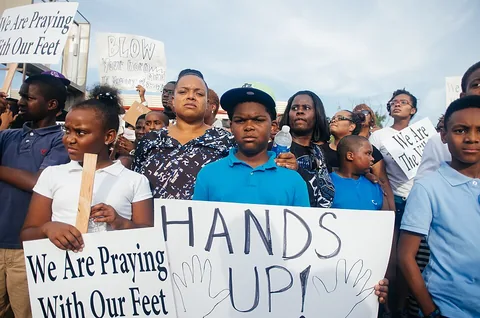 that Michael Brown was trying to surrender.
If that's true, then that was a cold-blooded murder. But if you listen to the officer, he says, hey, I was being attacked. In fact, I think he had a broken eye, a broken bone above his eye.37Fact-checkSmith recalls that the officer had a broken bone above his eye, but Darren Wilson had no fractures: his medical records show a bruised jaw (Wikipedia, "Killing of Michael Brown"). The subsequent review ended up showing that the officer was largely correct, but you couldn't prove it. And it was out of that case — Michael Brown's family said,38The killing of Michael Brown. On August 9, 2014, in Ferguson, Missouri, police officer Darren Wilson shot and killed 18-year-old Michael Brown, setting off days of protests across the country. A grand jury declined to indict Wilson. In March 2015 the US Justice Department concluded there was no credible evidence that Brown had tried to surrender and that Wilson's actions were not a crime; it also found systematic racial bias in the Ferguson police. After the grand jury decision, Brown's family called for all police officers to wear body cameras. we want body cameras, and the police union said, you know what, we want them, because we at least want the world to see what's happening. And now, as I sit here today, what's interesting, some of these civil liberties groups that were big proponents of body cameras are now saying that they're turning against them.
They're saying they're broken because they're not finding all these bad cops, that there's something wrong with the body cameras. I have a different point of view, and that is, you have to accept the possibility that the vast majority of cops do a good job and they're falsely accused. And I think that's what body cameras have proven.
And so you get out there, the market starts moving, and I'm assuming it just becomes de facto, right? I mean, all over the country at this point. I mean, maybe you can just share a little bit about the scale of the business today.
Oh yeah, yeah. Once Ferguson happened, then everybody needed body cameras and they needed them fast. And that's where our bet on the cloud made a big sense. Remember, back in the day, like, you know, in 2010, cloud was relatively new to government. And they had this perception, well, if it's here and it's sitting on my computer, it's safe, because it's here in the room with me, right? I can keep eyes on it.
But that's not true. In cybersecurity, there could be Chinese hackers, you know, in the server in my building, no problem. It comes down to the technology and the stack and the people. And so, like, from first principles,39From first principles — reasoning up from basic facts rather than by analogy with how things are usually done. The idea of first principles goes back to Aristotle. we knew the cloud could be safer than your average police department. And we could scale it. And so because of the urgency after Michael Brown, then it just really took off.
And so today, virtually, I think, every major police department now wears body cameras. And the vast majority are on our system. I think partly because we were first, but also because we tend to be — we're sort of maniacally mission-driven. And I know that always sounds a little bit cheesy, but, like, we have the luxury of choosing what problems we want to solve. And so we work on things that are going to make a difference, that we're excited about. And that leads to different product outcomes than companies that are just purely profit-motivated.
10Flock, Ring and the fear of surveillance
Cameras are already everywhere, Smith says, so the real question is the rules for data access that guard against abuse.
Maybe you could tell us a little bit about what's gone on recently with some of the public sentiment around monitoring. So there's this company Flock40Flock Safety — an Atlanta company that makes cameras that read license plates. In 2025–2026 a number of cities dropped its cameras, in part over complaints that the data was reaching federal immigration authorities. Pictured: a Flock camera outside a store in Aurora, Colorado, mounted on a pole with a solar panel and reading the plates of passing cars.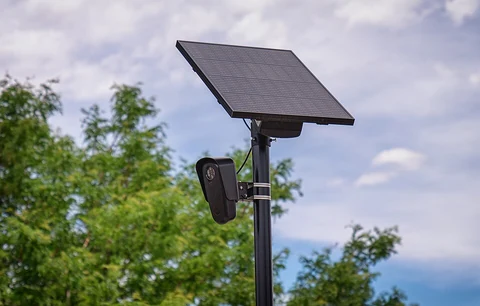 that's been installing cameras in cities, and they're starting to get these city councils to reject the cameras. And there's this concern about the development of effectively a surveillance state, and that government agencies, police forces, getting all of this monitoring technology creates a bigger, more powerful state that's monitoring us all the time. No citizens want to have that. And obviously there's the public safety argument, but maybe you could just kind of frame up what's going on with public sentiment right now and these issues.
Well, I think this is part of a larger concern about AI in general and the proliferation of cameras and sensors. And look, it's not unreasonable. Like, I don't think any of us want to live in China, meaning, you know, a surveillance state where every citizen is tracked everywhere they go. However, I think there's got to be some nuance here. We can't go back to the United States as it existed in the 1950s, when there weren't cameras everywhere. The fact is there are cameras everywhere.
There's more cameras than people. You know, you and I probably have four cameras just on our cell phones, plus, you know, maybe a dozen in our house, plus all the business cameras. So really what this comes down to is how we think about data governance. Like, how should society — under what circumstances should we share those camera feeds to the government? How should they use that? I think in general, we try to distill things down to simple, you know, principles about, okay, what would we be proud that we've built?
Like, what would be good for society? And if we build that, it will be durable. And so in the example of cameras, look, we build license plate reading cameras too. I think we've been pretty thoughtful about the security controls we put in place to try to avoid some of the issues you've seen. What people are really upset about are things like when a police officer can go in and do searches on their, you know, ex-girlfriend. Like, those sorts of things are morally offensive to folks.
Or if you could track every American everywhere they go — like, we don't want that. But, like, tracking a stolen vehicle, you know, being able to look up license plates that are around the crime scene of a violent crime, I think people agree that those are reasonable use cases. And even the critics — like, Benn Jordan41Benn Jordan — an American musician and YouTuber, one of Flock Safety's most prominent critics: in his videos, he and security researchers have shown vulnerabilities in its cameras. has been a very thoughtful critic. I think he kind of started this. He will tell you, if you listen to him, he's not saying to get rid of this technology. We just need good guardrails and we need safeguards. And so I'm a big proponent.
By the time this webcast actually hits, I think, you know, we'll be after the election, and we'll start to see some movement in federal regulation. I'm a big supporter of what Senator Hawley's42Josh Hawley — Republican senator from Missouri. He introduced the Stop Flock Abuse Act, which tightens limits on license plate camera data and the requirements for protecting it. The episode was recorded before the midterm elections of November 3, 2026. doing to introduce guidelines and oversight, so that we can get the benefit of these technologies to fight crime, but safeguards to prevent them from tracking everyday Americans.
Do you think that people get that rationally? Because I've noticed some things you can kind of get people to rationalize and you can understand them. And other things, people just have a very acute emotional response and they're like, icky, yucky, I don't want to have anything to do with that. I think Ring did that Super Bowl ad,43Ring — Amazon's maker of smart doorbells and cameras. Its ad for the Search Party feature, which aired during the Super Bowl in February 2026 (30-second spots that year cost $10 million), showed neighbors' cameras helping find a lost dog. Critics called it an ad for surveillance, and within days Ring and Flock canceled a planned integration that would have let camera owners share footage with police. and the negative sentiment around the Super Bowl ad — being it's so creepy that all these cameras are monitoring everyone all over the neighborhood all the time — is what really triggered a lot of people. And I think there were stories about Flock where these cameras were being used by city employees to look at people when they weren't supposed to be. So you could argue, yes, let's put in the guardrails, but the general notion that this sort of technology exists, this sort of power exists, this sort of privacy infiltration, intrusion exists, makes people feel really uncomfortable with it.
How do you kind of think about changing that sentiment to being one of rational and guardrails, and away from the sort of big emotional response everyone's having?
Yeah. Well, I think part of that's just an adjustment as society moves forward. Like, look, plenty of people still go — they may say, boy, that made me uncomfortable, but they go buy Ring cameras, specifically because Ring has some of the best technology for being able to protect your home, or if you need to share videos with police because you had a crime at your house. And so I think there is a little bit of back and forth, which is normal. Like, this is democracy. Like, as you move forward, people aren't going to agree on every topic.
But over time, I think, you know, we find middle ground. I don't think it's reasonable — I don't think we're going to end up with, like, making doorbell cameras illegal, right? But I think Ring likely learned from that incident. They've put really good safeguards in place. In fact, we have a partnership with Ring44The Ring–Axon partnership: in 2025 the companies launched Community Requests, which lets a police agency that uses Axon's cloud service Axon Evidence ask residents of a given area, through the Ring app, to share footage. Participation is voluntary, and submitted videos go into Axon Evidence. where we're both very focused on how do we enable homeowners to share Ring camera video with the police if there's a crime committed, but actually make it really hard for people to enable — like, we don't enable police to just go out and randomly, you know, canvass those videos.
There's a ton of privacy work that goes in so that people know these are my cameras, I control how they're used. And — but if I, you know, I actually had a car stolen from my house years ago, and it took me days. I had to get a technician to come download the video from this, like, you know, homegrown camera system. I couldn't get it to the police for days. I have Ring now because I do want to be able to share it if something like that happens. So I think it is also a matter of just — yes, not everybody's gonna agree with the guardrails, but I think policymakers can't just — we have to find the reasonable middle ground.
We've got to find reasonable public policy. And we've already seen that. I think, again, I was really impressed with Senator Hawley's bill. It's very rational. It's got criminal penalties if police officers individually misuse this for personal purposes. I believe there's criminal and civil penalties.
And then there's going to be safeguards from manufacturers like us and Flock that are going to require that, before you can run searches, you've got to have viable case codes, that we know this is a legitimate case that's somewhere in your law enforcement system. There's two-key systems45Two-key system (two-person rule) — a rule that a critical action requires the consent of two people. The best-known example is a nuclear missile launch, where two officers must turn their keys at the same time. where you've got to have collaboration before you're running searches. So if you're searching for your ex, you're gonna have to find another officer who's willing to put their career at risk before you can do that, right? Those sorts of safeguards, I think, will get the 90% of people that are rationally paying attention to this to — but you're not gonna win 100%. Sure, there are going to be some people that are just going to have a fear of this, but I think, you know, I've been around this long enough to see those things subside when you get good, rational safeguards in place.
11Skydio drones
Axon's mission is to protect life, and after the Taser and the body camera, its next step is Skydio drones that reach a call before the police.
So, I mean, you guys start with the Taser handheld device, reduce the use of guns in policing, move to the body cam. And now you guys have this framing, I believe, on being the operating system for public safety. What else does that encompass? So is it similar to Flock's business, and maybe help explain some of the other products that come out now and in time to realize that mission?
Yeah, so our mission is to protect life. And we chose those two words, meaning we focus on violence as a problem that's worth solving. And that means with a Taser, our goal is: how do we reduce the number of times police actually have to shoot and kill someone? With a body camera, it's: how do we reduce the risk of police using too much force, and how do we protect them when they're doing this job that is dangerous and risky, so that they don't have to worry about being falsely accused of things. And then we persist that all the way through. We're partnered with Skydio on drones. So, in fact, we recently will have become the largest investor in America's leading drone company.46Skydio — a California drone maker. On November 5, 2026, Axon announced it would invest about another $1.2 billion in Skydio in cash and stock and become its exclusive distributor to police and other public safety agencies in the US and Canada; according to press reports, Axon's stake will rise from about 15% to about 37% once the deal closes, which is planned for the fourth quarter of 2026 and the first quarter of 2027.
So if you don't know Skydio, they're the guys who build these robotic autonomous docks,47Docks — protected nests from which a drone takes off on its own, then lands and recharges. They are the backbone of the Drone as First Responder model, in which a drone answers a call before a patrol car. The first such US program was launched in 2018 by the police in Chula Vista, California. where a drone can now be flown from off a fire station anywhere in a city, and you can have a drone on scene in a matter of seconds. This is reducing the number of times police have to take resources to go, you know, to alarm calls. So it allows them to focus on bigger calls. And when there's big events, they're able to get a drone on scene sometimes before the 911 operator has even finished entering the call for service. So that's improving the service to the community. Now, again, drones are also an area where people would say, well, there are things like, how are these being used?
How do we have safeguards to know the police aren't, you know, using these in ways that the public wouldn't want them to? And so Skydio, together with us, we've developed controls. For example, agencies can share their mission profiles with the public. So if the public has concerns, they can see how they're being used. And most agencies have policies where they're not just flying drones around on patrol missions. They very specifically fly them only to the site when they've been called, where somebody is calling for help, and you get a drone there quickly that can help you see what's happening.
And in some cases, they've even flown a drone down and been able to distract, or we've had people surrender to drones. So I think the whole idea is, across the board of all the things we do, we look for how do we connect these devices together in a way that's going to make us all safer, but also acknowledge that, yes, there are risks of abuse, and we should build this in ways that address those risks. Not everybody's going to agree on everything, but we've so far been able to get to a point where we're finding that right balance, so that we're using these things to make the world safer and protect privacy and find the right balance along the way.
12Freedom vs. safety
Friedberg fears an all-seeing state, and Smith replies that the people who most want policing technology live in poor, high-crime neighborhoods.
You know, I think there's this great debate on how much safety and at what cost, that I think is what really triggers a lot of people: that the benefit to them individually of more safety isn't felt as acutely as the risk or the cost to their privacy or their personal space, this Orwellian idea that the state has so much power — that the government, that the policing force has so much power that they can effectively, if they chose to — there may be guardrails, but if they chose to, they now have such supremacy over the citizens. And this Orwellian idea that now the state can determine, hey, I don't like the speech that you're using, or I don't like whatever it might be. There's all these reasons why people can feel like there's an infringement of that power of force upon them.
It's almost like, how far do you take it? Like, the movie Minority Report,48Minority Report (2002) — Steven Spielberg's film, based on a Philip K. Dick story, about a future police force that arrests people for crimes they have yet to commit. I think, did a good job exploring this, where it's like, at what point do you become predictive with AI of crime happening, and then you arrest people before they do the crime? And, you know, everyone's kind of fantastical ideas become — is that really worth the risk? Like, do I really want to take on that level of cost to my individual liberties to have, quote, that much more safety? And I think that seems to be the great debate people seem to be having right now. Is that a fair characterization?
Or do you think it's a little bit misguided?
No, no, no. I think it's a fair debate, and that is the right debate to be having. And I think — but this is hard work, right? Like, it's finding the balance. And what's interesting, you will find the people who most want these sorts of technologies come from the poorest neighborhoods that have the highest crime rates. Paradoxically, those are the ones that, you know, people say, well, we worry about overpolicing.
But when you actually go out, you know, frankly, most concerns are coming from wealthy neighborhoods, where this is more theoretical. But when you talk to people that are dealing with gun violence every day in their cities, they cheer when the police show up. And they're the ones who want to have more of this technology. So there's deterrence. I mean, ultimately, I would say this. In America, sometimes we have these simplistic notions.
Like, you know, frankly, in the political spectrum, sometimes there's just lock everybody up, or, no, no, no, like, abolish the police. Like, come on — neither of those are the right solution. I think the right solution is: how do we deploy technology so we deter people from making bad decisions in the first place? Like, the best deterrence to criminal behavior is not long sentences. It's a high probability that you will get caught and prosecuted. And then the question is, how do we then balance that as well against making sure that we're not building technology that can be used to track everyday people?
But those are interesting technoethical problems to deal with, right? How do we build the tech to meet the ethical bar, to make the right trade-offs?
You're right. I don't live or work in neighborhoods where I'm experiencing a lot of violent crime. I'm driving through San Francisco and I got three speeding tickets. I'm like, get rid of those damn cameras. You know, like, my reaction is, why are these cameras here? It's what this guy Rob Henderson calls luxury beliefs.49Rob Henderson — an American writer. By "luxury beliefs" he means views that confer status on the well-off while the costs fall mostly on the poor.
13The Taser drone and the ethics board revolt
Advisers quit in 2022 over the Taser drone, but Smith is continuing the project because he thinks a non-lethal weapon on a drone beats another gunfight.
I think there was an incident in — and I have this in my notes — in June of 2022. You had some members of your advisory board who quit in protest after you guys announced plans to develop a Taser-equipped surveillance drone that you were designing to stop school shootings. And I think the board had voted against the project due to ethical concerns and whatnot and privacy concerns. Can you tell us a little bit about kind of that incident, what you've learned from it? And does that project still continue?
Yes, that project is continuing, and that's why they quit. That was — look, life can be challenging at times. I was very disappointed. We set up an AI ethics board to give us feedback, frankly, not from pro-police people, but from civil liberties groups that are concerned about policing, right? And that's been a very useful function. That's one of the reasons we've got, I think, great safeguards in how we built ALPR50The Taser drone. In June 2022, shortly after the school shooting in Uvalde, Texas, Axon announced plans to develop a remotely operated Taser drone to protect schools. Its AI ethics board had already voted 8–4 against even a limited pilot, and on June 6 nine of its twelve members resigned in protest. Smith then announced he was pausing the project. ALPR is automated license plate recognition. and other technologies.
Now, on this case, we had been working with them for about a year on the idea that we could have a Taser-capable drone to be used in extreme circumstances — like, a school shooting was the incident there. But today, for example, if you have a person with a gun show up in a building anywhere in America, do you know how we stop them? We got to wait for the police with a gun. Yeah. We send in more people with guns and they have a gunfight. Like, yeah, this is the Wild West, guys.
Like, is that really the best we can do as a society? And so what we're saying is, rather than waiting and sending a person with a gun to have more bullets flying, we could send in a drone or a robot armed with a non-lethal weapon. This is a key distinction. Like, you'll never get a cop that will take a non-lethal weapon up against somebody with a gun. But if we can send in a small drone or robot, then everything shifts. They're like, oh, wait a minute, now I can use non-lethal force.
Now, we can argue whether or not the criminal deserves to die, but even there, like, anytime you have more bullets introduced, innocent bystanders get killed all the time accidentally. And so I continue to believe — and we are doing R&D on this — that using non-lethal force safely deployed from a distance via a drone or robot is in everybody's best interest compared to, you know, having more gunfights in society. Now, because of the way that went down — frankly, I think this was post-George Floyd. Some of our advisors were worried about getting canceled over this issue. Many of them worked in universities, and they were already being accused of being pro-police. And so I think there was some personal dynamics.
Many of the people on the board privately agreed with me that, like, you're right, Rick, this is a better solution than what we have today with sending in cops with body armor and assault rifles. But it was too politically risky, and it blew up. But I'll tell you one thing I'm proud of. We didn't give up. Many companies have now canceled their ethics boards. We dug in, we reconstituted.
We still have it; it's been rebranded as our Equity and Ethics Advisory Council.51The advisory council is officially called the Ethics & Equity Advisory Council. It was formed in 2022 by merging the AI ethics board (set up in 2018) with a community advisory coalition (set up in 2021). And frankly, it now has more black and brown voices on it, where previously it was more academically focused. Like, if you want to talk about the concerns of overpolicing, it is primarily from underrepresented, you know, communities. And one of the criticisms we had gotten in that whole process was that we didn't have the right people in the room. If you want to talk about, again, the concerns of overpolicing, it should be from communities who are most affected. And so you live and you learn.
We've recalibrated, but we've continued to bring in, you know, people who have critical views of policing, because we think those are important for us to understand their concerns. And by doing it early, we actually learn, in many cases, we can build safeguards into the product if you listen and you do it up front. It's much better for us to do that and hear the critical voices early in the design process rather than after we've launched it, because then all we can do is sort of argue about things. We've lost the ability to make significant design changes.
14Policing in ten years
Smith believes robots and drones will make policing safer, because force decisions will involve several people and everything will be recorded.
Let's just talk about the future. Ten years from now — I think there's five companies launching humanoid-like robots52Humanoid robots — for example, in October 2025 the startup 1X opened preorders for NEO, a home robot priced at $20,000 (or $499 a month), with deliveries in 2026. for commercial sale in the next 12 to 18 months that are going to be available here in the US. 10 to $30,000 price ranges have been kind of talked about. Do you think the future of policing involves humanoid robots, other types of robots and drones? Give us a sense of, a decade from now or 15 years from now, what local community policing looks like with all this technology that's coming to market.
Yep. Well, first I would say policing is still fundamentally a human job.
Any decisions about using force on another person will be made by humans. And that's a bright line for us. So even with the Taser drone you and I talked about earlier, part of what we learned from the concern was people are worried about misuse, abuse, how these things will be used. So any of the robotic systems we're involved in will not only have required human oversight, but we're building multi-key processes. So, for example, you could set it up so that before any officer could operate even a non-lethal weapon from a drone or robot, we can set it up so that there's required real-time approval from an administrator. So we're actually going to be building the least abusable technology in the history of policing.
Like, today, you give a cop a gun, they walk out the door, you have no control over what they do with it. You can prosecute them later. These robotic systems will give us the ability to have institutional decision-making with multiple parties in real time, which I think will lead to far less, you know, mistakes, less concerns about abuse. And I do believe both humanoids — I think drones will be bigger faster. Humanoids are coming as well. But, again, that's why we invested in Skydio.
We bought almost half the company. We wanted to buy about as much as we could, because we're big believers that there's going to be millions of drones in the next few years deployed in the US. But we also actually felt, in this case, it was better for us to leave it as an independent company that could move at startup speed and continue to raise and spend capital in ways that maybe weren't constrained by being part of a public company. And yet, at the same time, we've secured the exclusive rights. So we will be the exclusive channel into the markets that we care about, because we believe that is absolutely going to be one of the biggest parts of the future, is drones and robots arriving on scene way before people, you know, have an opportunity to get there.
And the whole idea is to just — let's understand what's happening. Let's make sure we're making the best decisions possible. And the idea is to keep everybody as safe as we can.
How do citizens feel like they can maintain their individual liberties from being overwhelmed by a state that is equipped with this much technology? I think that's really where I react personally, to think about as more of a libertarian.53Libertarian — someone who favors maximum personal and economic freedom: the state, in this view, should be limited to protecting citizens, running courts and defense. I'm a big proponent of the role of government being public safety, so let me be clear on this. But this idea that you're creating a significant concentration of this extraordinary power, and it's hard for the citizens to be able to ultimately protect themselves against a government that decides to overwhelm voices and individuals at some point in the future.
All you got to do is take a step back and look at the world as it exists today. So let's imagine, David, that police have got a tip that there's a dangerous felon in your house. This has happened, right? We've all heard of cases where police go to the wrong house and they're doing an entry. So today, the way that works — like, if they believe that you are a dangerous felon, they may come through the door in your house, and you're gonna be dealing with multiple officers that are suited up with body armor, with lethal weapons in their hands, who are gonna have to make a life-or-death decision instantaneously while their own adrenaline is surging, right? Human beings don't make good decisions under the fight-or-flight.
So the fact is, the government already has a monopoly on the legal use of force,54A monopoly on the legal use of force — the German sociologist Max Weber's definition of the state in his lecture "Politics as a Vocation" (1919): a state is what successfully claims a monopoly on the legitimate use of physical force. and almost every one of those officers has lethal force. And I will tell you, if they feel their life is at risk, the thing in their hand will be a gun. By comparison, if those police are going to come into your house, imagine a future where, if they do have to do this mission — and again, we can debate about under what conditions they should do it — now they're gonna be sending in a drone or a robot. So the operator is going to be a team of people, not just one. It's not gonna be a person who's in the fight-or-flight response, afraid for their own safety, shaking with their finger on the trigger.
And if they make a mistake, you're gonna get hit with a Taser or pepper spray or some non-lethal weapon. And, oh, by the way, the whole thing will be recorded, because to even operate these things, you have to have camera systems on them. Many police shootings today are not recorded. And so I think it just comes back to how do we — you know, we just need to sort of take a step back and understand how the job is done today and how we can do it in the future that is safer for everybody, and then answer legitimate questions about what are the controls in place. Things like multi-key authorization. We will work with our customers to push hard that every one of them has an oversight function.
So anytime one of these robotic systems is used, that there's independent civilian oversight and review. So I think, again, this just comes down to — it's not an unreasonable concern. These things could be misused. However, we also don't want to — I don't want to live in a world where everybody else has robotics and AI, and the police are showing up in a '74 Chevy, you know, with an old radio. Like, they're gonna need enough tech to keep up with the rest of us. And then the laws and regulations and oversight are gonna have to evolve, you know, to make sure that we are controlling the government as the people, and that we've got a good judiciary and good balance of power, so that they can't do abusive things without, you know, being held accountable.
15What happens without police
Defunding the police would be catastrophic, Smith says, but democracies recover, and he expects a near-utopia in 10–20 years.
And what's your view on the shifting political landscape, the rise of a DSA political class55DSA (Democratic Socialists of America) — the largest socialist organization in the US. Its member Zohran Mamdani won the New York City mayoral election in November 2025. The slogan "Defund the police" took off during the 2020 protests. today that's calling for defunding the police? And what do you think happens to communities and cities over the next couple of years if and as more of that voice becomes elected?
Well, if you actually defund the police, you know, we will get some social experiments. I can tell you, you don't need an experiment to show what would happen. It will be catastrophic. But, you know, democracies recover. And I'll give you an example. I think it was in 1968,56Fact-checkSmith says 1968, but the Montreal police went on strike on October 7, 1969 (Wikipedia, "Murray-Hill riot"). the police in Montreal, Canada, went on strike for no other reason—
It was a simple — it was over pay. There was no, you know, there was no George Floyd-type situation. This was just a labor relations strike. And looking back on it, that is now known as the Night of Terror,57The Montreal police strike began on October 7, 1969, over pay. Within a day, stores and banks were looted, there was arson, and a police officer was killed; order was restored by the provincial police, the Royal Canadian Mounted Police and the army. Pinker, who grew up in Montreal, recalled that the events dispelled his teenage anarchism; he wrote about them in The Blank Slate (2002). In The Better Angels of Our Nature (2011), he argues that violence has declined over human history. because criminals heard the police were on strike and the city went crazy. In fact, Steven Pinker, the Harvard psychologist, who's sort of famously both liberal but also very rational — he wrote Better Angels of Our Nature — and this is his example on, like, you need a functional police force, because it is the glue that holds society together.
So we have rules that we can all trust we're going to abide by. And so I hope we don't see major examples of that. We started to see some of that, frankly, with — some states had decriminalized shoplifting,58Proposition 47 — a California ballot measure passed in 2014 that made theft under $950 a misdemeanor rather than a felony. In 2024 voters passed Proposition 36, which toughened penalties for repeat theft again. as you recall, in the post-George Floyd. And that led to catastrophic consequences, where you saw that downtown San Francisco got abandoned.
I've seen it myself.
Yeah. Yeah. And then with that, you get the jobs flee. You get these, you know, deserts where there's no economic activity, because it's just not safe for people to do it. The business models implode. Now, I think in your example, I think San Francisco has already begun to swing the other direction and take corrective action.
And so I try to stay out of politics too much. I think, you know, things will swing one way or the other, but we have corrective mechanisms that over time will kick in.
And I think non-lethality is a great mission. I think public safety is critical to the underwriting of all of our other social contracts. Without good public safety, none of the other social contracts work and the systems don't work. And so I think, obviously, it's an important mission and important work you do. Congrats on the business, on the progress, on the Skydio investment. Obviously, there's a lot of, I think, social challenges ahead here with this big debate that's going on right now on the limits of that and the limits of technology.
Well, I'll tell you as well, like, you know, there's a lot of uncertainty right now. You know, The Economist, I think four months ago, had a cover that, you know, the AI jobs apocalypse. And then a couple months later, there was the, hey, wait a minute, no, AI is making millions of jobs. Like, people don't know what to think. And we are at this point where the acceleration of technology is leading to massive amounts of uncertainty.
And what I tell our customers is, like, guys, we need you to stay strong. Like, policing might be the glue that needs to hold society together. Hopefully we don't see the sorts of things we're seeing in France right now and the sort of social upheaval. But, God forbid, if we do, we need the men and women of law enforcement to be ready to stand up and help us keep order as we get through to — I'm a huge optimist. I think 10, 20 years from now is going to be a near-utopian society. Again, maybe I'm a little out over my skis, but I think technology is going to cure many diseases, many ills.
I think we're going to see, you know, Elon's idea of universal high income59Universal high income — Elon Musk's recurring description of the future that AI and robots will bring, as opposed to universal basic income. will be fantastic, but we may have some difficult moments as we get through the transition. And our view, our role at Axon is, like, how do we arm the police for that in a way we'll look back on and we'll be proud of the way that we did it, to help them do this the right way. Now, I mean, it's not going to be perfect, but let's put some good controls in place and help make people more comfortable that, you know, we're gonna get through this together okay.
Yeah. Well, Rick, I really appreciate you taking the time. I'm glad we got to finally do this. Thanks for joining us on the All-In interview. It's been great. Been a lot of fun.
Anytime.


