



Sourcery
Chapters
Starcloud's first satellite is already circling the Earth with an H100 on board, the second is in assembly, and the third exists so far as a chassis mock-up.
Read the chapter- Starcloud 1, the satellite with the first H100s in space, travels at about 17,000 mph and circles the Earth in an hour and a half.
- Johnston wrote his marriage proposal on Starcloud 1 and showed his fiancée the satellite as it passed over Cabo, where he proposed.
- Johnston promises Starcloud 2 in assembly, a Starcloud 3 chassis mock-up in the fab shop, and new buildings coming online next year.
A new vibe table would have taken two years, so the team bought a broken one for $200,000 and revived it over a weekend, the kind of scrappiness Feilden calls a startup's superpower.
Read the chapter- A new vibe table takes almost two years and costs about $1.5 million, so Starcloud bought a broken one for $200,000.
- The table arrived full of water with a leak at its high-voltage heart, and the country's top vibe table expert said it couldn't be fixed.
- Over a weekend the team tore it down to the core and got it through a full spacecraft vibe test, and the 16-ton table runs on a big generator.
- A startup's superpower, Feilden says, is not taking no for an answer and turning crazy situations around.
Starcloud moved to Seattle because most satellites are built here and the hyperscalers are down the road, and co-founder Adi Oltean came from SpaceX and Microsoft.
Read the chapter- Starcloud went from founding to orbit in 21 months, against a previous best of four years, Johnston says, because Oltean and Feilden built the satellite by hand.
- In Johnston's telling, 90% of satellites launched in recent years by mass were designed and built in Redmond, and Starcloud's team is half ex-SpaceX and half ex-hyperscalers.
- At SpaceX Oltean owned tracking beams, Starlink for planes, ships and Starship, after two decades at Microsoft running large GPU deployments with Nvidia.
- His team's demo was in Jensen Huang's 2019 GTC keynote, and this year Huang unveiled Space-1, the first GPU built for space, at the same event.
Cooling is Starcloud's biggest technical challenge, and it builds that part itself: the engineering is doable, the question is making it cheap and manufacturable.
Read the chapter- Starcloud buys Nvidia boards but builds the radiators, solar panels and cooling system in-house, which Oltean calls the secret sauce.
- The engineering is doable, Oltean says, and the real question is how to make cooling super cheap and manufacturable at scale.
- Every watt from the Sun has to be dissipated, using the same liquid cooling that every data center moved to in 2025.
Starcloud's founders want to send the first spacecraft to the nearest star for $10–15 million, to get people thinking about the Fermi paradox.
Read the chapter- The founders' nonprofit aims to send the first spacecraft to the nearest star for $10–15 million, using existing technology: solar-powered Hall-effect ion thrusters.
- The probe will spend five years spiraling toward the Sun and five more firing at perihelion, and will meet Alpha Centauri in 80,000 years.
- Johnston hopes it will be the first to leave for another star and the last to arrive, with descendants overtaking it, then catching it and putting it in a museum.
- The galaxy could be settled in 10 million years, so, Johnston argues, either we're exceptionally rare or intelligent life doesn't last.
- On board will go Johnston's fiancée's name, donors' messages, the Voyager Golden Record and a digital copy of a fruit fly brain.
Johnston is sure SpaceX will be worth more than $100 trillion in 10 years and treats its purchase of Tesla as settled.
Read the chapter- Barring a world war, Johnston says, SpaceX will be worth more than $100 trillion in 10 years, largely thanks to Optimus robots building Optimus factories.
- Johnston calls SpaceX buying Tesla "not a hot take, just a fact," saying they're only waiting for the stock unlocks so nobody calls the price unfair.
- On the new Roadster, Johnston has heard about cold gas thrusters and even lift, while Molly bets on an eVTOL.
- Johnston bought his sword at a Halloween store that morning so as not to be sword-mogged by earlier guests.
Starcloud's biggest platform, Starcloud 3, weighs about two tons, 50 of them fit in one Starship, and a mock-up of its chassis stands in the fab shop.
Read the chapter- The fab shop keeps dirty work apart from clean, with MIG, TIG and laser welding and a sheet-metal shear.
- Starcloud 3 weighs about two tons, delivers 235 kilowatts and is sized for Starship's Pez dispenser door.
- Inside Starship they stack two across and 25 high, floor to ceiling of the shop, for 50 per launch.
Getting on a Falcon 9 rideshare used to be easy, but it's winding down before Starship is ready, so Starcloud faces a launch crunch.
Read the chapter- The first thing the company did was book Starcloud 1's launch, 21 months out, on a credit card.
- Falcon 9 rideshare is winding down and Starship isn't ready yet, so, Feilden says, launch is in a crunch.
- A Falcon 9 launch is cheap to insure, the spacecraft itself is hard to insure, and no policy gives back lost time.
- Neutron's first flight has slipped to 2027, and Feilden, who knows from experience how hard big composites are, still trusts Rocket Lab after 100 Electron launches.
By Johnston's math, once launch drops below $500 a kilo an orbital data center beats one on the ground, and Starship is designed to go far lower.
Read the chapter- Starcloud 2's radiator unfolds to 120 feet and, Johnston says, has at least 10 times less mass and about 500 times less cost per watt than the ISS radiator.
- A solar farm on Earth needs permitted land, batteries and panels, while space needs no land or batteries, and eight times fewer panels.
- Space wins below $500 per kilogram to orbit, and Falcon 9 is about $5,000 now.
- Starship is designed for internal launch costs of $20–40 per kilogram for SpaceX, so even a tenfold markup works for Starcloud.
The real risk, Johnston says, isn't cooling but chip failures, and Starcloud 1 is already running inference on satellite imagery for government customers.
Read the chapter- If chips fail 10–20% more often in space than on the ground, the economics fall apart, because chips are by far the most expensive part.
- Starcloud adds redundant pumps, overprovisions solar capacity and gives chips a three-month full-power burn-in to get past the "infant mortality" stage.
- Starcloud 1 carries three Nvidia chips, two Arm and some AMD CPUs, which trained nanoGPT and now run inference on radar and hyperspectral imagery.
- A satellite can find a ship in imagery and send down coordinates in minutes rather than waiting hours for a ground station.
Orbit catches up with Earth once Starship sells capacity, and then, Johnston says, one sun-synchronous orbit can hold 10 terawatts of compute.
Read the chapter- Johnston expects Starship reuse within a year and commercial sales from 2028, and Starcloud has booked Stoke and Firefly as backups.
- Training needs a tightly networked cluster, so orbit will mostly run inference for agents and ChatGPT queries.
- Each Starship launch adds 10 megawatts, the 88,000-satellite filing adds up to about 20 gigawatts, and the dawn-dusk orbit has room for 10 terawatts.
- The satellites fly over the poles and never block the Sun from the Earth.
The vibe table proves a satellite won't shed parts or rock its neighbors on a shared launch, and SpaceX wants the reports.
Read the chapter- On a shared launch nothing may fly off, and no satellite may resonate and rock the whole stack.
- The vehicle goes through a sine sweep across every frequency, random vibration and shock, and SpaceX requires the first mode to be above about 40 hertz.
- The part on the table is the accumulator, the cooling-loop component that lets the fluid expand as it heats.
- The table itself is safe, but the xenon tank packs half the explosive power of a hand grenade, so everyone leaves the building for that test.
- The FCC licenses orbit and spectrum, and SpaceX wants the vibe reports, which Johnston says would be quite hard to fake.
Starcloud keeps its team lean, and Molly, who bragged about her welding, earns a "solid five" from Miguel Rivera.
Read the chapter- Starcloud has 30 people, only two of them non-engineers, and may reach about 100 by the end of next year.
- Camilo Lopez cuts Molly a gift on an xTool laser cutter, and a big Amada fiber laser comes next.
- Miguel Rivera spent a decade in the Army and ran Helion Energy's fabrication shop, and took up welding after listening to Mike Rowe.
- Molly, who learned to weld as an art student, earns a "solid five" out of ten.
Starcloud's engineers spend half their time on the hardware, and engineering manager Bailey Montaño designed and built the hardest part, the radiators.
Read the chapter- Engineers split their time between CAD and the hardware, while four or five technicians weld and assemble.
- After SpaceX, biotech and fusion, Montaño realized he's only happy working on space.
- Montaño, Johnston says, designed and built the radiators and assembled the satellite bus in Colorado in three weeks.
- Asked what he dislikes about Johnston, Montaño says the office is always full of tours, and Johnston jokes that was the politest way to tell Molly to fuck off.
Starcloud is building a campus where satellites will roll down a line like Teslas, up to a hundred a week.
Read the chapter- One of the campus's three spaces has about 100,000 square feet to fit out for manufacturing, and the room is also needed to test Starcloud 3's 100-meter deployables.
- The line will turn out up to 100 satellites a week, like a Tesla factory.
- Starship-bound satellites will go to Florida by truck, the way Starlink ships today.
The $450 million raised goes to launch slots and manufacturing, and shooting down a satellite, Johnston says, is harder than blowing up a ground data center.
Read the chapter- The money goes to launch reservations, which are scarce from 2028, plus fit-out, hiring and materials, and interest brings in about a million dollars a month.
- At 17,000 mph a satellite is harder to hit than a data center in Virginia is to blow up, and Starlink in Ukraine shows the adversary's playbook.
- Starcloud uses the same cryptography as Starlink, anything bigger than an inch is trackable in orbit, and an attack would be an act of war that Space Force exists to deter.
- For Johnston the big event of the coming year is Starcloud 2's January launch, a test of the radiators.
Quotes
On Tesla's future
“This isn't a hot take, this is just a fact. SpaceX is going to buy Tesla.”
Philip JohnstonRead from 00:39On what the first satellite cost
“They told us it would cost $75 million to $100 million to do Starcloud 1. And we did it for about $2.5 million.”
Philip JohnstonRead from 13:17On the trip to Alpha Centauri
“So the hope is that we'll be both the first to leave on this journey to another star and also the last to arrive.”
Philip JohnstonRead from 14:08On why power in orbit is cheaper
“And so in space, number one, we don't need permitted land, so your biggest cost is gone. We don't need batteries and backup power, because we're 24/7 in the sun.”
Philip JohnstonRead from 32:47On the biggest risk for space data centers
“And the reason we put so much time into that is if the chips have, you know, like a 10 or 20% higher failure rate in space than they do on the ground, then the whole economics of the model fall apart.”
Philip JohnstonRead from 34:00On what makes a vibe table dangerous
“The worst thing that can happen with a vibe table is whatever you're testing can explode.”
Philip JohnstonRead from 44:55On how an engineer answered about his boss
“It's good and bad. That was the politest way to tell you to fuck off.”
Philip JohnstonRead from 1:01:47
Summary
Molly O’Shea walks through the new Redmond headquarters of Starcloud, the $2 billion startup building data centers in orbit just outside Seattle. CEO Philip Johnston leads the tour, with co-founders Ezra Feilden and Adi Oltean and engineers explaining their corners of the shop along the way. The company went from founding to orbit in 21 months: Starcloud 1, carrying the first H100 in space, cost $2.5 million instead of the $75–100 million a big contractor quoted. Starcloud 2 has just passed its vibration test on a $200,000 secondhand table the team brought back from the dead over a weekend, and in January it will fly the largest commercial deployable radiator in space.
Johnston's core point is that everything hinges on launch cost. In orbit you need no permitted land and no batteries, and eight times fewer solar panels, so below roughly $500 per kilogram space beats the ground; Falcon 9 is around $5,000 today. Starcloud 3, a two-ton, 235-kilowatt vehicle, is built for Starship at 50 per launch, and the company has filed for a constellation of 88,000. The biggest risk isn't even cooling but chip failures, which is why chips get a three-month burn-in on the ground. For now the satellite runs inference on imagery for government customers: in orbit it can spot a ship in minutes instead of waiting hours for a ground station.
Along the way: a hot take (SpaceX will be worth more than $100 trillion and will buy Tesla), the nonprofit Fermi Explorer mission, which wants to send a $15 million probe to Alpha Centauri to be the first to leave for another star and the last to arrive, a live vibe table test, and Molly welding her way to a "solid five" from Miguel Rivera. It ends with a new campus meant to turn out a hundred satellites a week, $450 million in the bank, and why shooting down a satellite is harder than blowing up a data center in Virginia.
Advice
When the clock is running, don't take no for an answer: secondhand equipment from an auction, repaired by your own team, can save years of waiting and millions of dollars.
Build in-house whatever is your core advantage: Starcloud buys Nvidia boards but makes its own radiators and cooling.
Lock in your longest dependencies first: Starcloud booked its launch before anything else, 21 months ahead.
Remember that insurance can't give back lost time, a startup's most valuable resource, so decide what to insure case by case.
Keep the team extremely lean and engineering-heavy: Starcloud has 30 people, only two of them non-engineers.
Have engineers work on the hardware with their hands, not just in CAD: problems surface faster and design stays close to manufacturing.
Mentioned
 Starcloud00:53the startup building data centers in orbit
- Starcloud-101:10the company's first satellite, with an H100 on board
- NVIDIA H10001:10the first H100s in space
 Airbus03:53where Feilden built satellites
Show 48 more mentionsShow fewer mentions
 SpaceX07:37where half the team came from; launches, Starship and a $100 trillion forecast
 Amazon Web Services07:37a hyperscaler down the road
 Microsoft Azure07:37a hyperscaler down the road
 Starlink08:26Oltean's tracking beams, the Redmond factory and Ukraine
 Microsoft08:26Oltean's 20 years and GPU clusters
 NVIDIA GTC09:10keynotes featuring demos by Oltean's team
 Jensen Huang09:10unveiled Space-1
- NVIDIA Vera Rubin09:10the Space-1 module for orbit
- NVIDIA10:54boards Starcloud doesn't make itself
 Shaun Maguire11:55did the math on data centers in space
 Fermi Explorer Mission13:12the mission to Alpha Centauri
 Kam Ghaffarian13:17Fermi Explorer co-founder
- Alpha Centauri13:17the mission's target, 80,000 years away
- Andromeda Galaxy14:47a billion years beyond a settled galaxy
- Fermi paradox15:22why we see no intelligent life
 Isaac Asimov17:01the books that got Johnston into space
- Foundation17:01Johnston's favorite series
- Voyager Golden Record18:09a copy will fly on Fermi Explorer
- Neuronal wiring diagram of an adult brain18:42a digital fruit fly brain on board
 New York Stock Exchange19:09where Molly recorded hot takes
 Elon Musk19:26retweeted the call to buy SpaceX
- Tesla Optimus20:11robots that build robot factories
 Tesla20:45SpaceX will buy it, Johnston says
- Tesla Roadster20:45predictions before the unveiling
- Starship25:48the rocket Starcloud 3 is built for
- Falcon 926:46rideshare for the first launches, about $5,000 per kg
 Rocket Lab29:13whose Neutron is awaited
- Neutron29:13first flight moved to 2027
- Electron29:33100 launches
- International Space Station31:07its radiator is heavier and costlier per watt
- nanoGPT35:53the first model trained in space
 Andrej Karpathy35:53author of nanoGPT
 Gemma35:53the Google model run on Starcloud 1
 Arm Holdings35:53two Arm chips on the satellite
 Advanced Micro Devices35:53CPUs on the satellite
 Stoke Space38:32a backup launch option
 Firefly Aerospace38:32a backup launch option
 ChatGPT38:50queries that could run in orbit
 Zipline42:12Molly walked through their fans
 Federal Communications Commission46:58licenses for orbit and spectrum
 Helion Energy53:15where Rivera ran the welding shop
 Mike Rowe53:57talked Rivera into welding
- Dirty Jobs53:57Mike Rowe's show
 Brex1:06:35the treasury product Starcloud uses
 OpenAI1:06:45a rumored listening device
- Starshield1:07:19SpaceX's military satellites in Ukraine
- Outer Space Treaty1:08:05an attack on a satellite would be an act of war
 United States Space Force1:08:05developing interceptors
Sponsors of the episode
- Brex22:41corporate cards, expenses and banking with AI agents
 Harvey23:40an AI platform for lawyers
 Zone Frontier23:56data center campuses for AI
 Mercor48:09the APEX index of how AI handles professional work
 VCX48:23a listed fund holding stakes in private tech companies
 Public.com48:38multi-asset investing with AI agents
 Deel49:03hiring, payroll and visas for employees in any country
Transcript
01Starcloud 1 overhead, Starcloud 2 on the floor
Starcloud's first satellite is already circling the Earth with an H100 on board, the second is in assembly, and the third exists so far as a chassis mock-up.
We are here at Starcloud1Starcloud — a Redmond startup founded in 2024 as Lumen Orbit that builds data centers in orbit. In 2026 it raised $170 million at a $1.1 billion valuation and then $250 million at $2.3 billion. in the Seattle region. Not going to disclose the exact location because it's a secret, right, Philip? Top secret. Top secret. Okay. We're with Philip Johnston, the CEO, and we're going to go through the $2 billion company and what they're building behind us.
So welcome to Starcloud. On the screen we actually have the location of Starcloud 1. So that's the satellite we launched in November last year with the first Nvidia H100s on board. This little green area is everything that's visible anywhere on Earth where you have a line of sight to the satellite, because it means if we have ground stations anywhere in this green area, we can see the satellite. It's moving about 17,000 miles an hour, so it takes about an hour and a half to circumnavigate the globe. So if we come back in half an hour, you'll probably find it over Africa somewhere. Yeah, it's moving fast.
And before we walked over here, it was down here. Something special happened over here.
Oh yeah, yeah. So it actually just came over Cabo,2Cabo — Cabo San Lucas, the resort at the southern tip of Mexico's Baja California peninsula. which is where I proposed to my fiancée, and it only comes over there once every three days. So I waited till 6 a.m. and then showed her on the phone, because I'd written the proposal on Starcloud 1. So yeah.
It's cute. Check out the post if you haven't yet. Okay. All right. So we're going to walk through the facility. Just give us, like, a sense of what we'll be looking at, what stages of development. Are we gonna see Starcloud 1, Starcloud 2, maybe Starcloud 3 anywhere close?
Yeah, well, so Starcloud 1 is launched. Starcloud 2 we have in the assembly facility. As I say, we are—this is midway through moving, so please take it with a pinch of salt, there's boxes everywhere. And then we'll go through to the fab shop.3Fab shop — a fabrication shop: welding, cutting and metalworking. We've welded up a mock-up of the chassis of Starcloud 3, so you can get a sense of how big it is. And then we'll go through and we'll finish the tour in some of the newer facilities that we're bringing online next year.
Awesome. Cool.
Cool. This is the main assembly area for Starcloud 2, and this is the satellite in the background. You can see Starcloud 2. You can see on the top the two lasers,4Lasers — optical laser communication terminals that let a satellite exchange data with other satellites at tens to hundreds of gigabits per second. Starcloud has agreed with SpaceX to use Starlink laser terminals on its next spacecraft. and then we have some deployables.5Deployables — solar panels, radiators and antennas that are folded for launch and unfold in orbit.
02The $200K vibe table that shouldn't have worked
A new vibe table would have taken two years, so the team bought a broken one for $200,000 and revived it over a weekend, the kind of scrappiness Feilden calls a startup's superpower.
It's about a 120-foot wingspan deployment. And we actually just put this through vibration testing. So this is our vibe table6Vibe table — a vibration table that shakes a spacecraft the way the rocket will shake it during launch, to make sure nothing breaks or comes loose. More in the explainer below. here. Fun story about this vibe table is we actually had—I'm gonna move around here so you can see it. So we couldn't find a vibe table in the US that would vibe with a pressure vessel on there in the time we needed. And the lead time on new vibe tables is about, like, almost two years now.
Oh no.
Yeah. And it's about $1.5 million for a new vibe table. So we actually bought this secondhand broken vibe table for 200 grand, and then the team worked all weekend to fix it up. I don't know if you can see—maybe we can go around—you can see how janky, like, the amp that we bought for it is. And—
All right, we have a new entrant on the video. So we're here with Ezra. Ezra is also a co-founder. Do you want to give a couple sentences on your background, and then we'll talk about the vibe table?
For sure. Yeah, my name is Ezra Feilden. I'm the co-founder and CTO at Starcloud. Before Starcloud, I was with Airbus7Airbus — the European aerospace group; besides airliners, its Airbus Defence and Space division builds satellites. Feilden worked at its British subsidiary SSTL (Surrey Satellite Technology). designing and building satellites, focusing on large deployable structures, which is a very critical piece of what we're building here. And before that, I did my PhD in materials engineering.
So yeah, we're standing in front of our vibe table, our very old, very beaten-up vibe table. We had to get this on an extremely short lead time. New vibe tables are, you know, 26-month lead time, over a million dollars, and that didn't work for our schedule. And we had to do this test in-house for various reasons. So the only option available to us was to get a secondhand vibe table. And this one, I can tell you, has had a life.
It is as old as I am. It came to us filled with water, and with a horrendous internal leak. So there's very high voltage inside, it's obviously vibrating, there's high temperatures, and right in the heart of all of that, there was a very large leak, which is the reason why the previous owner sold it, evidently. We didn't realize that until we got it in-house, you know, two days before the test, essentially.
And so through the weekend, like evenings and weekends, we had to absolutely hustle to tear this thing down right to the core and repair the leak. We had basically the country's expert in vibe tables come and tell us that the repair is not possible. And we pressed on, and we got it limping along, at least enough to complete our spacecraft-level vibe test.
So do you find this on, like, Facebook Marketplace? Like, where do we find old vibe tables?
Yeah, so it tends to be auction houses, surplus auction houses. When companies go out of business, they get rid of all their assets, and there's some diamonds in the rough there, for sure. It's not easy to move. It's about 16 tons.
Oh my God.
16 tons. Yeah, yeah. Which is a beast. It's hefty. And just to power this thing, we need a generator. So we have a very large generator outside.
I know when I was pulling up, I was like, oh, we're in kind of like a warehouse office park. Which one could possibly be Starcloud? Probably the one with huge generators outside.
Yes, that's—yeah. But yeah, I mean, when you have extremely tight timelines, when you're trying to do new things very quickly, you often find yourself in these kind of situations where you have to get very creative and hustle and basically not take no for an answer, and just be incredibly scrappy. And that's our superpower as a startup, I think: the ability to turn these crazy scenarios around and make a success of them.
0321 months to orbit, Redmond and Adi Oltean
Starcloud moved to Seattle because most satellites are built here and the hyperscalers are down the road, and co-founder Adi Oltean came from SpaceX and Microsoft.
It's a great point, because Starcloud, you guys went from founding to in orbit in 21 months.
Yeah, which is a record. I think the fastest anybody did that before us was four years. And that was basically because Adi and Ezra built the satellite by hand. Yeah, we'll speak with Adi in a minute, but—
Oh my God. And so I know this is something that might surprise people. It definitely surprised me, because now I'm doing more of these tours, and the location—like, it's not El Segundo, it's not down in Long Beach,8El Segundo and Long Beach — cities in the Los Angeles area that are hubs of the US space business: SpaceX headquarters is next door in Hawthorne, El Segundo is full of space startups, and Long Beach hosts Rocket Lab, Relativity Space and Vast. but you guys are up here in the Seattle region. So why Seattle?
Yeah, so people don't realize this, but 90% of all satellites launched in the last few years by mass were designed, built and tested in Redmond, Washington, which is exactly where we are now.9Redmond — the Seattle suburb home to Microsoft's headquarters and the SpaceX factory that builds Starlink satellites, which outnumber all other satellites in orbit combined. Me and Ezra were literally sitting in El Segundo for the first month of the company, and we were typing into LinkedIn, like, okay, spacecraft thermal engineer, and it was literally going, like, Redmond, Redmond, Redmond, Bellevue, Seattle, Redmond, Redmond. And we were like, okay, shit, I guess we have to move up. And yeah, so about half our team actually formerly worked at SpaceX. The other half were the hyperscalers.10Hyperscalers — the biggest cloud providers, AWS (Amazon), Microsoft Azure and Google Cloud, which build data centers at enormous scale. Amazon and Microsoft are both based in the Seattle area. So we have AWS and Azure down the road. So for doing data centers in space, this is literally the best place in the world you could be.
Okay, so we're also joined by another co-founder of Starcloud, Adi. So, Adi, tell us a little bit about your background. How did you end up here?
Yeah. Before Starcloud, I was at SpaceX for about two years. I was a responsible engineer for a feature called tracking beams,11Tracking beams — a Starlink feature in which a satellite's antenna beam follows a moving terminal: an airplane, a ship or a rocket. which essentially gives Starlink12Starlink — SpaceX's satellite internet service; by 2026 the constellation had about 10,000 satellites in low Earth orbit. to all the in-motion vehicles, including aviation, cruise ships and even Starship. So if you've ever seen those cool Starship videos—yeah, I helped build that. Before SpaceX, I was at Microsoft for about two decades. And in the last couple of years or so, I was working on large-scale GPU deployments in production. We onboarded the very first large language models, before they were called LLMs, in a bunch of data centers, and worked very closely with Nvidia on that.
And it was really rewarding to be part of two keynotes at GTC:13GTC (GPU Technology Conference) — Nvidia's annual conference in San Jose, where Jensen Huang unveils new chips and platforms in his keynote. one in 2019, where Jensen14Jensen Huang — co-founder and longtime CEO of Nvidia. talked about conversational AI—that's what it was called back then—and our demo was part of that keynote. And then later, this year, part of the same GTC keynote in San Jose, Jensen just introduced Space-1,15Space-1 — Nvidia's Space-1 Vera Rubin module for orbital data centers, based on the Vera Rubin platform and unveiled at GTC in March 2026. which is the very first GPU designed to work in space.
Damn. Yeah, Philip was telling me you've been mentioned in GTC talks multiple times.
Not me personally, but our team, yes.
That's incredible.
I helped build the demo.
Yeah. So we're standing in front of Starcloud 2. Do you want to give us a little rundown on it?
Yeah. So people are busy at the moment. They're about to fire the HDRM,16HDRM (hold-down and release mechanism) — holds folded panels in place during launch and releases them on command, usually with a pop. which is essentially a latch that will deploy the solar panels on each side of the spacecraft. And if you hear a loud pop, that's it. So we are testing the satellite actively. We are testing various systems. There you go.
No, it's not as exciting. I was like, something's gonna explode.
Maybe not as climactic as wanted, but this is actually the most important deployment event that happens in orbit. We use that to kick off the deployment of both solar panels in orbit and make sure we can get kilowatts of power to all our compute.
04Cooling is the hard part
Cooling is Starcloud's biggest technical challenge, and it builds that part itself: the engineering is doable, the question is making it cheap and manufacturable.
So I know this is a very new facility, but where does that get made? Like, where are all these components coming from? Is it vertically integrated?17Vertical integration — when a company makes most of the chain itself, from components to the finished product, instead of buying from suppliers. SpaceX is famous for it. How do you think about engineering?
We try to vertically integrate as much as possible. Obviously, we are not manufacturing the Nvidia boards or the high-level compute systems, but we integrate everything here, and we manufactured our radiators. We put together the solar panels. So a lot of the cooling system is being built internally here, which is kind of our secret sauce, if you will. Another HDRM firing. And yeah, we try to integrate as much as possible in-house.
What's been the biggest technical challenge coming over to Starcloud?
I think the cooling system and the radiators are by far the largest technical challenge. And I think we are very proud of what we did, and how it works, and how compact the whole thing is. It's mostly a focus on engineering costs rather than "is this possible or not?" We know it's possible, but the question is: how do you make it super cheap, and how do you make it manufacturable at scale?
Yeah, I mean, that's a big point. I was interviewing Shaun Maguire,18Shaun Maguire — a partner at the venture firm Sequoia Capital who has invested in SpaceX and other Elon Musk companies. and he was talking about data centers in space, and he was like, I did the math on it and it makes sense. The math maths. And so a large component of that is energy transfer, and, like, how much energy is used on Earth for Earth data centers versus in space. And so in space, this is going to be a little bit of a different environment. It is very, very cold, but you still need radiators, you need cooling, all that kind of stuff. So could you explain that out a little bit more?
ExplainerHow to cool a computer in space
On Earth a data center dumps heat into air or water: fans, chillers, cooling towers. In a vacuum there is neither, so the cold of space doesn't help by itself: heat can only leave as radiation, and a surface radiates more the larger and hotter it is (the power grows with the fourth power of temperature).
So an orbital data center works like liquid cooling on Earth, with a radiator in place of the cooling tower. Liquid picks up heat from the chips and carries it to wide panels that glow in the infrared into the dark sky. The radiator has to be kept edge-on to the Sun, or it will heat up instead of cooling down.
All the energy the solar panels collect ends up as heat, so radiator area grows with power. Hence Starcloud's main engineering problem: make radiators light, cheap and deployable — the less mass per watt, the cheaper the launch.
Well, it's basically: the engineering math is hard, but the economic math is the one that truly matters in orbit. What you want is to dissipate every single watt you're receiving from the sun. So that is the hard part: how you make it very efficient, how you essentially emulate a cooling system that mimics the one in data centers today on Earth. As people probably know, 2025 was the year of liquid cooling19Liquid cooling — removing heat with liquid flowing through cold plates mounted right on the processors instead of with air. Racks of Nvidia's newest GPUs, such as the GB200 NVL72, no longer work without it. in all the data centers. People had to switch to liquid cooling, because that's the only way to achieve the incredible densities of compute in next-generation data centers.
And we are capitalizing on that and using the same technology in space as well.
05Fermi Explorer: a probe to Alpha Centauri
Starcloud's founders want to send the first spacecraft to the nearest star for $10–15 million, to get people thinking about the Fermi paradox.
For those who don't know about the Fermi Explorer mission,20Fermi Explorer — a nonprofit project from Redmond announced in September 2026 to send a spacecraft with a 1 kg payload toward Alpha Centauri; the goals are a launch before the end of 2029 and a budget under $15 million. can you explain that and why it's significant for you?
Yeah. So my co-founders Adi, Ezra and I have created a nonprofit with a few others, Kam Ghaffarian21Kam Ghaffarian — American entrepreneur, co-founder of Axiom Space (private missions to the ISS), Intuitive Machines (lunar landers) and X-energy (small nuclear reactors). and others. We created a nonprofit to send the first spacecraft to the nearest star. So the nearest star system to us is Alpha Centauri;22Alpha Centauri — the star system closest to the Sun, about 4.4 light-years away: a pair of Sun-like stars and the red dwarf Proxima Centauri. it's about four light-years away. And we realized after doing Starcloud 1 that you can do things very cheaply. Like, for example, Starcloud 1: we had a quote from one of the primes.23The primes — prime contractors, the biggest US defense and space contractors, such as Lockheed Martin, Boeing and Northrop Grumman. They told us it would cost $75 million to $100 million to do Starcloud 1. And we did it for about $2.5 million.
No way.
Yeah. So we realized you can do things very cheaply in space. And we found a trajectory. We had a physical AI lab24Physical AI lab — the startup Physical Superintelligence (PSI); its CEO Matt Pines says the Fermi Explorer trajectory was found with its open-source AI agent Get Physics Done. out of MIT run this analysis and find a trajectory that allows us to get a spacecraft on a trajectory to Alpha Centauri for about $10 or 15 million.
It won't use any technology that doesn't exist today. It's going to use solar Hall-effect ion thrusters,25Hall-effect thruster — an electric rocket engine in which an electric field accelerates gas ions (usually xenon) to tens of kilometers per second. The thrust is tiny, but it needs far less propellant than a chemical engine; Starlink satellites use them. with solar to power it. And we're going to basically spiral in towards the sun for five years, and then we're going to fire the thruster at the perihelion,26Perihelion — the point of an orbit closest to the Sun. Burning there gives the most speed for the fuel, the so-called Oberth effect. at the closest point to the sun, for another five years to create these ever-expanding ellipses. And then on the last firing, we're just going to fling off in the direction—it's actually not even anywhere close to where Alpha Centauri is today. Alpha Centauri is moving towards us, and it will intersect on a path in about 80,000 years. So the hope is that we'll be both the first to leave on this journey to another star and also the last to arrive.
So, you know, hopefully in 50 years or 100 years there'll be better propulsion technology; in a thousand years, much better propulsion technology. So I hope stuff starts flying past us. And then by the time we arrive in 80,000 years, you know, maybe for 15,000 years there's already been a colony, even if your propulsion technology was only 20% faster. And so what I hope happens is they sort of applaud our spacecraft across the finish line, they capture it and they put it in a museum or something. And then from there, it'll take sort of five to 10 million years to settle the galaxy, even with just today's technology. And then from there, it's about a billion years to get to Andromeda,27Andromeda Galaxy — the nearest large galaxy to the Milky Way, about 2.5 million light-years away. our nearest galaxy.
And then from there, to get to the local group28Local Group — the group of galaxies that includes the Milky Way, Andromeda and the Triangulum Galaxy along with dozens of dwarf galaxies. of 50 galaxies is about another sort of 5 billion years. And the purpose for me of doing it is, like, either all of that happens or it doesn't for some reason. And there's this idea of the Fermi paradox:29Fermi paradox — the contradiction between the high apparent odds of alien civilizations and the absence of any trace of them. It is named after the physicist Enrico Fermi, who in 1950 asked colleagues over lunch, "Where is everybody?" the question of why we don't see more intelligence in our galaxy, or more obvious evidence of it.
Aliens.
Yeah. Or why our solar system isn't part of a galactic empire, you know? It's pretty quick—like, 10 million years to settle the galaxy is the blink of an eye in galactic time frames. So if there had been intelligent life on any other star—trillion, trillion planets in our galaxy—if there had been intelligent life on any other one in the last 10 billion years, and the galaxy's been around for more than 10 billion years, then it would have been five million years to settle the whole galaxy.
And so it's really kind of concerning that we don't see more evidence of that. To me, there's two options. Either we're exceptionally rare—maybe we're the first species or intelligence to get to this level of complexity in the whole galaxy, or maybe even in the local cluster of 50 galaxies—and by the way, I'm open to that. I like that idea. Like, maybe we're going to be the first to settle the galaxy, and that's a great privilege. Or the other alternative is intelligent life doesn't last very long. Maybe there's been intelligent life on many other stars in our galaxy, and for some reason it doesn't survive very long.
So either way, I think we should, like, know about that. And one of the reasons to do this mission is to make people think more about our place in the galaxy and more about the Fermi paradox and other things.
How did you get into space, and how did you get interested in this?
So, I mean, I've always been interested in space. Like, I wanted to be an astronaut as a kid, like anybody.
But why? Like, what exposed you to that?
I guess, like, yeah, sci-fi movies when I was a kid. I read the Asimov novels,30Isaac Asimov (1920–1992) — American science fiction writer and science popularizer, author of I, Robot and the Three Laws of Robotics. the Foundation series.31Foundation — Asimov's series about the collapse of a Galactic Empire and the scientist Hari Seldon, who uses "psychohistory" to shorten the millennium of barbarism to come. There's this phrase that people sometimes say, which is like: we're too late to explore the Earth and we're too early to explore the solar system and the galaxy. And I always thought that was really sad. Like, it was exciting to me to be an explorer, and the voyages across the globe were kind of exciting to me. And then realizing, okay, we've kind of explored everything now, everything's done—it's kind of sad. And then, yeah, recently started thinking, okay, well, maybe we can do our own effort.
Maybe we can be the first to send a spacecraft to the nearest star. And, well, like, what an incredible privilege that would be.
So if you wrote a sentimental note on Starcloud 1, what are you gonna put on the spacecraft?
I'm definitely gonna put the name of my fiancée on there. So for the low, low price of—
Oh, you're gonna start selling logo spots. Wow, we got an advertising option.
Yeah, there you go. People can go to fermiexplorer.com/donate,32Donations to Fermi Explorer come in tiers: from $10 for a name on the mission website and $100 for initials engraved on the spacecraft up to $1 million for a 3×3×3 cm cube holding any object on board. and people can put whatever message they want on there. But what would I put on there? Like, I'm excited to put lots of information, like records of what Earth is like. We'll have some scientific payloads on there, and we'll have the Golden Record,33Voyager Golden Record — gold-plated copper records launched in 1977 aboard Voyager 1 and Voyager 2, carrying sounds of Earth, greetings in 55 languages, music from Bach to Chuck Berry and encoded images. A committee chaired by Carl Sagan chose the contents; Fermi Explorer plans to carry a copy. which is one of the artworks that they put on one of the probes going out of the solar system. But then we'll also have a solicitation period for various artistic payloads, like various artworks that people can put on there.
So we're actually drawing ideas from various places. One cool-ish scientific payload: did you ever see this fruit fly that Google—or there was a startup—they sliced the brain of a fruit fly?34The fruit fly brain. In October 2024 the Princeton-led FlyWire consortium published in Nature a complete wiring map, or connectome, of an adult fruit fly brain: about 140,000 neurons and 50 million synapses. The brain was cut into thousands of ultrathin slices, imaged with an electron microscope, and the neurons were traced with AI, including tools developed at Google. Yeah. So we'll put a digital copy of that, of this fruit fly thing.
And whoever finds it is gonna be like, humans, they're tiny.
Yeah, yeah, yeah.
They were like, how the hell did they build this?
Yeah, yeah, yeah.
06Hot take: a $100 trillion SpaceX that buys Tesla
Johnston is sure SpaceX will be worth more than $100 trillion in 10 years and treats its purchase of Tesla as settled.
That's awesome. All right, so I do have to address this, because every time—we've done plenty of hot takes now. We did one at the New York Stock Exchange,35New York Stock Exchange (NYSE) — the world's largest stock exchange by the market value of its listed companies. we did one in Paris at the RAISE AI summit.36RAISE Summit — an annual AI conference in Paris held at the Louvre. So I have to ask you now: what is your hottest take?
Every time I do a hot take with you, I get in trouble. Because last time we did it, I said you should buy SpaceX stock. And then Elon retweeted it. And then—
But you were right.
I was totally right. I was 100% right.
Okay.
And then what's my hottest take? Let's stick on the theme. So Elon reposted that they're going to be worth a hundred trillion dollars37$100 trillion — roughly the annual GDP of the entire world (about $110 trillion in 2024, according to the IMF). The world's most valuable company, Nvidia, first passed $5 trillion in 2025. in 10 years. I think they might be worth more than a hundred trillion dollars in 10 years.
Yes. If all goes to plan and there's no world war, you believe SpaceX will be worth more than $100 trillion.
Correct.
Okay, well, that'll be good for business.
Yeah, exactly.
What would make that up, though? So, like, break that down. How do you think about it?
Well, a good chunk of it will come from the fact that Tesla's Optimus38Optimus — Tesla's humanoid robot. Elon Musk says robots will eventually account for most of Tesla's value. will be up and running. And so once you have Optimus building Optimus factories, then you have this incredible exponential. And so for all of manufacturing, the rate of growth will increase a lot once Optimus is producing Optimuses. It's a bit like what's happening now with recursive self-improvement,39Recursive self-improvement — a scenario in which AI helps build ever more capable versions of itself, so progress accelerates on its own. but for the physical world.
Do you think Tesla will merge with SpaceX, which will help with that?
This isn't a hot take, this is just a fact. SpaceX is going to buy Tesla, and they have to wait until the unlocks of the stock,40Lockup — the period after an IPO, usually about six months, during which founders, employees and early investors cannot sell shares. SpaceX went public in 2026. because if they do, then everyone's going to say the price wasn't fair. So at the moment you're not going to see too many announcements. I think there's a Roadster announcement41Tesla Roadster — an electric sports car. Elon Musk unveiled the second generation in 2017, promising 0–60 mph in 1.9 seconds, and its release has been delayed many times since; in 2018 Musk promised a "SpaceX package" for the Roadster with small thrusters. tonight, but beyond that, I don't think you're going to see any announcements about Optimus for the next year. And then once they do the merger, then we'll hear a lot more.
I know this will come out after the Roadster announcement, but what's your prediction?
What I've heard is they have these cold gas thrusters42Cold gas thruster — the simplest kind of thruster: it just releases compressed gas through a nozzle, with no combustion. Spacecraft use them for attitude control. from the spacecraft. So you have a compressor that's compressing air, essentially, and then that's being fired out the back, which gives you, like, absurd acceleration and cornering and everything else. And also, I think—lift. Yeah, I actually think you can get lift on these things.
Oh my gosh.
What do you think?
I just kind of thought it might be an eVTOL.43eVTOL (electric vertical take-off and landing) — an electric aircraft that takes off and lands vertically, the "flying taxi" category of companies like Joby and Archer.
That would be wild, but I don't think it is.
You don't think it is?
We would know by now if it's an eVTOL.
I think you could just skip the whole car thing and just go to eVTOL. Call it a Roadster.
It would be amazing. Like, that would be incredible, but I would be extremely surprised if it's an eVTOL.
All right, stay tuned for our predictions. Oh my God. I don't know—this one is a little bit more than length.
Length and girth, length and girth.
That's crazy. So what do you use this for?
This is for screwing in bolts.
That's crazy. Where did you find this?
I went to a Halloween store this morning, because I was like—
Well, that's actually pretty impressive for a Halloween store.
I can't be sword-mogged44Sword-mogged — to "mog" is slang for outshining someone. Swords are a Sourcery running joke: in the show's best-known interview, at Palantir's office in 2025, CEO Alex Karp waved a sword around. by the rest of your guests.
That's wild.
AdBrex, Harvey, Zone
This episode is brought to you by Brex, my favorite. You become what you spend on, and I refuse to spend my time on work that shouldn't exist: expense reports, receipt chasing and manual closes. The companies building what's next, from Vercel, OpenAI, Anthropic, Granola and Deepgram, all made the same call: they all run on Brex. Brex is the intelligent finance platform that combines cards, expenses and banking into a single stack, with agentic finance built in: AI agents that handle expenses automatically, enforce policy before spend happens and close your books in minutes. That's why Sourcery runs on Brex, so I can spend time on building and not busy work. It's time to get Brex AF.f"Time to get Brex AF" — the slogan of Brex's ad campaign: AF stands for agentic finance, and also for the slang "as f*ck." Learn more at brex.com/sourcery. That's B-R-E-X dot com slash S-O-U-R-C-E-R-Y. Bye.
From handshake to signature, faster. Harvey, the AI platform built for legal work, is trusted by 80% of the Am Law 100gAm Law 100 — The American Lawyer magazine's annual ranking of the 100 highest-grossing US law firms. and over 20% of the Fortune 500. Learn more today at harvey.ai. That's harvey.ai.
AI needs more than chips. It needs power, land and infrastructure. Zone develops next-generation data center campuses, partnering with AI companies, site developers and technology leaders to bring compute online faster and at scale. Zone is building the foundation of the AI frontier. Visit zonefrontier.com to learn more. That's zonefrontier.com to learn more.
07The fab shop and a Starship-sized Starcloud 3
Starcloud's biggest platform, Starcloud 3, weighs about two tons, 50 of them fit in one Starship, and a mock-up of its chassis stands in the fab shop.
Okay, so we just finished the vibe table. We finished looking at Starcloud 2.
Now we'll go to the fab shop, so we can see where we're welding and fabricating various aluminum and steel parts, some of which are for the actual spacecraft, and most of which is for test equipment and other things. Maybe Ezra can talk a bit about the fab shop.
Yeah, this is a big upgrade from our last facility. We've literally just moved in here as of, like, the last few days, so everything's a little bit chaotic. But we moved from this tiny office building into this lovely manufacturing space. And this area of it we call the fab shop. So this is where we do dirtier work, so that the cleaner work goes on in there.
Dirtier work happens here. So we're talking sheet metal work, welding and general fabrication. We have lots of fab shop equipment here. We have MIG welding, TIG welding,45MIG and TIG — two kinds of gas-shielded arc welding: MIG feeds a consumable wire through the torch (fast and simple), while TIG uses a non-consumable tungsten electrode (slower but cleaner, used for thin metal, aluminum and titanium). laser welding, we have a shear for sheet metal, and right here we have the manufacturing demonstrator46Manufacturing demonstrator — a full-scale article built to prove out the manufacturing process, not to fly. for Starcloud 3. Starcloud 3 is our largest platform. It's a two-ton vehicle, approximately.
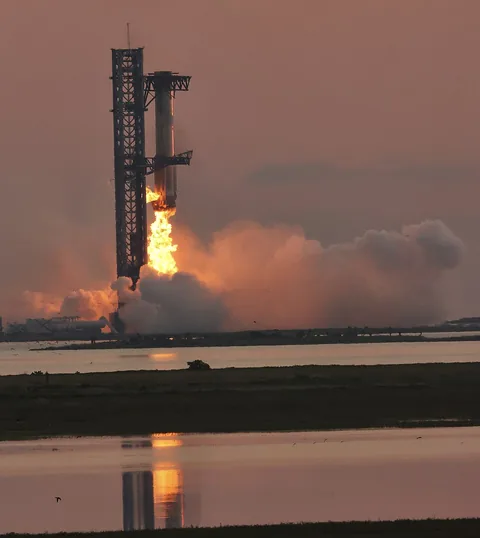
Okay, so this is the Starcloud 3 manufacturing demonstrator. We wanted to get some experience building a primary structure of the scale of our Starcloud 3 vehicle. This vehicle is designed to go through the Pez dispenser door47Pez dispenser — the nickname for the slot in Starship's hull through which Starlink satellites are pushed out one by one, like candies from a Pez dispenser. for Starship. It's around two tons fully loaded, 235 kilowatts, and we can deploy up to 50 of them per Starship launch.
My God. And I've not seen Starship—I have no idea on the scale of that—but you said two of these fit in.
So per layer, you get two of these wide, and then 25 tall.
Oh my God.
So it's, yeah, from here to the ceiling of these stacked inside.
So right now we're in the middle of Starship. We're inside of it.
Yeah. That gives you an idea of the diameter of Starship, the fact that this can fit in there. It's an enormous vehicle.
08Getting a ride to orbit
Getting on a Falcon 9 rideshare used to be easy, but it's winding down before Starship is ready, so Starcloud faces a launch crunch.
How have you guys been launching today? I know you have three launches coming up as well.
So our first launch was with Falcon 9.48Falcon 9 — SpaceX's reusable rocket and the most frequently flown rocket in the world: its first stage lands and flies again. So yeah, a Falcon 9 Rideshare mission.49Rideshare — a shared launch carrying dozens of satellites from different customers, each paying for its own kilograms. SpaceX runs them as the Transporter and Bandwagon missions. Our upcoming launches are all with Falcon. And yeah, it's really hard to beat the benefits and the economics of rideshare when you're producing single missions like we are at the moment. The future is definitely Starship, and that's what we're gearing up for here.
What's the process like for booking a ride?
So booking Rideshare is unbelievably easy. It was actually basically the first thing we did as a company: we booked the launch for Starcloud 1.
Do you have to book it really far in advance? Like, how do you—I mean, you're gunning for getting on the vehicle, but how does that work?
Yeah, so we booked about 21 months in advance. And the initial booking is—you can pay for it with a credit card, you can get a confirmation straight away. Falcon 9 Rideshare is going away, though. So these were the rosy days when it was much easier to get a single payload launched. We're in a transitionary period at the moment, where Falcon 9's being wound down and Starship has yet to be wound up. So we're definitely in a crunch time at the moment when it comes to launch.
What is the process for that, though? Do you need insurance? What happens if it doesn't go to plan?
So insurance is relatively inexpensive for Falcon 9, because it has such a strong track record: 300 consecutive launches without a failure. So you can insure a failure on launch: the rocket explodes, the payload doesn't separate, that kind of thing. It's much more difficult to insure things going wrong with the spacecraft, as this is the first spacecraft of its type to be built. So we got insurance for the launch. And, you know, if something goes wrong, then that can give you a bit of a financial payout.
But what it can't compensate you for is the lost time, which is really the most valuable resource for a fast-moving startup. So yeah, I'm slightly on the fence on the value of insuring payloads, but we'll take it case by case.
We were just at Rocket Lab,50Rocket Lab — Peter Beck's US–New Zealand launch company, second in the US by number of launches after SpaceX. Sourcery made a series about it, with a tour of the company. and we did a tour, we did a series there, and the one topic that keeps on getting delayed is Neutron.51Neutron — Rocket Lab's reusable medium-lift rocket built from carbon composite, designed to carry about 13 tonnes to low Earth orbit; its first launch has been postponed several times. How do you think that will or will not affect the market if and when it starts to be serviceable?
Yeah, I think just yesterday they publicly announced the first flight will be 2027. Composite manufacturing is really hard. I know from personal experience: very large composite structures often take a bit longer than you expect, especially when you're producing them for the first time and you're running the tooling for the first time. I have a lot of faith that Rocket Lab can get Neutron flying regularly. They've proven, you know, 100 launches of Electron,52Electron — Rocket Lab's small launcher for small satellites, flying since 2017. so they can do scale. So yeah, we're definitely rooting for them as well.
09The radiator and the $500-a-kilo math
By Johnston's math, once launch drops below $500 a kilo an orbital data center beats one on the ground, and Starship is designed to go far lower.
All right, so now we're walking around here. You have a motorcycle. We're gonna go look at that.
We can look at it if you want.
Whose is that? That was a joke, by the way.
I think it's Bailey's.
Does that go into space?
Yeah, maybe. Depends how fast they go. I'm permanently terrified that somebody's gonna kill themselves on a motorbike, like half our team.
Yeah, that is a liability.
Yeah, yeah. So this is kind of interesting. This is a half-built zero-gravity offloading rig.53Offloading rig — a frame with hanging trolleys that carries the weight of a deployable panel during ground tests, so gravity doesn't stop it unfolding the way it would in weightlessness. And so we have these runners that run in two axes, and so the deployable for Starcloud 2 runs down—this is one half of it. The other half goes that side. So it's like a 120-foot-long deployable.
Oh my God.
Yeah. So that small package you saw there extends down the length of this on one side, and then down the length of that on the other side.
Oh my God.
Yeah, yeah. And the first few segments of that are radiator segments. That's the radiator we've designed and fabricated in-house. As Adi was mentioning, our design is way more efficient than any other. So when we launch in January, it'll be by far the largest commercial deployable radiator in space, and the nearest comparison is the International Space Station.54International Space Station — it dumps excess heat through large deployable radiators with circulating ammonia, the usual benchmark for any big space radiator.
Our radiator is at least 10 times less mass per watt of dissipation than the ISS radiator, and about 500 times less cost per watt of dissipation than the ISS radiator. Now, the ISS is an easy benchmark to meet on cost, but on mass it's quite an achievement.
One of the biggest topics—and I know we talked about this with Adi—is the economics of this. You are making more economical satellites going out in space, and the vehicle itself. And so that's one thing. And so I'd love to break that down, the economics there, and then also further drill down the difference between on land, like terrestrial data centers, versus orbital.
Yeah. So the whole thing is actually contingent on the launch cost. If the launch cost gets below around $500 a kilo, then it will be much cheaper to do this in space than terrestrially. And I think a good comparison for this is if you build a new solar project on Earth to power a data center, because solar is kind of the cheapest form of energy we have terrestrially. The way you can think about it is solar terrestrially has these three big costs. The biggest cost is the cost of permitted land,55Permitted land — a site that already has all the permits for construction and grid connection; in the US approvals can take years, so such land is expensive. depending where you are. The second biggest cost is the cost of battery storage and backup power. And then the last cost is the cost of the solar cells themselves.
And so in space, number one, we don't need permitted land, so your biggest cost is gone. We don't need batteries and backup power, because we're 24/7 in the sun. And then we need eight times less solar cells, because one square meter of solar panel in space produces about eight times the energy of one in space.56"One in space" — a slip: Johnston means a panel on Earth. In orbit there is no atmosphere, no clouds and no night, so a panel in a dawn-dusk orbit produces several times more energy over a year than the same panel on the ground. So we have all these savings in space. The main additional cost we have is the launch cost. And so that's where this trade-off comes, and when you run those numbers, you come out to about $500 a kilo where it makes more sense to do it in space than terrestrially. And of course, right now with Starship, we're at about $5,000 a kilo.
Source: Harry W. Jones, NASA Ames, "The Recent Large Reduction in Space Launch Cost," 2018
Sorry, with Falcon 9. Starship is designed to produce internal launch costs for SpaceX of sort of $20 to $40 a kilo. So as long as they pass that launch cost through to us at anything less than, say, 10 times their marginal launch cost,57Marginal launch cost — what one more launch costs SpaceX with the rocket already built: propellant, servicing and refurbishing stages, without development costs. or even more, that makes sense for us. Right now, by the way, on Falcon 9, they charge two or three times their marginal launch cost. So it seems reasonable.
10Chip failures and what Starcloud 1 is doing
The real risk, Johnston says, isn't cooling but chip failures, and Starcloud 1 is already running inference on satellite imagery for government customers.
Another thing that I listened to—so I listened to a handful of your interviews—one of the other very concerning points is chips and chip failures. So how does that work into the model?
Yeah, for sure. It's actually a super relevant point. I think it's actually more relevant and pertinent than even cooling, which people think is the biggest challenge. We've basically solved the cooling challenge. The other part of it that we're working on is the radiation shielding and testing all the chips in different particle accelerators,58Accelerator testing. Space radiation — protons and heavy ions — flips bits in memory and can permanently damage transistors. To test a chip, engineers expose it to particle beams at accelerators, compressing years in orbit into hours. to make sure they can survive the radiation environment of space. And the reason we put so much time into that is if the chips have, you know, like a 10 or 20% higher failure rate in space than they do on the ground, then the whole economics of the model fall apart.
And the reason is the chips are by far the most expensive part of what we're doing, actually. And so there's a few ways that you can go around that. Essentially, we're not going to have access to the satellites once they've launched, so they operate a bit like the way the Starlink satellites work, which is you need to have redundancy on critical systems, you know, things like pumps. And then you overprovision things which fail over time. Like the solar panels: you're going to lose a few percent per year, so you slightly overprovision that. And then on the chips, we have a longer burn-in period59Burn-in — running new hardware under load and at elevated temperature for a long time before shipping, to bring out hidden defects. on the ground.
Most chips actually fail in the first period of their life. And so if you can put them through a more rigorous burn-in—
Why is that?
I don't know. They call it infant mortality60Infant mortality — the engineering term for the high failure rate early in a product's life from manufacturing defects; failures then fall for a long time and rise again toward the end of service life. Plotted, it looks like a bathtub, hence the "bathtub curve." of the chips.
Oh no.
Yeah. I know, it sounds kind of terrible. Yeah. So what you want is to get through the infancy period and find out all those failures. So for Starcloud 2, we had a three-month burn-in period. It basically means you run the chips hot for three months, so you can find all those failures early.
It's basically like, yeah, if the chips can survive three months at full power, the chance they have a failure from that point onwards diminishes very dramatically versus the chance they have a failure in the first three months.
So you have five chips up in space right now, including one H100.
What are they doing?
So actually, yes, we have three chips from Nvidia, two from Arm,61Arm — the British company that designs processor architectures and licenses them; Arm cores run almost every smartphone and many server chips. and we also have some CPUs from AMD on Starcloud 1. And what they're doing is—at the moment, we used them to do some interesting workloads, like train the first model in space, nanoGPT62nanoGPT — a small open-source project by Andrej Karpathy, former head of AI at Tesla and an OpenAI founding member: minimal code for training GPT-style language models. On Starcloud-1 it was used to train a small model on the complete works of Shakespeare. from Andrej Karpathy. We did the first run of the first version of Gemini.63Fact-checkStarcloud-1 ran not Gemini but Gemma, Google's open model; asked for its first words from space, it replied, "Greetings, Earthlings!" (GeekWire). But now they're actually doing useful workloads for government customers. So they are mainly in sort of a test phase, but we're doing inference64Inference — running an already trained model: answering queries, recognizing images, analyzing data. Unlike training, it can be spread across many small machines. on satellite imagery: on synthetic aperture radar65Synthetic aperture radar (SAR) — a satellite radar that builds images from reflected radio waves, so it can see through clouds and at night. data, on hyperspectral data.66Hyperspectral imaging — pictures in hundreds of narrow spectral bands instead of three colors, which can tell apart materials, vegetation, minerals and camouflage. So we will actually do an announcement about some of the results of this, but we've got some very interesting results. And the use case for that is: let's say the government has a bunch of military satellites. They collect enormous amounts of mostly imagery, but also other types of data.
They don't want to have to wait for a ground station to downlink all of that data. So if they can run inference on that at the edge,67At the edge — computing where the data is produced rather than in a distant data center; here, right in orbit. we can then send down the insight much quicker. For example, if they're monitoring a patch of water, they might want to know: is there a vessel crossing some boundary? At the moment, what they do is they take an enormous amount of imagery, and then they have to wait at least an hour and a half to get to a ground station, and then they try and downlink as much as they can, but that's usually not very much. Once we're in space, we have a bunch of optical terminals on our satellite. In real time, they can send data to us, we can then run the inference workloads on our satellite, and then we can downlink the coordinates of a vessel, for example, in minutes rather than hours and days, which is the current way that this works.
1188,000 satellites and 10 terawatts
Orbit catches up with Earth once Starship sells capacity, and then, Johnston says, one sun-synchronous orbit can hold 10 terawatts of compute.
That's wild. Oh my gosh. So the initial use cases for these satellites, and what they're doing right now, are satellite operators and that kind of data. When do you think it'll reach outward into other parts of the economy?
Yeah. So it's entirely dependent on the launch cost hitting 500 bucks a kilo. The business as it is today runs, you know, economically with the current launch price. In order to be competitive with terrestrial data centers on energy and infrastructure cost, that's where we need the launch cost to be 500 bucks a kilo or less. My expectation is that—we've already seen Starship deploying its first payloads. We'll see reusability of Starship probably within a year, or at least we'll see the capture of the upper stage;68Catching the upper stage. Since October 2024 SpaceX has caught Starship's first stage, Super Heavy, with the "arms" of the launch tower; the next step is to catch and reuse the second stage, the Starship vehicle itself. reflight might take a little bit longer. And then 2028 onwards, we're hoping to see SpaceX selling capacity to commercial customers. You know, if they don't, we are also considering other options, and so we've booked on a bunch of different other launch vehicles, not just Falcon 9, but also some others.
I think we announced Stoke69Stoke Space — a rocket startup from Kent, Washington, founded by Blue Origin alumni; it is building the fully reusable Nova rocket. already, we announced Firefly,70Firefly Aerospace — an American space company from Texas that makes the Alpha small launcher and Blue Ghost lunar landers. and we'll announce some others soon.
Congrats.
Yeah.
Well, if the goal on Earth is to get to a one-gigawatt facility, a five-gigawatt facility, what is realistic for space, and what does that look like in mass?
Yeah. So very large data centers on Earth are usually used for training large models. You need a very highly internally networked cluster to train a frontier model. In space, for a long time, we're probably not going to be docking together things. And so most of the workloads we're going to be doing in space is running inference. And that's usually for things like coding agents and back-office business processing agents and ChatGPT queries. So the roadmap is we launch a bunch of things like this.
So the 200-kilowatt one, we can launch 50 per Starship. So you're talking about close to 10 kilowatts—sorry, 10 megawatts—of new compute capacity per Starship launch. And we've filed with the SEC71Fact-checkStarcloud filed its application for an 88,000-satellite constellation not with the SEC (Securities and Exchange Commission) but with the FCC, the Federal Communications Commission, which assigns radio spectrum and licenses satellites; the FCC accepted it for filing on March 13, 2026 (Advanced Television). for a constellation of 88,000 of those.
That's crazy.
Yeah. And that's just the first 88,000.
So that's the first 88,000.
I mean, we're not stopping there. So that enables us to deploy the first 20 gigawatts. We think we can fit about 10 terawatts in this dawn-dusk sun-synchronous orbit. So that's about 20 times the entire US power grid.7220 times the US grid. The US generates about 4,200 terawatt-hours of electricity a year, an average of about 480 gigawatts; 10 terawatts is roughly 20 times that. And then once we run out of that, we can go to cislunar, MEO, beyond GEO and to the Lagrange points.73Cislunar space, MEO, GEO and the Lagrange points — the next "floors" above low orbit: medium Earth orbit (MEO) runs from about 2,000 to 36,000 km and hosts navigation satellites; geostationary orbit (GEO) is at about 36,000 km; Lagrange points are spots where the gravity of the Earth and Sun (or Moon) balances out and a spacecraft can stay with very little fuel. And essentially, if you want to scale much more compute, then you really need to do it in space.
So will we have access to sunlight on Earth if we have so many solar panels up?
Yes. And the reason is—
Because I saw—was it Starcloud 3?—
It's four square kilometers74Four square kilometers. Starcloud's 2024 white paper describes a 5-gigawatt orbital data center with solar panels and radiators about 4 by 4 km. in orbit.
What is that?
ExplainerWhy satellites in a dawn-dusk orbit don't block the Sun
A sun-synchronous orbit is nearly polar: the satellite passes over the poles a few hundred kilometers up. Because the Earth bulges slightly at the equator, the plane of such an orbit slowly turns, about one degree a day, exactly keeping pace with the Earth's yearly trip around the Sun. So the angle between the orbit and the direction of the Sun stays the same all year.
Line that plane up with the terminator, the boundary between day and night, and you get a dawn-dusk orbit: the satellite always flies over places where it is morning or evening. For it the Sun almost never sets — it dips into the Earth's shadow only briefly and only in some seasons — so it barely needs batteries. And because it sees the Sun off to the side of the Earth, its panels never sit between the Sun and the Earth and cast no shadow on it.
These are the orbits, 600–850 km up, that Starcloud named in its filing for 88,000 satellites.
Yes. Starcloud 3—it will take a while before we start docking together these large structures, but even when we do, they won't ever cast a shadow on the Earth. And the reason is they're flying over the poles. So if this is the sun here, and this is Earth, Earth spinning on its axis, they fly over the poles like this. And so the Earth will never create a shadow on our satellite, and our satellite will never create a shadow on Earth. So they never go behind or in front of Earth, basically.
The more you know, the more you know.
Science.
12The vibe table in action
The vibe table proves a satellite won't shed parts or rock its neighbors on a shared launch, and SpaceX wants the reports.
So, Philip, we're back at the vibe table, and we're about to do some testing. Do you want to explain this?
Yeah. So we need to simulate the launch environment. In order for SpaceX to allow us to launch on a rocket with multiple tenants, they want to make sure both that nothing's going to fly off from any individual satellite in launch, but also they don't want any satellite to resonate at a certain frequency, which throws the whole stack off. And so the point of the vibe table is to put the satellite through every different frequency and amplitude that the satellite is going to experience during launch, and also this shock test, so that we make sure nothing flies off, and we also make sure that we don't have resonance at a certain frequency.
How long do you run it for?
It depends on the test, but the launch environment itself is about seven minutes. And so there are some tests we would run for a few minutes. Most tests we run for a shorter period. What they call random vibe we run a bit longer, but the shock test we run for shorter.
Have you ever sat on a vibe table?
I've never sat on that, I have to say. Yeah, people—
I've touched them before, but—
Oh yeah.
We were at Zipline,75Zipline — an American company that delivers medicines, blood and shopping by drone; Sourcery filmed a tour there too. and we went into their testing room, and they had a vibe table and these, like, RC fans to test the drones with, and they would fly them in front of it and see if anything would, you know, get fragile or break, if there were any, like, fractures. And it ended up just being me walking through RC fans.
No way.
Which is—I think they go, like, 80 miles an hour.
Yeah.
Crazy. Oh, there you go.
So this is a very low-frequency test. We're doing it at low frequency mainly so that you can see what it looks like when it moves. When it moves faster, basically you won't be able to see it moving. That's if they're moving at least 50 hertz, so 50 times back and forth per second. And this is basically a huge solenoid,76Solenoid — a current-carrying coil that acts as an electromagnet. A vibe table works like a giant loudspeaker: alternating current in the coil pushes the table back and forth. so a huge magnet that's pulling this thing in and out. It's basically speeding up now.
So the hardware we have on the table at the moment is part of our thermal management system, called the accumulator.77Accumulator — a vessel that takes up the extra volume of liquid as it expands with heat and holds the pressure in a closed loop. So we have liquid cooling on Starcloud 2 and all of our future vehicles. As the liquid heats up, it wants to expand, and so you have to have a component which allows that expansion to take place; otherwise you'll burst your cooling system. So that's what the accumulator does: it allows for that thermal expansion of the fluid, to manage the pressure inside the cooling system. And that's what we have on the table right now: the accumulator for Starcloud 2.
Yeah.
We could—
Yeah, go for it.
Yeah, yeah. There you go.
Oh my God. That's crazy.
Yeah. So right now the test it's doing is what's called a sine sweep.78Sine sweep — a test in which the table glides through every frequency from low to high to find where the structure resonates. It's where we're going to go through every different frequency and amplitude that the satellite will experience during launch. So it starts very low frequency. We're doing this low frequency—normally we wouldn't even start this low, but we wanted to be able to see that it's moving here. As it gets faster and faster, you won't really be able to see it moving.
What is the worst thing that a vibe table has done?
The worst thing that a vibe table—
Has a vibe table, like, ever—like, has a magnet shot out or anything?
No, the actual vibe tables themselves are pretty safe. The worst thing that can happen with a vibe table is whatever you're testing can explode. So, for example, underneath Starcloud 2 we have this xenon tank79Xenon — an inert gas used as propellant for electric thrusters; it is stored in the tank at hundreds of atmospheres. for the thrusters, and if the xenon tank explodes, it's about half the explosive power of a hand grenade. So—
That's awesome. That's really good to know.
Yeah. Okay, that's why we're not doing that test today.
Yeah. So does everyone leave the building when you test that?
Literally everybody leaves the building. So we put this entire satellite on this. By the way, you can see it's in two axes, so the solenoid actually can flip up, and we can test it like this, so that we can test in different axes. But yeah, when we fire that test up, everybody has to leave the building.
I doubt the toy manufacturer that has storage across the street has any idea what's going on in here.
They have no idea. But they are far enough away that we know that they're good, they're safe.
Yeah. Like, why is everyone running out?
Yeah, yeah.
That's first mode.
ExplainerHow a satellite is tested on a vibe table
During launch a rocket shakes its payload: running engines, acoustic roar, g-loads, jolts at stage separation and satellite release. To make sure no spacecraft on a shared launch breaks apart or shakes its neighbors, the launch provider requires ground tests and reports.
The tests run on a vibe table, essentially a huge loudspeaker: an electromagnet pushes a table with the spacecraft bolted to it. A sine sweep slowly takes the frequency from a few hertz to a hundred or more, hunting for resonances. Random vibration is noise across all frequencies at once, as in a real launch. A shock test mimics the sharp jolts of separation.
The key thing is the first natural mode, the lowest frequency at which the structure starts to sway on its own. Launch providers require it to be above a set threshold so the satellite won't resonate with the rocket. The tests are repeated along all three axes, turning the table or the spacecraft.
So what they're testing for is this first mode.80First mode — a structure's lowest natural frequency, where it most readily resonates. Launch providers require a satellite's first mode to be above a threshold so it won't rock along with the rocket. It's the first frequency at which it's resonating, and when you can hear it making this clicking sound, that means we've hit the first mode of this thing here. What SpaceX requires is that you don't have a first mode below a certain frequency. I think it's around 40 hertz. So it cannot resonate at anything less than 40 times a second. And the reason for that is, let's say it would resonate at, like, twice a second, then the whole thing's going to go like this, back and forth, and that will move all the other payloads in the stack.
That's a really good point. So what is the process to get your spacecraft, or any kind of components, up into space—tested to make sure that it's viable for Falcon 9 or Starship?
Yeah. So as Ezra mentioned, booking is just putting your credit card down, but then that kicks off a whole long process, both regulatory—we have to file with the FCC81FCC (Federal Communications Commission) — the US radio and telecom regulator: it licenses spectrum and satellite constellations and requires a plan to deorbit each satellite at the end of its life. for the orbit and for the spectrum we're going to use, and we have to have a deorbit procedure and all of these kinds of things—and then SpaceX has a whole laundry list of requirements, mainly, to be honest, to make sure that your spacecraft isn't going to destroy any other spacecraft on the stack. So if you book a fully dedicated Falcon 9, the requirements are less stringent than if you're booking a rideshare, because they need to make sure you're not going to move the whole stack, or you're not going to have things flying off and killing other spacecraft.
Damn. So how do they actually verify your approvals?
So we have to do vibe, and then we send them the vibe reports after we've done the vibe testing.
Does anybody ever lie?
I don't think so. It would be quite hard to lie. I mean, reproducing these vibe reports would be quite a challenge.
I don't know why you would do that, unless you're an op.
Unless you're an op.
Unless you're an op.
There you go.
Jeez, I think we just uncovered something. Okay, cool.
AdMercor, VCX, Public, Deel
How good is AI at real professional work? Mercor's AI Productivity Index, or APEX,hAPEX (AI Productivity Index) — Mercor's index of how well frontier models handle the work of lawyers, bankers, consultants and doctors. tracks it with every major frontier model release, built with partners like Harvey and Cognition. See where the frontier actually stands at mercor.com/apex.
Today's episode is sponsored by VCX by Fundrise,iVCX — a Fundrise closed-end fund whose shares trade on the stock exchange, giving investors a stake in a portfolio of private tech companies. the public ticker for private tech, allowing investors of all sizes to invest in venture capital. Learn more at getvcx.com.
Public is a multi-asset investing platform where you can automate your investing with AI agents. Create your own custom agent with a simple prompt. Agents can monitor markets, execute trading strategies and manage your cash across stocks, bonds, options, crypto and more. Want to buy at market close and sell the next day's open? Just tell your agent. Automate your investing at public.com.
Founders scale faster on Deel. Set up payroll for any country in minutes, hire anyone anywhere, get visas handled fast and get back to building. Visit deel.com/sourcery. That's D-E-E-L dot com slash sourcery.
13The laser lab and Molly at the welder
Starcloud keeps its team lean, and Molly, who bragged about her welding, earns a "solid five" from Miguel Rivera.
All right, so we're walking on through to the laser lab. How many people work at Starcloud?
Right now it's 30 people at Starcloud.
Wow, that's it.
That's it, yeah, yeah.
Oh my God.
30, only two non-engineers. And so we'll probably have 50 by the end of the year, maybe 100 by the end of next year, but we very deliberately—oh, there's Camilo—very deliberately keep the team extremely lean. As I say, we have, like, the most kick-ass engineering team on planet Earth. This will become a full laser lab, so we'll use this for cutting and welding of aluminum and things. We just want to show you—we have a little demo for you.
Make things go zap.
Yeah, yeah. This is Camilo, who's—
Do we want to give you a mic and you can talk through it, or do you want to talk?
I can just do the—yeah, yeah. You can have a little watch demo. So this is our CNC xTool82xTool — a Chinese maker of compact laser machines for workshops, prototyping and hobbyists. laser cutter. We use this to do quick prototyping on different types of materials. It just gives us a lot of flexibility for getting things done as fast as possible. So right now I have a little demo with some 30-thou stainless. Sorry for the compressor, a little loud. But you'll see just how fast and how quick this can do very complex cuts, and it's extremely accurate. So, run a quick demo here.
If you want to get the camera in there, you can probably—here.
You can go in there. Yeah. All right, ready to go.
Fire.
You'll see it here.
Oh my God, it's so cute.
It's a little present for you.
That's awesome.
I got some here that are ready.
Oh my God.
So stuff like this helps us a lot to move quickly, and it gives a lot of flexibility. And this is just a start. We're gonna get much larger professional machines.
Wow. Is this your favorite tool, or one of them?
One of them. The next one's gonna be my favorite.
What is it?
It's gonna be an Amada83Amada — a Japanese maker of sheet-metal machinery, one of the largest in the world. fiber laser cutter, so that we can fit material that's up to, I believe, five by ten feet. So it's a professional-grade laser cutter. It's gonna be significantly more capable than this one is.
Damn. That's fun. Thank you.
And as I understand, you yourself—
Oh, really? Okay, I get to keep it.
I can take it if you want me to put it in my pocket.
Here, I'll give it to Brett. All right, so we walked through fab shop, assembly area, laser.
We'll be assembling a clean room,84Clean room — a room with filtered air and dust control where sensitive hardware, including satellites, is assembled. which I don't think we showed you, but that's on the other side. But as I understand, you yourself are actually a proficient welder. Is that true?
I made a very bold claim, but I did learn how to weld in college.
I think we should put this to the test. I think your viewers would find this very exciting.
I am down to try. I was called a prodigy, so we'll see.
Still the case? We'll find out. We'll find out. So we have some welding materials back here. Shall we get you in?
Sure. Do I have to change?
Yeah, you need to change.
All right, we've now advanced. We're now with Miguel, the engineering operations lead here at Starcloud. What are you gonna show us today, and what's your background?
Yeah, so we're gonna do a little bit of welding, just traditional welding. We do a lot of laser welding here at Starcloud, but we can also fabricate pretty much anything out of steel, aluminum, titanium, stainless steel. So we're set up for doing MIG welding right now, so we're gonna have you run some beads and make some sparks. And yeah, before here, I was the welder for Helion Energy,85Helion Energy — a startup from Everett, Washington, building fusion power plants; in 2023 it signed a deal to supply Microsoft with electricity from 2028. Sam Altman is a major investor. where we built fusion generators. I ran their fabrication shop over there for over a year. And before that, I've been working at a lot of different fab shops, doing architectural, structural welding and fabrication.
And before that, I spent a decade in the US Army.
Oh my God. How did you get into welding?
I wanted to do something very different. I wanted to do something that was, you know, neutral, in the sense that I was contributing to society in a different way. So I decided to get into fabrication and welding after listening to Mike Rowe,86Mike Rowe — American TV host; his mikeroweWORKS Foundation gives scholarships to people training for skilled trades, and he has long argued that America needs welders, electricians and plumbers, not just college graduates. the guy from Dirty Jobs.87Dirty Jobs — the Discovery show, since 2005, in which Mike Rowe tries the toughest and least glamorous occupations. He said, you know, the United States really needs welders, and it needs people to build stuff with their hands. And I was like, well, I can build stuff with my hands. So that led me to this career path, which has been very rewarding.
It's very satisfying.
Yeah, it's a lot of fun. A little addicting. Yes, a lot of fun. A lot of fun.
That sounds like you. You posted recently on X. Somebody was like, America needs more welders, and you're, like, posting shit about how good you are at welding. So now we're gonna find out. Now we're gonna find out.
Now we're gonna find out. I used to be very good. So, for background—this is, like, not at all in this world—but I went to college for studio art. Like, I grew up as an artist, and I was also very entrepreneurial, so I ended up going that path. But I went to college for art, and so the first year of studio art, you do every discipline, every practice. And one of them—we went and we did metalwork, woodwork, glassblowing...
Nice.
All of the fun flame stuff. Like, it was so fun. And then I'm like, well, making this for fun isn't really a job, you know? Like, you might as well be doing that at trade school. So, like, I don't really understand that, but it was so much fun, and I was called a prodigy, so—
We will see. We're about to find out. So what we're gonna do is we're gonna give you a little bit of PPE. The sparks can burn you, so just put this jacket on, and we're gonna give you some—
Should I tie my hair back?
If you keep it in the jacket—as long as it's behind you, you're fine. And make sure that you button at least a couple of the buttons. As long as you have all this on, closed-toe shoes, you'll be just fine. If you feel anything hot, just stop and step back, but you should be perfectly fine.
Yeah, I remember we weren't allowed to wear any polyester.88Polyester is dangerous when welding: synthetic fabric melts from sparks and sticks to the skin, so welders wear cotton, wool or leather.
Yeah. Perfect. And then you can do your sleeves as well.
You haven't done any of this? Why?
Busy guy. He's never here. Traveling the world.
It's true. He's always on stage somewhere. Why aren't you in the shop?
So we'll have you put this on first. The way you put it on, it goes over your head, and you click this, and then you can leave this up, right? Then when it's time to weld, you can put it down. You can see through it just fine. And the second that you start welding, it'll auto-darken.89Auto-darkening helmet — a welding helmet whose filter darkens within a fraction of a millisecond when the arc strikes and stays clear the rest of the time. So you don't have to worry about doing anything.
All you have to do is put it on, crank this down, and you'll be ready to go. Yeah, do this one first. Yep. I'm gonna do the same. I'm gonna put on some PPE.
Do you have, like, any kind of glass? I'm gonna be quite far back.
You can use the same one right there.
This one?
Yep, you can put that on.
Who is she?
Very nice.
That one my hand skipped a little bit.
Yep, that's fine. Still counts. We can do one more if you want.
Okay, one more. All right, last one. This is the one that counts.
All right. Stay nice and tight.
Closer.
Nice.
You're hired.
Not bad.
Bam. Let's go. Nice.
America needs welders.
Nice job.
Cool. Thank you, Miguel.
You're very welcome.
This was so much fun. That's my real reaction.
So on a scale of one to ten, like, what are we talking about?
You're a solid five.
Wow! That's amazing. Damn!
Oh, there you go.
That's right. We do. That's great. Cool, thank you.
They just lifted the satellite. I don't know if you want to—maybe it's too late to get footage of that, but if you want, we just—
Well, yeah, let's go over there. So we just did the welding and crushed it.
I'm a five.
He didn't say out of ten. It could be out of five.
He did say out of ten.
Did he?
I thought he said, "You're a solid five."
Did he?
Okay, okay, okay.
14Engineers on the floor and Bailey Montaño
Starcloud's engineers spend half their time on the hardware, and engineering manager Bailey Montaño designed and built the hardest part, the radiators.
It's like, damn, that's pretty good. Okay, but I was wondering, like, how does the flow change of how many people are working on the floor versus up in the offices through the different stages and processes of building out Starcloud 2?
Yeah. So actually most people you can see are engineering, and we have all the engineers make sure that they are hands-on with the satellite as well. So half the time these people will be upstairs designing stuff in CAD;90CAD (computer-aided design) — 3D modeling software for parts and structures, such as SolidWorks or Siemens NX. the other half of the time, they're down here fiddling with wires and testing stuff. We also have a technician team—that was Miguel. We've got four technicians, some more coming on soon. Maybe five now. I don't want to get it wrong.
And their job is, like, welding and fabrication, actually producing the satellite. So yeah, Miguel's team—the whole compute module here is an aluminum box that they produced and fabricated in-house.
And I am contributing.
You are contributing a huge amount.
Whenever you need me, let me know. I can come on.
For your listeners, it is official: you have now done more welding at Starcloud than I have.
Wow. You gotta really visit Miguel. I think he's waiting for you to put in some work. Yeah. You're not doing enough. Bailey, tell us a little bit about yourself. I know we're in front of Starcloud 2, and something just happened, and you guys are testing things, but we'd love to learn more about you and how you contributed.
So I'm the engineering manager here at Starcloud. And what we're doing right now is a leak check91Leak check — after the vibration test, the fueled propulsion system is checked for leaks: the xenon is under high pressure, and even a hairline crack would empty the tank over months in orbit. of the prop system. So right now we have a fully fueled electric propulsion system, an ion thruster, and we are testing it after vibe, to make sure that we didn't introduce any cracks or other leaks during the vibe test.
How did you come here? How did you get to Starcloud?
It was a bit of a long journey. So I started my career at SpaceX in aerospace. I spent about four years there. Then I did a couple other side quests, in, like, biotech and consumer product design. Those didn't really stick. Moved on to fusion energy, which was really cool, but at the end of that three-year stint, I realized I'm a space nerd; I need to be working on space to be happy.
And fortunately, living in Seattle, there's a ton of cool companies in the area. But Starcloud really stuck out. Back then they had a different name.92A different name. Until March 2025 Starcloud was called Lumen Orbit; it renamed after a complaint from the telecom company Lumen Technologies. And I got in contact with the founders super early on, and the rest is history.
What's your favorite thing about Philip?
You can't do that. You can't do that. What's the least favorite thing?
Yeah, what do you hate about him? What's your least favorite thing?
We don't say hate.
What's your biggest challenge with Philip over here? Does he not give you enough attention? What's going on?
No, definitely not. Let's work this out on camera. It's a two-sided coin or whatever, but, like, the office is very busy with tours and things like that all the time.
We gotta go. There you go. There you go. There you go. It's good and bad. That was the politest way to tell you to fuck off.
My God. Damn, Bailey, give me the mic. Oh, that's funny. Okay, so what are you most looking forward to? What is your favorite part of the process?
I think the next thing I'm looking forward to most is obviously the launch, for sure. I'm going to be tremendously proud of this. Like, a lot of blood, sweat and literal tears into this thing. As far as the whole design process goes, I would say the test is kind of my favorite part. That's where the rubber really hits the road. So this recent vibration test was a really big one.
And then the cooling system was another big one. Back when we were in Colorado, not long ago, that was our first, like, full-up integrated test of the whole cooling system, which was kind of, like, my baby from day one. So it was really cool to see that up and running too.
So everybody always asks about what the hardest thing about Starcloud is, and it's the thermal system, these radiators in particular. And Bailey was responsible for designing and fabricating the radiators. And also, Bailey is responsible for the satellite being here. In the end state, we only had three weeks to do the final assembly of the satellite, and Bailey went down and basically built that bus93Bus — the satellite's "chassis": structure, power, attitude control, communications and propulsion, onto which the payload — here, the compute module — is mounted. from scratch.
Damn.
That was fun.
Where'd you build it?
In Colorado, in our bus provider's office.
15A new campus and satellites on trucks
Starcloud is building a campus where satellites will roll down a line like Teslas, up to a hundred a week.
Oh my God. All right, so we're just leaving the main facility. We're now going over here.
Yeah, we're gonna go to—
You're buying up the entire—
We're building a bit of a campus here. This is definitely the place we need to be to build AI satellites, basically. So we've got now this middle section, where this will come online in November, and then we have access to the third one in February next year. And so this enables us to scale manufacturing for Starcloud 3. And the reason we need so much space—one of the reasons—is you have 100-meter, almost 400-foot deployables on Starcloud 3 that we need to test the mechanisms on. But also, to manufacture something like 88,000, you know, we're gonna need a way bigger facility.
I'm so sorry. To manufacture 88,000?
Okay, yeah, yeah. To manufacture 88,000, we're gonna need a whole bunch more space.
So how many do you think you'll be able to produce a day?
So we'll be up to 100 a week from what we've got here. So 10 a day, or more than 10 a day after. So this is one of the three spaces, and so we've got about a hundred thousand square foot that we can fit out for manufacturing. So we're gonna remove this wall, and we'll remove that wall, and then that enables us to—
This is huge. Oh my God.
Yeah, it's gonna be quite a sight to behold when this is up.
You should throw a Halloween party in here.
Yeah, we'll do an opening party sometime soon. So you're very much welcome, but I know you're on the road all the time, so—
You never know where I land.
Who knows? Maybe Woodinville94Woodinville — a small town next to Redmond known for its wineries. in three weeks.
Okay, so in here it's gonna look much different than the previous—
It will look pretty similar actually to the previous one, except with a manufacturing line. Like, in the end state, we want it to be like an auto manufacturing line. So when you see a Tesla factory, you see cars going down a line—it'll be exactly like that, except with Starcloud 3 chassis going down the line, with various things being added.
Okay, so this is a crazy question. How does Starcloud 3 get to Starship?
We load them on the back of a truck and then drive them down the motorway. That's it. That's it, yeah. It's very similar to the way—at the moment, just down the road from here is where the full Starlink facility95The Starlink factory — SpaceX's satellite production site in Redmond; satellites are trucked from there to launch sites in Florida and California. is. So they literally load all those on the back of a truck and then drive them across the country to Florida.
16Money, security and a January launch
The $450 million raised goes to launch slots and manufacturing, and shooting down a satellite, Johnston says, is harder than blowing up a ground data center.
Damn. Yeah. Okay, wow. All right, so one thing we haven't talked about yet is Starcloud has raised $450 million96$450 million — including $170 million in a round led by Benchmark and EQT Ventures in March 2026 and $250 million at a $2.3 billion valuation in August. in total. What are you using the money for? How is the capital being utilized?
Yeah. Well, right now, launch is very constrained, especially from 2028, 2029 onwards. So a portion of that cash is going to reserving launch slots. A bunch of it's going to fitting out these places, and then hiring and materials and everything else. Yeah, we're making about a million dollars a week on interest right now.
Oh my God.
A million dollars a month, sorry, in interest. But soon we'll be spending.
Brex has a really good treasury product.97Brex is a Sourcery sponsor; its ads run in this episode. A treasury product is an account where a company's idle cash earns a return, for example through money market funds.
We do use Brex, actually, and they do have a great treasury product. So there you go.
I know. I get a good interest on that.
There you go. Yeah.
So one major thing that has been a topic of discussion, as global competition heats up and satellites become the greatest asset for national security, is: what happens if someone tries to shoot it down, or our adversaries get in contact with it, or maybe there's a listening device? Apparently there was one at OpenAI. So how do you think through the national security concerns when it comes to chips and data centers in space?
Yeah. So it's a great point, and one we think a lot about. It's actually a lot harder to shoot down a satellite than it is to, for example, blow up a data center in Virginia,98Virginia data centers. Loudoun County in the north of the state, "Data Center Alley," is the world's largest cluster of data centers, carrying a large share of global internet traffic. which is surprising. And the reason is satellites are traveling at about 17,000 miles an hour. And so to target and have some kind of kinetic impact on a satellite at that speed is very difficult. And we have a pretty good case study, actually, from the Starlink satellites. So Starlink is being used in Ukraine,99Starlink in Ukraine. Since 2022 Starlink has been the main front-line communications link for the Ukrainian army; Russia has tried to jam it with electronic warfare. and also Starshield,100Starshield — SpaceX's military unit and satellite line for the US government: secure communications, reconnaissance and surveillance. and it's not like the Russians are particularly happy about that. And so, both in terms of cyber and in terms of the physical security of satellites, we can kind of see the tactics people are using already on Starship—sorry, on Starlink.
And so, yeah, we're using the same kind of cryptography for making sure that the satellites are secure from that perspective. And then, anything that approaches a satellite would be very visible. So anything bigger than a one-inch cube you could track in space. And so we would see if somebody was tampering with our satellites, and it would be considered an act of war. You know, there's this Outer Space Treaty,101Outer Space Treaty — the 1967 foundation of international space law: it bans placing nuclear weapons in orbit and claiming celestial bodies, and makes states responsible for their spacecraft. which governs what you can and can't do, and that would be considered an act of war on the US. And that's the purpose—the primary purpose—of Space Force.102US Space Force — the military branch created in December 2019 to run military satellites, track objects in orbit and protect American spacecraft.
One of the key purposes is to—you know, they're developing interceptors and things to dissuade offensive action.
So as we just finished walking through the HQ, seeing the tracking of Starcloud 1, the development of Starcloud 2 and some of the early innings of Starcloud 3: what are you most looking forward to in the next 12 months?
Definitely the thing I'm most looking forward to is the launch of Starcloud 2. So that's going to happen in January, and it's going to be a huge proof point for the radiators and everything else we've designed on there.
Exciting. Well, thank you so much, Philip.
Thanks so much for coming. Cool.
Hey, it's Molly. If you enjoy our interviews, check out our newsletter, sourcery.vc, where we deliver a once-a-week top deals and tech headlines email, and also go deeper on our podcast interviews. Subscribe to Sourcery today. And don't forget to subscribe to the podcast on YouTube, Spotify, Apple, or wherever you listen. Link in description to sign up.


