

Core Memory
Chapters
Stephenson's new book D continues his Bomb Light series about the 1930s physics that led to the bomb, and it is as much an espionage and action story as a physics one.
Read the chapter- Bomb Light will probably run to three books, Stephenson says, and D picks up pretty much where Polostan left off.
- Stephenson is interested in the mid- to late-1930s work in Europe that teed up the Manhattan Project before Oppenheimer and Groves.
- The nuclear discoveries happened, by pure coincidence, alongside the rise of the Nazis and the start of the war, which makes the book an espionage story too.
Stephenson doesn't mind book tours: they're short, the publisher organizes them, and they're a win for everyone.
Read the chapter- Stephenson only has to tour for about two weeks every two or three years, and the publisher makes it easy.
- Instead of driving city to city with books in the trunk, he says, publishers now cram as many events as possible at key stores into two weeks to push the book up the bestseller list.
- For bookstore staff in a low-paying job, an author event is one of the perks, and Stephenson has twice been Andy Weir's interlocutor in Seattle.
Stephenson was slow to see that something real is happening with AI, but he doesn't buy the singularity: he's an S-curve guy.
Read the chapter- For decades, Stephenson says, AI meant something that didn't quite work yet, and now that it does he has belatedly started using it, though not for writing.
- A writer becomes an instant expert on a book's subject and then walks away, so people expect him to know things he stopped following 30 years ago.
- The only technology Stephenson can name that never hit a ceiling is nuclear weapons, from tabletop experiments to hydrogen bombs in about 15 years, and he assumes AI will flatten into an S-curve like everything else.
- The curve feels steep right now, Stephenson says, because whole swaths of the economy see their jobs becoming obsolete.
Vance sees the AI labs as more powerful than governments, and Stephenson boils the debate down to a dilemma that his novel turned out to be about.
Read the chapter- The heads of four or five labs, Vance says, seem to hate each other and, as in Lord of the Rings, chase a ring they are deeply afraid of.
- Tesla's charging network and SpaceX's rockets were already doing what governments used to do, Vance notes, and he doubts the US government could build data centers at the labs' scale.
- Stephenson frames the dilemma as taking the foot off the gas and letting China get it, or keeping the pedal to the metal, and says D, to his surprise, turned out to be about the same question.
The 1940 story, as Stephenson tells it, mirrors today's AI race with China: the paranoia proved unnecessary, but nobody could know that at the time.
Read the chapter- The German reactor design, Stephenson explains, was uranium cubes suspended in a vat of heavy water that slows down the neutrons.
- In February 1940 the head of IG Farben asked to buy all the heavy water from the only plant in the world that made it, in Norway, and banker Jacques Allier alerted French intelligence and by March was evacuating the stock from under the Germans' noses.
- After overrunning Belgium, the Germans ordered all the uranium they could get from the Belgian Congo mines, leaving Allied intelligence only one conclusion and setting off the Manhattan Project.
- The Germans never came anywhere near a bomb, but you couldn't know that mid-war, and Stephenson says the same goes for China and AI.
Vance asks about the unflattering films on Zuckerberg, Altman and Musk, and Stephenson declines to pass judgment, pointing to fiduciary duty.
Read the chapter- The head of a big company, Stephenson says, is legally bound to pay investors back, or the board will replace him, unless he has special shares.
- Such decisions are made on business grounds, not highfalutin ethics, and these people, in Stephenson's words, may not be amoral but gotta do what they gotta do.
- Stephenson has no special insight into China, while Vance is convinced China will lead the technological future.
Brain-computer interfaces leave Stephenson cold because he sees thinking as something the whole body does, and he worries about other things entirely.
Read the chapter- Everything that makes Stephenson happy is about translating concepts into words, and the interface of letters on a page is enough for him.
- He writes with a fountain pen, and to him the motor cortex and the hand are part of thinking, not a dumb chunk of meat attached to the brain.
- Caitlin Clark and Michael Jordan stick their tongues out at moments of maximum concentration, and Stephenson wonders whether repurposing the tongue for speech helped humans lap other animals in brain complexity, while a BCI would bypass it.
- Vance, who is filming a Neuralink documentary, dreams of sharing experiences directly as in Arrival, and Stephenson warns of a world where you hit the pleasure lever over and over like a monkey.
- The two big problems that scare Stephenson are too much carbon in the atmosphere and people being unable to agree on what is real.
The tech world keeps asking for inspiring science fiction, but dystopias are cheaper to film and positive futures take real imagination.
Read the chapter- Arizona State president Michael Crow chided science fiction writers for sad dystopian garbage, which led to the Hieroglyph anthology, where Stephenson wrote about a tall tower.
- Tech investors keep asking Stephenson how to foster inspiring science fiction, and he recently judged an XPRIZE competition for films showing AI in a more encouraging light.
- Stephenson's theory is that the big bang of dystopias was the last shot of Planet of the Apes, a toppled Statue of Liberty that made a powerful but very cheap image.
- A positive future, Stephenson says, takes hard imagining, the kind that went into creating Star Trek.
Stephenson thinks Snow Crash was lucky to escape adaptation, since graphics kept overtaking every plan.
Read the chapter- A Snow Crash movie made in 1995, 2000 or 2005 would look dated today, Stephenson says, the way the original Tron does.
- One idea was to shoot the Metaverse straight and signal that it was computer-generated, and now graphics really are indistinguishable from photography.
- The rights have long been at Paramount, now Paramount Skydance, which eventually bought them, and Bezos, Stephenson says, delegates such decisions to the people running his organizations.
Stephenson's startup Whenere lets fans tell their own stories in favorite worlds instead of waiting for Hollywood.
Read the chapter- Fans, Stephenson says, wait years for Hollywood to disgorge something and then hate the result, from Rings of Power to the last season of Game of Thrones.
- Whenere doesn't use gen AI video: worlds run in Unreal Editor for Fortnite, pixels are rendered on game hardware, and AI helps write scripts and power non-player characters.
- The first world is public-domain Pride and Prejudice, with Regency-era props drawn from historical sources rather than other people's creative work.
- Type "Tell Darcy he sucks," and Claude comes back with a line in perfect Regency-era English.
- Whenere is recruiting early playtesters from the overlap of Fortnite's hundreds of millions of players and Austen fans, and Epic has been helpful but doesn't privilege any developer.
Stephenson left Blue Origin once it became an engineering organization, but his tortoises remain on its coat of arms.
Read the chapter- From 1999 to the end of 2006, Stephenson says, the company studied alternatives to chemical rockets.
- Once Bezos decided to build rockets, Blue became an engineering organization, and an engineer, Stephenson explains, can't go on a book tour and miss a design review deadline.
- SpaceX was already jackrabbiting ahead, Bezos wanted to say "we'll keep our own pace," and Stephenson suggested tortoises as supporters on the coat of arms.
- Blue Origin is raising outside money for the first time, Musk has suddenly turned to the Moon, and former Blue CEO Rob Meyerson has started Interlune to mine helium-3 on the Moon.
From an Indian private rocket the talk turns to radical launch methods, and the one Stephenson still likes best is the tall tower.
Read the chapter- India's Skyroot, Vance says, reached orbit on its first try and started work when commercial space was still illegal in India.
- Vance recalls monkeys on the rocket and cows at Sriharikota, Europe's spaceport in French Guiana and Rocket Lab's launch site in New Zealand.
- SpinLaunch and Longshot echo ideas Blue Origin studied back then, the ram accelerator and the Slingatron, but every big gun, Stephenson notes, has trouble meeting the atmosphere.
- By Geoff Landis's calculations, a rocket launched from the top of a tall tower can put twice as much mass in LEO, thanks to less noise, a lower max Q and a more efficient vacuum nozzle.
SpaceX squeezed more out of chemical rockets than anyone expected, while new launch ideas run into insurance.
Read the chapter- SpaceX, Vance notes, launches almost every two days, has reuse down and Starlink up, and Starship is coming.
- The answer to Blue's founding question turned out to be yes, Stephenson says: chemical rockets can be optimized to transform launch economics, even though specific impulse barely improves.
- The tall tower also appeals to Stephenson because it would be really cool to have something that big.
- The rocket's cost is a round-off error next to a satellite's, and a radically new launch can't be insured, which Stephenson assumes is why Musk launched his car into space.
The listener lightning round opens with swords: for the past ten years Stephenson has focused only on the basket-hilted broadsword.
Read the chapter- The basket-hilted broadsword, Stephenson says, is the longest-lived sword type in the West, used from the 1500s to roughly the First World War.
- People see it as oddly heavy for a single-handed weapon, but Stephenson thinks they're doing it wrong.
- His style is based mostly on George Silver, a contemporary of Queen Elizabeth, and he moved away from longswords after getting tired of having his hands broken.
Societies pick technologies one at a time, and ed tech like the Primer won't fix schools' real problems, in Stephenson's view.
Read the chapter- Kevin Kelly pointed out that the Amish reject specific technologies rather than all of them, and Stephenson sees the same today in messaging apps, refusals to use AI and debates over screens in classrooms.
- The educational book from The Diamond Age is now as hot an idea as the metaverse was five or six years ago, and Stephenson hears about it every day.
- The pressing problems teachers describe on their forums, Stephenson says, can't be solved with a gadget, and many ed tech initiatives have failed.
- Vance describes a 22-year-old who built a fusor in his bedroom with Claude as his guide, and Stephenson replies that, like young Abe Lincoln, such a kid would have succeeded a hundred years ago and doesn't need help.
Stephenson's answers sound complicated because he thinks like a novelist, who needs a coherent world rather than a forecast.
Read the chapter- The first duty of a novelist, Stephenson says, is to keep people turning the page, and that requires a coherent world.
- A writer has to embrace a technology's full complexity, how it goes bad, how it gets misused and what its business plan is, or the reader will sense it's false.
- Vance urges listeners to buy D.
Quotes
On how AI caught a science fiction writer off guard
“For me the whole AI revolution sort of blindsided me in a lot of ways. I mean, I've obviously been aware for decades that there was this thing called artificial intelligence and people were working on it.”
Neal StephensonRead from 09:13On why Stephenson doesn't believe in the singularity
“So the only example I can really think of where it didn't tail off at some point and become an S-curve was nuclear weapons.”
Neal StephensonRead from 11:41On the fear of a German bomb
“And then later on we find out — now we know that the Germans never came anywhere near making a bomb. Their reactor didn't work.”
Neal StephensonRead from 22:32On what Stephenson is afraid of
“For me, the two big problems that I'm scared of are too much carbon in the atmosphere, and the fact that people cannot agree on what is real.”
Neal StephensonRead from 39:16On the ending of Planet of the Apes and the fashion for dystopias
“So they got a model of the Statue of Liberty, and they kicked it over and threw some dirt on it. So that was a really cheap and easy way to make a very powerful image.”
Neal StephensonRead from 47:25On how Stephenson came up with Blue Origin's coat of arms
“And so I said, ‘Well, maybe the supporters should be tortoises.’ And so that's still there. It's, like, painted on the wall.”
Neal StephensonRead from 1:09:07On who doesn't need edtech
“So there's Abraham Lincoln kids who just cannot be stopped, no matter how rugged their circumstances might be. But they don't need help.”
Neal StephensonRead from 1:31:27On the novelist's craft
“Because the first duty of a storyteller or a novelist is to keep people turning the page.”
Neal StephensonRead from 1:33:14
Summary
Ashlee Vance admits he has spent his whole career writing about things Neal Stephenson once predicted, and the occasion for the conversation is Stephenson's new novel, D: Heavy Water, the second in his Bomb Light series about the 1930s physics that led to the atomic bomb. Stephenson tells how in 1940 the Germans tried to buy up all the heavy water from a Norwegian plant and all the uranium from the Belgian Congo, and Allied intelligence drew the only possible conclusion and launched the Manhattan Project. It later turned out the Germans had come nowhere near a bomb, but there was no way to know that at the time, and Stephenson sees a parallel with today's AI race with China: take your foot off the gas, and what if something is happening over there that we don't understand?
Contrary to Vance's expectations, the guest turns out to be not a tech enthusiast but a cautious observer. The rise of AI, he admits, blindsided him; he doesn't believe in the singularity, he's "an S-curve guy," and the only technology that grew without a ceiling, he says, was nuclear weapons. He doesn't judge the heads of the AI labs: they have a fiduciary duty to their investors. Brain-computer interfaces leave him cold: he writes with a fountain pen and thinks of thinking as something the whole body does, right down to the tongue basketball players stick out at moments of peak concentration. He is afraid of two things: carbon in the atmosphere and people's inability to agree on what is real.
Then: why the movies love dystopias (blame the cheap, powerful final shot of Planet of the Apes), why Snow Crash still hasn't been filmed after 30 years, and how Stephenson's startup Whenere builds Pride and Prejudice worlds inside Fortnite. He recalls the early years of Blue Origin, when the company was looking for alternatives to chemical rockets, from space guns to a tower from whose top you could put twice as much payload into orbit, and the tortoises he proposed for the company's coat of arms. The lesson of those years was sobering: no one will insure a radical rocket, and owners of billion-dollar satellites don't need a cheap launch.
At the end comes a lightning round of listener questions: basket-hilted broadswords, "amistics" (how societies choose their technologies), and why the Primer from The Diamond Age won't fix schools: teachers don't need gadgets, and gifted kids don't need help at all. Stephenson declines to predict the future: his job is telling stories a reader will believe.
Advice
Before you build a radically new technology, look at who will pay for it: owners of expensive satellites care more about insurance and schedules than a cheap launch, and no one will insure something new with no flight history.
If you're building a product for schools, start with what teachers actually want: their pressing problems aren't solved by one more device, and that is exactly why many edtech projects have failed.
Check who really needs your product: the most capable users will manage without it, and making something that helps everyone is much harder than it looks.
Mentioned
- D: Heavy Water01:50Stephenson's new novel about heavy water
- Polostan02:00the first novel of the Bomb Light series
 J. Robert Oppenheimer02:00scientific director of the Manhattan Project
 Leslie Groves02:00military head of the Manhattan Project
Show 68 more mentionsShow fewer mentions
 Andy Weir07:32Vance's fellow Mountain View resident, author of The Martian
 Ray Kurzweil11:09the chief prophet of the singularity
- Tsar Bomba11:41an example of a technology without a ceiling
 OpenAI13:15sure that AI will keep growing
 Anthropic13:15sure that AI will keep growing
- The Lord of the Rings15:26the AI labs are chasing the ring
 Tesla16:10built a nationwide charging network
 SpaceX16:10does what only governments used to do
 IG Farben19:35wanted to buy all the heavy water
- Vemork19:35the only heavy water plant
 Jacques Allier19:35got the heavy water out of Norway
 Werner Heisenberg22:32not a great experimentalist, says Stephenson
 Mark Zuckerberg24:55subject of an unflattering film
 Sam Altman24:55subject of the film Artificial
 Elon Musk24:55subject of an unflattering film; launched his own car on Falcon Heavy
 Sam Bankman-Fried24:55subject of an unflattering film
 Elizabeth Holmes24:55subject of an unflattering film
 Caitlin Clark31:58sticks her tongue out when she's concentrating
 Michael Jordan31:58his trademark tongue
 Neuralink36:22Vance is filming a documentary about it
- The Matrix37:01downloading kung fu into the brain
- Arrival37:01aliens who communicate in symbols
- Innovation Starvation40:11Stephenson's essay on the shortage of big ideas
- Jonathan Huebner40:11paper arguing that invention is slowing down
 Michael M. Crow41:53chided science fiction writers for gloomy dystopias
 Arizona State University41:53put out Hieroglyph with Stephenson
- Hieroglyph: Stories and Visions for a Better Future42:50an anthology of optimistic science fiction
 Blue Origin43:46Stephenson worked there in 1999–2006
 XPRIZE Foundation44:43the optimistic film contest Stephenson judged
 ChatGPT45:08after its release, the Valley started thinking about optimistic science fiction
- Planet of the Apes47:25the ending that started the fashion for dystopias
- The Sixty-Year Mission: How Star Trek Changed Television and the World48:57a documentary about Star Trek
- Snow Crash50:02the novel that has never been filmed
- Tron51:10an example of dated graphics
 Jeff Bezos53:26founder of Blue Origin
 Paramount Pictures53:39holds the rights to Snow Crash
- Seveneves54:18a novel the studio once had the rights to
 Whenere55:06Stephenson's startup
 J. R. R. Tolkien55:09his world is one fans want to keep going
- The Lord of the Rings: The Rings of Power55:39the series fans didn't accept
- Game of Thrones56:29the ending that disappointed fans
 Fortnite57:47Whenere builds worlds in its editor
- Pride and Prejudice57:47Whenere's first world
 Jane Austen1:00:11in her novels you can rewrite the plot
 Claude1:00:21writes characters' lines in Regency English
 Tim Sweeney1:02:06head of Epic, Stephenson's friend
 Epic Games1:02:06helps Whenere
 Pablos Holman1:06:18one of Blue Origin's first employees
 Rob Meyerson1:10:52former head of Blue Origin, founder of Interlune
 Gary Lai1:10:52former Blue Origin engineer, co-founder of Interlune
 Interlune1:10:52wants to mine helium-3 on the Moon
 Stoke Space1:11:21a rocket startup from Washington State
 Skyroot Aerospace1:11:32an Indian private rocket company
- Vikram-11:11:32the model rocket on Vance's table
 Indian Space Research Organisation1:12:36launches rockets from Sriharikota
 Rocket Lab1:13:14its launch site in New Zealand
 SpinLaunch1:13:42a centrifuge for launches
 Longshot Space1:13:42a space gun
 Geoffrey A. Landis1:15:35worked out the gains of launching from a tower
 Starlink1:17:16the main reason the number of satellites has soared
- Starship1:17:16SpaceX's next leap
 Lockheed Martin1:21:19the reliable, expensive way to orbit
- Falcon Heavy1:21:58first launch carried Musk's car instead of a payload
- Basket-hilted sword1:23:30the sword Stephenson practices with
- George Silver1:24:35the master whose treatises he fences by
 Kevin Kelly1:26:01noticed how the Amish choose their technologies
- The Diamond Age: Or, A Young Lady's Illustrated Primer1:27:37the novel with the Young Lady's Illustrated Primer
 Abraham Lincoln1:31:27learned by scratching his lessons on a shovel
Sponsors of the episode

Transcript
01A new novel about 1930s physics
Stephenson's new book D continues his Bomb Light series about the 1930s physics that led to the bomb, and it is as much an espionage and action story as a physics one.
Normally, this time I would be doing an introduction, or would have already done an introduction, but our guest today needs no such introduction. I'll embarrass you by saying: living legend, one of the greats among us, Neal Stephenson.1Neal Stephenson (born 1959) — American science fiction writer, author of Snow Crash, The Diamond Age, Cryptonomicon, Anathem and Seveneves. He worked at Blue Origin from 1999 to 2006, and from 2014 to 2020 was chief futurist at Magic Leap, which makes augmented reality glasses. Famous author: sci-fi author, historical fiction, and some nonfiction now and then, at least in magazines and whatnot. And as a fellow author — since most people will be listening now — I think we should get right to the point at the beginning, which is: you have a new book out.
I do. Do you want to...? D.
Yeah, D. And whatever you want to tell us about it. I know it's a sequel, and I'll let you do it.
Yeah. Well, it's the second book in a series that'll probably go to three. So the name of the series is Bomb Light.2Bomb Light — Stephenson's historical series about the 1930s and the prehistory of the atomic bomb. The first novel, Polostan, came out in 2024; the second, D: Heavy Water, in October 2026 from William Morrow. The first book was called Polostan. D is continuing the story from pretty much where Polostan left off. The whole series is about developments in physics during the '30s that led up to the Manhattan Project3The Manhattan Project — the American program to build the atomic bomb (1942–1946), with Britain and Canada taking part. The first test, Trinity, took place in New Mexico in July 1945; in August the bombs were dropped on Hiroshima and Nagasaki. and the bomb. But it's stuff that I didn't really know about until comparatively recently. Everyone knows kind of the basic story of the Manhattan Project, about Oppenheimer4J. Robert Oppenheimer (1904–1967) — American theoretical physicist and scientific director of the Los Alamos laboratory, where the bomb was built; often called the "father of the atomic bomb." and Groves5Leslie Groves (1896–1970) — US Army Corps of Engineers general and military head of the Manhattan Project; before that he oversaw construction of the Pentagon. and the other big players in that project. But that stuff all happened, and it was all kind of teed up in the mid to late '30s by other things that went on in Europe that I think are equally interesting in a lot of ways.
So I decided to write about that. I say it's about physics, and it is, but in case that's scaring anyone off, it is also kind of an espionage and action kind of book. Because one of the weirdest things about this part of history is that these incredibly important developments that led to nuclear energy and the bomb just happened, by pure coincidence, to be going on at exactly the same time as the rise of the Nazis and Hitler's invasion of Poland and the beginning of the Second World War. So that's merely a coincidence, but the fact that those things were happening simultaneously made for a really interesting situation.
Ah, fantastic. And I'm sure our audience in particular — I'm sure you have many, many readers among our listeners who have been waiting for this book and are excited to grab it. So I'm going to go off script, if that's okay, because I figure you have to...
I didn't know there was a script.
02The book tour today
Stephenson doesn't mind book tours: they're short, the publisher organizes them, and they're a win for everyone.
No, there isn't, there isn't really. But it's really hard to interview someone who's been interviewed so many times. And instinctually I put up on X, "What should I ask you?" And then everyone wants to know your vision of the future, and I know you don't really like to do that. What's it like... I was curious how you feel about this, the whole book tour exercise. It's never my favorite thing to do. I feel like you have to go on autopilot and repeat yourself over and over again.
You know, so obviously it's a huge privilege to publish a book at all, and among people who get to publish books, it's a huge privilege to have a book tour.
Now you're going to make me look like an asshole.
Well, I mean, I have to preface the answer by saying that, you understand. But I actually don't mind it. I mean, I only have to do it for like two weeks every two or three years, right? And I could do anything. And they make it pretty easy. People used to go on these endless book tours for months that were just terrible.
That's what I was going to ask you. It must be different than when you first started writing, because especially even before COVID it felt like they were slowing down, and then it felt like COVID almost killed the book tour to some degree. And then I notice now, all my author friends, it's very condensed.
Well, I think they are. Yeah, it could be that the author friends you have now are different from the ones you had before, because I think that the old-school, like, driving from city to city with a bunch of books in the trunk of your car style of book tour is something that people used to do kind of to get their career going. And the modern, sort of publisher-financed and publisher-organized book tour is a whole different animal. What they're basically trying to do is hit the bookstores that they think are going to give the best numbers, and cram as many of those events into, say, a two-week period as is physically possible, you know, with airplanes.
Because what you want to do is jack up the sales figures for those key stores. And that's partly about, hopefully, you get a better position on the bestseller list,6The bestseller list — above all The New York Times list. A place on it sells a book by itself: stores put it on prominent shelves, the press writes about it, libraries order it. which leads to knock-on effects. And even if you don't, it's a way of making friends with the people who run those bookstores. You know, it's not a high-paying job a lot of times. One of the perks, if you're a person who works in a bookstore or runs a bookstore, is being able to do an event, right? So it's kind of win-win.
Yeah, they love it. I live in Mountain View, and Andy Weir used to live there,7Andy Weir — American science fiction writer and former programmer, author of The Martian (2011), about an astronaut who survives alone on Mars; Ridley Scott filmed it in 2015 with Matt Damon. and for a moment in time — I will not compare myself to Andy Weir, but we had cornered the market on Mars.8Cornered the market on Mars — Vance's joke: Weir's The Martian is about Mars, and Elon Musk's dream of colonizing Mars takes up a lot of Vance's own biography of Musk. And the bookstore loved it when...
Yeah. I've done two events, on two occasions when he came to Seattle. I got to be the interlocutor who talked to him.
Oh, yeah, that's perfect.
Third Place Books.9Third Place Books — a small chain of independent bookstores in Seattle and its suburbs; Stephenson lives in Seattle. The name refers to the idea of a "third place": neither home nor work, but somewhere people gather. Yeah, it was fun.
03Blindsided by AI
Stephenson was slow to see that something real is happening with AI, but he doesn't buy the singularity: he's an S-curve guy.
I mean, there's, you know... I feel bad, because I know people will throw similar questions at you, but then there's some things where I feel like I have to ask you this stuff. And I'm going to be... doesn't matter. I'm going to be indulgent and ask these things. Yeah, I mean, look, I feel like I've spent my entire career pretty much covering... I tend to cover things that are at the very edge of what's just becoming possible. A little bit crazy, but real ideas, at the fringe end of science and technology. And quite often it's things that you predicted would happen, or people who were inspired by your books and ideas who then went off to make them real. And then clearly we're living in this peculiar moment where AI is lighting up in some sort of fashion. And, yeah, I got you here. I just couldn't be more curious about what you make of this particular moment in time.
Yeah. Well, that's pretty broad. I'll see what I can do with that. Yeah, I mean, for me the whole AI revolution sort of blindsided me in a lot of ways. I mean, I've obviously been aware for decades that there was this thing called artificial intelligence and people were working on it. And until pretty recently it seemed like it was just software, you know, and AI was always used to refer to something that we haven't quite got working yet.10AI is what doesn't work yet — the so-called AI effect: as soon as a problem is solved (chess, speech recognition), it stops counting as artificial intelligence. Larry Tesler's version: "AI is whatever hasn't been done yet." And that's clearly no longer the case. And so after decades of kind of, I guess, downplaying it a little bit, I've been a little slow to realize that, you know, something's happening now. So I have kind of belatedly come to it and started using it.
I mean, that's sort of amusing.
Yeah, I know. Yeah. But I mean, when you're writing books, one thing that people may not realize is that you become an instant expert in whatever you're writing about, and then you walk away from it. And so people tend to assume I know a lot of things about stuff that I stopped paying attention to like 30 years ago, because I finished the book and I'm like, "Okay, what am I going to write about next?" So anyway, I think I'm kind of up to speed on it now, as much as you can be without actually working at an AI lab. And I've been using it quite a bit — not for writing, but for other stuff.
But I mean, there's people who are, I guess, perhaps more fully, directly associated with something like the singularity, like Ray Kurzweil,11Ray Kurzweil (born 1948) — American inventor and futurist, author of The Singularity Is Near (2005); he predicts the singularity by 2045. although you explore these themes in your books. But there's guys I hang out with — it's not like some private company here — very well-known tech figures fully think we are living in the singularity right now, or whatever, the beginning of the takeoff.12Takeoff — in AI debates, the point when systems start accelerating their own development and capabilities shoot up; people argue whether it will be "fast" (days or months) or "slow" (years). Do you have any...
I mean, I'm more of an S-curve guy. So the only example I can really think of where it didn't tail off at some point and become an S-curve was nuclear weapons. So that was a case where it went from people in labs doing little tabletop experiments to hydrogen bombs in like 15 years.13From tabletop experiments to the hydrogen bomb — nuclear fission was discovered in Berlin in December 1938, and the first US hydrogen bomb (Ivy Mike) was detonated on November 1, 1952: less than 14 years. And so that was a case where there never was really a ceiling that it tapered off to. Like, the Russians end up building the Tsar Bomba,14Tsar Bomba — the Soviet thermonuclear bomb AN602, detonated on October 30, 1961, over Novaya Zemlya: about 50 megatons, thousands of times more powerful than the Hiroshima bomb. It was originally designed for 100 megatons, but the yield was cut in half. which is like 50 megatons, and basically figured out that you could go on making them bigger all you want, but beyond a certain size, all it does is punch a hole in the atmosphere and vent out into space.
So there wasn't a technical ceiling on how big you could make a bomb. But other than that, most technologies do at some point hit some kind of natural limitation, and so what seemed like an exponential curve at a certain point ends up being an S-curve. So I assume that AI is one of those. I could be wrong.
I mean, it's a weird moment, because it feels like what we've done so far is extremely brute force: vacuuming up all these words, kind of getting — I don't know if lucky is the right word — but having some things like transformers15Transformer — the neural network architecture described by Google researchers in the 2017 paper "Attention Is All You Need." Almost all modern language models are built on it, GPT and Claude included. come out that unlock these new powers on this stuff. And then it's not at all clear to me, even though they're clearly getting better and better, there is something about this that still feels very almost rudimentary and early days to me, and like we could sort of hit a wall. But when you talk to the people at OpenAI and Claude, or in Anthropic,16OpenAI and Anthropic — two leading American AI labs: OpenAI makes ChatGPT; Anthropic, founded in 2021 by people from OpenAI, makes the Claude models. Vance misspeaks and calls the lab by its product. they argue something very different: that it is totally clear to them that this just keeps going. The more computers we put in...
Okay. I mean, they know more than I do.
You're so mellow about all this. I thought this would be, like, sort of a profound moment of sorts, maybe.
Well, all I can do is play with it. Play with what's publicly available, you know, see how it might be interesting or useful to me. So I think right now the steepness of the curve feels very palpable to a lot of people, because there's whole swaths of the economy where people are looking at this and saying, "Okay, I think my job is becoming obsolete," right? Or at least it's going to get radically transformed now. And so I think that adds a strong sense of anxiety and crisis to what's going on, because it's obviously showing the potential to disrupt a lot of people's lives and careers. So I think that adds to a sense that, you know, kind of something explosive is going on. But, again, I just don't have enough knowledge of my own to know where it might end up.
04Corporations stronger than the state
Vance sees the AI labs as more powerful than governments, and Stephenson boils the debate down to a dilemma that his novel turned out to be about.
And there's other themes that you've written about that seem to be taking place among these AI companies, or at least to me. It looks to me like a moment in time when corporations are clearly quite a bit more powerful than the government in a lot of ways. You have — whatever the number is you want to put on it — four or five of these giant labs. They're run by figures that at the moment all seem to kind of hate each other, and are chasing... I mean, it always reminds me of Lord of the Rings. They're all sort of chasing the ring, but they're deeply afraid of the ring at the same time. I mean, that part could be comical at times.
But, you know, this is something I've been writing about for a long time. Even back when Tesla started building a nationwide charging network,17Tesla's charging network — the Supercharger network of fast-charging stations that Tesla has been building since 2012. In 2023 its connector became the standard for most electric cars in North America. and then SpaceX with its success with its rockets, you could just tell that companies were doing things the governments used to do, and doing them in a way the government seems almost incapable of doing things like this now. And then you reach this point where these AI companies have so much more computing capacity. I think if the US government wanted to build data centers of the scale that these companies are, I'm not sure that it could.
Oh, that it could, yeah. Yeah.
And so, you know, you end up in this spot where, if this technology even remotely lives up to its billing, the companies are in charge of something very powerful. This is a very long-winded way — I don't even know how much you pay attention to this stuff — but clearly a large group of people think these tech companies are evil, all five of these people running these labs are to be questioned. Do you come down on one side or the other on any of this?
I mean, the question that keeps coming up is, you know, do we take our foot off the gas, hit the pause button, and think about this a little bit, in which case China gets it? Or, you know, do we keep the pedal to the metal? So a funny thing about this book, about D, is that that question has a lot of parallels with what I'm talking about in D. And I didn't know that when I started it. So I started this series a long time ago, like 2012, and put it aside for a long time, and then kind of got back into it about four or five years ago, I think. And the whole AI revolution has happened, you know, during the time I've been working on it.
05Heavy water, uranium and Manhattan Project paranoia
The 1940 story, as Stephenson tells it, mirrors today's AI race with China: the paranoia proved unnecessary, but nobody could know that at the time.
ExplainerWhy the Germans needed uranium and heavy water
A nuclear reactor sustains a chain reaction: a uranium-235 nucleus splits and releases two or three neutrons, which split further nuclei. But the fast neutrons from fission are poorly captured by uranium-235, so they are slowed down by passing them through a moderator. Natural uranium, which is only 0.7% uranium-235, works only with a very good moderator that absorbs almost no neutrons: high-purity graphite or heavy water.
Heavy water (D₂O) is water in which ordinary hydrogen is replaced by deuterium, hydrogen with an extra neutron. Its letter D became the title of Stephenson's novel. In nature there are thousands of ordinary molecules for every molecule of D₂O, and the only plant in Europe that produced it in significant quantities was Norsk Hydro's Vemork in Norway.
The German physicists chose heavy water: after a faulty measurement in 1941 they had judged graphite unsuitable. Their last reactor, B8 at Haigerloch (1945), with 664 uranium cubes hanging on cables in a tank of heavy water, never reached a chain reaction. The Americans, meanwhile, started the first graphite reactor in Chicago in 1942 and produced enriched uranium and plutonium for the bomb.
So if you look at... Actually, there was just a big story that broke last week about the German bomb program.18The big story about the German program — in late September 2026 the journal PNAS Nexus published an analysis of the last German reactor, B8, based on surviving uranium cubes and documents: it had only about half the uranium and less than half the heavy water it needed for a chain reaction. ScienceDaily. Soldiers of the American Alsos Mission dig up the hidden uranium cubes of the German reactor near Haigerloch, April 1945.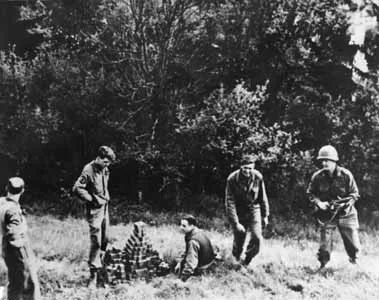 Because the big impetus behind the Manhattan Project was obviously the fear that the Germans might have it. Okay, so eventually this will end up wrapping back around to AI, by the way, but it's going to take me a minute. The reactor that the Germans wanted to make, to start working on the bomb, was uranium cubes suspended in a vat of heavy water. So the uranium does the fission, and the heavy water is there as a moderator to slow the neutrons down. And so they needed a lot of those two things.
And in February of 1940 — so it's after the invasion of Poland, but it's before the invasion of the rest of Europe, I should say — the head of IG Farben,19IG Farben — the German chemical conglomerate, the largest in Europe. Under the Nazis it used slave labor from Auschwitz; after the war its executives were tried at Nuremberg and the company was broken up into BASF, Bayer, Hoechst and others. the soon-to-be-infamous giant German chemical company, sends a letter to the manager of this plant in Norway20The plant in Norway — Norsk Hydro's Vemork near the town of Rjukan: a hydroelectric station that from 1934 housed the world's first industrial heavy water production. In 1943 Norwegian saboteurs blew up its equipment, and American bombers hit the plant. that's the only place in the world that makes heavy water, and says, "We want to buy all of your heavy water now." And so this guy gets in touch with his banker, who's a French guy named Jacques Allier,21Jacques Allier — French banker (Banque de Paris et des Pays-Bas, a major Norsk Hydro shareholder) and intelligence officer. In March 1940 he moved the plant's entire stock of heavy water, about 185 kg in 26 cans, from Norway to France via Scotland. and Allier notifies the Deuxième Bureau,22Deuxième Bureau — France's military intelligence service from 1871 to 1940. which is the French intelligence service. And they talk to physicists, and the physicists are like, "This is really frightening. This is really important. It's hard to explain why, but just take our word for it: we do not want the Germans to get all of the heavy water."
So that happens in February. By March, Allier is in Oslo, evacuating the existing stock of heavy water from out from under the noses of the Germans, just right before the Germans invade Norway. And he succeeds in doing that. There's a whole story downstream of that that's in the book. But it's in June,23Fact-checkIn June — actually earlier: Germany invaded Belgium on May 10, 1940, and the Belgian army surrendered on May 28 (Wikipedia, "Battle of Belgium"). then, that the Germans do invade westward, and they overrun Belgium. And Belgium has the Belgian Congo, which is where uranium comes from. And the first thing they do upon getting control of Belgium is to place an order for basically all of the uranium they can get from the Belgian Congo mines.24Uranium from the Belgian Congo — the Shinkolobwe mine in Katanga was the richest uranium deposit of its time. In 1940 Edgar Sengier, head of the mining company Union Minière, shipped more than a thousand tons of ore to New York, and that ore later went to the Manhattan Project.
Okay.
So if you're a person in the intelligence services of France or England or the US, and you know that they are aggressively moving to get all of the heavy water, and they're aggressively moving to get as much uranium as they can get their hands on, then there's only one conclusion that you can safely draw from that. And so that's what kicks off the Manhattan Project. And just last week they found a cube of uranium in some guy's garage somewhere. He was, I think, a Harvard professor. It was one of the cubes that the German nuclear project made during the war that they were going to suspend in the big tank of heavy water. And I might get to see it in a couple weeks.
But the point being that — I told you this is going to get back to AI — if all you know is Germany trying to corner the market on heavy water and uranium, you have no further info, then the only thing you can do at that point is launch the Manhattan Project. And then later on we find out — now we know that the Germans never came anywhere near making a bomb. Their reactor didn't work. They didn't have enough stuff. They were maybe screwing up the calculations, because Heisenberg25Werner Heisenberg (1901–1976) — German theoretical physicist, one of the founders of quantum mechanics and a Nobel laureate; during the war, the leading scientist of the German uranium project. wasn't a great experimentalist. So it turned out to be unnecessary paranoia, but you can't know that when you're in the middle of the actual war.
So that's kind of where we are, I think, vis-à-vis China with the whole AI thing. It's like, okay, sure, if AI is scary, we could take our foot off the gas. But then, you know, what if there's stuff we don't quite understand that's happening in China that would allow them to seize a commanding lead?
AdBrex
This episode is brought to you by Brex.cBrex — an American fintech company founded in 2017: corporate cards, accounts and expense management for startups and large companies. Since April 2026 it has been owned by Capital One. I spend all of my time inside of the world's most ambitious companies making rockets, semiconductors, robots. Very often the business is struggling, and then all of a sudden things click and take off. Then the company's expenses spin out of control. They either have to clamp down, start counting pennies, or cross their fingers, hope for the best that the quarter or the year comes out okay. Brex was built to handle exactly these situations.
It helps you move fast, spend smarter at the same time. They've got credit cards, banking, expense management, all in one place. They've got AI technology looking over everything, taking care of tasks for you — no more chasing down receipts. We use Brex at Core Memory. It has been a godsend and giving me back so much time. Giants like Anthropic and Zoom use Brex as well, and so do tens of thousands of startups. You should use Brex, and you can find out exactly how to do that by going to brex.com/corememory.
06Why people don't trust the tech moguls
Vance asks about the unflattering films on Zuckerberg, Altman and Musk, and Stephenson declines to pass judgment, pointing to fiduciary duty.
In the Manhattan Project, clearly you had big personalities who were driving that, but ultimately it was the government, at the end of the day, that owned and controlled the technology for quite some time. Whereas in this case you have companies and individuals. And, I mean, look, everybody knows I tend to be more on the optimistic side and fascinated by all this stuff. But, you know, I don't know when this podcast will air, but as we're recording this, I think we've got a movie coming out on Mark Zuckerberg, Sam Altman, Elon Musk, SBF, and Elizabeth Holmes.26Films about tech moguls — for example, Luca Guadagnino's Artificial, with Andrew Garfield as Sam Altman, about Altman's firing and return to OpenAI in November 2023; it premiered at the New York Film Festival on October 5, 2026. SBF is Sam Bankman-Fried, founder of the crypto exchange FTX, convicted of fraud; Elizabeth Holmes, founder of Theranos, was also convicted of fraud. None of these movies are flattering. People do not trust these people now. Yeah, just as somebody who's explored this intellectually, I'm just curious what you make of...
Well, I mean, you start a company. If you're lucky, it grows, it gets big, and then you find yourself having a fiduciary responsibility — you know, a legally enforceable fiduciary responsibility27Fiduciary duty — the legal obligation of directors and managers to act in the interests of the company and its shareholders rather than their own. Shareholders can sue over a breach. — to pay the investors back, and pay them back as much as you can. And if you don't take all necessary steps to do that, then the board will replace you. Unless you're really smart, that is, and you've got special shares that make that impossible.28Special shares — a dual-class structure: the founder holds shares with many times the votes, so the board and other shareholders can't remove them. Meta and Alphabet are set up this way, for example. But the point is still the same: I think when you're running one of these companies, you have to make certain business decisions based on business, not on kind of highfalutin ethical considerations. And that's the dilemma that these people are in. They may not necessarily be amoral people, but, you know, they gotta do what they gotta do.
And I sense you're a little — I don't know if reluctant is the right word, and it's hard to generalize across five, six individuals — but you don't seem to want to be casting judgment on our current batch of tech overlords, is my sense.
Well, I mean, they're all different people, right? So I'm trying to speak in general terms, and so what I've said is kind of broadly true of anybody in that position. I don't know the specific decisions that these individuals have to make, necessarily.
When we were talking about China — how much do you pay attention to what's going on in China at the moment, from a tech and science standpoint?
Tech and science? I mean, I don't have any great insights that go beyond what another reasonably well-informed person would know. I don't have a lot of contact there. I don't visit there. So I don't know if I can be super interesting about that.
No, I just find it fascinating. I have become quite convinced that they will be leading our technological future.
Oh, yeah, there's all kinds of evidence to support that.
And I didn't know if you'd played out in your head maybe what that looks like at all.
07Brain-computer interfaces, the body and the tongue
Brain-computer interfaces leave Stephenson cold because he sees thinking as something the whole body does, and he worries about other things entirely.
How much do you follow the brain-computer interface stuff that's going on?
I've known a couple people who've gotten involved in that stuff. I mean, it's obviously great for, you know, if you've got ALS,29ALS — amyotrophic lateral sclerosis: an incurable disease in which motor neurons die and a person gradually loses the ability to move, speak and breathe. Stephen Hawking had it. let's say, or locked-in syndrome30Locked-in syndrome — a condition in which a person is conscious but almost completely paralyzed, able to move little more than their eyes. or something like that. So that's wonderful. My whole life and career, everything that makes me happy is about words. It's about translating concepts into words, and then words back into concepts. Okay? So the interface of letters on a page is what I like, is where I'm happy. I've never felt any particular desire to have something different. So I've tended, I guess, not to pay super close attention to that stuff, just because I don't see how it's applicable to my life.
It's so different than what I was picturing in my head. I just thought you'd be, like, obsessed with all this stuff and where it was at.
I mean, it's still a little too abstract for me, I guess. So if I could look at specific examples of what people are doing with it, then maybe it would be more something I could react to. But I think we are embodied creatures, and I think that bypassing the body — I just don't understand it. You know, I write with a fountain pen on paper.31Fountain pen — Stephenson is known for writing his drafts by hand: that, he says, is how he wrote the Baroque Cycle, some three thousand pages. You know, the full engagement of the body — not just the abstract stuff up here, but the motor cortex and down the arm to the hand — that is all part of thinking, to me. It's not that there's thinking, which is this separate thing up here, and then there's this chunk of meat attached to it that's kind of dumb and stupid. We're all one big kind of brainified creature. So I guess it's an interesting thought experiment to think about bypassing the body, but I can't get any real traction on it myself.
I read you talking about this and how you write. I was envious. When I was younger, in my teenage years, I always had the notebook and was writing short stories and things like that, but my handwriting is so bad that I could barely read it then.
Couldn't read your own handwriting?
I mean, like, you know...
Wow, that's pretty bad.
No, I mean, like, okay, but I wouldn't want to write an entire book and then have to transcribe what I've done. But I like that sensation you're talking about. I do miss that. I feel like I think quite differently writing than I do just speaking, what's coming out of my... Like, when I think about, oh, what would it be like if you had a BCI and you could just think out the thoughts, I think I would do really quite poorly. Because there is something about this movement and this process of how the words get shaped that feels so natural.
I think so. I mean, I got really interested in — here's a weird side thing, I think it's a related but weird thing. So I started watching a lot of WNBA, and so I've watched a lot of video of Caitlin Clark.32Caitlin Clark (born 2002) — point guard for the Indiana Fever and the WNBA's biggest star of recent years; the No. 1 draft pick and Rookie of the Year in 2024, and before that the all-time leading scorer in college basketball. And she does something that Michael Jordan used to do,33Michael Jordan — six-time NBA champion with the Chicago Bulls, considered by many the greatest basketball player of all time. His tongue sticking out mid-flight is his trademark; he says he picked up the habit from his father. which is that, basically, if you're on the opposing team and you see their tongue come out, you know something bad is about to happen to you. So it's the moments of maximum concentration, when they're about to do some amazing athletic feat, that suddenly the tongue is sticking out. And then they do the amazing thing. And then sometimes after it's done, the tongue comes out again, when they're sort of exulting in, you know, a dunk or an amazing shot or a great pass or whatever.
And so I was kind of thinking about the whole tongue thing, because it was a Michael Jordan thing and you see it with some other great athletes. And I think, you know, why would you do that? There's got to be a reason, right? So your brain at that moment is fully engaged in taking in this whole sensory world around you, and every muscle in your body is kind of working in concert to carry out a three-dimensional plan. What's the point of sticking your tongue out? And I don't know the answer, but there must be a reason. And one thing that occurs to me is that your tongue is... I don't know if it never touches the spinal cord. I don't know if there's nerves that go straight from your brain to your tongue without going through your spinal cord,34The tongue's nerves — the tongue is controlled by the hypoglossal nerve, one of the twelve cranial nerves: it comes straight out of the medulla, bypassing the spinal cord. or if it's just very, very high up in the spinal cord. But, you know, maybe that's part of it.
And kind of to the other earlier point about BCIs: the human tongue does amazing stuff when you think about speech. I mean, it's this multivalent tool. We use it to eat, obviously, but we also use it in speech. And speech is, you know, one of the things that differentiates us from other higher primates. So — this is a question for people who study evolution and neurology — but what's the evolutionary pathway where early humans kind of repurposed this basically food-swallowing machine to make sounds, to speak, in a way that I think led to us very rapidly lapping all of the other animals in the world in terms of our brain size and our brain complexity? So that's one of the things that I... It's not really a clear train of thought or a clear conclusion, but when I think about brain-computer interfaces, I'm like, well, are we going to bypass the tongue? And what does that mean, for an embodied creature to not have to use that weird, complicated muscle anymore?
Yeah, okay. So I've spent a lot of time on BCI. I've been filming a Neuralink documentary35Neuralink — Elon Musk's company, founded in 2016, which makes a brain-computer interface implanted in the brain. The first patient, paralyzed Noland Arbaugh, received it in January 2024 and went on to move a cursor and play chess with his thoughts. and hanging out with the patients. And, like you said, if you have ALS or you're paralyzed, it's quite obvious what we do. Then I try to play it forward in my head, and I'm like, what superpower would I be sort of wanting from this? I mean, we're already at the point where, if I wanted to be controlling a robotic arm or something like that with my mind, I basically could be. Or if I had a prosthetic or an extra arm, I could. I don't know if I would want that.
We can't really put information in yet in any meaningful way. Although, you know, the thought of — just like in The Matrix36The Matrix (1999) — the Wachowskis' film about a simulated world. Knowledge is uploaded straight into the hero's brain, and seconds later he opens his eyes and says, "I know kung fu." — downloading kung fu or Spanish or something like that seems appealing. My favorite, one that I feel on some sort of visceral level — and I don't know if it would be good or bad — is more like the Arrival style,37Arrival (2016) — Denis Villeneuve's film based on a Ted Chiang story: the aliens write in circular logograms, where a whole sentence is a single sign, and the linguist who learns their language begins to see time differently. where the aliens are communicating with this symbol. I do feel like our words are limited. Like, if I go to a concert and it's hitting me in this euphoric way, and you almost want to share that with the person next to you as you experience it, I don't really have a mechanism to convey to them what I'm feeling in my body and head. And I have this...
You'd have to go home and write poetry.
Yeah, but even then, it's... that burst of chemicals and energy and stuff. And I do sometimes wonder if we could get somewhere like that with BCI. But maybe that's horrible. I don't know if we all want to experience each other in that way.
Well, and then, you know, it becomes... If it's just a bunch of bits, then it's repeatable. And so you could just sit there like the monkey hitting the lever,38The monkey hitting the lever — a nod to 1950s experiments in which James Olds and Peter Milner implanted electrodes in the "pleasure center" of rats' brains: the animals pressed a lever that stimulated it thousands of times an hour, forgetting to eat. you know, hitting your pleasure centers over and over again to inhabit this kind of fake, euphoric, imaginary world.
So — and I'll veer off this line of questioning — but, you know, okay, so I'm here, I'm covering BCI stuff, I'm covering artificial wombs.39Artificial womb — a device that gestates a fetus outside the mother's body. So far it is being tested on animals: in 2017, at Children's Hospital of Philadelphia, premature lambs were kept in a "biobag" for up to four weeks. There is this weird class of things, especially in biotech, that are right on the edge of becoming possible now. As I stated, I tend to get excited about these things. Obviously, other people can see them from quite dystopian points of view. And so there's nothing about this particular moment in 2026 that's making you tilt utopian or dystopian one way or the other? Like, this moment feels a little unnerving and different.
I mean, so if I've got ALS, then the biggest problem in my life is that, and if a BCI helps with that, then BCI is solving a huge problem. It's really important. Okay, so that's great. For me, the two big problems that I'm scared of are too much carbon in the atmosphere, and the fact that people cannot agree on what is real. Okay? And so any technology — or it doesn't have to be a technology, but any action of any kind that addresses those problems is really interesting to me. I'm all over it. Okay? But if it's not... like BCI, I don't see how it solves any problems that I'm currently having.
08Can science fiction inspire?
The tech world keeps asking for inspiring science fiction, but dystopias are cheaper to film and positive futures take real imagination.
I think you wrote an essay, I think it was 2011-ish, in Wired, about the struggle to come up with new big ideas.40The big ideas essay — "Innovation Starvation" (2011). Stephenson argued that America had forgotten how to take on big projects like the Moon program and called on science fiction writers to imagine futures worth building. It appeared in World Policy Journal and was reprinted by Wired. And if I remember right, there was at least part of it that was: things have become so specialized, you have to be so knowledgeable about this minutia in your field, that it was kind of hard to think maybe broad enough and be able to push things forward. There was more to it than that. And when you wrote that, I remember, I think just a couple of years earlier, this guy Jonathan Huebner,41Jonathan Huebner — a physicist at the Naval Air Warfare Center at China Lake. In a 2005 paper in Technological Forecasting and Social Change he calculated that the number of important innovations per capita peaked in 1873 and has been falling ever since. who was in the Navy, had written quite a paper that a lot of people had paid attention to. He'd gone through all the patent record and was trying to argue a similar thing: that we just weren't having these big, world-changing breakthroughs anymore. We'd kind of gone to the edges of the tree of invention. And so I paid a lot of attention to that essay, and then I noticed that yours was near-ish in time.
And I was thinking back to that moment in time, and clearly now, AI would be something that is quite different. At least, you know, there were hints of it back in 2011, but nothing like we have now. And then there's things like a ton of fusion startups now. There's people doing some interesting things in space, although I don't know if it's revolutionary in some ways, but in other ways not. Yeah, I was just kind of curious. It's been, I would think, 15 years since you wrote that. Do you still feel the same way?
Well, I think that came out of...
I totally got the date wrong.
No, no, it's... that sounds about right. I don't know if it was in Wired, though. But I had been on a panel discussion with Michael Crow, the president of Arizona State,42Michael Crow — president of Arizona State University since 2002. Under him it has become one of the largest universities in the US; after his conversation with Stephenson it opened the Center for Science and the Imagination, which brings science fiction writers together with scientists and engineers. and he was sort of jokingly saying, you know, "We've got all this technology, and we're ready to go, we're ambitious, and you science fiction writers are letting down the side, because all you do is write kind of sad dystopian garbage that depicts a future we don't want to live in. So why don't you shape up and write some futures that are worthy of being made real, and be more productive members of society, basically, by inspiring engineers to do cool things."
ExplainerWhy launching a rocket from the top of a tower pays off
NASA physicist Geoffrey Landis worked through the idea: at an altitude of tens of kilometers the air is many times thinner than at the ground, and that changes the whole design of the rocket.
- A vacuum nozzle. At ground level the nozzle has to be short, or atmospheric pressure will make the flow separate; up high you can fit a large bell right away, like the engines of upper stages, and it is noticeably more efficient.
- Quieter. At liftoff a rocket nearly shakes itself apart with the sound of its own engines reflected off the ground; in thin air the acoustic load is much lower.
- Lower max Q, the moment when the combination of speed and air density pushes hardest on the airframe. Up high the air is thin, so the structure can be lighter.
Through the rocket equation, every kilogram of structure saved pays off with an exponential multiplier, so, by Landis's estimate, the same rocket launched from the top of a tall tower could put roughly twice as much payload into low Earth orbit.
And so out of that came a book. I mean, I did write a piece about it, but I worked with the Arizona State people, and we brought out an anthology of science fiction stories called Hieroglyph43Hieroglyph: Stories and Visions for a Better Future (2014) — an anthology edited by Ed Finn and Kathryn Cramer. Stephenson's contribution, "Atmosphæra Incognita," is about building a steel tower tens of kilometers high. that was meant to depict more kind of positive futures. And so my contribution to that was a story about making a tall tower, which was kind of the one, of all the alternative space launch technologies that we looked at in the early years of Blue, that was the one that kind of stuck with me as, "Hey, you know, this is actually worth doing."
Just for the non-space nerds: Blue Origin.44Blue Origin — the space company Jeff Bezos founded in 2000. It makes the suborbital New Shepard and the heavy New Glenn rocket; Stephenson worked there from the very beginning, in 1999–2006.
Blue Origin, yeah. At the time it was Blue Operations LLC, but then it became Blue Origin.
So anyway, I mean, this is a common theme. I've heard this from a lot of people. Even within the last few months, I've heard multiple times from people in the tech world — investors, mostly investors — who are kind of like, "Hey, is there any way we can foster the writing of science fiction that's inspiring and that makes people want to go out and build cool things again?" I hear this all the time.
Yeah, yeah, yeah. I was actually going to ask you about this very thing.
Yeah, yeah. So just three weeks ago I was one of the judges on a SpaceX — not SpaceX — XPRIZE competition45XPRIZE — Peter Diamandis's foundation, which runs competitions with big prizes for technological breakthroughs. This was the Future Vision XPRIZE, a $3.5 million competition for films about an optimistic technological future; the finale took place in Los Angeles on September 25, 2026, with Stephenson and Neil deGrasse Tyson on the jury. to make films that presented technology, and particularly AI, in a somewhat more encouraging light.
Do you feel like you at all have a... Okay, so I've been through this exercise. After ChatGPT came out,46ChatGPT — OpenAI's chatbot, released on November 30, 2022. Within two months it had about 100 million users, and it set off the current AI boom. there were a bunch of people in Silicon Valley who kind of got together. It wasn't like a cloak-and-dagger thing, but it was a little under the radar. And it was like: people don't know what's coming. We see what's coming. We don't want to scare them, and we're pretty optimistic about what's happening. We need to very quickly make some science fiction mass media that's on Netflix or somewhere where enough people will see it, that people can...
When was this?
This is probably like 2024-ish.
Oh, okay.
And it's possible it's all spilled over and spilled out in some ways.
Yeah, or a little parallel evolution or something. Yeah. It was co-sponsored by Google 100 Zeros.47100 Zeros — a Google program that co-funds films and series showing technology in an inspiring light. Through it, Google became a partner of the Future Vision XPRIZE.
Okay, so mine's a little different. But, you know, and so I'm sitting here in these conversations, and I sort of get the spirit of it. Almost all good science fiction tends to have things going wrong in some way, for the most part, I think, is fair to say. And so you're sort of in this battle of: well, you can't just write some everything-is-wonderful type thing. But the tech people tend to struggle with that, and struggle quite badly. And then it's not all clear to me... Like someone like you: you write about these futures where things do go wrong, but you're clearly very interested in technology. And so, yeah, I don't know. So is that something that appeals to you on some level, that you do think you could...
Well, I'm happy to help foster that stuff. You know, it's a little side project, or series of little side projects, that could have some kind of constructive effect. It could maybe help some writers or filmmakers get some traction somewhere. And, like you say, a lot of people in the tech world are keen on the idea. So...
You would, you know, clearly make the worst films, though.
Yeah. Well, so, I mean, this is a kind of hobby horse of mine for a long time, but my theory is that the big bang of this was the last shot of Planet of the Apes,48The ending of Planet of the Apes (1968) — Charlton Heston's character rides along a beach and sees the Statue of Liberty jutting out of the sand: the "planet of the apes" was Earth after a nuclear war all along. One of the most famous endings in film history. where you see the Statue of Liberty, it's fallen over, you know. And it's a super powerful image, but a very inexpensive one, right? So they got a model of the Statue of Liberty, and they kicked it over and threw some dirt on it. So that was a really cheap and easy way to make a very powerful image. And so you kind of see this in a lot of post-apocalyptic, dystopian movies: you see examples where they've just taken something that exists today and sort of bang it around and throw some dirt on it, and it looks cool, and it doesn't require a big imaginative investment. Okay? Whereas if you're trying to show a more positive kind of future, you do have to do some pretty hard imagining.
At this XPRIZE thing I was at, one part of the program was a documentary called The Sixty-Year Mission,49The Sixty-Year Mission — Mark A. Altman's 2026 documentary for Star Trek's 60th anniversary about how the original series was made; William Shatner is an executive producer. In theaters from October 9, 2026. which is a documentary about the creation of Star Trek50Star Trek — the science fiction universe that began with Gene Roddenberry's series (1966–1969): a future humanity, free of war and poverty, explores the galaxy aboard the starship Enterprise. The classic example of optimistic science fiction. and Gene Roddenberry and all of that. And they had to put some energy into imagining what that future world was going to look like. And so that's the kind of thing that you have to do if you're going to create any kind of positive science fiction. And I don't think it's tremendously hard, but it just seems to be the path of least resistance for movie companies and TV companies to kind of go the dystopian route.
Okay, okay. So they have to try harder, be more creative.
Yeah, I think so.
09Why Snow Crash has never been filmed
Stephenson thinks Snow Crash was lucky to escape adaptation, since graphics kept overtaking every plan.
So there's a person on our staff. He's an enormous fan of yours.
Okay.
It is his life's ambition to see Snow Crash made...51Snow Crash (1992) — Stephenson's cyberpunk novel about the hacker and pizza courier Hiro Protagonist and a virus that strikes people both in the virtual world and in the real one. It gave us "metaverse" and "avatar" in the sense of a user's virtual body. There have been attempts to film it since the 1990s, but it has never reached the screen.
Into a movie.
Into a movie. He has an idea where — I'll read it to you. I don't know if he expressed it as a question. You know, he wants to adapt it exactly how Hollywood would have treated it in 1992, when the book came out. Pretend it's a lost, unfinished artifact that got shelved before release. Blair Witch-style marketing.52The Blair Witch Project (1999) — a low-budget horror film presented as "found footage" of missing students. Before release, the makers launched a website and rumors that it was all real, one of the first viral internet campaigns in film.
And, you know, I was looking through all your works, and you've addressed this before, but, my God, I mean, if anyone should have tons of TV shows and movies based on their work, it's you. You seem to me to have, in a much bigger way, been caught in some kind of the typical Hollywood option-rights hell,53Option — the right a studio or producer buys from an author to be the only ones who can adapt a book for an agreed period. Options are often renewed for years without the film ever being made, which is what people call development hell. where things get started and don't get finished. It's crazy to me, though. I mean, this must be frustrating.
Well, first of all, to your friend...
Can we have the rights to Snow Crash?
To your friend's point: I've been watching people think about adapting Snow Crash since it came out. And at every stage along the way, I've kind of said, "Boy, it's a good thing that they never made that movie in 1995 or 2000 or 2005," because just a few years later the computer graphics had gotten so much better that it would look dated, in the way that, like, the original Tron54Tron (1982) — Disney's film about a programmer pulled inside a computer, one of the first films with extensive computer graphics. Its neon worlds look naive today. looks dated today.
So during one phase of this conversation, one of these guys had the idea to use HDR photography.55HDR (high dynamic range) — imaging that preserves detail in both the brightest and darkest parts of a frame, which makes the picture look slightly unnatural, "too" sharp and saturated. Instead of rendering the Metaverse using computer graphics, just shoot it straight, but then manipulate the film to kind of send you a message that this is actually generated by computer graphics, right? And so that was the first point when people began to think, okay, the graphics are so good that in this future world it's just going to look like photography. And now, of course, we're to the point where it simply would look like photography. You wouldn't be able to tell it apart from something that really happened, unless there was some other visual cue, like something that was physically impossible in the scene. So I just found that an interesting reflection from the message you just read, because you could kind of flip that on its back and go ahead and make it using 1995, you know, Doom computer graphics.56Doom (1993) — id Software's game, one of the first 3D first-person shooters. Its pixelated graphics are the benchmark of early-'90s computer imagery.
Yeah, I think that's what he wants. Yeah, yeah. Is it still tied up?
It is. It is, yeah.
I mean, you started Blue Origin with Jeff Bezos. I assume you guys are still friendly. I mean, he owns an entire media organization.57Bezos's media organization — Amazon, with its Amazon MGM Studios: Amazon bought the Hollywood studio MGM in 2022. Bezos has also personally owned The Washington Post since 2013.
Well, it's at a different media organization. Has been for a long time. So it's been at Paramount, and Paramount/Skydance,58Paramount Skydance — the media company formed in August 2025 by the merger of Paramount Global and David Ellison's Skydance. Paramount bought the film rights to Snow Crash back in 2012. for a long time.
So they just write you a check every year.
That was true for a while, and then they just bought it.
Okay.
So at some point they're like...
"We have to stop writing Neal a check every year."
I mean, like, honestly, tell me to fuck off if I'm just going too far, but there's no way in hell... Jeff must want to make at least some handful of things you've written.
Well, I think they did have Seveneves59Seveneves (2015) — Stephenson's novel in which the Moon breaks apart and humanity has two years to move into orbit before the rain of rock. Seven women survive, the "seven Eves." for a bit. I think they might have had Snow Crash... No, they didn't. But, you know, he delegates those kinds of decisions to the people who run those organizations. So... But yeah, I mean, it's a mystery.
It's a tragedy, is what it is.
Well, yeah. I mean, it's given me, I think, some kind of insights and some thoughts about the nature of that business, how it works, how it doesn't work.
10Whenere: Jane Austen in Fortnite
Stephenson's startup Whenere lets fans tell their own stories in favorite worlds instead of waiting for Hollywood.
Well, and you've got the startup — is it Whenere?
Whenere, yeah.60Whenere — a startup Stephenson co-founded with CEO Karen Laur: a platform where, with the help of AI, you can step into the world of a favorite book and write your own stories in it. The first world is Pride and Prejudice.
And so, Whenere — I was reading about it. I think I get it. So you're trying to use AI to let people create these worlds from fictional works, but you'd be able to kind of change them a bit. Or it's like, if Lord of the Rings — I mean, you're reading Tolkien's snapshot of that world in this particular moment in time, but clearly there's limitless universes and stories. Is that the right...?
Yeah, yeah. And if you look at the fan reaction to Rings of Power,61The Rings of Power — Amazon's series The Lord of the Rings: The Rings of Power (since 2022), set in the Second Age of Middle-earth and one of the most expensive series ever made. Many Tolkien fans rejected it for taking liberties with the source. you know, there's multiple subreddits full of serious Lord of the Rings fans talking about how much they don't like it. And so that's been the fate of fans for a long time, right? There's all these fictional universes that have very intense fan groups, and this is how entertainment works now. I was at Comic Con in New York62New York Comic Con — the largest fan convention on the East Coast for comics, film, TV and games; it takes place every fall in New York and draws more than 200,000 visitors. just a few days ago, and that's like a giant monument to multiple fandoms obsessed with multiple story worlds.
And their only way to see these things get translated into visual media has been to wait for Hollywood to disgorge something, right? Sometimes after decades, and very expensively. And then a lot of times they're not happy with the result, right? We can all think of examples, like the last season of Game of Thrones63The last season of Game of Thrones (2019) — the eighth season of HBO's series based on George R. R. Martin's novels. By then the showrunners had overtaken the books, and the rushed ending became one of the most derided in TV history. or what have you, where, if you're a fan of the source material and you know the source material, you can just see that, "Oh my God, the person who wrote this scene doesn't understand that character at all."
Unsatisfying.
Yeah. Or the showrunners — you know, what were they thinking? So there's this kind of frustrating situation for fandoms who just want to see stories told in their favorite worlds.
But do you guys have massive compute to go power this? I don't know what state it's in.
No, we're not using gen AI video.
Oh, that's right. You're doing the Unity thing, right?
Yeah, Unreal.
Oh, off a game engine.64Game engine — the software foundation of a video game, which renders the picture and computes physics and sound in real time. Unity and Unreal Engine are the two most popular; Unreal belongs to Epic Games. Right, right, right.
Unreal Editor for Fortnite.65Unreal Editor for Fortnite (UEFN) — a free Epic Games editor (since 2023) for making your own games and worlds on Unreal Engine inside Fortnite and publishing them to its players. So the generation of the pixels happens at the edge, using sort of tried-and-true game engines and game-engine-compatible hardware. So we're not hitting data centers for just churning out lots of pixels. But there's all kinds of other ways that you can use AI to assist people in writing scripts, or to power sort of AI-powered non-player characters in these worlds. There's a bunch of ways that AI can be kind of efficiently used, I think, that don't take creative agency away from the creator. We're working with a company called Dreamlands.ai that has a system that enabled us to generate realistic environments in the universe of Pride and Prejudice66Pride and Prejudice (1813) — Jane Austen's novel about Elizabeth Bennet and the proud Mr. Darcy, one of the most loved and most adapted books in English literature. incredibly efficiently.
But is that in the public domain?67Public domain — works whose copyright has expired, which anyone may use freely. In the US, as of 2026, that covers everything published before 1931.
Well, that's the thing. Yeah, certainly Pride and Prejudice is.
So you can't do Snow Crash, because somebody has it, but you can start somebody else's.
Yeah, yeah, exactly. But the source material is also public domain. So, I mean, for the visuals, right? If you want a Regency-era chair,68The Regency — the period in Britain when the future George IV ruled as regent for his ailing father, George III (1811–1820); more broadly, the first decades of the 19th century, the time of Austen's novels. well, there's a million pictures of chairs on the internet, just from antique shops or whatever. So you're not screen-scraping somebody else's creative output to repurpose it. You're working with just historical documents, basically.
And then I'm exploring this world like a game, or I'm watching it like a movie?
You can write scripts. We have just a web-based script editor, in which you say what you want to happen, and then in Unreal — UEFN, basically, in Fortnite — you see that script get played out.
Oh, okay, okay. So I'm, like, in a Jane Austen novel, just getting to tweak the story a little bit, or just make one up. Okay.
Yes. So there's all kinds of AI enhancements that make that easier. So you could type in, you know, "Tell Darcy he sucks," and then hit a button, and then Claude comes back with perfectly written, sort of Regency-era English: "I must observe, Mr. Darcy, that..." blah, blah, blah, blah, blah, that actually rings true in that world and that sounds like what that particular character would say.
Is this like early days, kind of small thing, or is this, like, big, you guys are going full steam ahead?
Well, it's still... Where we are right now is getting ready for kind of early play test, sort of looking for people. So there's hundreds of millions of people who play Fortnite. Somewhere there's some Venn diagram overlap between them and people who like these kinds of books. You know, the most popular sort of genre of books in the world is Jane Austen and your Bridgerton69Bridgerton — Netflix's series (since 2020) based on Julia Quinn's romance novels about high-society families in Regency London; one of the platform's most popular shows. and all of that. And so we're looking for a few of those people who are willing to put up with a still kind of janky, early-days version of this thing, and play with it and point out all of the things we're doing wrong. And once we get past that phase, then the next step would be to launch it and see if people want to play with it.
And you're friends with Tim Sweeney from Epic?70Tim Sweeney (born 1970) — founder and CEO of Epic Games and author of the first version of Unreal Engine. Epic makes Fortnite and the Unreal engine.
We certainly have a friendly relationship, yeah. We're in touch from time to time.
I didn't know if he was kind of behind this or helping. He's...
Well, I'll say that Epic overall has been incredibly helpful.
Okay.
They've been great. But they're very scrupulous people, I think, and that comes from the top, it comes from Tim. So I think if there's something that we need that has general utility for their developers — you know, a lot of developers might want — then we can have a conversation about that. But they're also very even-handed about not privileging one developer over another.
11Inside Blue Origin
Stephenson left Blue Origin once it became an engineering organization, but his tortoises remain on its coat of arms.
I'm keeping an eye on time. I do want to get to a little bit of a rapid-fire round for people who sent in things. But before we do that, there were just kind of two last things that I really wanted to be indulgent on. I know you've talked about your time at Blue Origin before. Just to give people some context: I think you were basically employee number one, or with Jeff, and the idea in the early days was to explore quite different ideas of what we could do in space. We know how to make liquid-fueled rockets, and there's really not that much you can do to tweak their design. And so it was kind of like, what else could we do that would be a bit more adventurous?
And what comes next is not meant to be mean or anything like that. I have written books about all this stuff, and it was such a nice chance to talk to you about this. But, you know, so you're at that, I think, for about six years. Blue Origin eventually gets going. I've seen you say that you left when things got a bit more conventional after all. And then, you know, Blue — I mean, I admire, especially where they're at now — but when you compare them to SpaceX, it looks like one company was almost standing still for about 18 years while the other was developing four rocket families71Four rocket families — Falcon 1 (first successful orbital flight in 2008), Falcon 9, Falcon Heavy and Starship. and learning how to land rockets and dominating satellites and taking over the entire space industry. And Blue is still trying to prove that it could even deliver satellites to space and all that.
So, I mean, is that painful? Obviously, you haven't been there on, like, a day-to-day basis for these 20 years. Blue's the only space company I really haven't spent time at, in part because it was quite secretive. Jeff is the only kind of tech billionaire type I've never really hung out with. I've always worked somewhere where somebody else covered Amazon, and I just never had that chance. And so Blue's the one place I don't know much about. As an outsider, it's frustrating, you know, to have all those resources and then just get stuck for such a long time. Although, you know, they really are seeming to kind of come on strong now.
But, yeah, I guess my question is twofold. It's like, I don't know if you have an emotional attachment to Blue still, and sort of how do you feel about how it's done? And then, second, I've heard you say you're impressed by SpaceX, but I'd be curious, like, sort of how impressed, given that context of you were looking at doing things quite different. And so they've done some different things, but then, yeah, some that aren't that radical.
Well, I mean, for starters, I'm very impressed with SpaceX. I mean, you can't not be, if you know anything at all about rockets and space. So that's easy. That's an easy one. I was there from sort of the inception of it in 1999 up until the end of 2006, after we launched the first kind of rocket-powered vehicle in West Texas.72The first rocket-powered vehicle — the Goddard demonstrator, named after rocket pioneer Robert Goddard. On November 13, 2006, it rose about 85 meters and landed at Blue Origin's site in West Texas, near the town of Van Horn.
And with Pablos Holman,73Pablos Holman — American hacker, inventor and investor; one of Blue Origin's first employees, he later worked at the Intellectual Ventures lab, where among other things he built a laser that shoots down mosquitoes. He has been a guest on Core Memory. who's been in that chair as well, who I think is a friend of yours.
Yeah. He was probably one of the first five people who was involved in Blue Operations LLC.
Yeah. And then after that I just said, "This is great, this is fun, really interesting, but I feel like I could walk away for 20 years and I wouldn't be missed," you know. Simply because, in the early years, we were doing studies on different alternative launch technologies, which is different from engineering per se. And once Jeff made the decision to build rockets, and picked a path to follow, then it became an engineering organization from that point on. And I could have probably talked my way into some kind of engineering role there, but when you're a member of a team like that, you have responsibilities. You can't go on a book tour and fail to deliver a document in time for the design review74Design review — a scheduled examination of a design at a given stage of development: engineers submit documentation in advance, and a panel decides whether the project can move on. or what have you. And so I just didn't really see my relevance there from that point on. So it was a completely amicable parting of the ways at that point. But from that point, end of 2006, I haven't had hardly any real insider knowledge of how things work there, what's going on.
And again, if I'm overstepping my bounds, tell me, but are you and Jeff... are you guys friends? Are you pretty...
I mean, we communicate a few times a year, I would say.
Have you asked him over the years, like, "What the fuck is going on?" I mean, it went a little crazy for a while. It must have been very frustrating to see SpaceX just racing ahead.
Well, strangely enough, the one enduring thing that I contributed was that — it would have been, I don't know, '04 or '05 — Jeff wanted to make, like, a seal or a coat of arms that would embody the company's values, you know.
The motto. Yeah.
Yeah. And I think at that point it was already evident that SpaceX, which had started at about the same time, was jackrabbiting forward at an incredible pace. And I think part of the message that Jeff wanted to send was, you know, "We don't care. We just don't care. We're just going to keep working at our pace." And so there's a thing that you see in coats of arms called supporters.75Supporters — figures of people or animals that hold up the shield on either side of a coat of arms. Blue Origin's coat of arms has two tortoises, and the company's motto is Gradatim Ferociter, "Step by step, ferociously." The tortoise refers to Aesop's fable in which the slow tortoise beats the overconfident hare. You'll get animals that support the escutcheon. So, like, in the case of the arms of the king of England, it's a lion and a unicorn that hold up the shield. And so I said, "Well, maybe the supporters should be tortoises." And so that's still there. It's, like, painted on the wall.
I always loved that. And then, as the years went on, it started... It was looking like the tortoise was maybe too slow. I mean, Blue Origin might — they might get the Moon, they might get the Moon, but they have a lot of work to do still.
Although it seems like suddenly, in the last few months, Elon is getting interested in the Moon.76The Moon — under NASA's Artemis program both companies are building landers for astronauts: SpaceX a lunar version of Starship (2021 contract), Blue Origin the Blue Moon lander (2023 contract).
Well, he is, because that's where there's money, and Trump is — you know, the government's turning its eye there. I mean, Elon was always, "We're going to do Mars, and not the Moon. The Moon is just... you're just wasting time if that's where you go." But clearly, you know, I think there's things to be gained now, and all this stuff is expensive. It's interesting that Blue Origin is taking outside money for the first time.77Outside money — in July 2026 it emerged that Blue Origin was seeking outside investors for the first time: about $10 billion at a $130 billion valuation, in a round to be led by Coatue. Until then Bezos had funded the company himself. Fortune.
Raising money, yeah. Well, Rob Meyerson,78Rob Meyerson — engineer and former NASA employee; president of Blue Origin in 2003–2017, effectively running the company under Bezos. He is now CEO of Interlune. who was the CEO of Blue Origin for a long time, and Gary Lai, who was a very senior engineer there that I used to work with, have started a startup called Interlune,79Interlune — a Seattle startup founded in 2020 by Rob Meyerson and Gary Lai, formerly chief architect of New Shepard. It wants to mine helium-3 on the Moon, a rare isotope needed to cool quantum computers and possibly, in the future, for fusion power. which is going to mine helium-3 on the Moon's surface. It's pretty close to me, in Seattle.
12Skyroot, spaceports and space guns
From an Indian private rocket the talk turns to radical launch methods, and the one Stephenson still likes best is the tall tower.
I saw this. And you guys, you've got Stoke Space80Stoke Space — a rocket startup from Kent, near Seattle, founded in 2019 by Blue Origin alumni; it is building the fully reusable Nova rocket. up there, which is interesting. And, yeah, Washington still has a couple interesting things. I saw you, when you first came in, you peeked at my little rocket.
Yeah. I can't help it.
So that's Skyroot.81Skyroot Aerospace — a private rocket company from Hyderabad, founded in 2018 by former ISRO engineers. Its Vikram-1 rocket reached orbit on its first try on July 18, 2026, India's first private orbital rocket. Space.com. So that's an Indian private rocket company. They went to orbit on their first try, like two or three months ago, which basically never... Yeah, they made it to orbit, and they put a satellite in the right spot. Although, I mean, it's technically a four-stage rocket. It's really three stages with solid rocket fuel, so they went a little bit easier, and the fourth stage is kind of a kick stage.82Kick stage — a small upper stage that places the satellite in its final orbit after the main stages have done their work. And it wasn't totally clear how clean their stage separation was, on a couple things. But, you know, what they built that for... So they started, I think, in 2018. At the time, commercial space was illegal in India,83Private spaceflight in India — in June 2020 the government opened the space sector to private companies and created a regulator for them, IN-SPACe, and in April 2023 it approved the Indian Space Policy, which enshrined their rights. but they started anyway. So they started designing, and then around 2022, 2023, the Indian government made commercial space legal. And so these guys had a rocket that was coming ready. And I think they built that whole thing for $60 million, which I don't think has ever been done for less than a billion.
Where did they launch from?
From Sriharikota. It's an island off the east coast of India. It's the same place where the Indian government, ISRO,84ISRO — the Indian Space Research Organisation, the national space agency, founded in 1969. It launches rockets from the Satish Dhawan Space Centre on the island of Sriharikota. launches, like, the PSLV85PSLV (Polar Satellite Launch Vehicle) — India's workhorse launcher, flying since 1993; it sent Chandrayaan-1 to the Moon in 2008 and Mangalyaan to Mars in 2013. and all its rockets. I've been there for a launch. It's amazing. It's right by Chennai, just a little bit north.
Yeah. There must be some great sights there.
It's unbelievable. So when I went, I got to stay on the island, and there are monkeys crawling all over the rocket, there's cows at the launch site, and it's full-on jungle. And it was amazing.
Yeah. I know a couple of people who've been to the Baikonur site, and apparently that's also pretty rural.
Yeah, yes. Yeah, the launch sites is one of my favorite things to do, because they're always in the weirdest places. Like French Guiana: I think it's in the bottom five of the poorest countries in the world,86Fact-checkFrench Guiana is not a country but an overseas region of France, and it is not among the world's poorest countries: its GDP per capita is well below the rest of France's, but far from that of the poorest countries (Wikipedia, "French Guiana"). The Kourou spaceport has operated there since 1968, launching Europe's Ariane rockets. and then all of a sudden there's this huge European rocket launch site. I've been to Alaska, Ukraine, New Zealand. Rocket Lab87Rocket Lab — Peter Beck's space company, founded in New Zealand in 2006. Its small Electron rockets lift off from its own launch site on the Māhia Peninsula, right on the ocean. is one of the most beautiful launch sites, as you can imagine.
Oh, yeah. Spectacular site.
So, yeah. When you were looking at these different concepts... I mean, the only ones that I know that are quite radical today are SpinLaunch,88SpinLaunch — a California startup that wants to fling payloads into space by spinning them up in a vacuum centrifuge and releasing them at thousands of kilometers per hour. Its test accelerator stands at Spaceport America in New Mexico. with sort of the centrifuge-type system where you're going to throw something to space. And I don't know if you've seen Longshot — we did a video on them. They're making, like, a 10-kilometer-long space gun, more or less. Obviously not human-rated. This is all satellites. But it sort of pushes the projectile along this tube and accelerates it with gas. Is there anything that...
Yeah, that's... Yeah, we looked at both of those. Well, we're really about to go down a deep rabbit hole here, but there's a ram accelerator89Ram accelerator — a gun devised in the 1980s at the University of Washington under Abraham Hertzberg: the projectile flies down a tube filled with a combustible gas mixture and itself acts as the center body of a ramjet, burning the mixture around it. that was developed at the University of Washington that sounds like what you're talking about — it's close to the Longshot thing, yeah. And then the centrifuge thing existed back then under the name of Slingatron.90Slingatron — an accelerator proposed in the 1990s by physicist Derek Tidman: the projectile rolls along a spiral channel that is gyrated in circles, gaining speed with each turn like a stone in a sling. But it was the same idea. It's a spiral thing. It's a big table that goes like this, and you have a spiral passage in it, and it's a big gun, basically. So all big gun systems have got problems that you're obviously aware of around, you know, what happens when you meet the atmosphere, and that kind of thing.
But, I mean, as a kind of almost tongue-in-cheek thing, I looked at gigantic steel bullwhips, which is still a topic I'm obsessed with. I've got five Substack posts91Substack — a platform for paid and free newsletters. Stephenson's newsletter there is called Graphomane. about that kind of technology now.
But the one that I still think somebody ought to build is the tall tower. Okay? So this came out of a paper by Geoff Landis,92Geoffrey Landis (born 1955) — a physicist at NASA's Glenn Research Center and a science fiction writer who has won the Hugo and Nebula awards. where he went through and enumerated all of the advantages that you would be able to benefit from by launching from the top of a tower. And some of them are kind of non-obvious. Like, well, if you know rocket engines, you know that the one that's designed to operate in vacuum has a big bell, and it's more efficient. So you'd be able to do that. And there's some really odd things, like you have to build the rocket so it won't destroy itself with its own noise, and it's not as noisy up there. You have to build it so it won't buckle at max Q.93Max Q — the point of maximum dynamic pressure: the moment in flight when the combination of speed and air density puts the most stress on the rocket's body. It usually comes a little over a minute after liftoff. Up there, max Q is going to be a lot lower. And so you do have to put less weight into structural strength of the airframe. So when you add all those things up and factor those into the rocket equation94The rocket equation — Tsiolkovsky's formula: a rocket's change in velocity is proportional to the logarithm of the ratio of its initial mass to its final mass. Hence the exponential: to reach a given speed, the propellant mass must grow exponentially, so every extra kilogram of structure is very costly. — an exponential equation — it turns out that, at least according to Landis's calculations back then, for a given kind of rocket configuration, you could get twice as much mass into LEO.95LEO (low Earth orbit) — orbits up to roughly 2,000 km; home to the ISS and Starlink satellites. So, okay...
I don't want to... No, sorry. I don't mean to cut you off.
Well, no, I can...
13Why radical rockets don't fly
SpaceX squeezed more out of chemical rockets than anyone expected, while new launch ideas run into insurance.
Source: Wikipedia, List of Falcon 9 and Falcon Heavy launches
I mean, okay, so then, I mean, SpaceX — clearly they've gotten cadence way up. For people who aren't space nerds: governments were super lucky to do 12 launches a year. SpaceX is going almost every two days.96Almost every two days — in 2025 SpaceX launched 165 Falcon rockets, one every 2.2 days on average, more than half of all orbital launches in the world. They've got reuse down. We've gone from roughly 2,500 satellites in space to now about 15,000. The vast majority of that is overnight and driven by Starlink.97Starlink — SpaceX's satellite internet in low orbit. SpaceX launched the first 60 operational satellites in May 2019; it is the largest satellite constellation in history. Starship is coming.98Starship — SpaceX's fully reusable super-heavy rocket, the largest and most powerful ever flown; test flights have been under way since 2023. So you're talking mass to orbit — I mean, a giant leap forward on that. And you've already said SpaceX is impressive, but are you dissatisfied, because you still want these far more... Does Starship scratch your itch, or do you still want more?
Well, yeah. I mean, so the question that was before us at the beginning of Blue Origin was: are there optimizations that you can apply to chemical rockets that would radically transform the economics of space launch? So it turns out the answer is yes. That was not totally obvious back then. It was kind of felt that if you look at, say, the Space Shuttle main engine,99The Space Shuttle main engine — the RS-25: Rocketdyne's hydrogen-oxygen engine, reusable and one of the most efficient liquid rocket engines ever built. Upgraded RS-25s power NASA's SLS rocket. it's a pretty amazing engine. The specific impulse of that engine100Specific impulse — the main measure of a rocket engine's efficiency: how many seconds it can produce thrust equal to the weight of the propellant consumed. The RS-25 achieves about 452 seconds in vacuum, close to the limit for chemical propellants. is very impressive. So, well, that's not going to get a lot better. The specific impulse is not going to get a lot better. That's just a thermodynamic reality. And so is there a way that you can do something that's not all about that? And so we looked at laser launch,101Laser launch — the idea of propelling a vehicle with a powerful ground-based laser: the beam heats propellant or a reflector on board, so the rocket doesn't have to carry all its energy with it. we looked at electromagnetic propulsion, all kinds of ideas.
But for me, the attraction of the tall tower went beyond just "it's a good way to launch rockets." There's this additional factor of: it would be really cool to have something that big. And so it goes to the whole American Dynamism,102American Dynamism — the name venture firm Andreessen Horowitz has used since 2022 for its investments in defense, space, manufacturing and infrastructure: companies that build big physical things for the country. "why don't we build big things anymore?" kind of question. And if it were built, I think it would be possible to monetize it in a whole bunch of additional ways beyond just launching rockets from it.
Yeah. Well, I haven't seen anything that interesting. But China seems to have its own thoughts on reuse and things like that, which is kind of interesting. I think India actually is... So from the moment the government made commercial space legal, which is roughly 2023, till now, there are 500 space startups in India. There's probably around eight rocket startups, three to four of which I would say are sort of legit and have a chance. And not hugely radical ideas that are different yet, but we'll see.
Well, it's interesting that... I think, you know, one thing that we did figure out — it was sort of like a cold-water-in-the-face moment — was that the business of space, at least then, probably now, is essentially launching these huge satellites up to GEO103GEO (geostationary orbit) — an orbit above the equator at about 35,800 km, where a satellite circles the Earth once a day and appears motionless from the ground. Big communications and broadcast satellites operate there. that are incredibly expensive, and their time is incredibly valuable. And so, to begin with, the cost of the rocket itself is kind of a round-off error compared to everything else.
I mean, yeah, a launch, even if it was expensive, Lockheed or something,104Lockheed — Lockheed Martin, the American defense and aerospace giant, which makes both satellites and rockets; with Boeing it owns United Launch Alliance, which flies the Atlas V and Vulcan rockets. is $300 million. Those satellites could be, like, $2 billion each.
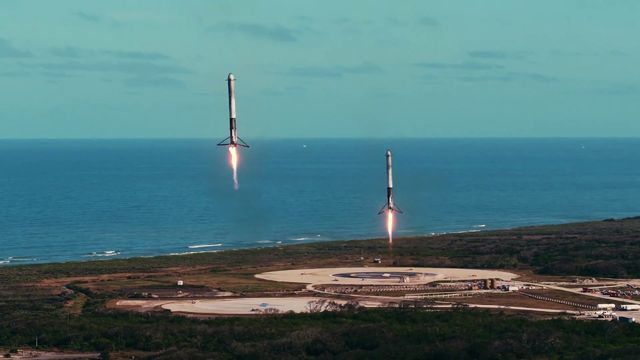
Yeah. And you need insurance, you know, and you're not going to get insurance on a brand-new launch, a radically new launch concept. I assume that's why Elon launched that car into space, you know. He had to show that he could do it. But no one was going to risk an expensive satellite until...
That was on the first Falcon Heavy105A car in space — on the first Falcon Heavy launch, on February 6, 2018, the rocket carried Elon Musk's own cherry-red Tesla Roadster into orbit around the Sun instead of a payload, with a spacesuited mannequin, Starman, at the wheel. one, I think. Yeah. And I think Elon wanted...
I'm sure, I'm sure, yeah. But it was a cold-water moment, in that we kind of realized, "Oh, man, we could come up with the coolest new idea imaginable, and it would never go anywhere commercially, because it would be uninsurable." And, you know, if one of these launches gets delayed by a few weeks or a few months by technical issues, then that's a few weeks or a few months that it's not generating revenue for the owner of that satellite. And that's an enormous loss. So why not just pay Lockheed to send the thing up, you know?
14The basket-hilted broadsword
The listener lightning round opens with swords: for the past ten years Stephenson has focused only on the basket-hilted broadsword.
Okay, I'm looking at the time. I'm really pushing my limits now. I have to let you go in about 10 minutes. Can I go rapid fire?
Yeah. And, you know, we can go a little over if you want.
Okay. I just want to be careful. Anyway, people tweeted these in, so I'm not responsible for what comes out, you know. Next, there's quite a bit of interest in your interest in sword fighting. I'll let you pick. One, which I think is extreme, was your 20 favorite swords, and the other was asking about sword-fighting techniques. Anything you want to tell the people about swords currently?
I mean, I assume they mean 20 favorite types of swords.
Yeah, sorry. I don't know what I said, but that's correct.
Yeah, I don't know. In the last probably 10 years, I have focused entirely on kind of a niche sword type, which is the basket-hilted broadsword.106Basket-hilted broadsword — a single-handed sword whose hilt has a lattice "basket" that fully encloses the hand. The best-known variety is the Scottish broadsword, often, though inaccurately, called a claymore. And that is not done by a lot of people these days, which is funny, because I think it's the longest-lived sword category that was in actual use, in the West anyway. Because we know it was in use in the 1500s, and it was in active military use until basically the First World War. But it's a single-handed sword where the hand is completely protected by a basket. There were versions of it that existed in Italy, called the schiavona,107Schiavona — a 17th–18th-century Venetian basket-hilted sword. The name means "Slavic": it was carried by the Doge's guard, recruited from Dalmatians. and in Germany, but it's mostly associated with English and Scottish military.
So I did a video about it. It's viewed as being kind of a weirdly heavy weapon for a single-handed user, but I think that's because people are doing it wrong. So that's the thing that I do. I started doing it partly because I got tired of having my hands broken working with longswords,108Longsword — a two-handed sword with a simple cross guard; historical fencing has more schools and treatises for it than for anything else, but it leaves the fighters' hands almost unprotected. which don't have hand protection, and partly because it's a historical era that I'm kind of interested in. So the particular style that I practice is based mostly on the work of a guy named George Silver,109George Silver — English fencing master, author of Paradoxes of Defence (1599). He fiercely attacked the fashion for the Italian rapier and Italian teachers, championing English swords and techniques, hence his controversial reputation. who was a contemporary of Queen Elizabeth and all of those guys, and is a well-known and somewhat controversial figure in the world of historical European martial arts.110Historical European martial arts (HEMA) — a movement that reconstructs the fighting arts of medieval and early modern Europe from old treatises.
15Amistics and the Young Lady's Illustrated Primer
Societies pick technologies one at a time, and ed tech like the Primer won't fix schools' real problems, in Stephenson's view.
Okay. This question comes from one of my favorite readers. I don't know if it's answerable.
Okay, we'll see. We'll soon find out.
ExplainerAmistics: how societies choose their technologies
Amistics is a word Stephenson coined in Seveneves (2015) from the name of the Amish. In the novel it means the set of choices a culture makes about which technologies to let into its life and which to keep out.
The Amish themselves, descendants of Swiss and German Anabaptists living in Pennsylvania, Ohio and other states, don't reject technology wholesale. The community debates each new thing: will it strengthen or weaken family and community? So many communities have no cars, televisions or grid electricity in the home, yet there may be a shared phone in a shanty at the edge of the farm, solar panels, diesel engines for milking machines, Rollerblades and bicycles. Kevin Kelly described this logic in What Technology Wants (2010): the Amish are not enemies of technology but its pickiest users.
In Seveneves, the descendants of seven surviving women split into races, each with its own amistics: some carefully limit technology, others don't. The question "what are America's amistics?" is about what societies choose today: which messengers, whether to let AI into work, whether to give children screens.
What are the Amistics of America? I mean, the Amistics: they kind of choose which technology they want to adopt and bring into their society, right? I mean, sort of inspired by the Amish.
Yeah. Yeah. Well, I mean, so this is an idea that is from Kevin Kelly,111Kevin Kelly (born 1952) — American writer, a co-founder of Wired and its first executive editor. He wrote at length about the Amish and their choice of technologies in What Technology Wants (2010). who kind of pointed out a long time ago that the Amish don't reject all technology. You know, they use Rollerblades. They just reject specific technologies. So, I mean, you see it all the time now if you're trying to communicate with people, because you've got people who use Signal, Telegram, WhatsApp, plain old SMS messages, email. And so that's a very common and kind of trivial example of people deciding which technology they're going to use and not going to use. But clearly there's people now who are being super fastidious about AI — you know, refuse to use AI. There's a huge debate over: should we allow students in classrooms to have screens,112Screens in schools — in the 2020s many countries and states restricted phones in class: the Netherlands from 2024, Brazil from 2025, for example; in the US, dozens of states have passed such laws. or children in any circumstance to have access to screens? So you can kind of see examples of it all over the place.
I think so. The screens... I assume you've had to answer this question before. The screens kind of hits on another thing that came up about six or seven times, which is: can we now make the Young Lady's Illustrated Primer? Should we be doing that? Can we? Should we? Are you?
Yeah. So this is now...
Should we describe what it is?
Yeah. It's a hypothetical device — a nanotech, sort of magic book — in my book The Diamond Age,113The Diamond Age: Or, A Young Lady's Illustrated Primer (1995) — Stephenson's novel about a world transformed by nanotechnology. A girl from a poor family gets hold of a stolen interactive book, the Primer, which teaches her, adapts to her and tells stories in which she is the heroine. It won the Hugo and Locus awards. that teaches kids. It's an educational system. So this is now hot in a way that the metaverse was,114Metaverse — a word from Stephenson's Snow Crash. In 2021 Facebook renamed itself Meta and declared the metaverse its future, and for a couple of years it was the whole industry's buzzword. like, five or six years ago. So I hear about it every day.
I mean, I've been thinking about it a lot, I guess, is the first thing to say. You know, I'm actively thinking about this stuff. What I have been doing is trying to pay attention to what teachers actually want. So, like, I follow the Teachers subreddit and a bunch of other channels of information where actual teachers in actual classrooms talk about the problems they face, none of which can be solved by giving them a piece of technology. Okay? I mean, that is at the bottom of their list in terms of what they actually want. So I think it's fine to think about ed tech, but I think it's really important to go about it in a way that is observant of the fact that there have been many ed tech initiatives down through the years that haven't worked out, and that don't address the pressing issues that teachers actually have to deal with day to day.
And this is all meant to be directed to you. I'll say one thing. One of the most-read stories I've done recently: I had this experience — I was with this 22-year-old, I was hanging out with him. He had built a nuclear fuser in his bedroom115A fusion reactor in his bedroom — a fusor, the tabletop device invented in the 1960s by Philo Farnsworth: an electric field accelerates deuterium nuclei toward each other, and some of them fuse. It consumes far more energy than it produces, but building a working fusor at home is a well-known challenge for amateurs. using only Claude as his guide. He'd never built a hardware system before. And we were hanging out in his little San Francisco apartment, and he had, like, seven different AI systems running at the same time, and he was speaking into one of them. He was sending in all the receipts from Amazon that he had bought for this fuser thing, getting his diagrams back. And he had this, like, fluidity with the computer that I... Even though I'm on the older side now, I'm, like, pretty good. I use all the latest and greatest tech. I go pretty deep. He had, like, a different relationship with his computer. It wasn't exactly a tutor, but it was like this symbiotic sort of thing going on that I did not have.
And so one of the questions — like, the first question that comes up when you seriously start talking about this — is: okay, you know, we don't want to just make a gadget that is going to serve a small, privileged population that doesn't need it, because they're going to be fine anyway. No, we should make something that's going to work for everyone, that's going to have broad social impact. And so once you go down that road, which is very feel-good, and again start looking at the real problems of education, then very soon you sort of focus back down to: okay, let's try a pilot program for a few kids. So the kid that you're describing, I would put it to you, would have been just as successful a hundred years ago.
My analogy for this is Abe Lincoln.116Abraham Lincoln (1809–1865) — the 16th president of the United States. He grew up poor on the frontier and had almost no schooling; according to his relatives, as a boy he wrote with charcoal on a wooden shovel and then scraped the writing off. Okay? So when Abe Lincoln was a kid, he didn't have paper. So he had a shovel. So he would stick the shovel in the fire, and so it was covered with soot. And then he would flip it over, wait for it to cool down, and then he would scratch his lessons out on the shovel by scratching the soot off. And then, when the shovel was full of words, he would stick it back into the fire again. So there's Abraham Lincoln kids who just cannot be stopped, no matter how rugged their circumstances might be. But they don't need help. So I'm not saying I have the answer. I'm just saying that these are the immediate questions you have to start thinking about when you begin to ponder bringing out a new kind of ed tech.
16A storyteller, not a prophet
Stephenson's answers sound complicated because he thinks like a novelist, who needs a coherent world rather than a forecast.
Okay. I'll leave you with this last one. I mean, I was going down this road before. There's just a million things. I mean, this must be so frustrating, because people see you as some kind of oracle. I mean, talking to you has been different than I thought it would be in some ways. Like, I thought you would be a total latest-and-greatest tech obsessive across all these fronts. I mean, I could just tell now, you're just super thoughtful, you research things. You must have this unique ability to, like, conjure these worlds and futures in your head, but it must be frustrating. I'm sure people turn to you all the time hoping for you to tell us what the future would be like. But it's all on here: everyone wants to know, like, utopia or dystopia?
Oh, yeah, yeah.
Where are we heading?
Well, look. So what you're seeing is essentially a storyteller or novelist method to thinking about these things. Because the first duty of a storyteller or a novelist is to keep people turning the page. And so you've got to try to put them into an immersive world, a fictional world that is coherent and makes sense. And there's all kinds of signals that you can inadvertently send to the reader — they may not even be fully conscious of them — but they'll immediately kind of say, "Oh, wait a second, that doesn't make sense," or, "I don't know why that character did that. This seems kind of simplistic." And they close the book and they put it down.
And this goes to what I was saying earlier about Hollywood adaptations, what makes them succeed or fail. So if you're going to write a fictional scenario that involves technology, you need to embrace the full complexity of that technology: how it can go bad, how it can succeed, and also how would a society interact with that technology, and what would happen when people misused it or used it in really unexpected, creative ways. And you also have to think about what's the business plan. How would it make sense economically for a given fictional technology to actually be rolled out and put to use? And so if you do all those things, and you do a good job of it, then the reader reading the book will say, "Hmm, okay, yeah, that kind of adds up. This rings true to me."
And if you don't, again, they'll get a sense that it's false, and they won't like the result. So I think what you're seeing — if you see me as being ambivalent or kind of complicated in some of my responses — it's me, the novelist brain, trying to constantly ask the question of: how could we tell stories here that have that complexity and subtlety about them?
Yeah, no, which is fair. And I wish the world was wired a bit more like that. Neal, I can't thank you enough. Honestly, I don't want to embarrass you or anything, but it's like an honor of a...
Oh, thanks.
...lifetime to talk to somebody who's, first of all, just prolific and wonderful at writing, and who's really shaped the world in ways that... it's rare to run into. So please definitely buy the book, D.
Yes, buy the book.
That's the most important thing. Yeah. I knew I should get it first, because I knew we were going to get distracted a little bit. But please buy the book. And, yeah, no, this is a highlight of the year. Thank you.
Well, good. Well, it's been fun. I've enjoyed talking to you and looking at your cool rocket models and... Are those Tesla batteries? Are those... whatever they are?
They are lithium-ion batteries, but they got made in a laboratory in Tennessee. We collect these artifacts as we go around.
Of course.
That's my face, built by some robots in Los Angeles. And, yeah, we just keep adding as we go.
Cool. Okay.
Yeah.
Well, great, it's been fun.
Thank you, man. Thank you so much.
Yeah, pleasure.
And good luck with the rest of the tour.
Thanks. Okay.
The Core Memory podcast is hosted by me, Ashlee Vance, and/or Kylie Robison, or both of us together. It is produced by me and David Nicholson. Our theme song is by James Mercer and Jon Sortland, and the show is edited always by the Jon Sortland. Thank you so much to Brex for all your support, and thank you most of all to everybody for listening or watching. We love you. Please leave us a like, a review, a subscribe, all those tremendous things. Thank you, and we'll see you again.


