



Cheeky Pint
Chapters
Kirby didn't see United's record aircraft order in the middle of COVID as a risk: with everyone else shrinking, United only had to be not totally wrong.
Read the chapter- Every expert, Kirby says, predicted travel demand would fall 50% for good, every long-haul airline except United permanently retired some wide-bodies, and United ordered 200 wide-bodies and several hundred narrow-bodies.
- The payoff was very good pricing, and Boeing could tell other customers, "United believes. You should too."
- Kirby names two human mistakes, extrapolating the present into the future and trusting surveys: experts "live in the world of two standard deviations" while value is created in the tails, which is why he calls VaR and Black-Scholes dumb models.
- He uses surveys only to learn how people liked what United already did, and something new, like the Starlink tracker launched the day of the recording, is faster to just build and see whether people like it.
United got off mainframes with no payback case and can now do things rivals can't, and after Kirby's "AI epiphany" the company went all in on AI.
Read the chapter- In the depths of COVID United started a several-hundred-million-dollar project to leave mainframes for modern databases, and Kirby says it is really paying off today.
- Kirby thinks AI that summarizes documents is silly and sees its power in coding: after three one-hour lessons with a tutor, he vibe-coded a page during a Saturday workout that pulls odds from four sportsbooks and places the bet at the best one.
- On the day United switches off one of its most critical mainframe systems, it simply doesn't schedule several hundred flights, so passengers aren't hurt if something goes wrong.
- United, Kirby says, is the only airline in the world that owns its reservation system, shared only with its partner Copa, while everyone else outsourced to Sabre and Apollo.
United is taking seat-back software in-house so it can surprise customers, and Kirby wants a new "wow" every time, because each one only counts once.
Read the chapter- United is taking the seat-back software from Panasonic: the screen will remember that Ben loves the map without the globe and will celebrate a passenger's two-millionth mile.
- When weather threatens, United will send the probability that it affects your flight, say 41% for yours and 12% for an earlier one.
- Kirby told his officers their job is "wow," which United gets credit for once, after which it owes the customer the next one.
- Delayed passengers in Chicago who were sent a radar map of the storm line gave an NPS of plus 60, Kirby says, versus minus 60 for those who got the standard message.
- He won't accept weather as an excuse: AI simulations could cut summer thunderstorm delays in Denver by 50–75%, but that needs the FAA's help.
Air traffic control is by far the industry's biggest constraint, Kirby says, and politics makes it very hard for government to modernize.
Read the chapter- Kirby calls air traffic control 90% of the issue: the FAA has already capped flights in New York and this summer in Chicago, and more places will follow.
- Five- to ten-year projects are funded through annual appropriations, so after shutdowns and ramp-up there are maybe four months of work before three months of winding down.
- Airlines pay 100% of the fees while private jets fly essentially free and lobby against modernization, and Kirby says there are 450 control facilities for political reasons.
- Under Secretary Duffy and FAA Administrator Bryan Bedford progress is the best of Kirby's career, but he thinks private industry could do the job in two or three years.
Kirby argues Chicago would be better off with one hub than two, because two hubs burn hundreds of flights on duplicate feeders.
Read the chapter- A hub needs hundreds of short catchment flights, like United's eight daily flights to Milwaukee, and in Chicago American's and United's fully duplicate each other.
- Atlanta and Dallas are smaller than Chicago but, with one hub each, have more international flights and more passengers, and Kirby is sure Chicago should be the biggest airport in the world.
- He estimates American will lose about $1.5 billion in Chicago this year, while United now has roughly double its revenue share there.
- Kirby denies it is personal revenge on his old employer: United has taken even more share from Southwest in Denver and from Southwest and Alaska in the Bay Area.
Kirby calls Starlink the biggest, and temporary, competitive advantage in airline history: United has a two-to-three-year window to win other airlines' loyal customers.
Read the chapter- Starlink is on 48% of United flights, about three planes a day are being fitted, Los Angeles will be the first 100% hub, and the 787s will take longest because Boeing is slow on certification.
- Kirby calls Delta's choice a mistake: airlines are used to stretching retrofits over eight years, and he says Starlink's numbers weren't that big.
- His plan is that customers try United for Starlink and stay for the rest of its technology, since within a few years everyone will have fast low-Earth-orbit internet.
- The free Wi-Fi on legacy systems at his three big competitors is, Kirby says, slower than dial-up: fast is the value proposition, and there isn't enough bandwidth to make it free.
Kirby believes he sees the future better than others, and tells fellow CEOs to stop complaining about Wall Street's short-termism and make big bets.
Read the chapter- Kirby credits how much he reads for spotting opportunities in the tails; he keeps his board deeply involved, while Wall Street almost always hates United's big moves, such as aircraft investments.
- He tells other CEOs to make the big bet, and if it doesn't work, to accept that they deserve to be fired.
- Being CEO is 99% about creating the right culture, Kirby says, and he told the team in Los Angeles their mission is to show Delta loyalists who cross the road that United is the best airline.
- Six of ten US airlines will lose money this year, but United and Delta built brand loyalty, and United is solidly profitable even with fuel costs up $8 billion.
United finds new destinations through a team that hunts for what isn't in the data, and it quickly cuts routes that don't work.
Read the chapter- Ego still drives the industry, Kirby says: airlines add routes he could tell at a glance would run negative 30–50% margins.
- Nuuk, which Kirby had never heard of, came from Patrick Quayle's team; United will fly to 53 transatlantic destinations next summer versus 23 a decade ago, only two have failed, and Bergen was dropped after a small loss.
- Quayle read about pilgrimages and found "broken itineraries" in the data, people flying into one city in Spain or Portugal and out of another, so United added both.
- Collison marvels at how Greenland, a country of 50,000, is building airports, and Kirby thinks visitors could boost its economy.
Planes fly as fast as they did in 1967 because, Kirby says, Boeing and Airbus have tacitly agreed not to invest in new designs.
Read the chapter- Collison notes the first 737 flew at Mach 0.78, as the 737 MAX does today, even though the new one burns 50% less fuel and is 30–40 times safer.
- Kirby sees a tacit Boeing–Airbus duopoly whose investors don't want new spending, says the industry needs a third manufacturer, and has begged both for a 757 replacement for twenty-plus years.
- He thinks the next big step is the blended wing, like the B-2 bomber; United has invested in JetZero, though such planes would require redesigned gates.
- Kirby holds up Skunk Works' Kelly Johnson, who designed the U-2 and SR-71 in a couple of years.
Kirby explains Relax Row and seat-back screens as brand building rather than price slicing, and tests decisions through the eyes of a parent with small kids.
Read the chapter- Thompson asks whether Relax Row is just another price tier, and Kirby says it will be profitable but invisible in the financials, because the goal is building a brand.
- Kirby has seven kids and thinks about a parent flying alone with small children: Relax Row, Starlink and screens showing "Bluey" make that trip easy.
- The Starlink ad campaign was launched by VP Maggie Schmerin without asking Kirby, which he sees as speed, since 16 layers of approvals at big companies water everything down.
Kirby supports caps on flights, but he says sky-high fees at big airports have priced low-cost carriers out.
Read the chapter- Collison explains that before 1978 airlines couldn't compete on price, which is why they rolled out lobster carts.
- Kirby himself pushed for slot controls at Newark, because scheduling more flights than an airport can handle is the worst thing for customers.
- Under Chicago's rules, American, which focused on the Sun Belt and never restored its pre-COVID schedule, lost six gates to United.
- New York airports charge $52 per passenger against Spirit's average fare of $58, Kirby says, and costs at big airports are up roughly 70% since before COVID.
Low-cost carriers die when they stop being what they are, Kirby says, and only the disciplined Ryanair still thrives.
Read the chapter- Network airlines built basic economy and can now compete on price profitably, so, Kirby jokes, people fly Spirit by mistake only once.
- The low-cost model depends on cheap airports: Southwest used to fly to Oakland and Burbank, Ryanair still avoids Heathrow, but US low-cost carriers moved into Chicago, Newark and San Francisco.
- Every airline-within-an-airline that big carriers built to beat the low-cost carriers failed, Kirby says, and now Southwest is trying to be like United and won't do well either.
- Collison points to In-N-Out and to Ryanair skipping transatlantic routes and Wi-Fi on one-hour flights, and Kirby names discipline as what sets Michael O’Leary and Allegiant apart.
Discipline in the airline business, Kirby says, is the route network: fly to your hubs and cut money-losing "strategic" flights.
Read the chapter- United doesn't fly point-to-point: in Dallas 75% of American's passengers are connecting, so without connections United would be fighting over the remaining 25%.
- In a 30-year career Kirby has closed three hubs and opened none, and the Southeast has no airport that could handle the 600 daily flights United would need to compete.
- About 12% of passengers on one United flight to Tokyo were trying to get on to Ulaanbaatar, which ANA didn't serve, so United added a flight there.
- Kirby tells new CEOs that if they hear "strategic flying," they should cancel it without even asking which hub or route.
- He thinks credit card revenue is overrated: 50,000 people a day fly United free on miles, and carrying them costs money.
Kirby measures the frequent flyer program, the lounges and the alliances against one goal: loyalty to the United brand.
Read the chapter- Kirby frames program changes not as rules but as efforts to build brand loyalty, and Global Services stays deliberately exclusive.
- During COVID, with no customers around, United more than doubled its lounge space versus pre-COVID and will grow it another 50%.
- About 60% of passengers on his Frankfurt and Munich flights connect beyond thanks to the Lufthansa partnership, Kirby says, and partners only added seat selection for United customers when he threatened to cut them off.
- Kirby wants an airline Americans are proud of the way Dubai is proud of Emirates; today, he says, two-thirds of long-haul seats into the US belong to foreign competitors even though only 40% of customers come from overseas.
Kirby has time for seven kids, books and an airline because he wastes none and sleeps a lot.
Read the chapter- Ninety percent of the time others use a fork, Kirby uses a serving spoon: it's faster and everything gets mixed, though it annoys his wife.
- He keeps meetings to 2–3 hours a day, stays off social media apart from writing his own LinkedIn and Instagram posts, and basically doesn't watch TV.
- Kirby sleeps eight and a half hours: when he counted cards in Vegas on three hours of sleep, he started making mistakes.
- The Bellagio barred him from blackjack about 15 years ago and still does, and Kirby says rules like 6/5 blackjack have made card counting impossible.
Quotes
On why United ordered hundreds of planes while everyone else shrank
“We just have to be not totally wrong.”
Scott KirbyRead from 01:35On why the experts got post-COVID travel wrong
“Surveys are the absolute worst way to figure out what’s going to happen in the future.”
Scott KirbyRead from 03:30On what Kirby told the operations team at his previous employer
“Anyone that says the word weather in my presence is going to get fired, because I do not want to use weather as an excuse.”
Scott KirbyRead from 21:12On Starlink on United planes
“I think it’s the biggest competitive advantage. And it’s temporary.”
Scott KirbyRead from 35:38On rivals' free Wi-Fi
“You could call the other fast and free, but it’s not. It’s like dial-up internet. It’s slower dial-up internet.”
Scott KirbyRead from 37:00To CEOs who complain about Wall Street's short-termism
“Make the big bet. If it works, great. Shareholders will like it. But if it doesn’t work, you deserve to be fired.”
Scott KirbyRead from 39:56On why low-cost carriers lose to the mainline airlines
“People may make the mistake of flying Spirit once, but they’re not going to do it twice.”
Scott KirbyRead from 57:02On money-losing flights called "strategic"
“If you hear the word strategic flying, you don’t need to know what hub it is, you don’t need to know what route it is, you should cancel it.”
Scott KirbyRead from 1:07:23
Summary
Scott Kirby, CEO of United Airlines, takes John Collison and Ben Thompson through the airline business and his bets against the grain. At the height of COVID, when experts predicted demand would fall 50% for good and every long-haul airline was retiring wide-bodies, United placed the largest order in its history: with everyone else shrinking, it didn't have to be right, just not totally wrong. That is where Kirby's distrust comes from, of experts who "live in a two-sigma world," of VaR models and of surveys, which are fine for judging what you've already done but useless for predicting the future. In the same period United launched a several-hundred-million-dollar project to get off mainframes with no payback case, and it is now bringing one piece of the stack in-house after another, from the reservation system to the seat-back screen software. Kirby had his own "AI epiphany" after three lessons with a tutor: in one Saturday gym session he vibe-coded an app that compares odds across four sportsbooks and places the bet for him.
Kirby calls Starlink the biggest competitive advantage in the industry's history, and a temporary one: in a few years everyone will have fast satellite internet, so United has a two-to-three-year window to win over other airlines' loyal customers. As they record, Starlink is on 48% of flights, three planes a day are being fitted, and Los Angeles will be the first hub at 100%. He thinks Delta's decision to pass on Starlink is a mistake but doesn't expect Delta's CEO to lose his job over it, and he says free Wi-Fi on the legacy systems is "slower than dial-up." The industry's biggest bottleneck isn't planes or airports but air traffic control: multiyear projects are funded with annual budgets, private jets pay almost no fees, and control facilities are scattered across congressional districts for the jobs.
The second half is about route networks, which "make or break airlines." Kirby explains why two hubs in Chicago waste hundreds of flights on duplicate feeder routes and why, by his estimate, American loses $1.5 billion a year there; why low-cost carriers die once they leave cheap airports (Spirit paid $52 in fees in New York on an average fare of $58) and only the disciplined Ryanair thrives; why "strategic" money-losing flights should be cut without even asking which route they are; and why credit card revenue is overrated, since 50,000 people fly United free on miles every day. Also: Nuuk, pilgrims and Ulaanbaatar found in "broken itinerary" data, the Boeing–Airbus duopoly, JetZero's blended wing, alliances, the dream of a national carrier on the scale of Emirates, and Kirby's personal habits: a serving spoon instead of a fork, two to three hours of meetings a day, eight and a half hours of sleep, and a lifetime blackjack ban at the Bellagio.
Advice
Don't test new things with surveys and focus groups: it's faster to build it, see whether customers like it, and either drop it or do more. Surveys are for judging what you've already done.
Keep surprising your customers: every bit of delight earns you credit only once; after that the customer takes it for granted, and you owe them the next one.
Don't complain about short-term investors: make a big bet on the future and be ready to answer for it if it doesn't work.
Don't build layers of approvals; let strong people act without your sign-off. That's where speed comes from, and after 16 layers of approval any bold idea gets watered down.
Know who you are and stick to your strengths: companies are bad at being something they're not, and copies of someone else's model fail.
Start with the foundation of the business: check the profitability of every route and cut the losers, even if they're called "strategic." If the foundation is broken, nothing else will save you.
Mentioned
 United Airlines00:11Kirby took over in May 2020, at the height of the pandemic
 Boeing03:01United's order "restarted the market"; the duopoly with Airbus
- Black–Scholes model04:46a "dumb model" because it assumes a normal distribution
 Kalshi08:52one of the four venues in Kirby's vibe-coded betting app
Show 38 more mentionsShow fewer mentions
 Sabre10:51where other airlines outsourced reservations; Kirby once worked there
 Panasonic12:29United is taking the seat-back screen software back from it
- Unreasonable Hospitality: The Remarkable Power of Giving People More Than They Expect12:29the book that taught Kirby to "create memories for people"
- ConnectionSaver13:46was supposed to save Ben's connection in Denver, but didn't
 Federal Aviation Administration (FAA)19:37needed for the weather simulations; air traffic control is the main bottleneck
 Sean Duffy22:22answers Kirby's texts within 30 seconds
 Bryan Bedford22:22"the best FAA administrator we've ever had"
 American Airlines26:58the "battle royale" with United over Chicago
 Delta Air Lines29:17passed on Starlink; Kirby learned brand loyalty from it
 Ed Bastian30:17won't lose his job over passing on Starlink, Kirby thinks
 Starlink30:20on 48% of United flights, its main competitive advantage
 All Nippon Airways31:10United's transpacific joint venture partner
- Boeing 787 Dreamliner34:11the plane where Boeing is slowest with Starlink certification
 SpaceX34:51backed the accelerated Starlink rollout
 Elon Musk36:28wants airlines to make the internet free
 Amazon37:17will also offer low Earth orbit internet
 Warren Buffett41:33airlines as the canonical bad business
 Juan Trippe43:41the era of decisions driven by ego
 Patrick Quayle44:30found Nuuk and the pilgrimage routes
- Boeing 73747:32flies at the same speed as in 1967 but burns half the fuel
- The Impossible Factory48:18the Skunk Works book Kirby is reading
 Clarence "Kelly" Johnson48:24built the SR-71 and the U-2 in a couple of years
 Airbus48:24the quiet duopoly with Boeing
- Boeing 75748:52Kirby has spent twenty-odd years asking Boeing and Airbus to replace it
 Boom Supersonic49:11United is working with it on a supersonic airliner
 JetZero49:21United has invested in its blended wing aircraft
- Bluey51:01kids watch it on seat-back screens while their parents relax
 Maggie Schmerin52:08launched the Starlink ads without sign-offs
 Spirit Airlines56:19an average fare of $58 against $52 in fees
 Ryanair57:40the only truly successful low-cost carrier
 Southwest Airlines57:53left cheap airports and is trying to be like United
 In-N-Out Burger58:39a business that doesn't chase growth
 Allegiant Air59:56a low-cost carrier that sticks to its model
 Michael O'Leary1:00:38Ryanair's entertaining and disciplined CEO
 Star Alliance1:11:14Kirby used to chair its board
 Lufthansa1:11:4260% of passengers on flights to Frankfurt and Munich connect onward with it
 Croatia Airlines1:13:09Kirby's favorite small partner airline
 Emirates1:14:30the national carrier Dubai is proud of
Sponsors of the episode
- Stripe Economics26:21Stripe's research on the internet economy, AI and productivity
Transcript
Scott Kirby took over United Airlines1United Airlines — one of the world's largest airlines: more than 1,100 aircraft, headquarters in Chicago, and eight hubs, including Chicago, Denver, Newark, San Francisco and Los Angeles. in May 2020 at the height of the pandemic. Refusing to play defense, he’s made massive bets on fleet expansion, premium seats, and Starlink Wi-Fi, creating differentiation in the hugely competitive airline market.
01Betting against the experts
Kirby didn't see United's record aircraft order in the middle of COVID as a risk: with everyone else shrinking, United only had to be not totally wrong.
You did a big fleet order during COVID that looked risky. Was it risky?
I didn’t think it was. Back during COVID, every single expert in the world said travel demand is going to be down by 50% forever. That’s what everyone said. One other point, you should ignore the experts outside of two sigma.2Sigma (σ) — standard deviation. In a normal distribution about 95% of values fall within two sigma of the mean; the "tails" are the rare extreme events beyond that. In the tails, the experts are terrible. I just thought they were all wrong. I thought COVID’s going to be deep and last a long time, and then travel demand will recover. Everyone else around the globe was shrinking, so we did the exact opposite.
Literally, every global long-haul airline in the world, except for United, permanently retired part of their wide-body fleets. We looked at that and said, “We think the premise is wrong, and it’s just a huge opportunity to do the opposite,” do the biggest aircraft order in history, which we did. I remember telling our board when they asked, they said the same thing: “This seems like a really big risk. Everyone else is shrinking, and you’re going to do the biggest—”
How big was the order?
200 wide-bodies, and then we did another several hundred narrow-bodies.3Wide-body aircraft (Boeing 787, Airbus A350) have two aisles and fly long-haul; narrow-bodies (Boeing 737, Airbus A321) have one. In June 2021 United ordered 270 narrow-body Boeing 737 MAX and Airbus A321neo jets, and in December 2022, 100 Boeing 787s with options for 100 more.
Pretty big.
Those are airplanes that list for… We get a big discount, but they list for $400 million.
Sure.
I told our board, “This is one of those cases because everyone else is shrinking, we don’t have to be right. We just have to be not totally wrong.” It’s just one of those situations where the odds are so stacked in your favor. People out here in Silicon Valley do this stuff all the time where... Figure out something that you have a different view than everyone else and go big on it. If it works, the returns are huge, and the downsides are smaller.
There’s been this cycle with large capital purchases. It’s actually also a tech story that’s relevant with memory. Samsung came to dominate memory by systematically investing into every downturn because it’s very cyclical.4The memory chip market is known for violent cycles: shortages and high prices are followed by overproduction and a crash. Samsung kept building new fabs during downturns and became the world's largest memory maker. Today, demand from AI data centers has memory in short supply again, and prices are soaring. Obviously, it’s hugely beneficial today. The flip side of that is everyone wants to invest when it’s at its peak. Have we gone full circle?
You want to invest when everyone else... When things are down, and not invest when things are up. For us, and probably for memory, it’s a little harder too because our assets are so long-life. For us, our assets are 30-year. I guess for a chip factory, it’s less because the technology moves away, but it’s 30-year life. We’re going to go through several recessions, and we’re going to go through several ups and downs. It’s a little harder to do that, but you get better terms, you get better deals. We got really good pricing, for example, during—
You’re the only person ordering airplanes.
Because we were the only one in the world. We re-launched the market. For Boeing, they could go to other customers and say, “Look, United believes. You should, too.”
I remember... It’s very striking. I remember that period of people over-extrapolating COVID. The tech version of that was companies deciding that they’re going to be fully remote forever, and a lot of companies decided that, and then were like, “Wait a second. No, that’s not right.” Why were people so wrong on the travel side of things?
There are two things that are human nature that are mistakes. One is to extrapolate the current into the future. Assume that everything that’s happening today is going to continue into the future. Two, trusting people on surveys. Surveys are the absolute worst way to figure out what’s going to happen in the future. Because the reason travel experts thought travel… They did surveys, and people were terrified. Everyone’s dying. You ask them, “Are you going to travel internationally again?” “No!” That was true what they thought at the time. But once it was over, of course, they were going to go back to traveling again.
By the way, I said this earlier. Experts live in the world of two standard deviations. They force-fit everything into the things that they’ve already seen. When things happen outside two standard deviations, when the tails happen, which is where you create all the value…
It’s famously in finance, the frequency of six-sigma events5A six-sigma event — in a normal distribution, a deviation that happens about once in half a billion observations; with daily data, less than once in a million years. Markets see such moves far more often: in August 2007 Goldman Sachs CFO David Viniar complained they were seeing "25-standard deviation moves, several days in a row." is…
That’s where I first started. VaR, Value at Risk,6VaR (Value at Risk) — an estimate of the loss a portfolio won't exceed over a given period with a given probability, say 99%. The classic calculation assumes normally distributed returns and so underestimates the likelihood of extreme events, the "fat tails." is the dumbest model in history. It’s stupid. Things that shouldn’t happen in the history of the universe happened once every five years. Because it’s a dumb, dumb, fundamentally flawed mathematical model that assumes everything is normally distributed. It’s not. It’s just the perfect...
I had a debate when I was getting my master’s degree7Kirby's education: in 1989 he graduated from the US Air Force Academy with a degree in computer science and operations research (he also trained as a pilot there), then earned a master's in operations research from George Washington University. back in the ‘90s. This was about Black-Scholes.8The Black-Scholes model (1973) — a formula for pricing options. It assumes that asset prices follow a lognormal distribution and that volatility is constant. They’re such a dumb model for valuing options because it assumes a normal distribution. The world is not normally distributed. The tails are much fatter in everything that matters. Anyway, that applies to everything but especially in a crisis.
Black-Scholes has a lot of ‘assume a spherical cow’9The spherical cow — an old joke about theoretical physicists: asked to solve a problem about a cow, the physicist begins, "Assume a spherical cow," simplifying reality beyond recognition. assumptions baked into it. Okay, I love hearing you talk about the over-fixation on surveys. The travel industry, the airline industry, loves surveys. United probably surveys people up the wazoo. Definitely at Stripe,10Stripe — the payments company John Collison co-founded in 2010 with his older brother Patrick; John is its president. we find we need to deprogram people a bit because in tech, people love running things via metrics, and you can outsource your thinking to the dashboards and metrics. We’re trying to encourage people to… Yes. Your opinions should survive contact with reality,11Survive contact with reality — a riff on the Prussian field marshal Helmuth von Moltke the Elder, usually quoted as "No plan survives contact with the enemy." but the metrics are not going to tell you what to do.
We use survey… I like surveys for how did people feel about stuff we’ve already done. I ignore surveys for what are we going to do in the future.
Apple famously does not do a lot of focus group testing12Focus groups — small groups of consumers who discuss a product before launch. Steve Jobs told BusinessWeek in 1998: "It's really hard to design products by focus groups. A lot of times, people don't know what they want until you show it to them." on their products. They just build the products they want to build.
That’s the way... Stuff that we’re doing right now. Today, we rolled out a Starlink tracker.13United's Starlink tracker launched on October 15, 2026: starting three days before departure, you can check whether your flight will have satellite internet. At the time Starlink was on almost half of the airline's daily flights, more than 2,500. I didn’t ask anyone about that. I sit on an airplane and talk to customers, and I know they’re going to think that’s cool. And they do think it’s cool.
When you’re getting to the second thing, which is people try to over-measure tiny steps, and it’s just like, “Do the Starlink tracker. If it’s that useful, whatever, makes this better.”
Especially in a world of AI, you can do so much so fast. It’s really powerful. I have a different view of what we’re probably talking about, but I at least have a different view of where the value is going to be created in AI. But you can just try so much so fast. And some of it doesn’t work and people don’t care. I don’t need to do it. It takes more time to do a survey or a focus group than just do it. See if they like it. And if they don’t, stop. And if they do, do more of it.
02Owning the tech stack
United got off mainframes with no payback case and can now do things rivals can't, and after Kirby's "AI epiphany" the company went all in on AI.
How important is your ability to do these sorts of experimentation? We talked eight months ago,14Stratechery — Ben Thompson's newsletter; in January 2026 he published an interview there with Kirby about United's tech overhaul. redoing your whole tech stack so you could put these things on top of it.
I’ve always been a big believer in technology. I have a computer science degree.
You’re one of us.
Yeah. But eight months ago when I talked to you, I not yet had my AI epiphany. But, I’ve always wanted to get on modern platforms. During COVID, another thing we did, in the middle of COVID, said, “When everyone else is cutting back at airlines, cutting everything, we’re going to double down on technology investment.” We started a several-hundred-million-dollar project to get not just on the cloud, but get everything off of mainframes,15Mainframe — a large centralized computer such as the IBM System z, which banks and airlines have run their systems on since the 1960s. That software is often decades old, hard to change and hard to connect to modern applications. to build databases that are modern, that we can access the data just to really modernize our tech stack.
There was no ROI. There was no payback, which is why companies don’t do it. It’s really hard to do the ROI on something like that. But what it does is it enables you to move fast and do things. We’re doing stuff that other airlines, frankly, can’t do because they don’t have the right tech stack, and we can do them easy and do them fast. We started that in 2020 in an anticipatory way, and it’s really paying off today.
My AI epiphany that I think has happened within the last eight months is I don’t think AI, summarizing documents and all that crap, I think it’s ridiculous. “Summarize my day.” I can read my calendar. I don’t need to summarize my day. The power of programming. I hired a tutor and took three 1-hour sessions. If you want me to tell you the stuff I did.
No, we want to see the vibe-coded app.16Vibe coding — programming where a person describes in words what they want and an AI writes the code, with the author barely looking at it. Andrej Karpathy coined the term in February 2025. Not out right now.
I’ll just tell you what the first thing I did was. I’ve always been into gambling... For better or worse, which helps you make big bets on aircrafts, for example. After three 1-hour sessions, completely by myself, got up on a Saturday morning, went down to the home gym, worked out, took my laptop down there. It took about 2.5 hours of run time, but I did a full workout. It takes time to run.
I do the exact same set-up at my gym. I actually have an iPad with the keyboard there. In between sets, I’m just typing prompts, and it’s like running. It’s perfect.
That’s what I did. On my own, in two and a half hours, created a web page that had drop-down menus for what sport do you want, what dates do you want, what kind of bets do you want, so four or five drop-downs. Then it would go off four sportsbooks, Kalshi being one of them,17Kalshi — an American exchange for event contracts, where people trade on the outcomes of elections, games and other events. Formally it isn't a sportsbook but an exchange regulated by the Commodity Futures Trading Commission (CFTC). not actually a sportsbook, but four sportsbooks. It would pull up all the odds, and you could just decide what you wanted to bet and put the dollar amount in. And then it would go to whichever sportsbook had the best odds and make the bet on my behalf.
You’re aggregating the sportsbooks.18Aggregation Theory — Ben Thompson's own idea: on the internet, the winners are aggregators that gather users and make suppliers interchangeable. Don’t tell them; they’re blocking you pretty soon.
I could do it with three hours of tutoring on my own, could write a program to do that, was an epiphany for me. I think I called them on that Saturday, our team, and like, “We’re all in on this.”
On that point, though, he did tell me when I asked him about it, they had this huge switchover coming the following week, and it went off without a hitch. I remember because I was actually flying the next day. You had warned me about it.
That one, what we do for those is, I think I told you... Just in case, we canceled several hundred flights on that day. Just in case something goes wrong, we’re not putting customers... That was a switch from one of our biggest, most critical mainframe systems that’s tied into everything. We felt really good about it. We thought... But those things are so big and complicated, turning off a legacy mainframe system and turning on the new system. It did go off without a hitch, but we’d cancel several hundred… We just don’t schedule flights during that window so that in case something goes wrong, we’re not putting customers in harm’s way.
How much of the airline issues have been a story of outsourcing? You look at... Sometimes what’s needed is some good de-vendorization and bring the tech in-house. You look at why Tesla was so successful. They realized that software is important to cars, and the wing mirror and the wing mirror adjuster is made by the sub-vendor that does that, and so you can’t centrally control it, and you just need to own the tech stack. Have you guys been bringing more in-house?
We are.
Which subsystems in particular?
We’re bringing much more in-house. We have more in-house, I think, than any airline in the world. We’re the only airline in the world that owns our own reservation system. Everyone else has outsourced to Sabre and Apollo.19Sabre — the reservation system American Airlines and IBM built in the 1960s; it was spun off as a separate company in 2000. Apollo — the reservation system United launched in 1971; it later became part of Galileo and then Travelport.
You worked at Sabre, right?
I did. It wasn’t Sabre then. It was called American Airlines Decision Technologies.20American Airlines Decision Technologies — the consulting arm of AMR, American Airlines' parent company, later Sabre Decision Technologies. Kirby worked there before moving to America West Airlines in 1995. But, that’s a mainframe system. Because we own our… We locked into it. A legacy decision that we own our own mainframe. And because we owned it... Copa uses it too, Copa Airlines in Panama uses it because they’re a partner with us. We’re the only two airlines in the world that use it.21SHARES — United's mainframe reservation system. It was Continental Airlines' system, and in March 2012, after the merger with Continental, United moved all its reservations onto it and dropped Apollo. For many years SHARES was run by EDS, and after HP bought EDS in 2008, by HP. Copa Airlines is United's Panamanian partner in Star Alliance. Eventually, it was EDS owned it, and then someone else. They didn’t want to keep supporting it, so we had to. We lucked into it, but we had to support it on our own. But it’s been huge. Now we’re taking over all kinds of other parts of the tech stack. Partly because we do things... It’s so much more complicated at United than it is at most airlines around the world.
03Seat-back screens and a culture of delight
United is taking seat-back software in-house so it can surprise customers, and Kirby wants a new "wow" every time, because each one only counts once.
Is that just because of the size or what?
The size and complexity is just much higher. But I’ll give you another example of one that we’re taking over that I got so frustrated about. The seat-back entertainment screens. I didn’t actually realize it until I started complaining about the maps. The maps are terrible. The map... I just want a map to show up. I’m into maps. Go where I’m going; I can zoom in, zoom out if I want. The stupid map switches to the globe. I know approximately where I am on the globe. I don’t need to see the damn globe.
By the time you find the information you’re looking for, it switches screens.
What I want though is because you already know who I am, you log in, my name’s there, put in my birthday or whatever. I do nothing but have the map on the whole time. I want to have my map preferences. Every time we go—
That’s so true.
“Oh, this is amazing.”
We’re taking over the map software from Panasonic.22Panasonic Avionics — a unit of Japan's Panasonic and one of the largest suppliers of in-flight entertainment and connectivity systems to airlines. They’re taking over the whole software. There’s all kinds of stuff. One is we’re going to know Ben likes the map. It’s just going to come up. You can get to other stuff. It’s just going to pop up with the map on the screen. Another one, these are little things... But it comes from this book, Unreasonable Hospitality.23Unreasonable Hospitality (2022) — a book by the restaurateur Will Guidara, former co-owner of New York's Eleven Madison Park, about service that goes beyond what guests expect. One of the things about that book... That I took away from that book is try to create memories for people. To me, this is another example of a cool thing, which is when you’re hitting your two million mile mark,24Million Miler — United's program that grants lifetime elite status to people who have flown a million miles or more with it; two million miles earns lifetime Premier Platinum. the screen is going to pop up with a little thing in the bottom and say, “Congratulations, Will.” It basically is going to do a countdown, like—
Oh, that’s great.
1, 9, 9, 9, 9. 12. 13. And then, like, celebration.
The last 10, it should take over the whole cabin—
The flight attendants are going to know exactly when you hit two million, we’re over the country. It’s a little thing, but it’s cool. We could have never done that unless we took over the software.
These surprise-and-delight product touches are quite important.
That’s another one, the AI. It makes it possible to do things like that that wouldn’t have been possible... To know who you are, know what you want to drink. Do you want a gin and tonic?
I want your excellent wine selection.
Do you want your Guinness? Well, I don’t think we have Guinness on the airplanes.
We’ll work on that.
I have a question on this surprise-and-delight thing,25Surprise and delight — a marketing technique: giving customers unexpected small pleasures beyond what they paid for. because that is a great thing. You show up, and United delivers something I didn’t expect. The question is: How do you handle that becoming a feature? I was traveling this summer, and my flight was delayed out of Madison due to a maintenance issue. But I’m like, “It’s going to be super tight in Denver,26Denver — one of United's eight hubs, through which passengers from smaller cities like Madison connect. but ConnectionSaver is going to save me.”27ConnectionSaver — a United system launched in 2019 that automatically decides whether a connecting flight can be held for a few minutes to wait for passengers from a late inbound flight without hurting everyone else. The gates were next to each other. I was totally relaxed about it.
Then I get there, and the flight had already closed. I walked to the gate. They closed it early. They had taken off. I’m like, “If American Airlines does that,28American Airlines — one of the world's largest airlines and United's main rival, headquartered at its main hub, Dallas/Fort Worth. In 2013 it merged with US Airways, and Kirby, then president of US Airways, became president of the combined American. I don’t care. It’s my expectation.” I was crushed because... I’d already internalized it as, “You do this amazing thing.” You’re such a large airline... It’s hard to get into that.
We have to get really good at communicating on it. A couple of things. First, on something like that, we have to get really good at communicating. The seat-back screens now are going to be helpful, too. We’re going to tell you that. We’re going to put it on the screen. The seat-back screen today is completely divorced from the app. Tomorrow, once we take it over, they’re going to be the same. And so, we’re not going to just have to text you about your… We’re going to text you and tell you exactly where it is. If something changes, what probably happened on that flight is it got delayed by air traffic control, and we didn’t have time to hold for it.
Oh no, it was one of those things where I knew... I understand the complexity of airlines. It was just I was looking at myself like, “Why am I disappointed here?” I’m like, “Oh, because —”
No, you should be disappointed... Because what we should do is communicate with you really well on that. Another cool thing that I hope we’re going to have rolled out, actually. We’re going to roll it out pretty soon. I’ve told them I want it done by Christmas for Christmas travel because there’s weather at Christmas, is normally, if there’s a weather delay coming on one of your flights, all airlines, including United, send you a text that says: “Oh, there may be weather in Denver tomorrow.” Great. What are you supposed to do?
What can I do about that?
Cross your fingers?
Yes, it’s December in Denver. I’m aware.
Give you a little shot of anxiety before your trip.
What we’re doing today, it already has started, is when we say that, we say, “Here’s other options for flights that you can just switch to. You can stand by for this one if you want, or there’s seats available on this one.” What we’re going to do is send you the screen. On the screen is going to say, “Your flight to Denver... We estimate it has a 41% chance of being impacted by weather. If you switch to the earlier flight, it’s only a 12%. The later flight is a 3%,” so that you can have some intelligence about making decisions. But the point on how do we... Keep wowing customers is a really important one.
Two years ago at the end-of-the-year officer meeting, I told our officers that their job is: “Wow.” They all looked at me like, “What the hell does that mean?” Our job is to do things that a customer gets—they’re a frequent flyer—gets on the airplane and says, “Wow, I’ve never seen that before.” By the way, we get credit for that one time.
I know. That’s the challenge.
Then we owe them another “wow.” They should put that in the bank and we should owe them. It’s a culture that means you can’t ever rest. You can’t be complacent. What are you doing that’s new, that’s cool? Because I want every cool thing that we do, a customer to take that for granted. You should take it for granted. We do something to surprise you in the future. That’s cultural to try to tell you.
Ben has a theory that I like, which is that all of the top global airlines lists29Airline rankings — the best-known is compiled by the British firm Skytrax from passenger surveys. Ten airlines currently hold its five-star rating: nine Asian carriers (including ANA, Singapore Airlines and Cathay Pacific) and Qatar Airways; United has three stars. are just totally missing the point. It’s like... People talk about benchmaxxing30Benchmaxxing — tuning AI models to score high on popular tests (benchmarks) at the expense of real-world usefulness. in AI where people are optimizing for the wrong things. All the top global airlines, which feature heavily, the Asian and Gulf airlines, do so because they have really nice meals and very well-coiffed flight attendants and all these things. Whereas what you actually care about is the airline having really good tech. You have things like ConnectionSaver where it can rebook you if you—
I’m 100% with you. I think those airlines do a good job. I say schedule is the number one reason people pick an airline. But, everything else matters for brand-loyal customers. It’s service, product, reliability, and technology. The Asian and Middle East carriers do better than the US airlines on product for sure, and probably service too. I think we do a really good job, but they have different cultures for service, so they do better on that. But I think technology is the differentiator.
United, that’s why I now believe that United in totality is the best airline in the world, and it’s because of technology. It’s exponentially getting better. Things like being able to do this for customers when there’s a delay and tell them what’s going on. We started it this summer. AI allows us to institutionalize this. But if you’re going to have a delay, like sending customers weather radar maps. In Chicago, there was a day where the weather was over the horizon, but you had to fly. It was sunny at the airport, but you had to fly through this line of thunderstorms, and so the routes were closed. You couldn’t—
We were like, “Why? It looks fine outside. What’s the problem?”
We sent half the people the normal weather delay, which they think you’re lying... Because it’s sunny outside. You must be lying to me. We sent half a picture with the radar map, and you have to fly through this line of thunderstorms, and the routes are closed because it’s unsafe. The people with a 1-hour delay, I think the numbers were negative 60 NPS31NPS (Net Promoter Score) — a customer loyalty measure: the share of customers who would recommend a company minus the share of detractors. It ranges from −100 to +100. on the normal way of sending it, plus 60 when we send a picture of the map. A 120-point difference.
It wasn’t just that they weren’t mad. They were actually happy. They’re like, “Thank you for everything.”
It was better than an on-time flight. People can handle… They understand they don’t want to do something that’s unsafe, but they don’t like uncertainty.
It sounds like a lot of what you’re describing is expectation management and communication.
Yes, 100%.
It being a key part of the experience, because this is high stakes for people.
I would leave the expectation management out of it. It’s communication. People should expect that we’re going to get them—
I think it’s expectations management.
Why isn’t it expectations management?
Because I don’t want to use it as an excuse. It’s like, “Oh, sometimes weather happens, so you should expect it.” Our job is to try to… It does, but our job is trying to figure out the way to make it the best possible for you. I’ll give you another example for weather. Now, this one, we’re going to have to get the FAA to help us,32FAA (Federal Aviation Administration) — the US civil aviation regulator; among other things, it runs air traffic control. but we started running simulations with AI for Denver in the summer. In Denver, there’s a lot of pop-up thunderstorms that happen around the airport.
Denver is really your bête noire.
Well, no, it’s actually easier than the others. Newark is the hardest.
My two options for connecting are Chicago and Denver. It’s just a roll of the dice.
This will help Denver especially. Because Denver... Winter storms are actually pretty easy. You know what’s happening. Pop-up thunderstorms are what’s hard. The reason is, because if a lightning strikes within three miles of the airport, the ramp closes for 30 minutes,33The ramp — the apron by the terminal where planes are serviced: baggage loading, fueling, pushback. When lightning strikes nearby, ground crews are brought indoors and aircraft servicing stops. people are not going to be outside. Which, one, is dumb. If a storm is moving from the east to the west... Or from the west to the east, which is what happens, from the west to the east. And it happens west of the airport, you should probably close it. But if a storm is moving west to east, and it happens three miles east of the airport, you don’t need to close it.
Anyway, using AI, so what will happen is there’ll be a forecast in the afternoon for there’s going to be thunderstorms. The FAA just takes the worst case. We don’t know where the thunderstorm will be. They limit all the corner posts...34Corner posts — entry points into the approach airspace of a major airport, through which streams of arriving aircraft are funneled; there are usually four, at the corners of the area. And they just pull down the amount of traffic that’s going through the airport proactively. Take the worst case. But when you look at the data, well, sometimes the weather is to the southeast, sometimes it’s… But in most cases, you can use different arrival routes and departure routes, but you can keep the airport running.
Because there is nothing around Denver Airport, so you have lots of space to work—
Yeah, and you can keep the airport running. We can probably reduce 50%–75% of the weather-impacted delays in Denver in the summer by using this technology. It’s just transformational for customers. That’s my point about expectation management. Instead of just saying, “Oh, weather.” Like my previous employer, I told the operations team, “Anyone that says the word weather in my presence is going to get fired, because I do not want to use weather as an excuse.” I know weather happens, I know we’re going to be safe, we’re never going to do anything that’s unsafe, and weather does happen. But our job is to figure out how to minimize the impact of weather, and you can’t use weather as an excuse.
That’s my expectations management point. I want to have our culture be, “We find ways to overcome the challenges.” Instead of trying to manage your expectations, we try to set high expectations and try to meet them. But we do communicate with you.
04Air traffic control
Air traffic control is by far the industry's biggest constraint, Kirby says, and politics makes it very hard for government to modernize.
What do you see as the biggest limiter of your business? Is it airport capacity? Is it airplanes?
ExplainerHow US air traffic control is organized
On a single flight, a plane passes through three kinds of control facilities. The airport tower handles it on the ground, on takeoff and on landing. An approach control (TRACON), covering a few dozen miles around the airport, sequences arrivals and departures through the corner posts. At cruising altitude the plane is handled by Air Route Traffic Control Centers (ARTCCs): there are 21 of them, twenty in the lower 48 and one in Anchorage, each responsible for the sky over several states.
- There are more than 500 towers, about half of them run under contract by private companies; approach controls and en route centers are federal and run by the FAA.
- Neither a center nor an approach control has to sit next to an airport: controllers there watch radar scopes fed over communication lines. That is why Kirby says they could be consolidated into a few large centers with redundancy.
- Much of the equipment is old and modernization takes years: in 2025 the Department of Transportation announced a brand-new air traffic control system and Congress appropriated $12.5 billion for it, but, as Kirby complains, the money still flows through the annual budget process.
No, it’s air traffic control. It’s by far air traffic control. Air traffic control is 90% of the issue.
How do we finally… This is the great white whale, air traffic control modernization. Is there a path to… It’s a complex technical project, it’s a complex social and political project. Can it be done?
It can be done. Look, the president35The president — Donald Trump. From 1989 to 1992 he owned an airline, Trump Shuttle, which flew shuttle routes between New York, Boston and Washington. is supportive. He’s the most pro-aviation... He knows about aviation, he likes talking about it. We have support from him. Secretary Duffy is great. I could text him right now and get a response. Unless he’s in a meeting, unless he’s standing up speaking or something, I would get a response within 30 seconds. Bryan Bedford36Sean Duffy has been US Secretary of Transportation since January 2025. Bryan Bedford has led the FAA since July 2025; before that he ran the regional carrier Republic Airways for more than 25 years. is the best FAA administrator we’ve ever had. But it’s the government.
It’s just so hard for the government to do it. Just take the appropriations process. These are the kinds of capital projects that are five to 10 years to get done. They do an annual appropriations project. They start at the beginning of the year. It’s often delayed because of the government shutdown stuff.37Shutdown — a halt in US federal government operations when Congress fails to pass a budget in time. The longest shutdown in history lasted 43 days, from October 1 to November 12, 2025: air traffic controllers worked without pay the whole time, and the FAA had to cut flights at the busiest airports. They may be starting two months into the fiscal year38The fiscal year of the US federal government begins on October 1. If Congress hasn't passed a budget by then, agencies run on stopgap funding or shut down. before the budget gets approved. Then they take three months to ramp up to start. Then they work for four months. Then they take the last three months to shut the project down, because they don’t have authorization past 12 months. It is absurd.
Could the airlines fund it to get around the—
If they would let us. It’s super politically controversial to privatize the FAA and air traffic control. But it’s the kind of thing that private enterprise, I think, could get done in two to three years.
But you wouldn’t need to privatize it. You could just have a user fee system where your—
It’s a user fee system today. The real issue is, there are several political groups that are opposed to it. The biggest being private jets, who today... Airlines pay 100% of the fees.39Fees — the FAA is funded mainly by the Airport and Airway Trust Fund, which collects a 7.5% tax on domestic airfares, a per-segment fee, taxes on international departures and aviation fuel taxes. Private planes that don't carry paying passengers pay mostly the fuel tax. The FAA is airline-funded. We pay 100%, and essentially it’s free, 99%. Essentially, it’s free to fly private jets. They’re a really powerful lobby, and I think that’s probably the biggest impediment to modernizing the FAA. But the problem is, anything that’s done through the government, it’s like you go, and… The government is just not efficient at that stuff. It is the best FAA, best DOT we’ve ever had. But the conversations they have on Capitol Hill is, “Well, how many jobs are you going to put in my district?”
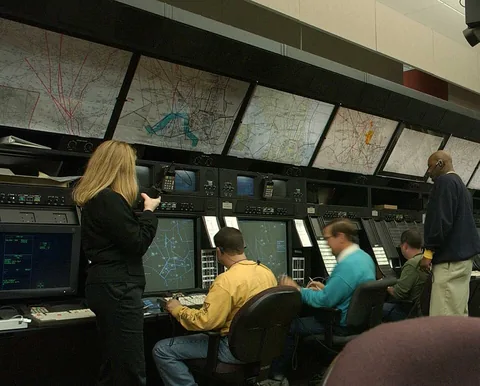
Think about air traffic control. Air traffic controllers don’t need to be at airports. They mostly sit in basements, look at screens... They can be in a centralized facility anywhere in the country. Instead, there’s an air traffic control facility in every single district... For political reasons. It makes it incredibly inefficient. One wire gets cut, and if you got one big facility, you get a backup.
As we saw.40Newark — United's main hub in the New York area. Since 2024 its approaches have been handled from a control facility in Philadelphia, with data sent over telecom lines. In spring 2025 failing old lines repeatedly cost controllers radar and radio contact with aircraft, after which the FAA capped flights at Newark. And on September 21, 2026, the facility's primary link failed and its backup fiber cable was cut by construction crews in New Jersey the same day: the FAA halted flights for several hours into Newark, Philadelphia, Teterboro, JFK and LaGuardia.
You have 450 of them. Things happen all the time. It just makes the system inefficient. I’m not actually advocating for privatizing the FAA, because it’s so politically toxic. But we’re doing more than we’ve ever done, but it’s going to be hard for government to ever be leading-edge on this.
What will happen? Because already certain areas, capacity-wise, are creaking at the seams... And air capacity grows 5% a year. We have an unstoppable force and an immovable object.
There’s going to be limited… There’s going to be fewer flights. It’s already happened in New York. The FAA has put limits on the number of flights in New York. It happened this summer in Chicago.41O'Hare — Chicago's main airport. From May 17 to October 24, 2026, the FAA capped it at 2,708 takeoffs and landings a day, 372 fewer than airlines had scheduled. It’s going to happen more and more places.
That’s what we saw in San Francisco.
We hit the limit of what the FAA can manage, and then that becomes the limit. That’s the limiter. There’s more space in the sky, but you’ve got to have a different air traffic control system and process. And they’re trying to modernize it. They are making good… I’m not trying to be totally negative. I’m not being negative. They’re making more progress than has ever been made in my career, but they’re never going to get to the… If the people at Stripe were allowed to run it, they’d really increase.
More progress would happen.
A lot more progress would happen. If we were allowed to run it, more progress would happen because we’re not constrained by politics. They’re constrained by politics.
AdStripe Economics
Scott has spoken about how some flights take longer today than they did 50 years ago, despite planes flying a lot faster, all because of a bottleneck with air traffic control. Stripe Economics recently looked at a similar paradox with AI. So one study found that while AI can save workers 1.5 hours a week, those savings actually had little relationship with actual work output. It turns out making individual parts of the system faster doesn’t always make the whole system more productive. If you’re interested in these kind of topics, and you want to read more about AI and productivity or other research about the Internet economy, go to stripeeconomics.com.
05The battle for Chicago
Kirby argues Chicago would be better off with one hub than two, because two hubs burn hundreds of flights on duplicate feeders.
You said something at the Crain’s Business lunch in Chicago42Crain's Chicago Business — Chicago's business publication, which hosts events with executives. In late August 2026 Kirby told Crain's again that American would eventually leave O'Hare because economic gravity wins out in the end. in August. You’ve had this battle royale with American Airlines. Very pertinent to me, since I fly to Chicago the most, where it would actually be better for consumers if United was the dominant airline at Chicago.
I wouldn’t use the word dominant, but—
If you were the largest airline, had infinite capacity to expand. How is that? Is that just another articulation of the premium strategy—
Because more routes is a benefit outside of cost?
It’s understanding of how networks work. The real reason for that, is there’s a limited number of flights at Chicago. If you’re going to add one flight to Milwaukee from Chicago, that means you can’t fly… It’s not the shortest, but it’s short. You can’t add somewhere else. For a hub to work, you have lots of what’s called catchment-area flying.43Hub — an airport where an airline gathers passengers from many flights and connects them to others. Catchment-area flights are short hops from nearby cities that feed passengers into connections. O'Hare and Milwaukee are about 70 miles apart. United flies, I think, eight times a day from Chicago to Milwaukee on small airplanes. Not carrying... People aren’t going from Milwaukee to Chicago and getting off the airplane. They’re connecting on to other destinations. And that’s really important.
We have several hundred of those catchment-area flights for connecting customers within a few hundred miles of Chicago. American has totally duplicative services on that. Those do nothing for the city of Chicago. They help support each of our two hubs. But by the way, the same exists in Atlanta and Dallas.44Atlanta and Dallas — single-hub cities: Atlanta's airport is Delta's main hub and has long been the world's busiest by passengers; Dallas/Fort Worth is American's main hub. Atlanta and Dallas are much smaller cities than Chicago. But they have more international service and more passengers. Every metric you look at, they’re bigger, and they drive more economic activity for Atlanta and for Dallas. Single-hub airports drive more economic activity. And this is the reason: because they don’t have to waste several hundred of their flight possibilities on catchment area. They have half as many.
Between you and American, there’s like 16 flights a day.
They have half as many catchment... So what happens is instead of having 16 flights a day to Milwaukee, you have eight flights a day to Milwaukee on bigger airplanes, by the way, so you carry the same number of passengers, and you add an extra flight to Paris, and an extra flight to Tokyo. You get more long-haul flying out of it. I’m 100% sure, Chicago should be the biggest airport in the world. It’s not. It’s because of this. I’m 100% sure it’s better for the city of Chicago. I think it’s going to get you… I mean, American’s going to lose probably a billion and a half in Chicago this year. I think it’ll eventually get there.
How much is your… You famously were from American, were passed over, came to United.45Leaving American: Kirby was president of American Airlines, but in 2016 the board decided he would not become CEO and pushed him out. That same year he joined United as president, and in May 2020 he became CEO. How much is your competitive position versus American will drive some of your comments, versus your past will drive those comments? When are you going to actually start taking real aim at Delta?46Delta Air Lines — one of the three largest US network airlines, along with United and American; headquartered at its main hub, Atlanta. That’s the question we’re looking for.
Everyone thinks that it’s personal for me. I get it.
Maybe a little bit.
But it really isn’t. In Chicago, they’re a big… It’s been a competitive battle there. But look at our market share gains. In our market share gains in Chicago, we went from having lower market share than American to basically having double the revenue share. Those are unprecedented share shifts. The market share shift that we’ve had against Southwest in Denver47Southwest Airlines — the largest US low-cost carrier and one of the four biggest US airlines. Historically it flew point-to-point with an all-Boeing 737 fleet, no bag fees and no assigned seats. is even bigger. The market share shift we’ve had against Southwest and Alaska combined48Alaska Airlines — a Seattle-based US airline. It grew in the San Francisco Bay Area by buying Virgin America in 2016, and in 2024 it absorbed Hawaiian Airlines. here in the Bay Area is even bigger. It hasn’t been directed at them. But with respect to Delta, I think that what’s happening right now with Starlink is the biggest push.
06Starlink
Kirby calls Starlink the biggest, and temporary, competitive advantage in airline history: United has a two-to-three-year window to win other airlines' loyal customers.
That’s what we want to get to. Is Ed going to lose his job49Ed Bastian — CEO of Delta Air Lines since 2016. In March 2026 Delta chose Amazon Leo's satellite network over Starlink for in-flight internet (the first 500 aircraft from 2028). On September 30, 2026, Elon Musk wrote on X that Bastian would lose his job over it. because he didn’t get Starlink?
He’s not going to lose his job over it. By the way, I have a lot of respect for Delta... I took inspiration for it. They were the first airline to start down this, building a brand loyalty. I don’t call it premium, because I want to invest nose to tail for a customer. Starlink applies to everyone. It’s not a premium product, it’s for everyone on the airplane. But, they’ve done a lot of really good things. I think Starlink, behind the schedule, is the most important thing for customers to choose an airline now. Today, we’re at 48% of our flights are on Starlink. In the next week, it’s going to be up to 50.
Way fewer than your seat miles,50Available seat mile (ASM) — one seat offered for one mile of flying; the basic measure of an airline's capacity. Wide-bodies on long-haul routes generate far more of them than narrow-bodies. though. Why did you start on the little planes, and not do the big ones first?
Because they were certified. This is the FAA process. You have to get the other airplanes certified. We’ve been getting them all certified. We’re doing about three airplanes a day. In fact, it’s going to go up by two points in a week and a half.
To this Asian airline point, you have a joint venture with ANA.51ANA (All Nippon Airways) — Japan's largest airline and United's partner in Star Alliance. The joint venture lets them plan transpacific flights together and share revenue. Most people I know who fly over the Pacific would often choose the ANA flights. Now going forward, of course, they’re going to choose the United flights because it’s got Starlink.
Customers are going to try United because of Starlink. Then they’re going to realize the technology, in particular, is better than anything they’ve seen everywhere else in the world. We’re going to get customers that have been loyal to other airlines that try us for Starlink and stay because the technology is better.
With Starlink, we now have this moment where this real differentiation between airlines that previously were closer, the differentiation has gapped out. The fact that every airline has not chosen Starlink suggests to me that the economic deal for an airline was not like an obviously, “Oh, yeah, we must do this.” There was a case you could have made to not do it because some airlines did not do it. Can you talk us through how you made the decision to do it? How painful was the decision?

It wasn’t painful. I thought it would be a big deal to customers, and so wanted to do it. Economics were... Yes, it’s more expensive, but it’s a whole lot better. You often get what you pay for, and that’s true in this case. Mostly at airlines, you look at this like these things are incremental. It really takes time to put them on. The easiest way to put it on is to do it in a heavy check.52Heavy check — a scheduled deep inspection every few years in which the plane is partly taken apart and sits in a hangar for weeks. You got an airplane that’s going to be down. You strip the airplane down. And while you’re working on it, you already got the airplane down, put Starlink on. That’s how we started.
We were only going to do 65% of our fleet because planes were retiring. Once we put it on the first aircraft, we realized all these anecdotes. I’m talking to people like, “I’m switching to flying a regional flight because it’s got Starlink.” I was like, “Holy cow.”
I was booking a flight this week, and I was just thinking through it. I had to book around the Brewers game.53The Milwaukee Brewers — the Wisconsin baseball team Ben Thompson roots for. In October 2026 they swept the Los Angeles Dodgers in the National League Championship Series and reached the World Series for the first time since 1982. Whereas if I had known for certainty that my flight was going to have a Starlink, I would have booked it during the game. There’s such a huge gap between maybe there’s Starlink—
Congratulations, by the way.
Not yet. We’re not talking about it right now. Maybe there’s Starlink, versus there is definitely Starlink. It feels to me like you actually haven’t reaped any of the benefits yet, because certainty is going to make a huge difference.
I think you’re right. I think we’ve got some. But getting to 50% matters... But you’re right. We run a tracker today that gives you a bunch more data. We’re going to put in the app sometime soon the probability that there’ll be Starlink on your flight. At least you know the probability... For flights, and it’ll be different. Today, if you’re flying on a MAX 8,54MAX 8 — the Boeing 737 MAX 8, the most common version of the fourth-generation narrow-body Boeing 737. it might be 25%. But if you’re booking for Christmas, it’s 36% because we know how many we plan to have done. We’re going to have that. We also are going to have a bunch of premier markets that we’re going to get to 100%. Our first hub, I’m not going to tell you the date yet, the first hub that’s going to be 100% Starlink is Los Angeles. Sometime in the first half of next year, if you’re in LA—
Is that because that’s the most competitive hub?
It’s a competitive hub, but... It’s also the kind of aircraft that fly there. Our only aircraft that are still a challenge, we have to get Boeing over the finish line on some of the certification work on the 787s.55Boeing 787 Dreamliner — Boeing's long-haul wide-body with a composite fuselage, in service since 2011. We will get there, but if you’ve got a market like San Francisco that has a lot of 787s, it’s just going to take longer because... Boeing is slower.
Was the CapEx or OpEx56CapEx and OpEx — capital expenditure (here, installing the equipment on planes) and operating expenditure (here, the monthly connectivity fee). more painful in the economic model as you looked at it?
The numbers weren’t that big.
Oh, really? But then why is Delta’s strategy rational, or do you think it’s completely mistaken?
It was a mistake. I think at all airlines, even the ones that... If you watch the other airlines that picked it after United had done it, they’re stepping into it gradually. That’s just the way we’ve always done it in airlines. Everything is slow. Do an aircraft remodification. It takes eight years. That’s the way we’ve done it. I think it’s just the way everyone has done it. If you’re thinking that this is an eight-year project, okay, I’m a year behind on starting, but that’s not that big of a deal. United will be at 12%. We’ll be a year behind. It’s not going to be enough to matter. In a traditional way of looking at it, it can feel rational. I don’t think people... We even didn’t appreciate how big it was. I thought it was big, then we put the pedal to the metal, and SpaceX supported us.
Is this going to be the biggest differentiator of all time?
I think it is. I think it’s the biggest competitive advantage. And it’s temporary. Everybody eventually is going to have high-speed, low Earth orbit. It’s going to be a must-have. But we are going to have a few years of being the only airline that has it at scale. That’s our mission is, we’re going to convince customers that United is the best airline. We’re going to get customers to switch their loyalty to United. Get our credit card, switch their loyalty to United. Not because of Starlink, they’re going to try us for Starlink, and they’re going to stay because all the other technology, and everything else is better. The technology in particular is so much better than technology at... And it’s accelerating. Because we’ve got the right tech stack. Our gap is getting wider and wider with our technology every day.
You have a two to three year window to woo customers.
Exactly. That’s exactly right.
What do you think of Elon’s strategy57Elon — Elon Musk, head of SpaceX, which owns Starlink. of requiring airlines to make it free?
ExplainerWhy legacy inflight Wi-Fi is slow
Before Starlink, planes had two kinds of internet. One is air-to-ground: an antenna under the fuselage talks to a network of ground towers, like a phone; it only works over land, and all passengers share one link. The other is geostationary satellites, 35,786 km above the equator. The signal goes from the plane to the satellite, down to a ground station and back the same way, more than 140,000 km, and light alone needs almost half a second for the trip: pages load with a lag and video calls are nearly impossible. One satellite beam covers a huge area and all the planes under it share its capacity, so when Wi-Fi is made free each passenger gets less and less. That is Kirby's "physics". Starlink satellites fly at about 550 km, 65 times lower, with latency of tens of milliseconds, like home broadband, and many satellites pass over any area at once.
We were going to make it free anyway. Free was going to be... Although in fairness, free is not the value proposition. Fast is the value proposition. The truth is, I’ve flown all three of my big competitors who have it free on the legacy systems,58Free Wi-Fi at the other three biggest US airlines is only for loyalty program members: at Delta since 2023, at Southwest since October 2025, at American since January 2026. and it’s terrible. I have flown them each two or three times in the last year. It’s terrible because there’s not enough… It’s physics. There’s not enough bandwidth to make it free.
I was sad when they started making it free. Because I’m like, “This is going to make my experience worse.”
It makes it unusable for almost everyone. Free was never the value proposition. Fast is the value proposition. And there’s only one option for fast. It’s Starlink, that is the only option. You could call the other fast and free, but it’s not. It’s like dial-up internet. It’s slower dial-up internet.
You mentioned that in the long run, everyone will have Starlink. The technology stack is—
Or maybe Amazon,59Amazon Leo (formerly Project Kuiper) — Amazon's low Earth orbit satellite network and a Starlink competitor. Delta chose it for in-flight internet. but they’ll have low Earth orbit.
How do you think about in the long run where a reason people prefer, say, the Asian airlines versus the American airlines is they feel like the soft bits are better? Do you need to circle back around to that in the long run?
I want us to be the best at everything... And acknowledge that Asian and Middle East carriers are really good at service and product. Now, it does help that they’re quasi-state entities60Quasi-state entities — Emirates is owned by the government of Dubai, Qatar Airways by the state of Qatar, and Singapore Airlines is controlled by the state fund Temasek. In 2015 Delta, United and American accused Emirates, Etihad and Qatar Airways of receiving more than $40 billion in subsidies from their governments. and subsidized. We can’t do it and lose money. If you get ahead, you start to have exponential benefits, you can go faster and do more things.
I think being in the lead and never being complacent, we’re going to have to keep reinventing things and doing stuff to make it great for customers. I think we’ll have a big lead. When you have a big lead, we’ll have the resources to invest. Everyone else is mired in these hitting the Wall Street number for next quarter. And the only way to do that is to cut your investments. They get mired in the short-termism, and they don’t invest. Our constraint on investing in technology is how much can we manage? It is not money.
07Wall Street and big swings
Kirby believes he sees the future better than others, and tells fellow CEOs to stop complaining about Wall Street's short-termism and make big bets.
You’ve talked about airlines being run by operations people where, taking cheese out of the pizza61Taking cheese out of the pizza — saving money by making the product a little worse at a time, like a pizzeria putting on less and less cheese: customers don't notice at first, but eventually they leave. is the only move. What has given you more social permission with your investors, with your board, to do things like the bigger aircraft order during COVID? We’re going to do Starlink. It feels like you have taken bigger swings. Is that just you’ve seen the future better, or do you somehow have more permission to take big swings?
I think we’re better at seeing the future. I don’t know if we talked about it here, but I think reading as much as I do. We talked about the two… I think people that do that, connect dots, can see the things in the tails better than others. They can spot the opportunity where other people don’t. I have a great board who’s been supportive. I spend a ton of time communicating with the board and keeping them involved. We talk about what’s going on. I have a lot of support from them for doing that. From the external perspective, Wall Street almost always hates the big things we do, and I don’t care.
What are some big things they’ve hated?
The aircraft investment. They don’t say, “Don’t invest in technology,” but they want your CASM-X,62CASM (cost per available seat mile) — the main measure of an airline's costs. CASM-X is the same figure excluding fuel and certain special items. which is your cost per available seat mile, to be the only... We can’t control, like, airport fees are going up. Union contracts are what they are. The only way you can cut the budget is to not invest for the future. We’re going to invest for the future.
In the long run, it works out. I’ll hear other CEOs complain about, “Oh, Wall Street is short-term.” What I say to them is: “Yes, they are. Stop complaining about it. That is what it is. But what you should do is invest for the long term and do the right thing. But by the way, if it doesn’t work, you ought to lose your job, and you ought to be comfortable with that. You get paid a lot of money. Make the big bet. If it works, great. Shareholders will like it. But if it doesn’t work, you deserve to be fired. If you’re not willing to take that risk, then stop complaining about it.”
Yes. More gamblers as CEOs.
More gamblers.
Everyone in tech loves, or I think a lot of people in tech love airlines. It’s super interesting but the actual job, how many employees does United have?
120,000.
120,000, with a wide range of skills and abilities. Some are on the ramp. Some are doing route planning. How do you, in all this experience, what is the key to managing that and getting people excited? You’re dealing with unions, all these sorts of things.
I think being the CEO of almost any company, but certainly for me, is really 99% one thing: create the right culture. I was in LA yesterday, and I told the whole team what I just told you guys. The first hub that’s going to get all Starlink, you’re going to get a lot of people that are coming across the terminal, which is where Delta is, across the roadway there to United. They’re going to try us that are loyal to another very good airline. Your mission is make sure they know United is the best airline in Los Angeles. They’re all like, “Yeah, we’re going to do it.”
People want to win. It’s fun.
People want to win. It’s fun.
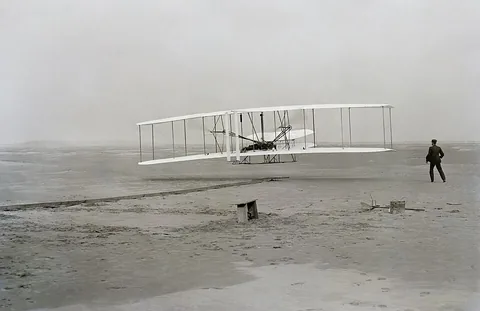
I want to come back to Wall Street. You talked about investor perception. Historically, airlines were the... Canonical example of a bad business. The famous Buffett line63Warren Buffett noted in a 1999 Fortune article that by 1992 the money made by all US airlines over the whole history of aviation added up to zero. In his 2007 letter to Berkshire Hathaway shareholders he wrote that a far-sighted capitalist present at Kitty Hawk would have done his successors a huge favor by shooting Orville Wright down. At Kitty Hawk, North Carolina, the Wright brothers made the first controlled powered airplane flight in 1903. Berkshire bought stakes in the four largest US airlines in 2016 and sold them in spring 2020, early in the pandemic. of a farsighted capitalist would have shot down Orville at Kitty Hawk. The fact that airlines had cumulatively lost money until 1992. I think the entire industry since Kitty Hawk had lost money on an aggregate basis. That is no longer true. It seems to have really changed. Now, airlines are more robustly profitable. I think Berkshire owned at least some airline stocks for a while recently. Has the structure changed? Presumably, you think yes. What has changed such that airlines are no longer the poster child for—
Well, yes and no. Yeah, it had gotten better, but you look at what’s happening in the last 12 months, and things have gone back... This year, six of 10 US airlines are going to lose money. And much of it’s structural. I talked about American earlier. American lose a billion and a half... They’re probably going to lose about a billion and a half in Chicago this year. The golden rule of airlines is you can’t fly places that lose money.
Any business, if something loses money and it’s structural, you have to stop losing money. It’s not unique to that airline. Basically, almost every airline country has a place where they lose a bunch of money around the globe. Some of the losses are like... Lots of places, the airlines have more than negative 100% margins.64A margin worse than minus 100% — a route's costs are more than double its revenue: for every dollar it brings in, the airline spends over two. Which sometimes people think is like, mathematically, impossible because its revenue... It’s possible. Yet they still fly it.
Ego is still big. Ego is the reason those things, I think, have happened in the past. Ego still exists. But the structure of the industry that’s different today is there are basically two winning airlines in the US: United and Delta. We’ve created brand loyalty. Customers fly us not just because of the schedule, which is the commodity part of the business, but because of all the other stuff we’ve talked about today. Even now with oil prices for us are up $8 billion this year. Our best year in history made $5 billion. We’re not going to make as much this year as last, but we’re solidly profitable. It’s just a completely different picture.
08Nuuk and the pilgrims
United finds new destinations through a team that hunts for what isn't in the data, and it quickly cuts routes that don't work.
But hang on. You think we’re still in the Juan Trippe era of aviation65Juan Trippe (1899–1981) — founder of Pan American World Airways (Pan Am), which he ran for more than forty years and made the world's largest international airline; he took big risks for the sake of scale, such as ordering the first Boeing 747s. where it’s not being run by bean counters at every airline, and they’re making... Incoherent, irrational decisions based on ego?
It’s probably not quite the Juan Trippe, but there’s still a lot of ego that’s happening where people are adding routes. I started as a route planner. I could look at like, you’re going to lose. That’s going to be a negative 40% margin, between negative 30 and negative 50.
How are you guys thinking about routes? You’ve added a bunch... You just added an announcement last week of all these new cities that I’ve never seen before.
Yeah, 10 new international destinations. That’s very cool.
How do you make the decisions? When you launch Nuuk in Greenland,66Nuuk — the capital of Greenland, with about 20,000 people. United became the first US airline to fly there nonstop, with seasonal flights from Newark starting in June 2025. is that you have a vibe that it could work? Is it actually very... Is it card counting or poker?67Card counting — a way to beat casinos at blackjack by tracking the cards already dealt and calculating the odds precisely. John contrasts calculation with playing on instinct, as in poker. Kirby, it turns out at the end of the episode, used to count cards.
That one, it’s different. It’s hiring great people. Because I would have never picked Nuuk or known Nuuk. We got a guy named Patrick Quayle68Patrick Quayle — United's senior vice president of global network planning and alliances. and a great team that are really creative. And they go look for things that are different and outside the norm. Not in the data. We talked about data earlier. That aren’t in the data because no one’s ever done it, so there’s no data to support it. Nuuk has been really, really good as an example.
Really?
Yeah, people love it. It’s a great place to go. We’ve added… Across the Atlantic, by next summer, we’ll have 53 destinations. We had 23 destinations 10 years ago. When I got to United, we’ll have 53 next summer. We’ve only had two that didn’t work. But we’re also disciplined about it. When they don’t work, we stop. That’s the great deal, our assets are fungible. Bergen, Norway didn’t work. I think Norway’s awesome.
Bergen is incredible.
I think it should have worked, but it didn’t. We tried it, and it lost a little bit of money. It was not that much. It lost a little, and we just stopped. That’s the great thing. We can try stuff and stop.
The fellow, Patrick Quay—
Patrick Quayle.
Yeah, Patrick Quayle. How does he make the decision that Nuuk is a go?
He has all kinds... They’re staying really connected to what’s happening in the world. Another example, I forget the names of these cities. But we added a couple of cities in Spain and Portugal... That I’ve never even heard of. And I don’t remember them now—the names—that are part of pilgrimage trips.69The Camino de Santiago (Way of St. James) — a Catholic pilgrimage route with Spanish and Portuguese branches that all end in Santiago de Compostela in northwestern Spain. In May 2026 United launched the first scheduled nonstop flights from the US to Santiago de Compostela, from Newark. People... Catholic... They fly to one, and they walk to the pilgrimage to the other, a couple of hundred miles apart, and then they fly out of the other city.
You have to add both of them at the same time.
We’ve added... Anyway, he went and somehow read about pilgrimages. He went and got some data, how many people do it. Then he went and found data that said, “Oh, I can see all these broken itineraries that somebody flew us into one of the cities, and they flew another airline out of the other city.” We added them, and they went gangbusters. He, this year, took a trip to Uzbekistan and Kazakhstan. We can’t fly there today because we can’t fly over Russia.70Flying over Russia — since 2022, after Russia's invasion of Ukraine and the sanctions on both sides, US airlines have stayed out of Russian airspace. But he’s there like—
This could work.
This could work down the road. He’s doing stuff like that, and his team is great. He’d be more interesting maybe for one of your podcasts in the future than me.
Yeah, I’m very interested. Greenland, by the way, is fascinating. I love it. It’s a country of 50,000 people, and they’re just going gangbusters building airports.
It’s the only way to get there, to places.
Yes, but sure, it’s the only way to get there. An international airport in Nuuk maybe makes sense. They just replaced it, and that’s the new route that you guys have. But they’re replacing the airport in Narsarsuaq. There’s already a perfectly good airport there, and they’re building a new airport there in the south, full jet-capable international airport. They love these capital projects for a country of 50,000 people.71Greenland's airports: Nuuk's new airport, with a 2,200-meter (7,200-foot) runway, opened in November 2024, allowing jets from Europe and North America to fly in. In the south, an airport at Qaqortoq opened in April 2026, replacing Narsarsuaq, an airfield built by the US military in World War II; Qaqortoq's runway is 1,500 meters (4,900 feet), for turboprops. Greenland's population is about 57,000. Sentinel-2 photographed Nuuk’s new runway ten days before the airport opened in November 2024.
Nothing else to spend their money on, I guess.
But it’s such a cool, no pun intended, place to go. It can drive the economy, 50,000 people, having people come in.
Sure.
It can drive the economy.
09Stagnation in aircraft design
Planes fly as fast as they did in 1967 because, Kirby says, Boeing and Airbus have tacitly agreed not to invest in new designs.
I want to talk about the tech for a second.
Yeah.
How should we feel about the last few decades of the actual airframe advances, where everyone likes to talk about the 737 first flew in 1967,72Boeing 737 — one of the best-selling airliners in history (in October 2025 the Airbus A320 family overtook it in deliveries); it first flew on April 9, 1967. The 737 MAX is its fourth generation. Mach 0.78 is about 515 mph at cruising altitude. it flew at Mach 0.78, and the 737 MAX today flies at Mach 0.78-ish. Now... It does burn 50% less fuel, the latest version, so that’s a significant improvement. It is 30 to 40 times safer, so that’s a significant improvement. But at the same time, people feel like, again, it’s one of these examples people trot out of stasis. How do you feel about the rate of technological improvements in airframes?
It’s maddening that we haven’t done more. In fact, this book, where is it?
Impossible Factory.
It’s a Skunk Works book.73Skunk Works — Lockheed's (now Lockheed Martin's) division for secret projects, founded in 1943 by the aircraft designer Clarence "Kelly" Johnson. It produced the U-2 and SR-71 reconnaissance planes. The Impossible Factory is the journalist Josh Dean's book about Johnson and Skunk Works, published in May 2026. I want to read this. I had not known there’s a new Skunk Works book.
The Clarence “Kelly” Johnson. Developing the SR-71, the U-2 in a couple of years from start to finish. I think the fundamental problem is Boeing and Airbus have a global duopoly,74Duopoly — a market split between two players. Boeing and Airbus supply nearly all of the world's large airliners; COMAC's Chinese C919 has flown since 2023 and so far only with Chinese airlines. and they have quietly, not officially agreed, but they have quietly agreed: “Neither one of us will invest in new airframes.” They’re pacing the frontier. If you don’t have an option... We need a third aircraft manufacturer, to be blunt.
Okay, so you think there’s basically a breakdown of competition?
Yeah, so neither one of them, their investors don’t want them to invest, and so they just won’t do it. I’ve been begging them both for 20-something years to build a 757 replacement...75Boeing 757 — a mid-range narrow-body built until 2004. Neither Boeing nor Airbus has ever built a direct replacement. Begging them, and they just won’t do it.
I am on a 757, actually, to Chicago, I’m a little nervous about it. A great plane. The takeoff’s amazing.
Yeah, it’s a cool airplane. It’s a cool airplane.
Speed is obviously one thing, and obviously, you guys are working with Boom.76Boom Supersonic — an American startup developing the Overture supersonic airliner. In 2021 United agreed to buy 15 of them with options for 35 more. But speed is also hard, and it requires much more fuel. Other than speed, what improvements would you like to see?
Well, a couple. The next generation, I think, of airframes, you could build on the current airframes. I think the biggest thing is probably going to be blended wing bodies. Think of the B-2 bomber. It’s a much more efficient airframe for flying, and so turning that… We’re an investor in a company called JetZero,77Blended wing body — a design in which the fuselage merges smoothly into the wing and generates lift itself, like the B-2 bomber. JetZero is an American startup developing an airliner of this type; in 2025 United invested in it and secured the right to order up to 200 of the planes. On the unmanned X-48B model that Boeing and NASA flew in 2007–2010, the fuselage blends into the wing.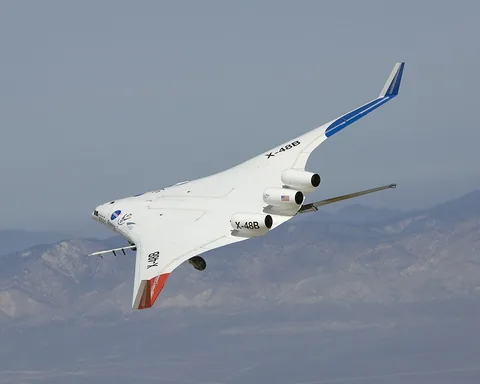 who’s trying—
Is that an airport challenge though too—
Creates airport challenges. It’s bigger, so airport space. But that’s really a gate challenge. You got to re-gate. I think that’s an example of something. Engine technology, I think, can advance as well. Another cool thing, by the way, we’re starting the Relax Row,78Relax Row — a row of three economy seats with leg rests that rise to turn the row into a flat bed. United unveiled it in March 2026; the first planes with it are promised for 2027, and more than 200 Boeing 787s and 777s by 2030. later this year or next year. Which is in coach, you can put three seats, and a bed comes out, and you can lay down on them. We have little United stuffies, airplane stuffies. I’ve already got some for my kids. My kids love them, but that’s another cool—
10Brand over price tiers
Kirby explains Relax Row and seat-back screens as brand building rather than price slicing, and tests decisions through the eyes of a parent with small kids.
But is that an example of basically a lot of the economic outcomes that you’re looking for? I pushed you on this with the premium question.
Yeah.
How can you take a large, fixed-capital product and basically deliver infinite numbers of strata of pricing?
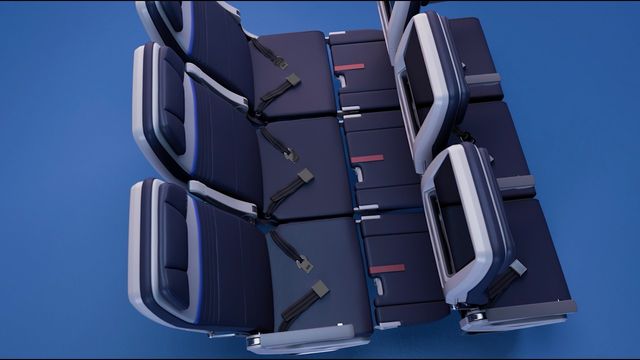
Yes and no. I think of this as… I don’t think of it that way. I think we are trying to build a brand. We’re trying to build a great brand. Something like, Relax Row, I think, will be profitable. But it’s going to not even be around in our financials. But it’s cool and it’s good to do stuff that’s cool. Good for families. I also said earlier, I have seven kids. And I think of air travel through the lens of a parent traveling alone with a couple of young kids. How do we make it easy for them? If we can make it easy for them, we’re going to make it great for everyone.
Relax Row is perfectly consistent with making it easy. Starlink is great for them. It was seat-back entertainment. I love walking through our airplanes with seat-back entertainment, which a lot of airlines went away from. You’ll see kids watching, and parents just totally relaxed because their kids are watching Bluey.79Bluey — an Australian animated series about a cattle dog puppy and her family, one of the most popular children's shows in the world.
I heard you could now watch Cheeky Pint on there.80Cheeky Pint — the podcast John Collison launched in 2025: conversations with guests over a pint.
You can now watch Cheeky Pint on the inflight entertainment.
That’s cool.
It’s pretty cool. People are probably watching this.
Maybe I’ll watch this.
Exactly. You can just put it on there. When you’re saying things like the Relax Row, social media has almost changed airline marketing, where there could be things that are maybe not the biggest from a ticket booking perspective, but if it gets people broadly excited about United, that is valuable.
I look at... We’re trying to build a brand. All the Starlink stuff that’s happening.
Sure. You’re feeding it. That’s your buy farm.
I feel bad for Ed. Just kind of. But I love it for us. Actually, we had a big push that was coming.
I was going to ask about it. How did you decide to run those ads,81The ads: on October 1, 2026, right after Musk's jab at Bastian, United launched a "Switch to Better Wi-Fi" campaign inviting travelers to stop waiting for things to load and switch to United for the fastest Wi-Fi in the sky. It offered elite members of Delta's and American's loyalty programs matching status for 90 days. right? Because you only have 50%, are you ready to do this?
We were waiting to actually… We’re going to cross the 50% threshold next Friday. We were waiting until then to really push. We’re going to do it anyway, but that was a moment to like… Our team is great. Maggie Schmerin,82Maggie Schmerin — United's chief advertising officer, with the company since 2017. who’s our VP, runs that. It’s awesome, and she did. One of the things… this is another advice to companies that she tells me. She did it without… She didn’t ask me. She knew she didn’t ask me. No approvals. She’s awesome. I trust her. That creates speed.
Most companies, especially big traditional companies, have 16 layers of approvals. You can’t do stuff fast or creative or fun or interesting because it just gets watered down. She just went out and did it, knew that she had support from everyone at the company to go do it. And did it. I was at a CVS board meeting because I’m on the board of CVS Health.83CVS Health — the largest US pharmacy chain, which also owns the insurer Aetna. And I started reading about it: “Well, this is pretty cool.” People are asking. Actually, I didn’t read it. People were asking me like, “This is cool.” Like, “Oh, what did we do? That’s cool.”
11Slots and expensive airports
Kirby supports caps on flights, but he says sky-high fees at big airports have priced low-cost carriers out.
As we think about the airline business in the United States... Pre-1978, everything was very heavily regulated.84The Airline Deregulation Act was passed in the US in 1978. Before it, the government's Civil Aeronautics Board decided which airlines flew which routes and what tickets cost. United flew on routes approved by the government with fares set by the government. I think people don’t realize when they look at those old-timey ‘60s photos of someone coming along with a lobster cart, and everything’s so brilliant. It’s because at that time, airlines could not compete on price and therefore competed on perks. We’re much better off these days when you actually have a real market and real price competition.
One of the places where we have less of a free market in air travel is the slot system.85Slot — permission to take off or land at a set time at a congested airport. In the US, slots are required at New York's LaGuardia and JFK and at Washington's Reagan National. At Newark the FAA capped takeoffs and landings in 2025, after controller outages and mass delays. There, we have very limited number of slots in airports. I actually don’t fully understand how slots are granted, but do we have a breakdown of competition in certain airports because you have this wacky slots system?
Yeah, but I think it’s at the margins. What’s bad for customers is scheduling more flights than an airport can handle. That’s what’s really bad for customers.
Well, didn’t that happen in Chicago though?
It did. Maybe it was going to happen. It happened in Newark, historically. We finally got it, effectively slot control at the airport. It’s now the most reliable.
Oh, you wanted slot control because it’s bad for customers?
It’s horrible for customers. I begged the FAA, and we finally did it.
But that’s the contrast, right? In Chicago, you’re making this move. This wacky law. Every year, they re, sort of—
What’s the wacky law?
Every year, they take a number of flights previously and reallocate the gates. But it’s a weird thing. It takes a while to move the gates. It’s this weird time delay that’s introduced into it.
It created a bad outcome. It’s part of how American got to lose a billion and a half because what happened in Chicago, American wasn’t paying attention and lost six gates to us.
They weren’t paying attention? It’s like forgetting to renew the internet domain. It’s like they just—
By the time they were doing all those, United added on so many flights.
We hadn’t done anything. We went back to our normal pre-COVID schedule.
American was focused on the Sun Belt,86The Sun Belt — the warm southern and southwestern US states, where people and businesses have been moving for decades. and they talked about it publicly. Phoenix, Dallas, Miami. More demand, leisure demand. That’s what they were focused on. They just didn’t add back their schedules. And we didn’t do anything special. But because they did it, they lost gates to us. You have to have slots... Because that’s the only way to manage a limited resource. They’re mostly grandfathered,87Grandfather rights — an airline keeps a slot the next season if it used it at least 80% of the time ("use it or lose it"). That is why slots at congested airports stay with the same carriers for decades. which is probably fair. If you’re British Airways, and you’ve invested billions of dollars in London to build facilities and stuff, and then they say, “Oh, we’re going to take them away and give them to someone else.”
But there’s a balance here. You both want people to earn a return, and you want Schumpeterian destruction88Creative destruction — the idea of the Austrian economist Joseph Schumpeter: new companies and technologies displace old ones, and that drives economic growth. where British Airways should only be allowed to recoup so much investment, right?
Yeah, I think the better answer is to change air traffic control and create more slots. That’s how you… You can create more slots with better air traffic control. And then you can allocate those in whatever way you see fit. But the other thing that’s happened at all these big airports that have slot controls is the government entities that run the airport have made the cost so prohibitive that no low-cost carriers can afford to fly there.
The New York airports are now $52 per passenger to fly at the New York airports. Spirit Airlines, before they liquidated,89Spirit Airlines — the largest US ultra-low-cost carrier. After two bankruptcies and failed talks on government aid, it stopped flying on May 2, 2026, and was liquidated. average fare was $58. You didn’t have to be a rocket scientist to figure out if you’re paying $52 out of $58 before you buy your fuel, before you buy your airplanes, before you pay your employees, before you do maintenance, that just mathematically doesn’t work. The airport authorities... The big airports in the country are up something like 70% of the expenses since pre-COVID to today. They’ve just priced low-cost carriers out of the market.
12Why low-cost carriers die
Low-cost carriers die when they stop being what they are, Kirby says, and only the disciplined Ryanair still thrives.
Well, did you price low-cost carriers out of the market?
We didn’t price them out.
You had the basic level, and you had this much more fine-grained cutting up of the seats.
The low-cost carrier business model was predicated on having a price advantage. Being able to charge a lower price. We created basic economy90Basic economy — the cheapest fare at mainline airlines: no seat selection, no changes, sometimes no carry-on. United introduced it in 2017 to compete with low-cost carriers. where we could profit. And we up-gauged airplanes, so we could profitably be competitive on price most of the time. If we’re competitive on price, there’s no reason... My joke was: “People may make the mistake of flying Spirit once, but they’re not going to do it twice.”
Why did Spirit go bust?
Because they weren’t charging as much as their costs. They were not able to charge enough—
That’s what I’m trying to ask—
It’s pretty simple. It was simple. They weren’t able to charge enough. Look, what’s happening—
It was because of cost inflation, basically.
Cost inflation, but there’s a whole bunch of things. Fundamentally, what I think has happened to the low-cost carriers... There’s really one still low-cost carrier, successful airline in the world. It’s Ryanair.
I was going to ask.
The fundamental premise of a low-cost carrier is to fly to low-cost airports. Southwest, when they started flying here, they flew to Oakland,91Oakland, Burbank and Ontario — secondary airports: Oakland is on the east side of San Francisco Bay, Burbank and Ontario are in the Los Angeles suburbs. LAX is Los Angeles' main international airport. not San Francisco. San Francisco is too expensive. In LA, they didn’t fly to LAX. They flew to Burbank and Ontario. LAX is too expensive. Ryanair still does it. Ryanair doesn’t fly to Heathrow.92Heathrow and Charles de Gaulle — the main airports of London and Paris. Ryanair serves London mainly through Stansted and Paris through Beauvais, about 50 miles from the city. They don’t fly to Charles de Gaulle. They fly to secondary airports, because they’re low-cost.
All these companies’ eyes get too big for their—
In the US, every single one of them abandoned that.
Is it an ego?
Then they went to fly into… I don’t know why.
They run out of customers, right?
Yeah, and they went into Chicago and Newark and San Francisco. Back to the New York... You can’t charge 58 bucks when you’re paying the airport authority 52. You just can’t.
Is it a chasing growth story? I’m always very impressed by In-N-Out93In-N-Out Burger — a family-owned California burger chain with a very short menu. It grows slowly and opens restaurants only within a day's drive of its distribution centers, which supply fresh ingredients by truck. as a business because they don’t chase growth. They famously do everything within one day’s drive of the refrigeration centers... Distribution centers. And so they’re only in the California West Coast type area. They don’t feel the desire to go crazy on the menu: “We have the salad this, and we have whatever that.” I see they keep the menu very narrow. I feel like maybe if they’re a public company, they were trying to chase growth, and we’re going to expand this way. And they just do the same thing exceptionally well with a cost advantage.
Is the problem that as public companies, maybe, or as just short-term oriented companies, they had this good thing flying to Oakland and flying to the secondary airports, and for whatever reason, they just got distracted from it?
Yeah, I would actually say a little different than just chasing growth. I would say, know who you are, know what your strengths are, and stick to your knitting.
Companies are not good at trying to be something they’re not. In the past, this predated me, but all the big airlines, American, Delta, Northwest, Continental,94Northwest and Continental — former major US airlines: Northwest merged with Delta in 2008, Continental with United in 2010. tried to go compete with Southwest by creating airlines within an airline that were going to try to out-Southwest Southwest.95Airlines within an airline — for example, Continental Lite at Continental, Delta Express and Song at Delta, and Shuttle by United and Ted at United itself. All of them shut down. In Europe, they still do it. In Asia, they still do it. They try to out-low-cost carry low-cost carry. And they’re terrible at it! Every single one of them has been. Nobody does it well.
By the way, Southwest has now tried to be like us.96Southwest abandoned its long-standing principles in 2025–2026: it introduced bag fees, extra-legroom seats and assigned seating instead of open seating. They’re not going to be very good at that either. You got to stick to the things that you’re good at. We aren’t going to ever go try to compete with Allegiant Air97Allegiant Air — a US ultra-low-cost carrier that flies vacationers from small cities to leisure destinations like Las Vegas and Florida, often only a few times a week. and be Allegiant Air because we’d be terrible. They’re better at Allegiant.
If they try to compete with us—
The low-cost model works, but you have to understand.
You got to stick to it. You got to accept that there’s limitations. “I’m not going to be as big as United Airlines. I’m not going to fly to Chicago O’Hare.” I have a great… Allegiant is an example. Allegiant Air, you know, it mostly flies to Vegas. They fly from small cities. They’ve done a great... They’re one of the four airlines that is going to be profitable this year.
What else have you learned from Ryanair?
The guy’s entertaining. Michael O’Leary is entertaining.98Michael O'Leary — CEO of Ireland's Ryanair since 1994, who made it Europe's largest airline by passengers; known for provocative statements and salty language. In early 2026 he sparred publicly with Elon Musk, refusing to install Starlink: according to O'Leary, the antennas add weight and drag and increase fuel burn.
We’d like to get him in the pub here.
You had him here?
No, I would like to.
You’ll get a few more swear words than you get out of me.
He knows his business exceptionally well. He’s a very impressive CEO. They’re also In-N-Out. They have avoided distraction.
He’s disciplined.
They always get asked about transatlantic.
Discipline is probably a better way.
It doesn’t work because you don’t get the low-cost advantage when you can’t get the number of turns99Turns — how many flights a plane makes in a day. Low-cost carriers make money by keeping planes on the ground as little as possible, while on transatlantic routes a plane can make only one round trip a day. high enough. They get asked about Wi-Fi on the planes, and it’s like, “Guys, the flights are short. Just look at your phone for an hour or something. You don’t need it on an hour-long flight.”
He’s disciplined. That’s a better way of saying it. Getting outside, you have to be disciplined to be successful. Companies get stars in their eyes, and they’re not disciplined.
13Discipline means routes
Discipline in the airline business, Kirby says, is the route network: fly to your hubs and cut money-losing "strategic" flights.
What’s the version of discipline for you? Because it’s easy, like United, you guys are a huge global airline. You fly big aircraft, you fly small aircraft, you fly internationally, you fly domestically. It would be easy to want to do everything where it’s like, “We’re cost-competitive, but we have a great wine list.” What is your version of staying disciplined?
In the airline business, discipline is really about where you fly. The foundation, our product starts with the route network—
You fly routes that make money—
And fly places that make money. Every time I go—
Does that mean where you’re less point-to-point in domestics?
We don’t fly point-to-point.100Point-to-point — direct flights between cities that bypass hubs. Southwest has historically used this model; United, Delta and American build their networks around hubs. I hear it all the time. In LA yesterday, when I do stuff in San Francisco tomorrow with employees, they’re always asking, wanting to fly new routes and point-to-point routes. It won’t work for us.
We’re an airline that flies to our hubs.
ExplainerWhy airlines fly through hubs
Linking every pair of 100 cities with nonstop flights takes 4,950 routes, and most of them wouldn't fill even a small plane. A hub solves this differently: 100 flights from one airport to 100 cities give a passenger from any of them a way to any other with one connection. The plane from the hub to Milwaukee is filled by people heading to dozens of different places, and to keep connections short, flights arrive and depart in "banks": dozens of planes land almost at once, swap passengers for about an hour and take off again. Hence Kirby's conclusions:
- a hub's value grows with the number of destinations, and a second hub in the same city burns slots on duplicate feeder flights;
- a nonstop flight against someone else's hub is nearly hopeless: the rival's plane is full of connecting passengers, while you only have local demand;
- opening a new hub is nearly impossible, since it takes an airport that can handle hundreds of flights a day.
The hub-and-spoke model spread in the US after the 1978 deregulation, when airlines began choosing their own routes.
We fly to our hubs. That’s our strength and a whole bunch of reasons that works. We’re not going to go try to fly point-to-point routes.
If you’re not first, you’re last.101"If you ain't first, you're last" — a line from the comedy Talladega Nights: The Ballad of Ricky Bobby (2006) starring Will Ferrell.
If you’re not first, you’re last. That’s true in the airline business. It’s by market. It’s not overall. People in Dallas ask me, “Why do you not fly here?” Because we’d lose. American has too much network depth. When they fly from Dallas to Los Angeles, 75% of the people on the airplane are connecting from other destinations. If we’re just flying Dallas and LA, we can’t compete because we don’t have any connections. We’re competing for 25% of the market. It doesn’t work.
Does that then mean the little decisions you make are, “Okay, should we fly from, is it Newark to Greenland?” That’s a little decision. The big decision is: “Are we going to launch a beachhead and take a new hub?” How frequently do you make those decisions?
Rarely.
Is the last big hub up, Denver, when you grew it hugely?
But this was an existing hub that we chose to grow. In my 30-year career, I’ve closed three hubs and never opened a new one. It’s a hard decision to do. It’s very rare that that’s… Lots of examples in the airline industry of that not working, and almost none of that working in the post-deregulation era.
Do you think it’s basically impossible to launch a new hub these days? Building a new airport, it just hasn’t happened in the last 50 years.102New airports — the last major US airport built from scratch was Denver International, which opened in 1995.
Yes, is the short answer. Take the Southeast. It’s the one part of the country where we’re number three because Delta has a hub in Atlanta, American has a hub in Charlotte. I’d like us to be bigger in the Southeast, and it doesn’t matter to customers, but there’s just simply no airport that’s big enough where we can be competitive. We would need to have 600 flights a day to be competitive with American and Delta. The biggest city that would work, that’s a big enough city, maybe is Raleigh-Durham.103Raleigh-Durham — the North Carolina airport serving the Research Triangle (Raleigh, Durham and Chapel Hill), a fast-growing area of universities and tech companies. But the airport’s not big enough. There aren’t enough gates. There aren’t enough runways. You couldn’t have 600 flights a day. Try to do something just because it’s a cool vision, we don’t do. We’re disciplined.
But this would be a big enough deal for a region that could you work with Raleigh-Durham to expand the airport?
Expanding airports in this country is like... A decade-long process.
Yeah, more. That’s optimistic, probably. Okay, so you think it’s just—
It’s just…
Okay, so discipline for you—
It’s possible someday we’ll at least experiment with going into a big city that’s not really a hub for anyone. Delta has done some of that. It’s been, I think, break-evenish, but they’ve not lost money.
You did, though. This is not a hub at all, but way back in the day, you used to have a hub in Narita.104Narita — Tokyo's international airport. United got a hub there in 1986 by buying Pan Am's Pacific routes and for many years flew from it across Asia; most of those flights were later cut. You’ve added a few connecting flights. There’s one from Hong Kong to Thailand and to Vietnam—
Ulaanbaatar—
And you’re flying to Kaohsiung from Narita105Ulaanbaatar — the capital of Mongolia; in 2025 United launched seasonal flights there from Tokyo's Narita. From Narita it also flies to Kaohsiung, Taiwan's second-largest city. And in December 2026 United is launching the first nonstop flights from the US mainland to Sapporo, Japan, from San Francisco. now. Is that just more on the margins sort of things?
It’s on the margins, but there are places like in Tokyo, we have connectivity with our partner. A lot of the people that… Like Ulaanbaatar, we realized that something like 12% of the people that were flying us into Tokyo were ultimately trying to get to Ulaanbaatar, and it was really hard. ANA didn’t fly there.
That is a mess. Wait, I don’t believe that—
What’s going on here—
That number is way too high.
It was the summer, but it was a high percentage of people.
For vacation?
Yeah.
Am I missing something? I haven’t been to Ulaanbaatar. Am I missing anything?
I haven’t been there either. My mom went. My mom travels a lot. She uses my flight benefits and travels a lot. She’s just awesome. But... We’ve seen that data and we added the flight. Now a lot of the people that fly us into Tokyo connect on to Ulaanbaatar. It was a particular flight that it was 12% at one time a day, at that time of day. But then we also have all the ANA connections. They weren’t flying.
Kaohsiung is the same thing. For us—
Why to Sapporo?106Sapporo — the capital of the Japanese island of Hokkaido. A couple of hours' drive away is the ski resort of Niseko, famous for its deep, dry powder. It’s going to be fun.
Sapporo is booking really well. It’s going to be…
Is that for skiing?
Skiing.
Yeah.
But Japan has become like... The hottest destination—
For the tech people here in San Francisco.
People just love it. Even in Dallas, people love Japan. I have all kinds of friends that, “We went to Japan for spring break,” and they love the food, the people are great. They just love it.
What I’m taking away from this is that route selection makes or breaks airlines.
It broke Spirit or the low-cost carriers. It broke American in this fracas you guys had.
Well, they haven’t accepted that it broke them, but it did.
Then similarly, success means a disciplined route expansion strategy that understands your strengths.
Look, that’s pretty insightful. I tell new CEOs, which many of them call, talk to me. I don’t think any of them have taken my advice yet, but I tell them, “The one thing I’ll tell you, start with the route network is the foundation. If that’s broken, it doesn’t matter how good you do everything else. If you have bad routes that lose money, you cannot make the airline work. It is impossible.” You’re going to hear, if you look through the route P&L,107P&L (profit and loss) — an income statement; here, the profitability of each route. which you should do, you’re going to see a bunch of negative flying. When you ask people about it, they’re going to say it’s strategic.
They’re going to have convincing excuses.
They’re going to call it strategic. If you hear the word strategic flying, you don’t need to know what hub it is, you don’t need to know what route it is, you should cancel it. You have to stop flying. Anything that... If you default to it loses money, but it’s strategic, you have to cancel it. And they don’t do it.
What are the lies people tell themselves to convince themselves to stay running a route? What does it mean to be strategic?
Corporate customers, something like that.
Yeah, or credit cards. If we’re not big in this city, then we just won’t get the credit card—
Is that the biggest tail risk if credit cards ever go away?
No, it’s not nearly as big as people think.
The perception amongst the—
Yeah, the perception is big because people look at… They can see the amount of revenue that we get, and they say, “Oh, almost all your net profit is coming from credit cards.”108Co-branded credit cards — US airlines earn billions of dollars by selling miles in their loyalty programs to banks for co-branded credit cards: cardholders earn miles and redeem them for tickets. United issues its cards with JPMorgan Chase. Well, yeah, but there’s a cost. We carry over 50,000 people a day. 50,000 people today will fly free on United Airlines by using their credit card miles. Nobody counts the cost.
Oh, you’re saying they just can’t do an accurate contribution profit calculation?
Yes. All that we disclose is the revenue. Everyone’s like, “Oh, look at the revenue.” Fifty thousand people a day are flying for free. There’s a cost of carrying 50,000 people.
Okay, so the whole Twitter meme109The meme: "Airlines are banks (or credit card businesses) with planes attached." There are numbers behind it: in 2020 United borrowed $6.8 billion against its MileagePlus loyalty program, which appraisers valued at about $22 billion, more than the market value of all of United. of airlines are a credit card business with airplanes attached, it’s just they’re holding the financial statement upside down.
They’re ignoring half. They’re looking at the revenue side and ignoring the cost. Ignoring the cost side. It’s important. It’s good, but—
But it’s blown way out of proportion.
But it’s blown way out of proportion—
14Loyalty and alliances
Kirby measures the frequent flyer program, the lounges and the alliances against one goal: loyalty to the United brand.
How do you think about changes in the frequent flyer program? You just went to, I think, $32,000 or whatever you call it—points110Premier qualifying points are earned for money spent with United; from 2027 they are the only criterion for elite status. The flight-segment requirement was dropped, and the threshold for the top status, Premier 1K, was raised from 28,000 to 32,000 points.—which... I appreciate getting rid of the segment one because I never qualified on that one, so I appreciate the simplification. But, is that a—
You in general just seem to want to keep the riffraff out, like with the Wi-Fi, with the…
It’s a real challenge here.
They want the cutoff to be right below Ben.
Yeah. That’s exactly right.
I applaud these changes. I looked back on my past few years. I’ve always well-exceeded 32,000, so it’s no problem for me. I want emptier lounges,111Lounges — United's airport lounges are United Club and, for long-haul business class passengers, Polaris. Elite status grants access, so the more elite customers there are, the more crowded the lounges get. so it’s all good. What’s the calculation in that? Delta obviously has gotten a lot of grief from frequent flyers in the changes they made.112Delta's changes: in 2023 Delta announced a sharp tightening of its SkyMiles loyalty program and lounge access rules, then partly backed down after a wave of outrage from frequent flyers. Yours seemed to go fairly well. What do you think that was?
I don’t think about it through the lens of the frequent flyer program. I think about how do we grow brand loyalty. The frequent flyer program is one of those things. Really, if we’re doing something that’s going to detract from brand loyalty, there’s got to be a good reason to do it. Clubs are… How many people are a Global Services member?113Global Services — the top tier of United's loyalty program: it has no published criteria and is by invitation only. People love being Global Services, but we limit it. It’s exclusive.
There was one year I thought I was going to make it. January passed and it never came. It was very sad.
Clubs are another example. This is another thing. During COVID, I’m pretty sure we’re the only airline that did this, we doubled down on club investment. We’ve doubled our square footage of club space from pre-COVID to more than doubled it. And it’s going to grow by another 50%. It was the one time in history... If you close a club, it’s complicated. But close a club, it makes customers mad in the short term. You have to do it sometimes to expand it. But COVID was the one time in history, we had to spend money, but we had no customers. We could get away with doing it, we could do it faster. Expanding club space is what we have a bit. We’re going to do more of that. Those are the kinds of things that we’re more focused on. Any changes to the frequent flyer program are about trying to build loyalty.
That is just, “We could deliver a better experience if there’s fewer people.”
Well, sometimes it’s that. I guess there’s only a certain number. We’re putting more first-class seats on, but at any given time, we only have so many first-class seats on airplanes. We’re calibrating the program to make it valuable for loyal customers.
You run the Star Alliance board?114Star Alliance — the world's largest airline alliance, founded in 1997; its members include United, Lufthansa, ANA, Air Canada, Croatia Airlines and about twenty other airlines. Alliance partners sell joint connecting tickets and honor each other's loyalty programs.
Not anymore.
Oh, you used to. What’s that like? Because it’s an interesting construct, right? It’s one of these businesses where the airline business is one of these businesses where these are kind of competitors, but you do run some overlapping routes, but it’s better to work together, but then you got to pick who you work together with. How much are you picking based on the vibe of the other CEO versus it’s strategic? How much does that change?
We’re all locked into alliances now. It’s hard to switch. The real value for customers is being able to connect on to places that we don’t fly to. When we fly, we fly into Frankfurt and Munich, and I think we have four times as many flights into Frankfurt and Munich as American and Delta combined. But it’s because we have a partnership with Lufthansa.115Lufthansa — Germany's largest airline, with hubs in Frankfurt and Munich, and United's partner in Star Alliance. Together with Air Canada they run a transatlantic joint venture, coordinating schedules and sharing revenue. I think 60% of the people on our Frankfurt and Munich flights are connecting beyond Munich. They’re going to Kazakhstan and all kinds of places that we don’t fly to. That’s the value for customers.
The downside is the experience doesn’t feel the same as on United. That’s what we’ve been working to do. We’ve made a lot of progress. A few years ago, actually, I finally asked and asked and asked other airlines about this, and I finally said, “If you don’t have seat assignments available for our customers, we’re going to turn off our partnership with you.” That got everyone to do it. We’ve been begging them to do it for years, but it just wasn’t a priority for them. Other stuff wasn’t their priority. We finally had to say, “We’re going to cut you off unless you do it.”
My focus on our partnerships has been, how do we make the customer... If a United customer is flying on any of our partners, how do we make it feel to them like it is still United Airlines? I think the other airlines ought to be doing this—
Is that the nature of the partnership? You provide the most customers, and so that ultimately gives you the control—
Yeah, we’re by far the biggest and the access to have the big hubs. Lufthansa is second. Across the Pacific, ANA is big. There’s just several big partners. But some of the others are like, one of my favorite airlines is Croatia. I love the people. They’re small, 21 airplanes. One, I love Croatia. It’s a great country. Super fun. People are awesome. I like the CEO. I like the culture. I like the people. It doesn’t drive a ton of economic value, but when we try to do new stuff, if we’re going to do new technology stuff, they’re one of the smallest. They raise their hand every time. So, I appreciate that.
Your career is very much defined by consolidation and doing stuff together. You’ve been talking about, “Oh, we should just buy American Airlines116A merger with American: according to Bloomberg, in February 2026 Kirby floated the idea of a United–American merger to Donald Trump; there were no formal talks. or whatever it might be.” Is there any limit in your belief in the power of consolidation and doing a better consumer experience?
I was going to start with, thank you for adding it, my belief is delivering a better consumer experience works. We’re not in a commodity business. Maybe not true in steel because it’s a commodity. But, in non-commodity businesses, doing things that are good for your customers is the winning formula.
The consolidation that—I actually hadn’t thought about this. The consolidation dynamic that you’re referencing is that ultimately, eliminating duplicative flights in a capacity-constrained airport, which is all the major ones, means that you can have more selection as a—
That’s the Chicago example.
But it’s not just that.
It’s not just that. The American rationale is, I would like to create an airline that Americans, broadly, are proud of. That they think of as the flag carrier of the United States. If you go to Dubai, people are proud of Emirates. They may complain about stuff, but they’re proud of Emirates. They recognize that Dubai, the wealthy city-state, exists because of Emirates. They’re hand-in-hand. Singapore, same thing. Singapore is not without Singapore Airlines. I would like to create the same thing.
We also have a massive trade deficit with international airlines. It’s two-thirds of the long-haul seats into the US are from our competitors, even though only 40% of the customers are coming from overseas... Because they’re all state-subsidized. There’s a bunch of reasons for it. I’m not complaining about those. But I would like to create an airline that can compete head-to-head with those airlines. By the way, that doesn’t create as many good jobs in the US. It’s a whole bunch of reasons. I would create a great airline in the US that can really compete head-to-head with state-subsidized entities around the globe. Not just in totality, but on every factor.
15The spoon, sleep and blackjack
Kirby has time for seven kids, books and an airline because he wastes none and sleeps a lot.
Anything we haven’t covered?
He does have seven kids. He goes to soccer games, reads a lot of books, and apparently runs a global airline. How do you pull that off?
I’m very efficient with time management.
Was this a post-kid thing?
No, I’ve always been.
Oh, you’ve always been? Okay—
I got a bunch of weird quirks, if you want to ask, but my wife can tell you that are time efficiency.
Please tell us the weird quirks. You can’t set that up and then not share it.
The one that people find the most amusing, I think, is 90% of the time you use a fork, I use a spoon. By the way, I use a serving spoon.
Completely agree. Spoons are the most underrated—
Because it’s so much more efficient. Eating a salad—
The lettuce will fall off, no?
No...I cut it up. Then you can mix it all up, too.
It’s tastier because you get all the little bits and pieces on the spoon. I’m completely with you.
I watch my wife here, she’s mad at me. She stabs a tomato and eats a tomato. Then she stabs a piece of lettuce and eats a piece of lettuce. Mine’s all mixed up. It does taste good. And, it’s faster. A salad, which has little nuts and cheese crumbles and stuff, you eat it with a fork. All that’s left, all that good stuff falls off and is left on the tray plate.
I presume your wife loves you salad-splaining her like this and telling her how to do it.
No, she gets super annoyed with me. But the bigger things are, I only have 2–3 hours of meetings a day. I limit myself to 2–3 hours, and I don’t waste time. In particular, I’m not on social media. I do write my own stuff for LinkedIn and Instagram, but I don’t even know how to log on. I watch other people on TikTok or YouTube and like, “Oh, my God, what are you doing? It’s such a time waste.” I don’t watch TV, really. I don’t waste time.
That watching TV is a huge one.
If you don’t waste time, you got time for a whole bunch of other stuff.
You have the sleep one, right?
I sleep 8 and a half hours a night. Last night, I slept over nine.
I do find the short-sleeping contest in American business a very funny one because it’s like very proven, deleterious cognitive effects.
Yeah, and you can watch people in meetings that don’t get enough sleep, and they’re not technically asleep, but their brains are turned off. You can just see... They’re zoned out. I’ve always slept a lot. One of the other things I used to do is count cards. And I particularly realized that... When I’d go to Vegas to count cards I would only sleep like three hours a night because I just wanted to maximize my time at the table. I realized that when I got tired—
You lost count?
Well, I was having to go back and check. I was like, normally, I could just glance at a table, I’d done it so much, you’d see it. I was having to realize... I’m probably making mistakes.
I’m maximizing time and losing money.
When I get tired, I need to… I stopped doing that. I started just going to bed, getting back to my 8.5-hour sleep.
Are you still allowed back to Vegas, or are you blocked?
I’m allowed to go, but I’m not allowed to play blackjack. I went back for the Super Bowl when it was in Vegas,117The Super Bowl — the championship game of the National Football League; it was held in Las Vegas on February 11, 2024. The Bellagio is one of the biggest casino hotels in Las Vegas. Card counting is legal, but casinos may bar suspected counters from blackjack tables. and I’d gotten a credit line set up to play poker. I sat down at the poker tables, had to give them my ID, so they came back. A manager came over. It was like 15 years ago that I got barred at the Bellagio last time. The manager comes over, and he’s like, “Mr. Kirby, you’re welcome to play any game in the casino, but just so you know, still no blackjack.” I wasn’t planning to, but okay.
It’s like when you get a little bit older, and you buy some booze, and they check your ID. “Oh, they check your ID?” That’s like the platinum version of it.
That’s true. That’s true.
With card counting these days in Vegas—
It’s impossible today.
Are they blocking it with the multiple decks and shuffling frequently?118Multiple decks — casinos deal blackjack from a "shoe" of six to eight decks and reshuffle well before it runs out: the more decks and the earlier the shuffle, the less counting helps.
Well, they also changed the rules. The rules, it’s like 6/5 blackjack.1196:5 blackjack: in classic blackjack a winning "blackjack" pays 3:2. Paying 6:5 raises the house edge by about 1.4 percentage points, and card counting stops paying off. The math is impossible—
They’ve just subtly changed the odds.
They’ve changed the odds.
I don’t think it’s very subtle.
Apparently, people still do it.
All righty.
All right. This has been fun.
This was awesome.
I enjoyed it.
Thank you.
Thanks, John. Ben, good to see you again.
Thank you.


