


Core Memory
Chapters
Vance sees Naman Pushp as one of the leading figures of India's hard tech revolution and came back from Bangalore deeply impressed by Airbound.
Read the chapter- India, Vance says, has a ton of 18- to 21-year-olds building hardware and very difficult technology rather than apps, software and services.
- Airbound is trying to make the world's lightest, most efficient aircraft, for deliveries for now and, Pushp hopes, a whole new class of aircraft for carrying people one day.
- During Vance's visit they put up 28 aircraft, 26 first-gen and two second-gen, and they were super quiet and could hover.
- The clean, well-organized factory reminded Vance of Rocket Lab and Peter Beck, who takes these things very seriously.
Pushp wants to build a universal aerial transport that is cheaper, faster and more versatile than almost everything that moves goods and people.
Read the chapter- Anything used for movement, Pushp says, is judged on cost, speed and versatility, meaning how easily you get from point A to point B without another mode of transport.
- Whoever is cheaper, faster and more versatile, in Pushp's view, is pretty much guaranteed to win the market.
- Airbound's goal is aerial transport that beats 80% of the logistics market and 90% of the human transportation market.
Pushp argues that the best carbon fiber parts can't come from metal intuition, because they would be impossible to make out of metal at all.
Read the chapter- Everything we design, Pushp explains, is a function of manufacturing limits, which is why a mic's metal mesh only makes sense in metal.
- An engineer with metal intuition designing in carbon fiber is stuck with parts that can be made from both, and Pushp says there isn't much great stuff in that overlap.
- Making the best carbon fiber parts means building new manufacturing processes for designs long known to be impossible with older materials.
Airbound's vehicles look more like small planes than quadcopters, and a few hundred grams of structure carry kilograms of payload.
Read the chapter- Vance describes a curved, fatter middle with wings and just two propellers, taking off vertically and then flying like a plane.
- The first-gen shell weighs 300–400 grams and carries 1 kg, while the second gen, with a 2.4-meter wingspan and a structure of about 700 grams, carries about 5 kg.
- Hovering on two propellers, Pushp says, comes down to fine control of pitch, roll and yaw, and the number of propellers doesn't matter.
- The first gen covers about 30 km at 60 km/h, and the second can fly up to 100 km in roughly an hour.
Pushp expects to beat Zipline and Amazon on aircraft efficiency, since as a latecomer he can focus all his energy on the vehicle.
Read the chapter- Volume matters more than weight, Pushp says, so Airbound built a big payload basket that holds five or six orders, enough to restock dark stores, restaurants and small warehouses.
- Industry best, by Pushp's numbers, is four to five kilograms of aircraft per kilogram of payload, Zipline is about 5.8 and Amazon six to seven, while Airbound lifts 5 kg with a 3 kg aircraft.
- When Zipline and Amazon started, drone delivery was a question of if, Pushp says, and now that regulations are being written Airbound can focus on the aircraft alone.
- Pushp calls autonomy and safety binary checkboxes, while a structurally lower cost is an edge that always matters.
Airbound plans to carry passengers one day, because to physics a payload is a payload.
Read the chapter- The plan to move people is in a ten-page manifesto that, Pushp jokes, most people in the world haven't read.
- People need windows, seats and a bit of HVAC, but in aviation, Pushp points out, practically the same aircraft move cargo and passengers.
Pushp started building aircraft as a schoolboy in his Mumbai bedroom, with no interest in drones but a drive to invent something that changes the world.
Read the chapter- Airbound began as OpenDrone, an open-source delivery drone anyone could 3D print, and Pushp had never been into drones before building his own.
- Learning about the Fermi paradox in first or second grade showed Pushp that a child can understand questions no human can answer, and he has wanted to invent something world-changing ever since.
- The first money was a $500 hackathon grant, then $1,000 from 1517, $25,000 from gradCapital and about $12,500 from Emergent Ventures.
- His parents, both bankers, suspected a scam, and gradCapital's founder had to get on a call to convince Pushp's father.
- Resin and a class three carcinogen in a small apartment pushed Pushp to move out at 16, and it was his parents' idea, on condition he stay in the city.
While Pushp was in school Airbound was a science project, and a deferred admission plus a Lightspeed-led round turned it into a company.
Read the chapter- Pushp says the nice VCs of the world were basically paying him, a schoolboy, to learn engineering.
- After high school he deferred his admission to CMU, and a round of about $1.5 million led by Lightspeed made Airbound an actual company.
- Investors backed an 18-year-old, Pushp thinks, because of SpaceX and Tesla, Musk's path as an engineering outsider, more young founders succeeding and funds willing to back a kid in high school.
- The aircraft only started flying meaningfully after the Lightspeed round, and by the seed round the company had 15 to 20 people.
Pushp stayed in India for practical reasons at first, and now believes it's a better place than the US to build Airbound.
Read the chapter- For Pushp's father, success meant always putting food on the table, so he valued stability, but his parents never pushed a career, and his mother told him he could cut hair as long as he was the best barber in the city.
- Accelerators offer double the valuation for moving to the US, Pushp says, but great technology can be built anywhere, and Airbound has now raised about $37 million.
- Pushp calls Indians one of the greatest talent pools in the world, and says moving abroad is less popular: about 80% of his class went abroad for college, and many now plan to come back.
- Over time emotional reasons joined in, namely the chance to be one of the people who push India forward.
Vance finds daily life in the US smoother, while Pushp misses India's ten-minute deliveries and safe streets at night.
Read the chapter- Bangalore and Hyderabad, in Vance's impression, grew faster than anyone planned, and their traffic is no joke.
- In India Pushp got a kurta for a wedding delivered in 20 minutes, while in the US he ended up shaving because he couldn't order a trimmer.
- Pushp feels safer walking around at night in India than in Europe or the US, and his parents had their bags stolen in a Spanish hotel lobby.
Pushp credits venture capital above all for India's deep tech wave, though big late-stage money is still scarce.
Read the chapter- In Hoskote near Bangalore, which Vance calls the El Segundo of India, young founders who skipped or dropped out of college are building aircraft and missiles.
- Deep tech can't exist without venture willing to put tens of millions into pre-revenue companies, Pushp says, while a century ago inventors ended up in debtors' prison.
- Electric scooter maker Ather, Vance says, had to go public because nobody would fund its expansion, and Pushp says it then 4x'd in less than two years.
- The government is opening deep tech funds, and raising up to $10 million is easy in India, but few parties can write larger checks, since the LPs behind big funds dislike that risk.
Airbound will stay in Bangalore and won't take defense contracts: pre-revenue funding lets it stay focused, and civilian markets are far bigger.
Read the chapter- Airbound will expand globally, but its center of operations, what Fremont is to Tesla, will stay in Bangalore, ideally Hoskote.
- Since it can raise a lot before revenue, Pushp sees no need to scatter focus on defense, though he'd take a contract over dying.
- Pushp doesn't want his technology to accelerate weaponry and doesn't think the nuke was good for mankind.
- Logistics and human movement, Pushp says, are a close to $30 trillion market that blows global defense spending out of the water.
Pushp argues India needed fast, dramatic change and a government that can assert its will delivered it better than peak democracy would have.
Read the chapter- Vance's Indian friends tell him bureaucracy and corruption will undermine the boom, and he notes that nobody criticized the government on camera.
- Democracy is a spectrum, Pushp says, and a government that can assert its will is the most effective way to get dramatic change done.
- Pushp concedes the long-term path carries risks, but credits the government for less corruption, cleaner bureaucracy and easier business.
Pushp's most optimistic case for India is melding American innovation with Chinese manufacturing, powered by a knack for leapfrogging.
Read the chapter- India skipped landlines and went straight to mobile, Pushp notes, and many people don't bother with home Wi-Fi because unlimited 5G is so good.
- Pushp sees China as a sensible country that moves step by step, from cheap manufacturing to the best EVs, while big leaps like COMAC go less well.
- India, in Pushp's view, resembles industrial America in the early 1900s, with a strong industrial base and highly ambitious individuals.
Pushp answers aerospace engineers' skepticism by arguing that metals only seem easy out of habit, and that the product needing less material wins in the end.
Read the chapter- Carbon fiber thread is about 10 times more expensive per kilo than steel, Pushp says, but parts need far less of it, and most of the cost is the manual labor of making parts.
- Pushp calls casting metal harder than putting glue on a cloth and curing it, and says we only find metal easy after two centuries of practice, so carbon fiber needs engineers trained for it.
- At its essence, Pushp says, Airbound is a carbon fiber manufacturing play, betting it can make things from carbon fiber better than anyone in the world.
- Cost and supply chain are temporary problems, even if temporary means 20 years, Pushp says, and the end state always favors the product that needs less stuff.
- Vance says Airbound impressed him and that he wants to make an annual pilgrimage to India.
Quotes
On why Airbound will carry both cargo and people
“physics doesn't exactly care whether the payload you're moving has a soul or not.”
Naman PushpRead from 22:18Airbound's founder on drones
“So that's like a funny thing, where I've just never been into drones. The first drone that I ever flew and the first drone that I ever built were both an Airbound drone.”
Naman PushpRead from 24:08On Airbound while Pushp was in school
“It was basically me just being, you know, paid by like the nice VCs of the world to learn engineering.”
Naman PushpRead from 32:45Pushp's mother's instructions
“Like, you can go and cut hair for all I care, but then you better be the best barber in the city, right?”
Naman PushpRead from 40:45On what set off India's hard tech wave
“As much as founders like to shit on venture and be like, ugh, investors, the reality is that deep tech cannot exist without venture.”
Naman PushpRead from 53:51On how inventors found money a century ago
“And I've like researched a lot about like this innovation like a hundred years ago, so like pre-semiconductor era. Like, if you look at a lot of like surprisingly insightful conversations between inventors, they happened in debtors' prison.”
Naman PushpRead from 56:13On why Airbound turns down defense work
“Like, I don't know if this is a hot take or not, but I don't think the nuke was good for mankind as an invention, and I really don't want to invent something like a nuke.”
Naman PushpRead from 1:03:05On why metal engineers knock carbon fiber
“And if you show them carbon fiber, they're like, God, this is a shitty material, the same way that if you show a woodworker steel, they'll say, God, this is a shitty material.”
Naman PushpRead from 1:17:41
Summary
Ashlee Vance is back from India, where he toured Airbound's factory and test site near Bangalore, and talks with its 21-year-old founder, Naman Pushp. Airbound builds ultralight vertical-takeoff delivery aircraft out of carbon fiber: the first-generation airframe weighs 300–400 grams and carries a kilogram of cargo, while the second generation, with a 2.4-meter wingspan and a structure of about 700 grams, lifts 5 kg of payload on a 3 kg aircraft. Pushp's core thesis is that aviation still designs carbon fiber parts with a "metal" intuition, and that if you design for the material itself, you can beat Zipline and Amazon on efficiency and later move on to carrying people.
Pushp is self-taught. At 15 he started OpenDrone, an open-source delivery drone project, learned to work with carbon fiber from YouTube and built aircraft in his bedroom, and at 16 he moved out of his parents' home to have room to build. Grants from the 1517 Fund and Emergent Ventures, a first $25,000 from gradCapital, then a round led by Lightspeed, and his place at Carnegie Mellon stayed deferred. By Pushp's account, Airbound has raised about $37 million so far.
Much of the conversation is about India's new wave: young engineers are staying home and building hard tech, because venture capital has learned to fund pre-revenue deep tech and the government is pushing investment. Pushp explains why he won't move the company to the US or take defense contracts, defends India's strong government and sees the country's niche in "leapfrogging," between American innovation and Chinese manufacturing. At the end Vance passes on the skepticism of aerospace engineers he knows: carbon fiber is too expensive. Pushp replies that metals only seem easy out of habit, and in the end the product that needs less material always wins.
Advice
Design for the new material, not by the habits of the old one: with a "metal" intuition you'll be limited to parts that can be made of both metal and carbon fiber and miss the best of what the new material offers.
Don't spend your energy on what will soon be a required checkbox for everyone, like autonomy and safety: nobody will pick you over a competitor for them, while a structurally lower cost is always an edge.
Don't move to the US just for an accelerator's doubled valuation: if your business doesn't need the move, great technology can be built anywhere.
If you can raise money before revenue, don't chase early revenue in someone else's market, such as defense contracts: a company that splits its attention does much worse.
Don't drop your thesis because of "it hasn't worked before" and "that's how it's always been": revisit it only when you hear a convincing argument from first principles.
Don't underestimate scaling up production: making one of something is not the same as making ten, and a hardware startup is better off thinking of itself as a manufacturing company from the start.
Mentioned
 Airbound00:47the guest's company: ultralight carbon fiber delivery aircraft
 Peter Beck01:40Vance compares Pushp to him
 Emergent Ventures04:47gave Pushp a grant
 Shruti Rajagopalan04:47runs Emergent Ventures India, which funded Airbound
Show 17 more mentionsShow fewer mentions
 Boeing07:31gradually replacing aircraft parts with carbon fiber
 Airbus07:31also moving to carbon fiber step by step
 Zipline14:23Airbound's main benchmark in drone delivery
 Amazon14:23also building drone delivery
- Zipline P214:37the Zipline drone that lowers packages on a tether, which Vance compares with Airbound's aircraft
 gradCapital28:00the first investment in Airbound, $25,000
 YouTube32:19where Pushp learned to work with carbon fiber
 Carnegie Mellon University33:46Pushp deferred his admission
 Lightspeed Venture Partners33:47led the round that turned the project into a company
 SpaceX35:39hard tech built by an outsider
 Tesla35:39the same example; Fremont as the model for a center of operations
 Elon Musk36:18also started out as an outsider in engineering
- Toy Story37:12"we were not flying, we were falling with style"
 Anduril Industries54:54deep tech from a founder who had built a company before
 Ather Energy57:57the electric scooter maker local funds wouldn't back
- Yangwang U9 Xtreme1:11:04the Chinese electric car that became the fastest car in the world
 Commercial Aircraft Corporation of China1:11:04an example of a failed Chinese "leap" in aircraft building
Sponsors of the episode

Transcript
01The boy wonder of India's new hard tech
Vance sees Naman Pushp as one of the leading figures of India's hard tech revolution and came back from Bangalore deeply impressed by Airbound.
This week's guest is part of a revolution. His name is Naman Pushp. He is the founder and CEO of a startup called Airbound. They are based in India and they are trying to make the world's lightest, most efficient aircraft, for the moment for delivering goods, basically deliveries, like you might see Amazon1Amazon has been developing drone delivery, Prime Air, since 2013, when Jeff Bezos announced it. and DoorDash2DoorDash — the largest restaurant food delivery service in the US. It is testing drone delivery with Wing, an Alphabet subsidiary. and Zipline3Zipline — an American company founded in 2014; since 2016 it has delivered blood and medicine by drone in Rwanda, then in Ghana and other countries, and now orders in the US too. trying to do today, and then he thinks he can build a whole new class of aircraft for carrying people one day in the future. I say he's part of a revolution because Naman is one of these kids. I just got back from a trip to India where there are a ton of 18-, 19-, 20-, 21-year-olds building a new class, a new, far more ambitious class of startups in India than we've seen before.
They're doing hardware, they're doing very difficult technology, they're not trying to do internet startups or mobile apps or software and services. They're really getting into it. Naman is one of the leading examples. Airbound has raised millions of dollars.4Millions of dollars: in October 2025 Airbound raised $8.65 million in a seed round led by Lachy Groom, and in August 2026, $37 million in a Series A led by Greenoaks. TechCrunch, YourStory. They've already built one generation of aircraft and a second. The first is so light that I could pick it up with a couple of fingers. The larger second generation, I could hold the whole thing in my hand, and it's able to deliver about 10 pounds of goods through the air. And we saw them fly. It was pretty amazing. They're very quiet. They can hover. They kind of take off vertically and then fly like a plane. They can hover. Super impressed by the factory that I saw. This dude strikes me as quite possibly the real, real deal. It had early Peter Beck from Rocket Lab5Peter Beck — a New Zealand engineer with no university degree, founder and CEO of Rocket Lab (2006), which launches the small Electron rocket. vibes for me, at least. And so there's a lot of people now like Naman that want to stay in India, build their startups, raise money and try to do things differently, and dramatically use some of India's limitations, things like traffic, as the impetus to invent around them, get up in the air and move things around. All these kids are super into carbon fiber.6Carbon fiber (strictly, carbon-fiber-reinforced polymer) — a composite of carbon threads soaked in resin, usually epoxy. Weight for weight it is stronger and stiffer than steel and noticeably lighter than aluminum. We're gonna have tons of podcast episodes coming with some of these entrepreneurs. We are going to have videos on our main video YouTube channel. We'll have one on Airbound shortly, which you should check out. Please, as always, like, subscribe, leave a review, tell people about the show. It would be an immense help. I think you're gonna love it, this chat. He's thoughtful, he's brimming with confidence and enthusiasm, and he has ideas about how ambitious India can be in the future.
I am Ashlee Vance. This is Core Memory. Here we go.
This is very exciting for me. Well, I do this podcast from Playground, which is where we first met like seven or eight months ago, I think.
Close to a year ago, yeah.
Something like that. And you immediately struck me as a super bright, interesting person. And then just... I don't know when this podcast will air, but two weeks ago, basically, I went to visit you and Airbound in India, in Bangalore.7Bangalore (officially Bengaluru) — the capital of the state of Karnataka and India's main tech hub, its "Silicon Valley."
Yeah.
Yeah. And so we got to... People will have video that comes out. People will get to see the aircraft flying, both generations, and a bit more on the factory and how these all get built, and so it'll be a cool episode. That was... it was an amazing day. People won't get to see it on this podcast, but they will see it in the videos. We had aircraft everywhere.
I think we put up like 26, if I remember.
Oh yeah, so 26, I think, first gen and two of the second gen. I was surrounded and it was glorious, and they were super quiet. I got to pick them up. They are indeed super light, and it was awesome. I was just interviewing somebody else, Shruti, who works at Emergent Ventures,8Emergent Ventures — economist Tyler Cowen's grant program at the Mercatus Center at George Mason University. Its Indian branch, Emergent Ventures India (since 2020), is run by the economist Shruti Rajagopalan. who funded you guys, and I was giving her the report card from the field. I was really impressed by what you guys had done.
Your factory... I've been to so many aerospace... or I've just been to so many factories, and there is like a... there's a certain aesthetic, I guess, that I notice sometimes just with people who take stuff seriously. It was all... it was like super well organized. It was clean. You could tell people were taking their jobs seriously. You know, it reminded me a little bit of like Rocket Lab and Peter Beck, who takes these things very seriously. So anyway, I was impressed.
02Universal transport
Pushp wants to build a universal aerial transport that is cheaper, faster and more versatile than almost everything that moves goods and people.
Let's get into your background a bit, because it's fascinating. Or you know what? So I just gave my two cents on describing Airbound. But do you want to describe it first, just so people have a feel for the way you're thinking about the company, and then we'll go back maybe to how it got started?
Yeah, yeah. So I mean, I think Airbound... what we're doing has evolved a lot over time. But I think where we are today, we deeply believe in this idea of what I would call a universal transport, right? And it's a fact that anything that we use for movement is generally evaluated on sort of three axes: your cost, speed, and versatility, right? Cost and speed are obvious. Versatility is sort of how easily can I get from point A to point B without needing to use any other transport. So for instance, trains, not very versatile.
And the other is, you know, how much payload do I need for this to make sense, right? Trucks and buses, not very versatile; cars and scooters, very versatile. And we believe that if you want to displace a form of transport, if you are cheaper, faster, and more versatile, you are pretty much guaranteed to win in that market. So our goal is really to make aerial transports that are cheaper, faster, and more versatile than 80% of the entire logistics market and 90% of the human transportation market.
03Designing for carbon fiber
Pushp argues that the best carbon fiber parts can't come from metal intuition, because they would be impossible to make out of metal at all.
And so it's this massive goal, and you talk about it so confidently. I love it. You know, so you guys have made this huge bet on carbon fiber. I mean, that's really the one place where you start. And when we were talking in India, I mean, correct me if I'm mischaracterizing this, but it's sort of... Obviously we use carbon fiber in aircraft today. There's rockets made of carbon fiber.9Carbon fiber rockets — for example, the body of Rocket Lab's small Electron rocket is made almost entirely of carbon composite. In Boeing or Airbus, as I understand it, they've been replacing bits and pieces of their aircraft over time with carbon fiber.10Boeing and Airbus: composites, mostly carbon fiber, make up about half of the structural weight of the Boeing 787 Dreamliner (first flight 2009) and 53% of the Airbus A350. In earlier generations of airliners they were just a few percent. The 2007 assembly photograph shows the complete carbon-fiber nose section of a Boeing 787.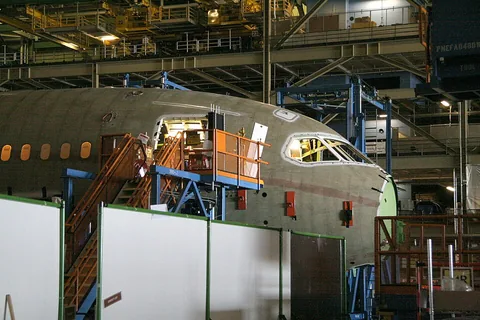
It's very light, it's very strong, but obviously didn't go in to making the plane with carbon fiber in mind. This is like something that's come on over time. And when I was talking to you, it just seemed like you seem to be saying, if you knew about carbon fiber from the very beginning and you were gonna go all in, you would design your aircraft differently. And we're starting from that thesis and that first-principles approach.11First principles — reasoning up from basic physical facts rather than by analogy with how things are usually done. Elon Musk popularized the approach, for example by working out the price of a rocket from the cost of its raw materials. You're looking at me like maybe I'm getting this wrong. But so that was a bit of my impression of talking to you, is... People... even though carbon fiber has been around for a long time, it has a reputation of being expensive.
It was a little bit harder to make for a while, and you felt like we'd reached a point with it where if you really took it seriously, you would do things differently.
Yeah. So I was... right. Yeah, okay. Yeah, yeah, you're definitely right. I think I've also just found some ways to make this a bit more intuitive and easy to understand.
I think one of the things that people often don't realize, but is actually really obvious once you start thinking about it, is that the way we design anything in this world is a function of our manufacturing limitations, right? If you look at the mic that you have, the sort of, you know, metallic mesh that you have there, you wouldn't see a mesh like that made out of any other material, because it is uniquely easy to manufacture a shape like that out of metal. And the best engineers, whether they do this consciously or subconsciously, they're always designing with the production limitations of a material in mind. Now, the problem when you move across material classes is if you are designing based on metal intuition and you are designing for carbon fiber, then you are somewhat limited to the overlap of parts that can be made out of metal and can be made out of carbon fiber.
And we feel like that overlap is like... there's not a lot of great stuff in that overlap, right? Similar to how there's not a lot of great stuff that can be made in the same way out of wood and metal. And we realized that actually the best parts you can make out of carbon fiber would be impossible to manufacture if you try to make them out of metal. So it's a lot of both breaking the intuitions we have around how we make things around metal, and also just about actually pushing the frontier and building new manufacturing processes for designs that we've known for a long time are impossible to make out of the old era of materials, but suddenly become possible with the new era of materials.
04Not a drone but an aircraft
Airbound's vehicles look more like small planes than quadcopters, and a few hundred grams of structure carry kilograms of payload.
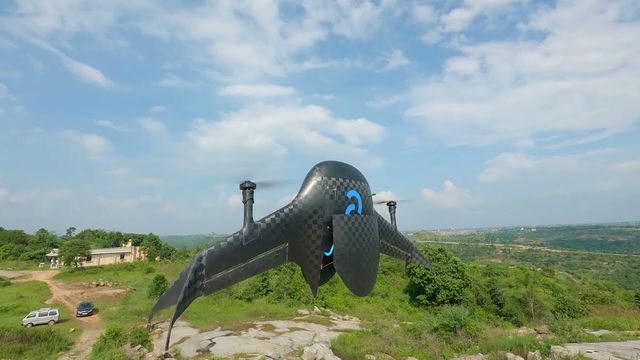
And you... and I think one way also to explain this, maybe, for people... Well, I don't know if this is totally fair, but my sense was you don't love it if people call your vehicles drones. You prefer aircraft, and that's because... And I want to describe it to people who haven't seen them. I mean, they're not like... they're not a drone like most people think of a drone, like a DJI.12DJI — the Shenzhen company that is the world's largest maker of consumer drones. It's not this quadcopter thing with four propellers. You guys have two. I mean, it looks more like an aircraft.
It looks... God, how... this shape is kind of unique. It's hard to describe. I mean, it's sort of got this curved, fatter middle bit, and then with the wings on the side, and then just two propellers, and obviously there's a spot for the batteries and the flight controller and some of the avionics.13Avionics — an aircraft's onboard electronics: navigation, communications, sensors, control systems. The flight controller is the onboard computer that keeps the aircraft in the air. But I mean, it's quite simplified.
The first generation, I mean, how light it was... Yeah, like, I mean, the aircraft shell itself is around, what, like 300, 400 grams.
300, 400 grams, and that one can fly two pounds of...
Yes.
Two pounds.
One kilo, 2.2 pounds.
Okay. And then the bigger one, what was the wingspan on it?
Bigger one was 2.4-meter wingspan. And it can carry about five kilos, so 11 pounds.
And how much does that one weigh, the frame?
So the structure itself weighs about 700 grams.
ExplainerHow a tailsitter flies
Airbound's TRT is a tailsitter: on the ground it stands upright, nose to the sky, and takes off like a helicopter on the same two propellers that later pull it forward.
- Once it has climbed, the aircraft pitches over by about 90° and flies on its wing like a plane. Now the wing provides the lift, and the propellers only have to pull it forward, which takes far less energy than hovering.
- The body is a lifting one: the fuselage blends smoothly into the wing (a blended wing body) and generates lift too.
- There are no separate propellers for takeoff. Aircraft with a different layout, one set of rotors for hovering and another for cruise, carry their lift rotors as dead weight in cruise.
- It is steered by changing the propellers' thrust and tilting the motors on gimbals, which turns it in pitch, roll and yaw both in the hover and in forward flight.
- The layout was tried in the 1950s on piloted fighters such as the Convair XFY Pogo and abandoned: landing tail-first while looking over your shoulder proved too hard for pilots. A drone with an autopilot doesn't have that problem.
Okay. And so they take off vertically, vertical takeoff and landing,14Vertical takeoff and landing (VTOL) — taking off without a runway, like a helicopter; Airbound's aircraft then transition to horizontal flight on the wing, like a plane. and then the propellers kind of shift to then let you fly in a way that would look very similar to a plane, or kind of a bigger drone. And just super quiet. I mean, like, they were up there flying with all these birds, and it was sort of hard to tell which one was which, to be honest. I mean, it had just like a little hum to it. And then they... As you know, I got super hung up on... I mean, they can hover like a helicopter just with the two propellers.
And I was... I mean, so they're kind of gimbaled,15Gimbal — a pivoted mount that lets a part turn about several axes. Here it tilts the motors and propellers to change the direction of thrust. and I was sort of shocked. I mean, it's not a violent movement. It was like very fine-grained controls to do the hovering.
Yeah. I mean, it just comes down to, you know, the same way you have three axes of movement, you have three axes of rotation: pitch, roll, and yaw.16Pitch, roll and yaw — rotation about the lateral, longitudinal and vertical axes: nose up and down, tilting onto a wing, nose left and right. And if you can control your aircraft in all of these rotational axes, then you can achieve great control. So that's really it. It doesn't matter whether you use one propeller, two propellers, five propellers to do it. It just matters how finely can you control this and how quickly can you respond to, you know, any disturbance.
And so in these early days, with the one kilo, two pounds of capacity, flying things like medical goods, remind me how long they can fly and what distance. Maybe do both the first and the second gen.
Yeah, so the first gen can do about, you know, 30 kilometers of distance, and that's... I mean, flies at 60 km/h, so roughly around like... slightly longer than 30 minutes of flight time. The version 2 can do up to 100 kilometers, and that would generally correspond to a flight time of around an hour. But it depends. I mean, you can go faster and, you know, drain that range more quickly.
05Taking on Zipline and Amazon
Pushp expects to beat Zipline and Amazon on aircraft efficiency, since as a latecomer he can focus all his energy on the vehicle.
And for the moment, I mean, this is vaguely comparing to Zipline or what Amazon is trying to do with delivery. I am most familiar with Zipline by far, just because I spent a bunch of time with them.
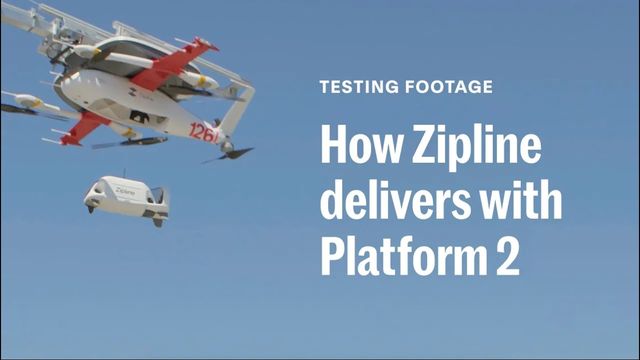
I mean, they had pretty lightweight aircraft. It was made of sort of like a styrofoam material in a lot of parts. They do this thing where the big drone is covering the distance, and then they pop out this little baby drone17The baby drone: Zipline's second-generation drone, P2, hovers over the delivery point and lowers a small craft with the package on a tether, which steers itself to the target. on a tether, and that's what's like bringing your sandwich or your coffee down to the ground. And they have mechanisms on that, if I remember right, like kind of little propellers to try to combat the wind while it's lowering this thing down on the tether. Is your approach similar? I remember, I mean, there is a bit of a tether.
So I think one of the main differences in our approach is that we realized weight alone is not the issue. Volume is actually a much bigger issue. And so you can build an aircraft with like 3 kg, 5 kg of payload capacity, but if you have to fit that all in a tiny space, you'd be hard-pressed to find payloads that actually use up the full capacity. So what we focused on is just making like a big... what we call a big payload basket, where you can just dump items in, and you can put like, frankly, a disgusting amount of stuff inside of each aircraft. And that's the thing, right? Like, you can put five, six orders in there.
You can use this to restock, you know, dark stores,18Dark store — a store with no shoppers, a warehouse from which online orders are picked for fast delivery. restaurants, small warehouses, et cetera. Like, it's viable for a lot more than just single package delivery.
Okay. And then one contention... I mean, well, I guess this is just math and metrics. I mean, Zipline and Amazon, they're just heavier machines than what you guys make. I forget off the top of my head. I mean, do you know the comparisons?
Yeah, so generally, sort of industry best is around: for every kilogram of payload that you lift, you need about four to five kilograms of aircraft. I think Zipline's at about 5.8. Amazon is even higher, I think somewhere in the six to seven range. So, you know, vast majority of the weight is the aircraft there. What we've managed to do is we're lifting five kilos of payload with a three-kilo aircraft, right? As compared to, you know, industry standard would be like a 25 to 30 kilogram aircraft.
Right. Okay. Okay. So, okay, both those companies have been at this for a very long time. I think beyond a decade. And, you know, I know Zipline takes a lot of pride in safety, and some of this engineering they've put in, I think they would argue, is to get the thing down on the ground without plunking someone in the head, and also to withstand pretty gusty wind and weather conditions.
I'm kind of going on a tangent to my main question, which is: there were very well-funded companies who have been trying to do this for a very long time. You're a young man, you know, starting well behind them. And so clearly that didn't intimidate you. You're just betting on this theory that you can design just a far more efficient vehicle than what they've done.
Yeah, because I think what we have, you know, moving later, is the benefit of foresight. And, you know, the benefit of just being able to see how everything plays out. When a Zipline or an Amazon started, drone delivery, you know, was really a question of if, not when. Today it's a question of when, not if. And so we get to see that, hey, things are panning out, regulations are being made. We can, you know, build according to those.
We can see, you know, how the market is adapting to this. And so rather than having to invest our energy across multiple different fields of, you know, not just the aircraft, but how do you think about, you know, figuring out the loading, unloading, when there is zero standard for it that exists? How do you figure out, you know, noise, the customer experience? How do you figure out the infrastructure, the regulations? You know, like you're sort of being the aircraft, the airport, and the airline. And that's a lot to do, right? You know, excellence there really means being good at a lot of things.
Now, our belief is that as a lot of this becomes more standardized, we feel like there's actually minimal differentiation in doing the airport right or doing the airline right. It really comes down to the aircraft. And so we have the luxury to focus all of our energy on the aircraft, on making that as efficient as possible, because at the end of the day, you know, we believe that autonomy is getting solved. Autonomy in the air is much, much easier than autonomy on the ground, right? The systems that... like the 28 systems we put up in the air are all fully autonomous. We also believe that safety is the kind of thing that comes with maturity of development, and you're already starting to see great safety with a lot of these platforms. The key thing with both of these is they're sort of binary checkboxes, right? If you're autonomous, great. If you're safe, great. But nobody's going to choose you over someone else because you are 10x more autonomous or 10x safer. But when it comes to efficiency, that's not the case. Unit economics19Unit economics — revenue and costs per unit of product; here, per delivery. are something that continuously matter, and if you are able to have a structurally lower cost than your competition, regardless of what their costs are, you have an edge over them, which is not true when you apply that to safety or how quiet the aircraft is or anything else.
AdBrex
This episode is brought to you by Brex.bBrex — a San Francisco fintech company (2017): corporate cards, accounts and expense management for startups and large companies. Since April 2026 it has been owned by Capital One. I spend all of my time inside of the world's most ambitious companies making rockets, semiconductors, robots. Very often the business is struggling, and then all of a sudden things click and take off. Then the company's expenses spin out of control. They either have to clamp down, start counting pennies, or cross their fingers, hope for the best that the quarter or the year comes out okay. Brex was built to handle exactly these situations. It helps you move fast, spend smarter at the same time. They've got credit cards, banking, expense management, all in one place. They've got AI technology looking over everything, taking care of tasks for you. No more chasing down receipts.
We use Brex at Core Memory. It has been a godsend and giving me back so much time. Giants like Anthropic and Zoom use Brex as well, and so do tens of thousands of startups. You should use Brex, and you can find out exactly how to do that by going to brex.com/corememory.
06Cargo and people
Airbound plans to carry passengers one day, because to physics a payload is a payload.
You're... I think we're fine to talk about this, because we talked about it in India. I mean, you're not just hoping to do cargo.
I mean, you have a vision all the way up to transporting people one day.
Yes.
Yeah, I tweeted about this, and people seemed to... like this was the first time they'd heard it, but I guess I had already tweeted it.
So no, we put it up on our manifesto, but yeah, it's something that, you know, I understand if, you know, you didn't read the full 10-pager, which, you know, most people in the world have not read.
I should have. I should have, if I was a decent reporter.
Oh yeah, I just mean people. I think the manifesto came out after your trip. So I will give you the benefit of the doubt.
But so that is the goal, is all transporting objects and flesh.
Yeah, and I think that's sort of that idea of the universal transport that I began with, that, you know, it has to work for everything, right? It has to work regardless of whether you're moving flesh, whether you're moving... like, you know, physics doesn't exactly care whether the payload you're moving has a soul or not. It's all the same at the end of the day. Yeah, sure, you need to add like, you know, windows and seats and like a little bit of HVAC to keep the humans happy inside.
But, you know, in the grand scheme of things, there's not a big difference between a system that has that and one that doesn't, especially in aviation, right? It's practically the same aircrafts that move cargo and the ones that move people.
07A workshop in the bedroom
Pushp started building aircraft as a schoolboy in his Mumbai bedroom, with no interest in drones but a drive to invent something that changes the world.
Okay. Okay. So I have some... I mean, I've got some questions. They're vaguely tough, I think, about the technology, but I'm going to save those just for one second. And I just want to go back to the origin story a little bit, because you're a fascinating dude. So you're... I mean, if I remember right, you're about 16 years old when you start to put together this idea and look for some funding behind it.
Yeah, yeah, around that age.
So what happens? You're sitting around at 16 and you're like, I think I can make a better aircraft than anybody else. How does this happen?
I wish I sort of, you know, started with that level of conviction. But no, I think I had very realistic ambitions when I started out. Airbound actually started off as OpenDrone. So it started off as a project to create an open-source delivery drone design that anyone could use and 3D print and just make drone delivery in their own locality.
Just because you wanted to do it, or you were into drones, or...?
Yeah, I think just... I actually... So that's like a funny thing, where I've just never been into drones. The first drone that I ever flew and the first drone that I ever built were both an Airbound drone.
And it was actually less than a year ago that I first owned a drone that was not an Airbound drone. So I'm definitely not the drone guy. But I was like... a lot of why I'm doing this sort of goes back to much, much earlier. I think one of my core memories from when I was a child, like when I was around first or second grade, was...
Using "core memory." Solid.
Yes. You know, shameless plugs.
So this was when... this was like, I think, me learning about the Fermi paradox,20The Fermi paradox — the contradiction between high estimates of the probability of alien civilizations and the absence of any trace of them. It is named for the question "Where is everybody?" that the physicist Enrico Fermi put to colleagues in 1950. you know, where are the aliens out there? And I just found the concept really fascinating, that there exists a question, right? And actually there exist many questions that a first or second grader is capable of understanding, yet no human in the world is capable of answering. It just opened my eyes to like, there is so much out there that is not yet discovered. There is so much that can still be done with humanity, which, you know, at first when you look around, you're like, damn, we like solved everything. There's nothing else left.
So that was there. I'd been sort of deeply obsessed with kind of the scale of humanity and, like, what it takes to, you know, answer these questions, do something that hasn't been done before. And at first it just feels impossible, right? Like, there's 8 billion people in the world. Statistically, like, you know, each one of us is insignificant. You're insignificant, I'm insignificant.
But somehow that is not true, right? Somehow there are still people that, in spite of the odds, move forward and really, like, measurably impact humanity as a whole. And I've been deeply interested in being one of those people. I think it comes through leverage, and the strongest leverage we have is technology. If you invent a new technology that changes the way people live, then you would have by proxy changed the world. And so I always wanted to invent something.
And I think why I just landed up in this space was honestly more coincidence than anything. I'd actually seen some videos on Zipline. I was deeply inspired by what they were doing. And I just wanted to see what I could do to contribute to this space.
And so you're 16, and you start tinkering to try to build one.
Yeah, yeah. I sort of... So this was around COVID, 2020. I sort of joined this, you know, hackathon project. There were these like online groups where people had come together to volunteer their time. So did a hackathon there, managed to get a $500 grant. And I was just like, you know, I want to build this, I'm gonna see how this goes.
And that was the Emergent Ventures grant, or different?
No, this was... Emergent gives more money than $500, you know. Yay for Shruti. So that's there. This was at 15. This was just like the conception of the idea. Then I realized that, oh God, I like messed up the design completely. I learned a bunch through the process, still built that aircraft. It got like a quarter second of airtime.
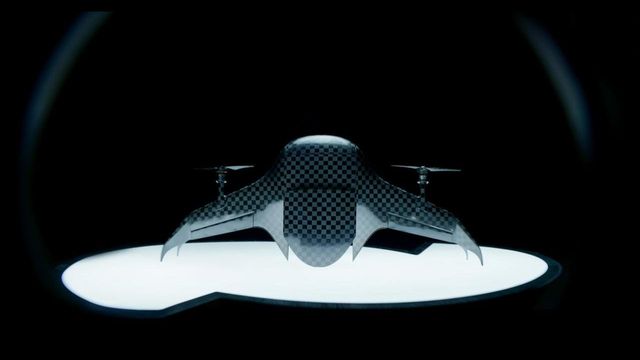
And then I was like, okay, here's what I need to fix. I designed a new aircraft. That one is the TRT, like we still use it today. And I think with that design, I managed to get a $1,000 grant, still not Emergent Ventures. You know, used that to... like, I could finally afford a 3D printer, start working with carbon fiber instead of fiberglass.21Fiberglass — a composite built on glass threads: cheaper and easier to work with than carbon fiber, but heavier and less stiff. And so I was just building this, had these weird sims in my bedroom.
And I think somewhat in parallel, I ended up getting, you know, our first investment, which was like a $25,000 investment from gradCapital.22gradCapital — a Bangalore venture fund that has invested in student-founded startups since 2021. Its cofounders are Abhishek Sethi and Prateek Behera. And I also got a, you know, roughly like $12,000, $12,500 grant from, now, Emergent Ventures.
Okay. Okay. And how did you hear about them?
So this was actually through the $1,000 grant. So I got this from 1517.231517 Fund — an American venture fund run by Danielle Strachman and Michael Gibson, who previously ran the Thiel Fellowship. It invests in very young founders, including those who skipped college, and used to give them small grants. I don't know if they still do; they used to run a grant program. And so they just had these weekly calls with people from the community, and they were like, oh, you should check out Emergent Ventures. And so I did, and it didn't look very interesting, because it was this like weird fund. And then they're like, no, no, no, you're on the wrong website.
There are a couple.
Yeah, yeah, there are like VCs called Emergent Ventures, and I was just like, is this what they want? No, it's like, you know, the Mercatus... Now it's the first thing that comes up when you search Emergent Ventures. Back then it wasn't. So after like going to the wrong website, I finally made my way to the right one. I sent an application. I think two weeks later, I got a call from Shruti, and she was like, cool, we will give you money.
Yeah, yeah. And you're telling your parents about all this? What are they making of it?
I think they're just deeply confused. I think they were trying to figure out whether all of this is a scam or not, and I think they were just confused as to how do you scam a 16-year-old by giving him 10,000. Like, honestly, with the gradCapital investment, the founder of gradCapital, Abhishek, said he literally had to get on a call with my dad to convince him why he should let his son take money from them, and why, like, they are not a scam or, like, a money laundering scheme or something.
Yeah, yeah, I guess I could see that. Yeah. What do your parents do?
They're both in the banking sector.
Okay. Yeah. Oh, so they were... yeah, they're on alert, looking for some money...
Actually, my mom used to work in anti-money laundering.
Do you have brothers and sisters?
No, I'm an only child.
Okay, so you're... I mean, you were mentioning it a bit, but so describe your bedroom to me at peak prototyping.
Oh, God, there's too much to describe. I should actually send you a photo of it. I have it on my phone. But it was like... because I was basically trying to run an entire workshop out of my bedroom, and my desk only had space for one thing at a time. So I would just have like a random 3D printer on the side. The floor would like always be filled with newspapers, because I would work with like resin and carbon fiber a lot, and my parents were like, you're gonna destroy the floor, so just like replace the newspapers every day. I spent a decent amount of time like taping newspapers to the floor.
Shouldn't you have some like airflow for this?
Yeah, yeah, this is like what I learned later. I was working with these chemicals, and my parents were complaining about the smell, and I'm like, no, no, no, don't worry about it. It does smell weird, but it's safe. Like, you know, I checked the material safety data sheet,24Material safety data sheet (MSDS) — the manufacturer's document on a substance's properties, hazards and the precautions for handling it. you know, I'll show it to you. And I just whipped out the material safety data sheet, and I was like, oh shit, no, this has a toxicity rating of four on a scale of one to four, and it is like a class three carcinogen. And I was just like, okay, I should buy a respirator.
That was also like a lot of the impetus for like, you know, hey, when I get money, I should probably move out. Like, I don't have the space. Like, yeah, it's a small apartment, right? So I had to build out of my bedroom. I needed to go to a place where, you know, I could sleep and build in different rooms. That was like the ultimate luxury.
So at 16, I ended up moving out, got my own place, just sort of had like master bedroom for this, had like a tiny half bedroom for me to sleep.
What did your parents think of that?
They actually suggested it. So actually... so I was living in Mumbai25Mumbai (Bombay until 1995) — India's largest city and its financial capital. at the time, and my plan was to move to Bangalore, because I was like, that's where all the startup stuff is. And they were like, no, you are still in school. And it's online school. I can just... like, they don't know whether I'm in Bangalore or Mumbai. And they're like, no, nothing doing.
You know, we know some localities nearby. You can get your own place, but it has to be in the city. So a lot of people ask like, oh, how did you convince them to like let you move out to, you know, this other part of town? And I'm like, it was their idea.
Okay. So you did stay in town, though. Okay, this is fascinating. And you're teaching yourself carbon fiber on YouTube. I mean, you're learning these skills from YouTube.
Yeah. YouTube is awesome.
It's kind of amazing, right?
Yeah. It is.
08From science project to company
While Pushp was in school Airbound was a science project, and a deferred admission plus a Lightspeed-led round turned it into a company.
Okay. So you're moving along, you're getting some money, and then how does this start to become a company?
Good question. And I think like different ages of Naman would give you different answers, right? I think that, you know, while I was in school, while I was, you know, spending a bunch of my time building this out, I was still like juggling classes at the same time. It was really just like me. It was basically me just being, you know, paid by like the nice VCs of the world to learn engineering.
And like, thank you to them. I will hope to make you money someday.
But that's there. Like, I think Airbound was really a science project26Science project — venture slang, mildly dismissive, for a technology that doesn't yet have a business around it. while I was in school, which I think teenager Naman would take a lot of offense to, me saying that. But I think it's true. I think a lot really changed, you know, around when we got our pre-seed round.27Pre-seed — the very first investment in a startup, before the seed round; after seed come Series A, B, C and so on. So this was... you know, I graduated from high school. I was like, look, I really want to pursue this.
Let me just defer my admission by a year. You know, still have a seat at college; worst case, I'm just late by a year.
In the US or India?
In the US, yeah. India doesn't really do deferrals.
Okay. Which school?
This was CMU.28CMU — Carnegie Mellon University in Pittsburgh, one of the strongest technical universities in the US.
Okay.
So that's there. I deferred my admission, and in that year I was figuring out a bunch of things, but we ended up raising, you know, a one-and-a-half-mil round led by Lightspeed.29Lightspeed (Lightspeed Venture Partners) — an American venture firm. In November 2024 Airbound announced a $1.7 million round led by it. And that's when, you know, it sort of hits that like, oh shit, you know, this is an actual company now. This is not just me. Like, it's hard to spend a million dollars, like, you know, just building tech out of your bedroom. But, you know, that's when we started to hire people.
That's when we started to, you know, build a real business and not just, you know, me creating some tech for fun.
So there's like part of this that would fit in the Silicon Valley lore, clearly. Been funding college dropouts for decades, you know, and some of them have done all right. Bill Gates, Mark Zuckerberg,30Bill Gates left Harvard in 1975 to work on Microsoft; Mark Zuckerberg left in his second year at Harvard for Facebook. the list goes on. But I mean, there's something wild about like an 18-year-old saying, you know, I'm gonna design aircraft that nobody else have ever done. You know what I mean? Because it's a field, obviously, a hundred years of people trying to design aircraft. You didn't have any of the typical credentials people might want to see. When I talk to you, I mean, I think anyone who talked to you would understand you're incredibly bright.
So I'm sure this was playing a factor in everything. You know, you're convincing when you talk about this stuff. You don't come off as just like totally crazy. But I mean, it's nuts to sort of be like, I'm 18, I'm gonna design aircraft better than anyone has done before. Trust me. So, I mean, that seems like almost like the highest bar to talk a VC into. Maybe it's a hard question for you to answer, maybe I should ask them.
But yeah, why do you think they sort of bought into the pitch?
I'll have to be like, eh, it's just me, and I'm like, I'm just great at this. I floored them. No, I think this is just the natural evolution of, I think, VC as a whole. Look, I think the frank reality is that if I started doing this even five years earlier, I don't think Airbound would have ever gotten off... just off into even being a company, off to hiring our first employee. I think a few different things have come together for this. One is that case studies like SpaceX and Tesla, which, you know, you know very well...
I'm familiar.31"I'm familiar" — a joke: Vance wrote the biography Elon Musk: Tesla, SpaceX, and the Quest for a Fantastic Future (2015).
You're familiar... have, I think, proven that you can build great tech in this manner. Musk was also a complete outsider, right? Sure, he wasn't an 18-year-old, but he started these companies without having done any engineering before. He learned everything on the job. And it's that, hey, actually, if you're just really good at thinking from first principles and building this... It's a different skill set, but it's a similar skill set to just building a business.
You just have to be exceptional at the tech. So I think that's one of the things that helped. You know, obviously young founders being successful was becoming more and more common. And, you know, there were just starting to be funds that were contemplating the idea of like, hey, maybe I'll fund a kid that's still in high school.
And you had built something.
Yeah, I'd also built something.
Like, they could see it. Yeah. It was flying... It was not flying? Was it not flying?
It was not flying for a while. I think we got to actual flying meaningfully after the Lightspeed round. Yeah, we were, you know, to quote Toy Story, we were not flying, we were falling with style.
Okay. And so, and you were... you finished... You said you were at online school, you finished high school. And then you're kind of getting this Lightspeed check at the same time, roughly. And then how many people are you hiring?
I think we were slow to hire early on, but I think by the time we raised our seed round, we were maybe around like 15, 20-ish people.
09Why not move to the US
Pushp stayed in India for practical reasons at first, and now believes it's a better place than the US to build Airbound.
Holy cow. Okay. Wow. And the... I don't... God, I don't think I'm being like too egregiously stereotypical or something. I just feel like... I feel like, you know, in the US, if you come from a family where you're supposed to kind of like be on the path to college, there's a lot of pressure to drop out, although obviously it's sort of become a thing in the tech world. I just feel like all my Indian friends, everything I know is just that you're meant to become a lawyer or a doctor or an engineer. And those are kind of like all the options, and not going to Carnegie Mellon is definitely not on the recommended path.
Is that changing, or was that a really difficult conversation?
I think, again, a mix of both. I do think it's starting to change. I do think, you know, especially like... I mean, it's obviously nowhere close to Silicon Valley, but India is like the third or fourth largest startup ecosystem in the world. We have seen enough cases of really young kids go out and be hyper successful. And I think the government32The government of India has been led since 2014 by Prime Minister Narendra Modi of the Bharatiya Janata Party. is also pushing a lot on making these stories more visible. So the idea of being a startup founder is becoming less and less alien.
There are more comparisons. Like, somehow my parents had a friend that had done a startup, which I wouldn't have imagined happening with their parents, for sure. And I think the other thing is a lot of this is sort of about wealth at a country scale. I think India is a country where, you know, my generation is sort of the first generation where you have at least some people that do come from, you know, a decent amount of wealth, right? Like, I think for me the biggest luxury is that I knew, no matter, you know, what happened, I would always have food to eat and I would always have a roof over my head. And at the end, like, how much more do you need?
Right? And I think that's the luxury that I had that my parents never did, right? Like, for my dad, success meant, you know, always being able to put food on the table for your family. And he had seen a lot of people in his family run businesses. And to him, running a business meant that if the business doesn't do well, you can't eat. And so he wanted the opposite of that.
Like, he wanted that stability. He was never thinking about, oh, this is what I enjoy doing, etc. But it was because of that that my parents were able to let me have passions, right? I think one thing that was a bit unique about my childhood is my parents never pushed a career path on me. I do think it helped that I never wanted to become an artist or something that doesn't make money. I always wanted to get into engineering and physics.
I'm gonna be an industrialist.
Yeah. But like one of the things that my mom told me from a really early age is just, you know, do whatever you want, but be the best at it, right? Like, you can go and cut hair for all I care, but then you better be the best barber in the city, right? Like, everyone should say, like, I want Naman to cut my hair, right? Like, that's what I want you to do. Do whatever career you want, just be excellent at it.
Okay. Okay. Okay. So they didn't try to talk you out of it or anything. Did anyone try to talk you into moving to the US to build the company?
I think enough folks early on... I just never saw like a very compelling reason for it. I think, yeah, I don't know. I think a lot of people move to the US because it's just like, oh my God, there's more money here, right? And I mean, you have a lot of accelerator programs33Accelerator — a program that invests a small sum in a startup for equity on standard terms and spends a few months helping it with advice and investor introductions; the best known is Y Combinator. that just have a standard investment deal, but the standard deal gives you double the valuation34Valuation — what investors say a company is worth when they invest. The higher it is, the smaller the stake a founder gives up for the same money. if you move to the US. There's a lot of these early-stage money things where you can just be like, oh, just move to the US. But to me there's no compelling reason for the business. I am trying to build great technology, and that great technology can be built anywhere.
I think there is a lot of talent in India, and I think I can build it here. And over time, I think it's gone from, you know, this ambivalence of like, you know, just why move to the US, to like, no, actually, I think India is the better place to build this tech. I think there's a lot of unique things about India that make it a better place to build a company like Airbound than the US.
Well, like, let's get into those.
Because, look, we've got multi-decades of this brain drain of India to the US. You and I were hanging out, playing board games one night, and something you guys were talking about really struck me, which was... and please correct me if I'm misremembering sort of how you put it, but that young people maybe didn't have like pride in India, and so maybe that was another reason you'd sort of want to go to the US and make your mark. And so you're talking about, oh, I think there's business reasons to stay. I don't know, walk me through both sides of that. Was some of it emotional and wanting to build a company like this in India, or was it just quite practical?
I think in the early days it was mainly practical. I can't deny that... I think there are emotional reasons now. I think especially when you get to a point that you realize that you could genuinely be one of the people that pushes your nation forward, that if I succeed hard enough, I actually become part of the reason that India is becoming better, then it's pretty hard to leave India and to give up on that ambition. But yeah, I think early days it was really purely practical, right? I mean, first off, just early days, when you don't have a lot of money, it doesn't make sense to, you know, come here, you know, ramp up your burn a bunch. But I think like...
Yeah, can we break that down for a second? I mean, you're saying land is cheaper, a building's cheaper, the people are cheaper, all of that.
Yeah, yeah. Like, yeah, I mean, cost of living is much lower, right? Like, a dollar goes much further in India than it goes in the US. But, you know, as you scale up, that stops being a good reason, right? It just becomes that, hey, you know, we've raised like 37 mil now, and that is actually enough money to like run a company out of the US, by like a decent margin. I think for me there's a few different reasons. I think one of the biggest ones is the people.
Right. I think Indians are sort of one of the greatest talent pools that exist globally. I remember seeing this little diagram of like what is the highest-paid nationality in each state in the US, and I think 70% of the states were just Indians.
Like, Indians do really well. And I think pretty much all of the great businesses you see here are built on top of Indian talent, right? There's an obscene number of Indians in like Tesla, SpaceX, and I mean, now they're just running multinational companies.35Running multinational companies — for example, Satya Nadella (Microsoft) and Sundar Pichai (Alphabet and Google). So I don't think there's any question that like Indian talent is not good. I think Indian talent is great, and especially if you're able to get that talent early, it works really well. There's also an increasing... like, moving out of the country is becoming less and less popular, right?
And this has changed like dramatically, even at a time scale of like three to five years, right? Five years ago, when I was looking at going to college, it was just like, duh, I mean, if you can afford to go to the US, why would you ever stay in India, right? Like, nobody was thinking about staying in India. And, you know, like, in my school, about 80% of the class would go to college abroad. And now a decent chunk of those people are planning to come back to India after they're done with college and spend the rest of their lives in India.
Is it because the US got shittier, or India's nicer? I think it's a mix of both.
Right. Like, I think it's interesting because, you know, like, again, 10 years ago, when you go to the US, it's just an objectively higher quality of life than India. But, you know, I don't know, like, I feel like today it's more just a different quality of life, right? The US is better in certain regards, but it's also worse in certain regards. And suddenly it's not as clear that, you know, India is the worst place to live.
10Life in India and in America
Vance finds daily life in the US smoother, while Pushp misses India's ten-minute deliveries and safe streets at night.
Yeah, I mean, I'll run the risk of giving my three-weeks-in-India survey of things. I would say I feel like life is probably like at least... you know, again, sorry, audience, this is my limited experience as a momentary traveler. But it feels like... I feel like life is like easier day to day here, just like a little smoother. You know, there's just shit tons of traffic... Not that we don't have traffic, but the traffic in Bangalore and Hyderabad36Hyderabad — the capital of the state of Telangana and one of India's largest IT hubs, with big offices of Microsoft, Google and Amazon. is bad. It's no joke. I mean, both cities feel like... my assumption is they grew so much quicker than anyone had ever planned for, and there was no central planning at all.
And so it's just kind of like hanging on for dear life. I think India in general is that bit more like chaotic and frenetic and full of energy, and all of that like is actually awesome, but also adds this like friction to just getting around, doing your daily life. And so I mean it's like... what... but I mean, what a... And it reminds me of like when I went to Nigeria, which... it's like in Lagos,37Lagos — Nigeria's largest city and one of the largest in Africa; the country's capital until 1991. which I feel like most people... a lot of people do not like. I love the energy and like, not just like the chaos, but like just the... everybody's doing something and is like out, quite ambitious, trying to make their way in the world. And there's just... and then, oh man, I just love, obviously, like all the culture, the colors and the food and everything.
But I mean, what do you like... when you're doing the pros and cons, what do you love about staying in India, then?
Yeah, I think, look, I think the US has like a lot of obvious benefits, right? I think traffic is definitely better, the roads are a lot better in the US, the air is a lot cleaner, you know, there's much more nature present. But then there's a bunch of things like... in India, if you're living in India, your day-to-day life becomes a lot easier, right? Like, most homes have house help. You're generally looking at... getting deliveries is a lot easier, right? Like, food comes a lot faster.
You're able to just get anything in 10 minutes,38In 10 minutes: India's big cities have quick-commerce services such as Blinkit, Zepto and Swiggy Instamart, which bring groceries and household goods from dark stores in 10–20 minutes. The photograph shows a Blinkit dark store in Hyderabad in 2025.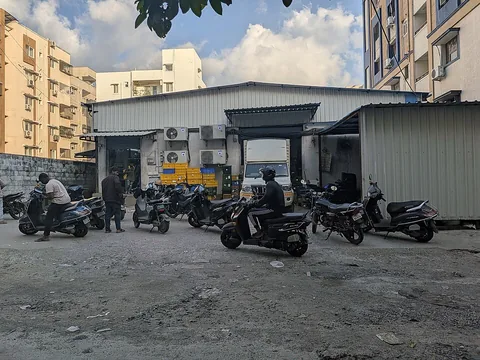 right? Like, I had to go for a wedding, and I couldn't find my kurta,39Kurta — a long, loose shirt reaching to the knees. In India it is worn both every day and in dressy versions for weddings and festivals. which is like Indian version of a suit. I couldn't find my kurta. And so I just ordered one, and it came in 20 minutes. I don't think like anyone in the US can imagine like not having a suit for a wedding and getting that in 20 minutes.
It is hard to explain. I was like at a party, and I'm like, oh, I'm not feeling my best. And then everyone's ordering me medicines, teas, all these, and they're just arriving. But like, as I'm trying to leave the party, they're like, no, no, it's gonna be here in two minutes. And it's like... it's just a total cultural thing with these delivery apps.
Yeah, it's like one of those things where, again, I feel like whenever... Look, you'll always be biased towards the place where you are, right? And I think as an American coming to India, you're gonna notice the things that like India doesn't have that the US has. And generally you never notice the flip side. Indians going to the US are like, oh my God, it's just so much better here. But what I find surprising is like I start to notice things. I'm like, oh God, I have to like pre-plan my food, because I can't just order when I'm hungry and expect it to show up in like 15, 20 minutes.
I have to... like, just a really random thing, right? Like, I generally don't shave. I trim my beard. I forgot to bring my trimmer, which in India is not a problem. Like, you'll just get one in 10 minutes. I just couldn't find a trimmer here that I could get ordered.
And I was just like, I really like... Indian deliveries have just spoiled you. I just don't have any need to like go to a store and buy something physically.
And so I'm just like, well, I guess I'm shaving now.
Yeah. David Nicholson, our cameraman, who you met, if you remember, he also forgot his razor and had one delivered in like four minutes. Yeah.
So that's there, right? Like, getting food at midnight is like a big pain over here.
It's not a pain at all in India.
So I think there's differences. Crime rates are actually like surprisingly low in India. Like, you don't have... because just employment is much higher. Like, you don't really have to, you know, worry about, you know, like the homeless or any other like... just safety is... I'd say, like, honestly, I feel much safer walking around in India at night.
Because this had not occurred to me, and a couple people brought this up. I mean, is it anecdotal, or are there numbers behind this, that all the gig work in India has had this material difference on unemployment? And that... I'm sure, I'm sure there are numbers.
I don't know the numbers. I think for me it's mostly anecdotal. For me, like, the biggest anecdote is just... I remember when I was like, I don't know, 10, 12 or something, and like, you know, I was going around, my parents would just be like, don't leave your bag in the car, you know, be careful when out in the street, someone could just snatch your bag or anything. You know, like, just be really careful, right? Like, what if you get kidnapped, et cetera. And now what I hear is, when you're in Europe and when you're in the US, be careful about this, right?
Like, don't leave your bag in a car.
Like, San Francisco40San Francisco is notorious for car break-ins: thieves smash a window and grab bags left inside in seconds. is a fucking nightmare.
Yeah. Like, my parents... And again, like, I don't know, it's just... it's hard when you're brought up this way. This feels like such an inversion, right? Like, my parents are just like... they went to holiday in Europe, and they were in Spain, and they were just like shit-scared for their belongings all the time. And there was this one moment when we went... we were checking into a five-star hotel and just left your bags, you know, just down next to you in the lobby, and then they were stolen. Somebody nicked them.
And just like, you don't hear about things like this in India.
11Venture, deep tech and the Indian wave
Pushp credits venture capital above all for India's deep tech wave, though big late-stage money is still scarce.
Spain's like that. I love Spain, but it's been like that for a long time. Okay, so this is fascinating. And then you and I, we talked about this a lot when I was there. I mean, you're not alone. I mean, there's a whole... Okay, so there's a part of Bangalore called Hoskote.41Hoskote — a town east of Bangalore and the site of Airbound's headquarters.
I kept describing it as like the El Segundo42El Segundo — a city next to Los Angeles International Airport and a longtime center of the aerospace industry. In the 2020s dozens of startups building satellites, rockets and defense hardware set up there. of India, meaning, I guess, for people who aren't nerds, sort of like this hard-tech-centric place, people building aircraft, missiles, everything you could imagine, all in this region, and setting up in these... like you guys, in this kind of warehousey type environments. And so there is this generation. I mean, everybody I met and hung out with, all your friends, they all either didn't go to college, dropped out of college, or doing these startups. And again, I mean, we talked about this a lot, but there does seem to be a thing going on. I mean, this is like a moment.
It feels like it, right? It is. And so this is... it's just part of... You said you couldn't do this five years ago. It's part of... it's part of what? Like, what in those five years... what totally changed to make everybody wanna kinda take this risk now and stay and do things different?
I feel like a lot of founders are gonna hit me for saying this, but I think there's a lot of reasons, but I think it's mainly just venture capital. It is venture. As much as founders like to shit on venture and be like, ugh, investors, the reality is that deep tech43Deep tech — startups built on scientific or engineering breakthroughs: rockets, chips, new materials, biotech. They need years and lots of money before their first revenue. cannot exist without venture. Especially when you look at historical accounts of how businesses, industrialists were made in the, you know, like early 1900s and all. Like, it is genuinely insane that people are willing to throw tens of millions of dollars at pre-revenue companies to be like, yeah, just build the tech. Like, we know you'll get money later.
It is insane. Like, this environment did not exist even until very recently.
So, okay, we've been doing deep tech in the US for a very long time, although the interest in it has these boom and bust cycles. We're clearly in a bit of a boom. And so that, if I'm reading you right, that kind of carried over to India as well.
Yes, absolutely. And I think like lots of things the government has done combined. But honestly, like, I honestly don't think that deep tech has really been a thing in the US until this boom cycle. Obviously you've had cases like SpaceX, Tesla, Anduril44Anduril — an American defense company founded in 2017: drones, air defense systems, autonomous systems for the military. and all, but I think these are all second-time founder companies.45Second-time founders: before SpaceX and Tesla, Elon Musk founded Zip2 and X.com (later PayPal), and Anduril founder Palmer Luckey had created Oculus.
I guess the way I'm describing it is like, we did semiconductors for decades, and it was expensive, and it took years to pay off. We did gene sequencers.46Gene sequencer — an instrument that reads the sequence of DNA. We, you know... I've lived through these periods. Like, you know, what tends to happen is like the dot-com boom comes along, and then it's like, wow, it's way easier to make money potentially off of a website than it is to like fund semiconductors, so people pull away, you know. And then something like... like you're saying, then something like Tesla comes along, or SpaceX, and it's like, oh, well, if you hit this right, it's fucking massive, you know. And so then it swings back. And then obviously we have this kind of political, national moment of wanting to manufacture again and all that.
But I think... we did actually used to do deep tech. It just looked slightly different.
Yeah, but I think, again, like, back then it wasn't really like venture that funded it, right? Like, these were large research bodies, these were, you know, traditional investments. Like, you had weird structures if you wanted to get money for this, right? Either you get a government grant because it's like spun out of a PhD program, you're doing this from like a very big college that has a lot of money behind it, or you're somehow able to figure out how to commercialize early, you get like weird debt things. And I've like researched a lot about like this innovation like a hundred years ago, so like pre-semiconductor era. Like, if you look at a lot of like surprisingly insightful conversations between inventors, they happened in debtors' prison.47Debtors' prison — imprisonment for unpaid debts. The US abolished it at the federal level in 1833, and England with the Debtors Act of 1869. Charles Goodyear, who invented the vulcanization of rubber, was jailed for debt more than once.
Yeah? Okay.
Because that was the only way they could get money.
Okay.
And because they couldn't pay it back fast enough, some of the greatest minds were just locked up in prison. Because financing structures were terrible back then.
Yeah, and I guess, I mean, the definition of deep tech, I guess, could be very... I was just thinking back to like, you know, it's like when... I mean, really, some of the first instances of what we think of as venture capital of the day would be like Fairchild Semiconductor, and then Arthur Rock48Arthur Rock — financier and one of the founders of venture capital: in 1957 he found the money for Fairchild Semiconductor, started by eight engineers who had left William Shockley, and in 1968 he raised Intel's first investment. putting money into Intel, and then you had the whole PC run with Apple and Microsoft and things like that. But anyway, we don't have to get... So this is part of what changed, is that people are willing to take risk on an 18-year-old who has a wild idea on aircraft in this moment in time. And so, okay, so it's sort of like a big, big-picture change, and then your friends are like, we might as well do it here.
There's structural advantages. I like living here, and money can get here. But you guys, you seem to like have done pretty well with the venture capitalists. I mean, almost everybody else I talked to in India was quite critical of the local VCs for still chasing the easier money in apps and AI and software and not wanting to take risks on the hard tech. When I was there, hung out with Ather,49Ather Energy — a Bangalore electric scooter maker founded in 2013. It listed in May 2025 at 321 rupees a share; on its first day of trading the stock closed almost 6% below the offer price. which is on a path to make a million electric scooters over the next year, has been around for almost a decade, I think. I went to their factory. It was like, couldn't be more legitimate. There's just people making scooters everywhere. They're awesome, they're cheap. Couldn't raise money, had to go public because nobody would give them money to expand as fast as they wanted.
Like, there is a local... it felt like a dislike for the local venture capital community.
Yeah, no, I think Ather's story is especially funny, because I think Ather grew more in their first year in the public markets than they grew in their past five years in the private markets.
Like, people missed out.
Source: NSE prices, Yahoo Finance; IPO price per the company
People really missed out on Ather. In fact, the funny thing is that when Ather IPO'd, it was a really lukewarm reaction, because investors were like, yeah, sure, they're like a unicorn50Unicorn — a private company valued at $1 billion or more. The investor Aileen Lee coined the term in 2013, when such companies were rare. now, but it took them way too long to get there. And then guess what? They like 4x'd in less than two years.
Right. And if somebody had given them 200 million earlier, they would have grown so much faster.
Yeah. So that's there. I do agree. I think this environment is starting to change, and I think the change is happening fast. I think the government is also throwing a lot of fuel to the fire.
So they open these deep tech funds?
Yeah. Exactly, you know, to encourage investment in deep tech.51Encouraging investment in deep tech: in July 2025 India's government approved the RDI (Research, Development and Innovation) scheme worth 1 trillion rupees (about $12 billion): long-term low-interest loans and investment in private research, including through a fund of funds for deep tech startups. So I think what this means is that like this whole deep tech boom cycle that you're seeing in SF has, I think, transferred to India much faster than most other boom cycles do.
Yeah.
And I think that's great. The challenge is just, I mean, if you think about like structurally how to build a fund, I think deep tech requires a very different thought process. And, you know, the large funds in India, the LPs52LPs (limited partners) — the investors in a venture fund: pension funds, university endowments, family offices, wealthy individuals. The money is managed by the GPs (general partners), the fund's own partners. behind them generally do not like that kind of risk appetite, right? Like, they don't like the idea of, you know, throwing tens or hundreds of millions of dollars at a company that has a similar risk profile to a seed-stage bet, even if, you know, the eventual outcome can be many orders of magnitude higher. So I think it's because of those risk profiles that the large funds have not yet been able to make a great jump into doing like late-stage bets.53Late stage — Series C, D and beyond, when a company has already grown and rounds run to tens or hundreds of millions of dollars. And you see a lot of early funds that are doing really well, but it takes time for a small fund to grow into a big fund.
And so I think, you know, honestly, right now, if you're trying to raise like single-digit millions, maybe up to 10 mil, India is honestly a pretty great environment to raise for deep tech. The problem is just that when you're looking for larger chunks of capital, the amount of parties that can give that just thin out really quickly.
12No defense work
Airbound will stay in Bangalore and won't take defense contracts: pre-revenue funding lets it stay focused, and civilian markets are far bigger.
And do you think you're committed to keeping Airbound in India as the headquarters?
I am. I do... I do see India... like, I honestly... like, everything else aside, I just don't see any other place making sense as the headquarters. We will naturally expand globally. We'll have offices in other locations. But I think our like center of operations, right, you know, what like, you know, Fremont is to Tesla,54Fremont — the California city that is home to Tesla's first big car factory, the former NUMMI plant the company bought in 2010. for us will always be, you know, India, Bangalore.
Ideally Hoskote.
And then we talked about this. I mean, usually if you're in deep tech land, the easiest way to make money is to get a large defense contract. And you seem like you're pretty committed to not doing defense business.
Yeah. I think, again, this is really just a function of the majority of the ecosystem now, because, look, if it was between survival and getting a defense contract, like, you know, getting a defense contract or dying, I'd obviously pick getting the defense contract. And I think in an earlier world, that would be the case. Like, we would need to show revenue sooner, and defense is a great way to do that. I think what's changed now is the fact that you can raise a lot more pre-revenue. The fact that like you can use this time to really build out the tech, it gives us the luxury of being focused as a company.
I think your company will be far, far worse if you try to scatter your focus. And because we're not a core defense company, it doesn't make sense to do that just for the sake of early revenue. And because we're able to run the business without needing that early revenue, we can be fully focused on the end state that we want, on the markets that we really want to capture.
Are you ideologically opposed to defense? Is that where that is sort of coming from?
I think it's a very like complex question on, you know, ethical question on like whether or not I would want to do defense. I think I'm clear: I don't want the technology I've built to like, you know, accelerate, you know, sort of weaponry or any capabilities that can lead to the death of humans. Like, I don't know if this is a hot take or not, but I don't think the nuke was good for mankind as an invention, and I really don't want to invent something like a nuke. That being said, though, I think that doesn't necessarily mean that defense is bad. I think there's a lot that can be done. But if my ambition is to 10x, 100x a market, I don't think I want to live in a world where I make defense as a market 10x bigger than it is today.
Yeah, like, I just personally would not want to cheer for a larger defense market, because that means we are in a world that is more at war. But the other, like, honestly, like, other really clean-sheet reason for this is that defense as a market is genuinely not that big, considering what we're looking at, right? If we want to solve for logistics and human movement, that combined is a close to 30 trillion dollar TAM. And that just blows the TAM of global defense spend55Global defense spending in 2024 was $2.72 trillion, by SIPRI's estimate; for comparison, world GDP is about $110 trillion. out of the water. And it is much easier to like capture this as a global market than to capture defense as a global market, right? You are effectively locked to one side.
13Democracy and a strong state
Pushp argues India needed fast, dramatic change and a government that can assert its will delivered it better than peak democracy would have.
Yeah. When I get optimistic... You know, I came back so optimistic about what I saw going on in India, and then I have many, many Indian friends and talk to them, and they're like, dude, don't get your hopes up. That place is gonna undermine itself. The government is too bureaucratic. There's too much corruption. It's just the infrastructure is... They're like, don't, don't, don't get your hopes up. It's not fully gonna happen. And then, you know, when I was there, you know, like, everybody I talked to was like reticent to sort of criticize the government and push back.
Obviously they would when our cameras were not on, but not when the cameras were on. I mean, is it hard to like operate in that environment? Is that true?
Source: V-Dem via Our World in Data
It is an interesting question. And I think India sort of plays... because again, I think democracy is a spectrum. And I think it is not controversial to say that India is not as democratic as the US,56Not as democratic as the US: in 2021 Sweden's V-Dem Institute reclassified India as an "electoral autocracy." In the Economist Intelligence Unit's Democracy Index, both India and the US are "flawed democracies." or not as democratic as other countries. The US is also not the most democratic country in the world.
We have our moments. This is probably not peak.
So that's there. But I also don't think that peak democracy is necessarily the best way to run a country. I think that India as a country needed very, very dramatic change, and it needed that change very quickly. And I think a government that can assert its will is the most effective way to get that change done. The reality is that I don't think a highly... maybe they could, but I just think that for a very democratic government, like a government that was just constantly listening to the people at every moment, I don't think it would have been able to provide this unified vision for the country and change the country as deeply and dramatically as it has.
And I do think that the country has meaningfully changed for the better. Now, is this a good long-term pathway? That is unclear, right? And I think that is really the sort of threat with countries that, you know, slowly lose their democracy, because if that slips away too much, then you end up in a dictatorship and you end up with a lot of issues. I don't think India will necessarily end up there. I think there are obviously risks to, you know, the way it is run.
But I also think that you can't deny like these two things kind of go hand in hand. You can't... The reason why corruption has lowered so much from like 10 years ago, the reason why bureaucracy has become so much cleaner, the reason why just ease of business has improved57Ease of doing business: in the World Bank's Doing Business ranking, India rose from 142nd place (2015 edition) to 63rd (2020 edition). The ranking was discontinued in 2021 after a data-rigging scandal. so much from where it was previously... that trend line being so sharp is very much thanks to the government.
14India's niche between the US and China
Pushp's most optimistic case for India is melding American innovation with Chinese manufacturing, powered by a knack for leapfrogging.
Okay. I'm gonna come back to carbon fiber nerdery shortly. So just sort of one last question. I mean, play this out for me. United States: multi-decade track record of doing interesting things in technology. China: last 20, 30 years clearly became the world's manufacturing powerhouse, and then now is also pushing the edge of innovation on all sorts of fronts. India has a... it's got a manufacturing base.
It does a lot of stuff internally, you know, has these capabilities. It has nuclear energy, has a space program,58The space program — India's ISRO; in 2023 its Chandrayaan-3 lander became the first to touch down near the Moon's south pole. very like massive big things. Obviously tremendous education system and talent and all that. So, you know, if you have... I'm trying to think of like countries of size that would be substantial players in the tech and manufacturing field moving forward, and all three of those really jump out at me. And I see Europe as kind of like a... dying... I love Europe, but I don't think it's gonna be in this discussion. So yeah, like, fast forward whatever, however many years you want, 10, 15, 20: what's like the most optimistic case for India in this spectrum between making stuff and innovating? And, you know, does it have its own totally unique niche compared to China and the United States, or it's like it's decided, yeah, we're gonna take China on in manufacturing and we're gonna innovate over here, or... It's a very broad question.
ExplainerHow India leapfrogged
The best-known examples of Indian leapfrogging:
- Phones. India never had many landlines; mass telephony arrived as mobile. In September 2016 Mukesh Ambani's Reliance Jio launched a 4G network with free calls and several months of free data; mobile data prices collapsed, and India became one of the cheapest places in the world for mobile internet. For hundreds of millions of people, the first way online was a smartphone, not a computer on a wired connection.
- Payments. In 2016 the instant payment system UPI went live: money moves by phone number or QR code, with no cards or terminals. By 2025 it was handling about 20 billion payments a month, and even street vendors take payment by QR code.
- Identity. Underneath it all is Aadhaar, a biometric ID issued since 2010, to which bank accounts and subsidies are linked. Together with UPI, this public infrastructure is known as the India Stack.
Yeah, yeah. I'm just like, I don't know why you think I'm qualified to answer these questions, but I will do my best at answering them. I think India does have its own niche. I think it looks very similar to China on the surface, but I think India's superpower is like the idea of leapfrogging.59Leapfrogging — when a country that lags behind adopts the newest technology directly, skipping the intermediate ones: mobile service without landlines, mobile payments without bank cards. I think that's a very unique Indian concept, right? Like, India never had landline; we skipped straight to mobile. The interesting thing in India is that like most people have phones, but most people don't have Wi-Fi, because it's just like 5G is so good. We have unlimited data plans;60Unlimited data plans: in 2016 Mukesh Ambani's operator Reliance Jio launched with free mobile data and crashed prices; mobile internet in India is among the cheapest in the world. why even have Wi-Fi in your home? Which is again a concept that you wouldn't really imagine here in the US, but it's really because Wi-Fi came first.
If data came first, a lot of people wouldn't have Wi-Fi. So that's there. I sort of... and maybe I'm personifying countries too much, but I sort of see China as this really sensible country, which is like, okay, first I will do A, then I will do B, then I will do C, right? Like, this idea of: we will first be the low-cost manufacturing hub of the world, then we will sort of scale this to getting into higher-tech manufacturing, and then we will eventually use this base of difficult technologies we're able to build and incrementally innovate on them to make them even better, right? Kind of like how China got good at cars, then China got good at EVs, and now not only are the cheapest EVs made in China, but also the highest-performance EVs are made in China.
Like, it blew my mind that the fastest car in the world is an electric Chinese car,61The Chinese electric car — the Yangwang U9 Xtreme hypercar (a BYD brand): in September 2025 it reached 496.22 km/h on the test track in Papenburg, Germany. The previous benchmark for production cars was the gasoline Bugatti Chiron Super Sport 300+, at 490.48 km/h in 2019. right? Like, they didn't just beat the record for the fastest electric car, they just beat the record for the fastest car. So that's insane. But at the end of the day, it is just incremental in nature. I think when China tries to do like massive leaps, it doesn't tend to work out the best. I think like the best example of this is... I mean, COMAC62COMAC — China's state-owned commercial aircraft maker, founded in 2008. Its C919 narrow-body airliner has carried passengers since 2023. A China Eastern COMAC C919 on approach to Shanghai (May 2026). is generally considered to be a broad like failure of China.
It's, you know, their attempt to like fight against Airbus and Boeing and build a third major aviation player, and there's a reason why most people have not heard of COMAC. I think India is much better at this. And so I think if we're able to get our talent in order, if we're able to build a powerful ecosystem that is able to get capital into it, able to get talent into it, and able to get the right founders, then I do think that India is like really uniquely positioned for these hardware moonshot opportunities, where it is tech that is just so meaningfully different that I don't think China's sensible approach will work. And it's also tech that just requires the sheer amount of skill and proficiency in the trades that I don't think the US has the kind of labor base to match what can be done in India.
And so India gets this kind of like... you know, I think I see US as like the innovation hub and China as the manufacturing hub, and like India can be that melding of the two, where if you need to do innovative things that are like at their core great mass-manufactured products, I think India is the right place to do that. India to me feels actually shockingly similar to industrialist US in the early 1900s, where you had this powerful industrial base that was powering the development of the economy, combined with these highly ambitious individuals that wanted to do crazy things and really reshape the way people live. I think those combinations exist in India. And I think in the next few decades, we can genuinely see that kind of economic boom come out of the country.
15Isn't carbon fiber too expensive?
Pushp answers aerospace engineers' skepticism by arguing that metals only seem easy out of habit, and that the product needing less material wins in the end.
That was a really nice note. That's probably where we should end. I do have carbon fiber questions. So I'm gonna sneak a couple in. I mean, you know, just since having visited you, yeah, I'm excited. Like, you know, anything I say, it's like... it's not even devil's advocate, it's just like kind of thinking these things through a little bit, because I definitely don't like to like squash people who are chasing a big idea, and definitely not when they're young and when their company's young. You know, you guys got a long way to go.
So... but, you know, it's like, got excited, I'm telling people about Airbound and all my aerospace buddies... We talked about this, and I know you've heard it before, but I mean, they're just a hundred... there's like, carbon fiber's too fucking expensive. You know, this is like a fruitless exercise. And I know you've heard this before, but, you know, why would all these people be getting that wrong?
Great question. So I think there's two different layers to this problem. It's worth thinking about carbon fiber, the raw material, which... I'm not even talking about the cloth, I'm talking about the raw threads63Carbon fiber threads — filaments of almost pure carbon a few microns thick. They are woven into cloth or laid in tapes, soaked in resin and baked, which produces carbon fiber composite. A 6 μm carbon filament next to a 50 μm human hair (electron micrograph).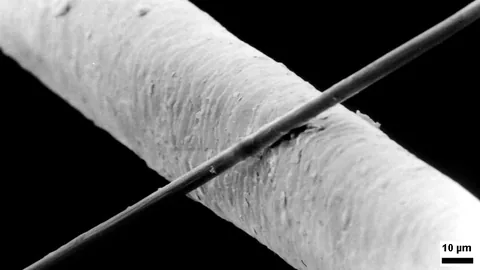 used to make carbon fiber. And then there is making a final carbon fiber part out. When you look at the cost of these threads, they are expensive, don't get me wrong, but they are about 10 times more expensive per kilo than steel, which, like, steel is really, really cheap, right?
And I think for the scale of carbon fiber, A, you can make an argument that when this ramps up to steel-level scale, this will get to similar cost to steel. And the other thing is, because of the aggressive weight advantage you can get with carbon fiber, I think you can actually outcompete steel on cost even today with select parts, because you are just putting less stuff in it, right? Something that would need 10 kilos of steel, we can make with one kilo of carbon fiber. And that is much cheaper than 10 kilos of steel. But that's not actually where most of the cost lies. When people say that carbon fiber is expensive, they actually say that making a carbon fiber part is expensive, because it needs a lot of human labor in the process.
It's got its own issues. Right.
My view on this is that carbon fiber is genuinely hard to manufacture with. But I genuinely believe that steel is even harder to manufacture with, right? Because it's worth just thinking, like, what have we actually done with metals? And it's genuinely insane, right? Like, tell me, which one seems more reasonable and easy to manufacture, right? Taking this material, liquefying it to over 3,000 degrees Celsius,64Fact-checkPushp says over 3,000 °C, but steel actually melts at about 1,450–1,520 °C, depending on its composition, below the 1,538 °C of pure iron (Wikipedia, "Steel" and "Iron"). injecting it, and also making sure that, you know, all of this is in an environment without any oxygen, because that fucks things up.
Injecting this inside a mold, which again, without any oxygen inside, you need to also ensure you're able to evacuate all of the air from it, because if there's an air bubble, it'll screw things up. You need the material to cool consistently and at a very specific rate, so that it crystallizes the way you want to. It then solidifies, and then you eject it from the mold, and you're doing this multiple times a minute. Is that easier? Or is taking a cloth, putting some glue on it, pressing it on a surface and letting it cure in an oven easier, right? We think manufacturing with metals is easy because we have been doing it for the past two centuries.
ExplainerHow carbon fiber parts are made
Carbon fiber reinforced plastic is a composite: the carbon filaments give it strength, and the resin that binds them holds its shape. So a part isn't cast or stamped, it's laid up.
- The usual starting material is prepreg, carbon fiber cloth or tape already impregnated with resin. The plies are cut and laid into a mold, each at its own angle: a filament carries load only along its length, so the directions are chosen to match how the part will be loaded.
- The stack is covered with film and the air is pumped out from under it. This vacuum bag presses the plies together and removes bubbles.
- Then the resin is cured with heat, often in an autoclave under pressure; a cycle takes hours.
- That's the difference from metal: a steel part is stamped in seconds, a carbon fiber one takes hours and is still largely made by hand. In return, the material sits only where it's needed and only in the direction it's needed, which is where the weight savings come from. On the Boeing 787, composites make up about half of the structure's weight.
Processes like this... I just described, like, casting of metals, is just second nature. Nobody thinks about how difficult and complex this really is. So what we are doing is we are getting into this arduous journey of figuring out the zero to one of manufacturing with carbon fiber and recognizing that carbon fiber is its own material. If you ask a woodworker to work with metal, he will not be able to make anything for you out of metal. And I think the problem is today, because carbon fiber is so new as a material, we're not asking carbon fiber engineers to work with carbon fiber. I'm sure everyone you spoke to is working with metals right now.
These are engineers that were trained to design and make things out of metal. And if you show them carbon fiber, they're like, God, this is a shitty material, the same way that if you show a woodworker steel, they'll say, God, this is a shitty material. We need a completely new skill set to be built around carbon fiber. And we need to create new production techniques, a new design language around the material. And that is the only way that we can really make it manufacturable. Do I believe that we can fully automate carbon fiber to the level that we have automated metals and steel?
I think we absolutely can, but it will take time. There will be new technologies that need to be developed for it. I just believe that the pot of gold at the end of the rainbow is very well worth it, right? I believe in a world where, just like how you see steel and metals everywhere around you... There's not a single part of the world you can go to where you don't see metal somewhere. I believe the same thing will happen out of carbon fiber. That, you know, if we have this conversation maybe, you know, three decades later, you'll be chatting to me on a carbon fiber mic, or, you know, this boom will be made out of carbon fiber. Like, there'll be things in this room that are made out of carbon fiber.
So, and do you think Airbound will play... Do you think you'll be vertically integrated,65Vertical integration — when a company makes its key components and materials itself instead of buying them from suppliers; SpaceX and Tesla work this way, for example. making those machines?
Yes, yes. That's... I would say Airbound, at its essence, if you strip away everything, you strip away the market, the drone, etc., we are really a carbon fiber manufacturing play. We are a company that is saying that we are better at making things out of carbon fiber than anyone else in the world, and we will maintain our position by continuing to be better than the rest of the world at making things out of carbon fiber. If we can do that, we have an insane edge that we think is best applied to, you know, movement and aircraft, because they really care about mass. But this can honestly be applied to anything, right? Like, I think eventually, when this becomes commoditized and it becomes common enough, you'll see like tables and chairs made out of carbon fiber, the same way that someone in a pre-industrial era could never imagine a world made out of steel, right? If you spoke to a blacksmith in the, you know, 1700s, they would say that, look, dude, we've been working with steel, we've known how to use this material for 4,000 years now. This is not new. If there was some discovery to be made, we would have made it. It's just not possible to make this in a non-highly-labor-intensive format, right? It takes an immense amount of care and effort to forge something out of steel. You need to have decades of experience to work with this material. And so, yeah, you'll never see a table or a chair made out of steel; that's ridiculous.
It'll always be wood that makes these things.
So maybe this is the way this has to happen, but how can you be so confident about this? I mean, you're still in your 20s, you've never worked in a big manufacturing operation before. You must have had someone far smarter than I am push back on this, maybe while they were doing due diligence66Due diligence — an investor's check of a company before a deal: technology, finances, legal risks. or something like that. I mean, it takes a lot of gusto just to believe this. But, you know, also this is how things change.
So I think it's just that... the only arguments I've received against carbon fiber are all some flavor of "it hasn't worked before," and "things have always been this way," and "the metal processes don't work with carbon fiber." I have not yet come across a real first-principles argument for "here's why carbon fiber can never be made manufacturable." And until I come across a highly structured and convincing argument in that format, I'm gonna keep on believing in carbon fiber.
Yeah, yeah. And this is a really difficult question. It's sort of shitty. It's like an intuition I have. It's just, you know, every time I'm with like a rocket company, it's like you build the first rocket, and then, first of all, it's crazy hard to manufacture that one. And then when you get bigger, a whole new world of hurt opens up, and companies go under and crumble and they can't do it.
And, you know, when I was looking at where you guys are, again, I was just so impressed that, especially with the first generation, you were able to manufacture... it was like what, like four or five a week, or... I mean, I forget the numbers.
More than that. Like about two a day.
Yeah. Two a day. Okay, so clearly, you know, you had people building away, they were flying great. The second one, it looks like you guys have a lot of testing still to do on like how long... I don't even know how long you'd been flying it by the time I'd gotten there.
Like, I think a week.
A week, okay.
Like a really, really short period.
Fair enough. So you gotta work it out. So my general takeaway was like super fucking impressed. And then I was just playing through in my head, I'm just like, oh, there's gonna be problems, because there always are as you get bigger and everything. And then, again, this is based on nothing other than... I'm just like, man, I wonder if the thesis starts to break down as you... you know, like, it's working great now, but as shit gets more serious and bigger, I just... yeah, I wonder if it breaks down. Again, I have no math or anything to back this up, but I think it may... it may not.
I think manufacturing is really, really difficult. I think we're not ones to underestimate it. I do think, though, historically, the reason why manufacturing and scaling is really hard for companies is because people underestimate that challenge. They think that, hey, I've made one, how difficult could making 10 be? And I think part of our edge is the fact that we know that, again, at our core, we are a manufacturing company. There's nothing else to it.
Everything else is just layers of design and market and other shell and fluff built on top of a production company. All we are is a manufacturer that has found a pretty good design to use and monetize. And yeah, my deep belief is that at the core of it, manufacturing is just: you take a certain amount of stuff, and you have to pay for the cost of producing that stuff, and you have to pay for the cost of bringing that stuff together into the thing you're trying to make. And I just feel like... to me it just feels obvious that structurally, if you need less stuff to do the same thing, if you can do the same thing with 10x less stuff, that stuff might be more expensive early on, but eventually you can figure out cost, you can figure out supply chain. All of these to me feel like temporary problems.
And when I say temporary, it might be like a 20-year-long temporary problem. But the end state will always favor the product that needs less stuff. And carbon fiber fundamentally needs less stuff to do the same things that metal can. You can, with great design, achieve the same strength that you would with steel while using 10x less mass in carbon fiber. And so what that means is that as long as per kg our production costs can eventually get to within 10x of steel, which we're already pretty close to without having scaled up this industry at all, then it will be a more manufacturable and scalable material.
Okay. Okay. I'll stop torturing you. I remember meeting you for the first time. You came in with just this like boundless energy, and I don't even think you had any idea... I think somebody had just sort of told us to meet. I think you were walking through aircraft design with me and folding this napkin, and I was like kind of taken, but I didn't really know what to make of you.
And then, you know, just going to see what you guys had built, really... I don't say this often. I mean, you just... you like stand out, you know? And it was impressive. And I just... I'm nowhere near enough of an engineer at all to sort of like approach some of this the right way, but I have been to like a lot of these facilities with people trying to do stuff like this, and everything you guys are doing looks like super spot on. And so, yeah, I just wish you so much luck, man. It's been really fun getting to like hang out with you a bit.
Yeah, and I'm excited to see what the future holds.
I am too. I can't wait to see what you guys do next. So you've like set the bar pretty high next... because now I think I want to make an annual pilgrimage to India.
Oh, that'll be great.
So you're gonna have to like up... We're gonna have to do more.
Yeah, I think we can do more. I'm not worried about that.
All right, you have to let me know when we should come out next year, so we can kind of time it for maximum visual stunningness. And thank you. Thanks so much for spending time with us and coming by again.
Yeah. Awesome.
The Core Memory podcast is hosted by me, Ashlee Vance, and/or Kylie Robison,67Kylie Robison — tech journalist and former senior correspondent at Wired; before that she wrote for The Verge, Fortune and Business Insider. She now writes for Core Memory and cohosts the podcast with Vance. or both of us together. It is produced by me and David Nicholson. Our theme song is by James Mercer and Jon Sortland, and the show is edited always by the Jon Sortland. Thank you so much to Brex for all your support, and thank you most of all to everybody for listening or watching. We love you. Please leave us a like, a review, a subscribe, all those tremendous things. Thank you, and we'll see you again.


