

Cheeky Pint
Chapters
New reactors need HALEU, which only Russia makes at commercial scale, and Russian uranium imports to the US are about to end: that is the gap General Matter wants to fill.
Read the chapter- After ten years investing at Founders Fund, Nolan asked reactor developers in 2023 what their hardest problem was, and they said it wasn't licensing but fuel, which they had to get from Russia.
- Nuclear fuel takes five steps: mine the uranium, convert it to a gas, enrich it to raise the share of uranium-235, convert it back to a solid, and fabricate fuel pellets.
- Today's reactors run on uranium enriched to 3–5%, while advanced reactors need just under 20%, which allows a much smaller core that can be built in a factory.
- Nolan says about a quarter of US enriched uranium is still imported from Russia, and the rest comes from France and the European consortium Urenco.
- Congress banned Russian uranium imports with waivers until January 1, 2028; General Matter's first goal is HALEU production by the end of the decade, and the second is lowering its cost.
A small core needs more highly enriched fuel to stay critical for years, and the safety of new reactors comes from their design, not from enrichment.
Read the chapter- Commercial fuel and power in the US are licensed by the NRC; Nolan thinks its bad reputation is undeserved, since it cares about safety, security and environmental impact, and an SMR company he knows called the process straightforward.
- Almost the entire US grid runs on light water reactors, and billions go into construction, including the huge containment dome built for worst-case accidents.
- Nolan compares enrichment to octane: it drops as fuel burns, so a gigawatt reactor can refuel every 18–24 months, while small reactors out in remote places want to refuel only every 5–10 years.
- Passive safety comes from reactor design, Nolan explains: in a molten salt reactor a plug melts and drains the salt if it overheats, and helium coolant can't become radioactive.
The data center boom hasn't touched General Matter yet, but within five years Nolan expects data centers to move from gas to nuclear, if nuclear gets cheaper.
Read the chapter- Most of an enricher's contracts are with the existing fleet, so even if data centers all run on natural gas, General Matter is fine.
- In five years Nolan expects a shift from gas to nuclear baseload, with the open question being whether it comes from gigawatt reactors or SMRs.
- Counting deaths and CO2 emissions across the whole chain, Nolan says nuclear beats even wind and solar, and cost is the one place it hasn't won.
- He believes in the solar cost curve but hasn't seen the same data for batteries, given how much storage a "five nines" data center needs; the competitor he sees for data centers is solar in sun-synchronous orbit.
Nolan argues nuclear got expensive not because of fear of accidents but because of high interest rates, missing scale and weak incentives to cut cost.
Read the chapter- Even at historically low rates, 20% of Vogtle's overrun was interest, and in the 1970s mortgage rates peaked around 18%, making decade-long projects nearly impossible to finance.
- Plants were built slowly, without supply chains, with workers moving from project to project; Nolan says big reactors get cheaper simply by building them faster and building more.
- Safety fears may have paused things, but in the 1970s and 1980s, before global warming was a focus, people had no reason to ask for a bigger power bill.
- Utilities work on a cost-plus basis and contract out construction, so nobody pushes prices down, which Nolan compares to space launch.
Attitudes toward nuclear swung from unbridled optimism to environmentalist hostility, and now, Nolan says, both parties support it.
Read the chapter- Collison recalls radium watches and energy "too cheap to meter," followed by nuclear becoming public enemy number one for environmentalists.
- Nolan describes a split inside the Sierra Club, where one faction argued nuclear could be the most environmentally friendly source if people were going to consume energy anyway.
- Young people are far more pro-nuclear, and Nolan points to bipartisan alignment: the Biden administration wanted to triple US nuclear by 2050, and the Trump administration wants to quadruple it.
Nearly all the new reactors, from microreactors to larger SMRs, should eventually be able to run on HALEU, which makes them General Matter's future customers.
Read the chapter- At the small end, Nolan names Antares, for forward military bases and space, and Radiant, a 1-megawatt containerized reactor mainly for military base energy independence.
- At SMR scale are Aalo, Valar and Oklo, likely serving data centers first, and larger formats from Oklo, X-energy and TerraPower could compete on the grid in the near term.
- Until HALEU is available, some use LEU+ at 6–10%, while Westinghouse's gigawatt-scale AP1000 can't run on HALEU but is looking at LEU+.
- New reactors choose 19.75% because a different regulatory regime starts at 20%, while submarines, which have to be cut open to refuel, run above 90%.
General Matter aims to start its plant by the end of the decade, and Nolan says it will hit that public deadline while working to a faster internal schedule.
Read the chapter- The company started at the end of 2023, now has just over 200 people, is headquartered in Los Angeles and is building in Paducah, Kentucky; Nolan says it submitted its NRC license application last week.
- The timeline is tied to the January 1, 2028 ban on Russian uranium, which leaves a gap of about a quarter of US demand, and to the first commercial advanced reactors in 2028–2029.
- Nolan explains Musk's "green lights to Malibu" planning as a response to people using all the time they are given, but names the risks: waste, wrong architecture decisions and the difficulty of judging people against a best-case plan.
- Used well, he says, it finds bottlenecks by stripping out all the buffers, as long as leadership makes sure nobody does the wrong thing just to win a day.
At SpaceX Nolan learned to go after an industry's bottleneck, and he sees fuel for small reactors the way launch once was for small satellites.
Read the chapter- Nolan joined SpaceX in 2003 as one of its first interns and stayed until 2007, working on test stands, Merlin engine components and engines for the Dragon capsule, then cargo-only.
- His main takeaway was to work on things not everyone thinks are most important, and to ask which industries have failed to deliver over the last 50 years and what their real bottleneck is.
- In the early 2000s small satellites had no good way to orbit; now small reactors need fuel, and for some SMRs fuel with enrichment can be up to 50% of the full LCOE.
- Non-dilutive funding takes away the fundraising risk: General Matter was shortlisted for a DOE program under Biden and awarded $900 million under Trump to build its first plant.
An enrichment plant has no nuclear or chemical reactions, and the hard part, Nolan says, is doing it cheaper than Europe, Russia and China.
Read the chapter- General Matter needs nuclear physicists and chemists mostly for safety analysis, because the plant only separates gas.
- Uranium is mined, today mostly by in situ leaching, as yellowcake U3O8, a separate chemical plant converts it to a gas, and the enricher separates uranium-235, 0.711% of natural uranium, from uranium-238.
- Nolan lists at least five methods (gaseous diffusion, centrifuges, aerodynamic processes, aqueous processes and laser enrichment) and says General Matter will unveil its own in the first half of next year.
- The site search took over a year, more than 10 states and more than 1,000 plots, and ended in Paducah, where a DOE enrichment plant closed in 2013: the community welcomes the work, the talent is there, and the site has DOE security and land already studied for environmental review.
The US lost enrichment through path dependence, and Nolan looks for a cost advantage in decades of technology that incumbents never captured.
Read the chapter- First-generation technology, built to win World War II and the Cold War, gave the US over 90% of world supply but lost on cost to European and Russian approaches.
- After the Berlin Wall fell, the Megatons to Megawatts deal had US reactors running on down-blended uranium from Russian warheads, and there was less reason to keep expensive plants at home.
- Ten years ago, Nolan says, utilities were fully contracted and there was no advanced reactor market; the import ban and HALEU demand have opened the window.
- Collison names scale and simplicity as the usual cost advantages, and Nolan adds a third: Russia, China and two European firms on the same technology haven't done a clean-sheet design in decades.
Cost-plus incentives make industries stagnate, and in Nolan's experience a small, fast team can beat the giants.
Read the chapter- Collison compares General Matter to lean manufacturing in the 1970s and 1980s: today people are finding stagnation in hardware, as SpaceX did in launch and Anduril among defense primes.
- Nolan notes the three examples are about a decade apart, and each was found by someone going deep, like Elon in launch or Trae at Founders Fund searching for a defense company.
- As an intern on a cost-plus military program at Boeing, Nolan saw more people added without things going faster: without downward pressure on cost, incentives don't reward speed.
- The best big companies, he says, always have a new, almost existential project, and that is how they stay young.
- By the end of his first week or month at SpaceX, then under 50 people and a thousand times smaller than incumbents, Nolan was fairly sure it would win because of its speed of execution.
Companies tied to Founders Fund share a zero-to-one mindset, Nolan says, and a very high bar for founding anything at all.
Read the chapter- Nolan points out that SpaceX predates Founders Fund, which was its first outside investor, and says the credit belongs to SpaceX and Elon.
- What these companies share, he says, is working on something important others don't see, starting with a small market, owning it and going from there.
- Founders Fund hires people who want to be investors, so leaving to start a company only makes sense for something exceptional.
- Nolan's three conditions are that it is exceptionally important, nobody else is doing it, and his skills improve the odds; after that most of the risk is execution.
- Before founding General Matter, Nolan says he was absolutely sure of the idea.
To start up by the end of the decade, General Matter runs three workstreams (licensing, the building and the equipment), and Nolan sees manufacturing as the hardest.
Read the chapter- Nolan says the NRC license application went in late last month.
- Nuclear projects usually contract out construction, but General Matter copied Tesla's playbook and built its own EPC team, with its own general contractor, procurement and engineers.
- The main challenge he names is manufacturing the equipment at the right economics, something relatively few US companies have proven they can do at scale.
The main lesson Nolan took from Founders Fund is to avoid competition by working on an important problem nobody else is tackling.
Read the chapter- Avoiding competition comes naturally when you work on something truly important that no one else is doing and that you can be uniquely good at.
- General Matter, Nolan says, came not from wanting to start a company but from asking what was holding nuclear back, and the answer was fuel.
- Opportunities like that, he believes, only become obvious to people who follow their passion and go deeper into a field than others.
Quotes
How Nolan found the idea for General Matter
“And so I said, ‘Well, why don’t the US companies that make all the fuel for the existing fleet of reactors—94 reactors on the grid, 20% of US power—why don’t they make the fuel that you need?’ They said, ‘What US companies?’”
Scott NolanRead from 00:44On the US nuclear regulator everyone loves to blame
“The blame is often placed on the NRC. I actually don’t think it’s deserved. They’ve been great to work with.”
Scott NolanRead from 06:13Why nuclear construction is so expensive, the Vogtle example
“Vogtle was way over budget, way over schedule. But, at a time of historically low interest rates, 20% of Vogtle’s cost overruns were interest rate overruns, interest payment overruns.”
Scott NolanRead from 15:54Nuclear power's fundamental weakness
“It’s the cleanest base load, the safest base load, not the cheapest base load. You have to be the cheapest.”
Scott NolanRead from 17:51On "green lights to Malibu" schedules at Musk's companies
“That schedule philosophy of green lights to Malibu, it comes out of this idea that if you give people more time, they will simply take more time.”
Scott NolanRead from 27:56What actually happens at a uranium enrichment plant
“In our facility, there’s no nuclear reactions. There’s not even any chemical reactions. What you have is a separation of a gas.”
Scott NolanRead from 35:42Where a newcomer finds a cost advantage over Russia, China and Europe
“There’s economies of scale, there’s simplicity, and then the third, honestly, is decades of technology improvement that no one’s captured.”
Scott NolanRead from 44:55On interning at SpaceX when it had fewer than 50 people
“I think the bigger thing I walked away with after Boeing, even in just being an intern at SpaceX when it was sub-50 people, was at the end of the first week or month, I felt pretty high certainty that SpaceX would eventually win, even though it was at most 1/1,000th the size. It was just because of the speed of execution.”
Scott NolanRead from 50:23
Summary
Scott Nolan, one of SpaceX's first interns and then an investor at Founders Fund for ten years, asked the reactor developers he knew in 2023 what the hardest part of their job was. The answer wasn't "licensing" but "fuel." American nuclear plants buy their enriched uranium from Russia and Europe, and HALEU, uranium enriched to just under 20% that small modular and other advanced reactors can't do without, is sold commercially only by Russia. The waivers on the ban on Russian uranium imports, which covers about a quarter of US demand, run out on January 1, 2028. General Matter, now over 200 people, is building a plant in Paducah, Kentucky, on the site of the last American gaseous diffusion plant; it has a $900 million award from the Department of Energy, has filed its license application with the NRC, and aims to start up by the end of the decade. It isn't disclosing its enrichment method yet.
Why did nuclear power get so expensive? Nolan doesn't think fear after Three Mile Island and Chernobyl was the main reason. Nuclear is the cleanest and safest baseload power, but not the cheapest: in the 1970s high interest rates strangled construction (even in an era of low rates, 20% of Vogtle's overruns were interest), the industry never reached economies of scale, and cost-plus utilities didn't push prices down, much as in space launch before SpaceX. The fix is to build faster and build more. Along the way: whether solar and batteries compete with nuclear (Nolan believes in solar, including in orbit, but not yet in batteries), the Sierra Club's split over nuclear power, today's bipartisan support, and a tour of the startups, from Antares and Radiant microreactors to Oklo, X-energy and TerraPower.
Then, how enrichment works (the plant has no nuclear or chemical reactions at all, only the separation of uranium isotopes in a gas) and how the US lost the industry: its first-generation technology lost on cost to European and Russian plants, and after the Cold War the Megatons to Megawatts program made its own plants redundant. Nolan looks for a cost advantage in a clean-sheet design: the incumbents haven't reinvented the process in decades. Finally, lessons from SpaceX, Boeing and Founders Fund: cost-plus incentives don't produce speed, a small, fast team beats the giants, and the best strategy is to avoid competition by taking on something important that nobody else is doing.
Advice
Set an internal schedule tighter than the public one, "as fast as we can": give people more time and they'll simply take it.
When you compress the schedule, don't sacrifice the right architecture: leadership should be deep in every engineering decision and never let anyone save a day at the cost of a wrong call; better to do it right and make up the time elsewhere.
If you're building a company with expensive hardware, look for non-dilutive government funding: it takes part of the cost of the first facility off the table, along with the risk of running out of money before you can prove the idea to investors.
Don't chase a trillion-dollar market on day one: start with a small market that really needs a new solution, make customers love the product, own that market completely, and expand from there.
Avoid competition: take on an important problem that nobody else is working on and that you can be uniquely good at, and before you start, check carefully that nobody really is solving it.
Look for ideas not in trends but in a field that genuinely fascinates you: go deeper into it than others, and its biggest problems will become obvious to you.
Mentioned
 General Matter00:27Nolan's uranium enrichment company
 Founders Fund00:44the venture firm where Nolan spent ten years
 Urenco03:26a European supplier of enriched uranium to the US
 Nuclear Regulatory Commission (NRC)05:37the regulator General Matter has applied to for a license
Show 24 more mentionsShow fewer mentions
 U.S. Department of Energy (DOE)05:37owner of the Paducah site, awarded General Matter $900 million
- The China Syndrome15:28the film often linked to the fear of nuclear power
 Sierra Club20:27environmentalists who split over nuclear power
 Antares22:44microreactors for the military and space
 Radiant22:44a 1-megawatt reactor in a shipping container
 Aalo Atomics23:08an SMR developer
 Valar Atomics23:08an SMR developer
 Oklo23:08advanced reactors, a future HALEU buyer
 X-energy23:08a large advanced reactor
 TerraPower23:08a large advanced reactor
 Westinghouse Electric Company23:49developer of the gigawatt-scale AP1000 reactor
- AP100023:49a gigawatt-scale reactor that can't run on HALEU but is looking at LEU+
 SpaceX27:13Nolan worked there from 2003 to 2007
 Elon Musk27:13"green lights to Malibu" planning
 Full Self-Driving27:13an example of an "Elon-style" timeline that doesn't get met
- Merlin30:51the SpaceX engine Nolan worked on components for
- Dragon31:10the SpaceX capsule whose early team Nolan was on
 Peter Thiel31:53the philosophy of working on what others think unimportant
 Danaher45:52an example of adopting lean manufacturing
 Anduril Industries46:35a "neo-prime," also tied to Founders Fund
 Trae Stephens47:19went looking for a defense company, then co-founded Anduril
 Boeing48:32Nolan interned there on a military program
- Zero to One52:15the "zero to one" principles
- Tesla55:48an example of an in-house construction team
Sponsors of the episode
 Stripe Press29:46Stripe's book publisher: two new books
- Built to Grow: A Handbook for High-Performance Sales Teams29:46Stephanie Friedman's book on building a startup's sales team
- Nomad Letters29:46Nick Sleep and Qais Zakaria's letters to their fund's investors
Transcript
01America is short of nuclear fuel
New reactors need HALEU, which only Russia makes at commercial scale, and Russian uranium imports to the US are about to end: that is the gap General Matter wants to fill.
Scott Nolan leads General Matter, an advanced uranium enrichment company. His ultimate goal is to slash energy costs so dramatically that entirely new capabilities become cheap and routine.
Cheers.
Cheers.
General Matter. What are you guys trying to do?
We are enriching uranium. When we started, not many people were talking about uranium, not many people were talking about nuclear energy. This was mid-2023. I’d been doing investing at Founders Fund1Founders Fund — a San Francisco venture firm founded in 2005 by Peter Thiel, Ken Howery and Luke Nosek. It was the first institutional investor in SpaceX and Palantir, and both Anduril and General Matter were started from inside it. for 10 years and investing in some of the reactor companies. I asked them, “What’s the hardest thing you have to do?” I was like, “Licensing, obviously.” They said, “No, it wasn’t licensing. It’s actually getting the fuel. We have to get all of our fuel from Russia. It’s very hard to import.” And so I said, “Well, why don’t the US companies that make all the fuel for the existing fleet of reactors—94 reactors on the grid, 20% of US power—why don’t they make the fuel that you need?” They said, “What US companies?”
This is both new nuclear companies, like startups, and existing nuclear plants in the US. Both require your enriched uranium, and both have to source it from Russian companies?
Russian or European.
Okay. But non-US companies.
Non-US. Let’s run through the big picture on where fuel comes from. Reactors, like any engine or anything producing power, does consume something. It consumes nuclear fuel. The nuclear fuel is made with five steps. First, you get uranium out of the ground. You then turn it into a gas. You then separate the gas to enrich it, meaning get more density of U-235, the fissile material.2Fissile material — an isotope whose nuclei split after absorbing even a slow neutron and release new neutrons, sustaining a chain reaction. Uranium-235 is the only such isotope found in nature. You then turn it back into a solid, and then you make your fuel pellets. Five steps. All reactors in the US run on this stack for making nuclear fuel.
The more modern reactors, SMRs,3SMRs — small modular reactors: reactors of up to 300 MW of electric power, meant to be assembled in a factory from ready-made modules and shipped to the site. advanced reactors,4Advanced reactors — in the US, the term for new reactor designs, such as small light water, molten salt, gas-cooled, sodium-cooled and micro reactors, as opposed to the large light water reactors of today's fleet. those will use fuel that’s enriched to a higher level. Call it 20%, just under 20%. Most of the reactors on the grid today, they go at 3-5%. The big difference that that unlocks is if you’re going low-enriched, 3-5%, you generally want a much bigger reactor vessel, a core.5Core — the part of the reactor that holds the fuel and where the chain reaction takes place. The reactor vessel is the steel pressure vessel around it. If you’re going up to 19%, 19.75%, 20%, it unlocks a much smaller core that lets you do a factory-built reactor.
A lot of what you’re hearing about with advanced reactors is a combination of safety, enhanced passive safety6Passive safety — systems that shut down and cool a reactor without electricity or operator action, relying on physics: gravity, natural circulation, thermal expansion. that doesn’t exist in the existing fleet, and then a form factor that could be built in a factory modularly that lets you bring the cost down.
When people talk about small modular reactors, the modularity is that you can mass-produce it in a factory rather than needing to build it custom on a site, and you have a bunch of shipping containers that you hook up.
Exactly. More or less. Trying to minimize the construction aspect of the project.
Yes. Diablo Canyon,7Diablo Canyon — California's last operating nuclear plant: two pressurized water reactor units totaling about 2.2 GW on the coast of San Luis Obispo County. It is owned by the utility PG&E. where do they get their enriched uranium?
From existing suppliers. That’s a combination of Russia and Europe. In the US, we get about a quarter from Russia, still imported. That’s going to keep going until 2028. Then the rest from European providers. That’s France, and then a European consortium called Urenco.8"France" means the state-owned company Orano (Areva until 2018), with its Georges Besse II plant. Urenco is a British, Dutch and German consortium; it also has a plant in the US itself, in Eunice, New Mexico.
Source: World Nuclear Association, via Wikipedia
Does US mine uranium?
We do, small quantities.
The problem you’re trying to address is that uranium is mined in the US or Canada, it is then shipped across an ocean to be enriched, and then ultimately shipped back as fuel.
More or less, yeah. Most of US supply will come from Kazakhstan9Kazakhstan — the world's largest uranium producer, with about 40% of global output. and Canada, and then where it’s turned into a gas varies.
Got it. I presume if you talk to a nuclear startup that wants to get 19% enriched uranium, they agree with you on the geopolitics of this. It would be valuable to onshore this stuff, but they probably have more acute problems that you’re solving beyond just it would be good to re-onshore the supply chain.
For them, it’s mostly about availability. As they think about their very first deployments and then scaling up in the early 2030s to 10s of deployments, it’s all about where are we going to get the enriched uranium, the 19.75% enriched uranium, also called HALEU, high-assay low-enriched uranium. That’s all about availability. That was the first problem that I heard of. That was the question of, only Russia makes this today commercially.10HALEU is in fact produced in small quantities in the US: since 2023 Centrus has been enriching uranium under a Department of Energy contract at a demonstration centrifuge cascade in Piketon, Ohio. But at commercial scale, HALEU is sold only by Rosatom's companies. How are we going to import it?
In mid-2024, Congress passed a ban on imports of Russian uranium.11The Prohibiting Russian Uranium Imports Act was signed on May 13, 2024. Imports have been banned since August 2024, but until January 1, 2028, the Department of Energy can grant waivers when no other source is available. That ban goes into effect January 1st, 2028. Right now, they’re still importing under a waiver, but January 1st, 2028, that ends. So all these companies are wondering, “Who’s going to produce HALEU?” Our first mission as a provider is produce HALEU before the end of the decade for all these reactors. Part 2 is bringing the cost down, so that’ll be the other big lever that we work on.
02Why small reactors need stronger fuel
A small core needs more highly enriched fuel to stay critical for years, and the safety of new reactors comes from their design, not from enrichment.
How is this regulated? Can you give us the map of enriched uranium? Where does weapons-grade uranium start to happen? And, who do you have to work with as a regulator for all this?
ExplainerLevels of uranium enrichment
Natural uranium is almost entirely uranium-238; fissile uranium-235 makes up only 0.711% of it. Enrichment raises the share of uranium-235. Ordinary power reactors run on low-enriched uranium (LEU) with 3–5% uranium-235; LEU+ is uranium enriched to roughly 5–10%. HALEU (high-assay low-enriched uranium) is 5–20%, in practice usually 19.75%: just under the 20% threshold above which uranium counts as highly enriched and is regulated far more strictly. Uranium for nuclear weapons and submarine reactors is enriched to 90% and above.
If you’re doing commercial sales of nuclear power or fuel, that’s going to go through the NRC, the Nuclear Regulatory Commission.12NRC (Nuclear Regulatory Commission) — an independent federal agency created in 1975, when the Atomic Energy Commission was split into a regulator and a research and development agency, ERDA (which in 1977 became part of the new Department of Energy). It licenses nuclear plants and fuel cycle facilities. In the US, that’s your regulator. If you are selling to the government, there’s potential Department of Energy13The US Department of Energy (DOE) — created in 1977. Besides energy policy, it oversees the national laboratories, the nuclear weapons complex and former nuclear industry sites, including the one in Paducah. paths, or if you’re an R&D reactor, you could go through a DOE path, but it’s primarily NRC if you’re doing commercial operations.
How have they been to deal with?
Great. Like I said, I think the investment community, the startup community, the whole tech community historically has just heard: “The NRC is really difficult,” or something.
The NRC has a bad brand.
Yeah. The blame is often placed on the NRC. I actually don’t think it’s deserved. They’ve been great to work with. Ultimately, they care about two things: safety and security.14Safety and security — in the nuclear industry these are distinct things: safety means protection against accidents, security means protection against theft of materials, sabotage and attacks. And then there’s an environmental consideration as well. All their licensing focuses on those things. This was the answer we got from the SMR company that I knew. We asked them, “Hey, how hard is it to get the NRC licensing?” They said, “It’s pretty straightforward. You do the safety analysis, you do the security analysis, you show low environmental impact, and it’s a straightforward process. It’s a lot of paperwork and analysis, but it’s doable.”
Can you give us a bit of a map of nuclear reactor designs? There’s the traditional designs installed in plants operating today, and then you were talking about these newer startups that are pursuing SMR-type approaches... There are a bunch of different technical approaches there. But can you just ground us in what everyone’s trying to do? Presumably, there’s some even that don’t use uranium as a fuel, so they’re outside of the scope for you, but are maybe relevant to this discussion.
Most of the US grid, virtually all of it, runs on light water reactors.15Light water reactors run on ordinary ("light") water, as opposed to heavy water reactors such as Canada's CANDU, which use water enriched in deuterium. These are reactors with uranium enriched to low-enriched uranium levels, LEU levels, 3-5% enrichment. That goes into the core. Your moderator and your coolant16The moderator slows down the fast neutrons released by fission: slow neutrons are far more likely to split uranium-235. The coolant carries heat away from the core. In a light water reactor, ordinary water plays both roles. is water, just regular water. That’s most reactors on the grid. You end up with a pressurized steam line—large dome covering the reactor. That’s part of the large construction project that leads to the billions in cost per reactor.
Is the large dome covering the...
That’s a containment dome.17Containment — a sealed building of prestressed reinforced concrete, often steel-lined, around the reactor and its primary circuit. It has to hold in radioactive material even in the most severe design-basis accident.
I see.
In the case of an accident, in the case of loss of cooling,18Loss of cooling — in the nuclear industry, above all a loss-of-coolant accident (LOCA), such as a break in a primary circuit pipe. Containment and emergency cooling systems are designed around it. that’s meant to do containment of any radiological material.
I see.
The reactor is not actually that large. It’s a much larger dome covering the reactor.
Why does the containment dome need to be so big?
Mostly for the most extreme accident scenarios. Just making sure the thickness is there, the internal volumes are there.
I see. It’s small on the inside, it’s just very thick.
Smaller.
That’s the traditional light water reactor design. How about the startups?
Nearly all of them are focused on going modular, bringing the size down, bringing your core size down. Let’s go to stranded demand centers and let’s serve those demand centers, and let’s go containerized or even smaller than that. You’re going to be using HALEU in that very small format. Again, that’s the 19.75% enriched, smaller core, smaller format. Now we’re talking about fuel formats, but they often go hand in hand with the reactor design.
Why do those two things go together?
Which pieces?
The smaller core and highly enriched uranium.
To unlock a smaller core design that could be built in a factory, you want your fuel to be higher octane, so to speak, higher enrichment level. The reason you care about your fuel being at a higher enrichment level is because at some point, as it’s consumed, as it reacts, that enrichment level will drop. At some point, you can think of it as the power going out, the reactor fizzling out. If you have a stationary 1-gigawatt reactor, you’re running 3-5% enriched uranium. You’re probably doing refueling every 18 months, 24 months. That’s an acceptable thing.
You have a very big reactor, your core will stay critical19Critical — the state in which a chain reaction sustains itself: each fission on average causes exactly one more. It isn't an accident; it's how a reactor normally runs. "Not critical" means the reaction is dying out. for quite a while, and the refueling every 18, 24 months is not such a big deal. If you have a very small core, think of it as you need more higher octane fuel. As it burns up, it will pass through acceptable power production down to not even being critical more quickly. Some of these reactors also want to have 5-year, 10-year refueling cycles because they’re out somewhere remote, not somewhere central. It’s a combination of you want to unlock a smaller core that will remain critical for a longer period.
That makes sense. Can you talk about the passive safety advantages of highly enriched uranium that you mentioned?
Not highly, but HALEU.
Sorry. Yeah.
The enrichment level itself does not lead to safety advantages, but people’s reactor formats do. Some of these reactors are passively safe. A classically well-known version of this was molten salt reactors.20Molten salt reactor — a reactor in which the fuel is dissolved in molten fluoride salts. The experimental MSRE ran at Oak Ridge from 1965 to 1969; one of its safety systems was a "freeze plug": salt in a drain pipe was kept solid by cooling, and if the reactor overheated or lost power it melted and the fuel drained into tanks where a chain reaction is impossible. The molten salt has thermal properties that cause it to self-regulate, and then if somehow it were overheated, you could put a plug in the bottom of the reservoir, and then the plug would melt, and then everything drains out, and criticality stops. That’s the idea of a molten salt reactor.
You have other ones like helium-cooled, where the helium can’t be activated,21Activation — the conversion of stable nuclei into radioactive ones when they absorb neutrons. The helium-4 nucleus is very stable and absorbs practically no neutrons, so helium coolant hardly becomes radioactive. the helium cannot become radioactive. So, even if you had a cooling release, you’re not releasing any radioactive material. In general, these newer designs just have either passive safety features or modern architectures around active safety.
You can design into the reactor some self-correcting mechanism, like a fuse plug-type thing, where the act of starting to run away from you causes the safety mechanisms to kick in.
Right. Well stated.
03Nuclear power for AI
The data center boom hasn't touched General Matter yet, but within five years Nolan expects data centers to move from gas to nuclear, if nuclear gets cheaper.
The AI scale-up and power-up has been powered significantly by turbines22Turbines — gas turbines. To avoid waiting years for a grid connection, AI data centers increasingly build their own gas turbine plants and reciprocating generators. and other forms of electricity that you can bring online very quickly, generators in some cases. Has it affected your market at all, or really the market for your customers? Or are the timelines for nuclear power too long?
I think no, and no. It has not impacted us specifically. A lot of the topics in nuclear today are all about SMRs and advanced nuclear. That’s an important segment. I think it’s going to grow tremendously over the next decade, but it’s still a small market today. As an enricher, most of the contracting volume that we do is with the existing fleet. It’s for low-enriched uranium, it’s with the utilities.
As people think about how are they powering data centers in the next couple of years, we think that some of that will be SMRs as they contract that, but even if it’s all natural gas, that’s fine, because in the next few years, most of our demand is from existing fleet utility customers.
Now, where does that go in five years? I think there will be more and more push to move off of natural gas, move to true base load,23Baseload — power plants that run around the clock at nearly constant output and cover the grid's minimum demand. Solar and wind without storage can't play that role: their output depends on the weather and the time of day. and I think that’ll be nuclear. Then the really big question, I think, is does that happen through more of the gigawatt-scale reactors, or does it happen through more SMRs, and what’s that balance? If you just take a big step back and say, “What type of energy do we want to power these data centers?” I think there’s going to be a lot of pressure for it to be safe, and for it to be clean, and for it to be base load.
The thing that people forget is that nuclear is by far the cleanest and safest base load. It’s actually safer than wind power per terawatt-hour.24Per terawatt-hour — according to Our World in Data (2020), counting accidents and air pollution, deaths per terawatt-hour of electricity are about 25 for coal, 18 for oil, 2.8 for gas, 0.04 for wind, 0.03 for nuclear and 0.02 for solar.
Sorry, how do people get hurt with wind power, just the maintenance of the turbines?
Yeah. If you look at all downstream mortality, it’s more dangerous than nuclear. Then, if you look at all downstream CO2 emissions, nuclear is actually the lowest. Lower than wind or solar. If you think that those things matter, and that base load matters, then it will have to be nuclear. The one thing nuclear has not done a good job of in beating everything else is on cost, and I think that’s actually what it all comes down to. The question of do we deploy lots of gigawatt-scale reactors, or is the scaling handled by SMRs? It comes down to who is actually deploying more quickly, and cheaply on a per-megawatt scaling basis.
Isn’t the true competitor for nuclear “solar + batteries?” Because both are coming down a very aggressive cost curve? And so, you could just be cost-competed by solar and batteries in a lot of use cases?
I believe the solar cost curve.25Cost curve — for solar modules it's known as Swanson's law: with every doubling of cumulative production, they get about 20% cheaper. I haven’t seen data that’s as compelling on the battery cost curve. That could be coming, but if you want a data center that’s five-nines,26Five nines — 99.999% availability, meaning no more than about five minutes of downtime a year. you need a lot of storage. I’d actually delete one thing, the battery piece, and I would say the competitor for nuclear is actually pure solar, solar in sun-sync orbit27Sun-synchronous orbit — a near-polar orbit on which a satellite passes over each point on Earth at the same local time. On a dawn-dusk orbit of this kind, running along the line between day and night, a satellite is in sunlight almost all the time. for data centers, if we’re talking data centers. I do think that that’s the one other angle that’s pretty smart and could possibly win. If we’re talking about power on the ground, I think nuclear still wins, whether that’s data center, industrial, whatever it is.
04Why nuclear got so expensive
Nolan argues nuclear got expensive not because of fear of accidents but because of high interest rates, missing scale and weak incentives to cut cost.
How will cost get solved, or will it get solved?
It will get solved. And then the way it gets solved depends on what you think the cause of the cost issues in nuclear are being. This is one of those overdetermined problems of, “Why haven’t we scaled nuclear?” I think most people just say safety. They look back to the ‘70s, and they say: “There was a movie, The China Syndrome. You had Three Mile Island.28The Three Mile Island accident in Pennsylvania on March 28, 1979, was a partial meltdown of the core of Unit 2, the most serious accident in the history of US nuclear power. "The China Syndrome," a film about the cover-up of an accident at a nuclear plant, opened 12 days before it. You had Chernobyl. Clearly nuclear was going to stop, and we wouldn’t scale it.”
I do think the scaling piece is actually one of the proximate causes. We never hit economies of scale. We weren’t doing it quickly enough. We never built out the supply chains. The workforces would shift around from project to project. Vogtle29Vogtle Units 3 and 4 in Georgia, with AP1000 reactors, were the first reactors built from scratch in the US in decades. They came online in 2023 and 2024, about seven years behind schedule, and their cost grew from an initial $14 billion to more than $30 billion. was way over budget, way over schedule. But, at a time of historically low interest rates, 20% of Vogtle’s cost overruns were interest rate overruns, interest payment overruns. You realize that the overnight cost30Overnight cost — what a plant would cost if it were built overnight: without interest on loans during the years of construction and without inflation. of a plant, when they take 10 years to build, actually doesn’t matter as much as interest rates and how long are you actually taking to build these things.
If you think about the big reactors, I think the way that we bring the cost down dramatically is just build them quicker and build more of them. I think that goes a very long way. If you look at the period when things really slowed down, and that downward spiral began for nuclear, it was the ‘70s. You had oil price shocks,31Oil shocks — the oil price spikes of 1973 (the Arab oil embargo against Israel's allies) and 1979 (the Iranian revolution). In 1986, by contrast, oil prices fell by more than half. you had oil prices going very low, you had interest rates that peaked, I think, in 1981 on mortgages, 18% mortgages3218% — in October 1981 the 30-year fixed mortgage rate in the US hit a record 18.63% (according to Freddie Mac), as the Fed under Paul Volcker fought inflation. at that point. How do you finance a huge infrastructure project when your cost of capital is well north of 10%, way north of that?
Because the classic old story of what happened is this very accident-based mood of things like Three Mile Island and Chernobyl, and you basically reject that as an explanation, where you don’t think it was that we saw these near-misses and accidents and things and said, “Screw that... We’re going to strangulate nuclear and overregulation,” everything like that. You think it was much more of a WTF happened in 197133"WTF happened in 1971" — a reference to the website WTF Happened in 1971?, a collection of charts of economic indicators that change course sharply around 1971, the year the US ended the dollar's convertibility into gold.-type story where we lost the ability to build large infrastructure projects, generally, and nuclear plants are an example of a large infrastructure project?
Yeah. Maybe the safety concerns put a slight pause on it, but I think that that is often blamed as the only thing. And maybe that kicked off this cycle to some extent, but I think it was probably inevitable anyway when your product is not cost-competitive. I think fundamentally that’s the thing in nuclear. It’s the cleanest base load, the safest base load, not the cheapest base load. You have to be the cheapest.
I also think for people in general, if presented with, “Here’s a new technology. Would you like this to power your grid? You’ve maybe heard some safety issues with it that are probably confusing of which side to believe, and then also your energy won’t be cheaper.” If we’re talking about being in the 1970s, 1980s, when global warming was not really a topic, and emissions wasn’t as front and center, why would you say yes to: “I want a more expensive electricity bill”? I think that put us here. I think the way it gets solved is building more.
I think the other side of it, if we want to talk about the cost structure thing in terms of being overdetermined, you have to ask yourself, “Why did the cost get high? Why wasn’t there more downward pressure on them?” I think there just wasn’t a strong enough incentive in the ecosystem to push prices down. You had utilities that are more like cost-plus organizations,34Cost-plus — a contract under which the customer reimburses the contractor's actual costs and pays an agreed profit on top. Regulated US utilities work in effect the same way: their rates cover their costs plus a regulator-approved return on capital. and they’re generally going to outsource the construction of the facility. You end up with this dynamic that was, in some ways, similar to the launch industry of no very strong economic pressure to reduce price.
It just stopped being a market and started to become a place where people rent-extract35Rent extraction — earning income not by creating value but from one's position: a monopoly, regulation, a lack of competition. Economists call such income economic rent, which Nolan talks about next. in all their local corners.
Maybe not intentionally, but I think absent a strong pressure to keep prices low and push them down and compete them down. I think in a lot of industries that happens. It happened in space launch as well.
05From euphoria to fear and back
Attitudes toward nuclear swung from unbridled optimism to environmentalist hostility, and now, Nolan says, both parties support it.
It feels like, in general, the nuclear mood is this very interesting story of extremes, where there was crazy unbridled optimism early on. Remember the radium watches,36Radium watches — in the 1910s and 1920s their dials were painted with luminous radium paint. The women who applied it with brushes they pointed with their lips, the "Radium Girls," fell ill and died from radiation poisoning; their lawsuits changed American workplace safety law. where people were making watches with radium-226 for the glow-in-the-dark dials, and this energy too cheap to meter,37"Too cheap to meter" — the words of Lewis Strauss, chairman of the US Atomic Energy Commission, in a 1954 speech about the future of nuclear power. and the Jetsons future. It was really ebullient in its optimism. Then there was this crazy pessimism, where nuclear became the public enemy number one, and the enemy of environmentalists, which is ironic given you’re saying it is provably the safest and lowest-carbon format.
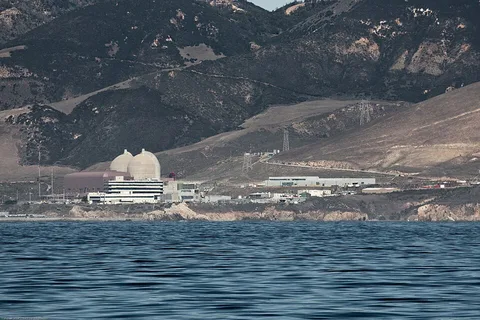
It was a big debate with the Sierra Club, actually, internally. There was about half of the Sierra Club.
There was a pro-nuclear side of the Sierra Club?
Very pro-nuclear, and it was divided on this around the time of Ansel Adams taking photos for the Sierra Club.38Sierra Club — the oldest environmental organization in the US, founded in 1892. In the 1960s it split over the Diablo Canyon nuclear plant: part of the board, including the photographer Ansel Adams, supported building the plant on that stretch of coast, while executive director David Brower opposed it. The dispute was one reason Brower left in 1969; later the club came out against nuclear power. I remember this as being something that created some huge rift. The argument was basically, “We can try and have less energy consumption as a society, and that might be the best thing for the environment, but it seems unlikely. Therefore, the alternative is more coal, other things we’re doing.”
Maybe solar can work, maybe wind can work, but those are visually and in terms of acreage, more impactful to the environment. And so, nuclear may be the most environmental source of energy if you think we’re going to consume it. That was a big internal argument, even amongst the environmental movement around that time.
I hadn’t realized that there was a rift there, but ultimately one side won out.
Yeah.
Where I was going was, it feels like we are now getting to a better spot where, at least amongst the youth, opinions are very striated by age, but younger people are much more likely to be pro-nuclear. Do you think we’re getting to a better spot, generally, in terms of public perception?
Yeah, I think we are. You look at not just age demographics, but also just politically. Ten years ago, nuclear was much less popular in general, and also it was a political issue. Now it’s got bipartisan support. You look at the Biden administration wanted to triple nuclear production in the US by 2050, the Trump administration wants to quadruple it.39Tripling nuclear — in December 2023, at the COP28 climate conference, the US and more than 20 other countries pledged to triple nuclear capacity by 2050. In May 2025 Donald Trump signed executive orders aiming for 400 GW by 2050, roughly four times today's capacity. There’s good alignment politically around nuclear now. I think it’s because people who historically would have been concerned more with environmental are realizing it’s the cleanest, lowest CO2 emissions source, and it’s actually extremely safe.
06The startups reinventing reactors
Nearly all the new reactors, from microreactors to larger SMRs, should eventually be able to run on HALEU, which makes them General Matter's future customers.
Yes. Who do you sell to, who are your customers or prospective customers? I know you probably can’t pick favorites, but what are a few of the most exciting approaches that you see amongst the startups?
If we’re talking about specifics, let’s just go smallest to biggest in no particular order.
You’re so diplomatic. Finish your Guinness.
The smallest would be like, Antares.40Antares — a company from Torrance, California, founded in 2023: heat-pipe microreactors for military bases and space. That’s going to be more for forward-deployed military, space, things like that. They have an incredible business in that market. Next size up would be Radiant41Radiant — a company from El Segundo, California, founded in 2020 by SpaceX alumni: the Kaleidos microreactor, about 1 MW, helium-cooled, that fits in a standard shipping container. 1-megawatt, very good reactor design, containerized for remote applications, primarily in base resilience. Great business there.
Then you start getting up into the SMR size, and you have people like Aalo,42Aalo Atomics — a company from Austin, Texas, founded in 2023: compact sodium-cooled reactors for factory mass production. Its experimental Aalo-X reactor reached criticality in July 2026. or Valar,43Valar Atomics — Isaiah Taylor's company: high-temperature gas-cooled reactors running on TRISO fuel. or even Oklo.44Oklo — Jacob DeWitte and Caroline Cochran's company, listed on the New York Stock Exchange since 2024; Sam Altman chaired its board until 2025. It is developing the Aurora, a 75 MW sodium-cooled fast reactor running on HALEU. Then you go bigger. That would be serving the data center market, primarily. That’s probably the first applications there and the ones that are most urgent. Then you go larger than that, and you’re looking at Oklo, X-energy,45X-energy — developer of the Xe-100, an 80 MW high-temperature gas-cooled reactor with TRISO pebble fuel. TerraPower46TerraPower — a company founded by Bill Gates. In Kemmerer, Wyoming, it is building the Natrium plant: a 345 MW sodium-cooled fast reactor with molten salt heat storage.—larger format that can really compete on the grid in the near term. Not all of these are using HALEU today. Some might use low-enriched or LEU+, 6–10%, because that’s available—
But all of them could. It’s like putting 100 octane in your car. It can take it.
I don’t think all of them can. If you go big enough—those are all the advanced ones. I think none that I named... I’m not aware of any limitations of any that I named. I think all of those can run HALEU at some point. Some are choosing to run LEU or LEU+ today because that’s what’s available. If you go bigger on the grid today, those large reactors, those gigawatt-scale AP1000s,47AP1000 — Westinghouse's Generation III+ pressurized water reactor, about 1.1 GW, with passive safety systems. It is the reactor in Vogtle's new units. the Westinghouse design, that cannot run HALEU, but they are looking at operating and running LEU+.
Got it.
Again, going back to what we were talking about before, you increase the enrichment level, and you don’t have to refuel as often, or you can get a little bit more power out of it. So, that’s the landscape. Think large-format light water reactors, really the ones people associate with Homer Simpson, that’s low-enriched uranium. And then everything else that’s happening generally trends towards a higher enrichment level, just under 20% HALEU.
Is this relevant to submarines and all the non-power plant—
No, submarines care even more about refueling cycles. When you refuel a submarine, you have to cut it open and remove the reactor, so as infrequent as possible is ideal there, and they’ll run north of 90% enrichment.48Above 90% — US submarine reactors run on highly enriched uranium. The core of a Virginia-class submarine is designed to last about 33 years, the boat's entire service life, without refueling.
Which is, again, getting into a different regulatory regime. You cannot, as a civilian company, use that.
Completely different, and that’s why all of the new SMRs, all the advanced reactor designs, specifically choose HALEU, 19.75%, just under 20, which is the cutoff for different regulation internationally and domestically.
I see. 20% is the cutoff, because beyond that, you’re getting...
07The race to 2030
General Matter aims to start its plant by the end of the decade, and Nolan says it will hit that public deadline while working to a faster internal schedule.
You’re getting close.
Too close. That makes sense. Where are you guys in the development of the company? We’re talking a lot about the market, but how many people... Do you have a bunch of uranium sitting in a warehouse somewhere? When do you enrich it? Just a description of where you are on the journey.
Big picture, we started end of 2023. Today, here we are, almost three years later. The team is just over 200 people, scaling pretty quickly. We have facilities in LA as headquarters, engineering. The facility that we’re building is in Paducah, Kentucky,49Paducah — a city in western Kentucky at the confluence of the Ohio and Tennessee rivers; about 27,000 people (2020 census). so western Kentucky. Everything we’re doing at the company is aimed towards bringing that online by the end of the decade. That means licensing. We just submitted our NRC license last week. It means all engineering efforts. It means manufacturing, construction, pretty much every piece of this is targeting that end-of-decade timeline.
You’re delivering enriched uranium by the end of the decade?
Yes, yeah. On the commercial side, all of our contracts are lined up against that date, because we know that’s when both the ban on Russian uranium imports starts January 1st, 2028. Utilities do have some inventory, they do have some other contracts that can see them through for a little bit, but we want to be online as soon as we can after that to help plug that gap, which is about a quarter of US demand. Then all of the advanced reactors are more or less targeting first deployments in ‘28, ‘29 commercially, and then scaling up from there. That’s about the right time to be online for the market, and it’s about as fast as we can go.
You worked at SpaceX. Elon’s companies have this green lights to Malibu50"Green lights to Malibu" — a deadline set as if every traffic light on the way to Malibu, the coastal city west of Los Angeles, will be green. In other words, a schedule for the perfect scenario, with no buffer. concept with planning. The idea is, as I understand it, that it costs you time to plan conservatively a timeline that you can hit because you’re building in buffers into the schedule. Instead, you should plan based on a green lights to Malibu, what if all the traffic lights were green, basis. Curious what you think of this idea, generally. But then two, is this end-of-the-decade an Elon-style green lights to Malibu, we’ll have FSD51FSD (Full Self-Driving) — Tesla's autonomous driving system. Since the mid-2010s Elon Musk has promised almost every year that fully driverless cars would arrive the next year. next year-type timeline, or is it a timeline you guys are going to hit?
This is one we’ll hit. That’s our external timeline. We’re speaking publicly.
I see. You have a secret internal timeline as well.
Secret internal timeline is to go as fast as we can. We do, we have an internal timeline. That schedule philosophy of green lights to Malibu, it comes out of this idea that if you give people more time, they will simply take more time. There is a minimum... And you can maybe go too quick and squeeze all time out of the schedule to the point where now you’re doing things that are not in support of the correct architecture or a very long-term cost structure. That’s always the critique.
That is the tension.
That’s the tension. That’s even the internal tension at any company trying to run a green lights to Malibu schedule, is: Number 1, do you have waste? Number 2, do you make the wrong architectural decisions? Then number 3, how do you manage people against this plan? If you’re doing performance-based management, and you give someone a very difficult plan that maybe is perfection, it’s more difficult to judge the performance against that.
You have to have in your own mind, “What’s a little bit of buffer? What’s a reasonable thing?” It’s often very useful. The green lights to Malibu is not only a scheduling tool, it’s also a constraints tool of if we really try and dial this in and remove all buffer, what breaks? What’s the thing that’s the critical path52Critical path — in project management, the longest chain of interdependent tasks: a delay in any of them pushes back the whole deadline. that’s preventing us from...
It’s a bottleneck discovery tool.
I think it can be, when done properly. Then the critiques I raised, they can be dealt with in other ways if you’re just extremely exacting about, “No, this is the architecture we’re going to do.” If leadership is very deep in the weeds on every engineering decision, and can say, “We have this schedule, but no one in the room thinks we should do this thing just to shave one day. Don’t do that thing. Let’s do it right. Let’s take three days back. It’s okay, we can make it up elsewhere.”
AdStripe Press
From building great companies to investing in them, Scott Nolan knows both sides. And Stripe PressaStripe Press — the book publisher of the payments company Stripe, founded in 2018. John Collison co-founded Stripe with his brother Patrick, so this ad is an in-house one. has two new books tackling each. First up, Built to Grow by Stephanie Friedman, the tactical playbook for building a sales engine from hire number 1 to 100. And it’s out right now, you can buy it.
And then coming soon is Nomad Letters, collecting the insights of Nick Sleep and Qais Zakaria,bNick Sleep and Qais Zakaria ran the Nomad Investment Partnership from 2001 to 2014 and wrote about their investments in detail in letters to its investors. Amazon and Costco were among the fund's largest positions. fund managers who generated a 900% return in just 13 years backing the relentless flywheelscFlywheel — an image from Jim Collins's "Good to Great" (2001): a business that keeps itself spinning. At Amazon, for example, low prices bring in customers, customers bring in sellers, and growth allows prices to fall further. of companies like Amazon and Costco. So grab both at press.stripe.com.
08From SpaceX to nuclear fuel
At SpaceX Nolan learned to go after an industry's bottleneck, and he sees fuel for small reactors the way launch once was for small satellites.
What did you work on at SpaceX?
SpaceX, when I started, I was just an intern, 2003.
You were there really early.
Yeah, pretty early. One of the first interns.
SpaceX was founded in ‘02?
‘02. Very, very lucky to graduate at the right time in aerospace. Where prior to SpaceX, there wasn’t too much interesting to do. I remember the first summer was working on test stands. We were getting ready for an engine to be able to be mounted vertically and put on a test stand.
First winter break was working on a surrogate for the engine. Then after I graduated, I worked on the engine systems. The Merlin engine,53Merlin — SpaceX's kerosene and liquid oxygen engine: it powered the Falcon 1 and now powers the Falcon 9 and Falcon Heavy. a bunch of components on there. I didn’t design it myself, there were much more experienced people doing that, but I helped make sure the individual parts could withstand the thermal and structural loading.
Then after that, did a series of engines across a few vehicles, including the Dragon capsule,54Dragon — SpaceX's spacecraft: the cargo version first flew to space in 2010, the crewed Crew Dragon in 2020. which at the time was just cargo. I was part of the early team and got to work on a few subsystems there, so I was there 2003 to 2007.
I’m always struck in US manufacturing, and Chinese manufacturing for that matter, how influential Elon’s management style and philosophy has been, where most of the companies founded later explicitly reference some tenets. Just what has been influential for you in terms of the design philosophies?
I think the thing that I draw more out of the SpaceX experience is working on something that not everyone agrees is the most important thing. It overlaps with Peter’s philosophy.55Peter Thiel — co-founder of PayPal and Palantir and founder of Founders Fund, where Nolan was a partner.
Picking a flying car is not a 140-character56A flying car and 140 characters — a reference to Founders Fund's manifesto "What Happened to the Future?" (2011): "We wanted flying cars, instead we got 140 characters," the length limit of a tweet at the time. type problem.
Pick something that’s almost, in some ways... What industries have not lived up to their promise over the last 50 years? What are the actual bottlenecks to these things? What are the markets that we know need fixing, even if it’s not a completely new greenfield thing, but that is a big lever on a much bigger industry?
At the time, early 2000s, everybody was talking about modern satellites. How do you do SmallSats? How do you do CubeSats?57CubeSats — a standard for small satellites built from cube-shaped units 10 cm on a side, proposed in 1999. Then it turned out there was no good way for them to get to launch. When your satellite costs a billion dollars, 100 million for a launch isn’t so bad.
When it costs $1 billion,58$1 billion — as recorded: Nolan gives the same figure twice, though he is contrasting an expensive satellite with a small one. The second time he presumably means a small satellite, for which a $100 million launch is out of reach. now you really need to think about it. It’s almost the same thing. You have a small reactor—SMR—a small modular reactor, and now you’re no longer doing a multi-billion-dollar construction project, but now you need the fuel. In fact, the fuel cost matters proportionately more, to where some of these SMRs, their total LCOE59LCOE (levelized cost of energy) — all of a plant's lifetime costs, including construction, fuel and operations, discounted and divided by its total output. The main yardstick for comparing different energy sources. could be 50% fuel cost with enrichment.
It’s that high.
In some cases, yeah. It depends on the exact design, but at today’s market prices, it can be.
LCOE is levelized cost of energy, but basically the energy cost, right?
Basically, the cost of producing energy, if you factor in both the upfront capital into the reactor and then the operating cost. The fuel cost starts mattering a lot, which is the second part of what I appreciated in 2023. Not only did we need to remove this bottleneck, but for advanced nuclear, to really scale on HALEU, you would want to bring down the cost. The biggest piece that felt like we could influence turned out to be enrichment as well.
It feels to me one of the big challenges for you guys is the same challenge that many hardware companies face. Which is dollars required and time required until you’re profitable, or even you have meaningful revenue to fundraise against. Because so many hardware companies have had good ideas and have gone out of business because they couldn’t prove that the idea was good to investors before they run out of money, and so, ultimately this fundraising risk. How do you burn down that fundraising risk that’s inherent in the company?
If you really look at the big picture, you’ve got equity funding, you’ve got debt funding, and then you’ve got non-dilutive funding.60Dilution — the shrinking of existing shareholders' stakes when a company issues new shares to investors. Non-dilutive funding means grants and government contracts that don't require giving up equity. In our case, when we began, we competed for a program that Congress authorized to help address this ban—
As part of the ban.
Exactly. And on the lack of availability for fuel for advanced reactors.
We competed for that. We were down-selected under the Biden administration, awarded under the Trump administration earlier this year, for a $900 million award61$900 million — in January 2026 the US Department of Energy distributed $2.7 billion to rebuild domestic uranium enrichment: $900 million each went to General Matter and American Centrifuge Operating (a Centrus subsidiary) for HALEU production and to Orano Federal Services for low-enriched uranium. for capacity building, which helps us stand up that first facility and takes a lot of that cost off the table. It’s a big lever for getting past some of these challenges that companies often have in getting their first project online.
09How uranium is enriched, and why Paducah
An enrichment plant has no nuclear or chemical reactions, and the hard part, Nolan says, is doing it cheaper than Europe, Russia and China.
That’s great. How do you spin up on all this material? You’re not a nuclear physicist by background.
Luckily—
You are?
No, I’m definitely not and, luckily, don’t need to be. Everyone thinks of enrichment, they hear nuclear, they think, “Is your team half nuclear scientists?” The answer is it’s actually relatively few. It’s very few.
Just chemistry?
Not even chemistry. In our facility, there’s no nuclear reactions. There’s not even any chemical reactions. What you have is a separation of a gas. You still need chemists. You still need nuclear scientists, but mostly for safety analysis. Mostly for making sure you don’t have those things happen. No chemical reactions, no nuclear reactions.
That’s a good question because, actually, I don’t know much about enriching uranium, so this is good. It’s filling in some gaps for me. You mine uranium out of the ground—
As a solid.
Exactly, as a solid. It’s like a rock-looking thing. It’ll look like a rock to you. Then, you boil it?
Then someone else has step 2 after it’s out of the ground, and that’s called yellowcake62Yellowcake — uranium ore concentrate, mostly the uranium oxide U3O8. Yellowcake, the uranium concentrate made from ore and then turned into a gas for enrichment.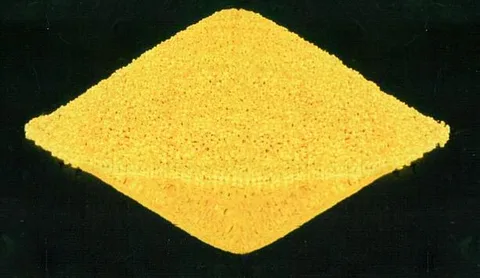 out of the ground, U3O8. Classically, it would be open-pit mining, and then you have a milling process to turn into U3O8 from the ore. Today, that’s done with in situ recovery,63In situ recovery (in situ leaching) — a mining method: an acidic or alkaline solution is pumped into the ore body through wells and then pumped back out with the dissolved uranium. More than half the world's uranium is mined this way, including almost all of Kazakhstan's. like enhanced techniques that involve pumping a fluid underground and collecting the uranium out of rocks. That will come out as U3O8. Step 1: Get the U3O8, that’s mining and milling. Step 2: Take the U3O8 and chemically convert it into a gas. That’s a separate chemical facility that does that work.
I see. That’s a chemical process to convert it into gas.
Then it would arrive at our facility as a gas64Uranium hexafluoride (UF6) — the gas that arrives at an enrichment plant. At ordinary conditions it's a solid, but at atmospheric pressure it sublimes at just 56.5 °C; every industrial enrichment method in use today works with it. that we can separate.
You just spin it in a centrifuge, and what else is in there? What are you separating it from?
There are a few techniques that one might use to go do this. Where we’re doing it in Kentucky, we are at the site of the last place that the US did enrichment,65The Paducah Gaseous Diffusion Plant operated from 1952 to 2013. Strictly speaking, enrichment does still happen in the US: since 2010 the European consortium Urenco has run a centrifuge plant in Eunice, New Mexico. Paducah was the last plant using American technology. which is western Kentucky, Paducah. There was a facility that was shut down in 2013 on a DOE site. That was a gaseous diffusion process.66Gaseous diffusion — uranium hexafluoride is pushed through thousands of porous barriers, and molecules with the lighter uranium-235 pass through slightly faster. Gas centrifuges separate isotopes in a spinning rotor and use about 50 times less electricity; all the major enrichers today use them: Russia, Urenco, Orano and China. South Africa enriched uranium with an aerodynamic process, and in the US laser enrichment is being developed by Global Laser Enrichment. That’s the first thing that was pioneered. The Europeans use gas centrifuge, other countries have done aerodynamic processes, and there’s even aqueous processes, as well as laser enrichment. So at least five techniques that are classically used, and our technique is one that we’ll unveil first half of next year when we’ll talk about it.
It’s gaseous diffusion, and so you...
That’s what was done in Paducah.
I see.
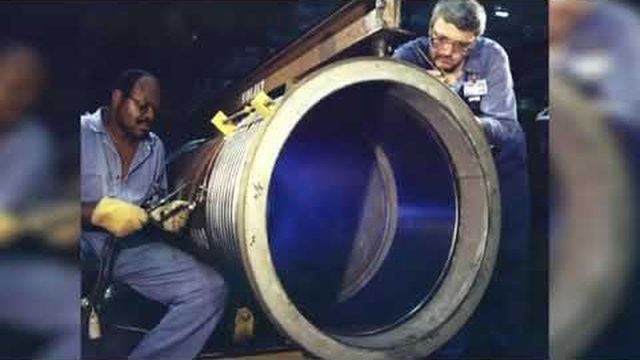
That’s not necessarily what we’re doing. We’re building a fresh facility in Paducah on the same site in the last community that did enrichment in the US.
If it’s simple, why do you need to be in Paducah, where the last version was? Do they leave a bunch of machines behind, and you get to say, “Wow, there’s all this free stuff here.” Or, is there expertise amongst local employees?
Yep.
Why Paducah?
Our search for Paducah lasted over a year. We went to over 10 states, looked at over 1,000 plots of land. The answer in the end was the obvious one. Go to where the community most recently did this. You have a combination of two things. We always felt like the community was the most important part. We’re building a facility that’s going to last decades. We want to make sure that the community that we’re building in actually welcomes us there.
Paducah was extremely familiar with enrichment, comfortable with it, understood it to be a positive thing for the community, and has the talent. So it was this combination of community support for what we’re building and the talent base there above anything else. Now, the DOE site had other benefits. By building on a DOE site, we were able to have some shared services. So out of the gates, a little bit less to stand up, already a piece of land there that’s 100 acres, just big enough for us to build a first facility, DOE security around it, lots of different benefits.
Presumably, it’s simpler from a permitting point of view because you’re working with the DOE rules, and not county and municipality rules?
Could be. We are primarily doing commercial sales out of this facility, so we will be NRC-regulated.
But federal, and not state and local.
The biggest benefit was that the site had been heavily characterized environmentally. And so the environmental work that was required to get to a point where we knew what the environmental impacts would be was quicker than it would have been on a completely uncharacterized separate piece of land.
That makes sense. Again, going back to the enrichment, what are you separating the uranium from when you’re enriching uranium?
From itself. You have two isotopes.
It’s the different isotopes. I see.
Uranium out of the ground is 0.711% U-235. That’s what you want. That’s the number when we talk about 3–5 or 19.75. It’s 1%—
It exists in the world as 0.7%, and then you’re enriching it to a number beyond that.
Exactly. The rest is primarily U-238, which is not the fissile material you want.
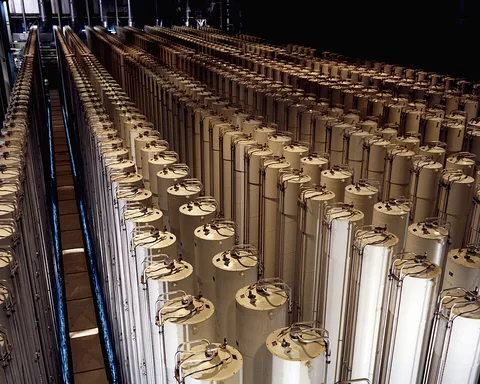
If the isotopes have different masses, why can’t you just spin it around in a centrifuge and have it separate?
Many people do.
I see.
Many people do. Or you can do an osmosis-type process, which is gaseous diffusion. Or you might split the gas using an aerodynamic process. There’s a lot of options.
It does sound quite simple when you put it that way.
When you put it that way.
Why is it hard?
The hard part about most of nuclear, I think, nuclear is perceived as this incredibly complicated thing. I think fusion67Fusion — controlled thermonuclear fusion: the joining of light nuclei, as inside the Sun. Net energy gain has so far been achieved only in individual experiments, and there are no fusion power plants. Today's nuclear plants run on the fission of heavy nuclei; the first reactor was started in Chicago in 1942. is pretty difficult. That is really new physics. That’s new science. Fission has been around for a long time. If we just talk about reactors, it goes back to economics, I think, more than anything. To me, for all the advanced reactors versus the gigawatt scale, the most interesting thing is not just the technology. It’s really, what is the cost implication going to be?
For us, enrichment has been done before. A number of countries do it. But the real challenge is we don’t only want to bring it back in the US, we want to make it globally competitive. We want the US capability to be truly commercial, be able to compete with Europe, Russia, China over time, and so it’s all about cost. I think the hard thing is not simply doing enrichment, it’s doing it in a way that can be scalable and highly cost-competitive, and so that’s the North Star.
10How the US gave up enrichment
The US lost enrichment through path dependence, and Nolan looks for a cost advantage in decades of technology that incumbents never captured.
You don’t worry that this is a bad market, somehow, the fact that there isn’t a US producer suggests there’s something a bit broken about the market and the buyers?
No, I don’t think so. I think there’s a path dependency68Path dependence — a concept from economics: an industry's current state is explained by a chain of past decisions and accidents, not only by what makes sense today. of how we got here. We can talk through that, but it’s—
No, please tell me the path dependency.
I think the history of it was really the US did a first-generation technology to win World War II, to stay dominant in the Cold War. We were over 90% of supply, globally. Ultimately, that approach, that specific design and technology was not cost-competitive with the European and Russian approaches. We shut those down. We shut them down following the Cold War.
The Berlin Wall fell. The US entered a trade agreement with Russia. It was nicknamed Megatons to Megawatts.69Megatons to Megawatts — the 1993 US-Russian HEU-LEU agreement: through 2013, 500 tonnes of highly enriched uranium from some 20,000 Russian warheads were down-blended to low-enriched uranium and sold to the US as fuel. During those years it supplied about 10% of all US electricity. We imported Russian warheads, blended them down, ran our reactors on it, and started to trade with Russia that way. We, since the ‘70s, have been trading with Europe. Once we felt like the Cold War is over, there was less reason to keep these plants running in the US.
It was a glut moment in the US, basically?
ExplainerHow the US lost uranium enrichment
The Manhattan Project built the K-25 gaseous diffusion plant at Oak Ridge, and after the war two more followed: Paducah (1952) and Portsmouth near Piketon, Ohio (1954). For a long time the US enriched uranium for almost every nuclear plant in the Western world.
- Competitors. In the 1970s came the European consortium Urenco with gas centrifuges and France's Eurodif, while the Soviet Techsnabexport began selling enrichment to Western utilities. Centrifuges use 40–50 kWh of electricity per separative work unit; gaseous diffusion uses 2,400–2,500, about 50 times more.
- Failed replacements. The Department of Energy abandoned its centrifuge plant at Piketon in 1985 in favour of the AVLIS laser technology. AVLIS was dropped in 1999 by USEC, a government corporation set up in 1992 to enrich uranium and privatised in 1998. Its own American Centrifuge project ended in bankruptcy in 2014, out of which came today's Centrus.
- Shutdown. Portsmouth stopped enriching in 2001 and Paducah in 2013. Since 2010 a Urenco plant has run in New Mexico, but its technology is European.
Why are we running these more expensive plants when we’re now in a world of free trade, and we can trade for this? At the same time, there were efforts inside the US to develop new technologies, but they didn’t really hit the cost structure required to compete internationally, and they’re still in development to some extent to try and get on that curve, and so I think it’s simply a… We used to do it, we then relied on free trade, and then only more recently does this seem like an issue. The issue is really around HALEU availability for advanced reactors and low-enriched uranium availability for the larger reactors given the ban on Russian imports.
If you tried to start a company like this 10 years ago, you might say, “What’s the market?” The utilities are fully contracted. There’s no gaps. Why would they leave gaps? They’re going to make sure that they have reliable source. Then there is not a really big advanced reactor market that you could sell into. And so, both on the LEU side and the HALEU side, it would have been much more challenging to get to some critical mass that could support a new entrant. Today, that window is open.
Classically, cost advantages in manufacturing come from scale, that’s one common one, or simplicity in design. It feels like the market is what the market is. It’ll grow, hopefully, but it’s not like you guys are going to come out of the gates targeting 10x or 100x larger scale than the incumbents. Then also, when you say simplicity, as you described, there’s a few approaches that everyone knows here, and so you don’t get to have a radically simpler process. And so, how do you plan to have a cost advantage versus all the incumbents?
I’d say you missed one more. There’s economies of scale, there’s simplicity, and then the third, honestly, is decades of technology improvement that no one’s captured. The last time anyone, to our knowledge, reinvented enrichment, at least if you look at the incumbents being Russia, China, and two European firms70Two European firms — Urenco and France's Orano. Both use centrifuges of the same design, made by their joint venture ETC (Enrichment Technology Company). that use the same underlying technology, the last time anyone’s done a clean-sheet redesign was decades ago. If you think of all the progress in technology over the last few decades, there’s a lot you can do in addition to economies of scale and simplification.
Meanwhile, there’s no public domain technology in this space since the ‘50s or ‘60s. And so, you look at those few decades of technology that you could leverage. Then you do a clean-sheet redesign doing something very novel, and you can end up somewhere pretty different.
11How the small beat the stagnant giants
Cost-plus incentives make industries stagnate, and in Nolan's experience a small, fast team can beat the giants.
I want to try something on. It feels like sometimes you have a trend that sweeps an industry that takes place at many companies at once. In the US, in the ‘70s and ‘80s, this happened with lean manufacturing,71Lean manufacturing — a management system that grew out of the Toyota Production System: minimal inventory, just-in-time delivery and the constant elimination of waste. where a lot of the success of private equity firms72Private equity firms — buy whole companies, often with debt (LBOs), improve their management and sell them a few years later. In the US, the buyout boom came in the 1980s. at that time or early Danaher73Danaher has since the late 1980s rolled out the Danaher Business System, a management system modeled on the Toyota Production System, at the companies it buys; its entire acquisition strategy is built on it. were... There were all these US firms that had not embraced lean manufacturing. And so, you can buy a manufacturing firm, just adopt the lean stuff about better inventory management and everything like that. You can make the business much better, because it turns out this is a managerial technology, that had not been adopted by a whole bunch of firms.
Maybe there’s people doing this today with AI, applying it to services industries.
Exactly, that would be another example. It feels like this may be another trend that you’re a part of in hardware. Which is, there is this stasis in companies, where there was stasis in launch until SpaceX came along and targeted much lower-cost launch. There was stasis amongst the primes, and then Anduril, and now a whole bunch of other neo-primes74Primes — the Pentagon's prime contractors: Lockheed Martin, RTX, Northrop Grumman, General Dynamics, Boeing. "Neo-primes" are new defense companies like Anduril that develop products with their own money and sell them finished. are coming along.
Similarly, you’re identifying stasis in the existing companies that enrich uranium that you can very easily… Does that resonate with you as a trend where there’s something that has not been adopted amongst a whole set of companies, and entrepreneurs are coming along and finding those weak spots and building better competitors?
It seems like it, although each of those three examples is at least a decade apart, I’d say, on average. SpaceX, Anduril, us, would be on average a decade in between. The only way that those opportunities were found were by people trying to actually go deep in the space. Nobody really thought that space launch was the thing until Elon tried to launch something75Tried to launch something — in 2001 Musk came up with Mars Oasis, a plan to send a small greenhouse to Mars. He went to Moscow twice to buy refurbished Dnepr rockets, converted ICBMs, but no deal was made, and in 2002 he founded SpaceX to build rockets himself. and realized it was the cost of the launch. Trae76Trae Stephens — a Founders Fund partner who in 2017 became one of the co-founders of Anduril. at Founders Fund was looking for a defense company, couldn’t find someone that was taking this holistic approach. Then, we only discovered this because I knew many or virtually all of the advanced reactor producers, and they had the same issue.
What is the thing that all of the incumbents miss? Why do they become slow and stodgy? Presumably, this is not a problem for you yet. But it will be a problem when you’re successful, that you’ll also need to avoid becoming slow and stodgy.
You definitely want to avoid that.
How do you avoid becoming ULA77ULA (United Launch Alliance) — a joint venture of Boeing and Lockheed Martin formed in 2006; before SpaceX it was nearly the only launch provider for the Pentagon. Lockheed Martin is the largest US defense contractor. or Lockheed Martin?
I think all those industries, not to single them out, but they were all cost-plus industries. That was my experience. Before SpaceX, I did work at one of the aerospace incumbents as an intern.
Which one?
Boeing. I worked on a military program. It was cost-plus. There was a big project, there was a goal of getting online. At some point while I was there, it felt like more and more people were working on the project, and it just didn’t feel like we were going faster. You realize that is one tool, put more people on the project. If there’s not strong downward pressure on cost, your incentives are just not aligned with moving fast and doing it in a lean way. I think these industries that end up getting stagnant often have that same characteristic.
Now, people assume once a company gets to a certain size that it becomes that way. I think it doesn’t have to at all. I think the best companies that get large, even tens of thousands of people, always have that new project, that new thing that’s borderline existential, where if they mess it up, they’re going to be in a much worse place than if they never tried it. It almost risks the business, and I think that’s almost the thing to stay young as a company, you just have to keep doing that next project, and not just say: “I have this nice business, I’m just going to earn my economic rents and do nothing else ever again.” You have to have a vision for the future of what you want this industry to be.
What were your other takeaways from Boeing?
Really, the main takeaway, I think, that I walked away with was that the cost-plus structure was not the right structure to motivate moving fast. That was just empirically evident by working at both.
It sounds like you more broadly think it’s a completely broken incentive system.
I think the whole point of cost-plus is to make sure people can work on projects whose costs are very uncertain. We have a very urgent project, the government needs you to do XYZ. We need some of the suppliers to come forward and actually say that they’ll try and do this, and it’s for everyone’s good.
It’s a wartime, and not a peacetime incentive system.
I think so, or it’s something where it’s very urgent, never been done before, and it’s very uncertain what the cost will be. Once you get to equilibrium, I don’t think that structure makes sense, at least not to motivate the right behaviors. I think the bigger thing I walked away with after Boeing, even in just being an intern at SpaceX when it was sub-50 people, was at the end of the first week or month, I felt pretty high certainty that SpaceX would eventually win, even though it was at most 1/1,000th the size. It was just because of the speed of execution.
The thing I walked away with that, especially in the early years with that as a more recent memory while I was at Founders Fund, was these small teams. Even though they seem completely outmatched, by moving quickly with a good group of people, you can still beat incumbents.
It gave you that ability to be optimistic about the odds of a five-person startup.
Bet on the small guy. If they have a vision, if they have some insights about how they want to do it differently, especially if they’re motivated by something more than just, “Let’s stand up a small business here.” No, let’s actually change things long-term.
12What SpaceX, Anduril and General Matter have in common
Companies tied to Founders Fund share a zero-to-one mindset, Nolan says, and a very high bar for founding anything at all.
The three examples I used were SpaceX, Anduril, and General Matter. I hadn’t realized until you said it, in formulating those examples, that all three are deeply tied to Founders Fund. What is it about Founders Fund and the culture that makes it a good breeding ground for these sorts of companies?
Maybe the one thing, SpaceX was started before Founders Fund.78Before Founders Fund — SpaceX was founded in 2002, Founders Fund in 2005. In August 2008, right after the third failed Falcon 1 launch, the fund invested $20 million in SpaceX and became its first institutional investor. I don’t think Founders Fund can take too much credit—
Founders Fund was an early high-conviction backer.
First outside investor at a time when very few others wanted to do it. I think the—
I’m going to go with deeply tied.
Yeah. I think, you know, SpaceX, they get the credit. Elon gets the credit. You could say that it’s something coming out of the whole zero-to-one mindset,79"Zero to One" (2014) — Peter Thiel's book. Thiel opens it with the question "What important truth do very few people agree with you on?" and asks it in job interviews. The advice to start with a small market and own it completely comes from the same book. and these frameworks of working on something that’s important that other people don’t realize. What important truth do you believe that most of your peers would disagree with you on? Don’t go after a trillion-dollar market on day 1, focus on a small market that really needs a new solution, and satisfy those customers. Make them love your product, own that market, and go from there. Those, I think, are common to those companies.
Probably even more than that is Founders Fund does not programmatically start companies, and it doesn’t want to either. Everyone there is selected for wanting to be an investor, not hoping that they can someday be an entrepreneur. I think this leads to a mindset of, “don’t start companies, don’t do it programmatically.” It’s almost like that airplane with all the war wounds80The plane with the bullet holes — a reference to survivorship bias. During World War II the statistician Abraham Wald, studying the damage on returning bombers, proposed reinforcing not the riddled areas but the places with no holes: planes hit there simply didn't make it back. on it, which you would think, “What about all the companies that didn’t get started out of Founders Fund?”
I think the bar when you’re starting something, at least for me, was always being an investor is a great job. It’s a great career. It’s awesome in so many ways. To actually go start something, it had better be extremely important. You have to believe no one else is doing it, which is why, in both Anduril and our case, there was a long search for someone doing it, because if there was, it wouldn’t be worth starting a new company.
Then finally, the one that’s seemingly the most difficult is, in my case, it should be something where my skill set actually contributes to making it more likely. And so, extremely important, no one doing it, and actually lines up with skills is such a small Venn diagram that it’s almost like that activation energy81Activation energy — a concept from chemistry: the minimum energy molecules need for a reaction to get going at all, even if it's favorable overall. is so high to go do it. It has to be extremely compelling. Then most of the risk, I think, ends up being on execution. You end up with these forgotten opportunities that were overlooked for a long time, but that are actually really central to an industry taking off. It just so happens no one did them for a long time because there wasn’t the convergence of market opportunity, and often it was just extremely hard.
How much conviction did you get on the idea before you took the jump and went and started the company?
I would say, extreme conviction.
13What it takes to start up a plant
To start up by the end of the decade, General Matter runs three workstreams (licensing, the building and the equipment), and Nolan sees manufacturing as the hardest.
What are the intermediate milestones for you guys as you approach production in Paducah by the end of the decade? Presumably, that is not the target on the whiteboard in the office. You have short-term targets.
Nothing in between. If you think of the big workstreams to do that... At the end of it, you have a large facility, and it’s filled with equipment, and the equipment is operating. If it’s operating, that means it’s licensed. One workstream is licensing. As I mentioned, late last month, we submitted our NRC license. That’s one of the workstreams. Another one is, you have this big building that’s operating. Let’s work backwards. You have your license, that’s how it’s able to operate, but also the building exists. That’s important, and so you have a large construction effort.
Typically, in the nuclear space, people outsource the construction of their facilities. In our case, we copied the Tesla playbook of build your own in-house construction EPC team.
What’s EPC?
Engineering, procurement, construct. Design your buildings, order the steel, build it. We have our own GC on the construction side. We have our own procurement and engineering teams internally. And, so that building is being designed and built. And... it’ll exist in time to install hardware, and commission it, and operate it by the end of the decade.
Then, of course, you need all of your equipment inside. That’s ordering out of your supply chain. It’s manufacturing, and manufacturing final designs that hit the economics that you want. I think a lot of people think of nuclear, and they think it’s all about core technology, or it’s all about licensing. For the reactors, it’s actually about... If you’re a big reactor, it’s probably about a construction project. If you’re a small one, it may be mostly about building your factory. For us, it’s more that, it’s more manufacturing. Manufacturing is the thing that relatively few companies in the US have really proven that they can do at scale. I think that’ll be the really exciting part in a year or two.
14Avoid competition
The main lesson Nolan took from Founders Fund is to avoid competition by working on an important problem nobody else is tackling.
Last question. We’ve talked about what you learned at SpaceX and Boeing and various places. What did you learn working at Founders Fund?
Avoid competition.82Avoid competition — Thiel himself puts it more bluntly: "Competition Is for Losers" was the title of his 2014 essay in the Wall Street Journal. Which happens automatically if you work on something that’s really important that no one else is doing, and that you can uniquely be good at. Avoid competition... You achieve it that way, but it’s also something that will inherently be true if you’re solving a problem that’s not solved. What important truth do you believe, or what important problem is no one working on?
I think that was actually the thing that led us here was, it wasn’t a desire to start a company, it wasn’t anything specific like that. It was: What thing is actually holding back the nuclear industry? What is the bottleneck? What is the one thing that could prevent all the reactors from scaling, all the SMRs, or gigawatt-scale light water reactors? It’s fuel. A lot of the other pieces have been solved, and so it’s just fuel.
For other future entrepreneurs, there’s presumably equally big opportunities just staring them in the face.
There certainly are. I don’t know what they are. I think it takes a lot of digging to see them.
Enriching.
Then enriching and turning into a gas. No, I think you only find out about these things if you follow some passion that you might have that not everyone’s thinking about. It’s usually not part of a trend, or at least it’s ahead of the trend. If you’re into something, and you think it has value, and you go deeper, and you work in that space, you’ll see what the problems are. I think they become obvious to those who go deep enough.
Scott, thank you.
Thank you.


