


The Every Podcast
Chapters
A dedicated frontier team, Dan Shipper argues, resolves the "do my job or keep up with AI" dilemma: it watches the frontier so everyone else can get their work done.
Read the chapter- Every employee has to choose between their own work and figuring out what new tools mean: ignore the frontier and an agent-native competitor blindsides you, chase it and you never build anything lasting.
- The frontier team keeps up with the frontier while everyone else ships products and services people can rely on.
- At worst an experiment becomes good content, tweets and YouTube videos; at best it gets pushed into Every's products and services.
- New things reach the rest of the company only once they are ready for it.
A frontier team needs both pirates and architects, Dan says, and its biggest payoff for Every is moving fast on new things without distracting the whole team.
Read the chapter- Pirates, people like Dan himself, move fast and sloppily and try a billion things in a couple of days.
- Architects take a big mess and turn it into a system that can be understood, maintained and built on.
- The architect matters most right before an experiment is handed to the rest of the team; otherwise it stays a one-off vibe-coded project.
- Every adopts new things fast without distracting everyone, which gives the team confidence it can handle whatever changes.
Mike Taylor puts numbers behind impressions of models, and Opus has finally cut him a whole explainer video with a source behind every sentence.
Read the chapter- Models can do far more than people have had time to try, Mike says, and the team's job is to find those edges.
- Mike made up his own title, head of evals: he puts numbers behind qualitative "vibe checks," helps colleagues build personal benchmarks and tests what AI "sycophancy" actually means.
- Opus is finally good at video editing, which for Mike, who runs a popular Udemy course, removes the worst part of the job.
- For the Checks explainer, Opus in ultracode sent hundreds of agents through his meetings, Slack and Granola notes, boiled the story down to 12 sentences with receipts, found the screenshots and did the voiceover through Gemini.
Mike's advice is to hand AI all your context and to treat protecting your colleagues' attention as part of the job.
Read the chapter- Mike recommends connecting AI to email, Slack, Drive and notes: models are remarkably good at picking out the right context, and their judgment can be trusted more than before.
- Whoever does more with AI floods colleagues with ideas; Mike is already accused of being in every channel, so he now sees making his work digestible, for example as videos, as his job.
- In Mike's view, many people's jobs will shift the same way.
A wrangler, Arielle Shipper explains, maps scattered experiments to themes and tracks whether the token spend pays off.
Read the chapter- Arielle collects experiments, maps them to digestible themes and turns them into content, products and concepts taught in consulting.
- The team burns through tokens "like wildfire," so Arielle thinks it matters to see at a meta level what experiments are running, what they cost and what they return.
- In the usage dashboard, a skill gathers data from every harness on the computer and shows spend by person, model and effort level, while a built-in workflow sorts sessions into work buckets and estimates their cost.
- Arielle calls herself less technical, an operator, but now builds systems herself that she once would have waited on model companies or an engineer to provide.
Senior editor Jack Cheng built himself a tabless browser and next wants to build things that protect his attention.
Read the chapter- With each new model Jack builds interactive experiences and video games to see what has become possible.
- He once would have written a Chrome extension; now he built his own browser, with an agent pane that can use any model and a quick "peek mode."
- Extensions, Jack says, never let you change the application itself; now you can build a whole app personalized to you or your team.
- Jack, who has ADHD, does far more with AI than before, but has never felt such strain on his focus, so next he wants to build things that protect his attention and serve his values.
Katie Parrott added a reader profile to her Compound Writing plugin, and now it shows where a draft loses part of its audience.
Read the chapter- Katie tests models before launch and writes vibe checks, and she is a crash test dummy for her colleagues' tools.
- Compound Writing takes a writer from idea to final draft, built around a voice guide and style.md, and now she is adding audience.md, a profile of the reader.
- The audience.md for her Working Overtime column builds in the hero's journey: every piece should transform its reader.
- The plugin found where her draft loses early "seekers" and what operators are missing.
- Katie will test-drive Every Type, Kieran's bid to get everyone off Google Docs, and is building her own word processor, Word Better, to show Kieran what makes more sense to her.
Jannik Jung takes vibe-coded projects to production and wants to work with AI at the level of goals and plans rather than individual coding sessions.
Read the chapter- Jannik took over Proof from Dan and brought it back to life; now he is building Cakebench, a skill that replicates the judgment and taste of the editor-in-chief.
- AI is great at bringing an idea to life for a demo, Jannik says, but reliable, maintainable software needs knowledge of code structure, libraries and deployment.
- In his Minga orchestrator, an agent breaks a project, such as Reply Guy for colleague Becky, into tasks, runs them in the background and pings the human only for decisions.
- Next Jannik wants a multiplayer mode where a pirate and an architect build the same project at once, with shared context.
Kieran Klaassen runs experiments every week and sees each model handle more ambitious work, but for him a frontier team is worth only what sticks in the company.
Read the chapter- The frontier team, Kieran says, existed without a name since he started building Cora; he runs at least one experiment a week and shares what he learns with the team and Every subscribers.
- In Kieran's telling, GPT-4 started writing code, Sonnet 3.5 handled multiple files and UI, agents arrived with 3.7 and Opus 4, Opus 4.5 took on hard things like an editor with CRDT, and Fable 5.1 runs longer and can be trusted more.
- Kieran is a musician and tries to build an audio workstation with every new model, and now he finally can.
- His video editor records meetings, where ideas get lost, and hands them over in a format editors know, while staying agent-native.
- Kieran's advice is that a frontier team has to inspire and listen to the company: a hundred experiments dumped in a channel are worth nothing if none of them stick.
Quotes
On the two ways companies fail at AI
“Or you can keep up with the frontier and just chase shiny objects and never build anything that lasts.”
Dan ShipperRead from 00:17On pirates
“Pirates are people like me who are just like, I just want to, like, go really fast, and I'm going to do stuff that's kind of a little bit sloppy, but I'm going to try, like, a billion things in the space of a couple days.”
Dan ShipperRead from 02:53On the flip side of AI productivity
“Now that you're producing a lot more, hopefully, if you're using AI more, it's your job now to protect other people's context.”
Mike TaylorRead from 11:34On what AI gave a non-engineer
“It's not a power that I've had before, and it feels magical, and it feels really exciting.”
Arielle ShipperRead from 16:46On AI and ADHD
“I do feel like I am, like, doing so much more now, but at the same time, I've never felt such strain on my ability to focus.”
Jack ChengRead from 22:44On a rite of passage
“Everyone at a certain point decides to vibe code their own word processor.”
Katie ParrottRead from 29:51On the frontier team's biggest mistake
“It's very easy to overwhelm the entire organization by just dumping 100 experiments in a channel.”
Kieran KlaassenRead from 41:27
Summary
Every time a new model drops, every employee faces the same choice: get your work done, or figure out what just changed. Dan Shipper's answer at Every is a "frontier team," a small group that plays with new models, runs experiments and passes the useful findings into products, consulting and writing without distracting the rest of the company. It mixes "pirates," who try a billion things in a couple of days, with "architects," who turn the mess into a system that can be maintained. Co-host Natalia Quintero interviews all seven members in turn.
Head of evals Mike Taylor helps colleagues build personal benchmarks and shows an explainer video that Opus, running in ultracode, cut together from his Slack messages and meeting notes, with a source behind every claim. His cheat sheet: give AI access to all your context, and package your own output so it is easy to digest, because protecting colleagues' attention is now part of the job. Arielle Shipper, the team's "wrangler," turns experiments into themes and built a dashboard that tracks who spends how much on tokens and on what. Senior editor Jack Cheng, who has ADHD, built himself a tabless browser to protect his attention.
Writer Katie Parrott is adding a reader profile, audience.md, built around the hero's journey, to her Compound Writing plugin. Engineer Jannik Jung makes vibe-coded projects like the Proof editor production-ready and is building Minga, an agent orchestrator that works at the level of goals and plans. Kieran Klaassen, the creator of compound engineering, traces how models grew from GPT-4 to Fable 5.1, which finally lets him build his own audio workstation, and sums up the lesson: a frontier team is measured not by how many experiments it runs but by how many of them stick in the company.
Advice
Set up a small frontier team that plays with new models and runs experiments while everyone else ships the product: you won't be blindsided by an agent-native competitor, and the whole company won't chase every new release.
Mix "pirates," who try lots of ideas fast, with "architects," who turn a promising experiment into a maintainable system before it is handed to everyone else.
Connect AI to all your context, from email and Slack to documents and meeting notes: models are good at picking out what matters, and without context you miss most of their value.
The more you produce with AI, the more carefully you should package it for colleagues, in short videos and clear summaries: your team's attention is now the scarce resource.
Track token spend by person and by kind of work: it's the only way to see whether experiments pay off.
Judge a frontier team not by the number of experiments but by what sticks: listen to the team and carry findings through to adoption instead of dumping everything in a shared channel.
Mentioned
 Every00:53Shipper's company, where the frontier team has been running for a couple of months
 Claude Opus06:46according to Mike Taylor, surprisingly good at video editing
 Udemy06:46where Mike has a popular course whose videos he hates editing
- Checks07:20Every's personal benchmark product, the subject of the explainer video Opus made
Show 24 more mentionsShow fewer mentions
 Slack07:20Opus combed Mike's messages there for evidence behind each claim in the video
 Granola07:20Mike's meeting notes, from which Opus built the video's story
 Claude Code07:58its ultracode mode ran hundreds of agents for Mike's video
 Google Gemini09:31Opus voiced Mike's video through the Gemini API
 Google Drive10:44Mike says not to be shy about giving AI access to it
 Gmail10:44Mike hooked AI up to his email and recommends doing the same
- Claude11:34now picks up ideas from what Mike says in meetings on its own
 Google Chrome19:56Jack Cheng once would have written an extension for it; now he built his own browser
 ChatGPT20:41what Jack usually edits with in the browser
- Compound Writing25:28Katie Parrott's plugin that takes a writer from idea to final draft
 GitHub27:09where, Natalia says, Compound Writing can be downloaded
- Working Overtime27:27Katie's column, whose readers she describes in audience.md
- The Hero with a Thousand Faces28:06source of the "hero's journey" Katie built into her audience profile
 Google Docs29:51Kieran wants Every to stop using it
 Proof30:58Shipper's collaborative editor, which Jannik Jung made production-ready
- Minga32:42Jannik's agent orchestrator, where work happens at the level of goals and plans
 Twitter33:04where the Reply Guy tool finds trends to answer with vibe checks
- Cora35:51the email assistant Kieran Klaassen started with at Every
- Compound Engineering35:51the approach to building with agents that grew out of Kieran's work on Cora
 GPT-5.437:24one of the older models Natalia asks Kieran to compare with today's
- GPT-438:15in Kieran's account, the first model that wrote decent code
- Claude Opus 4.539:01with it, Kieran says, AI took on genuinely complex work
- GPT-5.539:01Kieran links it to the "Proof era"
- Claude Fable39:01Fable 5.1 finally lets Kieran build his audio workstation
Sponsors of the episode
- Gemini Audio17:45Google DeepMind's voice models: clean speech transcription and voice conversation with reasoning
- Every42:23Every subscription: reviews of new models and AI tools, two weeks free
Transcript
01Why a company needs a frontier team
A dedicated frontier team, Dan Shipper argues, resolves the "do my job or keep up with AI" dilemma: it watches the frontier so everyone else can get their work done.
You need a frontier team.1Frontier team — Every's name for a small group that tests new AI models and turns the useful experiments into tools and workflows for the rest of the company. "Frontier" is common AI vocabulary: frontier models are the most capable models from the leading labs. Here's why. Every single person in your company is caught in this dilemma. Do I get my work done, or do I stay up to date with AI and figure out what all these new tools and workflows mean for what work I should do? That's just crazy. It's so hard to figure out.
Every single company is struggling with this right now. Because, I mean, on the one hand, you could ignore the frontier, and that'll probably work for a little while until you get disrupted by some agent-native2Agent-native — a product designed from the start so that AI agents can use it: anything a person can do, an agent can do just as easily. Shipper and Every push this approach in their own products, such as the Cora email assistant and the Proof editor. version of your product that you didn't see coming. Or you can keep up with the frontier and just chase shiny objects and never build anything that lasts. The reason why you need a frontier team is it separates things out. So you get this nice separation of concerns3Separation of concerns — a programming principle: each part of a system handles its own job and stays out of the others'. Edsger Dijkstra coined the phrase in a 1974 essay. where you're both keeping up with what's going on on the frontier and you're actually getting your work done. And I had my co-host Natalia…
Welcome, Natalia.
Hey, Dan, good to be here.
…who is our head of enterprise AI adoption,4Natalia Quintero runs consulting at Every, helping other companies adopt AI; according to Every, in a year she talked to more than 100 organizations, from hedge funds to Fortune 500 companies. come in and do a little bit of digging into our frontier team. So we've been running the frontier team at Every5Every — Dan Shipper's media company, founded in 2020: a newsletter and site about business and AI, its own AI products and a consulting practice. for, I guess, a couple of months now, and it has been kind of transformative. And I think Natalia is one of the best people to come in and take a peek and be like, what are we actually doing?
So actually, I might turn the tables a little bit to you, because it was your idea to have a frontier team.
Yeah, I mean, the frontier team, I think, has been a huge unlock, and it's because of this separation that I've been talking about. I think there's so many people at Every, like me, who just love playing with new things, and that's super important. But if that's all you're doing, then you're not going to make progress as a business. Like, you actually do need to go execute on products and services, things that people can rely on. And it felt like we needed to choose one or the other: either just, like, constantly be playing with new stuff, or make a product that we just build once and then we add features to and we support forever. And the frontier team was sort of an attempt to say, okay, what if we take all the people like me who love all the new stuff and we just unleash us to just run experiments?
And at the low end, the experiments are just really good content. They just teach us something interesting, and they become good tweets or YouTube videos or anything like that. And then on the high end, they get pushed up from the frontier into the products that we build, into the services that we offer, without the rest of the company feeling like they always have to be paying attention to every single model that drops and every single new experiment that we're running. So I feel like it's allowed me and the other people on the frontier team the space to just figure out what the future looks like without forcing that on the rest of the company until it's actually ready for them to pay attention to it.
02Pirates and architects
A frontier team needs both pirates and architects, Dan says, and its biggest payoff for Every is moving fast on new things without distracting the whole team.
Now, one of the things that you seem to have figured out pretty early in the formation of the frontier team is that you wanted to have both pirates and architects. Can you describe what that is?
I think there's two archetypes that work really well together: pirates6Pirates — an image with a long history in tech culture. In 1983 Steve Jobs told the team building the first Macintosh, "It's better to be a pirate than to join the Navy," and the team raised a pirate flag over its building, with a rainbow Apple logo as the skull's eye patch. and architects. Pirates are people like me who are just like, I just want to, like, go really fast, and I'm going to do stuff that's kind of a little bit sloppy, but I'm going to try, like, a billion things in the space of a couple days. And I'm going to figure out what's useful, but it's going to be a mess. Architects are people who are really good at being like, there's a whole big messy thing. What would it look like to compress it a little bit and form it into a shape that actually works, that we can actually use? Because what we try to do on the frontier team is we're experimenting with lots of stuff.
Most of that stuff gets thrown out, and some of it ends up getting pushed into the rest of the team to see if the rest of the team likes it. And at that point, like, there's a point right before we do that that an architect becomes really useful to come in and say, like, this is messy. We can't actually maintain this, and it wouldn't work in these five different ways for the people internally at the company, and helps turn it into a system that we can actually understand and build on, instead of just being, like, a kind of one-off vibe-coded7Vibe coding — programming where a person describes in words what they want and an AI writes the code, which the person barely reads. Andrej Karpathy coined the term in February 2025. project.
Dan, what do you think has been the most impactful thing you've seen about having a frontier team at Every?
I think it lets us move incredibly quickly on what's new without distracting the whole team. And that has a deeply… it's, like, confidence-building for the team, because you feel like, hey, I'm going to know when things change, we'll be able to handle it. And I'm not feeling crazy and frazzled and distracted all the time. And I think that is, like, the core important thing that affects the day-to-day experience of building and working in and running a company in this environment.
Absolutely. Thanks, Dan.
Thank you.
03Personal benchmarks and a video edited by Opus
Mike Taylor puts numbers behind impressions of models, and Opus has finally cut him a whole explainer video with a source behind every sentence.
So, Mike Taylor, welcome. We're so excited to learn about the work that you're doing on the frontier team as the head of evals.8Evals (short for evaluations) — test suites that measure how well an AI model, or a product built on one, handles the tasks you care about. So can you tell us a little bit of what you're doing as part of the frontier team?
Yeah, so it feels like it's different every week, or maybe every day, sometimes every hour. But the goal of the frontier team is really just to kind of push the models to the limits and see what is now possible, and, like, what is a new way to work, given that the models are constantly getting better and there's still a lot of capability overhang.9Capability overhang — the gap between what models can already do and how people actually use them: the abilities exist, but nobody has yet figured out what to apply them to. What I mean by that is the models are able to do much more than we have had time to try. And so we're trying to, like, find those edges.
And specifically, what is your title as part of the frontier team?
Yeah, so I made up my own job title, which is very me, but it's head of evals. So what that means: evals is short for evaluations, and so it's my job to kind of take the kind of vibe checks10Vibe Check — Every's series of quick, hands-on first impressions of new models and tools, usually published on launch day. that we've been doing with models that are more, like, qualitative, and then try and put some numbers behind them.
So I've been working with a lot of the team to help them build their own personal benchmarks,11Benchmark — a standard set of tasks used to compare models. A personal benchmark, as Mike explains later, is a set of tasks from your own real work that every new model can be tested on. including with you, and we're trying to roll that out as more of an internal product initially, to get more people involved with testing the models, and I can talk a bit more about that. But also just running more experiments, like, when we say that AI is sycophantic,12Sycophancy — language models' tendency to flatter users and agree with them even when they are wrong. In April 2025 OpenAI had to roll back a GPT-4o update that made ChatGPT excessively agreeable. what do we mean by that? How do we define that? And can we test that? Those sorts of things. And then also just, like, pushing it a little bit further.
And so what are you most excited about now?
Yeah, one of the things I've been finding more is that Opus13Opus — Anthropic's line of top-tier Claude models; in the fall of 2026 the newest was Claude Opus 5.5, released on September 22. is, like, very good at video editing. And this is, you know, maybe obvious to some people who have been testing it, but I've been testing AI on video editing for a while. I have a popular Udemy14Udemy — an online marketplace of paid video courses that instructors record and sell themselves, founded in 2010. course, and it's, like, the worst part of that side project is having to edit the videos afterwards. So for me, I've been testing a bunch, and it's, like, finally working, and that's opening up a lot that I can do that I couldn't previously have done.
So one of the things I did recently was I made an explainer video for the Checks product,15Checks — Every's product for personal benchmarks: a user saves a small set of tasks from their real work, and AI models can be run on it again and again. The score, as the video puts it, is a count of "yes" answers to check questions. for the personal benchmark product that we're making. So I asked Opus to go back through all my Slack16Slack — a workplace messaging app built around team channels. messages, go back through all of my Granola17Granola — an AI notepad for meetings: it records the call and fills out the user's notes from it. notes, and then pull the narrative of the video together with receipts, right? Like, with references to the specific things that I'd said in Slack or in meetings. And then it, like, cut that whole video together, and then I had an explainer video. So I feel like that's opening up a lot for people who are like me, who, you know, are maybe too busy running experiments to ever, like, tell anyone what we're doing.
So cool. Can you show us an example?
So this is the one I was talking about. So this prompt goes back a really, really long way. But I went back and forth with Opus on this. And initially it was in ultracode,18Ultracode — a Claude Code setting in which Claude builds its own dynamic workflows for serious tasks, launching subagents, checks and loops. It is turned on with the /effort ultracode command. Docs. which, if you don't know, is, like, one of the settings that is, like, the highest effort setting. And so it will use hundreds of agents, basically, that it's orchestrating to do the task. And the reason I chose ultracode for this is I knew that I had a lot of context that I wanted it to read.
And, like, one model can't read all of that context. So what it does is it sent hundreds of agents,19Agents — here, subagents: separate copies of the model to which the main agent hands parts of a task. Each has its own context window, so together they can read far more than one model and return only a summary to the main agent. you know, one agent per meeting that I had, and then pulled everything back into this, like, library, essentially. These are all the sources, right? So you can see all the different calls I had with different people, and it found all the ones that are relevant. So now we have this big library of sources.
But it didn't just do that, right? Like, it also then created this story spine,20Story spine — a plot template invented in 1991 by playwright and improviser Kenn Adams: "Once upon a time… Every day… But one day… Because of that… Because of that… Until finally… And ever since then…" It became widely known through Pixar. which is… like, it tried to boil it down to what is the narrative. Like, if someone doesn't know the Checks product, what is Checks? And it boiled it down to, like, these 12 sentences. So, like, "A personal benchmark is a small set of your own real work, saved so that AI models can run on it again." So that's the definition I just gave you earlier. But now we have, like, the receipts, right? Like, I can click in and see, like, where did that sentence come from, back to the insight card, and then from the insight card back to the specific things I said in meetings.
So it's all auditable. And then, you know, it puts everything together, and then we have this explainer video, right? Yeah. So the interesting thing is… so, like, see all these screenshots? Like, it went and found those screenshots from my Slack. Like, these are things that I shared, you know. And then, like, it put everything together, it annotated the screens, it did the voiceover. It used Google Gemini:21Gemini — Google DeepMind's family of AI models and its assistant, the main rival to ChatGPT and Claude. I gave it a Gemini API key.22API key — a secret string that lets a service identify a program and bill it for calls to a model. By handing the agent a key, Mike let it call Gemini on its own, for example to record the voiceover. And so these are the 12 sentences, but, like, shown in video form. And that is again pretty amazing. And then I can share that with the rest of the company, and then now they understand, like, oh yeah, "a score is a count of yeses," right? So, like, now they understand the Checks product.
04Mike's cheat sheet: give AI all your context, protect your colleagues'
Mike's advice is to hand AI all your context and to treat protecting your colleagues' attention as part of the job.
So maybe last question for you would be, you know, as head of evals, you're evaluating a bunch of models, you're seeing what actually works, what the new capabilities are. What is, like, the cheat sheet that you could give someone? I know it's, like, late October 2026, so this might be outdated in a matter of days, but can you give us a cheat sheet for what we should know about using models today?
Oh yeah, so what is my cheat sheet? So I think one thing that people are not doing enough of is just giving all their context23Context — everything a model sees while doing a task: instructions, documents, messages, notes. The more complete and accurate the context, the better the result, which is why connecting AI to email and work chats changes how useful it is. over to AI. I think previously, if you've tried this in the past and you've asked AI to look through your call notes, or, you know, maybe been hesitant to give it access to your Google Drive or whatever… And I was that person, like, earlier in the year: I didn't have it hooked up to my Gmail or my Slack. And living within the Every community, like, being in the team, now I'm, like, full on: AI has access to everything. And I would say, like, just make that leap, because it's amazing how good it is at picking out good context once you give it access. So I'd say, like, that's gotten so much better, and people need to do more of that, and you can trust it more to use its judgment in what it brings into that task.
The second thing is that I feel like it's your job. Like, now that you're producing a lot more, hopefully, if you're using AI more, it's your job now to protect other people's context. So I'm, like, regularly accused of saturating the company LinkedIn, where, like, every channel I'm posting in, it's, like, Mike, Mike, Mike. And I'm really conscious of that. So creating that video, you know, creating more videos like that, making the work that I'm doing more digestible, I think is now actually my job. I'm coming up with good ideas, I'm giving it to Claude.24Claude — Anthropic's family of AI models and its assistant. Claude's finding those ideas more automatically for me when I've said them. But now I'm, like, flooding people with new ideas. So that's the other part that I'm working on. And I think that that's where a lot of people's jobs are going to go.
Super cool. Thanks so much for joining us, Mike Taylor.
Yeah, good to talk to you.
05Arielle Shipper: why a frontier team needs a wrangler
A wrangler, Arielle Shipper explains, maps scattered experiments to themes and tracks whether the token spend pays off.
So welcome, Arielle, so excited to have you. And can you tell us what your role is as part of the frontier team at Every?
Yes, I'm officially the frontier wrangler, which means that I help make sure that our experimentation is in some ways organized enough for us to then harvest and synthesize learnings and digest it for the outside world, and direct our exploration internally. So I work on the systems and processes that allow us to do that internally, and I partner closely with Dan on that. And then I'm also running my own experimentation. So unlike other folks on the team, I'm less technical, but I'm an operator.25Operator — in startup jargon, someone who runs a company's operations, its processes, people and finances, as opposed to the engineers who write code and the investors. And so there's a lot of interesting opportunity for practical systems that we can experiment with, using some of these new tools and techniques on the inside, that I'm playing around with pretty consistently.
Why does the frontier team need a wrangler?
I think one of the cool things about working with folks in the org is that everybody is a meta thinker. People are so creative, and they're so excited to just sort of chase the next thing. And that's great. We need people like that. And then we also need an organizational layer to say, like, what are we learning from this? And how can we actually digest everything that's coming out of these experiments for our audience?
And so I think it's pretty important to have a layer that basically looks at everything that people are doing, maps it to digestible themes, and tries to find some of the meaning in all of this experimentation, and then creates a layer that allows us to turn it into content and products and even concepts that we're teaching in consulting.26Every's consulting practice helps other companies adopt AI; Natalia Quintero runs it. So it's a way of, like, harvesting all of this and then translating it into other areas of the business.
So what are you working on now?
With all of these models coming out constantly, the frontier of AI capability keeps pushing forward, and that's really exciting. That also means that there's so much to play with and experiment with that we are constantly burning through tokens27Tokens — the word fragments a model splits text into, and the unit it is billed by. Long agent tasks that read and write millions of tokens cost real money. like wildfire. And that's an important investment in our business and experimentation, but also understanding at a meta level, like, what experimentation are we doing, how much money are we spending on that, and what are we getting out of it in return is pretty important.
Can you show us an example of, kind of, like, a recent insight or maybe process that you've tried to apply lately in your job as the wrangler?
Yeah, definitely. So this is what the usage dashboard looks like. Some of this is going to be a retrospective, because we don't have a full month of spend for October yet. But what this basically allows us to do is understand, like, what is the total dollar value that we've spent, what are the tokens, like, what's the token count that we've spent it on. And then there's actually a breakdown by person. So we created a skill28Skill — the Agent Skills format Anthropic introduced in October 2025: a folder with a SKILL.md instruction file and, if needed, scripts, which an agent loads when a task calls for it. that looks, you know, across all the different harnesses29Harness — the program around a model that turns it into an agent: it provides tools, file access and memory and runs the work loop. Claude Code and Codex are examples. that you're using on your computer to harvest…
These are the tokens that you used across each of these harnesses. You can also click in and see… we're collecting data in real time, so it gives you the actual, like, model and effort level.30Effort level — a setting for how much a model reasons before answering: at low effort it is faster and cheaper, at high effort it spends more tokens but handles hard problems better. And this dashboard also includes a workflow that basically looks across all of your sessions and categorizes at a high level what you spent those tokens on, and then runs it by you for approval, so that you can see, you know, both the percentage share of the sort of token spend that's gone to each different work bucket, and then what the estimated dollar value of those tokens is. So you can make a sort of quick calculation of, like, oh, was that worth it or not?
All right. And Arielle, maybe last question for you: what are you most excited about next as the frontier team wrangler?
I think what I'm most excited about is, as these models get smarter and smarter, my ability to actually build the capacity for that grows. It's not a power that I've had before, and it feels magical, and it feels really exciting. And being able to take some of the ideas that I have and will them into existence is actually a totally new thing. So in my previous life as an operator, I would have had to wait for different model companies to add this kind of tracking capability that I'm looking for, or I would have had to partner with an engineer to do any of this. And now I actually have the ability to create some of it myself. So what I'm looking forward to is, as these models get better and better, my capacity to actually build systems to do this work for us gets better and better. And I'm really excited about diving into that. I'm excited to see where it goes.
Thank you for joining us, Arielle.
Cool. Thanks so much.
AdGemini Audio
One of the great things about working with AI is you can just talk to it now. If you're interested in groundbreaking voice experiences, you need to check out Gemini Audio.aGemini Audio — Google DeepMind's line of voice models. Google introduced Gemini 3.5 Transcribe, a speech-to-text model, in August 2026, and Gemini 3.8 Live and 3.8 Live Extended Thinking, for voice conversation, in September; the latter can reason in the background while the conversation continues. Gemini Audio is the new voice models from Google DeepMind.bGoogle DeepMind — Google's AI lab, formed in 2023 by merging DeepMind and Google Brain; it builds the Gemini models. Gemini 3.5 Transcribe turns speech into clean, formatted text. If you say, "Let's meet Tuesday, no, Wednesday," it'll detect the correction and handle it automatically, and remove filler words. There's less cleanup between a rough thought and something you can actually use.
And now with Gemini 3.8 Live Extended Thinking, you can talk through more complex work. It can reason and speak simultaneously, which keeps conversations going while it's working in the background on your behalf. You can even ask follow-up questions and give feedback as you go on. Together, it makes voice a useful way to develop an idea, with room to change your mind along the way. You should check out the link in the description and learn more about Gemini 3.5 Transcribe and Gemini 3.8 Live Extended Thinking. And now back to the episode.
06Jack Cheng: a tabless browser and the fight for attention
Senior editor Jack Cheng built himself a tabless browser and next wants to build things that protect his attention.
Yeah, so I'm Jack Cheng.31Jack Cheng — a senior editor at Every and a novelist, author of the middle-grade novels See You in the Cosmos and The Many Masks of Andy Zhou. I'm a senior editor at Every, and, yeah, part of the frontier team. I think my role on the frontier team… I think we're all figuring out what our roles are on the frontier team. And, you know, I've definitely been testing more of the early-access models32Early access — AI labs give select testers, Every among them, new models ahead of release to get feedback; that's why Every's vibe checks come out on launch day. that we've been getting, and something I've really started doing more of there is basically just, like, creating these, like, interactive experiences and games and things like that, to just really, like, try to push at, like, what is even capable now with each new model release. Like, what can it do that it maybe, like, wasn't good enough… like, it wasn't good enough that I would even think to try with a model before.
And so lately that's kind of meant I'm just, like, creating video games and things like that. And then the other piece of it is just actually, like, making my own applications. So, you know, I was finding that I was really getting overwhelmed by my browser's tabs and being constantly forced to, like, context-switch. And I was like, well, wouldn't it be nice if I had a browser that didn't have tabs, and that you could, like, turn off the tabs? And I think before I would have maybe, like, built a Chrome33Chrome — Google's web browser, the most popular in the world. Extensions are small programs that add features to it but can't remake the browser itself. extension or something like that. But now, like, the models are so good that I was like, no, I can just build my own.
So here is my browser, basically. Yeah, like I mentioned, it's a tabless browser, and that was the original intent: to, you know, have this browser where I'm not sort of, like, tempted to, you know, switch tabs and open things in the background and, like, never, you know, get to them. But once I had this going, I was like, well, you know, in order for me to use this day to day… I have, like, you know, my whole editing workflow that I normally, like, use ChatGPT34ChatGPT — OpenAI's chatbot, released on November 30, 2022; it kicked off the current AI boom. in the browser for. So basically I added this agent pane that could let me, like, pick any, you know, any model provider and use any model for editing, which, you know, I couldn't really even do with Claude and the Gemini models, because their plugins for Chrome35Plugins for Chrome — Anthropic released its Claude for Chrome extension as a research preview in August 2025, and in September 2025 Google built Gemini directly into Chrome. weren't as good.
But there are things like, you know, just in sort of daily use, I'm like, oh, there are times when I actually do need to, like, peek at something. And so the latest thing I added was sort of this kind of, like, peek mode, where I could, like, very quickly, temporarily open up a page and then, like, you know, look up something and then go back to my document. And I think, like, what I'm starting to learn with this is just the way that, like, you know, I think we had this concept of, like, plugins and extensions for a while, but, like, those things never really let you get close to the actual, like, application and changing how the application worked. And now with sort of the latest generation of, like, frontier models, it's really, like, possible to build this, like, you know, fully, like, personalized to you, or personalized to your team and their workflows, application that you couldn't do before.
All right, I think maybe a good closing question might be: what are you most excited about building next?
I think I'm most excited about building more things that help, basically, like, protect my attention. And I think, you know, like, with all this… like, first of all, I have ADHD, have a diagnosis of ADHD, and that's always just been a huge challenge throughout my life. And I've kind of had to come up with, like, these, like, adaptive strategies throughout the years in order to manage it. And I think, like, now, you know, it's even more kind of, like, tempting to kind of just, like, try to do a million things. And, yeah, and I do feel like I am, like, doing so much more now, but at the same time, I've never felt such strain on my ability to focus and ability to, like, keep my attention on something for long enough that, you know, it's sort of, yeah, for long enough that I think it makes a meaningful difference in my life.
And, you know, experimenting and experimentation is definitely, like, important to me, but I think there's also this other side of me that's like, yeah, you know, I want to build things that, like, help me write more, help me, like, create more beautiful things in the world. I want to build things that, you know, connect me closer to, like, my local community. And so really, like, thinking about it not as just, like, building something for creativity's sake, but, like, doing it in a way that, like, also helps, you know, reinforce and serve and deepen my values.
07Katie Parrott teaches her plugin who the reader is
Katie Parrott added a reader profile to her Compound Writing plugin, and now it shows where a draft loses part of its audience.
Wonderful. Thank you so much for joining us, Jack. Welcome, Katie. So excited to be back on the pod with you and to be talking about your role as part of the frontier team. What do you do in the frontier team?
Yeah, so there are a couple different things that I do on the frontier team. Number one is I'm on the testing team for the new frontier models that come out from OpenAI, Anthropic, Gemini, Grok.36Grok — the AI models and chatbot of Elon Musk's company xAI. We get early access to these models. We're putting them through our workflows and just seeing, okay, what is it like to use this model, so we can turn around and pass that information along to the people who read our vibe checks. So that's kind of one of my lanes. The other lane is writing the vibe checks themselves, and in other ways kind of, like, sharing out what we're learning on the frontier team.
So I'm kind of, like, the resident writer embedded inside the frontier team to write about what the frontier team is learning. And then I'm building stuff myself, and that's where stuff like my plugin Compound Writing37Compound Writing — Every's plugin for writing with AI, which Katie Parrott modeled on Kieran Klaassen's Compound Engineering: it walks a writer through the stages from idea and outline to draft and revision. comes in. That's where using new models that are fine-tuned38Fine-tuning — additional training of an existing model on specialized data so it gets better at a particular task, such as writing. for writing comes in. And that also includes crash-test-driving, being a crash test dummy for some of the things that other people on the frontier team are building, like Kieran39Kieran Klaassen — runs Every's email assistant Cora; he created the compound engineering approach and the plugin of the same name. and Mike as well.
And can you give us an example of something that you're working on now?
Yeah, so right now I'm continuing to build out Compound Writing. And so for folks who don't know, that is my plugin that sort of takes you through the writing process, from ideation through planning and outlining, through drafting, to finalization. And the whole thing, up to this point, has been built around two core documents: the voice guide, that captures how your voice sounds on, like, a sentence level and, like, the word choice that you use, and then style.md,40.md — the extension of Markdown files, a simple text formatting language created by John Gruber in 2004. AI agents read their instructions and knowledge from files like these. which covers what you write about, how you like to talk about your subject matter. And right now what I'm doing is I'm adding a third document, which actually in hindsight feels very obvious to the writing process, and that is audience.md: so who is the reader that is ultimately going to be receiving this content?
And so I'm adding that to my plugin and saying, okay, how does this change the experience of using this plugin? Does it make it more useful? So I can share my screen.
And so for anyone who's not familiar with Katie Parrott's Compound Writing plugin, you can find it on our GitHub,41GitHub — the largest service for hosting code and collaborating on software, owned by Microsoft since 2018. The Compound Writing plugin is in an open Every repository. and you can just point your AI of choice to the page, and you can download it, and it'll take you to this, yes? And so what are we seeing here?
So this is me setting up my audience.md for my column, Working Overtime,42Working Overtime — Katie Parrott's column at Every about how she uses AI in her own work. which is where I write about my misadventures and regular adventures, you know, applying AI in my own working life. So I wanted to set up an audience.md folder for that work that's specific to this column, and it gives me this readout of who the Working Overtime audience is. So the territory it covers, you know, the main reader being a combination of, like, the early seeker, who's kind of AI-curious, and then that operator, who's looking for, like, practical applications to their day-to-day work.
Something I kind of baked into how the audience.md is structured is the idea of a hero's journey,43Hero's journey — the story pattern mythologist Joseph Campbell described in The Hero with a Thousand Faces (1949): the hero leaves the familiar world, goes through trials and returns transformed. The diagram shows the hero crossing the threshold from the known to the unknown, descending into the abyss of death and rebirth, and returning with a gift.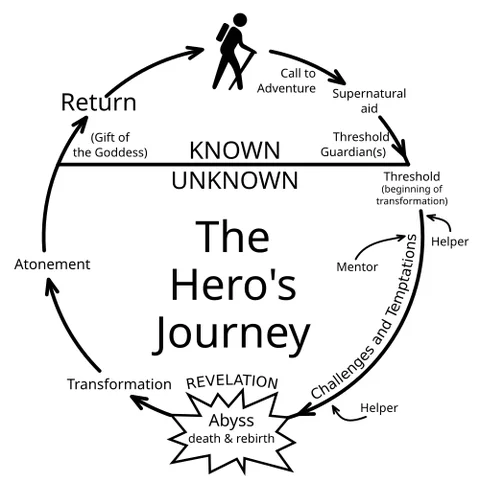 which I really like. Every piece of reading should take the reader on their own hero's journey in some form or other. You're looking to enact some kind of transformation in them. And so I wanted to include that in my audience.md.
ExplainerThe hero's journey
The idea that nearly all the world's myths tell one story was laid out by American mythologist Joseph Campbell in The Hero with a Thousand Faces (1949), who called it the monomyth: the hero leaves the familiar world, goes through trials, wins and returns transformed, with a gift for their people.
- Hollywood. George Lucas said he drew on Campbell when writing Star Wars. In 1985 screenwriter Christopher Vogler circulated a seven-page memo at Disney with a practical summary of the book, which he later expanded into the screenwriting manual The Writer's Journey (1992).
- Vogler's twelve steps: the ordinary world — the call to adventure — refusal of the call — meeting the mentor — crossing the first threshold — tests, allies and enemies — approach to the inmost cave — the ordeal — the reward — the road back — the resurrection — return with the elixir.
- In nonfiction the pattern reads as a promise of change: the reader arrives with a problem, works through the difficulties alongside the author and leaves different. That's how Katie uses it in her audience profile.
And then, what that unlocks for us in Compound Writing: I went ahead and did a pre-bake, where I just asked it to review my most recent Working Overtime draft for audience fit, which was my piece about how I accidentally made all of my context worse by trying to make it better. And it's using the audience.md that I updated today to then give, like, an overview of what already works. So it says it's clear, context gets an explanation, the fix is personal, not universal, which is something that I've said: that I don't like to just prescribe things, I like to describe things.
And then here is where it loses the seeker side. This is really good feedback. It's like, where am I not being accessible to people on the earlier side of that spectrum that I might want to be reaching? So this is really good stuff that I'd want to engage with. And then some smaller operator notes, like: what was the damage? Like, what was the cost to me when, like, I wasn't getting the results I wanted out of AI? So this is the kind of, like, higher-detail feedback and, like, more value that I think we can bring to tools like Compound Writing to help empower people to make better writing.
Do you have a sense of what your next experiment might be?
My next experiment… so, well, I'll be working with Kieran on Every Type, which is his bid to get us all to stop using Google Docs.44Google Docs — Google's online document editor with real-time collaborative editing. So I'll be sort of, like, test-driving that and being very annoying in my feedback and my particular preferences as a writer. I'm also kind of, like, building my own word processor. I joke it's, like, a rite of passage: like, everyone at a certain point decides to vibe code their own word processor. So I'm, like, building my own word processor, Word Better, on the side, because it's easier for me to articulate what I want in a tool… just to build it at this point, to just build it myself, and then I can show it to Kieran and say, here's what makes more sense to me. So that's kind of what I'm doing now. Like, I'm just on that part of my journey where I feel like I can build a better word processor than Kieran, so.
08Jannik Jung: the architect and the Minga orchestrator
Jannik Jung takes vibe-coded projects to production and wants to work with AI at the level of goals and plans rather than individual coding sessions.
Fantastic. I love it. Well, thank you for Compound Writing. I've personally really enjoyed using it, and thank you for joining us. So welcome, Jannik. So excited to have you. And can you tell us what is your role as part of the frontier team?
Yeah, sure. I'm mostly working as, like, an architect on some of the projects. I took over a lot of projects from Dan. Like, I think my first project here was, like, working on Proof,45Proof — Every's free, open-source document editor where people and AI agents work together: live editing and comments, with a colored rail showing what a human wrote and what the AI wrote. Shipper vibe-coded it and released it in spring 2026; it quickly went viral and started breaking under the load. getting it production-ready, getting it back to life, I would say. And nowadays I'm mostly focusing on, like, compounding,46Compounding — a step of the compound engineering approach: the lessons from each task are saved so the agent does the next one better (see the explainer below). basically working on Cakebench, having, like, a skill which tries to replicate the judgment and taste of our editor-in-chief, to reduce some of our work, basically.
And maybe tell us a little bit about that, because I think a lot of people, you know, have tried vibe coding something, building a product, and then it can break in all kinds of ways. You're the person that gets brought in to kind of clean up the mess and see what's really there. So what's that experience like?
I think AI is really good at, like, bringing something to life: just making assumptions, looking up what to use, and just building something that looks good and potentially also works for that demo case or initial implementation. But I think there's, like, still need for, like, the architect role, who has, like, that background knowledge into, like, knowing how to build stuff that's reliable, that's, like, maintainable over time, how you should, like, structure code, what libraries to use, how to deploy47Deploy — to roll software out to servers so real users can use it. it, know, like, what's important on, like, the software side, to make it ready for the future, I would say.
Now, can you give us an example of something you're working on now?
Sure. I think, like, I'm currently working on, like, two workstreams. One is compounding, with, like, Cakebench I mentioned earlier, and the other one is more explorative, where I see how should we work with AI. All right. So this is my orchestrator.48Orchestrator — a program that manages several AI agents: it splits work into tasks, hands them out, keeps them in order and gathers the results, like a conductor with an orchestra. It's called Minga.49Minga — the experimental agent orchestrator Jannik Jung is building. Minga is a Quechua word for communal work in the Andes, when neighbors join forces to help one another.
And what I can do here is create a project. For example, I created a new project called Reply Guy.50Reply guy — social-media slang for someone who compulsively replies to other people's posts, especially popular accounts. The tool's name is self-deprecating: it helps reply to trending posts. The idea is that we give a colleague, Becky, a tool which she can use to, like, explore what's trending on Twitter51Twitter — the social network Elon Musk bought in 2022 and renamed X in 2023; many people still call it by its old name. and basically reply to it with one of our new vibe checks, for example. And the main goal for this tool was: I want to take the work to, like, a higher level. So I want to work on the level of, like, goals and, like, a plan, but not focus too much on the individual, like, coding sessions itself.
And we have an orchestrator agent here that's, like, my main interface, so I can talk to that agent, discuss what we're trying to build, tell it, like, the requirements, what tech stack52Tech stack — the set of technologies a product is built on: language, frameworks, database, hosting. I want to use, and it can take all of that and break it down into the individual tasks of a plan, basically. And this plan has, like, separate steps; it shows the dependencies, what needs to happen in which order. And it has, like, some autonomy to kick off work in the background, so it's, like, implementing it, and whenever it needs me, it can ping me for, like, a decision where it needs my input. It can show me, like, drafts or mockups of some UIs where I can give my input on, and I just give it my feedback, and it continues working, basically, by itself.
Super cool. Thanks for sharing. What do you think your next experiment might be?
Like, for this week I'm probably going to focus on this orchestration idea. There are, like, some questions I want to explore. For example, the idea is that this could be, like, multiplayer53Multiplayer — a term borrowed from video games; in software it means real-time collaboration, as in Figma or Google Docs. as well. So you could invite other people from your team, or potentially even the whole company, and have, like, a shared context of what you're working on. And everybody can bring their strength. So, like, the pirate and architect idea is, like, the pirate can bring his ideas and what he wants to experiment on, and the architect can bring, like, the technical knowledge, but, like, at the same time. So we don't have to, like, hand off the work after one is done, but we can, yeah, like, build the same project at the same time with a shared context, and everybody brings in their expertise.
Great. Thank you so much, Jannik. Really good to see you.
Thank you.
09Kieran Klaassen: from GPT-4 to Fable, and the frontier team's one rule
Kieran Klaassen runs experiments every week and sees each model handle more ambitious work, but for him a frontier team is worth only what sticks in the company.
So welcome, Kieran. So excited to be talking about the work that you're doing as part of the frontier team. What are you doing on the frontier team?
Yeah, it's really cool. I love the frontier team because, basically, when I started with Every, I started building Cora54Cora — Every's AI email assistant: it sorts the inbox, drafts replies and sends email briefs. and experimenting with stuff, and out of that came compound engineering55Compound engineering — an approach to building software with AI agents created by Kieran Klaassen: the lessons from each task are saved, so the next ones go faster (see the explainer below). and so many more things. And I just felt this team was already there, but we never gave it a name. And now saying, hey, we're the frontier team, we're allowed to do experiments to figure out what might work and what might not work… yeah, it's great. So what I'm doing now is I'm just trying out what we can build with AI today, and that changes every time a new model comes out. I'm running an experiment every week, at least one, most of the time multiple, and I learn something. And the big part is then to share what I learned with the team, with Every subscribers, to make sure they can adopt, or they can, like, direct whatever they do in the direction that I learned from.
ExplainerCompound engineering: every task makes the next one easier
The approach took shape as Kieran Klaassen built Every's email assistant Cora almost entirely through AI agents. He noticed he kept correcting the agents on the same things, so he started recording each correction in a way the agent would take into account next time.
- The loop. Work goes in a cycle: plan the task, do it, review it, and "compound," saving the lessons (mistakes, good techniques, project rules) into files the agent will read next time. Over time more steps were added, and Every has described an eight-step version, but the last step is still considered the most important.
- Compound interest. The name comes from compound interest: just as interest earns interest, every solved task makes the next ones faster and more reliable.
- The plugin. Every packaged the approach as the Compound Engineering plugin for Claude Code, Codex, Cursor and other tools.
- For writers. Katie Parrott carried the same principle over to writing with Compound Writing: instead of coding rules, the plugin accumulates knowledge about a writer's voice, style and readers.
So that's the biggest part: inspire the team to do bigger things, to be more ambitious. And it's a little bit less scary if someone already did it and said, yeah, it's actually working, this is a good pattern, or someone says, this is not a good pattern, you should go this other direction. So that's really my job: to, yeah, go wide, but also go deep. It's both.
And I'd be curious, Kieran, you know, when you started playing with the models, kind of, like, really testing what was possible, could we back up, and could you share an example of, like, how the capabilities have evolved, in terms of, like, what you were testing, say, GPT-3, 4, you know, GPT-5.4,56GPT-5.4 — an OpenAI model released on March 5, 2026. Opus 4.8,57Opus 4.8 — a Claude Opus model released in May 2026. versus what you are now doing with the models that you have access to?
Yeah, it's every time something new, and the whole point is to see it fail. Like, it's like, how far can you push it until it fails? Like, a lot of models are very good, and they do a lot of things. So, like, the hard part is, like, how do we test even whether it's good or not, and how far can it go? And in the beginning it was like, can it write code? Wow, it can write code.
GPT-458GPT-4 — an OpenAI model unveiled on March 14, 2023. suddenly could write pretty good code, and that was, like, the first unlock. And then we had Sonnet 3.5,59Sonnet 3.5 — Claude 3.5 Sonnet, Anthropic's mid-tier model released in June 2024; the upgraded version of October 2024 solved 49% of SWE-bench Verified, a test where a model fixes real bugs in open-source projects. that could write, like, code across multiple files pretty well, like multiple pieces of code together, and UI, like, you could, like, create UI with it. Then we went a little bit further and started to see agentic work.60Agentic work — when a model doesn't just answer a prompt but acts over many steps on its own: reading files, running commands, checking the result and correcting itself. Like, models could pass work along. Like, before it was just, like, a prompt in, and then something came out, and then you iterate on it. And the agentic work with 3.7, Opus 3.7,61Fact-checkThere was no Opus 3.7: Claude 3.7 Sonnet came out in February 2025, and the next Opus models were Claude Opus 4 (May 2025) and Opus 4.1 (August 2025) (Anthropic). with 4, 4.1: like, suddenly the agents could do work.
And with Opus 4.562Opus 4.5 — an Anthropic model released on November 24, 2025; it was the first to score above 80% on SWE-bench Verified and cost a third of its predecessors' price. it shifted again, to doing more complicated work. Like, we could suddenly create, like, text editors with CRDT63CRDT (conflict-free replicated data types) — data structures that let several people edit a document at once, even offline, and still end up with the same version (see the explainer below). and, like, real-time editing and all of that, which is very complicated, but suddenly an AI could just do that in a week. And you saw Dan make Proof. This was, like, the Proof era, like GPT-5.5.64GPT-5.5 — an OpenAI model released on April 23, 2026. So suddenly we were like, oh, like, we can be more ambitious, we can create bigger things without hand-holding too much. And especially with Fable65Fable — Claude Fable, Anthropic's line of most powerful publicly available models; Fable 5.1 came out on September 1, 2026. now, with Fable 5.1, is that, like, you have a model that can run even longer, even more deep; you can trust it even more.
ExplainerCRDT: how several people edit one document
A collaborative editor like Google Docs has a hard problem to solve: two people edit the same spot at once, edits travel over the network with delays, someone may be working offline, and everyone still has to end up with the same text.
- Operational transformation (OT). The classic approach, used by Google Docs: a server receives the edits and "transforms" each one to account for those that arrived earlier. It works, but the algorithms are notoriously tricky and almost always need a central server.
- CRDTs (conflict-free replicated data types) were formally described in 2011 by Marc Shapiro, Nuno Preguiça, Carlos Baquero and Marek Zawirski. The data is structured so that edits can be applied in any order on any copy, and all copies still converge to the same state without a server acting as referee.
- The cost. Every character needs a unique identifier and a place in a shared order, and deleted text is often kept as a "tombstone," so documents bloat and implementations are full of subtleties. Popular libraries include Yjs and Automerge.
That's why Kieran uses such an editor as a yardstick: not long ago it was months of work for a team of specialists.
Like, I'm a musician, so I always try to build a DAW.66DAW (digital audio workstation) — software for recording, mixing and arranging music, such as Ableton Live, Logic Pro or FL Studio. Pictured is the open-source DAW Ardour: tracks for instruments and vocals with recorded waveforms on the left, a mixer with a fader for each channel on the right.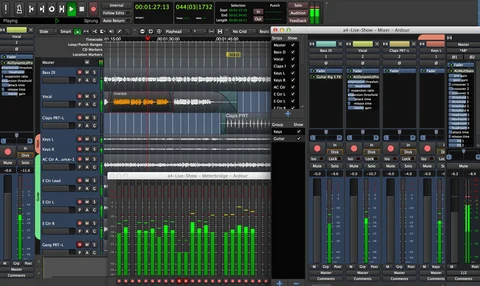 So I started maybe a year ago, and every time a new model comes out, I just try it again and say, hey, can we work more on it? And we're now at a point where I can just do that, which is insane. So maybe I should do a video editor, because that's what we need. Yeah.
Could you tell us a few examples of things that you've built recently? So you are doing a lot of video stuff, for example.
Yeah, like, my favorite is the video stuff. So I do a video editor, but it's not just a video editor. It's also, like, a live-streaming, like, meeting recorder, like the whole thing… that we have so many people at Every that say and have such interesting ideas, but, like, they get lost in meetings. So this is also a way to record all of that, but also give that into a format that editors know, but also agent-native, obviously. So everything agent-native. And the other is an editor for writing. So this is also similar to, like, Proof, but we're like… I'm just experimenting: can we make the next version of Proof? Can we make it better? Can we do even more?
For anyone else who is on a frontier team, maybe at their company, right? Maybe it's a startup, maybe it's a large enterprise team. What is one tip that you would have for them about how to succeed as someone who's operating at the frontier, embedded in a larger organization?
Yeah, I think the most important thing of a frontier team is that you inspire your team, but also you listen to your team. If you do a hundred experiments and don't let it land and don't integrate it, it doesn't work. You need to listen to your team, get inspired by your team, and then do stuff, and then make sure that some things will be adopted. So it's really about integration. Yes, you should be free and, like, have the freedom to do everything, but in the end it is about integration and actually bringing it back to the actual organization. So I would urge everyone: make sure people get what you do, and don't get overwhelmed, because it's very easy to overwhelm the entire organization by just dumping 100 experiments in a channel. Make sure some stick, make sure people understand what you do. Like, that's your job as a frontier team.
Amazing. Thanks so much, Kieran.
AdEvery
If you like this video, you should check out every.to. We have a two-week free trial for anyone who's watching or listening at the link in the description. Every is the only subscription you need to stay at the edge of AI. It is the one subscription that, if you're super AI-pilledcAI-pilled — internet slang derived from the red pill in The Matrix: someone whose eyes have been "opened" to AI and who has become an ardent believer. and you want to learn how to use it to do the best work of your life, it's got everything you need. It has education and equipment. On the education side, we review every new model that drops and tell you what's good.
On the equipment side, we have software tools specifically made for you, like an agent that helps you AI-pill your whole company, all bundled together under one subscription. So get two weeks free now at the link in the description.


