

Huberman Lab
Chapters
Cold is enough as long as it's uncomfortable: the sign of the right dose is cold shock, when your breathing gets away from you.
Read the chapter- Søberg says the water should be cold enough to be unpleasant, which triggers cold shock: the sympathetic nervous system activates and catecholamines are released.
- Huberman asks whether trouble controlling your breath is a good marker, and Søberg agrees: in beginners cold shock shows up as hyperventilation and a reflexive gasp, and with practice the response fades.
- Cold water is supposed to be hard, that's the point, and if you enjoy the plunge, Søberg thinks something is wrong.
A shower, a neck-deep bath and a walk in a T-shirt work differently, but all of them activate brown fat, through the brain and directly.
Read the chapter- In water the cold hits the skin's receptors harder and engages the autonomic nervous system faster, but a walk in cold wind also raises norepinephrine and activates brown fat.
- Brown fat is the first responder that defends body temperature, and the muscles start shivering second.
- According to Søberg, there aren't really any studies yet on how much a cold shower activates brown fat.
- Cold receptors report to the hypothalamus, norepinephrine, adrenaline and cortisol rise, and norepinephrine switches on brown fat; there is also a direct route from the skin and, Søberg suspects, a third one from the muscles.
- Brown fat seems to switch on when the skin warms up too, helping keep the body in balance in both directions.
Shivering is nothing to fear: it activates brown fat and trains the metabolism, which is why Søberg says to end on the cold.
Read the chapter- Søberg explains the afterdrop: in cold water the vessels constrict to keep blood around the internal organs, once you're out they dilate, warm blood cools near the skin, and core temperature keeps falling after you've left the water.
- Shivering activates brown fat and trains the cells, the muscles and the metabolism, improving insulin sensitivity, and Søberg likens it to a hard session at the gym.
- Cold and heat are healthy stress, or hormesis: cells make more heat and cold shock proteins and grow more resilient, and Søberg calls cold water a "cold training center" and the sauna a "heat training center."
With regular cold the body adapts, brown fat and muscles speed up the metabolism, and insulin sensitivity improves.
Read the chapter- Each plunge gets easier: brown fat gains more mitochondria that heat more efficiently, skin capillaries constrict better, and the stress response weakens.
- In a study Søberg found just before starting her PhD, middle-aged people saw lower blood pressure and heart rate and better insulin sensitivity over one winter swimming season.
- That study didn't measure brown fat, so Søberg suspected it was the missing link and tested the idea in her own work.
A hand in cold water, a cooling vest or a cool bedroom is enough for brown fat.
Read the chapter- Cold, Søberg says, is the main trigger: brown fat switches on with any temperature change on the skin, even a hand dipped in cold water, and people who work outdoors and move a lot have more of it.
- A month of sleeping in a 19 °C room increased brown fat and improved insulin sensitivity, while at 24 and 27 °C the effect faded.
- Brown fat pulls glucose and fatty acids out of the blood and so helps reduce white fat, an energy store we need but that does harm in excess.
- Huberman suggests that under the duvet it's the cold on the face that grows brown fat, and Søberg agrees: the face has so many cold receptors that it's enough.
- In Søberg's own experiment, a hand in 4 °C water for 4 minutes noticeably warmed the brown fat under the collarbones.
Søberg went looking for the smallest dose of cold and heat that still pays off, and found that experienced winter swimmers had better insulin sensitivity than controls.
Read the chapter- Her own first dip was very uncomfortable, but she felt fantastic afterward and says one dip would have been enough.
- The participants were experienced winter swimmers who, two or three times a week, took three dips of one to two minutes and two sauna sessions at 80 °C of 10 to 15 minutes each, starting and ending in the cold.
- The water was 15 °C and below, around 2 to 4 °C on the coldest days, and Søberg stresses that it doesn't have to be that cold.
- The winter swimmers had better insulin sensitivity: they produced less insulin when fasting, and after a glucose drink their blood sugar fell faster than in the control group.
The benefits come from 11 minutes of cold and 57 minutes of sauna a week, and more isn't better.
Read the chapter- In total the winter swimmers spent 11 minutes in cold water and 57 minutes in the sauna per week, one to two and 10 to 15 minutes per session.
- There's no need to swim in cold water for half an hour, Søberg says: a short stress switches on the heat shock proteins that repair cells.
- Overdo it, she warns, and the cells get exhausted, and the risk of cardiovascular disease goes up.
Cold and heat lower inflammation, and Søberg sees that as an open door to preventing lifestyle diseases.
Read the chapter- The study measured IL-6, which went up, and IL-10 follows it, as is well known in the literature.
- By lowering inflammation, Søberg argues, cold and heat may help against type 2 diabetes, and against depression, anxiety and Alzheimer's disease, which research links to inflammation.
- For decades we've lived in well-insulated houses and sat a lot, obesity started climbing in the 1980s, and Søberg ties that partly to giving up natural stresses like cold and heat.
End on the cold and the body rewarms itself, so the workout goes on for hours.
Read the chapter- After the cold, brown fat and muscles keep working even once you're home, and neurotransmitters stay elevated for several hours.
- After three to five times you notice you warm up more easily, and in Søberg's study the winter swimmers had warmer skin than the control group even at rest.
- Winter swimmers lose heat through the skin faster, and Søberg doesn't see that as a bad thing, because their brown fat and muscles constantly have to do a little work.
Huberman and Søberg agree that what counts is not the temperature but the switch between warm and cold.
Read the chapter- If you only have two days a week, you can dip for a minute or two several times in a row, since, Søberg says, the temperature swings are what strengthen the cells.
- As Huberman puts it, it's not about getting cold but about the transitions from warm to cold and back, and rigid "so many degrees for so many minutes" protocols aren't necessary.
- Even water up to 12 °C or air at 19 °C activates brown fat, and there are no studies yet on the exact dose, Søberg notes.
Quotes
On cold water
“You shouldn't think about cold water and cold water immersion as something that is comfortable. It should be hard, because that's the point of it, right? If you enjoy it, then, yeah, then I'm thinking something is wrong.”
Susanna SøbergRead from 01:54On sleeping in a cool bedroom
“The subjects were sleeping at 19 degrees for one month, had increased its insulin sensitivity.”
Susanna SøbergRead from 15:54On the dose of cold
“You don't have to go extreme. You don't have to swim for a half an hour in the cold water.”
Susanna SøbergRead from 27:43On overdoing cold and heat
“And if you overdo it, you exhaust the cells, and that will increase your risk of cardiovascular disease also.”
Susanna SøbergRead from 28:30On comfortable living
“So this very modern sedentary lifestyle has made us more temperature-comfortable, just neutral. So no wonder, I mean, that obesity is increasing.”
Susanna SøbergRead from 31:55On the Søberg principle
“If you end on the cold, you have an exercise for your body going on for hours afterwards.”
Susanna SøbergRead from 33:49On what really matters
“It's not really about getting cold. It's about going from warm to cold and from cold to warm.”
Andrew HubermanRead from 36:08
Summary
A condensed version of Andrew Huberman's conversation with metabolism researcher Susanna Søberg. Cold works as long as it's uncomfortable: the sign of a big enough dose is cold shock, when your breathing gets away from you. Cold receptors in the skin switch on brown fat, the tissue that burns glucose and fat to make heat, both through the hypothalamus and norepinephrine and by a direct route. Brown fat responds even to a hand in a bucket of cold water, a cooling vest or a cool bedroom: a month of sleeping at 19 °C grew it and improved insulin sensitivity.
Søberg's own study looked at experienced winter swimmers who alternate short dips with sauna two or three times a week. They had better insulin sensitivity and cleared glucose from the blood faster, and in total they got by on about 11 minutes of cold and 57 minutes of sauna a week. More isn't better: overdoing it exhausts the cells. Cold and heat act as a "healthy stress," hormesis, and lower the inflammation linked to type 2 diabetes, depression and Alzheimer's disease.
The practical takeaway is the "Søberg principle": end on the cold, so the body rewarms itself and brown fat and muscles keep working for hours afterward. And the main thing, as Huberman puts it, is not specific degrees and minutes but the transitions, from warm to cold and back again.
Mentioned
 Wim Hof08:35Huberman had heard him talk about the afterdrop, but Søberg is the first to explain it clearly to him
- Altered brown fat thermoregulation and enhanced cold-induced thermogenesis in young, healthy, winter-swimming men20:47Søberg's study of winter swimmers and brown fat
Sponsors of the episode


Transcript
01How cold is cold enough
Cold is enough as long as it's uncomfortable: the sign of the right dose is cold shock, when your breathing gets away from you.
Welcome to Huberman Lab Essentials,1Huberman Lab Essentials — condensed, half-hour to 40-minute versions of past Huberman Lab episodes, released on Thursdays since November 2024. This one is an abridged cut of the full conversation with Søberg. where we revisit past episodes for the most potent and actionable science-based tools for mental health, physical health, and performance. I'm Andrew Huberman, and I'm a professor of neurobiology and ophthalmology at Stanford School of Medicine. And now for my discussion with Dr. Susanna Søberg.2Susanna Søberg — a Danish metabolism scientist. She earned her PhD at the University of Copenhagen and studies how cold and heat affect brown fat and insulin sensitivity; she wrote "Winter Swimming," a book about cold-water swimming and cold exposure. Dr. Susanna Søberg, welcome.
Thank you.
So great to have you here. For many years, I've been interested in cold thermogenesis.3Thermogenesis — the body's production of heat. Cold thermogenesis is extra heat made in response to cold: from shivering muscles and from brown fat, which warms the body without shivering. And you're bringing so much quality information about this area that for a long time, I think, was kind of niche and is now becoming more and more mainstream. So my first question: is there any way that we can start to gauge what is the best way to approach a deliberate cold exposure4Deliberate cold exposure — Huberman's term for cold you take on purpose: ice baths, cold showers, winter swimming. By "protocol" he means any practice with set parameters: how long, how often and at what temperature. protocol? I mean, should it feel uncomfortable?
If the temperature is very cold and you feel that you also feel very cold, then you should stay in the water a little bit longer. So I think it's just, you should get uncomfortable cold. So as long as you get uncomfortable cold, it's cold enough, and you get this, what we call the cold shock. So the cold shock is activation of your sympathetic nervous system5Sympathetic nervous system — the branch of the autonomic nervous system that readies the body for "fight or flight": it speeds up heart rate and breathing, constricts blood vessels in the skin and releases adrenaline and noradrenaline. and this activation of the catecholamines.6Catecholamines — adrenaline, noradrenaline and dopamine: hormones and neurotransmitters of stress and alertness.
Does the shock mean that I'm having trouble controlling my breathing? Is that a good gauge?
Yeah, you can say so, because that's kind of like how we define it. So you hyperventilate, so you have a faster breathing rate. So that increases also because you activate your gasping reflex7Gasp reflex — an involuntary deep breath when the skin is suddenly chilled, part of cold shock. If your head is underwater at that moment, you can inhale water: cold shock is one of the main causes of death after falling into icy water. if you are new to this, but if you are adapted, it kind of subsides with time and with the adaptation. So what you can do is that you can train this cold exposure and you can kind of, like, get adapted to it, so you don't have this hyperventilating response every time you go out in the cold water. So this is, like, building up your resilience, building up your adaptation, is going to make this shock, like, subside a bit.
So it's always harder in the beginning, but you should do hard things, right? You shouldn't think about cold water and cold water immersion as something that is comfortable. It should be hard, because that's the point of it, right? If you enjoy it, then, yeah, then I'm thinking something is wrong. It's not right. You should not enjoy it.
02How cold switches on brown fat
A shower, a neck-deep bath and a walk in a T-shirt work differently, but all of them activate brown fat, through the brain and directly.
What are the differences in terms of impact, short term and perhaps even long term, between cold showers, cold plunge to the neck — so that could be in ice water or just very cold water — immersion with dunking one's head and then coming up, because obviously people have to come up for air at some point, and then simply being outside on a cold day in shorts and a T-shirt or something of that sort?
So there are different outcomes, because they are very different exposures of the cold to your cold receptors8Cold receptors — sensory nerve endings in the skin. The main molecular cold sensor in humans is the ion channel TRPM8, which also responds to menthol, which is why mint feels "cool." David Julius and Ardem Patapoutian won the 2021 Nobel Prize for discovering the receptors for temperature and touch. in your skin. So the more you, you can say, cover your body in the cold, which you would do in cold water, because of course the molecules are closer to your skin, you have a more potent activation of all your cold receptors in the skin. So that one will definitely activate your autonomic nervous system9Autonomic nervous system — the part of the nervous system that runs heart rate, breathing, digestion and body temperature without conscious control. It has two branches, sympathetic and parasympathetic. more and rapid compared to going out in a T-shirt in the cold wind, just go for a walk. But that is also something that's going to activate your sympathetic nervous system, meaning then that you have an increase in norepinephrine,10Norepinephrine (noradrenaline outside the U.S.) — a hormone and neurotransmitter of the sympathetic nervous system. Acting on adrenergic receptors on brown fat cells, it is what switches on their heat production. and you will activate something called the brown fat.11Brown fat, or brown adipose tissue, makes heat without shivering: its cells are packed with mitochondria carrying the protein UCP1 (thermogenin), so the energy of glucose and fatty acids goes into heat rather than ATP. In adults the most noticeable deposits are above the collarbones, in the neck and along the spine. Wikipedia. So this is a healthy kind of fat tissue that we have in our body, and when you activate that, that's going to increase your metabolism.
So it is kind of like our first responder in the body to keep our temperature up. There are two tissues which can increase our thermogenesis. So the brown fat, which is, like, always temperature-regulating our body, and then we have the muscles, which will secondarily start to shiver, and that's going to increase our temperature in the body. But as soon as you go into a cold shower, you will activate your brown fat also immediately. So it could be good also for increasing metabolism in theory, because we haven't really any studies showing how much does it actually activate the brown fat. So if someone out there wants to do a study on that, it would be great.
So it sounds like any form of cold to the skin that people register as what you call the cold shock or an uncomfortable, like, "Oh, like, this is kind of jarring," activates the brown fat. Do we know what the pathway is from cold receptors on the skin to the brown fat? I mean, how does the brown fat know that we're cold?
The cold receptors will send a signal to our temperature-regulating center in the brain, so hypothalamus,12Hypothalamus — a small region of the diencephalon and the brain's main control center for hormones and autonomic functions: body temperature, hunger, thirst, sleep. and that's going to be taking in this message. And we have so many cold receptors in the skin, so it's going to be very fast, as you can say. If you immerse the body into cold water, this is going to be so rapid, so it will have a rapid increase in neurotransmitters in the brain, so noradrenaline, adrenaline, and cortisol,13Cortisol — a hormone of the adrenal cortex and the body's main "stress hormone": it raises blood sugar and mobilizes energy reserves. which is not that much, but it's still there. So you have this increase in noradrenaline, which will then immediately activate the brown fat. But there's also a direct pathway from the cold receptors in the skin to the brown fat, which really shows that, because of these different pathways, it shows that it could be that this tissue to keep us warm was developed in our evolvement as humans to keep us warm and to save us whenever the temperature on our skin varies just a little bit, to keep us in that right homeostatic balance,14Homeostasis — the body's ability to keep internal measures, such as temperature, blood pressure and blood sugar, within narrow limits no matter what changes outside. so we don't get hypothermic, but also so we don't get hyperthermic. Because it seems that the brown fat is also activated when we get warmer in our skin.
So it's also maybe a temperature regulator in our body, but the pathway is different. I think it's also a third pathway, directly from the muscles. So the brown fat is also activated even though the muscles are starting to shiver. So there's an extra pathway that way to keep our temperature up, so muscles and brown fat are working together to keep us warm, so we don't suffer too much in the cold water.
AdEight Sleep
I'd like to take a quick break and acknowledge our sponsor, Eight Sleep. Eight Sleep makes smart mattress covers with cooling, heating, and sleep tracking capacity. Eight Sleep just launched the Pod 6, which is their most advanced sleep system. The Pod 6 is half the size of their previous models. It's 20% faster with its cooling and heating, and it has nine times as many sensors for tracking your sleep. The reason why Eight Sleep is so effective at improving your sleep quality and duration is because it helps control your core body temperature.
And the reason for that is that in order to fall and stay deeply asleep, your core body temperature has to drop by about one to three degrees. And to wake up feeling completely refreshed and energized, you actually want your body temperature to be increasing in the final hours of your sleep. Eight Sleep automatically regulates the temperature of your bed throughout the night and is monitoring your sleep and dynamically adjusting the temperature of your sleep environment, so you get the maximum amount of deep sleep and rapid eye movement sleep.aRapid eye movement (REM) sleep — the stage of sleep when the brain is almost as active as when awake while the body's muscles are relaxed; most vivid dreams happen in it. I've been sleeping on an Eight Sleep mattress cover for nearly five years now. And with each new iteration of Eight Sleep, it gets better and better at figuring out what my body needs in order to get the best possible night's sleep. If you would like to try Eight Sleep, go to eightsleep.com/huberman to get up to $200 off their new Pod 6.
Eight Sleep ships to many countries worldwide, including Mexico and the UAE. Again, that's eightsleep.com/huberman to save up to $200.
03Shivering and the afterdrop
Shivering is nothing to fear: it activates brown fat and trains the metabolism, which is why Søberg says to end on the cold.
I want to ask about shiver. I've heard that shiver causes the release of succinate,15Succinate — a salt of succinic acid and an intermediate of the Krebs cycle. A 2018 paper in Nature showed that brown fat takes up succinate from the blood and that it boosts heat production (Mills et al., "Accumulation of succinate controls activation of adipose tissue thermogenesis"). which then activates the brown fat. Is it known whether or not inducing shiver is important? And when should people shiver?
You shouldn't be so afraid of shivering, I think, because the shivering — as long as you don't get too hypothermic. So if you don't sit in the cold water for too long. Something called the afterdrop16Afterdrop — core body temperature keeps falling after you get out of cold water, as cold blood from the skin and limbs returns to the center of the body. is when your core temperature17Core body temperature — the temperature of the internal organs, about 37 °C (98.6 °F), as opposed to the temperature of the skin and limbs, which varies much more. decreases even after you get out of the cold water. And it always does that, your body, because as soon as you get into the cold water, all your blood vessels is going to constrict, because you need to keep your blood in your core and keep your vital organs warm. So as soon as you get up, those blood vessels will open again, and the warm blood will flow out and get colder and then flow back again into the core. And that's going to decrease the temperature in your core, of course.
Years ago, Wim Hof18Wim Hof — a Dutch extreme athlete nicknamed "The Iceman," a record holder for cold endurance and creator of the Wim Hof Method: breathing exercises, cold exposure and concentration. — I heard him talk about the drop, and I've heard colleagues of mine talk about the drop, but that's the first time I've ever heard it explained clearly. Let me make sure I understand this. So I get into cold water. Obviously I'm cold. Vessels constrict to keep blood near the center of my body, keep me alive. I get out, the warming up of my body allows those vessels and capillaries to dilate again.
The blood goes out to the surface, but the surface is still cold. And so that blood is cooled, and then my core body temperature drops. And that's what you're referring to as the drop, and that's what induces shiver.
Exactly.
Great. And then am I right in thinking that then the shiver activates brown fat, which then warms me up again?
Got it.
That's why you should end on the cold. It's training. It's training for all your cells, it's training for your muscles, it's training of your metabolism, and that's going to increase your, what's called, the insulin sensitivity.19Insulin sensitivity — how readily muscle, liver and fat tissue respond to insulin and take up glucose from the blood. When it falls (insulin resistance), the pancreas has to make more and more insulin; this is the road to type 2 diabetes. So if you can, like, in your mind get used to the thought of shivering is just like when you go exercising in the training center and get that feeling of, like, "Oh, this is tough." Now it hurts a little bit — yeah, it's going to hurt, because that's what shivering also does, but it's just a different way of training your cells in your body.
It's going to create what is healthy stress. It's called hormesis20Hormesis — the beneficial effect of small doses of a stressor that is harmful in large doses: brief cold, heat or exercise sets off protective and repair mechanisms in cells. in the cells. And the more you expose your muscle cells or your brown fat cells to these kind of, like, healthy stresses — exercise, cold and heat exposure — it's going to make them better at, like, activating and also at keeping you healthy. So as long as the cells get exposed to this, it's going to keep them on its toes, you can say, because it becomes more robust, increasing these heat shock proteins21Heat shock proteins — chaperone proteins that cells make under stress: they help other proteins fold correctly and repair damaged ones. Cold shock proteins (in humans, for example, RBM3 and CIRP) switch on with cooling. and cold shock proteins in the cells to make you more robust for the next time. And that is also what happens when you go to the training center, and I keep, like, drawing that parallel, because people today know more about — we know more about exercise and what that is going to do to your muscle cells.
But the same kind of, like, training is also what you do when you go out into the cold water and submerge into cold water, because that is just your cold training center, you can say, and also your heat training center, going into the sauna, because the cells are getting stronger with hormetic stress. So it's the same process, just different practices.
04Adaptation and insulin sensitivity
With regular cold the body adapts, brown fat and muscles speed up the metabolism, and insulin sensitivity improves.
What are some of the other things that happen at the level of metabolism and brown fat in, let's say, the hours and day after a deliberate cold exposure?
ExplainerBrown, beige and white fat
A white fat cell stores energy in a single large droplet of fat. A brown one holds many small droplets and a mass of iron-rich mitochondria, which give it its color; brown fat also has more capillaries, which carry the heat it makes around the body.
- How brown fat makes heat. Signaled by norepinephrine, the protein UCP1 (thermogenin) in the inner mitochondrial membrane lets protons flow back around ATP synthase, so the energy from glucose and fatty acids that would have made ATP goes straight into heat.
- Two kinds of brown cells. "Classical" brown fat sits in dense deposits — in the neck, above the collarbones, along the spine, around the kidneys — and shares its origin with muscle. "Beige" cells appear within white fat when the sympathetic nervous system drives it, for example in the cold, which is how regular cold exposure "adds" brown fat.
- Found in adults only recently. Active brown fat in adults was first noticed in the early 2000s on PET scans taken to look for cancer metastases, and in 2009 several research groups confirmed that it really was brown fat. It declines with age, and which adult deposits are classical and which are beige is still debated.
Yeah, so what happens is that you get adapted a little bit every time you go, so you will, like exercise, get a little bit stronger. So every time you go into the cold water, for every time you will be more exposed to it, you will feel more comfortable in the cold. So you're going to build your adaptation, which happens on a metabolic level, which is going to be the brown fat. So you will have more activation of your brown fat. The mitochondria22Mitochondria — the cell's "power plants," where energy is extracted from glucose and fats. Brown fat has especially many of them, and they turn energy straight into heat; they are what gives the tissue its brown color. in the brown fat cells are going to be — you have more of those, and they will be more efficient at heating you up, because the body expects you to do this again, so you are prepared. The capillaries in your skin will also become better at, like, constricting, so you will have a better shield of your body to prepare you for the next time. Your stress response will also be subsided a bit, so you will have a less increase of your catecholamines. Because of this activation of your brown fat or your muscles, you will have an increase in your metabolism, which will then make your insulin sensitivity better.
And this is shown in studies. For example, there was this interesting study I found just before I started my PhD, which was from Gibas-Dorna et al. from 2016,23Gibas-Dorna et al., 2016 — the paper "Cold Water Swimming Beneficially Modulates Insulin Sensitivity in Middle-Aged Individuals" in the Journal of Aging and Physical Activity (2016). where they measured insulin sensitivity in middle-aged men and women during one winter swimming season. During these four, five months they were winter swimming, they saw that they had a lower blood pressure after the season and they had a lower heart rate, and they also saw that they have a better insulin sensitivity. And I think that is very interesting, because if you can have a better insulin sensitivity, you can prevent lifestyle diseases,24Lifestyle diseases — chronic conditions linked above all to diet, inactivity, smoking and stress: type 2 diabetes, obesity, heart and vascular disease. and with lower blood pressure, which is a very strong outcome also for telling how much inflammation you have in the body. And because it didn't measure brown fat, I figured that it could be that was the missing link.
That was one of the explanations to why we see this less inflammation in the body. So the long-term outcomes could be that you lower your blood pressure and you have a lower heart rate. You also have a better insulin sensitivity and a better glucose balance, but that was shown — that is shown in my study.25Søberg's study — Søberg S. et al., "Altered brown fat thermoregulation and enhanced cold-induced thermogenesis in young, healthy, winter-swimming men," Cell Reports Medicine (2021): experienced winter swimmers who alternate dips with sauna, compared with a control group.
05Brown fat without ice water
A hand in cold water, a cooling vest or a cool bedroom is enough for brown fat.
Is it the case that as we're just moving around — I've heard of NEAT,26NEAT (non-exercise activity thermogenesis) — the energy the body spends on everything other than sleeping, eating and sport: walking, housework, standing, fidgeting. The concept was introduced by Mayo Clinic endocrinologist James Levine; Huberman spells out the acronym slightly differently. non-exercise-induced thermogenesis — so if we're just moving around, that we are activating brown fat, or does there need to be this stressor? Does there need to be shiver and a cold stimulus or a heat stimulus to activate the brown fat?
So cold is the most potent stressor or activator of our brown fat, because it's our temperature-regulating organ in our body; it's the first responder to that. So actually just exposing yourself, or a hand actually, just to cold water — so studies have shown that if you just put your hand in cold water — not that you're going to do that all day or every day or anything, it's not something you have to do, but it just shows that you can activate your brown fat just by getting a temperature change on your skin. People who works outside or move a lot or get in and out of, like, changing the temperature of their body all the time, they will have more brown fat. And activating that is going to keep your metabolism higher and your insulin sensitivity. Studies have also shown this.
So the brown fat can be activated as soon as you just change your temperature in the skin. So going outside in a T-shirt, wearing cooling vests — also studies have shown this, for 10 days — it's going to also grow your brown fat. So you can get more brown fat if you expose yourself to the cold. You don't have to start in a cold shower. You don't have to start in a cold plunge if you are not really ready for that yet. But just exposing yourself to the cold wind has also shown to activate your brown fat.
Or if you don't want to be, like, in this awake state, then you can also just sleep in the cold, and you won't notice it that much, maybe, but studies have shown that if you sleep in 19 degrees Celsius, then you will activate your brown fat and you will grow your brown fat, so you have more of it. So this very nice study from Hansen et al. from 201727"Hansen et al., 2017" — the experiment described next, four months of sleeping at 24, 19, 24 and 27 °C with PET-CT scans of brown fat, matches the study by Paul Lee and colleagues in Diabetes (2014), "Temperature-acclimated brown adipose tissue modulates insulin sensitivity in humans." showed that a group of subjects who slept in a room at 24 degrees — and then they made this PET-CT28PET-CT — positron emission tomography combined with computed tomography. The subject is injected with radioactively labeled glucose (FDG), and active brown fat, which takes it up greedily, lights up on the scan. In this scan the patient was cold: deposits in the neck, above the collarbones and along the spine light up.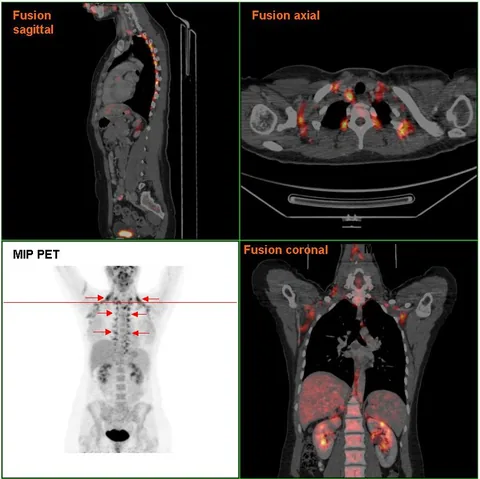 scanning to see how much brown fat do they have from the beginning, so what we call baseline. Then they measured again after a month of sleeping in 19 degrees, and they saw — I think it's remarkable — just one month at 19 degrees sleeping there. They had a duvet on, and they still had clothes on when they're sleeping.
So they're under a cover, under a duvet.
Yeah, under a duvet, yeah.
The subjects were sleeping at 19 degrees for one month, had increased its insulin sensitivity. The next month they slept at 24 degrees. They measured this again, and then they had decreased, actually, a little bit. And then they slept at 27 degrees, so quite warm room, actually, for the fourth month. And they saw even less activation of the brown fat and also insulin sensitivity. So it seems that you can expose yourself, and pretty rapidly the brown fat will respond to this, because it's so sensitive to noradrenaline, right? So if you keep exposing yourself to a little bit of cold, you also get a little bit adapted to it, but that's because the brown fat has grown these more mitochondria in the cells.
So these small energy fabrics that's going to activate the cells, and that's going to take up glucose and fat, from the fatty acids, from the bloodstream to keep the thermogenesis up. And that's going to clear up some sugar in the bloodstream and some fat as well. So the brown fat can in that way decrease our unhealthy fat, which is the white fat. And the white fat is what we don't want too much of, but we still need some, of course. It's our energy storage, so it's very important that it's there. We just don't need a lot of it.
So on our thighs and also around our inner organs, that's where it's located. So if we can have activation of the brown fat just by going out in the cold and just by sleeping in a cold room — or if you have courage for it, you can go out and expose yourself in a cold plunge; cold showers is also going to do the trick. So you can do different variations of this. Just exposing yourself to various temperatures is going to activate the brown fat, because it was evolved to keep us in a perfect homeostatic balance regarding temperature, so to keep us alive.
I want to just get a clarification around this 19 degrees Celsius room that they're sleeping in. So they're under a comforter, a duvet, and you mentioned they had clothes on. The room is 19 degrees Celsius, but the temperature underneath their blanket might not be 19 degrees Celsius. So presumably it's the cold on their face that's activating the increase in brown fat. Is that a reasonable expectation?
I think so, yeah, because you have so many cold receptors in your face, so it's actually enough. And I think it corresponds very well with the studies showing that you can activate the brown fat just by putting a hand into a bucket of cold water. And I did this experiment myself in my studies, just to see how well did they respond to cold water. So it was 4 degrees Celsius cold water for 4 minutes, and then I just measured blood pressure and heart rate to see, do they have, like, an activation of this. I actually also measured the brown fat during this cold exposure for 4 minutes with an infrared thermography camera. Usually you cannot really see activation of your brown fat, because it's located centrally, around your central nervous system.
And the biggest depot, as you mentioned before, is up here under the clavicular bones, very close to the skin surface. And because it's so close to the skin surface, I could measure it with this very expensive camera. We measured the brown fat with this, and I could see that after a few minutes the activation was there; an increase in temperature arose from that activation, just 4 minutes. So it's very rapid. And I also measured in my study how deep was the brown fat under your skin. So it's very close to the surface, which also shows that it needs to be there to heat you up and heat your inner organs.
AdAG1
I'd like to take a quick break and acknowledge our sponsor, AG1. I'm excited to share that AG1 has just launched their newest formulation, AG1 Pro. AG1 Pro takes the clinically backed AG1 formula, which is a blend of vitamins, minerals, probiotics, and adaptogens,bAdaptogens — plant substances (ashwagandha, rhodiola, ginseng and others) said to boost resistance to stress. The concept is disputed: pharmacology does not recognize adaptogens as a distinct class of compounds. and adds three important new ingredients: creatine monohydrate, calcium HMB,cHMB (beta-hydroxy-beta-methylbutyrate) — a breakdown product of the amino acid leucine, sold as a supplement for preserving muscle mass. and zinc carnosine. Each serving has 5 grams of creatine monohydrate to support muscle strength and performance, as well as brain health; calcium HMB to support muscle recovery and reduce muscle breakdown; and zinc carnosine to support and improve the lining of your gut. All three of these ingredients have compelling science to support them, and therefore I love seeing them added to the existing AG1 formula. As most of you know, I've been taking AG1 every day for nearly 14 years now.
I started taking it long before I even knew what a podcast was. It's a great product, and it's now made even better with the new AG1 Pro formula. If you would like to try AG1 Pro, you can go to drinkag1.com/huberman to get a special offer. AG1 is giving away a free bottle of omega-3 coenzyme Q10 with your first subscription. Again, go to drinkag1.com/huberman to get a free bottle of omega-3 coenzyme Q10 with your first AG1 subscription.
06The winter swimmer study: the minimum dose
Søberg went looking for the smallest dose of cold and heat that still pays off, and found that experienced winter swimmers had better insulin sensitivity than controls.
I'd like to talk about your study. It explored not just cold, but sauna and the co-use of cold and sauna as a way to probe metabolism and brown fat and other markers as well. If you could tell us about your study, what you did and what you discovered.
When I started this research in 2016, I wanted to see if we could do, like, some kind of activity, so we can have people move or so, go and do something, do something together or whatever. And the cold made us think about, well, what about winter swimming? So we were just thinking, okay, winter swimmers29Winter swimming — bathing in open water in winter. In Denmark, Finland, Sweden and other Nordic countries, winter dips are traditionally alternated with the sauna. must in theory activate the brown fat, right? But we kind of didn't really know: was this kind of stressor too much, too little, or what will happen, actually? I read the literature, I understood in theory what happens when you go into cold water, but I completely understood it when I first tried it. It was really uncomfortable just doing it.
But afterwards, as soon as I got up, I felt fantastic. And we went into the sauna, and I did three rounds, because I just loved it. I loved the feeling afterwards, because you have all these neurotransmitters going in your brain and you feel more positive. You feel — I feel invigorated, I had so much energy, and I could totally see why people would do this to get energy throughout the day, because I definitely had that. I didn't have to do three dips to get that. I think one would be enough.
I wanted to study the lowest dose, you can say, the lowest amount that we can get away with but still see health benefits. So I recruited winter swimmers who have been swimming for two to three seasons, and they stayed only in the water for one to two minutes. So the cold shock subsides very quickly, and you will get this activation of your rest-and-digest system, which is your parasympathetic nervous system,30Parasympathetic nervous system — the branch of the autonomic nervous system opposite to the sympathetic: it slows the heart rate, stimulates digestion and helps the body recover. so the other branch of your autonomic nervous system. And you get that activation because you submerge into cold water, and when you do that, you have an activation of your diving response,31Diving reflex — the response to dunking the face in cold water: the heart rate slows, blood vessels in the limbs constrict, and oxygen goes first of all to the heart and brain. and you slow down your oxygen consumption in your body. And that is because the body tries to preserve oxygen, so you will not get hypothermic too fast. So it's kind of like a survival system in your body. So this survival system is very important for us, of course, so that will be activated. And because of that, you will, after maybe one minute or so — I can't be precise on that, because it maybe also varies a bit in humans — so one to two minutes, you will have full activation of the sympathetic nervous system, but also the parasympathetic nervous system.
So they do this two to three times per week, and for each time they go, each day they go, they take three rounds of — so three dips and two sauna sessions. So they start in the cold and they end in the cold water.
What is the temperature of the sauna?
About 80 degrees Celsius.
Then how long are they in the sauna?
So they stayed there for 10 to 15 minutes, so depending on if they went two times per week or three times per week.
And we will talk about why it's important to end on cold, the so-called Søberg principle.32The Søberg principle — Huberman's name for her advice to finish cold exposure on the cold rather than the heat; they discuss it in detail near the end of the episode. How cold was the water in this particular — given average, because I realize it's outdoor winter swimming, so it's going to vary?
It's a very uncontrolled environment to do this kind of study in, but I wanted to do something that was also very close to something people can do for free: going out in nature and use that, and also have the nature — like, it's a very healthy impact on us. It lowers our stress level as well. So it's within the spectrum of very cold water, I would say from around 15 degrees Celsius and down, but it was actually not colder than, like, two to four degrees, like, on average, when it was the coldest. So it doesn't have to be that cold to be good enough and enough to activate our metabolism.
So what did you discover in terms of changes in brown fat, insulin resistance — or insulin sensitivity, rather — and metabolism?
So what we saw was — we had these kind of different measures to try and unravel what's actually going on when they are already adapted to the cold water, compared to a control group who was matched on various parameters. We did see that the winter swimmers had an increased insulin sensitivity. They produced less insulin on all the experimental days. So besides from just cooling them and measuring the brown fat on each of these cooling days — there were two cooling days and one thermocomfortable day, right? So I wanted to measure insulin when they were just — they were fasting, meaning that they hadn't eaten in eight hours before the study day, and they were completely lying still, not moving, just in a bed. And we measured insulin during the experimental day just to see what level are they on.
And we could see that the winter swimmers had lower production of insulin. And they also, when they had a glucose drink33Glucose drink — the oral glucose tolerance test: after fasting, you drink a solution with 75 g of glucose, and blood sugar is measured several times over two hours. How fast it returns to normal is used to diagnose diabetes and prediabetes. — so we give them that to test, before we enroll them in studies, to see if they have diabetes, for example, and not knowing — for example, that would, like, ruin maybe the study. So we test for that and see if they have, like, a normal curve. So what we did see in that was that the winter swimmers had faster glucose clearance in the bloodstream. So after two hours, we could see that they had a lower level, and the curve went down faster than in the control group.
0711 minutes of cold and 57 minutes of sauna a week
The benefits come from 11 minutes of cold and 57 minutes of sauna a week, and more isn't better.
So despite having lower insulin release, they have better blood glucose clearance, which is really what you want, what we all seek, right? You know, excessive insulin is bad, insulin being more or less a chaperone for blood glucose.34Insulin as a chaperone — strictly speaking, insulin doesn't carry glucose: it signals muscle and fat cells to move the glucose transporter GLUT4 to their surface, and the glucose gets in through it. (In biology, "chaperones" are a different thing: proteins that help other proteins fold.) How much cold exposure do people need? How much heat exposure do people need in order to extract these benefits?
Yeah, so when we then calculated the numbers together, we could see that this ended up being 11 minutes in total per week.3511 minutes a week — this figure from Søberg's study became a rule of thumb for Huberman and his listeners: the amount of cold per week, split into short sessions, that he suggests as a target. For the sauna, the equivalent target is 57 minutes a week. So not in one session, of course, but they had two to three visits to the water and the sauna per week. So when we divide that out, it corresponds to being in cold water one to two minutes at a time, but also in the sauna 10 to 15 minutes at a time. And I think this is very, like, also similar to what we see in other studies. Then I think it fits very well with what we call the hormetic stress, or healthy stress, so you expose the cells to this kind of, like, potent, very stressful situation where they increase heat shock proteins in the cells, and that will repair the cells. It shows that you don't have to expose yourself very much to the heat, or very much actually to the cold, to get these healthy benefits from going into cold, going to heat, and have healthy benefits on your cardiovascular system.
So I think this is very important also, message to get out, that you don't have to go extreme. You don't have to swim for a half an hour in the cold water. You can go in the water for one to two minutes per session, but go up to 11 minutes per week in total. And for the sauna, my study showed 57 minutes in total per week. And if we also then divide it out on these two to three days and two sessions each day, it corresponds to 10 to 15 minutes. So it's a low threshold, but I think it's good to have that, so maybe we can aim for that, if people need to have something to aim for. And I think it's really good to have that, because then you don't overdo it.
And if you overdo it, you exhaust the cells, and that will increase your risk of cardiovascular disease also.
AdMateina
I'd like to take a quick break and acknowledge our sponsor, Mateina. Mateina makes my absolute favorite zero-sugar cold brew yerba mate.dYerba mate — a stimulating infusion of the leaves of a South American holly, Ilex paraguariensis; it contains caffeine. In fact, I helped create the newest flavors. Listeners of this podcast know that yerba mate is my preferred caffeine source and has been for a long time. That's because yerba provides a smooth energy lift without giving you the jitters, and it has many other potential benefits, such as helping to regulate blood sugar, improving digestion, mild appetite suppression, and more. And I can tell you that having tried all the different brands of yerba, hot and cold, Mateina is my absolute favorite.
So much so that I became a partial owner in the company. And the flavors we developed together, I have to say, are fantastic. Raspberry YuzueYuzu — a Japanese citrus fruit whose aroma is somewhere between lemon, mandarin and grapefruit. is probably my favorite, but I also like the mint flavor, and I love the peach flavor. So I really can't pick just one. I love them all. In fact, I drink at least three cans of them every day, and you'll often see them on the table during my podcast recordings.
If you want to try Mateina, you can go to drinkmateina.com. You can also find Mateina at both Whole Foods and Sprouts MarketfWhole Foods and Sprouts — American supermarket chains specializing in natural and organic food; Whole Foods has been owned by Amazon since 2017. nationwide. And Mateina is now being sold at all Earthbar locations nationwide. So be sure to check out Mateina nationwide at Whole Foods, Sprouts, and now Earthbar as well.
08Cold, heat and inflammation
Cold and heat lower inflammation, and Søberg sees that as an open door to preventing lifestyle diseases.
So in addition to looking at regulation of blood sugar, brown fat, metabolism, and so on, were there any markers that you examined in the deliberate cold exposure group as compared to controls that revealed to you that deliberate cold exposure could have additional benefits, say for immune system function, or for any function, for that matter?
Yeah, so we looked at inflammation, of course. We measured the outcome of blood pressure and so on, but we also measured the IL-636IL-6 and IL-10 — interleukins, signaling proteins of the immune system. IL-6 can act as pro-inflammatory, but when muscles release it during exercise it acts as anti-inflammatory; it triggers the production of IL-10, one of the main anti-inflammatory interleukins. in the study, just to see also an inflammatory, anti-inflammatory marker. So IL-6 went up, and it also follows with the IL-10. So that is, like, also very known in the literature. So we measured that, and I think it's very important to think about the cold exposure and the heat exposure as something that then lowers the inflammation in the body. And if we can do that, we will have an open door for preventing lifestyle diseases, right? So for type 2 diabetes, but actually also for some mental diseases as well, such as depression and anxiety, and also Alzheimer's disease, which are all associated in research — also newer research showing that inflammation increases the risk of depression, anxiety, and Alzheimer's, neurological diseases.
So if we can decrease inflammation in the body, we will decrease modern lifestyle diseases, but also these increasing mental diseases that we see in these modern lifestyle times. I think it's very interesting that we can go out in nature and we can use these natural stressors. And I don't want to have it sound very romantic or anything. It's just exposure to temperature, actually, just to cold or to heat, that is going to trick our body into a natural state again and reset it where the homeostasis, the balance, is lost a bit. So the body is going to repair itself in that way. And I think it's beautiful that we can do that just by changing the temperature of our body.
And although people are very scared of doing this, because in our times we have been away from cold, away from heat — temperature — for decades now, since we isolated our houses better, and we are more sedentary, we also sit more indoor, we don't move as much. So this very modern sedentary lifestyle has made us more temperature-comfortable, just neutral. So no wonder, I mean, that obesity is increasing.37Rising obesity — in the U.S., according to national health surveys, about 13% of adults were obese in the early 1960s and 42.4% in 2017–2018. We don't expose ourselves to the natural stresses that we did earlier on in our evolvement, but also up until maybe the '70s, the '60s, where we started having more, like, comfortable lifestyles, right? And obesity increases in the '80s; we can see that from statistics. So I think that if we can take in cold and heat, it all increases the hormetic stress in the body.
So it doesn't have to be other than natural stresses to the body, which then could keep us in that natural balance again.
09The Søberg principle: end on the cold
End on the cold and the body rewarms itself, so the workout goes on for hours.
Could we talk about what I refer to as the Søberg principle, which is to end on cold in order to force your body to heat itself back up and thereby increase metabolism further still?
Yes. So when you end on the cold, you force your body to heat up by itself. And that will require that you activate — you keep your brown fat activated, and also your muscles, which is a good thing. It's a good collaboration to keep your thermogenesis up. And that's like an exercise even when you go home. So in that way, you don't have to think about your cold exposure — dipping in your plunge or open sea or what it is — as just an exercise that you do for one to two minutes and then it's over.
If you end on the cold, you have an exercise for your body going on for hours afterwards. And that's not only on your metabolism, but it's also going to keep your neurotransmitters activated as well, and increase that, because your body is still cold. So you need those neurotransmitters to activate the brown fat as well. So that's going to make your brown fat cells more efficient and also your muscle cells more efficient, so increasing mitochondria in the cells, which will then generate heat very fast. So if you have done this for a few times — so maybe three, four, five times — you will notice a switch where you, like, feel that you get easierly warmer and you can keep yourself warmer. And that is also what we've shown in my study, that the winter swimmers were physically warmer on the skin compared to the control group. So they…
When they are out of the cold?
When they're out of the cold, just relaxing. And we tested this on the days where they were sleeping in the lab. So we could see that they had more activation of the brown fat, a higher temperature. So probably because they also lose heat — they have a higher heat loss to the body compared to the control group, because they have a more vascular skin because of the contrast of cold and heat. So they lose heat faster from the body during that day. But is that a bad thing?
No, probably not, because that's going to keep your brown fat and your muscles a little bit activated. So you will have to — it has to work to keep you warm.
10Transitions matter more than degrees
Huberman and Søberg agree that what counts is not the temperature but the switch between warm and cold.
Let's say somebody only had two days a week to do deliberate cold exposure. Maybe they don't have access to a sauna, maybe they do. Would you suggest that they get in for one or two minutes, then get out, then get back in for another couple of minutes, then get out, and call that for, you know, four or five minutes, to try and get to that 11 minutes total per week?
Yeah, so definitely. I think the changes in temperature is what is strengthening your cells in the body. So if you can do the short amount of exposure and then get out and get back in, that is going to, you can say, strengthen your cells, because you are challenging them to adapt to changing temperatures.
That's really what I keep hearing coming through as you explain these data and all these beautiful studies, yours and others: it's not really about getting cold. It's about going from warm to cold and from cold to warm. I think if people can internalize that idea, that they're going to have a lot more flexibility, a lot more fun, and get a lot more benefit, as opposed to thinking, "Okay, I need to get into X degrees of water for X amount of time on X number of days," you know, in a very rigid way.
All the time, how much and how cold. And I mean, it's just like, well, because we also don't have studies showing exactly, if you just keep 5 degrees in your water and you do that for a month, then what happens. Maybe in the future we will know much more about this, and I'm sure it's going to come, and I really hope so. But I just think, by logically changing that temperature up and down, up and down — and you also do that in your water — it's not that important what temperature you will have your water then; then just keep changing it, going up and down. It could be all up to 12 degrees Celsius. You're going to activate your brown fat anyways. I mean, 19 degrees cold air is enough to activate your brown fat.
So maybe we don't have to go as cold as I think many people think, and putting ice even all the time. You don't have to. I don't think it's necessary to expose yourself to that cold temperature all the time, but vary it a bit.
Well, Susanna, I want to really thank you for coming here today to talk about your work and the incredible direction that it points to, because I think that, you know, no one study is definitive, but your study really, again, stands as a landmark in the landscape of exploring deliberate cold exposure and heat. So first of all, I just want to thank you for doing the work that you've done and for the work that you continue to do, which includes coming here today to share knowledge with me and our audience. So thank you ever so much.
I'm very grateful for being here.


