

The Next Token
Chapters
Sunil opens without Dillon, and Rhys is back from YC raving about Astra.
Read the chapter- In the three or four weeks Rhys was away at YC, there was Navier–Stokes, Jev and the OpenAI–Anthropic math drama, plus rumors of an unreleased paper that buckshotted a bunch of Millennium problems.
- "Everyone hates it. I love it," Rhys says of GPT-6 Astra, the first model to get him to spend his YC OpenAI credits; OpenCode capped employees at $2,000 a month on Astra.
- Agentic coding, Rhys says, comes in peaks and troughs: it flies once the problem is clear, but the models don't help you get to that clarity.
- Rhys sent a "make it fast" prompt, left for two hours and came back to a report: the app had gone from one second to 200 milliseconds.
Jev is a classifier that doesn't write text but answers short questions instantly, and JavaScript Twitter promptly buried it in demos.
Read the chapter- As Sunil tells it, TypeSafe spent 18 months to two years in stealth building a classifier, a "System One model," that doesn't generate text but answers with a boolean, a fraction of yes called a noul, or a pick from a list.
- TypeSafe sees itself as a data company: the training data is mostly synthetic, and there's no long context because the model is meant for short questions like "is this email risky."
- The demos include Connect Four, drones, Sunil's city simulation, instant edits on a tldraw canvas and json-render, and Sunil understands Vercel has made Jev the default in its eve harness to give every prompt a security rating.
- Rhys wants to classify his email and pick from 10,000 tools right inside Code Mode scripts; the name comes from the Jevons paradox.
The TypeSafe team is having a blast, while capital-E Engineers, in Sunil's view, get mad and miss a textbook case of disruption.
Read the chapter- TypeSafe has about a dozen people, a beefcake Jevons as its mascot and $5 of free credits nobody can burn through in a day; CEO Diogo Almeida is starting the conference circuit.
- Sunil says TypeSafe fixed two things about classifiers: you don't have to bring your own dataset to train one, and the API is simple, with state, a prompt and options in and an answer in 20–30 milliseconds.
- Jev is cheaper and ostensibly worse than LLMs but will eat the market from the bottom, Sunil argues, summing up The Innovator's Dilemma, "the only business book that's worth reading."
- Cloudflare, in Sunil's telling, is the same kind of company: people poo-pooed Workers isolates with 128 MB of RAM, yet it is eating the market from the bottom up.
Rhys compared Jev with open classifiers on Executor's data, and nothing came close.
Read the chapter- Jev gave about a 70% improvement, while the open source options came in at about 20%.
- Sunil would love an open-weights version to run on his own machine and phone, but thinks anyone who builds one will trail behind TypeSafe.
- Sunil tells Rhys to train a tiny classifier on his own tool-search data, since classifiers are suddenly sexy again.
Simple ideas like Code Mode take the industry years to reach, even when they were possible much earlier.
Read the chapter- It took three years to go from every tool in the context window to Code Mode, even though, Rhys thinks, GPT-3.5 could have handled it.
- Rhys says "the fewer tools, the better" with bash is an illusion, because one CLI holds hundreds of tools.
- Muse, Grok Bot and ChatGPT Work run on real VMs now, but Rhys thinks assistants could have been given a full VM long ago.
- Sunil notes that React ran on IE8, so it could have existed years earlier; of a hundred "React killers" few survived, and a team that's having fun has the stamina to last.
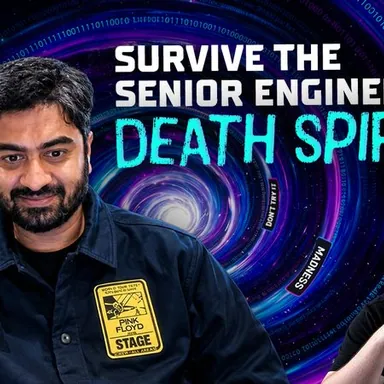
Sunil walks through the post that drew millions of views: an engineer trying to prove their level drives themselves into a spiral.
Read the chapter- After a promotion or in a new job, an engineer "cosplays" their level and takes on a big refactor they aren't ready for, almost the Peter principle.
- For weeks they give positive updates at standup, "I'll have something to show you soon," and in trying to catch up they lose sleep, eat less and spend less time with their partners.
- It ends in burnout, leave, a PIP or quitting, and it happened to Sunil himself on the React team.
The only way out of the spiral is to drop down a level and build momentum on small tasks.
Read the chapter- A P5 starts acting like a P4 and becomes the best teammate anyone has seen: bugs, helping people, the annoying tasks.
- To an engineer, Sunil says, the only thing that matters is the daily routine, not goals and releases; after 30 days you look back and see how much got done.
- In your head it's the worst case, but in reality everyone likes you, which is how you got picked for the team.
Twitter and Sunil's DMs welcomed the post, and Hacker News didn't.
Read the chapter- Sunil heard from people who'd just been fired, people doubting their self-worth, and many women who couldn't say it in public.
- The post is a voice dump in lowercase, and Sunil thinks it worked because it isn't slop: "Claude slop is so bad because you're listening to the same French dude over and over again."
- Hacker News commenters wrote that "no real engineering org would let this happen" and "I can't take anyone who says 'bro' this much seriously."
- Rhys went through a small version of the spiral shipping Vercel for Platforms and asks whether programming is still a creative endeavor.
Sunil advises managers to talk to a report in the spiral directly.
Read the chapter- The manager should stop the "grand vision stuff" and talk only about this week's work.
- To the objection that dropping a level means the project won't ship, Sunil answers that the project isn't shipping anyway.
- Help someone directly once, and next time they'll reach out to say they're struggling.
YC gives you exactly what you put into it, and Rhys isn't happy with himself.
Read the chapter- Once accepted, you get Bookface and the perks before the batch even starts.
- Partners won't build the company for you, but they give pointers, such as not fearing telemetry: "People won't care."
- Events cluster at the start and the end, with a lull in the middle, and Rhys wishes he'd gone to the co-working space more often.
- The product barely changed during the batch, and the right structure came to him two days after it ended.
Sunil likens YC to a modern university where you run reinforcement learning on yourself.
Read the chapter- At group office hours, founders set two-week goals in users or ARR, and if they miss them, they run an experiment.
- A goal, Rhys says, should be not "ship 50 PRs" but an outcome that moves the company, which you can only steer toward.
- Sunil thinks YC is still elite and special, even if naysayers recall "12 people in PG's kitchen."
Rhys rebuilt Executor once he realized every app can be code that an agent edits.
Read the chapter- No workflow will save you if you're dealing with the wrong set of primitives, Rhys says.
- In a thousand-message thread, workspaces forced him to separate the SDK from the product; contracts in Effect live apart from the implementation.
- MCP, auth and caching are all defined as code the agent edits, and through WebMCP any website can be turned into a set of tools.
- Rhys got the apps npm name from Zeke Sikelianos, who, Sunil says, invented Swagger and OpenAPI.
Models can't design an SDK, but while Rhys is out walking they find a slowdown and split the diff into PRs.
Read the chapter- Twice Rhys tried a Hail Mary rewrite with one big prompt, and it didn't work; everything grew on a slow exponential.
- While Rhys was out walking, the agent figured out why the app had slowed down and split the diff into a stack of PRs, but he rejected the lazy loading.
- "Make it right, make it good, make it fast": the extra 20 milliseconds can wait.
- Contracts and infrastructure as code in Alchemy let the agent deploy and tear down a test environment on its own.
The agent generates the code, but only someone with hands on the knobs can land the plane.
Read the chapter- Sunil compares Rhys's workflow to flying a plane and admits he might be able to take one up but could never bring it down.
- Following Ryan Dahl, Rhys keeps a private repo with notes and a clean public mirror, and a tweet served as the model's instructions.
- Rhys uses Theo Browne's T3 Code instead of the Claude desktop app and is excited about OpenCode v2.
- Rhys brought email and auth in-house on Cloudflare Email, since the agent can write the features on top.
Quotes
On Jev and the big models
“Someone's come up with something that's cheaper and ostensibly worse than large language models, and it's going to eat the market from the bottom.”
Sunil PaiRead from 11:57On Christensen's book
“The only business book that's worth reading is The Innovator's Dilemma by Clay Christensen.”
Sunil PaiRead from 12:41On why Code Mode came so late
“Like, sure, the models had to, like, get better and all this, but, like, I'm pretty sure if you went back to GPT-3.5, you plugged in Code Mode to it, it would, like, be able to call it and work super well.”
Rhys SullivanRead from 19:08On getting out of the death spiral
“So the move is actually to drop down a level. Like, if you're a P5, you start acting like a P4.”
Sunil PaiRead from 27:17On why Claude's writing gets tiring
“Like, this is the reason why Claude slop is so bad: it's because you're listening to the same French dude over and over again.”
Sunil PaiRead from 31:38On the objection that the project won't ship
“And I'm like, brother, the project's not shipping anyway.”
Sunil PaiRead from 36:36On "solved" coding
“Like, it's, like, fascinating if people say coding's solved, and, like, it's a weird thing, and, like, it's not solved. It's just, like, different now.”
Rhys SullivanRead from 1:07:06On how AI changed picking vendors
“Like, that's an interesting one in terms of, like, my buying purchases on software have changed to, like, what is extendable, what has the best security, what has the best reliability, because all of the stuff that would have made up for that in the past has, like, gone away a little bit.”
Rhys SullivanRead from 1:13:59
Summary
In episode six Sunil Pai and Rhys Sullivan record as a duo while Dillon Mulroy is away. In the month Rhys spent at Y Combinator, the world seems to have lived through a year: there was Navier–Stokes and the OpenAI–Anthropic math drama, and the controversial GPT-6 Astra came out, which Rhys adores. But the big news is Jev from TypeSafe AI, a "System One model": it doesn't write text but answers yes or no, a probability or a pick from a list in tens of milliseconds. JavaScript Twitter promptly buried it in demos. Sunil sees Jev as textbook disruption in Clayton Christensen's sense, cheaper and seemingly worse than LLMs but bound to eat the market from the bottom, as Cloudflare once did, while Rhys muses about things that are "obvious in retrospect": Code Mode or VMs for assistants could have been built years earlier.
The second topic is Sunil's post "The Senior Engineer Death Spiral," which has racked up millions of views. An engineer in a new job or freshly promoted tries to prove their level with a big project, gives weeks of "positive updates" at standup, skimps on sleep and burns out; Sunil admits it happened to him on the React team. The way out is counterintuitive: drop down a level, become the best teammate around and build momentum on small tasks, because for an engineer the daily routine matters, not milestones. He advises managers to talk to such a person directly. Hacker News didn't like the post, but a flood of people messaged Sunil.
Rhys sums up Y Combinator: you get out what you put in, and goals are set on outcomes (users and revenue), not the number of PRs. He isn't happy with himself: the product barely changed during the batch, and the right structure came to him two days after it ended. He then demos his new workflow: in Executor v2, built on Effect and Alchemy, every app is code that an agent edits. Models, in his experience, are bad at designing SDKs, but while he's out on a walk they work out why the app got slower and split a diff into a stack of PRs. Sunil compares it to flying a plane: anyone can take off, but only someone with hands on the knobs can land.
Advice
Don't put off anonymous telemetry for fear of backlash: done respectfully and with an opt-out, users don't mind, and you learn what they actually use.
In an accelerator, stay close to your batchmates and the co-working space: the energy and ideas from talking to them fade fast in the mid-batch lull.
Set goals on outcomes, not on work: not "ship 50 PRs" but users or revenue; you can only steer toward them, but they're what moves the company.
Before polishing your AI workflow, find the right primitives for your product: on the wrong foundation no agent will help.
If your product is open source, keep a private repo next to it for notes, plans and scripts, and keep the public one a clean mirror.
When choosing vendors, look at extensibility, security and reliability: convenience features on top you can now write yourself with an agent.
Mentioned
 Executor00:20Rhys's company: a tool gateway for AI agents
- Navier–Stokes existence and smoothness00:48its solution is credited to an internal OpenAI model
 OpenAI00:48the Navier–Stokes proof and the credit dispute
 Anthropic00:48one of its mathematicians ended up at the center of the credit dispute
Show 40 more mentionsShow fewer mentions
- Millennium Prize Problems01:13rumor has it OpenAI solved several at once
- GPT-6 Astra01:14"everyone hates it, I love it"
 OpenCode01:31an Astra limit for employees; Rhys is waiting for version 2
 Claude Fable03:56Rhys sent it to evaluate Jev
 Jev04:29the episode's big news: a "System One model"
- TypeSafe AI04:29the fun team that built Jev
 Vercel07:29checks tool calls with Jev; Rhys used to work there
 William Stanley Jevons08:12Jev is named after his paradox
 NVIDIA09:00the Jevons paradox, GPU edition
 Diogo Almeida10:44TypeSafe's CEO hits the conference circuit
 Clayton Christensen12:41author of the theory of disruptive innovation
- The Innovator's Dilemma12:41"the only business book that's worth reading"
- How Will You Measure Your Life?12:41Sunil calls it "How to Live Your Life"
 Cloudflare13:44a disruption theory company
 Matthew Prince13:44Cloudflare cofounder
 Michelle Zatlyn13:44Cloudflare cofounder
 Theo Browne14:36"he would call it T3 Safe"; maker of T3 Code
- Code Mode18:32took three years though it was obvious
 Claude Code19:08with a single bash tool
 Muse19:52personal assistants on virtual machines
 Grok Bot19:52personal assistants on virtual machines
 ChatGPT Work19:52personal assistants on virtual machines
 React20:54could have arrived years earlier
 Dax Raad21:36on teams that are having fun
 Waymo22:10Rhys counts their cars and wants to classify them with Jev
- The Senior Engineer Death Spiral22:48Sunil's post, the episode's main topic
 Claude Shannon31:38"Claude is French"
 Hacker News32:04didn't like the post
 Y Combinator38:03Rhys just finished the batch
 Answer Overflow47:37Rhys's earlier project
 Paul Graham48:33"12 people in PG's kitchen"
 Cursor51:02where Rhys runs a thousand-message thread
 Effect52:19the foundation of Executor v2
 Zeke Sikelianos55:09gave away the package name and came up with the name Swagger
 Alchemy1:00:53infrastructure as code in Executor v2
 GitHub1:01:21native stacked pull requests
 Ryan Dahl1:07:55Rhys borrowed his two-repo setup
 celld1:07:55Rhys uses it for the local version
 Lauren Tan1:09:40an engineer who builds quality software with AI
 T3 Code1:10:37brings all the harnesses into one place
Transcript
01Just the two of us, and a year of news in a month
Sunil opens without Dillon, and Rhys is back from YC raving about Astra.
Welcome to The Next Token. Today is Monday, September 21st, 2026. I'm Sunil Pai, and this is a podcast about three software engineers who don't have the time or the energy to be hosting a podcast. In fact, today Dillon is busy living his life1Dillon Mulroy — the show's third host; at the time he was on his honeymoon in Scotland, as he explains at the start of the next episode. and just really not having time to host the podcast. So it's two engineers.
I'm Rhys. I'm building out Executor.2Executor — an open-source tool gateway for AI agents: services are connected once (via MCP, OpenAPI, GraphQL), and any agent gets access to them with configured permissions. Rhys founded the company, which went through Y Combinator in summer 2026. Y Combinator page.
By the way, Cloudflare sponsored the show and I work there. Anyway, on today's show, Rhys has revamped his workflow, especially after YC.3YC — Y Combinator, Silicon Valley's best-known startup accelerator, founded in 2005. The program lasts about three months: companies go through it together as a batch and finish with a demo day for investors. We talk about Jev. I wrote a blog post. Rhys talks more about his experiences at YC. And you know what?
We're just gonna avoid discussing AI safety for the week. So let's get into it, Rhys. How's it going?
I think the last time we did an episode with me, it was like a month ago, and a year has gone by in terms of the state of the world. What do we have? We have Navier-Stokes, we have Jev, we've got the OpenAI-Anthropic math drama. We've got the, like— did you see the rumors of, like, the unreleased paper, that they just buckshotted a bunch of—
Millennium problems.4The Millennium Prize Problems — seven math problems for each of which the Clay Mathematics Institute offers a million dollars; one concerns the smoothness of solutions to the Navier–Stokes equations. In early September 2026 OpenAI announced that its internal model, almost without human help, had proved that solutions of the forced three-dimensional Navier–Stokes equations can lose smoothness in finite time. A credit dispute broke out at once: NYU mathematician Tristan Buckmaster and Levent Alpöge of Anthropic, who had proved a similar result for the Euler equations, accused OpenAI of behaving badly in negotiations. OpenAI researcher Sébastien Bubeck denied trying to strip Alpöge of credit but apologized for his remarks; he said OpenAI had gone after the Millennium problems following rumors that Anthropic had solved two of them. On September 21, the day of recording, OpenAI said the same model had resolved more than a hundred open problems. TNW, TechCrunch. Yep. Yep.
Yeah. Which, what a crazy fighting ground that is. I think this is my, like, first episode— I think I've been gone for like three or four weeks, and in that time we've had Jev, we've had Navier-Stokes. Astra came out.5GPT-6 Astra — OpenAI's flagship model, released September 3, 2026. It was considered controversial because of "opaque recurrence," a way of reasoning in which part of the thinking doesn't show up in the chain of thought and is harder to check. TechCrunch. Oh my God, what a model.
Everyone hates it. I love it. It's great.
I really like Astra. It's a problem. I swapped over to using— we got, like, OpenAI credits with, um, YC, and it's the first model that's made me tap into those credits, which I would be getting more creative if they weren't included credits, but I, like, understand— I empathize more with companies now. I saw OpenCode6OpenCode — an open-source coding agent from Dax Raad's team that runs in the terminal, on the web and as a desktop app, with models from Anthropic, OpenAI, Google and other providers. put $2,000 a month limits on their employees for Astra specifically, and I'm like, yeah, that is very reasonable, but also, man, what a model.
Maybe. It's like a day for me. I'm, like, using it pretty heavily at the moment. Oh, there's this really interesting thing with agentic coding7Agentic coding — work in which an AI agent doesn't suggest lines but carries out the task itself: it reads the project, edits files, runs commands and tests until it gets the result. where, like— we'll get into it a little bit more in, like, the workflow part, but, like, you have these, like, peaks and troughs, and so, like, right now I'm, like, in a peak and I'm, like, hitting flow state8Flow state — total absorption in a task, when you lose track of time; the psychologist Mihaly Csikszentmihalyi introduced the idea in a 1975 book. with, like, all the stuff that I'm doing. But, like, that's because, like, I've thought about the problem for, like, three months and I, like, have a very clear vision of, like, what it needs to be now. But, like, they're not helpful at all for getting to that point. So it's a fascinating, fascinating one.
You know, I would have thought that among the three of us, I was the one most susceptible to, like, psychosis,9Psychosis — a nod to "AI psychosis," the term for cases in which people lose touch with reality after long conversations with chatbots. Among developers the word circulates as a joke about people who run agents around the clock; later Rhys calls his own musings "psychosis ramblings." but you kind of got crazy eyes going on right now. That's what I'll say.
Well, look, I'll show it in the workflow part. Now you got me worried that I'm gonna show a slop app10Slop — low-quality content mass-produced by AI. A slop app is a hastily generated app that barely works. in the workflow part and it's gonna be an intervention.
I can't deny the results, just so we're clear. Like, I can't deny the results anymore of, like, software being built. I just want to make sure that you're getting a 20-minute walk and, like, eight hours of sleep.
Oh, yeah, I guess that's the thing about— I sent off a prompt that was like "make it fast," and I went on a walk, and I came back to— two hours of— went on, like, a walk around, I went to a market, I got a new piece of art for my apartment, and I picked up a steak from, like, a butcher shop. Then I came back, and, like, two hours later I came back to a completed report of Astra, and it was like, "Cool, your app has gone from one second to 200 milliseconds," because of, like, this large import had, like, snuck in.11Rhys posted about this walk on X. And what—
02The Jevolution
Jev is a classifier that doesn't write text but answers short questions instantly, and JavaScript Twitter promptly buried it in demos.
What a time. What a time to be alive. Love that. Speaking of which, have you been following the Jevolution?
I have— I haven't. So I sent Fable12Claude Fable — a line of Anthropic models; Fable 5.1 came out in September 2026. to play with it, because I'm, like, not ready to swap out— actually, I have a use case for Jev with my Code Mode stuff,13Code Mode — an approach Cloudflare introduced on September 26, 2025, in a post by Kenton Varda and Sunil Pai: instead of calling MCP tools one by one, the model writes TypeScript against an API generated from MCP servers, and the code runs in an isolated sandbox. Cloudflare blog. where there's, like, 10,000 tools in a catalog, and I sent Fable off and I was like, "Hey, go evaluate this." And it was, like, very— I was just gonna say, Fable was very impressed by it.
I haven't— I didn't, like, look underneath that, but it seems very good for my use cases, and so I'm excited to play a bit more.
For the rest of the room: Jev is the first— they're calling it a System One model,14System 1 — psychologist Daniel Kahneman's term (Thinking, Fast and Slow, 2011) for fast, intuitive thinking, as opposed to slow, deliberate System 2. TypeSafe AI unveiled Jev on September 15, 2026, as the first "System One model": it doesn't generate text but returns typed decisions with calibrated probabilities in 70–500 milliseconds; input tokens cost $0.042 per million, and output is free. TypeSafe announcement. from a company called TypeSafe.15TypeSafe — the name sounds like the programming term type-safe (code in which type errors are caught before it runs), which is why Rhys admits later that he took TypeSafe for a developer tools company. One of the founders is one of the co-creators, I want to say, of RLHF, the thing that powered ChatGPT, etc.16RLHF (reinforcement learning from human feedback) — reinforcement learning on human ratings. TypeSafe cofounder and CEO Diogo Almeida worked at OpenAI and was one of the authors of the InstructGPT paper (2022), whose methods ChatGPT is built on. And then he decided to go off, and for the past 18 months or two years— I think 18 months— they've just been in stealth17Stealth — when a startup operates without publicly revealing what it's building. building a better classifier model. That's it, that's what it is. So the big thing about it is that it doesn't spit out text. But you can ask it to answer either in terms of a boolean or something that they call a noul, which is how much of a yes or a no— it's kind of like a fraction18Noul — a question type in Jev: the model weighs a yes-or-no question and returns the probability that the answer is yes (documentation).— or you give it an enum,19Enum (enumeration) — a data type with a predefined list of allowed values. you give it a bunch of choices, and it picks the things that are most relevant. And you can talk to it effectively like a prompt, and this is how it answers it.
Are the fractions good in terms of, like— I guess, is that part of that training? Because I know when you, like— if you, like, have GPT rate a codebase, or, like, Codex rate a codebase,20Codex — OpenAI's coding agent: it writes and edits code, runs tests and carries out tasks in a repository. The current Codex came out in spring 2025. it will always give, like, seven or eight in terms of what it ranks it at. Like, due to the nature of LLMs, they always, like, hit that point in the middle.
The big thing about Jev is that classifiers have always existed, but they consider themselves a data company, not so much a model company. Like, they have given— and crazy, apparently most of the data was synthetically generated. Like, they consider themselves data artists. And it's trained on a large corpus of types of problems, which means that its guesses are very good. But the thing is, it doesn't have, like, a massive context window,21Context window — how much text (in tokens) a model can take into account at once: the prompt, documents, conversation history. right? Like, it's not like you can give it a codebase and say, "Is this codebase good?"
That's not what this is meant for. It's meant for, like, much shorter things, which is: is this email potentially risky? So they launched this, and it's just a classifier model. And so I saw it and I was like, "Okay, this is cool. I need to get back to it." And I come back six hours later and the internet has exploded.
Well, I say the internet, but, like, JavaScript Twitter has exploded, because everyone's using it for so many funny things: playing Connect Four with it, flying drones. I did a thing where I mixed it up with an LLM, and it's a fake 3D isometric world where you can give, like, fake laws, and every citizen reacts to it differently, and it gets stored into the state of the city.22Sunil's demo, a disaster-prone city. My favorite one was somebody used it to do live editing of a tldraw canvas,23tldraw — a developer kit that gives web apps an infinite canvas for drawing and diagrams. The Jev demo. where they're like— and it's funny to me, because three days before that I'd built a version of this with GPT Live and Claude. But this one just uses Jev, and it's so fast, where it's like, "Hey, can you put a yellow circle here? Can you move the circle over here?
Can you put a red triangle?" And it's instantaneous. Like— and that's when, like, the magic kicks in.
There was a really great one with json-render as well, by, um, ctate.24json-render — an open-source Vercel Labs framework for generative UI: the model outputs JSON against a predefined catalog of components, and the library renders the interface from it. ctate is Vercel engineer Chris Tate, the author of json-render; his Jev demo. That was— exactly. That was really interesting to see as well.
The way I understand it, the Vercel people25Vercel — a cloud platform for web apps and the company behind the Next.js framework. Rhys used to work there. have already made it the default on their eve harness,26Harness — the program around a model that gives it tools, context and a work loop; Claude Code, Codex and OpenCode are built this way. because I think every prompt gets, like, a security rating.27eve — Vercel's agent tool. On September 19, 2026, the company published a guide to checking every tool call in eve with Jev: the model labels a call safe or risky, safe calls run without asking, and risky ones wait for human approval.
Yeah, yeah, something like that.
Yeah, I'm excited to plug it into Code Mode. The reason I'm excited for that is you can just run a loop, and then for, like— the model can just, like— I have this prompt that I wrote that, like, goes through all my emails and X DMs and, like, classifies them in terms of, like, what do I need, what, like, needs my attention. And being able to, like— that prompt always takes, like, 40 minutes to run, and there's no real reason for that. I'm excited. I'm gonna go play with that.
Code Mode, I imagine the big one is: "Hey, which of my 10,000 tools are relevant to this query?"
Well, so, even using it inside the Code Mode script as well, like, to classify inside— yeah, because, like, it can just write these little scripts so quickly now. Yeah. Oh, that's exciting. Oh, and then did we get into the name of it? That it's called Jev because of Jevons paradox? That's right, which is— it's brilliant. Jevons paradox.
And Jevons paradox is that— by that one guy called Jevons.
Mr. Jevons, Sir Jevons, I don't know, whatever his first name is.28William Stanley Jevons (1835–1882) — English economist. In The Coal Question (1865) he observed that more efficient steam engines didn't reduce coal consumption but increased it: the cheaper it is to use a resource, the more of it ends up being used. This is the Jevons paradox. When you make something more efficient, it actually increases usage of that resource. It strikes in many places. My favorite is when they do it for roads, right? Like, if there's a lot of traffic on three lanes of traffic, so they're like, "Oh, let's make it a six-lane road."
Source: Nvidia annual report (10-K) for fiscal 2026; the fiscal year ends in January, so the DeepSeek drop fell in its last week
And you end up getting six lanes of jam-packed traffic. Like, it's just a thing, always. It's the thing with GPUs, right? Somebody made an efficient LLM and Nvidia stock dropped, and everyone's like, "Oh my God, we have to buy this," because two weeks later, of course, it went back up.29DeepSeek-R1 — a Chinese model trained far more cheaply than American ones. On January 27, 2025, after its release, Nvidia stock fell almost 17%, a record one-day loss of market value for a single company, about $590 billion. Same thing with Cloudflare. The security stuff came out and Cloudflare stock tanked, and everyone's like, "Oh, why are they shorting30Shorting — betting on a decline: borrowing shares, selling them and hoping to buy them back cheaper later. the bulletproof vest company when someone has just invented a gun?"
03A fun team and capital-E Engineers
The TypeSafe team is having a blast, while capital-E Engineers, in Sunil's view, get mad and miss a textbook case of disruption.
And again, I think Cloudflare hit, like, an all-time high today, which is kind of weird. But the fun thing about Jev is the team. So the TypeSafe team are a fun bunch. I think there are about 12 of them. I don't know the number, but you can see it on Twitter.31The TypeSafe team on X. And they're having a ball of a time on Twitter.
Jevons is their mascot now. Constantly they have generated images of him basically being a beefcake and, like, chopping down trees.
It's, like, Jevons is their mascot? Exactly. Yes, yeah, yeah. I have not seen this. This is incredible.
Yeah, yeah, yeah. If you follow those people, you'll see it all over the place, but they're going crazy on their Discord as well. On Discord, it is just a joyous time. Everyone's talking about— so every user gets, I think, free $5 in credits. And because it's so cheap, they'll use it for a day and burn through, like, four cents. And they're like, "I will bequeath the rest of my Jev credits to my children when I pass on."
They're having a lot of fun. I actually recommend, like, following that bunch. They have an energy which is very different from the model company energy. It's good to see.
What about the development process took two years? Was it, like, kind of figuring out the— did you follow much of that? I'm curious.
So again, they've been mentioning it. And by the way, their CEO, I think his name is Diogo, he's now starting the conference circuit. I think he's speaking— he's definitely speaking at Cloudflare Connect. He's going to be on the Latent Space podcast,32Latent Space — a podcast and newsletter for AI engineers, hosted by Shawn Wang (swyx) and Alessio Fanelli. and that's happening, like, this week.33Diogo Almeida, cofounder and CEO of TypeSafe AI, spoke at Cloudflare Connect 2026 and was a guest on the Latent Space episode "Jev: System One models for Prod, not God." I think, like, he's starting to do the circuit where he'll talk about it in more detail.
He already did a talk on RLHF at AI Engineer34AI Engineer — a conference on AI engineering founded by Shawn Wang (swyx), cohost of Latent Space. a while ago. The way I understand it is they fixed two things about classifiers. One is the data that it's trained on. Like, the problem with classifiers traditionally has been that you have to come with your dataset and train it, no matter whether using BERT35BERT — Google's 2018 language model; it and models like it are often fine-tuned on labeled data to build classifiers. or, like, one of the others. So no, this out of the box is very, very useful. And the API is beautiful.
It's very much a: here's some state, here's the prompt, here are your options, response. And it responds in, like, 20, 30 milliseconds. This is the thing that I knew would happen, and it was wonderful to see it happen exactly as planned, which is: a lot of engineers got mad about this. And I'm saying— I'm using capital-E Engineer. They were like, "Well, classifiers have always existed. Oh, look at this open source, somebody invented it six months ago."
ExplainerThe theory of disruptive innovation
Clayton Christensen distinguished two kinds of innovation. Sustaining innovations make a good product even better for the most demanding and profitable customers, and in that race market leaders almost always win. Disruptive innovations start out worse on the measures the market cares most about, but they're simpler, cheaper or more convenient, and they find buyers where leaders aren't interested: at the low end or in a new, low-margin market.
The dilemma is that a leader who sensibly listens to its best customers and invests in what's most profitable rationally cedes that low end. Meanwhile the disruptive technology improves faster than the market's demands grow, and one day it becomes "good enough" for mainstream customers too, and then it takes the market from the bottom up.
The book's main examples are disk drives (each new generation, from 14 inches down to 3.5, was led by new companies while the old leaders lost out) and excavators: hydraulic ones were small at first and good only for digging ditches, but within a couple of decades they displaced cable-driven machines. Sunil applies the pattern to Jev: a cheap, fast classifier is "worse" than a large language model, but it's enough for a huge number of simple decisions.
"Oh, like, I made an open source version this weekend that blasts past its, like, metrics." And you're like, yep. It's just— the way I'm thinking about it is that it's classic disruption theory, in the technical definition of the word. Someone's come up with something that's cheaper and ostensibly worse than large language models, and it's going to eat the market from the bottom. I suspect model companies will do something of their own, by the way, because of course they have to introduce it into their harnesses. But for now, it seems to the— and I say this, but, like, yeah, the CEO is also retweeting the disruption theory comparisons, because—
Do you want to give a two-sentence on disruption theory for those of us that—
Okay, so this is back to Sunil Pai's book club. The only business book that's worth reading is The Innovator's Dilemma by Clay Christensen.36The Innovator's Dilemma by Harvard Business School professor Clayton Christensen came out in 1997. In it he described disruptive innovation: simpler, cheaper products first take the low end of a market that leaders don't care about, and then displace the leaders. The sequel is The Innovator's Solution (2003). It's actually a trilogy of books, and they're great. He also has another book, which is— I think it's called How to Live Your Life,37Fact-checkSunil says How to Live Your Life, but the book is called How Will You Measure Your Life? (2012); Christensen wrote it with James Allworth and Karen Dillon (Wikipedia, "Clayton Christensen"). which is quite wonderful to read. Disruption theory is the phenomenon where a competitor, an alternative, shows up in a market filled with incumbents, and it is usually cheaper and worse than existing solutions. But by its very nature, it ends up eating the market and eventually toppling the incumbent. The book itself is written, I think, in 1999 or 2000,38Fact-checkSunil says 1999 or 2000, but The Innovator's Dilemma came out in 1997 (Wikipedia, "The Innovator's Dilemma"). so there aren't, like, software examples in it.
It talks about how— what is that machine that digs up dirt, bro? Hydraulic, what have you.39Excavators are one of the main examples in The Innovator's Dilemma: hydraulic excavators, small and weak at first, displaced cable-driven ones, and almost all the makers of cable machines failed to adapt. There are a number of examples. Point being that it is the only business book you should read. It's gripping. If you buy it and start now, in three hours you can, like, finish it.
Cloudflare is considered a disruption theory company, which is because Matthew Prince and Michelle Zatlyn, founders of Cloudflare, were Clay Christensen's students in Harvard Law School,40Fact-checkSunil says Harvard Law School, but Prince and Zatlyn studied at Harvard Business School, where Christensen taught (Prince earned his law degree at the University of Chicago); they founded Cloudflare in 2009 together with Lee Holloway (Wikipedia, "Matthew Prince," "Michelle Zatlyn"). which is just absurd to me. And if you look into how Cloudflare makes money, you're like, "Oh, this is what they're trying to do," because the technology is weaker, you know, Worker isolates, 128 MB RAM,41Cloudflare Workers runs code not in separate virtual machines or containers but in V8 isolates, lightweight sandboxed instances of the JavaScript engine; each isolate gets 128 MB of memory. and everyone poo-poos it because you're like, "Oh, it's not, like, a really big machine," but it is eating the market from the bottom up. So Jev— the TypeSafe company, which, by the way, they are terrible at naming things.
Terrible name. I was— oh, okay. You mentioned the outputs, and I was like, "Oh, does Sunil like the name?" I hate the name. I thought it was, like, a developer tools company. Exactly.
No, it's, like, a JavaScript company. They released a classifier.
Yeah, that's— well, he would call it T3 Safe,42Theo Browne ("he") — a YouTuber and developer who names everything T3: T3 Stack, T3 Chat, T3 Code. I guess. That's what he would call it. They're terrible at naming. They're just a bunch of ragtag, you know, "Hey, we are just here to have fun." And you can see the model companies haven't really, like, responded to it, because it's beneath them, I would imagine. But everybody loves it, and it's just— the other thing I notice is the way capital-E Engineers are responding to this.
They are competing with Jev as it's released today, but the TypeSafe team has a long roadmap of other things that they're going to start shipping now over the next few weeks and months. So it's really fun at the moment.
04Jev versus open source
Rhys compared Jev with open classifiers on Executor's data, and nothing came close.
What's the difference between Jev and the open source options? Because I— so I was like, I saw the tweets that were like, "Wow, why do you need this? These open source options are great. And I recreated it in an hour." And so I, like, sent Fable out, because I was, like, evaluating it for Executor, where I was like, I ship a local desktop version, data needs to stay on the user's machine. The— using Jev, it was like a 70% improvement.
It was excellent. And, like, it's so cheap that I'll probably have an option to just use it as, like, a hosted endpoint. But, like, for the users that don't want that, don't want that data to leave the machine, there needs to be, like, an option for them. Everything came in at, like, maybe, like, a 20% improvement, but no, nothing got close to it in terms of comparing.
Well, Jev is going to get better, whereas you've probably squeezed out a lot from this open source thing just to get up to the Jev benchmarks. Didn't even get close to the Jev benchmarks. That's just it. I'm telling you, like, they can— because they consider themselves a data company, the quality of the outputs is so good. You can try this with an LLM. And LLMs also— like, Jev even beats LLMs at some of these questions.
Now, LLMs get better at, like, bigger questions and larger datasets, of course, but that's the thing, which is, like, you actually don't need that for a large number of use cases. I do wonder, because it sure would be nice to have an open source version of this. I mean, an open-weights version43Open weights — a model whose trained parameters are published for download, so it can be run on your own hardware and fine-tuned. of this that I can run on my machine, that I can run on my phone, because I can build a bunch of useful stuff. And I suspect someone will do it. But then they're just trailing behind the TypeSafe team, who have many more tricks up their sleeve.
I have all of this intent information on the way that models search tools on Executor, and it would be interesting to see if I can have, like, a super specialized classifier for only my own use case that is, like, tiny, based on, like, the real data that I've got. I need to look into it in terms of, like, what the logistics are, but, like, for improving routing and everything, like, that would be— there's so much more left to do in terms of, like— we're at the tippy top of the iceberg. Purely based on vibes, I feel like there's probably another 2x leap over what Astra is available there. Like, in talking about— and this is, like, purely based on vibes, but, like, in terms of, like, model capabilities, I feel like regular LLMs can get better in that way.
It's, like, purely based on vibes, but it doesn't seem to be stopping. So, like, scaling,44Scaling — the growth of model capabilities from more compute, data and parameters; the regularities of that growth are called scaling laws. scaling, and then also, like, other novel use cases. Like, Jev is a really interesting one that I just didn't even, like, know kind of was a possibility or existed. Because it's, like— yeah, it's interesting.
You should absolutely train your own little classifier. By the way, if the outcome of this is that classifiers are suddenly sexy, like, you should absolutely— like, we didn't even— like, they've been around for decades, but suddenly seeing it in a new shape— and, like, no one's used specialized classifiers for all the use cases, even though they could have. And it's not that hard to, like, train a classifier, so to speak. But I think just showing it has, like, lit the way for a lot of people. I think that's the big thing that happened.
05Obvious in retrospect
Simple ideas like Code Mode take the industry years to reach, even when they were possible much earlier.
There's, like, another thing I've been thinking about here in terms of these things that seem, like, obvious in retrospect.45Rhys's tweet about things that are "obvious in retrospect." And I put air quotes around that, because I do not want to diminish the work that the TypeSafe team has done. Incredible launch from them, Jevons paradox, like, excellent work from them. You were mentioning that, like, classifiers are this, like, technology that's been around forever. And I look at something like— the one that I really feel this on is Code Mode, where it took us three years to go from putting every single tool in the model's context window to, like, Code Mode, as a hyper-efficient way for them to do execution. Why the hell did that take three years?
Like, sure, the models had to, like, get better and all this, but, like, I'm pretty sure if you went back to GPT-3.5,46GPT-3.5 — the OpenAI model ChatGPT launched on in November 2022. you plugged in Code Mode to it, it would, like, be able to call it and work super well. And, like, the principles behind it are not, like, super crazy, in terms of: you need lazy loading of tools,47Lazy loading — loading something not in advance but at the moment it's first needed. so you need search, you need to be able to invoke them, and then you need a way to be able to chain tools together, and you need to be able to filter the results. And, like, I mean, I had, like, a post on this called, like, "the execution environment,"48Rhys's tweet about the execution layer. and, like, we got that maybe a year and a half in, kind of accidentally, with bash.49Bash — the Unix command shell, first released in 1989. A bash tool lets an agent run any command in the terminal and so use every installed program. Like, people hooked up Claude Code50Claude Code — Anthropic's AI coding agent, which started out on the command line; a preview came out in February 2025.— Claude Code just had a bash tool, and everyone was like, "Oh, the more tools you give it, the—" oh, this was— I fell for this one.
"The less tools you give it, the more it can do." But no, you haven't actually given it less tools when you give it a bash tool. You're just giving it a different way to talk to the tools, because one CLI51CLI (command-line interface) — a program used from the command line, like git; a single such utility can have dozens or hundreds of subcommands. contains hundreds of tools inside of it. So you're just shifting the operation space.52Operation space — Rhys presumably means the action space, a reinforcement learning term for the set of all actions available to an agent. So, like, that's one. The other one was looking at the personal assistants: Muse, Grok Bot, now even ChatGPT Work.53Muse — Meta's personal AI agent, launched in the US in September 2026. Grok Bot — xAI's agents, each with its own cloud computer; the beta came out in August 2026. ChatGPT Work — OpenAI's agent inside ChatGPT for work tasks, acting in connected apps and files; launched July 9, 2026. This one might have been a little bit more in terms of— wasn't possible without the underlying sandbox infrastructure,54Sandbox — an isolated environment where an agent can run code and programs without risk of harming the real system. but, like, all of those are running real VMs now.
And everyone's like, "Wow, we've got these amazing assistants with access to browsers and all this stuff." But, like, again, I'm, like, pretty sure you could have given personal assistants, like, a full VM so long ago. I wonder if this falls into another one of those things that's, like— just, again, like, I hate using the, like, thing of, like, "obvious in retrospect" or, like, that kind of thing. But, like, yeah, it really makes me wonder, like, what else is out there in terms of, like, these small things that we're missing, and how do we find them? Yeah.
One of my favorite examples is when React launched in 2013, 2014.55React — a JavaScript library for user interfaces, created at Facebook and open-sourced in May 2013. Sunil worked on its core team. It could run on IE8, which was at that point six years old,56Fact-checkSunil says IE8 was six years old and that React could have existed in 2008, but Internet Explorer 8 came out on March 19, 2009 (Wikipedia, "Internet Explorer 8"), so it was four years old when React launched in May 2013, and in 2008 it didn't exist yet. which meant you could have had React in 2008. But no, it actually took someone to do the work and show what it looks like. And by the way, that's just it. When React came out, a hundred React killers also came out, a lot of virtual DOM libraries,57Virtual DOM — an in-memory copy of a page's element tree: the library compares the new version with the old and applies only the difference to the real page. React popularized the approach. etc. Not many of them survived.
Yeah, exactly, which survived. There's, like, a thing of being the one that invents— like, that's also why I'm, like, excited about TypeSafe, of, like, when you're the one that puts it out, there's, like, a— it feels like the one that puts it out generally, like, really takes good care of it, you know what I mean?
Yeah, I am excited about it. I think Dax mentioned this,58Dax Raad — a developer and one of the creators of the open-source coding agent OpenCode. which is that when you have a team that's, like, actually having fun, you suddenly get the stamina to do it for a long, long period of time. Because you're not really competing. Like, you're going to office to have fun with your friends almost on a daily basis. And again, like, no one serious is giving you attention, right? Like, it's all just your hacker enthusiasts, the people you're hanging out with on Discord and Twitter.
They've already leaked, I think, that they're going to do multimodal next.59Multimodal — able to work not only with text but also with images, audio and video. I think that's the next drop.
That's cool. I have Waymos60Waymo — an Alphabet company that grew out of Google's self-driving car project; its robotaxis carry passengers with no driver, including in San Francisco. go past my Ring camera,61Ring — smart doorbells with cameras and home security video; owned by Amazon since 2018. and I wanted to use Jev to classify. I have, like, a tracker that, like, tracks how many Waymos I've seen and what the different types are. And I was like, "Oh, can we use Jev for this?" And it's like, no, it's not multimodal yet. So I need Jev for Waymo detection.
06The senior engineer death spiral
Sunil walks through the post that drew millions of views: an engineer trying to prove their level drives themselves into a spiral.
Do we want to talk about your blog post, which I saw when you posted it, and then I checked back this morning and it's at, like, 2 million views on Twitter? And I think I'm the only person in the world who hasn't read it yet, which— I'm very excited to learn about it.
So I say— I don't mean to be that guy, but I do mean to be that guy, which is like, "Oh, you should go read my blog." I wrote a blog post of a conversation that I've had, I don't want to say 100 times before, but many times before. I call it the Senior Engineer Death Spiral.62"The senior engineer death spiral" (the post) — Sunil published it on September 19, 2026, two days before the recording. And it is by far the most common way that engineers kind of fail at work. I swear, like, I was in New York, I had it with, like, three different people, at which time I was like, "Okay, this is annoying as hell." And every time I write a blog post, I try to frame it as a blog post, you know, like, hero's journey,63The hero's journey (monomyth) — a common story pattern in which the hero sets out, passes a decisive ordeal and returns transformed; Joseph Campbell described it in The Hero with a Thousand Faces (1949). like, a start, a middle, and then this time I was like, "You know what? Everyone's tired of that shit," especially because I use, like, AI, like, LLMs to clean up my stuff, and I'm not going to spend two days then, like, making it not sound like an LLM.
So I just did a voice dump, and I did clean it up, but I was like, "Keep all the words, just, like, grammar, etc." I did, like, a once-over and I pasted it, and I forgot about— like, I say "forgot about it." I pasted it, and it kind of caught fire, like, immediately. I think I had— pretty sure I was at a thousand likes in, like, 15 minutes or something. I was like, "Oh shit, something's going on." So first let me tell you what the blog post is.
And the idea is: anytime an engineer either, like, starts a new job or a new project, or they just got promoted, okay? Things are going well for this person. And they think to themselves, "Oh, I need to act my level. I need to cosplay being, like, a senior engineer to show people that I'm, like, worthy of the position," or to get a promotion or something like that. And they try to be ambitious. They're like, "I am going to do a refactor that does so-and-so and enables so-and-so for the team," right?
And hell, they'll even say it. Everyone's excited. They're like, "You know what, man? Like, go for it, you can do it." And they start designing it. They start, like, implementing it quietly. And, you know, like, especially in 2026, they're like, "Oh, let me plan it out for six hours and generate, like, a big 10,000-word document," right?
And they start spiraling immediately, because, clearly— it's almost a Peter principle thing,64The Peter principle — a tongue-in-cheek law from the book of the same name by Laurence J. Peter and Raymond Hull (1969): in a hierarchy everyone gets promoted until they reach their level of incompetence. which is, like, they're not qualified for that, right? Like, they've ended up at a point of being not qualified for the work they're doing at the moment. But they'll keep, like, plugging away at it. And then, like, one week passes, two weeks pass, three weeks pass. They start doing the positive updates at standup,65Standup — a short daily team meeting where everyone says what they did, what they plan to do and what's blocking them. Traditionally held standing up so it doesn't drag on. which is like, "Yeah, guys, I'm still working on it. I'll have something to show you soon."
And everyone's like, "Yeah, awesome, man, whenever you want." And you'll even do the bluff, which is the "Hey, if anyone wants to reach out and, like, see, I'd be happy to chat with them about it." And no one does, but even if they do, you'll be like, "Oh, I have my demos kind of broken, I don't have anything to show at the moment," etc. So they start spiraling. And the horrible part of the spiral is that then they do things that make the spiral worse. They'll be like, "Oh shit, it's been three weeks.
So now in the next week, I'm going to try to do a month's worth of work. What I'll do is I'll just sleep a little less. Like, I'll go to bed at, like, 2 a.m., and that'll be good because no one will be online. I'll have time to focus." And they'll start losing sleep, they'll spend less time with their partners, they'll eat less, and it gets worse.
The spiral gets worse. And inevitably the horrible thing happens, which is: manager gets mad at them, the work is not, like, worth it, they will burn out, they will take leave. They will be like, "I've burnt out, I need to take, like, leave," and they will not recover after the leave, because the project is still, like, impending. I've seen people get PIPed66PIP (performance improvement plan) — a formal probation with specific goals; if they aren't met, the employee is usually let go. because of this. I've seen people quit their jobs because they're like, "Yep, I've just burnt all my bridges here by attempting this thing. Before making it worse, I'm just going to quit my job."
And it's horrible. It sucks. I've seen this happen to the best of— I've seen— it's happened to me multiple times. And you know what? I said it on Twitter, so I might as well admit it on the podcast. It happened to me, like, on the React team.
The team that I was so proud to join. I was like, "This is— I'm set. Like, this is the thing I want to do." I tried building Suspensey images,67Suspense — a React mechanism that lets a component "suspend" rendering until what it needs has loaded, showing a placeholder in the meantime. "Suspensey" images likewise wait to load before appearing on screen. and I had some demos, and they were cool as hell. Never shipped it. End of the year— end of one year, I was pretty sure I was going to get close to being PIPed, but I flamed out, I quit. And I kind of recovered really well, which is why I'm happy and, like, I feel safe enough to, like, admit these things right now, which is, like, yeah, like, my life has gone amazingly well after that, but it was rough.
07The way out: drop a level
The only way out of the spiral is to drop down a level and build momentum on small tasks.
Anyway, so it turns out the thing to do here is to not try to be more senior when you find yourself in that situation. The move— look, the project's not happening anyway. So the move is actually to drop down a level. Like, if you're a P5, you start acting like a P4. If you're a P4, you act like a P3.68P3, P4, P5 — engineering levels in the internal ladders of big companies: the higher the number, the more senior the level. And you tell yourself, "Okay, for the next week, two weeks, I'm just going to be the best teammate anyone has ever seen, best teammate in the world.
I'm going to do bugs, I'm going to help out people. I'm going to do the things that people don't have the time to do, all the annoying things."
Is this for someone who is in that— they're in that death spiral, and then—
So this is someone in the spiral that needs a way out.
This is— yeah, by the way, this is the thing, which is that I think a lot of the response was because no one had even seen an actionable solution to the spiral. Because the solution is counterintuitive as hell, because you think you have to perform harder and do better. But really, the thing you want to do is drop a level. And the reason for that is: in this game, in the programming game, momentum is everything. Like, you can only do things while, like, you're doing them as a matter of course. It's where you get the stamina from, it's where you get just the strength, etc. Like, we like thinking in terms of outcomes and goals and releases, but to an engineer, the only thing that matters is the daily routine. Not even the weekly, etc. stuff, no, it's the— you wake up in the morning. San Francisco people will grind their own beans and put a little spray of water69A spray of water — a coffee ritual: beans are misted with a drop of water before grinding so the grounds build up less static and don't fly around (the Ross Droplet Technique, RDT). on the espresso, or whatever your routine is. You make your coffee— I use a moka pot,70Moka pot — a stovetop coffee maker in which steam pressure pushes water through the grounds; Italy's Bialetti has made it since 1933. that's the fanciest I get about it. You do the routine, you sit down, and you just do your job, right? Like, you do the thing that you do every day, and you do just a little bit of work.
So you do your work, and you will notice that you will— that is the recovery mode. First thing it does is it repairs your relationship with everyone. The thing where you are constructing a worst-case scenario in your head that everyone hates me, it turns out is not true, because everyone likes you. You're on the team. Everyone always liked you. That's how they picked you to be on the team, right? You passed your interviews, etc.
You don't have to prove that you're someone bigger. But then you start getting momentum. You start sending bugs, tasks, then you look at the big project and you're like, "You know what? Instead of building the big thing, I'll just do something, like, for today to progress on it. I'll send, like, one PR,71PR (pull request) — a set of code changes that colleagues review before it's merged into the main branch. I'll send two PRs. Or I'll just build something by the end of the day that I can demo to my team."
And the moment you start getting momentum and you fix the relationships— that's how big work happens, because you do this for 30 days, you look back and you're like, "Holy shit, I just did a lot of work. I chewed through the project, it's going well, but because I'm not thinking about it in terms of milestones, etc. anymore, I actually got more done." This also I've done by myself. I've rescued myself from situations like this; other people have had. Anyway, that's what I wrote. I wrote this blog post down, and it's just a voice dump.
08DMs, Twitter and Hacker News
Twitter and Sunil's DMs welcomed the post, and Hacker News didn't.
You should read my blog. And it's caught fire. And I have to tell you about the reactions to it. One is: everyone really liked it, because I finally put a shape to a problem that everyone apparently faces in the industry. And then I had an actionable "oh shit, this is what you should do to fix it." And I don't think that ever— like I said, it's counterintuitive.
So no one had considered it before. Even worse were my— not worse, even more overwhelming were my DMs. The number of people who had just gotten fired, or were in situations like that, or had faced it, like, three years ago, not being able to admit it in public, but willing to say to me, like, "Thank you for saying something." I was so confused about, like, myself— somebody pointed out that they were confused about their self-worth. And the fact that I could just say that— like, it's not commentary on you, it's just a pattern that a lot of people— the number of women in my DMs who weren't able to, like, say it in public, they were like, "Thank you for, like, saying this." Bro, super— I felt happy, because, like, it felt like I gave them closure to do this.
So that thing is still going, by the way. I think it passed, like, 7,000 likes72Sunil's tweet with the post. or something. This is, like, my most popular blog post. I kind of hate that my most popular blog post is not a technical deep dive, it's this woo stuff. But it worked. But the other reason I think it worked is because it's not an LLM slop post thing.
I think everyone is super tired of reading the patterns, etc. Basically, because it's just one person speaking to them, right? Like, this is the reason why Claude slop is so bad: it's because you're listening to the same French dude over and over again. I assume Claude is French, by the way, because of the name. Claude Shannon, right?73Claude Shannon (1916–2001) — American mathematician and engineer, the founder of information theory. Not French. Anyway, anyway. So I think me saying it in— and I write in lowercase, and it's got a lot of, like, "right, bro, man" in it.
I think that really connected to people. And as you can imagine, Hacker News was not happy about this post,74Hacker News — a forum on programming and startups run by Y Combinator, hence Sunil's joke about "nerds in Hacker News" as he turns to Rhys's YC story. The discussion of the post. which is also good. Like, it got a bunch of engagement because of it. They were like, "No real engineering org would let this happen. How can, like, management let this happen," etc. "Also, I can't take anyone who says 'bro' this much seriously.
Clearly this person has no seniority whatsoever." Oh my dude, I just got promoted, like, three weeks ago. This is a weird thing to say. I mean, like, there was some decent discussion, and even there, there were three or four people who were happy, they were like, "Oh shit, like, I recognize this pattern, that's happened." But it was very funny to me that on Twitter I had this overwhelmingly positive reaction, and Hacker News were like, "Well, like, maybe they should have a mentorship program in—" What are you talking about, dude? Nobody constructs companies this way. But you should read my blog post. It's— it's something that I've spoken to so many people about so many times, it's happened to me.
I was just happy to, like, put it down. I think that's the post. So you should read my post. I can't believe you didn't read my post, Rhys.
I know, I can't believe I didn't either. I did bookmark it.
I don't know, I hit, like, a small version of that one trying to ship Vercel for Platforms when I was at Vercel, where I had this, like, big grand vision of, like, "I want to get this docs site live, and, like, this, like, set of components, and, like, these elements," when, like, really the best thing— like, I wanted it all to come out as, like, one big piece kind of a thing, when you can, like, make progress so much more piecemeal and, like, iterative. That one ended up landing, but, like, it was definitely one of those ones where it's like, "Yep, I'm making progress, I'm, like, working on it." There's, like, a— do you think programming is, like, a creative endeavor, or, like, the, like, engineering?
Well, it used to be, at least for me. I'm not so sure anymore, right? You don't think it's still creative? Well, it is still creative. Well, okay, the type of art, I think, has changed. I used to think that the typing and the functions— I thought that was the art, but now I think about it in terms of, like, connector blocks and the flow of data.
I think it's still art. Yeah, it is still art. I can appreciate that. Yeah, it makes sense. Also, the Hacker News crowd— I don't know, is it just people that, like, are on Hacker News all day? Like, I don't understand the Hacker News crowd. This is— I don't want to anger them.
I think— is it cultural? The thing that I've spoken about this before— I don't remember if we did it on the podcast. Okay, so the reason that simple topics get a lot of engagement is because it's very simple to engage with simple topics, you know what I mean? So if you're on Hacker News— by the way, the name of the place is Hacker News.
So if you're there, you have to be a hacker, you know? Like, "Oh, like, I'm better than other people." So they're always looking for opportunities, things to contribute to. Right. And then they see something about, like, "Oh, this is about senior engineers." They're like, "Well, I'm a senior engineer, so I will have a take here."
09What managers should do
Sunil advises managers to talk to a report in the spiral directly.
I know you mentioned that you were unhappy that one of your best ones isn't a technical blog post, but I feel like this matters so much more than the technical blog posts.
I've had managers reach out to me. Yeah, no, no, it is clearly important. Hell, managers reached out to me saying, "Heck, I've seen this in reports before. And the fact that you're giving me an actionable thing means I know what to do the next time it happens."
Yeah, do you have advice— your advice was from the perspective of engineers wanting to get out of it themselves, but for the managers that— for the managers that, they manage people, and they're like, "Oh, this person's going kind of the wrong direction," do you have, like, a— it's literally the same thing?
You tell them to pat the other person on the back— virtually, I imagine, nowadays— and be like, "Okay, calm down. I'm going to help you, like, ship this. The first thing you're going to do is you're going to stop this grand vision stuff. We're just going to talk about what you're doing, like, for this week. Don't worry, the entire team is here to, like, help you." Look, a little of the pushback that I got on this post, they were like, "Well, if you do this, the project is not going to ship if you, like, drop down."
And I'm like, brother, the project's not shipping anyway. That's the point I'm trying to make.
Yeah, it's not happening. Like, would you also burn out, like, people on it? Do you think the way for managers to approach it is to be very direct in terms of, like, "Hey, we should chat, you've been struggling on this one for a little bit. Like, we want to help you out and make momentum"? Or do you think it's more, like, a less— I guess I wonder, is it best to do, like, the kind of direct chat, or is it more of, like, a "Hey, I know you have this project going on, but let's also, like, start tackling some of these small bugs and, like, start splitting your time here a little bit more"?
No, no, I think you want to be direct, because if you're not direct, that gives the person the opportunity to continue the ruse and spiral more, right? "Oh yeah, yeah, I'll do my work and I'll do, like, bugs, tasks." So now you're, like, double the workload. No, I think you want to be direct. I think you want to build that high trust, because the moment you're direct and you actually help them out, that means the next time you're in the spiral, that option opens up in your head: "You know what?
I'm just gonna reach out to my manager and be like, 'Bro, I'm, like, struggling.'" Yeah, I think so. Again, I don't have a lot of management experience. The last time I tried to manage, it flamed out really badly. That's why I like being a bit of a lone wolf sometimes, I guess. Speaking of nerds in Hacker News, Rhys, you've been doing Y Combinator. You just finished it up.
10Rhys on Y Combinator
YC gives you exactly what you put into it, and Rhys isn't happy with himself.
You did the demo. We were so happy for you. I think we even gave you a shout-out in our last episode. How was it, bro? Like, I would love to hear your experience. I have not done YC, and I bet most of our listeners haven't.
Yeah, it was a really interesting experience. One of the interesting things on it is when you get accepted to it, you get access to, like, the Bookface75Bookface — Y Combinator's internal social network for the founders of its companies. and, like, the perks and all that, like, immediately. And so even though your batch hasn't started yet, you can, like, just kick off work and start going. And then, in terms of, like, the experience, I feel like what I landed on for it was: you really get out, like, what you put into it, in terms of, like, the partners— like, the partner is not going to, like, build your company for you. They've seen enough of the same situations over and over that they can, like, give you the small little guiding parts. And there's a bunch of, like, interesting things there as well.
Like, one example of what I mean by that— and this one isn't so much a guiding part, but, like— so I added telemetry to Executor,76Telemetry — automatic collection of data on how a program is used: which features get run and where errors happen. like, anonymized, for the local app. It's, like— I had these features, like toolkits, and I was like, how are people actually using— like, are people actually using this? Does it make sense to have— also, like, I know telemetry is, like, an interesting subject, but, like, I actually think, as long as you do it in a respectful way, it's, like, fine to have. I pushed off adding it for, like, a month, because I was like, "I don't know, I feel like people are going to be really upset about it." And their advice was like, "People won't care."
ExplainerHow a Y Combinator batch works
YC is a three-month program, now run four times a year: winter, spring, summer and fall. On the day a company is accepted, YC commits its standard $500,000: $125,000 for a fixed 7% plus $375,000 on an uncapped SAFE with a "most favored nation" (MFN) clause, meaning on the same terms as the best subsequent SAFE.
A batch is divided into groups led by YC partners, and the groups into sections of 6–10 companies. The heart of the program is office hours: one-on-one meetings with a partner and group sessions where founders report together on their goals for the coming weeks. The program ends with Demo Day, when the companies present to investors; YC says many founders call the eleven weeks before it the most productive of their lives. After the batch, founders keep the alumni network and the internal social network Bookface.
Like, I was like, "Well, and it has to, like, land with this other stuff," and, like, I'm overthinking it. And yeah, it was like— there's, like, an opt-out if people want it; people don't mind. So, like, that was interesting. And then also the other thing that I really enjoyed— so then there's the actual, like, structure of it. So, like, batch kicked off a bunch of kind of events at the start of the batch, meet the batchmates, and then kind of, like, slows down towards the middle, where, like, you've got, like, your structure a bit more now, your batchmates, you've got your structure a bit more now, and it's like you really need to be focused on, like, building, talk to customers, that kind of an element. And then ramps up towards the end.
Sorry, when I say "ramps up towards the end," I mean, like, the kind of getting back together with your batchmates, like, that element. There's, like, this— I don't know, there's a bunch of interesting things. There's, like— the lull was actually a little, like— I kind of missed the events, or, like, batchmate energy, in the lull. I think that's more on— to either, like, supply yourself, or, like, they also had, like, these things of, like, founder dinners, where they would, like, match you with a group of founders. But whenever I'd, like, come away from the events, I would, like, have a ton of energy and great ideas from, like, talking to my batchmates, and then, like, I lost that a little bit in the lull. But back to, like, the "you get out what you put into it" thing, there was, like, a co-working space that I could have gone to a little bit more often.
It's just, like, my apartment is, like, a 45-minute, or, like, 30 minutes out from, like, where they are. That's also another one, is, like, if I was doing YC— like, I had an apartment in San Francisco before YC, and I was like, "Oh yeah, like, good with my apartment location." Probably would have been good to just, like, spend more time, like, over in, like, the co-working areas, like, that kind of an element, I think so. Did you like it? Oh yeah, 100%. There's always so much to be done instead, on top of.
It's a company that, like, cares a lot, I would say, in terms of, like, they want you to succeed. Like, obviously they have, like, a very vested interest. It's actually kind of, like, funny in terms of— if you compare it to, like, college, where, like, you've got this, like, really great vested interest in them being in, like— the alignments are incredibly aligned, in terms of, like, if you succeed, they succeed. I'm like— I guess, I don't know that that's a good comparison, because you do— there is that alignment, kind of, in college, but, like, they get the money regardless. I'd say that, like, I really enjoyed the, like, getting to meet the people, the partners.
There's something about, like, being in a space where, like, everyone cares so deeply about what they're working on. And, like, you would go and talk to every— and every single person was, like— you would talk to them, and, like, you would get kind of blown away at, like, "Oh, there's really, like, a deep passion, a deep, like, care, deep energy for, like, what they want to build and what they want to—" I also really appreciated that, like, pretty much everyone was, like, wanting to do good in the world, or, like, make people's lives better. It was great seeing that basically everyone was, like, very directionally aligned, in terms of, like, not only wanting to have a successful startup, but, like, wanting to make something that, like, helps people in some way. And I think on Twitter there can be sometimes, like, a vibe with some startups where it's, like, either— I think sometimes people view startups as, like, a race toward the bottom, or that kind of a thing.
But I think that there is, like, just this, like, great energy when you, like, go in and you're like— either you're naive to a process, or you're like, "How hard can it be?" And you go in and you, like, find all of these things. Like, you'll have this when you start a new job, where you start a new job and they're like, "Yeah, the kitchen catches on fire every Tuesday at 3 p.m., but the fire extinguisher's pretty good and gets it most of the time." There's kind of that vibe for, like, when people look at how, like, different industries— like, how software is done. And so yeah, and then also the, like, last part that I really loved doing was— I got to, especially on, like, the community side, and as the batch wrapped up, I got to make a bunch of introductions between investors and batchmates.
And, like, that process was so much fun, because it was connecting, like, investors who cared really deeply about startups and people to people who cared really deeply about products and what they're building. And so, like, that whole process was great. The last thing is I was actually, like, not super happy with the progress that I made in the batch. If you, like, go look at how the product's changed, it actually hasn't changed that much over the course of the batch. And, like, the reason for that— and maybe this is the senior engineer death spiral— but I was like, "I have this, like, grand vision of what I want it to be." And I, like, kept trying to get to that grand vision, and, like, it's an interesting one in terms of, like— I actually view programming— we mentioned this— like, I view programming as, like, a creative process a little bit, and, like, it was, like, a little bit of trying to, like, force that creative output out of it.
And now that I've, like, figured that out, I'm, like, very excited. And, like, now that I've, like— and so, like, what's funny is, like, the batch wrapped up, and then, like, two days later I figured out what the right structure of the product is, what this, like, nice kind of framework setup is. And we'll dive into that a little bit in workflow, because my workflow has changed a little bit. Yeah, it's an interesting one of, like, you can ship fast and you can, like, iterate, but also, like, shipping fast and iterating on the product as it is, it's kind of like polishing a turd when there's, like, a significantly better version of it to exist. Yeah, really just, like, very, very happy that I did it, and especially as an ongoing resource as well.
Just incredible. I very much would recommend it to people, I would say.
11YC as reinforcement learning
Sunil likens YC to a modern university where you run reinforcement learning on yourself.
I was going to do a bit about how I think YC is the modern university, where all these very high-energy people come and focus— I don't want to say in, like, classrooms, but definitely in the shared space, hostel— they kind of eat together.
They have— I don't want to say teachers, but partners, who, well, are an extremely— a fairly rare resource. But I think the real analogy here is that you're actually doing reinforcement learning on yourself,77Reinforcement learning (RL) — a training method in which a model tries actions in an "environment" and is rewarded for successful ones. Modern LLMs are fine-tuned this way, hence the comparison: YC is an environment where a founder learns from their own attempts. on, like, how to work before you face the real world.
They had a comparison— there's a group office hours,78Office hours — founders' meetings with a YC partner; in group sessions several companies from the batch report on their goals together and work through problems. a little bit like group therapy, basically, where you have, like, eight of your batchmates, and each of them, you, like, set goals for yourself on, like, "These are what I want— in two weeks I want the company to have X amount of users or X amount of ARR.79ARR (annual recurring revenue) — how much a company will take in over a year from subscriptions and contracts at its current pace."
And they mentioned that that was their, like, reinforcement learning environment for founders: if you don't meet those goals, then, like, you go run an experiment and you try something new.
Yeah, it's interesting. I really like that goal-setting process, because you were meant to basically set the goal on what the output of the work was, not the work itself. And so what I mean by that is, you know, if it's like, "Ship 50 PRs" or "Ship a certain feature," it's like, great, that's in process of getting users, or that's in process of getting revenue. The other thing is, I think, like, setting goals that are, like, outside of your control, if that makes sense. So, like, at the end of the day, like, users is in your control, in that, like, you can steer in that direction, but you can't just, like, go get a hundred. I mean, you can, but, like, you have to— like, I don't know, like, you could go pay 10 people or something, you know? But, like, you're, like, steering in the direction of the goal, instead of, like, it being something that you can just go, like, achieve, but doesn't actually move the needle.
I don't want to say I'm jealous, but I'm definitely jealous of people who go through YC, because you end up with a network. Like you said, like, it also, like, lasts after the three months are over. And, you know, I'm already an Executor fan, so I'm really happy you did it, bro. Like, super cool.
It was, like, pretty magical getting, like, the acceptance to it. And it was also fun. I like the comparison that you made to, kind of, like, college, where, like, when I was in college, I was, like, so focused on, like, doing practical things to, like— or so, actually, one thing that I liked a lot about my college is they did a lot of, like— it was, like, an engineering degree, but it was structured as in, like, you're going to be working on GitHub and doing collaborative projects to, like, learn the PR process, to, like, learn the collaboration process and what it's, like, actually like in the real world. They had, like, a big focus on real-world learning. And, like, also, the reason I started on Answer Overflow,80Answer Overflow — a project that makes Discord discussions visible to search engines (website). Rhys single-handedly grew it to 1.5 million users a month. my, like, web-indexing Discord project, was I was like, "Oh, one day I'm going to be in an interview, and they're going to ask me, 'How have you handled systems at scale?'" and I'm going to be like— ah. I like the alternative paths.
Although, is it still alternative, or is it mainstream now?
YC, I think— no, it depends on the context, who's looking at it, I guess. Most people don't go through YC. A lot of people on Twitter do, and, like, the people I follow and the people who follow me do, but no, I think it's still fairly elite and exclusive. I mean, there will be naysayers, like, "YC was better when it was 12 people in PG's kitchen81PG — Paul Graham, cofounder of Y Combinator. YC started in summer 2005 with a program for eight startups in Cambridge, Massachusetts." or whatever, but no, I think it's still pretty elite and pretty special. On that note, I want to hear how your workflow has actually changed. You got super excited about this yesterday, saying, "You know what? I'm hitting my stride, and I badly want to show my second take on this," which, by the way, is fairly classic.
12Executor v2: everything is a custom tool
Rhys rebuilt Executor once he realized every app can be code that an agent edits.
Again, Executor, you weren't happy about it a while ago, and now you're like, "Yeah, I'm gonna land the thing. It's coming." So we want to see your workflow, man.
The pretext I'll give is: it doesn't matter how good your workflow is, if you're, like, dealing with the wrong set of primitives,82Primitives — a system's basic building blocks, from which everything else is assembled; for Rhys these are accounts, providers, apps and deployments. or you're, like, dealing with, like, a lack of understanding of a realm of the problem, like, the AI really is just not going to help you out of that scenario. And I'm realizing, like, two months ago I tweeted that I was unhappy with AI tools, and I got a Dax reply that I did not understand at the time, and now I get it, in terms of, like, this is what— goddamn.83Rhys's tweet about finally understanding Dax's reply. So what's interesting is, like, the thing that actually changed, partly, is not, like, the tool. Like, I think it's fun to talk about the tools and, like, how I've been working, but, like, the thing that changed really wasn't the tools, it was, like, the way that I was building the product.
And, like, that's just something that, like, I have no— I wish I had practical advice in terms of, like, this is how you figure out what you need to build, or, like, what the right thing to build is.
But, I mean, it is something you can kind of, like, make progress on too, but, like, I tried to do it a couple times. Anyways, diving into the workflow. I have this chat, which is "Executor workspaces," and this chat is, like, probably about a thousand messages now at this point. And what happened is I had to build this feature for Executor that was, like, workspaces for specific users, where it's like, you know, if you're in sales, you should only have your sales apps. And if you're, like, an engineer, you can have access to Datadog,84Datadog — a cloud platform for monitoring servers and applications. that type of stuff. And I was, like, doing workspaces, and, like, in the back of my mind, I had, like, that I wanted to do custom tools in a little bit.
And then also, the way that I, like, built it originally, there was, like, too much intertwining between what I would consider, like, the SDK85SDK (software development kit) — a set of libraries and tools through which developers build a product into their own code.— Executor SDK— and the Executor product. I'm gonna open it up in Cursor86Cursor — a code editor with built-in AI from the company Anysphere, built on VS Code. so I can, like, talk a little bit about examples. But basically, like, I went to ship this workspace feature, and I was like, "Oh, these two concepts are so intertwined that, like, building workspaces can be a little bit of a mess. So let me, like, back up here and present the options of, like— here are these three things: I want to do custom tools in the future, I want to clean up the SDK, and I want to have this workspaces thing." I really do want to get to the start of this thread, because I think it— ah, I'm, like, tempted to get to the start of this thread, but I think it's going to be too annoying to get to.
But so I basically was just like, "Okay, let's pop open Cursor and, like, let's first figure out what, like, the SDK shape is." And so I started with this project. I started with this SDK package, and I was like, "Okay, what is the, like, shape of this?" And I've got this split into two folders. This has been really helpful for me as well. I have a contracts folder, and I have an implementation folder.
And so, like, I'm using Effect,87Effect — a TypeScript library that describes programs as values with typed errors and dependencies and handles concurrency, retries and resources (website). and what's great about Effect is, like, I can define my API handlers, my schema, everything outside of the implementation. And then implementation becomes, like, an implementation detail, and I can kind of just see how it comes together. So then I was like, "Okay, go put together this SDK. We need to have providers, we need to have, like, these concepts, like accounts, providers, tools, apps, that kind of a thing." What's interesting with Executor is there's, like— there's just this, like, long tail of integrations88Long tail — the mass of rare, niche items that together weigh as much as the few popular ones; Chris Anderson popularized the phrase in a Wired article (2004). that it really needs— like, I really want to get right with it. And one of those things is, like, "Oh yeah, multi-account support."
You should be able to use multiple accounts of one service. So this is the Executor product as it is today. Today they're called integrations. You can, like, hit this "add integration," and when you add an integration, you get, like, the MCP89MCP (Model Context Protocol) — an open protocol Anthropic introduced in November 2024: a standard way to connect external tools and data to AI models.— so you can add MCP, OpenAPI,90OpenAPI — a standard for machine-readable descriptions of HTTP APIs, formerly the Swagger specification: documentation, client libraries and tools are generated from such descriptions. GraphQL.91GraphQL — an API query language created at Facebook in which the client specifies exactly what data it needs. So you can add them, but, like, it's just such a rigid product in terms of, like, what if you want part of an OpenAPI spec? What if you want to add caching to it?
Or what if something doesn't have these clean elements? And so, like, I have, like, never really been that happy with this as a product. And so what I wanted to get to was custom tools. Maybe, like, a month ago, I had the realization that, like, everything is a custom tool. And so then we can dive into the v2 code here. And so, first of all, the UI— not to toot my own horn, but, like, much better. And then, like, here's the Axiom MCP.92Axiom — a service for storing and analyzing logs and events. PostHog, which Rhys mentions next, is an open-source product analytics platform.
And you can actually see a little bit about— like, this is something I spent a ton of time on, is, like, what does this defineApp shape look like. And so you can still, like, add apps, you can still, like, add an MCP server, but it just scaffolds all of this code for you. Let me do PostHog. Oh, interesting— your definition is code now? Like— yeah, so it's all defined as code.
This is too slow. This will get fixed before it goes live. I just merged the thing. But so it's all defined as code. And what's super nice there is it's one path for everything. So, like, there's not a separate MCP tools thing.
And so it does add, like, complexity in terms of, like, if you think about what's involved with, like, calling an MCP server now, you have to, like, do this deployment and stuff. But, like, a lot of that kind of gets hidden. Like, at the end of the day, it'll still be the same amount of clicks. But, like, what's nice here is now you have PostHog. If you want to, like, change how policies work on PostHog, you'll just, like, prompt your agent to be like, "Hey, yeah, remove these tools."
Yeah. If you want to, like, add caching, you just tell it, "I want to add caching." Also has the apps npm package name,93npm — the main JavaScript package registry. Package names are unique, and short dictionary names like apps were taken long ago, so such a name is a valuable gift. which is amazing. And I want to shout out Zeke, because I got the npm package name from Zeke.
You got Zeke's? Do you know the thing I learned about Zeke last week? Just such a— like, such a reserved dude. He invented Swagger and OpenAPI.94Fact-checkSunil says Zeke invented Swagger and OpenAPI, but the Swagger specification was started in 2010 by Tony Tam at Wordnik (Wikipedia, "OpenAPI Specification"); the name was coined by Zeke Sikelianos, a designer and developer who worked there too. In 2016 the Swagger specification was renamed the OpenAPI Specification and handed to the OpenAPI Initiative under the Linux Foundation. Sunil's tweet.
I saw that.
I wish. So I got coffee with him, and I was like, "Thank you so much. This is an incredible gift of a package name." I wish that I knew that he invented OpenAPI then, because, like, that's amazing.
It's such a— it's a spec that's just, like, stood the test of time in terms of the value of it. I was sitting next to him, I was like, "What do you mean you invented it?" And, you know, like, he's such a, like, reserved, just very calm dude. He was like, "Yeah, it was good, man." I was like, "Shut the hell up, man. Like, everyone uses this."
Yeah, Zeke's a cool guy. He's great. Yeah, so everything gets added as code, and so it just, like— when this— this is, like, a quick add flow. And it just scaffolds out. Like, it inserts an MCP. But what's really cool is, like, auth is defined as code.
So, like, OAuth,95OAuth — a standard for delegated access: a user lets an app act on their behalf in another service ("Sign in with Google") without handing over a password. API key. Like, it's just, like, if you need to set a header in a certain way, or have, like, a certain secret. Also, I have a really cool demo of this working, where you can actually sub this out from OAuth to browser, and it pops up a headless browser96Headless browser — a browser without a window, driven by a program: it opens pages, clicks buttons and fills in forms. where the agent can then inject— like, control the code— and it can modify its own app, and then it can insert— it can basically convert any website into a set of tools through WebMCP.97WebMCP — a proposed web standard under which a page itself describes its functions as tools available to AI agents in the browser. And it, like, builds the WebMCP out, which solves this long tail of, like, things that I have wanted to get the product integrated with. It's such an incredible, like, primitive to have finally stumbled upon. Or it's not "stumbled upon."
"Stumbled upon," like, takes away the, like, two months of banging my head against, like, SDK shapes and everything. Back to this. So I, like, had this— oh, and then, like, what apps contain is: apps have tools, skills,98Skills — the Agent Skills format Anthropic introduced in October 2025: a folder with a SKILL.md instruction file and any needed scripts, which an agent loads only when it's needed. UI, storage, triggers, workflows. And so, like, if you, like, think about how you work with PostHog, and, like, you think about the way you, like, interact with data and all this stuff— when I'm, like, working with PostHog, I might, like, want to visualize something, I might want to start extending the MCP out. And, like, I might have this interaction that's like, "Yeah, I want, actually, this every day to go into PostHog to, like, sync some data, or to, like, run this cleanup script, or to visualize this."
And so you start from this, like, super basic package, the agent knows about it, and then can just modify it how it needs. And so it's got deployments in here. This is all built on Cloudflare as well. It's open source as well. And so, shout-out— I wish— this is using Artifacts,99Artifacts — a Cloudflare service: versioned storage for AI agents that speaks the Git protocol. Dillon Mulroy is among its authors; a private beta opened in April 2026, and a public one on October 1. Product page. which is also great. But yeah, you've got, like, the working source there, you can see, like, the commit history. The goal is for, like— what's so funny is, like, I think that I'm just gonna tell people to edit this stuff through their agent, because I, like, want to build out as little UI stuff as possible. And, like, if you look at— like, I mean, think about how am I going to do this old, like, configuration, "add OpenAPI spec" flow— I don't have one offhand, but, like, it, like, popped up this, like, really annoying editor to, like, have to insert headers and all this stuff into, and it's like— it's just such a better experience to do it through your agent.
Also, accounts are no longer linked to integrations. Accounts stand standalone, and the reason that that's nice is you can then, like, fork this Axiom package into, like— you can have an app that uses Axiom, PostHog and whatnot in, like, one specific app. How I, like, got here is really just, like, thinking through the SDK in terms of, like, what's needed if we're on an SDK like this, and what does it look like. And then, like, I was like, "Okay, actually, the, like, apps—" so I'm thinking what primitives there are: there's accounts, providers— an account is an instance of providers— and then there's deployments as well. This SDK shape was kind of inspired by Vercel, in terms of, like, you have an app and then you have deployments in that app.
13Models are bad at SDKs
Models can't design an SDK, but while Rhys is out walking they find a slowdown and split the diff into PRs.
And just, like, a lot of it was, like, just working through these different SDK shapes and trying out different designs. And it's fascinating, because, like, the models suck at this. The models are so bad at SDK design. And, like, there's also been a couple of times where I, like, tried to do— there was, like, two times where I was like, "Okay, I get it. People on Twitter say that things are good now. And so I guess I can do a Hail Mary rewrite to get it from this product to this product. I can just go prompt, like, have this big prompt and, like, have this set of Markdown files, and it'll work."
And, like, no, that's not how it works at all. No. And so what the kind of evolution of this project— there's this— maybe needs, like, a blog post or something, in terms of, like, getting into the nitty-gritty details. But it was, like, this really, like, slow exponential in terms of, like, getting all of the foundation and the building blocks for the model to play with. And so, like, there's places that I, like, put a ton of care into, in terms of, like, this main.ts file. I was like, "Okay, I want one place for me to be able to, like, see all of the routing in the app."
And so, like, this is just using Effect HTTP. Also, like, it's all built on Effect, you get, like, nice typed errors. But I was like, "Okay, so we're gonna have this consistency of main.ts files, and, like, that's where the routing's gonna happen." Also, infrastructure as code with, like, Alchemy.100Alchemy — a TypeScript infrastructure-as-code tool: cloud resources (Cloudflare, AWS and others) are described in code, type-checked and deployed along with the app (website). This has been amazing. I sent this prompt off because I— so I merged a PR, and then things got slow, and I didn't understand why. Or, like, it didn't make sense for things to have gotten slow from that.
And so, like, sent a prompt off, and I was like, "Oh, go, like, figure out why this is slow." And so then— like I mentioned at the start, I, like, went on a walk, I went to, like, a market, I, like, had lunch, it was great, and then I came back and it was, like, a pretty manageable diff.101Diff — the set of changes between two versions of code: which lines were added and which removed. So I took this diff, and I actually— the code matters so much, because— I don't know how to express the importance of how much the code matters. But so I took this diff, and I was like, "Okay, take this diff and split it up into, like, stacks of PRs," which each individual part I can review. And also, GitHub has native stacking now,102Stacked pull requests — an ordered series of small PRs, each of which can be reviewed separately and all merged together. GitHub opened them in public preview on July 30, 2026. GitHub blog. so that was super easy, so good. Finally. And hopefully my drafts get blurred here. So I didn't send this one yet, just because, like, I couldn't find the right phrasing, but there was, like— it split it up into five changes, and the first two were good. One was reusing Effect router, which made sense. The other one was— so it has to compile these apps, and there was a big, like, Wasm module,103Wasm (WebAssembly) — a compact binary format that Rust, C++ and other languages compile to so the code can run in a browser or on a server at near-native speed. and so it, like, split it out into its own Alchemy worker, and it was all done infrastructure as code, which is great. But then it lazy loaded the MCP imports in Autumn,104Autumn — a billing service for usage-based B2B companies (website). and, like, for Autumn it actually doesn't make sense to lazy load that package. Like, I'm using, like, two API endpoints. Like, I was just like, "Oh, actually, just make an Effect client for Autumn and do the two API endpoints."
So now that it's, like, a dependency—
It thought it was, like, a best practice. It was like, "I'm gonna lazy load it anyway."
No, I think it probably looked at, like, what are the large packages that are used infrequently. And so Autumn was only used on the billing routes, and it was like, "Okay, I can just lazy load this." But, like, the better fix there is to just not use the Autumn SDK, 'cause, like, I don't need all— I don't need all of it. Another one— and then a similar thing on the MCP, where it lazy loaded a bunch of stuff.
And, like, that one actually wasn't wrong per se to lazy load that. 20 milliseconds isn't, like, negligible, but in terms of, like, getting an application live, it's not— 20 milliseconds is an improvement that I want to do, but not at this time, because I want to, like, get it working. Yeah. What is it? Make it— make it right, make it fast, something like that. And so, like, this one I was like—
Make it right, make it good, make it fast.105"Make it work, make it right, make it fast" — the maxim Rhys is reaching for; it's usually attributed to programmer Kent Beck. And so this one I was like: the complexity and whatnot involved in lazy loading imports is both wrong, and also it can just live on its own worker, like we were for the, like, app compilation. So, like, that was really interesting in terms of, like— I want to, like, express how amazing it is that I can just, like, go on a walk and come back and, like, look high level at, like, what the work was. So, like, most of this has been built in, like, six days, but, like, I can, like, tell you how the whole application works, what the design— what the trade-offs were made, where things are. I would say— I think it would be dishonest to be, like, "Every single line of code, I am, like, a perfect master of on this application."
But, like, the scaffolding around it, especially the contracts— the contracts thing has been a huge help, in my opinion, in terms of, like, being able to define this all at a high level, in terms of, like, "This is what—" let's see, like, "These are, like, the API shapes," because it really struggles with API shapes, but it doesn't struggle as much with implementation at the moment, whatever, is what I found, especially when you give it, like, a verifiable loop. The testing setup is still roughly the same as the last workflow episode, where, like, it has an end-to-end test environment. The other thing— the thing that made this one possible, of, like, going on a walk and coming back to it, is it has the whole thing as infrastructure as code with Alchemy, so it can just tear down and deploy and tear down the app at will on its own test setup.
Also, like, it made Alchemy adapters for PostHog, GitHub. I'm just, like, everything— I want everything as code.
14Hands on the knobs
The agent generates the code, but only someone with hands on the knobs can land the plane.
The big vibe I'm getting from your workflow is almost like flying a plane. Like, planes used to be, let's say, simple to fly a while ago. And now they're this— not beasts, but they're much bigger, way more complex. And there are some things, I think, which make flying a plane easier now, which is, well, you don't have to go— did planes ever have, like, a big— no, those were cars, I guess. Whatever, you know, like, you mostly push buttons now, you don't, like, manually steer the rudder or whatever it is.
But you still have to be fairly skilled to be able to fly a plane without, like, crashing it. You're describing a system where you still have the touch, even though it's flying— so it's generating all this code, but you still have an insight into, well, the knobs, etc. Like, you still need your hands on the knobs. You need to, like, land the plane without it going haywire. I get it. Like, if I try to fly a plane, I might be able to take it up, but there's no way I can bring it down.
That's a really good— bring it— yeah, the "bring it up," keep it in there. Like, it's, like, fascinating if people say coding's solved, and, like, it's a weird thing, and, like, it's not solved. It's just, like, different now. And, like, also, I really wish that I had, like, good advice to give, in terms of, like— because, like, I was like, "Use Effect and Alchemy." Yeah, like, use Alchemy. Yeah, I guess it is, like— the people that say you don't need to understand the codebase are, like— I don't know, I do see people who have success with it, but at least for me personally, every time that I've tried to be like, "I trust these people, I'm going to let it go" or whatever, it just has, like, gone poorly for me.
Whereas, like, this is the best that I've ever felt about any project that I've ever done. Like, I'm really happy with the code quality. I, like, love the iteration speed that it has. This is gonna come out easily, like, this week, with the migration happening later this week. There's also one that I wanted to show of— so I got the strategy from Ryan Dahl, of Deno fame, and he developed— I'm actually using celld now, I believe, for the local version. He developed this one, which is celld, which is self-hosted Durable Objects.106Ryan Dahl — creator of Node.js and Deno. In August 2026 he unveiled celld, an open-source, self-hosted implementation of Workers and Durable Objects compatible with their APIs: each object keeps its data in its own copy of SQLite, with S3 or a similar store as the backing storage. Durable Objects — a Cloudflare Workers primitive devised by Kenton Varda: an object with a unique global ID and its own storage that runs on a single thread. The Register. And the thing that is really interesting here is this tweet that he had on how he developed it,107Ryan Dahl's tweet about how he develops celld. and what I think is interesting here is, basically, he said that he has two repos: he has the celld repo, and then he has a dev repo, and the dev repo has his psychosis notes, it has, like, all of his deploy scripts, it has all this stuff, and then the main repo is just, like, a clean mirror of it. And so I originally started this in a new repo, and then I was like, "Okay, I'm gonna reconcile that," and then I was like, "Oh, I actually don't want to— like, I actually don't want to put this in the v2 repo, in the original repo, because it has a bunch of notes in it." And so instead I just gave— I literally, like— I cannot overstate how easy the world is now with LLMs in terms of, like, adopting stuff like this, because I gave the model the tweet and I was like, "I want to do this," and it did it.
Anyways, so I have this executor-next repo, and it's got, like, notes and plans and stuff. Also, I'm actually using GitHub issues a lot more now, because they're private, and PRs are private. I think that, like, if you do open source development, you really should consider having a private secondary repo. I realized from seeing a lot of poteto's work108poteto — the handle of Lauren Tan, one of the authors of React Compiler on Meta's React team. Her tweet about pstack.— Lauren, from, now, SpaceX AI,109SpaceX AI — Elon Musk's former xAI: SpaceX bought it in February 2026 and in July 2026 renamed it SpaceXAI. Grok Bot is one of its products. who's working on the React Compiler, and then Grok Bot— there's this, like, thing of engineers that I really respect getting super deep into AI tools and, like, producing quality software that isn't slop. And in the same way that, like, people who kind of discounted LLMs after seeing GPT-3.5 and never, like, re-updated their priors, I was, like, in that world a little bit, in terms of, like, "Oh, LLMs produce slop, like, they can't get good output."
And, like, there's definitely, like, parts of the codebase that I'm, like, "Eh, it's maybe not great," but, like, everything's, like, kind of, like, trade-offs that you make, and I feel very aware of the trade-offs and whatnot that have been made on this codebase. So yeah, I mean, this one mirrors to the main repo. It's just on, like, a v2 branch for the moment, but hopefully by the time this is out, it'll be on main. I might clean up these, like, export things, we'll see. And then the last part is: T3 Code has been incredibly useful.110T3 Code — Theo Browne's open-source app for driving several coding agents at once: Claude Code, Codex, OpenCode, Cursor and others (website). It's developed by Theo, and it just gets all of your harnesses in one place, so I can use Codex and Claude Code. Their snooze feature is really nice, their settings are great.
Really, it's just been, like— I didn't love the Claude desktop app. Like, I just want to use the native harnesses at the moment. I'm very excited about OpenCode v2.111OpenCode 2.0 came out on October 12, 2026, three weeks after the recording. We'll see, maybe in the next workflow episode I'll be on OpenCode v2. But I feel like that's everything. Am I missing anything that I should be covering on my workflow that you're curious about?
I kind of love it. I mean, Theo will be super happy to see it powering Executor. I think he already knows that, though. I do like the idea of composable primitives, because I think that did, like, untie your hands in terms of, like, letting the agent take the—
Yeah, like, and really, also, going back to it, the peaks and troughs. So, like, when I got, like, the Dax reply of, like, "Oh, there's, like— you know, people are able— people are working fine with this." There's, like, a— I think if you're, like, in the trough of LLM development, it's, like, hard to understand what that means and, like, how to get out of it a little bit. I don't know, I really don't think that the LLMs can, like, help you find the primitives, from, like, everything that I've tried with them and, like, all of the previous attempts. Like, they're great for exploring ideas and, like, for all this, but, like, the reason that it wasn't working is because I didn't have the right thing to build it on.
And now that I, like, figured out all of the right things to build it on, it's, like, flying and going great, but they just, like, weren't helpful for getting to that point. Maybe that's, like, the thing to evaluate: if you're in the trough, like, what the thing your app is trying to do is, and, like, what you need, that kind of a thing. Anyways, these are my psychosis ramblings.
Are you recommending dropping a level and just doing the smaller bits for a while so you get momentum? Is that what you're suggesting?
I hate to do this, but, like, in this case, like, it kind of worked for me. Before LLMs, doing this, like, rework of the product in, like, this short of a time would have just not been possible, you know? One more quick thing that I forgot to mention is on evaluating providers. So I was, like, setting up email and setting up auth in this v2 version, and I kind of just made the decision that, like, I just want to in-house both of them. I had it look at, like, different email providers, and I'm, like, not actually, like, super familiar with email, and I was like, "Hey, beep boop, what are the benefits of each provider?" And none of them were, like— it just mentioned, like, DX.
None of them were, like, improved reliability or deliverability.112Deliverability — the share of emails that reach the inbox rather than landing in spam or getting lost. It was just, like, "Yeah, here are, like, the features you get." And I was like, "Oh, I actually kind of just want to, like, use either Cloudflare Email or SES,113Cloudflare Email Service — Cloudflare's email service: routing of incoming mail and sending (in beta) (documentation). SES (Simple Email Service) — Amazon Web Services' email-sending service. and, like, I can build features, like, on top of it." That's fine. In the past, I would have probably used one of the smaller SaaSes. Now I used Cloudflare Email in this one, because I was already on Cloudflare. Same thing with auth, where I was like, "Yeah, I mean, I guess I'd just bring that in-house." Like, that's an interesting one in terms of, like, my buying purchases on software have changed to, like, what is extendable, what has the best security, what has the best reliability, because all of the stuff that would have made up for that in the past has, like, gone away a little bit.
Exactly. Well, you go for a walk, and it implements the feature you want on top. Yeah, yeah, I like it.
Cool.
That's amazing. Thank you for sharing your workflow again. Actually, that was, like, super fascinating, and I have enough things I'm going to steal.
I'm excited to see yours.
Oh man, mine is— well, a little bit of a slop cannon, but I'm really excited to share how I do this builder-in-residence thing,114Builder in residence — Sunil's role at Cloudflare since August 2026: building in public and testing ideas on people far from programming, such as musicians, teachers, parents and small businesses. which is just a— oh yeah. How do I get my ideas in place? How do I explore multiple ideas?
I gotta show you the depth camera that I bought for an art piece that I'm doing. On that note, this was a great episode. God, it just feels like centuries move in between the episodes now. New models, new capabilities, and just world freaking out about things. We shall have— I think Dillon's going to be back for the next one, so that'll be good. He'll discover that the world has changed.
He's in the middle of the Scottish Highlands right now, drinking whiskey and doing what have you.
These are our catch-ups. And so it's very fun to just, like, once every two weeks find out how the world has changed together. It is kind of weird.
And by the way, that's— I'm not overwhelmed, but I definitely feel like— like I said, I'm going to show you, like, my multi-thousand— multi-hundred-message threads, where I'm like, I don't really— I assume Cursor compacts it115Compaction — when a conversation with an agent no longer fits in the context window, the harness replaces the older part with a short summary and keeps working. once in a while, and it just sort of works. That'll be fun as well. Thanks a lot. And I guess the next one, we might do a workflow, we might have a guest, who knows? And the world might have changed.


