



The Next Token
Chapters
Dillon and Sunil introduce Michelle Chen, who explains that every model and GPU at Cloudflare goes through her.
Read the chapter- Rhys is preparing Executor for YC Demo Day, so the show's first guest takes his seat.
- Michelle is a group product manager over Workers AI, AI Gateway and AI Search, and she still PMs Workers AI herself.
- Any Cloudflare team that needs a model or a GPU goes through Workers AI, and Michelle's team decides which models to run.
Workers AI grew out of a single off-site in three weeks, and a slide deck got Michelle into the room.
Read the chapter- About five years ago, Michelle recalls, Cloudflare had a blog post with NVIDIA about a partnership.
- Michelle, a former intern and Dane Knecht's chief of staff, made the deck for an off-site, got invited, and volunteered to write the PRD for AI Gateway.
- Within the week of that decision, three weeks before Birthday Week, the hardware team was flying to data centers with GPUs in their suitcases, which Michelle calls a testament to how fast Cloudflare moves.
Workers AI owns the hardware, AI Gateway connects to everyone else's models, and the two are now being merged.
Read the chapter- Workers AI is the GPUs in Cloudflare's data centers plus model scheduling and scaling, and ML engineers make sure models run fast and efficiently.
- AI Gateway touches no hardware: it connects to any provider, from OpenAI and Anthropic to video models, and adds observability, logging, caching and security.
- Michelle says urgency split them into two products, "shipping the org chart," and now they're converging on one binding and one REST API.
Launching a model is easy; the hard parts are working out whether it pays and clearing the license.
Read the chapter- The naive launch: weights from Hugging Face go into R2, then you SSH into the cluster and run an SGLang recipe with the right flags, and a model can be up very quickly.
- SGLang and vLLM have so many flags it's a language of its own, and they can move MFU and GPU utilization.
- The market sets the price and a token is nearly a commodity, so Cloudflare held DeepSeek back until DeepSeek itself raised prices fivefold.
- Open weights don't mean open to serve: labs increasingly require licenses depending on revenue.
Cloudflare bet on small models close to users, the industry went toward giant ones, and the network had to grow a second tier.
Read the chapter- At first Cloudflare put small GPUs all over the world, expecting models to get smaller and faster.
- The opposite happened: research follows scaling laws, and models keep getting bigger.
- Fast models like Moondream and voice agents stay close to users, while interconnected NVIDIA GPUs get data centers with liquid cooling and lots of power.
Michelle credits the Chinese labs' strength to a reverse brain drain, fierce competition and, perhaps, distillation.
Read the chapter- Researchers are returning home to China, where they can be near family and get paid very well.
- There are rumors of distillation from closed models' reasoning traces, and Michelle neither confirms nor denies them.
- In her view, China has a weaker notion of intellectual property, and open models follow a cultural principle of the common good.
- The labs compete rather than collaborate, and papers get published to dunk on rivals.
The six-to-12-month gap has vanished, and Sunil plans to become "the USB drive guy."
Read the chapter- Maybe not on benchmarks, Michelle says, but on the rate of improvement open models have caught up; Dillon adds that Kimi K3 tops SlopBench.
- Open models used to reach GPT-4 or 3 and now compete with Fable, and Sunil feels new releases drop twice a week.
- People get attached to old models, like the 4o crowd, so Michelle can't deprecate them and they sit there eating GPU space.
- If governments lock down GPUs, Sunil will hand out weights on USB drives and run community LLMs in his commune.
Nearly every GPU comes from NVIDIA, and the hardware ages faster than it arrives.
Read the chapter- NVIDIA has the majority foothold thanks to CUDA, and AMD is catching up; chips go to those with a good NVIDIA relationship, after a wait of one to two years.
- A year ago everyone wrote Hopper kernels; after Black Forest Labs' Flux, everything got optimized for Blackwell, with huge efficiency gains.
- Older GPUs mean worse margins, so Cloudflare is already thinking about Vera Rubin.
- Kimi K3 has 2.8 trillion parameters; one instance of Kimi K2.6 needs 16 GPUs and at one point served 0.5 requests per second.
Subscriptions lose money, customers are spoiled, and the cheap-money era, Michelle says, is over.
Read the chapter- Customers want a million-token context, 100 tokens per second, no quantization, serverless pricing and an 80% discount, and Michelle can't even pick two of those.
- Tokens are too easy to burn, so a subscription isn't insurance but a loss leader, and the providers saying yes to big discounts may be lighting money on fire.
- ZIRP is over: labs want pricey licenses and IPOs, inference engines sell privatized forks, and GPU rentals, even Hoppers, are getting more expensive.
- Michelle expects subscriptions to be heavily cracked down on, with more usage-based pricing.
- Fraudsters create millions of accounts a day to drain free tiers and sell the tokens on Temu; some people in the industry say fighting this takes 90% of their time.
Cloudflare plays in inference because compute is the new currency and agents on its platform need models nearby.
Read the chapter- Michelle says the inference muscle has to be built now, before it's too late; even DoorDash is a neolab.
- Agents and apps on Cloudflare need models in the same place, and inference providers won't build a compute platform or a database tomorrow.
- Dillon sees early bets paying off: open models got good, and Dynamic Workers turned out perfect for agents. "Kenton's always right."
- In January, tool calling didn't work on Workers AI, and now it hosts three-trillion-parameter models; Sunil and Michelle cleared a year's backlog in two weeks at the peak of their AI psychosis.
Sunil calls on builders to make small, useful software for real life instead of software factories and agent frameworks.
Read the chapter- Instead of breakout products, Sunil sees AI upsells, buttons with butthole-like logos, while normies turn more and more against AI.
- Sunil's joke tweet about software factories that make better factories took off and brought angry replies.
- He urges people to build apps for their family, friends, a meetup or feeding the fish; per Max Kreminski, lots of garbage made with a new technology means it's a success.
- Sunil is tired of new agent frameworks and "we just killed OpenRouter" tweets, and is building a digital mural with depth cameras.
Quotes
On Michelle's job
“I probably would call myself the arbiter of tokens and GPUs.”
Michelle ChenRead from 01:59On Cloudflare's first GPUs
“And within the week that we decided that we wanted to do this, our hardware and infrastructure team was actually on planes with GPUs in their suitcases, flying around to our data centers and installing them in all the colos that we run in”
Michelle ChenRead from 06:38On deciding whether to serve a model
“Are we going to make money if we run this model for the public? And is there enough demand out there for us to make money on this model? If the answer is no, we actually don't release the model.”
Michelle ChenRead from 13:44Sunil on open weights
“Which is to say, in a world where governments start locking down who has access to GPUs and compute, I'm going to be the dude who has a bag full of USB drives with model weights, walking across the country, handing it out so that you can run it in your backyard, like 100%.”
Sunil PaiRead from 25:57On the hardware one model needs
“For one instance of Kimi K2.6, which is one trillion parameters, you pretty much need 16 GPUs to run it.”
Michelle ChenRead from 36:22On what inference customers want
“They want all of that at serverless pricing, so no commitment, and then 80% discount on all of it. I can't even pick two of those, you know.”
Michelle ChenRead from 38:54On why AI subscriptions lose money
“People think it's kind of like insurance: people might not use it if they pay the subscription for it. But it's so easy to burn tokens.”
Michelle ChenRead from 39:29On software factories
“I'm like, ‘What does it make?’ ‘Well, right now it makes software.’ And you're like, ‘Okay, what kind of software?’ ‘Well, it makes better factories.’”
Sunil PaiRead from 52:52
Summary
In episode five, Dillon Mulroy and Sunil Pai (Rhys Sullivan is off preparing Executor for Y Combinator's Demo Day) welcome the show's first guest: Michelle Chen, who runs Cloudflare's AI platform and calls herself "the arbiter of tokens and GPUs." She tells how Workers AI and AI Gateway grew out of an off-site with CTO Dane Knecht in three weeks, with engineers flying GPUs to data centers in their suitcases. Then comes the kitchen of inference: download the weights from Hugging Face, launch them with an SGLang recipe, tune the flags, and work out whether the model pays for itself at market prices. Cloudflare held DeepSeek back until DeepSeek itself raised prices fivefold, and open-model licenses increasingly get in the way.
Cloudflare's network was built for small, fast models close to users, but the industry went toward giant models, so the company added a second tier of liquid-cooled data centers for interconnected GPUs. Michelle credits the rise of Chinese labs to a reverse brain drain, fierce competition and, perhaps, distillation; in her view, open models are no longer six to 12 months behind but competing with Fable. NVIDIA is effectively the only GPU seller, deliveries take one to two years, and Blackwell overtook Hopper faster than anyone could adapt; a single copy of a trillion-parameter Kimi needs 16 GPUs.
The episode's big theme is that the industry is lighting money on fire. Customers want a million-token context, high speed and an 80% discount with no commitment, subscriptions lose money, and free tiers get drained by fraudsters who resell tokens on Temu. Michelle believes AI's zero-interest-rate era is over: GPU and API prices are rising, and subscriptions will be cracked down on. Cloudflare still plays the inference game because compute is "the new currency" and agents on its platform need models nearby. Sunil closes with a call for fewer "software factories" and agent frameworks, and more small, useful, beautiful software for real life.
Advice
Before launching a product on expensive hardware, work out its economics at the market price and real demand: if you can't make money at that price, it's better not to launch than to subsidize every customer.
If your business runs on hardware, plan for the next generation now: deliveries take one to two years, and on older chips your margins are worse than competitors' on new ones.
Build abuse protection into your free tier from day one: fraudsters create millions of accounts a day and resell anything they can get for free.
Build software for real people's real problems (family, friends, small communities) rather than yet another developer tool: there are already too many of those, and only a handful break out.
Mentioned
 Rhys Sullivan00:17skipping the episode to prepare for Demo Day
 Executor00:17Rhys's company, which he's preparing for Demo Day
 Y Combinator00:17the Demo Day Rhys is preparing for
 Cloudflare Workers AI01:59the inference platform Michelle runs
Show 34 more mentionsShow fewer mentions
 Cloudflare AI Gateway01:59the model gateway where Michelle got her start
 Cloudflare03:55how a company of tiny isolates got into GPUs
 Dane Knecht04:27Michelle was his chief of staff
 Hugging Face11:33where model weights get downloaded from
 SGLang12:00the inference engine whose recipes launch models
 vLLM12:31the other engine whose flags need tuning
 OpenRouter13:16where market token prices are visible
 Fireworks AI13:16one of the inference providers
 DeepSeek14:03served only after it raised prices fivefold
 Moonshot AI16:51a Chinese open-model lab
 Zhipu AI24:07"Z," feuding with Moonshot
- DeepSeek-R124:50the source of open models' architectures and reasoning
 Kimi25:52K3 tops SlopBench; one copy of K2.6 needs 16 GPUs
 GPT-4o27:03an example of a model users got attached to
 Claude Fable27:51open models now compete with it
- Claude Opus 4.528:40new open models already beat it
 Advanced Micro Devices30:50catching up with NVIDIA
 Jensen Huang31:06the former Denny's waiter holding the keys to intelligence
 NVIDIA31:27almost the only GPU supplier
 CUDA31:27the main reason for NVIDIA's dominance
- NVIDIA Blackwell32:12its data centers are just coming online
- NVIDIA H10033:24Hopper, which everyone wrote kernels for a year ago
 Black Forest Labs33:24after its Flux, everything got optimized for Blackwell
- FLUX.133:24the model recommended to run on Blackwell
- NVIDIA Vera Rubin34:03the next generation Cloudflare is already planning for
 OpenCode38:10per Sunil, not burning money
 Anthropic43:13cut back what subscriptions can be used for
 Temu43:32where black-market tokens are sold
 DoorDash45:00even it has its own AI lab
 Llama46:51Llama 4, which Dillon once wouldn't have bothered with
 Cloudflare Dynamic Workers46:51a bet that turned out perfect for agents
 Kenton Varda47:41"Kenton's always right"
 Claude Code48:02Michelle used it to fix tool calling overnight
- Community50:57the sitcom whose college flag looks like a butthole
Transcript
01The first guest: the arbiter of tokens
Dillon and Sunil introduce Michelle Chen, who explains that every model and GPU at Cloudflare goes through her.
Welcome to The Next Token.1The Next Token — a podcast by three developers: Sunil Pai and Dillon Mulroy of Cloudflare and Rhys Sullivan, founder of Executor. Episodes come out every two or three weeks; Cloudflare sponsors the show. Today is Monday, August 24th, 2026. I'm Dillon Mulroy, and this is a podcast about three software engineers who don't have the time or energy to be hosting a podcast.
I'm Sunil Pai. I work at Cloudflare,2Cloudflare — an American company running a content delivery network, DDoS protection and the Workers edge computing platform, where developers' code runs in hundreds of data centers around the world. as does Dillon, and they sponsor the show.
On today's show, Rhys will3Rhys Sullivan — the show's third host, creator of Answer Overflow and a former Vercel engineer. be off the episode. He is preparing Executor4Executor — an open-source gateway through which AI agents connect to APIs and MCP servers with configured permissions; Rhys's company went through Y Combinator in summer 2026. executor.sh. for YC Demo Day,5Demo Day — the day when each Y Combinator (YC) batch presents its startups to investors; for a company it's the main shot at raising its first round. ycombinator.com/demoday. so we'll get him back on the next episode. But in Rhys's seat, we are joined by our first guest, Michelle Chen. She works at Cloudflare as well, alongside us, and is here to talk about open weight models,6Open weight model — a model you can download and run on your own hardware. That's not the same as open source: the training data and recipe are usually not published, and a license sets the terms of use. what it takes to run inference7Inference — running an already trained model to answer requests. "Serving inference" means hosting models on your own GPUs and selling access to them. at scale, being the Gen Z whisperer of Cloudflare, and whatever else she can tell us. Welcome, Michelle.
Hi, everyone. Good to see you all. I'm excited to be here and be the first guest of the show. What a big fan. Sorry to have Rhys not be here, but I'm excited to be here. Lots to gossip about, lots to spill tea over.
I love that. Excellent. We were just discussing before we started the show about how we try not to spill company secrets, but if there is a group of three in Cloudflare that is not good at it, that's probably these three people on the show right now.
It's like when we were in Miami for React Miami,8React Miami — an annual developer conference in Miami about React and web technologies. it was like Love Island9Love Island — a dating reality show: contestants live in a villa, couple up and talk to the camera one at a time in a confessional about everyone else. The US version has run since 2019; the episode description links to a tour of the season 8 villa. villa levels of gossip and confessionals.
Let's get into the meat and potatoes of the show. Give Michelle the stage here, get into local models, open weight models, what it takes to run these things on GPUs and data centers, the whole spiel.
I have this thing with everyone in Cloudflare, by the way. I'm friends with everyone, I talk to everyone, and I kind of know what they do. This is the same relationship I have with my friends as well. And my friends are like, "You work in computers, don't you, Sunil?" I'm like, "Yeah, I make websites." And that's where the conversation ends. Michelle, what do you do in Cloudflare? Please describe it to us.
Yes. I also have the same thing with my friends. They're like, "Can you fix my computer and my printer?" I'm like, "No, not really." Okay, my official title is group product manager. I run our AI platform, which includes products like Workers AI,10Workers AI — Cloudflare's service for running open AI models on GPUs in its data centers with pay-per-use pricing, called from Workers code or over a REST API. It launched in September 2023. cloudflare.com. AI Gateway,11AI Gateway — Cloudflare's gateway between an app and model providers (OpenAI, Anthropic, Workers AI and others): it logs requests, caches responses, rate-limits and tracks spend. It launched alongside Workers AI in September 2023. cloudflare.com. AI Search.12AI Search — Cloudflare's AI-powered search over your own data (RAG): it indexes documents and websites and answers questions about them; it was previously called AutoRAG. Docs. I have a team of PMs now, actually, kind of new. Ming, she's a really great PM, she's on AI Gateway. And then had a PM, Annie, she was on AI Search, she recently departed. We're hiring. But then I personally PM Workers AI still, which is a lot of fun, and it's definitely a lot of meat and potatoes. But yeah, that's my official title. I would say my day-to-day is, there's a lot of engineering. I probably would call myself the arbiter of tokens13Token — a chunk of text (part of a word) that a language model operates on. Models accessed through an API are billed by the number of input and output tokens. and GPUs.
Anyone and any team that needs a model or wants to use a GPU has to go through Workers AI. And so all models hosted on our infrastructure are on Workers AI. It's kind of a very Cloudflare principle of you need to be dogfooding,14Dogfooding — using your own product inside the company so you're the first to hit its flaws. The phrase is usually credited to Microsoft manager Paul Maritz, who used it as the subject of a 1988 email about internal use of the company's products. right? And so you need to be using Workers AI. Also, early days, when we first shipped Workers AI, we had to rebuild it on containers, our Containers product,15Containers — Cloudflare's service for running containers on its network, controlled from Workers code; its open beta began in June 2025. and things like that. And so anyone that has anything that needs to run on a GPU has to go through me. Anyone that wants a new model, new models that come out, our team decides what we should run and what we shouldn't.
I feel like that's really the day-to-day: looking at research, looking at models, how can we run models more efficiently so that we can use less GPUs, so that we can free up more GPUs to go run new models, continue the cycle. There's sometimes customers that want custom models, things like that, and there's proxy models to get up on AI Gateway as well. So it's a lot of models.
02How Cloudflare got into GPUs
Workers AI grew out of a single off-site in three weeks, and a slide deck got Michelle into the room.
How the hell does a company like Cloudflare, that's otherwise known for running these itty-bitty isolates16Isolate — an isolated instance of the V8 JavaScript engine (the one in Chrome). Workers runs each customer's code in its own isolate, which starts in milliseconds and takes megabytes of memory, so code can live in hundreds of data centers at once. in tiny places across the world, get into AI inference? That's my first question. And the second is, well, just downstream of that, I see on Twitter some company announces a model, and then 24 to 48 hours later, I see Michelle saying, "Oh, it's on Workers AI," or "on Gateway." How the hell does that happen? So the first one is, how does Cloudflare get into the GPU game? I think they even tried, like, three years ago, right, in some different fashion.
Yeah, like five years ago or something, there was an NVIDIA blog post17In April 2021, Cloudflare announced a partnership with NVIDIA to put GPUs in its network and run machine learning models close to users. Cloudflare blog. that we did about some partnership that we were working on. But I vividly remember how Workers AI and all the AI products started, because this was two, three years ago, I was Dane's chief of staff.18Dane Knecht — Cloudflare's CTO since March 2025; he joined the company in 2012 and previously ran emerging technology and incubation. So I was a Cloudflare intern in 2019. I came back, I was Dane's chief of staff, and together we started a lot of products.
What a promo. From intern to chief of staff of the CTO.
In between, I did consulting and whatnot. But Dane and I worked together. I was the Dane translator.
Is this where the Gen Z interpreter and translator comes in?
I guess so, yeah. Dane always text messages us, and he goes, "Don't get it. Just don't get it." And then I have to go back and explain to him.
I'm like, "I know, that's a banger, then."
Question mark, yeah. "Don't understand." But yeah, so when I was chief of staff for Dane, we started a bunch of products together. I remember this was the time ChatGPT was blowing up. And so we were trying to figure out if we should do anything in this space, what should we do here? And he was having a little on-site with a bunch of people in Austin, and I was helping him prepare for the on-site.
I actually wasn't supposed to go. I was just like, "Oh, let me help you do the agenda and the scheduling, and what should we talk about? What does the industry look like?" I made a slide deck. Going back to consulting and how you communicate ideas, I made a slide deck of like, "Oh, here's the different stages, and where we could play," and blah, blah, blah. And then he messaged me. He's like, "Who made this slide?" And I was like, "I did." And he was like, "Okay, come to the on-site." That's how I ended up, I squeezed my way into this on-site.
Then we just talked a bunch about things that we wanted to create. And then I remember, literally, they were like, "Oh, there's just no PM to do AI Gateway." And my background is in product. When I was an intern at Cloudflare, I was a PM intern. I actually worked on WARP,19WARP — Cloudflare's free VPN service built on its 1.1.1.1 DNS resolver, launched in 2019. which was very different. And so I raised my hand and I was like, "Oh, I can help write the initial PRD20PRD (product requirements document) — a document describing what's being built, for whom, why, and how you'll know it worked. for it." And that's really how I got started. It was just raising my hand, making a slide, getting myself into the room and going in there.
But the fun thing is, this was three weeks before Birthday Week.21Birthday Week — an annual week in late September when Cloudflare celebrates its birthday by shipping a batch of new products. Workers AI and AI Gateway launched during Birthday Week 2023. Cloudflare blog. So this was late August, we had this on-site. And within the week that we decided that we wanted to do this, our hardware and infrastructure team was actually on planes with GPUs in their suitcases, flying around to our data centers and installing them in all the colos22Colo (colocation) — placing your servers in someone else's data center: you rent racks and space, and the building's owner provides power, cooling and connectivity. Most of Cloudflare's network works this way. that we run in, which is just a testament, I think, to the speed that we run at here. But that's how you get started, right? You run a network of data centers, you allow people to do fun and wacky ideas, you have the executive decision to like, "Okay, let's go do this," and then people are flying around and installing GPUs in our data centers.
03Workers AI vs. AI Gateway
Workers AI owns the hardware, AI Gateway connects to everyone else's models, and the two are now being merged.
Just for maybe some people who aren't familiar with Cloudflare's product offerings, or even maybe AI gateways in general: what is the difference between Workers AI and AI Gateway? How do they kind of relate? And what makes Workers AI and Cloudflare's gateway different than maybe other AI gateway routers out there?
This is kind of where Cloudflare's culture is to ship fast and just build. What I always say is, I feel like when we start new products, we pull Avengers teams together, people from different teams, and then they ship really fast and get things out the door.
AI Gateway and Workers AI probably should have just been one product from the start, but there was a sense of urgency and needing to move fast, so we had to staff it differently when we first started. Workers AI is actually responsible for the GPUs and the models that we run. And so that's our infrastructure: Cloudflare's data centers, we added GPUs to them, we're running models on them. It's responsible for the platform of scheduling models, auto-scaling them, how we route to different models. That's our platform team's responsibility. And then the MLE team is like, what models are we running? Are we running them efficiently? Are they fast, and have high throughput and low latency, and can we use less GPUs to run these models? So that's the remit of the different teams.
AI Gateway is less about any hardware. It doesn't really touch any hardware. It's about connecting you to models. So we have providers on there like OpenAI, Anthropic; Workers AI is one of the providers on there. And then all the different modalities, so we have Seedance23Seedance — ByteDance's video generation models; Kling — video generation models from China's Kuaishou. and Kling and different audio and image models and things like that. And with that one, you can connect to any model, and then you can get better observability, better security, better logging, things like that. When I think about it, it's very much the Cloudflare play of: we sit in the middle, and then we can add so much value and benefit with the caching and logging and security and all that, right? So it's kind of that play again, but for AI.
Recently, we've made this effort to kind of combine Workers AI and AI Gateway,24Cloudflare described the unification of Workers AI and AI Gateway on its blog: requests to Workers AI now go through AI Gateway and get its logs and analytics. Cloudflare blog. so that when you use Workers AI, you get all the AI Gateway observability and security and logging automatically. When you use AI Gateway, you can very seamlessly just get these open models from Workers AI. And so that was an effect of us moving fast, having to move fast, and kind of shipping the org chart,25Shipping the org chart — when a product's structure mirrors the company's: each team builds its own piece, and users see the seams. It follows from Conway's law (1968): systems mirror the communication structure of the organizations that design them. I guess. And now we're like, "Oh, wait, maybe this should be more combined."
But that's what it's fixed... I don't want to use the word "fixed," but now it is the actual vision. Workers AI and AI Gateway are kind of the same thing. You can use the same libraries. I know because I worked on that library, of course, to interface with either something behind another model provider or our own GPUs.
Yeah, it's moving towards that direction. We want one AI binding,26Binding — in Cloudflare Workers, a way to give code access to a platform resource (a database, storage, a queue) through an object in its environment, with no keys or URLs. The AI binding gives access to Workers AI models. one REST API. I think there's more to be done with the dashboard and multi-provider routing and things like that, which we teased at Agents Week,27Agents Week — a themed week of Cloudflare announcements devoted to tools for AI agents. but it's the right direction.
Oh my God, I have so many questions. So I guess the first clarification is that AI Gateway is more of a proxy, or a reverse proxy almost, to other providers serving inference on their own GPUs, generally. And then what kind of sets Cloudflare apart is that we also run our own GPUs and infrastructure for serving open weight models, right?
That's one of them, yes. There's other things that are interesting, I think.
04How a model gets onto Workers AI
Launching a model is easy; the hard parts are working out whether it pays and clearing the license.
I have so many questions. I don't even know where to start. A couple questions off the top of my head, I'm just going to rip some out there. How do we decide what models we're going to run on our GPUs? And I guess, how has the experience been of acquiring GPUs? Because that's been a hot topic: it's very, very hard, very expensive, there's low stock. So is there this back and forth of, we have X number of GPUs in compute, and we have to be like, "Oh, well, maybe we shouldn't serve this GLM28GLM — the family of open language models from Beijing's Zhipu AI, which has operated abroad under the Z.ai brand since 2025. GLM-5.3 came out on August 14, 2026, ten days before the recording. release"? Or is it that we just slowly roll off old models? What goes into our infrastructure, and how do we decide on models?
So much. So, how do we choose a model to run? Usually, when people open source a model, we can get the model up and running, and realistically, tactically, this is what needs to happen. You download the weights from Hugging Face,29Hugging Face — the largest platform for publishing models and datasets, a kind of GitHub for machine learning; open models are usually released there. you store it in R2.30R2 — Cloudflare's S3-compatible object storage; unlike Amazon S3, it charges nothing for egress. It can be hundreds of gigabytes of weights, depending on how big the model is, right? And so we upload it to our model file, and then we use inference engines to run the model, right?
And so that means you SSH into the GPU cluster. First pass, usually the inference engines have day-zero support. So there's SGLang cookbooks,31SGLang — an open-source inference engine for language models that grew out of the LMSYS project at Berkeley and Stanford. For popular models it has ready-made launch recipes: which flags and parallelism to use on which hardware. or recipes, I think, is what they call it. And it's just like, SGLang, serve this model, and it's all these different flags of, use batching32Batching — processing several requests in one pass over the GPU to keep it busy. With continuous batching, new requests join the batch as soon as a slot frees up, without waiting for the others to finish. with this batch size, and continuous. So you literally just copy that launch flag, and then you SSH to the GPU cluster, you have your model's weights downloaded onto the cluster, and then you hit run. And so you can get a model up and running really, really quickly, but that's the most naive implementation of it, right?
But we'll do that, right? And we'll try it, then we'll start tweaking some things. There's a lot of optimizations that you first do. The most low-hanging fruit is what we call hyperparameter tuning,33Hyperparameters — settings that aren't learned by a model but set from outside. Michelle uses the term for an engine's launch settings: batch size, parallelism, the share of memory for the cache and so on. which is tuning the flags of SGLang or vLLM34vLLM — an open-source inference engine for language models created at the University of California, Berkeley, in 2023; SGLang's main rival. to make sure they make sense with your use case.
It's insane. There are flags I've never heard of. There are flags that are like, "Oh, if you do just this much, it'll improve your MFU35MFU (model FLOPs utilization) — the share of a GPU's theoretical compute that a model actually uses. by this much, or your GPU utilization by this much." It's crazy. That's one set of tuning and optimizations in itself. And so technically, you can launch a model pretty easily, as long as you have the GPU space for it.
That's what we do. We run it, and then we see, okay, what can we tune? That's step one, do some tuning. And then we start doing calculations of, what is the API price at? Because pricing is determined a lot by the market here. If you go on OpenRouter,36OpenRouter — a service that gives access to hundreds of models from different providers through one API and publishes their prices and usage stats. In August 2026, Stripe announced it was acquiring it. you'll see most people are around the same pricing, because really, a token from us is kind of similar to a token from Fireworks,37Fireworks AI — an American inference provider for open models, founded by former Meta engineers who worked on PyTorch. from the original model API provider, etc. So it's a little bit of a commodity. Pricing is set by the market.
We do calculations of, okay, if we listed it at this pricing, what kind of chips are we running on? What can we run? What's the throughput at peak? Are we going to make money if we run this model for the public? And is there enough demand out there for us to make money on this model? If the answer is no, we actually don't release the model.
And so DeepSeek, for example:38DeepSeek — a Chinese AI lab from Hangzhou spun out of the quant hedge fund High-Flyer, famous for its R1 model and very low API prices. we ran it. It's pretty efficient, it's cool, very hyped release. With the DeepSeek pricing, we didn't release it, because we were not going to make money at these prices. And we kind of knew that they were unsustainable, right? Then DeepSeek recently increased their prices 5x, as we kind of saw: it's pretty unsustainable to be running super, super, uber cheap. And so then we were like, "Oh, wait, okay, now we can run it sustainably," and we released the model.
And you can see now on OpenRouter, and I say OpenRouter because it's good to see the stats all together, most providers have actually increased their pricing to match DeepSeek's new pricing. It's a testament to how much pressure there has been for people to make money on it, because you could undercut the market easily as well and get more traffic, right? But yeah, that's how we decide. Launching the model, tactically, is pretty simple. Then the harder part is calculating, are we actually going to make money on this model? And then lastly, there's also a gate of licensing that we have to go through recently. There's been a trend of model labs needing licenses. So that's typically what we have to decide on.
So just because a model is open weight doesn't mean it's open to serve.
ExplainerOpen weights aren't the same as free
A model with open weights can be downloaded and run on your own hardware, but the license sets the terms, and for big models it is often non-standard. Meta's Llama shipped from the start under its own license: companies with more than 700 million monthly active users need separate permission from Meta. Kimi K2 (July 2025) came out under a "modified MIT" license: if a product built on it has more than 100 million monthly active users or more than $20 million in monthly revenue, it must prominently display "Kimi K2" in its interface. Kimi K3's license goes further and requires large inference providers to share revenue with Moonshot. Hence Michelle's "middle ground": Workers AI is too big to slip under the thresholds, yet it lacks the special agreements the labs' partners have.
Yes, exactly. There's been more rules and stipulations. Sometimes, under a certain revenue, you could serve the model, and then over a certain revenue, if you have special agreements, you probably don't need to. We're in this middle ground. We were joking, we were like, "Should we just take Workers AI and spin it off from Cloudflare, so that we can build our own business there?" But obviously that doesn't make sense. But yeah, there's licensing and stuff that needs to happen now, too.
Interesting. So even the open weight labs, are they using just the classic software licenses, like MIT, Apache 2, all that stuff?
Yes. So they're usually Apache 2,39MIT and Apache 2.0 — the most common permissive open-source licenses: you can use, modify and sell the software as long as you keep the copyright notice. Apache also grants patent rights explicitly. MIT, and then some would be modified MIT or modified Apache.
05The latency tier and the throughput tier
Cloudflare bet on small models close to users, the industry went toward giant ones, and the network had to grow a second tier.
Got you. Interesting. I have two questions that spawned from that. The first question is, how unique is Cloudflare in the way that we deploy GPUs? Because our PoPs40PoP (point of presence) — a site where a company's network connects to local providers. Cloudflare has them in more than 300 cities, and Workers code runs in the one closest to the user, at the network's "edge." and data centers around the world are very focused on being edge and being fast and nimble. How much does our deployment of GPUs look different from maybe other companies doing inference? And you talked about all the flags that can be kind of tweaked and configured: how much of that can we leverage to optimize our stuff? And also, is that a task that could be optimized with something like autoresearch?41autoresearch — Andrej Karpathy's open-source project (March 2026): an agent edits the training code of a small model, runs short experiments and keeps only the changes that improve the result. Repository. Can you run a model to optimize its deployment on GPUs?
And then my second question is around these open weight labs. I'm assuming, given your position here, you have contacts and relationships with the labs that are putting out open weight models. And I'm curious what their ambitions are and what their view of the world is, as companies. I have no insight into Moonshot42Moonshot AI — a Beijing AI company founded in 2023 by Yang Zhilin; it makes the Kimi models, including open-weight ones. or any of these companies, so I would love to hear your perspective on those.
Yeah. I feel like I keep missing the follow-up questions, so just ask me again, because I get ADHD-sidelined by the first interesting question here, which I conveniently forgot.
What is Cloudflare's story for serving these models, and can we actually optimize around them?
Yeah. Okay, so when Workers AI first started, it was that we were thinking about Cloudflare's distribution. And as you know, it's pretty unique in that we're not centralized in us-east-1.43us-east-1 — Amazon Web Services' Northern Virginia region, the oldest and largest. A huge part of the internet runs on it, and its outages regularly take down hundreds of services at once. It's global, regionally distributed, spread out across the world. So when you deploy a Worker, it can be global within minutes or seconds. So we kind of followed that same pattern for our GPUs at first, because we installed, I would say, mid to low, small chips, I think, in GPUs around the world. And our thesis was that models were going to get smaller, models were going to get faster, and you would really need low latency, to the point where latency would really, really matter there, right? And so we first deployed those GPUs, and I think what we saw is that the industry has taken the opposite, right?
And models are getting larger and larger. Yeah, I was going to say, how the turntables.44How the turntables — a meme from "The Office": Michael Scott garbles "how the tables have turned."
Exactly. So I think the research has been following scaling laws45Scaling laws — empirical relationships showing that model quality improves predictably with more parameters, data and compute. OpenAI researchers described them in 2020, and they drive the race for ever-larger models. a lot, right? The larger the model, the more powerful it is, more data, things like that. And so what we've seen is actually the opposite. And so we have our existing latency tier of GPUs and models that we run. It's really important for use cases where it's a really fast vision model, like Moondream,46Moondream — a small open computer vision model: it describes images, answers questions about them and finds objects. moondream.ai. that we launched, or voice agents, for example, because you want to have a WebSocket connection to a GPU that's closest to you, so you don't have to ship your audio so far.
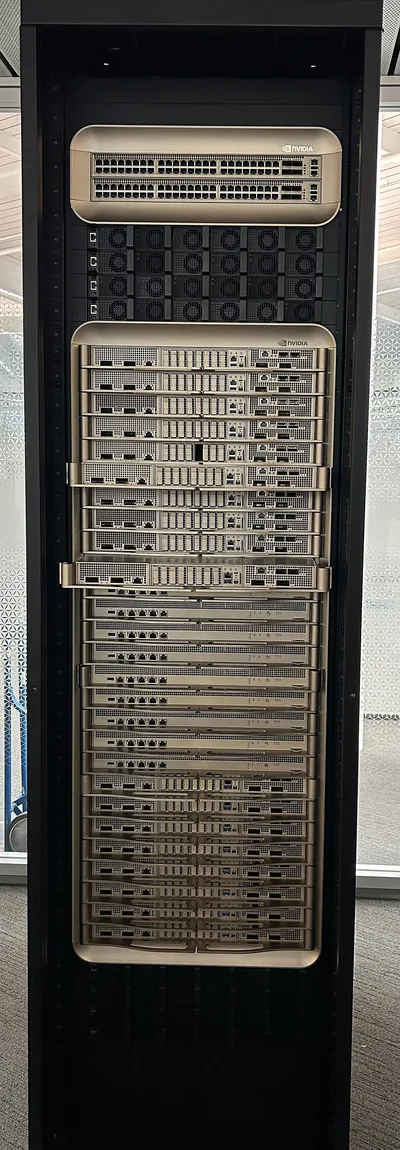
So we still have that, but now we've added the concept of a throughput tier, where our infrastructure is designed to host these larger chips, which are interconnected GPUs. They need to have really high bandwidth communication between the GPUs, but also between the clusters as well. And the new chips from NVIDIA just take so much power, which our original infrastructure is not exactly designed for, because it needs special liquid cooling. It takes so much power. And so we've come up with this concept of a throughput-tier style of hardware and data center, which has its unique cooling and power properties, where we can kind of run these larger models.
So yeah, that's kind of how we came to be, but also how we've evolved with the research and the times. And now we have these two concepts, which I think make a lot of sense and have different applications and use cases.
06Why Chinese labs are so strong
Michelle credits the Chinese labs' strength to a reverse brain drain, fierce competition and, perhaps, distillation.
My follow-up question... That was a great answer, thank you. I know nothing about this world, so it's fascinating getting insights into it. Yeah, the ecosystem.
So that's just it. For the longest time, I thought American sovereign model companies were the best in the world, and, "Oh, look at these people who are the Chinese distillation,47Distillation — training a model on the outputs of another, stronger model. More in the explainer below. they're destroying freedom," or what have you. But no, it turns out they're actually just building absolutely great models. A, how are they doing it, I guess? But B, more interestingly, how are they able to give it out for so much cheaper? That's the thing I actually don't understand, which is, they expect a return on it. And does the DeepSeek new pricing reflect what's actually happening? It's a completely foreign world to me, mostly because nobody writes JavaScript there, so I have no idea. Yeah, no one writes JavaScript. That's funny.
Yeah. I think, for a really long time, American labs were leading, and you saw a lot of great research come out of it. But also, a lot of the times when you read those papers, you'll see just a lot of Chinese last names and everything, right?
I think there's, even just immigration-wise, been a trend of a lot of people returning back home, right? And a lot of them wanting to go back home. And now, if you go back home to China, you can work there, you can be in your home country, near your family, you can speak your home language, and you get paid really, really highly, right? And so there's just been this brain... I forgot what they call it.
Yeah. That's what it's called. People are going home, and people are doing a lot of research. And so now there's these Chinese model labs that are a lot more prominent, and they can be competitive, pay competitive salaries, and people can be home. And researchers feel this attraction and draw to them as well, right? I feel like that's a lot of the reason why there's been an uprise in Chinese model labs. I will also say, there's a lot of distillation, things like that, sort of rumors and theories.
I'm not privy to that kind of information, but you can see how everyone's kind of pushing each other, right? Open source or closed source, people are pushing each other to improve the intelligence of these models, getting better models. There used to be these games that people would play, where people would drop models on the same day, or wait for the other one to drop, so then the other person could upstage them and then be state of the art, right? I vividly remember OpenAI released the io product48io — the AI device startup of Jony Ive, Apple's former chief designer. On May 21, 2025, in the middle of Google I/O, OpenAI announced it was acquiring io for about $6.5 billion. with Jony Ive on the day of Google I/O.49Google I/O — Google's annual developer conference, where it shows its biggest launches, lately mostly AI models.
ExplainerWhat distillation is and what Chinese labs are accused of
Distillation trains a model on the outputs of another, stronger one: the "student" sees not just correct answers but how the "teacher" answers, and picks up its behavior far more cheaply than training from scratch. Inside one company it's a standard technique for turning a big model into a small, fast one. It becomes contentious when the teacher is someone else's closed model whose answers and reasoning traces are harvested through the API in violation of terms of service that forbid it. In January 2025, OpenAI said it had seen signs that DeepSeek had distilled its models. In February 2026, Anthropic said DeepSeek, Moonshot and MiniMax had used thousands of fake accounts to pull Claude's answers for training their own models. That's why closed labs hide raw reasoning traces and show users only a summary.
And I was like, there's just so much competition going on, right? And so people, just naturally, within these companies, but also within Chinese model labs, open, closed, things like that. So I feel like they've been able to get good because probably they've learned off some of the research, and even the closed source models: there's this cool paper where you can kind of hack, and you could see the reasoning traces50Reasoning trace — the intermediate "scratchpad" a reasoning model writes before answering. Closed labs usually show users only a summary of it, partly so it can't be used for distillation. and whatnot. You could probably distill from that. I'm not confirming or denying the allegations.
But also, I've always had this thought that in China, there's not really this concept of IP, right? You can see, when you want to get dupes or fakes, a lot of people go to China to get this, because it's kind of like the common good: when you develop something and build something and it's for the common good, everyone benefits from it. And I almost feel like these Chinese open source models follow the same principle of, people are improving intelligence and models, and it's almost like a cultural thing where it's like, "Oh yeah, we should use this for the common good and be this foundational improvement that we have on society," and things like that. So I feel like maybe that's where things have come from.
I have complete ignorance over the geopolitics of China and how their economy works, but is there more collaboration among Chinese labs? Are they incentivized to share their research and their technical optimizations and things like that?
Not really. I would say there's actually probably more competition between labs. Or, okay, I'll speak culturally, being Chinese: I think there's actually more competition. Actually, one of the founders, I think, of Z51Z.ai — the international brand of Beijing's Zhipu AI, maker of the GLM models. came from Moonshot, or the other way around, and there's big beef going on. I don't know.
Yeah, I've heard about this. Their CEOs hate each other, too.
Yeah. So it's kind of like us: we push ourselves to be better and be competitive here. So I actually think there's more competition going on. And then the thing about models and open AI is that a lot of research is just open, right? You can publish, it's technically free. Everything's open source: new research, optimizations, new models, things like that.
All of that is published out. You can learn from it. So a lot of the architectures that we've inherited come from the first DeepSeek-R1,52DeepSeek-R1 — DeepSeek's open-weight reasoning model, released on January 20, 2025. It was the first to show openly how reinforcement learning can teach a model long reasoning, and it knocked almost 17% off NVIDIA's stock in a day. and reasoning comes from DeepSeek-R1, right? Even GPT-OSS53GPT-OSS — OpenAI's open-weight models (gpt-oss-120b and gpt-oss-20b), released in August 2025 under Apache 2.0, the company's first open language models since GPT-2. kind of made this thing called mixed precision, like MXFP4,54MXFP4 — a 4-bit floating-point format in which each block of 32 values shares one scale factor. GPT-OSS shipped with its expert weights in MXFP4, which let the big model fit on a single 80 GB GPU. popular, and that's still used today. There's state-space models and hybrid transformers55State-space models (such as Mamba) process a sequence in time linear in its length, rather than quadratic as transformer attention does. Hybrid models interleave layers of both kinds. and things like that that are still carried on from the legacies of previous open source models. So I think people learn from each other, but it's almost not in a collaborative sense, I feel like, it's more in a competitive sense. And then you release the research paper to dunk on people, and you're like, "Why didn't you guys think of this? But you can have it now." So it kind of feels like that. But yeah, it definitely feels very competitive in all the space.
07Have open models caught up?
The six-to-12-month gap has vanished, and Sunil plans to become "the USB drive guy."
So, hot take question for you: have open weight models caught up to American models?
I think so, for sure. If not the actual acute number on the benchmarks, definitely the accelerated pace, right? The slope of how models are improving, I think, has caught up a lot.
I do believe Kimi K356Kimi — Moonshot AI's model family. Kimi K2 (July 2025) is an open model with a trillion parameters; Kimi K3 (July 2026), at 2.8 trillion parameters, was the largest open model at its release. scored the highest on SlopBench,57SlopCodeBench ("SlopBench") — a benchmark for coding agents that scores not only whether a task is solved but how much junk code the agent leaves behind. The episode description links to it. if I recall, on my notes.
Yeah. You know how benchmarks actually are, like, whatever, and vibes are super important? I think especially in the last three months, Chinese model vibes... Like, I've used GLM, loved it. Used Kimi, loved it. Like, actually, they're very, very pleasant and useful to work with, where I'm like, "Okay." Which is to say, in a world where governments start locking down who has access to GPUs and compute, I'm going to be the dude who has a bag full of USB drives with model weights, walking across the country, handing it out so that you can run it in your backyard, like 100%. The weights are absolutely usable and wonderful right now. Which takes me to my next question.
There's always this framing of open weight model companies being six to 12 months behind the frontier. Is that number a real thing? Because to me, it's almost feeling like that number itself is shrinking now, right? There's no way that a Kimi is 12 months behind OpenAI. Unless, well, of course, OpenAI is cooking its own thing internally right now, but just publicly released stuff.
Yeah. I think six to 12 months was the intercept a while ago, but now the slope has changed, right? It's truly that models are releasing on a faster cadence. I wish it would slow down a little, particularly just because once I release a model, people get attached to it, you know, like the 4o crowd,58GPT-4o — a 2024 OpenAI model. When OpenAI replaced it with GPT-5 in August 2025, users attached to its warm manner protested, and the company had to bring 4o back for a while. right? People get attached to it, and I can't deprecate it, and it just sits there eating up GPU space, right? So I'm like, "Oh, let's just wait a little bit between releases." That's what I hope for. But no, yeah, I definitely think the pace of research and acceleration of model development has increased, especially from the Chinese labs. I don't think it's six to 12 months anymore. I think six months ago it might have been six to 12 months, but now it's just not. I think it's caught up.
I mean, of course all the other labs are accelerating as well, and people are keeping secrets a bit guarded to their chest: what does OpenAI have, what does Anthropic have, right? So it might be the case that we're just not seeing the latest from these closed source labs and what they're capable of, at least publicly. But I do think, when Fable59Claude Fable — Anthropic's line of most capable publicly available models, above Opus: Fable 5 came out on June 9, 2026, and Fable 5.1 on September 1. was talked about and released, it was unfathomable for me that an open model would be on the same chart as Fable, right? And now it's like, "Oh, they're competing," open models competing with Fable. Before, it'd be like, "Okay, maybe an open model could be like a GPT-4 or 3," right? And now it's like, "Oh, we jumped to competing with Fable." It's crazy.
If you remember the entire 4.5, 4.6 rush,60Claude Opus 4.5 (November 2025) and Opus 4.6 (February 2026) — Anthropic models after which many developers said agents could finally write code on their own. right? So in January, February, we were talking about how the next peak has been climbed, like, "Oh yeah, this has changed the game." And now we are saying every new open weight model release kicks 4.5's ass. We are past that. We are just in the "Oh, well, it's not as good as Fable 5," and you're like, sure, but this was absolutely unthinkable six months ago, when we started saying, "Oh shit, everything's different now, AI psychosis61AI psychosis — here, jokingly: the obsession that agents let you build anything, so you don't leave the computer for days. The hosts devoted their third episode to it. Used seriously, the term describes delusions that intensify over long conversations with a chatbot. is now mainstream," etc. And that shit now drops twice a week, is roughly my feel.
There's a good chance we get off this podcast and some other company is like, "Here you go." Two days later, "Here's a new benchmark," etc. Everyone's telling me Google's next model is around the corner. As of this recording, there's a model out there called Ox Alpha62Ox Alpha — a model that topped the benchmarks at the time of recording; the episode description links it to Z.ai's GLM-5.3 Flash announcement. that's beating everyone's benchmarks, so I assume by the time the episode is out, four other models have been released after that. So yeah, it's like here. Like I said, I'm going to become the USB drive guy. That's absolutely going to be my thing.
You're going to need a lot of USBs. Also, the subreddit for you is r/LocalLLaMA.63r/LocalLLaMA — the subreddit about running language models on your own hardware, the main community of open-weight enthusiasts, named after Meta's Llama. Would you build your own data center in your backyard?
100%. And not only will I do that, but I'll be the local guy for community-based LLMs. That's my thing. It's not just for one house, it's in my commune. While the zombies are trying to get inside, inside we have LLMs, water, solarpunk,64Solarpunk — a movement in science fiction and aesthetics imagining an optimistic future where society lives in harmony with nature on solar power and local technology. Wikipedia. that sort of thing, all going on. Yeah. The GPU supply is still... That's just it. No one knows where I get the GPUs from, and that's part of the mystery that we'll stretch on for three seasons while you figure out what the story is.
Honestly, same here. Where do we get the GPUs from? No. Yeah. I think someone asked this question.
We've learned that Sunil has doomerism tendencies, probably has a bunker that's undisclosed in New Zealand.65A bunker in New Zealand — a running joke about Silicon Valley billionaires, some of whom, such as Peter Thiel, bought land there as a hedge against catastrophe.
It's not doomerism, it's prepper tendencies. That's the thing. I would like to be a prepper. Well, I dream of being one. Just so we're clear, if I wake up the wrong way, my back hurts for three days, okay? I don't think I'm capable of all of these things, but it would be nice.
08Where GPUs come from and how many you need
Nearly every GPU comes from NVIDIA, and the hardware ages faster than it arrives.
Okay, no, which takes us to the next thing. Michelle, I hear there's a GPU shortage. Where the hell are these coming from? Is it just one company? Does AMD66AMD — NVIDIA's main rival in GPUs; its data center accelerators are called Instinct. have a story here? It can't be just one company, dog.
It kind of is right now. Yeah.
The Denny's waiter67Denny's — an American chain of cheap 24-hour diners. As a teenager, Jensen Huang worked there as a dishwasher, busboy and waiter, and in 1993 he and his co-founders came up with NVIDIA in a booth at a Denny's in San Jose. is going to be the trillionaire who holds the keys to intelligence for the world. I say that with love, by the way. Jensen Huang is a G. He's a full-on G. But yeah, do they have a special favorites list, or is it just a bidding thing? How do you get GPUs?
Source: NVIDIA annual results
Oh, probably, yeah. Yes, it kind of is just NVIDIA right now, or at least they have the majority foothold of what people are wanting to use. And that's just because of, I think, the popularity of CUDA68CUDA — NVIDIA's platform for programming its GPUs, released in 2007. Over nearly two decades, almost every machine learning library has come to depend on it, which is the main reason it's hard to leave NVIDIA. and just the history of NVIDIA being around for so long. I will say AMD is catching up. If you look at... GPUSteve works at a company called Wafer,69Wafer — a startup where the developer known online as GPUSteve works, focused on inference performance on GPUs. wafer.ai. and a lot of what they do is host on heterogeneous chips, so they use AMD, not only NVIDIA, and they perform really, really well. So I feel like things are going off well there. So to get chips, you have to have a good relationship with NVIDIA, and then you say, "Please, can I have this?" And then they're like, "Yeah, it'll take us maybe a year to deliver them."
And if you pre-order the new chips that are coming out, it's like, "Okay, yeah, it's one to two years," subject to availability and if the build goes correctly. So, Blackwells were announced70Blackwell — NVIDIA's AI GPU architecture, the successor to Hopper, behind the B200 accelerators and GB200 NVL72 racks; named after mathematician David Blackwell. not at the last GTC,71GTC (GPU Technology Conference) — NVIDIA's annual conference in San Jose, where Jensen Huang unveils new chips. but the year before, so GTC in 2025,72Fact-checkBlackwell was unveiled at GTC in March 2024, not 2025; GTC 2025 brought Blackwell Ultra (B300) and details of Vera Rubin (NVIDIA press releases, March 18, 2024 and March 18, 2025). right? I think I was there for that one. The data centers for Blackwells are just coming online today. People are still getting the chips delivered. We've actually also skipped from B200s to B300s.73B200 and B300 — Blackwell accelerators; the B300 (Blackwell Ultra) is the upgraded version with 288 GB of HBM3e memory, shipping since the second half of 2025. I think there is something about the B200 build quality not being good, and so everyone has actually just skipped to B300, right? And so the lead times for these data centers are more than a year and a half, right, for these data centers to come online. That's so crazy. It's insane.
Doesn't that lead to... How does this not lead to a world where, by the time you get the hardware, it's obsolete, and the modern models that are out might not be optimized for that? I assume that's a real problem. How do we plan around that with Workers AI and stuff?
I mean, I think we're still learning what we want to do, to be reactive or proactive about this. But it is a real problem, in the sense that just a year ago, Hopper was74Hopper — NVIDIA's previous GPU architecture (2022), behind the H100 and H200, the workhorse chips of the generative AI boom's first years. the latest and greatest, and researchers were writing for Hopper. With GPUs, you can write kernels75Kernel — a program that runs on a GPU across thousands of threads in parallel, such as matrix multiplication or attention. The fastest kernels are written for a specific architecture. that are specific to that chip, for just better utilization of the tensors and things like that. A year ago, Hopper was all the rage, people were writing Hopper kernels. And now there was suddenly a flip, I feel like. I don't remember the timing, but I remember this being the model: the Black Forest Labs Flux model.76Flux — image generation models from Germany's Black Forest Labs, founded by the creators of Stable Diffusion; the first family, FLUX.1, came out in August 2024. They were like, "Oh, we recommend you run this on Blackwells." And I was like, "Blackwells?"
"Who's using Blackwells?" This was at least a year ago, or maybe more than that. I was like, "Who has Blackwells now? Oh my God." But I remember that being a distinction, and then everything after that was optimized for Blackwell, trained on Blackwell, runs better on Blackwells. And obviously, Workers AI was only two years old, so we were still kind of figuring out the space, but we were like, "We don't have Blackwells. Where do we get Blackwells?" But the efficiency gain from moving from Hopper to Blackwell is incredible. It's a lot. It's like a ton, ton, ton more. It's much more efficient on Blackwells. And so if you're not planning for the next generation of hardware, you're behind. And so we're thinking about Vera Rubins77Vera Rubin — NVIDIA's platform after Blackwell: Vera CPUs and Rubin GPUs. In January 2026, Huang announced it was in full production. It's named after astronomer Vera Rubin. and what comes next already.
You don't know exactly when the switch will flip between, okay, everyone's now doing research on Vera Rubins and not Blackwells. But at some point, these GPUs become, not obsolete, because you can still run workloads on them, but it's just not as efficient. And not being as efficient means that you're not as margin efficient, and so you can't run or compete for these things as well as someone that's running on the latest and greatest hardware. So you almost have to be thinking a year or two ahead. I can't even think a week ahead. I don't know what models are going to release next week or whatever, right? And so it's really, really hard to plan for the hardware side of things.
Let's say with Kimi K3 versus Kimi K2.5: is the cost to serve Kimi K3 dramatically higher than Kimi K2? Or what is the thing that determines the actual cost for somebody doing inference?
Kimi K3, I think, is bigger. I think Kimi K2 is smaller, it's something like seven... Wait. I think about models every day, I don't know the exact numbers. I think one of them is like 700-ish billion parameters, and one of them is like... Oh, okay. Kimi K3: 2.8 trillion parameters. Trillion. And then K2, let's see, K2 is one trillion. So it's two times bigger, more than two times bigger. K3 is two times bigger than K2.6.
ExplainerWhy one copy of a model needs 16 GPUs
A model is mostly its weights, and all of them have to sit in GPU memory at once. A trillion parameters take about a terabyte even in 8-bit format, and about half a terabyte in 4-bit. An H100 has 80 GB of memory, an H200 141 GB and a B200 180–192 GB, so the model has to be split across several GPUs that exchange data at every generation step. On top of the weights, memory goes to the key-value (KV) cache for each request, which grows with longer contexts and more simultaneous users. Hence Michelle's math: one copy of K2.6 is 16 GPUs no matter how many requests it serves, and handling real traffic takes many such copies. That's also why fast GPU-to-GPU links, as in NVL72 racks, matter so much for big models.
You need giant ones. I don't know. Hey, you should use R2. For one instance of Kimi K2.6, which is one trillion parameters, you pretty much need 16 GPUs to run it. One instance, right? And one instance... I actually don't remember the latest, but at some point, we were able to run 0.5 RPS78RPS (requests per second). 0.5 RPS per instance means one request every two seconds on 16 GPUs. on one instance. So imagine how many RPS we get on Kimi, imagine how many instances, and then multiply that by how many GPUs there are, and then how scarce GPUs are and how expensive GPUs are. I think it's not 0.5 anymore. I think we've optimized it. But at some point, that was the number I was working with.
That's like the best painting of the scale. The way you just stated that, it's very easy to go from, "Okay, here's a single GPU, what does that mean?" to, "Here's how you serve a single model at a very low rate." And then, ah, that's mind-boggling how much GPU it takes.
09The industry is lighting money on fire
Subscriptions lose money, customers are spoiled, and the cheap-money era, Michelle says, is over.
Okay. First of all, this has cleared up so much for me, but now I have 12 different new questions. Okay, why the hell would you get into the inference serving game at all? Because holy shit, the kind of expenses that you have to lay out for assets... They're basically like shitty cars, right? They're just depreciating for every moment they're running. Secondly, holy shit, there's an entire generation of developers that have been spoiled by monthly subscription plans, or call it what you will. But I suspect there's some way to make that math work where at least you're not losing money. And I'm saying this, and I would like for either you or someone else to correct me.
Nobody is making money on subscriptions.
Yeah. No, that's just it. Like, OpenAI and Anthropic, sure, it's because they're doing this massive model thing. But I don't think OpenCode79OpenCode — an open-source coding agent for the terminal. opencode.ai. is lighting money on fire. Cloudflare is famously allergic to lighting money on fire. We just try not to do that, right?
So Michelle's like, "I want more GPUs. Give me money for GPUs."
Yeah, exactly. So the industry is lighting money on fire. It's insane. People are kind of spoiled. So part of the reason is, I feel like I wanted to come on and be like, "Oh, guys, you guys are being spoiled right now."
Give us the tea and the hot takes. What are people not aware of? What is the tea?
Yeah, what are people not aware of? Because I just learned way more in 30 seconds than... I mean, a lot of my assumptions are kind of broken now.
I made this meme where it's like, people want the one million context window,80Context window — how many tokens a model takes into account at once. TPS (tokens per second) is generation speed; time to first token is the delay before the model starts answering. Quantization stores weights in fewer bits, making a model cheaper and faster at some cost in quality. incredibly high, like 100 TPS at all times, less than one second time to first token, no quantization. They want all of that at serverless pricing,81Serverless pricing — paying per request or token, with no reserved capacity or commitment. The opposite is commits: a customer promises to spend a set amount over a year and gets a discount in return. so no commitment, and then 80% discount on all of it. I can't even pick two of those, you know. People are really getting spoiled out here, I think. And subscription models, I do believe they're losing money. And I think people originally thought... Tomas from OpenRouter and I were just talking about this.
People think it's kind of like insurance: people might not use it if they pay the subscription for it. But it's so easy to burn tokens. It's not like insurance, where I have to go fill out all this paperwork and I'm not going to go do that, right? It's just so easy to burn tokens, all hours around the day, I can burn that. So I do think subscriptions are kind of a loss leader model there. But yeah, people are lighting money on fire. I've had people come and they're like, "I want an 80% discount from the serverless pricing."
And I'm like, "I honestly cannot do that." It's just not possible, based on all the hardware costs that are in here. But people expect that and they want that, because that's kind of how other products are priced, right? People want to come to you for commits, and then they get huge discounts or whatever. But some of these providers are saying yes to things like that, and it's because maybe they're lighting money on fire, right?
Or maybe they've already had committed GPUs, and some utilization at an 80% discount is better than none. And so it's actually pretty hard to compete in this space. And as Sunil said, one thing that we have always done is prioritize running a sustainable business, right? And not just one that's lighting money on fire at all times. So sometimes it's hard to compete. But I will say, I do think that the tides are turning a little bit and things are shifting here, because I think everyone has understood now that we're out of the growth phase. We're out of the Uber's $3 phase.82"Uber's $3 phase" — the 2010s, when Uber rides and deliveries were cheap thanks to venture money. Uber posted its first full-year profit only in 2023.
We're out of the zero interest...
Exactly. The ZIRP era83ZIRP (zero interest rate policy). In 2008–2015 and 2020–2022, the Fed's rate sat near zero, money was cheap, and venture-backed companies ran at a loss for years to grow. Rates rose sharply from 2022, ending the era. phase of Q-commerce,84Q-commerce (quick commerce) — grocery delivery in 10 to 30 minutes from "dark stores"; in 2020–2021, billions of dollars poured into services like Gopuff, Getir and Gorillas. best era ever, when I had avocados at my door for $1 in 10 minutes. We're out of that era. I feel like things are shifting now where model labs want expensive licenses now. They need to make money. They want to IPO, right?
They need a stable revenue stream.
Some of the open source inference engines have privatized versions of forks, and they're selling containers or a more optimized version of their inference engine. They need to make money, right? Even the GPU hardware itself: if you go on the spot or on-demand markets,85Spot market — renting idle GPUs at the current market price, with the risk of being bumped at any moment; on-demand — hourly rental with no long-term contract. everyone's increasing pricing. It's not decreasing. It's not like there's more chips in abundance and things are decreasing. People are increasing pricing, even for Hoppers, which is what we just talked about, depreciating asset, obsolete: those are increasing in pricing. It's insane. And so compute is scarce, and pricing is increasing. APIs like DeepSeek are increasing pricing as well. So my theory is that we're kind of out of the ZIRP era here, and now everyone's going to make money. So I hope people are emotionally prepared for this, because people, like, throw a fit, you know.
We'll staple this as a receipt86A nod to the show's segment Receipts Required, in which the hosts revisit bold predictions and check whether they came true. for Michelle, or a hot take we can revisit. But 12 months from now, six months from now, do we still have subscriptions from OpenAI and Anthropic that people are still having à la carte? And does inference continue to get more and more expensive? I think it's interesting, because at Cloudflare, in the day-to-day, we're using API billing, and you get a real sense of what your real spend is. And I think a lot of people that are just using their own subs, or have operated at a small enough scale inside companies that they can do the enterprise subscription stuff, don't see the real cost of running this at scale. So yeah, do subscriptions exist in six to 12 months?
I think they exist, but I think they're heavily cracked down on, and limits decrease. I think people are used to it.
We're assuming both those companies have IPO'd87In 2026, both companies moved toward going public: OpenAI filed for an IPO in June, but in September Sam Altman said it wouldn't list in 2026; Anthropic filed for a Nasdaq IPO in October 2026. in the next six to 12 months, by the way. So they have to start showing financials that make sense.
Yeah, yeah. I mean, even Fable, when it was out, was only API pricing, right? And Anthropic has, over the months, decreased what you can use your plan and subscription for. And I almost don't feel like it was evil. I almost just think it was a usage and capacity thing, where it was being a loss leader for them.
I do think it's either going to be gone, or it's going to be really, really heavily rate limited and cracked down on, and the use cases minimized and whatnot. I feel like more of it is going to be usage-based. The other thing that I think is going into subscription models, and why I don't think they're going to be around for much longer, is because people are using them for fraud. I don't know if you guys have heard of this phenomenon. People are selling tokens on Temu.88Temu — an online marketplace for cheap goods shipped directly from manufacturers, mostly in China; owned by PDD Holdings, which also owns Pinduoduo.
You can go on Temu or wherever, and you can buy black market tokens, and they're heavily discounted. There are people signing up for subscriptions and creating millions... On Workers AI, we have had to face a lot of abuse recently, and fraud, where people are signing up for subscriptions. We have some free tier, right? You can test and try things. And you want to be able to provide that experience for your users, because you want them to be able to test and try things before they have to pay and subscribe and commit or whatever. People are going on, creating millions of accounts per day, and capturing that, and then selling those tokens on Temu. And so it's not even just us. I've talked to people in the industry where it's like, literally 90% of my time is fighting fraud and abuse. And subscription models are very, very ripe for that kind of abuse.
10Why Cloudflare does inference
Cloudflare plays in inference because compute is the new currency and agents on its platform need models nearby.
Big question. Okay, so in such a crowded space that's so hard to compete in, especially with money on fire, why is Cloudflare in this space?
I think, like I mentioned, it's almost inescapable now, right? I don't know if I could go a single day in my life without using AI, both at work and in my personal life. You have to have some skin in the game here. And like we said before, GPU compute is scarce. You kind of need to think about the future and what the world will look like. And I think Cloudflare is making a bet that GPU compute and inference is going to be in the future, and we want to start playing in this game now, right? It's almost like compute is the new currency, and you need to be finding and sourcing this stuff and building the muscle around it now, versus later, when it's too late. And all of these companies... DoorDash is being a neolab for research.89Neolab — a 2025–2026 buzzword for a new-generation AI lab that trains its own models but isn't one of the giants like OpenAI or Anthropic. Michelle jokes that even the delivery company DoorDash now does its own AI research. DoorDash is a neolab.
Exactly. All these companies are trying to figure out what they want to do and experiment in this space, and I think it's good. I think it's good that everyone is thinking about the future. I think this is the future, and everyone wants to play in this space. I think Cloudflare's strategic advantage here is that we have a developer platform, right? We want people to build full-stack apps, we want people to build agents on us. If you assume that AI is the future, you're going to assume that your full-stack apps need AI, your agents need to be powered by models and things like that. And we want that to be accessible all in one place, which is Cloudflare, right? And so agents deployed on Cloudflare should be powered by models that are on Workers AI. Even if I was an enterprise and I had to do one less procurement Zip workflow,90Zip — an American platform for approving corporate purchases: each new vendor goes through finance, legal and security review in it. ziphq.com. yeah, I would do that, you know?
And so having that at Cloudflare, and allowing your users to access AI through the platform, I think is the strategic advantage there. And we just want to learn, and we want to play in this space, and it's better that we do it earlier than too late, right? And so we're experimenting here.
I mean, it feels like some of our early bets are paying off, though, like betting on open models getting good. Before I joined Cloudflare, if you would have asked me about Cloudflare hosting open weight models, and it's like Llama 491Llama 4 — Meta's open-weight models, released in April 2025; they disappointed developers, and Meta was accused of gaming benchmark results. and stuff like that, I was like, "This feels like a waste of time and money. I'm not going to use this." But now they're good, and it's accessible, and we planned for it, and we're building out for it. And that just feels like a good example of... I don't know, I feel like we're very good at being forward-thinking and making strategic bets. Dynamic Workers:92Dynamic Workers — a Workers feature that loads and runs arbitrary code on the fly in a fresh V8 isolate within milliseconds; Cloudflare uses it to run code that agents write. great example of something that two years ago would have been like, "Why? What's really the use case here?" But now it's like, this is peak for agentic workloads.
Almost accidentally. Workers is perfect for agents. Did we know what an agent was when we built it? No.
So this is the show where we say Kenton was right93Kenton Varda — the lead architect of Cloudflare Workers and creator of the Cap'n Proto protocol. "Kenton was right" is a running line on the show: the decisions he built into Workers turned out to be exactly what agents need. six months ago. We say that on every episode. Kenton's always right.
He had a vision, you know. Yeah, I feel like it's interesting, because we want to be the platform that has it all. And I think we're different in that there's a lot of inference providers out there that are doing amazing, you know, I really respect and admire and look up to them. They're not going to build a compute platform tomorrow, or a database platform tomorrow.
But we already have these solutions, you know, and we're building the inference muscle and getting better here. And I think we've improved so much in this year. Tool calling94Tool calling — a model's ability to call a function with arguments (a search, an API, code) instead of just answering in text. Without it, a model can't be used in agents. didn't even work in January, guys. I remember being in Lisbon and fixing that overnight, because I just learned we could use Claude Code95Claude Code — Anthropic's coding agent for the terminal, released in February 2025. at work, and I fixed that. And now we're hosting three trillion parameter models. It's insane, right?
So things have improved a lot. That is quite a glow-up. And just across the board, from hardware to software, the amount of change, going from not having models that can tool call to hosting trillion parameter models, is actually wild.
I actually remember that earlier part of the year very fondly. Me and Michelle were trading bugs and solutions just nonstop. I was working on the Workers AI provider,96Workers AI provider — the workers-ai-provider package for Vercel's AI SDK, which lets you call Workers AI models through the same library as other providers' models. I was finding bugs, she was fixing this, she was sending back bug requests. I think in two weeks, we just wiped an entire year's worth of backlog. It was one of the most fun times I've had, because Workers AI went from even me thinking that it was a piece of shit to being like, "Holy shit, this is the future. Yeah, I'm putting all my chips into this right now." It was excellent.
I will say, that was the peak of my AI psychosis, though.
Literally, I just did not leave my house. I was shocked that people were leaving their house and doing things. I was like, "You guys don't understand. How are you guys not building? You guys are going to be behind if you're not building right now." Anything in this world is possible now, it's at your fingertips. If you just type the right combination of words, you can unlock anything in the world, and people are going outside and having fun? I was so deep in my AI psychosis at that time.
11Fewer factories, more beautiful software
Sunil calls on builders to make small, useful software for real life instead of software factories and agent frameworks.
Well, Michelle, as much as I could sit here and ask you questions all day long about this, because this is fascinating and a side of Cloudflare and the AI world that I don't have a lot of insight into, but have a lot of interest in, we do have one last bit here. Sunil has a call to action for everyone listening. You want to share your thoughts here, Sunil?
No, it's actually a good segue from the "why is anyone leaving their houses," because they can actually build anything they want. In the months since then, it looks like the things that people have built are extremely navel-gazey and very developer-focused, and I've seen such few great products actually break out, specifically AI products. Instead, a lot of my products now have what I'm... I think we need a phrase for this: AI upsells. Every AI company has some variation of a butthole logo.97Butthole logo — a common joke that AI company logos (the swirls and starbursts with a dot in the middle of Claude, OpenAI and others) look like an anus. So on my UI now, there will be a butthole, which will be, "Use this AI feature." Just somewhere.
See, I thought you were going to say the sparkle emoji.98Sparkle emoji ✨ — the standard icon for AI features in the interfaces of Google, Notion, Adobe and others. This one went a totally different direction.
No, they're all... If you've ever watched the show Community,99"Community" — an American sitcom (2009–2015) about students at Greendale Community College. The college's flag in the show is a gag: it looks like an anus. you know how their flag is basically just a giant butthole. Anyway, so AI companies, for some reason, butthole logos. That's the most times I've said the word "butthole" in 30 seconds, I think, by the way, which is also good. And part of my new role as builder in residence100Builder in residence — in August 2026, Sunil moved into this role at Cloudflare: building products in public and testing ideas on people far from programming. is actually trying to find out the answers to this. And it's happening at a time when normies are extremely anti-AI.
And some of their reasons kind of don't make sense, but a lot of their reasons do, which is, bro, the biggest AI company in the world is putting out an ad where the houses are on fire, and they're saying they have the way to stop that. It's not even good propaganda, you know? Stop freaking them out. What are the user experiences around this? How do you actually make lives better? And don't start off by saying, "Well, install this flavor of Linux and give us your keys."
By the way, that's just it. Some products are now going to read your entire chat message histories, not chat messages, your iMessage histories and stuff. And I'm like, "What are you guys doing?" So my wife is in academia, which means I hang around academics all the time, and they are not happy, dog. There's these visceral visions of books being chopped up101In 2025, a lawsuit against Anthropic revealed that the company had bought millions of print books, cut them apart and scanned them for model training. The judge ruled this lawful, while Anthropic agreed to pay authors $1.5 billion over downloading pirated books. just for being scanned, etc. It has freaked out millions of people across the planet.
I put out a little tweet, a joke tweet, and you never know which ones will take off, right? I was talking about a conversation with someone who's built a software factory,102Software factory — a 2026 buzzword for a system of agents that writes, checks, fixes and ships code with almost no humans involved. which is what everyone is building right now, software factories. And I keep asking, "Well, what does the software factory make?" It's only a good factory if you make something, right? Also, I could have made it a big communist joke, because it's about factories owning the means of production and development. Regardless, I'm like, "What does it make?" And they're like, "Well, you don't understand."
"The factory is a closed loop. It detects defects and automatically fixes them. And they're self-approving PRs, and it spawns out subagents." I'm like, "That's cool. What does the factory make?" "You don't understand. We can move quicker than ever before." I'm like, "What does it make?" "Well, right now it makes software." And you're like, "Okay, what kind of software?" "Well, it makes better factories." And this is the state of the industry right now.
By the way, that's just it. I saw this, and then I started seeing popular people liking and retweeting it. I was like, "Oh shit, the people who are mad at me are going to show up in the replies." And yep, within 20 minutes, people are like, "Just let people have fun. Let them just do this." I'm like, "It was just a shitpost, man. Don't take it so seriously."
But my call to arms is for people, first of all, to make more personal software. Rhys was talking about this in our last one. So did you, I think. Building little apps for your real-world use cases. And when I say real-world use cases, it means for your family, for your friends, for organizing a little meetup, for automating feeding the fish. Things like that are actually amazing to do right now. There's a tweet by Max Kreminski,103Max Kreminski — a researcher and developer of generative games and AI tools for creative work. and unfortunately his account is private now, but he said that if, for a given new tech, you see a lot of garbage being created, that actually means it's an unmitigated success.
That's what you want: people to be using it to do all sorts of things, not just developer workflow enhancements. I started work on something, and I'll only share it in a month or so. I started work on this digital mural piece with depth cameras and stuff, and I'm having the time of my life. And I was wondering why I didn't do this three months ago, but it's because I never even considered it an option. I was thinking to myself, "How do I bring down the defect count, and how do I kick up the PRs and lines of code that are being submitted to my repository?" And the call to arms is for people to do more bullshit like that.
I'm tired of seeing new agent frameworks. I saw a tweet, "We just killed OpenRouter," on the day that they announced they're getting acquired for $7 billion.104Stripe announced its acquisition of OpenRouter in August 2026; the price wasn't disclosed, but Bloomberg reported more than $7 billion. I'm like, "Shut the hell up. What are you doing here?" No. People should create more things of beauty, for friendship, and just software that people use. Because if they don't, I'm just going to be tweeting things like this, and I will get 5,000 likes every single time I do this. You need to kill this for me.
Less factories, more beautiful software.
Yeah, exactly. Just build useful stuff. It's not that hard. The world is a terrible place to be in right now. Fix it with software. It's fine. You can do that.
All right, folks. Well, that's it for the fifth episode of The Next Token. We'll be back next time with more opinions, predictions, hot takes, workflows, and whatever Sunil happens to be excited or upset about. Follow the show wherever you're watching or listening, and tell us what you think in the comments.
Thanks to Michelle Chen from Cloudflare for being a wonderful, wonderful first guest. I have to tell you, I didn't expect to learn as much as I did, and I think I got madder at the industry as a whole, which is good. That's why we have people come over. Thank you, thank you very much, Michelle. And see you at the next thing where we're all together, I guess.
Yes, thank you so much.
Thanks. We'll be back in two weeks, I guess, that's our usual cadence. Maybe we'll do a guest workflow, something else. Best of luck to Rhys, everyone. Hopefully... well, he'll still be prepping, I think, when this episode comes out. I hope Demo Day goes well for you. Michelle, would you like to take us out?
Yes. Thank you so much for having me as your first guest on the podcast. Big-time listener, first-time caller. Hopefully we get to do more. I feel like next week we'll have even more hot takes and different models and whatnot, and the industry will have changed. But yeah, thank you. Thanks for having me. It was so much fun.
You're always welcome, Michelle. We'll definitely have to have you back. All right. Peace, y'all.


