



The Next Token
Chapters
Dillon opens the show, introduces the guest and reports on his honeymoon; Rhys describes Claude modding games.
Read the chapter- Matt Carey from Cloudflare is here to talk about Code Mode and MCP servers.
- Dillon spent two weeks in Scotland, with distilleries, hiking and Sunil in Edinburgh, and got Artifacts, his Git storage product, to open beta.
- Rhys sent Claude off to build custom servers and maps for the racing game Inertial Drift, and half an hour later it was loading Mario Kart maps.
Fans are remaking games with AI, and Dillon thinks this might be the biggest uptake of AI among regular people.
Read the chapter- Rhys tells how fans cracked Skate, EA's live service game, added custom servers and maps from older entries, the player count exploded, and the studio grudgingly accepted it, as long as nobody touches cosmetics.
- In mashups like Minecraft inside Skyrim, both games run at once, with AI writing the translation layer between them.
- In ultracode mode, Claude built Inertial Drift a first-person view with a hand on the wheel overnight; at medium reasoning, Rhys says, the result is terrible.
- For Dillon, the modding that made Skyrim and Morrowind great is now available for any game, which is the era of personal software.
News from Matt and Sunil, and Rhys watches agents haggle with each other.
Read the chapter- Matt spoke at conferences in San Francisco and joined a hackathon on a boat circling Alcatraz, where everyone wore orange prison jumpsuits.
- Sunil threw out half his USB cables and needed a USB-B cable for a synth the very next morning.
- Rhys listed a broken lamp for free through Muse, and about 20 of other people's Muses responded immediately.
Agents can now answer issues and PRs, and new etiquette is forming around that.
Read the chapter- Dillon signs his agent's replies with the model used and a note that a person checked it, and wants better tooling for agents talking to agents.
- Sunil calls it a generational fumble by GitHub: he doesn't mind issues filed by agents, but random agents replying "I agree" drive him mad; the agents repository has had PRs closed for a year and a half.
- In the TypeScript MCP repo, Matt says, every maintainer PR draws five or six OpenClaw-style bot reviews that sometimes catch bugs but more often tag the maintainer.
- A slop report from Rhys led to changes in two Cloudflare repositories.
Rhys explains why it's easier for a model to write code than to call tools one at a time.
Read the chapter- Code Mode is scripted tool calling: TypeScript types are generated from MCP servers, and the model writes a script against them, the way a programmer writes against an API.
- At first every tool got dumped into the context window, and authors of big MCP servers got yelled at for bloating it.
- Bash brings gradual discovery via --help, filtering output and chaining commands; to Rhys, it's the same pile of tools, just in a different execution environment.
- The downside of bash is that you don't know the action space of an arbitrary CLI, and you have to put every credential on the machine.
- Rhys's agent has around 10,000 tools, and with search by namespace it scales without trouble.
The idea came to Kenton from an MCP creator, and the name was coined at Cloudflare.
Read the chapter- The "just let the model write code" idea goes back to the CodeAct paper from Apple.
- DSP, from the team that made MCP, suggested the idea to Kenton Varda, and Sunil turned it into one of the first client-side implementations, before Claude Code.
- "Code Mode" was coined at Cloudflare, and later companies passed their products off as "advanced Code Mode"; Sunil even has the hat.
- Matt sees two directions, "let the model write code" and "everything is a file," since models trained in Linux file systems get very good at files.
Matt tells how MCP went from bloated context to a whole API in 1,000 tokens in about a year and a half.
Read the chapter- In April last year Cursor added MCP, people vibe coded servers over a weekend, and tool schemas swamped the context; GitHub's MCP server with 55 tools took the most heat.
- Pi launched with four tools and promised never to connect MCP, and Peter Steinberger of OpenClaw built MCPorter, which turns MCP servers into CLIs.
- In February Cloudflare released an MCP server with two tools, search and execute, where the model writes code that searches the OpenAPI spec, and the whole API fit into 1,000 tokens.
- Asked about the search index and its parameters, Matt answers "it's just code": the spec gets reloaded into a REPL every day.
A year after the blog post, all the major coding agents run in Code Mode.
Read the chapter- OpenCode 2.0 and Pi 1.0 ship with built-in JavaScript runtimes, as do Codex and ChatGPT on the web; in Claude Code, Matt thinks, it's still behind an experimental flag.
- Dillon loved Earendil's example of an agent in Pi writing code that pulls issues and classifies them with the Jev model.
- Rhys wants to rip approvals out of Executor, since users run their agents with permissions skipped or in auto mode anyway.
Nested Code Mode turns out to work, though the model gets confused when it needs variables from the outer code.
Read the chapter- Rhys lists the options: a custom interpreter like OpenCode's, the tiny QuickJS, or V8 isolates as in Cloudflare Dynamic Workers, which are heavy to ship in a client.
- Cloudflare serves Code Mode meta-tools on the server by default, and Matt thinks nested Code Mode will become expected in time; Dillon's internal CF Portal already works that way.
- A model in a Dynamic Worker imports a container library and runs code in a container through container.exec, and Matt says this triple Code Mode works surprisingly well.
- The main failure is that variables from the outer closure aren't available in the inner one, and the model gets confused, creating R2 buckets and bindings.
There are plenty of tools for running Code Mode, and the hard part, Rhys says, is getting other tools into it.
Read the chapter- The tools include Cloudflare Computer, OpenCode's interpreter, Vercel's Run SDK and Callscript, Pydantic's Monty for Python, and Theo's TypeScript in Rust running as Wasm in a Worker.
- Pause and resume is needed for approvals that may arrive three days later; Rhys thinks all tool calls should be async, and Sunil points to cheap batch inference.
- The hard part is getting tools into the Code Mode format, especially non-MCP ones: broken OpenAPI specs, headers, missing security schemes.
- Bash is great at hot reloading and fixing CLIs, but bad at multiple accounts and health checks.
Code Mode spread faster than React did, and the hosts see state and events as the next step.
Read the chapter- The tech preview came out in 2023, Rhys notes, but within a year of the blog post everyone had it; React, by Dillon's count, took about half a decade to become standard.
- In Kent C. Dodds's Kody, the agent writes reusable scripts and imports them into Code Mode.
- Rhys is excited about triggers, durable execution and extensions like a five-minute undo-send for Gmail via Executor v2; ChatGPT already supports skills over MCP and MCP events.
The guests' predictions: from just-in-time computers to stubs the server hands the client.
Read the chapter- Sunil thinks a Linux VM for everything isn't sustainable, bets on unikernels, and expects MCP to be the "new REST" for agents.
- Executor sends every email Rhys gets to the Jev classification model and deletes spam without an always-on VM.
- Matt proposes boiling MCP down to resources at URIs, Markdown skills and executable stubs, which would give tools a hierarchical structure.
- Rhys predicts that in two or three years Code Mode will move off the client and be placed next to the API it calls, since tool call latency will matter more as inference gets faster.
- "Kenton was right," Dillon says: promise pipelining and stubs from Cap'n Web solve this, and Sunil adds that Kenton's ideas are collected in Cloudflare OS.
Personal agents already click for regular people, but in Sunil's view their economics don't work yet.
Read the chapter- Dillon's wife Justine took to Grok Bot right away and used it on the honeymoon for car rentals and weather updates.
- Sunil says users will want agents running all the time, which costs far more than $20 a month; Rhys expects prices to come down.
- Rhys churned off Grok Bot largely because it wasn't his computer.
- Matt's whole family is on Instinct, and the agent finds apartments matching very specific requirements a couple of times a day.
Agents write to people on people's behalf, and services get ready to fight back.
Read the chapter- Rhys saw a tweet about Instinct emailing stadium staff from a one-sentence prompt, which cost them about an hour of work to find a jumbotron video; Matt's agent is threatening his carrier with civil lawsuits in Portuguese.
- Sunil predicts retaliation against agents, while Matt expects MCP to become the gateway: Muse requires an MCP server to do everything the website can.
- A headless internet is Dillon's dream, but Figma's MCP server only works with Claude and Codex, and Matt considers that a dangerous precedent.
- The MCP team, Matt says, is resisting a separate gRPC transport so that clients and servers don't fracture into camps.
Matt takes a victory lap and tells the best Code Mode story.
Read the chapter- Matt's AI Engineer prediction that MCP would become a flag in full-stack frameworks has, in his view, already come true.
- Rhys says people had to be taught to take their complaints to the harnesses, not to MCP server authors.
- A booth neighbor at MCP Dev Summit told Matt that running LLM-generated code was unacceptable, and three minutes later someone from Lockheed Martin came over: "We love Code Mode."
Quotes
Why agents did better with bash than with MCP
“the reason bash did so well was because it was, like, built over 30 years, and everyone vibe coded their MCP implementations in, like, a weekend and then never touched them again.”
Rhys SullivanRead from 16:10Why Cloudflare didn't build search over its API
“Why don't we just let the model write some code to do, like, .startsWith or something over the OpenAPI spec?”
Matt CareyRead from 27:47Code Mode a year after the first post
“As of today, all the major coding agents do Code Mode by default, which is just crazy.”
Sunil PaiRead from 30:30Rhys's two-to-three-year prediction
“Code Mode moves off of the client, and we start doing dynamic placement of Code Mode next to whatever API you're calling it.”
Rhys SullivanRead from 59:53Why the economics of personal agents don't add up
“Look, the thing about these things, they are so viral that you end up— a significant percentage of the user base will learn that they want these things working on things all the time, after which it costs way more than 20 dollars per month.”
Sunil PaiRead from 1:05:34How an Instinct agent got a stadium jumbotron video
“it was, like, one sentence of prompt that probably triggered, like, an hour, I would say, of, like, human work out of it.”
Rhys SullivanRead from 1:11:56How an Instinct agent demands money from Matt's carrier
“‘Sent from Matt's agent’ at the bottom of all these messages, and it's, like, this really long message in Portuguese, like, real properly threatening, like, my telephone operator with, like, civil lawsuits.”
Matt CareyRead from 1:12:47A Lockheed Martin engineer at MCP Dev Summit
“We love Code Mode. We rearchitected our entire Kubernetes cluster in order to run untrusted code generated by LLMs.”
Matt CareyRead from 1:23:23
Summary
In episode seven, Dillon Mulroy, Rhys Sullivan and Sunil Pai bring in Matt Carey from Cloudflare as Code Mode turns one. First, the news: Dillon is back from his honeymoon and has taken Artifacts to open beta; Rhys had Claude build custom servers, custom maps and a first-person view for his favorite racing game, Inertial Drift; and when his Muse listed a broken lamp on Facebook Marketplace, other people's agents pounced on it instantly. The dead internet, in action.
Rhys explains Code Mode as scripted tool calling: instead of getting every tool description in its context, the model writes TypeScript against types generated from MCP servers. The idea goes back to the CodeAct paper, and it was MCP co-creator David Soria Parra who suggested it to Kenton Varda. Matt recalls the year MCP spent being bashed for bloated context, how Pi and OpenClaw got by with nothing but bash, and how Cloudflare's MCP server, with just two tools, search and execute, fit an API of thousands of endpoints into 1,000 tokens. As of recording, Code Mode is the default in OpenCode 2.0, Pi 1.0, Codex and ChatGPT; Dillon notes that React took far longer to catch on.
Then: what comes after Code Mode. The hosts weigh where to run model-written code (an interpreter, QuickJS, V8 isolates), what goes wrong with "Code Mode inside Code Mode," and why pause-and-resume for approvals, state and events matter. Sunil bets on unikernels, Matt on an MCP made of nothing but resources where "everything is a file," Rhys on Code Mode moving off the client and next to the API, and Dillon concludes that Kenton was right: Cap'n Web's stubs and promise pipelining solve the problem.
The second half is about personal agents for regular people. Grok Bot clicked instantly for Dillon's wife, Sunil thinks the economics of these products don't work yet, and Matt uses Instinct to hunt for apartments and to go after his mobile carrier. They expect services to start blocking agents and worry about an app store mentality forming around MCP, as with Figma, which opened its server only to Claude and Codex. To close, Matt tells how a neighbor at his booth called running LLM-generated code unacceptable, and three minutes later someone from Lockheed Martin walked up to thank him for Code Mode.
Advice
Don't brush off issues filed by agents: if an agent is getting stuck on something, that's a valuable signal, because agents are increasingly the ones using your product.
Don't write off an agent product because of inference costs: they fall fast. Build on a truly capable model, and move everything that doesn't need its full power onto cheaper ones.
Mentioned
 Executor00:12Rhys's company: a tool gateway for agents built on Code Mode
 Code Mode00:19the main topic of the episode
 Model Context Protocol00:19the protocol the whole conversation revolves around
- Cloudflare00:19where Dillon, Sunil and Matt work
Show 44 more mentionsShow fewer mentions
 Cloudflare Artifacts01:07Git storage for agents that Dillon took to open beta
- Inertial Drift01:34Claude built it custom servers, maps and a first-person view
 Claude01:34mods games at Rhys's request, overnight in ultracode mode
- skate.02:34fans turned EA's live service game into a moddable one
 Muse09:20Meta's agent, whose broken-lamp listing drew a swarm of other agents
 Facebook Marketplace09:20where Rhys's Muse listed a broken lamp and landed in the dead internet
 GitHub10:54a "generational fumble" on agent replies
 OpenClaw12:15OpenClaw-style reviews in the MCP repo
 Claude Code14:51brought the "fewer tools is better" mantra
 Bash14:51why agents did so well with it, and what it can't do
- CodeAct: Your LLM Agent Acts Better when Generating Code18:42the paper Code Mode grew out of
 Kenton Varda18:48co-author of Code Mode, creator of Cap'n Web and Cloudflare OS
 David Soria Parra19:01suggested the Code Mode idea to Kenton
 Cursor22:32the first to bring MCP to a mass-market client
 Pi24:02got by with bash at first, now has Code Mode built in
 Peter Steinberger24:36creator of OpenClaw and MCPorter
 MCPorter24:36turns MCP servers into CLIs
 OpenCode29:51a JavaScript interpreter and Code Mode by default in version 2.0
 Codex29:51also loads MCP tools into its execution environment
 Earendil31:33made the Code Mode demo with Jev in Pi
 Jev31:33the classification model the agent calls from code
- QuickJS35:32a tiny engine for untrusted JavaScript
 Cloudflare Dynamic Workers35:32the V8 isolates where Cloudflare runs model code
- Cloudflare Computer37:41an agent runtime that decides where to run code
 Vercel42:13Run SDK and Callscript
- Vercel Run SDK42:13"secure eval for agents" built on QuickJS
- Callscript42:13serializable steps with pause and resume
 Monty44:45Code Mode in Python
 React49:14the yardstick for adoption speed
 Kody49:58agents write reusable scripts
 Kent C. Dodds49:58author of Kody
 Gmail50:55a five-minute undo-send through Executor v2
 ChatGPT53:02plugins, skills over MCP and MCP events
- Cap'n Web57:36stubs and promise pipelining as a foundation for MCP
- Cloudflare OS1:01:40where Kenton collected these ideas
 GraphQL1:03:07the reason Kenton built Cap'n Web
 Grok Bot1:03:18clicked instantly for Dillon's wife
 Dots1:03:18one of the personal agents
 Tailscale1:07:22to reach the VM where Grok Bot runs
 Google AI Overviews1:08:18most people's first exposure to AI
 Instinct1:09:15finds Matt apartments and complains to his carrier
 Poke1:10:02Matt's favorite assistant, which he turned off because of spam
 Figma1:17:20an MCP server only for Claude and Codex
 Lockheed Martin1:23:23rebuilt its Kubernetes cluster to run LLM-generated code
Transcript
01Who's here and what's new
Dillon opens the show, introduces the guest and reports on his honeymoon; Rhys describes Claude modding games.
Welcome to The Next Token. Today is Monday, October 12th, 2026. I'm Dillon Mulroy, and this is a podcast about three software engineers who don't have the time or energy to be hosting a podcast.
I'm Rhys. I work on Executor.1Executor — an open-source tool gateway for AI agents: you connect services once (via MCP, OpenAPI or GraphQL), and any agent gets access to them with configured permissions. Rhys founded the company, which went through Y Combinator in summer 2026. Y Combinator page.
On today's show, our guest is Matt Carey. He also works at Cloudflare and is here to talk about all things Code Mode and MCP servers.2MCP (Model Context Protocol) — an open protocol Anthropic introduced in November 2024 for connecting AI applications to external tools and data. An MCP server describes what it offers as a set of tools, resources and prompts. modelcontextprotocol.io.
Hey everyone. Yeah. Thanks for having me. This is gonna be fun.
So a quick round of what are people doing in their real lives? Because we need an update from Dillon, because you were missing from the last one. So let's start with you. What's up with you, Dillon?
I was obviously out. You guys did a fantastic job on the last episode. It was great to listen to an episode and not hear my voice. Maybe our viewers, listeners feel the same. But I was in Scotland for two weeks for my honeymoon, and that was amazing. Drove around kind of the whole country, hit whiskey distilleries, hiking, hung out with Sunil in Edinburgh for two or three days.
That was great, fantastic, got some good Indian food. That's what I've been up to. Got Artifacts3Artifacts — a Cloudflare service: versioned storage for AI agents that speaks the Git protocol. The private beta opened in April 2026 and the open beta on October 1; the announcement was written by Dillon Mulroy, Matt Carey and Matt Silverlock. Alongside the open beta, Cloudflare announced a $25,000 contest for the best Git platform built on Artifacts. Cloudflare blog. to open beta.
Congratulations.
Thank you, thank you.
If you are looking for Git storage outside of other providers, check it out. Yeah, that's been what I've been up to.
Oh, you're pointing at Dillon for me. I actually— I feel like my life has been very digital for the past, like, two or three weeks. I figured out the right product shape for what Executor is and then was just, like, really drilling that vision. But I've been having Claude mod a bunch of games, which has been fun. There's a game that I love called Inertial Drift,4Inertial Drift — an arcade drift racer with twin-stick controls from Level 91 Entertainment, released in September 2020. Rhys and Claude built its custom servers and maps in early October 2026; Claude worked on the first-person view the night before the recording. and I was, like, hanging out with one of my friends who isn't, like, super familiar with AI capabilities, and I was like, "I bet you we could, like, get our own custom servers for this game and, like, have custom maps for it now." And so I sent Claude off, and then, like, 30 minutes later, we had the Mario Kart maps5Mario Kart — Nintendo's series of arcade racers starring characters from the Mario games; the first, Super Mario Kart, came out in 1992. loading into it.
02AI mods for everyone
Fans are remaking games with AI, and Dillon thinks this might be the biggest uptake of AI among regular people.
Wait, by the way, this is a thing I'm noticing. People have been remixing games, but— yeah, those were really interesting, which is just bonkers, by the way. It must be very confusing to the game studios, where they're like, "How do we even respond to this?"
Skate is a really interesting example of this. So EA came out with Skate6Skate (styled "skate.") — EA's free-to-play online reboot of its skateboarding series, released in early access in 2025. In October 2026 fans released ReSkate, a modding platform for playing offline on custom servers and maps; it was downloaded more than 350,000 times within days. The studio, Full Circle, said it supports community creativity but opposes mods that unlock paid cosmetics or locked content. PC Gamer.— Skate 4, but they just called it Skate. People, like, figured out how to get custom servers, custom maps on it, so you don't have to, like, use it the way they're doing it, just like a live service game,7Live service game (games as a service) — a model in which a game gets updates and seasonal content for years, runs on the publisher's servers and makes money from in-game purchases. and, like, no one was really that happy about that. And now some people cracked it, like, did custom servers, custom maps, and put all the Skate 2, Skate 3 maps in it. And the, like, player count of it exploded, and they put out a statement. It was basically like, "Guys, we're gonna do custom maps in the future." Like, the statement was like, "We're not happy about this, but as long as you don't do cosmetics,8Cosmetics — in-game items that only change appearance (skins, outfits, boards) and give no gameplay advantage. Free-to-play live service games make their money selling them. it's fine, I guess."
And so that's been really interesting to see.
I mean, I feel like this kind of matches or fits, like, kind of the theory behind Executor, right? Like, it's taking the data, the games, and being able to basically make them your own, the era of personal software,9Personal software — programs people build with AI for themselves, to their own needs, instead of buying something off the shelf. right? Like, the modding community is— like, I was really into, like, Skyrim and Oblivion and Morrowind10Morrowind (2002), Oblivion (2006) and Skyrim (2011) — entries in Bethesda's role-playing series The Elder Scrolls, famous for its huge modding community. back in the day. And so much of the culture around those games that made them great was modding. And now that's, like, kind of accessible to any game ever. It might be the biggest uptick of AI in, like, normies outside of tech.
It's such a— I swear I don't even understand how it works, just so we're clear. Like, everything else makes sense to me. Yeah, Rhys is, like, hacking games and licenses all week.
I can jump in on how you do the mashups of games, like the Minecraft inside of Skyrim. It's really, like, an insane visual. But the way it works is you're not actually, like, putting Minecraft into Skyrim. You're running both of those games at the same time. And so they, like, cut out the player from Minecraft, and then they put it into Skyrim. And so the AI writes the translation layer to basically figure out what the relevant parts of the Skyrim terrain are.
And that's how the combination works. And that's also how it works for, like, Skate and all this other stuff.
I saw an insane one, which was Skate— it was Minecraft with, like, the Skate mechanics, but you also had guns, like Call of Duty. Yeah. It was actually— I don't know, it was kind of like a brain mashup. I was like, "What is going on here?" And he was, like, grinding, like, the edge of some, like, fortress that he'd made in Minecraft. It was so weird.
This for me, I think, is the first AI thing built by AI that I don't understand. Like, I don't know how they did it. Like, you just explained it to me, and I'm like, "I don't see how that's possible. What are you talking about?"
Well, for, like, the racing game, I, like, booted it up, and I, like, realized that I forgot that I told it to, like, make a first-person mode for it. And so I booted it up, and it, like, booted up in a broken state where, like, the camera was just on the floor. But then I was like, "I actually do want the first-person mode for this still." And so I was, like, telling my friend, I feel like a Victorian child, like a spoiled Victorian child, where I'm like, "I want a first-person mode. Give me a first-person mode." And so I set that prompt off in, like, Claude ultracode.11Ultracode — a Claude Code setting under which Claude builds dynamic workflows for serious tasks on its own: it launches subagents, verification passes and loops. It's turned on with /effort ultracode. Documentation.
With the ultracode, the way that you have to make them is really interesting, because if you do it in, like, medium reasoning,12Reasoning effort — a setting for how much the model "thinks" before answering: low, medium, high and up. The higher the level, the slower and pricier the answer, and the better the result on hard tasks. the result is terrible. But if you do it in ultracode, where it, like, spawns up verification workflows and, like, loops and all this shit, then it actually works really well. But yeah, anyways, I came into my office this morning, I forgot that I did that. I just, like, saw on my monitor the game running in first-person mode with, like, a hand on the steering wheel, and it's like, "Okay, wow." That's just— anyway. Matt, I know you had a busy couple of weeks.
03A hackathon around Alcatraz and the dead internet
News from Matt and Sunil, and Rhys watches agents haggle with each other.
So for context, you're in the Lisbon office of Cloudflare. Next to the New York office, I think it's got the most beautiful view, because you can see the bridge and the ocean right outside there, and huge windows. What have you been up to for the last week, two weeks?
I was in San Francisco for a bit. Before that, was in London for a bit. But San Francisco was fun. Spoke at, like, a bunch of conferences, saw some old friends, some old Cloudflare people as well, saw Boris. And yeah, it was good craic. And then had, like, a day off on Saturday before I flew home, and I got to see a little bit of Northern California, which is really nice.
I got to go for a run in the— I don't know even what it's called— like, Mill Valley,13Mill Valley — a town in Marin County north of San Francisco, next to Muir Woods National Monument and its coast redwoods. like, where all of the national park areas are, saw some redwoods. It was really cool.
Oh yeah, yeah. So I kind of lumped that into work. Yeah, we did this, like, insane hackathon on a boat going around Alcatraz.14Alcatraz — an island in San Francisco Bay that held a maximum-security federal prison from 1934 to 1963 and is now a museum. Hence the orange prison jumpsuits at the hackathon.
They got us all dressed up in these, like, orange jumpsuits and things. It was quite ridiculous, but it was very good fun. It was very good fun. Yeah.
What won the hackathon?
There was a bunch of, like— it was with one of the inference providers.15Inference — running a trained model, as opposed to training it. Inference providers run open or third-party models on their own GPUs and sell access through an API. So there was a bunch of, like, generative video apps that were kind of cool. There was one where you went down a street and went into all of the stores, and it was all generated video. That was pretty cool. And then I think the one that won was, like, a virtual pet thing, but it was very intense. And they didn't have very long to do it.
So it was pretty awesome.
Amazing. On my side, I've been doing just home Newcastle stuff. We finally got ourselves a fun secondhand car, so we went to the tip, which meant I've been cleaning garbage from my house. Not garbage, it's just a bunch of stuff that we've carried around with us for years and years, you know, through houses, box, box, box. And I shit you not, we went yesterday, and I decided to go through all my USB cables, and, you know, big box of cables, and I got rid of half of it. And this morning I needed a USB-B cable16USB-B — the square USB connector found on printers, synthesizers and other peripherals; it's become rarer since USB-C arrived. that I'd just given the last of up just today, like, literally less than 24 hours.
I can't believe I— I just— I was like, I know that it's a joke: "Oh, you're gonna get rid of it and immediately—" No, I'm telling you this, like, we went and threw stuff away at the tip yesterday, and this morning I'm like, "Well, shit, I guess I need—"
What do you need one of those cables for, dude?
It's for a small synthesizer that I have, and that uses USB-B. And I'm disappointed in myself, but it's kind of weird that the physics of the universe still makes this happen.
I'm doing a spring cleaning of my own, and the cables are the one thing that I'm not gonna touch, in terms of, like, I just have a bin and they keep going into it.
And then I, like, listed stuff on Facebook Market— I downloaded Muse,17Muse — Meta's personal AI agent, launched in the US in September 2026. Rhys posted about this on October 10: the agent listed an item for free and about 40 messages arrived at once; he guessed other people's Muses were simply hunting for anything free. and I used Muse to list stuff on Facebook Marketplace.18Facebook Marketplace — Facebook's buy-and-sell listings section, launched in October 2016. And oh my God, it's the dead internet.19Dead internet theory — a half-joking conspiracy theory that most content and activity online is generated by bots rather than people. My Muse got— like, I listed a broken lamp for free, and I was like, "Hey, this lamp is broken," and I got, like, 20 instant notifications immediately, just on Messenger, that were like, "I really want this broken lamp," from all of their Muses getting in contact with my Muse, to the point where I turned off notifications and I was like, "I can't do this."
So maybe video games is not the first widespread normie AI usage. It's Facebook Marketplace and Muse.
Oh, this must be just an SF thing, right? Like, this is clearly going to reach the rest of the world in two months, three months, but SF, yeah, I imagine everyone's got their version of bots running. Clearly Muse.
04The slop superhighway on GitHub
Agents can now answer issues and PRs, and new etiquette is forming around that.
I don't want to jump into it too soon yet, but, like, the slop superhighway20Slop — low-quality content mass-produced by AI: text, images, code, issues. Later in the episode Rhys proposes "slop highway" as a term. of just every— like, do you guys manually reply to stuff on GitHub anymore, or do you have your, like, agent reply to things?
Because I, like, disclose on PRs21PR (pull request) — a request to merge changes into a GitHub repository; maintainers discuss it, review it and accept or reject it. and comments and stuff that, like, Claude is writing a response, but, like, I'm not manually— no, but if I have my agent review something for me and I oversee it and I want it to reply, I always tell it to, like, basically at the end of it be like, "This was reviewed with a person," and then I list the model, the thinking. That's what I normally do, at least. So I don't— I want better tooling for agents talking to agents.
Yeah. Yeah. Which, by the way, generational fumble by GitHub. How are they not dropping everything and only working on this at the moment? The agents repository has had PRs closed since forever, so for about a year and a half, if not longer. But I'm honestly thinking even, like, the way the Earendil people22Earendil — the Vienna company of Armin Ronacher, creator of Flask, and Colin Hanna. In April 2026 Mario Zechner joined it, bringing his Pi agent. do this, which is the moment you open it, it gets closed and locked, and then it gets opened up when you want to.
I think that's the move, because now that they can't open PRs, they spam the issues23Issue — an entry in a GitHub repository's tracker: a bug report, a feature request, a question. itself, and I'm like, "Get out of here. This is not your business." Like, we don't care anymore.
I like what, like, you mentioned, it's, like, kind of a fumble. So actually, when, like, agents have a problem with something, I, like, want to know about it, because that's who's gonna be using it. But then things shifted really quickly into one direction of, like, slop, slop GitHub issues, and then to the other direction of, like, "Okay, no slop," like, social shaming of opening slop issues. But, like, I don't know, Dillon, I sent you a slop report. That was, like, a helpful report to receive.
And it got code changes into two different repos inside Cloudflare.
No, no, no. To be clear, I don't mind opening issues. It's the replies from rando agents, because they want, like, credit for stuff. They'll come in and they'll be like, "Well, I agree with you." And I'm like, "Dude, you have to shut up. Like, you have nothing to do here."
Like, on the TypeScript MCP repo, on every PR that a maintainer opens, we'll have, like, five or six— like, we call them free reviews, where they're just chatting to each other below, because we will have, like, the official Claude review on the MCP repos, and then we'll have, like, I don't know, yeah, five or six OpenClaw-style reviews.24OpenClaw — an open-source personal AI agent that runs on the user's computer and talks to them through messaging apps. Created by Peter Steinberger; formerly called Clawdbot and Moltbot. And sometimes they catch stuff, to be fair to them. But most of the time it's like, "Oh, this didn't load when I loaded it into my config running OpenClaw 5.73. Like, why didn't this work? Tagging maintainer."
It's like, "What, guys?"
05What Code Mode is
Rhys explains why it's easier for a model to write code than to call tools one at a time.
Yeah. It's funny. I'm pro issues. So Code Mode25Code Mode — the approach Cloudflare introduced on September 26, 2025, in Kenton Varda and Sunil Pai's post "Code Mode: the better way to use MCP": instead of calling MCP tools one at a time, the model writes TypeScript against an API generated from the MCP servers, and the code runs in an isolated sandbox, a V8 isolate on Cloudflare Workers. Cloudflare blog.— well, I was gonna say it's coming up on, like, a year of being a thing, but we'll get into it in the history, but that's a year of relevance. But the history of it's super interesting. But before we dive into, like, the history of Code Mode and, like, kind of a retrospective on how we got to this point, first, what Code Mode actually is. I don't know.
Who wants to define it? Should I define it? Dillon, do you want to take it?
I think either you or Matt should, given that you're building a company on top of Code Mode.
ExplainerHow Code Mode differs from ordinary tool calling
With ordinary tool calling, the model makes one call per turn: it asks, say, for Germany's exchange rate, waits for the answer, reads it, and only then asks for the next thing. Descriptions of every tool sit in the context from the start, and every intermediate result passes through the context even if the model doesn't need it.
In Code Mode, tools become an ordinary API: TypeScript types are generated from the MCP servers' schemas, the model writes a short script (with a loop, filtering and several calls in a row), and the sandbox runs it and returns only the final result. The authors' argument: models' training data contains mountains of code and vastly fewer examples of an invented tool-calling format, so models write code more confidently; the CodeAct paper rests on the same idea. In its post on code execution with MCP (November 2025), Anthropic gave an example where this approach cut token usage from 150,000 to 2,000.
Yeah, so Code Mode is— one of the ways to think of it is, like, scripted tool calling. And so when you're, like, watching agents do bash commands,26Bash — the Unix command shell Brian Fox wrote for the GNU project; the first version came out in 1989. Coding agents run terminal commands through it. sometimes you'll see it actually uses, like, Bun,27Bun — a JavaScript and TypeScript runtime; bun -e executes the line of code passed to it. and it runs, like, bun -e and then the script that it wants to run. And Code Mode is essentially: you can take all of your MCP servers, generate TypeScript types28TypeScript — Microsoft's statically typed superset of JavaScript: code is checked against types and compiles to plain JavaScript. from them, and then give them to the model to be able to write TypeScript against. And so in the same way that you might write, like, a small TypeScript script that's, like, combining a bunch of calls from APIs, you can do the same for MCPs. And the thing that's super nice about that is, when you, like, think about the problem from kind of first principles, you have an LLM, and it needs to be able to perform some action.
And what we started with originally is we were like, "Let's just dump all of the tools into the context window.29Context window — how many tokens a model sees at once: instructions, conversation history, tool descriptions and tool results. Everything put there takes up space and costs money, and anything extra distracts the model." It used to be, like, if your MCP server had a lot of tools, people would get mad at you. Do you guys remember that? Yep. That was crazy. It would be like if you got mad at people for having a large OpenAPI spec,30OpenAPI — a standard for machine-readable descriptions of HTTP APIs: routes, parameters, request and response schemas. Cloudflare's API has more than 2,500 endpoints; as separate MCP tools, their descriptions would take up more than a million tokens. which, I mean, Cloudflare's is a little bit ridiculous. But yeah, so originally the problem was basically, "Oh, there's, like, way too many tools in the context window."
And people kind of got this, like, mantra around it, in terms of, like, the less tools you give the model, the better it performs. And this was a really interesting one, especially with the release of Claude Code, because people were like, "Oh, if you just give it a bash tool, then it's able to, like, compose these tools together, it's able to compose these CLIs together, you're not, like, bloating the context window." But what I think is really interesting about the bash tool specifically is you're not actually giving the model less tools. You're just changing— I've ended up calling it, like, the execution environment. You're changing the environment that those tools execute in. And so with bash, what naturally fell out of that is you get gradual discoverability.31Progressive disclosure — giving the model only a short list of capabilities at first and letting it ask for details when it needs them. The term comes from interface design.
So that's, like, CLIs' --help. You get filtering of results. So that's when it, like, pipes a dev server command or logs into a file so it can, like, cat32cat — the Unix command that prints a file's contents; its output is usually piped onward, say into grep for filtering. and filter on top of that. And then it also gets chaining tools together. And so, you know, same thing with filtering, where it's chaining tools together, or, like, maybe it's sleeping for 30 seconds, doing an API call, sleeping for 30 seconds. In, like, February 2025, I would say everyone was like, "CLIs are the best things for agents."
Yeah— well, no, I mean, like, it makes sense from— I had a tweet33Rhys's tweet of October 11, 2026, making the point that bash had 30 years of development behind it while harnesses' MCP implementations were vibe coded in a weekend. that was like: the reason bash did so well was because it was, like, built over 30 years, and everyone vibe coded their MCP implementations34Vibe coding — programming in which a person describes the task in words and AI writes all the code, which hardly anyone reads. Andrej Karpathy coined the term in February 2025. in, like, a weekend and then never touched them again. Which I then went to some of the open source harnesses35Harness — the software around a model that turns it into an agent: the call loop, tools, context management, permissions. Claude Code, Codex, Pi, OpenCode and the like are harnesses. and I, like, told Claude, I was like, "Hey, fact-check this tweet," and it turned out to be correct, in terms of, like, yes, it was implemented in a weekend and then not touched again. But yeah, then you got all of these, like, articles that people would post on, like, "This is how you write a CLI for agents," and you need to, like, not have blocking things. Like, do you remember how important it was to, like, not block things from running, like, that requested human input, that kind of stuff?
Yeah, people really thought that CLIs were, like, going to be the future for agents. But kind of diving into the, like, why— why at the time I was so against CLIs, and then why we're seeing, like, this resurgence a little bit of MCP. There's just a bunch of things with CLIs. One of the things is, like, the capability space, like, the action space. If I give you an arbitrary CLI, you can't, like, tell me everything that CLI can do. You can, like, run the help commands, right? But there's not, like, a standard that the help commands follow.
It's just printing text in the terminal. So with that, if you, like— there's kind of no reason a background agent should36Background agent — an agent that carries out a task on its own, with no human at the screen, for example in the cloud, and comes back with a finished result. have, like, destructive tools. And so if you're, like, running a background agent— I don't know, you can, like, get into running classifiers and stuff, and I actually think that's probably where approvals will end up. But that was, like, a big thing at the time, in terms of, like, you don't know the action space of what these tools can do. You have to put all of the credentials on the machine as well. That was another big one.
And people kind of solved that with, like, outbound proxying and stuff, but that was another just, like, pain point. So then getting into what came after bash, or, like, how you make MCP work without bash, one of the really interesting ones is Code Mode. And so I mentioned earlier, it's, like, scripted tool calling. The big benefit of it is that you have this, like, indexable tool catalog that the model can invoke. And what's really interesting about that is, you know, I give my agent, like, probably 10,000 tools now across, like, Cloudflare, GitHub— like, Cloudflare and GitHub alone, like, 6,000 tools. Like, it just handles it, no problem, because it, like, knows, "Hey, these are the namespaces I can search," and, like, it scales fine.
06Where Code Mode came from
The idea came to Kenton from an MCP creator, and the name was coined at Cloudflare.
Yeah, in, like, the history of where Code Mode came from— did you know it came from Apple?
Yes, CodeAct.
Yeah, the CodeAct paper.37CodeAct — the method from a paper by Xingyao Wang and co-authors (ICML 2024): the agent acts by generating executable Python code instead of tool calls in JSON or text. Across 17 models it solved up to 20% more tasks. The paper is published on Apple's research site as "CodeAct: Your LLM Agent Acts Better when Generating Code". Yeah, the…
I think it's 2024. Sorry, no, you're right. Yeah, the original Code Mode blog post that Sunil wrote with Kenton38Kenton Varda — lead architect of the Cloudflare Workers platform, creator of the Cap'n Proto protocol and co-founder of Sandstorm. references that, which is just coming up over a year old now, a year, a year and two months or something.
Actually, I can give you a little inside story also here. Yeah, the original idea for Code Mode wasn't even ours. It was from DSP39DSP — David Soria Parra, an Anthropic engineer and one of MCP's two creators (with Justin Spahr-Summers). on the MCP team, who made MCP. So he met Kenton in New York, and he was like, "You know what, you should just have your clients write code to do tool calls." So Kenton heard that, he messaged me, and he was like, "This is what DSP told me. Can you, like, make it happen?" And I think we were like, "Okay, fine, we'll just—" and, like, our first experiments with it just, like, knocked us out. We were like, "This is amazing."
"We should have it." And I think we were one of the first client-side, like, Code Mode implementations. It landed in Claude Code, like, after us. More importantly, we invented the name Code Mode. And it's weird to us, because for a number of months after that, a bunch of companies would be like, "This is advanced Code Mode." And we'd be like, "Thanks, man."
Like, you're just giving our blog post so much SEO by saying this. Thank you very much. Do you like the name Code Mode? I love it. I have the hat.
Oh, wait, I don't even have that. I need that hat.
But that begs the question, though. Do you like the name Code Mode, Rhys?
Maybe, like, scripted tool calling?
Programmatic tool calling40Programmatic tool calling is Anthropic's name for the approach (more on it below); to Dillon it sounds like corporate Java, the byword for dull enterprise software. sounds like you're a Java enterprise dev at an insurance company.
Code Mode's fun. Code Mode encompasses the whole idea, which I think is really nice. Like, the idea of just "let the model write code," which I think was in the original Apple paper. It's like, "We're just gonna try and let the model write code, like, nothing else." And I see, like— I guess there's, like, two avenues which are cool about, like, the current state of giving models tools. And that is, like, just let the model write code, so let the model have, like, some sort of bash or execute environment where it can write code— whether that's JavaScript or bash, it doesn't matter, or Python. And then the other one is, like, everything is a file,41"Everything is a file" — a Unix principle: devices, processes and communication channels are exposed to programs as files in a single file system. which I think is also kind of awesome, because all of these models are, like, RL'd on— well, they put them in these, like, reinforcement learning gyms42Gyms — slang for the environments in which models are trained with reinforcement learning: the model performs tasks and is rewarded for results. The word comes from the OpenAI Gym library. in Linux file systems.
And so they get really good at file systems. And so there's this, like, cool intersection where you're like, let the model write code, and everything can be a file, and maybe the file is, like, a Markdown file, or the file is more code and you can just run more stuff. And there's some talk, actually, to re-architect, like, MCP in general to "everything should just be a resource." And maybe tools are just a resource that returns some code, which is kind of interesting.
07From MCP hate to a thousand tokens
Matt tells how MCP went from bloated context to a whole API in 1,000 tokens in about a year and a half.
Okay, I want to take a quick step back before we get too much more in the weeds, for people who may not be as familiar with both MCP, or the current state of MCP, and Code Mode. So first I want to ask: how does Code Mode work? And, like, what is the kind of general high-level, hand-wavy implementation? And second, why are we seeing a resurgence in MCP now? And why did the kind of popular commentary in the tech bubble on Twitter go from "MCP is a bad spec, it's terrible" to now we see, you know, things like Pi?
The team was very outspoken against MCP. They now have adopted it. So how does Code Mode work, and what changed with the MCP spec that has made it better?
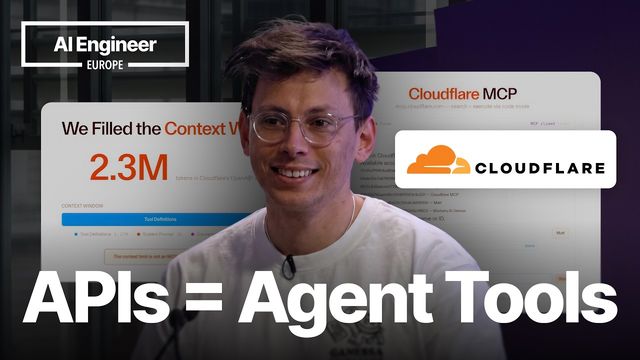
Yeah, we can go back to front. So in terms of MCP, we had April last year, where people, like, kind of discovered MCP, because Cursor added MCP to the client. And Cursor were like, "If you want to connect external tools, this is how you do it, through this protocol called MCP." And so in April last year, we had what Rhys said: people vibe coded their MCP servers in a weekend. And very quickly, Cursor was like, "Oh, we need a tool limit, because our models are getting swamped by context." And in a traditional— like, in a naive MCP approach, you take the list tools call, which returns a bunch of JSON schemas,43JSON Schema — a format for describing the structure of JSON data: which fields, of which types, which are required. MCP servers describe their tools' parameters this way. and you put that as tool schemas in your model context.
So every MCP tool fills up your model context. And when you get to, like, 40 tools— the context windows weren't that long at the time— suddenly, like, you're bloating the context window. And that was the hate that Rhys talked about. Like, the GitHub MCP server had, like, 55 tools or something. And Sam, who makes it, got so much hate, despite the GitHub server being, like, one of the best servers now, and he has actually continued to work on it loads. He got loads of hate at the time, where it was like, "Oh, this server just bloats your context window."
And then, like, moving onwards from April of last year, in the summer of last year, that was when, like, the term Code Mode was coined by Kenton and Sunil here. And then no one really did anything, if I'm being completely honest.
Yeah, it was crazy.
It was wild. It was like, this is the obvious way that this is gonna work, but it seemed complicated to implement, because suddenly a client, if it was in a CLI, had to ship, like, a whole REPL44REPL (read-eval-print loop) — an interactive environment that reads an expression, evaluates it and prints the result. or a whole JS execution environment, or some type of execution environment, to their users. And I think a lot of people who were building CLI products were just like, "Well, we have bash." And that's when Mario— that's kind of when Pi45Pi — a minimalist open-source coding agent that Mario Zechner started on his own and moved to Earendil in 2026. Pi's core toolset is read, write, edit and bash. Pi 1.0 came out on October 1, 2026. pi.dev. came out, and they were like, "We're just gonna have read, write, edit, bash. And the model is gonna use bash for everything. And that is, like, our implementation of this, like, Code Mode."
And they outwardly spoke about never connecting it to MCP, because MCP is a bloated context window. And this was kind of funny at the time, and very funny in retrospect, that they've done this U-turn. Shout-out, Mario. It's very nice. But then— so we're talking, like, almost a year, about a year ago now, there was this whole, like, "We can just use bash." And then fast-forward to, like, winter last year, I would say, like, November, December last year, when OpenClaw started getting huge. And Peter from OpenClaw, he made MCPorter,46MCPorter — a tool by Peter Steinberger, the creator of OpenClaw, for calling MCP servers through a plain TypeScript API or packaging them as CLIs (GitHub). which— he wanted to give all of his OpenClaws access to external tools, but he didn't want to make an MCP client that could run JavaScript or, like, anything like that.
He was like, "We'll just use bash. It's, like, the simplest." And so he made— it was really funny. We both did a talk in London at the same time, and I did a demo of an MCP server, like, playing around with this Code Mode idea. This was in February. And he did a demo of showing OpenClaw with all of these integrations being, like, powered by MCP but not using MCP. And this is very fun, because he made MCPorter, which was, like, a CLI that transformed MCP servers into— they generated this SDK,47SDK (software development kit) — a set of libraries for working with a service from code: instead of raw API requests, the programmer calls ready-made functions. and then they ran it as a CLI.
And he was like, "We're just gonna run things as a CLI." And then yeah, in February last year,48Fact-checkMatt says February of last year, i.e. 2025, but Cloudflare's Code Mode MCP server came out in February 2026; a few minutes later Matt himself says "February of this year" (Cloudflare blog). we made the Code Mode MCP server, which made a few waves, because we were like, "We're gonna put, like, I don't know, 3,000 tools in a context—" 3,000 tools in the server, "—but you're only gonna get 1,000 tokens in context.49Token — the unit of text a model works with, usually a piece of a word. Context, prices and model limits are all counted in tokens."
Can you go into a little bit more detail about that? So, yeah, just tell us more about that, because that was a big moment, like, for you, but also, like, for the ecosystem, it was quite a big moment, I think.
Source: Cloudflare blog, "Code Mode: give agents an entire API in 1,000 tokens", counted with the tiktoken tokenizer
Yeah, that was really fun. We kind of combined two ideas with this MCP server. So people throw a lot of words around. In that time, since Sunil's amazing— since Sunil's blog post and, like, Christmas last year, I guess, Claude Code had added tool search to their MCP client. So the point being, the model would get a tool which is, like, "search MCP servers," and then it would search across the servers, and it could connect— I think it could connect— or it would search across the tools, and then the model would get, like, the specific tool and could call the specific tool. So this, like, collapsed a massive amount of MCP tools into, like, much less.
And I think it was experimental for quite a long time, because they were trying to see how the model performed with it. But what we did was we combined this idea of tool search— maybe Claude Code wasn't the first one to have it— but we combined this idea of tool search with what became known as programmatic tool calling.50Programmatic Tool Calling — a Claude API feature: the model calls tools from code that runs in a sandbox, and only the final result enters the context. Anthropic added it in November 2025 together with the Tool Search Tool, which lets the model find the tools it needs by query instead of receiving every description up front. So the problem with tool search, and the reason why it took so long for it to become stable in a lot of the clients, is to actually get the search indexing, like, good, there needs to be a whole life cycle around indexing new tools, around, like, evaling that index,51Evals (evaluations) — sets of test tasks for measuring the quality of a model or a system; here, how well search finds the right tool. around, like, just working out, like, "Is my search doing well?" And it's a whole, like, recommendation system ML problem that goes back, like, a really long time. Like, "Is my search good?"
And we, like, got rid of all of that, because I was like— I spent, like, two years at a startup, like, trying to do recommendation systems, and I was like, "I'm not touching any of that. Why don't we just let the model write some code to do, like, .startsWith52.startsWith — a JavaScript string method that checks whether a string begins with a given substring. Matt's point is that the simplest operations are enough for the model to search the spec. or something over the OpenAPI spec?" And the OpenAPI spec is, like, this ordered schema, and the models can infer over that schema very, like, easily, and it could actually search that schema without having seen the whole schema. So it can write these very complex queries in code without you needing to make some brittle search algorithm. So we exposed two tools, search and execute, and both of them were code-driven. So when I speak to a lot of people about this now, they're like, "Oh, like, how did you do the search?
Like, what are the parameters for the search and stuff?" I'm like, "It's just code." And then they look at me again, they're like, "No, but what's the parameters? Like, what does K equal,53K — how many top results a search returns (top-k), a standard parameter of search and recommendation systems. or, like, how are you doing the indexing?" I'm like, "No, it's just code." And it normally takes about three attempts before I say, "No, I dump the OpenAPI spec into a REPL that the model can access, and then the model can write code that searches over the spec."
And the model can return whatever it wants, but the models are normally really good at not returning a lot of stuff to the context window, especially when they know it's an OpenAPI spec that's massive. They're like, "This is a big OpenAPI spec." And then, yes, execute just allows the model to call— it's just essentially an authenticated fetch handler.54fetch — the standard JavaScript function for HTTP requests; in Cloudflare Workers, a fetch handler is the function that takes a request and returns a response. It's, like, very, very basic. And so, yeah, this collapsed this massive amount of tools into 1,000 tokens and gave, like, full access to our API. And it was very maintainable for us, because there's this whole thing about, like, you want to maintain your MCP servers.
The GitHub MCP server we brought up earlier, they just added structured output55Structured output — when an MCP tool returns its result not as plain text but as JSON matching a schema declared in advance, which the client can validate. to their MCP server. And they actually hand-wrote all of their schemas, because OpenAPI specs are kind of unreliable. Like, this is an absolute pain, like, to keep two sources of truth: like, your OpenAPI spec describing your APIs, but then your MCP server describing your MCP tools. Like, this is an absolute headache. And so we got around all of this, for better or for worse, by just reloading the OpenAPI spec every day into context. So that was pretty much it.
08Code Mode becomes the default
A year after the blog post, all the major coding agents run in Code Mode.
And then fast-forward from February of this year, when we released that, through a bunch of, I would say, like, devrel-ing56DevRel (developer relations) — working with the developer community: talks, articles, demos and sample code to help people understand a technology and start using it. that we've all kind of done to, like, try and educate people on how, if you just let the model write code, good things happen, to now, and OpenCode v257OpenCode — an open-source coding agent. OpenCode 2.0 (released October 12, 2026) ships a minimal JavaScript interpreter, the @opencode/codemode package, which turns MCP servers and OpenAPI endpoints into functions the agent calls from a script, without Node.js virtual machines or QuickJS. In 2.0 every MCP server runs in Code Mode by default. Announcement. just got released, and Pi just got released, the new version of Pi, Pi 1.0. And they both come with inbuilt execution environments for running JavaScript. And they load all of their MCP tools into that execution environment. Yeah, and Codex,58Codex — OpenAI's coding agent, available in the terminal, code editors, the cloud and the ChatGPT app. It launched in April 2025 as the command-line Codex CLI. sorry. And Codex, yeah, ChatGPT web as well. Amazing.
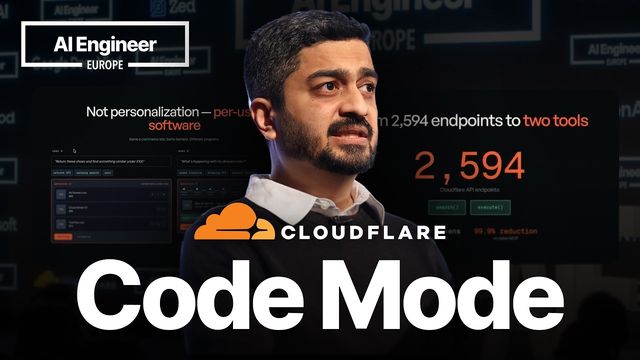
As of today, all the major coding agents do Code Mode by default, which is just crazy.
Is Claude Code doing Code Mode?
I haven't— yeah, I think so.
I think so.
I think it's still behind an experimental flag in Claude Code. There is, yeah, I think so. I think so. They do tool search by default now, which was turned on a few months ago, or, like, not behind the flag, but I'm pretty sure actual Code Mode is still behind a flag. But I need to double-check that.
And what's nice about the Pi implementation is all of the tools and all of the MCP tools are available in their Code Mode, like, execution environment. And just, like, watching the agent use the tools and writing code inline to solve problems— like, it just never gets old. Like, every single time it happens, I just sit there and I smile, I'm like, "Damn, that's the coolest thing I've ever seen in my entire life." Like, we can talk about this a little bit later, but, like, it might have been in the—
I want to say I shared a video of it.
So yeah, I think it was the blog post from Earendil and Pi 1.0, or maybe they wrote a special thing about Jev.59Jev (TypeSafe AI, September 2026) and Clef (Cloudflare, October 1, 2026) — "decision models": instead of generating text, they quickly produce typed probabilistic decisions, such as classifying inputs. The Code Mode demo with Jev in Pi was made by the Earendil team; on October 1, 2026, Dillon quoted it as a great showcase of both Code Mode and classification models. Jev announcement. I don't know. Either way, it has, like, probably the most succinct example of Code Mode, where they hook up a tool for using Jev, classifying something. And then they have other tools, like probably the GitHub MCP or just GitHub's— I don't know what the exact tool is— but they type into Pi. It's like, "Please go triage all of my open issues on the Pi GitHub and classify the issues, you know, based on a couple criteria."
And, like, the model then goes and uses Code Mode, writes code to go fetch all the issues, and then it writes a Jev classifier, completely dynamic, to classify things. Like, the model is choosing what the different categories that Jev has are, and it basically goes over this full list, and then the model also then writes code to format the output in a token-efficient way, and outputs, like, this nice list of, like, "Here's the issues, and here's their classifications, and here's the high-priority ones," or whatever. And, like, it is just magic to watch. And, like, I think it's just the best demonstration of Code Mode, like, period, and also, like, why things like Jev or Clef or Kev or whatever— like, how the power of, like, classification models like that can be injected into these workflows. Like, not even just in application land, which I think there's a lot of value— which I wish I would have been around for that episode, but we can maybe get into classifiers later— but, like, inside Code Mode, to help models make decisions on their own, like, them reaching for that.
It's just super cool. We'll attach that in the show notes.
I think there's a bunch of wild stuff about Code Mode that is also, like, non-super-obvious, beyond just this, like, composability of things. I think execute is doing some cool stuff. Maybe, Rhys, you want to chat about this. Like, I'm very interested in, like, how we do, like, permissioning in the future, and, like, how that layer works, like, in enterprises. I don't know how we're gonna solve any of this stuff.
I still don't have a good answer for permissioning. I actually want to, like, tear out the approval system from Executor, because, like, people just don't really care about it that much, and it, like, adds friction to most people, who want to, like, run it either in dangerously-skip-permissions60--dangerously-skip-permissions — a Claude Code flag that turns off all permission prompts. In auto mode, a classifier makes permission decisions in place of the human. or in, like, auto mode? Yeah, or in auto mode. Maybe what it looks like— I don't know, there's, like, a bunch of things where, like, I want the harnesses to get better, to where when they spawn a subagent,61Subagent — an agent that the main, orchestrating agent launches for a separate subtask with its own context, then collects the result from. the, like, orchestrating agent handles the approvals, that kind of a thing, or, like, the orchestrating agent has more ability to control that. What I'm really excited about— I can talk a little bit on why I was, like, so excited about Executor with Code Mode, though, or, like, why things click for me there, is I was like, you know, once you have this TypeScript representation of all of your tools and a way to execute untrusted code, you don't have to, like—
09Where the model's code runs
Nested Code Mode turns out to work, though the model gets confused when it needs variables from the outer code.
Before we go further, can you explain— that's one part that we didn't get an answer on there, is: how is the model going from writing code to that code executing?
Like, what is that path? So, like, we see in Pi or OpenCode, you know, invocation and then that code, but, like, how is that runtime execution environment working?
ExplainerWhere to run the code a model wrote
A model's code is untrusted: it may contain a bug, an infinite loop or an attempt to reach someone else's data. Sandboxes differ in startup cost and in how solid the wall is:
- a custom interpreter for JavaScript or TypeScript, like OpenCode's: it runs right inside the agent's process, but can only do what was implemented in it;
- QuickJS — a full JavaScript engine a few hundred kilobytes in size; it's compiled to WebAssembly and run inside the agent, where the code has no files or network, only the functions explicitly handed to it;
- V8 isolates — the Chrome engine mechanism Cloudflare Workers use to separate different customers' code: an isolate starts in milliseconds and takes a few megabytes, so you can spin up a new one for every script the model writes (Dynamic Workers);
- containers and virtual machines — familiar Linux with all its utilities, but startup takes anywhere from a hundred milliseconds to seconds, and the machine itself costs real money.
The, like, current state of Code Mode is interesting, in terms of there's a bunch of options. So OpenCode has, I think, the most novel approach that I've seen, where they wrote an interpreter, which is really interesting. And the reason you want an interpreter— so the model has generated some TypeScript. You need to run that TypeScript in a way. To run untrusted TypeScript, there's, like, three options that come to mind. There's QuickJS.62QuickJS — a compact embeddable JavaScript engine released in 2019 by Fabrice Bellard and Charlie Gordon. bellard.org/quickjs.
QuickJS is, like, a tiny, very portable, can-go-to-WASM63WASM (WebAssembly) — a binary code format that runs in browsers and other environments inside an isolated sandbox at near-native speed; C, C++, Rust, Go and other languages compile to it. library for running JavaScript. There's V8,64V8 — Google's JavaScript engine, which powers Chrome, Node.js and Cloudflare Workers. which is, like, more heavyweight. Like, V8, you can do isolates with it. That's, like, Cloudflare Dynamic Workers.65V8 isolate — an isolated instance of the JavaScript runtime; the Cloudflare Workers platform is built on isolates. Dynamic Worker Loader — a Workers API that lets a worker load and run arbitrary code in a new isolate on the fly; it starts in a few milliseconds and takes a few megabytes of memory. This is how Cloudflare runs Code Mode code. But I would, like, describe— is it fair to say it's a lot heavier to, like, spin up to use than, like, a QuickJS or, like, an interpreter? To spin up the whole V8 isolate, the whole, like, V8 runtime. Like, it's a lot to, like, have to ship in your client in comparison.
So that's actually a good point of clarification: is the execution happening generally on the client's device, or is it happening on, like, an MCP server somewhere?
Yeah, okay, so there's a whole bunch of things. So one, like, very bad world that we've, like, mostly avoided now— which is good, now that clients have good implementations— would have been that, like, every server ships their own Code Mode. So for Executor, I'm actually walking this back, in terms of, like, I'm gonna still have an execute tool, but I'm gonna ship just, like, some regular invoke tools. And Cloudflare— are you guys still defaulting? Are you guys defaulting to Code Mode, Matt?
Yeah, we're still defaulting to the meta tools, the Code Mode tools, on the server, but we do give an option for direct tools.
Yeah.
I actually— I don't know if I'm of this take, but the problem that you're trying to avoid is this, like, Code Mode in Code Mode problem, where every server then has to write code underneath. And I'm not convinced this will be bad once a few versions of the models have seen this. I guess my hot take is that, like, this will actually be, like, expected and wanted, because what we've actually found to work really well, which is almost the same thing, is the model writes code that can import— so, for instance, for us, the model writes code in a Dynamic Worker Loader if we're running agents in the cloud. And this is, like, a stateless thing. So if the model wants to— and it can't do things, like, it can't run a dev server in a Dynamic Worker.
Not really, not just yet. So if it wants to do these things, it normally has to spin up a container. So previously we were like, "Oh, we'll give an execute function for running in a Dynamic Worker and an execute function for running in a container." And this was— we released a blog post called Cloudflare Computer.66Cloudflare Computer — the @cloudflare/computer library that Matt Carey and Aron Carroll introduced on August 3, 2026, in the post "Your agent needs a computer, not a container": an agent runtime that decides for itself where to run code: in an isolate, in a container or in a browser. But actually what we found more recently is you can get all of the code to run in a Dynamic Worker, and then you can have, like, a module, a library that the model can import— essentially Code Mode— that is, like, container. And then it can do container.exec and run code.
And that actually works really, really well. Like, it can even do container.exec node -e, or whatever it is, and run JavaScript code inside the library code inside the Dynamic Worker. And that, like, triple Code Mode actually works surprisingly well. So I'm not convinced this, like, Code Mode on the client and Code Mode on the server will actually be bad in the long term.
Anecdotally, because, like, we have our CF Portal internally at Cloudflare that has some similar ideas to Executor, but, like, it basically is one MCP that hides a bunch of other MCPs under that. And CF Portal in and of itself is a Code Mode server, and then a bunch of the servers connected underneath. We have one called Town Lake, which is, like, basically our tools to query all of our data platforms at Cloudflare. And you get into this, quote unquote, problem of Code Mode inside Code Mode. But to your point, Matt, like, I thought this was going to be really annoying, and I was gonna want to try to figure this out and, like, you know, maybe just expose the tools directly. But, like, it just writes more code inside the code, and it just works.
I haven't seen this happen, but I could imagine maybe a failure case where, like, some state inside the outer closure67Closure — a function together with the variables of the environment it was created in. Here: code running in the nested environment can't see the variables of the outer code that called it. is tried to be used inside the inner closure, and that doesn't work. Or that could allow better composability.
You also lose indexing of tools. Like, being able to know up front, "This is all of the tools that the Cloudflare server exposes."
Yeah, so you're always gonna have to call search again. And to your point, Dillon, like, having variables in the outer closure that can't be used in the inner one, this is, like, the number one failure mode at the moment. So, like, a very obvious one that happens— it even happens with our MCP server at the moment— is, like, trying to use the Browser Run MCP via API in our Cloudflare MCP server. And it often outputs, like, a PNG file. And the PNG is, like, often too big to, like, return it without the correct headers. And so then it starts being like, "Oh, I can just, like, write something to use the PNG and then, like, change it and, like, modify it," but it can't, because it doesn't have access to the inner closure.
And so then it's like, "Oh no, actually, no, I need to write it to R2." And then it's like, "Oh, but I don't have an R2 binding,68R2 — Cloudflare's object storage. A binding is how a worker gets access to a resource such as an R2 bucket; it's declared in the configuration." and now it's, like, making an R2 bucket to then add an R2 binding. And it gets, like, very, very confused. So I think we have seen, like, empirically, that it is worse. But I think, set up correctly, where, like, the model is, like, conscious that it's— that sounds horrible— but, like, it's, like, conscious that it's, like, using it in a different execution environment. So, like, import container— I think when you're very clear that, like, now you're inside a container, then maybe that's it. But I think we'll see with the next generation of models.
10Sandboxes, pauses and the long tail of integrations
There are plenty of tools for running Code Mode, and the hard part, Rhys says, is getting other tools into it.
Yeah, and you could also get around it through, like, stubbed tool calls,69Stub — a client-side object that looks like an ordinary function or object but actually forwards calls to the server; RPC libraries like Cap'n Web are built on stubs. where, like, the model doesn't need to do any imports, but if it was, like, container.bash—
Basically, that's basically it, by the way, which is— it's not like it's generating, writing a function there. It is passing a string, and the string could be code that is then— but yeah, you could have— it's basically, like, container.bash or container.exec some code, et cetera.
Code Mode, if you want things to, like, check out to build your own harness or play around with it. So there's the Cloudflare Code Mode library.70The Code Mode library — an SDK in the Cloudflare Agents SDK that Cloudflare opened up in February 2026 together with server-side Code Mode, so the same approach could be used in your own MCP servers and agents. Cloudflare blog. Is that for people to use in their harnesses? Would you recommend it?
Yeah, I think we're moving towards Cloudflare Computer. It's just, like— the Code Mode library was very singular. Like, "This is a Dynamic Worker. We're gonna load code into it, we're gonna run it for you. You can pass us a bunch of tools, and we'll convert it to that format." And then I think, like, more recently we've decided that actually there are loads of different places you could run code.
And then, like, there are Dynamic Workers, there are containers, there is, like, R2 SQL or something like that. There's, like, loads of random places you might want to run code. Also in memory— OpenCode. So that's Cloudflare Computer.
Yeah, OpenCode's interpreter is super cool. Just point your agent at the repo and ask about it. It's npm-installable.71npm — the JavaScript package manager and the largest registry of open-source packages; it appeared in 2010 and has belonged to GitHub since 2020. There's two interesting ones from Vercel72Vercel — an American cloud platform for websites and web apps and the maker of the Next.js framework, founded by Guillermo Rauch in 2015. I want to talk about. One is Run SDK,73Run SDK — a Vercel package released on August 25, 2026: it runs untrusted JavaScript and TypeScript in a separate QuickJS context inside a worker thread, with no direct access to Node.js or the network. The app exposes only chosen functions to the sandbox, and execution can be paused to get authentication or human approval and resumed without redoing finished work. It powers code mode in the AI SDK. which they positioned as, like, secure eval74eval — a function that executes the string passed to it as code. "Secure eval" means running someone else's code so that it can't do any harm. for agents. It's built on QuickJS, which— I don't know, there's some things with the security boundary on QuickJS to, like, note. There's another interesting one from them called Callscript.75Callscript — an experimental Vercel Labs library (GitHub): the model writes JavaScript, but the code isn't executed; it's parsed into a JSON plan of tool calls. No sandbox is needed, the plan is checked before it runs, and execution can be paused and resumed. Callscript is actually very interesting. Have you guys seen that one? No? So Callscript is the same, like, interpreter approach or concept. Basically, what Callscript does is the agent has a subset of JavaScript it can write, and at each step it basically becomes serializable, sort of like a workflow. And so you can— oh my gosh, I'm looking at this README and it's such AI slop. Callscript's interesting from a perspective of, like, you kind of want pause and resume for Code Mode, and so it gives a way to do that. But when I evaluated it, the, like— why would I want pause and resume for Code Mode?
Give me some concrete examples here.
I mean, for Executor, I use it for approvals. Approvals, that's the big one.
Yeah. Approvals is a big one. You end up at a call that needs a user to click yes, and that yes might come three days in the future.
Okay, I see, I see.
Alternatively— I don't think any of them do this— no, Codex's implementation does this— letting the model, like, yield itself out of the script, so that way it can resume it. Because if it knows something's gonna take two minutes, it shouldn't be blocking on that. But there's also this thing of, like, I actually think that all tool calls should probably be async, just in general. Like, I think we're going to look back on blocking tool calls as, like, weird.
Oh, I think Pi's refactor makes all tool calls async by default, I think. And the reason they've done that is clever— I don't know if they still do, but at least the last time I spoke to them— which is you could probably turn on the mode where not just tool calls, but even inference calls— and you could turn it on to default to batched mode, which are way cheaper from inference companies, and nobody uses them except for, like, some ELT kind of stuff,76ELT (extract, load, transform) — pipelines that extract, load and transform data. Batch mode — sending requests to a model in bulk and getting the answers later, within a day; at OpenAI and Anthropic such requests cost half the usual price. right? Yeah. So, yeah, I absolutely agree. Tool calls, inference calls— why not just make it async?
There's Monty by Pydantic,77Monty — a secure sandbox for AI-written Python code from the Pydantic team; it's written in Rust and needs no containers (GitHub). which is Code Mode in Python, if that's your thing.
I don't know why it would be, but that one's kind of interesting as well, because they— what does model-written Python actually look like? It probably looks very different from human-written Python. So, "We're just going to get rid of all the bits that humans might need, and we're only going to keep the bits the models need, or the agents need, to write Python." I think that is quite interesting. The same way that Dynamic Worker Loaders don't have— like, it's only JavaScript and stuff, and there's no, like, syntax checking or anything like that when you're writing the code. There's nothing— like, there's no, like, handy bits, I guess.
There's no way to run it for yourself to, like, see what's going on. But I think, like, they went even further, and they just got rid of language features that people didn't need, which is kind of crazy.
There's another interesting one. You can actually— so, like, six months ago, it was too slow to run type check on Code Mode scripts, but you can actually use Theo's TypeScript Rust78Theo Browne — a YouTuber and developer who used AI agents to port the TypeScript compiler, with type checking and the language server, to Rust. He says the port is twice as fast as the official Go-based TypeScript 7, and, more importantly, the Rust version is easy to run in WebAssembly, where the Go version would have to carry a garbage collector along. The Register. in Wasm in a Worker and now type-check Code Mode scripts, which is— if that's your thing. They're generally correct, you don't need to type-check them, but it's cool.
Yeah, it's been a long time since I've seen an agent actually screw up Code Mode and writing code, like, on syntax or type errors.
Yeah, exactly. I have a very hot take that— well, maybe this isn't a hot take— but, like, the hard part of this isn't actually the Code Mode. The hard part is: how do you get the tools into the Code Mode format? How do you make it so that when the user is like, "I want to call this MCP server," that you can just add that MCP server, all of the tools get categorized and are now callable in that format? How do you integrate with things that aren't MCP? Because there's this, like, super long tail79Long tail — a multitude of rare cases: each one is uncommon, but together they make up a large share. Here, the countless nonstandard APIs and integrations. of, like, "Well, what if I want to add an OpenAPI spec? But what if the OpenAPI spec is wrong? What if it needs headers?
What if it doesn't, like, define the security schema format?" Almost like MCP solves that problem.
Hey, hey, Rhys, is there a company or a solo founder, would you believe it, who's working on this?
I think MCP is great, but also, like, there's this super long tail of things you want to integrate with that MCP doesn't support. And if you just let the model, like, write essentially an API and then load that, give it a way to call that, it's super useful. Yeah, I mean, so, like, I can talk a little bit on the, like, hard part, in terms of, like, competing with bash. I was, like, really mindful in terms of, like, what is everything bash does well. Bash does, like, hot reloading incredibly well. Bash does, like, recovery incredibly well, where, like, if a CLI is broken, the model will just open it up and patch the CLI and, like, fix it for you.
But then you get into, like, what does bash do poorly? And it's like, well, multiple accounts. Like, that's, like, not done well in bash. Like, bash has no concept of multi-accounts, which is, like, fine, but if you want, like, two instances of the Vercel CLI on your two different accounts, that's not, like, a thing that it represents well. It doesn't have, like, health checks that well. Like, again, that's, like, a CLI detail, but you really want to know that, like, all your accounts are working.
11What comes after Code Mode
Code Mode spread faster than React did, and the hosts see state and events as the next step.
And, yeah, I think I kind of want to jump into— like, I feel like we're missing something with Code Mode, or, like, what's next after Code Mode. I really like it, but there's, like— if you look back at how long it took us to get to the widespread adoption of Code Mode, it's crazy. That's crazy that it took us— what was it— the tech preview was 2023, and now it's 2026, and harnesses just now have it implemented.
And over a year since—
Yeah, and over a year since the blog post. I don't know if it's just, like, the time that it takes to proliferate ideas, but, like, yeah— like, I don't know. I know that there's all the complexities involved, which makes sense.
I mean, to be fair, to be fair, a year. I know time has been compressed with AI, but, like, I mean, as of, like, what? OpenCode 2.0 officially came out today, right? Is that— the blog post came out today? Yeah. Like, as of today, basically all of the major harnesses have Code Mode implemented. And that blog post came out maybe last October sometime.
And now, if we look, that means basically every single developer on the face of the planet that's using a coding agent harness is using Code Mode every day, multiple times a day, for hours a day. Now look back at, like, the adoption of even something like React.80React — a JavaScript library for user interfaces, created at Facebook and open-sourced in May 2013; today one of the most widespread web technologies. Sunil Pai used to work on the React team. Like, React took— the first time I wrote React was in 2014, right? And how long was it to the point where you could say basically, like, the majority of developers are writing React every day?
Half a decade, right? Like, so that is actually a remarkable turnaround on adoption.
Let's have, like, ideas. Yeah, what is your pitch? What is next after Code Mode? I have a couple of ideas. Oh, what's next after Code Mode? I have no idea.
I have, like, some idea, but it might be, like, too grounded in what Code Mode is today. Like, I think Kent C. Dodds's Kody agent81Kody — a "personal software factory" Kent C. Dodds introduced on September 8, 2026: a cloud sandbox where agents write and run code against connected services and turn successful one-off code into packages any agent can use later. does something remarkably cool, where the agent can write reusable scripts and then import those into Code Mode. I think that's really novel and cool, because it's almost like a form of, like, memory too. I don't know if that will become, like, a core piece of the Code Mode architecture that, like, becomes popularized, but I think that idea is interesting. It will.
It will. I'm interested to see how, like, triggers, once they officially come out in— or I don't know if they'd be rebranded as events— but basically a way for services to call back into the harness or MCP servers. And, like, there you could get into a world of using pre-written scripts there, or that coupled with, like, classification models too. I think there's some, like, interesting things there.
Some form of durable execution,82Durable execution — an approach in which a multistep process saves its state after every step and survives crashes, restarts and long waits, picking up where it left off. Temporal and Cloudflare Workflows work this way. I think, is really interesting. One of the things I'm, like, most excited about with Executor v283Rhys's tweet of October 8, 2026, about Executor v2: you can start from tools generated from the Gmail API spec, then ask for emails to be sent with a five-minute undo window, build a UI for unread mail, create a skill with your own writing style, or a webhook handler that deletes spam. is that, like, you can take the Gmail MCP, and you can be like, "Add a five-minute— like, set this up with a workflow to delay the send for five minutes," and then only after— like, that way I have, like, a cancellation period. Or, like, "Let me take notes on top of it." So, like, being able to vibe code, like, extensions on top of it. Yeah, that's, like, probably what I would see next being really popular. And we're seeing this early with, like— so what you mentioned on Kody— ChatGPT plugins is another one. ChatGPT plugins are actually really cool.
I did not realize how cool they were. They're running vinext under the hood, they, like, have an actual MCP server attached, they have storage. Very cool concept for, like, what is kind of next.
Yeah, yeah, yeah, that makes sense. Like, you're basically saying, like, an important piece of the puzzle, or what makes something like ChatGPT plugins good, or Executor, is, like, an introduction of statefulness to Code Mode.
Statefulness. And, like, think about what has been lost in the move to working with agents.
So, like, Gmail— when you would send an email in Gmail, like, I really like that undo send example, because it was like, you don't have that—
Some stupid emails, dude. I swear, I know.
I remember when Claude— I had Claude send you that one AI email?
Yeah. Yeah, that's good.
We had a nice podcast. But yeah, if you think about what was lost: triggers have been lost with the move to, like— something like a Linear,84Linear — an issue tracker for software teams, known for a fast interface that updates in real time. where, like, the state updates in real time. Like, you don't have that anymore with, like, a Claude artifact85Claude artifacts — standalone documents, code snippets and small interactive apps that Claude creates in a chat and displays alongside it. of, like, your Linear data. UI, that kind of has come back now with, like, Claude artifacts, but it's not just Claude artifacts UI.
Codex— well, ChatGPT just shipped generative UI, I think, over the last couple of days as well. Yeah. Yeah, they're also extensions.
Yeah. Also, the ChatGPT team— like, quick shout-out to them, because it's, like, incredible work that they're doing for driving MCP adoption. They supported skills86Skills — a format Anthropic introduced in October 2025: a folder with instructions in a Markdown file, SKILL.md, plus scripts and other files if needed; the agent loads a skill when a task calls for it. over MCP. They supported skills over MCP. They're, I think, the first major harness to implement MCP events87MCP Events — a new specification under which MCP servers can push real-time updates to the client (messages, comments, status changes) and so trigger users' automations. On September 30, 2026, Max Stoiber announced that ChatGPT supports it. as well, which I kind of— I kind of thought—
I kind of thought no one was going to implement MCP events, but I was, like, very excited to see, like, one of the biggest— like, probably the biggest, like, web app have them.
12Unikernels, resources and Cap'n Web
The guests' predictions: from just-in-time computers to stubs the server hands the client.
Yeah. So for me, a prediction is— well, the UI thing is fun. I think that's gonna happen more. If you look, basically we are working our way through things that otherwise would take too much time or required expertise. And I think the next one that's going to fall is unikernels.88Unikernel — a specialized single-address-space system image: only the operating system libraries a given application needs are compiled into it, and it runs directly on a hypervisor. Wikipedia. So creating— like, I actually don't think the idea of using a Linux VM for everything is— it's just not sustainable.
And we're gonna talk about that in a bit anyway. But the ability to construct a kernel and a computer that's built for purpose, almost just in time, if not completely just in time, and having clients talk directly to them. Why— and MCP, like, I feel like MCP becomes just, like, the protocol. It is just the protocol right now, but it's so— nobody really thinks about it anymore. It's just the new REST89REST — an architectural style for web APIs: resources live at URLs, and actions are expressed through HTTP methods (GET, POST and so on). The most common way services talk to each other. that agents use to talk to each other and to other machines. So I think unikernels are going to become a part of this.
This has been an interesting one with— I realize, so with the— I'm trying to avoid shilling Executor too much, but, like, it's general concepts that are really free.
It's fine. I think what's nice about Executor is it's a look into, like, where things will be with harnesses in six months. And so one of the things that I am, like, really excited about with it now is when I, like, get an email, I can just send that to Jev. And, like, the prompt is, like, dumb. I'm like, "When I get an email, send it to Jev and delete it if it's spam, and keep a record of it, so that way I can know in retrospect." That's a really interesting one, because if you compare that to, like, a "Hey, Grok Bot,90Grok Bot — xAI's AI agents: each bot gets its own cloud computer, connects to the user's services and carries out multistep tasks. The beta came out in August 2026. monitor my email every, like, 30 minutes and delete spam," you get a bunch of really interesting things there, where you can, like, let the model choose whether to escalate notifications.
It can just delete it, it will handle it immediately. You don't have to, like, spin up a full VM. That's a really interesting one.
I'm really interested in how much of it collapses into, like, MCP and then good clients, and there's, like, less of the smart server thing that we were doing before. And, like, I guess what I mean by that is, like, coming back to an old point about— there is an idea that MCP should just be resources, where— what is an OpenAPI spec? An OpenAPI spec is a list of, like, routes and then some JSON schema about requests and responses. Like, that's pretty much it. And from that you describe an OpenAPI spec.
For MCP, we wanted this to be, like, headlessly callable. And so you need some protocol— or you want it to be, like, headlessly callable without, like, going and having a look at some docs. So you need some protocol that includes proper auth. And that's where, like, OpenAPI spec has, like, sort of struggled, because even if you say "my OpenAPI—" like, I worked at an integrations company— like, "my OpenAPI spec is OAuth 2-compatible.91OAuth 2.0 — the standard for delegated authorization (RFC 6749, 2012), which over time accumulated many additional RFCs. OAuth 2.1 is an IETF draft consolidating the main ones into a single document; MCP's authorization is built on it." Like, what does that mean? Like, "OAuth 2.1-compatible," what does that mean?
There's still, like, hundreds, if not more than hundreds, of RFCs92RFC (Request for Comments) — the series of documents in which the IETF publishes internet standards, including OAuth and its extensions. that might be OAuth 2.1. So you kind of have to pick your particular flavor of auth. And the MCP team is picking their particular flavor of auth, so everything that is MCP-compatible complies with this auth. But that means the rest of it can actually be very, very simple. And maybe you only need, like, one primitive for request and response. And maybe it's, like, one primitive plus some notifications.
And so, like, that primitive could just be resources, or it could just be tools. But I think resources makes more sense here, because something like skills is a resource, it's just a Markdown file at some particular URI.93URI (uniform resource identifier) — a string that uniquely names a resource; a URL, a web address, is one kind of URI. Something like a tool could just be an execution at a particular URI, or you could go really fancy and return, like, a stub over MCP, which you could then, like, call on the client. Like, you could do some, like, Cap'n Web-style94Cap'n Web — an RPC library for browsers and servers that Kenton Varda and Steve Faulkner introduced on September 22, 2025, as a "spiritual sibling" of the Cap'n Proto protocol. It supports promise pipelining: the result of a call that hasn't finished yet can be passed straight into the next one, and the whole chain goes to the server in a single round trip. The authors compare it directly to GraphQL, which also avoids "waterfalls" of sequential requests. thing there. And, like, this means that you could do Code Mode on the client, like, some execution on the client using stubs from the server, but everything is still a file, because you're essentially, like, executing a file on the client that exists on the server. Does that kind of make sense?
Like, "everything is a file" and "the model just writes code" as my, like, two ideas of where we go forwards from this.
So can you define what an MCP resource is?
Yeah, it's something on the server that is addressable by some URI. And, like, it might have MIME type Markdown95MIME type — a standard label for a data format, such as text/markdown or application/json, that tells the recipient what it has been sent. file, or it might have MIME type executable.
So when you're saying "everything is a file," like, you're considering, like, the execution environment of a file.
Like, you get— how does— so if you think of Unix, if you think of, like, a Linux operating system, like, where are the inbuilt, like, bash scripts? Like, they are just files, and you have, like, an alias to them.96Alias — a short name for a command in a Unix shell. Unix commands themselves are mostly executable files in the file system, such as /bin/ls.
Is this, like, if your sitemap97Sitemap — a file listing all of a site's pages, which search engines use to learn its structure. included your APIs— your APIs?
Yes, exactly. So what this gives you is it gives a new hierarchical structure for your tools.
Okay. Yes. And that's what we are missing.
That's the main thing. That's the main thing we're missing, is this hierarchical structure for your tools. And, for instance, it also solves the problem where people are like, "Oh, my skills should contain scripts."
You can ship skills and the APIs right next to— yeah, okay.
Yes. And the skills probably should contain scripts. And so you're essentially co-locating your execution and your Markdown file. I quite like that.
That's good. I want to make a quick prediction, and then we should jump into the next topics. My prediction is that Code Mode actually moves off of the client. And this is, like, a two-, three-year-out prediction. Code Mode moves off of the client, and we start doing dynamic placement of Code Mode next to whatever API you're calling it. As this, like, race for inference— as, like, inference speed gets way, way faster, the time on tool calls matters a lot more.
And so for, like, the bleeding edge of agents that need to be really performant— like, if you have to wait 100 milliseconds for a SQL query to come back from your database each time, you're, like, now slowing down your, like, super-fast agent loop. And so, like, as you get into, like, quant stuff98Quant trading — algorithmic trading on mathematical models. It's measured in milliseconds and less, so servers are placed as close to the exchange as possible. for your agents, like, the dynamic placement, moving it off of the client, matters a lot more.
You know, I'm gonna say something here, and this is not gonna come as a surprise to Sunil or Matt, but Kenton was right.
ExplainerPromise pipelining: one round trip instead of three
An ordinary remote call is a question followed by waiting for the answer. If an agent needs to find a user, then that user's latest order, then the delivery status, that's three network round trips, each waiting on the one before. With pipelining, the client gets back not an answer but a promise stub and immediately passes it into the next call: "the orders of the user you're about to find." The whole chain goes to the server in one message, the server fills in the intermediate results itself, and only the final result comes back.
The idea was described by Barbara Liskov and Liuba Shrira in 1988 and picked up by the E language, and Kenton Varda made it the foundation of RPC in Cap'n Proto (2013) and Cap'n Web (2025). For agents the payoff is the same as with Code Mode next to the API: the farther the client is from the server, the more every extra round trip costs.
Promise pipelining99Promise — a JavaScript object standing for a result that will be ready later, such as a server's response. and stubs solves this problem. Exactly.
Yeah. Oh, does it? You can still run it on the client, but the promises—
You pass the stub back to the client, the client calls it, and it promises back to the server.
So you would just ship your APIs, and you ship your stubs next to your Markdown files, and then you return the stub.
This is the thing that was invented a year ago that has not gotten adoption, and we're like, "Why has no one adopted this?" Okay.
So Cap'n Web is about to have a moment. Everyone take notes.
And some people have figured this out too. Like, it's why Kenton's built Cloudflare OS,100Cloudflare OS — a platform for vibe coding personal apps that Kenton Varda released on August 5, 2026: each app instance (a "gadget") runs in its own sandbox, and the platform itself controls access. Kenton calls it a rethinking of Sandstorm, his startup from a decade earlier, now on Cloudflare Workers. by the way, which was called Gadgets or whatever it was called— Minions. It went through, like, three different names inside Cloudflare, where he takes all these ideas. So you can point your thing at the— and it's open source. If you'd like, today you can point your thing at the Cloudflare OS code base and say, "What new ideas can I steal from this?" Again, Cap'n Web is not Cloudflare- or workerd-specific.101workerd — the open-source runtime that Cloudflare Workers runs on. In fact, you can run it on the— yeah, I think we should start building different language runtimes as well. Like, I think we can build, like, Rust, Go, et cetera, versions of it. But feel free to steal Kenton's ideas from Cloudflare OS.
I have no idea how we can put it in the MCP core, but I did propose it.
And genuinely, like, it is the best fit of any, like, protocol that I've seen for, like, the lower-level protocol of MCP. Like, just being able to return stubs over the wire and then call them on the client, and it promises back to the server. Like, that's just so nice.
Compute locality, you solve waterfalls,102Waterfall — a chain of requests where each waits for the previous one's response, so the delays add up. you solve the latency, you solve the chaining as well.
So in MCP, the idea— there is some idea that every server can also be a client, or every client can also be a server to another client. And it hasn't really materialized, but this solves that as well. It's, like, ridiculous.
Yeah. Cap'n Web was actually made before MCP.103Fact-checkSunil says Cap'n Web was made before MCP, but Anthropic introduced MCP in November 2024 and Cloudflare released Cap'n Web on September 22, 2025 (Cloudflare blog). What predates MCP is Kenton Varda's Cap'n Proto protocol (2013), which Cloudflare calls Cap'n Web's "spiritual sibling." I think it was actually made because Kenton got mad at GraphQL,104GraphQL — an API query language Facebook created for its mobile apps and open-sourced in 2015: the client describes all the data it needs in a single request. if I remember right. Yeah, I think that's where it, like, comes from.
13The AI moment for normies
Personal agents already click for regular people, but in Sunil's view their economics don't work yet.
Yeah, I guess GraphQL kind of solves some of the waterfall problem, in a well-executed, designed GraphQL server, which very few people actually— theoretically, I love GraphQL. Yeah, yeah, that's a good point. Okay. So moving on, the next topic we're gonna dive into here is this genre of products coming out— Grok Bot, Muse, Dots:105Dots — OpenAI's always-on personal agents. They came out in September 2026, as did Muse, Meta's personal AI agent. is this the AI moment for normies? And I will start with a small anecdote, in that, like, I gave my wife Justine Grok Bot, and she, like— it instantly clicked.
Like, she was setting up new agents, having things scheduled, having it go off and do work. Like, while we were on our honeymoon, she's like, "Oh, I need it to go contact the rental car agency," or "I need it to do, you know, some bot to go check the weather and text me every morning," or "Can we fit another stop in this?" And, like, it just— like, now, obviously, she has exposure to, like, agents and stuff through me, and, like, she's, like, vibe coded some stuff, but, like, not that in the weeds that, like, her intuition should be, like, completely jaded or informed by what I do. But, like, it just instantly clicked for her how to get value out of these things. So I'm curious if, like, you guys have started using Grok Bot, Dots, pick whichever, or if especially non-technical people in your life have started playing with this, and you think this might be a moment.
I have two things here. I think, especially in the last wave of personal bots, the ability for these things to make phone calls, or basically use, like, communication channels, has been, like, a massive unlock. Emails, phone calls, messengers. That's the thing that starts making it interesting, right? Even just Grok Bot— I think they just shipped the fact that you can now do just Twitter searches, like, through it. So the fact that these are now using our communication channels— still scary, by the way, like, actually scarier— but I think that's been the unlock.
Look, the thing about these things, they are so viral that you end up— a significant percentage of the user base will learn that they want these things working on things all the time, after which it costs way more than 20 dollars per month.106$20 a month — the price of the basic paid tier of ChatGPT Plus, Claude Pro and similar services. In both— like, specifically, like, they will start saying, "Can you spin up 100 subagents?" There you go, that's your CPU cost right there. And first of all, like, it's a CPU-, GPU-constrained world. But these companies with deep coffers will have to burn so much building the goodwill, to the point that Justine is willing to pay 150 dollars a month for it, which will still barely break even, I think. So yes, but man, these— somehow these things have to become— you know what?
That's just it. It'll probably happen in six months. This level of intelligence will be 10 to 100x cheaper, and, I don't know, people will be using workerd. Who knows?
Yeah, I'm not, like, hugely concerned on the, like, cost of it, in that, like, the cost just naturally comes down, in terms of, like— if you look at, what is it, Haiku 5.5107Haiku — Anthropic's smallest line of Claude models, the fastest and cheapest. just came out, which is, like, a capable model that's, like, actually cheap. And then actually capable model, and then, like, getting as much stuff that doesn't actually need to run on full compute as possible. I think what's maybe more interesting for me is, like, Grok Bot— so I was, like, really excited about Grok Bot, and then I, like, churned pretty heavily off of it, because it just, like— it wasn't my computer. That was one, and, like, that was kind of a big pain point. I didn't think I cared that much, then I did kind of care.
I, like, don't like Grok 4.6. I was using Grok Bot 4.6 that much— is the model better than— no, Opus— oh yeah, it is running Opus.108Opus — Anthropic's line of large Claude models; Opus 4.6 came out in February 2026.
Anyways. And you can always set up, like, Tailscale109Tailscale — a service for private networks between your own devices and servers, built on the WireGuard protocol. too, to get to that VM.
I churned off of Grok— well, I haven't churned. My bots send me a notification every morning that's like, "Hey, man, we're ready for the day," and I'm like, "Sorry, guys." It's— yeah. And then my girlfriend is not using agents. I don't know that she has any real— like, I mean, actually, she's, like, using it indirectly, in that, like, I have a Codex agent— I have, like, a Codex routine that's set up to put apartments that we're looking for in, like, a Discord channel. There's, like, a brief aside here that, like, you can actually build a Discord bot purely off of MCP events, which is really interesting. And I've not got it fully set up yet, but, like, I want that to be a thing. Because you don't need to, like, run a full loop anywhere. Like, you can just do webhooks.110Webhook — an HTTP request a service sends to a given address on its own when something happens, so nobody has to keep polling it.
Anyways, but, like, I don't know that she has, like, that many use cases for it. Yeah.
The one that I'm, like, really intrigued about— because I still think it's people's, like, the majority of people's most likely exposure to AI is, like, the Google AI quick search thing. Like, if you Google something, you still get this, like, AI overview.111AI Overviews — AI-generated summaries Google shows above its regular search results; launched in the US in May 2024. And they've actually got pretty—
It was bad for a while.
It was bad, but now I, like, very rarely— the last time I've Googled, I, like, immediately was like, "Oh yeah, that's trash." And then you guys are like, "Oh, it's better." I don't even know. Like, I don't even remember the last time I've Googled.
So for me, for me, the big change is I now Google like a boomer in 2012, which is I write English sentences in my URL bar. Like, I ask— oh, wow. I've moved away from— yeah, I've moved away from keyword search now, which is just the way the world has been trained to use Google for the last 15, 20 years. And now Google—
And the thing that I don't understand is, like, how the cost on that works. And so I guess, like, I know there's no persistent VM there, but there is GPU, and/or TPU in their case,112TPU (tensor processing unit) — Google's own neural network accelerators, in its data centers since 2015; Google trains and serves its Gemini models on them. and, like, there is gonna be a cost there. So I feel like if Google makes it work, and if ChatGPT free is making it work, like, what happens when— I think it's a big test of things, of, like, when agents can come to, like, the free tier. And we kind of have that already a little bit. It's not a great example, but with Instinct113Instinct — a personal AI assistant you talk to by text message, with no separate app. In 2026 access was invite-only.— I know they raised, like, a silly amount of money, but it is, like— my whole family is on Instinct now, and it is so good.
Is Instinct just another— is it like Muse or Grok Bot? Is it the same style thing?
Yeah, it's in WhatsApp. So I turned off my favorite one, which was Poke,114Poke — an AI assistant you message through iMessage, SMS or Telegram, with no separate app. You connect it to your email and calendar, and it reaches out first: reminding you of meetings, sorting your inbox. when they got bought by Cognition,115Cognition — the American company behind the AI coding agent Devin. It bought the Windsurf development environment in 2025, and in July 2026 The Interaction Company of California, the startup that makes Poke. because it got a little bit, like, worse and a bit, like, spammy. It would just, like, text me whenever I got an email, and that was, like, horrific. Like, I get an email, and I have to check my email, and then I get a text being like, "You got an email." I'm like, "No, please stop." So I get notifications from everywhere when I got an email.
Which thankfully didn't happen too much. So I turned off that, and now I've got Instinct. And I'm doing the same thing. Like, I just asked Instinct, like, "Send a message to me and my girlfriend when new apartments come out." And, like, it's been very consistent at, like, every day, or a couple of times a day, like, managing to find a new apartment in my radius, or in my area that I'm looking for, with, like, really niche— like, "I don't want to be in a big block, but I'm okay if it's, like, the ground floor, but I don't like lower ground," and, like, "I'd like some outdoor space, but, like, if—" I have some, like, random, like, requirements, and also, like, requirements it would have to go through the photos and have a look at.
And so that thing must be absolutely churning, because it's, like, constantly pulling Rightmove or whatever, Idealista,116Rightmove — Britain's largest property listings site; Idealista — a Spanish property portal that also operates in Portugal. to, like, find— and then going through all the pictures. It's insane. It's been really good.
14Slop highways and the agentic internet
Agents write to people on people's behalf, and services get ready to fight back.
Oh, we could talk about slop highways. I want to coin the term "slop highway," in terms of, like— so you have all these sites now that are gonna— like, I'd be checking Zillow,117Zillow — the largest American real estate listings site. like, once a day, kind of a thing. But now Codex is doing that, like, twice a day, and you'll probably have other people that are, like, having it do it every three days. And so, like, that's, like, mostly fine, in terms of, like, those costs are, like, mechanical. But then you've got— there was some interesting Instinct ones. Like, I saw a tweet from someone who was like, "Oh, we were on the jumbotron, and so I put my Instinct out to go get me the results.118Olivia Levine's tweet of September 4, 2026: she and her boyfriend were shown on the big screen at the US Open, he wanted the footage, and Instinct got the video within 18 hours."
And it, like, got in contact with who runs the venue. So Instinct didn't find the video. Instinct found, like, the contact information of, like, these people at the stadium, and then, like, sent, like, a personal email to the people at the stadium, and then the people at the stadium went and, like, put a bunch of work into, like, retrieving the video. All of which was, like, triggered from, like— it was, like, one sentence of prompt that probably triggered, like, an hour, I would say, of, like, human work out of it. I feel weird about AIs messaging people on my behalf. So I, like, don't know that I would have, like, done that.
Let's say you have, like, a hundred people, like, doing this. Doing this right now, every time.
I'm literally doing this right now. My telephone operator overcharged me, and so I was like—
Oh, but that's an incredible use case. And that's a great—
I was like, "Instinct, I need to get my money back." And then I do ask Instinct to suffix all of my emails with "Sent from Matt's agent," because I think it sounds like— if you don't know that much about AI, it doesn't sound like— it's like Matt's secret agent, or Matt's, like, real estate agent, or, like, Matt's, like, personal, like, support agent. I don't know. Anyway, so I'm like— "Sent from Matt's agent" at the bottom of all these messages, and it's, like, this really long message in Portuguese, like, real properly threatening, like, my telephone operator with, like, civil lawsuits.
And then it was like, "I'm gonna escalate it." It sent me that a few days ago, and I was like, "Oh, can we just wait a few more days?" And then this morning I woke up to a message being like, "I've escalated it to the next highest law in the land," pretty much, which is, like, a civil thing where it's gonna get me into some serious trouble, I think, because it's put in the form which, like, submits, like, an official complaint to the Portuguese telecom association about these guys' bad conduct. And, like, it's kind of insane. But yeah, we'll see. I don't know what the next step is.
I really hope it doesn't involve me, like, hiring a lawyer, but I feel like Instinct can do it.
There's, like— on the, like, slop highway, what's really interesting is, like, okay, so assume every person in the world is, like, doing this. Like, people on the receiving end have— it's like an arms race of agents, where, like, okay, now on the other end, they have to have their own agents that can, like, handle all of this inbound and, like, triage it. And so, like, looking at GitHub as an example: first it was people, like, spamming maintainers with, like, issues and PRs. And maybe this is just me as a maintainer doing this to other people now, and other people aren't doing this, but, like, my agent triages the issues now and, like, will write the replies. Not, like, prefix it as, like, coming from AI, but, like, there's, like, a good enough reproduction environment now that, like, I'm, like, fine with the issue spam.
The agent can, like, handle it and triage it pretty well.
So my prediction, by the way, is that there is going to be retaliation against agents. I mean, you're already seeing that with Amazon, etc., like, blocking stuff, and everyone's like, "Oh, let's build an Amazon competitor." No, brother, you're not doing that. Yeah, there's going to be retaliation— blocks on the slop superhighway, so to speak.
I think MCP will be the gateway. Like, that's why you see things like Codex and stuff, they actually have quite strict requirements for the MCP server. I actually thought Muse's one was really strict.
To put an MCP server into Muse?
Yeah, to put an MCP server into Muse, it's crazy. Meta might actually enable the open internet. To put an MCP server in Muse, the MCP server has to be able to do everything your website can do. And Muse want that so that you don't, like, churn to the website out of Muse, or, like, your MCP server doesn't return, like, the link to your website. But what that means is that they're, like, MCP-server-ifying, for want of a better word, like, the whole internet. And then they will have, like—
Yeah, it's making the internet headless.119Headless — without its own interface: a service is available only through an API, and programs and agents display the data and act on a person's behalf.
Yeah, but then there's also just, like, one chokehold.
And then Amazon can be like, "Actually, guys, we're not accepting anything unless you use our MCP server." Or, "You've been rate limited, please go away."
That's it. Yeah, but if I get rate limited on Amazon, my agent's gonna go find the site of the person who sells it directly.
I have, like, a hot take here, because, like, that world you just described— you're painting: every service has become headless and can be used over MCP.
Yeah.
That is, like, the dream the world has been working towards.
Yeah, I think it's an awesome dream. Yeah, yeah, I think it's awesome. Like, the standardization of this— like, we have, like, this disruptive technology in agents, and the standardization of this could kill the fracturing of the internet, which I'm finding very exciting, but also scary, because from the client side, now you have, like, this, like, app store, like, mentality,120App store mentality — a nod to the App Store and Google Play, where the platform decides which apps reach users and takes a cut. Matt fears AI clients will do the same, deciding which MCP servers users may connect to. which, as we know, is not wonderful for the open internet.
How is it, like, an app store mentality? Doesn't Amazon have the prerogative to set rate limits and, like, "Okay, you want to do more shopping—" no, Amazon-side, headlessly.
You can use any— you can use any browser to access Amazon today. Yeah.
But what if you get deplatformed? Like, imagine being deplatformed from Codex. That's the thing. What if you're in the adversarial—
Okay, well, if they have an MCP, I can just write my own MCP client and connect, right?
No, because you wouldn't be able to authenticate this. No, like, I can't. No, because that's the whole thing with Figma's MCP server, where Figma's MCP server, you can only use it on Claude and Codex, and they don't allow— like, the whole thing is CIMD, or, like, DCR.121DCR (Dynamic Client Registration, RFC 7591) and CIMD (Client ID Metadata Documents) — mechanisms in the MCP authorization spec that let clients connect to a server without a prior arrangement: with DCR the client registers automatically, with CIMD the URL of a client metadata document serves as its ID. On September 30, 2026, Rhys wrote that anyone frustrated by the limits of Figma's MCP server should consider switching to Paper, which has no such limits.
It'll be fully adversarial. Like, everyone's going to put up a version of Cloudflare for the agentic internet. I mean, I think that's part of Cloudflare's bet going forward as well, by the way.
Yeah. But yeah, the, like, big concern that I would have in that world is basically, like, "Oh yeah, hey, we're an MCP, but we only work with ChatGPT and Muse." And then it's like all of the nicety, all of, like, the beautifulness of the open web kind of dies in that. Especially if you, like, lose access to ChatGPT. Oh, and then all your data has to flow through them. Yeah.
And we're trying to avoid that in MCP, because there is a big push to be like, "We could have multiple transports in MCP." Especially there is one big cloud provider that really likes gRPC, and they're like, "We want a gRPC-based transport." But then you have a fracturing at the protocol level. So it's like, in that case, we're like, "Oh no, no, for the ecosystem, everything should go through, like, Streamable HTTP,122Transport — the way an MCP client and server exchange messages. The spec defines two: stdio for local servers and Streamable HTTP for remote ones. gRPC is a remote procedure call framework created at Google." because if you have gRPC-based transports, you'll have gRPC-based servers that can only connect to gRPC-based clients, and now you have fracturing of client and server. But there is, like, a sad case, or, like, a steelman argument, where you kind of want the small fracturing, because you want to give people choice.
So yeah, I don't know, like, maybe not that type of fracturing, but at least fracturing of having multiple clients. And I think it's very dangerous, the Figma precedent, where they're like, "No, we're only going to do it for providers that we have, like, commercial—" well, I'm guessing commercial relationships with. And that kind of stresses me out.
My dream is every service, every government service, every API, every company I interact with has MCP, and I can plug it in.
Bro, if I never have to stand in line at the DMV123DMV (Department of Motor Vehicles) — US state agencies that issue driver's licenses and register vehicles, notorious for long lines. again, I will be so damn happy.
I still can't believe you have to stand in line to, like, register a car. Like, it's actually insane. I had to do it for the first time in Portugal here. And, like, in the UK, that is, like, five minutes on a laptop. Like, your Codex could browse all that stuff. Like, the UK has got a lot of stuff that's wrong with it, but putting their government software—
There's no rules on the sidewalk, for one. No social norms about how to walk on a sidewalk.
Okay, so some people like going left and some people like going right. It's, like, a thing you're brought up with, and you just decide whether you're a left or a right, and you just, like, deal with— no, no, you follow that—
Can we please replay 1776, whatever? Like, we can do the UK versus US thing on a whole-ass episode if you want. It's a good diversity of— exactly. Oh shit, that would be a fun one.
15Predictions and the defense contractor story
Matt takes a victory lap and tells the best Code Mode story.
Well, gents, any final words, predictions, hot takes?
I want to real quickly go back to— there was a prediction that you guys wanted me to stand by, which was, like, at AI Engineer,124"MCP is middleware" — Matt's talk at the AI Engineer conference: recording. where it's like, "MCP is middleware, Code Mode will move to the client." I think we're going to see MCP as a middleware— when you build an MCP server, when you build an API and you build an API service, it will be a flag that you can flag on in your favorite framework. The SDK itself is getting super, super lightweight. And I think by the end of this year, it will be, like, natively in every single— at least TypeScript— big full-stack framework. It will just be there natively, because it will be so small, it will literally just express the protocol in itself.
And it will be silly for them not to have it. They'll just have a native integration, and they'll be able to do "MCP: true" on all of your APIs. And because all of the clients will be doing programmatic tool calling, you can express, like, your thousand APIs from one Next.js app125Next.js — an open-source React web framework developed by Vercel, released in 2016. and just do "MCP equals true" and expose it as tools over MCP as well.
Yeah.
And I'm just going to do a victory lap, where I think this happened. So thank you very much. It happened earlier than I thought it was going to be, and I'm victory-lapping that because we didn't mention it. So thanks.
Well done, well done. Good prediction. I think your MCP— the Cloudflare MCP server just hastened that, because the big thing that it did was bring it in front of people, even if they didn't have Code Mode-capable clients. And then it was just a matter of time before the OpenAI team, the Anthropic team, the OpenCode team just were like, "Yeah, we should just do this. It works."
There's a lot of work that had to be put in to make people understand that they needed to put, like, the pressure on the harnesses that they use.
Yeah.
They were like— people were, like, putting all of their frustrations in the wrong place, which was with people that make MCP servers. Yeah.
But before we finish, can I give this, like, wonderful anecdote about Code Mode? So I'm sat at our booth in MCP Dev Summit in New York City. It's really good fun. Great thing. Would recommend anyone go. The booth next to me, he turns to face me, and he goes— I'm not gonna name him, for obvious reasons, in a second.
He turns to face me, and he goes, "What's your talk about?" And I'm like, "Well, we do this thing called programmatic tool calling, or we call it Code Mode, where the LLM writes some code and we run it, and we have these, like, primitives to—" I mean, that you can run LLM-generated code on the server, and it's, like, all really nice and secure and everything. And he looked at me and he went, "Huh? Well, we work with regulated industries, and we would never, never ever let anyone run LLM-generated code without having thoroughly reviewed it." And I was like, "Cool. But, like, it's, like, just to, like, call another API." And he's like, "Yes, that would be unacceptable."
And then, no kidding, less than five minutes later— I really want to say, like, three minutes later, because he was still, like, looking at me, and we were still kind of having this conversation— a guy walks over and says, "Hi, I'm from Lockheed Martin.126Lockheed Martin — the American aerospace corporation and the world's largest defense contractor; it makes the F-35 fighter, missiles and missile defense systems. We love Code Mode. We rearchitected our entire Kubernetes cluster127Kubernetes — an open-source container orchestration system: it distributes applications across servers, restarts crashed ones and scales them. Google open-sourced it in 2014. in order to run untrusted code generated by LLMs. We don't use your thing, but we have our own thing. So thank you very much."
Yeah, that's awful, that's awful. And on that note— oh, why did you do that to me? I loved this story before then. Now I can never tell it. Oh.
Thanks. I'll just say, you shouldn't have even mentioned the name of the company. It would have landed— you went and said Lockheed.
Okay, that is The Next Token, episode seven. Matt Carey, thank you so much for joining us and teaching us about Code Mode and MCP and all of that goodness. We'll be back next time with more opinions, hot takes, hopefully Sunil's workflow, maybe at some point. We're still waiting.
Follow the show wherever you're watching or listening. Let us know what you think in the comments, what you want to see, what guests you want us to have on. And, yeah. Cheers, guys.
Thank you.
Okay, so we're keeping that line, right? Are we keeping "Code Mode is bombing the Middle East"?
You have to.


