



SemiAnalysis Weekly
Chapters
The episode on data center moratoriums is recorded while the US midterms are under way, and Nanos asks Maya to start with what has changed since September.
Read the chapter- Nanos sets the topic: data center moratoriums and the US midterms, which are happening as they record.
- Joining Nanos are Maya Barkin, Wayne Ma and Jeremie Eliahou Ontiveros.
- In September, Maya was on to talk about her piece and, as Nanos puts it, educated a lot of people about the realities of the moratoriums.
Maya lays out the article's core argument: the 2027 buildout is already happening, while 2028 depends on the election.
Read the chapter- Roughly three quarters of the capacity due in 2027 in the top 20 states is already under construction, so the forecast of 50-plus gigawatts worldwide still holds.
- The SemiAnalysis model expects about 62 gigawatts in the US in 2028, and most of it isn't under construction yet and sits in states electing a governor.
- Texas accounts for nearly 30% of 2028 additions, the TCEQ permit freeze and the ERCOT audit are already in effect there, and a few lost months could move the national number.
- The September finding that moratoriums aren't killing the buildout has held: of roughly 20 GW inside local restrictions, only about 1.5 GW is actually delayed.
- Two things have changed: the Texas freeze now pulls on-site power into the hold, and of 20 gubernatorial nominees, nine now want a pause and 11 want conditions.
Conditions only make a project more expensive while a pause stalls it, and the polls, Maya shows, point to the conditions scenario.
Read the chapter- A pause is a halt on processing and issuing permits, whether for construction, air emissions or zoning, and a project without all its permits gets stuck.
- Under conditions, the developer pays for the grid upgrade, redesigns the cooling, signs a community benefit agreement and keeps building, slower and costlier but with a path to approval.
- Much of this, Maya says, was already coming: water usage studies, bill credits for households, and AWS and Google dropping NDAs.
- If moratorium supporters win everywhere, 30.3 GW of 2028 capacity is at risk, if the conditions camp wins, 5.7 GW, and the polls point to the latter.
The backlash against data centers is so big that both Democrats and Republicans back pauses and conditions, Wayne and Jeremie explain.
Read the chapter- Wayne expected Democrats to favor a pause and Republicans conditions, but it turned out that's not the case at all.
- A data center next door, Wayne says, will upset any ordinary resident: people are anxious about AI taking jobs, and there's lots of misinformation about water, power and taxes.
- States used to lure data centers with tax breaks, and now, Wayne says, that's going away regardless of party.
- As Jeremie puts it, with the US building 40 GW in 2027, 10 to 20 times the annual buildout of five years earlier, data centers aren't exactly wanted anymore, but if they come, they had better do it right.
Jeremie finds many complaints about data centers legitimate but expects data centers to adapt and become better neighbors.
Read the chapter- GPUs keep getting more expensive per megawatt and per acre, so, Jeremie says, data centers can take fewer incentives and invest more locally, since it's a tiny share of a project's cost.
- Loads dropping off all at once are dangerous for the grid, and in Virginia, Jeremie recalls, a voltage dip made a gigawatt and a half vanish at once.
- If there are five other projects nearby, Jeremie says, there won't be enough water for everyone, so everyone is becoming more water efficient.
- Jeremie expects data centers to adapt to the new scale and become much better neighbors, which should make the buildout better.
Ohio underestimated the cost of its incentives, and candidates from both parties promise to repeal them.
Read the chapter- According to Wayne, Ohio expected its incentives to cost about $136 million a year, but they grew to $555 million and then to $1.6 billion.
- Jeremie points out that big industrial projects always get incentives, and a gigawatt data center is a $50 billion project.
- Now that supply is constrained, developers can be asked for more, and many, Jeremie says, are already giving up tax breaks or investing more locally.
A governor can halt permits with a single order, and Maya expects a re-elected Abbott to let his restrictions quietly expire.
Read the chapter- Local approvals matter, but, Maya says, they're decided project by project.
- A governor can direct agencies to stop issuing permits, like Abbott in Texas and Tina Kotek in Oregon, while legislatures move more slowly and haven't adopted any moratoriums yet.
- Abbott, the favorite, hardened his rhetoric before the election, but Maya expects that after a win his directives will simply expire and permitting will resume in December or early next year.
The candidates' positions don't follow party lines: conditions are popular everywhere, and Democrats and Republicans part ways on only a few points.
Read the chapter- Nanos runs through a whole menu of positions: pause, conditions, paying your own grid costs, consumer protections, water limits, bring your own power, NDA bans, local control.
- Democrats lean toward a pause more often, Maya says, but conditions are popular across the political spectrum.
- Wayne notes that Democrats want union labor and NDA bans and Republicans want to leave control to local communities, but on everything else they agree.
The 2027 forecast is solid because the projects are already being built, Jeremie says, and its weak spot is Texas.
Read the chapter- The SemiAnalysis 2027 forecast, which Jeremie calls one of the highest on the market, is built on projects whose shells are going up and that have nearly all their permits.
- In Texas, some funded projects are being built without a final air permit, because it has historically come through quickly.
- If the pause drags into mid-2027, the data centers will be finished but their power plants won't, which Jeremie calls not the base case but entirely possible.
- The statewide New York moratorium mostly affects 2028 and beyond, and doesn't touch anything already under construction.
Under Abbott, Texas resumes permitting in December; under Hinojosa, the pause runs five to nine months longer, leaving projects due in 2027 almost no slack.
Read the chapter- If Abbott is re-elected, ERCOT files its audit report in early December and permitting reopens with stricter requirements, a break most projects can absorb.
- Abbott himself wants the 2027 legislature to end data center incentives, put cost protections in law and require projects to add electricity supply.
- His Democratic opponent Gina Hinojosa, Maya says, would keep the moratorium until the legislature protects electricity and water bills, ends subsidies, bans NDAs and requires union labor.
- With the legislative session running from January to May 2027, the pause would last about eight months, or close to a year.
- The polls favor Abbott, and the article, Maya cautions, takes the candidates' promises at face value, though some deserve a grain of salt.
Georgia is a toss-up, many candidates have no stated position on key issues, and Jeremie thinks some decisions are better left to local authorities.
Read the chapter- In Georgia, Wayne says, the candidates are neck and neck: Keisha Lance Bottoms wants a temporary pause, and Rick Jackson is more for conditions.
- Nanos notes that on many issues, such as repealing tax breaks, the candidates have no stated position, even though for a project that's one of the biggest levers.
- A statewide bring-your-own-power mandate, Jeremie says, would be strange when even Indiana has different grids, PJM and MISO, and a decentralized model can sometimes be faster.
Even if Democrats take both chambers of Congress, Maya doesn't expect much to change at the federal level.
Read the chapter- Trump has the veto until the end of his term, and a narrow Democratic Senate would still need Republican votes.
- Both parties and Trump agree that large electricity users should pay their own grid costs, so developers may have to pay upfront or post more collateral.
- Nanos is glad politicians at every level are thinking about substance rather than toeing the party line, and Maya says they're listening to their constituents.
People feel better about AI than about data centers, Nanos says, and the panel thinks data centers need transparency and visible benefits for small towns.
Read the chapter- Social media is full of fearmongering and clickbait, and data centers, Maya says, are slowly realizing they need a better PR strategy.
- Amazon and Google dropping NDAs, Wayne says, is a good start, since NDAs give the impression that politicians are in the companies' pockets.
- Wayne wants more telling of the story of fire stations, utilities and playgrounds, especially in underdeveloped West Texas towns, and of the facts about water and electricity.
- A lawmaker Maya interviewed attributes the resistance to uncertainty about AI and jokes that Christmas lights would do the trick.
You can't buy the neighbors' goodwill with cash, Wayne and Maya argue: it takes transparency and investment in schools and roads.
Read the chapter- Workers Nanos talked to drive an hour and a half to two hours for high-paying jobs, though $50 billion for a few thousand jobs, he admits, is probably a bad trade.
- Nanos thinks Meta's story about yearly bonuses for Louisiana teachers paid from the taxes on its site is a genuinely good one.
- Paying people $10,000 each won't help, Wayne says, and many construction jobs in Iowa go to people brought in from elsewhere.
- Nanos expects tax breaks to go away quickly, which simply means more money for the local community.
- Maya favors transparency, no NDAs and contributing to the community, not by handing out $10,000 each but by building schools and roads.
The key races of the day for the panel are Texas and Georgia.
Read the chapter- Wayne and Maya are watching Texas, which Maya calls the biggest one.
- Georgia, Maya says, is a real toss-up that could go either way.
Quotes
Why everyone is watching Texas
“And Texas alone is close to 30% of US additions in 2028. So a few months of lost time on that one state, on that one market, could move the national number.”
Maya BarkinRead from 02:40How a data center moratorium differs from conditions
“Because conditions make a project more expensive, and a pause can delay it.”
Maya BarkinRead from 05:55Why the data center backlash doesn't split by party
“If you're an ordinary resident and the data center is being built by you, it's going to upset you either way, right?”
Wayne MaRead from 10:30How Ohio underestimated its data center incentives
“So Ohio had these incentives that they thought would cost them maybe 136 million a year to bring data centers into the state. And last year those incentives cost them… or, two years ago those incentives mushroomed to 555 million. Last year it was 1.6 billion.”
Wayne MaRead from 16:30What a prolonged pause in Texas could bring
“And so you could actually see a bunch of shells in the scenario that are halfway built or mostly built, but don't have the electricity to run, because they were not able to get the permit, effectively.”
Jeremie Eliahou OntiverosRead from 26:22What a Democratic Congress would change
“I mean, yeah, so if Democrats take the House and the Senate, we don't believe that very much would change. First of all, Trump holds the veto until the end of his term.”
Maya BarkinRead from 33:04How one lawmaker suggested winning over neighbors
“And she did say, which I found funny, you know, like, if data center developers were hanging up Christmas lights, then we wouldn't be opposed to them.”
Maya BarkinRead from 37:21Can you buy off a data center's neighbors
“It's going to take more than just paying them off. You know, some people don't want to be paid off.”
Wayne MaRead from 39:39
Summary
Recorded on the day of the US midterm elections, while voting was still under way. Jordan Nanos talks with Maya Barkin, Wayne Ma and Jeremie Eliahou Ontiveros about a SemiAnalysis article on how the election will affect data center construction. The main conclusion: 2027 is largely locked in. Roughly three quarters of the capacity due to come online in the top 20 states is already under construction, and the forecast of 50-plus gigawatts worldwide still holds. But of the 62 GW the SemiAnalysis model expects in the US in 2028, most isn't under construction yet and sits in states electing a governor. Nearly 30% of it is in Texas, where Greg Abbott has already frozen permits for data centers.
The backlash against data centers doesn't split along party lines: of 20 gubernatorial candidates in key states, nine want a pause on construction and 11 want conditions, and both camps are roughly evenly split between the parties. A pause stops projects that don't have all their permits, while conditions, such as paying for their own grid costs, giving up tax breaks, bringing their own power or saving water, only make them more expensive. Jeremie thinks many of the complaints are fair: construction has grown 10 to 20 times, a mass dropout of data centers could take down the grid, as nearly happened in Virginia, and they can easily afford to pay communities more. The main risk to 2027 is a prolonged pause in Texas if Democrat Gina Hinojosa wins: the data center shells would get finished, but not the power plants to run them.
At the federal level, even if Democrats take both chambers of Congress, the panel doesn't expect big changes: Trump has the veto, and both parties support making data centers pay for their own grid costs. At the end they discuss how to win over the neighbors: drop NDAs, build schools, roads and fire stations instead of handing out cash, and tell the truth about water and electricity. The panel expects Abbott to win and is watching a toss-up race in Georgia.
Mentioned
- The Datacenter Backlash Goes Bipartisan: Next Week's Midterms and the 2028 Buildout00:54the SemiAnalysis article discussed in the episode
 SemiAnalysis01:57its capacity model: about 62 GW in the US in 2028
 Electric Reliability Council of Texas02:40the audit of data centers in the Texas grid interconnection queue
 Greg Abbott03:53froze data center permits; the election frontrunner
Show 7 more mentionsShow fewer mentions
 Amazon07:05AWS is dropping NDAs with local governments
 Google07:05also dropping NDAs
 Gina Hinojosa07:40Abbott's opponent, who promises a moratorium until new laws pass
 Tina Kotek18:40Oregon's governor, who froze environmental permits for data centers
 Keisha Lance Bottoms30:24a Georgia gubernatorial candidate who favors a temporary pause
 Donald Trump32:32against rising power prices; holds the veto
 Meta Platforms38:42bonuses for Louisiana teachers from data center taxes
Transcript
01Election Day recording
The episode on data center moratoriums is recorded while the US midterms are under way, and Nanos asks Maya to start with what has changed since September.
Hello everyone, welcome back to SemiAnalysis Weekly.1SemiAnalysis Weekly — the podcast of analysts at SemiAnalysis, Dylan Patel's research firm covering semiconductors, data centers and the economics of AI; it has been running since February 2026. On this episode, we talk everything data center moratoriums and the US midterms election that is happening today while we record it.2The midterms — US elections held halfway through a presidential term; in 2026 they took place on November 3: the entire House of Representatives, about a third of the Senate and the governors of 36 states were up for election. Democrats won majorities in both chambers of Congress. If you're listening to this after the results, well, you know what we're about to say, I guess. But we're going to dig into the impact of this election, the US midterms, and everything it has to do with data centers. So with me I've got Maya, Wayne, and Jeremie. And guys, let's dig in. Specifically, let's start with just what analysis you guys did, high-level context, and Maya, maybe specifically what has changed since you were last on talking about the piece in September, where you educated a lot of people about the realities of the moratoriums at that time.
022027 is locked in, 2028 is not
Maya lays out the article's core argument: the 2027 buildout is already happening, while 2028 depends on the election.
Sure. So this article3"The Datacenter Backlash Goes Bipartisan: Next Week's Midterms and the 2028 Buildout" — published in the SemiAnalysis newsletter on November 1, 2026; its authors include Maya Barkin and Wayne Ma. SemiAnalysis.'s core argument is that the 2027 data center pipeline is largely locked in, but that 2028 is not, because much of that capacity still needs approvals and permits in states where the midterms could bring pauses or tougher rules. So for 2027, there's roughly three quarters of the capacity that's due to come online for the top 20 states, and that's already under construction. So today's midterms, the results are not going to stop it. So that's why we're still comfortable with the 50-plus gigawatt4Gigawatt (GW) — a billion watts, roughly the output of one large nuclear reactor. Data centers are measured by the electrical power delivered to them. global year we laid out a few weeks ago. And the election could change the rules around how data center campuses5Campus — several data center buildings on one site with a shared substation and infrastructure; large AI campuses are designed for hundreds of megawatts to gigawatts. are built, but the 2027 pipeline has a big head start already.
And 2028 is actually the year that is important to watch. And we make that argument in our article. Our model has about 62 gigawatts of US additions that year. And most of it isn't under construction, as opposed to 2027. So it's mostly sitting in states that are voting for a governor in the midterms. So you've got all these projects waiting on permits, power and construction schedules while policies are being negotiated and potentially rewritten.
And so the single biggest risk, I would say, isn't like a single candidate, because in many cases both parties and candidates want developers6Data center developer — a company that finds the land, secures permits and power, builds the facility and leases it to a tenant, a cloud or AI company. to accept stricter terms. In the case of Texas, for example, it's a freeze that already exists. So Texas stopped issuing TCEQ permits to data center projects at the end of September, on top of an ERCOT interconnection audit7TCEQ (Texas Commission on Environmental Quality) issues the state's environmental permits, including the air permits without which a power plant can't be built. ERCOT is the grid operator serving most of Texas. On August 3, 2026, Governor Greg Abbott directed the state's Public Utility Commission and ERCOT to audit the data centers in the grid interconnection queue, and on September 21 he ordered TCEQ to issue no permits to data centers until the audit was finished; ERCOT expects to complete it in December 2026. Office of the Texas Governor. that started in August. And Texas alone is close to 30% of US additions in 2028. So a few months of lost time on that one state, on that one market, could move the national number. But the real difference is whether the campuses, the projects can meet the terms and keep building, and we have to wait and see what the state does and who gets elected.
So what's changed since September? So in September we said that the moratoriums weren't actually killing the buildout, and that broad conclusion has held. In September we looked at roughly 20 gigawatts sitting inside local restrictions, and we estimated that only about 1.5 gigawatts was actually delayed, and that's still true. And the two biggest things that have changed is, first, Texas. So, as I said, at the end of September Abbott8Greg Abbott — a Republican, governor of Texas since 2015; elected in 2014, 2018 and 2022, he was running for a fourth term in 2026. imposed this freeze on TCEQ permits for data center projects, on top of the ERCOT interconnection queue9Interconnection queue — the list of power plants and large consumers waiting for the grid operator to study their impact on the system and approve their connection. audit that began in August, and that pulls on-site power into the hold. So in September we thought that bring-your-own-power10Bring your own power (BYOP) — when a data center doesn't wait for a grid connection but builds its own generation on site, most often gas turbines. That too needs a TCEQ air permit. was the escape route, but it isn't anymore.
And then another thing that has changed is that candidates have moved. Of the 20 nominees that we looked at in the top states — there are 10 governor's races — nine want a pause on new construction and the other 11 want conditions, and the split is about even by party. And I can talk a bit more about, like, the difference between pauses or moratoriums and conditions and what that would…
03Pause or conditions
Conditions only make a project more expensive while a pause stalls it, and the polls, Maya shows, point to the conditions scenario.
Yeah, I think that'd be helpful. I've got on screen the table showing that this is bipartisan. There's Democrats and Republicans that are in favor of pauses or conditions. So maybe you can define what a pause is versus a condition.
Sure. So by pause we essentially mean a moratorium, which is a halt on the processing and issuing of permits at different levels. It could be a building permit, an air permit, a zoning11Zoning — local rules governing what can be built on a parcel; land for a data center often has to be rezoned, for example to industrial. halt, for example. And the difference matters because it's the difference between a project that's more expensive, in the case of conditions, and a project that gets stuck. Because conditions make a project more expensive, and a pause can delay it. So if new conditions are put in place, a developer can fund the grid update, they can redesign the cooling, they can sign the community agreement,12Community agreement (community benefits agreement) — a deal between a developer and local authorities or residents: jobs, payments and infrastructure in exchange for support for the project. and they can keep going. It might be slightly slower and costlier, but it has a path to approval.
And we also saw a lot of that coming anyway, like the water use studies, developers offering household bill credits to cover the infrastructure that they add, also AWS13AWS (Amazon Web Services) — Amazon's cloud division and the world's largest cloud provider. and Google dropping NDAs14NDA (non-disclosure agreement) — data center developers sign them with local authorities to keep the company behind a project secret for a while. Microsoft announced it would stop using such agreements in March 2026, AWS on October 2 and Google in late October 2026. and being more transparent in their process. But a pause is different, because the work just can't proceed for projects that don't have all of the permits in hand.
Makes sense. I think this map tells the story here, right? Like, if we look at 2028, it's pretty clear that it's not everywhere in the US, but these are the big states where we're tracking the biggest additions of capacity in 2028, in most cases where people have this in their backyard, for example. Can you talk about, you know, like, maybe dig in on Texas specifically a bit and just say what is the real difference between what's going on right now in 2027 versus what's going on in 2028, when you look at the difference between candidates like Greg Abbott and Gina Hinojosa15Gina Hinojosa — a Democrat and member of the Texas House of Representatives since 2017. She promised to keep the moratorium on data centers until the legislature gives local communities a say, protects household utility bills and repeals data center tax breaks. On November 3, 2026, Hinojosa defeated Greg Abbott, who was seeking a fourth term, and will be Texas's first Democratic governor since Ann Richards, who left office in 1995. here.
Sure. So in the map that you showed — so we looked at different scenarios. We looked at… This is number one, where the states where it's still a toss-up or it's not entirely clear who would win — this is the scenario where the pro-moratorium candidate wins. And so you can see here that 30.3 gigawatts of planned 2028 capacity could potentially be at risk. Of course, we're not saying that this could be the capacity that's delayed. It's just the capacity that is exposed, the capacity that is planned for 2028 in those states. And then we looked at the second scenario — if you scroll to the next map, right — this is where the conditions-only candidates would win, and here the gigawatts of planned capacity that are exposed goes down to 5.7. And then looking at the polls, which is the third map, so this is the most likely scenario of what is to happen, we see that it's not as dramatic as the first map shows, because only 5.7 gigawatts of planned 2028 capacity is most likely to be at risk.
04A backlash without party lines
The backlash against data centers is so big that both Democrats and Republicans back pauses and conditions, Wayne and Jeremie explain.
Makes sense. So when we look at, like, the potential outcomes here, one thing that strikes me — Wayne, maybe I can bring you in on this — is, like, the bipartisan nature of this. So when you were looking into some of these local races or any of the local politics, I think I was particularly surprised to find that this doesn't cut across party lines, about whether people are in favor of conditions versus a full-on moratorium.
Right. You know, when I was, like, researching this, right, I thought, oh, probably Democrats are all on one side, maybe they want to pause, Republicans just want conditions. But it turns out that's not the case at all. And I think a part of it is just because there's such a huge anti-data center backlash that it doesn't matter if you're Republican or Democrat. If you're an ordinary resident and the data center is being built by you, it's going to upset you either way, right? I mean, there's a lot of anxiety over AI taking people's jobs. There's lots of misinformation out there about how much water they use or how much electricity they use or whether they're going to raise your tax bills or your power bills.
And so I think that this is something that both Democrats and Republicans have kind of, like, tapped into in their campaigns. And so, you know, what we're seeing is that it doesn't really matter if you're Republican or Democrat. You know, some people… You know, it used to be that, you know, states wanted the economic development. They wanted the investment, right? They had all these tax rebates and tax incentives to bring data centers in. And now it seems like all that's kind of going away, regardless of what party you are on.
Makes sense.
Exactly.
Jeremie, what's your take there? Oh yeah, sorry, Maya.
No, I just wanted to… Jeremie, you can go ahead, but I just wanted to give an example of Texas or another state where — it's actually most states where, as Wayne said, both candidates are actually in favor of tougher conditions, if not moratorium, at least tougher conditions around building campuses in their states.
Makes sense, yeah. What's your take, talking to people themselves?
No, I mean, look, like, the global conditions have, like, changed so much, right? Because a few years ago the, let's call it, the supply-demand balance was so different, where counties would offer big tax breaks, would try as hard as they can to attract data center developers. And that actually kind of makes sense, because if you look at the data center, it's this big warehouse. You know, it's not that large of a construction project. It consumes energy, consumes water, but it's not as much as other heavy industrial use cases. But the value of the building is really large, right? Because the data center itself is expensive and the servers inside are even more expensive. Sort of the ratio of, like, project value to, like, project size and sort of industrial scale is quite interesting and one of the highest, I think, in terms of value per sort of industrial footprint, let's say. And so as long as these data centers… I guess just there weren't that many, so things were overall fine and people wanted them in the territory.
And so you would offer tax breaks. Now there's so many of them and they're becoming so large that it's becoming complicated. And obviously they have a few issues. They can make a lot of noise. The country, especially in some states, have more and more water issues. And there's a bunch of data centers in the past that would not really look at water as an issue, so they would have these open-loop16Open-loop cooling — a system that constantly draws fresh water and loses it to evaporation or discharge. Closed-loop systems circulate the same water and use almost none, but consume more electricity. cooling systems that would be very energy efficient but water inefficient. And so as you go from just the scale of, like, a few gigawatts built per year to, I mean, 2027 in the US, 40 gigawatts — so we're effectively at something like 10 to 20x the size of the annual buildout in something like five years — everything is different. There's obviously so many of them, and because of the supply constraints that we have now, the balance of power has dramatically changed, right? And so it's like, we don't necessarily want them now, but if they come, they got to do things right.
And they're also more and more valuable. GPUs17GPU (graphics processing unit) — the chips, above all Nvidia's, on which AI models are trained and run. They are the most expensive part of an AI data center. are much more valuable per megawatt or per acre or per square feet. And so you can effectively make them pay a lot of money, right? I think capitalism is going to solve part of the problem, where these guys should be able to pay materially… or, let's say, just get less incentives and so pay much more to the local community, contribute much more. It's such a small percentage of project value. So it makes total sense.
05Fair concerns
Jeremie finds many complaints about data centers legitimate but expects data centers to adapt and become better neighbors.
ExplainerWhy a sudden loss of load is dangerous
On a power grid, generation and consumption have to match every second. If load suddenly disappears, the surplus power speeds up the generators and grid frequency rises; if generation disappears, it falls. With tens of megawatts, automatic controls and dispatchers can restore the balance in time. But data centers connect in blocks of a hundred megawatts or more and all react to a disturbance the same way: when voltage dips, their UPS systems move the whole site onto backup power within a fraction of a second.
- In Virginia in July 2024, about 1,500 MW dropped off at once this way, more than a large nuclear reactor, only on the demand side. The grid held, but NERC reviewed the event as a new kind of risk.
- In Spain in April 2025 the cascade started on the generation side: overvoltage tripped power plants one after another, and within seconds the whole system collapsed.
- ERCOT's grid has few links to its neighbors, so no help comes from outside. In 2025 Texas passed SB 6: new loads of 75 MW or more must disclose their backup generation, and in an emergency the grid operator may disconnect them or order them onto it.
The other thing is, as you add more and more of these data centers — that's mostly on the electricity side — but as they connect to the grid, they can create a systemic risk, which is, in Texas, what the grid is worried about. It's kind of the opposite scenario of what we've seen in Spain18The Spain blackout — on April 28, 2025, the power grids of Spain and Portugal almost completely shut down. According to ENTSO-E, the European association of grid operators, it was the first known blackout caused by overvoltage. Power was restored in less than a day: 99.95% by 7 a.m. on April 29. a few years ago with renewables on the generation side, where if they're unreliable and there's sort of a fault, it can trigger a cascading effect where everything trips out and the grid goes dark for a few days. You can have the same thing on the load side. It's nearly happened in Virginia already, where, because of a voltage dip on the grid, every single data center that triggered their UPS19Uninterruptible power supply (UPS) — batteries that instantly pick up the load when the grid fails, until the backup diesel generators start. During a voltage dip, a data center uses them to drop off the grid onto its own power. system, they all disconnected at once from the grid, and you had one and a half gigawatts of load20The Virginia incident — on July 10, 2024, a fault on a 230 kV line in Northern Virginia caused about 1,500 MW of data center load to switch to backup power almost simultaneously. The North American Electric Reliability Corporation (NERC) analyzed the case in January 2025 as an example of the risk posed by large voltage-sensitive loads. disappearing.
That scale, that fast, that can trigger a blackout for the grid. So there's actually a lot of things that are very legit, which kind of makes sense and sort of justifies why this is bipartisan. And so all of this, I think, is understandable. There's a transition period where, yes, now you have to add equipment that's going to add a bit of cost to handle these sort of grid issues and make sure you're, let's call it, a good grid citizen,21Good grid citizen — a consumer that doesn't cause problems for the grid: it rides through voltage dips, doesn't drop off all at once, and can curtail load when the operator asks. as people like to say. Water, of course: now you realize that if you're taking water and there's five other projects, then obviously there's not going to be enough for everyone, so you got to be more water efficient. Everyone is doing that.
And so actually my expectation is — it's going to sound crazy, but I think things could get better, because everyone is sort of realizing, okay, yeah, it makes sense, the way we sort of designed before was for a smaller scale. And as we have so many of these data centers at the same time, we need to adapt the way we do it so it makes sense for the country, right? So yeah, I think data centers are going to become much better neighbors, and that should hopefully make the buildout better. But I would say that that heavily justifies why this is a bipartisan issue. There are very legit concerns that data center developers need to adapt to.
06Tax incentives
Ohio underestimated the cost of its incentives, and candidates from both parties promise to repeal them.
Source: Ohio Department of Taxation figures reported by AP (WTOP, May 2026); the forecast is the department's original estimate, actual figures before 2024 are not disclosed
Yeah, I just want to add, one of the things that surprised me was Ohio. So Ohio had these incentives that they thought would cost them maybe 136 million a year to bring data centers into the state. And last year those incentives cost them… or, two years ago those incentives mushroomed to 555 million. Last year it was 1.6 billion.22Ohio's incentives — according to the state tax department, the sales tax exemption for data centers, which the state had expected to cost about $136 million a year, cost about $555 million in 2024 and about $1.6 billion in 2025. In December 2025, Ohio Governor Mike DeWine suspended the review of new applications for the break. WTOP. So they were leaving, like… You know, they couldn't conceive that they would be leaving 1.6 billion on the table with these incentives. And that's why one of the things is a lot of these candidates, you know, are running to roll back all these incentives, regardless if they're Democratic or Republican.
I mean, just to caveat this a little bit, I think it's pretty common when you want to host, like, very large-scale industrial projects — because again, like, a one gigawatt data center, as we know, is a $50 billion23$50 billion per gigawatt includes the servers. In 2025 Jensen Huang put the cost of a gigawatt of AI capacity at $50–60 billion, about $35 billion of it Nvidia hardware. project. It's just an insane amount of money. It is pretty common to offer tax breaks, tax advantages. So it's not like data centers were the bad guys and this was, like, something crazy. No, I think it's pretty common. So one way to look at it is to say, like, hey, we could have gotten that much more money.
Another way to look at it is to say, like, this is actually the normal way, but because we're in times of supply constraints, now we can actually, like, have these guys contribute materially more and, you know, increase the welfare of everyone around, which I think, you know, I think makes sense. Everyone wants to build in the US. It's one of the world's best countries to build data centers. And so it makes sense to also make sure they can, you know, support the local folks. And, you know, I think we're starting to see more and more of that, and a lot of data center developers are spending, or are not accepting tax breaks anymore, or just contributing more locally.
07The governor moves fast
A governor can halt permits with a single order, and Maya expects a re-elected Abbott to let his restrictions quietly expire.
Yeah. But I guess one thing that I'm hearing you guys say is kind of converting a single governor's race into the policy across the whole state. And in practice, Maya, I think you've educated me many times that, like, this depends on city councils, county boards, boards of supervisors, utility commissions,24Utility commission — the state regulator that approves utilities' rates and the rules for connecting to the grid. like, local issues rather than stuff that's statewide. So let's say one of the states goes one direction or the other, how does that actually flow through to every single project, when there could be so many across the whole state, across so many different counties?
So local government approvals do matter, but it's going to be on a project-by-project basis that will look at whether a local government is pro data centers or not. And they're also very responsive to the local community. Whereas at the state level, it's going to depend on different factors. And here, ahead of the midterms, this is why we're looking at what's happening at the state level, and governors have a lot of power here, because they can move really fast. They can direct agencies to stop issuing permits, like Abbott in Texas, or also in Oregon, Kotek25Tina Kotek — Oregon's governor, a Democrat. On October 9, 2026, she ordered the state Department of Environmental Quality not to review or issue air and water discharge permits for new and expanding data centers until July 1, 2027. OPB.'s environmental permit hold. Whereas legislatures — we also looked at them — they can set the tax breaks, they can pass law, but they're slower to move. We haven't seen any moratoriums being adopted at the legislative level yet.
And we don't see this as a significant risk for the time being. So yeah, in Texas, going back also to what Jeremie said, I personally think that, well, first of all, Governor Abbott is the favored candidate, so he's expected to win a fourth term, although the race has somewhat tightened. And I think this is part of the reason why he's kind of changed his rhetoric, being very pro-data centers, to just, in the past few months, issuing all of those directives and being clear on his stance on how developers should pay their own way, should respect the communities, et cetera. But I think that once he gets elected, after the midterms, the most likely scenario is that the restrictions will ease. And one meaningful tell here is that all of those directives that he issued will just expire on their own. He doesn't have to reverse them. So it's quite easy for him to let them slip on their own, and the permitting can then move forward in December or at the beginning of next year.
08Mapping the positions
The candidates' positions don't follow party lines: conditions are popular everywhere, and Democrats and Republicans part ways on only a few points.
Maybe the other thing to dig into more is, like, functionally how it works. You said all of these different directives, and I was lumping all of this stuff in when I was reading the initial thing as just, like, either pause or conditions, but there's actually a whole bunch of different political positions that can impact a data center.
You guys go through, like, a temporary pause or moratorium, conditions, but also candidates can favor, you know, a political position where you force people to pay their own grid costs or protect ratepayers. They can end tax… They can have a position on water limits or reporting of water usage, bring your own on-site power, forced community benefits, transparency or bans on the NDA, local control over state decisions. So, like, I just listed off all of the different columns on this — or rows on this table here. Is there a coherent position that cuts across all of these, or is it just, like, a total mess across all of the different states? Like, is there anything everybody's in favor of or everybody's against, or, like, what's the way to think of this?
I would say that Democrats tend to lean towards a temporary pause, but it doesn't mean that if you're a Democrat, you're going to advocate for a moratorium. As you can see from the graph, it's quite bipartisan, even for the moratoriums. It's actually very interesting to see how popular these new conditions — whether it's pay own grid, end tax incentives, bring your own power — are popular across the political spectrum.
Yeah, people seem to be thinking these things through in an interesting way compared to other political positions. Like, everybody's coming up with their own sampling of different positions across all of the different stuff.
I think the Democrats lean toward, oh, we have to use union labor to build these data centers or operate them. That's a big one. Republicans want to leave control to the local communities. I guess that makes sense, you know, like state versus… like top-down versus bottom-up. And Democrats want more, you know, bans on NDAs. I think that's important, you know, to Republicans.
So that's sort of, like, where they're kind of split. But for everything else — conditions, electricity, end of tax incentives — I think they're very aligned.
09What 2027 is risking
The 2027 forecast is solid because the projects are already being built, Jeremie says, and its weak spot is Texas.
Makes sense. So do you think there's those specific positions… You think those are kind of like no-brainers, those are going to go through across all of the states, but potentially they don't actually impact the buildout in '28 that much. Do you think that's a reasonable conclusion?
I mean, look, to impact the 2027 buildout, you need something that impacts… Like, you need some item that projects already scheduled to be delivered in 2027 don't have. And as we've been hammering a lot over the last few weeks, few months, our '27 forecast, which is, I think, on the very high side of estimates on the market, is based on projects that are already under construction. Like, the shell26Shell — a data center building with walls and a roof, still waiting for its electrical, cooling and server equipment. is already under construction. So in the vast majority of cases, they already have the construction permit, stormwater,27Stormwater permit — required for almost any large construction project in the US: the developer commits to keeping rain from washing soil and pollutants off the site. It is required under the federal Clean Water Act. whatever you want. And most of them already have the air pollution permit. Now, to be fair, I would say the single biggest downside28Downside risk — the chance that the outcome comes in below the forecast; here, that less capacity comes online in 2027 than SemiAnalysis expects. risk that we have is probably Texas, based on our findings in this article, notably.
And as we've said to our clients over the last few weeks and few months, because some projects that are under construction today, where you see the shell being built, that are already funded, right — so some of them have raised billions, if not tens of billions of dollars to fund the DC — don't have the final air pollution permit yet. Because historically timelines are fairly short, and so you could sort of get away with this. But I think in other states stuff takes longer to get approved, and so it does not make sense to have this sort of more aggressive construction strategy.
And so there's a risk, as Maya was saying earlier, that if you follow what the Democrats are proposing in Texas, the pause could be extended until new laws are sort of approved. That could extend to perhaps mid-2027. And then the pause on approving new air pollution permits could be extended from — like, today the expectation is about December — into the middle of next year. And as you don't have this final approval, you're not allowed to actually build a power plant. The data center you can, and that's going to continue, but the power plant you won't.
And so you could actually see a bunch of shells in the scenario that are halfway built or mostly built, but don't have the electricity to run, because they were not able to get the permit, effectively. So yeah, that's a scenario, I would say, not our base case29Base case — the scenario analysts consider most likely and build into their main forecast. right now, but it's entirely possible. And so that's how '27 could be impacted. Otherwise, most of it, as we said, is '28, and, you know, we go into that in great depth in our article on moratoriums, which was published a few months ago, where, for example, we explained the impact of the statewide New York moratorium,30The New York moratorium — on July 14, 2026, New York Governor Kathy Hochul signed an executive order imposing a moratorium of up to a year on new data centers of 50 MW or more, the first statewide moratorium in the US. In the meantime, the state is drafting common environmental standards for such projects. which was mostly a question of, like, '28-plus. Anything already under construction is permitted and is not impacted by the moratorium.
10Two scenarios for Texas
Under Abbott, Texas resumes permitting in December; under Hinojosa, the pause runs five to nine months longer, leaving projects due in 2027 almost no slack.
Going back to the conditions, and taking Texas as the example, so we can look at the two different scenarios. So first, Abbott. So if he gets re-elected, what would happen is that ERCOT would… If everything goes to plan, ERCOT files its audit report — it's targeted beginning of December — and then permitting can reopen with stricter requirements. A restart around December is an interruption, but most projects can absorb this inside their schedules. But Abbott is also campaigning around the 2027 legislature ending data center incentives, putting cost protections in law, requiring projects to add electricity supply, and tighten water efficiency rules. So he also wants conditions to be implemented.
His Democratic opponent, she's a more bearish case, because she would keep a moratorium in place until the legislature passes certain protections. These protections are, for example, protecting household electricity and water bills, an end to subsidies, a ban on NDAs, union labor.31Union labor — a requirement to hire union members for construction and operations at rates agreed with the unions; unions are longtime allies of the Democratic Party.
And we looked at the different scenarios, and we estimated that, given that the regular legislative session32The Texas Legislature meets in regular session once every two years, in odd-numbered years; the 2027 session runs from January 12 to May 31. At other times, laws can only be passed in a special session called by the governor. runs from January to May 2027, if approvals go through that session, the pause would run about eight months. And if new rules take effect in late summer, it would be close to a year. So that's five to nine extra months versus a December restart. And campuses that are aiming for 2027 delivery, that doesn't leave them much time to spare.
Yeah. So clearly this is the race you're watching most closely today, Maya, or are you watching others as well?
Exactly. I mean, we're watching it closely, but the polls all show that Abbott is projected to win.
Makes sense, yeah. And I guess there's always a difference between what they're saying during the campaign versus what plays out in practice over the next number of months or years. I mean, the chart here…
Exactly. It's…
Yeah, go.
No, I want to say, I think it's important to flag that we also take all of the propositions from these candidates at face value in this article, even though some of them might… It might be smarter to take them with a grain of salt, right?
Yeah, yeah, makes sense.
11Georgia and decentralization
Georgia is a toss-up, many candidates have no stated position on key issues, and Jeremie thinks some decisions are better left to local authorities.
I was going to say that Georgia seems to be a huge toss-up, right? Like the polls, you know, both candidates are neck and neck, and, you know, Keisha Lance Bottoms, you know, she wants a temporary pause. And Rick Jackson33Keisha Lance Bottoms — a Democrat, mayor of Atlanta in 2018–2022. Rick Jackson — a Republican and founder of Jackson Healthcare; in a June 2026 primary runoff he beat Lieutenant Governor Burt Jones, who had Trump's endorsement. On November 3, 2026, Bottoms won the election, becoming the first Black woman elected governor of a US state. The same day, Democrats won both seats up for election on the Georgia Public Service Commission, which sets electricity rates, giving them a 3–2 majority. is more for conditions.
Yeah, but it's interesting just looking at this table that you guys made, because so many of these, you know, positions are not stated. So not only is it a toss-up election where the candidates don't differ that much, you know, issue by issue, but neither of them have a stated position on ending tax incentives, for example. That's, like, a huge thing for a given project, for, you know, a given company. Let's assume there's some conditions, and one of those conditions is ending the tax incentives. That's probably, like, one of the biggest impacts to a data center project right there. And you can just go through issue by issue, race by race, and I think get really wrapped up in exactly what this means going forward.
Then there's always a question of, like, you know, what is the most efficient way to deal with this? So do you want to have a state that, like, imposes everything, or do you want to delegate more to sort of local authorities? And, like, that more decentralized model can sometimes be faster. Like, for example, if we talk about power, like bring your own power — let's just imagine, and make it simple, imagine there's a law that says you must bring your own power. It's kind of a weird thing to say, because it's really like power can be very local. And even within a state you can have, like, different grids. For example, in Indiana you have PJM, you have MISO,34PJM and MISO — regional grid operators running wholesale electricity markets. PJM covers 13 states from Illinois to New Jersey plus the District of Columbia; MISO covers 15 states in the central US and the Canadian province of Manitoba. Part of Indiana is in PJM, the rest in MISO. US electricity markets on FERC's map (2025): ERCOT covers almost all of Texas, while Indiana is split between PJM and MISO.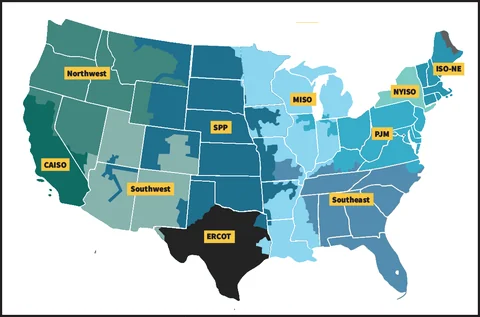 right, which function in different ways, and so those have different rules. And so it wouldn't really make sense for a state like that to say, hey, you must bring your own power, right? Like, hey, if there's power available in this area, then maybe you can take it.
If you want to go off grid, then obviously you're going to bring your own power, because that's the way you do it. So anyways, all of those to say, like, decentralization also makes sense. Sometimes it's better to not, you know, control everything at the state level. And also some of these rules must consider actual sort of local, you know, local conditions.
12The federal level
Even if Democrats take both chambers of Congress, Maya doesn't expect much to change at the federal level.
How about federal stuff? There's two more years of Trump administration coming after this, and the states obviously have their way of controlling things, but, look, this is bipartisan all the way up to the top, where Trump has made pretty clear that he doesn't want ratepayers'… you know, price on the grid to increase.35Trump's position — on January 12, 2026, Trump wrote on Truth Social that companies building data centers must "pay their own way" so Americans don't pay more for electricity. The next day, Microsoft pledged to seek rates for its data centers that cover the cost of supplying them with power. That's one position. So what else are you guys watching at the federal level after this happens? Like, let's say Democrats sweep and they take control of the House and the Senate.
I mean, yeah, so if Democrats take the House and the Senate, we don't believe that very much would change. First of all, Trump holds the veto until the end of his term. And a narrow Senate, which is what I believe is projected to happen, a narrow Democratic Senate…
It still needs Republican votes to move stricter legislation forward.36A presidential veto can be overridden only by two-thirds of each chamber of Congress. And in the Senate, most bills in practice need 60 votes out of 100, the number required to end debate (the filibuster). But it's true that the thing that both parties agree on is making large electricity users pay for their own grid costs. And Trump supports that as well. So what is most likely to happen is that the developers may have to pay upfront or post more collateral,37Collateral — a guarantee a large consumer posts with a utility for grid construction built for it, so the costs don't fall on everyone else if the project is canceled. and that can delay some projects, but it doesn't prohibit development. And so the permitting reforms38Permitting reform — measures under discussion in Congress to shorten federal environmental reviews and approvals for power lines and power plants. could actually speed up the infrastructure that the new demand needs.
Makes sense, yeah. One thing that I'm struck by, listening to all of this, is that at every level — like federal, state, local — it does seem like there's lots of politicians being pragmatic and thinking these issues through on their merit, rather than having this, like, party line they have to stick to, even if it doesn't make sense in their specific scenario for their constituents, which is encouraging. Like, this is an important topic, and I think it's actually quite nice to see that not everybody has, you know, one line they need to stick to, and they're going to actually think these things through. I don't know what you guys… Do you guys agree on that, or…
Yeah, I think politicians are listening to their constituents. We're also doing some work — it's still ongoing — on better understanding this anti-data center backlash that is really a 2026 phenomenon. So stay tuned for that.
13How to make friends with the neighbors
People feel better about AI than about data centers, Nanos says, and the panel thinks data centers need transparency and visible benefits for small towns.
Yeah, on the last podcast — wasn't there one? — I bring this topic up every time. Like, people have a more favorable rating, like a significantly more favorable rating, for AI than they do data centers. And they really like to log on to social media and post online, to all their friends to see on the internet, about how much they don't like data centers.
Yeah, there's definitely a lot of fearmongering online, and some, yeah, some social media posts that have gone viral, that are, like, clickbait and that have been widely reshared. So I think data centers are slowly realizing that they really need to have a better PR strategy.
Yeah, makes sense. Wayne, how do you think data centers can improve their PR strategy? What do you think?
I think, you know, Amazon and Google, you know, is a good start, that they're ending the NDAs, right? I mean, that gives the perception that there's, like, something secret going on, or that politicians are in the pockets of these companies, you know, because of it.
Yeah, I don't know. I think that… Yeah, I mean, PR is a pretty powerful thing, but if you can show that it benefits the community, right? There's, like, definitely all these examples of data centers coming in and, like, adding, like, public utilities or adding, like, a fire station, you know, that wasn't there before, or, you know, playgrounds and things like that. I mean, I think that there's, like, a lot of, like, economically underdeveloped, you know, towns, especially in, like, West Texas,39West Texas — the arid, sparsely populated part of the state, home to the Permian oil and gas basin and a lot of wind and solar generation. that I think by bringing in data centers, it'll, you know… it could definitely have a material impact on the economy. I think that that story needs to be told more. And another thing is, like, with water and the environment too, right? There's just so much misinformation about water and electricity.
A lot of these hyperscalers,40Hyperscalers — the largest cloud and internet companies, such as Amazon, Microsoft, Google and Meta, which build huge data centers for themselves. you know, they're, like, the largest buyers of renewable41Largest buyers of renewable energy — according to BloombergNEF data cited by Amazon, the company was the world's largest corporate buyer of renewable energy for five years running, from 2020 to 2024. energy, right? Or they, you know, put out more energy, or they try to put out, you know, as much energy as they, you know, can, you know, versus what they take in. So it's, like, net zero. And I think that a lot of people don't realize that.
And I think some of the uncertainty surrounding AI also feeds into the general opposition to data centers. One of the representatives that I interviewed actually was saying, you know, people don't know what's going to happen to their jobs. They don't know what kind of future they're leaving to their kids. And so having a data center being built in their backyard just doesn't make sense to them. And she did say, which I found funny, you know, like, if data center developers were hanging up Christmas lights, then we wouldn't be opposed to them.
14Jobs and money
You can't buy the neighbors' goodwill with cash, Wayne and Maya argue: it takes transparency and investment in schools and roads.
Interesting PR strategy, yeah. One thing you guys didn't bring up is jobs, I think. Like, it's fascinating. I went to visit a data center — I won't say where it was or who it was, visiting — but I got to talk to a lot of people who are working in construction, because it was under construction at that time. And, you know, it's significantly biased, because it's all the people that chose to work there. But they were all very much in favor of this project and talking about how important it's been to them and their families, and how they know people who are driving for, you know, as far as, like, an hour and a half, two hours away every day just for this job, and it's high-paying, it's good for the community, things like that.
When you hear Jeremie talk about the percentage of money that's spent on the GPUs and how expensive the building is and stuff, maybe it's not the absolute best, like, jobs program. You know, 50 billion for a few thousand jobs is probably, like, a bad trade, but there is stuff for the local community when you think about all that investment that comes in and people having their jobs, where that is a good thing. And then the Meta story about the teachers getting a yearly bonus, you know, based on the taxes that they were paying in that site in Louisiana42Meta is building its Hyperion data center campus in Richland Parish, Louisiana. In 2026, local school teachers received bonuses of up to $50,000, and the year before about $10,000, paid from the higher tax revenue generated by the construction. Meta. — I think that's one that they show off quite a bit, but it's a pretty good one. Quick take: what do you think about the financial incentives, like literally just paying people more money, giving jobs, local taxes? Can data centers, you know, builders, construction, can they just, like, pay more money for this problem to go away, with sentiment towards their sites?
I think paying… I don't think paying people, like, $10,000 each will get them to go away, right? I don't think that's, like, an effective strategy, or… Yeah, yeah. At least that's what the people we talked to on the ground say, right? It's going to take more than just paying them off. You know, some people don't want to be paid off. Yeah.
And another thing is, a representative, or somebody running for the Board of Supervisors43Board of supervisors — in Iowa, the elected board that governs a county. In unincorporated areas outside city limits, these boards handle zoning and so decide whether to let data centers in. in Iowa — which is crucial for approving certain projects in unincorporated counties in Iowa, where data centers are being lured because of cheap land and power — he was saying that a lot of the jobs that are coming in to build these data centers aren't local. You know, they're being, like… you know, they're brought in from other states or even, you know, from other countries. And so it's not really benefiting the local community's job market.
Yeah, they're specialists. I mean, maybe the view there is training, where I think a lot of people still feel like this is a fad that's going to go away. They're going to build some data centers, and then a few years from now they're going to tear them all down. We're going to forget about that AI thing — as opposed to being this, like, inevitable change where there's just going to be more and more of this over time. Maya, what's your take on, like, direct payments or… I think, you know, I wasn't necessarily saying we should go out and pay everybody as, like, a policy proposal, but the tax incentives going away thing seems like the most obvious next step, where there's so much demand for data centers, the supply-demand balance has changed, and the local governments or the states don't need to provide tax incentives to people to get them to build there.
And so that's probably going to go away quickly. And that just means more money for the local community.
Yeah, I think it should just be a more comprehensive process that involves more transparency, no more NDAs, educating the community, explaining also that new data centers don't consume as much water, are not as environmentally aggressive. And also contributing to the local community, I think, can help — not in the way of, like, bribing and giving each person $10,000, but perhaps building a school, building roads. I think this is something that has been appreciated in the cases that we've seen where it's been done.
15What we're watching today
The key races of the day for the panel are Texas and Georgia.
Cool. Awesome. Okay, what have we missed going through here? What are you guys watching today as the election plays out?
Yeah, same, same. Texas is the biggest one, and Georgia is the one where it's really a toss-up, so it could go either way.
Awesome. Thanks for the rundown, guys. Appreciate it. Good job with the article, and yeah, talk to you again soon.
Thanks. Thanks, Jordan.


