


Training Data
Chapters
A forward deployed engineer owns the customer's problem but leaves the win to the customer, and Silicon Valley often forgets that this work means suspending your ego.
Read the chapter- A forward deployed engineer, Noone says, takes ownership of the customer's problem and gets to the outcome at all costs, ideally three to five times faster than anyone else, but the win always belongs to the customer.
- Smart graduates of top schools who walk into, say, the LAPD and try to absorb 30 years of context in a hurry come across to the customer as ego.
- You have to let go of your own intelligence and skills and immerse yourself in the customer's context, which takes empathy and patience.
Working at UNHCR and Dimagi convinced Rudolph that many problems are downstream of data problems, and the founders chose cities because that is where most of life happens.
Read the chapter- After college Ben turned down a then-small Airbnb for the UN Refugee Agency and worked on the Sudanese and Colombian borders.
- UNHCR's scattered spreadsheets convinced him that many problems are downstream of data problems.
- At Dimagi he built apps for the Indian government that helped rural patients stay on their TB treatment, and the technology spread across the country.
- In 2016 the two former gymnastics teammates concluded that the city is where most of life happens, and that a good city rests on safety and, with it, individual privacy.
The founders got into their first police department after more than two dozen rejections, by calling the hero of an article about a landmark investigation and asking to learn from him.
Read the chapter- On February 26, 2018, after more than two dozen rejections, the San Pablo police let them into the building with badges and gave them desk space and access to information.
- The founders found an article about a young commander, Brian Bubar, who had been a covert operator on Operation Red Reach, a gang-affiliated narcotics investigation in Contra Costa County, and called him directly.
- The door opened because they led with trust: "We don't know that much, can we come and learn from you?"
- Their first ride-along was with the Oakland police, all night, in suits and ties, and it showed them how hard it is to earn these organizations' trust.
What carried the founders through the protests against police was holding two truths at once and diving into the complexity instead of judging it from outside.
Read the chapter- Noone questions assumptions not out of cynicism but to get at the truth, and that is what carried the business through a turbulent time.
- The founders' friends were protesting the police in San Francisco while they drove across the Bay Bridge every day to work with gang homicide investigators.
- The privilege, Noone says, is jumping into the pool and swimming: the deeper you go, the more gray zones and nuance you find.
- Back then engineers wouldn't even respond when the founders made a recruiting call.
- Today Peregrine works with police, fire, emergency management and health services and tries to deliver apolitical solutions that people and communities actually need.
Peregrine doesn't collect new data; it connects what agencies already have.
Read the chapter- Companies like Flock and Axon grow on data collection (sensors, cameras, manual entry) and then sell the customer more collection systems.
- Peregrine sits on top of existing systems and joins disparate information so people get more precise answers.
- The world fears a central authoritarian body with access to all the data, and the founders want the opposite, decentralization.
- It's the organization's and the community's data, not Peregrine's, and the company provides fine-grained permissions so only what's needed gets shared, instead of data being put in the back of a car and driven across the city.
Users start with nice search on an address and move on to analysis that was impossible before.
Read the chapter- At first AI simply shows everything that happened at an address, without scrolling through rows.
- A Florida county did over a hundred water rescues in a month, and an agent found that this weather pattern had never before lasted three days in a row, and that such weather carves sand channels, perfect conditions for rip currents.
- Keywords can't find such threats, but semantic search helped a detective uncover a pattern of antisemitic threats against two synagogues.
- According to Rudolph, 95% of the work happens before the user types the question: preparing the data so the AI answers and cites accurately.
- With AI, deployment strategists build whatever a customer needs, even a hurricane simulator.
Half of Peregrine's engineers work on the data platform, and agents already write the integration code.
Read the chapter- Peregrine has integrated tens of thousands of datasets across its customers.
- About 90% of the integrations in Python notebooks are written by agents overseen by the deployment team and checked with deterministic evals for completeness and correctness.
- The agents run for hours, analyzing databases and the ontology, handing work to subagents and reporting back to an orchestrator.
- Like code migrations, integrations suit agents well because the result can be verified.
Peregrine's first agent for end users digs through hundreds of gigabytes of evidence.
Read the chapter- A high-profile case means 200–300 GB of video, audio, images and PDFs, and older cases come as boxes of paper with CDs attached.
- A customer asked Peregrine to reproduce, with an agent, a case in which detectives had exonerated a wrongly convicted man, and the agent reached the same results.
- In a Wisconsin county, a few call detail records scattered through 300 GB of data placed a suspect at the crime scene and at the spot where the body was found.
- Noone explains that Peregrine doesn't trumpet these wins, because trust lasts when the credit stays with the customer.
Peregrine protects each agency's data instead of pooling it in one store, and Noone calls this the anti-network-effect proposition.
Read the chapter- The idea of a centralized, authoritarian AI combined with surveillance breeds pressure and distrust among agencies and communities.
- It's easy to pull in open-source data that laws or procedures may not allow you to use, and Peregrine guards against that.
- The goal is to preserve the sanctity and ownership of each agency's data, and only then build the connective tissue between them.
- Sonya Huang calls sweeping all the data into one central panopticon deeply un-American.
Peregrine doesn't draw red lines for its customers; it helps them understand the context.
Read the chapter- A Silicon Valley company, Noone says, shouldn't impose a general-purpose decision on an industry, whether about technologies or data retention.
- Most US public safety agencies and their communities choose not to adopt facial recognition, but Peregrine doesn't impose its own red line on top of the customer's decision.
- Cities are constantly calling one another for advice, and helping them get better information faster is what really works.
Deep work with every customer became affordable for cities and counties because the manual work turned into a platform that scales.
Read the chapter- Palantir, as Huang puts it, doesn't take contracts under eight figures, while Peregrine works with cities and counties.
- Network access, permissions, governance, ETL, data pipelines, ontology, UX and APIs all had to be built, and built first-class.
- Taking every customer all the way to the outcome looks unscalable, but that is exactly how a platform that scales came about.
Peregrine trusts its forward deployed engineers to act on their own, and to the founders they are a source of R&D and growth, not a cost center.
Read the chapter- Noone and Rudolph aligned on the pursuit of excellence and build a feedback culture that can sometimes be very intense.
- An engineer, in Noone's analogy, is sent into a dark cave with a tool belt and a rope: maintain your integrity and principles, go do good.
- Engineering, product and design are fed by what forward deployed engineers find at customers across the country and now in other countries.
- Once inside a customer, forward deployed engineers run pilots and keep sprinting on new use cases, and that's how the company expands.
Forward deployed engineers' hacks become platform features, and sometimes one-off tools for a single customer.
Read the chapter- Ben recalls writing code for a detective's reports on the way to San Pablo, and the requests were real and urgent.
- When Peregrine couldn't edit fields, a forward deployed engineer made the system update properties from comments, and the team then built editing.
- The engineer's job, Noone says, is to hit the objective, "to hell with the technology": hacks look unscalable but make the best signaling network.
- Deployment strategists build a hurricane simulator, or a model of how many people a new fire station would affect.
A price cut by an order of magnitude opens the road to 10,000 cities, and even then Peregrine will remain infrastructure that the agencies control.
Read the chapter- Peregrine provides the infrastructure, and the organizations themselves decide what to do with their data, as they wish and as they're required to.
- Each city and jurisdiction is unique, and the goal is to make each one better in its own way.
- Units of big companies failed to serve state, county and city agencies at an affordable price, while Peregrine cut the price by an order of magnitude or more, to under a million dollars a year.
- The founders say they hold no power over this data, because the power lies with the institutions.
Quotes
On what Silicon Valley misses about working at the customer
“Letting go of our intelligence, letting go of our own skills and abilities, trying to suspend our ego and really get into the customer's context — it's an easy thing to say, but it's such a high-empathy, patient way of working.”
Nick NooneRead from 04:01On building a police startup amid the protests
“We had very close friends, people we'd graduated with and built things with in the past, who were standing outside the Women's Center in San Francisco protesting the police. And we were driving a Honda Accord across the Bay Bridge out of San Francisco every day to work with gang homicide investigators. We were holding those two truths at the same time.”
Nick NooneRead from 15:32On how Peregrine differs from Flock and Axon
“Being not in the business of bringing more data to a customer, but in the business of building solutions that drive greater precision in how a human being interacts with their data — it's flipping the historical model on its head, so to speak.”
Nick NooneRead from 19:08On why a Florida county needed a hundred water rescues in a month
“these weather patterns had happened before, but after a couple of iterations, and the agent doing some deep research, out came the pattern: these weather patterns had never occurred for three consecutive days. And those types of weather patterns create these sand channels, and those sand channels are the perfect conditions for rip currents.”
Ben RudolphRead from 24:13On who writes Peregrine's integration code
“about 90% of that is written by agents, with the oversight of our deployment team. And these agents run for hours.”
Ben RudolphRead from 30:04On how an agent found a suspect in 300 GB of evidence
“We were recently working in a county in Wisconsin — again, a similar type of case, 300 gigabytes of data — and they were able to identify and place the suspect not just at the scene of the crime, but where the body was found. And this was from a few cell call detail records — the ping of a phone — scattered among a lot of data.”
Ben RudolphRead from 32:43On why pooling police data is dangerous
“A lot of this data used to just exist — and I think people now fear what happens when it's all swept up into a central panopticon. That's deeply un-American.”
Sonya HuangRead from 37:44On how to brief forward deployed engineers
“your job is to hit the objective. To hell with the technology. Our job is to build the technologies and tools that empower you to do higher and higher levels of work, but your job is to achieve.”
Nick NooneRead from 47:04
Summary
Sonya Huang of Sequoia Capital talks with Peregrine's founders, Nick Noone and Ben Rudolph. Peregrine builds a platform for police, fire, EMS and other city agencies that doesn't collect new data but connects what those agencies already have. Noone came from Palantir, where he was a forward deployed engineer and ran the unit working with US Special Operations Command; Rudolph came from the UN Refugee Agency and Dimagi. After more than two dozen rejections, they got into the San Pablo Police Department in February 2018 and built the company through the height of the protests against police.
The core idea is an inversion of the usual model. Flock, Axon and others grow by collecting ever more data; Peregrine brings nothing new and instead helps an agency work more precisely with what it already holds, with a heavy emphasis on permissions, data governance and sovereignty: the data belongs to the agency and its community, not to Peregrine. Noone calls this an "anti-network-effect" business: rather than sweeping everything into a central panopticon, keep each agency independent and only then build the connective tissue between them. The company also refuses to make calls like whether to adopt facial recognition on its customers' behalf.
With AI, adoption starts as "nice search" and then moves into analysis that used to be impossible. An agent worked out why a Florida county suddenly needed a hundred water rescues; semantic search surfaced a string of threats against two synagogues; a cold case agent reproduced the work of detectives who exonerated a wrongly convicted man, and in Wisconsin a few call detail records buried in 300 GB of evidence placed a suspect where the body was found. Agents already write about 90% of Peregrine's data integration code. To the founders, forward deployed engineers are not a cost center but R&D: their hacks turn into product features, and cutting deployment costs by an order of magnitude is what opens the road to 10,000 cities.
Advice
Own the customer's problem and get it to the outcome at any cost, but let the win be theirs: technology is only part of the answer, and trust is built on the customer's results, not your glory.
When you walk into a complex organization like a police department, don't try to master its decades of context in a rush: put your ego aside and immerse yourself patiently, or the people who've given their lives to the work will see you as arrogant.
To land your first customer, find a strong professional inside and call them directly, asking not for a sale but for a chance to learn from them: leading with trust opens doors.
Don't take credit for your customer's wins or broadcast them: in the public sector nothing destroys trust faster, and modesty earns you the next problem.
Don't shy away from manual, seemingly unscalable work to get each customer to the outcome: that's exactly what grows into a platform that scales.
Give engineers at the customer an objective, not a technology: their hacks and workarounds are the best signal of what to build into the product.
Mentioned
 Peregrine Technologies00:00the guests' company: a data platform for police and emergency services
 Palantir Technologies01:54where Nick Noone was a forward deployed engineer and ran the SOCOM unit
 UNHCR05:46where Ben Rudolph worked on the Sudanese and Colombian borders
 Dimagi07:14apps for tuberculosis treatment in India
Show 3 more mentionsShow fewer mentions
 Brian Bubar11:21the San Pablo police commander who got the founders into the department
 Flock Safety18:16an example of a company that grows on data collection
 Axon Enterprise18:16an example of a company that grows on data collection
Transcript
01What forward deployed engineering really means
A forward deployed engineer owns the customer's problem but leaves the win to the customer, and Silicon Valley often forgets that this work means suspending your ego.
One of the most important stories in AI is from a company that you may not have heard of, but that is almost certainly keeping you and your loved ones safe. Peregrine1Peregrine — the guests' company, founded in 2018 and headquartered in San Francisco. It builds a platform that brings together the data of police, fire, EMS and other city agencies. is building AI that protects cities and communities — and they are rejecting the surveillance state while doing it. This should be a fantastic conversation about one of the most important applications of AI, forward deployed engineering,2Forward deployed engineer (FDE) — an engineer who works on site with the customer and adapts the product to the customer's problems; the term and the approach come from Palantir. civil liberties,3Civil liberties — in the US, the rights that protect individuals from the government: freedom of speech and assembly, privacy, and protection from unreasonable searches (the Fourth Amendment to the Constitution). and much more. So let's get into it.4Sequoia Capital, whose partners host Training Data, is an investor in Peregrine: in March 2025 it led a $190 million Series C at a $2.5 billion valuation, and in June 2026 it took part in a $250 million Series D at $6.8 billion. Series C press release.
Nick, you ran Palantir's5Palantir — an American company founded in 2003 by Peter Thiel, Alex Karp and their partners; it builds data analysis platforms for the military, intelligence agencies, police and corporations. The name comes from the "seeing stones" in Tolkien's books. Engineers working on site with the customer are Palantir's signature. SOCOM6SOCOM (United States Special Operations Command) — the command that unites the special operations forces of all US military branches; established in 1987 and headquartered at MacDill Air Force Base in Florida. Wikipedia. unit. You deployed into dangerous, high-stakes intelligence operations in the Middle East. Tell me: what does forward deployed engineering actually mean, and what does Silicon Valley get wrong about it?
Palantir was a really fun experience and a really formative one, because before joining the company, I had no idea what this concept of forward deployed engineering meant. But I was surrounded by people who were running into customer environments and doing who knows what.
Yeah.
I watched them leave the office, and I watched them come back to the office and tell stories. It felt to me like the adventure of a lifetime: to be able to go into a customer context and own the customer's problem, but also take pride in the fact that the problem belongs to the customer, and then take pride in getting the customer to the win.
ExplainerForward deployed engineers, Palantir-style
Palantir sells not just software but the people who come with it: its engineers work on site with the customer (in military headquarters, intelligence agencies, police departments, factories) and push the platform until it solves that customer's specific problem. There are two roles, and they work in pairs:
- the forward deployed engineer writes code: connects the customer's data, builds data pipelines and the ontology, assembles applications on top of the platform;
- the deployment strategist (in Palantir's job listings, the Echo team) gets to know the customer's problems and people: finds where it hurts most, tracks down the right data, builds workflows together with the engineers and trains users.
What the deployed team builds for one customer flows back into the shared product. Peregrine adopted both the model and the job title. In 2025, according to the Financial Times, AI companies including OpenAI, Anthropic and Cohere also began rapidly expanding their forward deployed engineering teams.
There are these two truths that I learned as an early forward deployed engineer, and that we've tried to embrace as we built our company. First: we psychologically go in and own, or co-own, the problem. We talk internally about getting all the way to the outcome, with and on behalf of our customers. Technology, and all the skills and ways of delivering our tech, is part of the answer — but the real answer is just getting to the outcome at all costs, ideally three to five times faster than any other person or team could do it. Everything flows from there. And second: recognizing that at the end of the day, it's the customer's win. It's not our win. Taking deep pride in the impact we have on the institution, and on the people sitting across the table from us — that's where the magic is.
Culturally, what does Silicon Valley get wrong about it?
When we first started building Peregrine, the forward deployed engineering concept had been around for a while. And we got feedback that when really smart people from top-five, top-ten or equivalent schools go into a really complicated place like the LAPD7LAPD (Los Angeles Police Department) — one of the largest city police forces in the US: the city's 2026–27 budget provides for about 8,500 sworn officers and 2,300 civilian staff (Wikipedia). and quickly try to understand 30 years of institutional context — not just at the data level, but at the human level: how does this organization work? How are decisions made? How do teams interoperate? — the idea that moving fast is even possible in that environment is very counterintuitive to the customer. And unfortunately, I think that shows up as ego to a lot of organizations, where people have dedicated their entire lives to a particular role. I think Silicon Valley misses that sometimes. Letting go of our intelligence, letting go of our own skills and abilities, trying to suspend our ego and really get into the customer's context — it's an easy thing to say, but it's such a high-empathy, patient way of working.
02From refugees to cities
Working at UNHCR and Dimagi convinced Rudolph that many problems are downstream of data problems, and the founders chose cities because that is where most of life happens.
Yeah, I love that. Ben — while Nick was off deploying into the Middle East, you were in almost the opposite part of the world, in every sense of the word. You were doing refugee work in Africa, in India. But you landed on a similar thesis about the world and technology's role in it. Maybe say a word on that.
Yeah, absolutely. For me, I've always been obsessed with this idea of how you make impact with technology. I graduated school, and I remember I had these two offers: one was to go work at a small startup at the time — Airbnb8Airbnb — a marketplace for renting homes from private hosts, founded in San Francisco in 2008 by Brian Chesky, Nathan Blecharczyk and Joe Gebbia; today one of the best-known tech companies in the world. — and the other was the UN Refugee Agency,9UN Refugee Agency (UNHCR, officially the Office of the United Nations High Commissioner for Refugees) — founded in 1950 and headquartered in Geneva. It has won the Nobel Peace Prize twice, in 1954 and 1981. Wikipedia. an organization that helps refugees who are making these extremely dangerous treks across country lines, usually because of war, to try to get help. And so I took that path, and deployed to the Sudanese border, the Colombian border, and was deeply humbled. I came to deeply understand these types of situations — where technology can help, and honestly, where it can't.
The thing I took away from that experience: UNHCR is this deeply disconnected organization. It does phenomenal work, but it's deeply disconnected. They have some data; it's often in spreadsheets, and it's very difficult to actually make sense of. That's where I started to form this thesis that a lot of these problems are downstream of data problems, where you can have a lot of impact.
After UNHCR, I left to join an organization you probably haven't heard of called Dimagi.10Dimagi was founded in 2002 by MIT alumni and is based in Cambridge, Massachusetts. Its main product is CommCare, an open platform for mobile apps used by health workers and other field staff. Company website. They're a small company that builds last-mile healthcare solutions11Last mile — a term from logistics and telecom: the final, hardest and most expensive stretch of the way to the end recipient. Here, how to get medical care to remote villages. in under-resourced places around the world. One specific project I worked on there: we were working with the Indian government, building applications to help folks in rural India adhere to their tuberculosis drugs.12Tuberculosis — one of India's biggest public health problems: by the WHO's estimate for 2022, the country has 2.8 million new cases a year, 26% of the world total, and about 220,000 deaths annually (Wikipedia). Treatment lasts months, and many patients stop as soon as they feel better. At the end of the day, we got it deployed, and that technology rapidly spread throughout the country. That was a really cool moment for me, and it really formed my thesis around how Peregrine can have impact — how technology can have impact in the communities that we live in. Peregrine is really around this idea of: how can we leverage technology to work with our cities, our counties,13County — the administrative subdivision of a US state; there are 3,144 counties and county equivalents. A county has its own elected government and usually a sheriff, while cities within it have their own police. our states, to impact the places that we live in?
Take us back to 2017. You cold-called your way into the San Pablo Police Department.14San Pablo — a city in Contra Costa County in the San Francisco Bay Area, with 32,127 residents as of the 2020 census. Wikipedia. What was going through your heads when you did that?
In 2016, Ben and I got together — actually on a vacation with a bunch of our gymnastics teammates15Gymnastics team — Noone and Rudolph competed for Stanford's men's gymnastics team, which is where they met. Fortune. — and we had a conversation, basically ten years after we graduated, saying: should we build something together? We got together in San Francisco, with my experience in the national security space and the US government, and Ben's experience working on humanitarian causes. On my end, I'd been flying back and forth between Baghdad and similar places in the Middle East, and Ben was commuting God knows how many flights into Africa. And we looked at ourselves and said: this — the city — is the place where people live. This is the place where people thrive. This is where the majority of our lives are spent.
Then we started thinking about how to deconstruct working with American cities. And what we came to is that at the bottom of the pyramid,16The pyramid — the image recalls psychologist Abraham Maslow's hierarchy of needs (1943), where safety is the next level right after physiological needs, and only once those are met do people reach for higher ones. when it comes to how to make cities awesome, is the idea of safety: that people need objective safety and also need to feel safe. When that stability is there, it's amazing what's possible. There were all these contrasting — but actually similar — concepts we were wrestling with at the time. We were thinking about how to deploy inside of institutions, and find ways to eliminate the mishandling of information inside of really complex organizations that have access to super, super sensitive data. And then, if we could create the backbone infrastructure level of the modern city, we could help preserve individuality — privacy, and other aspects of what it means to be an individual person — but also bring people together. The idea that we could do both of those things: preserve and protect individual privacy, while also bringing people together and helping them realize that if we're staring at the same information, we kind of want the same thing. That's what I find really beautiful about cities. And I think we're very aligned on that.
Totally.
03Two dozen noes and the San Pablo PD
The founders got into their first police department after more than two dozen rejections, by calling the hero of an article about a landmark investigation and asking to learn from him.
Beautifully said. How many people said no before San Pablo said yes?
You know, it's such a blur at this point, but it's definitely over two dozen, in my opinion. We started the company on February 26th of 2018 — we'd incorporated a month or so earlier, but February 26th is the day the San Pablo, Northern California police department permitted us to step into the building with our badges. We had desk space, and we had access to information so that we could actually get to work.
The reason we got there is that we started to research subject matter experts in the art of public safety at the city scale, at the municipal level. And we found this amazing article about a young, up-and-coming commander in a local police department named Brian Bubar,17Brian Bubar has served with the San Pablo police since 2002 and became its chief in May 2024, the first Asian American to hold the post. City website. who had been catapulted up the ranks inside a paramilitary organization18Paramilitary organization — American police departments are modeled on the military: ranks, uniforms, a strict chain of command and slow promotion. that's very structured, that takes years and years to reach higher levels of leadership. He was young and intelligent and creative. There's this article we found online about Operation Red Reach,19Operation Red Reach — an investigation, begun in February 2009, into West Contra Costa County gangs that trafficked drugs and guns. Kamala Harris, then California's attorney general, announced the results in May 2011: 35 arrests and the seizure of more than 135 pounds of methamphetamine, 26 firearms, about $86,500 in cash and six vehicles. Press release. which was one of the most iconic cross-jurisdictional, gang-affiliated narcotics investigations that happened in Northern California at the time. Brian was a covert operator trying to figure out how to move this stuck investigation forward. And I thought it took so much courage for someone like Brian to come in and be the reason — and it obviously wasn't just Brian; so many people surrounded that work — and do something so impactful. It made headlines, but more importantly, it changed the state of safety in Contra Costa County.20Contra Costa County — a county on the east side of San Francisco Bay, with 1.17 million residents as of the 2020 census; the county seat is Martinez. San Pablo is part of it.
We just called him and said: Brian, we don't know that much. We may have some utility, but I don't know. Can we come in, ask you some questions, learn from you, try to understand some of the awesome things you've done, including some of these amazing prior investigations? And then maybe build something over time, and just see what happens. We led with that level of trust, and that was what finally got us access.
He took a chance on you.
Yeah. Truly.
Did you do ride-alongs?21Ride-along — a program at many US police departments that lets a civilian spend a shift in a patrol car with officers.
We have amazing photos from those days.
Our first ride-along was actually with Oakland PD,22Oakland Police Department (OPD) — Oakland sits across the bay from San Francisco and has about 420,000 residents; in 2021 the department had 709 sworn officers. After the "Riders" scandal, in which four officers were accused in 2000 of falsifying arrests and planting evidence, the city settled a federal civil rights suit for nearly $11 million and agreed to reform its police (Wikipedia). back when we were still in this deep research phase. That was a really eye-opening and interesting experience.
Overnight, I think.
Yeah — in a suit.
And tie. Overnight. And it was also eye-opening because most of the people coming from Silicon Valley to go on ride-alongs at the time were not engineers — they were reporters, or other types of community interest organizations. So I think we got the white-glove service at the time. And it really was eye-opening how difficult it is to penetrate and build trust with these organizations. There were so many lessons in that period that signaled to us that we just had to take our time.
04A police startup in the age of "defund the police"
What carried the founders through the protests against police was holding two truths at once and diving into the complexity instead of judging it from outside.
You started this company in 2017, 2018. I think "defund the police"23"Defund the police" — a slogan that went mainstream in the summer of 2020, during the protests after George Floyd was killed by police in Minneapolis on May 25, 2020. Supporters called for shifting part of police budgets to social services. Wikipedia. was starting to get going, maybe, in the early days of the company. What did that feel like, and how did it make you dig deep and think about your values?
I'll share, on a personal level: I tend to be a very experience-based learner. Very tactile. I want to hear the concepts, but build a bottoms-up understanding through action. And I've found in my life that that mentality fundamentally leads me to question assumptions — not in a low-trust, skeptical way at all times; I think there's a danger of becoming overly cynical — but to really understand truth. A curious adventure. I think that's the psychological backing that led us to build our business in the midst of a really tumultuous time in America.
I have a personal affinity for working with people who sometimes feel misunderstood, frankly. It's a very intuitive passion for me to help them feel more understood, and I think many people at our company have character qualities like that. When I think about moments like COVID, and the protests happening at the same time — the convergence of social unease in America — we were holding a lot of complexity. We had very close friends, people we'd graduated with and built things with in the past, who were standing outside the Women's Center in San Francisco protesting the police. And we were driving a Honda Accord across the Bay Bridge24Bay Bridge (San Francisco–Oakland Bay Bridge) — opened on November 12, 1936, six months before the Golden Gate Bridge; it carries about 260,000 vehicles a day. It's the route from San Francisco to San Pablo. out of San Francisco every day to work with gang homicide investigators. We were holding those two truths at the same time.
To me, it's not enough to look at a very difficult situation from the outside. The privilege is jumping into the pool and swimming. Through that process, we establish empathy. We realize: oh, this thing we thought was wrong is actually really complicated. There are a lot of gray zones. The deeper we go, the more nuanced and textured the problem actually is. How empowering is that? And so, even though in that period — our business is much more diverse now; the through-line is delivering safety and prosperity to cities, and now it's police, fire, emergency management, health services, all kinds of things, but at the time we were only working with police departments — engineers wouldn't even respond when we made a recruiting call. It was a fascinating time. I think we've seen the pendulum shift, and we're trying to deliver solutions that are apolitical: what people, communities, and the institutions that serve them truly want and need. In many ways, I don't think that's controversial at all, if done well.
05Inverting the data collection model
Peregrine doesn't collect new data; it connects what agencies already have.
How is your business structurally different from the data collection companies, like a Flock or an Axon?25Flock Safety makes cameras that read license plates; Axon (TASER International until 2017) makes Taser stun guns, police body cameras and the Evidence.com cloud storage for digital evidence. A Flock Safety license plate reader camera outside a retail store in Aurora, Colorado, June 2024.
We've been operating in public safety since 2018, and I think most of the companies that came before us built their business fundamentally on the back of data collection: the idea that a hardware or software solution is installed inside a customer base and is fundamentally about the input, whether it's passive collection through a sensor or human beings inputting information directly. Historically, those companies have grown because once they have information that belongs to the customer inside their system, plus a distribution advantage,26Distribution — in startup and VC parlance, access to buyers: the channels through which a product reaches them. A company already embedded with a customer sells it the next product far more easily than a newcomer. they can sell more stuff — and the additional stuff tends to be more collection systems.
Peregrine is the inversion of that entire model. We are fundamentally in the business of joining disparate information to provide a more secure, properly governed solution that sits on top of the pre-existing systems — that helps people do better work, and get more precision and accuracy in the answers to their questions. Being not in the business of bringing more data to a customer, but in the business of building solutions that drive greater precision in how a human being interacts with their data — it's flipping the historical model on its head, so to speak.
Okay. So structurally, the business incentive is almost the opposite. It's not about maximizing the amount of data you're collecting and creating network effects27Network effect — when a product becomes more valuable with each new user or, as here, with each new body of data; social networks, marketplaces and payment systems work this way. For venture investors it's one of the main defenses a business can have against competitors. on that data.
I think the world is very concerned about the amalgamation of data — this central, whether public sector or private sector, authoritarian body that has access to this privileged information, and what will they do with it? For us, we almost want to decentralize that: to get to a world where we are not, in any shape or form, in the business of bringing more data to the customer that they don't already have. The fundamental problem is that they can't utilize the data they have — or utilize it in a way that's secure and high-trust for the communities they serve.
I'll just say, from day one we've been really focused on this idea of permission controls, data governance, sovereignty.28Data sovereignty — the principle that data stays under the control and in the jurisdiction of its owner (here, the agency) rather than the software vendor that processes it. These are necessary ingredients to deploy to these types of high-stakes institutions. And Nick is right when he talks about trust. We think a lot about trust — trust with the community, because these public servants are ultimately serving the community members, and trust with those public servants themselves — and we have to uphold both. So we think a lot about how we build what we build, and how it interacts with the end user.
Yeah. It seems like the data governance — the data being so locked down — is almost the way you reconcile the tension between public safety and not becoming the surveillance state. That is the answer: local intelligence, local data, everything locked down. Maybe share a bit about your philosophy on data ownership and data sharing.
We deeply believe in the idea that each customer, each institution, owns their own data. That organization is serving the community: it is the community's data, it is the organization's data. It's not Peregrine's data. We think about providing the controls and capabilities that allow them to very securely roll this out within their own department, but also share select pieces of information when they need to. Without these types of solutions, folks will put a bunch of data in the back of a car and drive it across the city — and there's actually less control there. So we think a lot about where we can enable the outcome for our user, and provide controls that are specific and robust, so they don't overshare, and they can trust what they're delivering.
06From nice search to deep analysis
Users start with nice search on an address and move on to analysis that was impossible before.
What are the biggest use cases you see for your customer base? What are people starting to play with now, and where do you see it going?
This is what excites me the most.
Me too.
When you initially deploy this type of AI to these organizations, you often just get what I'd call nice search. Maybe you were looking for an address, and now you don't have to look at a bunch of rows — you see everything that happened at that address, in a nicely formatted way. As users get more used to the product and understand how it works, you start to see the floor get raised for everybody across the department, and you start seeing these really interesting, deep types of analysis that previously were just impossible.
I'll give a couple of examples, because this stuff is really interesting to me. We're working with a county in Florida, and the other month they had to do over 100 water rescues. And they asked: why? We've never had to do this many water rescues before.
A water rescue is — when there's a flood, rescuers need to get on a boat and literally go out and rescue someone from their car, which might be stalled in the middle of the flood, or from their home.
So they started asking Peregrine, interrogating this question. And what they started to uncover — these weather patterns had happened before, but after a couple of iterations, and the agent29Agent (AI agent) — a model that doesn't just answer a question but carries out a chain of steps on its own: it searches for data, calls tools, checks the result and decides what to do next. doing some deep research,30Deep research — a mode in which an agent spends many minutes searching, reading and pulling sources together into a report with citations. ChatGPT's agent of that name, Deep Research, arrived in February 2025 (Wikipedia). out came the pattern: these weather patterns had never occurred for three consecutive days. And those types of weather patterns create these sand channels, and those sand channels are the perfect conditions for rip currents.31Rip current — a narrow, strong current flowing away from the shore out to sea; it often forms in channels between sandbars and carries swimmers away from the beach. Wikipedia. A rip current off the North Carolina coast: the arrows mark the gap in the breaking waves where water flows back out to sea.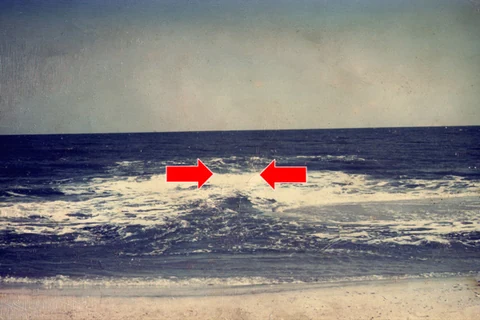 And those rip currents cause a lot of issues for people who are in the water at that time. That is actionable for the agency — they can think deeply about that.
And overlay their terrain maps, and all of the unique things that are happening.
This is all fed by — they obviously have incident information, 911 calls,32911 — the emergency number in the US and Canada; the first 911 call was made in 1968 in Haleyville, Alabama (Wikipedia). Call records are one of the main sources of incident data. weather information. All of that is integrated, and at the disposal of the AI to help the customer.
And we just couldn't have made this up. If we were sitting in our headquarters trying to pontificate on what emergency responders in a hurricane needed, there's zero chance we would have figured that out.
Super interesting. Another one I'm excited about: there was a detective investigating a threat against a synagogue, and what he was trying to do was figure out whether there had been any other antisemitic threats against these two synagogues in the area. When you think about that question as a detective — what are the keywords you search for to find that information? It's actually very difficult for keywords to find it. What gets me excited — and this is another thing that was previously impossible — is that with the help of AI, they're able to semantically understand all the information they have access to. And they were able to pull out a pattern of these threats that were occurring against these synagogues. That was pretty interesting to me, and a novel use case.
Interesting. Okay, so you've got semantic search33Semantic search — search by meaning rather than matching words: it will find a threat even if it contains none of the keywords that occurred to the detective. and embeddings34Embeddings — a representation of text (or an image) as a vector of numbers such that pieces with similar meaning end up close together; semantic search is built on them. going on; it sounds like reasoning models35Reasoning models — language models that "think" before answering by building a long chain of intermediate steps. The first widely used one was OpenAI's o1 (September 2024). that uncovered the water rescue use case. One of the most interesting things is that because you've brought in all this context and stitched it together, you can kind of let the AI do its thing.
Certainly 95% of the work is what happens before the user types in the question: all the preparation you do to get to a place where the AI can answer accurately, cite accurately. That's a really hard problem. We spend a lot of our engineering effort on that data preparation — getting the data AI-ready — and we have a lot of agentic use cases.
There's also this idea that AI allows you to write software rapidly. What happens when the cost of generating software is virtually zero? What if we could provide the platform for our deployment team that gives them the security and governance controls, gives them the APIs they need,36API (application programming interface) — a set of commands through which one program talks to another, for example to the platform's data. and then they're allowed to write the world with software? What we're seeing is that these deployment strategists37Deployment strategist — Peregrine's title for its forward deployed engineers. According to job postings, they look for customer workflows where the product will make a tangible difference, build data models and pipelines, and work with the customer's leadership. — you know, not every customer needs an agent; maybe they need a hurricane simulator — are able to build these things really well, with AI. This rapid innovation cycle is just super interesting to me.
So cool. Is it your deployment strategists who are coding things in customer environments, or do you think your customers — who have all these ideas in their heads of what they want — can go from idea to working application themselves, in your environment?
A hundred percent, we enable that. What we see most often is a partnership with our deployment team, to provide that technical expertise and take the idea to fruition. We do have some customers who are able to leverage the platform in that way, but a lot of that motion comes with our deployment team.
Do you think that'll change over the coming years?
I see it changing right now. I'd love to get your thoughts on this, Ben. I think it takes confidence to embrace it and say: you know what, let's innovate, and may the best method win.
So much of what Peregrine does and is, on the technology side, is emergent. Peregrine has been providing domain expertise — we deeply understand and empathize with law enforcement, fire departments, EMTs — and then we provide technology to enable them to achieve their most important missions. That technology can change over time, and that's the great thing about it. Most of it is downstream of really high-quality data: you can build charts, and that chart is completely useless if it's not accessing the right, accurate information. The same is true with agents, and the same will be true with the next technology. So I believe the core strategy of Peregrine has remained very unchanged in this new age of AI. We're just applying a new technology to see how it impacts our customers.
07Agents write the integrations
Half of Peregrine's engineers work on the data platform, and agents already write the integration code.
Are you doing anything on the long-horizon agent side, or background agents?38Long-running and background agents — agents that work on a task by themselves for hours, asynchronously, while the human does something else, and come back with a finished result.
Yeah, absolutely. A couple of things here. Stepping back a little: what is the Peregrine platform? About 50% of our engineers spend most of their time working on the data platform that enables our deployment team to integrate data the customer already owns. At this point we've integrated tens of thousands of datasets across all these customers. And we've built an agent that enables our deployment strategist team to integrate this data agentically. We have this amazing eval set39Evals (short for evaluations) — sets of test tasks used to measure how well a model or agent performs. Deterministic evals check the answer against a reference by clear rules, without grading by another model. where we can deterministically evaluate these agents for completeness and correctness on integrations. At this point — we use a version of Python notebooks40Notebook — a document in which pieces of code alternate with explanations and the results of running them, as in Jupyter; it's a convenient way to explore and transform data step by step. to do a lot of our integrations — about 90% of that is written by agents, with the oversight of our deployment team. And these agents run for hours. They'll analyze, look at the databases, understand the ontology,41Ontology — here, a model of the domain: what objects the data contains (people, addresses, incidents, vehicles), what properties they have and how they relate to each other. start to piece together the different pieces that need to be integrated. Those split off into subagents that all do a bunch of work, communicating back to the orchestrator agent.42Orchestrator — the lead agent that breaks a large task into parts, hands them to subagents, collects the results and keeps track of progress. So that's one bit on long-horizon agents.
It reminds me of how people are using coding agents for codebase migrations.43Codebase migration — moving a large program to a new language, framework or library version: thousands of similar edits whose correctness is checked by tests. Coding agents such as Claude Code, Codex or Cursor take on this kind of work. Similarly: long-running, unglamorous work.
A hundred percent. I love this problem because it's verifiable, and that makes the problem a lot easier — this is why coding agents are, in a lot of ways, a lot easier.
08A cold case agent
Peregrine's first agent for end users digs through hundreds of gigabytes of evidence.
The second piece we spend a lot of time on is: what do our agents look like for operational outcomes, for our end users? The very first agent we built was a cold case agent. To give you some context on what some of these very high-profile investigations look and feel like: you're uploading 200 to 300 gigabytes of data. Videos, audio, images, a ton of PDF files. And the detective is tasked with going through all of that, which in and of itself takes a really, really long time. I've been in police departments where they have paper records of these cases in boxes that are this big, with CDs attached. It's an outrageous amount of data.
ExplainerHow call records tie a phone to a place
For every call and text, the carrier keeps a record: the numbers, time, duration and the cell tower, often down to the antenna sector, that handled the connection. A phone connects to one of the nearest towers, so the record shows which area it was in at that minute: hundreds of meters in a city, kilometers in the countryside. Investigators plot the towers and sectors from a suspect's records on a map and match them against the places and times of events; at the FBI this is the job of a dedicated unit, CAST (Cellular Analysis Survey Team). There's also the reverse technique, a tower dump: every phone that was on a given tower during a given window.
Call records give an area, not a point, so they are combined with other evidence. Since the US Supreme Court's 2018 decision in Carpenter v. United States, police generally need a warrant to obtain historical phone location data.
Our cold case agent — we first built this with a customer, and again, this goes back to how we like to build. We were working with a customer who had worked a case where a man was wrongly convicted, and they were able to exonerate that individual.44Exoneration — the official clearing of a person convicted of a crime who turned out to be innocent. The National Registry of Exonerations counts 3,698 such cases from 1989 through June 2025 (Wikipedia). They said: hey, can you reproduce this result with an agent? So we took all the evidence and data they had on that case and started to work on an agent that would run for 30, 60 minutes and start to glean insights. Eventually we got to the place where it could reproduce the results those detectives had gotten to. That was the manifestation of our first cold case agent, and now we're using it in a few departments across the US. We were recently working in a county in Wisconsin — again, a similar type of case, 300 gigabytes of data — and they were able to identify and place the suspect not just at the scene of the crime, but where the body was found. And this was from a few cell call detail records45Call detail records (CDRs) — a carrier's records of every call: the numbers, time, duration and the cell tower that handled the connection. They can roughly establish where a phone was. — the ping of a phone — scattered among a lot of data. That was really interesting to me, and I think it points to this area where we can really up-level our public servants: unburden them from the administrative work of watching hours and hours of video and listening to hours and hours of audio.
A quick comment: this example Ben brought up was so impactful to the organization, as a culture, for our business. The way we maintain trust is by not taking credit — not shouting from the rooftops about the awesomeness of what happened here. I think that's one of the fastest ways to break trust with these organizations: the idea that we'd scoop up the work and trumpet our skill and the way we impacted the world. Being the quiet professionals46"The Quiet Professionals" — the nickname of US Army Special Forces, the Green Berets. in a context like this, and empowering the customer, is why we get access to the next problem.
09The anti-network-effects business
Peregrine protects each agency's data instead of pooling it in one store, and Noone calls this the anti-network-effect proposition.
I wish you would talk about it more, though. We're in this moment where public distrust in AI is so high, and this is a wonderful story.
Coming back to the earlier example of trying to identify threats to a synagogue — I think about network effects, and I think about what motivates us to tell our story. The convergence of this idea of a centralized, authoritarian AI capability and surveillance in American society — that convergence of forces has created immense pressure, and I think distrust, in many of the organizations and, frankly, the communities we work with. That can't be ignored.
And if we look at the organizations we work with, and the data landscape, the network effects are there, and they are unbelievably strong. For example: it would be very easy for an organization that's trying to hack its way to building something useful to go hit open source47Open source — here, publicly available data (in intelligence, OSINT, open-source intelligence): social media, news outlets, public registries and databases. and pull in data where there might be a gray zone on whether they can or should access it, based on laws, regulations, ordinances, or the standard operating procedures of the department. For us, we have to protect against those moments. We don't need to break the rules — nor, obviously, should any organization break the rules — to introduce AI or technology into these complex environments. The opposite is true: we have to protect the data, and protect these organizations that, by virtue of their structure, have astounding network effects. It's almost the anti-network-effect proposition:48Anti-network effect — Noone turns the term "network effect" on its head: instead of pouring every agency's data into a common pot where value grows with volume, Peregrine keeps each agency's data separate and links it only on the owners' terms. how do you preserve the sanctity of the data, the ownership of the data, and the ways of working for every individual agency and organization — and then build the connective tissue? The interoperability is going to happen. And this is where things that might seem mundane, but that we find really fascinating — how you think through data governance, how you think through permissioning logic in the context of AI — become unbelievably important. I feel really motivated to talk about that in particular.
Peregrine: the anti-network-effects business. I think it's important, especially given the heat right now around how powerful AI is. A lot of this data used to just exist — and I think people now fear what happens when it's all swept up into a central panopticon.49Panopticon — a prison design proposed by the English philosopher Jeremy Bentham in the late 18th century: a guard in a central tower can see any inmate, while the inmates never know whether they're being watched at that moment. In Discipline and Punish (1975) Michel Foucault made the panopticon a metaphor for a society of total surveillance. Wikipedia. Willey Reveley’s 1791 plan shows how every cell around the ring is visible from the central tower. That's deeply un-American.
Yeah. And I think, as a business — I find that our business is a big practice in letting go. How do we build high-integrity, transparent solutions for our customers? How do we make that translate to our customers and their constituents? And then how do we effectively let go, and not try to grow too fast?
10Facial recognition and hard calls
Peregrine doesn't draw red lines for its customers; it helps them understand the context.
Are there technology decisions you have to make that are morally nuanced? For example, facial recognition50Facial recognition is banned in some places in the US: the first major city to bar its police and other city agencies from using it was San Francisco, in May 2019. Other cities, such as Oakland and Boston, later passed similar bans. — I'm curious about your stance on that. And more generally: what is your North Star for hard decisions?
Quickly, on facial recognition: I think the idea of a Silicon Valley company imposing a general-purpose decision on an industry is fundamentally wrong. The idea that we as an institution would assert, whether it's the utilization of a technology or a retention policy — it's very much not how we think. Instead, the idea is to help a customer understand the context in which they're operating, bring to light all the considerations they may or may not know, and then — and this requires patience — help usher in the right way of doing business, the right way of thinking about deploying these technologies. On facial recognition specifically: most public safety agencies in America, and their communities, choose not to implement it. Some take a very strong stand; for some it's a matter of subjective preference that they'll assert. But creating a technological red line without understanding the texture and context is not a boundary we think we can assert on top of our customer.
So: follow the customer, follow the law.
Yeah — and expose it, and create clarity around what the left and right limits51Left and right limits — a military term for the left and right boundaries of the sector within which a unit is allowed to operate. are, and what the institutional norms may be. It's astounding how cities call each other. They call each other for advice. If you really listen to the way people learn inside the industries we serve, what we've realized is that helping them streamline the way they get the best possible information — so they can make their best decision, even about things like which technologies to use or not — goes a really long way.
11Technology for the underdogs
Deep work with every customer became affordable for cities and counties because the manual work turned into a platform that scales.
In a similar vein, I want to talk about delivering technology to the underdogs, and how you're able to scale this very deep customer motion into a very different customer base than, you know, the other company that has notoriously scaled this motion — Palantir — which notoriously doesn't take anything less than eight-figure contracts. Did your mentors try to convince you not to do this? Did people tell you the economics of this were not going to scale? What made you think it would be possible to deliver technology to the underdogs and serve them this way?
I think it takes confidence. Confidence to believe that if you build something well, you can solve problems that have never been solved before — and that it will scale later. The idea of going deep to build a vertically integrated tech stack52Vertical integration — when a company builds every layer of its product itself, from bottom to top, rather than assembling it from other vendors' components. — everything from network access to the permissioning, the governance, the ETL,53ETL (extract, transform, load) — the process that pulls data out of source systems, converts it to a common format and loads it into a data store. the pipeline, the ontology, the UX,54UX (user experience) — how easy and intuitive a product is to use. the APIs — configuring all of that and creating a system that's open, interoperable, and can check those boxes... the audacity, I think, is real. And building each of those components in a way that's first-class, not just to check the box. We were truly thinking about how to deliver these types of technology solutions to an end market that has never been able to use them before — let alone at the price point we were able to deliver them at. The uniqueness of Peregrine is that for each organization, we'll take the time to deliver solutions all the way to the outcome, and we'll own the responsibility, with our customers, of getting to that outcome. That might seem extremely manual, extremely laborious, extremely unscalable. And what we found is that being able to do that resulted in a technology platform that could show up, do something very different for these organizations — and also scale.
12Trusting the individual contributor
Peregrine trusts its forward deployed engineers to act on their own, and to the founders they are a source of R&D and growth, not a cost center.
I've had the chance to talk to a few deployment strategists at Peregrine, and they're amazing. They're so smart, so humble, and they so deeply embody the mission. I think you've selected for, and trained, a really extraordinary group of people. How do you do it? What do you look for? What do you interview for? How do you train these people up?
First of all, that's the greatest compliment, because we love our team. When you can build a culture where people are trying really hard and can achieve excellence — how could you not create the environmental factors, and the feedback culture, which sometimes isn't easy? Sometimes it can be really intense. Ben and I have aligned — we've taken tests and aligned on some character qualities — and one of them is definitely the pursuit of excellence.
I think a lot about the environmental factors of trusting the individual contributor.55Individual contributor (IC) — the term American companies use for a specialist with no direct reports, as opposed to a manager. It's a very important thing we're trying to hold on to. To do that with a forward deployed engineer — to truly do it — really requires trust. We use this analogy of a dark cave. We'll send a person into a cave, and they have a tool belt, and hopefully the tools are pretty good. And there might be a rope, with a friend at the entrance of the cave, so if they yell for help, you can pull them out. But truly, we are sending people into these zones and saying: maintain your integrity, maintain your principles, here are the tools — go do good. To do that at scale, I really believe, requires institutional trust, and a belief system that innovation actually happens at the farthest fringes of our organization — that the way our engineering, product, and design organizations are fed is absolutely through that innovation process across the country, and now across multiple countries, with our forward deployed team.
It's fascinating. So different from when I talk to companies who view forward deployed as a cost center.56Cost center — a unit that only spends money and brings in no revenue directly; the opposite is a profit center. It's fundamentally different talking to you.
Definitely R&D — definitely R&D and growth. After we land inside a customer base, we have these models where we'll do within-customer pilots, for all intents and purposes, where we keep sprinting57Sprint — in agile development (Scrum), a short stretch of work, usually one to four weeks, with a goal set in advance. on additional use cases. In many ways, how we land and then expand in a customer base is fundamentally about leading from the front through our forward deployed engineers.
13Products are born at the customer
Forward deployed engineers' hacks become platform features, and sometimes one-off tools for a single customer.
Have you discovered any new products through this motion?
A hundred percent. It's just the whole thing — it's hard to even separate it. I remember driving across the Bay Bridge to San Pablo, typing on the computer: okay, we've got to get these reports done, this is what this detective needs — literally typing as fast as I could to code what we needed at the time.
And it wasn't theoretical. It was Aaron Blaisdell who had an extraordinarily urgent request.
Yeah — you feel it. So it's hard to separate. Very rarely are we in a room pontificating about what to build. I really think about the FDE motion and how it impacts our product in two ways. One is: what are the basic primitives58Primitive — in programming, a basic building block from which more complex functions are assembled: here, for example, the ability to edit an object's field. the technology platform needs? There are a couple of examples of this that I think are fascinating, and reflect the engineering ingenuity of our forward deployed team. For the longest time, Peregrine had no ability to edit specific fields and properties. So one forward deployed engineer, to get around that, made an integration based on the comments people would write on these objects: the comment would be read by Peregrine and would then update a property. That was the way they implemented editing. We saw that and said: we need to implement editing.
And by the way, the reason that teammate did that is because our intent was — and this is the way the coaching and leading happens — your job is to hit the objective. To hell with the technology. Our job is to build the technologies and tools that empower you to do higher and higher levels of work, but your job is to achieve. That's what creates these crazy things that might look very unscalable, very hacky, but ultimately are the absolute best signaling network.
It's great signal for what actually works — the quintessential rapid prototyping. So that's category one: the product primitives you learn you need to provide the team so they can achieve the objective. Category two is almost what I call the innovation lab, where a deployment strategist goes and builds something totally unique that we're probably not going to integrate back into the product, because it's such a specific capability for that customer. This stuff gets me really excited, and I love watching what our deployment team builds. I was just looking at one the other day where someone had built a hurricane simulator in Peregrine, and I was like: how did you do that? I didn't know you could do that. There was another deployment strategist who built this thing that integrated data from all these different sources — 911 call times, budgets — and you could place a fire department in the city, and it would give you an estimate of how many people that would impact.
Unbelievable. And she'd been at the company for a month.
14Ten thousand cities
A price cut by an order of magnitude opens the road to 10,000 cities, and even then Peregrine will remain infrastructure that the agencies control.
Maybe the last set of questions. Ten years from now, suppose everything's gone right: Peregrine is the institutional memory layer for 10,000 cities.5910,000 cities — for scale: according to the show, Peregrine currently works in more than 400 cities and communities, while the US has 3,144 counties and about 30,000 self-governing cities and towns (Wikipedia). That's great power — power that outlasts any one administration. And with great power comes great responsibility.60"With great power comes great responsibility" — the line from the Spider-Man comics; it first appeared in Amazing Fantasy #15 (1962), the hero's debut. Wikipedia. How do you think about that?
I think there's the outcome, and then there's the path to get there. The end game of 10,000 cities requires an operating model that is fundamentally about infrastructure, actually. We, as a technology organization, are delivering technology infrastructure that empowers these organizations to do with their data as they would like — and as they are required to do. Every city, every jurisdiction, I deeply believe, is unique, and I think the idea of preserving that uniqueness is actually beautiful. How do you make each one — the potpourri of cities — more awesome, in its own unique way? That's cool.
The path to get there requires serious integrity, moral compass, core values — not just in words, but in our ways of working, our actions. And that never goes away. The way we think about the next marginal customer we support requires a level of hand-holding and delicacy that, candidly, I don't think was possible even five years ago. The marginal cost61Marginal cost — what it costs to serve one more customer, not counting the investment already made in the platform. of doing what we do — to drop it below a million bucks a year — is radical. Coming back to the origin stories: supporting state, county and city-level public safety — there's a lineage of failed business units of major, astounding organizations that tried to do it and failed, because delivering these solutions in a tailored way, at a price point these organizations can afford, was never possible. To create the efficiency to drop the price by an order — or orders — of magnitude has earned us the right to try to deliver on what you just said. And who are we to think that we hold any power over that? It's the institution that has the power.
You'll make every city awesome, for sure. I love that. I think you're in a very, very serious seat, and just in the course of this conversation, it's clear you're approaching it with great care and great stewardship. Thank you for what you do — I think the world needs more examples of AI being used to improve lives and improve communities. And thank you for joining the pod today.
Thank you, Sonya.


