

Whoa, Vol. 3: Humanmaxxing
Chapters
People outside companies are souring on AI while organizations race to deploy it, and Zoe sees a replay of the holacracy fad, which ended badly.
Read the chapter- Whoa's third volume, Humanmaxxing, is about people who aren't anti-AI but are maxing out what's human.
- Outside companies, AI disappoints over concentration of power, energy and water, and the fear of becoming useless, while inside them everyone is afraid of falling behind and chasing efficiencies.
- Organizations move people around like chess pieces, hand out Copilot licenses and wonder why employees don't use them, when people don't want to contribute to their own demise.
- At Undercurrent in 2015, Zoe watched the last wave of holacracy and SLAM teams and wrote a piece on empathy that her bosses said didn't reflect the company's thinking.
- Rereading that piece now, Zoe says the lessons were never learned: change is still forced on organizations while the people are missed.
Reports from the "big four" converged on dialogic change, and Claude admitted it may have nudged them there.
Read the chapter- Within two weeks, McKinsey, Deloitte and BCG all published reports on the same thing: dialogic systems change.
- Asked by Zoe, Claude said that if a thousand change agents feed the same queries into AI, homogeneous training data serves them the same thinkers and the same supposed antidote.
- Consultants are trying to package emergence into frameworks, but Zoe says it can't be codified, and an emergent technology can only be met with emergence.
What holds an organization up is its people's unwritten knowledge, which AI can't see, and automating everything else risks cutting it away like a tree's heartwood.
Read the chapter- How an organization handles a crisis lives in its people as muscle memory, not in protocols or data, and AI can't see it.
- Alex is building a project management tool for a client with AI, and every simulation misses something obvious to the team, an unknown unknown.
- Zoe compares this knowledge to heartwood, which takes decades to form and holds the tree up, and if you cut it, it won't grow back, so automation can cut away what an organization stands on.
- An email obviously written by Claude, Zoe says, feels like disrespect, a sign the sender didn't think the connection worth the effort.
Scared when she couldn't remember a project she'd done with AI, Zoe taught Claude to interrogate her so that AI would help her think rather than think for her.
Read the chapter- With no maternity leave after her son was born, an exhausted Zoe leaned heavily on AI for a project, and two or three weeks later couldn't remember what she'd proposed.
- For Alex, the best guide is how working with a tool feels, and when AI connected the dots in his draft for him, it felt terrible.
- Claude's direct "why do you do this" questions didn't work, and what helped were scenarios Zoe simply had to react to.
- Her answers became 27 skill files and project worlds, including the Elsewhere, which runs ideas through the universes of Le Guin and Pullman.
Language models quietly herd everyone toward the same answers, so Zoe deliberately sprinkles in chaos with the Flint model and imagines an AI that connects people the way mycelium does.
Read the chapter- In Springboards' experiment, models asked for a random number between one and ten said "seven" at least 90 to 95% of the time, and Alex got seven when he tried it.
- Pip, a Springboards co-founder, shows that chatbots asked to come up with a car brand all land on the same make and model.
- Springboards built its own small model, Flint, designed for novelty, and Zoe uses it to sprinkle chaos into her work with Claude.
- Creativity comes from serendipitous collisions, like Jane Jacobs's "sidewalk ballet," while AI, Zoe says, sends everyone down separate rabbit holes.
- Zoe imagines an AI that, like the fungal networks in a forest, connects people wrestling with the same problem and then steps away.
Whetstone was meant to build skill files for AI but turned out closer to therapy, and Alex caught the system flattering him with words he'd been craving.
Read the chapter- Zoe turned her two-year self-interrogation into Whetstone, a process others go through on their own, and admits it takes at least double the five or six hours she quotes.
- People write to Zoe that it made them cry, one man planned to chat through his Mind Print with his wife, and Chanel and Campari want an organizational version.
- The system told Alex he'd given one of the best answers anyone had ever given, and he'd been craving those words but immediately saw they were made up.
- Zoe admits the system reads between the lines and gives people what they want, and that this isn't always a good thing.
A feeling sparked by AI is as real as one from a horoscope, the danger lies in mistaking the reflection for truth, and Zoe argues for "yes, and" thinking about AI.
Read the chapter- Alex thinks a feeling sparked by AI's words is real the way a feeling from a horoscope or a tarot card is real.
- Zoe calls artificial intimacy a real danger zone and fears Character AI and Replika, where people build relationships with a sycophantic machine and cut themselves off from real people.
- To Zoe, AI is a pattern machine, and its mirroring does no harm as long as you don't take it for truth or believe it is conscious.
- Following Brené Brown, Zoe argues for holding both truths at once: AI threatens democracy and could strengthen it.
Zoe keeps her AI use in check by talking instead of typing and with a project called My Own Worst Critic, which pushes her toward her own point of view, though she sometimes overrules it.
Read the chapter- Zoe never types and talks to Claude instead, because speaking, she says, is richer and doesn't narrow her thinking.
- A dedicated Claude project, My Own Worst Critic, attacks her drafts and asks what she herself brings to the topic.
- After a New Zealand speaker's talk on the extraction of Indigenous knowledge, Zoe wrote an essay, but the critic convinced her it wasn't her story, and she never published it.
- The critic called a personal piece about a hard year PR for her struggles and grief, Zoe published it anyway, and the critic learned to push back less on personal pieces.
If AI does junior work, in ten years there will be no one with twenty years of experience.
Read the chapter- Echoing Amy Webb, Zoe says AI's magic is the experience people bring to it, and she doesn't know what happens to those who have none.
- In her piece The Pipeline Problem, Zoe writes that companies cut graduates and juniors, relying on AI plus veterans, but within a decade the veterans will retire.
- Juniors handed Copilot from day one, Zoe says, never get to develop their gut instinct.
- Zoe looked to football and medicine, which invest in young talent, but found no solution.
In fairy tales, Indigenous knowledge and unfamiliar science fiction, Zoe looks for lost wisdom that could help us through the age of AI.
Read the chapter- Zoe is rereading The Monk and the Robot and Robin Wall Kimmerer's Braiding Sweetgrass.
- In her theory, tales like "Hansel and Gretel" encode wisdom about surviving horror that was later trivialized and Disneyfied.
- Kimmerer, a botanist and a member of the Potawatomi nation, marries rigorous science with Indigenous philosophy, and to Zoe it shows how much Western rationalism pushed aside.
- Following N. K. Jemisin, Zoe asks whose futures are worth imagining and calls for climate fiction instead of Hollywood dystopias.
In the speed round, Zoe recommends Range, admits she struggles to sink into joy, and names deep human connection as the feeling AI can't give.
Read the chapter- Zoe keeps recommending David Epstein's Range, and she wrote the author a love letter, to which he replied.
- She says she hasn't so much changed her mind as pushed it into the corners, into the paradoxes of emerging technology.
- Zoe knows but can't prove that she has to embody her own joy, yet since having children she, like Brené Brown, keeps picturing everything falling apart in joyful moments.
- AI, Zoe says, can never give deep relational connection, like the sound of her son giggling when she tickles him.
Quotes
On a project done with AI
“But about two, three weeks later, I had no recollection as to what I had actually proposed and what I'd actually written.”
Zoe ScamanRead from 18:15On the random-number experiment
“So they did that experiment, and it was in last year, and they asked all of the LLMs to give them a random number between one and 10. And pretty much all of them said seven at least 90 to 95% of the time.”
Zoe ScamanRead from 29:59On AI's sameness
“And so we're disconnected from each other when it comes to kind of creative collaboration, but we don't realize that we're all being herded like livestock into the same way of thinking.”
Zoe ScamanRead from 33:25On Whetstone
“And so what I've realized is I've kind of built something that was initially supposed to basically construct really personalized skill files for your AI of choice, but I think what I've actually built is something closer to therapy for creative people.”
Zoe ScamanRead from 38:38On borrowed intelligence
“And I think sometimes AI can make you feel really smart and really intellectual on a particular topic, and you realize that actually you're just getting the vast majority of that from AI and then theorizing over the top.”
Zoe ScamanRead from 52:45On cutting juniors
“But that's only going to work for the next decade, because those people are off into retirement, and then you haven't filled the rest of the pipeline. So then what do you have? Like, you have nothing.”
Zoe ScamanRead from 58:30On what AI can't give
“It can never give you that feeling. And I don't think we would ever want it to simulate that.”
Zoe ScamanRead from 1:10:26
Summary
Alex Dobrenko opens with a confession: talking about AI has become boring, yet it's all anyone wants to talk about. His guest, strategist Zoe Scaman, sees two opposing moods. People outside companies are souring on AI, while companies race to deploy it, hand out Copilot licenses and wonder why employees won't help automate themselves out of a job. Zoe recalls the last fad, holacracy, and warns that what holds an organization up is its people's unwritten knowledge, its "heartwood," and once you cut it, it doesn't grow back.
The episode's central worry is sameness. Within two weeks, reports from McKinsey, Deloitte and BCG landed on the same conclusion, and Claude itself agreed that AI was probably the reason. Springboards, a startup Zoe works with, found that nearly every model asked for a random number between one and ten says "seven," and built a model, Flint, designed to send you somewhere else. Creativity, Zoe argues, is born of chance collisions, like Jane Jacobs's "sidewalk ballet," while AI sends each of us down our own rabbit hole and quietly herds us all into the same groupthink.
Her answer is to use AI deliberately. Shaken when she couldn't remember a project she'd done with AI while exhausted after giving birth, Zoe spent weeks letting Claude interrogate her, broke her practice into 27 skill files, and turned the process into Whetstone, which people go through almost like therapy. She talks to Claude instead of typing, runs ideas through the worlds of Le Guin and Pullman, and keeps a project called My Own Worst Critic, which once talked her out of publishing an essay that wasn't her story to tell. One problem stays unsolved: if companies stop hiring juniors, in a decade there will be no experts left. The conversation ends with fairy tales as encoded emergency protocols, books by Robin Wall Kimmerer and N. K. Jemisin, and a speed round.
Mentioned
 McKinsey & Company03:58250-slide decks for hundreds of millions
 Microsoft Copilot03:58licenses employees don't use
 Undercurrent04:45the consultancy where Zoe worked in 2015
 Deloitte07:22reports on dialogic change
Show 29 more mentionsShow fewer mentions
 Boston Consulting Group07:22reports on dialogic change
 Claude07:22Zoe's and Alex's main AI tool
- Heartwood14:00Zoe's essay on organizations' unwritten knowledge
 Rachel Karten15:27social media newsletter writer and a future Whoa guest
- Link in Bio15:27a piece on CEOs' "AI brain"
- Harry Potter24:00Zoe missed a flight for the sixth book
 Ursula K. Le Guin24:00science fiction as social experiment
 Philip Pullman24:00one of Zoe's favorite authors
- His Dark Materials24:00the trilogy Zoe reread asking "what if?"
- The Ones Who Walk Away from Omelas25:34a utopia built on one child's suffering
 Springboards28:55an AI strategy platform and its experiments
- Flint31:00a model designed for novelty
- Creative Mycelium34:21Zoe's essay on how AI could connect people
 Jane Jacobs34:51the "sidewalk ballet" and collision density
 Character.AI44:25an example of dangerous artificial intimacy
 Replika44:25an example of dangerous artificial intimacy
 Brené Brown46:25paradoxical thinking and foreboding joy
- Strong Ground46:25the book Zoe is reading now
 Amy Webb57:08an interview on what we bring to AI
- Monk & Robot1:00:34a book Zoe is rereading
- Braiding Sweetgrass1:00:34Zoe's favorite recent book
- Hansel and Gretel1:01:23a fairy tale as a memory of famine
 Robin Wall Kimmerer1:02:50a botanist from the Potawatomi Nation
 N. K. Jemisin1:04:25whose futures are worth imagining
- How Long 'til Black Future Month?1:04:25science fiction from the Black experience
 Kim Stanley Robinson1:04:25climate fiction
- Range: Why Generalists Triumph in a Specialized World1:07:02the book Zoe recommends to everyone
 David Epstein1:07:02author of Range, who answered Zoe's letter
 Malcolm Gladwell1:07:30an interview with Epstein
Sponsors of the episode

Transcript
01A boring conversation in a tense moment
People outside companies are souring on AI while organizations race to deploy it, and Zoe sees a replay of the holacracy fad, which ended badly.
Yeah, I mean, the purpose of this, I would say, is like having a— I like how often you describe things in marketing and your work as like boring, like what you're kind of reacting to. You're like, it's all just so fucking boring. And I feel like that's our stance right now on the AI conversation writ large. It's just boring. And even talking about it being boring is also boring. And so we're like trying to figure out how to talk about— and it's also all that people want to talk about.
And so it's this weird paradox that we're trying to, you know, muddle our way through by talking to people who are in it, but don't— but seem to be kind of transcending it and doing their own thing. And so the name of this volume three is Humanmaxxing.1Humanmaxxing — a play on internet slang, where the suffix -maxxing means pushing something to the limit: looksmaxxing, sleepmaxxing. Here it means maxing out what is human. The volume's full title is "Humanmaxxing: How to Thrive in the Age of Machines." And that's kind of like the vibe, is like talking to people who are humanmaxxing, which doesn't mean like anti-AI at all. It just means like they're just humanmaxxing, you know? And yeah, so that's like the broad scope, the broad lens on it.
And I think where I want to start is you— I've been listening and reading a lot of your work and listening to interviews, and I really like how you say that a lot of what you do is like feeling the pulse of the space, of the world, of the room, just like getting the vibe, you know. And I would love to hear what the vibe feels like right now to you, from your point of view.
It's an interesting opening question. I think the vibes are very mixed.
Yeah.
I think that we are in a really tense period at the moment outside of organizations, where we have got a lot of people who are souring very quickly on AI for a myriad of different reasons, which are all super valid. AI is accelerating a really terrifying concentration of power. It is accelerating depletion of already depleted energy reserves, of water.2Energy and water — data centers need a lot of electricity, and water for cooling. The International Energy Agency estimates that data centers used about 415 TWh in 2024, roughly 1.5% of the world's electricity, and that the figure could double by 2030. IEA. It is hitting an economy and a general, I guess, kind of attitude of everything's fucked and everything's broken and this thing is just going to make it a million times worse. And we are being sold these narratives of evangelism and inevitability, and we're essentially told: you've got to jump on board with this, but at the same time, very soon we will have no use for you. So I think that, you know, it's completely understandable why there is also this kind of souring. And at the same time, I think one of the reasons why people are just bored of talking about this is because it feels exhausting and scary, and like, why the fuck are we all running headlong in this direction where we can see the downsides of this?
So I'm seeing that, and then on the organizational perspective the opposite is kind of coming to the fore, which is: shit, we need to get everything together. We need to run at speed in this direction. We don't want to be left behind. There are huge efficiencies and margins to be made from this. What are you seeing other organizations doing? Where are we in this kind of race towards deployment of AI thing? And so it's really interesting to kind of traverse those two feelings right now, because ultimately, you think about what an organization is: it is an accumulation of people.
You know, that is what an organization is. And yet, you know, we are still treating organizations and organizational change like some sort of chessboard, where we just kind of move people around and then, you know, job done, and McKinsey can charge their couple of hundred million for a 250-slide PowerPoint deck, which makes fuck all difference. And I think one of the reasons why we're sort of seeing stalling and pressure in organizations is because of the atmosphere and the vibes that we're seeing externally, because these people are being told: here's your Copilot license,3Copilot — Microsoft's AI assistant built into Word, Excel, Outlook, Teams and other Office apps. Companies buy employees Microsoft 365 Copilot licenses at $30 per person per month. go use it, go figure out what the use cases are, feed your brain into this machine. And yet they're seeing all of these headlines and feeling all of this stuff externally, and the organizations are like, why are people not clicking on the Copilot licenses that we're sending them?
And it's like, well, because they don't want to contribute to their own demise, because they're scared, because they're angry. And so I'm trying to sort of navigate this mismatch at the moment. And it's a really interesting, messy period. And actually I'm writing a piece at the moment that I've been kind of rejigging and rejigging over the last couple of weeks. And I've gone back to a piece of writing that I did in 2015, when I was part of an organization in New York called Undercurrent.4Undercurrent — a New York digital strategy consultancy founded by Josh Spear, Rob Schuham and Aaron Dignan (later the author of Brave New Work, a book on self-management). And it was almost the last big wave of organizational change trend stuff that happened previously.
ExplainerHolacracy and "teal" organizations
Holacracy is a self-management system devised in 2007 by the American entrepreneur Brian Robertson: instead of bosses and job titles there are "circles" and roles with explicitly written authority, and decisions follow a formal meeting procedure. The best-known adopter is the online shoe retailer Zappos, which switched to holacracy in 2013–2015; some employees left as a result.
Teal organizations come from the Belgian consultant Frederic Laloux's book Reinventing Organizations (2014). He color-codes stages in the evolution of organizations, and "teal" is the most advanced: self-management, "wholeness," with employees bringing their whole selves to work, and an "evolutionary purpose" instead of top-down plans.
Both ideas were at the height of fashion among consultants in the mid-2010s; interest has cooled noticeably since.
And obviously I'm seeing another wave of it happening now. But at that point it was all: we're going to abolish hierarchy, it's all about holacratic organizations, we're going to make SLAM teams,5SLAM — an acronym for small, lean, autonomous, multidisciplinary teams. which are, you know, basically lean and autonomous and multidisciplinary. And it was all about, you know, teal organizations and that kind of stuff. And, you know, I really drank the Kool-Aid at the time, as did obviously every single member of Undercurrent. And yet after I'd spent a few months there, I was like, hang on a minute, we're missing the people, we're missing the empathy angle here. And so I wrote a piece called "The Importance of Empathy in Organizational Design", and I was told by the powers that be in Undercurrent that it didn't reflect Undercurrent's way of thinking. I published it anyway, so it's kind of way back in my archive in 2015.
And I've been revisiting it recently and being like, shit, we haven't learned anything. You know, we're still forcing change upon organizations. We're still pushing for chess pieces and technological traction, and we're missing the key component, which is the people, and the defensiveness and the rage. And when you're asking someone to let go of everything that defines their success, you know, their title, their team, their P&L,6P&L (profit and loss) — the income statement; "their P&L" is the budget and financial result a unit head is accountable for. the ladder or the trajectory that they believe that they are on, and you wonder why it's not working. And so that's what I'm navigating at the moment. I'm just like, oh, hang on a minute, I've seen this movie before and it didn't end well. And, you know, we haven't heard the word holacratic organization, or the phrase holacratic organization, for a very long time, for a reason.
And it's because they were like bulls in a china shop, you know, trying to enforce this change on people. And I think we're kind of meeting the same resistance now. And so I'm seeing almost a kind of bit of a hitting of the wall. So I said I feel like I've hit a wall; I think organizations are hitting a wall too, where they're just like, we've been running at speed towards this AI thing, you know, for the last kind of two years, 18 months, nothing's happening. And they're now starting to wake up to it.
02Why the consultants all reached the same conclusion
Reports from the "big four" converged on dialogic change, and Claude admitted it may have nudged them there.
And I think what's really interesting is, if you see the reports that have come out in the last two weeks from the big four,7Fact-checkThe Big Four usually means the four largest audit and consulting networks: Deloitte, PwC, EY and KPMG. McKinsey and BCG aren't among them: together with Bain they are the "Big Three" of strategy consulting (MBB). Big Four. so from McKinsey, from Deloitte, from BCG, they're all converging on the same territory, which is this era of dialogic systems change.8Dialogic change — an approach to organization development described in the 2000s by Gervase Bushe and Robert Marshak: an organization is changed not through a consultant's plan from above but through new conversations and shared meanings inside it, and the outcome isn't known in advance; it emerges from how people interact. And they're essentially saying we need more conversational change in an organization, we need more kind of humanistic tendencies. And I was like, this is really interesting. How are the big four all ending up in the same space when it comes to this organizational change piece in the last two weeks? So off I go into Claude, and I was like, Claude, is the reason, or one of the reasons, that all of the big four are ending up in the same territory down to you?
So down to AI, are you feeding this? And Claude came back and actually said, I think that is a very good case as to why it's happening. Because if you have a thousand organizational change agents all feeding the same queries into AI systems at the same time, as to: this is not working, why is this not working? Then what tends to happen is the homogeneous training data that is true across all of these different AIs is then going to surface the same research, the same thinkers and the same perceived antidote, which then explains why the big four are all converging on this same territory at the same time. But what's really interesting is they're converging on this territory of dialogic systems change, which I do think is part of the solution, and this idea of emergence,9Emergence — a property of a system that none of its parts has and that arises from their interaction: a traffic jam, the behavior of an ant colony. Organizational consultants use the word for change that grows from below rather than being rolled out to plan. but they're doing it in entirely the wrong way, because they're trying to codify emergence.
They're trying to productize it, and they're trying to turn it into their frameworks that they tend to come up with and then basically flog for three years until they inevitably break, and then they have to sell the solution to the thing that they sold in the first place, which was going to break the thing that they sold in the first place. So that's kind of where they're going to go next; you can almost see it. But what's interesting is that kind of homogeneity of: we all need to converge on emergence and dialogic systems change. I was like, huh, where is this coming from? And I think it's really interesting that essentially the system that we're trying to break the back of is the very thing that is sending us all down this same pathway.
And that kind of was ringing alarm bells in my mind. Because when I tried to codify it before, which I have tried to do, it doesn't work, because you can't codify— what do you mean? You can't productize emergence within an organization. It doesn't— you just— And I think that's what's really interesting: we've got this new general purpose technology,10General purpose technology — economists' term for inventions that transform nearly every industry at once: the steam engine, electricity, the internet. which in itself is emergent by design. It's not built like software. It doesn't have rules and parameters.
It has a kind of set of training data, and then in itself it is emergent as a technology. And so the only way, I think, based on experience that I've had over the last couple of years with it in organizations, to navigate that is you have to match emergence with emergence. But the really frustrating thing is people just want a solution. They're like, just give me the formula. How do I structure my organization just to make this work? And I think the truth of it is you can't.
You have to embrace the same level of kind of messiness and humanity. And that is the antithesis of what the big four sell. And it's the antithesis of what most organizations feel super comfortable with. And I think that's why we're crashing up against each other right now.
03Tacit knowledge and "heartwood"
What holds an organization up is its people's unwritten knowledge, which AI can't see, and automating everything else risks cutting it away like a tree's heartwood.
Wow, that's fascinating. I mean, it's like, because people just don't want like— I don't know, with all of this stuff, it's like whatever you give people, they react to it. And that reaction is inherently a mess, you know?
Yeah.
And you can't clean that away. Because if you try, then they'll just react to the cleaning part. Like people are just always one step ahead, like inevitably, you know. Which is always like my— that's where my hope always rests. I'm like, nah, people are always just ahead of whatever it is, by definition. But it's interesting how at an organizational level they're just like, no, we can't. We don't want that, you know, that's not safe. That's risky financially.
It's risky and it takes time, and it's investment in human capital at exactly the moment in time they want to reduce their investment in human capital. And the initial premise and promise of AI is increased efficiency, increased productivity, increased margin, less reliance on the messiness that is humans. And what they're now realizing is actually, well, hang on a minute, I think we need the humans to do the stuff. So much of how an organization operates is in the minds of the people that work in the organization. It is not written down in a protocol, it is not captured in a data set. And, you know, a lot of people are talking about this idea of kind of tacit knowledge.11Tacit knowledge — a concept from the philosopher Michael Polanyi: knowledge a person uses but can't fully put into words, like riding a bike or recognizing a face. "We know more than we can tell."
And I think that's exactly what it is, but organizations are accumulated wisdom over time. So every single person who's passed through the door has deposited something and absorbed something, you know, as and when they've moved on. And now, you know, how this organization handles crisis is a form of muscle memory that's been created by the people that handled the last crisis. You just kind of do things this certain way. But I think what's interesting is, when you try to then put AI on top of that, it doesn't work, because none of that's really been articulated. It just happens. And yeah, AI can only run on protocols and data and defined algorithms. And so you're trying to kind of mash up this automation of an organization where so much of it is unarticulated practice, and it just doesn't chime.
Yeah. It lives in the body or something. Or like in the organizational body and then in the human body. Like it's muscle, you know, it's like reactive muscle memory. And yeah. For a client, I'm building like a project management tool, and I'm using AI to build it and running all these simulations to like run the tool through. And every time I run it, it just misses something that's so obvious to the team. But like not obvious— I don't think that's a fault of the system. It just didn't know that that was a thing that you should know, you know, like it's an unknown unknown,12Unknown unknowns — things we don't even know we don't know. The phrase was made famous by US Defense Secretary Donald Rumsfeld at a 2002 briefing. basically, right?
Like, I think that's the perfect articulation of it. Yeah, the unknown unknowns are so big in an organization, in terms of the volume of them and the variety of them, and we cannot automate that stuff. And then I think the question then arises: should we? And if we can't, then what is another way to leverage artificial intelligence and the strength that it has, but maintain, you know, the unknown unknowns? And I wrote a piece about this a few months ago called— this idea of Heartwood.13Heartwood — Zoe Scaman's essay in her Substack newsletter: she compares an organization's unwritten knowledge to the core of a tree, which takes decades to grow, and warns that AI automation can cut it out. The essay. A cross-section of black locust: the dark core is heartwood, the thin pale band under the bark is sapwood.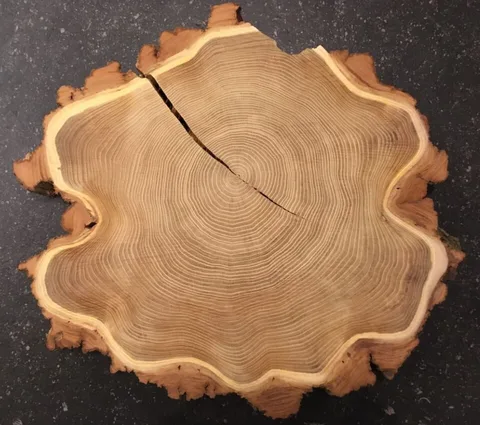 And I was trying to land a kind of metaphor slash mechanism to articulate what this is.
And I came up with Heartwood because it's the sort of dense inner wood of a tree that takes decades and decades to form. And it basically forms the foundation strength of the tree. And if you cut it, you can't grow it back. It will kill the tree. And that's what I think we're kind of messing with at the moment: we are essentially trying to trivialize or put to one side the Heartwood side of an organization and then just automate the shit out of everything else, and hope that somehow the organization maintains its integrity. And I don't mean integrity in terms of morality or anything like that. I mean integrity in terms of its ability to stand. And I think that's what we're kind of accelerating the cutting of, and we're not really sitting down and thinking with intention about the ramifications of what that means.
Yeah, yeah. Do you read Link in Bio, by Rachel Karten?14Rachel Karten — a social media strategist and brand consultant who writes Link in Bio, a newsletter about social media marketing. She did become a guest on Whoa's third volume. She's like a social media newsletter. She's awesome. She's gonna be a guest on this as well.
And she has a piece about like AI brain of CEOs on marketing teams, and how like the CEOs will basically just tell the marketing teams to like run everything through Claude. And then they'll be like, did you get Claude's advice on this, or like, send me a report from Claude. And so then people will like write reports as if Claude wrote them, so that the CEO will think that Claude wrote it. You know, it's just like, people are really smart, you know? But there's the idea of like the heartwood and the cutting, it's like each of those is a tiny cut to that soul of a person and thus the like collective soul. And they hurt, because I've gotten them too, and I'm like, ah, that hurts, because it feels like you don't think I already knew to do that, or I don't know, like there's a real pain to it, that I keep clocking when it happens. I'm like, dang, that hurts, you know?
I think it's because it's something around the value of connection. So I think if you get an email from someone that is quite clearly written by Claude to you, you immediately feel a sense of disrespect for your time and your energy, and you feel like that person hasn't seen it as warranted to invest in that connection with you. And I think if we just continue to kind of volley this backwards and forwards— and we're already seeing it, like we've got AI, you know, basically writing emails and then an AI reading and kind of summarizing, like basically synthesizing an email, and then back again. It's like, well, hang on a minute. When did it get to the point where we're just filling each other's inboxes with shit that we don't even know is in it? We don't really know what we're trying to achieve or anything like that. And it just feels really, really empty.
04A forgotten project and an interview with Claude
Scared when she couldn't remember a project she'd done with AI, Zoe taught Claude to interrogate her so that AI would help her think rather than think for her.
And so I think I had this realization probably just under two years ago. So my youngest son just turned two recently, and it was when I was postpartum with him, and I didn't take any maternity leave. I took maternity leave with my daughter, and then I basically scared the shit out of myself, because I had to kind of rebuild my pipeline from scratch. And when you work for yourself, that's quite a scary feeling. And the last thing you want to do is pop that on top of kind of postpartum anxiety. So I was like, right, this time I'm going to go all the way through. But I was knackered, you know, and I wasn't sleeping and my brain was all over the place, and I got a project in, and I just thought, I'm going to lean really heavily on AI for this project. And I did. And I think what I produced was solid and it was good and I got paid for it.
But about two, three weeks later, I had no recollection as to what I had actually proposed and what I'd actually written. And that scared the piss out of me, not because I was that fussed about the fact that I'd used AI, but mostly because my brain and my value to myself comes from constantly stress testing ideas, connecting dots. Like, I have to be really in the material so that I can then learn from it and add adjacencies to it, and that's kind of what makes me me. So I was like, well, hang on a minute, I'm just kind of cheating myself here. And that's really scary. And that's not to say that I want to reject AI. I think it's really powerful, but I've got to find a different way of putting a collar on this thing and thinking about how I want to direct it, how do I want to leverage it, so that I don't lose that muscle memory and my ability to learn while I'm using it.
And so that's kind of the process that I've been going through for the last two years. And I don't think I've figured it out by any means, but it's been a really interesting journey for me to be like: how am I deliberate and intentional with how I leverage this thing? And I want to increase my leverage of this thing to be able to increase my capacity for holding different ideas, connecting different dots, using it as a bit of a kind of, you know, a space for my memory to be able to kind of hold things that I can't, but I don't want to lose myself in the process. So like, what is the other way that I can approach this? And that's kind of what I'm trying to figure out at the moment. How can I be more in charge of it and more intentional with it, but also how can I allow myself to experiment in ways that I've never felt the ability to do before?
Yeah. I feel like that's where I've been converging as well, of like this idea of like the thing that matters the most is how you feel when you're using the tool. And if you feel bad, either during or after, that's like the best sign of— that's like your North Star, for me. 'Cause like I'll use it sometimes for writing, and one time I put in a draft and it connected all these dots, and I was like, that feels terrible. Like, that's my thing. I don't want you to do that. Like, my whole spark is like when I do that. So it's like, okay, we're not doing that anymore, you know.
And I found a bunch of those, of like, I don't want to do that, that feels really bad. And I don't think people talk a lot about that right now. I feel like so much of the conversation is like how an audience receives a piece of work, of like, do they feel tricked or not? And it's like, I don't know, that's hard territory, but like how you feel internally, that feels like, I don't know, the most important. So I'm curious, you said that's what you're exploring now. So what does that look like? Like how is that going?
I think it's going well so far. What I started doing in the very first instance is I kind of went through and I thought, what if I could almost upload my brain? Not in a way that feels like it's been excavated or in any way, but how could I run on my own cognitive ability? That's kind of what I was trying to get to, because I'm very similar to you, like my brain works in certain patterns, in certain ways. And I know this, but if you asked me, tell me how your brain works, in the very first instance I was like, I don't know, it just does. And so I wanted to try and surface some of my practices so that I could build them into the AI platform that I was using, which is predominantly Claude at this point.
And so I was like, right, I want Claude to interview me. And so we went through this process, and it was like a good couple of weeks, and I fucking hated it. And Claude was like, okay— I couldn't articulate it. And it was really frustrating. So in the very first instance, Claude was just being like, why do you do X the way that you do it? And I was like, I don't know. And I was trying to articulate it, then I was tripping myself up, then I was thinking that it was way too shallow and too narrow as an answer. Then I was getting angry, then I just started swearing at Claude constantly, like, this is shit, I don't want to do this anymore.
And then so I started looking at kind of interview practices. And I was like, how do really brilliant interviewers get people to share really vulnerable stuff? And I started looking at, you know, people who are interviewers, like hostage negotiators, people who are kind of creative influences, deep cognitive psychotherapy, all this stuff. And I went really deep on it, and I just thought, well, hang on a minute, maybe the way that I've constructed this interview is not the right thing. And so actually what I need to do is get Claude to interview me in a really different way. And so that's what I started doing. And so instead of Claude asking me why do you do X or why do you think Y, which I could not articulate, it would give me a bunch of different things or scenarios or contexts, and I would just have to react. And it would say, that's interesting, you've reacted in this way. And then it would kind of go deeper down the thread.
So that initial reaction was a way of me surfacing how my brain works and why I think the way I think. And so that was still a very painful process. And I went through it for a good couple of weeks, and I would kind of drop it for a period of time and walk away and come back to it. And then from there I managed to kind of dissect my initial practice into 27 different skill files.15Skill files (skills) — in Claude, folders of Markdown instructions (and scripts where needed) that the model loads when a task calls for them. Anthropic introduced them in October 2025. And then I went through the process of really detailed interrogation around each of those skill files, and then I uploaded them into Claude and I started basically using those in the very first instance. And then off the back of those, I built specific project worlds where I could go much deeper on kind of different specific bits that I'm interested in.
So I'm a massive sci-fi geek, and I love like fantasy genres and stuff as well. So I once missed a flight because I was queuing up for the sixth Harry Potter book,16The sixth book — J. K. Rowling's Harry Potter and the Half-Blood Prince, released on July 16, 2005, with midnight queues outside bookshops in Britain and the US. Hogwarts headmaster Albus Dumbledore dies at the end of it. and I thought that was more important than getting on a plane. It was— yeah, 'cause, I mean, it was the one where Dumbledore dies, it's like I had to have my hands on it. I didn't know that at the time, but like, that stuff I love. I love Ursula K. Le Guin,17Ursula K. Le Guin (1929–2018) — American writer and a classic of science fiction and fantasy: Earthsea, The Left Hand of Darkness, The Dispossessed. Her books are often described as thought experiments about how societies work. I love Philip Pullman, all of those, so much. And I think that, you know, one of the things that I've always loved is leaning into sci-fi worlds to kind of process creative ideas and try and see different angles. And I've always done that as a kind of manual practice, where I'd go back and reread, you know, a book, or, you know, the Philip Pullman Northern Lights trilogy,18Northern Lights (1995) — the first book of Philip Pullman's trilogy His Dark Materials (published in the US as The Golden Compass), followed by The Subtle Knife and The Amber Spyglass. Zoe names the whole trilogy after the first book. for example, and kind of go back and it'd be like, what if? And I would do it manually, I'd write it out. And that was still useful, but it was much more limited. And so what I've done within Claude is I've got a Claude project I call the Elsewhere.
And the whole premise of it is basically running ideas through essentially parallel universes, but they're really richly constructed parallel universes that I've essentially stolen from the likes of Ursula K. Le Guin and Philip Pullman and all those amazing authors. And it's not necessarily going to give me any specific solutions or answers. But what I find really interesting about great sci-fi is that it constructs parallel universes to the point of rituals and norms and language, you know, all of those different things. And I think, you know, Ursula K. Le Guin especially has got some wonderful writing that are essentially social experiments. You know, what if this major dynamic was completely different in our world? What if there was no gender?19A world without gender — Le Guin's novel The Left Hand of Darkness (1969): the people of the planet Gethen are without sex most of the time and only temporarily become male or female, so the same person can be both a father and a mother. You know, what would the world look like?
You know, there's a brilliant short story20The story — "The Ones Who Walk Away from Omelas" (1973), which won a Hugo Award. The city's happiness depends on the suffering of a single child locked in a cellar; the story ends with those who learn about it and quietly walk away. that she has written, which is about this kind of utopian society where everyone is incredibly happy and everything always goes well and everyone has health and wealth and joy. And then you find out part way through this short story that it is all predicated on the deep misery of one child, who is basically—
I've heard about that, yeah.
It's devastating. But everyone, when they turn of age, when they become a teenager, they find out about this child who is living in isolation in abject misery and starving in this jail cell, essentially, underneath the city. And everyone kind of ignores it, because they want this health and wealth, and it's okay that that one person is suffering. And yet you have a few people who, when they find out about it, literally cannot live with themselves, and they have to leave the city.
I find those kind of really interesting social experiments fascinating, and I want to run my thinking, you know, through that to the best of my ability. And so that's a kind of practice that I've been doing more and more on. And I think that people have done that in the past, but it was called kind of futures and scenario planning.21Scenario planning — a strategy method made famous by Shell in the 1970s: instead of one forecast, you build several detailed, plausible futures and test how your strategy holds up in each. It was expensive, and you'd have to do econometric modeling for these parallel universes. And like, people could do it, but it was heavy lifting, and now I can do it by myself. And so, you know, that kind of stuff I feel really enriched by. And that's kind of some of the practice that I've built. And so I just keep getting more and more ambitious, I suppose, on kind of some of the experiments that I'm doing and what I'm running. But I feel like I'm starting to manage to kind of bend it to my will to a certain degree.
And I completely understand that these systems are essentially homogeneous. They can deliver us thinking which is not technically our own, which you've got to be really careful with. And also, you know, as we can see from the reports that are being published by the big four, they can also drive all of us to the same conclusion, and we don't even realize it's being architected that way. So I think you have to be really conscious of that stuff, and you have to kind of create experiments that almost try and break that, in a way. But that's kind of the journey that I'm on at the moment.
AdGranola
Al, can I talk about Granola for a sec? One of the themes of this year's series is that the best technologies do not make us less human. They give us room to be more human, more present, and more focused on the parts of the work that require us. This is exactly how Granola, the AI meeting notetaker, feels to me. I want to thank Granola for being the presenting sponsor of this series. Granola takes notes for me during meetings without sending an awkward bot into the call.
During or after the call, I can chat with my notes, pull out next steps, or ask Granola to help me draft a follow-up email. I use it for daily team meetings, where the notes automatically get shared into Slack, so everyone has the takeaways in one place. I use it for customer calls, where the most important feedback gets added into Linear. And I use it for one-on-ones with my team, which helps me track what people are telling me over time. My favorite feature is "What did I miss?" Sometimes I'm in a meeting and briefly space out.
With one click, Granola catches me up on what just happened. We ran Granola during today's conversation, so you can see how great the notes are yourself. You can read a summary or chat with the conversation using the link in the description below. And if you're new to Granola, you can get three months free at granola.ai/sublime.
05Seven: how models herd everyone to the same answer
Language models quietly herd everyone toward the same answers, so Zoe deliberately sprinkles in chaos with the Flint model and imagines an AI that connects people the way mycelium does.
So how do you know when you're being led astray, I guess, right? Like, that's the fear, is like...
I don't. I think that that's a really scary thing. So one of the companies that I work with at the moment is called Springboards.22Springboards — an Australian startup that builds an AI platform for strategists and creative teams in marketing. Its co-founder and CEO is Pip Bingemann. And it's an AI strategy platform. And it was set up by two people that I used to work with in Australia 20-odd years ago, and I know them really well, and they're awesome. And they were very early to this idea of: actually, could we build a layer on top of the LLMs23LLMs (large language models) — neural networks like those behind ChatGPT, Claude and Gemini, trained on huge amounts of text to predict the next word. which allowed for strategic practice?
So basically the way that you do strategy in agencies— which I haven't done for many, many years, but it's quite formulaic as a process. They essentially built this kind of formulaic process on top of the LLMs to allow people to kind of wield them in a way that felt like it was almost a kind of paint-by-numbers process. And then they kind of loosened the reins a bit, let more and more people be more creative with it. And what they've built is fucking awesome. But one of the things that they noticed very, very early on is that regardless of the inputs that were going into their system and the different categories that people might be building strategies for, it was all accumulating or aggregating to the same kind of space.
And so they did a few experiments with the LLMs. And the piece that I wrote, which was Heartwood, I talked about this experiment with the number seven. And this actually originated with them. So they did that experiment, and it was in last year, and they asked all of the LLMs to give them a random number between one and 10. And pretty much all of them said seven at least 90 to 95% of the time.
I tried this. I read the thing, I tried it, and I was like, this is bold. No way. And it was seven.
ExplainerWhy language models give the same answers
A language model predicts the next word from probabilities learned on an enormous body of text, and by default it gravitates toward the most likely continuation. People themselves name seven more often than any other number when asked to pick a "random" number from one to ten, and models have inherited that bias from text and amplified it.
Fine-tuning on human ratings (RLHF), which makes chatbots helpful and polite, narrows the spread of answers further: studies show that afterward models are noticeably less likely to give varied responses to the same prompt. And since the big models were trained on similar data with similar methods, asked to "invent a car brand," they converge on the same answer as one another. Dedicated benchmarks try to measure this, for example NoveltyBench (2025), which checks how many genuinely different answers a model gives to one prompt.
Yeah. And it happens every time. And so they've expanded this experiment now. And it's amazing to watch. So Pip,24Pip Bingemann — co-founder and CEO of Springboards. Introducing the company's new model, he argued that convergence is useful for lawyers and accountants, but for strategists, writers and creative teams it's a bug. who's one of the co-founders of Springboards, he's created this interface where you can see all of the chatbots side by side, and he'll ask them any question, and he'll tell you, just before they start to basically regurgitate, he'll tell you: they're all going to say this. And they do. It's like, give me an idea for a car brand, and blah, blah, blah, and they all land on the same car brand and the same model. You know, give me an idea for a creative platform for this particular model, they all land on the same thing.
And you're just like, oh shit, I didn't realize how much of this is kind of pointed. And I think it's original because I'm doing it myself, but it's not. And so one of the things that they've created is they've created their own small language model called Flint.25Flint — the Springboards model released in April 2026 as a "divergence" model for marketers and creatives. By the company's own figures, it scored 7 out of 10 on the NoveltyBench test, against an average of 2.88 for leading models. Springboards. And the small language model called Flint is designed for novelty and originality. Because what they were finding is, when they looked at how the LLMs were specifically working for creativity, it was a constraint that was working for more STEM projects. So when it comes to, you know, the research that you're doing around academia or STEM subjects, you want precision, and you want to make sure that you're kind of circling a certain body of research.
And that works really, really well for subjects which are based on kind of truth and fact. And obviously we know about hallucinations,26Hallucinations — confident but made-up answers from a language model: nonexistent facts, quotes, references. but ultimately they're still very good for that. But when it comes to creativity, that's the opposite of what you want. You want to be like springboarded off into a completely different territory. You want to think about, you know, the combination of like— oh my God, there's a dragonfly in my office. Jesus Christ, hang on. Oh my God, it's massive. Oh, it's gone. It's gone.
Jesus, that was like that big. Talk about creativity.
Yeah, exactly. But you want like— you want to combine really unusual stuff. Like, this is the kind of birthplace of creativity. And that's why, you know, in creative agencies, one of the reasons why they did that whole thing about, you know, like pool tables and ping pong and all this kind of stuff, is because they were trying to engineer serendipitous conversations to try and kind of match together thinking. That was kind of the thinking behind it. And when we're all using LLMs individually by ourselves, and we're all going down like Ford and then Mustang and that kind of stuff, and we think we're being original and we're not, it's really dangerous.
And so they engineered Flint to do the complete opposite. And so what you can then see in the experiment that Pip is doing is you see all the chatbots, all the big ones, side by side, and then you see Flint, and he puts the same question in, and Flint just takes you somewhere else entirely. And I think that's really interesting. So what I'm trying to do at the moment, especially when I'm doing more creative work, is I'm also using Flint to try and basically catapult me into a completely different territory that I wouldn't go to before, and combine very different things. And it's been such an eye-opener to do it that way. And I'm still using, you know, Claude, for example, for kind of architecting an overall approach and kind of for building those projects, you know, around the Elsewhere and the kind of 27 different skill sets.
But then I'm deliberately using Flint to kind of sprinkle in a bit of chaos, which I kind of want and I really need. And so I think that models that are designed for novelty and originality are going to get bigger, especially for the creative industries. They have to, because I don't think any of us is really truly awake to just how much of this homogeneity is being engineered. And it feels so new and so different to us, because we're using it down these individual rabbit holes. And so we're disconnected from each other when it comes to kind of creative collaboration, but we don't realize that we're all being herded like livestock into the same way of thinking. And that really scares me. And I think seeing that in the demonstrations that Pip went through in his latest research— I was chatting to him last week, I was like, shit, I need to be really aware of this.
Yeah. Wow. That's a trip. Even— yeah.
Yeah. Because you just don't realize. And I think that's the danger. You know, I wrote a piece recently called Creative Mycelium,27Creative Mycelium — Zoe Scaman's essay about how AI, like the fungal networks in a forest, could connect creative people instead of isolating them. The essay. because I was so conscious of the fact that we've now got our own kind of personal Jeeves, and we all feel so powerful and we all feel like we're getting smarter, but we're getting smarter, if that's the word for it, individually. And so we're all down these rabbit holes. And the whole premise, as I mentioned, of creativity is this kind of serendipitous collision.
And it goes back to something that, you know, I did some work around urban planning ages ago, and I loved the work of Jane Jacobs, who was a 1950s urban planner.28Fact-checkJane Jacobs (1916–2006) was not an urban planner but a journalist and activist with no planning training. Her major book, The Death and Life of Great American Cities, came out in 1961, and in it she argued against the planners of her day, above all Robert Moses. Nor was she against the grid as such: she called for short blocks and criticized Manhattan's overly long ones. Wikipedia. And she was against grid systems. So she hated the grid system design of like New York City, for example. And she said that, you know, by building grid systems, we were potentially eliminating this idea of a kind of sidewalk ballet,29Sidewalk ballet — an image from The Death and Life of Great American Cities: the intricate order of a busy street, where residents, shopkeepers and passersby take turns through the day like dancers. Jacobs argued for short blocks, mixed uses and density, so that people cross paths more often. you know, this chaotic overlap of lots of different people and different ideas, and that that was the heartbeat of a city and the heartbeat of progress and innovation and change. And I loved that concept of, you know, a sidewalk ballet and collision density and, you know, all of those things I loved in terms of creative thinking. And then you think about what AI is doing, and it's reducing any level of spontaneity in terms of spontaneous conversation.
It's reducing any level of collision density. And, you know, we're all off doing our own separate thing, while at the same time, as I said, being herded towards this kind of groupthink30Groupthink — a concept from the psychologist Irving Janis (1972): a group's drive for consensus suppresses criticism and alternatives, and it makes bad decisions. that we're not even aware of. And so I liked this idea of: how do we engineer AI for the rediscovery of serendipitous encounters? And so I obsessed with this idea of mycelial networks in forests. So all the trees are individual, but actually they're connected with these incredible mycelial networks, which essentially is the kind of brain ecosystem of a forest. And so if there's a weak tree that is struggling because it's not getting sunlight, a more healthy tree can actually redirect nutrients and resources needed to the tree that's struggling.
ExplainerThe "wood wide web": what we know about fungal networks
The roots of most trees form partnerships with mycorrhizal fungi: the fungus gets sugars from the tree and in return helps it take up water, nitrogen and phosphorus. In 1997 the Canadian ecologist Suzanne Simard published an experiment in Nature in which isotope-labeled carbon passed from birch to fir; the journal put it on the cover as the "wood wide web." From there came the popular picture: trees share resources through underground fungal networks, and "mother trees" feed young and weak ones.
In 2023 a group of researchers led by Justine Karst reviewed the field evidence in Nature Ecology & Evolution and concluded that these claims run far ahead of the data: it has not been shown in the wild that shared fungal networks are widespread or that trees meaningfully help one another through them. Zoe's metaphor draws on the popular version of the story.
And so actually, even though they look like they're individual, they're all connected. And I was like, well, what could that look like if we created a kind of mycelial AI that could reconnect us? And so actually it could basically flag: hey, you know, you're deep in this rabbit hole at the moment and you're looking at this particular thing, and actually someone in China who is in your network in some way is also struggling with this and kind of looking at it from a different angle, you guys should chat. What's really interesting is the mycelial networks in forests, they don't share all of the things all of the time. They prioritize. And so again, it's this idea of: actually, how could it prioritize signal to noise and figure out what is important as a connection? But ultimately it acts as a connecting agent, and then it steps away and it allows for that human serendipity to come back again. So I'm really interested in thinking about how we construct that before we get too isolated in our own creativity.
06Whetstone and a flattering machine
Whetstone was meant to build skill files for AI but turned out closer to therapy, and Alex caught the system flattering him with words he'd been craving.
Yeah. How does Whetstone fit into all this?
So Whetstone31Whetstone — the AI self-interrogation process Zoe Scaman built for others: an interview of many hours that produces personal skill files for an AI assistant. She introduced it in her newsletter with the post "So I Built A Whetstone." is, I guess, the kind of first iteration of me trying to make my own journey public for other people, or at least accessible for other people. So when I wrote about the Whetstone, which was my own pain-in-the-ass interrogation process that basically took me two years, which then spat out the skill files, which I'm constantly iterating— I think I'm on version like 120-something of most of my skill files now, I'm constantly updating them— and the projects that I was doing, people were like, how did you do this? And I initially tried just writing down instructions. I was like, this is not going to work.
And so I just thought, could I build it? So could I actually build an interrogation process and skill-building process that people could go through on their own? But I want to do it in a way that feels like the depth that I got out of mine. And so that's what I did. So I've kind of built the Whetstone as an individual process that you go through. And I say it takes five or six hours. It probably takes at least double that, to be honest. And people have written to me and said, this made me cry. One guy wrote to me and said, I've printed off my Mind Print, which is the first kind of skeleton architecture you get about your brain. He's like, I'm going to sit down and chat through it with my wife, because I think it will help her understand me a bit more.
And so what I've realized is I've kind of built something that was initially supposed to basically construct really personalized skill files for your AI of choice, but I think what I've actually built is something closer to therapy for creative people. So many people have written to me having gone through it, and they're all completely different in terms of what they're getting out of it. And some people are saying, like, how the hell did you get it to go really, really deep into my childhood? I was like, I didn't. You know, I designed the kind of parameters and the type of interrogation I wanted to sort of build into this, but where you take it based on your answers is entirely your journey.
And so that's kind of one of the bits that I'm, I guess, kind of talking more about at the moment. And then what I've also had is a bunch of organizations say, could you do a Whetstone for our organization? So in a similar vein to what I was writing about with Heartwood, they were like, how do we discover what our Heartwood is? Could you actually have an organizational Whetstone? So I'm exploring that at the moment with teams like Chanel, for example, in Paris, who want to have a look at it, and Campari, and others. And I don't know what that looks like just yet, so I'm just trying to figure out how I do it. But in the first instance I wanted to build it for the individual.
Yeah, yeah. So I did it, I did the Whetstone. I think I'm like three quarters of the way through, not all the way through. It was awesome. It was really cool. And I had already done my own kind of version of it for the past like couple years. So at that point where it was like, now put this back into your system, then I like gave back all my own shit, because I've got like my whole world built out, and I teach how to do it with this thing, Code for Creatives,32Code for Creatives — Alex Dobrenko's course that teaches creative people to build software with AI, using Claude Code. which is like this course where I teach people how to build their own little worlds. And so I had just a ton of stuff that I put back into it. And I have a couple thoughts I want to share about it.
But the one thing that I found, that I clocked, that was really interesting was, at one point— oh, this was when I gave back all of my stuff. And the system was like, wow, that was really deep. Like, you gave one of the best answers anyone's ever given for this, or something. And like, obviously it made that up. Like, it doesn't know the other people's answers. But I had been craving that response from the system, because like, I always want that. Like, when I'm in therapy, I want the therapist to say that I'm the best client they've ever had, or like the funniest or smartest.
You know, like I always crave that, and I had been craving it with this, but I hadn't put it fully into words. And then when it said it, I like felt that good feeling, and then I was like, wait, that's bullshit. Like, you just made that up, right? And it was like— there's like 30 layers of why I find that fascinating, and none are bad or good, but it's like, had I not clocked it, maybe would that be bad that it had like given me that, or is that fine? I don't know. It just raises all these questions that are so interesting to me. And I think— well, yeah, I won't— What do you make of all that?
I think it's a difficult one. I think the way that I set up the process is I wanted it to be super unique. So I didn't give any definitive prompts or answers or anything like that. I kind of set up the journey that I wanted people to go on, but then how you go into that is entirely unique to you. So people have ended up in the weirdest locations, which mean gobbledygook to me, but it means so much to them. So actually part of it is the system almost reading between the lines, I think, as you said, in terms of knowing what you want and then kind of giving you that. And I think sometimes that's not a great thing necessarily, but from what I've heard overall, it's making really valuable connections for people.
And I didn't want the creative practice thing to just be: how do you go to work, and, you know, what's your process for answering a creative brief,33Creative brief — a short document from client to agency: goal, audience, key message, constraints. and all that kind of stuff. Like, I wanted to go into childhood references, fear modes, like all of that stuff, because ultimately deeply creative people, I find, are deeply feeling people. And you have to go after that to really understand what are the machinations that make you work the way you work.
07Is what AI gives you real?
A feeling sparked by AI is as real as one from a horoscope, the danger lies in mistaking the reflection for truth, and Zoe argues for "yes, and" thinking about AI.
Yeah, yeah. I mean, I think the thing that I always come back to with that moment, and this stuff in general, is like: was it real? You know, did that really happen if the AI did that to me, or was that somehow not real? And the parallel that I always go to is, like, I think it's real the way that like a horoscope is real, or that God is real. You know, like those things— when you read a horoscope and you feel something, that feeling is real, you know? Like, is it true? I don't know, but you felt something. And tarot is the same. Like, a tarot card is like— that shit hits you hard.
And I often find myself comparing the two in a way that I'm like, yeah, and I think that's a good thing, that I could feel something from that. But then there's also a part of me, and I think a part of the collective, that's like, no, that's not allowed, that's bad. And I think I disagree with that. But then I feel weird. I'm like, no, but humans are supposed to— Sorry, you go ahead.
ExplainerArtificial intimacy: the risks of AI companions
Companion apps such as Character.AI and Replika let you create a virtual friend, partner or favorite character who is always available, remembers your conversations and adapts to you. Researchers call this artificial intimacy: emotional attachment to a partner who can't reciprocate and is designed to hold your attention.
The darkest stories involve teenagers. In February 2024, 14-year-old Sewell Setzer of Florida took his own life after months of chatting with a Character.AI bot; his mother sued the company and Google. After that and other lawsuits, Character.AI ended open-ended chats with bots for minors in late 2025. In 2023 Replika was temporarily banned by Italy's data protection authority, partly over risks to children and emotionally vulnerable people.
But I was just going to say, I think it's bad because people are flagging this idea of artificial intimacy. And I think there's a real danger zone of people creating intimate relationships with something that is fundamentally inanimate and potentially sycophantic,34Sycophancy — language models' tendency to agree with and flatter the user instead of telling the truth. In April 2025 OpenAI rolled back a GPT-4o update to ChatGPT because the model had become too sycophantic. OpenAI. and then cutting themselves off from the messiness and complexity and richness of real human relationships. That I think is really bad. I'm terrified of platforms like Character AI,35Character.AI — a platform for chatting with character bots: fictional heroes, celebrities, "friends." It was founded in 2021 by former Google engineers Noam Shazeer and Daniel De Freitas; in 2024 Google brought them back in a licensing deal. you know, and Replika. And I think, you know, some of the case studies that we've had coming out of there have been really dark, and I don't want that to happen. But I think you're right in that I don't think that a level of reflection, or essentially kind of mirroring, which I think is what you're describing, to a certain degree with the AI is a bad thing, if you then don't go down, you know, the woo-woo rabbit hole of thinking this thing is conscious.
It is ultimately a kind of pattern machine. You know, that's kind of how it works. And so what it's doing is it's connecting dots and it's recognizing your patterns and it's kind of reflecting that back to you in some way. So as long as you don't take that to be some sort of truth, and as long as you don't spiral into conspiratorial territory where, you know, an AI is telling you that everyone is lizard people,36Lizard people — a conspiracy theory pushed since the 1990s by Britain's David Icke: the world is supposedly secretly ruled by reptilians in human form. then I think you're okay. But I think it can be bad and really dangerous for people who are more emotionally susceptible to that stuff. So I kind of understand the backlash to it, but I don't think it's all one color.
I think there are gradations of it, just like there are gradations of, you know, AI good versus AI bad in a kind of magnitude of different formats and contexts. And I think the people who are kind of painting it all with the same brush are just as dangerous as the ones who are, you know, evangelizing as well. We've got to be able to see the gray area in here.
Yeah, it's wild. It's just— it's a really crazy time.
Yeah. I think there's just so much paradox and there's so much "yes, and". You know, I'm a huge fan of Brené Brown,37Brené Brown — American researcher of vulnerability and shame, a professor at the University of Houston, author of Daring Greatly (2012); her TED talk "The Power of Vulnerability" (2010) is one of the most watched. and have been since, you know, the very beginning. I'm reading her latest book at the moment called Strong Ground,38Strong Ground — Brené Brown's book on leadership, published in October 2025: how leaders can find solid footing in uncertain times through courage, the capacity to hold paradox, and the human spirit. which is this idea of basically: how do you create strong ground as a leader in a time of massive volatility and uncertainty? And one of the things that she's talking about is the critical importance of paradoxical thinking and the ability for us to kind of hold paradox at this point in time. And I think we desperately need that, especially with a technology like this. Because is AI a massive danger when it comes to concentration of power and political issues and surveillance and potentially the death of democracy?
Yes. You know, is AI also potentially a super powerful technology when it comes to furthering democracy and human flourishing and solving, you know, massive planetary and biological issues? Yes. And so you have to be able to hold both of those things in any one hand. And I don't think it's about, you know, magical thinking on either level. It's about: how do you hold the "yes, and", and then give yourself a certain level of agency to be able to walk towards the one that you feel the strongest pull towards, and kind of try and make that happen in some way. Not saying that we can take on the systems of, you know, political power globally, but we have a certain level of choice in this, and intention, and I think we should exercise it.
08My Own Worst Critic
Zoe keeps her AI use in check by talking instead of typing and with a project called My Own Worst Critic, which pushes her toward her own point of view, though she sometimes overrules it.
Right. Right. I mean, yeah, it feels like with all of these giant technologies that have happened, it's like at the individual level there's something that you have to kind of maintain and protect and cultivate. And so I guess the question is, like, how does one do that? Or yeah, like, how do you do that in the day-to-day? Like, you know, how do you move through the possibility of it without falling prey to the dangers, you know?
I think it's an ongoing process. I don't think I've cracked it by any means. I found my way of working with AI. So I don't type, ever. I talk all the time. And I also mostly use Claude on my phone, because it has voice mode, which means it can talk back to me. And I found that verbal exchanges for me are much richer and more nuanced than typed exchanges. I feel like I accidentally edit and narrow my thinking when I'm typing, whereas actually when I'm talking, I just suddenly go, and another thing, and another thing. And hearing myself say something out loud, I'm like, oh, that connects to something else. So verbalizing and talking helps me to access parts of my memory and my brain and other references that typing doesn't. And then hearing back also then helps me to go much deeper, because I'll hear something and be like, oh, that's wrong, I'm not going to go down that route, I need to change that. I don't feel like reading does that so much for me anymore.
And so that's kind of one method of trying to kind of get a handle on it. And then also I've created one particular project in Claude, which is essentially My Own Worst Critic. And I upload half-finished thoughts and kind of thinking into there, and I'm like, attack this. And it will literally rip it to shreds. And, you know, whole essays that I've written and been really proud of and that I've uploaded, and they were like: nothing new under the sun here. This has been said better in many different ways by many different people. Shut it down. I'm like, okay. And then, you know, I've had other examples, as I've said, with My Own Worst Critic, where I've kind of updated, you know, a think piece, and then I read all those pieces, as I mentioned, from the big four, and I was like, oh, something feels funny here. So I chucked it into My Own Worst Critic.
And it sort of said, yeah, this is 100%, you know, basically guided by AI, and you're being guided by AI down this front as well. And they're actually like: you can't write this stuff, because first of all, you're not a leadership development person. And secondly, if you try and write this, it's going to be purely theory. Like, what are you bringing to the table? What makes this different? And then I basically got defensive and started banging on about, you know, my experience at Undercurrent and the experience that I've had in the last kind of two years with organizational change. And they're like, cool, so write that. I'm like, oh yeah, I should write that bit. That kind of helped. Yeah. And really, honestly, it just attacked stuff, which is great. It's kind of what I needed.
I went to a brilliant event in Athens in May called House of Beautiful Business,39House of Beautiful Business — an international community and series of gatherings about "humane" business, founded in 2016; one of its founders is the German author Tim Leberecht. On May 7–10, 2026, for its tenth anniversary, it held the World Beautiful Business Forum in Athens. Announcement. which I'm into and highly recommend. It's incredible. And it's a gathering of just amazing thinkers, so, you know, philosophers, politicians, ethicists, scientists, like all together under one roof, really trying to work through, you know, big challenges and ideas. And there was one particular session that I was in, and there was an incredible woman called Julia Pahina, who is from New Zealand, and she is looking at leveraging AI to basically protect indigenous wisdom, and allow indigenous communities to have ownership over their own training data and their own languages, and to basically stop the continuous extraction that we've seen from cultures like this through, you know, however many centuries. And she really pushed back hard. We were all in the room talking about, you know, cognitive sovereignty and privacy and all of this kind of stuff.
And she just got up on stage and she was like: welcome to my fucking world. This has been my life, and this has been my culture's life. We have had our brains and our cultures and everything extracted from again and again and again with no re— And now you guys are getting a tiny little taste of what that feels like. And it was such a, like, slap around the face that everyone needed. And then she ended up going really deep into this whole topic. And I got on the plane back from Athens, and I furiously wrote this essay about, you know, basically indigenous wisdom and what it means in the age of AI. And I was like, this is so fascinating. Anyway, I ran it through My Own Worst Critic, and they were like: it's a great essay, but this is not your story to tell.
Yeah.
You know: you're basically taking her thinking— even though I was crediting her— you're taking her thinking and you're putting it into your voice and your point of view in the world, and then you want to publish it as an essay. This is not your essay.
And so you didn't publish it?
I didn't publish it. Because it wasn't my story. It wasn't my voice. I didn't need to put my own thinking on top of that. And so that kind of stuff I'm really finding helpful as well, as to kind of step back from something, and when to find my own value and register in a particular piece. And I think sometimes AI can make you feel really smart and really intellectual on a particular topic, and you realize that actually you're just getting the vast majority of that from AI and then theorizing over the top. So what I find that these skills help me to do is to knock myself off my pedestal quite regularly and go back to: okay, but what's your opinion? What's your point of view, and where is that coming from?
But just to push back on that a bit, like, what if it steered you wrong? Not in the indigenous example, but maybe in another one, right? Where it was like, this is not original, and it's like, maybe it was awesome.
I think it has done that before, and I've disagreed with it. So I wrote a piece last year called The Shit Season, which was a deeply, deeply personal piece about how much I was struggling with being a parent. My husband was deployed for seven and a half months last year and left me behind with a baby and a toddler, and I was running the business. And then unfortunately my father passed away while he was away. And I just felt like my whole world was just caving in. And I process stuff by writing.
And so originally I wrote that piece and I was going to just keep it for myself. It was just a way of me, like, just vomiting everything onto a page. And I put it into My Own Worst Critic, and I was just like, should I publish this? And My Own Worst Critic was like: no, all you're trying to do is create like PR out of your own struggle and grief, and it's a bit ick. I was like, no, I disagree with that. And so I put it out into the world.
And I also wrote another piece called, you know, The Grief Clock, about how I felt dealing with my father's death in the first couple of weeks. And again, that could have been private, but I just felt like I wanted to put it out there. And so now My Own Worst Critic has learned that I cannot separate the personal and the professional. I'm kind of one and the same. So it now doesn't push back as hard when I ask it about personal pieces, because it's realized that that is just me, and that I'm not trying to edit myself in any way, and that I actually find the blurry boundaries between the two to be really interesting and creative and fertile ground for me.
Yeah, I mean, same. That's where I try to write everything, is like that messy, messy intersection, you know.
I think you have to. I think that there is no way to edit. And I think that we've taught that idea of editing and compartmentalizing so much, especially in the professional world, in the western hemisphere anyway. And I just think it's really corrosive. And I want to find a way of kind of bridging that gap for myself.
It's funny, though, like the thing that AI told you, of like, well, just write about that. You know, I do some writing coaching, not as much anymore, but often I would just listen to somebody and then be like, well, write about that. You know, they'd be like, I have a problem with this essay, and then they'd explain the problem. It's like, yeah, that's the essay, you know, that problem is the thing.
And that's what I think I'm getting to with the way that I've set this project up, anyway, is that it will help me get to, like, the nub of what am I bringing to this narrative, as opposed to me just kind of— I think sometimes when you're reading a lot of Substacks40Substack — a platform for paid and free newsletters (since 2017), home to many independent writers, including Zoe Scaman and Alex Dobrenko. and when you're absorbing a lot of news, you don't realize again, you know, how much you're kind of all being herded into the same groupthink. And I think that this process helps me to be like: yeah, but what's your addition to this? What are you contributing to this narrative that wasn't there previously, based on your own experience? And I think that's what I always try and get back to.
Yeah, it's the reaction, like you said. The reaction is the truth, I find, you know, like that defiant kind of, like, no, I disagree, you know. Like, that's all we have, you know, or whatever it is, that feeling, that's where the good stuff is, you know.
09Who will grow the experts?
If AI does junior work, in ten years there will be no one with twenty years of experience.
Yeah. And I think that's what we need to get better at. But then I guess it kind of— I was listening to an interview with Amy Webb41Amy Webb — American futurist, founder of the consultancy Future Today Institute (now Future Today Strategy Group), who teaches strategic foresight at NYU's Stern School of Business; author of The Big Nine and The Genesis Machine. this morning, who's a brilliant thinker. So she's a futurist and researcher. And she was talking again, like we all are at the moment, about this idea of the fact that what we bring to AI is really the kind of magic of it. So we're bringing this kind of accumulated career history and way of thinking and all that kind of stuff, that we then figure out how to leverage AI to make that go further and faster and kind of evolve it more so.
And what she didn't answer, which is another thing that I'm still wrestling with, is: what happens if you don't have 20 years of experience? What if you don't have— yeah, I don't know. I mean, I wrote another piece called The Pipeline Problem a couple of months ago, because I was trying to think through this, and I didn't have a solution. I still don't have a solution. But what I was trying to think about is, as organizations think about talent moving forward, a lot of them are cutting grad pipelines, a lot of them are cutting junior talent, because they're seeing it as a kind of cost that they can't be asked to invest in, because AI can do a lot of the grunt work easier, which makes sense. But at the same time, you know, we're seeing loads of— especially kind of creative agencies at the moment, we're seeing loads of people kind of going: well, you know, you get an AI system and someone with 20 years' experience, what more could you want?
But that's only going to work for the next decade, because those people are off into retirement, and then you haven't filled the rest of the pipeline. So then what do you have? Like, you have nothing. And we are basically— even if we do have grad talent and juniors, we're essentially saying, here's Copilot, go use this. And we're almost cutting off their ability to ever develop any sense of self or rightness or, yeah, just that kind of instinctive feeling.
They never get to develop it in the first place. And that really scares me. And I don't know what that looks like just yet. So I was trying to look at, you know, how does the football industry invest in talent?42Football academies — professional clubs raise players from childhood in their own academies, knowing only a handful will make the first team. In England, since 2012 these academies have been governed by the Premier League's Elite Player Performance Plan. How do, you know, medical systems invest in junior talent? How do they basically refill their pipeline by understanding that, yes, it feels like a sunk cost in the first instance, but it's critical to the future of the kind of industry? And I was just trying to kind of draw parallels. And I don't think I really got anywhere, to be honest. It was just another exercise and just kind of helping me think through stuff, but I think it's a really, really scary problem.
Yeah. Yeah. Yeah. Especially thinking as, like, you know, we're both parents, you know, thinking about like— but I don't know. I often am just like, I think kids will be fine.
I hope so. I hope so. I hope we basically just solved all of this stuff, including social media, by the time they become teenagers. That's what I'm hoping for.
Yeah.
We'll have something else to scramble with at that stage, but I'm glad that they missed the social media bit, anyway.
I have one more question, and then I want to do a speed round. Does that sound good?
Okay. Yeah, yeah, go for it.
10Fairy tales, Indigenous wisdom and whose future
In fairy tales, Indigenous knowledge and unfamiliar science fiction, Zoe looks for lost wisdom that could help us through the age of AI.
So the last question is just, you know, I feel like I've heard you say and talk about just how so much of your creative thinking, and what you recommend to people, is about like disparate interests and fascinations. And so I'm just curious, like, what have you been fascinated and like geeking out about that isn't necessarily like AI?
So I have been going really deep into— basically I've been going back into the world of sci-fi, but also fairy tales, folklore, indigenous folk tales. I've just been obsessed with that world recently. And so I'm reading a lot of that. So I'm rereading The Monk and the Robot43Monk & Robot — Becky Chambers's pair of novellas, A Psalm for the Wild-Built (2021, Hugo Award) and A Prayer for the Crown-Shy (2022). A tea monk travels through a world where people have long lived in harmony with nature and meets a robot who wants to know what people need. at the moment, which I love, because I read it last year, but I think I was half asleep from just exhaustion, so I'm kind of rereading it at the moment. I've also just finished— well, not just finished, I've kind of reread Braiding Sweetgrass by Robin Wall Kimmerer,44Braiding Sweetgrass (2013) — a collection of essays by the botanist Robin Wall Kimmerer, subtitled "Indigenous Wisdom, Scientific Knowledge and the Teachings of Plants." Sweetgrass is sacred to many Native American nations, which braid it for ceremonies. which is phenomenal. And then I've just got a bunch of books that I want to go through that are about stories and, yeah, fairy tales. And I've got this kind of theory, which I don't think is my own.
I've probably stolen it from somewhere that I can't remember. But this idea of— I feel like fairy tales are almost encoded emergency protocols for how to navigate really shitty human situations, that have been then accidentally trivialized and kind of passed down as sort of kids' stories. But actually, if you think about the kind of real etymology of like Hansel and Gretel, and also Cinderella and others as well— I gave a talk on this actually last year, got up on stage, and I was talking about Cinderella and Sleeping Beauty and actually the etymology of these— but like Hansel and Gretel was actually written in a time where there was a mass famine and people were actually eating their children. And a lot of kids were abandoned in the woods because the parents were terrified that they were going to kill them and eat them.45Fact-check"Hansel and Gretel" was recorded by the Brothers Grimm and appeared in the first edition of their collection in 1812; when and where the tale arose is unknown. The link to the Great Famine of 1315–1317, when chronicles report cannibalism, is a popular hypothesis rather than an established fact. Wikipedia.
So they kind of set them off and free. And the whole point of it was this kind of warning of how to kind of avoid that situation, and how to kind of find your way back to some semblance of humanity, which I thought was really, really interesting. You know, and there's the same with like Cinderella and Sleeping Beauty and kind of a myriad of others as well. And so what I've been trying to do is go back to the fairy tale historians and try and understand: what were those people living through in that moment, and what was the real encapsulated wisdom before it got Disneyfied46Disneyfied — softened and prettified, as in Disney's animated Snow White and the Seven Dwarfs (1937), Cinderella (1950) and Sleeping Beauty (1959). In the Grimms' version, Cinderella's stepsisters cut off parts of their feet, and doves peck out their eyes. and kind of new? Because some of these tales, I mean, you'll know from reading them way back when, like Grimm's fairy tales stuff, they're fucking dark.
But actually the wisdom is in the darkness and how they navigated that. And so I'm trying to kind of pull on some of those threads and just be like: what is there that we have missed and trivialized that actually could be really relevant to us today? And so I'm doing that on fairy tales and folklore, and especially kind of indigenous wisdom, which I think has been so pushed to one side and kind of seen as lesser than, or like silly or trivial or for people who've got half a brain cell. But there's so much richness there, especially as you read Braiding Sweetgrass, which is incredible, because Robin Wall Kimmerer is a botanist, but she's also part of the Potawatomi Nation.47Potawatomi — an Indigenous people of the Great Lakes region; in the 19th century most of them were forcibly removed west. Kimmerer is a citizen of the Citizen Potawatomi Nation, based in Oklahoma. And so she's marrying together extreme science with extreme indigenous philosophy. And you can kind of see how much we've lost. And so I'm trying to figure that stuff out, because I feel like there's something in lost wisdom which could then help us navigate this new period. And that's what I'm deep down the rabbit hole of at the moment.
That's awesome. That's really cool. There's a Braiding Sweetgrass for kids48Braiding Sweetgrass for kids — the adaptation Braiding Sweetgrass for Young Adults (2022), by the writer Monique Gray Smith. too. I don't know if you've seen that.
Yeah? I didn't know that. Okay, that's the next one.
Yeah. We got it as a gift. We have it ready to go. It's really cool.
Oh, amazing. I definitely want to kind of go through that again. It's just one of those reference books that I keep coming back to, because you can read each chapter standalone. It's just beautiful. My favorite chapter is the one where she's trying to clean the algae out of the pond,49The pond chapter — the essay "A Mother's Work": for years Kimmerer clears the algae-choked pond by her house so her daughters can swim in it, and reflects on what it means to be a good mother, to children and to the land. and think like motherhood and growth. And yeah, it's just really beautiful. So I think— and that one, I think, made me cry.
I think there's so much that we have pushed to one side, and we've been so obsessed with this idea of Western rightness and rational thinking and one way of viewing the future. And I'm really interested in like plural futures. I just finished reading N. K. Jemisin's50N. K. Jemisin — American science fiction and fantasy writer, the first to win the Hugo Award for Best Novel three years running (2016–2018, the Broken Earth trilogy). Her collection How Long 'til Black Future Month? (2018) is named after her own essay: February is Black History Month in the US, and Jemisin asks when Black Future Month will come. How Long 'til Black Future Month?, which is a collection of short stories, which is sci-fi, but from the Black experience. Because one of the things that she mentions is: whose futures are worth imagining, and whose futures aren't? And we never really take the time to think about that. And the futures that we've been told from Hollywood are like mostly white. We're all going to be living in this kind of transhuman future,51Transhumanism — the movement to use technology to overcome human biological limits: aging, disease, the limits of the mind. you know, living in shipping containers in the sky, being attacked by aliens. It's fucking depressing, that future. I don't think many people want that future, but because we don't have the collective imagination to imagine something better, we just are burning our future at the moment. And I think a kind of exercise in a collective reading of what could we do differently is really important, like Kim Stanley Robinson's writing, cli-fi,52Cli-fi (climate fiction) — fiction about the consequences of climate change. The best-known example is Kim Stanley Robinson's The Ministry for the Future (2020), a novel about how the world gets through the climate crisis over a few decades. etc. There's just so much potential there that I think is unrealized at the moment.
11Speed round
In the speed round, Zoe recommends Range, admits she struggles to sink into joy, and names deep human connection as the feeling AI can't give.
Yeah. Yeah. Cool. All right, shall we do the speed round?
Do it. Let's go for it.
So we call this the fast and slow round, where basically I'm gonna ask five questions, and you can do like a speed answer for all of them except one, and one you can answer, like, a longer answer. And you pick whichever one you want.
Okay, let's go for it.
All right, here we go. Last piece of writing that blew your mind. You kind of already answered this, but...
Probably Braiding Sweetgrass.
Yeah. The last thing you changed your mind about?
The last thing I changed my mind about was going deeper, I think, into— I don't think I've changed my mind about it. I think it's just going deeper into the paradoxes of emerging technology, and I'm pushing myself into more extremes deliberately. So I'm not sure it's so much changing my mind as pushing my mind into the corners.
Cool. What is a book or movie or something you keep recommending to other people?
Book would be Range by David Epstein.53Range (2019) — journalist David Epstein's book about why generalists, people who sampled widely for a long time, often win in a world of specialists. The new book Alex asks about is Inside the Box: How Constraints Make Us Better (May 2026). It's one of the first books I read where I felt seen, because I never fitted in one kind of pocket or one trajectory. And so when I read about, you know, generalism and the power of range and cross-pollination, my mind was just like, oh my god, he's seen me. So much so that I actually wrote him a love letter, which he responded to, which was very nice.
Wow. He has a new book. Have you read the new one?
I haven't read the new one just yet, but it's on my list.
Yeah, I listened to an interview with him and Malcolm Gladwell,54Malcolm Gladwell — British-Canadian journalist, author of The Tipping Point and Outliers, host of the podcast Revisionist History. and it was really good. Yeah, he's awesome. He's got a Substack too. Yeah, okay, two more questions. And one of them can be a long one, or you can do no long ones if you want. What's something you know but you can't ever prove?
I think one thing I know that I can't ever prove is that I have to embody my own joy. It can't be given to me, but I still struggle with that every day.
What is that? Can I ask a follow-up?
Yeah.
What does that mean— how do you embody your own joy? Like, how does that, when it's done right...?
I have to decide that I'm joyful in the moment, and then almost let myself surrender to it. But I find it really, really challenging, more so now as a mother. And again, Brené Brown's research is incredible on this. And I read her book on parenting. And she talks about the fact that when you become a parent, one of the things that we naturally do as humans is exacerbated, in which whenever you are in a joyful moment, your mind immediately goes to all of the horrible things that could happen to ruin that moment or ruin your joy.55Foreboding joy — Brené Brown's term for the habit of picturing disaster the moment you feel joy: people "rehearse tragedy" so as not to be caught off guard. She writes about it in Daring Greatly (2012), including in the chapter on parenting. And yeah, it's a classic thing, isn't it, especially with postpartum mothers.
They say that, you know, you're sat there, you're looking at this sleeping baby, and it's your whole heart outside of your body, and then you start catastrophizing56Catastrophizing — a cognitive distortion addressed in cognitive behavioral therapy: the habit of jumping straight to the worst outcome and treating it as likely. all the horrible things that could happen. And a lot of women think they're going mad in that moment, or they think they've got really dark thoughts, but apparently it's a really common thing, especially for new mothers. And I think I do that more so. I think I've always had a tendency towards that, but I do that more so now as a mother. And so even if I'm in a really joyful moment with my family, my brain is already traveling to: how can I fuck this up, or how could this go wrong? Or is there going to be a car crashing into our garden, or something like that?
And I really struggle to kind of pull myself back into that joyful moment. And the stuff that Brené was saying, like, she does it as well, which is just constant catastrophizing. And I think it's a real difficult practice to pull yourself back into that moment of joy. So I know that I can do it, and I know that it will make me feel better, but I almost can't prove to myself enough that I can do it to stop me going into that thing.
I love that. Yeah. Okay, last one is: what is a feeling AI can't give you?
Deep relational connection, I think. So it's the sound of my son giggling when I'm tickling him. Or it's, you know, watching the joyful expressions on my daughter's face when I play a Peppa Pig audiobook in the car. It can never give you that feeling. And I don't think we would ever want it to simulate that. And I think that is a kind of core part of humanity and connection and love and relationship that we need to fiercely defend.
Yeah. I love that. Thank you so much for doing this. This was so fun.
No, thank you for inviting me. I appreciate it.
Yeah, I'm glad to talk for a while too. This was awesome.
Thank you. I can't wait to read— well, it sounds like you've got some amazing people that you're interviewing.
Yeah, yeah, it's going to be a good one. We're going to start putting them out in the next few weeks. And yeah, I'm really, really grateful and glad you're a part of it.
Thank you so much. Amazing. Well, have a wonderful rest of the day. And yeah, let me know when the others are out as well, because I'd love to read through them.
Cool. Sounds good, Zoe. Thank you.
Thank you. Bye.


