

Whoa, Vol. 3: Humanmaxxing
Chapters
The AI discourse is boring because everyone experiences AI alone, and the public commons has shattered into one-on-one chats with an LLM.
Read the chapter- Alex's producers want him to talk about AI less, since it's all anyone wants to discuss yet almost everything said about it sucks, and Alex blames purity culture and the endless chase for a fresh take.
- Following Venkatesh Rao, Nadia likens stories of transformative AI experiences to recounting dreams or psychedelic trips.
- X articles, Nadia notes, rack up lots of likes, but nobody seems to remember them after a day or two, and they don't change how anyone lives.
- The conversation moved from the public feed to group chats and now to one-on-one chats with an LLM, as if with a therapist, which Nadia sees as one more step of atomization.
Alex reacts to viral articles either by satirizing them or by trying to go viral himself, while Nadia doubts that reach buys any influence over the conversation anymore.
Read the chapter- Alex either writes a satire or tries to win the virality lottery, and he doesn't know how to get to the healthy middle ground.
- Reach used to promise at least some influence, Nadia says, but now it feels like fake clout bucks, since nobody remembers you posted anything a week later.
- The most Nadia feels she can sway is something group-chat-sized or her newsletter list.
- Part of Alex is still running on an old operating system that says something has to blow up.
Nadia is in a watch-and-wait mode, as if in wartime, but doesn't buy that what's happening with AI is unprecedented.
Read the chapter- A chat with an LLM is the most private thing, yet the model, Alex notes, is "the average of all of it," and Nadia concludes that whoever shapes the models shapes the public discourse.
- Nadia feels like she's in wartime, in free fall, and realizes it could last the rest of her career.
- Nadia asks whether people would have panicked like this over the rise of the consumer internet, and whether they would have been justified.
- Alex wonders if it's just age: he was warned about TV as a kid, and today's kids may well be telling adults to stop asking them about AI.
- With social media, Nadia notes, people enjoyed it first and worried later, while with AI the fanatical use and the reckoning happen at the same time.
Back in San Francisco after years in Miami and LA, Nadia found nihilism: a place that always ran on positive-sum games now thinks about self-preservation.
Read the chapter- San Francisco is unlike the rest of the world, but to Nadia it is a petri dish that shows how technology reshapes culture.
- Many people now see their work as transactional and focus on self-preservation, which is unusual for people in tech.
- A place that always ran on positive-sum games now feels a little more zero-sum.
- What makes a fulfilling life is a timeless question that, Nadia suspects, innovation doesn't help with, since even endless abundance doesn't make people happy.
The progress movement measures success in technology and economics, but flourishing is a different question: the charts are going up and people are still unhappy.
Read the chapter- The city, Nadia says, has a million conferences and events about what the good life is and what it means to flourish.
- Progress studies looks at how to keep progress going, but in practice, Nadia observes, it defines progress as technological and economic.
- There is plenty of material abundance and people are still unhappy, so flourishing, to Nadia, is not the same as progress.
- With AI, people have started talking about taste and judgment, the part that still needs a human, and Nadia sees a move away from measurement culture.
People have never really flourished, but it's good that more of them can, and Nadia doubts creative self-expression is essential to it.
Read the chapter- People historically didn't flourish, Nadia says, but just as with running water and a roof overhead, it's good that more and more of them get to.
- Nadia suggests we may simply be moving up Maslow's hierarchy.
- Alex asks what the "toilets of flourishing" are, and Nadia wonders whether creativity even belongs on the list.
- People used to practice craft and art out of religion or family tradition, and an inner need for self-expression seems newer to Nadia.
One of the big losses of the AI era, Nadia argues, is not self-expression but flow state.
Read the chapter- We no longer need manual labor yet still go to the gym, and Nadia thinks time for flow has to be carved out the same way.
- AI lets you put out more writing and more code, but the process is less flow-statey.
- Nadia writes without much enjoyment, for what flow does to her brain, and after ten hours in it she feels energized.
- She used to spend 90% of her day in flow, and now, with kids aged two and a half and ten months, it's zero to 10%.
You can't learn to flourish from a paper: everyone knows what the good life looks like, and one thing that stops us from living it is attachment to our own neuroses.
Read the chapter- Alex notes that the vulnerability in his writing, like flourishing itself, is antimemetic and disappears as soon as you talk about it.
- Flourishing is knowledge from lived experience, so every generation, Nadia says, reinvents the conversation, and we're back in the '60s.
- Everyone knows what the good life looks like, and what interests Nadia is why we've failed to live it for centuries.
- As "Existential Kink," which Alex recommends, argues, part of us likes what we complain about, and Nadia adds that letting go of anxiety is scary and takes a leap of faith.
Jhanas, Nadia says, rewrote her brain, but like AI they are hard to talk about, and they should be taught through practice rather than theory.
Read the chapter- Jhanas are deep concentration states, from euphoria comparable to MDMA to an equanimity comparable to dissociatives.
- Nadia went on a retreat for a piece about the subculture, moved through the jhanas fast with no meditation background, and says it rewrote her brain with lasting effects, though she meditates about once a month.
- Nobody, Nadia is surprised to find, has clear terminology for the state that jhanas, psychedelics and breathwork all point toward.
- Her guide has almost no theory, and Nadia compares this to the difference between studying computer science and spinning up an app in the SaaS era.
- AI is the same, Alex says, since everyone talks about it and few build anything with it, and Nadia replies that people do a lot with it, but all of it happens in private.
In the speed round Nadia says she believes in God, urges walking down into the Grand Canyon, and won't hand AI the part of her that touches God.
Read the chapter- Nadia believes in God, and that is also what she can't prove but knows to be true.
- AI, she says, can't give her a sense of belonging.
- You have to walk down into the Grand Canyon, Nadia says, even for an hour, because from the rim it didn't impress her.
- AI helped her figure out how to parse her whole-genome sequencing data, though she never gave it the data itself.
- Nadia keeps her DNA from AI, along with the poetic, numinous part of her, the touching-God part.
Quotes
On X articles
“But then the scary part is that no one seems to really remember them beyond a day or two.”
Nadia AsparouhovaRead from 06:16On one-on-one chats with AI
“It's like everyone is, you know, having a conversation with their therapist, essentially, and then just spouting stuff off. But it doesn't matter to anyone else.”
Nadia AsparouhovaRead from 08:28On AI as a mirror of everyone
“the LLM is the most private thing, but it's also weirdly almost a back door into the public thing, because it's everybody.”
Alex DobrenkoRead from 13:45On progress without flourishing
“All the charts are going up, but there's some sense of malaise.”
Nadia AsparouhovaRead from 30:42On whether flourishing needs creativity
“Like, is creativity a toilet of flourishing, or is it kind of the off-gassing or byproduct of something else?”
Nadia AsparouhovaRead from 35:54On the search for the good life
“why is it that we have known this answer for centuries and centuries, and yet somehow can't seem to implement it?”
Nadia AsparouhovaRead from 45:32What Nadia won't give to AI
“It's something like the poetic, numinous, whatever part of me— the touching-God part. I don't let it do that.”
Nadia AsparouhovaRead from 58:05
Summary
Nadia Asparouhova — internet culture researcher, author of "Antimemetics" and publisher of Asterisk magazine — almost turned this conversation down: anything she could say about AI felt like everyone else's thoughts. Building on a remark by Venkatesh Rao, she explains why the AI discourse is so boring: everyone has their transformative experience alone, at their computer, and describing it is like recounting your dreams. The public commons is shattered: X articles rack up thousands of likes and are forgotten within days, and after the shift to group chats the conversation has gone one step further, into one-on-one chats with an LLM.
She compares the present to wartime: she is watching and waiting, and she doesn't buy that any of this is unprecedented. Back in San Francisco after years away, she found nihilism, zero-sum thinking and a wave of talk about flourishing. The progress movement measures success in technology and economics, but flourishing is a different question: the charts are going up and people are still unhappy. Nadia doubts creative self-expression is essential to flourishing; the real loss of the AI era, she argues, is flow state, which AI and two small kids have nearly erased from her days.
The second half is about what you can't learn from a paper: everyone knows what the good life looks like, the hard part is living it. Nadia describes how a piece about the jhana subculture led her to a meditation retreat that, in her words, rewrote her brain, and why such things should be taught through practice rather than theory. The speed round covers belief in God, a tip to walk down into the Grand Canyon, and the part of herself she won't let AI touch: "the touching-God part."
Mentioned
- There Is No Antimemetics Division00:00the book that blew Alex's mind
 Substack00:00Nadia's note about the bad questions people ask about AI
 Venkatesh Rao03:59said out loud that the AI discourse is boring
 Twitter05:26X articles nobody remembers
Show 8 more mentionsShow fewer mentions
- Antimemetics: Why Some Ideas Resist Spreading07:32Nadia's book on public and private spaces
 Asterisk26:59Nadia's magazine and its flourishing issue
 Abraham Maslow34:31the hierarchy of needs
- Existential Kink46:06why we do what we know we shouldn't
- Manufacturing Bliss48:16Nadia's piece on the jhana subculture
- How to do the jhanas52:13Nadia's guide with almost no theory
- Grand Canyon56:08Nadia's most recent big awe
 Claude57:33helped Nadia make sense of her genome
Sponsors of the episode

Transcript
01Why the AI discourse got boring
The AI discourse is boring because everyone experiences AI alone, and the public commons has shattered into one-on-one chats with an LLM.
Okay, cool. Yeah, well, thank you for being down to do this. I'm very excited to chat, because There Is No Antimemetics Division1"There Is No Antimemetics Division" — a novel by the British science fiction writer qntm (Sam Hughes) about a secret department fighting antimemes, entities that erase themselves from the memory of anyone who encounters them. It grew out of stories written for the SCP Foundation wiki and was republished by Del Rey in 2025. is probably one of the books that most blew my mind recently, in like the last few years. So I'm very excited to talk about that and talk about your book. Yeah, just to talk in general. I kind of want to start, though— I saw in one of your Substack notes2Substack Notes — a feed of short posts inside Substack, launched in 2023: something like Twitter for newsletter writers. recently, you wrote that you don't feel like people are asking good questions about AI.
And I think that that's true. And that's sort of like one of the central tensions of this series, for this volume of Whoa3Whoa — an annual series of long interviews from the company Sublime; the third volume, "Humanmaxxing," has been coming out since July 2026. that we're doing. This is like our third volume. And the producers, Sari4Sari Azout — founder of Sublime, a former venture investor and essayist; Sublime produces the Whoa series. and Gabe, have been, to me, they've been like, "Hey, don't talk about AI so much." Even though this whole thing is about AI, they're like, "Don't talk about it, but do, but don't," because it's like we're trying not to, you know. And there's this weird, like, meme, anti-meme5Meme and anti-meme — an idea that spreads on its own versus an idea that resists spreading: you want to talk about it, but it's hard to hold on to and hard to discuss in public. Hence the title of Nadia's book. vibe around it, where it's like, it's all we want to talk about, but don't talk about it, because everything people say kind of sucks about it. And I don't know, I'm just trying to kind of navigate that for the series. And then when I saw that note, I was like, oh, that's kind of it. So I'm curious, I'd love to just start there. Like, what does that mean to you, all of that?
Yeah, actually, I would love to flip it on to you first. Because I mean, I almost didn't agree to do this, because I've been avoiding a lot of the sort of— because everyone is asking, you know, like, what does this mean for AI and creativity, right? And I've pushed off a lot of those requests, because I'm sort of like, I don't know. And I feel like any interesting thoughts I have about it are kind of everyone else's interesting thoughts. But I think part of wanting to have this conversation was to challenge myself to say, okay, can I come up with something interesting to say about it instead of avoiding it? And also because I know you guys are thoughtful, and that we could have an actually, hopefully, interesting conversation about it. But yeah, I mean, I have thoughts on this, but I'm actually curious from your end, like, what is it that you have found kind of boring or repetitive about the discourse?
I think it's just that it seems to be very definitive, and it's very charged, and people have really strong opinions. And I mean, it feels like a lot of online discourse in general, you know, in the way that it's hard to have any nuance to it. And as a writer myself too, I feel like there's a lot of kind of purity culture6Purity culture — originally a 1990s American evangelical movement promoting abstinence before marriage. Online, the term now describes moral rigorism in which the slightest deviation from a community's norms gets you publicly condemned. around it. Like if you admit to using it at all, you're like shamed out of existence. So there's not a lot of nuance, and it is like the thing that everyone's talking about, which makes it kind of a hyperobject7Hyperobject — a concept from the philosopher Timothy Morton ("Hyperobjects," 2013): a phenomenon so vast and so spread out in time and space that it can never be seen whole, such as climate change. almost, which makes everyone also then be like, I need to say an interesting new thing, which is itself also the common new thing. And that's annoying. So we're kind of stuck in this loop, you know what I mean? Whereas I feel like if we just stopped all of that and then kind of just talked about it again, we'd be fine, you know? But yeah, I'll stop there.
Yeah, so the note that you're referring to that I published about it was actually referring to something Venkatesh Rao8Venkatesh Rao — an American writer and consultant, author of the blog Ribbonfarm and the book "Tempo"; he writes about technology, organizations and internet culture. had said. And yeah, he kind of said the quiet part out loud about AI discourse being boring. And his sort of critique around it was that everyone is privately having this transformative experience with AI. And to me it's sort of like, you know, talking about your dreams or talking about some amazing psychedelic trip you had or something, where it's like, oh, I had this really transformative thing happen to me personally, privately, and now I'm trying to tell everyone else about my subjective experience. And it's just not that interesting to hear about someone else's subjective experience.
And so you kind of just are saying it more loudly and, you know, hoping that if you say it louder, someone else will pay attention. But in the end we're all kind of talking past each other, because the thing that is happening that feels so transformative is often happening by yourself, on your computer, with an LLM,9LLM (large language model) — the kind of AI model behind chatbots such as ChatGPT and Claude. right? And I think there's some kernel there that tells me a little more about what is wrong with the discourse, which is almost that I think people are not noticing just how completely shattered our public commons are. So you take this idea of each person having a transformative experience and shouting about it out loud, but then no one is really listening or paying attention or absorbing it, and everyone is kind of just doing that on their own.
But it's like the things that people are saying about AI right now are not really having an impact on anyone else. And that to me reveals something is fundamentally wrong with the structure of how knowledge is being formed right now, or how new insights are collectively being formed or created. So for me, one of the canaries in the coal mine is this prevalence of articles on X right now, like Articles as a feature on X.10Articles — an X feature for long-form posts with headlines, images and formatting. It launched in 2024, initially only for paying subscribers. And they really bug me, and I can't really wrap my head around what is bothering me about them. But I think one of the things that really bugs me about it, as someone who's been writing on a blog, you know, blog, Substack, newsletter, is now seeing all these articles on X as a new sort of medium for long-form writing.
They get a ton of engagement by the numbers, right? People pass them around, they get a lot of likes, all this stuff. But then the scary part is that no one seems to really remember them beyond a day or two. I mean, I'm not even sure that anyone's really reading them in the moment. Maybe they're just sort of, you know, tapping like and then moving on. But it's this really strange mismatch between a piece that looks very long-form, as if someone had put a lot of thought into it— even though, obviously, if you dig in a little bit, a lot of these are also just AI-written pieces.
But, you know, typically long-form writing really requires someone to go deep and grapple with it. And you're seeing the metrics of engagement in terms of likes and shares and stuff, but then no one is actually retaining the information. It doesn't seem to change the way that they live their lives. I never hear people reference these articles again after the first couple days or weeks or something. And so something is really wrong about that to me. And so it says to me that, okay, the public commons— I think before it was sort of like, okay, I'm forming my own insight, I'm sharing it with the crowd.
ExplainerMemes and antimemes
Meme is a word coined by the biologist Richard Dawkins in "The Selfish Gene" (1976): a unit of culture — a tune, a catchphrase, a fashion, an idea — that copies itself from person to person the way a gene does. The easier an idea is to remember and repeat, the faster it spreads.
An antimeme is the opposite: an idea that resists spreading. The word caught on thanks to the SCP Foundation wiki and qntm's novel "There Is No Antimemetics Division," where antimemes are entities that literally erase themselves from the memory of anyone who encounters them.
In "Antimemetics" (2025), Nadia Asparouhova brings the concept down to earth: antimemes are important but boring, awkward or taboo truths that are hard to keep in mind and hard to discuss in public. They live in group chats and private conversations rather than the public feed, which is why they get lost even when everyone needs them.
The crowd is sort of chewing on it, digesting it, it's changing how they think, you know, they might then reference it in other stuff. This whole citation system or whatever is just kind of nonexistent for a lot of these insights that people say they're having. So there's just some strange mismatch here. And I think what is happening is we're kind of moving towards a further atomization of the knowledge commons or something. Even when I published Antimemetics11"Antimemetics: Why Some Ideas Resist Spreading" — Nadia's book, published in March 2025 by the publishing collective The Dark Forest Collective. just a year ago, which was right before sort of the explosion of this whole era of AI— perfectly timed— but, you know, when I published Antimemetics, I think the tension I was navigating was between very highly public online social spaces and the sort of group-chatification12The retreat from public feeds into newsletters, closed communities and chats was described in 2019 by Kickstarter co-founder Yancey Strickler in his essay "The Dark Forest Theory of the Internet": open social networks had become dangerous to speak in, so life moved to places strangers can't see. The collective that published Nadia's book is named after the idea. of these more private spaces online, right?
So you have group chats or whatever, these semi-private spaces, and then you have the very public spaces. But now we have one step further in atomization, where I think the locus has kind of shifted from that public, semi-private kind of discourse to— it's either group chats or the one-on-one conversations that you're having with LLMs. And so it's even more private now than it was before. And then the public part is kind of irrelevant. And so yeah, I don't feel like we're really learning anything from the insights that we're creating and hashing out. It's like everyone is, you know, having a conversation with their therapist, essentially, and then just spouting stuff off. But it doesn't matter to anyone else.
02Satirize it or go viral
Alex reacts to viral articles either by satirizing them or by trying to go viral himself, while Nadia doubts that reach buys any influence over the conversation anymore.
Man. It's so funny that you brought up the X articles thing, because I've had such a strong reaction or experience to those and not ever clocked it until you just brought it up. But I feel like I've had two kinds of experiences with them, and I think they're both really interesting in this conversation. And they're both to the same exact type of one, which is the kind of super viral "how to change your life in 10 hours" or whatever ones. Like, they have the black-and-white header images, whatever. My first reaction to it was like, I hate this, I'm gonna satirize it and make my own version making fun of that, which I got halfway through before ditching it, you know, forgetting about it.
Which I think is one kind of reaction I'm often having to stuff now: I hate this, I'm gonna make fun of it, do a satire of it. And then the other was like, holy shit, there's so much potential. Like, if this is going viral, maybe I could go viral. Let me write a super earnest thing that maybe will win the lottery on here. And I'll do that and publish that, and then obviously nothing will happen. But those are kind of my two lanes, you know? And I don't know, I feel like that's often also what's happening with any discourse, especially AI-related discourse, where you're like, I see it and I'm like, this sucks, or like, wow, there's so much opportunity here. And there's nothing in between. And I think it's the stuff in between that's maybe the much healthier, better stuff, but I don't really know how to do that anymore, or if I ever did.
I think there's another layer of complexity with this AI stuff. Because I think that was true for social media as well, right? Where you're like, oh, I can get a lot of followers, I can get a lot of clout by publishing this stuff, even though it also kind of disgusts me. But then I feel like the extra question for me now is, does it even matter? It feels almost like I'm getting these fake clout bucks or something. At least before, when you saw someone publishing something super viral, you're like, oh, well, then maybe I would get a lot of followers, and that would translate to some sort of— even that is questionable, but let's say that means something for influence in the world or something like that.
But now it's like, oh, people publish these X articles or whatever, and they get thousands of likes, but then no one even remembers that they published it a week later. So then why would I even do that? And so I feel like I'm having these much more existential questions, where I'm like, what is even the point of doing any of this, right? Are you even shaping the discourse? That's what I mean by: I feel like the focus has moved from public versus private spaces to now more private, individual, super-atomized spaces, where the most I can actually feel like I'm going to impact the discourse, as much as it still exists, is maybe group-chat-sized things, or my newsletter list or something, my own sort of circle. But then the notion of impacting a more public space feels a little bit almost passé now or something.
And you feel like you've truly transcended that? Like, no part of you wants that anymore, or I don't know?
No, I don't feel like I transcended. I think I just don't have answers to any of this stuff. I'm just sort of messing with ideas, because I like these ideas a lot.
Because I often feel like part of me is still running on an old operating system that is about going viral and having something blow up, even though most of me isn't interested in that at all. But there's still some part of me that's like, no, but that's what you have to do. Like, that's how this works. That's what we do, you know?
That's like... why?
Yeah, I don't know. I don't know. And I don't know if I can change either. You know, that's always my big question with any of this: can I change? I mean, yeah.
03Wartime: is any of this unprecedented?
Nadia is in a watch-and-wait mode, as if in wartime, but doesn't buy that what's happening with AI is unprecedented.
Hmm. I like this— the other interesting thing about that frame of semi-private versus the LLM, super private, with your therapist, is that the LLM is the most private thing, but it's also weirdly almost a back door into the public thing, because it's everybody.
Oh my gosh, I didn't think— it's like an ouroboros.13Ouroboros — a serpent eating its own tail, an ancient symbol of a closed loop: known since ancient Egypt, it later became an emblem of the alchemists. Here: models learn from people's writing, and then people ask the models. An ouroboros, the serpent eating its own tail, in an alchemical tract from a 1478 manuscript by Theodoros Pelecanos.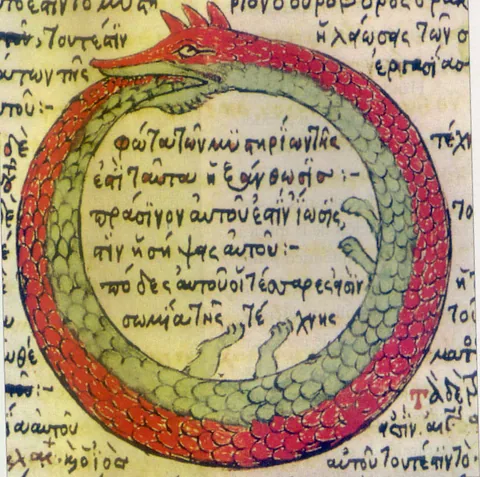
Yeah, like, it's all of us, right? You're actually talking to the average of all of it.14Language models are trained on vast amounts of text from the internet and books, so their answers gravitate toward the most probable, "average" response across all that text. So maybe that's a way out. I don't know.
Right. It's just a much more hyper-processed version of the former public discourse. And then if you shape the models, then you shape the public discourse.
Yeah. I mean, do you feel optimistic, pessimistic right now? Or do you even think about things that way?
I don't know that I think about things that way right now. I think I'm almost in a little bit more of a watching-and-waiting mode. It feels a little bit like, oh, we're in this really crazy period. It feels like being in wartime or something, right? Where I am just sort of suspending my previously held notions of how things worked. I feel a little bit like I'm in free fall and I'm kind of just watching, because I think if I were trying to map what's happening right now to whatever I understood before, I would just feel a lot of suffering or something, where I'd kind of be like, ugh, why isn't it like before? And I feel like that's just not a great way to think. I'm trying to make the present match the past. Well, it's not the past anymore, get over it. But I don't exactly know where all the pieces are falling into place now. And so I feel like I have been a little bit in watching-and-waiting mode. But I want to come out of that again and start to play around. But yeah, I don't know that I have strong opinions on what's happening.
And unfortunately, I think what I'm realizing too is that wartime can go on for a really long time, right? This isn't a couple months, this isn't a year. I was talking to a friend about this, both of us being in our 30s, and thinking about how this could end up just being what the rest of our careers look like, if this goes on for another 10 years or something. You know, this temporary wartime kind of state might just be it. So we might as well get used to it.
How would you define the wartime state that we might be in?
I think it's a state in which no one seems to know what's going on. It's sort of like chaos is the norm, maybe. And it's really hard— I feel like this is almost just a limitation of the brain to process memory or something. But for me it's hard to put myself— like, doesn't it always feel chaotic, and like no one knows what's going on? But then I look back on life, you know, a decade ago, and I'm like, everything made so much sense back then. But did it make sense back then? Probably not. And I think that's another thing that I do feel very wary about right now: I think I fundamentally don't buy the premise that this is so unprecedented and nothing like this has ever existed before.
I just don't think that's true. But then, viscerally, it feels really different to people somehow. So I think that's where I'm trying to poke around a little bit too and be like, okay, what is the actual story going on? Is it my and everyone else's subjective experience of what is perhaps yet another transformative technological paradigm shift or whatever? You know, would people have been this panicked about the rise of the consumer internet15Consumer internet — the internet for mass audiences. In the US it took off in the second half of the 1990s, along with the Netscape browser and AOL. or something? I don't think they were this panicked. But would they, from their vantage point then, have been justified in being this panicked? If not, then why weren't they that panicked? And are we just riling ourselves up or something? And again, that's not to diminish what is happening. I do think we're living in a very interesting time right now. But yeah, I think I'm just constantly trying to check: is it as unprecedented as people say it is?
Yeah. And sometimes I just wonder, is this just getting older, you know? You know what I mean? Like, I'm 38. Maybe this is just what it feels like to go through a lot and then go through something else. Because I think about how people must have talked about TV, because that was the thing when I was a kid, and the internet too. It was like, oh, you can't watch so much TV. You know, TV's really bad and it's going to destroy everything. And then the internet was kind of like that too. But I remember thinking back then, it's fine. The internet's fine. You guys are just being weird. It's all fine. And I wonder if kids are kind of like that right now. They're like, stop asking us about AI so much. It's fine, you know?
Yeah. So I think that's maybe why I'm less interested in a lot of the AI discourse I do see right now, because it seems almost like they're concerned that the stakes are super, super high, in the sense of, will we even be around in five years or something? And I think I'm more interested in these questions around— I mean, I do think that it is obviously a transformative new technology that is going to change a lot of things about how we live and work and think. But I just feel like maybe something is missing from the conversation that is not quite so mundane as, you know, what are the business and financial opportunities that AI creates or not— that's not as interesting to me— but then also, on the other end of this, not the extreme existential...
Yeah, I know what you mean. It's almost like everything got really collapsed. It's like we're having all the existential "what is this doing to society" really fast, you know? Like, shouldn't that happen in five, ten years? It just seems like— this is maybe to your point of, the war just started. It's really early.
But yeah, I mean, I don't know if you remember, with all the new social media platforms, when social media became a thing, right? There was a distinct period of people just enjoying it and using it a lot. And then there came a point where people were like, hmm, how is this changing stuff? And I don't know whether it's a good or bad thing, but right now it feels like those two things are happening at the same time: we're both fanatically using the technology while at the same time trying to assess how it's gonna affect our lives. And does that mean we're getting smarter about recognizing transformative new technologies, or are we just doing it wrong for some reason?
But yeah, or are we trying to sort of not repeat the last round by kind of getting ahead of this one?
Yeah, you know, which would be in some sense maybe wiser on the surface. But in practice, I just also feel like you can't know a lot of these things until you've lived them and done them for a bit.
AdGranola
Al, can I talk about GranolaaGranola — an AI notepad for meetings and the presenting sponsor of the Whoa series: it records the call and fills out the user's notes from it. for a sec? One of the themes of this year's series is that the best technologies do not make us less human. They give us room to be more human, more present, and more focused on the parts of the work that require us. This is exactly how Granola, the AI meeting notetaker, feels to me. I want to thank Granola for being the presenting sponsor of this series. Granola takes notes for me during meetings without sending an awkward bot into the call.
During or after the call, I can chat with my notes, pull out next steps, or ask Granola to help me draft a follow-up email. I use it for daily team meetings, where the notes automatically get shared into Slack,bSlack — a workplace messaging app. so everyone has the takeaways in one place. I use it for customer calls, where the most important feedback gets added into Linear.cLinear — a tool for managing tasks and product development. And I use it for one-on-ones with my team, which helps me track what people are telling me over time. My favorite feature is "What did I miss?" Sometimes I'm in a meeting and briefly space out.
With one click, Granola catches me up on what just happened. We ran Granola during today's conversation, so you can see how great the notes are yourself. You can read a summary or chat with the conversation using the link in the description below. And if you're new to Granola, you can get three months free at granola.ai/sublime.
04San Francisco's nihilism
Back in San Francisco after years in Miami and LA, Nadia found nihilism: a place that always ran on positive-sum games now thinks about self-preservation.
So what is fascinating you, or what are you super curious and interested in, if not— outside of all this? And I have one specific thing to ask about, if nothing comes to mind.
I mean, just like generally?
Yeah, yeah, yeah.
Yeah. I mean, I think some of my interests right now have been colored by moving. I moved back to the Bay last fall. I was in San Francisco for a long time. Then during COVID I went to Miami16Tech's pandemic-era move to Miami started with a tweet from Nadia's husband, venture investor Delian Asparouhov: in December 2020 he wrote "ok guys hear me out, what if we move silicon valley to miami," and Miami mayor Francis Suarez replied "How can I help?" for a few years, and then LA, and then I came back to San Francisco. And so I was away for four or five years. And yeah, I do believe that, even though San Francisco is a really different place from the rest of the world for obvious reasons, there are also some ways in which it is this, you know, petri dish of how culture is changing, and the ways in which the world can be shaped by technology.
And so yeah, it's been just seeing the sorts of questions that are cropping up in San Francisco that I felt less aware of until I moved back here and was really living in it. Those are the things that maybe I'm grappling with, because I think eventually everyone's going to be grappling with those same questions, or they already are and we haven't talked about it. But yeah, I think the prevalent mood here when I came back, and maybe we're still a little bit on the tail end of that, is a sense of nihilism. I think a lot of people feel that their relationship to work is much more transactional, which is an unusual thing for people working in tech to feel: that work is much more about making money now, about self-preservation.
I think a really big shift here, to me— as long as I've known it, and in my understanding of Bay Area history— is that this has always been a very positive-sum kind of place, and now it feels like it's a little bit more zero-sum.17Positive-sum and zero-sum — game theory terms. In a positive-sum game every player can win; in a zero-sum game one player's gain is another's loss. And people are a lot more self-preservationist. And so I think there are questions around just why is that happening? But we can observe that that's happening, and I feel like that's been pretty unanimous among people that I've talked to about it here. But then there's the question of what do we do about it, or is there a problem? What comes after this?
And so yeah, I think a lot of my headspace has been around what does it mean to feel fulfilled by your life, given the sort of constraints and conditions that we're in right now. Which is frustrating, because it is such a timeless question. And I think it's an especially frustrating one for people in tech and in San Francisco, because I suspect it's a question that doesn't benefit from innovation. When we talk about technological or economic measures of progress, you can talk about all the new inventions, all the new discoveries. It feels like there's this boundless frontier. But I think we've kind of been running that out and feeling like, okay, even with endless economic abundance, I still don't feel happy, right?
And so the answers have kind of been roughly the same, probably for centuries, as to what actually gives people a sense of satisfaction or feeling like they're flourishing in their lives. And so yeah, in some ways it is a very boring thing to be thinking about, but it is also a thing that seems to be very, very top of mind for a lot of people here. So yeah, I've just been playing around in that sort of space.
05Progress versus flourishing
The progress movement measures success in technology and economics, but flourishing is a different question: the charts are going up and people are still unhappy.
That's kind of what I wanted to talk to you about too. That's what I wanted to bring up, which is the idea of flourishing,18Flourishing — a concept that goes back to Aristotle's eudaimonia: a life in which a person realizes their potential rather than merely feeling content. In the 21st century it was taken up by positive psychology, for example in Martin Seligman's book "Flourish" (2011). because I know you're producing a magazine— it's Asterisk,19Asterisk — a quarterly magazine of ideas from the Bay Area, published since 2022; Nadia is its publisher. Its fall 2026 issue is devoted to flourishing. right?— on that topic. What does flourishing mean to you right now? Why that topic? What is flourishing? What does it mean to flourish? Teach us how to flourish.
I don't know the answers yet, but check back in with me in six months. But I do think some of the interest in that— it has felt like a lot of people I've talked to in SF have been thinking about this topic. There's like a million different conferences and events and things that I know about that people are now hosting around: what is the good life? What does it mean to feel like you're flourishing? All this stuff. So I think it's a top-of-mind thing for people right now. I think there are a few different ways you could maybe trace its provenance, but one that I find more concrete or interesting is: we've had this progress movement, and maybe its twin sister movement, like abundance.20Abundance — an agenda that journalists Ezra Klein and Derek Thompson laid out in their 2025 book of the same name: restoring America's ability to build housing, power plants and roads. But progress has been a really common term, a phrase that has been top of mind for people for the last decade or so, with this progress movement, progress studies.21Progress studies — a term coined by Stripe co-founder Patrick Collison and economist Tyler Cowen (2019).
What is that? I've never even heard of that. What does that mean?
ExplainerProgress studies and abundance
Progress studies got its name in 2019 from Stripe co-founder Patrick Collison and economist Tyler Cowen. In an essay in The Atlantic, "We Need a New Science of Progress," they proposed studying why some times and places — think Renaissance Florence or Silicon Valley — produce so many discoveries and inventions while others don't, and how to repeat it.
A movement grew around the idea: blogs and newsletters, funds and grant programs, think tanks in Washington proposing laws on science, energy and construction. Its closest relative is abundance, an agenda that journalists Ezra Klein and Derek Thompson laid out in their 2025 book of the same name. Their argument: American government has forgotten how to build housing, power plants and roads, and restoring growth means clearing away excess rules and permitting.
Nadia's point is that both movements understand progress mainly in technological and economic terms — and say almost nothing about whether people are flourishing.
It came from this idea that we don't take the idea of progress seriously enough. You know, we don't really understand what the origins are of why certain forms of progress have happened or not happened. How do we continue to encourage that progress continues to be made in, let's say, government or in policymaking? We kind of just take for granted that progress happens, but we haven't really had a very serious study of how we actually ensure that progress continues to happen, by understanding the things that have happened in the past, by taking fresher approaches to the work that we're doing now. And so I think a lot of interesting things have come out of that as a distinct movement or something. But I think something I've always felt a little bit unsure about is, okay, but what is progress?
And it's obviously a very generic term, so you could use it to mean a lot of things. I think in practice— this is its own subculture, right, in tech. I just like watching the little subcultures move around. And so, you know, as an observer, just making the observation about it, not my own opinion or anything, but just kind of watching: okay, what have people taken progress to mean in practice? A lot of it seems to be mostly about technological and economic measures of progress. And that's kind of widely felt.
I think even outside of progress as a subculture, in tech, when people talk about progress or they talk about optimism or whatever, they're always talking about technology, which obviously makes sense if you work in tech. And I think even in the last decade we've expanded that to mean much more than just startups or something like that. I also think there have been really interesting inroads made into policymaking or academic research. And so I do think we have expanded that notion of progress to mean much more than just the literal tech industry— which, like, what is even tech? You know, no one has ever given me a satisfying answer to what tech actually is. You kind of know it when you see it,22A nod to "I know it when I see it," the famous line by US Supreme Court Justice Potter Stewart in Jacobellis v. Ohio (1964), on how to define obscenity. right?
So it's okay for something to not be well defined. But I do think something that's missing from that whole conversation is still this sense of flourishing, right? Which is a little bit of, okay, you know, I have all the material abundance I could ask for in my life. I am living in a society that supports my goals, where I feel like I can do the things that I want to do. But the people are still not happy. And so, what's wrong with this picture, right? All the charts are going up, but there's some sense of malaise. If someone were to look at our society, they'd kind of be like, yeah, but are the people really happy?
Like, yes, they have all the objects they could possibly want, but they don't seem to be flourishing, right? So I think all these terms are maybe a little bit poorly defined. Tech is poorly defined, progress is poorly defined, flourishing is poorly defined. But there's something you can feel, where there's a sense that whether an individual or a society is making progress is a slightly distinct question from whether someone is thriving or flourishing in that environment. And so whatever is contained by that poorly defined term is the stuff that I think has been sort of underexamined right now. And I think implied in that is a little bit of a movement away from the more, I guess, measurement-oriented culture that we've had.
I mean, that even really precedes tech in its own form right now. But I think that was a much more widely held thing that came maybe even from management consulting23Measurement culture — the belief that you can only manage what you measure; the line "what gets measured gets managed" is often attributed to Peter Drucker. In management consulting and finance it has long been the norm: KPIs, metrics, dashboards. and other places, finance and stuff. So I think we're moving away from whatever that era is, where everything has to be measured. And I think some of this might be a positive outcome of what is being driven by this new sort of era of AI, where suddenly you hear people talking about taste and judgment.24Taste and judgment — the ability to tell good from mediocre and decide what to do. In conversations about AI they are often named as what will remain for humans once machines generate the options. Because they see it as: oh, AI can kind of do all the other stuff, but that's the one little piece— everyone has had the personal experience of, actually, you kind of need a human to give it a little bit of its own taste or its own judgment or something. And so that's kind of bringing that back into the spotlight. So I think it's a good time to be talking about stuff like this.
06The toilets of flourishing and the right to self-expression
People have never really flourished, but it's good that more of them can, and Nadia doubts creative self-expression is essential to it.
Yeah. Yeah, it really is. And I'm really trying to— to go back to our conversation about X articles, or reacting to stuff on social media in general— I'm trying to do that third thing of really trying to sit with it and understand it. Because my knee-jerk response is like, but have people ever flourished, you know? Like, is that a thing even? I guess I don't even know what it means to flourish, other than a movie montage or something, or a kind of black-and-white history documentary of people after a war or something. That's kind of what I picture. Like, what have they— are there times?
Yeah. I don't think historically people have. But I think maybe one reframe of the question could be: okay, historically people haven't flourished, there's no intrinsic assumption that you have the right to flourish or something. But we know that when people are flourishing— again, we're using these very vague terms— we know that when people are flourishing, that's a good thing, right? If someone were flourishing, we wouldn't say that's bad, right?
Yeah. Stop flourishing!
Stop, stop flourishing. In the same way— so maybe this is a next chapter of: how do we ensure that more people flourish, because they deserve to? In the same way that, when we were talking about material or economic measures of progress, you could say, well, have people ever had running water or access to shelter or something? Who's to say they deserve that? And it's like, well, yeah, most people haven't had it, but it's nice that a lot more people have it now than they did before, because we had some belief that that's good for them. And so yeah, how do we make sure that more people flourish now, since maybe we're moving up the, you know, Maslow's hierarchy25Maslow's hierarchy — psychologist Abraham Maslow's hierarchy of needs (1943): from physiological needs and safety up to love and esteem, with self-actualization at the top. or something? But I don't know how to do that.
Yeah, I mean, what is the running water of flourishing? You know, like, what are the things— the toilets of flourishing?
That's a great question. Yeah, I don't— I think this is the types of— but maybe, you know, that one. It is that one, maybe. I think this is the kind of stuff that I want to understand better. Because I do think this is something that bugs me when we talk about AI and creativity or something. I kind of want to re-examine: is creativity part of that?
Like, is creativity a toilet of flourishing, or is it kind of the off-gassing or byproduct of something else? I haven't really answered this question for myself, so it's not that I necessarily believe this or not, but something that I want to examine more is: do we even have the right to creative self-expression? Or is that just a weird byproduct of the transition to a more industrial society? Historically, of course, there's always been craft. There's always been, you know, tradesmanship and art and writing and stuff like that; of course that has existed for a long time. But people also used to do those things for religious reasons, or because they grew up in a certain tradition or a family that did that. I don't know that they were always motivated by a sense of intrinsic need for self-expression.
07Lost flow
One of the big losses of the AI era, Nadia argues, is not self-expression but flow state.
That feels maybe like a newer thing to me. And so right now, when people are sort of bemoaning the loss of creative self-expression, or that it's somehow being subsumed by AI, there's a little rebellious part of me that wants to be like, okay, but how important is it really? Is that part of what's required to flourish? Do I need that to flourish? Or is there something else beneath that that is the thing I actually need, and self-expression was sort of fulfilling it for me? Like, I think an underdiscussed thing for me is just the loss of flow state in this whole era.
ExplainerFlow state
Flow is a concept from the Hungarian-American psychologist Mihaly Csikszentmihalyi (1934–2021). He began studying it in the 1970s, interviewing artists, chess players, rock climbers and surgeons about the moments when work seems to do itself: a person is fully absorbed in a task, loses track of themselves and of time, and effort feels like pleasure.
According to Csikszentmihalyi, flow arises when a task is slightly harder than one's usual skill, the goal is clear and every action gives immediate feedback: too easy is boring, too hard is anxious. His book "Flow: The Psychology of Optimal Experience" (1990) became a bestseller, and flow became one of the central ideas of positive psychology.
Nadia treats flow mechanically: exercise for the mind, the way the gym is for the body. If AI takes over the work that used to put us into flow, time for it will have to be carved out deliberately.
And I think of flow state in this very mechanical sort of way: this is a thing that makes my brain feel good. It feels good when we are in flow state for long periods of time in a day. And most people don't get to have that every day. But it feels good in the way that— even though I don't need to exercise, in the sense that I no longer live a life where hard manual labor is required, I still go to the gym and work out, because I know that I live in this body and it is good for my mind and body to exercise. So I do it. And I think of flow state as maybe another version of this, for the mind, where maybe I don't need flow state in this sort of luxurious new world. There's nothing that requires me to be in flow state when I'm creating things, but I still need to carve out the time to do that, because it's psychologically good for me.
But yeah, so basically one of the great losses to me in the age of AI— and I hear it from all my friends who are engaged in creative work, and it's something I feel as well— is that the actual process has changed a lot. You could still be creating, you know, you could be writing blog posts or something, but the way that you're doing it is less flow-statey than before. Or you're writing code, and you can output a lot more code than before, but it's less flow-statey than it was before. So when we talk about what is the thing that we're actually trying to preserve here: am I trying to preserve code as output, as a form of my self-expression or something like that?
Or am I actually just trying to preserve, reify or protect this idea that humans need flow state somewhere in their lives, somehow, in order to keep their brains going? So can we toss out the self-expression part? And maybe self-expression was never actually the point in the first place.
That's fascinating about flow state. What, for you personally, gets you to a flow state?
Writing, unfortunately. I'm definitely a bit of a self-hating writer. But yeah, I do think the only reason I really ever write, even though I don't particularly enjoy it, I would say, is because I selfishly just like how it makes my brain feel, which is in that state.
Can you try to describe that place?
Yeah, I think it's that feeling of everything else kind of drops away. You're very locked into this one task. You're not really self-aware. And, you know, time can kind of pass very quickly. And I know it's different because at the end of the day I never feel exhausted. I often feel very energized. I can spend like 10 hours in that state and then come out and just be very refreshed, versus 10 hours of meetings, right? Just doesn't feel the same way.
I hadn't thought about the relationship between how often I achieve that— often through writing too— and my use of AI. Because I do think it's gone down, probably a lot, you know? Even though maybe my output hasn't— but my output actually has too, because I think maybe I'm able to hit it less and reach it less. I don't know. That's interesting.
Yeah. I mean, I'm in a different type of work right now, but yeah, I used to spend probably 90% of my day in flow state. Now, between kids and different types of work— not writing— it's like, I don't know, zero to 10% of my day is in flow state. That seems bad.
Yeah, kids are a flow state bummer, for sure.
Yes. I've tried to cultivate this— I believe it is possible to find flow state in the chaos or something, but it's really, really hard.
How old are your kids?
Two and a half and 10 months old.
Okay, wow, you're really in it. Holy shit.
I'm really in it, yeah.
My son's five and my daughter's two and a half. And I feel like I'm in it, but you're really in it. Holy cow.
Does it get better? Tell me it gets better.
It gets better. No, it does. I mean, even today, my five-year-old finally is just such a cool little dude. I mean, he wasn't awful before, but he's awesome now. It gets better. Yeah. He's achieved flow state.
Yeah, I'm immensely enjoying parenting, even at this age. I always have. But I notice, even with my son now getting older, there's this shift that happens, from doing very mechanical things all the time to, oh, we're having a conversation, this is cool, and you are doing and saying things that are totally unexpected, versus this very clear input-output thing.
08Antimemes, the good life and "Existential Kink"
You can't learn to flourish from a paper: everyone knows what the good life looks like, and one thing that stops us from living it is attachment to our own neuroses.
The thing I was going to say earlier, about this age of flourishing and even about flow state: a lot of my writing is very vulnerable, I guess— that's how people describe it. And it becomes a topic often of how to write vulnerably, and I find there's a very antimemetic quality to it: the minute you talk about it, it stops being vulnerable. When you look at it, it disappears. It doesn't want to be known. And a lot of this stuff, flourishing even— these things, they don't want you to know how they work, almost. And if you try, they'll just kind of run away a little bit, you know? And I don't know, there's just something kind of beautiful about that. When I remember that, and I sit in that and accept it, that itself feels like flourishing, you know?
Yeah. I think a tricky thing about flourishing is that a lot of how to flourish feels like knowledge that is gained through lived experience, versus something that you can kind of just read a paper on and then apply. You have to sort of— and I don't exactly know why that is. And I think that's why we keep reinventing the same thing every single generation. This is obviously not the first generation to be concerned with what flourishing is. We're just back in the '60s26The '60s — the era of the American counterculture: hippies, psychedelics, Eastern practices and the "human potential movement," centered on the Esalen Institute in California, founded in 1962. again.
So it feels a little bit frustrating that people keep reinventing it. Is there even a way to break that loop or something? But I think maybe, on the other hand, it's nice in that I don't think we have to spend tons of time— I think a lot of the flourishing discourse— I don't know if it's early to say that there is flourishing discourse, but this is it, it just happened— a lot of the stuff I hear starts with this question of, what is the good life, right? But I actually don't think that's that interesting of a question, because we all kind of know what the good life looks like. You know, everyone knows that it feels really good when you spend time with your friends and your family and not scrolling on Twitter or whatever.
So is that really the part that is hard? To me, the question is much more: why is it that we have known this answer for centuries and centuries, and yet somehow can't seem to implement it? So yeah, if I were to hope that we could do something differently with this generation of flourishing discourse versus prior generations, I would hope that we are making some progress in how we actually implement this for more people, versus asking the existential questions again.
Have you read the book Existential Kink?27"Existential Kink" — a 2020 book by Carolyn Elliott about "shadow work": admit that part of you secretly enjoys what you complain about, and you can let it go.
No, but you are like the third person to recommend this to me, so I really should probably just do it.
I think you maybe should. I mean, that is one answer to the question, I think, of why do we do the things we know we're not supposed to? Which is— maybe people have told you— it's just like, actually, some part of you does like it, you know? And it's a kink because we're not supposed to like it, and so you kind of do it and pretend not to like it, or whatever.
Definitely. Yeah, I mean, I think a lot of my interest in this topic is also informed by the last few years, where I kind of went down this rabbit hole around jhana meditation28Jhanas — stages of deep meditative concentration from early Buddhism; see the explainer below. and—
I was going to bring that up.
—deep states and stuff. And then trying to understand both the pedagogy around that, sort of how you teach that to someone else, and then also why some people resist it, and why some people find it difficult. And I do think partly the answer is definitely the existential kink thing: people get attached to their neuroses, right? They get attached to their rougher edges. And I can relate to a version of that too.
I think when people see those things about you as a defining personality trait or quality of yours, and then your lifestyle might be sort of rearranged around it— once you start to see the way it has really seeped into every piece of your life, it's very scary to say, oh, if I let go of this thing, am I going to be a different person? Will people like me less? I hear this all the time from, you know, people that were super depressed or super anxious and then aren't anymore. And it's like, well, if I don't have that, what do I have to think about all day? And you kind of have to be like, just trust me, on the other side of this, you will be amazed that you ever thought that was a thing. But you can't just say it and have someone believe it. It takes a leap of faith.
09Jhanas: bliss by thinking
Jhanas, Nadia says, rewrote her brain, but like AI they are hard to talk about, and they should be taught through practice rather than theory.
Can we talk about jhanas for a second? Can you, for the viewers and listeners, readers, just give us a jhana 101 of what it is, and where you're at with all of it?
ExplainerWhat the jhanas are
The jhanas (Pali jhāna, Sanskrit dhyāna, "meditation") are stages of deep concentration described in the early Buddhist canon; tradition holds that the Buddha first entered the first jhana as a child. Classically there are eight: four "form jhanas," moving from rapture and joy to contentment and complete equanimity, and four "formless" ones, in which the sense of space, of consciousness and even of perception dissolves.
In the 2020s the jhanas became a hot topic in the San Francisco Bay Area: techies on Twitter described them as drug-free "bliss on demand," and the startup Jhourney began running retreats that teach them in a week rather than years of monastic practice. Nadia attended two such retreats in 2024, wrote about the subculture for Asterisk magazine and published a practical guide with almost no theory.
Scientists are only beginning to study what happens in the brain during the jhanas; as Nadia says, there is still no shared language for the state itself.
Yeah. So the jhanas are a series of deep concentrated states that can be accessed through meditation; in theory they could probably be accessed through other things. I sort of stumbled into this whole thing a couple of years ago, because I was writing a piece29The piece, "Manufacturing Bliss," ran in 2024 in the sixth issue of Asterisk magazine, about the Bay Area subculture that rediscovered the jhanas. about people on Twitter who were sort of talking about the jhanas. Some of these states feel like extreme bliss and euphoria, comparable to MDMA.30MDMA — the psychoactive drug known as ecstasy, which produces euphoria and a feeling of closeness to others. Some of them feel like deep equanimity, comparable to maybe taking dissociatives.31Dissociatives — drugs such as ketamine that produce a sense of detachment from one's body and surroundings. They're really intensely altered states. So, you know, there are people on Twitter talking about accessing these states that feel like being on MDMA just by thinking with your mind, right? And so I decided to write a piece about that as a subculture and just poke around on it a little bit. And as part of that piece, I went on a retreat32Nadia learned the jhanas on two retreats run by the startup Jhourney, in March and June 2024, and later analyzed data on its students together with the company. to try to learn them myself, to be like, I don't know, let's see what happens.
I didn't have a background in meditation, and I had a very fast sort of journey through it, and was just really gobsmacked by some of the experiences that I had. And then it was sort of like, how is it possible that I've had access to those states in my brain this entire time, and I've been living for like 30-something years and I just didn't know it was there? And so I spent a few years just trying to understand that better, working with both a meditation retreat company and an academic lab on that. I don't practice them deeply. I don't really meditate very— I never was huge on meditation. I'm still not, despite now being this person that is associated with the jhanas. I meditate probably, I don't know, once a month or something, here and there, if I feel my brain kind of getting nudged out of place a little bit. But I actually do think a lot of the things that I experienced had, at least so far, what seem like semi-permanent, lasting effects. And so yeah, I do think something about it rewrote my brain in really good ways.
What a pitch.
And so yeah, I think it's definitely worth it, and I would definitely recommend it. But I think maybe jhanas are pointing towards some state that you can probably also access with psychedelics or breathwork;33Breathwork — techniques such as psychiatrist Stanislav Grof's holotropic breathing, in which rapid deep breathing induces altered states of consciousness. there are a lot of different ways to get to that state. And I think one of the things I was actually most surprised by was that no one has really come up with clear terminology on what that state is that is being accessed, or what the end goal of all this is. Like, what are we actually trying to get to, as sort of a defined mental state? We talk about happiness, but what is happiness, right?
And I don't even think happiness is the right term. But yeah, whatever state I ended up in, I'm very grateful to have been in. It's been really helpful with a lot of, yeah, just sort of challenging things that have happened for me. And so I do think it really changed something in my brain, but I think it's still very poorly understood. And again, I think that's the problem with this whole space: everyone is having these subjective experiences, and it's very hard to talk about your dreams and your psychedelic experiences and your jhanas, as it turns out.
I was going to say, it sounds a lot like how we were talking about AI, you know?
Yeah, totally.
Yeah. This thing of, like, this magical thing that we don't understand. But when someone does describe it, you're both like, what? And I want that, you know? Because hearing you say it, I'm like, oh, I want a jhana. I need to do some jhana, you know?
Yeah, I ended up writing a blog post about it,34Nadia published the post, "How to do the jhanas," on her website on June 13, 2024; its first section is titled "Jhanas are learned by doing, not reading." because I had been going around trying to find even just— can someone just describe what this thing is, and a very basic set of instructions? And I couldn't find anything. So then, after I went through my whole experience, I was like, I'm just going to write the plain-speak version of this. Which I was a little nervous about, because it's not my usual sort of thing to write about. But it ended up having, I think, a lot of interest, and a lot of people that appreciated it. I think because, yeah, it is just a hard thing to talk about very plainly. But one of the things I wanted to do with that piece was— I put basically no theory in it, and I was sort of like, here, just try this thing, sit and do it.
And I think, again, from a pedagogical standpoint, it's: how do you teach these sorts of things? I think right now there's way too much theory surrounding these sorts of things. And the analogy I made in that blog post was, it reminded me of the early days of the SaaS era,35SaaS (software as a service) — software that runs in the cloud and is sold by subscription. The first such companies, like Salesforce (1999), appeared around the turn of the 2000s. where, you know, studying computer science is really different from just sitting and deciding to spin up a new software application, right? And there's a time and a place for both of those things. But it would be sad if all we had was computer science and theory, and no one was actually building things. And so I feel like there's room for that kind of shift, where it's like, don't even think about the theory, don't even think about what you're trying to do. Just sit and try this thing and see what happens and see if you feel anything. And I think for this kind of thing, that's sort of how you have to teach it.
Yeah. And not to tie too much of a bow around it, but I do feel like that's also what's happening with AI, you know? Everybody's talking about it, and there aren't a lot of people, in what I see, actually doing stuff with it, besides just the talking-to-the-therapist thing, you know? You hear a lot of people be like, oh, how is it going to change work? And then I'm like, okay, but have you made cool stuff with it? Like, no, I don't know how to do any— I don't want to do that, you know.
Yeah, I think people are doing a lot of things with it, but a lot of it is just changes in their own process— thought process, work process, whatever. But it is all kind of happening in private, so you don't see the ways in which other people are using it, or how it's changing their lives.
Yeah. It's funny that the theme for this zine,36Each volume of Whoa also comes out as a print magazine. this volume, is Humanmaxxing,37Humanmaxxing — the title of Whoa's third volume. The suffix "-maxxing" comes from internet slang (as in looksmaxxing) and means pushing something to the max; here, being human to the fullest. which I feel like is essentially flourishing. I feel like it's the same thing, you know?
Flourishing is everywhere.
10Speed round: God, the Grand Canyon and a genome
In the speed round Nadia says she believes in God, urges walking down into the Grand Canyon, and won't hand AI the part of her that touches God.
Yeah, that's right. I think that's a good place to end. I just want to do a speed round, if you're down.
Is there anything, first off, that I didn't bring up that you want to cover?
No, I thought we covered a lot of good stuff.
Cool, me too. This is awesome. So the speed round— we call it a fast and slow round. I'm going to ask, I think, six questions, and you can just give a quick answer to all of them except one, which you can do a longer answer for if you want.
Those are the rules. And you just get to decide when you want to use your long-answer option. Okay. It's a super advanced game. Do you believe in God?
Okay, awesome. What's something you can't prove but you know to be true?
Yeah. As I said it, I was like, okay. What's a feeling AI can't give you?
Sense of belonging, maybe?
Hmm. When was the last time you felt awe?
I went to the Grand Canyon38Grand Canyon — the canyon of the Colorado River in Arizona, about 450 km (280 miles) long and up to 1.8 km (over a mile) deep; a national park since 1919. last fall for the first time. I mean, that's maybe not the last— I'm sure I've felt awe since then— but that was big awe. If you ever go to the Grand Canyon— oh, I guess this is my long answer now. Crap.
Okay. We're in it. We did it. Long answer.
I learned that most people, when they go to the Grand Canyon— the vast majority of people, I don't remember the exact statistic— most people just see it from the top, and they don't actually go into the canyon, even taking a few steps in. You don't have to go down that far, just go down a little bit. There are walking trails. I think I walked down for maybe an hour or something with a friend, and sat, and the experience of going into the canyon is completely different. Honestly, when I saw it from the top, I was kind of like, eh, I don't get it. But you've got to go in the canyon. So, highly recommend. That was a very strongly awe-inducing experience.
Hmm. Wow, that's beautiful. I have not ever been there. I want to. These are the last two. What's something that you've used AI for that has blown your mind recently?
I played around with a bunch of my whole genome sequencing39Whole genome sequencing — reading a person's entire DNA, about 3 billion base pairs. Today it costs on the order of a few hundred dollars. data. I didn't give it my data, but I used it to figure out how to parse and understand it. And yeah, it was just very, very, very fun and empowering.
So, like, you had your whole genome and you put it into Claude40Claude — Anthropic's AI assistant. In his course Code for Creatives, Alex teaches creative people to build software with it. or something?
I didn't put it in, because I'm paranoid like that, but I used it to help me figure out how to turn it into something that I could analyze.
Oh, okay, cool, cool. That's crazy. That's cool. I never even thought about doing that. Wow. And then, last one: what's something you don't let AI touch, in your process or at all?
I guess my DNA.
Your DNA. Besides your whole— yeah.
I have some felt sense of what I don't let it do, but I don't know how to translate that into a word. I want to say I don't let it do my thinking, but obviously I let it do some thinking for me. But I think I know what that means. It's something like the poetic, numinous,41Numinous — a concept from the German theologian Rudolf Otto's book "The Idea of the Holy" (1917): the experience of the divine as at once terrifying and fascinating. whatever part of me— the touching-God part. I don't let it do that. But yeah, I don't always know how to draw the line between what that is or isn't, but I can feel it when I know that that's the thing that I want. I kind of like this fast-answer thing, because it means I don't have to elaborate on things.
We should have done the whole interview like this. This was awesome, Nadia. Seriously, I'm really glad we got to chat. It was really nice.
Yeah, this was really fun. Thanks for having me.
Yeah, thank you. I'll let you know before it all goes out, and we'll run it all by you and all that.
Cool. Sounds good.
All right, good luck in the chaos of the kids and everything else. All right, see you. Bye.


