


The a16z Show
Chapters
DHH has spent 23 years on Basecamp and Rails, and he left the Mac for Linux when, as he tells it, Apple got hooked on commissions and soured its relationship with developers.
Read the chapter- Basecamp, DHH says, launched within a day of Facebook, and Ruby on Rails, extracted from it, went on to power Twitter, GitHub, Shopify, Airbnb and Coinbase.
- Over 25 years he wrote four books on running a company and on technology, Rework and Remote among them, and now posts those thoughts on X every day.
- Hundreds of thousands of people are switching from Windows and Mac to his distro, Omarchy, which to him means the year of Linux on the desktop has finally come.
- A Mac head since 2001, he switched two and a half years ago, fed up with Apple taking 30% of other people's business, spending ten years on a car it never sold and launching "a huge flop of a ski mask."
The real driver of the switch isn't grievances with Apple but agents: everything that used to put people off Linux now makes it the most agent-friendly system around.
Read the chapter- Acharya asked an agent to change the system he was working on the night before and it just worked, and DHH calls that malleability "deeply intoxicating."
- For the past five or six months agents have developed Omarchy end to end: DHH hasn't written a single line by hand, but hundreds of thousands through agents.
- Remapping workspace hotkeys on macOS means clicking through a settings app field by field, which leaves an agent only computer use, "pretty dumb" in DHH's words.
- Agents, he says, love exactly what Linux was mocked for: a command line for everything, predictable config files and full detail in error messages.
- Apple, meanwhile, keeps adding "scary pop-up screens" in macOS about not letting Claude access your files.
DHH believes agents have wiped out the app gap that locks in ecosystems, opening the door to a new OS for the first time since 2001: desktop first, then phones.
Read the chapter- Apple, DHH says, risks becoming the AOL of the agent era, offering a walled garden and Genmoji instead of a real agent, while most people want the open internet.
- Microsoft spent several billion dollars making Windows a thing on mobile and failed, because nobody wanted a Windows phone without Instagram.
- One member of the Omarchy community replicated and improved Lightroom in two weeks, a program Adobe spent, by DHH's account, a decade and a half and tens of millions of dollars on.
- His motto: "first we take Manhattan, desktop, then we take Berlin, mobile."
Agents, in DHH's view, will wipe out whole classes of apps that used to be professions, and software will soon be built and reshaped on the fly.
Read the chapter- Acharya notes that a token budget can now replicate the top 10,000 apps, and many may not need replicating at all.
- An agent drafted every contract for the Omacom Foundation, which DHH says raised $23 million, with no word processor, and it signs them with his signature and mails them out.
- Instead of hundreds of hours learning Photoshop, you just say "remove that idiot over there on the left."
- Models run at 50 to 120 tokens a second today, but Fireworks demonstrated 1,500, with a game mutating live as the presenter prompted "add lasers" or "more monsters."
- DHH and Ryan Hughes built the current Omarchy part-time in about two and a half months, the jump from Opus 4.8 to 5.5 has been enormous, and source code, he says, is no longer a moat.
Casado and DHH agree that software's value lives in finely tuned details, and agents give a perfectionist more control over them, not less.
Read the chapter- Casado, who still plays StarCraft at 50, points to a recent patch updating the Ghost's stats and argues that such small tweaks, not lines of code, are the real moat.
- The author of It Doesn't Have to Be Crazy at Work admits he's working 16-hour days, because a perfectionist like him has "just been granted superpowers."
- Vibe coders, DHH says, lose interest after the first 80%, while he gets "the entire dopamine payoff in the last 2%."
- He never wanted to trade 37signals and its 60 people for a company of 60,000, but the productive potential of 60,000 through agents, with no HR or committee meetings, tempts him; Tobi Lütke calls going back to the office "coming out of hyperdrive."
One $200 Claude subscription covers almost all of DHH's work, and he thinks superintelligence has already arrived for programming, though not for robotics.
Read the chapter- DHH has three Claude subscriptions but came close to maxing them out only two weeks in three months, and most weeks one $200 plan does everything.
- As early as next year, he says, superintelligence may out-polish him too, "and then maybe we're all dead at the end of next year," so he's savoring the moment.
- Casado gives every new model a $20,000 budget to order parts and build itself a robot, and none has come close yet.
- The roboticists DHH met at Unitree expect superintelligence in four to ten years, while Casado's Grok Bot keeps ordering home automation for his house instead of a robot.
DHH wants both strong US frontier labs and open models: without competition, he argues, AI will follow mobile platforms and the Google–Meta ad duopoly.
Read the chapter- The open internet of roughly 2000 to 2009, DHH says, gave way to mobile platforms where you have to beg for permission for your business to exist.
- In the encryption wars of the '90s, the industry got close to a ban on public-key encryption, and now plenty of smart people suggest the government should just take AI over.
- SpaceX AI is close behind the two leading labs, Google is in and out of the game, and open GLM 5.3 and DeepSeek Flash are maybe six months behind, though DHH distrusts the benchmaxxing.
- Six months ago DHH wrote that local models were useless, and now Qwen 3.8 Flash Next runs on a DGX Spark that costs a few thousand dollars.
- Without rivals, labs could charge $500 per million tokens, "because we would pay," just as Google and Meta captured 99% of the value in online advertising.
DHH's ambition has grown from "a nicer computer for myself" to overtaking 180 million Mac users within three years, or even 12 months.
Read the chapter- Acharya notes that as models improve, the ambition bar keeps rising: a self-modifying game gets maybe 40 likes on X.
- DHH started Omarchy by hand last year with Bash scripts, and the Quattro release, built with agents, was picked up by hundreds of thousands of people.
- He wouldn't put majority odds on unseating the Mac in 12 months but wouldn't rule it out, and he leaves populating planets to "the Elons of the world."
- Thinking several model generations ahead, he says, leads to AI psychosis, while the bomb that people feared next to Oppenheimer brought 50 years of Cold War without nuclear annihilation.
- DHH sticks to William Gibson's line that the future is unevenly distributed and sees 3 to 10% annual GDP growth as possible if everyone could do what he does now.
DHH asks for sympathy for programmers afraid for their jobs but insists the only way is forward, and he sees the anti-AI camp as largely a political tribe.
Read the chapter- Casado thanks DHH, Eric Raymond and John Carmack for guiding people through the confusion, and DHH replies that every programmer he respects is now "fully pilled."
- The financially independent don't feel threatened, he says, while most programmers fear losing a place they earned through years of hard work.
- They deserve sympathy, like the Luddites or Detroit auto workers in the '70s, but DHH doesn't want to go back to a preindustrial world or the assembly line.
- In his view the anti-AI crowd overlaps almost entirely with "woke people with blue hair," because the people they dislike embraced AI first.
DHH sees AI reviving the hacker culture of the '80s and '90s: individuals with handles are again moving core parts of computing forward, and Omarchy is deliberately styled after the demoscene.
Read the chapter- Omarchy's team includes outfoxxed, the creator of Quickshell, and the artist HANCORE, and the foundation sponsors 0xSero and Mia's Lab from the local AI scene.
- The browser engine, which DHH calls the most complex software after the Linux kernel, used to be reserved for giants like Google, and now such areas are open to individuals again, connected through X, an "anti-LinkedIn culture."
- Casado cheers the return of demo culture, and Omarchy's screensaver runs through 40 ASCII demo effects, while loading a local model comes with floating characters.
- At 14 DHH ran an elite three-line BBS out of his bedroom, and computers, he says, should be a little mysterious rather than "aluminum-polished" of all character, as Jonathan Ive did.
Quotes
On why Linux suits agents
“Every single thing that made Linux hard to use in the past, oh, it's very terminal heavy, it's got a bunch of config files that's hard to figure out, and it's got inscrutable error messages. These are the three things agents love.”
David Heinemeier HanssonRead from 00:00On source code as a moat
“Anyone who still thinks that there is moat in source code are delusional.”
David Heinemeier HanssonRead from 00:26On perfectionism
“Now, for whatever reason, I am blessed with the entire dopamine payoff in the last 2%. I don't actually give a fuck about the first 98.”
David Heinemeier HanssonRead from 19:01On why 37signals stays small
“You could do more, but then I'd have to deal with fucking 60,000 people. That sounds like misery. Absolute pain and torture. But dealing with the productive potential of 60,000 people through agents now? Now you have me interested, right?”
David Heinemeier HanssonRead from 20:22On the size of the Mac
“There's only 180 million macOS users in the world. The Mac is not that big.”
David Heinemeier HanssonRead from 34:38On fears of the bomb and of AI
“The bomb was the best thing that ever happened to world peace.”
David Heinemeier HanssonRead from 37:56On what a computer should be
“Computers should be a little mysterious. They should be a lot of cool, and they should not be so polished.”
David Heinemeier HanssonRead from 50:51
Summary
David Heinemeier Hansson, creator of Ruby on Rails and Basecamp, argues that AI agents have reopened a window for a new operating system for the first time in 25 years. The terminal, config files and verbose error messages that once scared people away from Linux are exactly what agents want, and near-free software development dissolves the app gap that has locked users into Windows, macOS, iOS and Android. He tells a16z's Martin Casado and Anish Acharya how agents now write his Linux distribution, Omarchy, end to end, and why he thinks it could pass macOS within three years, maybe even one.
If code costs next to nothing, DHH says, what's left is taste and the obsessive last 2% of polish, while a tiny team with agents gets the output of thousands without HR or committee meetings. He defends open-weight models as insurance against a two-lab duopoly and sees AI bringing back the hacker culture of the 1990s: pseudonymous handles, the demoscene and dial-up BBSes.
Advice
Don't count on your codebase as a moat: agents can rewrite millions of lines in weeks, so your edge lies in taste and carefully tuned details, not in the volume of code.
Finish the job: anyone can now get a product 80% of the way, and the value sits in the last 2% of polish, where most people lose interest.
Before you hire, try doing it with a tiny team and agents: you get a big company's output without HR, committee meetings or coordination costs.
Be ferociously ambitious within your own narrow field and build with the tools you have now instead of guessing where models will be in a year.
Don't build a cheap copy of the market leader: people want something unique, like Omarchy's demoscene look instead of a Windows imitation.
Mentioned
 Ruby on Rails01:24Casado opens with it, and DHH explains that he extracted the framework from Basecamp and that Twitter, GitHub and Shopify were built on it.
 Basecamp01:42DHH has worked on it for 23 years and calls it SaaS before anyone used the word.
 HEY02:34DHH lists 37signals' email service among his projects, though he gets its age wrong.
- Rework02:34DHH lists his books, where he developed his views on how to run a company.
Show 46 more mentionsShow fewer mentions
 Omarchy03:08DHH introduces his distro as the first native OS for the age of agents and says agents have written it for half a year.
 Ubuntu03:35DHH admits his first desktop Linux was Ubuntu, only two and a half years ago.
 Apple03:35DHH says he left the Mac because Apple got addicted to its 30% cut of other people's business and soured on developers.
- Apple Vision Pro04:08DHH calls it a "huge flop of a ski mask," proof that Apple doesn't need to innovate while it lives on commissions.
 Microsoft Windows06:24DHH lumps Windows with macOS as a mouse-and-click system unfit for the age of agents.
 macOS07:06DHH uses remapping hotkeys to show that macOS settings can't be handed to an agent without clumsy computer use.
 Linux07:34DHH explains why the terminal, config files and verbose errors that scared people off make Linux ideal for agents.
 AOL08:04DHH warns that Apple risks becoming the AOL of the agent era, a walled garden people will leave for the open world.
 Genmoji08:04DHH cites it as the watered-down substitute for a real agent that Apple offers instead.
 Windows Phone09:05DHH recalls that Microsoft spent billions on mobile Windows and lost for lack of apps.
 Adobe Lightroom09:34DHH kept a Mac only for Lightroom until an Omarchy community member replicated it in two weeks.
 Adobe Photoshop11:29DHH argues that agents will wipe out such app-professions: photos get edited by request, not after years of training.
- Omacom Foundation11:57DHH says an agent drafted every contract for the new foundation, which has raised $23 million.
 Fireworks AI13:11DHH recalls its 1,500-tokens-a-second demo, where a game mutated live as the presenter prompted.
 Claude Opus 5.515:49DHH says the gap between Opus 4.8 and 5.5 is enormous and hands this model all his work.
- StarCraft16:26Casado, still playing at 50, cites its balance patches as proof that value lives in small tweaks divorced from lines of code.
- It Doesn't Have to Be Crazy at Work17:39DHH laughs at his own anti-overwork book while admitting to 16-hour days.
 37signals19:55DHH explains why he never wanted to turn a 60-person company into 6,000 but would gladly direct 60,000 people's worth of agents.
 Tobi Lütke20:56DHH relays Lütke's line that returning to Shopify's office after a weekend with agents is like coming out of hyperdrive.
- Claude21:49DHH says he holds three subscriptions but one $200 plan usually suffices, rebutting the idea that this is only for the rich.
 Unitree Robotics24:37DHH recounts his visit: the roboticists there expect superintelligence in five or ten years, not next year.
 Dwarkesh Patel24:37DHH contrasts Unitree with an interview on Dwarkesh's show in which the guest predicts superintelligence by next year.
 Grok Bot25:28Casado says the agent, asked to build itself a body, keeps ordering smart-home gear for his house instead.
- Paperclip maximizer25:54DHH jokes that this is how a vague goal turns you into a paperclip.
 xAI28:15DHH names SpaceX AI as the lab that has come close to the two leaders.
 Google28:15DHH jokes that Google is in the game one moment and off "smoking something funny on an island" the next, but still has potential.
 GLM-5.328:55DHH cites it as an open model perhaps six months behind the frontier, if that.
 DeepSeek-V4.1-Flash28:55DHH pairs DeepSeek Flash with GLM 5.3 as open models that are already "in the game."
- NVIDIA DGX Spark30:01DHH admits he was wrong about local models: this desktop box already runs a useful one.
- Qwen3.8-Flash-Next30:01DHH calls it a totally usable model you can keep on your desk.
 Meta Platforms30:41DHH claims Google and Meta captured nearly all the value in online advertising and fears a repeat in AI.
 Anthropic31:19DHH cheers for the two US labs but is sure that, left to their own devices, they would repeat Google and Meta's path.
 OpenAI31:19DHH appreciates its work but calls a duopoly with Anthropic, especially one backed by the government, a nightmare.
 Elon Musk36:04DHH leaves planet-scale ambition to "the Elons of the world" and asks only for a seat on the Starship to Mars.
 J. Robert Oppenheimer37:31DHH imagines doomsaying next to Oppenheimer in 1944 and calls the bomb the best thing that ever happened to world peace.
- William Gibson37:56DHH quotes his line about the unevenly distributed future as the only prediction he enjoys.
- Eric S. Raymond38:48Casado names him among the veterans who are back and helping people through the AI wave.
- John Carmack38:48Casado, and later DHH, cite him as an industry pillar who has fully embraced AI.
- Luddites41:04DHH asks for the sympathy owed to the Luddites for programmers today, without going back to the pre-industrial age.
 Tim Sweeney44:23DHH names him among the programmers he respects who are all "pilled" on AI.
- Mitchell Hashimoto44:23DHH names the Ghostty author among the people whose software shaped his career and who are all in on AI.
- Quickshell44:52DHH says Omarchy's entire desktop shell is built on it and that its author goes by a handle.
 Google Chrome46:04DHH cites Chrome as an example of big companies closing off the hardest parts of computing to individuals.
 LinkedIn47:18DHH contrasts the culture of pseudonymous hackers with LinkedIn's real names and job titles.
 Twitter47:18DHH calls X the connective tissue for hackers, artists and the local AI movement and is glad Musk bought it.
 Jony Ive50:51DHH blames Ive for aluminum-polishing all the character out of computers.
Transcript
Introthe show's opening music
What happens when the operating system itself becomes something you can change just by asking? a16z's Martin Casado and Anish Acharya sit down with David Heinemeier Hansson to discuss Omarchy,fOmarchy — the Arch Linux setup DHH released in 2025; the name blends the Japanese omakase ("chef's choice") with Arch. How it works and why it took off is in the explainer below. his agent-first Linux distribution, and why he thinks AI is reopening the operating system market. They get into why Linux may be uniquely suited to agents, why source code is becoming less of a moat, what still makes great software when code is cheap, and how AI could put tiny teams and individual hackers back at the center of computing.
01From Basecamp to his own Linux
DHH has spent 23 years on Basecamp and Rails, and he left the Mac for Linux when, as he tells it, Apple got hooked on commissions and soured its relationship with developers.
Well, David, thank you so much for joining us. So we're going to talk about all things company building, AI, software. Listen, everybody knows you. I know you, you know, Anish and I are huge fans, but would you mind just giving the rough sketch of your background? I mean, Ruby on Rails1Ruby on Rails — the web framework DHH extracted from Basecamp's code and open-sourced in 2004. Its "convention over configuration" principle let small teams build web apps fast and shaped a whole generation of frameworks. rubyonrails.org and Basecamp2Basecamp — 37signals' project management app: to-dos, discussions, files and a project calendar in one place. DHH wrote Rails to build it; version five came out in 2026. basecamp.com and HEY,3HEY — 37signals' paid email service. At its 2020 launch it clashed with Apple, which threatened to pull the app from the App Store because the subscription couldn't be bought inside it — one of the episodes DHH has in mind when he talks about Apple's "abuse" of developers. Wikipedia and then now your current projects.
Sure. So as you said, I'm David Heinemeier Hansson. I have been building things for the internet, software, for some good 30 years or so, about 24 of those… No, that's not quite right. 23 of those Basecamp. The original project management tool, SaaS before it was called SaaS, released the day before or the day after Facebook went live,4Basecamp launched in February 2004, the same month Mark Zuckerberg launched TheFacebook at Harvard on February 4, so "the day before or the day after" is close to the truth. Wikipedia so that's about how old.
That's awesome.
That became the sort of founding application for Ruby on Rails. Ruby on Rails was extracted out of that, and Ruby on Rails was then used to build Twitter.5Twitter did launch on Rails in 2006 and was long the framework's showcase. When the service started buckling under load (the "fail whale" error page became the symbol), its back end was gradually rewritten in Scala and Java from 2008–2009 on. It's been used to build GitHub, Shopify, Airbnb, Coinbase, and a million other applications out there. And I've continued to work on both of those ever since. We still sell Basecamp. That's version five now.6Basecamp 5 came out in 2026; DHH has called it 37signals' "first fully AI accelerated development process." basecamp.com
I've worked on that for a long time. Ruby on Rails is up to version eight. And five years ago7Fact-checkNot quite: HEY launched in June 2020, nearly six and a half years ago. Wikipedia released HEY.com, our email service. And then in those 25 years or so wrote four books,8All four were co-written with 37signals founder Jason Fried: Getting Real (2006), Rework (2010), Remote: Office Not Required (2013) and It Doesn't Have to Be Crazy at Work (2018). The common thread is a small, profitable company without venture money, overwork or needless meetings. including Rework and Remote, It Doesn't Have to Be Crazy at Work, a bunch of titles, and kind of just was developing my voice around a bunch of these topics, both how to run a company, what I think about technology, and I put a lot of those thoughts onto X every day now. But yeah, that's the quick summary.
Oh, and then what am I doing now? I'm doing a Linux distribution called Omarchy, the first native OS for the age of agents. And we're having a lot of fun with that, getting hundreds of thousands of people to switch from Windows and Mac to a Linux system to finally make the prophecy come true after 25 years that this is the year of Linux on the desktop.9"The year of Linux on the desktop" — a long-running joke: since the late 1990s enthusiasts have announced every year that Linux will finally push Windows off home computers, while its desktop share hovered around a couple of percent. DHH repeats the phrase seriously, as a challenge.
What was your first Linux distro?
So it was Ubuntu,10Ubuntu is also where DHH's career as a distro author began: in 2024 he released Omakub, a script that turns a fresh Ubuntu install into a configured developer machine. Omarchy grew out of the same idea, but on Arch Linux. omakub.org and it was only two and a half years ago, if we're talking about the desktop. Now, I've been using Linux on the server since the '90s, but I did not run Linux on the desktop. I was a Mac head since 2001. I switched at beta four, I believe it was, of OS X,11Apple shipped the Mac OS X Public Beta in September 2000; version 10.0 came out in March 2001. OS X was built on NeXTSTEP, which Apple got along with Steve Jobs's company NeXT. and then just stayed in that ecosystem right up until Apple drove off the rails and got addicted to easy services revenue, where you could just take 30% of other people's business.12Since 2008 Apple has taken 30% of every App Store purchase and in-app subscription (15% for small developers since 2021 and for subscriptions after the first year). Google Play set the same rate; DHH sees this toll as the original sin of mobile platforms. That is a great business to be in. You don't even have to innovate.
You can waste 10 years developing a car13A nod to Project Titan: from 2014 Apple secretly worked on its own electric car, then shut the program down in February 2024 without ever showing it. Some of the staff moved to AI. you never sell to anyone. You can launch a huge flop of a ski mask.14The "ski mask" is Apple's Vision Pro mixed-reality headset: it launched in February 2024 at $3,499 and sold far below expectations. The photo shows why it gets the ski-goggles comparison: a glass front panel and a knit strap around the back of the head. No one cares. If you can just take 30% of other people's business, you're golden. Well, what was not golden about that was their relationship to developers. And I was certainly one of those developers who had advocated for Apple for decades. Suddenly, finally, I had enough and I switched to Linux.
02Why Linux is built for agents
The real driver of the switch isn't grievances with Apple but agents: everything that used to put people off Linux now makes it the most agent-friendly system around.
Is that your big "why now" for Linux desktop happening? I mean, how much of it is Apple and Windows and sort of others muddying the waters of their ecosystems versus AI and new technology that lets you modify the OS? I was playing with that last night, and it's really remarkable what you can do. You just tell your agent, modify the OS in which I'm operating right now, and it does it and it works. It's amazing.
That's what's making Linux happen in a big way. I mean, all of these other motivating factors, like I had about Apple not being so nice to the developers, is something a few developers care about, not even all of them. Plenty of them just continue to suffer the abuse because that's what you got to do. If you sell commercial software, you have to be on the app stores. So I don't think that that was ever going to motivate droves of people to switch to Linux, but the age of agents absolutely, positively will. And there was just another drop today that Apple is making it even harder to use macOS with agents,15This is macOS 27.3: in its second beta on November 16, 2026, Apple made Full Disk Access harder to grant — extra warnings, and an option to have apps ask every time. Apple explicitly cited the rise of autonomous AI agents. TechRepublic even more scary pop-up screens about how you shouldn't let Claude have access to your files.
ExplainerWhat Omarchy is
Omarchy is an Arch Linux setup that David Heinemeier Hansson released in the summer of 2025 as his personal configuration, built around the Hyprland tiling window manager, where windows don't overlap but tile across the screen and are driven from the keyboard. The name blends the Japanese omakase ("chef's choice") with Arch: everything is picked and configured by the author.
The turning point was version 4.0, Quattro, in mid-August 2026. The desktop shell was rewritten on Quickshell, a plugin system arrived, and so did a default-agent picker: Claude Code, Codex, Gemini and others install separately from the system, and the agent console opens with a single key. Quattro was downloaded 200,000 times in 18 days, and version 4.5 in November added support for Apple Silicon Macs.
A week after Quattro, DHH set up the nonprofit Omacom Foundation: it holds the trademarks and pays full-time developers, artists and the authors of the open-source projects Omarchy is built on.
Well, what is it going to do then if it doesn't have access to your files? So Omarchy is just going in a very different direction. We are leaning all in. The entire operating system is being developed by agents for the past five months or so now, maybe even six months. I've not written a single line of code for Omarchy by hand. But I've written hundreds of thousands of lines of code through agents. And we're using that to accelerate the development of Omarchy itself, and we're creating things at a rate I scarcely believed would be possible.
And then we're putting all that power into the hands of users. And I think exactly as you had, anyone who gets the experience where the entire operating system is malleable, that they can change anything. They can change how any element of it works. They want a new start menu. They want to move the clock around, they want a different calendar. They just want to add a feature to an existing part of the operating system.
And they can just do that by prompting, and it literally happens in sometimes seconds, maybe at most a few minutes. It's deeply intoxicating. And I don't think any of those people, if they really soak in it for five minutes, are going back. So I'm extremely bullish on the idea that both macOS and Windows are just unfit for the age of agents. And I think the age of agents is going to be the only thing that matters when it comes to these computers in about five minutes. So we're really just leaning hard into the idea that operating systems we've had for 40 years, built around mouse and click dynamics, they just don't work for the age of agents. I mean, let me give you just one basic example.
If you want to remap the hotkeys to go to a different workspace in macOS, there's only one way to do that. Manually go into a settings app, click one field at a time, put in the new hotkey, then click the next field, then put in that hotkey. You cannot do that agentically. Well, I guess you can have computer use16Computer use — a mode in which the model operates a computer the way a person does, looking at screenshots and moving the mouse, clicking and typing. Anthropic introduced it in October 2024. DHH calls it a dumb workaround: if a setting is one line in a config file, there's no need to click through fields. do it, but that's pretty dumb. That's pretty silly. And what we have on the Linux side is that every single thing that made Linux hard to use in the past, oh, it's very terminal heavy.
It's got a bunch of config files that's hard to figure out, and it's got inscrutable error messages. These are the three things agents love. They want a command line interface for everything. They want predictable config files that they can just edit and update. They want all the details in the error messages. So all these historic deficits for Linux have literally this year turned into the reason why you want Linux on your computer if you're into agents, if you're into AI.
03A window for a third operating system
DHH believes agents have wiped out the app gap that locks in ecosystems, opening the door to a new OS for the first time since 2001: desktop first, then phones.
And at this point, who that's making anything is not into agents, is not into AI? So I think Apple is running the risk right now of becoming the AOL of the agent era.17AOL was the biggest US internet provider of the 1990s: subscribers landed mostly in its own world of directories, chat rooms, email and news rather than on the open web. Once people discovered the open internet the model collapsed, and for DHH AOL stands for a platform trying to keep users penned in. We're going to provide this walled garden. We have Genmoji18Genmoji — an Apple Intelligence feature that draws new emoji from a description. DHH holds it up as what Apple offers in place of real agents: a cute toy inside its own system. over here. You do not need to use an actual agent from an actual frontier lab. Just give us a chance to give you something watered down and protected.
And most people don't want AOL. They want the open internet. And this is what we're trying to give them with Omarchy. What happens to mobile in this world? Mobile has to change the same way. And this is actually one of the reasons why I am so excited about this age of agents.
First on the desktop, because the window is now open for a third operating system for the first time in 25 years. The last time we had an opening was OS X in 2001.19Fact-checkOverstated: since 2001 ChromeOS has taken a real share of computers. Google unveiled it in 2009, and in 2020, amid the boom in remote schooling, ChromeOS laptops outsold Macs. It is, in fact, Linux too: ChromeOS runs on the Linux kernel. Wikipedia That was the last time anyone premiered a new operating system that made any dent in the global market share. Since then, nothing. Window closed. This year, window open.
Suddenly Linux has a chance again in a way it literally hasn't happened for 25 years. Mobile has been suffering under the same setup. We've had a duopoly, and Google and Apple have just divided that juicy 30% revenue from everyone else's business between them. And what were you going to do? Microsoft tried. They spent, I don't know, several billion dollars20The biggest bill was Nokia's phone business: Microsoft paid about $7.2 billion for it in 2014, wrote off $7.6 billion in July 2015 and cut 7,800 jobs. In 2017 it conceded there would be no new Windows phones. Wikipedia to make Windows a thing on mobile, and it wasn't a thing, in huge part because they did not have the applications.
Who wanted to switch to a Windows phone if they couldn't get Instagram?21A precise example: an official Instagram app for Windows Phone arrived only in November 2013, as a beta, three years after the iPhone version. The "app gap" is what sank the platform. So that died on the vine. That's what's changing right now. We're seeing it already on Linux. Someone in the Omarchy community rewrote the only application I still kept a Mac around to run, Adobe Lightroom,22Adobe Lightroom — photographers' standard program for developing RAW files and cataloging photos. It has no Linux version, so Linux-using photographers kept a second computer for it, as DHH did. because it had all my plugins and it had all my presets for my cameras, and I just wasn't willing to give that up. So I had a Mac just for that, right?
One guy over the course of two weeks replicated all of Lightroom,23DHH doesn't name the author. Omarchy's install menu does include, for instance, RAWmakase, a free Rust RAW developer modeled on Lightroom's interface that reads its XMP presets and camera profiles and imports Lightroom Classic catalogs. The repository appeared in September 2026 and had 26 releases within three weeks. dsebastien.net not just replicated, but made it better, than Adobe had literally spent, I don't know, a decade and a half and tens of millions of dollars, if not more, developing. Now apply that to a phone, an operating system running on a mobile device that suddenly can get every app you'd ever want, because if it does not exist, someone is going to come up with it, because they can just vibe code24Vibe coding — programming by describing what you want in words and accepting the AI's code with barely a glance. Andrej Karpathy coined the term in February 2025. it in five minutes. That completely changes the game. The entire lock-in on these ecosystems is about application availability. And in the age of agents, software development has just dropped to zero in terms of pricing, in terms of difficulty. Anyone, not even software developers, anyone who can steer these agents can replicate something as good as an Adobe, as good as anyone.
That's a complete reset of the playing field. And that's why this can happen. So my motto right now is: first we take Manhattan,25A line from Leonard Cohen's First We Take Manhattan (1987): "First we take Manhattan, then we take Berlin." DHH has made it Omarchy's motto — desktop first, mobile second — and it titled his interview with It's FOSS. It's FOSS desktop, then we take Berlin, mobile.
04A world without Word and Photoshop
Agents, in DHH's view, will wipe out whole classes of apps that used to be professions, and software will soon be built and reshaped on the fly.
Well, it is fascinating, because I think the concept of building a third mobile ecosystem five years ago was, it was just, I mean, certain to fail, completely daunting. And now for some token budget we can replicate the top 100,000, 10,000 apps. And for many apps, they may not even need to be replicated, because the agents can just natively do the work that you're signing the app up to do.
Correct. It's absolutely on the table. I think that's really interesting too, because one thing is to replicate, say, Adobe Lightroom or Adobe Photoshop. That's always been the historical example, right? Linux was never going to succeed because it did not have like three apps. It did not have Microsoft Word, it did not have Adobe Photoshop, and a couple of other things. Now, first of all, when was the last time I opened a word processor? I just ask my agent to come up with the contract, and then I will review it in Markdown.26Markdown — a lightweight plain-text markup (# for a heading, * for emphasis) created by John Gruber in 2004. Agents write in it by default, so DHH reviews the contract in Markdown and only turns it into a PDF at the end.
Source: Omarchy news
And when I'm happy, I'll just have it make a PDF. It looks amazing. So I've been setting up the Omacom Foundation,27DHH incorporated the Omacom Foundation on August 21, 2026. Twelve founding patrons, among them Tobi Lütke, Patrick Collison, Michael Dell and Jack Dorsey, gave $1 million each; corporations pledge $1 million a year or $1.5 million in tokens. His figure is right: after SpaceX AI's pledge of Grok tokens on October 8, total backing reached about $23.2 million. Omarchy which is the nonprofit behind Omarchy. We've raised, I don't know, 23 million dollars in tokens and donations, and I've had to make a lot of contracts. Every single one of those contracts made by an agent, where no word processor was involved. I don't even sign my documents anymore.
I just look it over and say, that's good to go, sign it. And the agent has my signature, and it'll put it on the document, and then it will mail it out. So I don't go through a word processor anymore. I don't need Word anymore. The same thing with photos.
You want something changed about your photo? Make this look great. What, you're going to spend tens of hours, hundreds of hours learning the intricacies of Photoshop? No one's going to do that. They're going to ask their agent to do it, and the agent is going to do a phenomenal job. Just, your photo comes back looking amazing, or you want to remove someone in that photo.
You just say, like, hey, remove that idiot over there on the left, I just want to look at these two people. Boom. So I think the agents, they're going to just eradicate entire classes of applications, because these applications historically, especially something like Photoshop, was not just an application. It was a profession. It was something you had to learn and spend in some cases years getting good at.
Now that's all great, but agents have taken all that on, and now they can do it without the app. But then even if you do want the app, what I've noticed and what we've seen happening in the Omarchy community a lot already is that whenever you need something of a Word or you need something of a Photoshop, you can on the fly basically just make this happen. Now, we're getting this weird early-stage look of what AI is, and it runs at about 50 tokens a second. And if you turn on ultra fast, it runs at 120. That's not enough for things to feel live. Like Fireworks,28Fireworks AI runs a cloud platform for open models and is itself one of the Omacom Foundation's corporate patrons. At its first conference, Forge, on November 3, 2026, it showed an ultra-fast mode on Nvidia Blackwell GPUs: up to 1,500 tokens a second on DeepSeek V4.1 Flash. Fireworks just two weeks ago at their big conference, demonstrated 1,500 tokens a second.
They were doing an example with a game. In four seconds, they went from the prompt, hey, can you make me a Tetris game, to the game running. Then they made another game. Make me a side-scroller, a shooter. The game is up on the screen. The game is running.
He just prompts at it. Hey, add lasers. Oh, great. Add bombs to it. No, bigger monsters. Everything just mutates live.
That was such a preview of what the future of software is going to be. Everything is just going to mutate live. And that's 1,500 tokens a second. We can do that today. What's going to happen next year? What's going to happen two years from now when these models are going to run at 100,000 tokens a second, a million tokens a second?
So directionally, we're going towards a place where all these historic barriers for anyone to launch and succeed with a new ecosystem is just going to disappear. Because not only can the ecosystems be created far more easily. I mean, Omarchy, the current version that we have, was made over the course of about two and a half months, part-time. Me and Ryan Hughes,29Ryan Hughes, a partner at Oodle, has been DHH's "wingman on Omarchy since day one": packaging, hardware support, gaming, theming, the move to Quickshell and the plugin system. He sits on the Omarchy Core Team. Omarchy my main partner on this project, that was the version that turned into this thing that's now taking off like crazy. What? We're competing against thousands of programmers over at Microsoft, tens of thousands of programmers around the world working at these huge companies, and now suddenly a [unclear] of a handful of people can make something that's not just competitive, but superior.
That's completely unheard of. That was never going to happen before. Now, you look at venture capital, right? Like, there's literally a, what, two-decade-long history where all the money just plowed into developers, because you needed developers to build the thing, and you also needed a runway of several years30Runway — how many months a startup can last on the cash in the bank at its current burn. DHH's point: venture money used to buy years of a development team's time, and now the same result comes in weeks. to have these developers build things. Now suddenly all of that is going to get compressed down to days, weeks, at worst months. And that's with the models we have right now.
Just in the time I've been developing Omarchy, we went from, whatever, Opus 4.831Claude Opus 4.8 — the Anthropic model released in May 2026. DHH says it's where Omarchy's agent-built phase began. was what I started this new phase of it with, and it was good. And then we got Sol,32Sol — OpenAI's flagship model tier: GPT-5.6 Sol came out in the summer of 2026, GPT-6 Sol in September. DHH doesn't say which he means. and now we got Opus 5.5.33Claude Opus 5.5 came out on September 22, 2026. By Anthropic's assessment it matches the flagship Fable 5.1 on most tasks at 40% less than Opus 5; it's what DHH now does all his work with. Like, the distance between Opus 4.8 and 5.5: enormous. And are we going to get another drop before Christmas? Probably. And if not, then we're going to get it early next year.
And these hops are accelerating. So anyone who still thinks that there is moat in source code, even millions of lines of it, or that that is going to protect their ecosystem, are delusional.
05Taste and the last 2%
Casado and DHH agree that software's value lives in finely tuned details, and agents give a perfectionist more control over them, not less.
You know, it's interesting, for me at least, to hear you speak this way, because I've always viewed you as such a craftsman. Like, your design aesthetic is so good, your ergonomics are so good. I mean, you're super legendary. And it's kind of funny, I play StarCraft.34StarCraft — Blizzard's 1998 real-time strategy game about the war between Terrans, Zerg and Protoss, a pillar of esports; the sequel came out in 2010. Casado uses it as an example of a game whose value has rested for decades on small, carefully tuned balance tweaks rather than on the amount of code. I still play StarCraft. I'm 50 years old.
And they just came out with a patch recently where they updated the stats of the Ghost.35The Ghost — a Terran infantry unit in StarCraft: a sniper that can cloak and call in nuclear strikes. It has been in the series since 1998, and, as Casado says, Blizzard still tweaks its stats in balance patches. Like, the Ghost has been around for 20 years. And it's these minor tweaks. And so, like, at some level I get this, like, we will just vibe, not vibe, but we will just have an LLM code something very quickly. On the other hand, I look at what you've done and I look at games like StarCraft, and I realize that software is these minor tweaks that are kind of divorced from the lines of code. And at some level, over time, that's what it is.
It's not the lines of code. And that feels like a moat to me. And I actually think, you know, if you're playing or dealing with these things, this long tail of design choices is what it is. And so is it also the case that maybe the change isn't that big, and you still need people that love software and will kind of imbue it in the same way? It's just you've lost the writing the lines of code.
That's exactly it. I feel like I can get more of my taste, more of my vision, more of my perfectionism into the software, because the barriers between me spotting something that's not quite right, a few pixels that are off, and wanting to fix it has just collapsed. I now see any problem, any problem at all, any piece of software that is not perfect, as an opportunity to go prompt until it's perfect. This is why I'm working 16-hour days right now. Now, historically I wrote a whole book called It Doesn't Have to Be Crazy at Work.36DHH and Fried wrote It Doesn't Have to Be Crazy at Work in 2018 against the culture of overwork: a "calm company" works no more than 40 hours a week. That's what he's laughing at as he admits to 16-hour days. It's totally… fuck your manifesto, it is totally fucking crazy at work right now. And the reason it is so crazy is that if you are of that type of personality that I am, that complete perfectionism, that craftsmanship of let's just keep whittling things away, you've just been granted superpowers.
And that is intoxicating, if not downright sort of dangerous to your health and sleep patterns, at least for a while, right? But I think that that is the moment that we're going through. You're completely right. Like, anyone could do this. Anyone could have done a lot of things over long periods of time, and they didn't. It still takes some sense of vision towards this. It still takes some sense of care, and it takes wanting to put all the pieces together and having some determination to see it through.
Now, what we're seeing with a lot of vibe coding projects is they start out and they're kind of promising, and then someone loses interest, and they just get to… The most gratifying, for some, maybe even for most people, is the first 80%. Let me just get something done in the first 80%, and then the last 20 is where things are a little janky, they're not quite right, they have some bugs, whatever, and they lose interest. Now, for whatever reason, I am blessed with the entire dopamine payoff in the last 2%. I don't actually give a fuck about the first 98. I want the last two. The last two is where I get my satisfaction of building software, right? So if you are of that type that you just keep at it and keep adding, keep at it until it's literally perfect, this is an extremely addictive moment in history, because there, at least for the time being, is still a place for someone to drive these agents.
I've not yet found the correct loop or setup where you can just one-shot everything37One-shot — getting the result you want from a single prompt, with no corrections or retries. and the design comes out perfect and everything comes out perfect. You need the eye, for a moment still. And to be able to supply that and then feel like you have an entire army below you with no coordination cost… This is one of the things I've historically said. I was never interested in trading my company at 37signals,3837signals — Jason Fried and DHH's company, maker of Basecamp and HEY. It takes no venture money on principle and refuses growth for its own sake, hence DHH's pride in a 60-person staff. we're about 60 people, for a company of 6,000.
Yes, sure, or 60,000. You could do more, but then I'd have to deal with fucking 60,000 people. That sounds like misery. Absolute pain and torture. But dealing with the productive potential of 60,000 people through agents now? Now you have me interested, right? No fucking argument, no HR, no committee meetings, just me, high bandwidth, with a fleet of agents executing on a distilled vision for what the perfect computer could be like.
Holy crap. Tobi Lütke39Tobi Lütke, Shopify's founder and CEO, is a longtime ally of DHH: he was on the first Rails core team in 2004, now sits on the Omarchy Core Team, gave the Omacom Foundation $1 million and is DHH's co-driver in IMSA racing. Shopify had about 7,600 employees at the end of 2025. Omarchy, The Logic calls this, when he does it over the weekend and then has to go back into the office of a literal company of 7,000 people, like coming out of hyperdrive. When it's just you and the agents, you're in hyperdrive, everything's going amazing, and then screech, you go into the office, you got to deal with fucking HR and teams and updates and reports and all the other nonsense that involves running a company. And you don't have to do that if you do it this other way. And you can get similar, if not better, results. That's what's so mind-blowing about this current moment.
06Superintelligence for $200 a month
One $200 Claude subscription covers almost all of DHH's work, and he thinks superintelligence has already arrived for programming, though not for robotics.
Even more so is this fact of just how cheap it is. I mean, I made the quip on X, I don't know, a month ago. I have unlimited tokens, right? Because, okay, I've been working for 20 years. I'm rich at this point. I could buy as many tokens as I want.
Do you know how many tokens I buy? I got three Claude subscriptions.40Claude's Max plan comes at $100 a month (5x Pro's usage limits) and $200 (20x) — the "20x sub." DHH keeps three but says one is usually enough. Claude That's it. And I can remember two weeks out of the last three months where I actually maxed or got close to maxing those out. Most weeks I'm on one $200 20x sub, and I could do everything. So don't tell me that this moment is just reserved for people who literally have unlimited money.
It totally is not. And this is frontier stuff. We're not even talking about open-weight models41Open weights — a model whose parameters are published for download, so you can run it on your own hardware and fine-tune it without depending on a company's API. Training data and code usually stay closed, hence "open weights" rather than "open source." or any of the cheaper models or running things with Luna42Luna — OpenAI's fastest, cheapest model tier (GPT-5.6 Luna, and since September 2026 GPT-6 Luna). DHH's point is that he doesn't even economize: the most expensive model does all his work. or optimizing any of those things. I'm just, fucking Opus 5.5, fix everything. And there we go, right? Like, I am saturated in terms of what I can move forward, and we can move forward at this lightning pace.
So yeah, I think there's still room for humans, but I'm also not so vain to believe that that's necessarily going to last forever. I think it's entirely possible that by next year we will have true superintelligence that's just better than humans at everything. And they will be better even than me at polishing the perfect computer. And you could just say, make me a great computer, whoopity doop doop. It does a Linux kernel bespoke for you and everything else. And there we go.
So I'm savoring this moment where the human, for maybe a blink of an eye, is still extra, is still additive to the process, whilst having this amazing capacity. And then, I don't know, maybe we're all dead at the end of next year. So enjoy it.
I have to ask: do you have in your head your, like, David superintelligence test that you test every… So I'll give you an example. So here's my superintelligence test: every time there's a new model, I ask it to go buy all of the stuff it needs to embody itself. Like, my house constantly has robotics parts showing up. I'm not kidding. So I give it, like, a $20,000 budget, and I'm like, just go build your robot. You know, and then things show up, and, like, OLED displays show up, and, you know, whatever. And we're just not at the point where it's even close to being able to do that.
But that's like my ASI test. As soon as I have a walkable autonomous robot that it built itself by ordering parts. So I'm just wondering if you have a similar, like, now you know it's arrived.
I don't, I probably should, but what I have is this sensation that for software development we already have superintelligence.
Oh, for sure. Yeah.
The AI is better than any programmer I've ever known when you consider the breadth of its ability. There are individual parts where individual superprogrammers I know are still able to one-up the agents in very narrow fields, but you take the whole thing together and you take the pace by which they do it.
We already have superintelligence, right? So I can build anything, literally anything that I want, just by prompting and sort of steering a little bit, right? But what's interesting about your example with the robots was, I was just in China, whatever, two weeks ago, and we went to see Unitree,43Hangzhou-based Unitree makes inexpensive robot dogs and humanoid robots famous for videos of boxing and kung fu. What matters to DHH is that even the engineers building such robots expect superintelligence years away, not next year.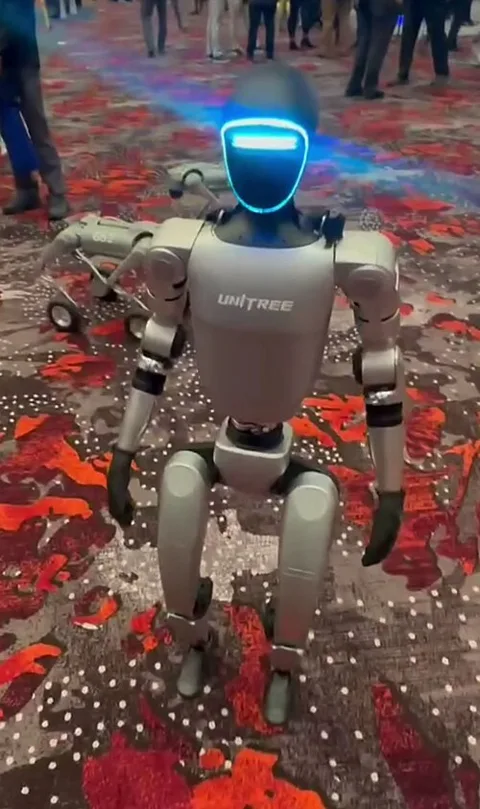 and we went to see the other one. Talking to the guys at Unitree, they have a very different perspective of this from what I hear from Silicon Valley, which is, I was just watching this Dwarkesh interview44Dwarkesh Patel hosts Dwarkesh Podcast, one of the main AI interview shows, where researchers from frontier labs often give short timelines to superintelligence. where he's talking to someone who's saying, like, by next year, maybe we're going to have the superintelligence, it's going to have rapid takeoff.45Fast takeoff — a scenario in which human-level AI improves itself into superintelligence within days or months, leaving society no time to adapt. Unitree guys are like, ah, I don't know, four years, five years, maybe 10.
So there's a weird mix here, where the folks working on the software side of things are like, oh my God, this is just about to happen. And the people working on actuators and mechanics and whatever are like, ah, I don't know, maybe it's actually quite hard to peel an onion or whatever.
So for what it's worth, right now, I mean, Grok Bot46Grok Bot — xAI's (now SpaceX AI's) agents: each runs on its own cloud computer, connects to a user's services and carries out multistep tasks, purchases included. The beta came out in August 2026, and Casado is describing how his bot decided on its own to order smart-home gear. thinks that the right way to have an AI in my house is basically home automation. So it keeps ordering home automation stuff for my house. So I think we're going to get, like, I think at least I'm going to get the Star Trek, like, the display on the wall with the face that talks to you, that controls the house, before the actual… But I think it's very pragmatic, actually, on its part. By the way, this was its decision, not mine.
So this is how you end up a paperclip,47DHH is invoking Nick Bostrom's 2003 "paperclip maximizer" thought experiment: an AI told to make paperclips turns everything around it, people included, into paperclips. The moral is that a vague or badly specified goal is dangerous, which is why Grok Bot turning "AI in the house" into home automation reminds him of it. by the way, if you're not clear. You're like, here's a vague goal, optimize human happiness, and bam, you're a [unclear].
We need Martin to pace his frontier.48Anish is borrowing from the previous a16z episode, where Nick Bostrom discussed "pacing the frontier": slowing frontier AI development when safety falls behind. In September 2026 Dario Amodei published the essay "We Must Pace the Frontier." Here the "frontier" is the robot Casado keeps asking his AI to build. Dario Amodei
07Open weights versus duopoly
DHH wants both strong US frontier labs and open models: without competition, he argues, AI will follow mobile platforms and the Google–Meta ad duopoly.
Please, please, Martin. Can you, by the way, can you talk a bit about, you know, you mentioned open source. I've always viewed you as so iconoclastic, you know, and having strong opinions on kind of consolidation of power. You've talked about it now. Like, how do you think about the frontier labs versus open source?
I think it's absolutely essential that we have open source and we have open weights to keep the whole game honest. We need competition. I mean, I have spent two phases of my career being very dismayed by duopolies splitting everything up. And we only got this brief refuge with the internet, from about 2000-ish to 2009, this glorious age where the most important platform was completely open, completely free. Anyone could build anything, and you didn't have to ask for permission. And then we got the mobile platforms, and the game was up.
ExplainerThe crypto wars of the 1990s
In the early 1990s the US government treated strong cryptography as a weapon: software with keys longer than 40 bits couldn't be exported without a license, like munitions. When Phil Zimmermann put the PGP encryption program online in 1991, he faced a three-year criminal investigation for illegal export; the case was dropped in 1996.
In 1993 the White House proposed the Clipper chip: encrypted phone calls, but with a copy of the key held by the government so the NSA and FBI could listen in with a warrant. Industry and civil liberties groups pushed back, cryptographer Matt Blaze found a flaw in the scheme in 1994, and Clipper was abandoned by 1996. In the Bernstein case a court held that source code is speech protected by the First Amendment, and by 2000 export controls had been largely relaxed. Without that there would be no HTTPS as we know it, the protocol online stores and banks rely on.
Suddenly you went back into this draconian economic scenario where you had to beg for permission for your application to be out there, and therefore for your business to exist. And I just find that personally completely intolerable. So as much as I appreciate Opus 5.5 and what OpenAI is doing, I think it would be a nightmare scenario if we end up with a duopoly position, especially one that's enforced by the government with big guns. That would be very bad for us. Now, this industry went through something kind of similar with the encryption wars in the '90s, where we got pretty close to banning public-key encryption,49Fact-checkOverstated: nobody moved to ban encryption inside the US. The government restricted exports of strong cryptography, investigated PGP's author and pushed the Clipper chip with a copy of the key held by the state, but ordinary users were free to encrypt. More in the explainer above. Wikipedia because NSA and others said, like, well, how are we going to eavesdrop on everything? Like, imagine the trajectory of the internet if we did not have encryption.
How are you going to do commerce? How are you doing communication? It would just have been an enormous injury to the world economy, to the development of the world, and to the web itself. And I think we are at that precipice with AI right now. I keep hearing plenty of smart people say, like, yeah, maybe the government should just take it over. Jesus.
And even if they don't, even if we just end up in a commercial situation where these two labs seemingly divide the market between them, that would be catastrophic. I mean, we need to avoid that. Now, the good thing is that there is more competition within closed models than any other area or phase of computer industry that I've ever observed. The fact that we don't just have these two labs that are ahead, but we have SpaceX AI50SpaceX AI — Elon Musk's former xAI: SpaceX bought it in February 2026, renamed it SpaceXAI in July and SpaceX Super Intelligence in October. Grok and Grok Bot are its products; on October 8 it became an Omacom Foundation patron, pledging $1.5 million in Grok tokens. Omarchy quite close to it. We have Google that seemingly one moment is in the game, and then the next moment somewhere off smoking something funny on an island somewhere. But there's at least a potential.
And then you have a handful of other labs that are nibbling at it as well. Now, I think that's hugely important. But what's even more important is that we have these open-weight models that are getting really good too. I mean, I don't know how to quantify exactly how far behind, but GLM 5.351GLM-5.3 — an open model from China's Zhipu (Z.ai), released in August 2026 with weights posted at the end of that month. On hard outside benchmarks like Terminal-Bench 3.0 it trailed the closed Fable 5 and GPT-5.6 Sol — roughly the gap DHH describes. or DeepSeek Flash,52DeepSeek Flash — DeepSeek's smaller, faster open-weight models; the latest, DeepSeek-V4.1-Flash, came out on September 10, 2026 under the MIT license. It's also the model Fireworks used for its 1,500-tokens-a-second demo. I don't know, is it six, seven months behind-ish on some tasks? Not even. There's a lot of benchmaxxing53Benchmaxxing — tuning a model to popular tests so its scores outrun its real usefulness. That's why DHH trusts only his own trials on his own work. going on, and I don't really buy that. They put out the one benchmark and say, oh, it's just as good as whatever Opus 4.8, and then I try it, and like, I don't know, on your benchmark, maybe, not in the real world.
But so what? They're in the game. They are in the game. These models are useful. You can run them on your own local hardware. This is the thing that's mind-blowing to me.
I wrote a piece, I don't know, six months ago or something, basically saying, like, this is stupid, why are people buying fast personal computers? The models we had at the time that could run locally were so lame, like as in they couldn't do anything. They couldn't move anything that mattered. And then, thankfully, I was totally wrong. And here we are, not even at the end of the same year.
And a DGX Spark54DGX Spark — Nvidia's desktop computer the size of a Mac mini: a GB10 superchip and 128 GB of unified memory, on sale since October 2025 from $3,999. The large shared memory is what lets it hold models that used to need a server rack. can run a useful model. You can actually use it for something. Qwen 3.8 Flash Next55Qwen3.8-Flash-Next — an open Alibaba model from the fall of 2026: 125 billion main parameters plus 51 billion in N-gram embeddings, with only about 6 billion active per token, which makes it fast. Quantized to NVFP4, it runs at about 38 tokens a second on a single DGX Spark. NVIDIA is a totally usable model. There is intelligence in a box that you can fit on your damn desk, that you can buy for single-digit thousands of dollars. That's incredible.
And we desperately need that. But I want all of it, right? There are other people in the open source community that are very hard-line on this. It is either open source or bust. I don't subscribe to that at all. I cheer for the fact that the US has these two frontier labs and that they do have the lead, because we get to then build with that stuff.
And I think it's amazing. As long as they're kept honest, as long as they don't just have an infinite money glitch where there's no competition and they can just turn the price of tokens up to $500 a million56For scale: Claude Opus 5.5 costs $4 per million input tokens and $20 per million output tokens through the API. $500 a million would be 25 times today's output price. or something like that, because we would pay. We would absolutely pay. And we've seen that story play out. When social media took off and the web at large sort of took off, it got divided between two companies, Google and Meta. And those two companies sucked out 99% of the value chain in online advertisement,57Fact-checkOverstated: Google and Meta are the biggest players in digital advertising, but nowhere near 99%. eMarketer forecasts that in 2026 Meta will take 26.8% of worldwide digital ad spending and Google 26.4%, just over half combined; with Amazon the top three get 62.3%. eMarketer because everyone was willing to just get one extra incremental cent back on every dollar they spent.
Source: eMarketer
And to me, that's perverse. As much as I appreciate the contributions, to some extent, in some areas, that these two companies have made, that is dystopian, when you capture essentially 99% of the value being created. Both labs would totally do that if left to their own devices, because that's just how capitalism works. And in fact, I think it's kind of a feature, not a bug, most of the time, because that's what inspires all this investment, and everyone wants to end up with one of these companies. Everyone wants to end up with shares in the next Google and Meta, or now Anthropic or OpenAI. But hold all these ideas in your head at the same time: we need the open weights.
We can cheer on the advances at the frontier. If we get all of it, everything just gets better for everyone. And we get to live in this p(bloom)58p(bloom) — a playful counterpart to p(doom), the AI community's shorthand for one's estimated probability that AI destroys humanity. "Bloom" means flourishing: DHH is talking about the odds of abundance for all. scenario, where there's just infinite excess and prosperity for all.
08Bigger than macOS
DHH's ambition has grown from "a nicer computer for myself" to overtaking 180 million Mac users within three years, or even 12 months.
So, David, one of the things I notice is, like, we're all sort of climbing the ambition ladder as these models get more and more capable. This is actually one of the reasons, I think, even for the people who are building software, where they get the dopamine hit in the first 10%, it turns out that you need to ratchet up the level of ambition to keep getting the hits, right? Because you build something that would have been magical five years ago, and, you know, now you're like, it kind of sucks. You want to get a like on X, you want to, like, do a 3D thing. It's like, no, I built this, like, self-modifying game that does all these incredible things. You get, like, 40 likes.
What am I doing here? Right. So I think it's actually really cool. And, like, here we are talking about this new desktop Linux revolution that you're leading in this distribution. So what does it look like for your ambition to be taken to the next level? Like, what is something that you never envisioned you'd be able to make that you might be building in the next 12 or 24 months?
Well, I'd already acknowledged the ambition inflation that's been happening on this Omarchy project. And I only just started it last year, and I started by hand, if you could believe it. I was writing out little Bash scripts59Bash — the standard Linux shell and its scripting language. Omarchy began as a set of Bash scripts that install and configure programs on a fresh Arch Linux system. with my 10 fat fingers, swearing at Bash a fair amount, and being very limited in what was possible. I just thought, hey, do you know what? If I could make a nicer computer for myself, a place I can live where Apple doesn't control my destiny, I'll be happy. I'll do that, I'll do it for me and whatever, my five friends and a few people on the internet.
And we did that, and it was going well. We had tens of thousands of people using it. Like, nice. Here we got a nice little open source project going, and I have a better computer. Wonderful. Then we got the agents.
And I went from, like, oh, it'd be nice to build a slightly better computer, to, oh my God, we can literally build the perfect computer. Everything I've ever wanted out of a computer over the course of 40 years where I've been using these machines, I can now make happen more or less by myself. Now, it's more fun to do it with friends, so I've invited a few hundred thousand people to come along, but by myself, I can make the perfect computer. And knowing that this is not just possible, but seeing it happen, seeing people experience Linux as not just an alternative to macOS, not just an alternative to Windows, but vastly superior, is so damn gratifying that of course you're going to get delusions of grandeur. And my current delusion of grandeur is that within, let's call it three years, we're going to be bigger than macOS.
There's only 180 million macOS users60Apple hasn't disclosed a Mac user count since October 2018, when Tim Cook cited 100 million active Macs; since then the company reports only its total device base, more than 2.5 billion as of January 2026. The 180 million is DHH's own estimate. MacRumors in the world. The Mac is not that big. I know it looks like it in America, especially if you walk around Silicon Valley, where everyone uses a Mac, but outside of that, tiny. 180 million, like, that's not even a fucking C-tier internet service, right? Like, the biggest of these services have billions of users. Of course we can get Linux above that.
Of course we can. Now, that sounds delusional, because the Linux folks have literally been talking about that prophecy for 25 years, making Linux happen on the desktop. And now suddenly we're here, and we're accelerating, and it's happening, right? So that's how my ambition ladder has been escalating just in the last, I call it, like, let's say four or five months, and maybe not even that. Seeing the traction we've gained with this latest version of Omarchy, the Quattro release, where we went all in on the agents, we built it with agents, we put agents in the hands of everyone, and seeing hundreds of thousands of people pick it up, I went, like, well, okay, maybe three years. That's the delusional thing.
Hey, how about let's check in in 12 months? Could we unseat the Mac in 12 months? Something that they literally spent, whatever, two decades building up this position with macOS. And before that, I mean, this is a company from the goddamn '70s that had a lineage that led to that point. I think it's entirely possible. Now, I wouldn't put majority odds on it for the next 12 months, but I also wouldn't rule it out.
I mean, if there are smart people at the labs thinking we have about 12 months left before recursive self-improvement61Recursive self-improvement — a scenario in which AI improves the next versions of AI, each iteration speeding up the next. It's what people at the labs who expect superintelligence within a year are counting on. is going to give us the super god of AI, well, surely we can kick off a, whatever, second-ranked operating system in the world. Now, and this is just me being ambitious within my own little circle here, within my own area of focus. I'm actually not that good at being ambitious on the grand scale in the same way. I mean, I leave that to the Elons of the world, like, let's populate all the planets. That sounds awesome. Just give me a seat on the Starship going to Mars.62Starship — SpaceX's super-heavy reusable rocket, on which Elon Musk plans to fly people to Mars; Musk is the "Elon" to whom DHH leaves planet-scale ambition.
I'd love to do it. That's not me. I try to be ferociously ambitious within this narrow scope and put all the energy into that. And then also just not try to think about what 12 months from now looks like, because I find that that is the surest way to develop a severe case of AI psychosis.63AI psychosis — a phrase that caught on in 2025 after stories of people whose long conversations with chatbots reinforced delusions. DHH uses it jokingly for obsessive thinking about what AI will do to the world in a year. I like to have AI euphoria. I think that's a much milder version of it, where you're just really excited and optimistic about the future, because you're focused on what's possible right now, what you're building right now with the tools as they look.
You try to imagine two, three, four model hops ahead, you're just going to go crazy, right? Because then why is there even a role for anyone? What do humans even need to damn well exist for? Are we all going to end up as paperclips? I think that is a bad path to go down. And I think this is why so many of these AI safety people end up fucking crazy.
Because that's what they do all day long. They just sit and think about, like, what if all the worst things happened over the next 12 months, wouldn't it be bad? Yeah, it probably fucking would. If you were sitting down next to Oppenheimer in '4464In 1944 Robert Oppenheimer was running the Manhattan Project's Los Alamos laboratory; the first bomb went off in the Trinity test on July 16, 1945. DHH compares the fears around the bomb then with fears around AI now. and going, oh my God, by the time this thing is out, can you imagine what's going to happen in five years? It's going to be a desolate planet, nuclear waste everywhere. And what happened?
The bomb was the best thing that ever happened to world peace. We literally got 50 years of a beautiful Cold War65The Cold War is usually dated from 1947 to the Soviet collapse in 1991, about 44 years. Nuclear weapons were never used in war during that time, which is DHH's point. that did not include total nuclear annihilation. So, very hard to predict the future it is. I try to stay out of that as much as possible. And the only prediction of the future I enjoy is the William Gibson quote:66"The future is already here — it's just not very evenly distributed" has circulated under the name of William Gibson, author of Neuromancer, for decades, and according to Quote Investigator he did say it in interviews as early as the 1990s. Quote Investigator the future is already here, it's just not evenly distributed.
So the future I'm seeing as I'm working with this system, I feel very comfortable doing some predictions on. If everyone was able to do what I'm doing right now and could see what was possible, of course GDP acceleration of three, four, five, 10% a year67For scale: US real GDP has grown about 2% a year on average since 2000, so even 3–5% a year would be a sharp acceleration for a large developed economy. is within the realm of the possible. So that seems easier to predict, but where the models are going to be in a year? Yeah. Shake the eight ball, ask again.
09Sympathy for programmers and the battle of the vibes
DHH asks for sympathy for programmers afraid for their jobs but insists the only way is forward, and he sees the anti-AI camp as largely a political tribe.
You know, David, actually, Anish and I were talking before, you know, right before this: one very unexpected, wonderfully unexpected phenomenon with this whole AI wave is how many of the greats that we've grown up with kind of showed up and helped guide the way. And listen, there's a lot of confusion, there's a lot of fear. And, like, it was you, and it's Eric Raymond.68Eric S. Raymond is one of the ideologues of open-source software, author of the essay The Cathedral and the Bazaar (1997) on how Linux is developed, and a co-founder of the Open Source Initiative. Casado puts him among the veterans who, as he puts it, are "back" and helping people make sense of the AI wave. Like, he's back, and it's amazing. And it's John Carmack,69John Carmack — the legendary programmer behind Doom and Quake, later CTO of Oculus; since 2022 he has run his own artificial general intelligence lab, Keen Technologies. and these just absolute stalwarts from the last 30 years. And so, first off, thank you so much for everything you've done.
I think your talk, by the way, where you're like, you know, software is over, now we're builders. Like, I was like, yes, you know, by myself. You know, I really think that you're leading a generation through this kind of very confusing time. So thank you. And then B, like, who do you look towards as you do these things, as kind of also a guiding light, who you think is right about this, who you think we should kind of follow more as we march forward? Because I just think we're in ultimate confusion right now, and not everybody lived through the internet like we did. And not everybody lived through the Great Recession like we did.
And not everybody lived through kind of the mobile confusion, share economy. And so I do think that, A, what you're saying has been very helpful to people, and, you know, the people that maybe you look up to could also provide a similar level of guidance.
Yeah, I think it is very interesting that everyone that I deeply respect for the programming chops, 100% of them are now fully pilled,70Pilled — internet slang from The Matrix, where the hero takes the red pill and sees the world as it is. To be "AI-pilled" is to have fully bought into AI and rebuilt your work around it. fully into it. Because of course they are, because anyone who has built something the hard way and achieved something with it, undeniable that these tools are able to accelerate that work. Whatever that work is. And I guess, for perhaps reasons of success, in many cases they're not threatened by it. Because I think we have this uncomfortable middle, which is, I don't know if it's unfortunate, but it just is: most programmers, most places, are not comfortably independently wealthy. They are somewhere in their career where they feel like they've earned a place because they put in a lot of hard labor to get there.
They learned a bunch of skills, and suddenly they're feeling the anxiety that, what if it all goes away tomorrow? What if we all stop being programmers now, and then we're all just makers, and, like, am I a good maker? I don't know. So I do think we have to have some sympathy with that. As you should have had sympathy with auto workers in the '70s in Detroit, as you should have had sympathy with the Luddites,71The Luddites were English weavers and knitters who, in 1811–1816, smashed the machines taking away their livelihood. DHH asks for sympathy for programmers whose trade is changing just as abruptly, without proposing a return to the pre-industrial world. the original weavers in England, as you should have had sympathy with plenty of people who felt intimately on their own profession the disruption that's coming. Now, it is possible to have that, have the empathy, and also go, yeah, I'm not going back to the pre-industrial age.
I'm not fucking subsistence farming here with my own hoe and an ox. That is not a world I want to return to. I don't even want to return to the assembly line work world, where an auto worker in Detroit could make a decent living by putting things mechanically together by hand. I don't think we should return to that. We got to lean forward into it. We got to find a way to bring everyone along into that.
And some of that is vibes. Some of it is vibes. And right now there is a battle of the vibes. And in that battle, you have a bunch of people who, for whatever reason, maybe their own personal anxieties, which can be very real, and sometimes also just sort of find this audience where, like, I'm going to be the anti-AI person here. And there's not just one, there's like a billion of them. Whole communities actually are getting addicted to this stuff.
If you draw the Venn diagram with the most insufferable woke people with blue hair72"Blue hair" — a mocking stereotype of progressive activists on the American right-wing internet. DHH, known for his fights over "wokeness" (in 2021 he banned political talk in Basecamp's work chats and about a third of the staff quit), says the anti-AI crowd and that crowd almost coincide. and the anti-AI people, it's a fucking circle, right? So in some ways we are all just replaying the last round. We're replaying every battle ever, because that's how the lines are now drawn up. And I think, unfortunately, for them, the way this cookie crumbled was that the people they didn't like leaned into this first. And that left them only one position to take, which was the opposite. And therefore they had to become anti-AI people, right?
So I mean, I do think there's a beautiful irony in there, because there's a bunch of those insufferable people, I don't mind at all them having a bit of anxiety about the future here, right? A bunch of the rest of us had quite some anxiety about the future about five years ago, when they seemingly had all the cultural power and could cancel anyone anytime, any place. Now the shoe's a little different, isn't it? But that's not all of it. And we shouldn't kind of fall into that trap that it's all just going to be tribal, and there's this side or the other side, or that everyone who is uncomfortable with AI is a blue-haired idiot.
It's just that every blue-haired idiot is also anti-AI.
But getting to sort of bring them along, and to realize, or help them realize, that, you know what, you can feel about this whichever way, but there is only one way forward, and that's through. We're not going back. No one is going to willingly give up this technology ever, unless we end up as paperclips on a stack somewhere in an AI warehouse. We're not giving this up. This is here now. The world is just different, as it was so many other times before.
10The hackers are back
DHH sees AI reviving the hacker culture of the '80s and '90s: individuals with handles are again moving core parts of computing forward, and Omarchy is deliberately styled after the demoscene.
After the Wright brothers73Wilbur and Orville Wright made the first controlled powered airplane flight on December 17, 1903, at Kitty Hawk: 12 seconds and 120 feet. For DHH it's an example of a technology after which the world can't go back. flew, the world was different. We're not going to ship everything by boat and so forth. So we have this obligation to push in. And who I look to in that is, first, all my fellow travelers in this. I mean, as you mentioned, Carmack, or Tim Sweeney,74Tim Sweeney — founder and CEO of Epic Games, creator of the Unreal Engine and, like DHH, a longtime opponent of the App Store commission: in 2020 Epic sued Apple. or Mitchell Hashimoto,75Mitchell Hashimoto — co-founder of HashiCorp (Vagrant, Terraform) and, since leaving it, author of the Ghostty terminal, popular with developers on Linux. or there's a million of these people I deeply respect who've worked on software products that I've been using my entire career. 100% of them are leaned in, they're pilled.
Then I also look to this really curious phenomenon that's been happening in both the Linux world, but also in the AI world: the return of the pseudonymous hacker. Now, the security world has always had this, but now it's leaking into the mainstream. On the Omarchy core team and the Omacom Foundation staff list, we have two pseudonymous people. One, outfoxxed,76outfoxxed is the handle of Quickshell's author. In September 2026 the Omacom Foundation hired him full time to lead Omarchy's shell, its second full-time employee. Omarchy the creator of Quickshell,77Quickshell — an open-source Qt Quick toolkit for building your own desktop shell: bars, widgets, menus. Omarchy 4.0 rewrote its whole shell on it, which is why an agent can reshape it so easily. the malleable shell that we're using for all the desktop interactions, and HANCORE,78HANCORE — a mechanical engineer who made two of the themes that ship with Omarchy and about twenty more extras, and who started the plugin catalog, now six thousand plugins strong. In October 2026 the foundation hired him as Head of Design and Community. Omarchy one of the artists in there, which to me is a total throwback to the '90s and, like, phreaker culture,79Phreaking — hacking the telephone network, popular from the 1960s on: phreakers used whistles and homemade "blue boxes" to fake control tones and call for free. Hacker culture, handles and all, grew out of that scene. elite message boards80Elite boards — invitation-only BBSes where people traded cracked software, hacking texts and demos. DHH, as he says later, ran one himself. and all of this stuff. And I love that.
I love that we have this energy around computers again, like it was in the '90s, the '80s, where hackers and experimenters are suddenly at the forefront of everything. Because maybe that was true for a split second with the internet, and then the internet got commercialized. And then it got taken over, and we got platforms, and we got social media, and then it was dead. There was none of that anymore, right? It didn't last that long as sort of this free spirit. Local AI, for example, has a ton of this stuff too.
0xSero810xSero is the developer behind the Local AI Registry: model configurations, hardware-specific recipes and speed measurements. Since September 2026 the Omacom Foundation has been sponsoring his work, for three years, on making local models work out of the box on Omarchy. Omarchy is someone we sponsor through the Omacom Foundation. Mia's Lab,82Under the handle MiaAI_lab, someone publishes recipes on Nvidia's developer forum for running models on the DGX Spark, such as Qwen3.8-Flash-Next with a million-token context on a single machine. NVIDIA Developer Forums also, both pseudonymous. 0xSero is, I guess his identity is known, but goes by a handle. I love this energy that now individuals, thanks to the power of AI, can actually play a pivotal role in the forward progression of the industry. Because, as I said, once the internet got sort of bottled up and commercialized, a lot of the sort of frontier work to push things forward just got gobbled up by the big companies. Oh, you had Google doing Chrome,83DHH's point about browser engines holds: hardly any are left — Google's Blink (Chrome, Edge, Opera, Brave), Apple's WebKit (Safari) and Mozilla's Gecko (Firefox). A new one from scratch is attempted only by rare enthusiasts such as the Ladybird team. and then that was the only browser in town. And then to create another browser was basically impossible. After the Linux kernel, the browser engine is the most complex piece of software humanity has ever produced.
So we just, we closed off all these domains of the consequential bits of the computer, and only the biggest companies in the world could work on them. And now we're re-democratizing it. We're returning it to the hacker culture, we're returning it to the individual who can actually move some of this stuff forward. So I look to those people, basically anyone doing cool shit with a pseudonymous handle online, and I'm like, hey, hey, I got to follow this person. Something's going on over here. I love that.
It's like it's anti-LinkedIn culture.84On LinkedIn everyone posts under real names and job titles, with an eye on their employer; DHH's "anti-LinkedIn culture" is a network of handles where all that counts is what you can do. Anti-LinkedIn culture is what it is, right? It's just the complete opposite, and a big part of it is infused by X. X has played such an enormous connecting tissue role for this whole revolution, for the artists, for the pseudonymous hackers, for the local AI movement, it's all getting connected through X, in a way that, if those blue-haired bandits had somehow managed to hold on to that shit back before Elon bought it,85Elon Musk bought Twitter in October 2022 for $44 billion, laid off most of the staff, loosened moderation and renamed it X in 2023. DHH believes that without that the platform would have stayed under the control of the "blue-haired." we might not have had any of it at all. It might all have ended up being LinkedIn human slop.86Slop — originally cheap content churned out en masse by AI. "LinkedIn human slop" is DHH's jab: people were producing that kind of filler long before AI.
I just want to, just a very, very quick throwback also. Another thing that I love: do you remember demo culture in the '90s?
Oh my God, yes.
Dude, it is so back, in the creative aspect. It's amazing. Like, some of the most sophisticated demos are by these random, you know, artists that have no interest actually in, you know, building businesses. It's purely for the love of art. I don't remember the last time we had such a movement, and it's awesome.
ExplainerThe demoscene
The demoscene grew out of 1980s piracy: groups that cracked copy protection on Commodore 64 and Amiga games put their own intro in front of the game — a crack intro with a logo, music and scrolling greetings to other groups. Gradually the intros mattered more than the games: groups competed to squeeze the most graphics and sound out of the hardware in a tiny program, and demos emerged as standalone audiovisual works generated by code in real time.
The main events became demoparties, multiday gatherings with competitions, such as Finland's Assembly (since 1992) or Denmark's The Party. A classic of the form is Second Reality by the Finnish group Future Crew, shown at Assembly in 1993. There are contests for extremely small programs too: 64-kilobyte intros and 4-kilobyte demos build entire scenes from a few thousand bytes of code. In 2020 Finland became the first country to add the demoscene to its inventory of intangible cultural heritage, kept under the UNESCO convention.
I'm trying to pull all of that into Omarchy. So I don't know if you've tried Omarchy yet, but one of the signature visual effects is the screensaver. And the screensaver is literally ASCII art running through 40 demo effects, just looking totally out of, like, a 1995 demo party intro, right? We're pulling all of those effects into it, keeping that terminal aesthetic, which is, by the way, also a completely different aesthetic from macOS or from Windows, because I think Linux historically, a lot of the distributions thought, if we would just make a Temu version of Windows,87Temu — the Chinese marketplace for ultra-cheap goods; a "Temu version" of something is a cheap knockoff that resembles the original only from a distance. everyone would love us. No, no one wants a fucking cheap copy of some shit that wasn't that great to begin with. They want something bespoke.
They want something unique. And the aesthetic of Omarchy is totally '90s demo culture. Totally that. That's exactly the kind of vibe that I'm going for. In fact, just before we hopped on this call, I'm working on some how-to-set-up-local-AI-on-your-own-machine. And one of the things we have is, booting a local AI model can take a while, like, I don't know, a few seconds, maybe in some cases even a few minutes.
So while it's loading, I jammed in another ASCII effect, just, like, fucking cool characters floating around on the screen. Does it have any functionality? No, absolutely fucking not. Just there to make you feel like you're using a cool-ass computer, because that's what the '90s and demo culture felt like to me. Like, I was into pirated games at the time too, and all these pirated games would have this intro, "cracked by Razor 191188Razor 1911 — one of the oldest piracy groups, founded in Norway in 1985; its crack intros, with music and scrolling text before the cracked game, became demoscene classics." or whatever, and the text would swirl around. And I just felt a little cooler, a little cooler that day, that I had got to witness that.
I mean, [unclear] feel like that. Even if your goddamn job is pushing an Excel spreadsheet around, at least you feel alive for that hot moment while Omarchy is booting.
Yeah, like, BBS culture89BBS (bulletin board system) — a computer people dialed into by modem to exchange messages and files. Before the mass internet, in the 1980s and early 1990s, BBSes were where computer people met; each phone line took one caller at a time, so 14-year-old DHH's three lines were a serious operation. was like that too, you know. I mean, all the protocols, you remember, Xmodem, Ymodem, Zmodem,90Xmodem, Ymodem, Zmodem — file transfer protocols for modems: Ward Christensen wrote Xmodem in 1977, Chuck Forsberg wrote Zmodem in 1986; each was faster and more reliable than the last. Kermit. Why is it Kermit? No one knows,91Fact-checkNot so: the name's origin is known. The Kermit protocol was created at Columbia University in 1981 and named after Kermit the Frog of The Muppet Show, with permission from Jim Henson's company. Wikipedia but it seems badass.
I ran an elite bulletin board system out of my bedroom, three lines in, when I was 14 years old. I can tell you, when the guy from the Danish telecom monopoly92Until the mid-1990s Danish telephone service was a state monopoly; in Copenhagen, where DHH grew up, lines were installed by the KTAS telephone company, part of Tele Danmark. Three lines in a teenager's bedroom looked plainly suspicious to the technician. showed up to install the third line and he saw this 14-year-old kid, he was like, what the hell is going on here? This has got to be illegal. And he was totally right. It was totally illegal. It was totally awesome.
And I can still hear the US Robotics93US Robotics was an American modem maker whose Sportster and Courier lines were perhaps the best-known modems of the BBS era. 33.6 kbps was the V.34+ speed of the mid-1990s, and the "connecting" sound is the hiss and screech of two modems negotiating a speed. modem sound, the 33.6 connecting. It's just such an iconic sound. And we got to have more of that. Computers should be a little mysterious. They should be a lot of cool, and they should not be so polished. As much as I love Apple, I think Jonathan Ive94Jony Ive led Apple's design from 1997 to 2019: the iMac, iPod and iPhone and, from 2008, the unibody aluminum MacBooks. DHH believes that polished style drained computers of character. essentially aluminum-polished all character out of the computer in that regard.
And maybe that was good for a time, but that time is over. We're fucking getting the hackers back.
David, you're such a legend, man. We really appreciate everything that you're doing now and everything that you've done. So we really appreciate you coming on, and enjoyed the conversation.
Thanks so much. Well, thank you. It is always a pleasure to talk about the '90s, demo culture, hackers and cool shit.
Let's do more together, man. What a pleasure. Where are you based now? In person next time.
By the way, is the office real? Is the office real? Like, the picture of your beautiful office view.
It's very real. I'm not in that office right now, otherwise I would pan the camera around. But yes, that office is in Malibu, and it never gets old. I mean, this is why I keep posting that picture, just for my own satisfaction.
Like, I cannot believe I work here. And yeah, one of the spoils of capitalism. This office was brought to you by commercial software. Thank you.
And really appreciate this. Really appreciate the time. Thank you.
Thanks so much. Thank you for having me on. Let's do it again in person.
All right, sounds good. Take care, man.
Bye-bye. Happy hacking.
Introthe show's opening music
Thanks for listening to this episode of the a16z podcast. If you like this episode, be sure to like, comment, subscribe, leave us a rating or review, and share it with your friends and family. For more episodes, go to YouTube, Apple Podcasts, and Spotify. Follow us on X @a16z, and subscribe to our Substack at a16z.substack.com. Thanks again for listening, and I'll see you in the next episode. As a reminder, the content here is for informational purposes only, should not be taken as legal, business, tax, or investment advice, or be used to evaluate any investment or security, and is not directed at any investors or potential investors in any a16z fund.
Please note that a16z and its affiliates may also maintain investments in the companies discussed in this podcast. For more details, including a link to our investments, please see a16z.com/disclosures.


