


Conversations with Tyler
Chapters
What drew Jews to South Wales, Moritz says, was economics rather than nonconformist tolerance, and outsiders were treated much the same there as in England.
Read the chapter- Cowen introduces Moritz as a journalist, Sequoia venture capitalist and philanthropist, and names his family memoir Ausländer as the occasion for the conversation.
- Moritz believes Jews with entrepreneurial attributes were encouraged to settle in South Wales to set up businesses and create jobs, and that no church made the newcomers feel more at home.
- Britain opened its doors to his parents, who arrived as teenagers around 14, Moritz stresses, but the country had few foreigners then, and anyone out of the ordinary was seen as an outsider.
- When Cowen cites a peak of about 5,000 Welsh Jews around 1919 followed by a sharp decline, Moritz pushes back: in the 1960s there were perhaps 600 Jewish families, and the young left for opportunity in London.
- Moritz himself left at 18 or 19 for university and has lived outside Wales since 1973.
Moritz owes his love of art to his mother, and he finds tough pictures like Otto Dix's more rewarding to live with than decorative ones.
Read the chapter- His mother left school at 15 but loved the visual arts and music all her life, and took him and his sister to the National Museum of Wales.
- Moritz bought his first picture, a drawing of a pithead winding mechanism, in Cardiff at 13 as a gift for his parents, and it now hangs by his desk at home.
- Grueling works like Dix's have many layers, are redolent of another epoch and leave room for exploration over the years, he says, while Chagall holds no pull for him and his wife Harriet.
- Moritz only took up painting in his mid-forties; he calls it "exasperating" and humbling, yet two hours can vanish while he works.
- He sees no influence of art on his investing, but says that looking intently and listening carefully help when you're taking the measure of a potential business partner.
Moritz fled his father's classics and religion but devoured Roth and Mailer, and Roth became his teacher.
Read the chapter- His father was a classics professor, and his Latin teacher expected a little genius, only to be severely disappointed for three years, Moritz recalls.
- As a young man he bought every new book by Philip Roth and Norman Mailer the moment it came out.
- At the University of Pennsylvania Moritz took Roth's small seminar, which drew on Roth's Penguin series of Eastern European authors and assigned short books rather than 600-page tomes.
- Roth wrote him a reference for Time Magazine, and much later they shared Thanksgiving dinner in New York for about half a dozen years.
- Moritz is not observant, though proud to be a Jew, and thinks his father's fascination with the Bible, like his devotion to Latin, drove him away.
Children are too self-absorbed to ask, Moritz says, while he would ask his family hundreds of questions, starting with their childhood.
Read the chapter- Moritz says children aren't curious, don't understand that every individual has a story, and don't know how to ask questions or listen.
- He wouldn't stop at one question for his parents, since each answer prompts another, but people who lived through trauma suppress memories.
- With his grandparents Max and Minnie, killed in the Holocaust, he would start as he does with founders, with the first 10–15 years of life, which he believes echo through everything after.
- He would ask a 10-year-old boy in a German village around 1890 who woke him up in the morning and what he had for breakfast.
- His grandfather Max served in the German army in World War I and survived Verdun, which alone would prompt countless questions.
Moritz sees antisemitism as a permanent condition of humanity that flares up where people feel left behind.
Read the chapter- Asked about a late-19th-century surge in Germany, Moritz answers that at the time of the Dreyfus Affair antisemitism was more prevalent in France, and that in Germany it grew after World War I.
- Refugees fleeing pogroms in Russia and Ukraine, he adds, probably didn't help matters in Germany.
- For centuries German Jews could live only in certain places and were barred from many professions, and it was Bismarck who made their lives considerably easier.
- Today, Moritz says, antisemitism is fanned by social media, the situation in Israel and the blurry border between disagreeing with the Netanyahu government and hating Jews, and a New York mayor vowing to arrest Netanyahu doesn't help.
- Moritz doesn't know why the Irish would be so anti-Israel, or whether it's even true; the only link he knows is that the current Israeli president's grandfather was chief rabbi of Ireland.
His trip to Germany and work on the book taught Moritz that you can never have enough passports, and the book showed him how his parents shaped him.
Read the chapter- Last summer Moritz went to Munich, where his father grew up, for the first time and found it charming, though every corner has its history.
- He couldn't get into Munich's new synagogue because he hadn't filled out application forms and lacked the documents security required.
- In Dachau what struck him was a spotless gas chamber full of bored high school students with AirPods, and the vast gap between that scene and the early 1940s.
- Moritz already holds German citizenship, though he doesn't expect to be driven out of the US or to live in Munich, and he notes that only Germany truly drums the history of the Holocaust into its population.
- Cowen argues that every venture capitalist is a philosopher, but Moritz demurs: philosophers to him are Aristotle and Cicero.
Moritz became a venture capitalist with no plan, by sheer luck: of five firms he wrote to, one hired him.
Read the chapter- At Time's San Francisco bureau he got hooked on Silicon Valley's tiny companies, among them Apple, Atari, Microsoft and Oracle, having never met anyone in Wales who started a company at 18 or 20.
- Without a technical background he couldn't start a tech company, so he left Time for a little publishing company.
- Writing about venture capital, he met Tom Perkins and Don Valentine, then wrote letters to the heads of five venture firms.
- Four rejected him, and Valentine hired a history major without an ounce of technical acumen at Sequoia, which made his peers think he'd lost his mind, Moritz recalls.
- His piece on Valentine, he says, isn't really a book but a long profile of the early venture industry, without enough in it to merit a book.
What people miss about Jobs, Moritz says, is his stoicism and the melding of artist and capitalist, and he calls himself a dilettante rather than an obsessive.
Read the chapter- Moritz points to the heroic way Jobs spent his last years, his native wit and raw intelligence, the artist-capitalist blend and his education in the wilderness after Apple cast him out.
- He sees no greater pattern in his books and art than unsatisfied curiosity.
- Moritz invites Cowen, a fellow Dix fan, to see the pictures in San Francisco that others wouldn't want to live with, and calls himself a huge fan of Frank Auerbach.
- Auerbach painted every day except Christmas and later gave up even that day off, which makes him an obsessive like Jobs, Gates or Musk, Moritz says.
- Moritz has too many interests to be an obsessive, he says, and could do each of his pursuits a lot better.
Early in the 21st century capitalism was ablaze in China rather than the US, Moritz says, and Sequoia flourished there for nearly two decades.
Read the chapter- Moritz calls China a collective effort at Sequoia, where visits to the mainland washed away many preconceptions.
- China had a skimpy safety net, he says, and people lived or died by their education or their wits, whatever was said about the Communist Party and state control.
- For close to two decades you could invest in almost any industry there, but things have tightened up a lot in the last few years, Moritz notes.
Supporting the Booker has shown Moritz how little he knows about literature, and both men agree fiction is in good shape.
Read the chapter- Moritz has nothing to do with judging, but reads the 12 shortlisted books and the International Booker picks, which open his eyes to new authors and countries.
- Cowen cites Ferrante, Knausgård, the Sonia and Sunny book, Houellebecq and Cărtărescu as great works of the last ten years.
- Moritz adds Douglas Stuart and says that despite all the talk of AI, great storytelling will never go out of style.
Philanthropy benefits from people out of the for-profit world, Moritz says, and without new housing San Francisco will keep pricing people out.
Read the chapter- Moritz wants more people in San Francisco contributing and believes operators from business set a different performance standard for philanthropies.
- His example is Missy Narula, Crankstart's CEO, who came from TPG and Bain five years ago.
- In philanthropy, as in business, he says, you set a standard and accept that some of what you try won't work.
- Cowen suggests artists may live in Fresno with a patron in San Francisco, and Moritz calls that quite possible.
- Mayor Daniel Lurie is working to make housing easier to build, Moritz says, and artists have always gone where they can afford to live, as writers have to Syracuse.
After a diagnosis of supposedly incurable blood cancer, Moritz took control of his own calendar, and he says true friends are very few.
Read the chapter- Cowen notes the diagnosis came about 20 years ago, and Moritz says it made him want to control his own calendar, more for contentment than for efficiency.
- True friends, in his view, are the ones you want around your deathbed.
- There are very few of them, because deep relationships are built on history and shared experience, and there isn't time for that with many people.
Britain never recovered from losing its imperial primacy, Moritz argues, and suffers from too much government.
Read the chapter- Moritz blames "the residue of the arrogance of empire": a century ago sterling was the world's reserve currency, and Britain had the largest navy and was the world power.
- Everything since, he says, has been a feeble, muted reaction to that loss.
- Eras when government was the answer to everything alternated with the Thatcher years and, to a lesser extent, Blair, Brown and Cameron, but overall, Moritz thinks, Britain has suffered from too much government.
Moritz wants to learn next about Iran from roughly 1890 to 1970, where he believes many of today's problems began.
Read the chapter- He means not contemporary Iran but the country circa 1890 to 1970, and Cowen brings up the constitutional liberal era of 1908–1911.
- Moritz admits he lacks deep knowledge but thinks many of today's issues stem from that period and from what happened in the early 1950s.
Quotes
On why children don't question their parents
“They’re too self-absorbed. They aren’t curious. They don’t understand that every individual has a story, and on the whole, with every individual, the more that you dig, the more interesting it becomes. They don’t know how to ask questions, and they don’t know how to listen.”
Michael MoritzRead from 13:08On the gas chamber at Dachau
“There were these high school students who were obviously bored out of their minds on their iPhones in there and with their AirPod earplugs in. I just stood there for a moment, shutting my eyes, wondering what the heat was like, what the smell was like, what the screams were like, what the work was like, what the stench was like.”
Michael MoritzRead from 21:53On why Moritz got a German passport
“The one lesson that I took from working on my book was you can never have enough passports.”
Michael MoritzRead from 23:08On how a history major got into Sequoia
“I literally wrote letters back then—you couldn’t write emails—to the people who ran five venture firms, got rejected by four of them, and then I got really, really lucky and Don Valentine hired me at Sequoia.”
Michael MoritzRead from 27:35On what's underrated about Steve Jobs
“The fact that his native wit, his raw intelligence, the melding of an artist and a capitalist, I think those are the principal things that aren’t appreciated about him.”
Michael MoritzRead from 28:22On what obsession looks like
“Frank Auerbach carried his obsession to new heights. He painted every day of the year, save for one, which was Christmas Day, when he treated himself to a day off and went to Brighton to go to the Brighton Pier on Christmas Day. Then later in life, he decided that, actually, the one day he was taking off was stealing time from painting, so he abandoned his trips to Brighton. There’s an obsessive for you.”
Michael MoritzRead from 30:10On where capitalism was ablaze
“if you wanted a country where capitalism was ablaze in the early 21st century, really ablaze, it wasn’t in the US, it was in China, despite what everybody says about the Communist Party and state control.”
Michael MoritzRead from 31:33On how to tell your real friends
“I think it’s the ones you want around your deathbed.”
Michael MoritzRead from 38:14
Summary
Tyler Cowen talks with Michael Moritz — a former Time journalist and Sequoia venture capitalist — about his new family memoir, Ausländer. Moritz's parents fled Nazi Germany for Britain as teenagers, and he grew up in Cardiff. What drew Jews to Wales, he says, wasn't the tolerance of the nonconformists but the encouragement entrepreneurs got to set up businesses there; outsiders were viewed with the same wariness in Wales as in England. His mother gave him his love of art; with his wife, Moritz collects "tough" paintings like Otto Dix's, which are more interesting to live with over the years, and he only took up painting himself in his mid-forties.
On the book and Germany: children don't question their parents because they're too self-absorbed and don't know how to listen; Moritz himself would ask hundreds of questions and start with childhood, just as he does with founders. He sees antisemitism as a permanent condition of humanity that flares up where people feel left behind, fanned by social media and the situation in Israel. After a trip to Munich and Dachau, Moritz now holds German citizenship: you can never have enough passports, and only Germany truly drums the history of the Holocaust into its people.
He landed at Sequoia by chance: he wrote to five venture firms, four turned him down, and Don Valentine hired a history major without an ounce of technical acumen. What's underrated about Steve Jobs, in Moritz's view, is the stoicism of his last years and the fusion of artist and capitalist. Great entrepreneurs and Frank Auerbach are obsessives; he himself is a dilettante driven by unquenched curiosity. Early in the 21st century capitalism was ablaze not in the US but in China. At the end: the Booker Prize, philanthropy and housing in San Francisco, an incurable diagnosis after which Moritz took control of his own calendar, Britain's "arrogance of empire," and his next subject of study, Iran from the 1890s to the 1970s.
Mentioned
 Sequoia Capital00:26the firm where Moritz spent nearly 38 years
- The Little Kingdom: The Private Story of Apple Computer00:26the first book-length history of Apple
- Leading00:26the book on leadership written with Ferguson
 Alex Ferguson00:26Manchester United manager and Moritz's co-author
Show 15 more mentionsShow fewer mentions
 Crankstart00:49the foundation of Moritz and his wife
 Booker Prize00:49the prize Crankstart has funded since 2019
- Ausländer: One Family’s Story of Escape and Exile00:49Moritz's new book, a family memoir
 Otto Dix06:45the difficult art Moritz and his wife live with
 Philip Roth10:11favorite author of his youth, his teacher and later a friend
 Norman Mailer10:11favorite author of his youth
 Time11:20the magazine where Moritz started as a journalist
 Otto von Bismarck17:21made life easier for Germany's Jews
 Apple26:03the tiny company Moritz wrote a book about
 Tom Perkins26:58founder of Kleiner Perkins, one of the leaders of the early venture industry
 Don Valentine26:58Sequoia's founder, who hired Moritz
 Steve Jobs28:20a stoic, a fusion of artist and capitalist
 Lucian Freud29:48the greatest painter of flesh
 Frank Auerbach29:58the obsessive who painted every day
 Daniel Lurie36:27the mayor making it easier to build housing
Transcript
01Wales, Jews and outsiders
What drew Jews to South Wales, Moritz says, was economics rather than nonconformist tolerance, and outsiders were treated much the same there as in England.
Hello, everyone, and welcome back to Conversations with Tyler. Today, I am chatting with Michael Moritz.1Michael Moritz (b. 1954) grew up in Cardiff, read history at Christ Church, Oxford, and in 1978 earned an MBA from the Wharton School of the University of Pennsylvania. At Time magazine he was San Francisco bureau chief by the end of 1982. He joined Sequoia Capital in 1986, stepped back from day-to-day work to become chairman in 2012, and left the firm in July 2023 after nearly 38 years. Wikipedia. Michael is perhaps best known for his work as a venture capitalist through Sequoia.2Sequoia Capital — venture firm in Menlo Park, Silicon Valley, founded by Don Valentine in 1972; its early investments include Apple, Oracle, Nvidia, Google, YouTube and WhatsApp. In 1996 Moritz and Doug Leone took over its leadership. Before that, he was a very active and successful journalist with several books to his credit, including the first study of Apple and an excellent work on Alex Ferguson of Manchester United.3The Little Kingdom: The Private Story of Apple Computer (1984) was the first book-length history of Apple; an expanded edition, Return to the Little Kingdom, came out in 2009. Moritz wrote Leading (2015) with Alex Ferguson, Manchester United's manager from 1986 to 2013. Back in his journalism days Moritz also co-wrote, with Barrett Seaman, Going for Broke, a book about the rescue of Chrysler from bankruptcy.
Michael is extremely well known, in addition, for his work in philanthropy. For instance, his institution Crankstart has been supporting the Booker Prize since 2019.4Crankstart — the charitable foundation of Moritz and his wife, Harriet Heyman. In 2019 it replaced the investment firm Man Group as sponsor of the Booker Prize, and the prize went back to being called simply the Booker, without a sponsor's name (under Man Group it was the Man Booker Prize). He also is involved in San Francisco Standard,5The San Francisco Standard — a San Francisco news outlet launched in 2021 with money from Moritz and Heyman. but most importantly, from our point of view, Michael has a new and excellent book out called Ausländer: One Family’s Story of Escape and Exile,6Ausländer is German for "foreigner." The book is Moritz's family memoir (2026): his parents fled Nazi Germany for Britain as teenagers, and his paternal grandparents were killed in the Holocaust. which I absolutely recommend to you all. Michael, welcome.
Thank you for that very kind and flattering introduction.
I have many questions for you in many areas. Let’s start with Wales. Did the nonconformism of Methodist Wales7Nonconformists — in Britain, Protestants outside the Church of England: Methodists, Baptists, Congregationalists. In the 19th century nonconformists made up the majority of worshippers in Wales, and in 1920 the Anglican Church in Wales was disestablished. make it easier for Jews to settle and feel at home there?
I’m not sure that that actually was the case. I think that the principal reason that Jews, particularly the ones of my parents’ generation, settled in Wales were that those with entrepreneurial attributes were encouraged to settle in South Wales8South Wales suffered mass unemployment in the 1930s after the decline of coal, and the government encouraged new industry there. In 1936 the Treforest Trading Estate was established near Pontypridd; many of its businesses were founded by refugees from Nazi-occupied Europe who had managed to bring out money and equipment. and in some other parts of Britain to set up businesses, to encourage local employment, and stimulate job growth. I don’t think that any aspect, probably of the established church or churches made the new immigrants to Wales feel any more comfortable.
How was Welsh antisemitism different from English antisemitism?
Well, first of all, I want to be really careful here because Britain opened its doors to my parents. My parents were refugees from Nazi Germany. They both were permitted to come into Britain as children, as teenagers. Both of them were around 14 years old when they were fortunate enough to land in Britain.9Getting to Britain: one route for children from Nazi Germany was the Kindertransport. In 1938–1939, in the nine months before the war, Britain took in nearly 10,000 children, mostly Jewish, from Germany, Austria, Czechoslovakia and Danzig. Often they were the only members of their families to survive the Holocaust. Britain was one of the few countries, albeit with quotas, that opened the doors to Jews desperately trying to flee the Nazi stain that was spreading all over Europe.
Britain, back in the late 1930s and certainly during the time that I was growing up there, which was predominantly in the 1950s, ’60s, and early ’70s, was far less a multicultural country than it is today. Anybody from abroad, they could have been Italian waiters in Soho—there were very few blacks or anybody from Asia in Britain at the time that I was growing up—anybody who looked out of the ordinary was considered by the majority of the people, as always happens, a bit of an outsider. That was displayed in a whole variety of ways. Nonetheless, whether it was in Wales or, to answer your question, in England, I’m not sure that it differed all that much.
According to some sources, the population of Welsh Jews peaked in around 1919 at around 5,000, and then it declined radically. Why did so many Jews leave Wales? Is it just movement to London?
I don’t think it declined that rapidly. I think there were, I don’t know how many in the ’60s when I was growing up, maybe there were 600 families around Wales that were Jewish out of a population of around, probably back then, about 2.5 million. I think the younger people tended to leave for opportunity. Small countries or Wales and other parts of the United Kingdom that presented limited opportunity for people with ambition meant that the younger people in particular tended to leave, and they tended on the whole to head toward London.
You left Wales at age 19, correct?
Yes, 18, 19.
What was your thought process at the time? Was it screaming, “I have to get out of here,” or a marginal decision?
No, it was far more conventional than that. I left Wales after I finished high school and I went to university. That was the first time I’d lived in England. Then outside of vacations, I never really went back to Wales. Since 1973, my life has been really spent outside of Wales.
02Living with difficult art
Moritz owes his love of art to his mother, and he finds tough pictures like Otto Dix's more rewarding to live with than decorative ones.
At that young age, were you already interested in art and fiction?
Funnily enough, I was in both. Take the art first. I think I owe this to my mother, whom otherwise I had a fairly strained relationship with, but bless her heart. She was the victim of this age-old prejudice against women and left school at the age of 15 and always felt a little inferior to people with college and university educations. She had a really—and I don’t know, I never talked to her about it—I don’t know where it came from. She had a lifelong affection for the visual arts and for music. At home, the radio was always on with her listening to music.
When she took me and my sister to the museum in Wales, the National Museum of Wales,10The National Museum of Wales in Cardiff is known for its Impressionist and Post-Impressionist collection. Its core is 260 works given and bequeathed to the museum in 1951 and 1963 by the sisters Gwendoline and Margaret Davies, heirs to a fortune made in coal, railways and docks. Museum website. which actually has a pretty good collection, some really interesting impressionist pictures and, oddly, some Francis Bacon.11Francis Bacon (1909–1992) — British painter known for distorted, unsettling figures; not to be confused with the philosopher Francis Bacon (1561–1626). I think that’s what woke my interest in art. I bought my first picture, which I gave as a gift to my parents when I was 13. I did so in Cardiff.12Cardiff — the capital of Wales (officially recognized as such in 1955). At the turn of the 20th century its port was the world's largest exporter of coal from the valleys of South Wales. It was a little watercolor and pencil drawing of a winding mechanism at a pit head,13Pithead winding gear — the headframe over a mine shaft with the pulleys of the winding engine, whose cables raised cages of coal and men. Coal mines were the backbone of the South Wales economy until the second half of the 20th century; the region's last deep mine, Tower Colliery, closed in 2008. these big winding mechanisms that used to sit astride the places in coal mines in Wales where the coal came up from below. I still have that picture. After my mother died, I got it, and it hangs in my office at home, right by my desk.
Is it easy to live with an Otto Dix painting or sketch?14Otto Dix (1891–1969) — German painter and World War I veteran who painted the trenches, maimed soldiers and the streets of Weimar Germany. The Nazis branded his work "degenerate art." It hangs on the wall. Many people think it’s ugly. It reminds one of unpleasant things in history, right?
Yes, for Harriet and me15Harriet Heyman — Moritz's wife, an American writer and sculptor. it is. I think the tougher, more strenuous, grueling works of art that other people would have difficulty living with have many layers to them. You explore them, and they’re difficult pictures, and they’re not easy at first sight. Unlike easier pictures that may be a bit more decorative, they leave room for plenty of exploration, as the years go by. Then they’re redolent, they tell stories. They’re redolent of history. They’re images of a different epoch. I think most of the paintings that we’ve been lucky enough to find over the years, they are tough paintings.
I feel that way about Haitian art,16Haitian art — above all naive painting, which became famous from the 1940s, when the Centre d'Art opened in Port-au-Prince. It is full of scenes of vodou, daily life and violence from the country's history. which has many brutal scenes. For you, is Chagall17Marc Chagall (1887–1985) — painter from Vitebsk who worked mainly in France: flying lovers, fiddlers, goats and the little houses of the Jewish shtetl. "Early Chagall" usually means the 1910s, his years in Paris and Vitebsk. too sentimental?
You don’t want to put it on your wall?
The earlier Chagalls I’ve been drawn to, but neither of us have felt the urge or the need to go out in pursuit of Chagall.
What is your own painting like?
Oh, exasperating.
Neue Sachlichkeit18Neue Sachlichkeit (New Objectivity) — a movement in 1920s German art that succeeded Expressionism: a cool, pointedly precise, often satirical realism. Its leading names are Otto Dix, George Grosz and Christian Schad. or something else, it’s like Kossoff?19Leon Kossoff (1926–2019) — British painter of London and portraits in very thick paint. He is grouped with Frank Auerbach and Lucian Freud in the so-called School of London.
No, I don’t know if you’ve ever tried painting or drawing. I didn’t take it up until I was in my mid 40s. I’d never picked up a crayon or outside of the obligatory, abbreviated art lessons that always seem to be held later on Thursday afternoon, with everybody waiting for the bell to ring to end school. I’d never taken up a crayon or drew, or let alone painted.
If I look back today at what I did early on, it’s a lot better. Then if I look at the paintings that I try to make, my goodness, it is an extremely humbling experience, but I enjoy it. I really enjoy it. There’s nothing like getting lost in making a painting, and before you know it, two hours have gone, and you have no idea where the time went.
How has living with the visual arts improved your investing skills?
I’m not sure that it’s had any influence whatsoever on investments.
Talent identification, isn’t it some area where there’s always a deeper understanding in the visual arts, and you then later can apply those frameworks to individuals or companies?
I understand the argument, but I began my life as a journalist and maybe subliminally, because I look fairly intently and always look fairly intently at works of art that have caught my eye, I think I’ve always looked carefully at whatever it is in front of me. It could be a landscape, could be a building, could be a person, and have been pretty watchful and have listened carefully. I think all three are connected when you are trying to take the measure of somebody when you’re thinking about forming a business relationship with them.
03Latin, Philip Roth and the Bible
Moritz fled his father's classics and religion but devoured Roth and Mailer, and Roth became his teacher.
Your father was a classics scholar. Were you interested in Homer as a teenager?
I was not. I suppose, like a lot of sons, I tried to get as far away from the classics as possible. My Latin teacher at school was sure that he had a little Latin genius on his hands since I was the son of a classics professor, and then I proceeded to severely disappoint him for the next three years.
What in Jewish literature means the most to you?
Well, when I was growing up, I devoured the works of the American Jewish authors who really made their mark during the 1950s and 1960s, and predominantly Philip Roth20Philip Roth (1933–2018) — American novelist, author of Portnoy's Complaint (1969), American Pastoral (Pulitzer Prize, 1998) and The Plot Against America (2004); his central figure is the mid-20th-century American Jew. and Norman Mailer,21Norman Mailer (1923–2007) — American novelist and journalist, author of the war novel The Naked and the Dead (1948) and twice winner of the Pulitzer Prize, for The Armies of the Night and The Executioner's Song. although there is obviously a string of others as well. Those were the two that, as soon as they published a new book, I immediately went out to buy the book.
You knew Roth, right? What was he like?
I was very lucky when I went to university in America, I went to the University of Pennsylvania, and here he was, one of the heroes of modern literature. He was teaching a small seminar class at the University of Pennsylvania and I enrolled in it. And as a teacher, he had edited a Penguin series on Eastern European authors,22Writers from the Other Europe — the Penguin series Roth founded and edited from the mid-1970s until 1989: it published translations of writers from Poland, Czechoslovakia, Hungary and Yugoslavia, including Milan Kundera, Bruno Schulz, Tadeusz Borowski and Danilo Kiš. Roth taught at the University of Pennsylvania from the late 1960s until 1980. so he taught from that canon. And one of his abiding virtues as a teacher or as a professor, was he prescribed short books to read, so he didn’t ask his students to read 600-page tomes.
Most of the books that I remember him asking us to read were fairly short, so you could really read them without feeling out of breath and then have time to ingest them. And he listened very carefully and was very polite and courteous toward all of his students. Then he very, very kindly wrote me a reference when I applied for a job at Time Magazine. I’m not sure that many people who applied at Time had a reference from Philip Roth.
Then later in life, way later in life, our paths crossed again through a mutual friend and for several years, when our family was in the habit of going to New York to celebrate Thanksgiving with friends, Philip was a mutual friend of the hostess and so for, I don’t know, half a dozen years, we always had Thanksgiving dinner and among the guests was Philip Roth. And unless he was in a deep funk, he was always wry and amusing and sardonic.
How would you describe your current relationship to the Hebrew Bible?23The Hebrew Bible — the Tanakh: the Torah (the Five Books of Moses), Nevi'im (Prophets) and Ketuvim (Writings). Christians call almost the same body of books the Old Testament.
More distant than removed. I am not an observant Jew and haven’t been. I obviously identify very proudly as a Jew. My father was what in America would be called a conservative Jew,24Conservative Judaism (Masorti) — a movement between Orthodox and Reform: it holds Jewish religious law to be binding but allows it to evolve. In the US it is one of the largest branches of Judaism. and he was deeply educated in the Jewish Bible and interpretations of the Jewish Bible. I think maybe his fascination with it, just like his devotion to Latin, I think drove me away from it. But he had also grown up in an era in Germany where there weren’t very many distractions, and I think the main entertainment of the week, best as I could tell, was going to the synagogue.
04Why children don't question their parents
Children are too self-absorbed to ask, Moritz says, while he would ask his family hundreds of questions, starting with their childhood.
Why do you think sons and daughters do not ask more questions about their parents’ and grandparents’ history when they can?
They’re too self-absorbed. They aren’t curious. They don’t understand that every individual has a story, and on the whole, with every individual, the more that you dig, the more interesting it becomes. They don’t know how to ask questions, and they don’t know how to listen.
If you could ask your parents something now, what would you ask?
It wouldn’t be one question. Because I obviously have written this book that’s a family memoir about what happened to my parents’ generation, and how that shaped me. It wouldn’t be one question, Tyler. It would be hundreds of questions. And you know better than I do from all the interviews that you’ve done, it’s the answer to a question that then prompts another question. I probably can’t imagine running out of questions for either of them, but these are for people who’ve been through extraordinarily traumatic times. People also suppress memories. It’s sometimes difficult to, even though their spirit may be willing, it’s very difficult to excavate an answer.
Say it’s your grandparents, Max and Minnie, who were killed in the Holocaust. Where would you start with them?
I think I’d probably start where I do, oddly enough, with founders at the beginning, because right or wrong—and different people will have different opinions—I just think the first 10, 15 years of life that anybody experiences shapes the individual in profound and deep fashions that then whatever happens to them, subsequently, echo through their life. It’s really the details of the circumstances.
Imagine being a 10-year-old boy in 1890 or 1891, and you’re in a little village beside a river in the middle of Germany. Well, what was life really like? Who woke you up in the morning? Did you have somebody else sleeping in the same bedroom or in the same bed? Do you remember what you had for breakfast? What were the clothes that you wore to school? I mean, you can just think of hundreds and hundreds of questions.
Obviously, my grandfather, the gentleman that you alluded to, Max, he joined the German army, and he served in World War I and was one of the survivors of the most gruesome, brutal battle in the history of mankind, which was Verdun.25The Battle of Verdun lasted from February 21 to December 18, 1916, one of the longest and bloodiest battles of World War I: the French and German armies lost some 700,000 men killed, wounded and missing between them. Fort Douaumont near Verdun in late 1916: a German aerial photograph, the ground around it churned by shell craters.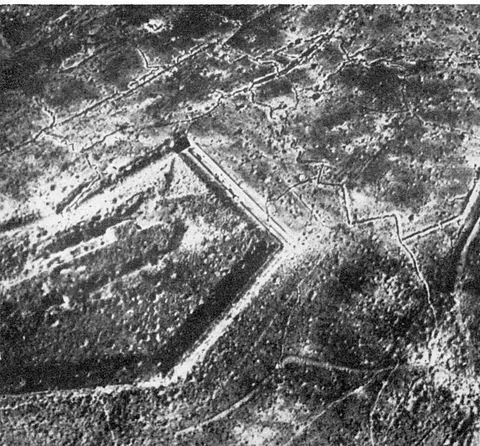 He survived it. You can just imagine the number of questions you’d want to ask about that. That’s just one experience and obviously an enormously dramatic experience, but you can just imagine the number of questions you’d want to ask about that.
05Antisemitism then and now
Moritz sees antisemitism as a permanent condition of humanity that flares up where people feel left behind.
Why do you think it is in the late 19th century that there’s such a resurgence of antisemitism in Germany, which for a while, at least by many people, was considered better than average by European standards on this question? Maybe that was an illusion, but something strange seems to happen, right?
I don’t know that it was in the 19th century, Tyler. I think it was much more in the early 20th century after the end of World War I. I think antisemitism in the late 19th century, with the Dreyfus Affair,26The Dreyfus Affair (1894–1906): Alfred Dreyfus, a Jewish captain on the French general staff, was falsely accused of spying for Germany and sentenced to life in exile. The case split French society and came with a wave of antisemitism; Dreyfus was fully exonerated only in 1906. in Western Europe, was far more prevalent in France than it was in Germany, but I think probably the influx of refugees from the East, from Russia, from Ukraine, who fled West because of the pogroms,27The pogroms — waves of anti-Jewish violence in the Russian Empire in 1881–1884 and 1903–1906. Together with anti-Jewish laws, they drove mass Jewish emigration westward, above all to the US; some refugees settled in Germany and Britain — including in the mining valleys of South Wales. probably didn’t help matters in late 19th- and early 20th-century Germany.
Until Bismarck, Germany had always had very strict—like every other country under the aegis of the Roman Catholic Church—they’d had very strict prohibitions against assimilating Jews. They were only permitted in Germany—and this dates back hundreds of years. It wasn’t anything to do with the late 19th century—in some places, they were only permitted to live in particular places, but there were a whole bunch of professions that weren’t available to them. They were tolerated as itinerants, as peddlers, as cattle dealers, as merchants.
Then, obviously, there were a few who became the favorite so-called court Jews,28Court Jews (Hofjuden) — Jewish financiers and suppliers at the courts of German princes in the 17th and 18th centuries: they provisioned armies, made loans and minted coins. The best known is Joseph Süß Oppenheimer, at the court of the Duke of Württemberg. who helped the various monarchs throughout Germany with their military undertakings, and helped finance various other exploits, but they were in a very, very small minority, but Jews in Germany as for Jews elsewhere, had always lived on the outside. It was Otto Bismarck29Otto von Bismarck — chancellor of the North German Confederation, then of the German Empire. A law of the North German Confederation of July 3, 1869, passed under him, abolished restrictions on civil and political rights based on religion; after German unification in 1871 it applied throughout the empire. who made life considerably easier for them. Even after that, they clearly weren’t in the mainstream.
Why is there such a resurgence of antisemitism today?
Antisemitism has a very long history. It’s 2,000 years old. I think it’s in the atmosphere of humanity, always has been, always will be. I’m not complaining about it. I’ve benefited vastly from being a Jew, so don’t get me wrong, I’m not whining about it or anything like that. I just think it’s a condition of the human race, and I think it flares up in societies where people feel left behind. They’ve felt that they’ve got a rough deal. Maybe it flares up too amongst people who are less well educated and for whom rabble rousers, who want to point accusatory fingers at particular people, whether they’re Haitians30Haitians: in September 2024, at a presidential debate, Donald Trump repeated a false rumor that Haitian migrants in Springfield, Ohio, were eating pets; JD Vance had spread the rumor too. or Jews or Somalis, and can stir the pot by doing so.
Clearly, social media has made it easier to spread these sorts of accusations and rumors. I think the situation in Israel31The situation in Israel — the war in Gaza that began after Hamas's attack on Israel on October 7, 2023, in which about 1,200 people were killed. clearly has not helped. This is obviously well known, and there’s this obviously amorphous border between not agreeing with the policies of the Netanyahu government, which many Jews both in Israel and outside Israel don’t agree with, and antisemitism. That, at the moment, I think inflames things further. It doesn’t help when you have the mayor of New York say he would arrest Netanyahu would Netanyahu ever set foot in Manhattan.32Zohran Mamdani, mayor of New York since January 1, 2026, promised during his campaign to arrest Benjamin Netanyahu on the International Criminal Court warrant issued in November 2024 if he came to the city. On July 22, 2026, the day after this conversation was recorded, Mamdani said the city has no authority to execute the warrant and called on the federal government to do so.
Why are the Irish33The Irish and Israel: in May 2024 Ireland, together with Spain and Norway, recognized the State of Palestine; Israel recalled its ambassador, and in December 2024 closed its embassy in Dublin, citing the Irish government's "extreme anti-Israel policies." in particular so anti-Israel and sometimes antisemitic?
I don’t know that. I just don’t know. First of all, I don’t know whether it’s true. I don’t know the stats. I don’t know the data. I would point out that the only connection between Ireland and Judaism or Israel that I know about is that the current president of Israel, his grandfather was the chief rabbi of Ireland.34Isaac Herzog — president of Israel since July 2021. His grandfather, Rabbi Yitzhak HaLevi Herzog, was chief rabbi of Ireland in the 1920s and 1930s and then Ashkenazi chief rabbi of Palestine and Israel. His father, Chaim Herzog, grew up in Dublin and was Israel's sixth president (1983–1993). Wikipedia.
There’s Leopold Bloom also in Ulysses,35Leopold Bloom — the protagonist of James Joyce's Ulysses (1922), a Dublin advertising canvasser and the son of a Hungarian Jewish immigrant. of course.
There is, yes.
06Munich, Dachau and a German passport
His trip to Germany and work on the book taught Moritz that you can never have enough passports, and the book showed him how his parents shaped him.
Now, these days, how is it you feel when you revisit Germany?
I hadn’t been to Germany for a long time. I went last summer. Oddly, I’d never been to Munich,36Munich was called by the Nazis the "capital of the movement" (Hauptstadt der Bewegung): the NSDAP gathered strength here in the 1920s, and in 1923 Hitler and Ludendorff staged the failed Beer Hall Putsch in the city. Dachau is 16 km northwest of Munich. which is where my father grew up and from which my grandparents were deported and eventually met their death and other relatives too. Munich today is, on the surface, like a charming city, very beguiling, the sort of place one might want to live. Then, obviously, every corner has a particular history in Munich, as it does in many European cities.
Last summer I went to—I don’t know who the architect was, I forget—the extremely moving building that is the new synagogue in Munich.37Ohel Jakob — Munich's new main synagogue, opened on November 9, 2006, the anniversary of Kristallnacht. The architects were Rena Wandel-Hoefer and Wolfgang Lorch. In 2003 police uncovered a neo-Nazi plot to bomb the ceremony laying its foundation stone. I actually never go into a synagogue but I had been curious about attending a service there. I tried to get into the synagogue, but because I hadn’t filled out application forms, because the security was so tight, because the police were all around it, and because I didn’t have the documentation to really prove who I was and hadn’t had authorization to be admitted, I couldn’t get into the synagogue.
Then I went to Dachau, which is not very far from the center of Munich, which is where several relatives of mine had been sent. I did what tourists do and went around it. Beyond obviously being very aware of the history of it, the one emotion it stirred up was when I was standing in a gas chamber. It was a gas chamber with multiple ovens,38Dachau — one of the first Nazi concentration camps, opened in March 1933. Moritz is describing Barrack X, the building with a gas chamber and crematorium: construction began in spring 1942 and it went into operation a year later. According to the Dachau memorial, there were no mass gassings at the camp, and why the SS didn't use the chamber for them is unknown; there is testimony that some individual prisoners were nonetheless killed with gas there. Memorial website. Barrack X at Dachau, the building with the gas chamber and crematorium built in 1942–43, now part of the memorial site. and it was spotless, really, really clean. Everything was spotless.
There were these high school students who were obviously bored out of their minds on their iPhones in there and with their AirPod earplugs in. I just stood there for a moment, shutting my eyes, wondering what the heat was like, what the smell was like, what the screams were like, what the work was like, what the stench was like. That could have been a million years ago, but that was the one place that really struck me, the vast difference between the scene that I visited and the scene as it was in the early 1940s.
The media report [that] you’re applying for German citizenship?
I actually have it. I’ve received it.39German citizenship: Moritz told the BBC in March 2026 that he was applying. People stripped of German citizenship by the Nazis on political, racial or religious grounds, and their descendants, have the right to have it restored under Article 116 of Germany's Basic Law.
You have it? Congratulations. Where in Germany do you feel most at home? Munich?
I’m not sure that I feel at home in Germany. People have asked, why did I apply for German citizenship? Do I expect to be driven out of the United States? I have British nationality as well. No, I don’t. Do I expect to be made to feel extraordinarily unwelcome and threatened and terribly frightened in San Francisco? Absolutely not. Do I envisage a time where I would be living in Munich? No.
The one lesson that I took from working on my book was you can never have enough passports. The reason that I applied was, both in Western Europe and also including the United States, the one place where the history of the ’20s and ’30s and the Holocaust is really drummed into a population40Drummed in: Germany's reckoning with its Nazi past is called Vergangenheitsbewältigung ("coming to terms with the past"); from the late 1950s and early 1960s it became part of education, church and public life, and the history of the Holocaust is a compulsory part of the school curriculum. is in Germany. Doesn’t happen in France, doesn’t happen in England or Wales, doesn’t happen in the United States.
Other than a lot of history and, of course, detail, at the philosophical level, what else do you feel you learned writing this book? More passports? What else?
Oh, one more. Yes, on a philosophical level, I’m not a philosopher, so I don’t really know what you mean.
Every venture capitalist is a philosopher, in my view.
Oh, I see. Why is that?
You have a theory of how the world will be and a theory of what makes people successful, however implicit. You couldn’t have written your Alex Ferguson book if you were not in some way a philosopher. It’s about successful organizations, sustainability, how irascibility41Irascibility: Ferguson's temper is legendary: his dressings-down, delivered at close range to an offending player, were nicknamed the "hairdryer treatment." In February 2003 he kicked a boot in anger that hit David Beckham in the face and cut his eyebrow. can sometimes make you a better mentor.
I think of philosophers as being people like the great thinkers of the past, Aristotle, Cicero. I don’t think of writing a book about leadership as being particularly philosophical. It’s a summation of observations and lessons. As I said, I’m no student of philosophy.
They wrote about exile,42Cicero spent a year and a half in exile in 58–57 BC, and Aristotle left Athens in 323 BC, after the death of Alexander the Great, fearing a charge of impiety. right, and having to leave?
Yes, they did, they did. I think the thing I learned most from writing the book was it educated me on how I became what I became, the forces that shaped me, the influences of my parents, the influences of the milieu in which I grew up. All of that shaped who I am, and I understood that a lot better after I finished working on the book.
07From journalist to Sequoia
Moritz became a venture capitalist with no plan, by sheer luck: of five firms he wrote to, one hired him.
In your life, how exactly is it that you moved from being a journalist to being a very successful venture capitalist?
There was no plan. It was great good fortune. I had wound up working in the San Francisco bureau for Time Magazine. I worked for Time Magazine for a few years at the beginning of my professional life. When I moved to San Francisco, I really didn’t know anything about Silicon Valley. I didn’t know anything about the tech industry or the tech business. Obviously, it was a lot different and smaller then than it is today.
Although I was supposed to write about all sorts of different topics, because the bureau in San Francisco covered pretty much everything from, believe it or not, Alaska down to Santa Barbara, the thing that I got attracted by was Silicon Valley. There were no technology companies in 1981, ’82 in San Francisco unless you count Charles Schwab, who had set up his discount brokerage there.43Charles Schwab founded his firm in San Francisco in 1971, and after fixed brokerage commissions were abolished in 1975 it became one of the first discount brokers in the US. I got really interested in writing about these companies, and they were really, really small.
You mentioned earlier that I had written a book about Apple. I had got to know Apple fairly well, but at the time it went public,44Apple's IPO — December 12, 1980. it had sold about 100,000 computers, 150,000 computers. It was really tiny, but I then got introduced through writing about these companies—Atari, Apple, Microsoft, Oracle,45Atari — video game company founded in 1972 by Nolan Bushnell and Ted Dabney; in 1974 a young Steve Jobs got a job there as a technician. Oracle — database software maker founded in 1977 by Larry Ellison, Bob Miner and Ed Oates. others. I’d never met anybody in Wales. I’d never conceived of the idea that anyone would start a company, let alone anybody who is 18 or 20 years old.
Then I began to understand how some of the mechanics worked, and I couldn’t start a company. I joined a company, but it was a little publishing company that didn’t require any technical skill or computer science background or electrical engineering or semiconductor know-how. I just didn’t have that sort of a background.
ExplainerHow the venture capital industry began
The first venture firm is usually said to be American Research and Development Corporation, founded in Boston in 1946 by Harvard Business School professor Georges Doriot. Its most famous deal was $70,000 for 77 percent of Digital Equipment Corporation in 1957: by DEC's IPO in 1968 that stake was worth more than $350 million.
In California the industry grew out of semiconductors. In 1957 the New York banker Arthur Rock helped eight engineers leave William Shockley and found Fairchild Semiconductor; in 1961 he and Tommy Davis opened one of the first venture partnerships in San Francisco, and in 1968 he raised the money for Intel. Fairchild alumni later became investors themselves: Don Valentine founded Sequoia, and Eugene Kleiner, with Tom Perkins, founded Kleiner Perkins; both firms appeared in 1972, and their addresses on Sand Hill Road in Menlo Park eventually became a symbol of the whole industry.
These firms are all built the same way: general partners manage money from pension funds, university endowments and wealthy families (the limited partners) for about ten years, charging a management fee — usually about 2 percent a year — and a share of the profits, usually 20 percent (carried interest). Big money came into the industry in the late 1970s: in 1978 Congress cut the capital gains tax, and in 1979 the Labor Department clarified the "prudent man rule" in the ERISA pension law, letting pension funds put part of their assets into venture funds.
Through covering these individuals, I then began to understand that there were these investors who invested in their companies, so I started writing. I did a few stories about the venture capital industry, and I got to meet several of the then-leaders of the industry, Tom Perkins, who started Kleiner Perkins,46Kleiner Perkins — venture firm founded in 1972 by Eugene Kleiner and former Hewlett-Packard executive Tom Perkins (1932–2016); it invested in Genentech, Netscape, Amazon and Google. and then Don Valentine,47Don Valentine (1932–2019) worked at Fairchild Semiconductor and National Semiconductor before founding Sequoia; he was an early investor in Atari, Apple and Cisco. who started Sequoia. I had quit Time, had cast my lot with this little publishing company48Technologic Partners — a company that published newsletters and ran technology conferences; Moritz became one of its founders after leaving Time. that many, many years later, thanks to the co-founder, was bought by Dow Jones, but that had nothing to do with me. I’d left that too.
I literally wrote letters back then—you couldn’t write emails—to the people who ran five venture firms, got rejected by four of them, and then I got really, really lucky and Don Valentine hired me at Sequoia. I think when some of his peers heard that he’d hired a history major who’d been a journalist who didn’t have an ounce of technical acumen, never worked for a Silicon Valley company, they thought he’d lost his mind.
Why not publish your book on Don Valentine? Rumor has it there are only a few copies in your Tuscany hotel.
It’s not really a book. It’s a fairly long profile of not just about Don, it’s about the early venture industry.
Many people would love to read it, right?
That’s kind of you to say that. I’m not sure that there’s enough in there to merit a book.
08Jobs, obsessives and dilettantes
What people miss about Jobs, Moritz says, is his stoicism and the melding of artist and capitalist, and he calls himself a dilettante rather than an obsessive.
What do most people get wrong about Steve Jobs?
Maybe what a stoic he was and the heroic manner in which he spent his last years, which I can barely imagine. The fact that his native wit, his raw intelligence, the melding of an artist and a capitalist, I think those are the principal things that aren’t appreciated about him. Also, I think the education he received during his years in the wilderness49Years in the wilderness: in 1985, after a clash with the board, Jobs left Apple, founded NeXT, and in 1986 bought Lucasfilm's computer graphics division, which became Pixar. In 1997 Apple bought NeXT, and Jobs returned. He was diagnosed with pancreatic cancer in 2003 and died on October 5, 2011. after he got cast out of Apple.
If we think of your interest in Steve Jobs, your book on Alex Ferguson, the art you buy, that you’ve now written a book on the Holocaust, is there some general pattern where trying to come to terms with really difficult things, is this a recurring theme in your life? Learning how to paint, that’s very hard, right?
I haven’t really thought about it that way, but I think life is made richer by having a challenge that you’re not sure whether you’re up to conquering. I’ve always been up for that. Each of these books has really just sprung out of being curious about something. I’m not sure that there’s any greater pattern than unsatisfied curiosity.
I love Otto Dix, but most people don’t like Otto Dix.
Let me know the next time you come to San Francisco.
Great.
You’ve got to come, and I’d be very happy to show you what we live with—
I’d be delighted to see it.
—that other people wouldn’t want to live with.
I love Lucian Freud50Lucian Freud (1922–2011) — British painter and grandson of Sigmund Freud, famous for portraits and nudes painted in an emphatically fleshly, unflattering way. His Benefits Supervisor Sleeping (1995) sold at auction in 2008 for $33.6 million, then a record for a living artist. as well, the greatest painter of flesh ever, perhaps, right?
Certainly in the 20th century.
Yes, maybe Rubens, you could say.
No doubt. No doubt.
You have Frank Auerbach51Frank Auerbach (1931–2024) — British painter born in Berlin; in 1939 his parents sent him to England, and they were killed in Auschwitz. He painted London and portraits in thick layers of paint, scraped off and repainted again and again. also?
Oh, yes, big Frank fan, huge.
Underrated in the United States, right?
Yes, but he’s having a show at the Metropolitan, I think it’s in two years, in New York.
I will go.
Oh, spectacular artist. I met Frank on several occasions. In a way, you were asking about Steve Jobs a few minutes ago. Steve, I think most great entrepreneurs, Bill Gates, Elon Musk, were obsessives. Frank Auerbach carried his obsession to new heights. He painted every day of the year, save for one, which was Christmas Day, when he treated himself to a day off and went to Brighton to go to the Brighton Pier on Christmas Day. Then later in life, he decided that, actually, the one day he was taking off was stealing time from painting, so he abandoned his trips to Brighton. There’s an obsessive for you.
How would you describe your greatest obsession?
I’m more of a dilettante than an obsessive because I’ve got too many interests. This isn’t false modesty on my part. It really isn’t. I just think each of these pursuits that I dabble in, each of them I could do a lot better.
That could be an obsession too, what you call dabbling in different pursuits?
Yes, or satisfying curiosity.
09China: where capitalism was ablaze
Early in the 21st century capitalism was ablaze in China rather than the US, Moritz says, and Sequoia flourished there for nearly two decades.
What is it you feel you saw early in China? Many people thought China would grow, but the notion that you could invest there and actually get a profit was arguably the better, more important insight. Around what corner did you see to grasp that?
I think it was a collective effort at Sequoia. It wasn’t just me. I think it was going to visit China and meet people, see what was happening with your own eyes. I’ve been to Hong Kong before, but I hadn’t been to the mainland. Going to the mainland, where so many preconceptions were washed away, and gradually beginning to understand, or understanding fairly quickly, that if you wanted a country where capitalism was ablaze in the early 21st century, really ablaze, it wasn’t in the US, it was in China, despite what everybody says about the Communist Party and state control. It was a country where there was a very skimpy, if nonexistent, social safety net and where people had to live or die by either the strength of their education or their wits. Then as the years went by and I got better educated about China, having a far keener appreciation of the strengths of the country as it came to grips with what technology had to offer, Sequoia flourished.52Sequoia Capital China was set up in 2005 under Neil Shen. In June 2023 Sequoia announced a split into three independent firms — Sequoia Capital (US and Europe), HongShan (China) and Peak XV Partners (India and Southeast Asia) — to be completed no later than March 31, 2024.
And I think it was one of the better decisions that we made for close to two decades in China, where it was possible to invest in pretty much anything anybody wanted to invest in any industry. It’s tightened up a lot,53Tightened up: in 2020–2021 Chinese authorities launched a campaign against private tech companies — in November 2020 they halted Jack Ma's Ant Group IPO, in 2021 they opened an investigation into Didi right after its New York listing and banned for-profit tutoring in school subjects. In 2023 the US restricted American investment in Chinese companies in chips, quantum technology and AI. obviously, in the last few years, and so the atmosphere and circumstances are different.
10The Booker Prize and literature
Supporting the Booker has shown Moritz how little he knows about literature, and both men agree fiction is in good shape.
Through Crankstart, you’ve been supporting the Booker Prize. What have you learned doing that?
Oh, how little I know about literature. I don’t read all of the submissions, obviously, and I have nothing to do with the judging of the prize whatsoever. It’s as big a mystery to me as it is to everybody else. I enjoy the challenge of going through the 12 shortlisted books54Shortlist: strictly speaking, what's announced in the summer is the Booker longlist — 12 or 13 books, the "Booker dozen." The shortlist of six books comes out in September. that come out in the summer or the books for the International Booker Prize,55The International Booker Prize in its current form has been awarded since 2016, for a novel or short story collection translated into English and published in the UK or Ireland; the prize is split equally between author and translator. because they just open your eyes new authors, countries perhaps that you don’t know very much about, circumstances that you don’t know too much about. I try to maintain a balance of reading fiction and nonfiction, so the Booker keeps me honest.
Does it feel to you like fiction is in a pretty good place right now? I argue this to my friends. They’re often skeptical, but if I think about Ferrante, Knausgård, the Sonia and Sunny book, Houellebecq, Cărtărescu,56Elena Ferrante — author of the Neapolitan Quartet (2011–2014); Karl Ove Knausgård — Norwegian author of the six-volume autobiographical My Struggle (2009–2011); The Loneliness of Sonia and Sunny (2025) — Kiran Desai's novel, shortlisted for the 2025 Booker Prize; Michel Houellebecq — French novelist, author of Atomised, Submission and Serotonin; Mircea Cărtărescu — Romanian writer, author of the novel Solenoid (2015). I think there’s a lot of great works just in the last 10 years.
Yes. Oh, I would completely agree. Douglas Stuart57Douglas Stuart — Scottish-American writer whose debut novel, Shuggie Bain, won the 2020 Booker Prize.’s one of my favorite authors as well. Storytelling, despite what everybody says about AI, great storytelling is never going to go out of style, and it begins with words on paper.
11Philanthropy and housing in San Francisco
Philanthropy benefits from people out of the for-profit world, Moritz says, and without new housing San Francisco will keep pricing people out.
How would you improve the San Francisco nonprofit community? There’s a lot of money. There’s going to be a lot more money. There aren’t that many talented people to run nonprofits. Is the whole thing just a mess? Is it doomed? Will it succeed?
I think two things. One, it’d be great to have more people in San Francisco interested in contributing in some fashion. The second is, I think, having people from the for-profit world operating philanthropies is very helpful and sets a different performance standard.
Missy Narula, who’s the wonderful CEO of Crankstart, her background before she joined us five years ago was TPG and Bain.58TPG — American private equity firm founded in 1992 as Texas Pacific Group. Bain is shorthand both for the consultancy Bain & Company and for the private equity firm spun out of it, Bain Capital. It wasn’t in the not-for-profit world. She has this wonderful ability to straddle both worlds. She has the sensibility of a person who cares deeply about others and those who are left behind. Also, the need for performance that comes out of having spent many years in the for-profit world.
I think it’s very easy for people to point fingers at philanthropies or not-for-profit services and say that they can be run more effectively. I think that’s probably true for lots of them, but you can say the same for many companies as well. What you try to do, I think, is set a standard and be the best. Also, knowing that some of the things that you’re going to try in philanthropy, just like in business, are not going to work. Harriet and I have been so fortunate. It really is our job to try and help others who just haven’t had the good luck and fortune and circumstances that we’ve both had.
There’s a great history of the arts in San Francisco: the Beat Poets, Wayne Thiebaud, Jefferson Airplane, Grateful Dead,59The Beats: in the 1950s San Francisco became one of their centers — Lawrence Ferlinghetti's City Lights bookstore and press opened here, and in 1955 Allen Ginsberg first read "Howl" here. Wayne Thiebaud (1920–2021) — painter known for his still lifes of pastries and cakes and San Francisco's steep streets. Jefferson Airplane and Grateful Dead — rock bands that came out of San Francisco's 1960s psychedelic scene. one could go on and on. Are the next 30 or 40 years going to look like that, or is everyone just priced out? Maybe they’ll live in Fresno60Fresno — a city in the San Joaquin Valley in central California, a few hours' drive from San Francisco; housing there is far cheaper than in the Bay Area. and have a patron in San Francisco.
I think that’s quite possible. Look, we’re working very hard. Daniel Lurie,61Daniel Lurie (b. 1977) — mayor of San Francisco since January 2025, having defeated incumbent London Breed in 2024. Before politics he founded Tipping Point Community, a nonprofit fighting poverty in the Bay Area. the wonderful mayor of the city, is working very hard to make it far easier to build housing. If you can’t build housing, and if developers and people who want to put up new houses are left in a straitjacket, people are going to be priced out of the city, no doubt about it. I think most people are already priced out of the city, the same as they’ve been priced out of Manhattan.
Artists have always needed to go to places where they can afford to live. I noticed that there was a piece in the New York Times over the weekend about Syracuse, New York, being a great haven for writers. Part of the reason being that it was affordable and rents were low compared to New York City and Boston. Look, housing is a huge problem throughout the country. Housing is, I think, the biggest issue in California, and it’s an acute issue in San Francisco.
12A diagnosis, a calendar and friends
After a diagnosis of supposedly incurable blood cancer, Moritz took control of his own calendar, and he says true friends are very few.
Now, your book starts with an anecdote where about 20 years ago, you were diagnosed with what is supposedly an incurable blood cancer, and yet here you are alive and kicking and just finished a book. How did it change how you allocate your time over the last 20 years? It’s at least some level of uncertainty, right?
It made me want to control my own calendar rather than have others control my calendar.
Was that good for your efficiency or just good for your happiness?
I think more for my contentment. I’m not sure that I became any more efficient. Probably pretty inefficient. I did not want to be imprisoned by obligations that only formed part of the life I wanted to lead.
How do you distinguish between true friends and others?
I think it’s the ones you want around your deathbed.
How do you know which ones they are, other than family?
Oh, there are very few of them. Through life, I think it’s very difficult to have deep relationships with a lot of people. It’s just very hard because it’s built on history, it’s built on the wavelengths missing, it’s built on shared experiences, and there’s just not enough time to do that with lots of people.
13Why Britain is stuck
Britain never recovered from losing its imperial primacy, Moritz argues, and suffers from too much government.
Why does the United Kingdom seem to be so stuck now economically, politically, otherwise? In its most fundamental terms, what has gone wrong there? There’s a lot of particular mistakes they’ve made, but why so much correlation in the mistakes?
I think it’s the residue of the arrogance of empire. Obviously, it’s the mantle. The pound sterling was the reserve currency62Reserve currency — a currency in which central banks hold reserves and countries settle trade. In the late 19th century more than 60 percent of world trade was invoiced in sterling; after World War II, under the Bretton Woods system, the US dollar became the main reserve currency. 100 years ago or so and the world’s reserve currency. Britain had the world’s largest navy,63The largest navy: for centuries the Royal Navy was the strongest in the world, but under the Washington Naval Treaty of 1922 Britain accepted parity with the US in battleship tonnage (a 5:5:3 ratio for Britain, the US and Japan). obviously had, for better or worse, its tentacles all over the world, and it was the world power. Then the mantle was lost to an entrepreneurial country.
ExplainerHow the pound gave way to the dollar
- World War I turned Britain from the world's chief creditor into a debtor, above all to the US.
- 1925–1931: Chancellor of the Exchequer Winston Churchill returned the pound to gold at the prewar rate of $4.86; exports became expensive, and in 1931, in the depths of the Great Depression, Britain had to abandon the gold standard.
- 1944: under the Bretton Woods agreements the dollar, pegged to gold at $35 an ounce, became the center of the world monetary system.
- 1949 and 1967: two devaluations — from $4.03 to $2.80, then to $2.40.
- 1956: during the Suez Crisis the US refused to support the pound until Britain withdrew its troops from Egypt — and Britain had to back down.
- 1976: Britain asked the IMF for a $3.9 billion loan, the largest in the Fund's history at the time.
- 1992: on Black Wednesday, September 16, after a speculative attack, the pound left the European Exchange Rate Mechanism.
Today the pound accounts for about 5 percent of world currency reserves, the dollar for more than half.
I don’t think Britain has ever recovered from the loss of the position of primacy. Everything, since then, has been a somewhat feeble, muted reaction to it, and where—and there’s a new prime minister64The new prime minister — Labour's Andy Burnham, previously mayor of Greater Manchester: he succeeded Keir Starmer, who resigned on July 20, 2026, the day before this conversation was recorded. who was appointed very recently, obviously—you’ve had these cycles where government is all the answer, and then certainly under the Thatcher years, and later to a lesser extent, under Blair and Gordon Brown and David Cameron,65Margaret Thatcher (Conservative) was prime minister in 1979–1990, Tony Blair (Labour) in 1997–2007, Gordon Brown (Labour) in 2007–2010 and David Cameron (Conservative) in 2010–2016. years where government wasn’t seen as the answer. It’s sad to watch, it’s sad to witness, but I think Britain overall has suffered from too much government.
14What's next: Iran
Moritz wants to learn next about Iran from roughly 1890 to 1970, where he believes many of today's problems began.
Before my last question, just to promote your book again, Ausländer: One Family’s Story of Escape and Exile. I very much enjoyed reading it. Final question, what is it you wish to learn about next?
Iran.
How will you do that? It’s hard to go there, right?
I am not talking about contemporary Iran. I’m talking about Iran—I don’t know whether or not I’ll go ahead and do it, but I’ve been reading a lot about it recently—circa 1900, 1890 to 1960, 1970.661890: Naser al-Din Shah granted the British major G. F. Talbot a monopoly on growing, selling and exporting Iranian tobacco. The Tobacco Protest broke out in response, with a fatwa calling for a tobacco boycott, and in January 1892 the concession was canceled; the protest is seen as a forerunner of the Constitutional Revolution.
The constitutional liberal era, like 1908, 1911.67Iran's Constitutional Revolution (1905–1911): in 1906 the shah agreed to convene a parliament, the Majlis, and to a constitution. In 1908 Mohammad Ali Shah broke up the Majlis by shelling its building, but in 1909 the constitutionalists deposed him; in 1911, under Russian pressure, the second Majlis was dissolved. I’m so curious as to what it was actually like back then.
Yes. I do not pretend to a great degree of deep knowledge about it, but I am extremely curious because I think so many of the issues that we confront today stem back to that period and to what happened in the early 1950s.68The 1953 coup: in August, with the involvement of the CIA and British intelligence, Iran's prime minister Mohammad Mosaddegh, who had nationalized the country's oil industry, was overthrown; after the coup the rule of Shah Mohammad Reza Pahlavi grew stronger.
Michael Moritz, thank you very much. It’s been a real pleasure.
Tyler, you’ve been extremely generous, and your questions were just wonderful. Thank you.
Much appreciated.


