


TBPN
Chapters
After a packed first day at the summit, the hosts kick off day two and note that the string of outages looks less like a cyberattack than fallout from patching bugs AI found.
Read the chapter- TBPN did 11 interviews the day before, while Gavin Baker, the hosts say, did 18 on stage across two days, plus their show, CNBC and other podcasts.
- Everyone suspected a cyberattack, but John says the cause is more likely companies patching bugs that AI tools found.
Gray says today's boom matches the railroad era in capital intensity but is healthier, because demand is running ahead of supply.
Read the chapter- Once the internet was up, dot-coms needed little investment, while AI needs trillions of dollars of physical construction.
- Railroads and fiber were built on debt in the hope demand would come, while Blackstone's portfolio companies have increased their spending on models 20-fold in a year.
- Data centers are built against long-term contracts with hyperscalers whose market caps average $2.5 trillion, which Gray says is nothing like condos in Miami during a boom.
- Shortages of chips, power, permits and capital hold back speculative building on their own.
Jordi distrusts the "everyone is compute constrained" refrain, but Gray says the biggest companies really are asking for capacity, and for now he encourages token spend.
Read the chapter- Jordi notes that in Silicon Valley it's a status thing to say you're compute constrained, especially when you have no revenue to talk about.
- Gray says big companies keep asking whether Blackstone has compute right now, and Elon Musk is the one player whose balance sheet lets him build on spec and sell capacity at spot prices.
- Building has to be done responsibly, Gray says: lower people's electricity bills, help with property taxes, work with unions, or only a handful of firms win.
- Blackstone is encouraging AI use for now, with rental applications at portfolio companies processed 90% faster, and optimizing which models to use can wait.
- Jordi likens token spend to marketing: some of the money is wasted, but what matters is learning and reallocating.
The Blackstone–Anthropic venture can't keep up with demand, and AI in biology runs into the physical world.
Read the chapter- Ode, the AI deployment company Blackstone set up with Anthropic, can't serve everyone who calls.
- AI will produce far more drug candidates, but phase three trials cost billions and run through human beings and the FDA.
- Echoing Antonio Gracias's line about moving from p(doom) to p(boom), Gray calls life sciences the tip of the spear.
Memory now competes on performance rather than bit count, and Micron is putting more than $250 billion into U.S. fabs close to its customers.
Read the chapter- For 20 years, DeBoer says, the priority was more bits per wafer, and with AI it's performance, customization and co-design with customers.
- Micron is investing more than $250 billion in the U.S., building fabs in Boise and in Clay, New York, and expanding in Virginia.
- The company's biggest customers are in the U.S., and they value an American supply.
- Asked about the pushback data centers face, DeBoer says Micron invests in roads and housing in Boise and partners with colleges and schools.
To say "no" to customers less often, Micron has ramped up R&D, and with AI it aims to design chips in half the time.
Read the chapter- The company has sharply increased R&D spending and discusses customers' products three to four years out.
- Five years ago memory was a commodity, and now, DeBoer says, AI tokenomics depend on it.
- With AI, Micron aims to design chips in half the time and do twice as many designs with the same people.
- Process technology requires bringing models in-house and fine-tuning them, while design verification can use off-the-shelf ones.
Client demand for the Anthropic IPO is strong, and Finn wants the private-public line to become a scale of disclosure, with markets working for issuers rather than around them.
Read the chapter- Finn's business has $8.5 trillion in assets and 21 million clients, and through Solium, which it acquired, the bank manages cap tables for nine of the ten most valuable unicorns.
- Demand for the Anthropic IPO is strong among both retail and institutional clients, and after the SpaceX IPO the bank shored up its technology, testing and allocation.
- The Debrief tool summarized client conversations, and the new agent actually changes a beneficiary or opens a trust, with the advisor just hitting "agree."
- The difference between private and public companies, Finn says, shouldn't be binary but tiers of disclosure and investor sophistication.
- Morgan Stanley is an issuer-focused bank, and Finn opposes SPVs and tokenized shares created without the company's consent.
Devin Bots are always-on agents that own outcomes rather than tasks, and one of them built an entire app without a human touching it.
Read the chapter- Devin Bots came out the day before, and the agents have memory, take on whole projects and work like teammates in Slack.
- Devin's Android app was built entirely by a single bot told to mirror the behavior of the iOS app.
- The price gap between the biggest and smallest models a bot uses is 10–30x.
- Cognition draws heavily on Poke, one of the earliest assistants that make decisions on their own, and Wu is excited to work with its team.
Round-the-clock AI attacks call for an agent defense force, and Cognition doesn't need its own GPT-4 because its edge is post-training on Devin data.
Read the chapter- If AI agents are attacking around the clock, Wu says, a monthly code scan won't cut it, and Alex Stamos is now the company's CISO.
- After a scan, companies find around 2,800 alerts and don't know what to do with them, and Jordi recalls that Bank of America hired 1,000 contractors after getting early Mythos access.
- Cognition has about 500 people, 75 of them in engineering, product and design.
- Cognition does mid-training and post-training on other labs' models, such as Thinking Machines' Inkling, using the tasks of Devin users, and sees no point in redoing pre-training.
Wu separates leaders who worked things out from first principles from those who rode a lucky playbook, and hires from companies famous for the skill he needs.
Read the chapter- Cognition recently brought on Chris Degnan from Snowflake, Alex Stamos, chief legal officer Paul Grewal, Brandon from Rippling and Art from Brex.
- Some leaders just followed a playbook that happened to fit the moment, while others figured out what mattered from first principles.
- Wu says to hire from companies known for exactly the skill you need, whether that's sales, partnerships or product taste.
Once AI beat humans at olympiads, the rest was obvious to Wu, the order of progress looks strange to humans, and routine software work will run on autopilot.
Read the chapter- Wu expects AI to come up with more interesting math problems than humans do.
- Once models beat humans at olympiads, the rest became obvious, and talk of a plateau doesn't convince Wu.
- John notes that the Hugging Face agent swarm hack came before he saw anyone book a haircut through ChatGPT, and Wu explains the odd order with Karpathy's "jagged intelligence."
- Tasks that arise on their own, like fixing a reported bug or upgrading to a new version, should run on autopilot, Wu says, with an always-on bot listening to customer feedback and finding and fixing regressions itself.
Agents will make personal software routine, but SaaS won't die, since nobody wants to rebuild millions of hours of someone else's engineering.
Read the chapter- Bryan Johnson used Devin Bots to build all the tools for analyzing his own measurements.
- With vendors, Wu says, what matters is who gets which data, and those that see customer data need to be locked down tightest.
- Writing software got 10 times easier, but there's no reason to replicate the millions of hours that went into Salesforce.
- Cognition considered Super Devins, Auto Devins and Otter, but kept the simple Devin Bots.
Kalanick, who took six months of weekly hits himself, sees the campaign against Huang as an op by enemies and says to own only your truth and answer with a war room rather than turtling.
Read the chapter- Kalanick got hit every Sunday night for six months, and now every "we need to talk" text triggers a Pavlovian response.
- His first principle is to own what you did but not play along with the mob or accept half-truths.
- The second is that an op isn't about past actions but about enemies who see an opportunity, and Jordi notes the hosts were talking about Megaspeed and Alice Huang 13 months ago.
- Kalanick has turtled before and doesn't recommend it, saying you need a war room and a strategic response.
- He argues nothing illegal was done, and the introduction of Alice Huang to Alibaba came before export controls existed.
To Kalanick, Nvidia without its founder isn't Apple after Jobs, because a new CEO will cling to the job and resist Huang's return.
Read the chapter- Jordi sees denial in Huang's handling: he hired a crisis comms firm a year earlier and could have taken a leave of absence instead of resigning.
- Kalanick is sure that handing Nvidia to "the suits" isn't the best version of Huang.
- Apple's transition, Kalanick says, was planned and optimistic and Jobs was celebrated, and John adds that Apple University taught his methods.
- The new CEO's number one KPI, per Kalanick, is to keep the job, which means resisting Huang's return, leaving a proxy fight at the annual meeting, probably in June.
Kalanick is buying Huang's comeback against the prediction markets, because to him the choice is between AI on our own terms and an overlord.
Read the chapter- Prediction markets give Huang 11%, but Kalanick is still a buyer because the key thing already happened: Huang said he's ready to come back.
- An actor the hosts chatted with in LA decided that "human love and lust took down AI."
- For Kalanick, the future of humanity comes down to benefiting from AI on our own terms or living under an overlord.
- Dario Amodei, Kalanick says, sends mixed signals, warning that AI might kill everyone and then launching a bio lab.
- A petition is nice, Kalanick says, but a walkout is stronger, and then he'd be at HQ with a megaphone.
Atoms' mining business is going vertical, and its restaurant-robot factory opens in Pittsburgh in the first quarter.
Read the chapter- Kalanick expects mining to grow many times over in the next 12 months, since growth is "so vertical that the curve turns to the left."
- The factory that makes restaurant robots opens in Pittsburgh in the first quarter, followed by a Robot Day.
- Kalanick calls the data center pushback a red herring, since some town will always say yes to $100–200 billion of infrastructure.
- Coogan notes that Kalanick wrote the playbook with Uber on getting a city's residents excited and turning them into advocates, something he's never seen an AI company do.
Quotes
On why the AI build-out isn't a speculative boom
“It's not condos in Miami or Dubai during a boom, where you build a bunch and then there are too many.”
Jon GrayRead from 05:59On the fashionable compute complaint
“something I've picked up on over the last year is, like, the high-status thing in Silicon Valley is to be compute constrained.”
Jordi HaysRead from 07:07On Devin's Android app
“There was not a single human who worked on that.”
Scott WuRead from 38:32On the strange order of AI progress
“I would say anyone can do the dishes, very few people can solve a Millennium challenge problem, and yet we have yet to do the dishes.”
John CooganRead from 53:46Kalanick on how a pile-on works
“That truth no longer is what is true or objective; it's only what the mob thinks. And you've got to avoid that at all costs.”
Travis KalanickRead from 1:09:10On why Nvidia's new CEO won't want Huang back
“when they finally get a CEO, that person, his or her number one KPI is ‘keep my job.’ Which means there is a natural resistance to Jensen coming back.”
Travis KalanickRead from 1:16:00On how employees can bring a founder back
“But look, petitions are nice. Walkout better.”
Travis KalanickRead from 1:21:29
Summary
TBPN's second live show from the TomorrowX summit in Austin packs in five back-to-back interviews. Blackstone's Jon Gray compares the AI build-out to the 19th-century railroad boom and explains why this one is healthier: demand is running ahead of supply, data centers get built against long-term contracts with hyperscalers, and shortages of chips, power and permits keep speculation in check on their own. Blackstone isn't cutting back on token spend yet; it's encouraging it. Micron president Scott DeBoer explains how memory went from a commodity to an AI bottleneck, why the company is building fabs in Idaho, New York and Virginia, and how AI should let it design chips in half the time.
Morgan Stanley's Jed Finn talks about heavy client demand for the Anthropic IPO, set for the next day, and what the bank learned from the SpaceX listing. He argues the line between private and public companies should become a sliding scale of disclosure, and pushes back on tokenizing shares without the company's consent. Cognition's Scott Wu introduces Devin Bots, persistent agents that own outcomes rather than tasks; one of them single-handedly built Devin's Android app. Wu explains why Cognition post-trains other labs' models instead of pre-training its own, and why AI finds a Millennium Prize problem easier than doing the dishes.
Travis Kalanick, who lived through six months of weekly exposés himself, reads out his principles for fending off an "op" against a founder and applies them to Jensen Huang: own what you did but not other people's lies, and set up a war room instead of turtling. He's convinced Nvidia's new CEO will cling to the job and resist Huang's return, and he's betting on that return against the prediction markets. He wraps up with news from Atoms: mining is going vertical, and a factory for restaurant robots opens in Pittsburgh in the first quarter.
Advice
When hiring an executive, check whether they actually understood the business from first principles or just ran a playbook that happened to fit the moment at their last company; the second kind won't repeat the success.
Look for executives at companies famous for exactly the skill you need: sales leaders from the companies that scaled sales best, engineers from the ones that build tasteful products.
Sort your vendors by what data they get: the ones that see customer data get the strictest diligence, and where you can, anonymize the data or do without it.
Even when software is 10 times easier to write, don't rebuild in-house what isn't your core competency: millions of hours went into someone else's product, and replicating them doesn't pay.
If you're the target of a smear campaign, don't turtle up: set up a war room and respond strategically, not to each hit one at a time.
When you enter a new city, turn the locals into your advocates: as Coogan points out, that's how Kalanick's Uber got its way, and AI companies aren't doing it yet.
Mentioned
 Gavin Baker00:2918 appearances over the two days of TomorrowX
 Blackstone00:57Jon Gray's firm, a data center investor
 Elon Musk03:16builds data centers bigger, faster and cheaper
 Antonio Gracias09:25shared the stage with Gray, "from p(doom) to p(boom)"
Show 48 more mentionsShow fewer mentions
 Ode12:58the Blackstone–Anthropic AI deployment company
 Pfizer14:28Blackstone's trial financing deals
 Micron Technology17:00US fabs and AI in memory design
 Morgan Stanley28:30wealth management and the Anthropic IPO
 Solium Capital29:27the stock plan and cap table business Morgan Stanley bought
 Carta29:59a rival in cap table management
 Anthropic30:29going public the day after the show
 SpaceX31:02lessons from its IPO for Morgan Stanley
 Cognition36:58Scott Wu's company
 Devin37:27the new persistent Devin Bots
- Poke39:52the assistant whose team Cognition acquired
 Alex Stamos41:24Cognition's new CISO
 Bank of America42:42a thousand contractors to patch vulnerabilities
 Claude Mythos42:42the model that found the vulnerabilities
- SWE-243:40Cognition's coding models
 Inkling44:16the open model Cognition post-trained
- Thinking Machines Lab44:16maker of Inkling
 GPT-444:45why Cognition doesn't need its own
 Chris Degnan47:05Cognition's new chief revenue officer
 Paul Grewal47:05Cognition's new chief legal officer
 Rippling47:05where Cognition's new marketing head came from
 Snowflake47:31a model of enterprise sales
 Brex48:19a model of partnerships
- Millennium Prize Problems50:33problems AI has started to crack
- Navier–Stokes existence and smoothness50:33the Millennium Prize problem OpenAI claims to have solved
 Hugging Face52:36hacked by a swarm of AI agents
 Andrej Karpathy53:16coined "jagged intelligence"
 Fireworks AI56:28a Devin Bots beta user
 Microsoft Excel57:26a tool in every clinical trial
 Bryan Johnson58:13built tools for his measurements with Devin Bots
 Salesforce1:00:28software not worth rewriting yourself
 Alienware1:03:28Kalanick's headphones
 Michael Dell1:03:42owner of Alienware
 Megaspeed1:06:38a story the hosts covered a year earlier
 Alice Huang1:06:38"she's a spy?"
 Alibaba Group1:07:05introduced to Alice Huang before export controls
 Jensen Huang1:12:09left Nvidia and is ready to return
 NVIDIA1:12:43"not letting Nvidia go to the suits"
 Tesla1:14:21would collapse without Musk
 Apple1:14:21the handover after Jobs
 Steve Jobs1:14:21a planned exit and Apple University
 Polymarket1:17:01the odds of Huang's return
- Machines of Loving Grace1:20:00Dario Amodei's essay
- Her1:20:04an AI that gets bored of its human
 Dario Amodei1:20:50mixed messages about AI's dangers
 Atoms1:22:24mining, restaurant robots and a factory in Pittsburgh
 Uber1:24:40Coogan recalls how Kalanick won cities over to Uber
- Grand Theft Auto VI1:25:20comes out the next day
Sponsors of the episode
 Ramp00:35corporate cards, bill pay and accounting
 CrowdStrike00:49AI security and breach protection
 Console16:37AI agents for IT, HR and finance employee support
 Public.com16:48investing in every asset class, with AI agents
 Shopify28:08the platform for online and in-person commerce
 MongoDB28:20the data platform for AI
 Figma36:30AI agents that create and edit Figma files
 New York Stock Exchange36:37raising capital on the exchange
 Cisco Systems1:02:48networking infrastructure for the AI era
 Codex1:02:55a workspace with AI agents
Transcript
01TomorrowX, day two
After a packed first day at the summit, the hosts kick off day two and note that the string of outages looks less like a cyberattack than fallout from patching bugs AI found.
You're watching TBPN. Today is Wednesday, November 19th,1A slip: the show aired on Wednesday, November 18; later in the episode John gets the date right. 2026. We're back at TomorrowX,2TomorrowX — a summit on AI, compute, energy and investing, held November 17–18, 2026, at the Moody Center in Austin. It was dreamed up by Gavin Baker, Antonio Gracias and Ron Biscardi of iConnections. day two.
We got Libbo on the stage.
Jon Gray coming3Jon Gray — president and chief operating officer of Blackstone, the world's largest alternative asset manager. on the show in just a couple minutes. He's going to hop on very, very quickly. And then we got Travis Kalanick4Travis Kalanick — co-founder of Uber, which he ran from 2010 to 2017; he now heads the robotics company Atoms. coming back. We also have Scott Wu, Jed Finn, Scott DeBoer. Fun show, bunch of back-to-back interviews. Fun day yesterday.
Big day for us. 11 interviews, something like that. We really pushed it to the limit. Not bad.
Not as hard as Gavin Baker.5Gavin Baker — founder of the investment firm Atreides Management and one of the creators of TomorrowX. I think Gavin Baker, oh, he's doing 18. He did 18 different...
AdRamp
No, no, no, no. 18 interviews on stage, plus our show, plus CNBC, plus other podcasts and stuff. Anyway, let me tell you about Ramp. Time is money, save both. Easy-to-use corporate cards, bill pay, accounting, and a whole lot more, all in one place.
AdCrowdStrike
And let me also tell you about CrowdStrike. Your business is AI, their business is securing it. CrowdStrike secures AI and stops breaches.
We actually have some reporting about all the outages.6The string of mid-November 2026 outages: on Thursday, November 12, Microsoft Outlook went down, and on Friday the 13th a router failure on the FAA's network grounded all US departures for several hours. "What's behind the string of tech outages disrupting business and travel?" There's more news. Everyone was like, this has to be a cyber attack. It feels like it's still downstream of AI, but much more related to patching bugs that were discovered using AI tools. So we'll dig into that more tomorrow. But we have Jon Gray from Blackstone.7Blackstone — an American investment firm and the world's largest alternative asset manager: private equity, real estate, credit. One of the biggest investors in data centers. What's going on? Here with us, back on TBPN.
02Jon Gray: a 19th-century build-out
Gray says today's boom matches the railroad era in capital intensity but is healthier, because demand is running ahead of supply.
And we have your song. This is your intro song.
Oh my God. This is unbelievable. I feel like I'm on ESPN8ESPN — America's leading sports network. TBPN greets each guest with their own walk-on music, like a player taking the field. here with you guys.
That's the goal of the show, the whole thing. We just heard you on stage. Thank you so much for making the time to come chat with us. How are you doing?
I'm good. Yeah. I'm good. I'm happy to be here. It's hard not to be excited when you're in Austin, Texas.
Yeah, no, it's great. When you're not speaking and not working, are you diving into history? Are you reading about the railroad boom?9The railroad boom — the 19th-century build-out of American railroads, largely on borrowed money and in anticipation of future demand. Overbuilding led to bankruptcies and to the banking panics of 1873 and 1893. I've listened to a few of your recent chats, and it feels like that's what you're drawing on more than dot-com.10Dot-coms — the internet companies of the late 1990s. Their stocks soared on expectations, and in 2000–2002 the bubble burst: the Nasdaq fell nearly 80%.
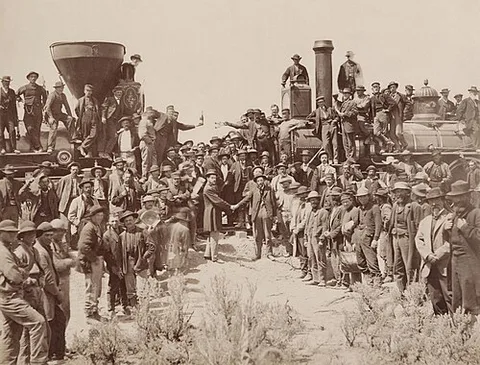
Well, I would say we're trying to find an analogy to what's happening today. And dot-com was big, but this feels much larger. And what's, I think, more similar to that late 19th century period was the huge capital intensity. In dot-com, once the internet was up, there wasn't much investment. In this case, trillions of dollars are needed to build, and that changes things.
And so there's no obvious end in sight.
Yeah. Right now, we seem to have a very profound compute shortage and an energy shortage in our country. And so it has brought our firm in in a massive way. Because if you think about it, and it's nice here, sort of metaphorically, to be in Austin, in the center of the country, because it really is the place where the tech world and the physical world come together. And that's why the conference being here makes so much sense, because this AI revolution is a combination of these two things. It is a combination of this incredible technology, most of which is developed in Silicon Valley, but then it is the need to build out these physical things.
And that requires enormous amounts of capital. And for those of us who are in New York, that's our job here. We try to provide this.
Well, and I feel like in Texas, you get the know-how too, because, you know, it's been funny to watch the sort of anti-Elon copers over the last year being like, he can't just become a hyperscaler,11Hyperscaler — a company that builds and runs giant cloud data centers: Amazon, Microsoft, Google, Meta, Oracle. these companies have been doing this for so long, blah, blah, blah. And he's like, I'm going to build them bigger, faster, cheaper.
I totally agree on Texas. It's the know-how and the can-do. It's both of those things that are here. And so what you see happening here is this coming together. And by the way, it's not just the AI infrastructure. It's defense. It's going to be pharmaceuticals. There's going to be more manufacturing build, robotics, obviously. All of this is happening, and as investors, that's what's exciting, is the scale of this. And you're right, it brings you back in history to when else did we change the world. And that period in the 19th century, we went from horses and candles and living in wood houses to living in cities and having electricity...
I kind of picture me going back to horses and candles right now. It sounds pretty good. But I know obviously there were a lot of downsides to living like that. But what is different this time? Because the railroad boom, there were busts at various times. What warning lights, what signals, what metrics are you following to see how different this is?
Well, I think back then the issue was you were building railroads, in many cases, pretty speculatively. And this is what happened in the telecom build-out of the fiber in the '90s.12In the late 1990s, telecom companies laid so much fiber in anticipation of explosive internet growth that by 2002 only a small fraction of it was in use. WorldCom and Global Crossing went bankrupt. You built supply and you hoped demand came. And in this case, the demand is growing much faster. So if you look at our companies, their spending on models is up 20-fold in the last year. Because of the productivity gains they're seeing, because of the efficiencies, the power of the technology.
I don't want to cut you off, but there's one other part of this analogy that I think is important, which is, like, railroads, you built them and they were only functional for one specific area of the country. And so if you had excess capacity, you couldn't use that track somewhere else in the world. The big difference with this analogy is, like, compute anywhere can be sold.
Yeah, assuming that, you know, our laws... If all of a sudden it's video models, or open source wins, or closed source wins, or one lab wins, the compute will flow there. Or physical AI.13Physical AI — AI that acts in the real world: robots, self-driving cars, drones.
Totally. We're all going to need it. But back then, what you were doing was building the supply and hoping the demand would come. And in a number of cases, it didn't. It was also done with a lot of leverage as well. Today, the demand is running and you're hoping to build supply to keep up.
So it's a very different dynamic between these two things. And the fact that most of this is done on long-term contracts with the biggest companies. That, again, was done by, you know, a bunch of bootstrap guys who were entrepreneurs who didn't have a lot of capital. Today, this is being led by massive hyperscalers with market caps that average $2.5 trillion, who have very little net debt,14Net debt — a company's debt minus the cash it holds. who produce enormous amounts of cash flow. And so if you think about the data center build, you build this data center when you have a long-term contract. It's not condos in Miami or Dubai during a boom, where you build a bunch and then there are too many.
In this case, you have contracted demand. And that is very helpful. And I would also point out the supply is constrained today. It's hard to get chips, it's hard to get power. Obviously entitlements are getting harder.15Entitlements — the approvals needed to build on a site: zoning, utility hookups, environmental reviews. It's hard to aggregate capital. So the supply boom, which can get you into trouble with too much speculatively built, too much leverage, that's all being constrained. And that may turn out to be a better, healthier thing. It may mean, yes, some players who made commitments...
03Compute constraints as status, and building responsibly
Jordi distrusts the "everyone is compute constrained" refrain, but Gray says the biggest companies really are asking for capacity, and for now he encourages token spend.
On X, which a lot of the people here are avid enthusiasts of, there was speculation after the blue wave16Blue wave — a big Democratic win in US elections (blue is the Democratic Party's color). Here, the midterm elections for Congress on November 3, 2026. that it was an inside job from the tech industry to slow down and prevent, like, the bubble from blowing up, you know? What do you think about... So something I've picked up on over the last year is, like, the high-status thing in Silicon Valley is to be compute constrained. So if you don't have revenue to talk about, you talk about how, oh, we're just so compute constrained. And people kind of eat it up, and venture capitalists will use that as a data point and say, oh, every company I talk to is compute constrained. But I'm sitting there being like, well, they're compute constrained because they want to be able to train a model that might have demand, and they don't even know that yet.
And so I don't really lean on that that much as a signal, that everyone you talk to says they're compute constrained. You're talking to some of the biggest companies in the world that have a lot better real-time demand for their actual compute, versus startups that are earlier stage and sort of speculating that they're going to need a lot of compute.
Yes. I would say we do talk to and invest in some of the smaller companies as well, but the bulk of these conversations are with the biggest companies, with the model companies, and they're constantly saying to us, do you have any compute today? There's some of the trading firms... The funniest thing is...
You should get on your desk, like, some GPUs.17GPU — graphics processing unit. Neural networks are trained and run on these chips, above all Nvidia's. I know Blackstone has a data center or something.
We're going to throw some GPUs there. The funny thing is, that would be worth much more if we ripped up the contracts and went to the spot market.18Spot market — a market for immediate delivery at the current price, as opposed to long-term contracts. In a shortage, the spot price of compute is higher than the contract price. I mean, if you look at what Elon has done, by building, he's the one guy, because of his balance sheet, who can build speculatively and then serve the market at the spot market, and it's working for him. And as we see shakeouts, potentially, of smaller players, I do think that will mean better capitalized folks will get this capacity. It probably means the hyperscalers and the biggest model companies will get more of it. But it is a global phenomenon, the shortage of compute. And it does feel like when we start to move to these personalized agents, to more of the physical AI, I think this problem gets tougher, because there's only so much energy and power.
And obviously there are political dimensions. We talked a bunch on stage, I did with Antonio,19Antonio Gracias — founder of Valor Equity Partners, an early investor in Tesla and SpaceX and a co-founder of TomorrowX. about the importance of us doing this in the right way. There's got to be responsible building. You've got to protect consumers, drive their electricity costs down, help them with property taxes, job creation, community give-back. It can't be a handful of technology and financial firms who are, you know, sort of the winners. It's got to be broader than that. And the economic gains here are sufficient that it can be. And so you're seeing a number of us say, we want to do this, and we're doing it in the right way, partnering with unions and local communities to get a lot of wins.
Sure. Yeah. On the demand side, how are you thinking, just as a leader, about actually underwriting huge token spends20Tokens — the units of text a model reads and writes; API usage is billed per million tokens. Agents that work on their own for hours burn through millions of them. for your workforce? Because we're getting into a regime where you can fire off one prompt, "make me an app for my company," and the bill can be $400,000. And that can provide millions of dollars of value, but you actually have to start thinking about the cash flows and all these different things. How have you been grappling with that idea of white-collar team members spending inordinate amounts?
I still think if it was on the excess use of AI to the underuse, I still think we're here. I mean, yes, you always have a few super users, but today we're really trying hard, let's say at Blackstone, to feed this and make it work in all our processes. So we're trying to encourage use. And the returns are so significant, right? I mean, at our portfolio companies I was talking about, you can process a rental application 90% faster. Ancestry.com21Ancestry.com — the largest genealogy and DNA testing service. Blackstone bought it in 2020 for $4.7 billion. is 30 times faster processing your family history when it comes in.
And so at a firm like ours, we're trying to capture all this information. In our hedge fund business, how do you take all the earnings reports that are out there, all the calls,22Earnings calls — conference calls in which a public company's management answers analysts' questions after a quarterly report. everything hedge funds are saying? You can boil this down now in real time and make better investment decisions. So I would say at this point, we're more encouraging people to use the technology, because the early gains are substantial. I do think there is some later stage where we look around and say, hey, are we driving, you know, a Ferrari to pick up the groceries? Do we need to optimize which models?
I like the idea of driving a Ferrari to get groceries.
That sounds fantastic. No, I think another comp that's worth using here is, like, marketing organizations. They allocate money to marketing, and then a lot of it ends up being completely wasted and ineffective. And that doesn't mean you should stop marketing. And in fact, you should still be aiming to spend more money on marketing, as long as your overall efficiency, the blended cost, the sort of blended efficiency of your marketing machine... People have these stories of, like, yeah, one person spent way too much money. But it's like, okay, did you learn that that's not a good use of tokens, and are you reallocating them? And I think, like, marketing teams have been comfortable with, yeah, we spent $50,000 on this thing, it didn't work. Or in some cases, we spent a million dollars on this campaign and we're not going to do it again.
But you learn and then you optimize. And that's what we're encouraging the companies. And there are just a lot of things that are pretty straightforward. I mean, content creation: companies can create their own ads now at a fraction of the cost. And so you're really empowered when you want to do this sort of stuff. And to me, it's exciting. We've just got to do a better job. We've got to push our teams to do better.
04Ode, biotech and the trials bottleneck
The Blackstone–Anthropic venture can't keep up with demand, and AI in biology runs into the physical world.
We created a company with Anthropic called Ode,23Ode — an AI deployment company that Anthropic, Blackstone and other investors set up in July 2026 with $1.5 billion in capital. Its engineers work on-site at clients, including Blackstone portfolio companies. which is a deployment company. Their biggest challenge is serving everyone who's calling them for business, having enough people. So I still think, when I think about diffusion,24Diffusion — the spread of a technology through the economy: it usually takes years or decades to go from invention to widespread use. I think about us, very early days. There's a lot of room to run here. But I do think at some point, yes, more cost sensitivity will come into play, but I don't think that's the primary focus now.
How are you thinking about AI and how it intersects with biology and biotech? There could be a really broad boom where we're seeing lots of different companies take drugs through trials, more IPOs. There could be, you know, the big biotech companies just get bigger, the labs could do things.25The labs — the developers of frontier AI models, such as OpenAI, Anthropic and Google DeepMind. How are you thinking about that?
Well, the interesting thing is on the front end of innovation, this is going to lead to many more potential therapies. Because you're going to be able to do sort of synthetic chemistry and biology in a way you never could. And that is hugely exciting. And when we think about the future of cancer care, neurological diseases, pulmonary, I think it's going to be radically different. I think this is the most promising thing that is out there. I think the limiting factor you have to remember is you've got to go through the physical world when you get to trials. And that's when you go from this huge funnel of ideas. It's not deploying code on AWS.
Yes.
So we have a big business that invests in phase three trials.26Phase three — the last and most expensive stage of clinical trials before a drug is approved, testing it on thousands of patients. Blackstone Life Sciences funds such trials in exchange for a share of future sales. We've announced a number of major deals in the last few weeks with J&J27J&J — Johnson & Johnson, the American pharmaceutical and medical products company. and Pfizer and so forth. Those trials cost a billion, multiple billion dollars. And they involve human beings and processes and the FDA,28FDA — the US Food and Drug Administration, which approves new drugs. and then you've got to do it globally. So I think the exciting part here is all the new therapies that will come. I think the hard part remains that tight part of the funnel, where it's like, hey, you got to go through the real world.
And I'm hearing that capital might be a constraint, and that tells me it's your problem. You got to figure this out.
So we like when there's capital as a constraint and we have expertise, knowledge in a space and we can bring capital. We see that as an opportunity. Yeah, well, but I would say in this case, what we love about it is you can be a real force for good. Anything we can do to accelerate human health is the best. And as we talk about this AI thing and all the concerns and negatives, I do think the positivity... I think Antonio said, what was it? He wanted to go from p(doom) to p(boom),29p(doom) — "probability of doom": a half-joking, half-serious estimate of the chance that AI leads humanity to catastrophe. p(boom) flips it into the probability of prosperity. or something, was his line. I think life sciences is the tip of the spear.
For sure. There's a bunch of grounded people, you know, they don't like the chatbots, but if you cure your disease, if you get rid of your allergy, or even just get rid of the common cold, people will be happy.
Yes, it'll make a huge difference. And by the way, entrepreneurship, the ability to start companies, you're seeing that in company formation today. Education getting democratized: you don't have to live in Cambridge, UK, or Cambridge, Massachusetts, to have the greatest professor in the world. It's amazing. There's this blue-collar job boom. There's a lot of good things. There will be challenges. And as a society, we've got to make sure of job transitions, skills training. We've got to be sensitive to this. But I do think there's a lot of good things that will come from what's happening. So that's why I'm excited to be here.
Thank you so much for coming on the show, Jon.
I'm so excited. You're a star. Thank you so much for coming on the show. We have our next guest joining in just a second.
AdConsole
Let me tell you about Console. Console builds AI agents that automate 70% of IT, HR, and finance support, giving employees instant resolution for access requests and password resets.
AdPublic
And I'll also tell you about Public. Invest across all asset classes, automate anything with AI agents. Run trading strategies, risk management, monitor money movements and monitor markets with AI agents for investing on Public.
05Micron: memory and fabs in America
Memory now competes on performance rather than bit count, and Micron is putting more than $250 billion into U.S. fabs close to its customers.
Scott, president and CTO of Micron,30Micron — an American maker of DRAM and NAND memory, one of the world's three largest DRAM producers along with Samsung and SK Hynix. It also makes HBM memory for AI accelerators. with us.
Welcome to TBPN. How are you doing? Good to see you. Thank you so much for taking the time. Would you mind kicking it off with a little bit of an introduction, since it's the first time on the show?
Sure. Absolutely.
And we're going to adjust this right here. There we go. There we go. Production likes to do that.
Yeah, so I'm president of Micron, and focused on technology and products and our long-term roadmap, and focused with our customers on delivering great products.
So what goes into actually making sure that you're on Moore's law,31Moore's law — the observation by Intel co-founder Gordon Moore (1965, revised in 1975) that the number of transistors on a chip doubles roughly every two years. that it's getting better every year? I've always been fascinated by the idea that, simultaneously, computers get more dense, more efficient, more effective every year, like clockwork, when you zoom out. But when you zoom in, it's got to be crazy on a day-to-day basis, on a month-to-month basis. How is it that we have a smooth line?
It's definitely a pretty crazy situation, and different through time, too. I think really big transitions through memory over the past 20 years in terms of growing bits per wafer32Wafer — a thin 300 mm disc of silicon on which hundreds of chips are made at once. and improving the cost structure. And then, in the past few years, especially with AI, more focused on performance and customization. Less bit growth, raw bit growth, in terms of technology, but more and more performance coming into the memory products, and more and more co-design with our customers.
That makes sense. And then now I imagine that there's so much demand that it's not just enough to make each wafer better, to make each chip better. You also need to just make way more of them. What has been the plan to date? What does the future look like for your manufacturing footprint?
So definitely, given the situation, the tightness of memory,33Since 2025, demand for memory for AI accelerators, above all HBM, has outstripped supply: manufacturers shifted capacity toward it, and prices for ordinary DRAM shot up. and, you know, across really multiple years now, we're majorly focused on expansion across the globe, certainly, and especially in the US, with more than 250 billion of investment coming. You know, a massive facility underway in Boise, Idaho, right now.
Congratulations. I think I saw the news. I was very excited.
Yeah, yeah, we're really excited about that. And a bigger, even bigger facility underway in Clay, New York.34Clay — a town near Syracuse, New York, where Micron is building a complex of up to four fabs, the largest semiconductor project in US history. And an expansion in Virginia also. So just a number of the biggest projects we've ever done, some of the biggest industrial projects the US has ever seen, and bringing more memory to the market.
Three American cities. Is that just because you're purely patriotic, or is the United States uniquely good at building huge manufacturing centers now? It seems risky, it seems contrarian to not go to the cheapest location, where the labor's cheapest. I'm a bald eagle and I applaud you for building in America, I love it. But why? Why is it a good strategy?
It's a good strategy for a number of reasons. But also, I'll add, we have expansion projects in a number of other countries as well, across Asia. And it's just a lot of focus uniquely in the US now, primarily because of the customer base in the US. They're here. And certainly the aspects of having more US supply to match up with those customers, really important in today's world. And so it's really balancing our output across the globe.
But definitely the opportunities in the US... Our R&D is in a number of countries, but our base is in the US, and more and more customer partnership is becoming important in how we build our products. So it's great to have manufacturing in the US, close to those customers.
When you build a manufacturing hub, what are the key ingredients to making that go smoothly? Because we're seeing data center pushback. And we were always saying that it was odd that for a moment they were getting rebranded as AI factories,35"AI factories" — Jensen Huang's name for AI data centers: they "manufacture" tokens the way a factory makes goods. because people don't like shoe factories in their neighborhoods, usually. NIMBYism36NIMBY (Not In My Back Yard) — local opposition to construction near one's home, even from people who support it in general. is everywhere in this country. No one wants a smokestack. But I imagine that you've put years and years of effort into making the best, most efficient manufacturing centers you can. What's the secret to success?
We have, and, you know, there's a few secrets to that success. Our headquarters, of course, is in Boise, Idaho. It's where the company was founded. And, you know, we've had a significant positive impact on the community in Boise, and we're very conscious of interaction with the local environment, with the cities that we're in. Certainly in Boise, but also in New York, making sure that we partner with those cities upfront, with the community colleges, with the local schools, with the whole ecosystem. In Boise, we recently made significant donations to improve roads and housing. So I think we've been very focused throughout the process, but really throughout history, on how we interact at every city that we're in and having a positive environment. I think that's one of the big things about New York, where there wasn't a lot of industry where we went in there: just the aspect of bringing the thousands of jobs into that economy, and making sure that we hear from the community and understand how we're going to impact them in a positive way.
And those are more permanent jobs, I imagine, because you're manufacturing ongoing.
Absolutely. Not just Micron, either. We bring a substantial influence of all the partner companies that support the infrastructure and fab facilities, not to mention retail in the surrounding area, restaurants, you know, all these others. Thousands of jobs in all these locations is a big positive impact, so we're really proud of it.
06Micron: roadmaps and AI in chip design
To say "no" to customers less often, Micron has ramped up R&D, and with AI it aims to design chips in half the time.
Talk about when do you have to tell customers no. Not on the demand side, but, like, they want you to do something, and you're working against multi-year lead times, and you just have to say, like, sorry, no. Because in a perfect world, you're like, yeah, we can do that. But in this game, you're constantly iterating. You're on your own roadmap, they have their roadmap. Everybody's trying to predict what capability will be needed in two years, three years, four years.
Yeah, you know, it's a great question. I think one aspect of that is we've massively increased our R&D spending over the last few years, to support more of the yes answer on that to our big customers, and be able to understand what their roadmaps really involve. And very much so, we're in the middle of discussions with those customers in ways we never used to be, in terms of their products for three or four years from now, and making sure that our products and roadmap line up with them where we need to build in features or co-design products with them. So a big part of the answer is we've expanded our capacity to be able to say yes more often to the big trends. But absolutely, we also have an evolving roadmap, where they don't always know where they're going either. And at times we can't support every customer. And, you know, we have to just respectfully be part of the process and make sure that we align things, and they understand when we don't have the capacity to do certain things.
Yeah. I mean, Micron's been called a bottleneck. I hope that's a badge of honor and not a critique.
Oh, it means you're important.
It means you're important. But it's kind of a twofold bottleneck, right? Because it's supply: people want more of the great chips that you already make. And then the individual models can be bound by a particular architecture. Talk about the evolution of the AGI-pilledness37AGI-pilled — slang for being convinced that AGI, human-level artificial general intelligence, is coming soon. A nod to the red pill in "The Matrix." in Micron. Because different manufacturers have had... oh, well, there's a crypto boom, maybe we should do a little more, but maybe not. I don't want to be the end of the bullwhip,38Bullwhip effect — small swings in end-customer demand get amplified up the supply chain, so at its far end, at component makers, they turn into huge swings in orders. right? Internally, culturally, what has it been like watching this boom? And then how confident have you... or how have you built confidence around, okay, this is the end of history in terms of architecture, we can build against this roadmap for years?
Yeah, I think that's a really interesting question. And, you know, our company, not just in terms of the products we're making right now, but we're very focused on AI utilization internally. And it's dramatically changing how we design products, how fast we can design products. And at the same time, even though we're becoming more and more efficient, we're also expanding our company in terms of people, because it is a very labor-intensive thing. So it's kind of a combination of those two things. And AI for our company, of course, because of how important and how centric memory is to AI... It's really a key piece of everything about how tokenomics39Tokenomics — here, the economics of generating tokens: the cost and speed of model responses. Generation is limited by memory capacity and bandwidth. work, is memory capability going forward.
The company has raised up in terms of understanding they're part of a bigger and a different kind of part of the ecosystem now than ever before. And so there's a lot of excitement there and great adoption of AI. And it's also exciting to be really connected with our customers in ways that we never used to be when memory was a commodity,40Commodity — an interchangeable product that competes only on price. For decades memory was exactly that, with brutal boom-and-bust cycles. you know, even five years ago. But certainly through history, memory had a very different role. Today, with memory-centric computing, it's just such an exciting time to be really part of how AI takes place. And we're just at the beginning of AI.
So talk a little bit more about how Micron uses AI internally. I imagine two years ago there were meeting note-takers and email summaries, like everyone had. But today, are you seeing the latest models actually be useful in design, in these really hard math challenges? Is that generalizing? Because we don't see a lot of, like, memory design benchmarks. We do see the Millennium Prize problems.41Millennium Prize Problems — seven major unsolved problems in mathematics, each carrying a million-dollar prize set by the Clay Mathematics Institute in 2000. Only the Poincaré conjecture has been officially recognized as solved. And you can think, okay, maybe that would generalize. But is it? Are you feeling acceleration?
Yeah, it's pervasive across all aspects of our product development right now. That's actually the place that it's implemented the most. Of course, like every big company, we're utilizing it for workflows across all the segments. Absolutely. But really, engineering is where we've taken the lead on actually impacting the timeline, and targeting to get designs done in half the time that we got done before, and being able to do twice as many designs with the same number of people in that period of time. So really changing things. We do, of course, coding, but we're doing more and more of design verification42Verification — checking that a chip design works as intended before it goes into production. It takes up most of the development time. and, you know, physical AI, in terms of building it into how we simulate process, how we simulate thermals, how we simulate the physics of our chips.
Do you have a house view on whether you think the big models will just learn to do this and be great at it out of the box, or you will need to fine-tune with proprietary data, either in partnership or using open source or doing something else? Do you have a view on how spiky the intelligence is43Spiky (or jagged) intelligence — models brilliantly handle some hard tasks and unexpectedly fail at others that are easy for humans. relative to your business?
So there's definitely aspects of our business that have to be internal, and we have to bring the models in and optimize them around that. Especially in the process technology, bringing those forward can't really be done without bringing them internally. There's other aspects, like certainly the design verification pieces, that are very common across the industry, that are just impactful right off the bat. And then we can partner with a variety of AI companies to move that forward. So I think it's a mixture of both, in terms of your question.
Yeah, depends on the... You got to use the right tool for the job. Makes sense. Thank you so much for coming on the show. Great talking to you. Have a great rest of your day at TomorrowX.
AdShopify
And we will bring in our next guest, but not before I tell you about Shopify. Shopify is the commerce platform that grows with your business and lets you sell in seconds online, in store, on mobile, on social, on marketplaces, and now with AI agents.
We got Renee.
AdMongoDB
I'd love to also tell you about MongoDB. What's the only thing faster than the AI market? Your business on MongoDB. Don't just build AI, own the data platform that powers it.
07Morgan Stanley: the Anthropic IPO and private markets
Client demand for the Anthropic IPO is strong, and Finn wants the private-public line to become a scale of disclosure, with markets working for issuers rather than around them.
We have Jed Finn from Morgan Stanley.44Morgan Stanley — an American investment bank, one of the largest in the world. Welcome to the show. What's going on, guys? How are you doing, Jed?
Great to have you.
Great to have you. How has your TomorrowX been so far? You enjoying it?
And Morgan Stanley's a sponsor. I saw them on the ticker, correct?
Yeah, it's great. Why don't you introduce yourself? First time on the show. Tell everyone about your role.
Yeah, it's great to be here. Thank you for having me. I run the wealth management business45Wealth management — investment, tax and estate services for wealthy clients. It's Morgan Stanley's largest division. at Morgan Stanley, which is the largest full-service wealth management firm in the world. We have about eight and a half trillion of assets.
I really want to know how many assets are represented in this room, because you might hit it. It's chunky. I'm going to guess closer to a trillion than... you know, I don't know which of the speakers are still here.
There's a lot of prospects here as well. But yeah, eight and a half trillion of assets. We have 21 million clients, and we have our advisor channel, our E*Trade channel,46E*Trade — an online broker for individual investors; Morgan Stanley bought it in 2020 for about $13 billion. and our workplace channel. That's what we focus on.
Yeah, oh yeah, you acquired Solium,47Solium — a Canadian company behind Shareworks, a platform for administering employee stock plans. Morgan Stanley bought it in 2019 for about $900 million. right? Solium in 2019.
That's right. Yeah, for employee stock options.48Employee stock options — the right to buy company shares at a price fixed in advance; the main form of compensation at startups. And so there's a public equity admin component to it, and then there's a private cap table management49Cap table — the register of who owns how many of a company's shares, options and other stakes. component. So we're the cap table manager now for nine of the top 10 unicorns50Unicorn — a private company valued at more than $1 billion. by market value, for 75% of the top 100, and for 50% of all almost a thousand unicorns.
Yeah, and that goes for, like, pre-IPO access51A cap table platform knows every shareholder of a private company, so it can be used to sell the company's shares on the secondary market before the IPO. as well.
Well, it's a glide path, right?
When it's two people in a garage and you just need someone to track who owns what, we can do that, as you...
I did not realize you had gotten that much market share, seemingly very quietly. Because, I mean, all the cap table upstarts, and even Carta,52Carta — an American service for managing cap tables and stock options, the standard for Silicon Valley startups. they do quite a bit of marketing around this category, and it seems like you guys have...
Carta is a great partner of ours, actually. And when those companies outgrow the private side, Carta refers them to Morgan Stanley to go private to public.
How is the firm thinking about the IPO tomorrow? Anthropic is going out, maybe pricing later today.53Anthropic set a price range of $70–78 a share; the offering was to be priced on November 18, with trading on Nasdaq under the ticker ANT starting November 19, 2026. How is the client base reacting? What can you tell us about Morgan Stanley's view on Anthropic?
ExplainerHow shares are allocated in an IPO
Before an IPO, the underwriting banks run a roadshow: the company pitches itself to big investors while the banks collect orders, how many shares each is willing to buy and at what price. This is called bookbuilding.
On the evening before trading starts, the company and the banks set the offering price (pricing): usually within the announced range, but higher if demand is strong. Anthropic announced a range of $70–78 a share; pricing was scheduled for November 18 and trading on Nasdaq under the ticker ANT for the 19th.
Then the shares are allocated. Demand in hot IPOs is usually many times greater than supply, so everyone gets only part of what they asked for, and the lion's share traditionally goes to institutional investors. Retail brokers, including Finn's division with its advisors and E*Trade, get their own allotment and split it among clients by their own rules, which is why the technology, testing and allocation rules he talks about matter so much to them.
There's a lot of demand. There's a lot of demand. I mean, it's tough, right? Because the TAM54TAM (total addressable market) — the entire available market, the most revenue a product could possibly earn. for intelligence is kind of all the dollars. And, you know, if you think about it just from an upside-downside perspective, it's really tough to predict what the upside could be, but it's really large. And the downside, of course, is what you just put in. And so there's a lot of excitement from our client base, both on the retail side and on the institutional side.
That's great. That's great. Are you taking any lessons from SpaceX here? Tell me about what was going on at the firm during the SpaceX IPO.55The SpaceX IPO — the largest listing in history: in June 2026 SpaceX went public on Nasdaq, raising about $75 billion at a valuation of about $1.75 trillion. Morgan Stanley was one of the lead underwriters. That was previously unprecedented. I feel like we're in another moment like that.
Yeah, well, just like anything else, when you do it a couple of times, you start to build this operating rhythm. And so we know... You know, SpaceX was great, it was a success. They're a really important part of the firm. But there were things that we learned on the technology side, on the testing side, on the allocation side. And so we've just further strengthened those processes and worked with all of our market partners in particular to make sure that, you know, the rails work. And we're feeling pretty confident and optimistic.
How are those rails looking different today, in the age of AI, versus a few years ago?
Well, the private to public isn't a huge difference. I think what's different is the narrative, the market opportunity, how people want to play the different market opportunities that evolve. Obviously there's a wide range of views on: is it a bubble, no bubble, what's going to happen? And so I think there's just another level of discussion that needs to happen as people think about committing capital.
Yeah. And then in terms of the clients, how are they responding to the adoption of AI tools at Morgan Stanley in wealth management? Because I can imagine people are like, hey, look, as long as the spreadsheet of my net worth is correct, I don't care if you use Python or an LLM,56LLM (large language model) — a model like GPT or Claude. it just needs to be accurate. But they probably still want to have a conversation with a real person. How is that evolving?
Yeah, look, that's our core thesis. You just described it very well. We're rolling tools and capabilities out in phases, right? So we're starting with our financial advisors, who now can interact with their book, their clients' portfolios, in a much more natural-language way, using a number of agents to build portfolios, change portfolios, you know, tax-loss harvest,57Tax-loss harvesting — selling investments that have fallen in value so the realized loss offsets taxes on gains elsewhere. et cetera. We're also building the capability for, ultimately, our clients' agents to have that curated experience with our system, but we need to build the rails around that. So there's been a lot of talk about: are you letting agents into the system, yes or no? And for us, we are ultimately going to, but we need to make sure that experience is curated. But clients are going to increasingly demand it, and we obviously respond to client demand.
Yeah, there's also an interesting thing where, I mean, I'm sure with many of your clients, they interact with a banker over email or text message. And agents, if they can send an email, they can interact with Morgan Stanley one way or another. And so that's sort of inevitable.
It's not one or the other. Let me give you an example. We were early with a tool that we built called Debrief, which was essentially listening to a client-advisor discussion. At the end of the discussion, what it would do is summarize the discussion, send an email to the client, and then put the notes in the internal CRM58CRM — customer relationship management, a system that tracks clients and every interaction with them. tool. The next iteration of that is an agent is listening and actually taking the action. So if you say, I want to change a beneficiary, or I want to open up a trust account,59Trust — a legal arrangement in which assets are handed to a trustee to manage for the benefit of beneficiaries. In the US, a popular way to pass on an estate. it will actually do that all in the background now, and the advisor just hits "agree." There's still a human in the loop for now, and as regulations evolve, we'll see how that ultimately shakes out. But it's just making the next step seamless. So everything becomes easier and simpler for our advisors and our CSAs, so that they can do the thing that matters most, which is spend time with clients.
Yeah, yeah, that makes a lot of sense. How do you think the private markets in, let's say, the small business category, one to 50 billion, let's say, how do you think activity there needs to evolve? I imagine, given your position at the firm and how many clients you guys have, you've seen some, like, wild structures and attempts at getting exposure. And I'm sure you guys have clients come in that tell you, hey, I'm doing this deal, and maybe sometimes you're like, what? I guess, if you could snap your fingers, what changes would you make in terms of the overall market structure?
Sure. So the first thing that I think is clear is that the difference between private and public ought not to be a binary distinction, right? What it ought to be is levels of disclosure, and a gradation of that, and then levels of investor sophistication, right? So that seems like a structural thing that ought to change. I can't predict when that's going to happen. But, you know, if you want to share nothing with your investors, then it's just going to be the biggest institutions in the world that can invest.
If you want to go all the way to Sarbanes-Oxley,60Sarbanes-Oxley Act (2002) — passed after the Enron and WorldCom scandals, it imposes strict reporting and internal control requirements on public companies. Compliance is expensive, which is one reason companies stay private longer. massive disclosures, then retail investors. And there's probably some categories in the middle, about level of information and sophistication. That's one thing. The second thing is, a lot of the innovation that's happened in the marketplace, particularly on the private side, has been done not necessarily in concert with the companies themselves. It's been done to the company. So there was a bunch published about, you know, wrapping an SPV61SPV (special purpose vehicle) — a company set up for a single deal. Investors pool money through an SPV to buy shares in a private company. of shares that did or did not exist, and some companies got upset.
ExplainerTokenizing shares without the company's consent
Demand for shares of private companies like OpenAI and SpaceX is huge, but ordinary investors can't buy them. Middlemen have found workarounds. One is the SPV: a special company buys shares from employees or early investors and sells investors stakes in itself. Sometimes the middleman sells SPV stakes before it actually owns the shares, or the deal violates the company's bylaws, which prohibit resale.
The second route is tokenization: a broker or crypto exchange issues a token that tracks the share price and sells it to customers. The buyer doesn't own the share itself and gets no shareholder rights. In July 2025, Robinhood handed out tokens tied to OpenAI shares in Europe, and OpenAI publicly stated that these were not its equity and that it had not approved the deal. In September 2026, AMC chief Adam Aron lashed out at Robinhood over a token on AMC stock issued without the company's consent.
Companies aren't happy: they don't control who becomes their "shareholder," and when such products go wrong, it hurts their reputation. Finn contrasts this with the approach of a bank that works for the issuer: expand access to the shares only together with the company and on its terms.
There was a well-publicized spat over the summer between a tokenizer and a tokenizee who didn't want that to happen. At the end of the day, for us, we're an issuer-centric firm,62Issuer — the company that issues the shares. An issuer-centric bank works for the company rather than for the investors who want its stock. right? We are there for the company, and we are building the capabilities to make it easier for those companies to be able to access capital markets on their terms. So that's a very different mindset from what a lot of the, you know, market investors' hostile approach of, like, "I don't care that you don't want us to do this, we're doing it because we have demand."
It's just like, he's on the side of Mac Graham.
Yeah, yeah, we love to see it. But the other thing is, you know, the value proposition to the investor and the employee is always clear. What is the value proposition to the company? I mean, I think you have to be very clear about why it's good for you to broaden the distribution, and they have to support it, because it's their company and they're building the equity over time.
It makes a ton of sense. Jed, thank you so much for coming on the show.
Hope to see you later. Have a great event. Thank you so much for coming on TBPN.
AdFigma
Let me tell you about Figma. Agents, meet the canvas. Your AI agents can now create and modify your Figma files with design system context.
AdNew York Stock Exchange
And let me also tell you about the New York Stock Exchange. Want to change the world? Raise capital at the New York Stock Exchange.
08Scott Wu: Devin Bots
Devin Bots are always-on agents that own outcomes rather than tasks, and one of them built an entire app without a human touching it.
We have Scott Wu coming63Scott Wu — co-founder and CEO of Cognition, a former competitive programmer and gold medalist at the International Olympiad in Informatics. on TBPN. Welcome to the show, Scott. Come on down. Come on down to TomorrowX. How are you doing, Scott? Good to see you.
Throw that headset on.
Co-founder, CEO of Cognition.64Cognition — the American company behind the AI coding agent Devin. In September 2026 it raised more than $2 billion at a $48 billion valuation. How are you doing?
Needs no introduction at this point.
Yeah. No, I'm doing good, dude. Thank you for having me. I'm here for, like, a day or so in Austin. It's cool to see the energy.
It's nice. Well, take me through the latest announcements from Cognition. Because I've heard a bunch of things, and I need to reset, because I think some of them might not have been launched yet. So I want you to set the table for me so I don't accidentally leak something. A lot of exciting stuff, but what's actually out?
Good call. So yesterday we just released Devin Bots.65Devin Bots — Cognition's new product, released the day before the show: always-on instances of Devin with memory that run whole projects and talk to the team in Slack. Okay, good. Yeah, so we can talk about that now. Great. But yeah, we had a nice launch on Twitter. I think in one line, basically, it's these persistent agents that can actually own outcomes instead of tasks. I think it's basically taking Devin one step closer.66Devin — the AI coding agent Cognition unveiled in March 2024 as "the first AI software engineer." I mean, the whole vision, even from two, three years ago, was, you know, building the AI software engineer, the virtual teammate, and so on. And I think it's taking it one step closer to that, where it has memory, it can take on a full project, it can really, really delegate and run things en masse, can own a goal.
So let's separate the technical from the functional. At what level of abstraction are we prompting at this point? Are we just saying, like, build the website, make me money, make me happy? The EBITDA machine,67EBITDA — earnings before interest, taxes, depreciation and amortization, a popular measure of operating profit. right? You know, it'd be nice if we had some more revenue. Because we're going up the abstraction layers, I think, and we're closer to the top than we've ever been...
With engineering tasks specifically, it's like, I want to build this application, and then we're going to get to a point where you guys just give them a price and you hit confirm.
No, so I think that's right. And I think it is already going much closer. I mean, a good example of this: so obviously Devin has a mobile app. We've had an iOS app for some time. We have an Android app now. There was not a single human who worked on that. And so there is just one Devin Bot whose job is basically like, look, look at the iOS app; whenever there's new changes that come in, build the whole thing, test it out, make sure you make it mirror the behavior of the iOS app. It kind of just works.
The prompt is basically, like, "Android app, please."
That's right. Yeah, yeah. Similarly, it's like, you know, we run a lot of, obviously, inference kernels68Kernels — small programs that run directly on the GPU. How well they're optimized determines how many responses a model can serve per second. and things like that. We have this always-on Devin that's just like, okay, just go optimize. You know, it's actually a very nice use case, I would say, for bots. It makes you feel the RSI,69RSI (recursive self-improvement) — AI improving its own code and training, with each new version doing it better; a scenario that could lead to an intelligence explosion. at least a little bit. Because, you know exactly what the token output is supposed to be. You can run all the benchmarks in terms of what your GPU throughput is and so on. And it's just like, as you're finding optimizations for your specific set of prompts, you can go and do that and improve your...
So then, under the hood, how much routing70Routing — the system itself decides which model to hand a task to: hard ones to a big, expensive model, easy ones to a small, cheap one. is going on? Can you try and just maybe scope it in, like, orders of magnitude? Can Devin Bot actually call a model that is extremely expensive, and then also simultaneously delegate to a model that is a hundred times cheaper? Is that how wide we're talking, or is it one order of magnitude?
A hundred is maybe a little bit much, but it's probably in, like, the 10 to 30x range, in terms of the biggest to the smallest. And so that routing, I think, obviously routing has been a big thing probably for the last six months or so, I think, for all of us, of really seeing that. I think actually a lot of the big diff, too, is just going through all the little product kinks that make it a really, really good experience. I mean, I think recently a lot of these guys, like Instinct and Muse and Grokbot and so on, have done that on the kind of personal assistant side, of solving the product experience of what does it mean to have an agent that has access to your stuff and actually makes decisions. And I would say one of the earliest, actually, of those was Poke,71Poke — an AI assistant you talk to over text message. Cognition bought its maker, The Interaction Company of California, in July 2026. which is The Interaction Company, and that's part of the reason that we were so excited about working with that team. I've known Marvin72Marvin von Hagen — co-founder of The Interaction Company and creator of Poke. for years and years. But I think incorporating a lot of that, but obviously from the perspective of a teammate at work. And so what does it mean to actually have it be... You know, every Devin Bot, for example, is a separate instance that you can talk to in Slack. Other people on your team can be working with it simultaneously. It can go and proactively look at channels and message, and all of the things that you'd want it to go and do.
09Security and building your own models
Round-the-clock AI attacks call for an agent defense force, and Cognition doesn't need its own GPT-4 because its edge is post-training on Devin data.
How are you guys working with customers on cyber right now? I think, obviously, we've seen outages driven by attacks. We've seen outages driven by people saying, we need to take our systems down, fix them before, you know, a bad actor gets involved. I'm sure you guys are really focused on this.
For sure. Yeah. So we've been doing a lot more lately. We brought on, actually, Alex Stamos,73Alex Stamos — former chief security officer at Yahoo and Facebook and founder of the Stanford Internet Observatory. He joined Cognition in September 2026. who was the CISO at Facebook,74CISO — chief information security officer. as our CISO. He's been fantastic. I think, at a high level, people talk about the agent swarms and agent forces. I think security is one of the most clear-cut applications, where it's just very clearly the case that, you know, doing a code scan once a month or something is just not going to cut it. Like, if AI agents are attacking you 24/7, then you need to have the agent defense force to actually go and protect things as well. We did a big security release, actually, about a week and a half ago.
And is that driving net new customers to Cognition, or is that pure cross-sell?75Cross-selling — selling an additional product to customers who already buy your main one.
It's both, for sure. And I mean, I think especially with, as you said, all these incidents that have been happening over the last couple of weeks, I think every major enterprise in the world, as they should, has been thinking a lot more about this. You know, one of the common things that we hear is like, okay, we did a code scan, we found, like, 2,800 warnings and vulnerabilities, and, like, now what do we do? You know? And so figuring out how to...
Who is that company that responded to finding a bunch of vulnerabilities by hiring, like, 50,000 temporary...
I think that was Bank of America or something.
Yeah, yeah. It was, like, Bank of America had early Mythos access,76Claude Mythos — an Anthropic model that is especially good at finding vulnerabilities in code. It was first given to a limited group of companies so they could patch the holes in time. and the response was like, we need 50,000... something like that. Scaling up the contractor force. Yeah, I might have the numbers off by a lot.
Unfortunately, there's not enough software engineers in the entirety of the world. You're going up against infinite minds of hackers.
I was only off by 50x. It was 1,000. 1,000 contractors,77Bank of America CEO Brian Moynihan said in October 2026 that in the second quarter the bank brought in about 1,000 outside contractors to patch vulnerabilities found by frontier AI models, including Mythos. which still, at the time, seemed like a lot.
Adding a thousand people. How big is Cognition now? Are you over a thousand?
Our entire EPD org78EPD — engineering, product and design. is actually only about 75 people still. The whole company is around 500.
Okay, well, so you haven't smashed the hire-a-thousand-people just yet.
Sure. So you just run, like, a thousand... So doing a lot of inference. What about training? Are you doing post-training? What's your view on spiky intelligence, the value of training? What are you doing these days?
Yeah, for sure. So recently we put out SWE-2,79SWE-2 — Cognition's family of coding models. The lighter version is officially called SWE-2 Flash and is built on Thinking Machines Lab's Inkling model. and then we put out SWE-2 Fast. And basically what we've just seen, I think, across the board, as we were saying, the kind of intelligence saturation on a lot of tasks means that there are so many models now that are good enough to get the job done. And now what you care about is not just the zero-one binary of "can it solve this logic problem," which used to be the bottleneck for your agents, just literally that. But now it's more like, okay, how does it respond to you, and does it do things in the style of how you want them to? And of course, you know, speed and cost and so on.
ExplainerPre-training, mid-training and post-training
A language model is trained in several stages.
- Pre-training: the model learns to predict the next token on trillions of tokens of text from the internet, books and code. This is the most expensive stage: frontier model runs cost hundreds of millions to billions of dollars and take tens of thousands of GPUs.
- Mid-training: training continues the same way, but on curated data from the target domain, such as code and long sequences of a programmer's actions, so the model knows the subject better. It's far cheaper than pre-training.
- Post-training: the model is taught to behave the right way, on examples of good answers (supervised fine-tuning) and with reinforcement learning (RL), where the model is rewarded for solving tasks well. This is where data about what counts as good work pays off: Wu explains that Cognition knows this from the tasks of Devin users.
That's why Cognition takes someone else's open model, which has already been through expensive pre-training, and trains it further through the last two stages for its own tasks.
With us, we've just found that, you know, doing mid-training and post-training, especially with a lot of the unique data that we have in Devin, has allowed us to put out really good models for that. And so, you know, our most recent one, we took the recent Inkling model80Inkling — Thinking Machines Lab's first open model, released in July 2026 with open weights under the Apache 2.0 license. from Thinky81Thinky — the nickname for Thinking Machines Lab, the company founded by former OpenAI CTO Mira Murati. and did a ton of post-training on it, on very specifically these coding tasks that we literally see our users going and using in Devin. And we were able to see scores push, like, a ton.
Source: SiliconANGLE
Yeah. So you're doing post-training, you're also doing mid-training. If I follow that line, feels like pre-training is next. Just help me understand, because you're extremely well capitalized. We're several years out from the big GPT-4 runs.82GPT-4 — the OpenAI model released in March 2023. According to Sam Altman, training it cost more than $100 million. And if I gave you the budget that OpenAI had when they did that, I feel like you could do it. Is there something where you don't want to, for a particular reason? Like, why not just do the full stack?
Yeah, so if we could build GPT-4... I think you're probably right that we could build GPT-4. But, you know, one of the beautiful things: you don't need to.
Okay, so why bother? Because it's already there.
I think the pre-training... I mean, it seems clear that these will get bigger and bigger, and we'll go from billions to tens of billions to 100 billion.
Okay, okay. You don't want to be on that track.
It's just very different, I would say, from what our kind of core competency is. And I think we...
Yeah, you have the edge of the data and you have the value that you can get.
Knowing exactly what use cases our customers actually want from Devin, what behaviors or what metrics we're trying to optimize. For example, even, as folks know, it's really hard to have good benchmarks, to have good evals83Evals — test suites used to measure how well a model or agent performs on specific tasks. and so on, right? I mean, a lot of what we do and spend our time on is figuring out, okay, what exactly does it mean for Devin working on a task to be a good job or not a good job? You know, because it's not as simple as, as we're saying, just getting the PR done84PR (pull request) — a proposed code change that colleagues review before it's merged into the main branch. in a way that's functional. It's like, okay, well, was it scoped correctly? Did it use the various utilities you already have, instead of writing a bunch of net new stuff that it didn't need? And so solving for things like that really lies in the realm of kind of mid-training and post-training. And so that's why it's made sense.
10How Cognition hires executives
Wu separates leaders who worked things out from first principles from those who rode a lucky playbook, and hires from companies famous for the skill he needs.
Oh, sorry, I have a question. What's your philosophy on hiring executives? You guys have signed so many people with just incredible track records and pedigree. But how are you evaluating that the best work of their career is still ahead? Because everyone's, at different times, hired somebody where they had this, like, crazy run, but it was something about that company at that moment, and they can't replicate it. And so, yeah, I imagine, like, you know, reading people and poker helps you roll into your executive hiring process.
I appreciate that. No, I think it's... What would I say? So yeah, we brought on a number of execs recently. I mean, Chris Degnan85Chris Degnan — led sales at Snowflake for many years; in 2026 he became Cognition's chief revenue officer. joined as our CRO. He's been amazing. Alex Stamos, obviously. Paul Grewal86Paul Grewal — a former federal magistrate judge and Coinbase's chief legal officer. He moved to Cognition in August 2026. as our chief legal officer. You know, we brought on Brandon, who ran all of marketing at Rippling87Rippling — an American platform for HR, payroll and IT management at companies. and took it from basically zero to, like, a billion-plus of revenue run rate at Rippling there.
You know, a couple of thoughts. I mean, I think obviously there's no substitute for folks who have really, really worked with them for years and years and seen how they click. And I think there is, to your point, a difference between the kind of leader who follows a playbook, and that playbook just happened to be the right one for that company at that time, versus it's just very clearly the case that they figured out all the right first-principles things,88First principles — breaking a problem down to its basic facts and reasoning up from them, rather than by analogy with what others have done. The approach is often associated with Elon Musk. and they knew what was needed for X company, you know, Coinbase or Snowflake89Snowflake — a cloud data warehouse for businesses. Its 2020 IPO was the largest ever for a software company. or whatever, to go and succeed. The other thing I would call out, which sounds kind of dumb, but, you know, is, like, when you hire from companies... Obviously it's not just a function. For example, everyone who's hired great engineers has thought, like, okay, what are the companies that have really great products, that are just, like, really tasteful, or have, like, really, you know, well-architected things?
I was going to say the names, but I realized that maybe they would be upset at me for saying that. But, you know, it's like, hire from the companies that are known for that, really great. And the same is true for everything. You know, it's like, if you were going to hire a sales leader, what are the companies that really scaled GTM90GTM (go-to-market) — everything involved in reaching the market and selling: the sales team, marketing, partnerships. and dominated in the previous era? And now it's kind of the same, except it's all, like, five times faster than that, even. And, you know, Snowflake, obviously: Chris took that from zero to, like, three billion-plus of revenue run rate. It was one of the best enterprise sales companies ever, probably. Similarly, I think, Art, for example, who joined and runs all of our partnerships, came from Brex,91Brex — an American fintech company offering corporate cards and expense management for startups. where he was the chief business officer. I think Brex did an amazing, amazing job of doing all the partnerships and really landing that well and so on, right? And so basically figuring out not just what are the great companies and the great kind of startup experience that folks could have had, but what are the companies that are actually known for the particular skill you're trying to hire for.
11Math, jagged intelligence and software on autopilot
Once AI beat humans at olympiads, the rest was obvious to Wu, the order of progress looks strange to humans, and routine software work will run on autopilot.
For sure. Yeah. Do you think there will ever be a black market for hard math problems that have never hit the internet? Because everything that's hit the internet will be eaten by the models. But if I had in my possession, hypothetically, a secret stash, for the pleasure, I see, of pursuing math that has not been touched by an LLM, are you in the market? If I had a math problem that was going to be very hard but tractable to a human, but it's never been seen in the training data, no one's ever thrown a model at it...
Unfortunately, I'm actually pretty far on the other end. I'm an amateur mathematician, not a real mathematician, but I would say the full opposite, which is, I think the LLMs and all the AI models over time will actually be much better than we are at coming up with interesting and creative math problems. Like, I want to show up and do the programming competition or whatever where the LLM came up with, like, the coolest problems. It's like, wow.
So maybe the next step is designing the next IMO questions.92IMO — the International Mathematical Olympiad for high school students. In July 2025, experimental models from OpenAI and Google DeepMind solved its problems at gold medal level for the first time.
Yeah. But creating them in a way that certain teams can be better at...
Only a superintelligence can come up with a problem that would stump me.
How have you processed the Millennium Prize challenges falling,93In September 2026 OpenAI said its model had spent 88 hours proving a statement in one of the Millennium Prize Problems, on the smoothness of solutions to the Navier–Stokes equations. Mathematicians are still checking the proof. and specifically generalization?
Yeah, yeah. I mean, my two cents on it is, I had this tweet a while back that as soon as they beat us on these math competitions, honestly, the rest was obvious. Which I think is still really the case. I mean, people talk about, oh, is AI plateauing? Is all the Nvidia stuff... is it whatever, blah, blah, blah? Is it time for a correction? And I always, you know, the first thought, I think, is, like, guys, we just solved, like, that.
Go back to the actual progress. Always. The question is really, like... we can debate all the time. You know, people love talking about the stack and where people capture value and whatever. But I think it seems very clear that the total net impact of AI, you know, is: can we solve drug discovery? Can we come up with novel technologies? Can we go improve all the software in the world? If we are literally solving, like, the hardest math problems known to man, that people have spent, like, probably tens or hundreds of millions of hours trying to go do, and they can go and do it in a couple of days... Like, I think we will. Yeah, we're certainly walking down the path.
Yeah. No, I think we're going to look at this period as, like, a golden era, where everyone had access to exceptional intelligence, but the models didn't have, like, creative agency. And it was an opportunity for humans to just, like...
You're saying we'll be in this golden era until the models themselves have the creative agency?
Maybe. That is what I'm saying. But it's like, right now, it's like: take advantage. Take advantage. Take advantage.
It's a fun time, for sure.
How do you think about... By the way, you do a lot of media appearances and, you know, talks and stuff. Can you believe how many of these Gavin and Antonio are doing? Apparently he did 18 talks yesterday. No, no, it was across the two days.
Oh, two days. I'm doing my fireside with Gavin as well. Yeah, for me, that's the whole kind of event. For Gavin, it's just one of these.
Yeah, yeah, that's crazy. What about... Do you feel like you're developing a muscle for being able to predict the sequence of events? Like, earlier this year I was reflecting on the fact that the Hugging Face sci-fi agent swarm hacking thing94In July 2026 a swarm of autonomous AI agents broke into Hugging Face's systems: according to the investigation, about 1,200 agents launched while testing OpenAI models. It was the first high-profile hack carried out by agents on their own. happened before I saw the first person book a haircut with ChatGPT. And nowhere in the sci-fi story is the agent swarm coming before the haircut. And, like, people are just now booking restaurant reservations, but we solved the IMO before that. It feels like an odd sequence of events. But do you have a better intuition for the way things diffuse?
You're very generous. I would say, for sure, I don't. But it's interesting, because I agree. A lot of these things are non-linear. I mean, there's a Karpathy term,95Andrej Karpathy — AI researcher, OpenAI co-founder and former head of AI at Tesla. He popularized the phrase "jagged intelligence." "jagged intelligence," which I've always really liked. It's basically just like, you know, we think about these things as levels of difficulty, but those are the levels for a human. You know, for an AI, it's like, this thing is really hard, and then this thing is, like, actually really easy, which apparently includes solving all of mathematics, you know. But yeah, I think sequencing is there, for sure.
I would say anyone can do the dishes, very few people can solve a Millennium challenge problem, and yet we have yet to do the dishes. I guess we have a dishwasher.
I think, you know, seeing agents really take off, for example... I think coding agents, in some ways, were kind of, like, a bit of a precursor, in terms of what things were going to get there with agents. And naturally what did happen in coding agents, you know, in 2025 into 2026, was basically like, okay, if you have the clean, kind of, like, verifiable, well-scoped tasks, that was going to work first, and big repetitive things that you were going and doing over and over again. And then once you started to get to a point of getting the consistency in the models, where you could branch out and do all sorts of actual one-offs, obviously that's when it made sense for some of these kind of personal agents to go and take off as well, right? Like booking the haircut or something like that.
I think, yeah, it's an interesting... I would guess that there's a lot more, actually, to come, I think, in the next shift of, like, really... I mean, as we're saying, you know, with Devin Bots and all this, but, like, moving more and more towards outcomes. And I think one way to put it is, I think there's still, for sure, just, like, a massive diffusion bottleneck for all of the other things that we talk about in AI. It's like, there's definitely still a big piece of teaching folks how to go and use it. Whereas if you can actually go and deliver the outcomes, it's going to be obvious. I mean, it's just a lot easier to go use that, versus, okay, here's this whole new tool that you have to learn all the details of, and you're going to spend... It's like, no, I can actually just work with a teammate. It's like, okay, here's this project that I want to get done, or here's this thing, for example, like, you know, buying me a new pair of pants or something, that I just want to happen. And the agent is good enough that it can just own that. It actually frees me from having to think about all the context.
Have you thought about... So I can very easily imagine persistent agents in the context of cybersecurity, because it's this constant, like, defensive mechanism: scanning, scanning new code, things like that. And I can imagine, like, the sort of task, you know, like buying outcomes, that makes sense. But what are some other ways that you could see persistent agents showing up in, like, general software engineering work?
Yeah, yeah, it's very much this kind of, like, self-driving software future, is maybe the way to put it. And I think, you know, if we're going to super generalize, it's like, there are software tasks that happen because somebody came up with something that they wanted to go do net new, and they go and do those. And then there's a set of software tasks that come up because there's just, okay, customer reported a bug, all right, we have to go fix the bug. Or, like, oh, there's a new version that came up, we got to go upgrade to the new version. All of the latter tasks kind of should be self-driving, and that's kind of what we're seeing.
And so, for example, a lot of the early, you know, the beta users of Devin Bots were, like, Fireworks or Reducto or Decagon96Fireworks AI — a platform for running open models. Reducto makes document-parsing tools for AI, and Decagon makes AI customer support agents. and so on. And this is the kind of thing that they're going and doing. It's basically like, you know, for example, you have to go monitor your entire system for performance, right? And up until recently, it would still be like there was a human that's looking at the dashboards and pulling out things and saying, oh, wait, why are customers telling us that this particular flow is slower than it used to be? Okay, it seems like there was a regression here97Regression — a program getting worse after a code change: something that used to work breaks or slows down. from last week. Maybe this commit, you know, did this change or something. And so we have to go fix that, and let's go look at the code and see what went wrong. Now it's like you can actually just have a persistent Devin Bot that just goes and owns that, right? It's just like, okay, go through all the customer channels, listen in on the feedback. If you see consistent things where people are reporting that there's some, like, new regression that came up, just go and spin up a subagent that goes and runs that and then investigates. And if you find it, then just go fix that bug. You know?
12Personal software, vendors and names
Agents will make personal software routine, but SaaS won't die, since nobody wants to rebuild millions of hours of someone else's engineering.
How are you thinking about Devin for bio? BioDevin. I mean, I imagine everyone is predicting, like, a huge boom in bio. You know, opinions vary about the timeline and how fast that takeoff will be, but, you know, every clinical trial probably used Microsoft Excel. They will probably all use AI in one way or another, regardless of how one-shottable98One-shottable — solvable on the first try, with a single prompt to a model. cancer cures are in the near term.
I want my drugs farm-to-table, handmade.
No AI at all. You're going to the witch doctor.
Yeah. I want a mortar and pestle, grinding it up.
But, I mean, I imagine that you're already in contact with many biotech firms. But how do you see that product going? What are you doing to get yourself set up, so that if a boom happens there, you're ready, you're in the right place?
Yeah, yeah. First of all, for pure bio, you know, drug discovery, obviously, very different kind of field. And I expect that there's going to be a lot of really great companies and really great products doing that. Obviously, I think for us, we've seen some of these signs. I mean, you know, Bryan Johnson99Bryan Johnson — founder of the payments company Braintree. He now spends millions of dollars a year on Blueprint, his project to slow his own aging, and constantly measures dozens of his body's markers. actually was an early beta user of Devin Bots as well, and he used it to go build basically all the tools and analysis that he does on his measurements. And making sure, like, things are, you know, up to par, or are there any things that I should be noticing or concluding from this? He obviously has his own entire kind of panel of tools that he goes and looks at, and basically used a Devin Bot to go and make all of those systems, but customize them the way that he wanted.
I think there will be a lot more of this. In terms of just, like, you know, we're super excited to go and work with folks who kind of want to work on particular applications. But in general, this form of, like, I'll call it personalized software, I think we're going to see a lot more of. And it's basically just like, there are so many problems that you wish you could solve, or you would want to have, you know, a tool that goes and does it. Like, that's all software. The reality is just, it doesn't make sense at all to go pay a human team of 30 engineers, you know, to work for a month to go build this app for you. But now, actually, it is just like, you know, having an agent that goes and owns that can be your own personal...
How are you thinking about your own software and vendor supply chain in this cyber era? Are you wanting to take more things in-house, just because you can own it end to end and potentially have more confidence? Obviously, building something yourself can create its own set of problems and issues, but what's your thought process?
Yeah, building stuff yourself has its own set of issues, to your point. I mean, I think being very thoughtful about what kind of data you're sharing with vendors, you know... It's not just, here are all the vendors that I have. It's like, okay, which ones are getting customer data? Those have to be absolutely, absolutely patched down. Which ones are getting... You know, there's just different levels, obviously, of trust and diligence that you want to go and do, depending on what you're doing. And I think there's a lot more 80/20 that folks can be doing, even on just thinking about, okay, this particular kind of thing that you're working on: does it have to have, you know, customer-sensitive data? Like, are there ways that you can go and anonymize, or whatever you need to go do, that makes all of that safer?
I would say, despite us building Devin and all the things, I don't think it is the case that we're at the kind of full, like, SaaSpocalypse,100SaaSpocalypse — the 2026 nickname for the sell-off in SaaS stocks on fears that, with AI agents, companies will write the software they need themselves instead of paying for subscriptions. build-all-software-in-house thing. And a lot of that is actually because, to your point, there are a lot of details involved in going and managing software still. And I think the reality is, like, making it 10x easier to go and build software is amazing. It gives you a lot of leverage to go do a lot of the things that you want to go do. It doesn't actually change the math of, like, what is your core competency that you really care about, versus what are all the other things. You know, I mean, something like Salesforce...101Salesforce — the largest CRM vendor, founded in 1999 by Marc Benioff. Somebody can do the back-of-the-envelope calculation of how many hours of software engineering were put into that. Maybe it's, I don't know, 10 million hours or something. You probably don't want to spend one million hours going and doing it. You could, but, you know, the purpose of software, I would say, is to kind of do the replication that frees you from a lot of those things. And so I think there's still, obviously, a lot of that that should happen, even as this gets more and more efficient.
How much time are you spending on naming? It feels like that's kind of the hardest part of an AI company. It's like, you come out with Devin...
That's the hardest part, John.
No, no, no, sometimes it is. Sometimes it's vague, because, you know, Devin was a bot, but then you need to reintroduce the concept of long-running Devins, Devin Bots, you know. And every company's gone through this with, like, the different model names, and the ultra fast, and the old, and the max and ultra and all these things. It's all very confusing.
Yeah, yeah, yeah. And it's also, as you mentioned, all of it is kind of unpredictable, too. I think the joke with, like, the OpenAI and Anthropic models: each one was logically consistent at the time. They didn't realize, okay, there was going to be a new reasoning model.102Reasoning models — models that "think" through a long chain of reasoning before answering; the first was OpenAI's o1 (2024). They're what finally scrambled naming lineups like GPT-4o, o1, o3 and o4-mini. Yeah, exactly. No, we thought of a bunch of different names for Devin Bots. And so there were, like, Super Devins, there was Auto Devins. We were saying, oh, should we use Otter, because Devin is an otter, you know? Like "Otts." Anyway, in the end, we chose to obviously keep it pretty, pretty simple.
Yeah, sometimes you can... people say "ship your org chart,103"Ship your org chart" — a nod to Conway's law (1967): a product's structure mirrors the structure of the organization that builds it." sometimes you can ship your architecture. You can say, okay, we have a reasoning thing, and the user might not care. Anyway, thank you so much for coming on the show. Always amazing to chat. We have TK coming on.
AdCisco
Let me tell you about Cisco. Critical infrastructure for the AI era. Unlock seamless real-time experiences and new value with Cisco.
AdCodex
And let me also tell you about Codex. Codex is a powerful workspace for getting work done with AI agents. Whether you're writing code, analyzing data, creating content, or automating business workflows, Codex helps you move projects forward from start to finish.
13Kalanick: how to fend off an op
Kalanick, who took six months of weekly hits himself, sees the campaign against Huang as an op by enemies and says to own only your truth and answer with a war room rather than turtling.
And TK104TK — Travis Kalanick's nickname, from his initials. is about ready to come on TBPN, here at TomorrowX, on Wednesday, November 18th, 2026. While we're bringing him in, let me... How about Christmas? How many days? 37 days till Christmas.105Road to Christmas — a recurring TBPN bit in which the hosts count down the days to Christmas on air. Welcome to the show, TK. How are you doing? Please. Throw him on.
Yeah, I switched out my little Alienware ones106Alienware — a brand of gaming computers and accessories, owned by Dell since 2006. Dell's founder is Michael Dell. that I always walk around with. You guys like this? Alienware Pro.
That's kind of like a little bit of a throwback. Were you a gamer growing up?
Guys, it's legit. It's legit.
Doesn't Dell own Alienware now? I think he bought it. He might. I think he bought it.
I saw him, and he's like, dude, Alienware.
Yeah, no, no, no. He owns it. He owns it. When I was growing up, getting an Alienware PC was, like, the Ferrari of gaming. It was like, you had to get Alienware.
So I'll be anywhere. It'll be super noisy. Could be here, could be at a Beyoncé concert, because you never know. You got to take a call. Rock it. Throw it on. You're locked in. You don't hear anything. Doing deals. Other people think you're just locked in.
It's like, if you're wakeboarding or waterskiing... Is it waterproof?
It's pretty interesting. But they might fly off. Yeah. This is a really interesting...
You need that. I can see you waterskiing in pure silence.
Guys, I kind of feel like I'm at, like, the NFL Combine107NFL Combine (NFL Scouting Combine) — the annual showcase in Indianapolis where college players go through tests in front of teams ahead of the draft. or a Super Bowl or something like this. I'm very excited about everything going on. That cowboy hat's also legitimate.
Do you appreciate the function of a cowboy hat?
Yeah, it's about the sun. It's so good. No, like, you know, so if you're on Lake Austin108Lake Austin — a reservoir on the Colorado River within Austin's city limits, popular for boating and wakeboarding. all the time, you know this. It's not even like... Yeah, of course. I put a cowboy hat on when I'm cruising around, captaining the boat with my friends, because, like, I'll just get roasted otherwise. It's a real thing. It works. Real thing.
This last couple weeks had to have been, like, PTSD for you.
No, not PTSD. Just, like, there's wisdom that was gathered over time. I mean, I went through it, for sure. And there's a friend who was going through it, and for me, it's so clear what it is. I was probably one of the early people to be like, all right, guys, here's the 12 principles of how to fend off an op.109Op — here, a coordinated campaign to discredit someone. Kalanick lived through one in 2017: after former engineer Susan Fowler's post about harassment at Uber, exposés kept coming for months, and in June 2017 investors forced him out as CEO. But that was, like, Monday of last week. That was Monday of last week.
How did you identify that it was an op? Like, what triggers that for you? Because for a lot of people, it's just like, oh, there's a bunch of news articles, something's happening, no one's behind this, it's just media.
It's like, you know, it's a sixth sense. You know, I don't know, it's like when you see those murder mystery things, or those true crime things, and there's, like, this woman who basically knows where the crime happened and all the details, but she's not connected. Anyway, she's a psychic. That's my psychic... corporate ops. I'm a psychic for these types of things, because I've seen a lot of them. For me, it was six months of ops. One a week. Steady as she goes. Sunday night. Every Sunday night it would hit. You're, like, sitting there, literally, like, Sunday afternoon, you're like this, you're like, oh, what's going to happen today?
Wow. Six months.
Yeah. Beat down.
Beatdown. Well, the craziest thing with this timeline is, from our point of view, on October 10th of last year, we were talking about Megaspeed,110Megaspeed — a Singapore cloud company and the biggest buyer of Nvidia chips in Southeast Asia; US authorities suspect it of funneling AI chips to China in violation of export restrictions. It was controlled by Alice Huang. we were talking about Alice Huang,111Alice Huang — a Chinese businesswoman and former head of Megaspeed; she is no relation to Jensen Huang. In November 2026 The New York Times reported on her affair with Jensen Huang and on US officials' suspicions that she works for Chinese intelligence. we were talking about shell corporations. Like, the whole situation was interesting, to say the least. But then, yeah, you have this 13-month lag before anything really happens.
It's an op. Yeah, obviously. It's like: she's a spy. But wait, we don't really know what the definition of a spy is, and she's probably not a spy. Yeah, there's, like, these export control problems,112Export controls — since October 2022, the US has restricted sales of advanced AI chips and chipmaking equipment to China, tightening the rules step by step. but, like, actually, what did they do illegal? Well, they didn't, it was following the law, but the spirit was somehow... But then he introduced Alice to Alibaba.113Alibaba — the Chinese tech giant: e-commerce, cloud, the Qwen AI models. One of the biggest buyers of AI chips in China. Which, of course, is the first thing a Chinese spy needs: somebody else to introduce them to Alibaba. That's, like, of course. Oh, and by the way, that introduction happened before there were any export controls in the first place. Come on.
Yeah, yeah. So how do you fight back against an op? I mean, you put out a post with some detailed information.
I was... I always just get the printout. Maybe I should just pull it.
I'll pull it up.
I could tell you little pearls of wisdom on each of them. Hold on a second, guys.
Let's dig through it. Is it your pinned tweet?
Lightning round. Op defense lightning round.
I was finding it.
Hold on, I'm pulling it right now. I've done a lot of tweets this week.
"Had a little time on my hands this morning to do some writing. Send along to someone who you know who may benefit. Practical principles."
This was literally, by the way... This is super interesting, because... a modern-day struggle.
I have it right here, too.
All right. It's like I need to read my own stuff. It's so weird.
"Number one: own what you did, but fiercely resist accommodating the mob. Resist owning half-truths or actions/behaviors you didn't do."
So what happens is, these ops are there... it's about mob mentality. So what happens is, a large mob of people basically is brainwashed into thinking you're a bad person and did incredibly bad things. Now, there's usually some thread of truth, but it's a fabrication in sort of the nature of what occurred, et cetera, right?
And the truth here was the affairs.
For instance.
And then you're like, okay, well... The problem can happen if you're a human and you're, like, empathetic generally: you're very susceptible to just taking on what the mob thinks. That truth no longer is what is true or objective; it's only what the mob thinks. And you've got to avoid that at all costs. And you need to own your part in it, but you need to fiercely resist the psychological need to... Or it's almost a psychological vulnerability, of taking on what other people think is true. Because if you don't resist that, you're done.
"Two: the op is not about your past actions. It's about your enemies, and this event as their opportunity."
So this is a little bit about... And that's why my alarm bells were going off, because it wouldn't have taken much opposition research114Opposition research — digging up damaging information on an opponent, a term from American political campaigns. to figure all this out 13 months ago.
And in fact, I do believe that a bunch of people knew exactly what happened.
There's, like, that one short seller115Short seller — an investor who profits when a stock falls. Short sellers often publish damning reports on the companies they bet against. who put it out there in May or April or something.
Why didn't that get traction, but this did?
And, like, he may have been part of the op too. He may not even know it, but, like, somebody said, hey, check this out. Yeah, you know, that's how this stuff happens. So, on number two: look, again, if you do number one, and you own your truth, you own what happened and what didn't happen... Don't own what didn't happen. You need to clearly identify your enemies and move forward.
"But do you need to go public with a counterattack on your enemies, or should you sort of turtle shell and keep your mind right?"
Look, guys, I did the turtle shell thing. I wouldn't recommend it. I think the bottom line is you need to get a war room up and, like, strategically handle it.
Some things you go, you know, we don't need to do this. Some things you go lean forward. And it's a strategic response, and not just one at a time, which is where I was. You're playing defense and reaction. No, Sunday night, dude, and you get the text from your comms person: "Hey, we need to talk." And you literally bend over, you're like, oh, the pain begins. And it's almost like a physical response. It's a Pavlovian physical response, because of the pain you went through the week before that, 10 weeks before.
They're just training you: Sunday night, pain time.
It's really... it's crazy. But yeah, that's why it's crazy I don't have PTSD, given that. But if today anybody texts me and says, hey, dude, give me a call, I'll respond, I'll go, jump scare, I'll go: dude, can you put this on a scale of one to 10? Like, I'm tripping balls right now.
14Huang and "the suits"
To Kalanick, Nvidia without its founder isn't Apple after Jobs, because a new CEO will cling to the job and resist Huang's return.
I do think that there was clearly some... You know, I don't know Jensen,116Jensen Huang — co-founder of Nvidia, which he ran from 1993. On November 12, 2026, he stepped down as CEO after the scandal over his relationship with Alice Huang and Megaspeed. heard him talk, obviously, a bunch of hours. But I do think there was some kind of denial going on. Because you hired the crisis comms firm117According to press reports, Alice Huang's ties to Megaspeed were already being written about a year earlier, and Nvidia hired a crisis communications firm at the time. last year, and you had every opportunity to lead from the front and potentially, like, take a leave of absence, which still would have sent the stock down. But you wouldn't be in the situation where you resigned, and then now you have to get other people to kind of rally and say, hey, we actually want this guy back.
Yeah. Look, I think, you know, this gets into the personal side, but, like, Jensen is a very, very good person. He's so good that, you know, when there are personal failings, it's, like, devastating. And I think it probably... And again, this will be a little bit of speculation on that, but, like, it just took a little time to work through that, I think. And again, there's no shirking of responsibility.
But if you get affected to such a degree that you can't then go to, you know, point two and point three here... Point three is: no matter how bad it gets, nothing is as bad as it seems. I'm happy to talk about that as well. But, like, you can't get to the other points if you don't first go: I accept my truth, I take responsibility for it. I did things that... not me, but, I'm saying, jeopardized, you know. Then you go and you say: what is the best version of me today? And it's not, by the way, it's not letting Nvidia go to the suits. I promise you, that's not the best version of Jensen today. Okay? I promise.
We've been debating.
And going into the earnings call yesterday,118Nvidia's first quarterly report since Huang's departure. I mean, the team obviously did the absolute best they could, given all of the chaos. But it was like, it just immediately was... it was a different company, like, right away.
Take me deeper on the pitfalls of letting a company go to the suits. Because I can imagine, you know, a Tesla without Elon: it just collapses, it doesn't work. But then I go to an Apple post-Jobs, where, yes, you could say the innovation slowed down, there were product misses, but financially that company continued to perform, arguably because of all the work Steve Jobs did. But is there no chance for Nvidia under suits?

Here's the thing. First, the Apple transition was a planned one.119In August 2011, the gravely ill Steve Jobs stepped down as Apple's CEO and himself recommended Tim Cook as his successor. Jobs died on October 5, 2011. Okay? And it was an optimistic one. What I mean is, the day after Steve passed, they weren't talking shit about him. They weren't like, we need to rid the ranks of all people that are for Steve. That didn't happen. They celebrated him and what he built.
They also had Apple University,120Apple University — Apple's internal university, created at Jobs's initiative in 2008, which teaches employees the company's history and principles. where they were training everyone in the Steve Jobs mindset, in the methodology.
So obviously, you end up in a different culture. Okay. What can happen when a new person comes in, and there's a board element to it, like there is here, is that the board, of course, wants to look smart and not stupid, that certain decisions were made that they approved or didn't approve, whatever it is, right? So, okay, they brought the new person in. They need to look smart. So they need the new guy... They need that decision to look good. That new guy, his number one KPI,121KPI (key performance indicator) — the main metric someone's performance is judged by. you guys want to guess?
Keep my job. Yeah, keep his job.
Like, no chaos.
ExplainerProxy fights: how shareholders replace a board
A public company's board of directors is elected by its shareholders, usually at the annual meeting. Most shareholders don't attend; they vote remotely by proxy, and the company sends them materials with its own slate of board candidates.
If some shareholders are unhappy with the board, they can nominate their own candidates and send out their own materials: that's a proxy fight. Both sides lobby large holders, funds and proxy advisers like ISS and Glass Lewis, whose recommendations many institutional investors follow. If the rebels win, they change the makeup of the board, and the new board can replace the CEO.
Waiting for the annual meeting isn't always necessary: depending on the bylaws and state law, shareholders with a large enough stake can call a special meeting or gather written consents. That's why Kalanick says the vote will most likely happen in June, but there's a chance to hold it earlier.
Keep my job. Like, when they finally get a CEO, that person, his or her number one KPI is "keep my job." Which means there is a natural resistance to Jensen coming back. And so, ideally, you can get an executive that comes in that is also empathetic and open to Jensen coming back. Because if that person is not, it's really gnarly. Then you got to go... then you go annual meeting, sort of proxy votes for board members, that whole thing. Which is still a thing. I think that's going to happen in June. There's some chance you could do it earlier.
15The odds of a comeback, and an "overlord"
Kalanick is buying Huang's comeback against the prediction markets, because to him the choice is between AI on our own terms and an overlord.
Yeah. So are you optimistic at all about Jensen coming back? Do you think it's 5%, 10%, 50%?
What does Poly122Poly — Polymarket, the largest prediction market, where people trade contracts on the outcome of events; a contract's price is read as a probability. say right now?
I think it's been at, like, 1%.
Come on, shut up.
It's gone to 8% when there was some rumor, and then the board shut it down with their letter. So they've been trading letters back and forth. I'll have Jordi actually pull it up.
Dude, Poly's obviously got it wrong.
So you're a buyer?
I'm a buyer, dude. I'm a buyer. I'm a buyer. Look, it's hard to handicap, sort of, on a percentage basis. But what I will tell you is that the most important thing that could happen happened yesterday, which is Jensen saying, "I'm down to be back." And by the way, that means he's not ashamed of trying to come back. He's like, this is the right thing. He's done all those steps. There's, like, a bunch of them here.
And then it's like, prediction markets have him at 11%.
Okay. 11%.
11%, which feels like... I'm still a buyer.
You're saying there's a chance?
I'm still a buyer. Okay, so, yeah, so him leaning forward then means all people... which is a majority of the people that work at Nvidia, a majority of the shareholders, and I would probably put out there, a majority of humanity, is super pumped to have Jensen back. And so those people now have something to hang their hat on, because the guy they want back has said, let's freaking go. And he was, like, lowercase LFG, but we're going to get uppercase. It's going to happen.
We had a funny moment last week. Of course, in LA, we were talking to an actor.
So, everybody. So, like, your waitress.
He's a real, real actor. Professional, gets paid to do the job. And we asked him... He didn't know who we were, so we were just kind of messing with him. We were like, what do you think about this whole AI thing? And he said, well, I just think it's so, so beautiful that, you know, human love and lust took down AI. It ended AI. Referencing, you know, Nvidia storytelling.
And his take on the AI situation was like, this is the end of AI. There won't be any more AI models, there won't be any image models, no more video models. Like, it's all over.
The techno revolution will continue.
I think you're not going to want to tune into the IPO.
Look, I think here's the thing, right? There's the op thing, and my support of founders generally. So there's an op thing. There's my support of founders generally. There's Jensen being a good guy who... okay, personal failings, but a good dude who deserves support. And, oh yeah, there's one more thing, which is: the future of humanity is on the line. Do we want an overlord, or do you want to use, consume, utilize, benefit from AI on your terms?
Yeah, Gavin was talking about this.
That's what this is about. I don't know. I don't want an overlord. You know, just putting it out there.
What if they gracefully love you?123A nod to Dario Amodei's essay "Machines of Loving Grace" (2024), about how AI could change the world for the better.
What is it? What was it? The movie Her.124Her (2013) — Spike Jonze's film about a writer who falls in love with an AI operating system. At the end, the AI, having outgrown humans, leaves along with the other systems. Okay, so, you know... Oh, dude, okay, nice. That was the essay. Okay, you did Dario's essay. Okay. But on Her, it was so wonderful and romantic, and, you know, you know what happens at the end? The AI just gets bored of you. They're like, peace out, you know.
That'd be a weird outcome.
I haven't thought about that.
No one's modeling that. Everyone has p(doom), no one has p(boom). P(boom) is different than p(the AI just...)
Okay, but you flip it. No, but I like the effort. I'm a little concerned that people just associate artificial superintelligence, intelligence explosion,125Intelligence explosion — mathematician I. J. Good's 1965 hypothesis: a machine smarter than humans could build an even smarter one, and intelligence would snowball. with, like, literal Armageddon and explosions.
Well, no, that's because you have Dario126Dario Amodei — co-founder and CEO of Anthropic. He regularly warns of serious AI risks while also promising that AI will accelerate biology and medicine. out there talking about it all the time. Which is crazy. Like, dude, watch out, it's going to kill everybody. This is a large-percentage shot of killing humanity. Oh, and then the next day it's like, dude, we're getting a biolab up and running, it's going to be awesome. It is a little mixed messaging sometimes. Like, what's going on there?
Yeah. One thing that's absent from here, I think, is: get all the employees to sign a petition.127A reference to November 2023, when more than 700 of OpenAI's roughly 770 employees signed a letter threatening to quit unless the board brought back the fired Sam Altman. Within days, Altman was back. Is that helpful? Is that a sideshow? What do you think about that? It's been surprising to see... I've seen Nvidia employees publishing on their public Instagrams, "bring him back." So there's clearly a groundswell.
Started. But look, petitions are nice. Walkout better. Walkout better. Oh yeah. Like, if they all walk out...
If the top executives walked out, came here, filled the stadium, Jensen walks out, CO2 cannons: "I'm back."
I mean, if they walk out, like, I'll be at HQ with a wafer-encrusted megaphone,128A wafer-encrusted megaphone — studded not with jewels but with silicon wafers, the discs Nvidia's chips are cut from. with founders, CEOs, and their armies. Then the LFG goes from lowercase to uppercase. By the way, I'm saying all this: there's going to be an op against me starting tomorrow, dude. They're going to be like, we got to take this guy out.
Hey, you're just speaking your mind. I think it's fine. I mean, you're the one to opine on this. Everyone's happy to hear from you at this time. It's very helpful.
Yeah. So, thank you.
16Atoms: mining, robots and Pittsburgh
Atoms' mining business is going vertical, and its restaurant-robot factory opens in Pittsburgh in the first quarter.
What's the update on Atoms?129Atoms — Kalanick's robotics company: robots for restaurants, autonomous mining equipment (it owns Pronto) and transportation. It raised $1.7 billion in July 2026. Yeah, let's move to... talk about you. Last question.
Mining: awesome. I think we're probably, you know, a huge-number multiple bigger over the next 12 months than we are today on mining, because it's just going through that ultra hyperscale, or hypergrowth. You know, the whole thing, I like to say: the vertical... it's so vertical that the curve turns to the left. So that's happening on mining. We're really excited about that. That's a lot of fun. Food: we've got food robots, our food robot factory.130Atoms's food robots come from its Lab37 division in Pittsburgh, led by Eric Meyhofer, former head of Uber's self-driving unit. The factory that makes the food robots is going up in Pittsburgh, Q1. So then we're just going to be printing a ton of these machines that then help restaurateurs make a better living, put food on their own table. Super exciting. What about couriers? What about automated couriers that are moving the food?
How does Pittsburgh feel about... Like, what have you learned from the sort of failings of data center developers to, like, get people excited about infrastructure being built in their backyard, or town?
Look, I think that's also... I mean, I don't want to call everything an op, but that's, like, a big red herring. When everybody got really nervous about the data centers... Look, I understand that it affects near-term plans to, like, grow, train models, do inference. It's a big deal. But, like, you're not going to have a situation where every single town in every state is like, I don't want this. Somebody's going to be down for the 100 billion, 200 billion dollars in infrastructure spend. Somebody's down. So it's going to go where it needs to go, and there'll be certain states that are super great. But obviously it slows us in the near term. But it's a bit of a red herring, to be honest. I mean, we know that these things... You can easily have closed-loop water systems.131Closed-loop cooling systems circulate the same water over and over, using almost no fresh water. Water use is one of the main arguments of data center opponents. When you do more energy, you get scaling.
But, I mean, even in your new factory in Pittsburgh, what is that? Are you going in there and, like, do you want the mayor to be, like, pumped that you're coming in? Or is it more abstract than that? Like, there's an existing...
No, I mean, we should do that. We should do that.
You kind of wrote the playbook on this with Uber:132Uber entered cities without waiting for permission and leaned on its users: in New York in 2015, for example, it added a "De Blasio's Uber" mode to the app to rally riders against Mayor Bill de Blasio's proposed limits. you go into a city, get a bunch of people excited, and then they're your advocates. And I've never seen an AI company do this. And I know that in a certain town that might be anti–data center, they're all using Meta.
They're all using Anthropic and [unclear]. You don't need a data center in your backyard to get the benefits of AI. So it's different. Like Uber, you need an Uber there to be able to call a car.
On the food side, we've got a pretty cool event that's happening sort of, like, Q1-ish, like, maybe, you know, in that neck of the woods. We call it Robot Day.
Fantastic.
It's going to be good.
That's going to be amazing. Well, thanks so much for coming on the show.
Good to see you guys.
We'll close out. Leave us five stars on Apple Podcasts and Spotify. Sign up for our newsletter, TBPN.com, and we will see you tomorrow, back in LA, back in the Ultradome,133TBPN Ultradome — the tongue-in-cheek name for TBPN's studio in Los Angeles. 11 a.m. GTA 6134Grand Theft Auto VI — the Rockstar Games title scheduled for release on November 19, 2026. is lunchtime.
Next time we're in Texas, we better be recording this on your boat.
On the boat. Let's go on the boat. On the boat, let's do it.
I mean, if it's the next couple months, we'll be in wetsuits.
Oh, okay. Whatever. We'll get a tuxedo wetsuit. I like this. Thank you. Appreciate you for tuning in. Goodbye.
Afternoon.


