


Conversations with Tyler
Chapters
The crisis of 1873, Ahamed says, didn't plunge the world into depression but set off twenty years of deflation that hit income distribution and politics hardest.
Read the chapter- Cowen introduces Ahamed as the author of Lords of Finance, winner of the Pulitzer Prize for history, and the new book 1873, a man who headed the World Bank's investment decisions and produced a movie about Iraq.
- Lords of Finance convinced Cowen that financial crises really matter, while 1873 almost convinced him they don't, because the world just kept growing.
- Ahamed answers that 1873 damaged the world's political economy for the next 20 years and admits that a better title would have been The First Great Deflation.
- The world adjusted because prices were flexible and nominal wages fell, and the real damage, for Ahamed, came from the distributional consequences and their political impact.
Politics after 1873 didn't go crazy, but it turned for the worse: populism, protectionism and a revival of imperialism.
Read the chapter- Ahamed lists the consequences: populism in the United States, resurgent protectionism in Europe, a retreat from liberal ideas and Britain's invasion of Egypt.
- Egypt, in his telling, began the scramble for Africa and gave imperialism a second wind after a period of retreat.
- Cowen notes that Malthus and Mill worked for the East India Company, but Ahamed still sees imperialism as contrary to the spirit of liberalism, with unhappy long-run consequences.
America was transformed between 1873 and 1896 and got its railroads, but deflation's political cost was heavy and the growth was anything but steady.
Read the chapter- Cowen suspects that the estimated 1.7 to 1.8 percent per capita growth understates how much life changed, and Ahamed agrees the period truly transformed the country.
- The Republicans, Ahamed says, lost their dominance: Democrats came back in the 1874 congressional election, almost won the presidency in 1876, and a backroom deal ended Reconstruction, with a line from there to Jim Crow.
- Three railroad booms and three busts left a fantastic transportation system that knitted the country together, so Ahamed agrees with Cowen that the builders were heroes.
- Half the period from 1873 to 1896 was recessionary, Ahamed points out, and both agree that restoring flexible wages and prices isn't politically feasible today.
Gladstone put 40 percent of his net worth into Egyptian bonds and profited from the invasion, but Ahamed doesn't think he invaded for the money.
Read the chapter- By Ahamed's account, Gladstone had 40 percent of his net worth in Egyptian bonds yielding 12 to 14 percent, and after the invasion Britain insisted that Egypt pay at par.
- Turkey, thanks to its geostrategic importance, had its debt cut in half and ended up paying maybe 30 cents on the dollar, so Egypt, in Ahamed's view, got a raw deal.
- Cowen suggests Gladstone wasn't corrupt but simply trading on inside information, the way, he says, some do inside the Trump administration today.
- Ahamed agrees that Gladstone sincerely thought debts should be paid in full, and left Turkey alone because he needed the Ottoman Empire as a bulwark against Russia.
The book's biggest villain is Bismarck: in hitting France while it was down, he destroyed bimetallism and set off the deflation.
Read the chapter- What surprised Ahamed most was how shallow the downturn and how resilient the growth were, but the key story is the fractured political economy and the retreat of liberalism that laid the ground for the troubles of the early 20th century.
- Ahamed doesn't see Gladstone as a bad guy, while Bismarck, trying to bring France to its knees, imposed a giant reparation bill and destroyed bimetallism.
- France held the largest stock of precious metal reserves and kept gold and silver prices stable until 1873, and ending that system, Ahamed says, started the deflation.
Cowen doubts two metals can stay pegged for long, while Ahamed is sure that central banks acting together could have kept the system going.
Read the chapter- Cowen notes that most currency pegs don't last, and Ahamed argues that central banks collectively could have held gold and silver prices steady even through the silver boom of the 1880s and 1890s.
- South African gold, Ahamed says, bailed out a gold standard that had become an ever-tightening vice on the world money supply, without which the US might have moved to silver.
- India and China, on silver, avoided deflation at the cost of devaluing, and Ahamed agrees with Cowen that from the vantage point of the 1930s that looks pretty good.
- Ahamed sees no good guys in this story, since nobody in charge understood how the system worked, even though Cowen calls the post-1815 19th century the most successful human era ever.
Britain's return to its prewar parity was defensible, but a joint revaluation of gold would have been better, and a global fiat system, for Ahamed, arrived only after 1945.
Read the chapter- Ahamed calls Britain's return to its old parity defensible, but says it would have been far better for everyone to revalue gold by 50 percent and boost global reserves with the stroke of a pen.
- Britain going off gold altogether, he thinks, would have caused a global financial crisis, though a small country with credibility could have managed it.
- Cowen thinks the dollar's tie to gold constrained the US until Nixon, while Ahamed doubts it, pointing to what happened when the link was broken in 1971.
Germany let hyperinflation rip to show that reparations would wreck it, and Schacht, who stabilized the currency, was an opportunist.
Read the chapter- Hyperinflation isn't seigniorage-maximizing, Ahamed agrees, and the only plausible explanation is that Germany wanted to show reparations would destroy its financial system.
- Ahamed agrees with Katja Hoyer that Stresemann was an underrated hero of the 1920s, since under him Schacht became central bank governor and stabilized the currency.
- Ahamed calls Schacht an opportunist who resigned rather than take the fall for the Great Depression, then resurfaced as Hitler's economics minister and central bank governor and saw Germany through the rearmament boom.
The governor of the Bank of England dabbled in the esoteric, and the 1920s were creative because Victorian constraints were gone while a shared sense of great art remained.
Read the chapter- Montagu Norman, Ahamed says, claimed that people could walk through walls, and his generation dabbled in esoteric spiritual practices.
- Ahamed prefers the American novels of the 1920s, Fitzgerald and Hemingway, to Joyce and modernism.
- The decade was so creative, he explains, because Victorian constraints had gone while a shared belief in what made great art and writing remained.
American pressure distorts the IMF, and the eurozone crisis lacked a hegemon to allocate the costs of restructuring debt.
Read the chapter- Ahamed wrote his third book by embedding himself at the IMF for a few weeks to explain what it does, and admits the book didn't do well.
- Ireland's bubble showed not just in price levels but in their unsustainable rate of increase, Ahamed says, while Cowen counters that Ireland actually built too few homes.
- Pakistan's 23 or 24 IMF programs stem, for Ahamed, from US pressure to use the fund as a vehicle for foreign policy objectives.
- Eurozone debts needed restructuring, and only a hegemon, Germany, could have decided who paid, but Germany was too reluctant.
- Ahamed can't explain why Britain, home to so many AI inventors, is stuck, and is optimistic about the US and France, but not about India, given its environmental and water problems.
Ahamed isn't a workaholic: he writes books to live an interesting life and to learn about what fascinates him.
Read the chapter- Asked if he's a workaholic, Ahamed says he just doesn't like golf, and what he maximizes is an interesting life, since writing a book is a remarkably good way to learn something and stave off dementia.
- Halberstam's The Best and the Brightest was probably the first book he read after coming to the United States in 1974, and it taught him how American politics worked.
- Ahamed became disillusioned with think tanks around 2016, when policy stopped being driven by good ideas, and would replace them with institutions that let great writers pursue what interests them.
- His Iraq movie, The Situation, was a total failure financially, but he calls it a fascinating project.
The Ismailis are pro-progress because of their living leader, the Aga Khan, whose moral authority sets an enlightened course for the community.
Read the chapter- Ismailis, Ahamed explains, believe the Aga Khan is the direct descendant of the Prophet Muhammad, and his authority is such that if he says move to Africa, big chunks of the community will.
- Cowen suggests that a nonhidden Imam is useful as a source of ongoing change, and Ahamed agrees that this was the whole rationale for Shiism.
- There are only two or three million Ismailis, and Ahamed suspects that believing in the potential divinity of a living man is not something many people will accept.
Ahamed wants his next book to be a narrative of the global economy with a few central characters, possibly about the collapse of Bretton Woods.
Read the chapter- He is currently reading the Eakin book about intellectual life in France in the 1940s through the 1960s.
- His next book, he says, will likely tell the story of the global economy through the interaction among countries and a few central characters, perhaps the 1971 collapse of Bretton Woods.
Quotes
On Gladstone buying Egyptian bonds before invading Egypt
“He simply was trading on inside information, the way you might find today inside parts of the Trump administration.”
Tyler CowenRead from 11:40On the heroes of 1873
“The biggest villain in my whole book is Bismarck.”
Liaquat AhamedRead from 14:19On what saved the 19th-century gold standard
“I think another decade of declining prices you could have seen the US abandon the gold standard and move to silver. I think the South African gold discoveries essentially saved the gold standard.”
Liaquat AhamedRead from 17:40On the people running money in the 19th century
“I don’t think of this system, or I certainly don’t think of the 19th century as divided between good guys and bad guys. Essentially, all of the people in charge had no clue how the system worked.”
Liaquat AhamedRead from 20:48On Bank of England governor Montagu Norman
“I think he claimed that people could walk through walls. He had some very weird spiritualist beliefs.”
Liaquat AhamedRead from 28:00On Ireland's housing bubble
“Ireland needed to build a lot of homes. They actually didn’t build enough. People should have been buying 10, 15 homes, not just six or seven. They didn’t have a big enough bubble, ex post.”
Tyler CowenRead from 31:45On why Pakistan has had 24 IMF programs
“The US has used the IMF as a vehicle for foreign policy objectives which essentially distort the IMF’s very reasonable economic practices.”
Liaquat AhamedRead from 32:29On why Ahamed writes books
“When you want to find out about something, writing a book about it is a remarkably good way of learning it. That’s what I’m trying to maximize to stave off dementia.”
Liaquat AhamedRead from 37:06
Summary
Tyler Cowen talks with Liaquat Ahamed, who once ran the World Bank's investment management and wrote the Pulitzer-winning Lords of Finance. The occasion is his new book, 1873, about a crisis that, unlike the crash of 1929, barely slowed the world economy. That sets up the central puzzle: why does one crisis break the world and another doesn't? Ahamed's answer is that 1873 brought not a depression but twenty years of deflation. Prices and wages were flexible, so growth carried on, but the hit to the distribution of income poisoned politics: populism in the United States, protectionism in Europe, a retreat from liberalism, a new round of imperialism, and the end of Reconstruction in the American South.
The book's chief villain is Bismarck. By loading France with huge reparations, he wrecked the bimetallic system that France held together and set off the deflation; only South African gold rescued the gold standard. Gladstone, on the other hand, may have kept 40 percent of his fortune in Egyptian bonds and then invaded Egypt, but in Ahamed's view he was no villain. Cowen presses him on symmetallism and the silver countries, on Britain's return to its prewar parity (Ahamed thinks everyone should have revalued gold by 50 percent together), on when paper money became workable, on German hyperinflation as a way out of reparations, on Stresemann, and on Schacht the opportunist.
The second half turns to the IMF, the subject of Ahamed's little-known third book: Ireland's bubble showed in how fast prices rose, Pakistan's two dozen programs reflect American pressure, and the eurozone crisis never settled who would pay for restructuring the debts. Britain's stagnation puzzles him; he is optimistic about the United States and France. They finish on the personal: why write books if not for money, his disillusionment with think tanks after 2016, a film about Iraq that flopped, why Ismailis are so pro-progress, and what his next book might be, possibly the collapse of Bretton Woods in 1971.
Mentioned
- 1873: The Rothschilds, the First Great Depression, and the Making of the Modern World00:25Ahamed's new book and the occasion for the conversation
- Lords of Finance: The Bankers Who Broke the World00:25Ahamed's book on the bankers who led the world into the Great Depression
 William Gladstone09:31the Egyptian bonds and the invasion of Egypt
 Otto von Bismarck14:19the book's chief villain: reparations and the end of bimetallism
Show 11 more mentionsShow fewer mentions
- Bimetallism14:19the stable system Bismarck destroyed
- Gold standard17:40a vice on the world's money supply, rescued by South African gold
 Katja Hoyer25:48sees Stresemann as an underrated hero
 Gustav Stresemann25:48the 1920s hero under whom the mark was stabilized
 Hjalmar Schacht26:04from stabilizing the mark to serving Hitler
 Montagu Norman27:56the Bank of England governor's spiritualist beliefs
- Money and Tough Love: On Tour with the IMF29:31Ahamed's little-known book about the IMF
 International Monetary Fund32:1124 programs for Pakistan and pressure from the US
- The Best and the Brightest37:31the first book Ahamed read in the US
- The Situation39:46the Iraq film Ahamed produced
- The Frenchmen, or My Life in Theory43:40the book Ahamed is reading now
Transcript
01Two crises: why one broke the world and the other didn't
The crisis of 1873, Ahamed says, didn't plunge the world into depression but set off twenty years of deflation that hit income distribution and politics hardest.
Hello everyone, and welcome back to Conversations with Tyler. Today I am chatting with Liaquat Ahamed, who is the author of a new and wonderful book, 1873: The Rothschilds, the First Great Depression, and the Making of the Modern World,11873 — Ahamed's second big book, published by Penguin Press in June 2026. which I enjoyed very much. Many of you will know him as the author of Lords of Finance: The Bankers Who Broke the World,2Lords of Finance — its protagonists are the central bankers after World War I: Montagu Norman (Bank of England), Benjamin Strong (Federal Reserve Bank of New York), Hjalmar Schacht (Reichsbank) and Émile Moreau (Banque de France). It won the Pulitzer Prize for History in 2010. from 2009, a book that won the Pulitzer Prize for history and numerous other awards. Liaquat also has extensive experience in the private sector, dealing with the World Bank and the IMF,3The World Bank and the IMF — international financial institutions created at the Bretton Woods conference in 1944: the Bank lends for development, while the International Monetary Fund bails out countries in balance-of-payments crises and oversees the world monetary system. and he has headed the World Bank’s investment decisions. He’s also produced a movie about Iraq and done much more as well. Liaquat, welcome.
Thank you, Tyler.
I have a general question about how your work fits together. Your book Lords of Finance, it convinced me that financial crises really matter, and your new book, 1873, almost convinced me that financial crises don’t really matter, because the world just keeps on growing. What makes the difference for when, historically speaking, crises will really matter?
I think the first book, Lords of Finance, was about the financial crisis that really plunged the world into a Great Depression. The second, 1873, is about a crisis that didn’t actually plunge the world into a terrible great depression, but what it did was cause a sequence of effects throughout the world which damaged the political economy of the world for the next 20 years.4The Panic of 1873 began in May with the crash of the Vienna stock exchange and spread to the United States in September, when the banking house Jay Cooke & Company failed and the New York Stock Exchange closed for ten days. The prolonged slump that followed, lasting in Britain until the mid-1890s, is known as the Long Depression. A better title would have been The First Great Deflation.
We’re supposed to believe that deflation is bad, nominal wages are sticky.5Sticky wages — pay in money terms is hard to cut because of contracts, unions and workers' resistance. So when prices fall, real wages rise, and firms lay people off instead; that is how economists explain why deflation is dangerous. This was a pretty slow deflation, but by one measure, the major world economies are growing 2.5 percent over the next 20 years from 1873 onwards. How did we adjust so well to this?
Because prices were flexible. Nominal wages went down. I think the distributional consequences6Distributional consequences: under deflation a debt stays the same in money terms while prices and incomes fall, so it gets harder and harder to repay. Creditors win and debtors lose, and in the 19th century the debtors were above all farmers. and the political impact of those distributional consequences were much more damaging than the pure economic consequences.
02An unhappy politics
Politics after 1873 didn't go crazy, but it turned for the worse: populism, protectionism and a revival of imperialism.
In the 1920s, and a bit afterwards, of course, you could say politics goes crazy in many countries, most of all in Europe. After 1873, would you say politics went crazy, or it just continued along its 19th-century path?
No, I don’t think it went crazy, but it wasn’t a happy time politically—it’s populism in the United States,7The Populist, or People's, Party grew out of farmers' alliances and became a national party in the early 1890s. It demanded the free coinage of silver to stop the deflation that was ruining indebted farmers. the resurgence of protectionism in Europe,8Protectionism in Europe: in 1879 Bismarck introduced tariffs on grain and iron in Germany, the "marriage of iron and rye," and in 1892 France adopted the protectionist Méline tariff. the retreat from liberal ideas, the revival of imperialism by Britain when it invaded Egypt.9The invasion of Egypt: in 1882, under Prime Minister Gladstone, British troops defeated Ahmed Urabi's army at Tel el-Kebir and occupied the country. Formally Egypt remained under Ottoman sovereignty; in practice it passed under British control. Those were not happy things that happened.
I wouldn’t endorse any of those, but they sound a bit like business as usual for Europe in the 19th century. England goes many places in that century, often with bad results, but Egypt hardly seems like a major outlier, right? There was protectionism throughout.
It was the beginning of the scramble for Africa10The Scramble for Africa — the colonial partition of the continent among European powers from the 1880s to the early 20th century; the rules of the partition were agreed at the Berlin Conference of 1884–1885. and gave a second wind to imperialism because you could argue that until then there was actually a retreat away from the growth of imperialism.
Do you view imperialism as a natural expression of liberalism, or as something contrary to its spirit? Because the liberals themselves often favored it. There’s a whole literature called liberal imperialism11Liberal imperialists — the name given to a wing of Britain's Liberal Party at the turn of the 20th century, including Lord Rosebery, H. H. Asquith and Edward Grey, who supported the Boer War and imperial expansion. as a topic.
No, I think it’s definitely contrary to the spirit of liberalism.
The liberalism of that era, surely it was a doctrine that thought England and some other countries could improve the rest of the world. They thought of that as quite a liberal idea. Malthus and Mill, of course, worked for the East India Company.12Malthus and Mill: Thomas Malthus, author of An Essay on the Principle of Population, taught history and political economy at the East India Company's college from 1805 until his death, and John Stuart Mill worked at the company's London office from 1823 to 1858, as had his father, James Mill. They don’t seem so morally torn over that. I’m not saying they were correct, but isn’t that in some way a high watermark of liberalism to think you can reengineer the whole world along liberal lines?
Yes, you’re right. They didn’t think that they were damaging these societies, but I think the long-run consequences weren’t happy.
03Growth, Reconstruction, and railroads
America was transformed between 1873 and 1896 and got its railroads, but deflation's political cost was heavy and the growth was anything but steady.
If we look at the somewhat fragmentary data we have, I see that the estimated rate of per capita economic growth for the United States over the period you consider it’s below 2 percent. Some sources would estimate 1.7 percent to 1.8 percent, but this seems to be the time in American life where just everything is starting to change. It’s not fully taking off until the 1920s, but fossil fuels are being mobilized. Some centerpieces of modern society are being laid. Am I right to think below 2 percent is a mistake, and we’re not hedonically measuring the improvements13Hedonic adjustment — correcting statistics for changes in the quality of goods: a new computer may cost the same as an old one but be far more powerful, and that difference is counted as growth in real consumption. carefully enough, and the real rate of growth was, in fact, considerably higher?
God, that’s way outside my expertise. Sorry.
You’ve read plenty about this period. You have a sense of life in 1873 and, say, 1896,141896: in the US the "Long Depression" is sometimes dated from October 1873 to December 1896. In July 1896 the Democrat William Jennings Bryan won his party's presidential nomination with his "Cross of Gold" speech for the free coinage of silver, but the election went to the Republican William McKinley. which is sometimes when the depression or recession is supposed to have ended. Don’t you feel that it’s a bigger difference than just real incomes doubling every 40 years, which is like a 1.8 percent rate of growth would imply?
Oh, yes. No question that it truly transformed the United States. When I talk about the distributional consequences and the political consequences, I think the thing that I focused on was at the beginning of the period, the Republican Party looked as if it was going to dominate American political life for a generation or two. It had the presidency. It had both houses of Congress. The 1873 depression or crisis and the subsequent monetary policy decisions set that back.
You got the revival of the Democrats in the South. In the congressional election of 1874, the Democrats came back.15The 1874 elections: under Republican President Ulysses S. Grant, in the wake of the Panic of 1873, the Democrats won a majority in the House of Representatives for the first time since the Civil War. They almost won the presidency in 1876. You could argue that they actually did, and only were deprived of the presidency because of the backroom deal.16The 1876 election: Democrat Samuel Tilden won more popular votes than Republican Rutherford B. Hayes, but the results in three Southern states were disputed. Under the informal Compromise of 1877, Hayes became president and the Republicans agreed to withdraw federal troops from the South, which ended Reconstruction. That set back Reconstruction.17Reconstruction (1865–1877) — the rebuilding of the South after the Civil War under the supervision of federal troops: the abolition of slavery and civil and voting rights for freed Black Americans, enshrined in the 13th, 14th and 15th Amendments. That was the end of Reconstruction. It’s not hard to trace a line from there to Jim Crow.18Jim Crow laws — laws enforcing racial segregation and effectively stripping Black citizens of the vote, passed by Southern states from the late 19th century and in force until the mid-1960s. Those were all terrible things, I think.
As you well know, we built a lot of railroads over the last 30 years of the 19th century. There was the boom-bust cycle, but we got the railroads. We still have them, in fact. The people who did all that, who extended the credit, should we just think of them as heroes and not villains? They’re the good guys in the story, just like the people today building AI. Some of them will go broke, whatever. It’s their money. They’re building stuff.
Oh, yes, very much so. As you said, we had boom-bust cycles. We had three railroad booms and three busts. We ended up with a fantastic transportation system that knitted the country together. No question, we should think of them as heroes. There were a few villains along the way, though.
Sure. The institutions of this period, like very loosely regulated credit, if it’s regulated at all, and flexible nominal wages and prices, due in part to less regulation, though there might be other reasons, should we just look back at those and say, “Oh, that’s better than what we have now?” Is that the correct conclusion? If you could have a big thing that you’re calling a depression, and we just have a lot of steady growth and lay the ground for some great infrastructure, wasn’t that just a better set of systems to have?
Did we have steady growth? Half the period from 1873 to 1896 was classified as recessionary.19US recessions are dated by the National Bureau of Economic Research (NBER). By its chronology, the contraction from October 1873 to March 1879, 65 months, is the longest in the country's history, followed by downturns in 1882–1885, 1887–1888, 1890–1891, 1893–1894 and 1895–1897. The growth was very opposite of steady. It was very unsteady and highly unstable.
The average growth seems quite good, especially if one believes, as you do, that we’re underestimating true growth over that 30-year period.
Yes. No question. I agree.
Those were just great institutions? Why shouldn’t we just like them?
Well, can we restore flexible prices? Can we get rid of nominal wage rigidity?
I could lessen it. I don’t think our current political system could. I know what to do. Trade union privileges, minimum wages, a bunch of other things, right?
That’s good, or that’s bad in your view?
I don’t think it’s politically feasible.
04Gladstone and the Egyptian bonds
Gladstone put 40 percent of his net worth into Egyptian bonds and profited from the invasion, but Ahamed doesn't think he invaded for the money.
Neither do I, but I could do it. Could you? Tell me the story of William Gladstone20William Gladstone (1809–1898) — leader of Britain's Liberals and four times prime minister between 1868 and 1894. buying so many Egyptian bonds.
The story is that when Britain invaded Egypt in the 1880s, Gladstone had put 40 percent of his net worth into Egyptian bonds.21Gladstone's Egyptian bonds: by historians' estimates, in 1882 about 37 percent of his personal investments were in Egyptian securities. He’d accumulated them over a few years, but he’d progressively put more and more money into Egyptian bonds until, at their peak, they were yielding probably 12 percent to 14 percent. He thought this was a great buy. It proved to be a fantastic investment because he invaded Egypt. Britain insisted that the Egyptians pay off their bonds at par. There was very little restructuring. Anyone who invested in Egyptian bonds at that point got 100 cents on the dollar or 90 cents on the dollar.
The question is, did he take the decision to insist that Egypt pay back its debt because of his own personal stake, or did he just believe in principle that that’s what should happen? The interesting contrast is with Turkey. Egypt owed $500 billion to British and French investors.22Fact-checkAhamed says $500 billion, but the figures were in the millions. By 1876, when an international Caisse de la Dette Publique was set up to oversee repayment, Egypt owed Britain, France and other creditors about £94 million, roughly $450 million at the time (Wikipedia, "Caisse de la Dette Publique"). The Ottoman Empire defaulted in 1875 on a debt of about £214 million, or around $1 billion (Wikipedia, "Ottoman public debt"); in 1881 the debt was cut and several taxes were handed over to the creditor-run Ottoman Public Debt Administration. Turkey owed $1 billion, but because of the greater geo-strategic significance of Turkey, they managed to negotiate to have their debt cut in half, so 50 cents on the dollar. Even that 50 cents on the dollar was restructured, so they essentially paid maybe 30 cents on the dollar. The differential treatment of Egypt and Turkey suggests that Egypt got a raw deal.
Could it be Gladstone thought that insisting on full repayment from Egypt was optimal, and he bought the bonds because he knew he would enforce it, but he wasn’t doing it to be corrupt. He simply was trading on inside information, the way you might find today inside parts of the Trump administration.
Yes, probably. I’m sure he thought that it was the moral thing for Egypt to pay its debts in full. If he could have insisted that Turkey pay its debts in full, he would have also insisted that Turkey pay its debts in full. He just didn’t have the power. He wasn’t going to invade Turkey. He needed the Ottoman Empire to remain intact as a bulwark against Russia.23A bulwark against Russia: throughout the 19th century Britain propped up the Ottoman Empire so that Russia would not gain control of the Bosporus and Dardanelles and access to the Mediterranean; it fought the Crimean War of 1853–1856 for that reason. Yes, I think you’re right that he didn’t invade Egypt in order to make a lot of money on his bond investments.
Given how Victorian the Victorians were, are you surprised that the Egyptian bonds were yielding 12 percent to 14 percent? They don’t seem like that risky an investment if you know Gladstone will back you up and insist on repayment. I would have bought some. Maybe you too, right? You’ve managed the portfolio of the World Bank. Fourteen percent sounds pretty good.
Yes, at a time when 14 percent nominal and goodness knows what real because prices were falling, it was a brilliant investment.
05The chief villain is Bismarck
The book's biggest villain is Bismarck: in hitting France while it was down, he destroyed bimetallism and set off the deflation.
Now, you’ve done a great deal of reading about this era starting 1873 or even a bit before. What has surprised you the most or what views have you revised the most as a result of all that reading?
I think that the downturn, the depression portion, was not that great. Surprisingly, the economic growth was surprisingly resilient. That’s not the most important thing. The striking thing about this whole period was the fractured political economy. Societies were totally divided in a way that they hadn’t been before. The liberalism, which was at its high noon during the mid-Victorian period, took a big retreat. It laid the foundations for many of the things that afflicted the global economy in the early part of the 20th century.
Who, for you, are the “good guys” of this era? I take it not Gladstone, not Joseph Chamberlain?24Joseph Chamberlain (1836–1914) — British politician and former mayor of Birmingham. He broke with Gladstone over Irish Home Rule in 1886, served as colonial secretary in 1895–1903 and campaigned for imperial tariff preference.
Actually, I’m going to disagree that not Gladstone. I think he wasn’t a bad guy. The biggest villain in my whole book is Bismarck.25Otto von Bismarck (1815–1898) — minister-president of Prussia, unifier of Germany and the German Empire's first chancellor, 1871–1890. In an attempt to bring France to its knees, he not only imposed this giant reparation bill on France,26The indemnity: under the Treaty of Frankfurt of 1871, which ended the Franco-Prussian War, France had to pay Germany 5 billion francs. It paid ahead of schedule, by September 1873, while Germany used those years to switch to a gold mark and began selling off its silver. which then disrupted the financial markets in Europe; he also destroyed what was actually a very stable monetary system, which is bimetallism. I’ve never quite understood why he decided to hit France while it’s down.
ExplainerHow France held bimetallism together, and why it fell apart
From 1803 France minted coins in both gold and silver at a fixed ratio of 15.5 to 1 and accepted any quantity of either metal at its mint. When one metal got cheaper on the market, it was shipped to France to be coined, and the dearer one left circulation: the huge French stock worked as a buffer and kept the world price ratio close to 15.5. The system survived even the flood of Californian and Australian gold in the 1850s, and in 1865 France, Belgium, Italy and Switzerland locked in the same rules as the Latin Monetary Union.
In the 1870s a chain reaction brought it down:
- Germany, having received 5 billion francs in reparations, switched to a gold mark in 1871–1873 and began selling the silver it withdrew from circulation;
- in 1873 the US stopped coining the silver dollar, and the Scandinavian Monetary Union chose gold;
- under a flood of cheapening silver, the Latin Union limited its coinage in 1874 and stopped it entirely in 1878.
Silver lost value and gold became scarce: in gold-standard countries prices fell until the mid-1890s.
France was the linchpin of bimetallism, and held the largest stock of precious metal reserves, stabilized gold and silver prices throughout the early part of the 19th century until 1873. By destroying that system, he, I think, initiated the deflation, which then had all of the damaging distributional consequences during the last 20, 25 years of the 19th century.27French bimetallism: from 1803 gold and silver were coined at a ratio of 15.5 to 1. When Germany moved to gold and dumped silver, the countries of the Latin Monetary Union (France, Belgium, Italy and Switzerland) limited the coinage of silver from 1873–1874 and stopped it altogether in 1878.
06Could bimetallism have survived?
Cowen doubts two metals can stay pegged for long, while Ahamed is sure that central banks acting together could have kept the system going.
Is bimetallism stable? Doesn’t it tend to collapse into monometallism?28Monometallism — a monetary system based on one metal, gold or silver. Under bimetallism coins are minted from both at a fixed ratio, and if the market price of one metal drifts from the official one, coins made of it are melted down or exported, leaving the cheaper metal in circulation; this is Gresham's law. Because over time, it may be corrected first, but the actual market values will diverge from the pegged price, and you end up with one currency or the other, which is okay from my point of view. It’s not really bimetallism in an active sense anymore.
Not if you have a stabilizing central bank. France had successfully stabilized gold and silver prices throughout the 19th century, even after you’d had massive expansions in gold supply. There’s an argument that they could have done it even with the massive expansions in silver supply. You’re right. If there’s giant increases in the supply of one metal versus another, that will cause bimetallism to collapse, but there’s no evidence that they couldn’t have stabilized gold and silver prices.
Most currency pegs29Currency peg — a fixed exchange rate against another currency or a metal, which the central bank defends by buying and selling reserves. don’t last for that long. There’s plenty of 20th-century evidence for that. You might get lucky they last a while, but eventually the central bank runs out of reserves, runs out of credibility.
You’re right, eventually. After the massive expansion of gold supplies, the Banque de France, and if you’d had other central banks doing the same thing, the central banks collectively, I think, could have stabilized gold and silver prices. They would have probably stabilized gold and silver prices through the big increase in the silver supply of the 1880s and 1890s. They could have then shifted their holdings into gold. I think they could have kept the bimetallic system going for a lot longer than they did.
Is it correct for me to think that the South African gold discoveries, in effect, ended the impetus for bimetallism?
How significant were they?
They essentially bailed out the gold standard. Until then, during the gold drought of the 1870s and 1880s,30The gold drought: after the California and Australian gold rushes of the 1850s, gold output declined in the 1870s and 1880s just as demand rose, with one country after another adopting the gold standard. it looked as if the gold standard was becoming a sort of ever-tightening vice on the global money supply. I think another decade of declining prices you could have seen the US abandon the gold standard and move to silver. I think the South African gold discoveries essentially saved the gold standard.31South African gold was found on the Witwatersrand, near present-day Johannesburg, in 1886, and by the late 1890s South Africa was the world's largest producer. Together with the Klondike and the new cyanide extraction process, this sharply increased world output, and deflation gave way to rising prices.
What do you think of symmetallism as an option?32Symmetallism was proposed by Alfred Marshall in 1887. In his scheme, though, banknotes would be convertible into a fixed bundle of gold and silver together; what Cowen describes, two freely circulating monies with no fixed rate between them, is usually called a parallel standard. You have two monies, gold and silver, but you don’t peg them. You just let the prices float. You deal with the inconvenience of having two monies. Some medieval systems approximated this. Could that have worked for the late 19th century?
God, you know, I’ve never thought of it. I think that if the goal is to stabilize prices, the average price level, I think a group of central banks stabilizing and holding reserves in both metals would have been optimal.
The countries that were on silver flat out—Netherlands, Mexico, Austria—how did they do? How was just having a silver standard?
Source: MeasuringWorth, "The Price of Gold, 1257 — Present"; ratio of market prices, annual average
They devalued. Essentially, India, China, everyone devalued against the gold standard currencies.33The silver standard: India stayed on silver until 1893, when the British authorities closed its mints to the free coinage of rupees; Mexico until 1905; China until 1935. The Netherlands had already moved from silver to gold in 1875. They didn’t face deflation. There was no deflation in India. There was no deflation in China, but it meant their currencies were going down. It would have been hard to think of their currencies as reserve asset currencies.34Reserve currency — a currency in which other countries' central banks hold their reserves and settle international payments; before World War I the main one was sterling, after World War II the dollar. If the US had become a silver currency, I think it would have delayed the development of the US as a major financial market.
Say Mexico was not going to have a reserve currency, anyway, the Netherlands, from the vantage point of the 1930s or even ’20s, the silver standard back then sounds pretty good. Oh, devalue, get rid of the deflationary pressure.
I totally agree.
Why did we just push out silver as a money altogether? Do you blame Britain for that, or who’s the villain there? Is that Bismarck again?
Yes, totally Bismarck.
Why did he do that?
I’ve never quite understood it. The Germans claimed that they wanted to emulate Britain, and Britain was on the gold standard. Because you can have a bimetallic global system with individual currencies, individual countries being either on gold or silver. That was the situation during, let’s say, 1820 to 1870. You just need some key countries and key central banks to stabilize the gold and silver price.
Bismarck’s a bad guy, Gladstone’s okay. Who then are the real good guys for you? The ones you sit down with, have a beer, and say, “Hey, I’m on your side, let’s plot something.”
I don’t think of this system, or I certainly don’t think of the 19th century as divided between good guys and bad guys. Essentially, all of the people in charge had no clue how the system worked. I can think of good guys and bad guys in the 1920s and ’30s, but I’m not sure that I would think of the 1870s to 1890s as divided between good guys and bad guys.
At least post-1815, the 19th century seems like it was, by far, and I do mean by far, the most successful human era ever. It’s weird not to have good guys, I think.
Right.
07Gold after World War I
Britain's return to its prewar parity was defensible, but a joint revaluation of gold would have been better, and a global fiat system, for Ahamed, arrived only after 1945.
I have some questions about the 1920s, which, of course, you’re also an expert on. If you had to steelman the British decision to re-peg the pound at its previous parity—that’s what, 1926 they did that?35Fact-checkCowen says 1926, but Britain returned to the gold standard in 1925, at the prewar rate of $4.86 to the pound; the decision was announced by Chancellor of the Exchequer Winston Churchill, and Keynes answered it with the pamphlet The Economic Consequences of Mr. Churchill (Wikipedia, "Gold standard").
How would you steelman that decision? Is it defensible at all?
Is it defensible?
Because Germany chooses a lower valuation, and they end up in a lot of currency trouble. They end up with a hyperinflation. The record of fiat currency36Fiat currency — money that cannot be exchanged for metal and rests on law and trust in the state. up to that time was not very good. Although we know it’s wrong, was it defensible in some way?
ExplainerWhy the prewar parity strangled the economy
Before 1914 the pound was convertible into gold at a rate that worked out to $4.86 per pound. During the war prices in Britain and the US rose by half or more, while the official price of gold stayed where it was, $20.67 an ounce in the US. The same gold now backed a much smaller share of the money in circulation, so going back to gold at the old price required prices and wages to fall again.
Britain returned to gold in April 1925 at exactly $4.86. Keynes reckoned the pound was overvalued by about 10 percent and predicted pressure on wages in the export industries; in 1926 a cut in miners' pay led to the General Strike. Ahamed suggests another option: all countries together raise the price of gold by about 50 percent, which would have allowed the gold standard to be restored without deflation. In September 1931 Britain left gold anyway.
It was defensible. I think the problem was could they have fixed it at a lower price or a higher price for gold? Could they have gone back and said, “Look, all prices have gone up by 50 percent because of the First World War? We need to revalue gold by 50 percent, all collectively, or change the price of gold.” I think that would have been a much better decision because that would have, with the stroke of a pen, increased the availability of global reserves and eliminated many of the constraints of the 1920s.
If Britain had just gone off gold altogether, and said it’s a fiat currency world from here on out, would that have worked or would that have been a global financial crisis?
Oh, I think it would have been a global financial crisis. I think the fear was that ultimately—and the example of Germany and France in the immediate post-war period, with no link to gold—investor confidence would not have allowed Britain to do that.
What do you think is the time in world history where a true fiat currency order actually becomes feasible? Is it as late as 1971? That sounds so strange to me. I somehow intuitively have the sense, like in 1890, someone like Sweden could have just done it. It would have been fine. Is that wrong?
I don’t know enough about Sweden.
But some smaller country.
Yes. As long as you had credibility, as long as there was a belief that you would not allow the currency to collapse, people could do it. Could we have had a global fiat currency system? I think we did after ’45.
There’s still a tie to gold through the dollar. Keynes made sure there was.37John Maynard Keynes led the British delegation at the Bretton Woods conference in 1944. His plan for a supranational unit of account, the bancor, lost out to the American plan of Harry Dexter White, and the system was built around a dollar convertible into gold. It was weird.
It was both. It was not really a tie to gold. Witness what happened when they broke the link with gold in ’71.38The Bretton Woods system (1944) pegged the dollar to gold at $35 an ounce and other currencies to the dollar. On August 15, 1971, Richard Nixon ended the conversion of dollars into gold for foreign central banks, a move known as the Nixon shock.
At least for a few decades, there’s a sense if the US inflates too much to just turn seigniorage against the world,39Seigniorage — the revenue a government earns by issuing money: the difference between its face value and the cost of producing it. that the French or someone else will convert into gold.40The French and gold: in 1965 Charles de Gaulle announced that France would convert its dollar reserves into gold; his finance minister, Valéry Giscard d'Estaing, called the dollar's position America's "exorbitant privilege." That did constrain us somewhat, right? Weren’t the ’50s and ’60s, pretty good, macroeconomically speaking?
Yes. Did it actually constrain us? I don’t think so.
08Hyperinflation, Stresemann, and Schacht
Germany let hyperinflation rip to show that reparations would wreck it, and Schacht, who stabilized the currency, was an opportunist.
Until Nixon, it constrained us, I think. Now, the German money printing of the ’20s, why does that get so out of hand? Germans, of course, were pretty smart back then. It’s not seigniorage maximizing to hyperinflate to the point where people push money around in wheelbarrows. Why didn’t they just inflate at 40 percent or 60 percent and try to get through at that level? Why did it go so crazy?
I don’t know. It happened over a very short period of time. That’s the first thing, so they lost control. Secondly, were they deliberately doing it to convince the world that they couldn’t pay reparations or to convince their creditors that they couldn’t pay reparations? I totally agree with you. I think there was, under any sort of revenue-maximizing strategy, it didn’t make sense. Yes, I don’t know. The only plausible explanation is that they said, look, the only way that we will get out of paying reparations is if they realize that it’ll destroy our financial system, which they did.41German hyperinflation: at its peak, in November 1923, one dollar cost 4.2 trillion paper marks. Germany, 1923: papering a wall with worthless one-mark notes.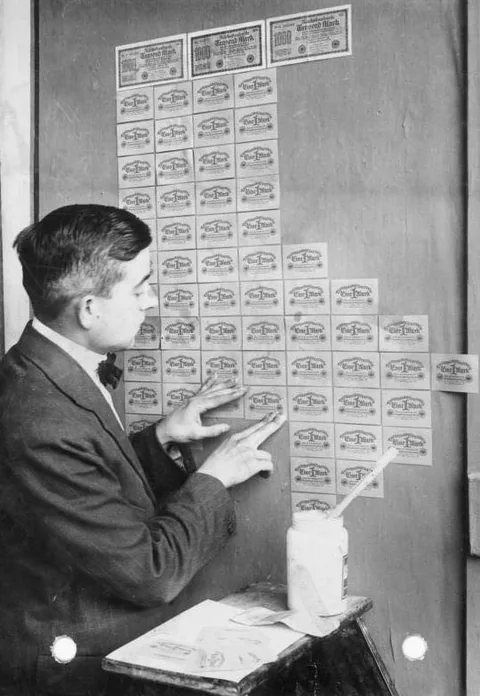
I had Katja Hoyer,42Katja Hoyer — German-British historian, author of books on the German Empire and East Germany. Her episode came out in June 2026, prompted by her new book Weimar: Life on the Edge of Catastrophe, a history of the city of Weimar from 1919 to 1939. the historian, on the show a while back. She postulated that Gustav Stresemann was a kind of hero of the ’20s. His death was a great tragedy.43Gustav Stresemann was chancellor from August to November 1923 and then foreign minister until his death. He died of a stroke on October 3, 1929, three weeks before the Wall Street crash. He’s underrated. Do you agree with that assessment?
Yes, yes. I think it was under him that we got the appointment of Schacht as the governor of the central bank. He’s the one who stabilized the currency,44Hjalmar Schacht became national currency commissioner in November 1923 and introduced the Rentenmark, which ended the hyperinflation; in December he took over the Reichsbank. so yes.
What’s your view on Schacht? Why did he turn bad? It seemed he was so reasonable, so smart. Do you think he was always bad, or he was an opportunist, or he was pressured, or he thought he could still do best that way?
I think he was an opportunist. He presided over the German economic miracle of the ’20s by stabilizing the currency, was never able to get reparations down to a reasonable level, but presided over a Germany that got them down at reasonable levels. Borrowed heavily from the US and had an economic boom of the late ’20s.45The Dawes Plan of 1924 stretched out reparation payments and came with a large international loan to Germany, and the Young Plan of 1929 cut the payments further. Schacht took part in the Young Plan negotiations and resigned from the Reichsbank in March 1930 in protest at its final terms. He always thought that the Allied powers should have done a better job about reducing reparations, and he was quite bitter about that.
I think when the Great Depression hit, he realized that he did not want to take the fall for that. That’s why he resigned and resurfaces later as Hitler’s minister of the economy and central bank governor. He presided over a second “economic miracle,” and it was based on the fact that Germany had no reserves, world trade had collapsed, and he had to do the best he could under the circumstances and devise this remarkable system of essentially constant controls and import quotas, and managed to see Germany through the whole rearmament boom.46Schacht's New Plan: in 1933 Hitler brought him back to head the Reichsbank, and from 1934 to 1937 he was also economics minister. The 1934 plan imposed strict controls on imports and foreign exchange and bilateral clearing agreements, while rearmament was secretly financed with Mefo bills.
09Norman, theosophy, and 1920s culture
The governor of the Bank of England dabbled in the esoteric, and the 1920s were creative because Victorian constraints were gone while a shared sense of great art remained.
What was Montagu Norman’s47Montagu Norman (1871–1950) — governor of the Bank of England from 1920 to 1944, the longest tenure in the bank's history, and one of the four protagonists of Lords of Finance. weirdest belief?
I think he claimed that people could walk through walls. He had some very weird spiritualist beliefs.
He was a theosophist,48Theosophy — the religious and mystical teaching of Helena Blavatsky and Henry Olcott, who founded the Theosophical Society in New York in 1875. right? Is that where it comes from?
I’m not sure. Yes. I think he was part of that generation of the 1920s where they dabbled in all sorts of esoteric spiritual practices.
As you know, the 1920s, they’re a very rich time culturally for much of Europe. What is it from that period, from culture, that you feel closest to?
Oh, fascinating question. I suppose I’m not a great modernist in terms of literature, so I couldn’t say that I love the modernist novels. I’m not sure the answer to that. I’ve never really thought about it. I actually prefer the American novels of the 1920s.
Like?
Fitzgerald, Hemingway, those, rather than Joyce and Ulysses.49American novels of the 1920s — for example, F. Scott Fitzgerald's The Great Gatsby (1925) and Ernest Hemingway's The Sun Also Rises (1926). James Joyce's Ulysses (1922) is the central novel of modernism.
Why do you think it’s seen as such a creative period?
Because we’d eliminated the sort of constraints, the Victorian constraints. And yet there was a much more sort of a shared belief in what was great art, great literature. I know literature better than I know art. We’d eliminated constraints, and yet there was a sort of shared culture about what made for great writing.
10The IMF: Ireland, Pakistan, the eurozone
American pressure distorts the IMF, and the eurozone crisis lacked a hegemon to allocate the costs of restructuring debt.
Now, there’s a third book you wrote, which is much less well known, and much of it deals with your experiences at the IMF.50Money and Tough Love: On Tour with the IMF (2014) — a short book with photographs by Eli Reed. It’s a shorter book. It’s quite vertical. I have a few questions from that book. Here’s a very simple and stupid question. Given the price of homes in Ireland today and the fact that it’s so hard to get anything built, before 2008, did Ireland actually have a housing bubble, or were those the correct prices?51Ireland's bubble: house prices peaked in 2007 and had roughly halved by 2012–2013; at the end of 2010 the country received an €85 billion rescue package from the EU and the IMF.
God, you’re taking me back.
You worked on this, right?
I did, although I was not a staff member of the IMF. This book came out of a strange idea that you could write about institutions by embedding yourself in for a few weeks and essentially try and describe what these institutions did from a journalistic point of view. When I started the book, my approach was, let’s suppose you are someone whose son has just got a job at the IMF. You ask your son, what does the IMF do? This book was designed to provide an answer to that. That was the origin of the book. It didn’t do well. It turns out I’m not a very good journalist.
It’s a good book. I like it.
Okay, great. Then turning back to Ireland, I don’t think you can judge a mania purely by the level. I think you can judge a mania by the rate of change as well. Prices were going up at an unsustainable rate, people were buying three, four, five houses. That’s, to me, the sign of an unstable economic situation. We got that in the US. We got that in Spain. We got that in many places in the world. A bubble has both to do with the level, but also the rate of change.
Isn’t this a bit like the railroads? A lot of the railroad companies went under. We got the railroads built. Ireland needed to build a lot of homes. They actually didn’t build enough. People should have been buying 10, 15 homes, not just six or seven. They didn’t have a big enough bubble, ex post.
They should have been building homes. I’m not sure they should have been trading on existing homes, but maybe one couldn’t happen without the other.
Now, as you probably know, Pakistan has been through what, it’s either 23, 24 IMF bailouts.52Pakistan and the IMF: in September 2024 the Fund approved a $7 billion program for the country, by the usual count its 24th since 1958. There’s something wrong there, right? Okay, it’s a poorly run country, but there’s a lot of poorly run countries that don’t go through so many IMF bailouts. If we make you dictator of the IMF, what would you do differently?
I would not respond to pressure from the US to put money into unsustainable countries. It’s happened time and time again. The US has used the IMF as a vehicle for foreign policy objectives which essentially distort the IMF’s very reasonable economic practices.
The eurozone crisis,53The eurozone crisis — the debt crisis of 2009–2012: Greece, Ireland, Portugal, Spain and Cyprus lost access to markets or couldn't rescue their banks on their own and were bailed out by EU countries and the IMF in exchange for harsh austerity. what should we have done differently?
The optimal thing when people borrow too much is to find a way to restructure their debts. Now, I don’t remember all of the details, but it seems to me that that should have happened. I don’t remember quite how that eventually happened,54Greece's debt restructuring: in 2012 private holders of Greek bonds wrote off 53.5 percent of their face value, the largest sovereign debt restructuring in history. but that, it seems to me, is the flaw in the eurozone crisis. That was the flaw in the US housing bubble problem. That whole era was we had too much debt by people who couldn’t pay it back. We should have found a better way to have restructured those debts.
Was the problem that Europe had no distributional mechanism for allocating the costs of that restructuring? Say they had been more liberal with Greece, treated it as Gladstone had treated Turkey, but then which country exactly picks up which part of that bill? Is that the thing that hadn’t been solved, or something else went wrong?
No, I think that was essentially the problem. What you need is a sort of, I don’t know, a hegemon, Germany, taking charge and deciding how that should have happened.
Germany was too reluctant because Germany was Germany?
Why does the United Kingdom now seem economically and politically to be so stuck? They have a system of government that, at least on paper, allows for a lot of decisive change, and yet they cycle through prime ministers55Prime ministers: since the 2016 referendum on leaving the EU, Downing Street has seen Theresa May, Boris Johnson, Liz Truss, Rishi Sunak and Keir Starmer; Truss resigned on her 50th day, the shortest tenure in British history. and nothing gets better, and they haven’t had much real wage or productivity growth since 2008. What’s gone wrong?
God, I wish I knew. I totally subscribe to the view that things have gone wrong. I really don’t know because there are so many impressive things about the UK. One of the striking things is how many inventors of AI were British.56Britons in AI — for example, Geoffrey Hinton, one of the creators of deep learning, was born in London, and Demis Hassabis co-founded London-based DeepMind; in 2024 both won Nobel Prizes, in physics and chemistry respectively. An educational system that can throw up that many innovative thinkers and yet not be able to capitalize on it, there’s something wrong there.
What’s a part of the world you’re especially optimistic about right now?
Oh, I’m generally optimistic about most of the world. I’m not very optimistic about India because of the environmental damage and because of the water problems and the inability of the authorities to deal with that. I’m optimistic about the US just because I think we will see ourselves through this downturn in our political fortunes and the inherent innovation that is coming out of the United States will see us through.
I think that Europe, I don’t know—and I haven’t been to Europe for five years apart from passing through. I haven’t spent enough time there, but I’ve always admired France, for example. It seems to have hit upon an equilibrium where people like the balance between work and leisure and a lifestyle that works very well. It’s a remarkably innovative country. I think it probably has more startups than most other countries in Europe.
11An interesting life
Ahamed isn't a workaholic: he writes books to live an interesting life and to learn about what fascinates him.
You’re a workaholic, right?
No, I’m not.
You’ve been very successful in the private sector. You’ve produced a movie. You’ve written two extremely notable books. You’re well known world over. You have the Pulitzer Prize, and you’re talking to me about work-leisure balance?
Well, it’s just I don’t like golf.
What is it you see yourself as maximizing? You left Harvard. You didn’t finish a PhD, which I can very well understand, but later in life, you come back, you write these two books when you’re not needing them for the income. What are you pursuing?
An interesting life.
What makes what you do interesting?
I don’t know. Intellectual stimulation. I’m not a great athlete, but ideas stimulate me. When you want to find out about something, writing a book about it is a remarkably good way of learning it. That’s what I’m trying to maximize to stave off dementia.
David Halberstam’s The Best and the Brightest.57The Best and the Brightest (1972) — journalist David Halberstam's book about how the brilliantly educated advisers of Kennedy and Johnson drew the US into the Vietnam War. Why do you find that book so notable?
Oh, it was probably the first book I read when I came to the United States in ’74. I find it’s just remarkable how it opened up the US political system. I learned so much about how the United States worked just by reading that book.
GPT said about you, “Think tanks are your hobby.” What might it have meant by that?
Oh, for a while, I used to kid around that when I retired from the investment business, and I was writing Lords of Finance, I joined the boards of several think tanks.58Think tank boards: among them the Brookings Institution, where Ahamed served as a trustee, and the New America Foundation. I found it quite fascinating because these are organizations that didn’t seem to have the dysfunction of universities where people were paid and got a stipend to be able to come up with good ideas. Being on the board of them exposed you to some wonderful thinkers. I suppose I became disillusioned after a point. In part because these were almost all policy ideas, and policy seemed to have nothing to do with good ideas. I suppose 2016 was the turning point in my mind.592016: Britain voted to leave the EU, and Donald Trump was elected president of the United States. That since then, for the last 10 years, so little policy is driven by great ideas.
If old-style think tanks are somewhat obsolete, what should we replace them with?
God, I don’t know. I wish I knew. It’s maybe a model which was less top-down driven. A model that essentially was more allowing a thousand flowers to bloom60A thousand flowers — a loose version of Mao Zedong's 1956 slogan "Let a hundred flowers bloom, let a hundred schools of thought contend." The Hundred Flowers campaign invited criticism of the Party and ended in a crackdown on those who spoke up. and create institutions where you allow people, you get great writers and thinkers to write about subjects they’re interested in, and then see what rises to the surface.
You produced a movie called The Situation, and it’s set in Iraq.61The Situation (2006) — Philip Haas's film about Iraq after the American invasion. The script was written by journalist Wendell Steavenson, who had worked in Baghdad, and Connie Nielsen played the lead. Why did you do that? This gets back to what do you optimize.
No, I had a friend who was a director. We were talking about the situation in Iraq. It was more and more depressing. This was in 2003, 2004, after we’d invaded. We’d met a journalist who’d been stationed there. We approached her about writing the script. It was a fun project. It was a total failure financially, so I would not do it again, but it was a fascinating project.
Do you follow how Iraq is doing these days?
A little bit. I’ve got a couple of Iraqi friends. Yes, yes, a little bit.
12The Ismailis and the Aga Khan
The Ismailis are pro-progress because of their living leader, the Aga Khan, whose moral authority sets an enlightened course for the community.
Now, I know you’re listed as non-practicing, but I’m quite curious about Ismaili Muslims and why they seem to be so much more pro-progress, on average, than other parts of the Muslim world. Do you have a view on this?
Yes, very much so, because of our leadership. We Ismailis believe in the leadership of a man, the Aga Khan.62Aga Khan — the title of the hereditary imam of the Nizari Ismailis, a branch of Shia Islam. Karim Aga Khan IV was imam from 1957, and after his death in February 2025 his son Rahim Aga Khan V became the 50th imam. We believe he’s the direct descendant of the Prophet Muhammad, and he sets the agenda for the whole community. Many, in the old days, people believed he was divine or he had divine spirit. I don’t think many people believe that anymore, but he’s invested with so much moral authority that if he says, move to Africa, big chunks of the community will do that. He has charted an incredibly enlightened direction for the community. It’s not very large. There are maybe two or three million Ismailis in the world.63Fact-checkAhamed says two or three million, but the Nizari Ismailis are usually estimated at 12–15 million people (Foreign Policy, 2025); there is no precise census.
You think it’s that the Imam is nonhidden64The hidden imam: in Twelver Shiism, Iran's state religion, the twelfth imam has been in "occultation" since the 9th century and, Shiites believe, will return at the end of time as the Mahdi. For the Nizari Ismailis the imam is living and present. that’s useful because he’s a source of ongoing change?
Yes. That was the whole rationale for Shiism.65Shiism — the second-largest branch of Islam after Sunnism. Shiites hold that the community should be led by imams descended from the Prophet Muhammad through his cousin and son-in-law Ali.
Why is it so persecuted by the mainstream in Iran? Because it’s a threat to the Ayatollahs?66Ayatollah — the highest rank of Shia cleric. Since the Islamic Revolution of 1979, Iran's supreme leader must be such a cleric; the first was Ayatollah Ruhollah Khomeini.
I don’t actually know how many remain in Iran. It was a very important community in Iran in the 19th century. The Aga Khan, in fact, came from Iran and moved to India.67The first Aga Khan: the title was granted in 1818 by the Persian shah to Hasan Ali Shah, Aga Khan I. After a failed rebellion he moved to British India in the 1840s and settled in Bombay; the British granted him a pension for his help in the First Anglo-Afghan War and the conquest of Sindh. The British sponsored him and invested him with the title “his highness,” making him, putting him on a par with other Indian princes. I think there were probably 20,000 or 30,000 Ismailis left in Iran in the latter days of the Shah of Iran.68The Shah of Iran — here Mohammad Reza Pahlavi, the last shah (1941–1979), overthrown by the Islamic Revolution. I don’t even know how many remain there now.
Maybe this is a naive question, but given that the Ismailis are so successful, why aren’t there more of them? You’re allowed to convert, right? There’s no barrier to entry.69Barriers to entry — an economists' term for anything that keeps new firms out of a market. Cowen, out of habit, describes religious conversion in the language of market theory.
No. Right. All religions have some strange beliefs. Perhaps believing in the potential divinity of a man is not something that people believe in.
Some number of Christians seem okay with that postulate, right?
Well, not someone who’s alive.
That’s a little harder, but he was alive at some point in time.
Well, there weren’t that many Christians in those days.
Sure.
They believed it retrospectively after he was crucified.
13What's next
Ahamed wants his next book to be a narrative of the global economy with a few central characters, possibly about the collapse of Bretton Woods.
Very last question—really combining two questions. What is it you want to learn about next, and what is it you want to do next?
Oh, okay. I’ve been reading a great book about the intellectual movement in France during the ’40s, ’50s, ’60s.
The Eakin book.70The Frenchmen, or My Life in Theory by Emily Eakin (Penguin Press, 2026) — part memoir, part history of French theory: Derrida, Foucault, Barthes, Deleuze, Lacan, Althusser.
Yes. I find that so fascinating. That’s what I’m reading at the moment. What do I want to do next? I would like to write another book. It probably is going to be a book about some aspect of the global economy. I would like to find a subject that draws on what I’ve been doing up to now, which is the interaction among countries with a few central characters as driving the story. A narrative about the global economy. I thought initially, or the one that I’ve stumbled across is the ’71 collapse of Bretton Woods. I’m not sure that has enough broad appeal, but that sort of checks many of the boxes of the things that I find fascinating.
I hope you do that topic. Liaquat Ahamed, thank you very much.
Thank you, Tyler. You took me in directions that I did not expect.
Always the case. Thanks.


