



Core Memory
Chapters
Vance thinks Realbotix has put more thought, artistry and philosophy into its lifelike robots than almost anyone, and that robots won't all end up generic and robot-looking.
Read the chapter- Realbotix, Vance explains, grew out of RealDolls built for emotional and sexual support, but is making a clean break with that past to build robots that could greet hotel guests, help out in hospitals or tutor students.
- Instead of all-metal factory-worker robots or home helpers with circular blank faces, Realbotix gives its robots animatronic faces and built-in AI so you can talk to them.
- Vance admits the robots strike many people as a little weird and that there's work left to do, but argues somebody should be trying to make human-like robots and trying to do it well.
- A YouTube video will show how the robots are made and Vance driving down the Las Vegas Strip with the robot Aria.
Kiguel says Realbotix, unlike Tesla, 1X and Figure, isn't replacing physical labor but building conversational robots that don't intimidate people.
Read the chapter- Kiguel describes Realbotix as both an AI software company and a robotics hardware company that marries the two into an all-in-one solution.
- Vance notes that his Silicon Valley neighbors Tesla, 1X and Figure, and most of what comes out of China, are building factory-worker robots, and he sees no one else doing what Realbotix does.
- Customer service, companionship, healthcare and education, Kiguel says, call for a robot with a human appearance, a flexible AI, and the ability to work all day, seven days a week.
- Aria has her own social media account because, Kiguel explains, the company deliberately made her a distinct brand ambassador, the way people recognize Optimus, and the look, voice and personality of any of its robots can be customized.
McMullen, who sees himself mainly as an artist, starts from a realistic envelope rather than the machinery, and Kiguel argues that is why their robots don't need legs.
Read the chapter- McMullen made lifelike three-dimensional art, like wax museum figures, and around 2016 wanted to bring it to life: a robot that makes eye contact, shows micro-expressions and moves like a person with no task at all.
- Engineers, McMullen says, build a roughly human-shaped machine and try to make it look human at the end, while he works backwards from the realistic envelope and fits the mechanics inside.
- Kiguel says Realbotix alone has robots with human proportions that wear human clothing and ride motorized wheelbases, and jokes that he's the only robotics CEO who has to worry about robot manicures and hairstyles.
- They started in a garage, McMullen recalls, with none of the co-founders getting paid, while robots pitched as replacing human workers are, in his words, easy to raise money for.
- Kiguel calls walking one of the least efficient things humans do, says nobody has nailed it, and describes seeing robots at shows walk into walls with a human teleoperator always nearby.
McMullen wanted the robot's face to come off from the start, and magnetic mounts let one robot become another in about a minute.
Read the chapter- Earlier animatronics had skin glued permanently to the actuators, so McMullen designed patented magnetic attachments that make the face removable for repairs and can be moved around inside the silicone.
- Kiguel calls the robot a platform: peel off the face, put on a different wig, pick a different personality in the app, and within a minute it's a different robot that can run Realbotix's AI or simply ChatGPT.
- Vance finds that seeing the robot without a face kills the Wizard of Oz effect, while McMullen thinks it's cool and says he can't remember any other humanoid robot with skin that peels off like that.
- One robot with four faces instead of four robots, McMullen says, matters as much as easy repairs, and the face's weight is what makes it look real when it moves.
- There are thousands of ways to make silicone and only 10 are right, McMullen says, so the company has its own blend, and artists put in the eyebrows by hand.
A Realbotix robot starts at about $20,000 for a bust, the company aims to halve its prices and also charges a subscription, and LLMs let its AI pick up humor and remember people.
Read the chapter- Kiguel offers three models with delivery within three months: a reception bust for about $20,000, the waist-up M-Series with about 39 degrees of freedom that runs off a wall socket, and the F-Series on a motorized wheelbase with about 52.
- Kiguel aims to cut prices by about 50% over the next few years and eventually sell a robot like the ones in the studio for about $30,000.
- A custom face from a laser scan costs extra and requires the person's permission, Kiguel says, and Nvidia once approached Realbotix about making a Jensen robot.
- A monthly app subscription, like a Tesla updating overnight over Wi-Fi, delivers new AI models, new animations and remote diagnostics.
- The first AI, McMullen recalls, was scripted in AIML as an elaborate "if this is said, give one of these three responses," and LLMs let them weave humor and knowledge into a personality; Kiguel adds that the AI now remembers what it learns about people.
Companionship, McMullen says, is a vital part of being human and the path that gave him the skills he needed, while the intimacy business now sits in a separate company.
Read the chapter- McMullen says the skills for building a very human-like robot came from his path, which started with physical companionship and moved toward emotional companionship.
- Kiguel stresses that Realbotix has always been a commercial, enterprise product, while robots for physical intimacy belong to a separate legal entity with a different market, and he confirms the direct-to-consumer side is RealDoll.
- McMullen points out that DVDs first flourished on adult content without anyone giving up DVDs, and Kiguel adds that most payment systems came out of online gambling and streaming out of pornography.
Kiguel insists companionship with a robot isn't weird but a way to help with an epidemic of loneliness, and McMullen says critics are simply imposing their worldview on others.
Read the chapter- Kiguel calls loneliness an epidemic: about 25% of the world identifies as lonely, and a widowed 75-year-old isn't going on Tinder, while a robot or AI avatar that remembers past conversations can fill that gap.
- Vance describes his 92-year-old father, a former avid reader who can no longer see well enough to read, struggles with a computer and just wants someone to talk to.
- Kiguel cites what he calls a Harvard report ranking companionship as the top use of AI and plans to launch an AI skin this year, maybe for free, that you can log into with ChatGPT or Grok.
- Kiguel recalls three PhDs attacking him on a podcast, and McMullen notes that every kind of robot, from factory arms to self-driving taxis, has its haters.
- McMullen calls Lars and the Real Girl, which featured their doll, a fair depiction of someone who needs this, and Kiguel says he gets five or six messages a week from lonely people asking for help.
Vance can't understand why all the money goes to worker humanoids, and the guests blame the difficulty of the problem and Silicon Valley groupthink while laying out where conversational robots are useful today.
Read the chapter- Companion robots are rare, Kiguel says, because AI only became good enough to integrate into robots in the last few years, and McMullen adds that the closer a robot gets to a human, the harder it is to build.
- What makes Kiguel angriest is Realbotix being called a novelty when its robots can tell whether someone is in a good or bad mood and spot danger or theft; in North America, he says, "we're it."
- A robot that speaks 100-plus languages, Kiguel says, can give directions and order room service in a hotel or help a Spanish-speaking student go over a math lesson at school.
- McMullen argues that a huge share of human work isn't physical and asks you to compare ordering coffee at Starbucks from Optimus with a human-like robot that smiles and tells you something funny.
- In a nursing home, Kiguel says, a robot with infinite patience can keep someone company for hours, write down their life story and relay messages to family and nurses, and McMullen adds that a soft silicone hand feels different from a metal one.
Almost everything in a Realbotix robot apart from the motors is designed and built in Las Vegas, and Kiguel considers its vision tied to the AI, which reacts rather than just describes, the company's key achievement.
Read the chapter- Figure, McMullen says, builds hands for physical tasks, while what matters to him is how a hand looks and feels in a human interaction.
- The motors are outsourced and an outside company makes the eyes from Realbotix templates, but all the fundamental designs, McMullen says, are manufactured in Las Vegas.
- The vision system runs on an Nvidia chip with cameras inside the eyeballs, which Kiguel calls a potentially very valuable patent, and McMullen adds that the eye, like the face, is modular.
- Kiguel says the robot recognizes people it knows and can tell whether someone is happy or sad, waving, passed out or near a fire, and react accordingly.
- McMullen explains that image-to-text AI often produces nonsense, so the hard part is filtering it out and folding what the robot sees into both the conversation and its memory.
The guests argue that theirs are the real robots and rivals' humanoids at trade shows are teleoperated, even though Silicon Valley dismisses Realbotix as the novelty.
Read the chapter- Kiguel says the robots drew four billion media impressions during CES in January, with heads of robotics from large companies coming by to see them.
- McMullen says every rival humanoid he has seen at these events is remote-controlled, and Kiguel asks what a robot that does karate chops on a 30-minute battery is good for.
- Vance says parts of the robots are strikingly realistic and parts still read as robot, and Kiguel answers that this is version one and the company just hired a new COO from Agility.
- A Realbotix robot, Kiguel says, ran on its own for six days, 8 a.m. to 8 p.m., at the Tomorrow electronics store in Times Square, telling jokes, speaking German and Hebrew to passersby and posing for selfies, while Optimus showed up a couple of weeks later for about 10 minutes of teleoperated drink serving.
McMullen wants people to be able to tell it's a robot: until the mechanics move like a living face, skin that is too realistic pushes it into the uncanny valley.
Read the chapter- Adding skin pores and tiny veins, McMullen says, would cross the line, and Ishiguro's androids look to him as if their faces were peeled off a cadaver.
- Vance recalls Ishiguro insisting his android was indistinguishable from a human when, to Vance, it plainly wasn't.
- Until the underlying mechanisms and controls move indistinguishably from a person, McMullen explains, there's no point making the skin indistinguishable, because the mismatch makes people recoil.
- Kiguel dresses the robots in vests so people can see the hands, with actuators where knuckles would be, and know it's a friendly robot; after CES, he says, they get 30 or 40 invitations from around the world.
- On the roadmap for the next couple of years, Kiguel lists hands that can feed someone, type on an iPad and open a pillbox, while walking is not on it.
Kiguel argues that Realbotix doesn't need to compete with OpenAI or China on models, and that private humanoid valuations are inflated the way they were in the dot-com bubble.
Read the chapter- There's no need to compete on models, McMullen says, because Realbotix can use other companies' AI and shape it to work with its platform.
- Kiguel reminds Vance, Musk's biographer, that people said SpaceX could never compete, notes that he launched the first public bitcoin miner when bitcoin was called rat poison, and says their work doesn't need hundreds of millions of dollars.
- Engineers, Kiguel says, hop from Tesla to Figure AI to Agility to Neo just to raise their pay, so the field never gets original thinking.
- Kiguel names Ericsson as one of the company's biggest clients, and McMullen says a growing number of people in the industry don't want to buy from Chinese suppliers who copy and knock off designs.
- Private valuations, Kiguel says, are "on ayahuasca": Figure AI is at about $40 billion while Realbotix trades at about $40 million, and he expects such valuations to fall once there is liquidity and price discovery.
Kiguel is confident in his AI's guardrails and dares Vance to break them, while McMullen tunes the robot's political correctness to how a person would behave.
Read the chapter- Vance is about to go for a drive with Aria, and Kiguel urges him to interview the robot unscripted and ask it sexual, racial, political and religious questions.
- McMullen says he asks himself how a person trying to be politically correct would answer, noting that people act differently in church than with the guys at the gym.
- Kiguel says an unfiltered AI for adult conversation is coming soon, where users set on sliders whether it is a friend, a romantic partner or a mentor and whether it uses foul language.
Quotes
On why a robot needs a human body
“And I think that having a human-like embodiment for a robot and for an artificial intelligence creates a bridge between humans and technology that can't be done in any other way.”
Matt McMullenRead from 07:50On the worries of Realbotix's CEO
“And, you know, I joke, I'm the only CEO of a robotics company that's got to worry about the dress for the robots and them having nice manicures and nice, you know, hairstyles.”
Andrew KiguelRead from 10:22On humanoid robots at trade shows
“I go to the shows and, you know, when the lights come on, I see robots walking into walls, turning over, and there's always a human there teleoperating it, with security all around.”
Andrew KiguelRead from 15:52On the secret of robot skin
“Well, I mean, there are thousands of ways to make silicone, and only 10 of them are right.”
Matt McMullenRead from 21:50On who needs a companion robot
“Like, if you're a 75-year-old man who's widowed, you're not going to go on Tinder to, you know, go on a bunch of coffee dates.”
Andrew KiguelRead from 33:31On critics of companion robots
“I'm not okay with you being happy with a digital avatar. I don't like it, therefore you can't have it.”
Matt McMullenRead from 39:37On rivals' humanoids
“You know, a robot that can do karate chops and has a 30-minute battery life — like, what is that good for?”
Andrew KiguelRead from 57:27On the robotics bubble
“And, you know, it takes me a little bit to valuation, because when you're talking to people on the investment front, they're like, the private company valuations are like on ayahuasca.”
Andrew KiguelRead from 1:08:03
Summary
Ashlee Vance visits Realbotix in Las Vegas, a company building humanoid robots that genuinely look like people. Its founder, the sculptor Matt McMullen, made his name with RealDoll, and CEO Andrew Kiguel previously built one of the first publicly traded bitcoin miners. Unlike Tesla, Figure and the Chinese makers, Realbotix isn't teaching robots to walk or haul boxes: its robots sit or roll on a wheeled base, run off a wall socket, speak 100-plus languages, recognize faces and react to what they see. The idea is to greet guests at hotels and casinos, help out in hospitals and nursing homes, and tutor students. A bust costs about $20,000, and a robot like the ones in the studio is supposed to come down to $30,000 over time.
Much of the conversation is about the hardware: a magnetic face that comes off in a minute and swaps along with a wig and a personality, cameras inside the eyeballs, the AI's own memory, and the option to plug in any model, from ChatGPT to Grok. McMullen explains why the robots deliberately still look like robots: until the mechanics move like a living face, skin that is too realistic pushes them into the uncanny valley.
The other big theme is the company's past and loneliness. The intimacy-doll business now sits in a separate legal entity, but the guests don't shy away from companionship: a quarter of the world is lonely, Kiguel gets messages every week from people asking for help, and Vance talks about his 92-year-old father, who has no one to talk to. They close on why Silicon Valley writes Realbotix off as a novelty, on China, and on the valuation bubble: Figure AI is worth about $40 billion by Kiguel's count, while Realbotix trades at about $40 million.
Advice
When looks matter, design from the outside in: if you build the mechanics first and add the appearance at the end, the mechanisms may simply not fit inside it.
Don't chase what everyone else is building: Realbotix found a huge market with no competitors by working away from Silicon Valley's groupthink.
Design for repair from day one: the magnetic removable face was invented to make fixes easier and became the main advantage — one robot, many characters.
If you sell hardware, think about recurring revenue: a subscription for AI updates, new features and remote diagnostics keeps earning after the robot is sold.
Don't compete where the giants spend hundreds of billions: plug into their models and invest in what's hard to copy — your own platform.
Mentioned
- Westworld00:49the series where androids' faces come off
 Realbotix01:08the guests' company
 RealDoll01:08the dolls McMullen started with
 Tesla05:14maker of the Optimus humanoid
Show 19 more mentionsShow fewer mentions
 Figure AI05:14factory humanoids, valued at $39 billion
- Tesla Optimus06:33the humanoid everyone recognizes
 Hiroshi Ishiguro13:49Japanese builder of androids
 ChatGPT18:25a Realbotix robot can run on it
 NVIDIA23:41wanted a Jensen robot; its chip runs the vision system
 Jensen Huang23:41promised a free robot double
 AIML27:34the language of the robots' first AI
 Grok35:09can be plugged into the AI skin
- Lars and the Real Girl37:53the film with a RealDoll
- Her40:51a film about falling for an AI voice
- Ray-Ban Meta53:02glasses that describe what you see
 Agility Robotics58:09where the new COO came from
 Elon Musk1:03:29an entrepreneur nobody believed in
 SpaceX1:03:29took on NASA with less money
 Hut 81:05:00Kiguel's previous business
 Bitcoin (BTC)1:05:00Kiguel mined it when it was hated
 Ericsson1:06:18one of Realbotix's biggest customers
 Unitree Robotics1:08:46Chinese robot maker
 Claude1:10:32an example of a too-PC AI
Sponsors of the episode

Transcript
01Robots that look like us
Vance thinks Realbotix has put more thought, artistry and philosophy into its lifelike robots than almost anyone, and that robots won't all end up generic and robot-looking.
If you are watching this episode, you will see right away that I have a couple of robotic companions behind me, and they look quite human-like. They come from a company called Realbotix.1Realbotix — a Las Vegas company that grew out of the robotics arm of Matt McMullen's Abyss Creations; in 2024 Andrew Kiguel's Canadian company Tokens.com bought it and took its name. Its shares trade on the TSX Venture Exchange. We're joined by its two top executives today, Andrew Kiguel and Matt McMullen. This is going to be a little bit of an adventure. Realbotix is trying to make human-like humanoids. They do have a background in making RealDolls,2RealDoll — life-size, lifelike silicone dolls made since 1996 by Matt McMullen's California company Abyss Creations, largely as sex dolls. companions, sometimes for emotional support and sometimes for sexual support.
But Realbotix is creating a clean break with that past, and it is meant to create a new type of human-like robot that's out in the world, maybe being a greeter at a hotel, offering help at a hospital, or even being something like a tutor. They're full of artificial intelligence technology to speak and hear and communicate with you. The robots have a lot of animatronic details.3Animatronics — mechanical figures that imitate living creatures with motors and actuators. Disney coined the term: in 1963 Disneyland opened the Enchanted Tiki Room with its singing mechanical birds. Instead of doing the all-metal, factory-worker-looking robot, or the generic ones we see that are supposed to be doing tasks inside of homes — a lot of these robots have these circular, kind of blank faces — Realbotix is all in on making these things look realistic. They've got animatronic components, they've got artificial intelligence software built in so that you can talk to and hear from the robots. They're a little weird, I guess, for a lot of people, and I get it.
I also think Realbotix has put more thought and artistry and philosophy in what they're making than just about anyone else. I think they've got a bit of work still to do, but I appreciate the care and effort that they're putting into this, because I suspect robots won't be generic and robot-looking universally. I think we will have things that are human-like, and somebody should be trying to do this, and somebody should be trying to do it well. So we went to Las Vegas to their headquarters, sat down, we had an interview. We're going to have a complete video coming with Andrew and Matt where we see how these robots are made. This will be on our YouTube channel. I go on a drive with one of the robots, Aria.4Aria — Realbotix's flagship robot, with a female appearance, which the company unveiled at CES in January 2025; the full-size version on a rolling base was then priced at $175,000.
We go down the Las Vegas Strip. It's going to be fantastic. As ever, please leave a review, some likes for the podcast on Apple or Spotify, or tell your friends that you enjoy the podcast. It would make a huge difference to people finding this show. I think you'll enjoy this chat. It is a little strange.
Quite a different take on robotics. Fascinating stuff. As ever, I am Ashlee Vance. This is Core Memory.5Core Memory — Ashlee Vance's science and technology media company, founded in 2025 after he left Bloomberg: a newsletter, a YouTube show and this podcast. Here we go.
02Robots for conversation, not warehouses
Kiguel says Realbotix, unlike Tesla, 1X and Figure, isn't replacing physical labor but building conversational robots that don't intimidate people.
Gentlemen, hello. Thank you for having us here. We're in Las Vegas at Realbotix HQ. This is exciting. There's so many places to go with this story. How would you guys, just to give the viewers — and you should absolutely be watching this episode and not just listening to it. But yeah, like, I mean, how do you guys usually describe what you do?
Sure. So we are an AI software company and a robotics hardware company. We sort of marry both into an all-in-one solution, but we've come up with sort of a different way of thinking about AI and robotics that I think is very unique and different from what everybody else in the world is doing.
Yeah, I mean, I live in Silicon Valley, not far from the American version of humanoid robot central, with Tesla, 1X,61X — a Norwegian-American company based in Palo Alto that makes NEO, a humanoid robot for the home; preorders opened in October 2025 at $20,000. Figure.7Figure AI — Brett Adcock's startup, founded in 2022, building general-purpose humanoid robots for factories and homes; one of the most richly valued startups in robotics. They're all down the street. But, you know, they're all doing the worker robot that's meant to be in a factory. That's most of what I see coming out of China right now. What I love about you guys' story is I just don't see anyone else doing anything quite like what you're doing. I mean, you guys are distinctly not making a factory worker robot.
That's right. We're not making robots to replace physical human labor. We're also not making robots that look like metallic cyborgs. We're sort of focused more on the human interaction and different things that robots can do, such as customer service, companionship, healthcare, education. And in those scenarios, you need a robot that has a more human appearance so that it's not intimidating. And you need an AI that is flexible, and you need a robot and AI that is customizable and can work all day, seven days a week.
And so we've got Aria.
We've got Aria and Melody, yeah.
Aria and Melody. And are they kind of — I mean, Aria, she's got her own social media account. Is she the one you put forward most often as, like, the public face of all this?
Yeah, so that was an intentional strategy for us, in that most of the other companies have these generic robots, are making a lot of the same-looking robot. And people still identify, you know, Optimus.8Optimus — Tesla's humanoid robot, announced by Elon Musk in 2021. Musk promises it will work in factories and homes and become Tesla's most important product. People know sort of what that looks like, and it's got a brand. We wanted to create a robot with a personality that has a distinct appearance, a distinct, you know, social media presence, as an ambassador of the company to show what we can do. Now, one of the amazing things about our company is we can customize the appearance, the voice, and the personality of all of our robots.
03An artist takes on robots
McMullen, who sees himself mainly as an artist, starts from a realistic envelope rather than the machinery, and Kiguel argues that is why their robots don't need legs.
Yeah, okay. I want to get into — I mean, you guys have done a ton of tech, from the skin, the appearance-level stuff that you're talking about, but then there's all this, you know, machinery underneath, and software. So I want to get into all that. I also want to give people a flavor for how this started, because unlike some of the humanoid robot companies — you know, it's been like a boom, they've all appeared over the last five or six years — I mean, Matt, you've been on this journey for quite a while. Yeah. I mean, so tell me — when I was preparing to meet you guys, I mean, there's stories going back 10 years plus about your work in this field. When did you get into robotics, and how did you get into this?
Well, you know, I mostly consider myself an artist, and I like to create very lifelike-looking pieces of art, three-dimensional, you know, kind of like someone that would maybe do wax figures in a wax museum or something like that. Like, that realism has always been kind of the core of what I want to do. And 2016 or so, I got really more fascinated with the idea of bringing something like that to life, as it were. And, you know, really at the center of all that, I always had this idea of, like he says, a personality and a character, versus — you know, a lot of people think of robots as a machine, and I want to think of them as a personality. And I think that having a human-like embodiment for a robot and for an artificial intelligence creates a bridge between humans and technology that can't be done in any other way.
So it was really important that the robot was able to express, you know, micro-expressions and make eye contact and kind of look around and move the way a person would move, with no real goal, no real task other than occupying that space and kind of feeling like you're interacting with a person.
So what did you — I mean, what did you do? I think you were in San Diego9San Diego: McMullen's company Abyss Creations is based in San Marcos, a town in San Diego County in Southern California. at the time.
Yeah, I'm originally from California.
And you're from California, and you said you're an artist. I mean, you're a musician, and—
Yeah, I did that too.
Yeah, yeah. And so, I mean, this happens in 2016. You want to make this thing. How do you even set out to do it?
Well, I mean, so I always kind of look at the way a lot of — you know, you look at the landscape of robotics right now, it's just blowing up. And I think at the core of most of these companies you have engineers, mechanical engineers, electronics engineers. So they're building this roughly human-shaped thing that can move, that has arms and legs. And then maybe at the end of all that they say, oh, let's make it look human. And so the last step in their sequence is making it look human, which is sometimes going to be an enormous challenge, because the underlying mechanisms are not completely able to fit within a human envelope. So my approach is, I've got the envelope. I'm going to work backwards from that. Okay, how can I fit the mechanical components that I need inside of that realistic envelope, versus trying to tackle that last, if that makes sense.
And we're the only group that has robots with human proportions. And so the clothes you see here is human clothing. And, you know, I joke, I'm the only CEO of a robotics company that's got to worry about the dress for the robots and them having nice manicures and nice, you know, hairstyles.
Yeah, yeah, yeah.
I mean, all the rest are — they're just cyborg, metallic or plastic-looking cyborgs. Yeah, I mean, and functional, not dissing what they're doing. But this is, you know — because we're not in Silicon Valley, and we've sort of been creating things as we think customers are going to want them, incredible things can happen when you're not sort of part of that groupthink,10Groupthink — psychologist Irving Janis's term (1972) for a group's drive toward consensus in which no one questions the shared idea. where they're all sort of competing to create that all-in-one cyborg that might be available in, you know, five or 10 years.
Yeah, and a lot of them, I've seen them try to put clothing on some of the robots, and it just doesn't work.
Yeah, it looks weird. Well, in order to get the bipedal movement going, you've got to have sort of different-sized hips and body shape. And so you sort of have to choose: it's not going to be able to wear human clothing if you're getting it to do that. And so I think we've been able to bridge that gap with our motorized wheelbases, where a robot can wear human clothing, so it can act as a fashion ambassador, a model, or even working in places where they're not intimidating. They look friendly, they're customizable. Our peers aren't even thinking about this kind of stuff.
Yeah. Well, okay, but, you know, like in Silicon Valley today, I mean, these humanoid robotics companies are raising like hundreds of millions of dollars. They've got massive factories. You know, it's a pretty expensive undertaking. When you started out to do this, I mean, I don't even know what to picture. Is this like you hired a team?
Well, for starting, you know, in your garage. Not in a large space and not with a large team either. And frankly, a lot of the people that co-founded a lot of this stuff with me, none of us were getting paid. You know, this was a labor of passion. It was a labor of having a vision and wanting to do it, which is different. You know, I think it's really easy to sell an idea to people who have money of, like, hey, this is going to be the next iPhone, like, this is going to be huge, these robots are going to be able to do all these jobs, we won't have to deal with human beings anymore. And that is the reality of the way that thinking works. That's easy to raise money. But this is something else. Like, this is a marriage of the idea of that same technology being used in a different way, and being used in what I would arguably say is a beneficial function for humanity, to be able to interact with our technology that we're creating.
It's funny, because, like, when you watch sci-fi stuff, most often — I mean, of course, you see images of like the clone army and these factory workers. But I feel like most of the sci-fi we care about, it usually is some robot you're interacting with. And sometimes it looks like C-3PO, where it's kind of robotic and everything. But, you know, if you go back to — I mean, often it's not, right? And it is either a human form, or it's some sort of foreign form, but it's a being. And it is funny the way everything has tilted just totally toward the metal cyborg type. Like, I'm actually kind of surprised more people haven't been working on this, and that you guys, you've been at this for a while.
And it's — I see, you know, I've been to Japan, I met with Professor Ishiguro,11Hiroshi Ishiguro — Japanese roboticist and Osaka University professor who builds androids that are hard to tell from people. who's been chasing, trying to make like one-offs, more like artistic pieces, like research, just for him. But he's been chasing — I'm just surprised there's not more of this, really.
ExplainerThe uncanny valley
In 1970 the Japanese roboticist Masahiro Mori described a strange pattern: the more a robot resembles a human, the more people like it — but only up to a point. When the resemblance becomes nearly complete but not quite, affinity abruptly turns into revulsion and creepiness, then rises again once the machine can no longer be told from a person. Mori called the dip in his affinity curve the "uncanny valley" (bukimi no tani in Japanese).
- What unsettles us: an almost human face that doesn't move like a living one — lagging expressions, a fixed stare, unnatural skin. Mori compared the feeling to shaking a prosthetic hand that looks real but feels cold.
- Motion makes it worse: according to Mori, a moving robot sinks deeper into the valley than a still one.
- Two ways around it: stay visibly mechanical, like most robots, or reach a likeness where no glitch shows. Realbotix takes the middle path: the faces are realistic, but the robot deliberately remains recognizably a robot.
Yeah, I think it takes a very specific mindset to want to do that. And frankly, a lot of people have fallen short. And, you know, what scares a lot of people that start thinking about this is that uncanny valley. You know, that you've attempted to make this thing look and behave like a human, and you end up with this creepy factor that's off-putting to people, and they don't want to interact. So the magic, I think, is making them look human enough that you do want to interact. That you're more mesmerized than sort of put off.
Interestingly, when you look at the end markets — so, you know, we're targeting hospitals, seniors, care facilities, schools, every shopping mall, every casino, every hotel, every resort, every mall. It's a massive end market. Whereas all of the other, you know, sort of groupthink robotics companies are all targeting that sort of industrial base, you know, moving boxes around. And like I said before, I think because we've never been part of that, we've been sort of working on the sides and sort of like, what do we want to do? We've been able to come up with something that's unique. And, you know, you said, why aren't other people doing this? This is actually really hard to do. To make a robot with facial expressions that can talk 100-plus languages, it's hard to replicate. And so while they're focused on trying to figure out how to make a robot walk without tripping and have a battery life that lasts more than, you know, 30 minutes, we've come up with our own solutions, because we think that's what consumers are going to want. That's what we think businesses are going to need.
So the walking part is pretty key, because that is — for the humanoid robots in the factories, I mean, walking's really hard. It takes a lot — like you mentioned, it takes a lot of battery.
But I would say, like, why is walking so important? Humans have already discovered that walking is one of the least efficient things people do, right? Like, we bike, we boat, we, you know, all kinds of things, we drive, to figure out solutions that are more efficient than walking. I don't care what you see on social media, nobody has nailed the walking down properly. Nobody. I go to the shows and, you know, when the lights come on, I see robots walking into walls, turning over, and there's always a human there teleoperating it,12Teleoperation — a person controls the robot remotely, with a controller, a VR headset or a motion-capture suit. It's how training data for robots is collected, but in demos it often passes for autonomy. with security all around.
There's a lot of smoke and mirrors on social media. We're trying to create autonomous robots that can see. So we've developed, I think, probably the most advanced vision system in the world for a robot, to create true embodied AI13Embodied AI — AI with a physical body: it perceives the world through sensors and acts in it, rather than only answering in text. that can act autonomously. It can see things, interpret them through the AI, and then react physically or emotionally.
04A face that comes off
McMullen wanted the robot's face to come off from the start, and magnetic mounts let one robot become another in about a minute.
Okay. And like when you were starting out on this, I mean, you have to build all the machinery on the inside to do some of this, but then you had this in mind as well. Like, I want the skin to be good, I want the face to be good.
Well, I mean, I had a crash course. It was, for me, it was a lot of analyzing the way our faces move, and then figuring out how to get that to work on the robot, and with the silicone skin and all of that. And one really key feature for me was — you know, I had built animatronics before, and a lot of the robots that had been built prior, and even still today, the skin is glued and attached permanently to all the actuators.14Actuator — a drive that turns a command into motion: a motor, a servo, a pneumatic cylinder. In a robot face, actuators pull the skin and move the lips, eyelids and brows. So what I wanted was I wanted the face to come off.
Okay. Like Westworld.
Yeah. And I wanted to be able to take the face off and get in there really easily to fix or adjust something, and then put the face back on. So we came up with the magnetic attachments that we now use for our faces, which is, you know, really key, I think. One nice thing about it too is that the magnets can be moved around within the silicone skin to get different points of articulation. And you can add more magnets if you need.
You can add additional anchor points if you need, but that face is still removable. So that was really part of that fundamental starting point, was figuring out how does that look on the outside when these things move. And I did — I mean, I'm no mechanical engineer, but I had to figure out where things should be, which way they should move, how far they should move, how fast they should move. And I think a lot of robots I've seen, they go overboard with that stuff, like super expression.
And an interesting thing about that is we think about our robots as a platform. So you can use the same robotic skeleton and create different characters. So, you know, I think we mentioned to you before, you can peel off the face, put a different wig on, use our app and choose a different personality, and within one minute, you have an entirely different robot under the same platform. And because our robots can use our AI or any other AI on the planet, it adds an extra layer of flexibility, in that you can say, okay, I want the robot to use our customized AI, or maybe I just want it to run ChatGPT. We provide that customization and flexibility that, again, nobody else is thinking about — these types of use cases.
Well, and I wanted to ask you guys about the face coming off part, because I think it's really — I mean, for what you guys are trying to do, which is turn this into like a business—
Well, it is a business. We're not trying to turn—
I mean, you know, grow the business, doing all these tasks that you're talking about in hospitals and stores and things like that. I mean, clearly you want to make the machine as mass-producible as possible. You want to be able to take off the faces, to create this variety. There is an element to it — when you see it without the face, you know, it's sort of like peeking behind the curtain, right? The Wizard of Oz kind of element goes away. It's a little arresting, I think, just for some people, because you're like, oh yeah, that's a fucking robot, you know? And I wanted to ask you — I was curious how you guys thought about this, and it's like, oh, maybe we should never reveal, you know, what lurks behind the curtain, or—
Well, I mean, I think it's cool, because, you know, I can't remember ever seeing a humanoid robot with a skin that just peels off like that. Which was patented, by the way. It is patented. But it was just, initially, more of a convenience. Like, how am I going to be able to get in here to fix this stuff? Because the traditional approach was like, you've got to take the back of the head off and take all this other stuff out just to get to the thing that's sitting right behind the nose.
And I said, I don't want to do that. I want to really be able to get to any aspect of this. And I think it looks great.
I mean, without slicing the skin. And we can even look at the face — one of the faces here that I have. So this would be sort of an example, and we can peel. So this is how the faces would peel off of a robot, and we can create different personalities.
I'm touching the skin.
But, you know, what's great about it is the other aspect, which is equally important to the convenience, is if I want to have four different characters, I shouldn't need four different robots. It's just one robot, four faces. So that was the whole—
It's weight, it's got some weight to it.
Yeah, and that's what makes it look real when it's moving.
How do you guys do, like, the hair? I mean, somebody has to do that by hand.
Artists put all these eyebrows in. Yeah, it is a marriage of art and technology and chemistry.
And so this one doesn't have the magnets. This is more of a test, but we would put the magnets here, and then you could peel off one face, do any repairs if you needed to, and then just swap it up with this one, throw a wig on it, and then you have a whole different character.
And it's fast. And is there something — like, obviously Hollywood does all kinds of things like this, but is your skin totally different to what I know?
Yeah. Well, I mean, there are thousands of ways to make silicone, and only 10 of them are right. So we have our own blend. You know, there are different additives, there are different things people can use for softening, for deadening, for pigmentation. You know, there's so many different ways, so we do have our own special way of going about that.
Okay. Is this Nadia?
No, that's Aria. That's actually the same face as the blonde there.
Okay.
AdBrex
This episode is brought to you by Brex.dBrex — a San Francisco fintech company (2017): corporate cards, accounts and expense management for startups and large companies. Since April 2026 it has been owned by Capital One. I spend all of my time inside of the world's most ambitious companies, making rockets, semiconductors, robots. Very often the business is struggling, and then all of a sudden things click and take off. Then the company's expenses spin out of control. They either have to clamp down, start counting pennies, or cross their fingers, hope for the best that the quarter or the year comes out okay. Brex was built to handle exactly these situations. It helps you move fast, spend smarter at the same time.
They've got credit cards, banking, expense management, all in one place. They've got AI technology looking over everything, taking care of tasks for you. No more chasing down receipts. We use Brex at Core Memory. It has been a godsend and giving me back so much time. Giants like Anthropic and Zoom use Brex as well, and so do tens of thousands of startups. You should use Brex, and you can find out exactly how to do that by going to brex.com/corememory.
05Prices, subscriptions and AI with memory
A Realbotix robot starts at about $20,000 for a bust, the company aims to halve its prices and also charges a subscription, and LLMs let its AI pick up humor and remember people.
So we can mass-produce — so when you're thinking about scaling and building a business, we can start mass-producing the internal robotic skeletons and the heads. We 3D-print the body panels.
Oh, okay.
And then we have molds made for certain characters that we can just get done very quickly. And if somebody wanted a custom face — and Matt, you can talk to this, with the sort of laser imaging — we can do that. We would charge an extra price. But some people — like I told you before, at one point Nvidia had approached us about making a Jensen robot,15Jensen Huang — co-founder and longtime CEO of Nvidia, the leading maker of AI chips, known for his ever-present leather jacket. and, like, you know, we should do that.
If you're listening, we'll give you a Jensen robot for free. But yeah, maybe talk about how that works.
So another, third benefit of this whole approach is the customization that you can do. So essentially, you can digitally scan pretty much anyone, take that, convert it into a physical sculpture, marry it to the robot core, and now you've got that character. So that could be anything from some fanciful character that someone designed in a 3D modeling software, versus an actual person that you want to scan and replicate.
And by the way, if someone came to us and said, hey, I want a Kim Kardashian or Scarlett Johansson,16Scarlett Johansson — the actress who voiced the AI Samantha in the film Her. In May 2024 she accused OpenAI of giving ChatGPT a voice, Sky, that sounded like hers, and the company pulled it. we wouldn't be like, great, let's do that. We would only replicate a human with their permission.
Okay. And like, if I wanted a robot — okay, say I just wanted to order one that you guys already have today. How long does it take to build one of these, and how much does it cost?
Our aim is — so we have three different models. Our aim is to deliver within three months. We sell the bust. So if you just wanted someone to sort of talk as a receptionist, it's sort of, call it, from the shoulders up, and that retails right now for us for about $20,000.
The models that we have here, we call the M-Series. And these are robotic from the waist up. It's about 39 degrees of freedom.17Degrees of freedom — the number of independent motions a mechanism can make: every joint that can rotate adds one or more. The human hand has about 27. And what's special about these is that it can plug into the wall. Any normal electrical outlet, they can plug in. So you're getting all-day, all-week functionality without a recharge. And then our top-of-the-line robot, we call the F-Series, which has a motorized wheelbase that's programmable and can, you know, move around.
Yeah.
That has about 52 degrees of freedom.
Okay. And you guys, I mean, so today they're kind of built by hand.
Today, yeah. But keeping in mind, we're an early-stage company, so we're not — you know, sometimes you get calls and people expect to see, you know, a robotic assembly line, but we are still finalizing some of our designs. There's ways — we're always learning how to make things a little more efficient. The goal would be to bring our prices down by about 50% in the next few years.
Well, that's all I was going to ask, because I have no idea what, like, the — you know, it's such new technology, people wrapping their heads around this.
Yeah.
And obviously I know enough that if you get the volume, I mean, all the economics start to change.
And so I think eventually we'll be able to sell a robot like this for about 30,000 dollars.
Okay, okay. And like, I order it and it comes three months later. Yeah, okay, okay.
And then we would charge additional things. So we do have a monthly subscription to the app. So, similar to how a Tesla updates itself overnight through Wi-Fi,18Over-the-air updates: since 2012 Tesla has updated its cars' software over the internet, without a service visit, sometimes adding new features. through the app we can deliver things like — let's say that Google comes out with a new AI, Ashlee AI. We can update the robot to run that AI remotely. If there's a new robotic animation — like, I don't know, prayer hands; they can do a lot of things, but let's say prayer hands or something like that — we can update a lot of those things remotely through the AI.
If somebody has a diagnostic problem with the robot, we can sort of pop in, take a look at it, and give people sort of direct assistance to what's happening. And so we charge for that as well. And it allows us, if our AI gets updated, we can also do those updates, again, remotely.
And like, since you started on this originally — LLMs,19LLM (large language model) — a neural network trained on a vast body of text, like the one behind ChatGPT. you know, the AI technology has come along. There were no LLMs.
ExplainerHow chatbots talked before LLMs
The first chatbots didn't understand language; they matched it against patterns. Joseph Weizenbaum's ELIZA (1966) played a psychotherapist: it found a keyword in what you typed and returned a prepared question — "I'm sad about my mother" got "Tell me about your family."
- AIML is an XML-based markup language Richard Wallace created in 1995–2000 for the A.L.I.C.E. bot. Each rule is a pair: a pattern for what the user says and one or more canned replies, from which the bot picks at random. A good AIML bot is tens of thousands of such rules, written by hand.
- A.L.I.C.E. won the Loebner Prize, an annual Turing-test-style chatbot contest, three times: in 2000, 2001 and 2004.
- How LLMs differ: a large language model stores no ready-made answers; it generates text word by word after training on a huge body of text, so it can hold a conversation on any topic, but it can also make things up.
Right, yeah, this has come along so far. Yeah, our first AI was scripted using a language called AIML,20AIML (Artificial Intelligence Markup Language) — an XML-based language for chatbots: a pattern for what the user says and canned replies to it. which is essentially a very elaborate A versus B. Like, if this is what's said, then one of these three responses will come out. And to some extent it was random. But it's amazing how it came across as, like, super believable, because it was so well done, right? Like, the fundamental code was well thought out and very versatile about talking about a lot of different things. But when LLMs started to hit the mainstream, it was a game changer.
That's right, it's got to be a big deal.
It's a huge deal. And it's so incredible how little things like humor and knowledge about X, Y or Z can be woven into this personality. And then on top of it, the voices now are just incredible. You know, the synthesized voices that are available.
Especially because you guys want to change personality.
Yeah, so you've got this unparalleled degree of — you know, I can change the personality to be witty. I can try different voices. I can put different faces on the robot. I can change the way she's dressed. And, like, you really give people an unbelievable amount of flexibility on customizing post-purchase.
Right. And we've also been able to tackle things like memory. And so while I listen to sort of what, again, some of our peers are doing, they're working on how do we create AI with a memory that learns about you.21AI memory: in 2024 OpenAI gave ChatGPT a memory that keeps facts about the user between conversations; other chatbots followed. So one day you say, hey, I don't like apples, and it remembers that, and it carries that forward into your conversations. So we've developed an ability for our AI to also have a memory when it's interacting with people. So it learns about you, remembers what it learns, and incorporates that into the AI.
So because you guys have your own model. I mean, I can use ChatGPT or Gemini or whatever if I want, but you guys have your own.
The idea is you'll just go to the app and select what you want. And so we get approached by a lot of AI companies that say, hey, can we integrate our AI into your app, so that it is part of something that a user or a client can select?
06The RealDoll question
Companionship, McMullen says, is a vital part of being human and the path that gave him the skills he needed, while the intimacy business now sits in a separate company.
All right. I know this is not your favorite topic. I just want to do some of the background of some of this. I mean, this does sort of have its, like, origin more in, like, the companionship kind of part, I think, right? Or is that—
Well, I mean, the way I would put it is companionship comes in a lot of different forms, and it is a vital part of being human. And also, the fundamental skills needed to create a very human-like robot were things that I learned along my path to get here. And so I think it started out as more of, like, a physical companionship, and then it started to trajectory, moving into emotional and mental and all of the other layers that can go into that. So at the core of it, for me anyway, like, looking back, it's very clear that that path had to be exactly what it was for me to be able to have the skill set that I need to do what I'm doing now.
But then you guys are — I mean, you're in a tough spot, because you want to take the business in this one direction. And then, I mean, there is always, at least at this moment in time, there's going to be a group of people who are like, oh, this is like a sex bot thing.
ExplainerRealbotix and RealDoll
In 1996 the sculptor Matt McMullen founded Abyss Creations in California, which began making life-size, lifelike silicone dolls under the RealDoll brand. In the mid-2010s he moved into robotic heads with moving faces and a conversational AI; this line became Realbotix, and its first headline project was Harmony, a head that could be fitted onto a doll's body.
- 2024: Andrew Kiguel's publicly traded Canadian company Tokens.com bought McMullen's business and renamed itself Realbotix Corp. Kiguel became CEO and McMullen president, and in 2026 chief creative officer.
- The split: commercial robots for hotels, hospitals, stores and trade shows are Realbotix, while dolls and intimate products for private buyers are sold separately under the old brand.
- New customers: in 2026 Ericsson bought a Realbotix robot for its demo center in Texas.
Right. So it's an interesting way. So it's not that we're taking the business in a separate direction. So Realbotix at its core has always been a commercial, enterprise-use product.
Okay.
There is a separate company that is more focused on what I would say, robots that are capable of physical intimacy. And what we're doing is we're sort of separating those two businesses out, because they have different end markets, and we don't want one to cannibalize the other. And so by splitting up the businesses — and today they're different legal entities — we're able to have each business lean into its expertise.
Okay. And the other — is it RealDoll? Is that the other—
That would be the direct-to-consumer, yeah.
Okay, okay. So I mean, like, look, I'm a nerd and I'm into, like, all the stuff, and I'm actually into just, like, the culture of robotics and all the different forms this takes. But I understand, like, for you guys, there's going to be some people who are just like, that's weird, you know.
Yeah. And it's — but, you know, it's kind of like, you know, everyone has a computer. You can watch porn on a computer. So it's not that that's all it's good for. And it's kind of like some of the origins of some technologies along, you know, humanity's path, like DVDs, initially were developed and flourished with adult content. Does that mean you're never going to watch a DVD? Probably not, right?
You know, I think even if you look at the advancements in the internet, like, most payment systems came out of online gambling.
Yeah.
Certainly most of the way streaming has developed has come out of the pornography business. And so you want to sort of look and use the technologies that have been developed for some of these other purposes and see how can we leverage that to make it more mainstream, more accessible.
07Robots against loneliness
Kiguel insists companionship with a robot isn't weird but a way to help with an epidemic of loneliness, and McMullen says critics are simply imposing their worldview on others.
Well, and like, to be clear, I mean, we are in a moment in time when, you know, I mean, it's like these AIs are getting — this is not like that unusual or anything. I mean, we're going to be interacting with these machines in a very—
Well, I think robots are going to be everywhere, AI agents.22AI agents — programs built on language models that don't just answer but carry out tasks themselves: browsing websites, booking, writing emails. Like, this is, you know, some of the biggest market opportunities in history. But I want to go back to what you said, that some people think it's weird.
Yeah.
It's not weird. If you think about things like loneliness — because, you know, when we think about this stuff, we're not like, this is for sex. We're like, this is about companionship. It's about making somebody's life better. And if you think about loneliness, something like 25% of the world identifies as lonely.
Yeah.
It's an epidemic,23The loneliness epidemic: in May 2023 US Surgeon General Vivek Murthy issued an advisory, "Our Epidemic of Loneliness and Isolation," which said loneliness is as harmful to health as smoking up to 15 cigarettes a day. leads to depression, which can lead to suicide, other morbidities. And when you think about longevity, there's been tons of research. It's not just about exercising and eating well, it's about your social community and having people to interact with. For people that might be geographically isolated, maybe they have PTSD, maybe social anxiety, they don't live in a town where you can just go — or maybe just age-related. Like, if you're a 75-year-old man who's widowed, you're not going to go on Tinder to, you know, go on a bunch of coffee dates. What we're providing is an assistive technology24Assistive technology — devices and software that help people with disabilities or age-related limits live more independently: hearing aids, wheelchairs, screen readers. for people to tackle that issue, which is a major problem around the world.
So the AI advancements today are so good that you have, even through our AI avatars or through our robots, something that can interact with you, remember your prior conversations, learn about you, and fill that gap as an alternative relationship. It's not weird. We're helping people.
Like, I know, 100%. I'm just, you know—
Yeah, yeah, yeah, no. The people who always criticize, it's always, like, the, you know, the reporter or someone who lives in New York that doesn't understand. They're like, wow, kids are going to — no, no, you're missing what the target market is.
Yeah. And then my — so my dad right now, he's 92, and, you know, it's really frustrating. He used to be an avid reader, he used to love the stock market. He's struggling to use a computer now. He can't read because he can't see, and he wants to, like, talk to somebody. You know, and then — you know how it is? I mean, it's awful, as part of getting old. It's like the people around him don't want to hear the same story for the 50th time, but otherwise he's bored. He wants to talk to somebody.
Harvard came out with a report about nine months ago. They did this massive study on AI use cases, and the number one use case for AI, not that there aren't several, but the number one was companionship. So people go on ChatGPT and, like, tell me a joke. And even when we had sort of our chatbot on our website, people are just looking for conversation. So one of the things we're looking to launch this year is an AI skin. So basically it would be a digital avatar that you can log into. I think we would offer it maybe for free, that then you just log into your ChatGPT or Grok25Grok — the chatbot from Elon Musk's xAI, built into X; known for filtering its answers more loosely than its rivals. or whatever it is, you choose the face, you choose the voice, and then you can just leave it, walk around your house, and, like, how do I cook this? What was the score in the hockey game last night? Tell me a joke, whatever. And for someone like your dad, that might be something really cool, maybe, you know, just to have somebody there that he can talk to all day.
Yeah, but I mean, the reality is people are already, and are going to continue to, actually form bonds with AI characters. And at some point, a character on a screen is a vastly different experience than an embodiment of an actual physical robot who, you know, in theory could be part of your life, could be a friend, or even someone who's, you know, very close to you.
So I'm, like, with where you guys are going, and I don't even mean this stuff, like, in a devil's advocate way or anything. I just think there's—
Oh, there's people.
Yeah, but I mean, in the starting, like you guys — you know, I think some people's mind will immediately — I think because we've just seen robots portrayed in media and stuff for a long time. So we had these conceptions, but now we're at, like, this moment in time where it's like this is—
You're far more informed about this stuff than sort of, you know, somebody who's looking at this stuff for the first time, and they're like, you know, nervous. You know, I remember going on a podcast, and they were like, oh, we just want to talk about this stuff. And I went in there, and they had these three PhDs on there who started attacking me about this. And, like, well, this is going to be kids. And I was like, no, no, we're not thinking about that. We're thinking about this as a system of tools to help people and help companies. But there's going to be that level of skepticism out there that you — you know, well, it is for anything.
You've got people out there who hate on robots, period. They're not in favor of factory worker robots, because that's putting people out of jobs. They're not in favor of self-driving taxis,26Self-driving taxis: since 2020 Waymo has carried passengers in Phoenix with no one behind the wheel, then expanded to San Francisco, Los Angeles and other cities. because that puts people out of jobs. Like, there is an undeniable group in any of these, you know, arenas that you might find robots in. There's going to be people that don't like it, that don't want it, that criticize it, that will, you know, come up with reasons why this is bad, we can't do this. So, I mean, that's never stopped any advancement in human history, and I don't think this is any exception.
It was your bot that was in Lars and the Real Girl.27Lars and the Real Girl (2007) — Craig Gillespie's comedy-drama: a withdrawn young man (Ryan Gosling) orders a silicone doll online and introduces her to everyone as his girlfriend, and the town decides to play along. Yeah, so like, is something like that, is that net positive for you guys, or is that—
I think it's positive. I mean, look, it's a great story, actually. That movie, I love it. Yeah, I worked with the producer who literally wrote the story,28The screenplay was written by Nancy Oliver, a writer on Six Feet Under; it was nominated for an Oscar. because they did the research, and it was, like, actually not a far-off depiction of somebody who would need that, right? And I think it served a therapeutic purpose for the character of the movie.
But is it a double-edged sword for the company? You must have to think these things through, because it's like, in some ways, it's humanizing all this and showing this, like, kind of real situation where this could play out. But then some people are going to be like, oh, this is so strange, this guy—
Well, I think — well, for all the people that think it's strange, I get at least five or six messages a week on LinkedIn, email, everywhere, which is like, I'm so lonely, can you please design and sell something to me that will solve my loneliness? Like, I'm — you know, people are desperate for some type of interaction.
Some kind of connection. Well, so I think when you've got people who are super critical of, you know, the topic, and of the underlying thought processes behind any kind of virtual companion or synthetic companion, it's that function that humans feel necessary to police each other. Like, I'm going to impose my worldview on you. And, I don't really like — I'm sorry you're lonely, but you need to find another way, because I'm not okay with this.
I'm not okay with you being happy with a digital avatar. I don't like it, therefore you can't have it. And I think that's a bigger problem than some guy in the privacy of his own home feeling happy. And, like, who cares if this guy's got a, you know, a connection with something that's not real?
So emotional attachment generally happens when there's an interaction happening, and, like, it clicks off your endorphins, your dopamine, serotonin, these types of things, which allow you to form a connection to something. And I always talk about my children, you know, building attachments to stuffed animals or some prized possession. But if you have something that is physical, that can converse with you and can sort of hit those things, you know, the serotonin, endorphins, all that in your mind, you're going to be able to form an attachment, an emotional attachment to that thing. It checks off the boxes to allow you to do that, which, again — an assistive technology to help with things like depression, loneliness, social interaction issues. We can deliver that.
08Why Realbotix has no competitors
Vance can't understand why all the money goes to worker humanoids, and the guests blame the difficulty of the problem and Silicon Valley groupthink while laying out where conversational robots are useful today.
How many people in the world do you think have a robotic companion?
So I think in Asia,29Asia: in Japan Gatebox sells holographic companions, and in 2018 Akihiko Kondo held a wedding with a hologram of the virtual singer Hatsune Miku. the idea of — I mean, I'm sure you've seen the movie Her,30Her (2013) — Spike Jonze's film about a writer who falls in love with an AI operating system named Samantha. this, you know, sort of a digital — in that movie, it was even, you know, it's just a voice. And so I think it's developed to the point where some of these digital avatars can be used. I don't think there's a lot of people that have robotic companions yet, but it's growing. There's a movement out there that's growing.
It's just another interface, right? Like, the robot is an interface, similar to an Alexa, right? It's just the embodiment looks human. And I think where people get triggered is, like, well, but she's attractive.
Yeah.
So therefore, I'm not okay with that. So you need to make all your robots look decidedly average, because this makes me uncomfortable. And so think about that. Like, why does that person get to dictate? And again, if this is making a person feel happy and somehow fulfilled, and filling a void that they had, why is it your job to say no?
And the technology — I mean, there's not a lot of people because the technology wasn't there before. The reason why AI and robots are so hot today is, while robotic things have existed for a long time, and AI as a notion has been around for a long time, it's only been in the last few years that AI has advanced enough that it can be integrated into robotics to create something that is usable by consumers. It just wasn't available before.
Yeah, but I want to ask you about that. I mean, because it has advanced really, really quick. But okay, but we've had — it's probably, like, around two years now running of, we've had people talking to their chatbots, you know, really turning to it for intimate conversations, trying to work things out in their life. Like, that is a phenomenon that's been going on. Well, this is — I just do not understand — I really don't understand why there's so much money being poured into the humanoid robots versus — like, I don't understand why you guys don't have competitors that are all funded with, you know — well, because this seems like it's so obvious to me that something big is going on.
To what he said, and this is — it's hard. It's harder than it seems. It's easier to make — like, the farther away you step from the human embodiment, the easier it becomes, right? Like, and again, robots have been around forever. And you see car factories full of these robotic arms assembling things.31Industrial robots: the first one, Unimate, went to work at a General Motors plant in New Jersey in 1961, unloading hot die castings. They're massive, and they're obviously not human-shaped, right? So the closer you get to a human, the harder it becomes.
There's also this groupthink happening, where everybody's trying to, like, compete and build these, again, these cyborg robots that can walk and do things that we just have never bought into. We, you know, we came from different roots. And so we're not part of that groupthink.
Yeah.
And then the other thing that we always have to battle with, that makes me angriest, is when people think, oh, our robots are just a novelty. Well, they're not. They have facial expressions; you know, we talked about that they can plug into the wall. They have vision that can actually see: is this person in a good mood, a bad mood? Is there danger? Is there theft? Is there a security issue?
These are really hard things to do. We're not a novelty. We're providing AI and robots that have real-world utility. So it really bothers me that we're sort of singled out in that way, because we are singled out. You know, they sort of look at us and are like, ah, we don't need to talk to Realbotix. Now a lot of people — you know, we were named one of the top 50 AI companies in the world a couple months ago. I think people are starting to see what you're seeing and say, well, who else is doing this in the world? There might be some guys in Asia doing this, but in North America, like, we're it. There's nobody else that's doing it here.
Yeah, and I think I was doing this really long-winded thing because I'm kind of processing it in real time a little bit. I think that's just the thing. It's like, the first reaction: oh, this is like some weird sex bot thing. Then, oh, this is a novelty thing. And then I'm just sitting here, I'm like, dude, obviously people are going to be having these robots in their house. I mean, this is clear as day, and then we're just spending all this money on this one.
Well, let's talk about some of the use cases. So our robots can talk 100-plus languages. So imagine having a robot in a mall, a casino, a resort, a hotel that you can walk up to and speak to it in Mandarin and say, where can I get a coffee? Where's the bathroom? Can I order fries and a burger to my room? Book me a ticket, a massage.
It can do it for you in any language, and it's providing that utility, because there's an actual action behind that that's occurring. And think about a school where you can have a tutor. I didn't understand that math lesson. English is not my first language, I speak Spanish. And then you can have a whole conversation that is, you know, not improvised, but it's a natural conversation. Can you repeat that? The teacher said this, I didn't quite get it. There are so many use cases for what we do that are beyond, you know, like, the companionship.
The physical humanoid robots here being built to do factory work, for example — people are overlooking the fact that there's massive amounts of work that are not physical.
Yeah.
You know, physical actions that can be conveyed to an agent or a robot that don't involve lifting a box. Like, what they're doing is they're focusing on the low-hanging fruit, which is, oh, we have all these, like, minimum-wage employees working in these warehouses, let's get rid of them and just have these robots do it. Right? Like, that's the low-hanging fruit. They're not seeing the obvious fact that — I mean, think of all the things that humans do, and all the careers, and all of the different tasks that humans perform daily. A huge chunk of them are non-physical.
And a huge chunk of them can be filled by an AI agent and/or a human-embodied robot, because you're able to — so think about ordering a coffee at Starbucks from Optimus. Think of that experience versus a human-like robot who smiles at you, maybe tells you something funny, right? It's a different experience. That interaction with something that feels human is really what we're doing.
Think about a nursing home. So we're having conversations with nursing homes. Again, you don't want to have a cyborg there talking to your ailing grandparent. But, you know, robots have infinite patience. Many parts of the world have shortages of doctors and nurses.32Health worker shortage: the WHO projects a global shortfall of about 11 million health workers by 2030. A robot could be there, have a conversation, remember your prior conversation. You know: I want to tell you my life story, can you write it down? Can you message my son or daughter? Or relay this back to a doctor or nurse. You know, you're not going to have a nurse that can just sit there with somebody and keep them company for eight hours.
Yeah.
And you can't have an Optimus or a Figure AI robot doing that. It'll scare the shit out of—
Like, think of Optimus comforting an old lady, putting his hand — versus this, you know, she puts her soft silicone hand. It feels different when she touches you than, you know, this metal thing.
09Hands, eyes and vision that understands
Almost everything in a Realbotix robot apart from the motors is designed and built in Las Vegas, and Kiguel considers its vision tied to the AI, which reacts rather than just describes, the company's key achievement.
Yeah, and that's an interesting — we should talk about our hands, because I was listening to—
Can we do, like, all the tech that's in here?
Yeah, we can talk about it. Let's talk. But the hands are interesting, because I was on this thing, listening to, you know, the Figure AI guys. And they were real proud of, like, you know, our hands — like, building hands that move like human hands is very hard. But they were real proud of, like, hey, we're working on this. We're going to — we got that already. Like, our hands, maybe talk about that, Matt.
Well, so I guess Figure's tried to — they've all been battling with hands for a long time, because they wanted to do the fine motor skills.
They're looking at a different use case. Yeah, they're looking at the physical tasks that hands do. So they're, again, going back to that low-hanging fruit of, oh, the hands need to manipulate this and that to get this job done. Whereas for me, it's not about what it can do. It's like, what does it feel like? What does it look like? Right? And in human interactions, a natural soft-skin hand feels different, obviously, than, you know, the T-1 Terminator's hand kind of resting. Right? It's about that human-to-human interaction.
So what are — like, if we look at our — what are all the bits and pieces that you guys built in-house? All of it? All of it. Yeah. So, do you even make the motors, the actuators?
We don't make the motors. So other than that, like, building all the mechanical components — our motors are outsourced, so we get those from all different places. But all of the — other than the motors, the structure — yeah, it's all in-house, yeah.
Like even the — okay, because there's machinery behind the eyes, but, like, the eyeballs themselves are usually—
Yeah, so we developed all the eye stuff in-house. We used to have an artist that would literally paint one at a time. We have a company now that we outsource the eyes to, that's able to provide us from our, you know, from our templates: this is what we want. And we do that with a lot of stuff. Like here, obviously, we're not going to have, like, 50 3D printers making fingers when we can outsource that component.
No, no, no.
Yeah. But all of the fundamental designs and pieces and everything that goes into building it, all manufactured here in Las Vegas.
And then, like, in the other room, we saw — I mean, behind the eyes and stuff, I mean, there's actuators to, like, move the eyebrows. I mean, there's this whole structure inside the skull, because you're trying to get these facial movements. So you guys have to do all of that stuff as well.
Yeah. Yeah. And we do use, for the vision system, an Nvidia chip.33Nvidia chip: for robots and other autonomous machines Nvidia sells Jetson modules, compact computers for running neural networks.
Okay.
That goes in there as well.
And where are the cameras?
They're in the eyeball. Yeah, they are, which we've patented as well. And that, by itself, might be a super valuable patent down the road. Like, we have the patent on cameras in the eye for robotic vision.
And what's cool about that? Just putting a camera in an eye, or how you — it's all of it?
Yeah, it's the fact that the eye, just like the face, is modular. So the whole eye — you could change the eyes from blue to green to brown, and anybody that's able to just pull it off can. And that's the modularity, but the vision system as well. Yes, and that, combined with the way the camera's attached and the board that it goes through to feed the processor, that's all part of the patent on that.
And like, when you talk about the vision system — because I heard you in some of the other interviews getting into this — I mean, okay, so it's got an Nvidia chip in the back running a computer vision neural net,34Computer vision — the field of AI that teaches machines to recognize faces, objects, gestures and scenes in images. right? Like, some sort of machine learning. And so what does it see? Like, it can recognize faces?
Yeah. So we can upload whoever we want into that particular character's database, and we can say, this is so-and-so.
Yeah. So it knows us. We stand in front, and it's like, oh, hi, Andrew. So there's a few parts of it. So if you think about true embodied AI, if you really want an AI or a robot to understand what it's like to be human and learn from that, it's impossible to do that without vision, right? Just can't. Like, all these robots you see, it's all staged and scripted. Walk on this line, do that. I see this at the conferences. They don't have the vision systems that we have. The vision system also has to be more than observational. It can't just be like, I see blue, I see a camera, this says whatever.
What's amazing and incredible about what we have done is that we've attached the vision to the AI brain. And so it can understand and recognize situations and facial cues. Is this person happy or sad? Is this person waving at me? I should wave back. Is there a dangerous situation? Do I see a security threat? Has somebody passed out? Is there a fire? And it can use that, based on how we fine-tune the AI, to react to it. And I think that's the amazing thing about what we've done, is it's not just observational, it's reactive to what it's seeing.
And I don't know anybody — like, we put this on social media. I tell you, all these companies say they have this. I've never seen anybody post this stuff on social media. We've got robots on social media recognizing people, describing their surroundings, reading, seeing colors, and we're like, yeah, we got it. I don't see anybody else doing it.
Well, you guys have worked on this for a while, but, like, if I put on my Meta glasses35Meta glasses — Ray-Ban Meta smart glasses with a camera and the built-in Meta AI assistant, which can describe what the wearer is looking at. now and I say, what am I looking at? You know, it'll say, you're looking at two men who are seated at a table in a room with a white wall. You know, I know — my impression was that you guys were working on this, like, years before some of this stuff happened. And then — but now, like, the LLMs are getting this function where—
But it's more than — but it's more like you could — it could, again — because we're actually talking about that: can we integrate the vision system into wearables? But then you might look at it, rather than just being observational, it can be like, hey, Ashlee, I see this shirt here that I think would look great on you. It matches your color, you know, should we go check it out? So observation's easy. The AI brain that then gets the robot to react to that is what's hard. Yeah, that's the hard part.
Okay, so then that's all in your brain.
Yeah, because, I mean, generative AI is like a two-way street. So you can either take an image and the AI will turn it into words, or you could take words and turn it into an image. But if you've messed around with this, you know that the hit rate is not 100%. You know, it's arguably like 2%. So a lot of times — you know, as cool as it is to say, oh, I see two men sitting here — but a lot of times you get stuff that doesn't make any sense too, right? So filtering all that out, and then having it integrated into the AI that's able to incorporate that not only into the current conversation but into memory, is pretty — it's a hard thing to do.
And you don't see that. And we're actually developing this so that you'll have the same functionality on a computer or a phone. We'll utilize the camera in the computer or your phone to actually be able to have a conversation with you and be like, hey, you're looking a little upset today. Can I tell you a joke? Or, you know, what's going on? Tell me about what's happening.
Okay.
And so, again, it's part of this portable AI that we've developed, which can be on a tablet, a phone, a computer, or a robot. And then robots that can be used as a platform for our AI or anybody else's.
10CES and remote-controlled rivals
The guests argue that theirs are the real robots and rivals' humanoids at trade shows are teleoperated, even though Silicon Valley dismisses Realbotix as the novelty.
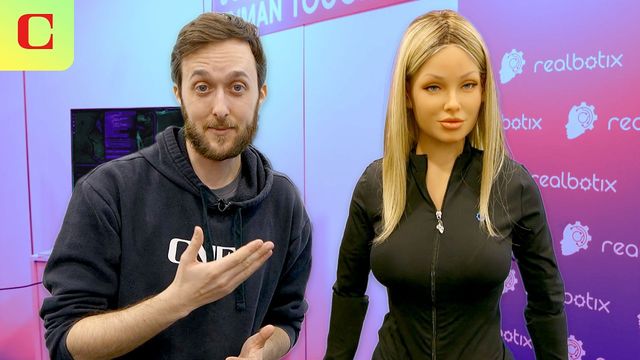
And, okay, and then, I mean, my sense, listening to some of your interviews and even just chatting with you today — I mean, like, when you guys are at CES,36CES (Consumer Electronics Show) — the world's largest consumer electronics show, held every January in Las Vegas. everybody's lining up to come see your robots. It's, like, massive. I see this huge boost on social media, everyone's talking about this thing. But then these other guys up in Silicon Valley are kind of getting all this attention right now. Like, my sense was, like, you felt like it's sort of unfair, or the world wasn't paying as much attention as it should to what you guys have developed.
You know, it's easy when you look at our stuff to dismiss it as a novelty and just a simple animatronic. Obviously, I think through this you see that we're not. But when we went to CES — like, one of the first things that we did when we developed our first robots was, let's go to CES. Nobody had seen the robots before, and that was about a year ago. The reaction was incredible. We got four billion media impressions37Fact-checkMedia impressions — how many times coverage of a company could have been seen by readers and viewers. As of January 15, 2025, Realbotix itself counted more than 2 billion impressions from CES. Business Wire in that month of January during CES, because nobody had ever seen anything like this. We even had people from the other companies coming in, like heads of robotics at different large companies, and they were all blown away. But you're absolutely right. We're sort of dismissed by Silicon Valley as this sort of novelty company. They don't—
Well, in the last year you've got, like, I don't know, dozens, if not hundreds, of companies building now these kind of generic humanoid task-performing robots. So that's where I think the focus shifted, and all of a sudden walking is sort of coming together, and people are like — but here's the thing: all of those robots that I've seen in any of these events are remote controlled.38Remote controlled: at Tesla's We, Robot event in October 2024, Optimus robots poured drinks and chatted with guests, but it later emerged that people were largely operating them remotely. There's no AI. None. So there's a guy driving the robot, and like he said, there's always security, and there's falls, there's accidents. So there's this huge sort of separation between the reality of what's going on and what people think is going on.
They're pre-programmed, right? Like, here's 20 tasks for you to remember within this environment, but there's no real AI there. And here's the biggest question: what is it good for?
Like, you see boxing. You see a robot, you know, like, walking, and you see a robot waving. Like, what is that good for?
Yeah. Did you say boxing?39Robot boxing: in May 2025, Hangzhou hosted exhibition bouts between Unitree G1 humanoids in boxing gloves; the videos went viral worldwide.
Yeah. Yeah. Yeah, because a lot of these robots — I mean, I think they're the novelty and we're the real thing. You know, a robot that can do karate chops and has a 30-minute battery life — like, what is that good for? Right.
And okay. And then, you know, coming here and seeing these for the first time — I mean, the uncanny valley question that you brought up at the beginning, that's always, like, a big thing here. I mean, there's parts of this that are extremely realistic and, like, a huge advance beyond things that I've seen before. And then there's parts where, you know, if I'm being totally honest, like, you know, it's a robot still, you know what I mean? So, like, do you guys feel like you've hit — that you're satisfied with where this is, or—
No, no, no. We're working on this stuff every day. You know, we're hiring new people. We've just hired a new COO from Agility.40The new COO is Eric Olsen: in February 2026 Realbotix named him chief operating officer of its US subsidiary; at Agility Robotics he had led customer deployments of its robots. We're working — like, we've got huge plans for this company. We're not stopping here. This is version one. And, you know, I will always hang our hat on the autonomy. I was telling you earlier about when we were in Times Square. There's a store called Tomorrow, high-end electronic store. We sort of taught the robot about the products and the floor layout, and then we're like, let's open up the doors and have it facing, you know, one of the busiest intersections in the world. We sort of watched it do its thing, and then we were like, let's go for dinner.
You were going to a show with your wife and, you know — we left the robot there with a security guy sort of a few feet away and just let it do its thing for several hours. We come back and we look at it, and it's telling jokes, it was talking, you know, German, Swiss,41"Swiss": there is no Swiss language as such — Switzerland has four national languages: German, French, Italian and Romansh. Hebrew, whatever, to different people. People taking selfies, it's waving, it's doing things. We just left it there.
Yeah.
And we did that, we left it there for six days. Like, eight o'clock in the morning till eight o'clock at night, store hours, we let the robot do its thing. Nobody else is doing that. You don't see anybody else doing that. A couple weeks later there was the Optimus, was there for, like, 10 minutes, serving a drink or something, that was teleoperated. There's no teleoperation here that we need to do. We can do that as well, but these robots act and think autonomously.
11Robot-looking on purpose
McMullen wants people to be able to tell it's a robot: until the mechanics move like a living face, skin that is too realistic pushes it into the uncanny valley.
And then, just to touch on your question about, you know, improving — and you can still tell it's a robot — but that's on purpose. So, you know, could we go further in terms of, let's add some more skin pores, let's add some tiny veiny details? And I think that's that line that you cross, and then you're in the uncanny valley.
That's what I wanted to ask.
Like, you've seen robots, I'm sure. Ishiguro does it.
Yeah.
Where the face looks like it literally was peeled off of a cadaver, because the detailing is so high.42Geminoid — Ishiguro's android double, built in 2006, with silicone skin, his exact features and hair from the professor's own head.
It is. But even when I'm with him — you know, this is what I just wanted to talk out with you guys — because when I'm sitting with him, he's like, you can't tell this from a human. I'm like, yes, I guess you can.
Right.
And I can't tell if he, like, really believes it.
Right. No, but I want people to be able to tell it's a robot. You do? Yes, absolutely. Until the underlying mechanism and control systems are able to move in such a way that they're indistinguishable, there's no point in making the skin indistinguishable, because when you do that, one thing looks super real and the other doesn't, and that causes humans to recoil.
It's built into us. Some people react to it as if they were looking at a dead person, right?
Often, what we do is we put the robots in vests. And the reason why is I want people to see the hands. And when you see sort of the hand articulation — which is, you know, we put actuators in the same place where you have knuckles — I want people to see that this is a robot, just a very friendly robot that draws people in. And Matt and, you know, we talk about this: at CES, our robots bring in massive foot traffic. It's like traveling with a rock star wherever we go. After CES, we normally get, you know, 30, 40 invitations all over the world from people who are like, can you please bring the robots here? Because nobody else has something like this.
But, like, when you're talking about — this is the heart of my question — like, if you're talking about this being in a hospital, in a hotel, in a casino, do you want it to look as lifelike as possible? Is that what it would take to make it super mainstream, or do you think it should be distinguished from—
Like I said, until the underlying mechanisms can move realistically, there's no point in pushing the outside to that point.
So is that something—
They have to work together, right?
That's something you guys would work on, on both? Yeah, absolutely.
So, you know, what's on our roadmap for the next couple of years is hands that — they can articulate a lot of things now, but are capable of small tasks. So maybe feeding someone. We're working on the ability to type on an iPad, so they can transcribe things. So small tasks like that, opening a pillbox and giving someone medicine, things like that, is sort of on our roadmap. Walking is not on the roadmap, not right now. At some point, when it's perfected, which I still think is years away, we'll find a way to replicate that, but it's not on the roadmap today. But we want to work on the AI, some of the things that might be useful to somebody.
Like, even if you were to have it in your house, in a kitchen, if it could actually lift small things and articulate certain things, that, I think, is far more useful than a robot sort of clunking around your house and bumping into things, because it doesn't even have a real vision system.
12AI giants, China and the valuation bubble
Kiguel argues that Realbotix doesn't need to compete with OpenAI or China on models, and that private humanoid valuations are inflated the way they were in the dot-com bubble.
So, like, I'm sure there's going to be people listening to this who see the foundational frontier AI companies43Frontier AI companies — the labs building the most powerful models: OpenAI, Anthropic, Google DeepMind, xAI. In January 2025 OpenAI and partners announced Stargate, up to $500 billion for US data centers. that are spending literally hundreds of billions of dollars on their data centers and their models. I mean, they would be skeptical that a startup in Las Vegas, you know, has some model that's comparable, or that has functions well beyond what the OpenAIs and the Anthropics—
Well, but we don't need to, because we can use their AI. Right? And we have our own, obviously, but it's not so much always about the model or the data center or any of that. It's about how we take that coming in and convert it into working with our platform. That's the important—
You're shaping it.
You bring up an interesting analogy, and this is something that maybe resonates with you. But, you know, you wrote a biography on Elon Musk,44The Musk biography: Vance's Elon Musk: Tesla, SpaceX, and the Quest for a Fantastic Future came out in 2015 and became a bestseller. and he made an entire career out of working outside the norm, whether it's electric cars or rockets. And, you know, I remember reading somewhere, you know, when SpaceX was first launching,45SpaceX was founded in 2002; the first three launches of its Falcon 1 rocket failed, and only the fourth, in September 2008, reached orbit. they were like, you're never going to be able to compete with NASA, all these other companies, with a smaller staff, less money, all this stuff. Yet you can be successful. So I think none of us are, you know, first-time founders or entrepreneurs. Like, we know — we're bringing in the right people. And I don't think you need hundreds of millions of dollars to do what we're doing. We identified what we're good at. We think it's hard to copy. We've got massive end markets with no competition. Like, I think we're going to succeed.
What I like about you guys, which I think is totally in line with what you're saying, and different — I feel like you guys have a point of view, and I don't really think these other companies really—
Well, they have a point of view: it's money.
Yeah, but it's always very generic.
We care about money too. So — but I think that there is, in that community, it's kind of like everybody's jumping on this boat. We'd better jump in, kind of thing.
That's what I mean. It's generic. It's like, whether you look at Optimus or Figure, the point of view might be like, oh, we want to make these robots do these functions. But you guys have, like, a very — you know, there's philosophy, there's art, there's culture, there's a lot going — you guys have a worldview that you're—
And a robot you can order now and use.
Yeah.
But, you know, we both come from — I think Matt and I, one of the reasons we get along well is we're both sort of outsiders. Like, my background, my business before this, I launched the first public Bitcoin miner,46Hut 8 Mining — the Canadian company Kiguel co-founded and ran; it listed in Toronto in 2018 and built large mining sites in Alberta. and I built, you know, one of the largest data centers in Canada for Bitcoin mining, at a time where people hated Bitcoin, when it was rat poison.47"Rat poison": in 2018 Warren Buffett called bitcoin "rat poison squared." And Matt's been doing this stuff, from his background, for two decades. And so I think that we are thinking about things in the way we want them to be. Again, that groupthink that happens, where you're just hiring a bunch of engineers and people that have all — you said it yourself earlier — you know, the guys from Tesla are moving to Figure AI, the Figure AI guys are moving to Agility, who are moving to, like, Neo. Literally, they're all — and they're just elevating their pay, and they're moving from — so you're never getting original thinking.
Yeah, yeah, yeah, no, I can see that. So, like, in terms of where China would fit in all this — same thing. When I look at Figure, Tesla, you know, most of them are buying a ton of their components from China already. It's very easy for China to clone or copy what they're doing. I mean, China's ahead. They're ahead. Yeah. So if — given that you guys are doing something different, and that you've had to build a lot of this technology, you know, is that a concern, that, oh, eventually China also comes around on—
No. And here's why. So one of our biggest clients right now is Ericsson,48Ericsson: in January 2026 the Swedish telecom giant put a Realbotix robot in its demo center in Plano, Texas, and in March showcased it in a 6G network trial. which is one of the largest companies in the world in the telecom space, and we're talking to all these people. And one of the key functionalities here is — number one, I think we can be relatively price-competitive. I think we're using higher-quality materials than maybe used in China. But the ability to integrate in third-party AIs means we're not necessarily competing with them on the AI front and all these things, because we've thought about these different functions that, again, I don't see anybody else doing.
So if you are a resort or a hotel chain, and you want to implement these across your North America, and you want robots that have a certain appeal, a certain aesthetic, and can operate your AI, I don't know why you would choose to go with a Chinese company, if a lot of that technology, the AI technology, is coming from what you've already developed anyways.
Well, and I mean, there's no question. I mean, China really doubled down quicker than we did on the robot thing. And they're really good at that, right? So they're going to have fingers in all of the pies. There's no question. But there's kind of this growing sentiment, at least in some of the people I talk to in the space, that are kind of like, well, we don't want to buy stuff from them.
Yeah.
Or we don't want to necessarily send them this or that, because they're going to end up copying and knocking it off. So I think there's some level of, really, like, importance to the fact that we are US-based, that we don't rely heavily on, you know, things being manufactured offshore. And, you know, the world is a dynamic thing. And I think when we as Americans start to double down on something, we do get things done.
Source: Figure AI — Wikipedia
Right. And, you know, it takes me a little bit to valuation, because when you're talking to people on the investment front, they're like, the private company valuations are like on ayahuasca.49Ayahuasca — a psychedelic brew from the Amazon; in Silicon Valley people drink it at "retreats" in search of insight. They're just throwing huge numbers, like Figure AI, 40 billion approximately50Figure's valuation: in September 2025 Figure AI raised more than $1 billion at a $39 billion valuation, 15 times higher than a year and a half earlier.—
Yeah, it's—
Because I think our valuation right now in the public markets is like 40 million. And you think about — yeah, we're behind them, but bigger end market, no competition, amazing patented technology. Like, we are a bargain right now relative to those guys. And I think when they start — you know, when Figure AI goes public at 100 billion dollars, and if we're still sitting at 40 or 50 million, people are going to be like, okay, maybe that big valuation, but we're definitely undervalued.
I mean, and then I think you—
That is not investment advice.
I think Unitree's51Unitree — a Hangzhou maker of quadruped robot dogs and humanoid robots known for low prices: its G1 humanoid starts at $16,000. like 10 billion or so. I'm like, that versus Figure, I'm like, what are you — this doesn't make sense, guys.
Well, the public markets, because there's liquidity, tend to have sort of a different viewpoint. On the private side, again, I think that groupthink of everybody like, oh, just throw the money and keep elevating it. It's what you saw during the dot-com bubble,52The dot-com bubble — the late-1990s internet boom: the Nasdaq peaked in March 2000 and by October 2002 had fallen almost 80%. and sort of the AI bubble, that you can keep feeding into your own, you know, drinking your own Kool-Aid and elevating these things. But at some point, when it gets to sort of liquidity and there's price discovery,53Price discovery — the process by which an asset's price emerges from trades among many buyers and sellers; private markets have almost none of it, and the last round sets the valuation. the valuations will change. And frankly, unless there's some massive advancements here I'm not aware of, I can't see those valuations maintaining themselves.
13How unfiltered should AI be?
Kiguel is confident in his AI's guardrails and dares Vance to break them, while McMullen tunes the robot's political correctness to how a person would behave.
Okay, well, this has been awesome, to go through some of the history and all this. I think, like, people are going to have to tune in to our video that will come after this podcast. But we get to — I get to, like, go on a drive, I think, with — am I going with Aria? Yeah, with Aria. And then we're going to have, like, a bit of a look, a little more at, like—
And you should interview one of the robots. Just have a conversation, ask a bunch of questions as well.
Let's do it. Yeah. And then we're talking maybe we can, down the road, get a little robot co-host on the—
Yeah, yeah, we could do that. Maybe. Yeah, that'd be cool.
Yeah.
And I would encourage you to ask any questions, and, you know, for the audience here: none of it is scripted. We haven't asked you for questions in advance, nothing. Like, ask whatever the fuck you want. Let the AI — like, we have a high degree of confidence, and you may want to even test it and push it. Ask it a sexual question or a racial question, political question, and see what it comes up with, a religious question.
You know, as we fine-tune it, we have a certain confidence in the guardrails54Guardrails — rules and filters that keep an AI model from answering on forbidden topics or saying harmful things. we've put in, but I would challenge you to even, you know, see if you can break them.
Like, do you want it to be — because obviously sometimes Claude55Claude — the AI assistant from Anthropic. and some of the other AIs can feel quite PC. I mean, is that something you try to avoid? Because you do have—
It's a balance. Yeah, you know, it's a balance between — you know, I always ask myself, if I was talking to a person, what would their response be if they were trying to be politically correct? Given — and it's also obviously dependent on the person and the environment, right? Like, you're a different PC when you're in church versus when you're hanging out with the guys at the gym. So yeah, there's a lot of little nuances there.
And we are launching a new AI soon that will be unfiltered for, what we'll say, adult conversation. So it can be a friend, a romantic partner, a mentor, and you as the user will be able to sort of decide, really on an actual sliding scale: do you want it to use foul language? Do you want it to have these types — and you answer on a slider. And then you can go back and be like, you know what, I'm not quite in love with the personality the way it is now. I'm going to create a new one and save it. So you can switch back and forth between different personalities for your robot or your AI.
Yeah, okay, that's cool. That's cool. Well, thank you guys so much for doing this. Thanks for letting us come. And I can't wait. I'm looking forward to my drive.
Yeah, that's been great.
Thanks for having us. All right, cool. Thank you guys.
We're having him? He's here, with us? On his show? He's just here.
It's mutual. Cool. Thanks.
The Core Memory podcast is hosted by me, Ashlee Vance, and/or Kylie Robison,56Kylie Robison — tech journalist and former senior correspondent at Wired; before that she wrote for The Verge, Fortune and Business Insider. She now writes for Core Memory and cohosts the podcast with Vance. or both of us together. It is produced by me and David Nicholson. Our theme song is by James Mercer and Jon Sortland, and the show is edited always by the Jon Sortland. Thank you so much to Brex for all your support, and thank you most of all to everybody for listening or watching. We love you. Please leave us a like, a review, a subscribe, all those tremendous things. Thank you, and we'll see you again.


