


MTS
Chapters
Confluent, Clowes says, becomes IBM's real-time data foundation, without which AI and agents can't be put to work in business.
Read the chapter- Sophia introduces Shaun Clowes, general manager of Confluent and Data at IBM, which bought Confluent for $11 billion.
- To succeed with AI, Clowes says, people need continuous access to data, secure infrastructure, hybrid deployment options and open ecosystems, and Confluent supplies the first.
- Confluent fits into IBM's vision as the real-time data foundation within its overall AI operating model.
- Data is locked in systems across the enterprise, on-prem and in the cloud, and the job is to turn it into data ready for AI and then take action back inside the business.
An agent can act only as fast as it understands what's going on.
Read the chapter- For a long time there have been two worlds, systems of record like CRM and ERP where the work gets done and analytical systems where it gets understood, both operated mostly by humans.
- In a world of AI, Clowes says, software operates software, solving business problems continuously and autonomously.
- Agents are very smart and very dumb at once: they know only the world they can see, and ten-minute-old data won't do for a customer who missed a flight.
- What matters is less "real time" than knowing where claims, deliveries or machines stand right now; without that, Clowes says, the map of the business is completely black.
- Hundreds or thousands of agents change the state of the business by acting, and the others need to know at once.
A pilot is easy; the real-world complexity isn't going anywhere.
Read the chapter- The sad realization, Clowes says, is that every enterprise wants to catch the AI wave, but many are trying things that aren't working.
- LLMs let you rent intelligence, so proofs of concept are easy to build.
- Proving a concept is one thing, and hundreds or thousands of agents working without humans across a complicated landscape is another.
- Old and new systems are here to stay, so companies come to IBM and Confluent to harness the complexity rather than wish it away.
It's very early: AI speeds up builders, not yet business processes.
Read the chapter- The industry moved from chatbots to copilots, and even Claude Code, Clowes argues, is a human working with an agent, still limited by the speed of humans.
- Builders using agents are the big market, and it's the one where, as Clowes notes, Anthropic is growing very large.
- The real goal is speeding up every business process, from claims processing to delivery to staff scheduling, most of which still keep a human in the loop.
- Clowes will call it success when whole sections of a business run autonomously with no human oversight, and for now we're only at the tip of the iceberg.
Knowledge is still diffusing, and the real world is messier than any vision.
Read the chapter- The people building autonomous systems first have to adopt agents themselves, and knowledge has to diffuse before others can use it.
- We're kind of in the trough of disillusionment, Clowes says: everyone can see the future, but it isn't obvious why it's not happening instantly.
- Organizations have long papered over the ugly parts of their systems with humans, and pulling those humans out is harder than it looks.
- Clowes recalls what people always say Bill Gates said, that we overestimate two years of change and underestimate ten, and gives AI about five years to reach real scale.
IBM, Clowes says, is building a complete AI operating model to turn AI's potential into actual reality.
Read the chapter- At its TechXchange conference in Atlanta, IBM made the case for a complete AI operating model.
- The model has four parts: understanding your data, safely operating and orchestrating agents, managing and observing them, and giving them a system to take action.
- The goal is to let companies adopt the model whole or in pieces and turn AI's potential into direct business value.
Quotes
On why agents need fresh data
“These agents really, in some sense, they're very smart. In another sense, they're very dumb, because they only know about the world that they can see, the world that they can reach, and they want to move very, very quickly.”
Shaun ClowesRead from 03:26On the cost of stale data
“You know, if the data is 10 minutes old or an hour old, you can't use it to make a business decision.”
Shaun ClowesRead from 03:59On a business without current data
“It's like having a map, but it's all black. You can't see anything that's on the map.”
Shaun ClowesRead from 05:17On what LLMs offer
“You can basically rent intelligence, which is fantastic.”
Shaun ClowesRead from 06:55On why Claude Code is still a copilot
“Then we moved towards copilots, you know, which I would even describe tools like Claude Code are still copilots, because they're a human working together with an agent to build something, but they're still fundamentally limited by the speed of humans.”
Shaun ClowesRead from 09:16On why autonomous businesses are hard to build
“Though, you know, organizations have papered over the ugly parts of those questions for a very long time with humans.”
Shaun ClowesRead from 11:49On when AI reaches real scale
“So let's be charitable and say maybe it's going to be five years.”
Shaun ClowesRead from 12:25
Summary
Sophia Dew talks with Shaun Clowes, general manager of Confluent and Data at IBM, about why IBM bought Confluent for $11 billion. To make AI work in business, Clowes says, companies need continuous access to data, secure infrastructure, hybrid deployment and open ecosystems. Confluent covers the first of these and becomes the real-time data foundation in IBM's strategy, turning data scattered across a company's systems into fuel for AI and agents.
His central point: agents are at once very smart and very dumb, because they only know the world they can see. Data that is ten minutes or an hour old is useless for helping a customer who missed a flight or filed an insurance claim. So agents need a new data infrastructure, and what matters is less "real time" than access to the current state of the business: claims and policies for an insurer, deliveries and vehicles for a logistics firm, machines and SKUs for a manufacturer. Hundreds or thousands of agents acting at once keep changing that state, and each of them has to know about it right away.
Why enterprises get stuck at the pilot stage: a proof of concept is easy, but the real technology landscape, old and new systems, cloud and on-prem, is complicated, and that complexity isn't going away; it can only be harnessed. Even Claude Code, Clowes argues, is still a copilot moving at human speed. Real success will come when whole sections of a business run autonomously with no human oversight. Borrowing Bill Gates's line about two years and ten, and allowing for AI's faster diffusion, he gives it about five years. He closes with the "AI operating model" IBM laid out at its TechXchange conference in Atlanta.
Mentioned
 Confluent00:26the data streaming company IBM bought, which Clowes now runs
 International Business Machines00:26bought Confluent for $11 billion
 Anthropic08:40its S-1 and its fast growth on agents for builders
 Claude Code09:16an example of a copilot limited by human speed
 Gartner11:19the "trough of disillusionment" from its hype cycle
 Bill Gates12:25his line about change over two years versus ten
Sponsors of the episode
 Lovable05:55apps from a prompt, with a back end, hosting and GitHub sync built in
 ElevenLabs14:34AI that talks to people across every channel
 Neon14:42Postgres back end for apps and agents, up to $100,000 in startup credits
 Kong14:55a platform for connecting APIs, LLMs and agents
 Larridin15:05measuring the return on AI spending
 MongoDB15:13data platform, up to $15,000 in Atlas credits
 Chargebee15:32billing and monetization
 ClickHouse15:38real-time database for apps and agents
 Blitzy15:51autonomous software development for enterprises
 AdQuick15:58billboard advertising bought and scaled like digital
 Arena16:04evaluating AI models on real-world tasks
 VCX16:09a listed fund holding stakes in private tech companies
Transcript
01Why IBM bought Confluent
Confluent, Clowes says, becomes IBM's real-time data foundation, without which AI and agents can't be put to work in business.
Hello, everyone, and welcome back to MTS.1MTS (Monitoring the Situation) — a live stream of tech and AI news and interviews that has run on X since April 2026; its recordings come out as this podcast. Today we are joined by Shaun Clowes, the general manager of Confluent2Confluent — a company founded in 2014 by the creators of Apache Kafka, the open-source event streaming platform behind real-time data processing at many large companies. Confluent sells Kafka as a cloud service and as software for customers' own servers. and Data at IBM, leading the next-generation data products across Confluent and IBM after IBM's $11 billion acquisition of Confluent.3IBM announced the roughly $11 billion purchase of Confluent on December 8, 2025, and closed the deal on March 17, 2026; Confluent became part of IBM's Data group. So Shaun, welcome to MTS.
Hi, Sophia, really excited to be here.
Very excited to be here. $11 billion acquisition of Confluent. I think a lot of people who are watching are probably curious: what is the big strategy around this acquisition?
Yeah, I mean, honestly, it's a really great match. IBM has been helping organizations convert technology into business advantage for many decades now. IBM is recognizing that as, you know, we all evolve in the world of AI, people need many different things to be successful. They need data, they need access to continuous data, which is where Confluent comes in. They need secure infrastructure, they need hybrid deployment options,4Hybrid deployment — running some of a company's systems in the public cloud and some on its own servers, with everything working as one. Hybrid cloud has been the core of IBM's strategy since it bought Red Hat in 2019. they need open ecosystems, which is what IBM has been investing in for such a long time. So, you know, we fit into IBM's vision as a real-time data foundation to really enable AI and agents5AI agent — a program built on a language model that carries out multistep tasks on its own, using tools, websites and other software rather than just answering questions. to get put to work as part of IBM's overall AI operating model and, you know, customer engagement strategy.
So tell me a little bit more about the strategy around customer engagement. What does that look like?
Yeah, I mean, obviously Confluent has been working with, you know, companies to put their data into motion6Data in motion — a long-standing Confluent slogan ("Set your data in motion"): data doesn't sit in storage waiting for a query but flows continuously between systems as streams of events. for a very long time. IBM has a really large ecosystem, many different customers all over the world in every vertical you could ever imagine. All of those customers have the need to get more value out of their data. You know, right now, data is locked in all of these different systems across the enterprise. It's on-prem,7On-prem (on-premises) — systems that run in a company's own data centers rather than in the cloud. it's in the cloud, it's everywhere in between. And IBM and Confluent can work together to help convert that data from, you know, raw fuel, like, you know, these siloed pieces of information, into, you know, data that's ready to be put to work in AI, and then to be able to take action back inside the business to deliver the business outcomes, which is what we really care about.
02Why agents need real-time data
An agent can act only as fast as it understands what's going on.
Yeah. For people who are trying to understand from a technical level here, why is something like real-time data so essential for making enterprise AI and agents work?
ExplainerHow data reaches agents in real time
Traditionally, data from systems of record (CRMs, ERPs, order databases) is copied into analytical warehouses in batches on a schedule, once an hour or once a day. So a report shows the business as it was at the last load.
Event streaming platforms work differently. Every change, a new order, a payment, a flight's updated status, is written right away as an event to a shared log, and every system that needs it receives it almost instantly. The log keeps events in order, so a new consumer can replay the history and rebuild the current state.
The best-known such platform is the open-source Apache Kafka: it was built at LinkedIn, and its creators founded Confluent in 2014 to sell Kafka as a service. Hence Clowes's argument: an agent that makes its own decisions needs to see the current state of the business, not yesterday's export.
Yeah, the problem is that in general, we've lived in a kind of a two-sided world for a long time. We have these important systems of record,8System of record — the main system that holds the authoritative version of the data and where the work gets done: a CRM for customers and deals, an ERP (enterprise resource planning) system for finance, purchasing, inventory and production. like a CRM or an ERP, where work is getting done. And then we have, you know, analytical systems where we understand the work. And mostly it's humans operating those systems, you know, humans operating the ERP system or humans operating the reports to understand and make decisions. But in a world of AI, we're looking to a world where instead of humans making the decisions and operating the software, software operates the software. And it does so continuously.
It never sleeps. It's constantly trying to solve business problems, and it's trying to do so totally autonomously. And for that to be the case, you know, you can only act as quickly as you can understand what is going on in the world. These agents really, in some sense, they're very smart. In another sense, they're very dumb, because they only know about the world that they can see, the world that they can reach, and they want to move very, very quickly. And so, you know, if you're not going to put those agents just inside systems of record, if those agents are going to need to work across those systems of record, we don't currently have a way to get it data fast enough.
You know, if the data is 10 minutes old or an hour old, you can't use it to make a business decision. Like, imagine if you were using data from 10 minutes ago to help a customer with a flight that they missed, or to help a customer with a policy, a claim that they're making in their insurance policy, or to help a banking customer, you know, with some need they have across their payments. You know, real business decisions tend to be very sensitive to the things that are going on. You need to know what's going on before you can make good business decisions. And so, you know, we really need a new data infrastructure, a new data substrate to be able to do that.
What does real-time data now unlock?
Everything. I mean, you know, it's funny, because obviously real time is one thing. I think a different way to think about it is that it's less about real time and it's more about being able to access the current state of your business. You know, whatever business you are in, if it's insurance, it's claims, policies, exposures.9Exposures — in insurance, the total of insured objects and amounts on which the insurer could suffer losses. If you're in logistics, it's deliveries, staff, vehicles. If you're in manufacturing, it's machines, ingredients, stock keeping units.10Stock keeping unit (SKU) — the code for a specific product in a specific variant, used to track inventory. Whatever business you're in, there exist these things that your business manages. And if you can't get out the current state of those things, you can't really make decisions.
It's like having a map, but it's all black. You can't see anything that's on the map. You can't understand what's going on. And, you know, folks have often had humans solve those problems, like, get in there and figure out what's going on, effectively humans to try and work their way across very complicated estates. We're not going to be able to do that. If we're going to really increase the clock speed of the business, we need to be able to get at the state of the business now, so that we can act, which will change the state of the business.
And if you imagine hundreds or thousands of agents all acting, they need to know exactly what's true now. They need to be able to take action, which will cause even more change and more change to the current state, which the other agents will need to know about.
AdLovable
I want to shout out our sponsor, Lovable. You know the app you've been meaning to build, the internal tool, side project, or product you'd otherwise lose a weekend to? With Lovable, you get software you can ship today. That includes an editable codebase you can inspect and change, plus two-way GitHub sync. Lovable also handles the back end and infrastructure, including managed Postgres,cPostgres (PostgreSQL) — a popular open-source relational database. "Managed" means a provider runs it rather than the developer. auth, storage, hosting, payments, and more. So you don't have to wire it all up yourself.
And through Lovable's MCP server,dMCP (Model Context Protocol) — an open protocol Anthropic introduced in November 2024 that lets AI models and agents connect to outside tools and data. An MCP server gives an agent access to a particular service. you can create and deploy your project directly from the agents you already use. Turn ideas into software people love with Lovable. Lovable.dev. Now, on to the episode.
03Why enterprise AI stalls at the pilot stage
A pilot is easy; the real-world complexity isn't going anywhere.
What's really interesting about IBM, and something you alluded to earlier in our conversation, is that IBM works with enterprises across the entire stack, so many different types of industries that you guys work with. What's something that you're noticing as a common trend when it comes to how all of these enterprises are thinking about adopting AI?
Yeah, I mean, I think the sad realization would be that every enterprise is extremely excited. Obviously, everyone can see the AI transformation that's happening. Everybody wants to catch the wave of the AI era. And many folks are trying things that aren't working. Like, they're, you know, you can see that you have these very, very smart brains, these LLMs11LLM (large language model) — the kind of model behind ChatGPT and Claude. that can effectively… intelligence. You can basically rent intelligence, which is fantastic.
And people are building these proofs of concept. They're imagining a world where, you know, they had this very smart intelligence able to operate on the pieces of their business, and they can POC that,12POC (proof of concept) — a pilot project that shows an idea works in principle but isn't ready for real production use. because they can say, okay, if this data were here, if this data were here, if I could take these actions, then that's what it would look like. But they're finding that, okay, it's one thing to POC it. It's a whole other thing to imagine thousands or hundreds of these agents able to work without humans needing to be involved. And the real world is very complicated. The real world tends to have very complicated technology landscapes, you know, landscapes of systems to act, systems to sense.
And so these customers are like, okay, if the real world is complicated, I need to be able to get the value from this intelligence. How do I solve my problem? And they can't just make it away. They can't wish it away, they can't make it go away. And so they're looking to IBM, they're looking to Confluent to be like, okay, if I'm going to be in this complicated hybrid, open, you know, estate forever, like, I'm going to have old systems, new systems, more new systems being created every day, how do I not try and wish the complexity away, but harness it and still get value out of my enterprise? That's the story that folks are kind of telling us. And that's an area that we really think we can help.
04Copilots versus real autonomy
It's very early: AI speeds up builders, not yet business processes.
Yeah, that makes a lot of sense. It's really fascinating right now. I know you're also in the Bay Area. I'm here in San Francisco, within a 10-mile radius of where we are. Of course, every big enterprise is adopting AI, but then when you look at something like Anthropic's S-1 report,13S-1 — the registration statement a company files with the US Securities and Exchange Commission (SEC) before an IPO, disclosing its finances, risks and plans. Anthropic made its S-1 public on October 26, 2026. you're like, oh, wow, we are so early. We haven't even touched the surface about what this adoption is going to look like. So I wanted to get your perspective: where are we when it comes to timelines? How much of the general population and enterprises as a whole are still just at the start?
Yeah, I think we're really early. Like, I think at the end of the day, we started in the AI world, we started with chatbots, which are effectively a way to learn together, a way to explore a problem space together, humans and machines. Then we moved towards copilots, you know, which I would even describe tools like Claude Code are still copilots, because they're a human working together with an agent to build something, but they're still fundamentally limited by the speed of humans. So builders, you know, builders using agents to build things is one thing. That's the big market. That's a market that you see obviously Anthropic is growing very large.
There's a whole bunch of, you know, engineers who are adopting Anthropic and making them somewhat successful. But if you think about the overall goal here, the goal isn't just for builders building things to be accelerated with AI. It's for every business process you can imagine to be accelerated. Claims processing, delivery, staff scheduling. Like, every business has, you know, many hundreds of different business processes that the business exists to operate. And we're just touching the surface of that, because, you know, we still have organizations building, you know, human-in-the-loop processes,14Human-in-the-loop — a setup in which AI does the work while a person checks, approves or corrects it at key steps. you know, systems where, you know, customer support systems where there's still an agent, like a human agent, involved, you know, processing systems where there's still human oversight needed on the final processes. And so we can't… that will never be fast enough.
That will never truly accelerate the clock speed of businesses. So we will know when we're really getting there when we start to see sections of businesses, whole sections of businesses, get automated with no human oversight. Like, truly autonomous execution of significant business processes at scale. I think we're just at the very tip of that. And when you think about the number of business processes that exist in the world, and the number of people that execute those business processes, and the value to enterprises, there's a huge, huge, huge opportunity ahead of all of us. You know, we're just kind of at the tip of the iceberg.
05What's holding adoption back
Knowledge is still diffusing, and the real world is messier than any vision.
What's the reason we haven't seen more adoption? What's the biggest blocker here?
I mean, it makes sense that the people building the things, the people building the autonomous systems, first need to adopt agents themselves, understand the capabilities of this technology. So to some degree, you know, people call it diffusion.15Diffusion — a term from the economics of innovation: how a new technology spreads through companies and society and starts to pay off. Knowledge has to diffuse before people can use that knowledge to do something. So it makes sense that the builders are the first people who've been figuring out how to build better, build faster and what to build. That's where I think we're at the next step now. We're kind of in the, you know, trough of disillusionment.16Trough of disillusionment — a stage of the hype cycle, a model from the research firm Gartner: after the peak of inflated expectations, interest in a technology drops because it hasn't lived up to its promises, then slowly recovers toward the "plateau of productivity." The Gartner hype cycle: technology trigger, peak of inflated expectations, trough of disillusionment, slope of enlightenment and plateau of productivity.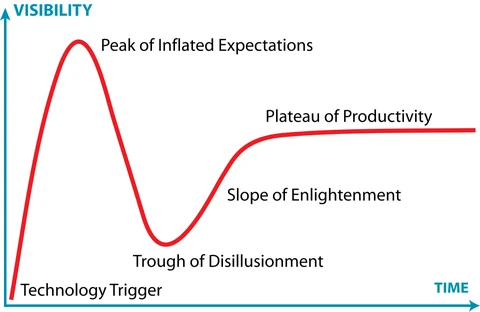
Not really, but you get what I'm saying, where effectively everybody can see the future, but it's not obvious why the future is not happening instantly. And partly it's knowledge diffusion, but the other part is the vision meets the complexities of the real world. You know, it's very easy to imagine totally autonomous processes and totally autonomous businesses. It's much harder to build them, because the real world is so complicated. There are so many different places where data is created, managed, moved, updated, changed. Though, you know, organizations have papered over the ugly parts of those questions for a very long time with humans.
So getting in there and pulling those humans out, getting from vision to implementation to, you know, success at scale is always harder than it looks, but it's also inevitable. You know, so I think, you know, obviously people always say that Bill Gates said, you know, people overestimate the change in two years, underestimate the change in 10 years.17The line comes from Bill Gates's book The Road Ahead: "We always overestimate the change that will occur in the next two years and underestimate the change that will occur in the next ten." A similar observation is known as Amara's law, after the American futurist Roy Amara. Maybe with AI, we're going to see faster diffusion than that. So let's be charitable and say maybe it's going to be five years. So we still have a little bit of time to go for this to truly reach scale.
06IBM's AI operating model
IBM, Clowes says, is building a complete AI operating model to turn AI's potential into actual reality.
Yeah, that is such a good quote. Well, Shaun, I wanted to ask before you head out: what is next for IBM, for people who are just following along? What can they expect to see come out of IBM over the next few months?
Yeah, at IBM, we recently had our big tech show in Atlanta, TechXchange,18TechXchange — IBM's annual conference for developers and technologists; in 2026 it ran October 26–29 in Atlanta. and we're talking about the need for a complete AI operating model.19Operating model — how a company organizes its work: processes, roles, systems and rules. Clowes means building AI into that work as a whole rather than running isolated pilots. And truly, you know, AI by itself is not… you know, AI is one thing, and an operating model is what converts the potential of AI into, you know, capable and actual reality. In the AI operating model, we think that you need the ability to understand your data. You need the ability to safely operate and scale agents and orchestrate20Orchestration of agents — coordinating many agents: which one handles which part of a task, in what order, and how they hand results to one another. and automate agents. You need the ability to manage agents, like a management and observability framework21Observability — the ability to tell what's happening inside a system from its logs, metrics and traces; for agents, what exactly they did and why. for agents. And you need a system for agents to take action. So the ability for agents to understand what can be achieved, how you manage tools and capabilities of the organization.
So we're working towards a complete operating model so that, you know, organizations everywhere can implement the operating model, pieces of the operating model, and convert the potential of AI into real, direct business value.
Well, wanted to thank you, Shaun, for joining us today on MTS, sharing about the latest at IBM and Confluent and how enterprises are adopting AI, all of the insights that we get from you, who's at the frontier, who's working with all of these industries across so many different areas. Thank you so much for joining us today on MTS.
It was a real pleasure. Thank you very much.
AdElevenLabs, Neon, Kong, Larridin, MongoDB, Chargebee, ClickHouse, Blitzy, AdQuick, Arena, VCX
A huge thanks to MTS sponsors.
ElevenLabs, AI that communicates at human level across every channel and modality. elevenlabs.io/mts.
Scale your startup on Neon. Millions of developers and startups have already chosen Neon for their back end. Start on the free plan or get up to $100,000 in credits for your startup at neon.com/mts.
Special thanks to our sponsor Kong, the AI connectivity platform. Connect APIs, LLMs, agents, and systems with serious security and governance. konghq.com.
Finally prove what your AI investment is worth with Larridin. Head to larridin.com today to start measuring your AI's bottom line.
MongoDB, trusted to run critical applications by 75% of the Fortune 100, the intelligent data platform for the era. Apply today for access to up to $15,000 in Atlas credits, dedicated technical support, and exclusive events and go-to-market opportunities. mongodb.com.
Chargebee, billing and monetization infrastructure for the AI era. chargebee.com.
ClickHouse is the real-time database built to keep up with every query your apps and agents send its way, and it now runs Postgres, observability, and AI tooling on one platform. Learn more at clickhouse.com.
Blitzy, autonomous software development for enterprise codebases. Ship 5x faster. blitzy.com.
AdQuick, make your brand a billboard. Out-of-home advertising as easy to scale as digital. adquick.com.
Arena, measuring AI performance in the real world. arena.ai.
Support for the show comes from VCX, the public ticker for private tech. The U.S. stock market started history's greatest wave of wealth creation. From factory workers in Detroit to farmers in Omaha, anyone could own a piece of the great American companies. But today, our most innovative companies are staying private longer, which means everyday Americans are missing out. Until now. Introducing VCX, a public ticker for private tech.
Visit getvcx.com for more info. That's getvcx.com. Carefully consider the investment material before investing, including objectives, risks, charges, and expenses. This and other information can be found in the Innovation Fund's prospectus at getvcx.com.
This is a paid sponsorship.


