

No Priors
Chapters
Tenev sees prediction markets as an evolution of news and clear demand for agentic trading, and he thinks the AI revolution in math is too centralized.
Read the chapter- More than 150,000 customers, Tenev says, have already opened agentic trading accounts at Robinhood.
- Sarah introduces Vlad Tenev, founder and CEO of Robinhood and co-founder of Harmonic, a startup building mathematical superintelligence.
Tenev boils everything Robinhood does down to one word: ownership.
Read the chapter- Robinhood is live in some form in more than 120 countries, and it started as an app for buying stocks without commissions.
- Owning assets is the tried-and-true route to financial independence, and the things you own become part of your identity.
- A society without broad ownership is fragile, while owners are more bought in and defend the system, which, Tenev says, matters especially now that AI is unsettling everyone.
- Trump accounts are ownership at age zero, Robinhood Ventures is ownership of private companies before they go public, and tokenization is ownership gone global.
Tenev traces his understanding of money and his independence to a childhood in hyperinflationary Bulgaria.
Read the chapter- Tenev was born in the late '80s, his parents left for the US first, and he didn't see his father for a year and a half.
- By his account, inflation in Bulgaria was about 170% in 1991 and about 2,000% a year in 1997.
- His grandfather, a doctor, exchanged his salary for copper cookware as soon as he got it, because it held its value better than the local currency, and that was the first real-world asset Vlad saw.
- At five, Vlad walked home from kindergarten on his own, and his parents, who were in the US on visas, impressed on him that without a scholarship there would be no college.
- Math, Tenev says, is like a good video game where you always know the next level, and in grad school he was drawn by the dream of creating a theory people would study for centuries.
AI has automated math, but Tenev doesn't like that discoveries are made by the closed models of big labs.
Read the chapter- Math has converged with programming: instead of chalk and a chalkboard, there's version control and proof verification in Lean.
- Harmonic's model Aristotle won gold at the International Math Olympiad, and once it was opened to the public, people used it to solve Erdős problems and reach new results.
- Sarah pushes back that people at the big labs would call this cope, saying human-AI teams will be outclassed by compute in an agent loop.
- Tenev calls a world where the labs make every discovery and sell the drugs themselves dystopian and unlikely, because they would lose their social license to operate, while the same discovery made by a random amateur would be far better received.
- He advises the labs to collaborate with mathematicians instead of painting a dark future where one company makes every discovery.
Stock tokens work like a stablecoin and are meant to become the default way for people in developing countries to reach the US market.
Read the chapter- As with a stablecoin, the assets sit with a traditional custodian, while the tokens minted and burned against them trade freely in DeFi, split into fractions and compose like software.
- Last year Robinhood launched stock tokens in Europe without DeFi, and this year it relaunched them fully DeFi-enabled along with its own blockchain, Robinhood Chain.
- Developers are already using the tokens as Lego bricks for NFTs and meme coin pairs, and Tenev, who is thinking about smart-contract options, won't predict what comes next.
- To the "corpo chain" criticism, Tenev answers that focused leadership and Robinhood-backed products give developers confidence.
Prediction markets as a way to monetize knowledge, and a new form of news.
Read the chapter- Expertise, say in AI models, used to be monetizable only indirectly, through derivatives on Google or Nvidia stock.
- KPI contracts will let you trade the metric itself, earnings per share or revenue, rather than a stock that can fall for unrelated reasons.
- For hedging, Tenev points to a contract on whether California's billionaire tax will pass.
- Many people, Tenev says, don't trade at all and just open the app to check the odds, like the front page of a future newspaper.
Agentic trading, Tenev says, already has product-market fit, and Robinhood Agents does for traders what Claude Code does for programmers.
Read the chapter- More than 150,000 customers opened agentic accounts within a few months, and tool calls are growing exponentially, with the latest announced figure at about 30 million a day.
- Robinhood Agents is a harness and interface inside the account, with loops, skills and an app store with data such as satellite images of parking lots.
- The goal is to give ordinary people the capabilities of a hedge fund: sophisticated users will trade more first, then more and more people, just as with coding agents.
- If turning an idea into a strategy becomes as easy as buying a single stock, a lot more people will do it.
Tenev sees no need for big changes: markets have long been algorithmic, and agentic trades are still a small share.
Read the chapter- The agent runs in a separate account, trades require approval by default, and it can't reach into other accounts.
- Markets went fully electronic about 20 years ago, and exchanges and brokers long ago adapted to algorithmic trading in New Jersey data centers.
- Sarah notes that CI/CD buckled under the explosion of generated code and asks whether the same could happen if everyone becomes a high-frequency trader.
- Robinhood optimizes its own code and sandboxes, market makers like Citadel and Jane Street and the exchanges have long handled huge volumes, and agentic trades, Tenev thinks, are still far from a double-digit share.
The gains from AI go to a narrow circle of investors, and Robinhood wants to let retail investors into private companies.
Read the chapter- Retail investors can't buy OpenAI or Anthropic, and while Microsoft and Amazon went public at valuations in the hundreds of millions, an AI lab valued at a trillion won't let them make a thousand X.
- Tenev explains the data center backlash by the fact that data centers bring people noise and threats to their jobs, but no money.
- Crypto is different: the masses owned it from the start, and in 2024, Tenev thinks, they swung the election in a meaningful way.
- The first Robinhood Ventures fund is a publicly traded late-stage venture fund holding OpenAI, ElevenLabs and Crusoe, and the second partners with YC to invest at the earliest stages.
- The north star is trading shares of a private company like Anthropic around the clock and in fractional amounts.
Tenev considers restrictions on retail investors a relic of the pre-internet era.
Read the chapter- Tenev calls the SEC's initiative to grant accredited status for passing an exam rather than for wealth a step forward, but says two hours at a testing center is still too much friction.
- The overwhelming majority of Robinhood customers agree that nobody should tell them how to invest their money, and a broker's job is to be clear about what the product is.
- You can buy meme coins in any amount but can't invest in private companies, which Tenev calls silly.
Robinhood is the broker and trustee of the children's investment accounts.
Read the chapter- Robinhood builds the app and infrastructure together with BNY, the Treasury and the IRS.
- The Treasury puts $1,000 into the account of everyone born from January 2025, Michael and Susan Dell added more than $6 billion, Gwynne Shotwell pledged SpaceX shares, and Brad Gerstner made a donation for Indiana's children.
- The goal is to raise the share of households owning stock from 65% to 95% and make the program the best product the government has ever launched.
Tenev credits his hard childhood for his calm.
Read the chapter- Business troubles pale next to the threat of deportation and 2,000% inflation.
- His own kids have safety, so challenges have to be constructed on purpose, and he hasn't figured out how yet.
- Following Bezos, Tenev advises growing thick skin: you can control yourself, but not the outside world.
Quotes
On why a society without broad ownership is fragile
“And if you have more people that own things, they're more bought in, they have more stake in the outcome, and they become kind of defenders and protectors of the system.”
Vlad TenevRead from 02:51On Tenev's grandfather in hyperinflationary Bulgaria
“And as soon as he would get salary, he would exchange it for copper cookware. So it was kind of the first real-world asset that I encountered people investing in.”
Vlad TenevRead from 08:09On the AI revolution in math
“And so the one thing I don't love about, like, this latest wave of AI models solving math problems is that it's too centralized, right? It's like AI companies with their big data centers and their employees using secret models to sort of do all this work.”
Vlad TenevRead from 14:34On prediction markets
“I think of it almost as— in the pure form, prediction markets are an evolution of news. So what does news look like in the future? I don't think it's the New York Times, but I think it could be something like it, where you have your front page, your business section, lifestyle, culture, sports— and sports is a big part of it.”
Vlad TenevRead from 28:14On what Robinhood Agents is
“So you can kind of think of it as— if you're a Claude Code or a Codex user, it's almost like a tool like that that's optimized for trading.”
Vlad TenevRead from 29:30On the backlash against data centers
“And, you know, then we're wondering, well, why are people upset about data centers? Well, I mean, if you think about it, if I'm an individual, I don't benefit economically from any of this activity.”
Vlad TenevRead from 39:48On restrictions for retail investors
“Meme coins, even— meme coins have, like, perfect regulatory clarity. If you want to buy a meme coin, you are free to do so. And the SEC even wrote a letter saying these are not securities, they're collectibles.”
Vlad TenevRead from 47:05Advice for leaders, after Bezos
“The best approach to all these challenges is just grow thick skin. You can control that about yourself, but you can't control the outside world.”
Vlad TenevRead from 53:28
Summary
Vlad Tenev sums up Robinhood in one word: ownership. The company that started as a commission-free stock trading app has become a financial conglomerate, and Tenev ties all of its businesses to that idea: Trump accounts are ownership from birth, the Robinhood Ventures funds are stakes in private companies before their IPOs, and tokenization is ownership for people in countries without functioning capital markets. A society without broad ownership, he argues, is fragile: people who own things defend the system. He traces his understanding of money to a childhood in hyperinflationary Bulgaria, where his grandfather kept his savings in copper cookware.
With Sarah Guo he discusses Harmonic, his second startup, whose model Aristotle won gold at the International Math Olympiad and has been used on Erdős problems, and why he dislikes the idea of math discoveries being made by the closed models of big AI labs. Then come stock tokens and Robinhood's own blockchain, Robinhood Chain; prediction markets as "an evolution of news" and KPI contracts; agentic trading, with more than 150,000 accounts in a few months; and Robinhood Agents, a tool like Claude Code but for trading. Tenev doesn't expect market infrastructure to need a major overhaul for agents: trading has long been algorithmic, and agent-driven trades are still a small share.
The bigger problem, as he sees it, is that the gains of the AI revolution go to a narrow circle of venture and institutional investors: companies go public at trillion-dollar valuations, leaving ordinary investors little upside, which he thinks explains the backlash against data centers. Robinhood's answer is publicly traded venture funds, tokenized private companies and a push to loosen accredited investor rules, which Tenev calls a relic of the pre-internet era. The conversation closes with how Robinhood runs Trump accounts and why a hard childhood helps keep a steady hand.
Advice
When business problems pile up, step back and compare them with real hardship: next to the threat of deportation or 2,000% inflation, a crisis at work no longer looks like a catastrophe, and it's easier to stay calm.
Grow thick skin: you can't control the whims of markets, the press or your users' moods, but you can control how you respond to them.
Mentioned
 Robinhood Markets00:47the guest's company: from commission-free trading to a financial conglomerate
 Harmonic00:47the guest's second startup: mathematical superintelligence
 The Vanguard Group04:38another "missionary" financial company
 Terence Tao04:38Vlad studied math under him
Show 17 more mentionsShow fewer mentions
 Lean13:22the formal proof language mathematicians use
- Aristotle13:52Harmonic's model: olympiad gold, Erdős problems
 OpenAI16:04an AI lab that could keep every discovery for itself
 Anthropic16:04likewise; Vlad would like its shares to trade around the clock
- Robinhood Chain20:48Robinhood's blockchain for real-world assets
 Model Context Protocol28:53the basis of Robinhood's agentic trading
- Robinhood Agentic Trading28:53agentic trading: more than 150,000 accounts in a few months
- Robinhood Agents29:30trading agents right inside a Robinhood account
 Claude Code29:30what Tenev compares Robinhood Agents to
 Codex29:30the same comparison
 Y Combinator43:07Robinhood Ventures Fund II invests in its startups
 Donald Trump48:38Trump accounts as part of his legacy
 Michael Dell48:38with his wife, gave more than $6 billion to Trump accounts
 Gwynne Shotwell48:38a donation in SpaceX shares
 Brad Gerstner49:46the architect of the Trump accounts program
 Andrew Reed50:44described Vlad as unlimited IQ plus a steady hand
 Jeff Bezos53:28the advice to grow thick skin
Transcript
01Preview and introduction
Tenev sees prediction markets as an evolution of news and clear demand for agentic trading, and he thinks the AI revolution in math is too centralized.
Hi, listeners, welcome back to No Priors. Today I'm here with Vlad Tenev, the founder and CEO of Robinhood. We talk about what Robinhood is today as a financial conglomerate trying to expand ownership in the economy, from tokenization1Tokenization — issuing tokens on a blockchain, each representing a share of a conventional asset: a stock, a bond, real estate. The asset itself sits with a custodian, while the tokens can be transferred and sold around the clock and around the world. to prediction markets to how AI agents will trade for everyone in retail. We also talk about Harmonic,2Harmonic — a Palo Alto AI startup that Vlad Tenev co-founded with Tudor Achim in 2023 to build "mathematical superintelligence." Its model, Aristotle, writes solutions in the formal proof language Lean, so a computer can check that they are correct. his effort to make a math superintelligence, and whether there can be distributed discovery and science rather than centralized. Welcome, Vlad. Vlad, thank you so much for doing this.
Thank you for having me.
02The ownership company
Tenev boils everything Robinhood does down to one word: ownership.
So everyone knows Robinhood, but it's also evolved a ton as a company. Can you just put it in context for our listeners? Like, how do you describe it today?
We do a lot of things. We're live in some form or another in over 120 countries.3Since July 1, 2026, Robinhood's new Stock Tokens have been available in the Robinhood Wallet in more than 120 countries, though terms vary by jurisdiction. The Robinhood app itself had almost 28 million customers in 38 countries as of July 2026, according to the company. And if I had to sum up Robinhood in one word or one idea, it would be ownership. I think we're the ownership company, the company that's most associated with that. And when I say that— so, why does ownership matter? I think on an individual basis, people want to own things.
It's the tried-and-true route to financial freedom, financial independence. You know, if you're an asset owner and you accumulate assets over time, it's just the best way to build your wealth. So there's an individual element to it that really, you know, whether you're trading, whether you're accumulating assets, whether you're investing in venture, I think it's very, very important. And also, you know, the things you own say a lot about your personality. It's almost like it becomes, like, a part of your identity. Like if it's a car collection or your collectibles, your cards, your stock portfolio, I think there's a lot of individuality in it.
So I think there's an individual benefit, but I think there's also a collective benefit, in the sense that a society without broad ownership is inherently very unstable. It's a fragile society. And if you have more people that own things, they're more bought in, they have more stake in the outcome, and they become kind of defenders and protectors of the system. And so I think especially now, when people are kind of pushing back against society and it feels a little bit fraught with AI and all of this disruption, I think giving people the ability to own companies at earlier stages is increasingly important. So it's really what ties together all of our things, from Trump accounts,4Trump accounts — children's investment accounts created by the One Big Beautiful Bill Act, signed July 4, 2025. For every child who is a US citizen born from 2025 through 2028, the Treasury deposits $1,000; families can add up to $5,000 a year. The money goes into low-cost index funds of US stocks and can be withdrawn from age 18. The program launched on July 4, 2026. which is ownership at age zero; Robinhood Ventures,5Robinhood Ventures — the Robinhood business that lets retail investors put money into private companies through publicly traded venture funds. Tenev describes its two funds near the end of the episode. ownership of private companies before they go public; tokenization you can think of as ownership gone global. Like, how can we make all the people outside the US, people in 120-plus countries that don't sometimes even have functional banking systems, how can we kind of plug them into this economic fabric of society?
So yeah, that's how I think about it. We started off as just a simple app to buy stocks at zero commissions6Commission-free trading — where Robinhood started: Vlad Tenev and Baiju Bhatt founded the company in 2013, and the app launched in 2015 offering commission-free stock trades from day one. In October 2019 the largest US brokers, Charles Schwab, TD Ameritrade and E*Trade, also dropped commissions on online stock trades. on your phone, and then we've kind of expanded from that into an increasingly global financial conglomerate that allows customers to own things across a wide variety of surfaces and asset classes.
03Hyperinflation and copper pots
Tenev traces his understanding of money and his independence to a childhood in hyperinflationary Bulgaria.
You might be the only large financial I think of as a missionary organization,7Missionary organization — in Silicon Valley, companies of "missionaries," driven by an idea, are contrasted with companies of "mercenaries," driven by money. The distinction was popularized by venture capitalist John Doerr of Kleiner Perkins. with the other being, like, Vanguard8Vanguard — the investment company John Bogle founded in 1975. It is owned by its own funds, and thus ultimately by their shareholders: it has no outside owners, and profits go back to investors as low fees. or something like that. Can we talk about how you got here? Like, you know, so you— I learned recently that you studied math under Terence Tao9Terence Tao — a mathematician at the University of California, Los Angeles (UCLA) and a 2006 Fields Medalist, considered by many the greatest mathematician of his generation. Tenev was a math PhD student at UCLA but dropped out to start his own company. and you worked on HFT.10High-frequency trading (HFT) — algorithmic trading in which programs make huge numbers of trades in fractions of a second. After school, Tenev and Bhatt founded Celeris in New York in 2010 and Chronos Research in 2011; both built software for high-frequency trading, and Chronos sold low-latency software to trading firms and banks. Wikipedia. Neither of those sound like a missionary for people, if I may say that. How did you discover this mission, or, you know, come to it?
Yeah, so, I mean, rewinding back even further, I was born in Eastern Europe in the late '80s, kind of on the brink of the collapse of the Soviet Union and the lifting of the Iron Curtain. And actually in the 1990s, so I immigrated to the US after my parents. My dad had an opportunity to come study at the University of Delaware for his master's, and then was also able to take advantage of that and stay in America full-time. And so my mom came about a year after, and I came about six months after her, which was a pretty unique experience. I mean, you talk to a lot of parents— I didn't see my dad for a year and a half and my mom for six months when I was a small child.
Source: IMF World Economic Outlook data, as tabulated on Wikipedia; average annual consumer price growth
I lived with my grandparents, and a large portion of that was we just didn't have the money to send the whole family. So we had to— you know, we weren't sure that my dad would have a long-term future in this country. So we thought maybe he'd come back after a year or two years. And anyway, he did quite well and was able to send for my mom and then me. And my last year in Bulgaria, 1991, the inflation rate was something like 170% in Bulgaria.11Fact-checkTenev recalls inflation of about 170%, but in fact consumer prices in Bulgaria rose by an average of 335.5% in 1991, roughly twice as much. Wikipedia. So my early memories were the rolling blackouts and, you know, my family huddled around the radio, which was battery-operated, just listening to what was going on.
The lines at the bodega, which I could see from my window, for buying milk and eggs. The milk would come in these big plastic bags. And, you know, the one week a year you would get bananas from other communist countries. So Cuba would— the Cuban bananas, I remember, were just amazing. And then I would come to the US and there were just bananas everywhere, right? But they weren't as good. And so, yeah. And even after I moved, in 1997, Bulgaria had the unfortunate distinction of having the number one inflation rate in the world. It was something like 2,000% annualized.12Bulgaria's 1996–1997 crisis peaked in early 1997: prices rose 242% in February alone, and by March annual inflation had passed 2,000%, according to the IMF. On July 1, 1997, Bulgaria introduced a currency board, pegging the lev to the German mark at 1,000 leva per mark, and in 1999 it redenominated the currency, dropping three zeros.
So they were just adding zeros to the currency every couple of months. And so from that point, I just developed kind of an understanding of money. I had to be very independent. You know, my parents— it was always a topic of conversation, and we would have to send money to my grandparents back home as they were dealing with this inflation crisis. And my grandparents actually would keep their assets in copper cookware. So there was this closet in my grandfather's house where— you know, he worked as a doctor, kind of in the shipbuilding and naval industries.
So he was on a boat a lot of the time. So he had his contacts at the port. And as soon as he would get salary, he would exchange it for copper cookware. So it was kind of the first real-world asset13Real-world asset (RWA) — the crypto industry's term for conventional off-chain assets such as stocks, bonds and real estate once they are tokenized. Tenev applies it to his grandfather's copper pots; later he calls Robinhood Chain a blockchain "built for real-world assets." that I encountered people investing in.
Exactly.
In the closet, you'd have—
Pots and pans, much better than the local currency at the time. And so, yeah, I just— I grew up with that. I grew up understanding, you know, what happens in a broken system, where you don't have, you know, free markets and good, healthy capital markets. And I'd say for me, I pretty quickly discovered that academically I was quite strong, and also independent, basically by choice. You know, my parents couldn't really afford babysitters or after-school activities or any of that stuff. They were both working multiple jobs, and my dad was a full-time graduate student.
So it was kind of like, you know, when I was in kindergarten, five years old, I would walk back from school by myself. They would tell me, "Okay, go to the neighbor's house." We lived in apartment buildings at the University of Maryland. "Knock on the door, your neighbor will watch you for, you know, a couple of hours." Then they realized, "All right, our son's going through this, like, complicated ritual to get home. We might as well just give him the key." And, you know, pretty soon after that, I would let myself in, do my homework, go outside, play with my friends.
So I was very independent. And there was always this, like, pressure of having to succeed and do well in school, probably for a couple of reasons. One, I was good at it, and so everyone around me was like, "Do more school, skip grades, like, do better in math, more math," you know. And, you know, the teachers would have these meetings with my parents, like, "Hey, your son— you know, do you know he's really good at math? You should, you know, put him in this thing." So I think that was one of the benefits of growing up around the University of Maryland, which is a very academically oriented community, and they would try to sort of, like, identify the kids that had potential and accelerate them.
The other thing was my parents would just sit me down and say, "Look, the financial status of this family is very insecure. We're not making any money. So you're going to have to basically get a scholarship if you want to go to college. And to get a scholarship, you're going to have to do very, very well in school. And also, by the way, we might get— we're, like, visa holders here. So, you know, if we lose our jobs, we're going to have to get sent back to Bulgaria."
So there was all this pressure to succeed academically. And, you know, for me, you know, my math PhD program— at some point it became kind of this challenge, like, what's the hardest thing? How can I do better at the hardest thing? And it was this almost, like, competition with myself, and with my parents, who are also very academically strong. Like, "Oh, what was the hardest subject for you at school, Dad?" "Oh, chemistry." Let me just do really well at chemistry. Or, you know, "What was the most advanced math that you did?"
And I think math has this, like, ladder of achievement. It's almost like playing a really good video game. Like, you always know what the next hardest thing is, and it's almost like, how quickly can you go to algebraic geometry or algebraic topology,14Algebraic geometry studies shapes defined by systems of polynomial equations, and algebraic topology studies the properties of spaces that don't change under continuous deformation, using algebraic objects such as groups. Both are usually studied in graduate school. and can you learn that earlier and kind of understand it? And I think what appealed to me when I got to grad school was this idea that if you create a new mathematical theory, you know, maybe you'll be remembered for a really long time. And, you know, just like kids in school, everyone learns, you know, Gauss and Riemann and all these greats. If you create a theory, maybe kids will be learning and sort of, like, thinking about your work hundreds of years from now.
So that was kind of what appealed to me.
04Math, Harmonic and centralization
AI has automated math, but Tenev doesn't like that discoveries are made by the closed models of big labs.
Just given that background— and, you know, you should also explain what Harmonic is as an effort— what is your reaction to the revolution in math that's happening with AI today?
I think, on the one hand, it's very exciting and sort of predictable, because the rise of AI models and the ability to verify the outputs put together has led to kind of automation of the math pipeline. And I think it's really, really exciting, right? I think that the power and the tools— I mean, the math is changing so quickly. And, you know, math as a field hasn't changed very rapidly at all in thousands of years. I mean, when I was in grad school, most of the work was still being done in person with, like, chalk and a chalkboard. It's like there was no collaboration.
People weren't even using computers. So now math has kind of converged with coding. Mathematicians are using the same tools. They're using version control. They're using, like, Lean for verification,15Lean — a programming language and interactive theorem prover in which a computer checks every step of a proof. Leonardo de Moura created it at Microsoft Research in 2013; Mathlib, the largest library of formalized mathematics, is written in Lean. and the field is accelerating very rapidly. About a year ago— so Harmonic, which is a startup that I co-founded a couple of years ago with the goal of building mathematical superintelligence.
So last year we created a model called Aristotle that was one of three that got a gold medal on the International Math Olympiad.16The International Mathematical Olympiad (IMO) — the leading annual math competition for high school students: six problems over two days. On July 28, 2025, Harmonic announced that Aristotle had solved five of the six problems of the 2025 olympiad, a gold-medal performance, with solutions written in Lean 4 and checked by computer. Google DeepMind and OpenAI also announced gold-level results at the same olympiad, but their models wrote solutions in natural language. arXiv. And then subsequently to that, we rolled it out to the public, and we had people using Aristotle to tackle unsolved math problems. And so it was used to, like, solve these Erdős problems.17Paul Erdős (1913–1996) — a Hungarian mathematician who left hundreds of open problems, often with cash prizes for solving them; the site erdosproblems.com catalogs them. Since late 2025, Aristotle has been used to formally prove solutions to several, such as a weak form of problem No. 124 and one interpretation of problem No. 728. There were these other mathematicians that were using it for new results and so forth. And so then I started thinking a lot about, okay, what's the future of math? Like, how should these tools be used?
And I think for me, it was very important for the tools that I build, not just Harmonic but also Robinhood, to be empowering to individuals, to people. And so the one thing I don't love about, like, this latest wave of AI models solving math problems is that it's too centralized, right? It's like AI companies with their big data centers and their employees using secret models to sort of do all this work. And I think what's more attractive, and what would ultimately win out in the end as a model, is rolling these things out and actually putting them in the hands of people, and having the users make interesting discoveries and inventions.
So I am probably, like, a pretty fundamental believer in decentralization as a philosophical premise. And I would love to believe that's true. I think that there are a lot of people who work at large centralized AI companies who would say— like, if I may push back a little bit— that this is cope, and centaur play18Centaur play — a human working in tandem with AI; the term comes from "advanced chess," in which each player sits at the board with a computer. Garry Kasparov played the first such match in 1998, a year after losing to Deep Blue. will just be outclassed by, you know, more compute in an agent loop.19Agent loop — a setup in which the model itself repeatedly chooses the next step, calls tools, looks at the result and decides what to do next, with no human involved. Like, do you believe that's true, or what will be the human input here that is productive in math?
Well, I think it's sort of, like, two separate things, right? One is, what's the role of the individual mathematician? And the other is, is this going to be, like, a product that people use, or are the AI labs going to be producing the products? I mean, I have thoughts on both of them, but the second one is much more interesting. I think that a world where you have the AI labs on a proprietary basis making all the discoveries, and you have, like, the OpenAI or Anthropic data centers that are just running code, you know, managed by the employees of those companies, and, you know, they're vertically integrating and, you know, producing all the drugs and selling the drugs to people, making all the mathematical and physical discoveries and publishing all the papers.
If all of that is happening and it's owned by the AI labs themselves, I think that's a bit of, like, a dystopian outcome, and unlikely to happen for a couple of reasons. Not just, like, technological and market, but I think also, like, if that happens to a significant degree, people will— they'll lose their license to operate,20Social license to operate — a concept from the mining industry in the late 1990s: the unwritten consent of society, local residents and authorities to a company's activities. A company that loses it runs into protests, lawsuits and regulators even if it formally holds every permit. right?
I think it's much more— I think you could have the same outcome of Navier–Stokes21Navier–Stokes and the Riemann hypothesis — two of the seven "Millennium Prize Problems," for each of which the Clay Mathematics Institute offered a million dollars in 2000. The Navier–Stokes problem asks for a proof that the equations of viscous fluid flow in three dimensions always have smooth solutions, or a counterexample; the Riemann hypothesis states that all nontrivial zeros of the zeta function lie on the line with real part 1/2. being proven, or, you know, the— like, the partial Riemann hypothesis, or any one of these things. And it'll be much more accepted if it was, like, a random layperson using it—
I think, for sure. And I think that's how it's going to happen. That's the likely scenario one year from now. I think you also have the confounding factor of a lot of the people that are going into these AI labs are former researchers. And so they're, like, excited by doing research, and I think they're confused as to why this is being poorly received. From their perspective, it's like, "Oh, I'm a researcher.
I was brought into a research organization to do research, and now all these academics are mad at me." But yeah, I think that— yeah, and I've said this to folks that work at the companies— I think it would have been much better if they found some mathematicians and kind of collaborated with them, to not make it seem like, you know, there's this dark data center dystopian future where, you know, one company is going to make all of the scientific discoveries.
05Tokenization and Robinhood Chain
Stock tokens work like a stablecoin and are meant to become the default way for people in developing countries to reach the US market.
Can we talk a little bit about both the, you know, new ways you want to extend ownership as part of Robinhood, and then also how Robinhood is intersecting with what's happening in AI? Maybe we can just start with what you guys are doing with tokenization, or your vision for it.
Yeah, so tokenization is really— it's a new innovation. And the idea is almost similar to stablecoin.22Stablecoin — a cryptocurrency pegged to the dollar or another asset. USDC and USDT work this way: the issuer mints new tokens when dollars are deposited into the reserve and burns them when tokens are redeemed, so the number of tokens in circulation matches the dollars in reserve. So the way a stablecoin works is you take some dollars or Treasuries, put them in a wrapper, put them in a box, and then you mint and burn tokens against the box. And the traditional assets stay custodied at a traditional institution, like a bank. And then the tokens can trade freely on DeFi.23DeFi (decentralized finance) — trading, lending and other financial operations carried out by smart contracts on a blockchain, without a bank or broker in the middle. So they can move anywhere around the world.
They can trade in fractional amounts. They can be swapped in different protocols or lending pools.24Lending pool — a smart contract into which some users deposit tokens to earn interest while others borrow them against collateral in other tokens; the largest such protocol is Aave. And that opens up just a ton of—
Yeah. So you can kind of extend that concept to any real-world asset. So we've done it with stocks.
ExplainerHow a stock token works
The mechanics are the same as a stablecoin's: the issuer buys real shares and keeps them with a custodian, then mints tokens against them on a blockchain; when a token is sold back it is burned, so the number of tokens matches the number of shares in the "box."
- A token holder gets the share price but does not become a shareholder: there is no vote at the annual meeting, and the claim is against the company that issued the token, not against Apple or Tesla. Robinhood's first European tokens in 2025 were legally derivative contracts; the new ones are debt securities of a Robinhood subsidiary.
- Hence the intermediary risk: a token is worth what it should be only as long as the issuer and the custodian actually hold the shares and honor their obligations.
- Private companies are harder. In July 2025 Robinhood gave European customers OpenAI and SpaceX tokens tied to stakes it held through an SPV. OpenAI replied that the tokens were not OpenAI equity, that it had not partnered with Robinhood, and that any transfer of its equity required its approval; Tenev said the tokens only gave indirect exposure to the stake. The Bank of Lithuania, which supervised Robinhood's European business, asked the company for clarification.
So you can put stocks in a box and mint and burn tokens against them, and they can trade all over the internet, on blockchains, like software. You can do it with private companies. You know, instead of a stock, it's like an SPV25SPV (special purpose vehicle) — a company set up to pool money from several investors and buy shares in a single private company with it; the investors own stakes in the SPV, not the shares themselves. with private company shares. Behaves the same, with some slight differences around redeeming and things of that nature. You could do it with art, collectibles, real estate. So what we launched— and we've been playing around with tokenization and experimenting with it for many years. So last year we had an event in the south of France26To Catch a Token — Robinhood's event in Cannes on June 30, 2025: the company launched more than 200 tokens of US stocks and ETFs on the Arbitrum blockchain for customers in the EU and announced its own blockchain. where we launched stock tokens, which are tokenized versions of US stocks, and we did it in Europe, but it wasn't fully DeFi-enabled.
So if you're a European customer using Robinhood, you could trade them, and they felt very much like real stocks, but you couldn't actually, you know, send them out on Ethereum27Ethereum — the second-largest blockchain by market value after Bitcoin and the main platform for smart contracts; most of DeFi runs on it or on top of it. or on the blockchain and put them in pools or compose them with other smart contracts.28Smart contract — a program stored on a blockchain that executes the terms of a deal by itself: it transfers tokens, accrues interest, accepts and returns collateral. Now this year we took it one step further. We relaunched stock tokens with fully DeFi-enabled characteristics, and we launched it in conjunction with Robinhood Chain,29Robinhood Chain — a layer-2 blockchain on top of Ethereum, built on the Arbitrum platform; its public mainnet went live on July 1, 2026. The new Stock Tokens launched at the same time: they trade around the clock and can be deposited in lending pools and used as collateral. Legally they are tokenized debt securities of Robinhood Assets (Jersey) Limited and aren't available in the US. The first generation, Classic Stock Tokens, remains in Robinhood's European app. which is our new blockchain built for real-world assets. And Robinhood Chain has become one of the fastest-growing— I think the fastest-growing, across a lot of metrics, blockchains in history. And what we've seen is just an explosion of developer activity. I think we announced recently it's the number one chain in developer activity, too.
And, you know, developers have taken stock tokens, which have become kind of like Legos, and have started building all sorts of interesting smart contracts, NFTs,30NFT (non-fungible token) — a unique token on a blockchain, usually certifying rights to a digital image or other object; the craze for them peaked in 2021. pooled assets, where you'll take, for example, a meme coin31Meme coin — a cryptocurrency issued as a joke or around an internet meme, with no practical purpose; the best known are Dogecoin and Shiba Inu. A meme coin's price rests entirely on attention and hype. and link it with a stock token. And, you know, this is just sort of month-one and month-two type activity. Yeah, I think these financial primitives32Primitives — in programming and crypto, the basic building blocks from which more complex products are assembled; here, stock tokens that developers build into their smart contracts. as the foundation of a developer platform will become really, really big. And I think what's more exciting to me than this is Robinhood Chain is a way to enable the long tail of countries.33The long tail — a multitude of small markets or customers, each tiny on its own but adding up to a sizable share together. Journalist Chris Anderson popularized the concept in 2004. So people in countries that don't have highly functioning capital markets or financial systems, like, you know, places in South America or Africa— anyone with a smartphone and a non-custodial wallet34Non-custodial wallet — a crypto wallet whose keys are held by the owner rather than by an exchange or broker: no one else can freeze the funds, but no one can recover a lost key either. can now get exposure to US markets at incredibly low cost.
So in the same way that I think stablecoin became the default way for people in these countries to get access to dollars, stock tokens and products like that will be the default way to get access to US equities for all of these people.
Exactly. And private companies. And really the vision for Robinhood Chain and tokenization is, let's just take all the things that work on Robinhood and put them on-chain35On-chain — recorded and executed directly on a blockchain rather than in a company's databases. and make them available to people in all these countries. And I think one thing I've learned is a lot of people— so, you know, we're new to operating a blockchain, or new to operating these, you know, on-chain smart contract products. And a lot of the criticisms that, you know, Robinhood has received— like, we've been called a corpo chain,36Corpo chain — crypto slang for a blockchain launched and controlled by a corporation, such as Coinbase's Base or Stripe's Tempo. right? Like, the best blockchains are— so they told me, they said, "The best blockchains are managed by these, like, organizations and consortiums, and everything's decentralized, and, you know, you guys are a corporation managing a chain. How is that going to be as good?"
Well, maybe you sacrifice a little bit of, like, organizational decentralization purity, but what you get is just focused leadership and someone, you know, or some group of people, with very, very clear direction pushing things forward. And the other thing is also, I think it is good to have Robinhood-backed products on the chain, too. A lot of chains take the approach of, you know, "Let a thousand flowers bloom,37"Let a thousand flowers bloom" — a twist on Mao Zedong's 1956 slogan "Let a hundred flowers bloom, let a hundred schools of thought contend." In English it is often quoted with "a thousand flowers" to mean "let people try everything," although the campaign itself ended in the persecution of those who took the invitation to criticize at face value. let the developers just build all this stuff." We love the developers as well, but I think having primitives like stock tokens that have our backing, that people can trust— we've seen that that just creates more interest to build on them. Because, you know, to some degree people know, "Okay, Robinhood's backing them. They're legit.
Like, that's a trusted brand. We know they're not going to go away." So that gives them much more confidence to build than, you know, if it was just a team of, you know, two or three engineers somewhere that are offering these primitives.
Is there an example of a composition that you think should exist on stock tokens, or has already come from the ecosystem, that you're excited about?
I mean, one of the things that I'm thinking about is, yeah, it's like, how can we take some of these derivative products, like options?38Derivatives — contracts whose price depends on another asset: options, futures, swaps. An option gives the right, but not the obligation, to buy or sell an asset at a set price before a certain date. Can you make, like, really nice smart-contract-native options contracts? You know, there's been a tremendous amount of innovation in the traditional markets that's to some degree, like, stymied by how hard it is to just move off of mainframes onto more modern things, and take all the counterparties that rely on the system being predictable and slow-moving. So I think a big part of it is just, let's provide the primitives and let the developers kind of put them together in new ways. And I don't want to, you know, presuppose what developers come up with, because I wouldn't have been able to tell you that, you know, stock-linked— stock-token-linked NFTs or stock token meme pairs would become a thing.
Like, I just had no way to foresee how quickly those things would grow and become real.
06Prediction markets
Prediction markets as a way to monetize knowledge, and a new form of news.
Yeah, I mean, I actually think prediction markets do tie into ownership, because a lot of people have unique knowledge and ideas, and they have hot takes on things that maybe not everyone knows. Like, you might be an expert in AI model development. You know, we have lots of contracts that allow you to speculate and hedge39Hedging — a trade that insures against losses on another position or against a risk in life: if the bad event happens, the payout on the contract covers the loss. on what AI model will be best this week or this month or this year. And the way to kind of, like, monetize that knowledge before prediction markets was highly indirect. Like, maybe you could trade derivatives on, you know, Google stock or Nvidia stock.
Yeah. And so there is an important thing with being able to monetize your own knowledge and doing it more directly. It's actually one of the reasons we announced, and we're planning to launch, KPI contracts.40KPI contracts (KPI: key performance indicator) — at HOOD Summit 2026, Robinhood announced earnings predictions, binary KPI options: exchange-traded, cash-settled contracts whose payout depends not on the stock price but on whether the company meets a condition on a specific financial or operating metric in its SEC filing. At the time of the announcement the product was awaiting regulatory approval. So for a long time, if you wanted— like, say you're studying a company and you have a pretty good idea that it's going to beat earnings, EPS or revenue.41EPS (earnings per share) — the headline number in a quarterly report. A company "beats earnings" when its results come in above the average analyst forecast. Well, in the past, if you bought the stock, or, yeah, you bought, like, an option on the stock, sometimes the company would beat earnings and the stock would go down for some unrelated reason— you know, guidance,42Guidance — management's expectations for the coming quarters, published alongside the results. Weak guidance often sends a stock down even after a strong quarter. and one of these things. So KPI contracts now allow you to actually trade the EPS print, the revenue print, or any of the other KPIs that might matter to a company.
So I think there's that aspect, where you can actually monetize your belief. You can hedge more precisely. For example, there's a "Will the California billionaire tax43The billionaire tax — Proposition 40, the 2026 Billionaire Tax Act: a one-time 5% tax on the wealth of California residents worth more than a billion dollars who lived in the state on January 1, 2026, with most of the money earmarked for health care. On November 3, 2026, after this conversation was recorded, voters rejected it. pass?" contract, which I think is a useful hedging instrument for some people. Not me personally— I'm not hedging with it, but one could. The other thing about it is, I think it's a new source of information.
I think of it almost as— in the pure form, prediction markets are an evolution of news. So what does news look like in the future? I don't think it's the New York Times, but I think it could be something like it, where you have your front page, your business section, lifestyle, culture, sports— and sports is a big part of it. And you just can see what's happening and what's likely to happen in the future through the odds. So a lot of people don't even trade these things. They just like to open the app and just check out what's going to happen.
Yeah.
07Agentic trading
Agentic trading, Tenev says, already has product-market fit, and Robinhood Agents does for traders what Claude Code does for programmers.
Do you think people will let agents trade for them? And when? And what's the impact of that?
Yeah, so we launched a product earlier this year, which is basically a Robinhood MCP.44MCP (Model Context Protocol) — an open protocol Anthropic introduced in November 2024 for connecting AI models to external tools and data. Robinhood launched Agentic Trading for stocks and options in the US in 2026: customers connect a model of their choice through the Trading MCP to a separate account and decide how much money to give the agent and what limits to set. We call it agentic trading, and we have agentic credit card as well. So in the broader realm of agentic finance, I think there's two things that have product-market fit. One is agentic trading, very clearly— like, having an agent execute your trades and do a strategy for you. And we're seeing really strong adoption. Like, over 150,000 customers have opened agentic trading accounts with us in the few months since we've launched it.
And if you look at the tool calls,45Tool call — an AI model's request to an external function: here, fetching quotes or account data, or placing an order. you know, the tool calls have just been following this smooth exponential, where the last number we announced was something like 30 million tool calls per day. So agentic trading, clearly product-market fit. And, you know, we started by just having an MCP. And a couple of weeks ago at our HOOD Summit46HOOD Summit — Robinhood's annual customer conference (HOOD is the company's ticker); in 2026 it was held in Houston on September 29. Robinhood Agents lets you build an AI agent right in the app, choose a language model for it and connect it to a separate agentic account; through Agent Apps the agent gets data and tools from 11 third-party companies. By default every trade the agent makes has to be approved, though the setting can be turned off; the agent can only trade in its own account. event, we announced Robinhood Agents, which is basically taking it one step further, and the harness and the entire UI47Harness — the software around a language model: tools, memory, loops, interface. It is what turns a model into an agent that carries out multistep tasks on its own. is now inside a Robinhood account. So you can kind of think of it as— if you're a Claude Code or a Codex user,48Claude Code (Anthropic) and Codex (OpenAI) — AI coding agents that work in the terminal or editor, reading and editing code and running commands and tests on their own. it's almost like a tool like that that's optimized for trading.
So you can run loops and say, "Okay, every day, you know, execute a run of my strategy, rebalance my portfolio,49Rebalancing — bringing the weights of assets in a portfolio back to their targets: for example, if stocks have risen above the planned 60%, some are sold and bonds are bought. look at opportunities." We have skills.50Skills — in agents like Claude Code, ready-made packages of instructions and scripts for a typical task, which the agent loads when that task comes up. So you can, you know, do, like, a portfolio rebalance or all sorts of other things. We have agent apps. So we launched an app store where you can, for example, connect to a source of satellite data. And if you want to create a strategy that, like, counts cars in parking lots of retailers51Cars in parking lots — the textbook example of "alternative data": hedge funds buy satellite images of parking lots at big retailers' stores to estimate revenue from the number of cars before the earnings report comes out. or, you know, something of that nature, we'll make that available.
And the way that I think that'll evolve is we're going to look at all the capabilities that the coding harnesses have and see how we can provide really nice, clean, trader-native versions of that, that just make it really, really easy to be an active trader.
Amazing. What do you think the impact is of this on either, you know, participant mix or financial infrastructure? Just because many of these things that you described, institutional traders have the ability to do this, but it's expensive and sophisticated, right? And so if that's democratized, what does that mean?
Well, that's really the north star of the product. It's, can we put the capabilities of a hedge fund or a sophisticated algorithmic trading firm into the pockets of normal individuals? So in the same way that, you know, if you were a sophisticated, you know, grad student in computer science or something, you could write a trading strategy. And if you went through even more effort, you could deploy it, you could get, you know, rack space in the data center connected to the exchanges. Can we just sort of, like, streamline all aspects of that, so that, you know, in the same way that it's made it easier for anyone to be a software engineer, Robinhood Agents and our MCP can make it easier for more people to be quant traders?52Quant (from "quantitative") — a trader or analyst who trades using mathematical models and algorithms rather than intuition. And I think the outcome of that is there will just be more trading activity.
I think at first it'll be concentrated in a relatively small group of sophisticated people, but their trading activity will likely increase quite substantially. And then over time it'll just filter to more and more of the population. Yeah, I think coding is a good analogy. It's like, there's lots of people that want to— there's people that code, and for them, you know, they were first to adopt the coding agents, and their output multiplied. But then now there's people that just wouldn't have picked up, you know, VS Code or Cursor53VS Code — Microsoft's free code editor, the most popular among programmers; Cursor — an editor built on it, with AI built in. before, but someone showed them how to use Claude or Codex, and now they can build a website just really easily. So I think it'll lift the tide across the board.
I believe the desire to make software or automate things is much broader than I did, perhaps, before any of the coding AI and agentic coding happened, but wanting to make money off of a belief feels like a much more universal thing.
Yeah. And I think that, you know, as it becomes easier— a lot of people have ideas, right? And if you can take that idea and turn it into a strategy with as little friction as possible— if we can get it to approach the friction of just buying a single stock, then I think a lot more people will do it.
08Can the infrastructure keep up?
Tenev sees no need for big changes: markets have long been algorithmic, and agentic trades are still a small share.
There may not be an answer to this question, but is there an obvious way in which financial infrastructure or risk management needs to change in reaction to this?
I don't think so. So I'll tell you the safeguards we have on day one. So right now you have to create a new separate account, which is segregated from your main Robinhood balance. So you can create an MCP account, you can create an agentic account; you have to move money in there. And then, you know, for customers that choose to have trade approvals— by default, you have to approve your trades, but then you can turn it off so that you can run a strategy.
Well, actually, it's not as dangerous as that, because it's not like it can go into your other accounts and move money for you.
So it's sandboxed.54Sandbox — an isolated environment from which a program can't reach the rest of the system. Stricter still is an air gap: an air-gapped system has no connection to outside networks at all. It's a sandboxed— maybe not quite air-gapped, but pretty close. And we built a lot of the— we refined a lot of the infrastructure for the sandboxing and the harness in-house at Robinhood. Yeah, so far I think that it's not just a huge percentage of the market. The reason I don't see any clear massive overhauls necessary is that high-frequency trading has been a thing for a really long time. I mean, markets went fully electronic about 20 years ago.55Electronic trading — in 2005 the SEC adopted Regulation NMS, which barred executing orders at prices worse than the best quote on another venue, and in 2006–2007 the New York Stock Exchange moved to a hybrid market in which most trades are executed electronically. The main NYSE and Nasdaq data centers are in New Jersey, and high-frequency traders place their servers right inside them (colocation).
And so, you know, everything from the exchanges to a lot of the brokers have sort of conformed to this new reality of most of the workflows being algorithmic trading that happens in data centers in New Jersey, rather than what a lot of people still think happens, which is paper tickets and floor traders in a trading pit.56Trading pit — an area on an exchange floor where brokers traded by voice and hand signals ("open outcry"). Almost none remain: trading happens on servers.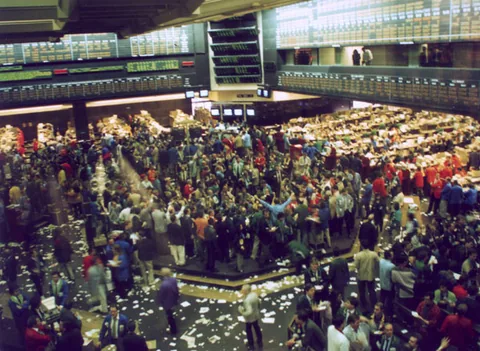 So it's not clear to me that anything fundamental has to change with regulation. But, you know, as it gets bigger, which I don't doubt it will, we might run into special cases for which we need more regulatory clarity, or—
Yeah, I was more from an infrastructure perspective. If you just use coding as a proxy, I did not— maybe we all should have, but I think it was not obvious that CI/CD57CI/CD (continuous integration / continuous delivery) — automatically building, testing and deploying every change to the code. was going to completely fall over in the face of orders-of-magnitude growth in code generation.
Oh, yeah.
And so that was my question, which is, like, yes, of course we've had HFT, but if, like, everybody is a high-frequency trader, that feels like new load.
Yeah, I mean, there's a couple of different layers in the stack, right? And we should expect— our on-chain stack is slightly different, that already has MCPs. But you have our on-chain tools, which a lot of it is— you know, I talked about Robinhood Chain being the best chain for real-world assets. Also, it's the best chain for AI agents. So we're seeing a lot of agentic trading there. On our CeFi,58CeFi (centralized finance) — financial services in which a company acts as the intermediary: an exchange, a broker, a bank. The opposite is DeFi, decentralized finance on smart contracts. centralized offerings, you know, we have a lot of end-to-end control over the entire system, right? We have our databases, we have our code that the strategies are running on, the sandboxes; we build a lot of those tools.
We have to optimize all of that. But, you know, once it gets through our system, you get to places like the algo— the market makers,59Market maker — a firm that constantly quotes prices to buy and sell and earns the difference between them. Citadel Securities, Jane Street and Jump Trading are major US market makers and high-frequency trading firms. Retail brokers, Robinhood included, route customer orders to market makers for execution and are paid for that order flow (payment for order flow), which largely underpins the commission-free model. which are all extremely sophisticated software shops. I mean, you're talking Citadel, Jane Street, Jump Trading. These are, like, low-latency, high-frequency folks. So I'm not so worried about them scaling to meet the demand. And then you have the exchanges, and the exchanges, because of pressure from HFTs and algo trading, have really optimized their APIs to handle huge volumes.
But that said, I think that we're still at a low percentage of the total trading is agentic. So I think we'll have some warning. I mean, we'll see it increasing. And I don't think that, you know, we're going to be at the point, you know, imminently, where agentic-mediated trades are, you know, a double-digit percentage of the activity. I think we'll have some time.
09Who gets the AI revolution
The gains from AI go to a narrow circle of investors, and Robinhood wants to let retail investors into private companies.
Given you're such a strong believer in ownership, and then democratized ownership as important to societal stability, and also, like, just opportunity for people— I think there's a sense that the AI revolution is not a broadly owned thing. Do you have an idea of, you know, what the solutions here might be? And maybe you can talk about Trump accounts as well here.
Yeah. And I think we identified this problem last year. You know, it's a couple of things, right? First, all of the major innovative AI companies are private. I mean, with some exceptions— you can look at Nvidia and Google, but, you know, those companies were already quite big before they really got into this new phase of AI. So if you wanted to invest in a large language model a couple of years ago, and you wanted exposure to OpenAI or Anthropic, you're basically out of luck as an individual investor. And I think there's a lot of reasons for that.
One is private markets have gotten60Private markets — deals in the shares and debt of companies that don't trade on an exchange: venture capital, private equity, private credit. In the US, access is mostly limited to institutional and accredited investors.— it's gotten really easy for high-growth, successful companies to raise money in the private markets. You know, they basically have— at massive scale. Massive scale. And that didn't used to be the case. You know, back in the '80s, a company like Microsoft, even in the '90s with Amazon, you know, they went public at valuations in the hundreds of millions.61Valuations in the hundreds of millions — Microsoft went public on Nasdaq on March 13, 1986, at $21 a share, and Amazon on May 15, 1997, at $18. Both were worth less than a billion dollars at the time; today each is worth more than a trillion. So individual investors that got in during the public offering could make a thousand X.
Now, if you have an AI lab that goes public at a trillion or two trillion, in order for an individual investor at IPO to make that type of return, they'd have to get into the quadrillions,62Quadrillion — a thousand trillion. For scale: the entire world economy produces a little over $100 trillion a year. right? It's crazy. I think it's unlikely, basically. Maybe it could happen, but I think it's going to be much tougher. And instead, you know, the gains keep getting concentrated into a smaller and smaller group of venture capitalists or institutional investors. And, you know, then we're wondering, well, why are people upset about data centers? Well, I mean, if you think about it, if I'm an individual, I don't benefit economically from any of this activity.
In fact, you could say, well, it's threatening my livelihood, my job, it's polluting my neighborhood, they're making all this noise. And yet, juxtapose AI with something like crypto. Crypto has not been— it's not like everyone trading crypto makes money, you know? And right now Bitcoin is, what is it, 85,000? If you bought at 120,000 a couple of months ago, you're down. 2022 and 2023632022 and 2023 — the years of the "crypto winter": in May 2022 the TerraUSD stablecoin and its sister token Luna collapsed, in November the FTX exchange went bankrupt, and Bitcoin fell from nearly $69,000 in November 2021 to about $16,000 by the end of 2022. were rough for the crypto industry, to say the least. A lot of people lost money in those years.
But yet in 2024, they came out in full force and swung the election,64Fairshake — a super PAC (a political committee that can raise and spend unlimited sums but may not coordinate its spending with candidates) funded by crypto companies. In the 2024 election cycle it raised more than $200 million, becoming one of the largest super PACs of that election, and spent mostly on congressional races. I think, in a meaningful way. And if there's even a hint of regulatory overreach for crypto, you have this army of people that are just blasting social media and, you know, messaging their congressman, or woman, and just fighting every inch of it. And I think a big part of it is crypto is distributed, broad ownership by individuals from the beginning. And it's almost— institutions are coming in late, whereas AI is the difference. So what do we do about it? Well, we launched two things. We believe that everyone should be able to invest in private companies, and I can't convince companies to go public earlier too effectively—
—even though I try doing that sometimes. Like, we do have our IPO— I mean, we're an underwriter,65Underwriter — a bank or broker that runs an IPO: it helps value the company and allocates its shares to investors. we're active in that pipeline. But individual investors should benefit from private companies and be a huge shareholder. That's really the vision behind Robinhood Ventures. How can we make it so that it's an anomaly to not have individual retail investors as a big constituent of your seed and Series A66Seed and Series A — the first rounds of venture investment: seed, when a startup has a team, an idea or a first product; Series A, when the product has found its first customers and needs money to grow. cap table?67Cap table — the register of who holds how many of a company's shares and options. So they should get— they should actually be at the earliest possible stage. And so Robinhood Ventures Fund I68Robinhood Ventures Fund I (ticker RVI) — a closed-end fund that listed on the New York Stock Exchange on March 6, 2026, raising $658.4 million, with no accreditation requirement or investment minimum. In March 2026 the fund invested about $20 million in ElevenLabs, in April $75 million in OpenAI, and in September it announced a $25 million investment in Crusoe, which builds data centers for AI.— we actually have an innovative structure for this.
You can kind of think of it as a publicly traded venture capital firm. And so what we did was we used our IPO channel69The IPO channel — Robinhood IPO Access: since 2021, customers can buy shares through it at the offering price, before trading opens, an allocation that used to go mostly to institutional investors.— we're the largest retail channel for IPOs— and we used that to raise capital in an IPO from Robinhood customers, individual retail, and then we use that to invest in startups. And then the funds are publicly traded on the New York Stock Exchange. So they trade just like a stock. And so Robinhood Ventures Fund I was late-stage privates.
OpenAI is in that fund. You have a couple of other companies— fintechs, a lot of AI companies, ElevenLabs, Crusoe, we recently announced. So that was ultra-late-stage. And then we asked ourselves, well, how can we actually go to the extreme and give people exposure to seed and Series A? And that's where Robinhood Ventures Fund II70Robinhood Ventures Fund II (RVII) invests in startups that have gone through Y Combinator; the accelerator itself doesn't sponsor or promote the fund. It is run by Rich Aberman, co-founder of the payments company WePay, later acquired by JPMorgan Chase. In October 2026 the fund invested $15.75 million in 46 companies from YC's Summer 2026 batch.— the idea came to partner with YC71YC (Y Combinator) — a Silicon Valley startup accelerator founded in 2005: several times a year it takes in startups, invests a small amount in them and puts them through a three-month program. Its alumni include Airbnb, Stripe and Dropbox. and use a structure to give people exposure to the earliest possible stage, where the risk is highest but the opportunity is also greatest. And that's the fund that Rich Aberman is running for us. And then we have tokenization of privates, which solves that problem in a different way, but right now for outside of the US.
And the north star is, can we get a private company to be real-time tradable 24/7 in fractional quantities, just like a stock or a crypto? You should be able to just trade Anthropic 24/7 in low dollar amounts, with, like, some degree of high-quality ownership, at least as good as, you know, owning LP interest72LP (limited partner) — a passive investor who puts money into a fund or SPV; decisions are made by the manager (GP, general partner), and the LP receives a share of the profits. in an SPV, right? And that should be available to everyone. So that requires pushing on a bunch of things in the US, accredited investor rules73Accredited investor — in the US, a person with income above $200,000 a year ($300,000 with a spouse) or net worth above $1 million excluding their primary residence; most private offerings may be sold only to such people. The concept was codified in the 1982 rules of Regulation D. A QP (qualified purchaser) is a higher bar: for an individual, at least $5 million in investments. being one of them. But yeah, we're highly motivated to lead that and make that happen.
10Accredited investor rules
Tenev considers restrictions on retail investors a relic of the pre-internet era.
That was my question for you, which is, you know, if you are, for example, a venture capitalist with a portfolio you think is going to make money in privates, then, you know, some people will have a choice of LPs. There's institutions, there's your friends you could make money for. Obviously there are rules around, you know, QP and accreditation, around taking retail interest. Your view is clearly, like, some of those rules need to be updated.
ExplainerWhy wealth is the ticket to private markets
The Securities Act of 1933 requires any public offering of securities to be registered with the SEC and exempts private placements. Who may be offered them was long left to the courts: in SEC v. Ralston Purina (1953) the Supreme Court held that the exemption covers buyers who are "able to fend for themselves."
- In 1982 the SEC replaced that vague test with numbers: Regulation D created the "accredited investor," with income of at least $200,000 a year or a net worth of at least $1 million. Wealth stood in for knowledge, on the theory that such an investor could hire an adviser and survive a loss.
- In 1988 a joint income threshold with a spouse of $300,000 was added, and in 2010 the Dodd-Frank Act excluded the primary residence from net worth.
- The thresholds are not indexed to inflation, so the number of accredited investors keeps growing over time, without anyone becoming more knowledgeable.
- The first path not based on money came only in 2020, when holders of the Series 7, 65 and 82 professional licenses became accredited. The exam Tenev mentions would open that path to any adult.
Yeah, you know, and there was an initiative by the SEC.74SEC — the Securities and Exchange Commission, the main US stock market regulator. It was announced last week, to allow a separate path. So they directed FINRA, which is the primary broker-dealer regulator, to create an exam, an accreditation exam,75The accreditation exam — on September 30, 2026, the SEC issued a package of proposals on access to private markets and, among other things, put up for comment an exam to be developed by FINRA: any adult could take it, and those who pass would count as accredited investors for ten years. It is expected to have about 75 multiple-choice questions and a two-hour limit. For now it is only a proposal: the exam still has to be developed, and the SEC has to recognize it by a separate order. where, you know, you can go as an individual and get accredited by, you know, taking a two-hour exam at a testing facility. You know, and I think—
Versus it being asset-based. Or there's also, you know, you can be affiliated, you can have a Series 7,76Series 7 — FINRA's qualification exam for registered representatives of brokerage firms. Since 2020, holders of Series 7, 65 and 82 licenses have counted as accredited investors regardless of income or wealth. which is an affiliation with a financial firm, licensure. But yeah, so it's a knowledge-based exam. And I think it's definitely a positive step. I think they're doing stuff. But yeah, I think the goal would be to make it lower-friction, because how many people are going to go and sit for an exam at a testing facility? So I think more work needs to be done, and we're going to be at the forefront of continuing to push for that.
I think the main argument against such, you know, evolution of rules would be some sense of, like, you know, protection against fraud, and paternalism there. How do you think about that?
For our customers, you know, we spend a lot of time talking to them, figuring out what they care about. And one of the things they care about most, that they agree with, is the statement that "I should be in charge of my money, and nobody should tell me how to spend or invest my money." When we say to our customers, "Do you agree with this?"— I mean, just overwhelming agreement. So not to say that they'll personally want to do every type of risky speculative investment, but they don't think that it's the government's place, or anyone's place, to tell them what to do with their money broadly. Now, of course, I think that people should be absolutely clear on what these products are.
And so we should make sure to tell you what it is, give you as much information as possible. But, you know, I think about this: am I going to tell you not to invest in the hot IPO? IPOs are risky, for sure. Meme coins, even— meme coins have, like, perfect regulatory clarity. If you want to buy a meme coin, you are free to do so. And the SEC even wrote a letter77The SEC's meme coin statement — on February 27, 2025, the SEC's Division of Corporation Finance published a statement saying typical meme coins are not securities, since they are bought for entertainment and social interaction, much like collectibles, so their issuance doesn't need to be registered with the SEC. saying these are not securities, they're collectibles.
You know, it's clear the way. So I think it's silly, from a couple of different angles, not the least of which is, you know, meme coins are completely fine in any amount, but private companies—
It's not rational from a, just, like, pure risk orientation to restrict private companies.
Yeah, I think that's right. And people are smart, right? I think that— I mean, there should be some sensible regulation, I'm in favor of that, but I think that we've just gone too far, and the conditions that made the accredited investor rule necessary no longer hold.
I mean, these rules are from a time before the internet. You couldn't even get any information. And now there's just an influx of information about everything, particularly private companies, and AI models that can just scour and synthesize it for you. So yeah, I think it makes a little bit less sense now.
11Trump accounts
Robinhood is the broker and trustee of the children's investment accounts.
Yeah, so this was, like, our way of serving our country, which we're very proud of. So Robinhood was selected as the sole initial trustee78Trustee — the party that legally holds an account's assets on the owner's behalf. In April 2026 the Treasury named BNY the program's financial agent and Robinhood the broker and initial trustee of the accounts. The Trump accounts app runs on Robinhood technology but under Treasury oversight. and broker for the Trump accounts, and we're working with BNY,79BNY (BNY Mellon until 2024) — an American bank founded in 1784 with the help of Alexander Hamilton; one of the three oldest banks in the US and the world's largest custodian bank. which is America's oldest and most storied bank, and with Treasury and IRS to make this program happen. And yeah, the idea behind it is, can we get every child from birth to own a chunk of the US economy through the S&P 500, through a low-cost diversified ETF?80S&P 500 — an index of the 500 largest US public companies, the main benchmark of the US stock market. ETF (exchange-traded fund) — a fund whose shares trade like stocks; an index ETF simply mirrors an index and therefore charges very low fees. And for every newborn child— so everyone born in January 2025 onward, for the next three years— they get a thousand dollars seeded by Treasury. And Michael and Susan Dell,81Michael and Susan Dell announced their $6.25 billion gift in December 2025: $250 into the Trump accounts of 25 million children under 10 who were born before 2025, and so get no Treasury deposit, in zip codes where the median family income is $150,000 or less. through their foundation, added another over 6 billion to children in lower-income zip codes. And a bunch of other people are following, like Gwynne Shotwell82Gwynne Shotwell — president of SpaceX. In July 2026 she and her husband pledged more than two million SpaceX shares to Trump accounts, worth more than $300 million at the time. committed a donation in SpaceX shares.
Brad Gerstner,83Brad Gerstner — founder of Altimeter Capital and the program's chief champion: his nonprofit Invest America promoted the idea of children's investment accounts. Gerstner himself pledged up to $100 million, $250 into the account of every child under five in Indiana. who is the brains and the architect behind the program— he, you know, pushed it forward and also made a really big donation to the citizens of Indiana and their children. And so we're kind of powering the infrastructure, building the app. And, you know, we love it, because I think it's the best thing for actually getting household stock ownership from 65% to 95%. So when it's successful, I think it'll lead to a much more stable and prosperous society in many decades. Our goal is to make this, like, the best product the government's ever launched, and the most enduring positive aspect of President Trump's legacy. That's our goal.
12A steady hand
Tenev credits his hard childhood for his calm.
It's an amazing effort. Sign your kids up. So, a last question for you. Andrew Reed,84Andrew Reed — a partner at the venture firm Sequoia Capital who works with late-stage companies; he sits on the boards of Figma, Klarna and ElevenLabs. who we both know well, described you as a strange combination of, like, unlimited IQ and the steadiest possible hand when working with, you know, the vagaries of the financial markets and PR and large user bases. How do you keep your level-headedness, or cool, or what advice do you have for the many business leaders that listen?
I think going through a lot of challenges as a child just made me very used to going through challenges, right? And, you know, I had a very supportive and amazing family, great parents, but we were kind of in this together, right? We kind of all immigrated to the US at the same time. And I wasn't, like, a child that was given things, right? It was almost like, you're a member of this family and we all kind of have to figure this out. I had my part, they had their parts.
So it was, you know, obviously their child, but kind of treated with a lot of autonomy, almost as an equal, from a very young age. And, you know, we come across a lot of business challenges at Robinhood, at Harmonic, at all these things. But, you know, when you step back and say, "All right, well, does it compare to the threat of deportation?" What about— you know, we talk about inflation here of 5% and freak out about it. What about the 2,000% inflation that, you know, we went through as children? So, you know, sometimes I think about that with my own kids, right?
We try. I mean, I try to construct challenge, but you have to construct it, right? It's a little bit harder, and they get a lot of positives. Like, they could have tutors, they could, you know, go to all kinds of museums that I didn't have. They have safety. Yeah, but they have safety. And, you know, I think there's something very important about having to, like, struggle and endure. I try to, like, create that environment as much as possible, but I think I haven't figured it out.
So I think that's a big part of it. And also, probably, as we were talking before, it's a good bit of, like, nature versus nurture. Maybe I was just born like that, and I don't know how much of it's the environment either.
I think if we take it away for advice for other leaders, it is just the optimistic take that whatever challenge you're going through will make you more level in the future.
I think Bezos said this, right? The best approach to all these challenges is just grow thick skin. You can control that about yourself, but you can't control the outside world. So if you can actually do that, I think it seems to be a big superpower that not everyone is capable of.
Thanks for having me.
Find us on Twitter at @NoPriorsPod. Subscribe to our YouTube channel if you want to see our faces. Follow the show on Apple Podcasts, Spotify, or wherever you listen. That way you get a new episode every week. And sign up for emails or find transcripts for every episode at no-priors.com.


