


Sourcery
Chapters
Marshall explains how Planet pioneered small satellites and why it makes its money from data, not hardware.
Read the chapter- Planet has built about 700 satellites in 15 years, more than any company except SpaceX, and launches four or five times a year, on more than 40 rockets so far.
- Satellites used to be the size of a double-decker bus and cost at least a billion dollars, while all 700 of Planet's, Marshall says, cost less than one typical NASA satellite.
- Selling imagery and analytics carries very high margins, and since launching satellites is hard, the barrier to entry is high while margins look like software.
The small Dove satellite, born in a garage, can make out individual trees from 500 km up, and about 200 of them image the whole Earth every day.
Read the chapter- The founders built their first satellite on nights and weekends while still at NASA, until they decided it was too cool and left.
- From 500 km up, the distance from San Francisco to Los Angeles, the Dove's telescope can make out individual trees and houses.
- A star camera recognizes constellations to work out where the satellite points, reaction wheels turn it, and a radio sends 2 gigabits a second over more than a thousand kilometers.
- About 200 satellites image all of Earth every day, roughly 4 million 47-megapixel pictures in eight spectral bands.
- People and AI both read pictures well, but machines do the looking at 4 million images a day.
A phone that survived a rocket crash showed that consumer electronics can handle space, and by taking more risk than NASA, Planet cut satellite costs by three orders of magnitude.
Read the chapter- A satellite takes 15 G of shaking at launch and a 200 G shock at stage separation, then swings from −40 to +20 °C every 45 minutes, and the telescope has to stay in focus throughout.
- Someone at NASA kept asking why spend a billion dollars on a satellite when a $500 phone has most of what a satellite has.
- The rocket carrying the phone failed, yet the electronics survived and the data was recovered, because consumer devices are built to be dropped.
- In the '60s to '80s NASA had to invent everything because there was nowhere to buy the parts, but today Apple and Google spend most of the money on developing electronics.
- Cheap off-the-shelf electronics plus a few spare satellites cut costs by three orders of magnitude, which Marshall likens to the jump from mainframes to desktop computers.
Downlink speed per satellite grew a thousandfold, which made daily imaging of the whole Earth possible, and the data comes down to 48 company-built stations near the poles.
Read the chapter- The first satellites sent about a megabit a second, today's about 2 gigabits, a thousand times more per satellite.
- That jump is what made Planet's first mission, imaging the whole Earth every day, possible.
- Planet built about 48 dish antennas in a few dozen locations, from Alaska, Canada and Norway to the southern tips of New Zealand and Australia.
- The satellites fly mostly polar orbits, so stations go as far north and south as possible, as long as there's an internet connection.
Bird names are a space tradition, each one tied to the satellite's mission, and Planet builds Pelican-10 itself from bought-in chips.
Read the chapter- Planet follows a space tradition that includes the Eagle that landed on the Moon and the military's Kestrel Eye: Dove stands for peace, and Tanager, a colorful tropical bird, for hyperspectral imaging of ecosystems.
- Pelicans fly low over the water, as the high-resolution satellites skim the top of the atmosphere, and owls have big eyes and wisdom, as the coming Owls will have lots of onboard compute.
- Pelican-10 has a propulsion system with its tanks at the back, star cameras shielded from dust, and a big telescope inside.
- Planet buys mirror blanks and radio chips but builds the telescopes, structures and radio systems itself: "the chips we buy, the systems we build," as Marshall puts it.
A Dove takes eight hours to build, but what matters to Planet isn't fleet size but how much data the fleet delivers and how fast.
Read the chapter- Planet has built more than 650 Doves and can make up to 40 a week, about eight hours per satellite, while at NASA, Marshall recalls, a satellite took eight years.
- A new facility in Berlin will be able to build up to 60 large satellites a year, while the Tanagers, built with JPL, come a couple a year.
- Planet's fleet is ten times bigger than anyone's and images a hundred times more area, since others cover less than 1–2% of the land each day.
- Owl, going from three-meter to one-meter resolution, will bring ten times more data, delivered ten times faster, with the same number of satellites or fewer.
Planet's satellites maneuver on efficient ion engines, and Marshall sees the real collision threat not in other satellites but in debris.
Read the chapter- A xenon ion engine shoots gas out about ten times faster than a classical rocket engine, with too little thrust for liftoff but far more efficiency in space.
- Operators cooperate, Marshall says, but the biggest challenge isn't the roughly 10,000 working satellites, it's some 100 million pieces of debris.
- Debris comes from satellites that blew apart or crashed and from anti-satellite weapons tests, and one satellite can shatter into tens of thousands of pieces.
- Marshall appears in Ashlee Vance's documentary Wild Wild Space, and Molly remembers the feud in it between Peter Beck and Chris Kemp.
Tanager spots methane leaks, satellites get smashed, shaken and baked in vacuum before launch, and Marshall reads the fact that none has failed as a sign of too little risk.
Read the chapter- Planet tells the gas company about a leak, and fixing one big leak, Marshall says, equals taking a couple of hundred thousand cars off the road.
- Satellites go through three tests: a hammer on the shock table delivers about 200 G, a vibration table simulates launch, and a thermal vacuum chamber simulates space.
- The most delicate part is the telescope, whose optics mustn't shift by more than a thousandth of a millimeter, so it's made from special materials rather than aluminum.
- Every satellite that reached orbit switched on and proved useful, which Marshall reads as a sign the company isn't pushing the envelope enough.
Planet has hooked a language model up to ten years of daily imagery of the whole Earth, so anyone who can talk can now get value from it.
Read the chapter- The archive holds about 3,000 layers of imagery over ten years, almost every day, and you can scroll through time and watch, say, the winter snow.
- An LLM only knows internet text, but paired with imagery, Marshall says, it can tell a farmer about their field and a journalist about a specific fire or flood.
- Asked by Molly about changes at Area 51 from 2021 to 2026, the system shows two planes gone and something black that Marshall can't explain.
- The value used to go to NASA and the NRO, but now all you need is to be able to talk, in any language, and the interface is in beta and open to all.
Finally, Marshall shows a new floor nobody before Molly had seen: the "nest" of finished Doves and an RF test chamber.
Read the chapter- In the nest, finished Doves stand in pairs waiting for launch.
- In the RF chamber the walls absorb all radio waves, so engineers can check that the right power reaches the antenna without interference from reflections.
Quotes
On what Planet's satellites cost
“We're talking about launching all 700 of our satellites cost less than a typical satellite at NASA.”
Will MarshallRead from 01:49On why satellite data is a good business
“So we have a high barrier to entry, but our margins look like a software business.”
Will MarshallRead from 03:03On why the phone survived the rocket crash
“They're designed exactly for you to drop it on the floor and it not break, because people do shit like that.”
Will MarshallRead from 09:38On how long a NASA satellite took
“And to give you a sense, when I was at NASA it was like eight years, okay, not eight days.”
Will MarshallRead from 21:45On the real threat in orbit
“So we've got about of order 10,000 satellites operating in space, but we've got of order 100 million space debris objects.”
Will MarshallRead from 25:37On why 100% success is a bad sign
“If we have 100% success, it means we haven't pushed it hard enough.”
Will MarshallRead from 30:03On what language models don't know
“It means if you're a farmer and you want to understand your crop yields, a normal LLM chat is going to tell you about the theory of agriculture, but it doesn't know shit about your field, right?”
Will MarshallRead from 33:16
Summary
Molly O’Shea tours Planet Labs' San Francisco factory with co-founder and CEO Will Marshall. Planet has built about 700 satellites here in 15 years, more than anyone except SpaceX, and all of them together cost less than one typical NASA satellite. The trick, Marshall says, is the attitude to risk: NASA spent decades inventing everything itself because there was nothing to buy, while Planet uses off-the-shelf consumer electronics that Apple and Google keep improving, launches a few more satellites than it needs and doesn't mind losing one or two. The phone the founders flew on a suborbital rocket while still at NASA crashed with the rocket, yet its electronics survived and the data was recovered. And the business isn't hardware but data: a high barrier to entry with software-like margins.
Along the way: what's inside a Dove satellite (telescope, star camera, reaction wheels and a 2-gigabit-per-second radio), 48 company-built ground stations near the poles, the story behind the bird names (Dove, Tanager, Pelican, and next, Owl) and the clean room where Pelican-10 is being integrated. A small Dove takes about eight hours to build; at NASA a satellite took eight years. What matters, Marshall argues, isn't fleet size but how much data it delivers and how fast: Owl will bring ten times more data with the same number of satellites.
Then come xenon ion engines, space debris as the real collision risk, the documentary Wild Wild Space, imagery of methane leaks and the test floor: a 200 G shock table, a vibration table and a thermal vacuum chamber. Marshall considers it a problem that every Planet satellite has been useful, since it means the company isn't taking enough risk. The tour ends with an AI interface to ten years of daily imagery, where Molly asks what changed at Area 51 over five years, and the new Dove "nest" with its RF test chamber.
Advice
Don't invent everything yourself: use the best off-the-shelf parts that giants like Apple and Google already spend billions improving. That's how Planet made satellites about a thousand times cheaper.
Plan for failure: build a few more units than you need, and losing one or two stops being a disaster, which changes both cost and speed.
Buy the components and build the systems: chips can come from others, while the value lies in how you put them together for your own job.
If everything works 100% of the time, you're taking too little risk: some failures are a sign you're really pushing the envelope.
Mentioned
 Planet Labs00:47Marshall's company, whose satellites image the whole Earth daily
 SpaceX01:27the only company that has built more satellites than Planet
 NASA01:49where the founders worked, and where a satellite cost a billion and took eight years
 Google02:45a new joint launch with Planet
Show 16 more mentionsShow fewer mentions
- Planet Dove05:56small satellites that image the whole Earth every day
 Fry's Electronics10:10the store where NASA couldn't buy the parts it needed
 Apple10:50spends more than anyone on electronics, and Planet benefits
- Planet Tanager16:53hyperspectral satellites that track ecosystems and methane
- Planet Pelican17:33high-resolution satellites that fly low, like pelicans
- Planet Owl18:05the next generation: one-meter resolution and powerful onboard compute
 Jet Propulsion Laboratory22:12builds the Tanager satellites with Planet
 Starlink25:29SpaceX wants to open up satellite position data to avoid collisions
- Wild Wild Space26:27the documentary on the private space race that Marshall appears in
 Ashlee Vance26:27the man behind Wild Wild Space
 Rocket Lab26:35Molly watched the film before her Rocket Lab shoot
 Peter Beck26:35his feud with Chris Kemp in the film
 Chris Kemp26:35his feud with Peter Beck in the film
- SkySat32:28satellite models in the room with the AI interface
- Area 5135:01what changed there over five years, in Planet's imagery
 National Reconnaissance Office36:12agencies like it used to be the only ones getting value from satellite imagery
Sponsors of the episode
 Brex13:07corporate cards, expenses and banking with AI agents
 Harvey14:05an AI platform for lawyers
 Zone Frontier14:21data center campuses for AI
 Mercor31:08the APEX index: how AI handles professional work
 VCX31:23an exchange-traded fund holding stakes in private tech companies
 Public.com31:37investing across asset classes with AI agents
 Deel32:02hiring, payroll and visas for employees in any country
Transcript
01Planet's factory: 700 satellites for less than one NASA mission
Marshall explains how Planet pioneered small satellites and why it makes its money from data, not hardware.
All right, we are here at Planet Labs.1Planet Labs was founded in 2010 by former NASA staff Will Marshall, Robbie Schingler and Chris Boshuizen. Since December 2021 its shares have traded on the New York Stock Exchange under the ticker PL. Thank you for having us.
No problem. Welcome.
So what are we going to see today?
We're going to see some satellites. Also some AI stuff. You'll get to see some of our new AI interface to all of our satellite data, but we're starting down here in the satellite lab because it's cool.
I mean, we got a little peek, so you guys are in for a treat. There's some vibration plates and some, like, what is that one thing? You have a Thunderstruck…
Yeah, that test is the shock table, yeah.
Yeah. Okay, so as we walk through, we'll start over here. I know you have some older satellites we can look through, but what are the different areas that we'll see today?
Yeah, I mean, basically this is our satellite manufacturing facility. So this is where we build loads of satellites. We just launched 20 more last week. We can pump them out. In fact, we've built about 700 satellites here in the last 15 years. That is more satellites than any other company on the Earth except for SpaceX.
So this is the manufacturing facility for satellites. We launch about four or five times a year. We've done it on over 40 rockets.2Rideshare launches — Planet's small satellites usually fly not on dedicated rockets but as secondary payloads: on Russian Soyuz, Indian PSLV, American Antares, Falcon 9 and other launchers. So what has really changed in the satellite game has been just the sheer size and number of satellites. And Planet sort of pioneered miniaturization of satellites, taking satellites that are bigger than this room and shrinking them down to small size, so that we can then launch loads of them, and with loads of them in space, we can do different kinds of missions. Before, each satellite was the size of a double-decker bus and cost a billion dollars minimum. I mean, some NASA missions cost up to 10; the really cheapest ones cost a couple of hundred million. We're talking about launching all 700 of our satellites cost less than a typical satellite at NASA. So it's about a 1,000x reduction in the cost. And that's all to do with the miniaturization of electronics, and that's what we pioneered here in this lab.
Something that I definitely want to talk about during our sit-down is the use cases have kind of pretty much changed substantially, especially with the new… you guys just launched with Google.3Google announced the Suncatcher research project in November 2025: computing in space on satellites carrying TPU accelerators, with Planet set to launch two prototype satellites. The first prototype, with four TPUs, reached orbit on October 1, 2026.
So you're moving into the world of intelligence, which, by the way, I heard has great premiums on it, but…
Yeah, it's a data business fundamentally. We're selling information services, exactly. So even though we have a satellite back end, our data business is a very high-margin business. Each sale of a picture, or analytics from that picture, is very, very high margin. I love that because, you know, as a business person, we do have some capex,4Capex (capital expenditures) — spending on building or buying long-lived assets; for Planet, that means satellites, launches and ground stations. but really it's a very high barrier to entry. People launching satellites are few and far between; they're very complicated. So we have a high barrier to entry, but our margins look like a software business.5Software margins — companies selling software typically have gross margins of 70–80%, since selling one more copy costs almost nothing. Hardware and manufacturing margins are much lower. And so it has the best of both worlds.
02The garage whiteboard and what's inside a Dove
The small Dove satellite, born in a garage, can make out individual trees from 500 km up, and about 200 of them image the whole Earth every day.
Amazing. Okay, so what do we have behind us? Let's talk through the lore of Planet Labs.
The lore, exactly.
Because we have some right here.
Yeah, yeah, we do. This is actually the whiteboard from our garage,6The garage — Planet started in a garage in Cupertino, in Silicon Valley, where the founders built their first prototypes in 2010. when we were playing around. This is the garage where we first set… this is our initial team. We were building a first satellite there in the lab. We were still working a little bit at NASA, and then we slowly left. This was in our nights and weekends, and then we were like, "Okay, this is too cool." So we started building these satellites. I mean, you can see various bits of them: solar panels, the actual boards that we make for the satellites.
I can actually show you: this is the optical telescope assembly. So this is the telescope and then the camera system. You can look down there and you can see the actual telescope; you can see yourself in the mirror, so to speak. And that is looking down, taking pictures. Now, we're 500 kilometers away,7500 kilometers — Dove satellites fly in sun-synchronous orbits about 475–525 km up. San Francisco to Los Angeles is about 560 km in a straight line. so about the same distance as from here to Los Angeles. We are taking pictures that far away, but we can see individual trees, we can see houses. It's amazing that we can do that 500 kilometers away from a telescope this big.
And this is what the satellite looks like all put together, except for the solar panels. Now, this is one of our older ones, but it gives you a sense. As I said, this is the telescope, this is the motherboard, this is pointing down, right, that's taking pictures. Up into the stars,8Star camera (star tracker) — a camera that photographs the sky and works out the satellite's orientation from the pattern of constellations, to a fraction of a degree. it automatically recognizes the constellations and then goes, "Okay, well, that constellation's there, therefore I'm pointed exactly in this direction." Then it can turn itself around using these little wheels,9Reaction wheels — electric motors spinning heavy wheels: spin a wheel one way and, by conservation of angular momentum, the satellite turns the other way, with no fuel used. so it can spin itself in any direction to take a picture that we want it to take.
Yeah.
Then it beams it down to the ground using these radios. Now, these radios, you might think, "What the heck are these bits of wire?" We can get two gigabits a second from our satellite down to the ground station at over a thousand kilometers away. So we're talking about two gigabits a second down to the ground over a thousand kilometers range. I mean, it's like sometimes our internet in this building is worse than that.
I understand. I understand.
So basically all of this electronics tells you where the satellite is in space, that's the GPS; where it's pointing, with a star camera, the sun sensors. And then we take a series of pictures, and then we embed that metadata on that picture so that we know where we're pointing, and then we stitch that to the Earth's surface. Now, we have about 200 of these in orbit. They image the entire Earth every day. It's the only system that does that, that images the whole Earth.
And how many images do you do a day, and what is the file size of that?
About 4 million 47-megapixel images, basically. So it's of order, I think, 100 terapixels.10Terapixel — a trillion pixels. Four million 47-megapixel images come to about 190 trillion pixels a day, the same order of magnitude as 100 terapixels.
Oh my God.
Yeah. And eight spectral bands11Spectral bands — wavelength ranges a camera captures separately. SuperDove satellites have eight, from coastal blue to near-infrared; they're used, for example, to gauge plant health. for every pixel. So it's actually kind of eight pictures for every point on the Earth's surface, with different colors, but not just the three that we have in our eye, RGB, red, green, blue: we have eight spectral bands that cover near-infrared into the optical wavelengths.
And so for people who might be newer to Planet Labs, why is image data so important, maybe versus, like, radio occultation data?12Radio occultation — a way to measure atmospheric temperature and humidity: a satellite picks up GPS signals that pass through the atmosphere at Earth's limb and bend on the way. Companies like Spire sell such data.
Well, there's all sorts of data that you can get from space. Imagery is, of course, super useful because it is the kind of data that we can visually interpret. We're visual creatures, right? You name it, we can see it, we can understand it. Also, there's a huge amount of work in visual language models13Vision-language models (VLMs) — neural networks that understand images and text together, so they can describe a picture or answer questions about it. now. So graduating from the machine learning things that we're doing, recognizing cats and dogs in videos online, can now recognize buildings and ships and planes and trains, or whatever it is that you're trying to find. So AI is very ready for it, just like we're very ready to look at it. Of course, we can't look at 4 million images per day. So we're using machines to do most of the heavy lifting there.
03A phone on a rocket: why consumer electronics are enough
A phone that survived a rocket crash showed that consumer electronics can handle space, and by taking more risk than NASA, Planet cut satellite costs by three orders of magnitude.
Okay.
Do you want to hold it?
Sure. Oh my gosh.
What do you think? No, don't drop it. Actually, if you dropped it, it wouldn't be so bad, because that is more or less dropping it from about this.
I heard one of your jobs is to throw this against the wall.
Yeah, exactly. Yeah, I'll demonstrate in a second. But actually, dropping it from about this height onto a marble floor is about the equivalent of the shock loads that it takes on when the two stages of a rocket separate.
It's kind of intense. Yes, 200 Gs,14G — a unit of acceleration equal to Earth's gravity: at 200 G, an object momentarily "weighs" two hundred times its normal weight. it's extremely intense. So one of the hard things about designing these satellites is not just that it needs to work, but it needs to work through the launch, which is 15 Gs shaking, 200 Gs shock loads. And then in the thermal environment of space, where we're going from minus 40 degrees C to plus 20 degrees C every 45 minutes.15Every 45 minutes — a satellite about 500 km up circles Earth in about 95 minutes, spending roughly a third of each orbit in Earth's shadow and the rest in sunlight, so it heats and cools more than ten times a day. I mean, that's much colder than, you know, a freezer, much hotter than, say… a sort of oscillation. And this telescope must stay in focus for that whole time. Even movement of a fraction of a wavelength would put this out of focus. So this thing has to survive those shocks, survive that thermal environment and stay in focus. So the difficulty is not so much the fundamental optic design, but how do you encase it in a system that will survive all of that load.
Right. And so the first version that you had, you put… I'll put this down.
Yeah, yeah, sure.
You put a phone up into space.
Yeah, this was a slightly catastrophic event, as you can see. Basically, we put this phone onto a suborbital rocket.16The phone on a rocket — in July 2010 the PhoneSat team at NASA's Ames Research Center, where Marshall and Chris Boshuizen worked, flew Nexus One smartphones on amateur rockets over Nevada's Black Rock Desert, to about 28,000 feet. In April 2013 three smartphone-based PhoneSats reached orbit. NASA report. The broken case marked PhoneSat in the middle survived the first rocket test of a smartphone. PhoneSat CubeSats stand on either side.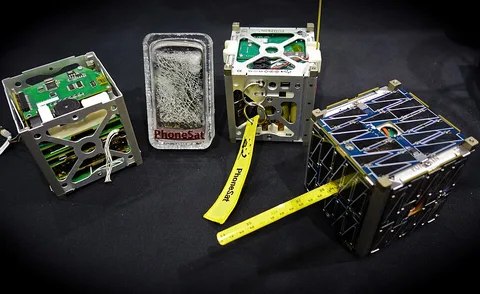 We were trying to show… well, basically, let me step back one sec. Okay. Someone at NASA kept on saying, when we were there, "Why are we spending a billion dollars on a satellite when a phone like this has most of what a satellite has, but it costs 500 bucks?"
Right.
It has GPS.
So what was the answer to that?
It didn't need to cost a billion dollars. Phones work just fine in space. Now, this first test did not work, but amazingly, all of the phone electronics survived, and we managed to get all the data. And this just showed the case in point that even though this was a failed launch, these things are incredibly robust. They're designed exactly for you to drop it on the floor and it not break, because people do shit like that. And so it actually was a surprising example of just how robust consumer electronics are.
See, what happened back in the '60s and '70s and '80s, NASA was pioneering all this technology because it had to. To go to the Moon, you had to put a capsule with humans in it, you had to have a computer, so they had to sort of develop microprocessors17Fact-checkThe microprocessor wasn't a NASA invention: the first commercial one, the Intel 4004, came out in 1971. But for the Apollo guidance computer NASA was an early adopter of integrated circuits and one of their biggest buyers in the 1960s. Apollo Guidance Computer. in order to get a computer that's small enough, because computers were the size of a building. They had to, you know, pioneer solar panels and various other technology in order to get it done. And so they're used to the idea of building everything themselves, because they couldn't go down to, you know, Fry's18Fry's Electronics — a chain of giant electronics stores in Silicon Valley and other states, where you could buy anything from computer parts to electronic components. It closed in 2021. or whatever and get the component. They didn't exist. You didn't buy batteries that they needed. You couldn't buy computers that they needed, they couldn't buy solar panels. So they invented it all.
ExplainerHow Planet made satellites a thousand times cheaper
A classic satellite is designed never to fail: a single spacecraft has to last 10–15 years, so it uses radiation-hardened parts proven over decades, and every component is tested for years. That's expensive and slow, and by launch day the onboard electronics are already out of date.
Planet went the other way; the company calls it agile aerospace. Its satellites are built from off-the-shelf electronics that phone and computer makers keep improving, and reliability comes from the fleet rather than from each spacecraft: Planet launches spares, so losing one or two changes nothing. Each satellite lives a shorter life, but new generations arrive quickly, each with fresh processors, cameras and radios.
Cheap launches help too: small satellites ride as secondary payloads on other people's rockets. In February 2017, for example, an Indian PSLV rocket put 88 Doves into orbit in one go.
So NASA had a mentality of inventing everything. Now, it did incredible things as a result, but now the consumer electronics, the electronics that we have in our back pocket, are far superior to what they had. And the dominant R&D is being spent by Apple and Google and whoever on developing these electronics to be better and better. So we took the attitude of: instead of developing all of that, let's take the best stuff that's already being developed commercially and use that for space, learning to follow the consumer electronics industry rather than trying to pioneer everything. And that whole approach: use cheap electronics that we can buy online, and then, by the way, throw up a few more than we need, and if one or two of the satellites breaks, no big deal.
Totally different risk attitude to what NASA did. And that also enabled us to just reduce the cost by about three orders of magnitude, which is, you know, a big deal for any sector. You know, it's a bit like the mainframe computers19Mainframe — a large computer filling a whole room; in the 1960s and '70s such machines sat in big companies, universities and government agencies, and from the 1980s personal computers pushed them aside. to desktop computer revolution. And all the, you know, applications we have with desktops now are completely different than what we did with a few mainframes, one per country or whatever, you know.
041,000 times more data and 48 ground stations
Downlink speed per satellite grew a thousandfold, which made daily imaging of the whole Earth possible, and the data comes down to 48 company-built stations near the poles.
So I have endless questions. I guess before I get to all of them, what is the biggest difference between, okay, V1, we're putting a phone up into space, to one of these going up there, to what we're about to see right now?
Okay, so one way to think about it is how much data they're producing and getting down to the ground. When we first launched the first satellites, some of which are here, various parts, they would get data rates down at about a megabit a second. So we take lots of pictures, we dump it down with a radio that's going at about a megabit a second. Well, if you're taking 47-megapixel images, you can't get very much data down at that rate. In fact, the… so now our data is about two gigabits a second, so about a thousand times better. That means we're roughly getting a thousand times more data than the first ones, per satellite per unit time. So huge increases in the amount of data. And that's what enabled us to get to this first mission, one, we called it, of imaging the whole Earth every day.
AdBrex, Harvey, Zone
This episode is brought to you by Brex, my favorite. You become what you spend on, and I refuse to spend my time on work that shouldn't exist: expense reports, receipt chasing and manual closes. The companies building what's next, from Vercel, OpenAI, Anthropic, Granola and Deepgram, all made the same call: they all run on Brex. Brex is the intelligent finance platform that combines cards, expenses and banking into a single stack, with agentic finance built in: AI agents that handle expenses automatically, enforce policy before spend happens and close your books in minutes. That's why Sourcery runs on Brex, so I can spend time on building and not busy work. It's time to get Brex AF.c"Time to get Brex AF" — the slogan of a Brex ad campaign, where AF stands for "agentic finance" while also winking at the slang "as f*ck." Learn more at brex.com/sourcery. That's B-R-E-X dot com slash S-O-U-R-C-E-R-Y. Bye.
From handshake to signature, faster. Harvey, the AI platform built for legal work, is trusted by 80% of the Am Law 100dAm Law 100 — The American Lawyer magazine's annual ranking of the 100 highest-grossing law firms in the US. and over 20% of the Fortune 500. Learn more today at harvey.ai. That's harvey.ai.
AI needs more than chips. It needs power, land and infrastructure. Zone develops next-generation data center campuses, partnering with AI companies, site developers and technology leaders to bring compute online faster and at scale. Zone is building the foundation of the AI frontier. Visit zonefrontier.com to learn more. That's zonefrontier.com to learn more.
Let's go take a look inside. I know you and your team work very closely together between manufacturing, testing, production, all that. So how do they communicate with one another? What's the flow here?
Well, we build all the satellites here. You'll see some of it. We're actually going to first go into the place where we build the bigger satellites. Now, all of this is done on these sort of automated test stands. This gentleman here is working on them, these guys here, and they build all the subsystems that all come together into this main clean room20Clean room — a room with filtered air and a strict limit on dust particles, used to assemble optics and electronics that dust would harm. Hence the hairnets and gowns. area, which you see here, which we can actually put our hairnets on and go in, so that we can actually see one of the satellites. They're a bit bigger than those first ones, because these ones, as I was mentioning, are trying to get to much higher resolution on the ground.
So… and I don't know if you were asking about how they communicate with each other, but we can talk about that. But basically, each satellite dumps its data to the ground stations, but we've got 48 of those ground stations all around the world.
Your own ground stations?
Yes, we built… basically, no one had that either. You can't go to Fry's and get that either. So basically we built about, I think it is 48 or so of these parabolic dish antennas, to do S- and X-band,21S- and X-band — radio frequencies around 2–4 and 8–12 GHz. Earth-observation satellites usually downlink imagery in X-band and use S-band for housekeeping data and commands. in a few dozen locations. We often have four or eight of these ground stations at any one location, because we have so many satellites, there's many to look at at any one time, even in the same spot. And they're in Alaska, northern Canada, northern Norway, the southern tip of New Zealand, the southern tip of Australia. So basically the highest-latitude locations, because our satellites are mainly in polar orbits,22Polar orbit — an orbit passing over both poles, so the satellite flies over the polar regions on every pass while Earth turns beneath it, letting it see the whole planet each day. and so they get many more contact points the closer your station is to the pole. So we put them as far north and south as possible with an internet connection, because we have to get all that data back, obviously.
05Bird names and Pelican-10 in the clean room
Bird names are a space tradition, each one tied to the satellite's mission, and Planet builds Pelican-10 itself from bought-in chips.
Okay, so as we go and we look through these, I want to address one thing. All of these satellites are named after birds.
Okay, this is actually a space tradition that precedes us. Like, in NASA there was the Eagle that landed,23The Eagle — Apollo 11's lunar module. After the landing on July 20, 1969, Neil Armstrong reported: "Houston, Tranquility Base here. The Eagle has landed." obviously a lot of military missions, like Kestrel Eye,24Kestrel Eye — an experimental small US Army satellite for imaging Earth, deployed into orbit from the International Space Station in 2017. and we wanted to name ours after birds that were a part of our mission. So Doves: trying to inspire how we're trying to help peace and security around the Earth. Tanager is our hyperspectral25Hyperspectral imaging — pictures in hundreds of narrow spectral bands instead of three to eight, which make it possible to tell substances apart: plant species, minerals, gases such as methane. satellite, and that's because these are looking out for biodiverse areas. Tanagers26Tanagers — a large family of American songbirds, mostly tropical, many with very bright, multicolored plumage. are some endangered birds with a lot of different colors in the tropics, so we can track ecosystems.
Pelicans are the highest-resolution systems. That's because they fly really low. Pelicans fly really low because they get a bit of lift off the water27Ground effect — close to the surface of water or land, a wing gets more lift and less drag. Pelicans and other seabirds use it, gliding low over the waves. when they fly really low; they get, like, 10 or 20% more lift. We can do the same sort of across the top of the atmosphere. So we fly these satellites really low so that we get better resolution on the ground. So we name them after pelicans because of that. So we'll continue to name them after cool birds. Oh, our next one is going to be called Owl.
Oh, yeah.
So we're launching all these Owls, because they've got bigger eyes, and they're wise, because they have a huge amount of compute on board. So we're naming them after owls, so we'll keep on doing that just for fun.
Amazing. Okay.
Okay, we'll put some hairnets on. Yeah, all right. So we're going into the clean room to see some of the bigger satellites. You're all hairnetted up. You look cool. We look cool. Let's go.
All right. So, yeah, so in here we actually build the satellites, the bigger satellites. That's a stand for one of the satellites here. You can actually see these are the solar panels that will be attached to these bigger satellites. This is a bus28Bus — the service part of a satellite: structure, power, attitude control, propulsion and communications. The payload is what the satellite flies for, here the telescope and camera. of one of the bigger satellites. So that's the core spacecraft components: it does the attitude determination and control,29Attitude determination and control (ADCS) — the system that figures out which way the satellite faces and turns it where needed: star cameras, sun sensors, reaction wheels. it does the propulsion, it does the radio communications. The propulsion, I think, is on the bottom. And so basically all of that harness holds the payload, which is a huge telescope that looks down. So most of the volume is taken up with that. And then somewhere around here we have one of the actual satellites. Oh, actually, this is a bit of fun. You can see there the optics, the primary optics there. That is the big telescope looking down, so that gives you a sense of the scale. But here's the spacecraft that we're going to look at.
So this is a Pelican-10. So it's one of our highest-resolution satellites. So this is now integrated; it has the telescope inside of it. So here you can see at the back, this is the propulsion system. You can see this is the feeder, these are the two main tanks, this is the pressurant tank30Pressurant — compressed gas, usually helium or nitrogen, that pushes propellant from the tanks into the engine. of that propulsion system. So that's the back end. The telescope is… this is the connection that goes to the rocket here. And then these are star cameras that are actually hidden, enclosed, so that we don't get dust in them. And the telescope is inside of here; you can't really see it. So it's all wrapped up in this main section.
Any questions?
Yeah.
Go on, then.
Okay, so Planet Labs is vertically integrated.31Vertical integration — when a company handles most of the chain itself, from components to the finished product and services built on it. So how many of these components are you building in-house versus which parts are not?
It's a little bit nuanced, because at the chip level we buy almost everything externally, but at the system level we build almost everything internally. So the telescope: we get the blanks32Blanks — raw discs of glass or glass-ceramic that are ground and polished into telescope mirrors. from a company, but we integrate the telescope, as you saw over there, here, and so we build up the framing and the structure. Similar for almost everything else. The radios: we don't build our own chips, you know, we get the same chips from other people, WiMAX33WiMAX — a wireless broadband standard popular in the late 2000s, whose radio chips are mass-produced and cheap. components, other things, but we integrate them into special circuits and with special antennas that enable us to get the radio frequency sort of output that we need. So it really depends. I would say the way to think about it simplistically is: the chips we buy, the systems we build.
06A satellite in eight hours, and why fleet size isn't the point
A Dove takes eight hours to build, but what matters to Planet isn't fleet size but how much data the fleet delivers and how fast.
And so how many Pelicans do you produce a year? How many Doves? How many Tanagers? How do you think through all these?
So we're ramping up on the Pelicans. The Doves, we build hundreds. We've built over 650 of those Doves here in this lab. We can build up to 40 a week. So we can… we don't do that every week, but we can build really fast. So I think each satellite takes about eight hours to build.
Okay.
To give you a sense. And to give you a sense, when I was at NASA it was like eight years, okay, not eight days. So it was like completely changing. These bigger ones take a bit longer, and we're ramping up the production so we can do many dozens of those. In fact, we just announced a new facility in Berlin,34Berlin — Planet has had a Berlin office since 2015, when it bought BlackBridge, operator of the German RapidEye satellite constellation. where we're doubling again the manufacturing space that we have, that we announced could do up to 60 of these per year. So, to give you a sense of scale.
And then the Tanagers are rather lower volume, because they're sort of specialized instruments that we're working with NASA JPL35JPL (Jet Propulsion Laboratory) — a NASA research center in Pasadena managed by Caltech. For Tanager, JPL developed the imaging spectrometer. on. And we just launched our second one literally last week, and we've got another one that's actually, I think, behind there. We can't go in because that one's more export-controlled.36Export controls — US rules limiting the transfer of military and dual-use technology, including much space hardware, to foreigners; outsiders are kept away from such equipment. Yes, so we can't go into that. You can see it's black. Top secret. That payload is a little bit more specialized. It takes a little bit more work, and so we're launching a couple more of those per year, sort of rate.
Is there a goal to how many you're going to build in a constellation,37Constellation — a set of similar satellites working together, like Starlink or the Dove fleet. or is some of this replenishing?
It is replenishing now, and in fact it's more about what capability you have on each satellite than the number of satellites. We have the largest Earth imaging fleet. It's about 10 times larger than anyone else, and most importantly, it images about a hundred times more area than any other commercial actor, at least Western one. The Chinese are trying to build similar systems. In fact, they even copy our names. They called theirs… what did they call it, pigeon or something? It was like close to dove. Anyway, it looked eerily similar, and they even named it eerily similar. But no, roughly speaking, we're the only ones that cover the whole world every day. If you look at any other players, they might task to38Tasking — imaging on request: pointing a satellite at a specific spot a customer ordered, rather than scanning everything. a few specific locations, but cover less than 1% of the landmass of the Earth per day, or maybe a couple of percent at most. Whereas we cover the whole of it. So, you know, a hundred times-ish area collection. So that's what we really care about.
The Owls are the upgrade to have the area collection the same, but 10 times more data per unit area, because we're going from three-meter resolution to one-meter resolution daily scan of the planet. And that's roughly three by three times more data, so 10 times more data, almost. And also we're getting it back 10 times faster, because we're adding optical links39Optical links — data transmission by laser, between satellites or from satellite to ground. They're faster than radio and need no frequency licenses. and links to get that back really quickly. So basically you can get it back within a few minutes. So we're getting it 10 times faster back and 10 times more data, but actually the number of satellites will stay about the same, if not go down a little bit, because of the nature of how we're building those. So it's not how many satellites you have, it's what you do with them, or something.
07Ion engines, space junk and Wild Wild Space
Planet's satellites maneuver on efficient ion engines, and Marshall sees the real collision threat not in other satellites but in debris.
Okay, is there anything else in here that we should see? Anything? Any technical specs?
Well, we can see… you see a few other things here. This is a propulsion system all laid out. You can see that on a bench. That's kind of fun. As I said, this is our telescope assembly here. So it's about 50 centimeters in size, and that determines how small an object we can see on the ground, together with the altitude of the satellite. So that's it.
What kind of fuel are you guys using?
In this, it's xenon. So it's an ion engine.40Ion engine — it accelerates xenon ions with an electric field to tens of kilometers per second, while chemical rocket engines exhaust at about 3–4.5 km/s. The thrust is tiny, but it needs many times less propellant. So they're very efficient in space. The gas comes out of the back extremely fast, much, much faster, like 10 times faster than a rocket engine, a classical rocket engine. It doesn't have as much thrust, so you can't take off using these engines off the planet. It's not nearly enough. But once you're in space, they're much, much more efficient, like, as I said, almost 10 times more efficient than those big rocket engines.
I think it was SpaceX, Starlink, that just put out they want to try to open-source the data for anti-collision avoidance.
ExplainerSpace debris: why one explosion endangers everyone
Orbit holds not just working satellites but debris: dead spacecraft, spent rocket stages, fragments of explosions and collisions. Only the larger pieces, from 5–10 centimeters up, can be tracked from the ground, and the small stuff outnumbers them by orders of magnitude. At orbital speeds of about 7–8 km/s, even a millimeter-sized particle hits with the energy of a bullet.
The most dangerous events are collisions that create more debris. In 2009 the American communications satellite Iridium 33 smashed into the dead Russian Kosmos 2251, producing more than two thousand trackable fragments. Anti-satellite tests added more: China destroyed its own Fengyun-1C weather satellite in 2007, and Russia the old Kosmos 1408 in 2021.
In 1978 NASA scientist Donald Kessler described what is now called the Kessler syndrome: if debris becomes dense enough, collisions start creating new debris in a chain reaction, and some orbits become unusable. That's why operators share satellite position data and deorbit spacecraft at the end of their lives.
Yes, satellite… space domain awareness data, SDA,41SDA (space domain awareness) — tracking every object in orbit: where it is, where it's heading and whether a collision threatens. yeah. Yeah, so I think that's really cool. Early on, I mean, we… we have a lot more objects in space. Yeah, we want to stop collisions. We've worked very collaboratively with the other players. The biggest challenge, though, is less the satellites; it's all the space debris. So we've got about of order 10,000 satellites operating in space, but we've got of order 100 million space debris objects.42Fact-checkSpace debris — the European Space Agency estimates more than 130 million fragments between 1 mm and 1 cm in orbit, about a million between 1 and 10 cm and tens of thousands larger than 10 cm, so "of order 100 million" is right. ESA: Space debris by the numbers. So objects that were former satellites that blew apart, satellites that crashed, satellites that were deliberately taken out by anti-satellite weapons from the ground. And those things cause one satellite to pop into tens of thousands of bits. Okay, let's carry on.
A wild, wild problem.
It is. It's wild, wild space.

Wild Wild Space. Great documentary by Ashlee Vance,43Wild Wild Space (2024) — an HBO documentary directed by Ross Kauffman, based on Ashlee Vance's book When the Heavens Went on Sale, about the private companies Rocket Lab, Astra and Planet and their founders. which you were in, by the way. Small plug.
It's cool, right?
So good.
Have you seen it?
Yes, I have. Before we went to Rocket Lab,44Rocket Lab — Peter Beck's American–New Zealand company, which launches small Electron rockets and builds spacecraft; in the film Beck is pitted against Chris Kemp. I watched that, and their little fight between him and, I think… who was it? Chris Kemp.45Chris Kemp — NASA's former chief technology officer for IT and founder of the rocket company Astra; in Wild Wild Space his rivalry with Peter Beck is the film's liveliest thread.
Yeah, Chris Kemp.
It was just hilarious.
Yeah. Quite some characters, those guys. Okay, we can take all this.
Okay, we don't need these.
08Methane leaks and shock, vibration and vacuum tests
Tanager spots methane leaks, satellites get smashed, shaken and baked in vacuum before launch, and Marshall reads the fact that none has failed as a sign of too little risk.
We do not need this for anything else. By the way, this is a poster of methane tracking46Methane — the second most important greenhouse gas after CO₂: over 20 years it traps about 80 times more heat. Tanager-1 images methane plumes for the Carbon Mapper coalition, which publishes the leaks it finds. activities of the Tanager spacecraft. So this is a plume of gas. By the way, when we enable them to be turned off, that's because we just tell the gas company, "Hey, you've got a big frickin' great leak on your pipeline."
Uh-huh.
Turning this one off is the equivalent of taking a couple of hundred thousand cars off the road from a pollution standpoint.
Oh my God.
So, one leak.
Ooh, when we go to the AI demo later, is it possible to see the difference of COVID versus non-COVID? You know, when everything was…
We can have a look.
Okay.
We can ask the AIs.
Let's ask the AIs. Is that named after a bird too?
ExplainerWhat a satellite goes through on the ground
Before it flies, a satellite passes three main tests, the ones Marshall shows.
- Shock. When rocket stages separate or the satellite is released, pyrotechnic bolts and springs deliver a short, sharp jolt: hundreds of G in milliseconds. On the test stand it's reproduced by a hammer striking a plate the satellite is bolted to.
- Vibration. Engines and aerodynamics shake the rocket all the way to orbit. A vibration table shakes the satellite at the right frequencies and strength, and then engineers check that nothing came loose or cracked.
- Thermal vacuum. In a vacuum chamber, the satellite is heated and cooled again and again, as in orbit, where it passes from sunlight into Earth's shadow and back every few dozen minutes, to check that it works and the telescope stays in focus.
The radios get their own check, in the RF anechoic chamber Marshall shows at the end.
It should do. That's a good idea. Okay, I'm going to steal that. So here we have some of our testing facilities. So here, this is a system that tests the shock when two stages of the rocket separate. So basically we put our satellite here, and we bring this up, and we let this hammer smack down, and it gives this 200 G-ish shock load.
And why isn't this in a sound barrier room?
Well, I guess people put earplugs in.
Okay.
The earplugs… you haven't got any, but they're up there. And then this is a vibration table, so this vibrates to simulate the launch environment. So we put our satellite on there, vibrate the shit out of it, and hopefully nothing falls apart.
What have been the biggest failures?
Well, we've had telescopes break.
Okay.
We have to redesign it.
What, like, what is the most delicate part of your satellite?
Well, it's probably the telescope, yeah, exactly. So it's because they're… again, just think about this. Like, the optics of that mustn't move by more than a fraction of a wavelength. The wavelength is of order less than a micron, so a thousandth of a millimeter. So the telescope's two components, the main optics, mustn't move by more than a thousandth of a millimeter, otherwise it's out of focus. Well, that's really annoying, because that's a very small distance. And again, even when it's in space, normally, if you just made the telescope out of aluminium like this, it would expand and contract so much that the telescope wouldn't work when it's too hot or too cold, because it would be totally out of focus. So we have to design it out of special materials,47Special materials — telescopes use materials with near-zero thermal expansion, such as Zerodur glass-ceramic, carbon-fiber composites or Invar; aluminum expands dozens of times more per degree. compensate for that expansion and contraction because of the thermal loads. So that's the kind of thing that's really difficult. And now I can actually show you where we test those thermal loads.
How many satellites end up having errors? Like, what has been the error rate?
Yeah. So, firstly, of all 700 satellites, if the launch worked and delivered us into orbit, our satellites have turned on and worked. We have had some that were out of focus. We have had a few problems where a solar panel didn't deploy, a reaction wheel stopped working early, things like this. But generally we've got utility out of 100% of our satellites, which I actually think is a problem.
And I keep on telling folks that, well, because it means we're not pushing the envelope enough. If we have 100% success, it means we haven't pushed it hard enough. And maybe we should have gotten a latest sensor or something that would improve it. So we want to push the barriers. Thanks for your help. All right.
What's this? We've got a little vacuum chamber here. What are you putting in there? [An engineer answers; inaudible.] Is there what? What is that? That's for Pelican? [Engineer: "Yeah. For the reaction wheels."] Oh, it's for the reaction wheels. Ah, cool. So you're testing that subsystem in this. Cool.
You have a bunch of 3D printers.
Yeah, 3D printers, fine. You know, normal, normal stuff. But those are the three main tests: the shock, the vibe and the thermal vac. Let's go here. By the way, I like this sign.
Oh, you actually have this.
You know how many people talk about this, but they don't actually have it?
Well, these guys have it. Yeah. Anyway, let's carry on.
AdMercor, VCX, Public, Deel
How good is AI at real professional work? Mercor's AI Productivity Index, or APEX,eAPEX (AI Productivity Index) — Mercor's index measuring how well frontier models handle the work of lawyers, bankers, consultants and doctors. tracks it with every major frontier model release, built with partners like Harvey and Cognition. See where the frontier actually stands at mercor.com/apex.
Today's episode is sponsored by VCX by Fundrise,fVCX — a Fundrise closed-end fund whose shares trade on an exchange, giving buyers a stake in a portfolio of private tech companies. the public ticker for private tech, allowing investors of all sizes to invest in venture capital. Learn more at getvcx.com.
Public is a multi-asset investing platform where you can automate your investing with AI agents. Create your own custom agent with a simple prompt. Agents can monitor markets, execute trading strategies and manage your cash across stocks, bonds, options, crypto and more. Want to buy at market close and sell the next day's open? Just tell your agent. Automate your investing at public.com.
Founders scale faster on Deel. Set up payroll for any country in minutes, hire anyone anywhere, get visas handled fast and get back to building. Visit deel.com/sourcery. That's D-E-E-L dot com slash sourcery.
09An AI interface to the imagery: Area 51 over five years
Planet has hooked a language model up to ten years of daily imagery of the whole Earth, so anyone who can talk can now get value from it.
So let's go upstairs. Cool. Yeah, so we're going to go up to the third floor. I guess I could take this at this point.
You ready? Well, he's ready. Let's go.
Come on. So here are some of our Doves. This is SkySat.48SkySat — high-resolution satellites built by the startup Skybox Imaging. Google bought Skybox in 2014 and sold the unit to Planet in 2017. This is our new Pelican spacecraft that you were just seeing downstairs, the model of it.
It's smaller.
Well, that is scaled down. But this is our AI interface. So basically, this is our imagery of the whole world. You can zoom in anywhere you want to zoom in on. You can go through time and see it as it changes over time. I mean, if we go up further north, if we go down to December, it's going to be snowier. And so you can see all the snow cover. But the coolest thing is that we have 3,000 layers of images going back 10 years, so pretty much every day for 10 years.
Zoom in as far as you can. Let's see what we're going to do.
Well, I mean, what do you want to have? But the coolest thing, before we do that, is not only that we can zoom in, it's that we can ask it questions, and we have tied an LLM to the back end. So LLMs are really only trained on the text of the internet, so they don't know much about the real world. We have all the real world, and we merge them together, and then you have a system that can understand all of human knowledge and tap into real-world stuff. And so what does that mean? It means if you're a farmer and you want to understand your crop yields, a normal LLM chat is going to tell you about the theory of agriculture, but it doesn't know shit about your field, right? But the farmer, he or she wants to know about their field, so this can tell you about that and can help crop yields. Or if you're a journalist trying to understand a report on some physical event, like a flood or a fire or something, it can go and tell you about that flood or fire.
And it can search the entire Earth in under a second. It can see changes over time, it can plot graphs. So, like, this is just an example that we were looking at earlier. I guess somebody was asking, but you can actually just ask it yourself. So this is just a visual that it gave of some deforestation that it was showing. I asked it earlier your question of "What happened in the last 24 hours? Show me some changes." I actually haven't got that here, I've got my computer, but it found a fire in Yosemite, it found a flood that caused a load of crap falling into a river, it found all sorts of things around the world. It's like a daily planet report,49Daily Planet — the newspaper in the Superman comics where Clark Kent and Lois Lane work. Marshall is playing on both the paper's name and his company's. if you like. But anyway, we can ask it any question. So what do you want to ask about?
Let's go to Area 51.50Area 51 — a classified US Air Force facility in the Nevada desert where the U-2, A-12 and other secret aircraft have been tested since the 1950s, which made it a fixture of UFO conspiracy theories.
Let's go to Area 51. Anything particular you want to know about it?
Let's see the changes over the last five years.
Show us the changes there over the last five years.
So it's going to zoom in there on Area 51. And now it's going to start to compare '21 to 2026, as you asked. This is a compare. Obviously it's waiting for the data to load here, showing some changes over time. If we zoom in… oh, we can actually zoom in on that image. We can try and see changes. So, oh, we can't zoom in like that, but I see. But basically this is, at a structural level, something changed in that… I don't know what that… look, there's a black… oh my gosh. I actually don't know what that is. You would see plane movements and stuff. You see, there were two planes on there and they're gone. This is a particular zoom level.
You can get a sense of what it can do. It's still early phase, but our point is to open up geospatial data51Geospatial data — any data tied to a place on Earth: imagery, maps, object coordinates. Analyzing it for the military and intelligence agencies is called geospatial intelligence (GEOINT). to not just the satellite imagery experts.
Yeah.
It used to be the case that NASA could get value out of this, the NRO52NRO (National Reconnaissance Office) — the US agency that builds and operates spy satellites; its very existence was declassified only in 1992. could get value out of this, but a farmer, a journalist, what have you, can't get value. Now anyone can go and play with this, because all they need to do is be able to speak. And, by the way, you can speak in any language into it. I mean, the LLM just takes in anything. And so, yeah, I mean, that's the power of AI and satellite data put together.
Amazing. So you built this internally? Did you have to bring in a separate team?
No, we just have a couple of engineers, an AI team specialized in doing this. Yeah. Cool.
All right. Anything else we should see while we're up here? Great. All right, well, and here's some of the AI engineers. Oh, we have an AI engineer with us right now.
In the house.
Was that demo sufficient? [AI engineer: "I don't know why it wasn't doing the search tool. That's what you were trying to get it to do, right?"]
Yeah, yeah. It… it doesn't do a perfect job, but it's getting better and better.
And can anybody access that? How do you get it?
It's on a beta launch right now, so anyone can access it, but it's just a testing version. But soon we hope to launch it.
Exciting. Cool. All right. Well, we're going to go to the sit-down interview now.
Let's do it. This is another floor.
10The Dove nest and the RF chamber
Finally, Marshall shows a new floor nobody before Molly had seen: the "nest" of finished Doves and an RF test chamber.
This is the first time anybody has seen this floor.
It's true. You're the first one to come in, yeah. All right. So actually I can show you just a couple of things before we sit down. But this is the so-called Dove nest. So this is where we build all the Doves, and they're sitting in their nest waiting for the launch. So you can see they're two by two in there.
Quite the difference from the garage you started in.
Yeah, it's a little bit more substantive. That's true. Oh, and there's one more fun thing. Thank you, you can put it back. One more fun thing for you to see in here. So here, you have to go in there, both of you.
You want to go first? Is this where you scream?
Yeah, exactly. I'm going to shut the door, and then you can just talk a little bit.
Okay. So we are here at Planet Labs in San Francisco, and now we are trapped inside. Yeah.
It's cool, right?
It's really cool.
So this is where we test the radios to go to space.
Faraday cage?53Faraday cage — a closed conductive enclosure that blocks external electromagnetic fields. Or is it soundproof?
No, it is an RF chamber,54RF anechoic chamber — a room whose walls are lined with pyramids of radio-absorbing material, so radio waves don't reflect and an antenna can be tested as if in open space. such that all the radio frequencies get absorbed by this.
Okay.
So that we can put our satellite here, point it there, and then basically reduce the power, such that we can check that the right power is getting to the antenna without reflected rays spoiling our ability to tell whether or not it's actually emitting at the right power. So basically it's a way of testing that the radios are going to work in space.
Yeah.
One final cool thing for you to see. Sorry, am I getting in your way? Off you go.
No, yeah.
We were just setting it up for you. It's your chamber. All right, let's go.
Hey, it's Molly. If you enjoy our interviews, check out our newsletter, sourcery.vc, where we deliver a once-a-week top deals and tech headlines email, and also go deeper on our podcast interviews. Subscribe to Sourcery today. And don't forget to subscribe to the podcast on YouTube, Spotify, Apple, or wherever you listen. Link in description to sign up.


