

Dwarkesh Podcast
Chapters
Caro hopes he lacks his subjects' ruthlessness but accepts that he shares their relentlessness: he won't take no for an answer when someone has to be interviewed.
Read the chapter- Caro hopes he doesn't share Johnson's and Moses's ruthlessness, but agrees with Dwarkesh that they share relentlessness: if he has to interview someone, he won't take no for an answer.
- Going through Mayor La Guardia's papers, stored in the boat basin on the Hudson, Caro kept coming across notes by Moses and realized he was following the same path.
- On requests for money Johnson would write "okay," "no" or "no, never," and John Connally, who handed out the money on his instructions, explained to Caro what that meant; the really fascinating stories, Caro says, begin when you ask why.
Caro points out that people said nothing could be built in Moses's day too, and thinks America today needs someone who will find a way to build.
Read the chapter- Dwarkesh cites the Second Avenue subway, in the works for half a century, where a mile and a half cost more than $4 billion, and California, which spent $15 billion over a decade without a single new mile of railway.
- In the 1920s people also said nothing could be built because property owners wouldn't let roads cross their land, and then Moses went ahead and built the road to Jones Beach.
- Caro isn't sure a happy medium exists: any big project runs into hundreds of people who don't want it, every so often a political genius comes along who can push it through, and decades can pass between such people.
- Caro doesn't want someone as ruthless as Moses, but he says you need someone who will find a way to build despite the opposition.
Contrary to popular belief, The Power Broker is not an indictment but the story of an idealist turning into a ruthless builder.
Read the chapter- To people who say everything Moses did was bad, Caro answers, "You didn't read the book": the first hundreds of pages are about a young idealist who wanted to open Long Island's beaches to city people.
- Before he built anything, Moses poured all his energy into civil service reform, so that people would be promoted on merit rather than political connections.
- The mature Moses builds the Cross Bronx Expressway against everyone's advice: tens of thousands are evicted with no relocation, and from the day it opens the road is the world's longest traffic jam.
- Caro doesn't want to say power "corrupted" Moses; it hardened him against any opposition.
Caro was writing the book as Moses lost power, and saw it happen.
Read the chapter- After every interview, Moses's secretary used to bring in a list of calls from people wanting things, and after the last one there were none.
- Deaf and surrounded by loyal "Moses men," he believed he would push through again and win, and Caro doesn't think he ever realized what was happening.
- In 1962 Rockefeller simply accepted the resignation Moses had used to bully mayors and governors, whereas earlier that was impossible in practice: Moses was New York's idol, and his posts formed an interlocking web he couldn't be pulled out of all at once.
Caro doesn't think Moses ever realized how he had changed: he was sure his plans were the best thing that could be done and removed anyone in the way.
Read the chapter- Dwarkesh recalls that Moses stopped talking to Caro after the seventh interview, when Caro mentioned a donation from a millionaire whose golf course the new parkway route had spared.
- Given an eighth interview, Caro would ask Moses only one thing: whether he realized he was changing.
- A Bronx politician, Henry Epstein, proposed moving the expressway two blocks and evicting a couple of hundred people instead of tens of thousands, and Moses destroyed him by making his affair public.
- Moses learned to exploit people's weaknesses, Caro thinks, when as a young man he kept failing to get anything done.
The Depression gave Moses cheap, compliant labor and gave New York beautiful architecture.
Read the chapter- Thousands of unemployed architects lined up on Fifth Avenue for Moses, and Caro says what mattered was less the low pay than the fact that they had nothing else to do.
- Moses hired, fired and drove his workers ruthlessly, because in the Depression they had no other jobs to go to.
- Buildings used to be more beautiful because craftsmen were cheap: the stonework near the roof of the building across from Caro can be seen only from his apartment and the one next door.
Behind Johnson's persuasion there was always the power to give or withhold, and Caro feels for Coke Stevenson, the man Johnson beat in 1948.
Read the chapter- When Johnson put his arm around a senator and leaned in, the senator knew Johnson could give or deny him a committee seat or the law he wanted.
- Dwarkesh's favorite book is Means of Ascent, about the 1948 Senate election in which Johnson beat Coke Stevenson, the Texas governor they called Mr. Texas.
- Caro wishes Stevenson had won: an idealist who knew how to get things done, Stevenson couldn't imagine what Johnson would do to him in that election.
Caro is sure he couldn't: Kennedy lacked Johnson's passion to change America.
Read the chapter- Kennedy, in Caro's view, was utterly charming, a good president and stronger than Johnson in foreign policy, but he didn't have the vision to remake the country.
- A year teaching poor children in Cotulla made Johnson determined to help the poor, which led to the civil rights and anti-poverty laws.
- The Vietnam War ruined Johnson's presidency, and why he kept escalating is exactly what Caro is trying to work out in his next book.
- Caro credits sheer willpower for Johnson's and Moses's 16-hour days, and tells of a senator who answered Johnson's 5 a.m. call with "I was just lying here waiting for your call."
To stay on track through years of writing without feedback, Caro boils each book down to one sentence before he starts.
Read the chapter- Having learned the hard way with The Power Broker, Caro thinks through the whole book before he starts writing.
- Caro says you have to get the book down to one sentence, or at most a paragraph, or three years in you'll be asking yourself what you're even trying to do.
- For the Vietnam book, Caro used his computer to find where soldiers' oral histories of the Battle of the Ia Drang Valley are held, but he says finding documents is a small thing compared to reading them.
Much of what Caro learned never made it into the books, so he gave his archive to the place where researchers can most easily reach it.
Read the chapter- Caro had to cut 350,000 words from the 1,050,000-word Power Broker manuscript to fit it into one volume, and his editor Bob Gottlieb later said he cut some of the best material he had ever read.
- Sam Rayburn, the Speaker who passed so many of Roosevelt's bills, still has no good biography, though Caro says the material for one sits in his cabinets.
- Caro did about 700 interviews for The Power Broker alone, and the cabinets also hold most of what he learned about the Senate that never made it into the books.
- Caro gave the archive to the New-York Historical Society, turning down far more money elsewhere, so the papers would be easy for researchers to reach.
Caro thinks America has never grasped the heroism of the loneliness of frontier life, and he works in a solitude of his own.
Read the chapter- Dwarkesh notes that the story of the Hill Country would be fascinating even without Johnson, and Caro thinks there still aren't enough books about frontier life.
- Johnson's mother could climb a hill and see nothing but more hills, and one woman Caro interviewed had lived all her life 22 miles down a dirt road without a single house along it.
- America, Caro says, may not understand the heroism of the sheer loneliness of that life.
- Caro talks to no one all day and returns calls only at the end of the day, and he says it has shaped his whole life.
Quotes
On how great builders appear
“You say, ‘Everything’s stalled. Nothing big is ever going to be built again.’ Then someone suddenly comes along and all of a sudden things get built. That’s the nature of political genius.”
Robert CaroRead from 10:49To those who think Moses was a villain
“When people say to me everything was bad that he did, what I say is, ‘You didn’t read the book.’”
Robert CaroRead from 12:58On Robert Moses's decline
“I remember I had one long interview with him. Maybe it was my last one. By the time I finished, I realized there had been no calls. The secretary had nothing to tell him. So whatever you thought of Moses, you felt the poignance of someone losing power.”
Robert CaroRead from 19:37On what Caro would ask Moses
“Off the top of my head, if I only had one question to ask him, I’d ask him, ‘Did you realize you were changing?’”
Robert CaroRead from 24:35On where Johnson's power came from
“Behind that personality, you know he has the power to do things to you or for you that you better be aware of.”
Robert CaroRead from 34:15On Johnson's relentlessness
“Johnson calls one senator at 5:00 AM to ask him for his vote on something, and the senator says, ‘Oh, Lyndon, I was just lying here waiting for your call.’”
Robert CaroRead from 39:58On how Caro starts a book
“You’ve got to get it down to one sentence. You say, ‘You can’t get it down to one sentence.’ Then you say, ‘Yeah, but Bob, you learned you better get it down to one sentence, or three years from now you’re going to be writing and you’re going to be saying, ‘What am I trying to do?’’”
Robert CaroRead from 42:17On how Caro works
“I come here in the morning. I turn off my telephone. I’m not going to talk to anybody all day. I’m a friendly guy.”
Robert CaroRead from 58:56
Summary
Robert Caro has spent half a century writing about power: first about Robert Moses, the unelected official who reshaped New York for decades, then about Lyndon Johnson. Dwarkesh asks him how he gets people to tell him things they know they shouldn't, and whether today's America, where building has become nearly impossible, needs a Moses of its own. Caro's answer is that people said nothing could be built in the 1920s too, when Moses started: every so often a political genius comes along who finds a way. You don't want someone as ruthless as Moses, but you do need someone who will find a way to build.
Much of the conversation is about how power changes a person. The young Moses was an idealist who fought for a merit-based civil service and opened Long Island's beaches to city people; the older Moses evicted tens of thousands for the Cross Bronx Expressway and destroyed opponents by finding their weaknesses. Caro recalls watching Moses lose power, the day the phone in his office stopped ringing, and names the one question he would still ask him: did you realize you were changing? Another thread is the Great Depression, when thousands of out-of-work architects and craftsmen working for next to nothing made it possible to build fast and build beautifully.
On Johnson: behind his famous powers of persuasion there was always the power to give or withhold. Kennedy, in Caro's view, could not have passed Johnson's laws, because he lacked Johnson's burning desire to change America, and Johnson's presidency was wrecked by Vietnam, the subject Caro is writing about now. The conversation ends on craft and loneliness: before starting a book you have to boil it down to one sentence; a third of the Power Broker manuscript had to be cut; Caro gave his archive to the New-York Historical Society so researchers can easily get to it; the lives of the Hill Country settlers were a heroism of loneliness, and Caro himself works all day with his phone switched off.
Mentioned
 Lyndon B. Johnson00:00the subject of the multivolume biography Caro has been writing for half a century
 Robert Moses01:30the subject of The Power Broker: from idealist to ruthless builder
 John Connally03:46handed out money on Johnson's instructions
- The Power Broker: Robert Moses and the Fall of New York05:30the book on Moses; some say building got harder after it
Show 9 more mentionsShow fewer mentions
 Nelson Rockefeller21:27accepted the resignation Moses threatened
- Master of the Senate32:51where Johnson's power came from: persuasion or leverage
- Means of Ascent34:39Dwarkesh's favorite book, about the 1948 election
 Coke Stevenson34:39Johnson's opponent in the 1948 election
 John F. Kennedy36:08could he have passed Johnson's laws?
- The Years of Lyndon Johnson46:21the Johnson volumes, more than 40 years in the making
 Robert Gottlieb47:17the editor who cut The Power Broker down
 Sam Rayburn49:47a great figure without a good biography
 New-York Historical Society51:20received Caro's archive
Sponsors of the episode
 Antithesis16:27deterministic simulation testing for every pull request from AI agents
 WorkOS31:35Airlock, a judgment layer that checks AI agents' requests to a company's tools
 Jane Street43:10results of the mystery chip challenge and a new one: design a protocol emulator chip
Transcript
01How Caro gets people to talk
Caro hopes he lacks his subjects' ruthlessness but accepts that he shares their relentlessness: he won't take no for an answer when someone has to be interviewed.
“If you do everything, you will win.” That is the maxim by which Lyndon Johnson1Lyndon Johnson (1908–1973) — the 36th president of the United States (1963–1969). Before that he was a congressman and senator from Texas, Senate majority leader and Kennedy's vice president. lived his life. My guest today is Robert Caro.2Robert Caro (b. 1935) — an American journalist and biographer, author of The Power Broker and the multivolume biography The Years of Lyndon Johnson. He has won the Pulitzer Prize for Biography twice: for The Power Broker (1975) and for Master of the Senate (2003). Over the 50 years that he has spent writing about Lyndon Johnson, he has lived in the edges of the Texas Hill Country3Texas Hill Country — rolling hill country in central Texas, west of Austin and San Antonio. Johnson spent his childhood and youth here; back then it was one of the poorest and most isolated parts of the state, and electricity arrived only in the late 1930s. to understand the poverty and loneliness of Johnson’s youth. He has sifted through millions of documents in the Senate and presidential libraries4Presidential libraries — archives and museums devoted to individual US presidents, starting with Herbert Hoover, run by the National Archives. Johnson's papers are at his library in Austin. of the entire nation. He has chased down for interviews everyone, from the former goon who helped Johnson steal an election5The stolen election — the 1948 Senate race in Texas: in the Democratic primary runoff Johnson beat former governor Coke Stevenson by 87 votes. In Means of Ascent Caro shows the victory was stolen, above all through the fraudulent ballots of "Box 13" in the town of Alice in South Texas. Dwarkesh asks about the book and Stevenson at 00:34:39. to the chauffeur who drove him on his first desperate campaign.
In other words, my guest today is a man who understands Johnson’s aphorism: “If you do everything, you’ll win.” Mr. Caro, it is such a huge honor to have you on the show.
It’s great to be here.
My first question is what I hinted at in the introduction. How much do you see yourself represented in Johnson or in Moses?6Robert Moses (1888–1981) — a New York official who never held elected office, yet from the 1920s to the 1960s built bridges, expressways, parks and beaches in and around New York City. At one point he held as many as twelve posts at once. Is part of the reason you’re able to write so compellingly about them that you share some of their qualities?
Let me say first, I think, I hope, there are qualities of both these guys that I don’t share. Among other things they’re so, I’ll use the word, ruthless. You say they’d do anything to win. That’s part of their greatness.
I remember when I started learning about Robert Moses, I went to the La Guardia papers,7Fiorello La Guardia — mayor of New York from 1934 to 1945; under him Moses became the city's parks commissioner. which were kept in the Boat Basin. They were stored by the Municipal Archives, literally in the 79th Street Boat Basin879th Street Boat Basin — a marina on the Hudson in Riverside Park. It was built in the 1930s as part of the West Side waterfront project run by Moses himself, then parks commissioner; Caro found forgotten papers on Moses's work in its garage. on the Hudson River, three levels down. There was this row of file cabinets against the wall. I’m sitting there day after day going through these documents. Occasionally I’d come across a note that Robert Moses wrote, and I realized I’m following the same path he was. It’s fascinating, actually.
Obviously, not all the qualities. But the quality I’m referring to here is that just like Johnson or just like Moses, you refuse to take no for an answer. If somebody says, “I won’t give you an interview,” you don’t stop there. You refuse to leave a stone unturned.9Turn every page — Caro's own motto, close to this one. It is also the title of a 2022 documentary about him and his editor Robert Gottlieb. So there is a relentlessness that you share with these subjects.
I’m going to take that as a compliment. Yes. You feel there are certain people that you have to interview. If they don’t want to give you an interview, you can’t, I feel, say no. Like Lyndon Johnson’s first secretary, the one who rode in the car with him on the campaigns. I said, “There’s no other human being on earth who knows what Lyndon Johnson is doing all these hours driving back and forth across Texas. I don’t know what I have to do, but I have to get him to tell me honestly about this thing.”
This raises another question that I wanted to ask you. You’re interviewing all these people, and in many cases, they must know that it’s not good for them to tell you what you want to know. In many cases, they tell you anyway. How do you get people to tell you things that they know they shouldn’t tell you?
You ask terrific questions. Sometimes you’re sitting there and you know this person doesn’t want to talk to you about what you want to get out of them, like John Connally10John Connally — Johnson's longtime aide and protégé, later governor of Texas (1963–1969) and Nixon's Treasury secretary. On November 22, 1963, he was riding in the same car as Kennedy in Dallas and was badly wounded. on how Johnson used money to get political power. I’m thinking, “But I’ve been through the notes. Connally collected the money and gave it out at Johnson’s instructions, so he’s the only guy who can tell me how Johnson did this, how he judged who to give money to.”
Sometimes Johnson would write on a request for money. If the guy asked for $1,500, Johnson would write, “Okay, 1,500.” Sometimes he’d write 500, sometimes he’d write no, but sometimes he’d write, “No, never.” I asked Connally what that meant, and he said, “This guy was never going to get money from Lyndon Johnson.” Then when you ask why he felt this way about this particular congressman, that’s when the really fascinating stories emerge.
02Does America need a little Moses?
Caro points out that people said nothing could be built in Moses's day too, and thinks America today needs someone who will find a way to build.
Before we get more into Johnson, I want to first start with Moses. In the last decade or two, people have been complaining that it’s become too hard and too difficult to build things, especially for the government to build things. If you look at the Second Avenue subway,11Second Avenue Subway — a Manhattan line planned since the 1920s; construction began in 1972 but was halted by the city's fiscal crisis. The first phase, three new stations, opened on January 1, 2017, at a cost of about $4.5 billion. they’ve been building it for around 50 years. They’ve opened up a mile and a half. It cost more than $4 billion.
People have been saying, “The Power Broker came out.12The Power Broker: Robert Moses and the Fall of New York (1974) — Caro's first book, a biography of Moses that won the 1975 Pulitzer Prize. It took him seven years to write. It was an immensely influential book. We were concerned about so much power being centralized and delegated to one person so they could build. We wanted to prevent that, and so we made environmental review13Environmental review — a mandatory assessment of how a project will affect the environment. The federal version came with NEPA in 1970, and states have their own laws, such as California's CEQA from the same year; the results can be challenged in court. and land use review14Land use review — in New York, the ULURP procedure, introduced by the 1975 revision of the city charter: projects that change zoning or land use are reviewed in turn by the community board, the borough president, the City Planning Commission and the City Council. and community boards15Community boards — New York's 59 neighborhood advisory boards, whose members are appointed by the borough presidents. Their views on projects are only advisory, but ULURP requires that they be heard. and litigation.” People say, “We’ve overcorrected. We’ve gone too far in the other direction.” What do you think of that?
They also say that because of all these safeguards, Robert Moses could not operate in the same way today. But the fact is, when Robert Moses started, there were also safeguards. People were also saying, “You can’t build anything.” This was in the 1920s. People were saying, “Government can’t build anything. There are too many blocks. Nothing’s getting built. We need highways. It’s the age of cars. Everyone’s getting automobiles, but we have the same old roads. Nobody can build them because the property owners don’t want the roads built through their land.”
Robert Moses comes along, and all of a sudden those things vanish because, despite all the safeguards and everything else, he just builds. Doing The Power Broker, it was just fascinating to me to see how he gets around everything. It doesn’t matter what it is.
He’s going to build a beach at Jones Beach.16Jones Beach — a state park with a beach on the South Shore of Long Island, opened in 1929; one of Moses's first and best-known projects. The Jones Beach boardwalk in 1940–41, a little over a decade after the beach opened.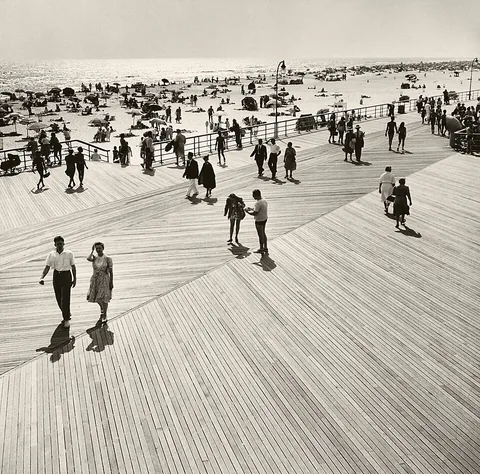 He sees it one day. He says, “This is the greatest beach I’ve ever seen. It’s only 27 miles from New York City. If I can build a road out here, I will give the people of New York City this great beach.” But it seems impossible to build that road because the property owners don’t want the road going through their farms and property.
He basically says, “I’m going to build it.” To watch him do it, to overcome each obstacle, there are so many, and then all of a sudden it’s open and you have Jones Beach and you have it accessible to New York. It’s an act of political genius, and it’s also an act of will: “I’m going to do it.” That’s fascinating to learn about.
So you think today if there were a Moses-type figure, they would figure out a way to work around everything that’s been set up?
The answer to that is, when Moses was building, they were saying the same thing. “Nobody’s ever going to build. We need roads for the automobiles, but they’d have to go through dozens of farms, scores of properties. No one’s ever going to be able to do it.” But he comes along and does it. So today someone would come along and do it.
This, I think, is a profound question for democracies: how do we end up in a place which is not the extremes of ’50s or ’60s Moses, but also not where we are now? Where I live in California, we’ve spent, I don’t know, $15 billion over the last decade. We haven’t gotten a single new line or single new mile of railway17The railway — California's high-speed rail line meant to link San Francisco and Los Angeles. Voters approved it in 2008 and construction in the Central Valley has been under way since 2015, but no section has opened yet. that those $15 billion have been spent to build.
Whereas in a different system… You could say China today is like New York City in the ’40s and ’50s. They have a very Moses-type attitude and they put up tens of thousands of miles of railways18China's railways — above all high-speed rail: the first line opened in 2008, and the network now exceeds 50,000 km (over 30,000 miles), about two-thirds of all the high-speed rail in the world. over the last 10-20 years. But of course, at the cost of similar amounts of displacement of people and recklessness. So how do we land in a good spot between either extreme?
I’m not sure there is a good spot. What you just said is the situation. To build anything on a large scale, you’re confronted with dozens or scores or perhaps hundreds of property owners who don’t want it built there. So the question is, how does anything get built? Then someone comes along and can do it.
When Robert Moses started, it seemed impossible, actually impossible, to build roads out into Long Island19Long Island — an island about 120 miles long stretching east from Manhattan. Its western end holds the New York City boroughs of Brooklyn and Queens; farther out are suburban Nassau and Suffolk counties, which in the 1920s were farms and the estates of the rich. because the road would have to cross scores of properties, most of whose owners didn’t want the roads coming through. They had the power to stop them then because he didn’t have the power of eminent domain.20Eminent domain — the government's power to take private property for public use, with compensation. But Moses said basically, “I’m going to build it.” He would find a way to overcome each difficulty.
What am I trying to say by that? I’m trying to say that every once in a while someone comes along who’s a genius, if that’s the right word, at getting big things built for the public. Decades may pass when there’s no one like that. You say, “Everything’s stalled. Nothing big is ever going to be built again.” Then someone suddenly comes along and all of a sudden things get built. That’s the nature of political genius.
I happen to be writing about two guys, Lyndon Johnson and Robert Moses, Johnson with civil rights21Civil rights — as Senate majority leader Johnson passed the Civil Rights Act of 1957, the first since Reconstruction, and as president the Civil Rights Act of 1964 and the Voting Rights Act of 1965. and Moses with public works, where people were saying, “You can’t do this.” But they did it.
Correct me if I’m putting words in your mouth, but if I may attempt an interpretation of what you said, it sounds like you think we need a little Moses today.
A great insight. I sometimes wonder about just what you said. The answer is, I certainly don’t want someone who’s as ruthless and disregarding public opinion as a Robert Moses. But at the same time, you need someone who’s going to find a way to get things built. He’s going to have to find a way despite the fact that so many people don’t want it built.
03Moses the young idealist
Contrary to popular belief, The Power Broker is not an indictment but the story of an idealist turning into a ruthless builder.
A lot of people who haven’t read the book have this impression that you think everything Moses did was bad, and that we need to make sure that we can never have a Moses again. So it’s interesting to hear you say that we need a little Moses again.
When people say to me everything was bad that he did, what I say is, “You didn’t read the book.” Because certainly the first parts of the book, hundreds of pages, are about a young idealist who sees this great need for recreation, for beaches on Long Island for the city people, and is going to find a way to make them accessible to people in the city. It’s an act of genius and willpower the way he does it, and that’s great.
Now, does it evolve into where Moses listens to nobody, and the only thing that matters is what he wants to get built? It does evolve into that. He does change.
But the young Moses, the idealist, before he’s building, is an expert in the technicalities of civil service. He devotes all his energies to trying to reform the civil service so that people get promoted on merit instead of political pull.22Civil service reform — this was the 1910s: the young Moses worked at the Bureau of Municipal Research and, under reform mayor John Purroy Mitchel, designed a merit rating system for city employees. The reform was killed by Tammany Hall, the New York Democratic political machine. He works so hard at that. You see a real idealism. You see a real idealism in his early works, when he says, “I want to make these beaches accessible to New York.”
Now, does that evolve into “I think there ought to be a highway here no matter what anybody says, and no matter how many thousands of people are in the way,” like the Cross Bronx Expressway,23Cross Bronx Expressway — a highway across the whole Bronx, built from 1948 to 1972. Its path through residential neighborhoods, above all East Tremont, is the subject of one of the best-known chapters of The Power Broker, "One Mile." The April 1973 photograph shows the recently completed expressway.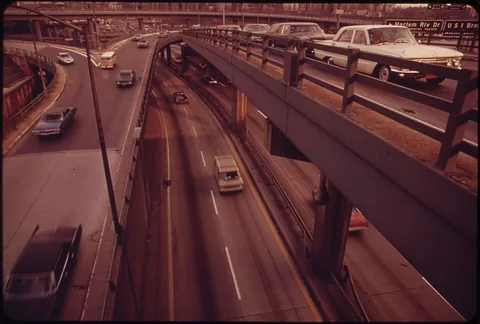 “I’ll evict them”? It does. He changes.
That to me is a big part of the story of The Power Broker: how this guy who’s in the beginning a young, idealistic guy who wants to build to make lives better for people, to give them access to the ocean and beaches, changes into someone who just wants to build because he thinks something should be built no matter what anyone else says. He’s going to do it no matter how many hundreds, thousands of people he has to evict, no matter how bad an idea it is, like the Cross Bronx Expressway.
People are telling him not to do that before he does it. The minute this road opens, it’s the world’s longest traffic jam. Not thousands, but tens of thousands of people were evicted, thrown out of their homes by him without any relocation provisions. So in a way it’s a story of how you give somebody power without the power, in a way — I don’t want to use the word “corrupting” him — but hardening him to anyone who opposes him, to any opposition.
AdAntithesis
Coding agentsaCoding agents — AI models that write, run and fix code on their own, such as Claude Code or Codex. work best when they get fast, detailed feedback. My sponsor, Antithesis,bAntithesis — an American company that makes an autonomous software testing platform. It was founded in 2018 by veterans of FoundationDB, a distributed database famous for its deterministic simulation testing. gives your agents some of the richest feedback there is by running every change they make through thousands of hostile simulations.
This usually isn’t feasible. Simulation testingcSimulation testing — running a program in an artificial environment where the network, clocks and disks are replaced with controllable fakes and failures are injected on purpose. If the environment is deterministic, any failure found can be reproduced exactly. is hard. It normally requires rebuilding your software around a fake network and clock, among other things. So most teams don’t bother. Even if they do, getting enough coverage typically takes hours. So they run these simulations overnight, by which point all the day’s changes are jumbled together, and it’s harder for the agents to tell which PRdPR (pull request) — a proposed code change that is checked by tests and colleagues before it is merged into the shared codebase. broke something.
Antithesis solves both problems. It runs your software inside a fully deterministic simulated computer, so you don’t have to rebuild anything yourself. And it explores fast enough that you can test every PR. On a recent project, it packed 15 hours of simulation testing into each 15-minute run. That speed comes from both parallelism and branching. Because it’s deterministic, whenever Antithesis finds an interesting state, it can save that exact moment and branch off hundreds of different futures.
It never wastes time replaying events, hoping to stumble across that state again. And it doesn’t just explore randomly. Antithesis systematically injects faults and tweaks your system in the ways most likely to break. So every minute in Antithesis is one of the unluckiest hours your software will ever experience. Learn more at antithesis.com/dwarkesh.
04Moses loses power
Caro was writing the book as Moses lost power, and saw it happen.
You start writing the book in ’66, ’67. You’re writing it while Moses is losing power. His career is not over yet. So the story changes while you’re writing it. I don’t know if you’ve talked about that, but presumably the conclusion changes because you don’t know whether he’s going to lose that power or not when you start.
That’s a great question. I watch that happen, and I’m young. Whatever my age was, I didn’t really know what I was doing. I watched him lose power, and I learned enough about him to know how sad this was going to be.
If I could think a moment, there’s a moment that this happened… Yeah… His office was still up at the Triborough Bridge Authority.24Triborough Bridge Authority (later the Triborough Bridge and Tunnel Authority) — a public corporation that built and ran New York's toll bridges and tunnels. Moses headed it from 1934 to 1968; the tolls gave him money to build without going through the budget. Its headquarters were on Randall's Island, right by the bridge. When he was in power, I interviewed him in that office several times. You felt his power. You felt outside there were all these people sitting around waiting for his decisions. As soon as I finished, the secretary would come in with a list of telephone calls from people who had called wanting something from him while I was talking to him.
I remember I had one long interview with him. Maybe it was my last one. By the time I finished, I realized there had been no calls. The secretary had nothing to tell him. So whatever you thought of Moses, you felt the poignance of someone losing power.
That’s fascinating. That’s what I was wondering about.
You couldn’t help feeling sad for him, even though you knew what he had done. You couldn’t help feeling, “Oh, this is, in a way, tragic that no one’s calling and asking him for a favor anymore.”
Did he realize that was happening?
I don’t think he really did. In a way, I’m sure he did. But by that time he was so insulated. Whatever his age was, he was up in his 80s. He was deaf. He still had at the Triborough headquarters on Randall’s Island all these Moses men who were loyal to him and treated him with the same deference they always had. He knew he wasn’t getting his projects done. But I know he felt he was just going to keep pushing like he always did, and he was going to win again. The answer to your question is no, I don’t think he did ever realize that.
In, I think, ’62, as you say, he tries to pull a trick on Nelson Rockefeller25Nelson Rockefeller — governor of New York from 1959 to 1973. In 1962 Moses threatened to quit all his state posts, and Rockefeller accepted; the governor's brother Laurance soon took over the State Council of Parks. Moses ran the Triborough Bridge and Tunnel Authority until 1968, when it was folded into the new Metropolitan Transportation Authority (MTA). that he had pulled on countless previous mayors and governors, which is to threaten to resign if he didn’t get his way. Rockefeller says, “I regretfully accept,” and nothing happens. That made me wonder as I was reading it. Could all those previous governors and mayors who were getting threatened have done the same thing?
Great question. Yeah, the answer is yes. Well, you say, “could they have done the same thing?” In part, the answer is yes. They had the power to fire him. He wasn’t an elected official.26Not an elected official — Moses ran for office only once, in 1934, as the Republican candidate for governor of New York, and lost in a landslide to Herbert Lehman. He never ran again. But there wasn’t really a possibility. The answer to the question at the bottom is no, they couldn’t, because he was simply too popular. You couldn’t fire Robert Moses. That’s like firing some person who was the idol of New York.
ExplainerHow Moses made himself untouchable
Moses was never elected, yet for decades he outmatched the mayors and governors who appointed him. The secret was how he built his posts.
- Many posts at once. At various points he held as many as 12 city and state titles simultaneously, with terms that expired at different times, so no single decision could remove him from all of them.
- An authority, not a department. The Triborough Bridge Authority, which Moses chaired from 1934 to 1968, was a public corporation: it lived not on a budget but on tolls and on bonds sold against them.
- Bonds as armor. The bond terms were a contract with the bondholders written into state law, and the US Constitution forbids states to impair contractual obligations. Those terms and multi-year appointments to the Authority's board made it largely impervious to mayors and governors. Toll revenue outran every projection, and instead of paying off the bonds Moses used it to build more toll bridges and roads.
- The end. In 1968 the Authority was folded into the new MTA. The bondholders could have sued, but their largest member and agent was Chase Manhattan Bank, headed by the governor's brother David Rockefeller. Promised a role in the merged authority, Moses did not go to court — and was left without power.
But in addition, with his genius, he had created, in all his different posts — chairman of the State Power Authority,27New York State Power Authority — the state-owned power utility. Under Moses it built large hydroelectric plants on the St. Lawrence and at Niagara; the Niagara plant bears his name. chairman of Triborough Bridge Authority, Parks Commissioner,28Parks commissioner — Moses ran New York City's parks from 1934 to 1960, and headed the Long Island State Park Commission and the State Council of Parks from 1924. Long Island Parks Commissioner, Jones Beach Commissioner — such an interlocking web that you couldn’t fire him from everything, because the terms ended in different ways, and some you didn’t have the power to fire him from. He had really made it impossible. Well, almost impossible, because at the end, if you wanted to do it, Rockefeller did it. But by that time, cracks had appeared in the armor.
I think for decades, the answer to your question is you couldn’t do it. But then as he got older, cracks appeared in the armor. If you wanted to brave criticism in all the newspapers and public criticism and everything else, you probably could have done it.
05Did Moses know he was changing?
Caro doesn't think Moses ever realized how he had changed: he was sure his plans were the best thing that could be done and removed anyone in the way.
Which leads into the next question I want to ask you. You interviewed him seven times. The seventh time, you mentioned your awareness of a donation that was made to his commission by a millionaire29The millionaire — financier Otto Kahn. He secretly offered the Long Island State Park Commission, which Moses chaired, $10,000 for surveys, on condition that the new route of the Northern State Parkway bypass his Dix Hills estate and its private golf course. whose golf course was spared by the new route for his parkway. After that, he didn’t talk to you again. If you had gotten an eighth interview with Robert Moses, what is the one question you would most want to ask him?
Oh, God, what a great question. Off the top of my head, if I only had one question to ask him, I’d ask him, “Did you realize you were changing?” That’s off the top... That’s a great question you asked. But that’s the answer I’ll give for now. That’s something I always would like to have asked him.
Do you think he realized that he was changing?
No. I think he felt from the beginning that he had this vision to build roads here and parks there. That was the best thing to do. It was going to get done, and it should get done. No matter how many hardships he had to inflict on people, no matter how many thousands he had to evict, no matter what he had to do, he was going to get the roads built. You see this increasing ruthlessness, this utter ruthlessness of him. If someone stood in his way, he was going to find a way to remove that person as an obstacle.
Explainer"One Mile": the Cross Bronx through East Tremont
The most contested stretch of the expressway ran between Anthony and Longfellow Avenues through densely populated East Tremont; it is the subject of The Power Broker's chapter "One Mile." Epstein was not the only one to propose another route:
- in early 1953 Bronx borough president James J. Lyons proposed curving the road slightly south, along the northern edge of Crotona Park, to save about 1,000 homes;
- Moses called the idea "unreasonable" and threatened to resign as city construction coordinator and to cancel the federal funding, while state officials backed him, saying the park route would create "curves and reverse curves of sub-standard radius";
- in May 1953 the city's Board of Estimate approved the original alignment, and in November 1954 it voted to buy the land and relocate 1,462 families.
Construction of the central section dragged on into the 1960s. Caro argues that Moses deliberately ran the road through the neighborhood, although a route just to the south would have required far fewer demolitions.
I’ll give you an example of that if you want. There’s a politician in the Bronx named Henry Epstein. Henry Epstein is opposing the Cross Bronx Expressway. He’s saying to Robert Moses, “You’re putting it right through a neighborhood where you have to evict tens of thousands of people. You can just move it two blocks to the south, and you only have to evict a couple of hundred people.”
Moses sets out to destroy Epstein, and basically does, by making it known he’s having an affair. If he can find a weakness in somebody, that he has a mistress, that he’s taking money or something, he’ll use it. He’ll use whatever he has to to get things done.
He learns that, in my opinion, by failing to get things done when he’s very young. He has things that he wants to get done, and they don’t get done. The awareness comes on him. We can see it in the book, or in my learning about him. I try to show how he learns that he has to find weaknesses in people. If he has a weakness, he’s going to use it. He’s going to get things done.
There’s a hardening, an increased ruthlessness, where the only thing that matters is to get the thing done. Anyone who stands in his way is going to get whatever it takes. If Moses has to destroy him, he’ll destroy him.
06Building in the Great Depression
The Depression gave Moses cheap, compliant labor and gave New York beautiful architecture.
As you say, you’re writing not the history of one man, but of an era in America. One of the most interesting things about The Power Broker is, especially in the period in which he’s able to accomplish so much so quickly, what’s happening, and you talk about this, is the Great Depression.30The Great Depression — the economic crisis of 1929–1939; by 1933 roughly one in four Americans was out of work. Moses's projects in these years were largely paid for by the New Deal's federal relief programs for the unemployed. He’s hiring thousands of architects, tens of thousands of linemen, for pennies on the dollar to do big public works for the city. So I wonder how big a part of Moses’ early achievements is just that the government, because of the Great Depression, could compete with the private sector for the top talent and for lots and lots of labor working 24/7 through the winter, moving fast.
Another great question. The answer is that it played a big role. He needed architects for something. I don’t remember what it is. It’s in The Power Broker. They lined up on Fifth Avenue, thousands of out-of-work architects that he could hire for very low wages. But more than the wages, they were available, because they didn’t have anything to do.
He was able to hire so many people, and hire and fire them in a ruthless way, making the workmen work hard. He could just fire them. It was the Depression. They didn’t have other jobs to go to. He used that. Yes.
As somebody who has studied urban development so deeply, here is one thing I’m curious about. You look at the things that were built at the beginning of the last century, or before the beginning of the last century — Grand Central Station31Grand Central — New York's Grand Central Terminal, a Beaux-Arts station in Manhattan opened in 1913. and all the beautiful architecture in New York — versus the things that were built in the second half of the century. They look a lot less beautiful. The earlier, more beautiful things were built by a much poorer country. What changed? Why were you able to build more beautiful things before?
One thing that changed is you had all these out-of-work artisans who could, we’ll just say, carve stonework on buildings. My apartment is on the 15th floor of an apartment house. Across the street is a building that’s 15-16 stories high. You say, “Look at all the beautiful carving that’s done in the stonework of that building up on the roof.” I said, “The only people who can see it are the people in my apartment and the people in the apartment next to it.” Someone was willing to spend that money because the builders who built that could hire skilled people at such low wages that they could make them do the decorations to make a building beautiful up on floors that nobody’s going to see, because people came cheap.
AdWorkOS
If you want your agents to do real work, they need to be able to use the tools that your company runs on. Things like email or SlackeSlack — a workplace messaging app, owned by Salesforce since 2021. or Stripe.fStripe — a payments platform: internet companies use its API to take payments, manage subscriptions and issue refunds. But giving them unfettered access is risky, because they could send confidential information to a customer or refund a bunch of payments that they shouldn’t have. Of course, you could just review every request manually, but that doesn’t typically last.
That’s why my sponsor, WorkOS,gWorkOS — an American company whose API gives SaaS products enterprise features: single sign-on, employee directory sync, audit logs and now access controls for AI agents. built Airlock. It’s a judgment layer that sits between your agents and your tools. Anytime that an agent wants to do something, it makes a request to Airlock, which evaluates it against your company’s policies and decides whether to allow it, block it, or escalate it to a human.
Whenever a request is allowed, Airlock takes the relevant action for the agent, hitting the necessary endpointshEndpoint — the address of a specific API function that a program sends a request to, such as "send an email" or "issue a refund." and passing along the response. That way your agents never see your API keys,iAPI key — a secret string that tells a service who is calling it and what they're allowed to do. A leaked key lets anyone act on the company's behalf. and so they can’t leak them or use them for unauthorized purposes.
Since Airlock holds the keys to all your tools, it has to be rock solid. Fortunately, WorkOS has spent the better part of the last decade building auth and permissions products, and they’re battle-tested. More than 3,000 companies rely on WorkOS, including OpenAI and Anthropic.jOpenAI and Anthropic — AI labs, the makers of ChatGPT and Claude. Airlock is in early access. If you’re interested, go to workos.com/airlock.
07Lyndon Johnson's threats and promises
Behind Johnson's persuasion there was always the power to give or withhold, and Caro feels for Coke Stevenson, the man Johnson beat in 1948.
I want to ask you about Johnson now. In Master of the Senate,32Master of the Senate (2002) — the third volume of The Years of Lyndon Johnson: Johnson in the Senate and the Civil Rights Act of 1957. It won the 2003 Pulitzer Prize. you make two points about how Johnson is effective, at least this is the way I read it. One is that he’s very persuasive if you’re talking to him. The other is he’s put himself in a position of leverage such that he has things to promise you or things to threaten you with. It’s not that he’s convinced you of anything, but you know that you need his favor if you want to be successful. Of the two, I’m curious which was really the source of his power: his leverage or his persuasion?
Behind his persuasion was the power. When you were talking to him, if he asked something of you, you knew he had the power behind him to give you or deny you things that you wanted. Say he was asking a senator for a vote on a specific issue. The senator might not agree with him, might not want to give him the vote, but he would know. He wants a committee assignment.33Committee assignment — in the Senate, bills are drafted in committees, and a seat on the right committee determines a senator's clout. Democratic seats were handed out by the party's Steering Committee, chaired by the party leader, that is, Johnson. Johnson has the power to give him that or not. Or he would know he wants a specific law. Johnson has the power to get that law passed or not.
Behind everything — when Johnson is talking to you, and he puts his arm around you, and he leans into you34The Johnson treatment — Johnson's famous style: looming over the other person almost nose to nose, he would grab their shoulders and lapels and pour out arguments, flattery, promises and threats. At the White House on July 29, 1965, Johnson leans over Abe Fortas, whom he had just nominated to the Supreme Court.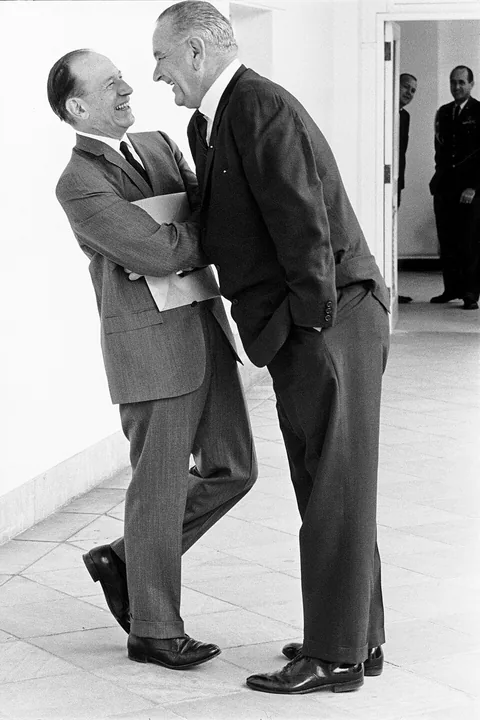 — it’s not just the force of his personality that he’s bringing to bear on you. Behind that personality, you know he has the power to do things to you or for you that you better be aware of.
Means of Ascent,35Means of Ascent (1990) — the second volume of The Years of Lyndon Johnson: the years after World War II and the 1948 Senate election. the book about the election with Coke Stevenson,36Coke Stevenson — governor of Texas from 1941 to 1947. On the 1948 election, see the note to the introduction. the 1948 Senate election. That is my favorite book perhaps ever. You paint such a compelling portrait of this person, Coke Stevenson, governor of Texas. They called him Mr. Texas. As you were writing his profile and writing this book, did part of you wish that he had won the Senate election?
You couldn’t help feeling… I’ll answer you directly. The answer is yes. I think Coke Stevenson, although he was an idealist, he knew how to get things done. When he was governor of Texas, he really accomplished things. I think if he had gone to the Senate, he would have been a great senator and accomplished things. So you wish that he had won. You feel the tragedy that he lost because of the way he lost. The thing about Coke Stevenson, he really didn’t realize someone could do all the things to him in the election that Lyndon Johnson did. He didn’t come to grips with that.
08Could Kennedy have passed Johnson's laws?
Caro is sure he couldn't: Kennedy lacked Johnson's passion to change America.
Suppose that Kennedy37John F. Kennedy — the 35th president of the United States (1961–1963). He beat Richard Nixon in 1960, with Johnson as his running mate. wins in ’60, but Johnson refuses the vice presidency, so he’s still majority leader.38Majority leader — the head of the party with the most seats in the Senate. Johnson led the Senate Democrats from 1953 and was majority leader from 1955. As Kennedy's vice president he lost nearly all his influence; he became president after Kennedy's assassination on November 22, 1963. The Civil Rights Act of 1964, the Voting Rights Act of 1965 and the Great Society programs all passed under him. How different do you think the bills that Kennedy would pass under Johnson as majority leader would be from the laws that Johnson as president was eventually able to pass? That is to say, the things that happened in ’63 and ’64 and ’65, would they have just happened earlier?
No, because Kennedy did not have the overriding desire to change America. John Kennedy was utterly charming. He was a good president. He was good in foreign policy, where Johnson certainly was not. But what he did not have was this vision, this desire to change America that Lyndon Johnson had.
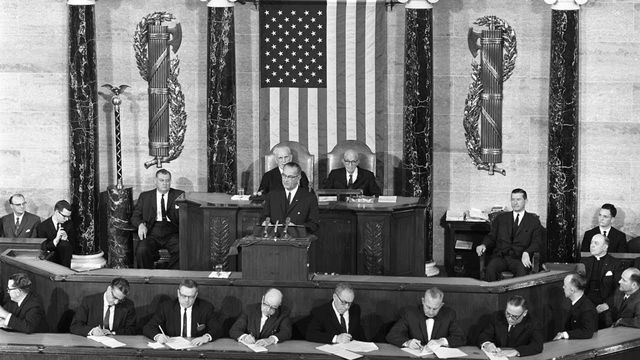
Lyndon Johnson comes back from his year teaching the poor kids in Cotulla39Cotulla — a small Texas town where in the 1928–1929 school year the 20-year-old Johnson, taking a break from college, taught at a school for Mexican American children. determined to change the education system to help poor people more, to do all these other things to help poor people. That determination is something that’s really unique. It’s what made him domestically such a great president, that we have all these civil rights laws, these anti-poverty laws40Anti-poverty laws — the War on Poverty, which Johnson declared in January 1964: the Economic Opportunity Act of 1964 and, in 1965, Medicare and Medicaid, government health insurance for the elderly and the poor. that we wouldn’t have had without Lyndon Johnson.
His presidency ends in tragedy because of foreign policy, because of Vietnam.41The Vietnam War — under Johnson the US went from military advisers to a full-scale war: by 1968 more than half a million American troops were in Vietnam. On March 31, 1968, Johnson announced he would not seek another term. But he has this desire to get things done to help people in America that’s almost unique. You say, “Gee, he’s determined to do this.” He’s going to find a way to do it. You watch him doing it. Then you say, “He was doing it.”
When his attention turns to Vietnam, everything falls apart, and his presidency is ruined. The things he started out to do domestically don’t get done in the way he would have done them. But he starts out after the election42The 1964 election — Johnson beat Republican Barry Goldwater with 61.1% of the popular vote. with the education laws,43The education laws — above all the Elementary and Secondary Education Act of 1965, which for the first time gave federal money to schools in poor areas, and the Higher Education Act of the same year. with the anti-poverty bills to change the country. He’s on his way to doing it. That’s the great tragedy of Johnson and Vietnam.
If I can ask about that, and it’s okay if you don’t want to talk about this because it’s in the next book. But if you’re willing to talk about it, fundamentally, why did Johnson keep escalating, even when—
The answer to your question is I’m still trying to figure that out right now, so I’m not going to—
That’s fine.
Because that’s quite a mystery.
One of the things that’s true of both Johnson and Moses is this inexhaustible energy, working 16 hours a day, sometimes even more than that. I wonder how much you think that is the fact that they had a different constitution, that they just had different reserves of energy. Or do you think it was just that their will was so strong?
I think it’s just their will. A lot of people have their energy. When you see Robert Moses sleeping very little, showing that he’d do anything to get his way, to get things done, being tired or something doesn’t even seem to figure into the equation. Sometimes I’m looking at something — I can’t remember one off the top of my head — and you’ll say, “Johnson’s making this call at 2:00 and 3:00 in the morning. He’s up making these calls to get his way.” In fact, there’s a funny anecdote. Johnson calls one senator at 5:00 AM to ask him for his vote on something, and the senator says, “Oh, Lyndon, I was just lying here waiting for your call.”
09A book in one sentence
To stay on track through years of writing without feedback, Caro boils each book down to one sentence before he starts.
So it’s their will. I want to ask you a little bit about writing biography now. One question I have is, you spend 5-10 years writing a single book. Through that process, maybe your editor and your wife are the only people who have seen the manuscript. So how do you make sure you’re on the right track? Because you’ve got to wait so long from when you start to when you get public feedback. How do you make sure that everything’s going to hang together and you’re pursuing the message the way you want to?
Part of your question is, how do you be sure you’re on the right track? The answer to that is you’re not. But how do you try to stay on the right track? I do have a device for that. Before I start a book — I learned this the hard way with The Power Broker, because I didn’t do it with The Power Broker — I think through what I want the book to be, the whole book. People say, “You mean you think it through to the end?” The answer is yes.
Then you say, “What is this book about?” I sit at that desk sometimes for a long time before I start writing, when I’m thinking about the book, just asking myself in one way or another, “What is this book about?” You’ve got to get it down to one sentence. You say, “You can’t get it down to one sentence.” Then you say, “Yeah, but Bob, you learned you better get it down to one sentence, or three years from now you’re going to be writing and you’re going to be saying, ‘What am I trying to do?’” Before I start a book, I try to get it down to a sentence or at most a paragraph and say, “Really, what is this book about?” I try to make everything hang together around that point.
AdJane Street
Back in August, my sponsor, Jane Street,kJane Street — a New York trading firm and market maker, a frequent sponsor of the Dwarkesh Podcast. released the design files for a mystery chip and challenged my audience to figure out its true purpose. The challenge is over, and Jane Street has released a blog post highlighting some of their favorite submissions. They also revealed the ASIC’s purpose. I won’t spoil it here, but if you’re curious, I have linked to it in the show notes. Anish, who helped design the puzzle, walked me through some of the best write-ups.
I think my favorite submission was probably this insane visualization made by Kjartan van Driel and Leander Post, who started by showing in 3D how a chip is made from standard cells,lStandard cells — ready-made logic building blocks (gates, flip-flops) from which design software assembles a digital chip. how all of the metal layersmMetal layers — layers of thin metal wiring above the transistors that connect them into a circuit; modern chips have more than a dozen. fit together to actually comprise the logic of the chip, and then showed each component of our puzzle design, what it does and how they reverse-engineered it, before then showing how it all fits back together into the puzzle.
Don’t worry if you missed this challenge. There’s a new one live right now.
So the goal with this new challenge is we want people to design a hardware protocol emulator chip that can be used to analyze and emulate different communication protocols. And as a bonus, we’re going to pay to fabricate our favorite submissions, and you’ll actually get your chip back mounted on a board, ready for you to test in real life.
The competition is open till January 18th. Go to janestreet.com/dwarkesh to get started.
A lot of your books you’ve written before we had digital archives, the internet, and all the resources that made available. How much of a difference have those resources made?
They’re making a big difference right now. The book I’m doing now, I’m writing about Vietnam. Let’s say I want to do a battle. I want to write in detail. This just happened. I picked a battle that I wanted to do in detail. It’s called the Battle of the Ia Drang Valley.44Battle of Ia Drang (November 1965) — the first major battle between the US Army and regular North Vietnamese forces. It is the subject of We Were Soldiers Once… and Young (1992) by battalion commander Hal Moore and journalist Joseph Galloway, which became the 2002 film We Were Soldiers starring Mel Gibson. Nobody’s written about it in detail. But I could go to my computer and I could look up where the oral histories are from soldiers who fought in that battle, what colleges the oral histories are at, what documents are available, in a way you couldn’t do before.
Do you think it would’ve made a big difference when you were writing the earlier volumes?
No. It might’ve made things faster, but just the way I am, I would look at the documents anyway. Things would go faster now. But I think about what you just asked. I was thinking about it the other day. It’s difficult for me to explain it, but I don’t think it would’ve gone any faster. I can’t quite tell you why. Certainly you could find the documents faster. But finding them is a small thing compared to reading them.
10Everything that didn't make it into the books
Much of what Caro learned never made it into the books, so he gave his archive to the place where researchers can most easily reach it.
A question just occurs to me. I’m curious to get your answer. If we were able to time travel back to ’75 and I could tell Robert Caro then that these three new volumes on Lyndon Johnson45The Years of Lyndon Johnson — Caro originally planned the biography as three volumes. Four have come out so far: The Path to Power (1982), Means of Ascent (1990), Master of the Senate (2002) and The Passage of Power (2012); he is now writing the fifth, about the presidency and Vietnam. he’s about to embark on will take more than 40 years, how do you think 40-something-year-old Robert Caro would have reacted to that? Would he have been happy? Would he have been afraid?
You ask terrific questions. The realization came to me when I was thinking about Johnson. I’ll give you a long answer, but this is the accurate answer.

I had to cut so much out of The Power Broker. I cut out so much stuff that shouldn’t have been cut out. I gave Bob Gottlieb,46Robert Gottlieb (1931–2023) — one of the best-known American editors: he ran Simon & Schuster and Knopf, and The New Yorker from 1987 to 1992. He edited all of Caro's books; their partnership is the subject of the documentary Turn Every Page (2022), made by Gottlieb's daughter Lizzie. my editor, a manuscript that was 1,050,000 words long. The most they could fit into one volume — and he really worked at this, because I was determined it would only be one volume — was 700 pages,47That's Caro's figure; the first edition of The Power Broker ran to 1,336 pages. or about 700,000 words, instead of 1,050,000 words, which meant we had to cut 350,000 words. He has said, “I cut a lot of the best stuff I ever read.”
I felt a lot of the stuff that I cut out, it’s tragic that no one knows it. To this day, people ask me about things. I say, “Oh, I wrote that.” Then they say, “Well, no one ever read it.” But the way I am, I don’t know that it would’ve changed anything, because as I’m writing the book, I’m saying, “Oh, this is too long. This is going to be too long. I’m going to have to cut so much.” But I don’t seem to have the ability not to write the stuff that I think should be written, even though I know so much of it is going to have to be cut.
Speaking of which, you have, in the other room here, cabinets and cabinets of notes on interviews, notes as you’re working, things which have never been published before. Eventually other historians will be able to study those notes and those documents that you have compiled over your career. What is it that you hope they do with it? What kind of scholarship do you hope for?
I cut out so much stuff from the books that I wish people knew. Sometimes you’re reading something and you’re saying, “Oh, if I had written about that, the newspapers wouldn’t be covering it the same way. There’d be a different understanding of it.”
I’ll give you an easy example. Sam Rayburn.48Sam Rayburn (1882–1961) — a congressman from Texas and, with interruptions, Speaker of the House from 1940 to 1961, the longest tenure in US history; a patron of the young Johnson. I have a brief chapter on Rayburn in my books. But Rayburn is a great figure in American history.
There’s no good biography of Sam Rayburn, yet he ran the House of Representatives. He passed so many of Roosevelt’s bills49Franklin Roosevelt — US president from 1933 to 1945; his New Deal was a set of programs to pull the country out of the Great Depression. and other bills. He did so much for America that it’s a tragedy for me that nobody knows it. The material to know it is in those cabinets.
There happen to be a lot of examples of things where I said, “Whoa, that stuff didn’t make it into the books,” but they’re there. I have hundreds of interviews. I think I have 700 interviews for The Power Broker alone. The notes for those interviews are in the file cabinets: detailed, typed-up notes.
So there’s a lot of material there that I think would help people understand how New York evolved the way it did. With Johnson, well, I’m writing about it now, things that happened under his presidency. There’s more understanding of it. It’s not going to make its way into my books. But they’re going to be there.
That’s why I gave my archive to the New-York Historical Society.50New-York Historical Society — a museum and library in Manhattan founded in 1804. It received Caro's archive in 2020: part of it is on permanent display in the exhibition "Turn Every Page," and the rest is open to researchers. Johnson's presidential library, with his papers, is in Austin, on the University of Texas campus. Now, I have to say, I was offered a lot more money by other places. But I took a lot less money, a great deal less money, an amount that mattered a lot to me, because I wanted them to be easily accessible. I wanted them to be in New York. I didn’t want them to be at the University of Texas, where you have to fly down there. I wanted it to be in New York.
The material is there for a lot of stuff that I never got to put in my books. But it’s there if somebody wants it. I’ll give you an example. I wrote so much more. I interviewed so many senators, so many assistants to senators, to try and write about the Senate. Then I had to cut out or not write or not even go into the vast majority — I don’t want to say 90%, because I don’t really know a percent — of what I learned that is not in the books, but is in the file cabinets. So they are there for someone to look at. That’s why my archives are in New York.
It’s great to know that that research will pay dividends through many generations of scholars.
Well, hope so.
Because obviously it will not be possible to interview the folks you interviewed in the ’60s, ’70s, and ’80s again.
11Loneliness
Caro thinks America has never grasped the heroism of the loneliness of frontier life, and he works in a solitude of his own.
This makes me wonder. In order to paint a picture of the era that you’re writing about, and the eras which shaped Moses and Johnson, in The Power Broker you talk about the Gold Coast51The Gold Coast — the North Shore of Long Island, where hundreds of lavish estates of America's richest families stood in the early 20th century. in New York and the tenements. In the Johnson biographies, you talk about what the Hill Country was like when the frontier was being settled.
One thing that’s interesting is that even if Johnson had not become president, the story of what was happening in the Hill Country would still be fascinating. It’s an odd thought, but it makes me wonder if you could spend 10-20 years writing the biography of a totally ordinary person, because a lot of what was true about Johnson would have still been fascinating even if his career didn’t end up where it did.
The example that you give of what the Hill Country was like. We see all these Western movies and all. But when I started to learn about the people who settled Johnson City52Johnson City — a small town in the Hill Country, named after its founder James Polk Johnson, a relative of Lyndon Johnson. Johnson City preserves the house where Johnson grew up and his grandparents’ log cabin.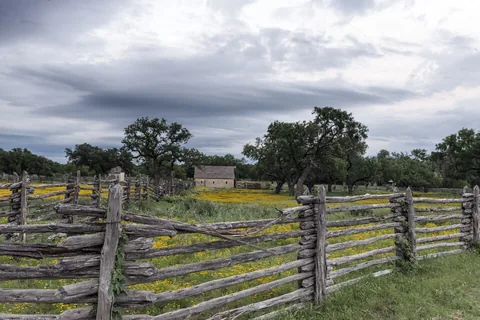 — Lyndon Johnson’s ancestors, but only the generation before him, or at most two generations before him — you say, “God, is this fascinating, what it was like.” What was it like? I wanted to do this book. What was it like to take your family and move them to the frontier? To move them, on one level, to Indian country,53Indian country — not the Indian Territory in what is now Oklahoma, but land where settlers faced raids: in the Hill Country, where Johnson's ancestors settled, the raiders were Comanches. where you might find your family massacred one day, and all these other difficulties.
That’s in my notes, because when I was talking to people, they would talk about their grandfathers, or what their grandfathers told them. When I’m talking to them about Johnson, I’m learning all about what life was like in that era. I said, “What an amazing, amazing story this is.” You say, “Well, there are a lot of books on it.” I happen to think there are not enough.
What’s also so amazing is just how different of a country it was. You think about Johnson growing up in Johnson City, in this tiny little lonely town, and even then being on a ranch that is tens of miles away from the city, versus America in the ’60s. It’s such a different place. I wonder if Johnson ever felt some shock at how different his upbringing was from the country he was leading.
The answer is yes. He was very aware of the frontier, of what his grandfather’s land was like. When he grew up in Johnson City — in the outskirts on the Johnson Ranch, which after all was 18 miles beyond Johnson City — what it was like to grow up on a ranch like that… In so many ways it was different. It formed your character in a different way.
Loneliness is a big deal. I wrote a section, and then I had to cut it down to about three pages, on his mother and how lonely she was. What it was like for people to settle their farms and ranches where there was nobody around you. I think I have a line where she could walk out in the afternoon and walk up on a hill, and there was nothing to see but more hills. There were no other houses near there.
I myself was shocked. I was trying to interview everybody who grew up with Lyndon Johnson, so they were elderly people. You’d call an elderly woman, and she’d say, “You drive out of Austin 22 miles and look on your left, you’ll find a cattle guard. There’s a dirt road there. You turn left on the dirt road, and it’s 22 miles to our farm.” And you say, “I drove 22 miles. I didn’t pass another house. I didn’t pass another person.” And this woman is living there all her life.
With all the wonderful books that have been written, I’m not sure that America understands the heroism of, forgetting Indians and raiders, just the loneliness of what life was like for these people.
I want to close on that, on loneliness, because obviously you’re not living on a ranch in the middle of nowhere. You’re living in New York City. But you and Ina54Ina Caro — Robert Caro's wife, a historian; for many years she was his only research assistant. For The Path to Power the couple lived in the Hill Country for about three years. have together basically been working alone for so long. How has loneliness affected your work and also your life?
Great question. A lot. Let me think how I can say this. I come here in the morning. I turn off my telephone. I’m not going to talk to anybody all day. I’m a friendly guy. Sometimes that very fact is hard, as a matter of fact. You’d like to pick up the phone and chat with somebody, but you say, “I’m concentrating on the book. I can’t do that. It’s going to break the concentration.” That sounds like such a phony thing. But you say, “I can’t really do that. I’m trying to think about this other thing.”
I think it’s impacted my entire life. Some people understand, but some people don’t understand that you don’t call them back. If people call me, I’m not going to call them back till the end of the day. I have friends who understand that, but a lot of people don’t understand that. So that’s a fact of my life.
Robert Caro, I can’t tell you how much of an honor it’s been. For six years that I’ve had this podcast, people will ask me, “Who is the person you most want to have on that you haven’t had on the podcast?” Every single time, I’ve said Robert Caro. So it’s a huge, huge honor. Thank you so much for doing this.
It was a terrific interview. Thank you very much.


