
Dwarkesh Podcast
Chapters
Dwarkesh finally sat down with Robert Caro, and while preparing he wrote down the lessons about power in Caro's books.
Read the chapter- Caro has spent half a century on a multivolume biography of Lyndon Johnson, after seven years on a biography of Robert Moses, and his books are considered the best study of political power ever written.
- For six years, asked who he most wanted to interview, Dwarkesh said Caro, and he pursued him through his agent, his publisher, the museums holding his archive and handwritten letters.
- This essay collects the lessons on how to accumulate and use power that Dwarkesh wrote down while preparing for the interview.
Moses built more of the physical city than anyone before or since and for over 30 years was more powerful than any mayor or governor, without ever winning an election.
Read the chapter- Moses built the Triborough and Verrazano bridges, the Cross Bronx Expressway, Jones Beach, Lincoln Center, Shea Stadium, two power dams and hundreds of parks and pools, plus 672 of the 899 miles of highway completed in the state by 1964.
- In archival footage, Moses answers those who say he doesn't have to be elected: "You don't have to be either."
- Dwarkesh's main answer to where that power came from is that Moses wrote the laws that governed him.
A few buried amendments turned a temporary bridge authority into a permanent institution whose powers the Constitution protected.
Read the chapter- As designed, an authority sells bonds, builds a bridge, collects tolls until its debts are paid and then goes out of existence.
- Moses's amendments to the 1933 act let old bonds be paid off with new ones "for any other corporate purpose," and let the authority build not just the bridge but connecting roads and "facilities not inconsistent with the use of the project," which meant almost anything.
- In 1946 the whole city of New York could borrow $150 million, and the Triborough Authority $360 million.
- Moses wrote his powers straight into the bond contracts, and the Constitution forbids states to impair contracts, so neither the legislature nor the governor nor the mayor could take them away.
Nobody could remove Moses for 30 years: the law shielded him midterm, and different officials appointed him to his dozen posts.
Read the chapter- Commissioners could be removed midterm only on stated charges after a hearing, and Moses took no payoffs: in Caro's words, he was "money honest."
- Moses held twelve posts, some appointed by the mayor and some by the governor, so no one could cut off every head at once, and removing him from one post meant making an enemy of the most powerful man in New York.
- Today's image of Moses took shape in the 1970s, when The Power Broker came out and New York was in decline, but Dwarkesh blames broader structural causes, since Detroit and St. Louis fell much further.
No mayor even wanted to fire Moses: he was popular, built fast and brought the city federal money.
Read the chapter- In the 1930s and 1940s New York high schools voted Moses the most admired New Yorker, and children cheered for him at park openings.
- Moses finished 1,700 park renovations in his first four months as parks commissioner, and he delivered big projects fast enough that a mayor could cut the ribbon before his reelection.
- For comparison, Dwarkesh notes that construction on the Second Avenue subway began in 1972 and the first section opened in 2017.
- Finished blueprints from the best planning team in the country brought New York one-seventh of all federal work-relief money, and Moses picked the projects.
Moses wasn't afraid of being fired; he constantly threatened to quit.
Read the chapter- Under Wagner, one aide said, Moses resigned "about twice a day," and La Guardia's lawyer had a stack of ready-made resignation forms printed for him.
- A mayor who accepted the resignation would lose the projects and the money and pick a public fight with the city's most respected official.
- Moses had spent years befriending newspaper owners, including the Sulzbergers of The New York Times, and the next morning every front page would take his side.
Moses made sure powerful people profited from every project, and power itself, in Caro's telling, became his drug.
Read the chapter- Instead of narrow interest groups blocking projects, Moses built a narrow group in favor of them: banks bought his bonds at a discount, unions got jobs, lawyers got fees, and party bosses got paid for insuring bridges.
- In the 1910s the young reformer Moses fought Tammany Hall, lost and learned that ideals without power are useless.
- In Caro's account, power at first served Moses's dreams, then became a drug he needed in larger and larger doses.
Johnson, by contrast, was an opportunist with no coherent ideology, yet as president he passed the landmark civil rights laws.
Read the chapter- In the Senate Johnson molded himself to the most powerful men there, the conservative Southern Dixiecrats.
- Former Senator Herman Talmadge told Caro that the young Johnson saw relations between white and black people as "master and servant," adding, "He was with us in his heart."
- And yet it was Johnson who passed the Civil Rights Act of 1964 and the Voting Rights Act of 1965.
Before Johnson, the Senate majority leader was a lightning rod with no real power.
Read the chapter- In Caro's words, the Senate had no master before or after Johnson, because the founders designed it not to be led.
- Formally the majority leader could only be recognized first, yet he took the blame for every failure of the Senate, and both of Johnson's predecessors lost their seats.
- Johnson became his party's leader at 44 partly because nobody else wanted the thankless job.
Johnson arranged things so that whatever a senator needed to survive, only he could give or withhold.
Read the chapter- Only Johnson could get a bill scheduled, persuade a committee chairman, reach Speaker Sam Rayburn or put in a word with Texas oilmen.
- Instead of the century-old seniority system, the party's steering committee, which Johnson controlled, started handing out committee seats.
- In 1957 Estes Kefauver voted against Johnson, and that same week the Foreign Relations seat he was counting on went to John F. Kennedy.
Whoever decides which version of a bill comes up for a vote decides the outcome.
Read the chapter- A unanimous consent agreement limits debate time and amendments, and Johnson made the norm what earlier leaders had rarely used.
- Johnson let no bill reach the floor without one, so every vote was settled in advance and neither debate nor a surprise amendment could unravel the deal.
- As Senator Paul Douglas put it, under Johnson all the action took place offstage before the play began.
Johnson knew more than anyone, so he brokered nearly every deal.
Read the chapter- Every committee assigned a staffer to tell Johnson what was being drafted, and he spent his days listening to colleagues in the cloakroom and the halls.
- Votes can be traded and bills amended in endless combinations, and the broker makes sure he always comes out ahead.
Johnson passed a bill that seemingly could not satisfy North and South at once by tying it to things that had nothing to do with voting rights.
Read the chapter- Without some civil rights bill, no Southerner could hope for the Democratic presidential nomination in 1960.
- Southerners demanded jury trials for officials who kept black citizens from voting, and Northerners knew all-white Southern juries would convict no one.
- Western senators got a vote on a dam between Idaho and Oregon, Midwestern Republicans got jury trials for striking workers, moderates got black citizens' right to serve on federal juries, and Southerners got a bill weak enough not to filibuster.
Caro's books read like novels, which makes their lessons easy to miss.
Read the chapter- The books are impossible to put down, so you never stop to ask what they teach about power.
- Dwarkesh made the essay to think the lessons through himself and to give viewers context for the interview with Caro.
Quotes
Who Robert Moses was
“For more than 30 years, Robert Moses was the most powerful person in New York, more powerful than any elected mayor or governor, despite the fact that he was not elected to anything.”
Dwarkesh PatelRead from 01:43On the Triborough Bridge Authority Act
“So with just a few minor tweaks, Moses had turned an act meant to allow for the construction of two bridges into the basis of an institution that could build basically anything it wanted anywhere in New York, and whose authority to do so was protected by the United States Constitution.”
Dwarkesh PatelRead from 06:45Building then and now
“Today it's almost unimaginable that the government could construct big things in a year or two. For example, construction on the Second Avenue subway in New York began in 1972, and the first section was opened in 2017.”
Dwarkesh PatelRead from 10:27How Moses threatened to resign
“He threatened resignation to Mayor La Guardia so often and over such small things that La Guardia's lawyer got a stack of forms printed that read ‘I, Robert Moses, do hereby resign as so-and-so,’ to save Moses the trouble of writing it out every single time.”
Dwarkesh PatelRead from 11:23What power did to Moses, per Caro
“But power is not an instrument that its possessor can use with impunity. It is a drug that creates in the user a need for larger and larger doses”
Dwarkesh PatelRead from 13:52The majority leader's job before Johnson
“When Johnson asked the Library of Congress for a list of the majority leader's formal powers, he found that there was exactly one: the right to be recognized first on the floor.”
Dwarkesh PatelRead from 16:52Johnson's political genius
“Whatever a senator needed to survive, whether that was money, committee seats, or the passage of bills that mattered to his home state, Johnson could give, and Johnson could withhold.”
Dwarkesh PatelRead from 18:56How Johnson ran the Senate
“As Senator Paul Douglas put it, under Johnson, ‘all the actions take place offstage before the play begins.’”
Dwarkesh PatelRead from 20:53
Summary
Before releasing his interview with Robert Caro, his favorite author, Dwarkesh Patel reread Caro's biographies of Robert Moses and Lyndon Johnson and turned his notes into a video essay on how the two men gained power and what they did with it.
Moses was the most powerful man in New York for more than 30 years without ever being elected to anything. His secret was that he wrote the laws that governed him. A few buried amendments turned the Triborough Bridge Authority from a temporary body meant to dissolve once its bonds were paid off into a permanent institution that could build almost anything, and because Moses wrote his powers into the bond contracts, the US Constitution protected them. He was hard to remove because he held a dozen posts at once, the public loved him, he could finish projects within a single election cycle, he brought in federal money, he was friends with the newspaper owners, and he had built a machine in which banks, unions and party bosses all profited from every project. In Caro's telling, Moses started as an idealist and power became his drug.
Johnson was the reverse: an opportunist with no visible convictions who, once he had real power, passed the most important civil rights laws since Reconstruction. He took the job of Senate majority leader, whose only formal power was the right to be recognized first, and made it the second most powerful position in the country with three tactics: he gathered every source of leverage over his colleagues, took control of the agenda and became the broker of nearly every deal. The model case is the Civil Rights Act of 1957, for which Johnson tied together a dam in Idaho, jury trials for striking workers and the rules for choosing federal jurors.
Mentioned
 Robert Caro00:00biographer of Moses and Johnson; the interview with him came out the next day
- The Years of Lyndon Johnson00:00the multivolume biography Caro has worked on for half a century
 Lyndon B. Johnson00:00the opportunist who became the most powerful leader in Senate history
 Robert Moses00:00the unelected builder who ran New York for more than 30 years
Show 10 more mentionsShow fewer mentions
 Triborough Bridge Authority02:51the 1933 act that made it permanent and nearly all-powerful
- The Power Broker: Robert Moses and the Fall of New York07:58the book that left Moses remembered as the man behind New York's decline
 Fiorello La Guardia11:23the stack of ready-made resignation forms for Moses
 The New York Times12:09the Sulzbergers, whose summer home Moses visited on weekends
 Tammany Hall13:52the machine that killed young Moses's reforms
- Master of the Senate15:07the volume on Johnson's Senate years
 Herman Talmadge15:07"master and servant": young Johnson's views on race
 Estes Kefauver18:15lost a committee seat for voting against Johnson
 John F. Kennedy18:56got the seat Kefauver was counting on
 Paul Douglas20:53on a Senate where everything was settled offstage
Transcript
01An interview six years in the making
Dwarkesh finally sat down with Robert Caro, and while preparing he wrote down the lessons about power in Caro's books.
So I recently interviewed Robert Caro.1Robert Caro (born 1935) — American journalist and biographer. He has won the Pulitzer Prize for Biography twice: for The Power Broker (1975) and for Master of the Senate (2003). He's spent the last 50 years writing a four-volume biography2The Years of Lyndon Johnson — four volumes have come out so far, in 1982, 1990, 2002 and 2012. Caro has been writing the fifth and final one, on Johnson's presidency, since 2012. of Lyndon Johnson,3Lyndon Johnson (1908–1973) — 36th president of the United States (1963–1969). Before that he was a senator from Texas, Senate majority leader and John F. Kennedy's vice president. and he spent another seven years before that writing the biography of Robert Moses, who was the master builder of New York. His books are widely regarded as the best explorations of political power that have ever been written. And they also happen to be literally my favorite books ever. Whenever I meet somebody new, one of the first questions that they often ask me is, who's the person you most want to interview that you haven't yet? And for six years, I've answered that question in the same way.
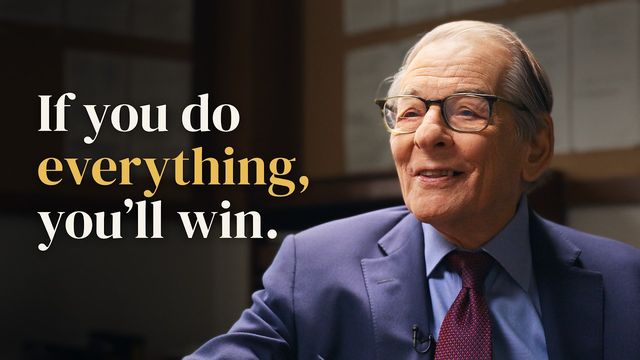
Robert Caro. And I've actually spent a lot of time trying to make this interview happen. I've chased down his agent, I've called this publisher, I've contacted the museums which are hosting his archives.4Caro's archive — in 2020 Caro gave it to the New-York Historical Society, which shows part of it in a permanent exhibition. I've even sent him handwritten letters. I finally got to sit down with him, and I'm very happy with how it turned out. It'll be out tomorrow.5The interview came out the next day, October 30, 2026.
In the meantime, as I was preparing for this interview and I was rereading all of these biographies, I was writing down all the lessons that they laid out about how to accumulate and use power, and this video essay is the result.
02New York's unelected master
Moses built more of the physical city than anyone before or since and for over 30 years was more powerful than any mayor or governor, without ever winning an election.
Robert Moses was the master builder of New York.
Our distinguished guest was Mr. Robert Moses, the nation's foremost city planner.
He built more of the physical city than anybody before or since. He built the Triborough and Verrazano bridges, the Cross Bronx Expressway,6Cross Bronx Expressway — built in 1948–1972, the first American expressway driven straight through a densely built city. It is blamed for the decline of the poor neighborhoods of the South Bronx; Caro's chapter on it is called "One Mile." Jones Beach, Lincoln Center, Shea Stadium, two giant power dams upstate, in addition to hundreds of parks and pools.7The Triborough Bridge (1936; renamed the Robert F. Kennedy Bridge in 2008) links Manhattan, the Bronx and Queens; the Verrazano-Narrows Bridge between Brooklyn and Staten Island opened in 1964. Jones Beach is a beach park on the South Shore of Long Island (1929); Shea Stadium was home of the New York Mets (1964–2008). The power dams are on the Niagara and St. Lawrence rivers. Of the 899 miles of highways completed in New York State by 1964, Moses had built 672 of them.
His projects collectively cost hundreds of billions of dollars in today's money. For more than 30 years, Robert Moses was the most powerful person in New York, more powerful than any elected mayor or governor, despite the fact that he was not elected to anything.
As I've heard it ad nauseam for the last 30-odd years, they say you don't have to be elected. My stock reply to them is you don't have to be either.
03The law Moses wrote for himself
A few buried amendments turned a temporary bridge authority into a permanent institution whose powers the Constitution protected.
How did he get that much power and how did he keep it? Part of the answer is that Moses wrote the laws that governed him.
He was called the best bill drafter in Albany,8Albany — the capital of New York State, seat of the state legislature and the governor. and he used that skill to write himself powers that the legislators voting on his bills didn't know that they were granting. The political genius of Robert Moses is perhaps best illustrated by his use of public authorities. These are government-created corporations that build city infrastructure. Public authorities sell bonds to pay for a specific project, say a new bridge. Once the bridge is built, the authority would charge drivers a toll until it had collected enough money to pay off its bonds. Then the authority would tear down the tollbooths, hand the bridge over to the city and go out of existence.
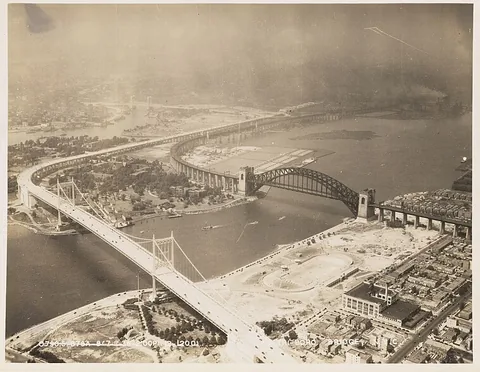
At least that was the idea. And that's what Albany assumed would happen when the New York State Congress approved the Triborough Bridge Authority Act of 1933,9Triborough Bridge Authority — in 1946 it merged with the New York City Tunnel Authority to form the Triborough Bridge and Tunnel Authority; since 1968 it has been part of the MTA and is now called MTA Bridges and Tunnels. Moses ran it from 1934 to 1968. whose final version included, buried within pages and pages of legalese, a few seemingly minor alterations that were drafted by Robert Moses. Now, Section 1 of this act clearly stated that the authority would dissolve once the bonds were paid off. And since the bonds could run at most 40 years and the revenues from the bridge would pay back the initial cost far sooner, it seemed like the authority had a clear built-in expiry date. However, in a subsection of Section 9, Moses added a single sentence that said that the authority could “from time to time” pay off its old bonds by issuing new ones. And those new ones could be “for any other corporate purpose.”
So just before the original bonds were about to expire, the authority now had the right to issue a totally fresh 40-year note for a potentially totally different use. And what could the authority build with all this money? Well, the original act let it build two bridges and their approaches.
Triborough's chairman, Robert Moses, called this project more than a mere bridge. “It will be,” he said, “an immense artery of travel in the very heart of the city.” From the island through the toll gate rides the first vehicle. Young men in rented tuxedos, the passengers. They parked here all week for the honor of being first across.
Moses' amendments also gave this authority the right to build connecting roads and “facilities not inconsistent with the use of the project.” These rights, when interpreted as creatively as Moses intended to, would allow Moses to alter most of the roads, parks, and housing in New York. For if a road connected to a road, which connected to a road, which connected to the bridge, or if a park lay along the road that connected to the road that connected to the road that connected to the bridge, surely the Triborough Authority was entitled to improve and change it. All this construction cost could be financed by the bridge's enormous toll revenues and the right of the Triborough Authority to borrow against them.
To give some perspective, in 1946, the entire New York City government could only borrow $150 million before hitting its legal debt limit. That very same year, Triborough could borrow $360 million.10$150 million and $360 million in 1946 dollars are roughly $2.5 billion and $6 billion today. So Moses' bridge authority had access to more than double the amount of money as the largest city in America. And what if a future governor or mayor eventually learned about all this power and revenue that had been delegated to this authority, and they decided to claw it back? Moses had planned for this too, and his solution was so clever that no lawyer or lawmaker in Albany saw it coming. The United States Constitution says that no state shall make “any law impairing the obligation of contracts” entered into by a government entity.11The Contract Clause — Article I, Section 10 of the US Constitution: no state may pass a law impairing the obligation of contracts.
A bond issued by a public authority is such a contract. Moses snuck a clause into the act which allowed him to add “any other matters of like or different character which in any way affect the security or protection of the bonds” into these bond contracts. And these matters included that Triborough could charge whatever tolls it wanted and for however long they wanted, and they could keep the surplus thus generated. That is to say, Moses could now entrench his powers simply by writing them into the bonds that he issued. From the moment that those bonds were sold, those powers could no longer be revoked by the legislature or by the governor or by the mayor, by anything, in fact, short of a constitutional convention.12Constitutional convention — an assembly of elected delegates that revises a state constitution. In New York, voters are asked every 20 years whether to call one. The powers that Moses now had were guaranteed for the bonds' entire lifetime, a lifetime which could always be extended simply by refinancing.
04A hydra with a dozen heads
Nobody could remove Moses for 30 years: the law shielded him midterm, and different officials appointed him to his dozen posts.
So with just a few minor tweaks, Moses had turned an act meant to allow for the construction of two bridges into the basis of an institution that could build basically anything it wanted anywhere in New York, and whose authority to do so was protected by the United States Constitution. These bond covenants had turned Triborough Authority's powers into granite, but nothing in them guaranteed that Robert Moses would remain its chairman. So how did Moses retain this position for 30 years? Part of the answer is, again, the law. Moses drafted the Triborough Act so that its commissioners could be removed midterm only “on stated charges after a formal hearing.” But any differences he had with a mayor or governor were more about what he decided to build and whom he displaced to build it rather than his personal conduct.
As Caro himself writes, “Robert Moses was not himself corrupt. He was, in fact, as uninterested in obtaining payoffs for himself as any public servant who ever lived. In the politicians' phrase, he was ‘money honest.’” So there were never any formal charges to bring. But this only explains why he wasn't fired in the middle of his term. Why was he reappointed every six years?
Well, at his peak, Moses was a hydra with a dozen heads. He held 12 different government posts at the same time: city construction coordinator, chairman of the State Council of Parks, chairman of the State Power Authority, and so on. Some of these positions were appointed by the mayor, some of them by the governor, and so no single person could cut off the heads simultaneously. And removing him from any one position meant that you were making an enemy with the man who would still be the most powerful person in New York. More importantly, no mayor or governor wanted to fire him. The way we remember Robert Moses today is based on a reputation that was calcified in the 1970s, when The Power Broker came out13The Power Broker: Robert Moses and the Fall of New York (1974) — Caro's first book, a 1,336-page biography of Moses that took him seven years. It won the 1975 Pulitzer Prize. and New York was experiencing a dark age of crime, deindustrialization, and white flight.14White flight — the mass move of white middle-class families from American city centers to the suburbs in the 1950s–1970s. In 1975 New York came close to bankruptcy.
Moses got much of the blame for this. After all, the subtitle of The Power Broker is “Robert Moses and the Fall of New York.” But in my opinion, this crisis had more to do with larger structural factors that had nothing to do with Moses himself. Cities that he had nothing to do with, like Detroit and St. Louis,15Detroit and St. Louis — between 1950 and 2020 Detroit's population fell from 1.85 million to 640,000 and St. Louis's from 857,000 to 302,000, while New York's grew from 7.9 to 8.8 million. In 2013 Detroit filed for bankruptcy, the largest municipal bankruptcy in US history. experienced a much more dramatic collapse. For the vast majority of his career, Moses was incredibly popular.
05The city's favorite
No mayor even wanted to fire Moses: he was popular, built fast and brought the city federal money.
In the 1930s and 1940s, New York high schools voted Moses the most admired New Yorker. This was because he had delivered over and over again public works which millions of New Yorkers got to use and enjoy. The beaches, parks, pools.
They used to dive off a dock into the murky river, but now it's splashing deluxe in a grand up-to-date Lido.16Lido — here, a big open-air public pool. In the summer of 1936 New York opened 11 large outdoor pools, built under Moses with federal money. It cost a cool million, and the kids say it's worth it.
And he did so at a speed and a scale that nobody had seen before.
In his first four months as the city's park commissioner,17Parks commissioner — Mayor Fiorello La Guardia appointed Moses to the post in January 1934; he held it until 1960. he kept crews working around the clock and finished 1,700 park renovations. And he did this all without a whiff of personal scandal. As Caro writes in The Power Broker, “It was not unusual at park and playground opening ceremonies for children, prodded by their parents, to break into the cheer.”18The cheer — Caro quotes it next: "Two, four, six, eight — who do we appreciate? Mr. Moses! MR. MOSES!! MR. MOSES!!!"
Importantly, Moses could deliver these enormous and popular public works within a timeframe that fit into a single election cycle. If the mayor gave Robert Moses the power to build something, he could expect to be standing at its ribbon cutting before he was up for re-election.
Robert Moses, Mayor Wagner, and Cardinal Spellman19Robert F. Wagner Jr. — mayor of New York in 1954–1965. Francis Spellman — cardinal and archbishop of New York in 1939–1967. join other dignitaries in a ribbon cutting at the Brooklyn side of the bridge.
Today it's almost unimaginable that the government could construct big things in a year or two. For example, construction on the Second Avenue subway in New York began in 1972, and the first section was opened in 2017. And just these initial two miles have cost the taxpayers $4.5 billion.20The Second Avenue subway — its first phase, about two miles of track and three new stations on Manhattan's Upper East Side, opened on January 1, 2017. Construction began in 1972 but was soon halted by the city's fiscal crisis and resumed only in 2007.
A lot of the funding for public works comes from Washington. Cities that receive the most money are the ones that have finalized their blueprints and can start breaking ground as soon as a new federal initiative is announced. Moses had the largest and best team of planners and engineers in the entire country. And because of that, by 1936, New York was getting one-seventh of the money that the federal government had set aside for Depression-era work relief21Work relief — Franklin Roosevelt's New Deal programs that gave the unemployed paid jobs on public works, above all the WPA (Works Progress Administration), created in 1935. for the entire nation. And the projects that this funding was going towards were the ones chosen by Moses. If the mayor had some different idea about what should be constructed, he'd have to draw up his own plans, which he didn't have the independent technical expertise to do so.
06Resignation as a weapon
Moses wasn't afraid of being fired; he constantly threatened to quit.
So he could either build the projects that Moses wanted to build, or he could build nothing at all. Between his ability to get things done, his popularity, and his control over money, Moses had a lot of leverage, and he was not shy about using it. Far from being worried about getting fired, Moses would constantly threaten to quit whenever he didn't get his way. Under Mayor Wagner, one aide said that “it seemed like he was resigning about one thing or another about twice a day.” He threatened resignation to Mayor La Guardia22Fiorello La Guardia — mayor of New York in 1934–1945. so often and over such small things that La Guardia's lawyer got a stack of forms printed that read “I, Robert Moses, do hereby resign as so-and-so,” to save Moses the trouble of writing it out every single time. But behind that joke was real fear.
If a mayor accepted that resignation, not only would he be forfeiting the completion of whatever projects Moses was working on, along with the money that was apportioned for those projects, he'd also be picking a public fight with the most respected official in all of New York.
Maybe that's the most important thing, it's just sheer stubbornness.
Moses had spent years befriending the owners of the city's newspapers. He spent many weekends at the summer home of the Sulzbergers,23The Sulzbergers — The New York Times has belonged to the Ochs-Sulzberger family since 1896: Adolph Ochs bought the paper, and in 1935 his son-in-law Arthur Hays Sulzberger became its publisher. which is the family that owns the New York Times. The mayor knew that if Moses resigned, the next morning all the front pages would tell the same story about how a man above politics was driven out by a craven politician because he refused to compromise the city's interests. And the power that Moses derived from his popularity with the masses was nothing compared to the power that he derived from his connections with New York's powerful private interests.
07A YIMBY machine, and power as a drug
Moses made sure powerful people profited from every project, and power itself, in Caro's telling, became his drug.
We are very used today to NIMBY, not in my backyard, where powerful but concentrated interest groups manage to stymie projects despite their broad popularity. Moses built a concentrated faction for YIMBY, yes in my backyard.24YIMBY — since the 2010s, the name taken by movements campaigning to build more housing, in opposition to NIMBY neighbors who fight new construction near their homes. He built a graft machine that ensured that the most powerful people in the state would all benefit when new construction happened. The banks got to buy his bonds at a steep discount without competitive bidding, the unions got more jobs, politically connected lawyers got legal fees, and party bosses got paid to broker insurance policies to bridges that had no plausible risk of falling down. Moses could then rely on these beneficiaries to call up anyone who stood in the way of one of his projects, whether that was a borough president25Borough — New York City is divided into five boroughs: Manhattan, Brooklyn, the Bronx, Queens and Staten Island; each has its own elected borough president. or the governor himself. Caro paints Moses as somebody who began as an idealist rather than somebody who craved power from the very start.
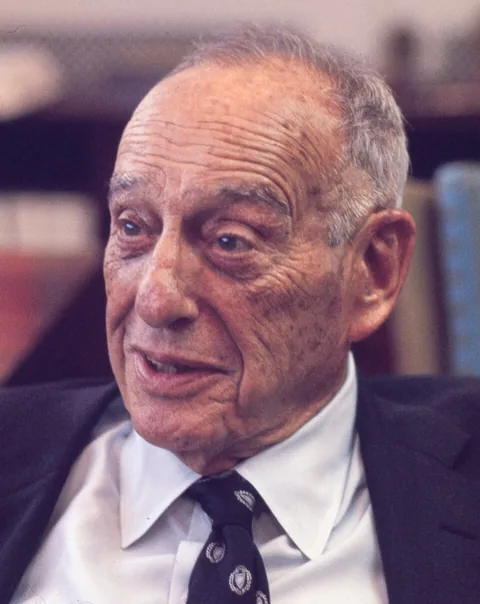
In the 1910s, Moses was a brilliant young reformer who joined this new good government movement, which was trying to replace Tammany Hall's patronage26Tammany Hall — the Democratic Party machine in New York, which from the 19th century handed out jobs and contracts in exchange for votes. Young Moses worked at the Bureau of Municipal Research and, under the reform mayor John Purroy Mitchel, designed a merit system for hiring and promoting city employees; it was scrapped after Mitchel lost the 1917 election. with honest and competent administration. He spent years fighting this machine, but his reforms got killed. The machine won, and Moses learned that ideals are useless without the power to realize them. Caro writes, “In the beginning, and for decades of his career, the power Robert Moses amassed was the servant of his dreams, amassed for their sake, so that his gigantic, city-shaping visions could become reality. But power is not an instrument that its possessor can use with impunity. It is a drug that creates in the user a need for larger and larger doses, and Moses was a user.”
08Johnson: the opposite path
Johnson, by contrast, was an opportunist with no coherent ideology, yet as president he passed the landmark civil rights laws.
Lyndon Johnson's story, on the other hand, is kind of the opposite. Through most of his career, there's little evidence that he had a coherent political ideology. He was a ruthless power seeker who embraced whatever happened to be the most expedient thing to do at that time. When Johnson first entered the U.S. Senate, he realized that the most powerful men there were the conservative Southern Dixiecrats,27Dixiecrats — conservative Southern Democrats who supported racial segregation. The nickname comes from the States' Rights Democratic Party, which ran Strom Thurmond for president in 1948. Johnson entered the Senate in January 1949. and the Johnson that they encountered was one who molded himself to their form.
While writing Master of the Senate,28Master of the Senate (2002) — the third volume of the Johnson biography, about his Senate years and the Civil Rights Act of 1957. It won the 2003 Pulitzer Prize. volume 3 of his Johnson biographies, Caro interviewed former Georgia Senator Herman Talmadge.29Herman Talmadge (1913–2002) — governor of Georgia in 1948–1955 and US senator in 1957–1981, an opponent of desegregation. He asked Talmadge what impression he got from freshman Senator Lyndon Johnson about the proper relationship between white people and black people. And now quoting Caro's recounting of this exchange: “‘Master and servant.’ So I, Caro, asked, well, didn't Johnson have any sympathy for blacks, any desire to improve their lot? My notes say ‘long pause.’ And then I wrote Talmadge's two-word reply: ‘None indicated.’ Another pause. And then: ‘He was with us in his heart. I believed him. I believed him.’”
Of course, we know that once he became president, Johnson spearheaded the 1964 Civil Rights Act and the 1965 Voting Rights Act,30The Civil Rights Act of 1964 banned discrimination on the basis of race, color, religion, sex or national origin, as well as segregation in public places. The Voting Rights Act of 1965 banned literacy tests and the other devices the South used to keep black citizens from voting, and put voter registration there under federal oversight. Johnson signs the Civil Rights Act as Martin Luther King Jr. looks on (White House, July 2, 1964).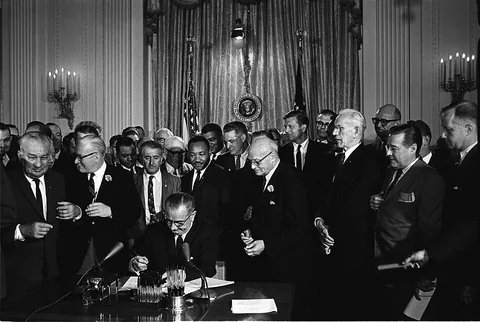 the most important civil rights laws since Reconstruction.31Reconstruction — the period after the American Civil War (1865–1877). The Constitution was amended to abolish slavery and give former slaves citizenship and the vote, and the first federal civil rights laws were passed.
09A job with no power
Before Johnson, the Senate majority leader was a lightning rod with no real power.
So Moses began as a naive idealist, but in Caro's telling became somebody seeking power for its own sake. Johnson, on the other hand, was an opportunist from the very start, and it was only once he had real power that he used it for ideals few knew that he had. Before he was president, Lyndon Johnson was vice president, and before he was vice president, Lyndon Johnson was in the Senate. And Lyndon Johnson was the most powerful Senate majority leader, perhaps the most powerful legislator period in the history of this country. Here's Caro: “He was master of the Senate, master of an institution that had never before had a master, and that at the time, almost half a century later, when this book is being written, has not had one since.” No leader before Johnson had wielded this kind of power because the Senate had deliberately been set up by the founders to not be led.
When Johnson asked the Library of Congress for a list of the majority leader's formal powers, he found that there was exactly one: the right to be recognized first on the floor. Before Johnson, the majority leader was less a leader and more a lightning rod. He'd be blamed in the national press and in his home state for everything that the Senate failed to do, yet he had no actual power to do anything about those failures. Being in this predicament was so politically toxic that Johnson's two predecessors as majority leaders had both lost their own Senate seats.32Johnson's predecessors — Scott Lucas, majority leader in 1949–1951, lost his 1950 race to Everett Dirksen, and his successor Ernest McFarland lost to Barry Goldwater in 1952. Johnson became leader of the Senate Democrats in January 1953, when they were in the minority, and majority leader in 1955. A big part of the reason that Johnson became his party's leader at just 44 years old in a Senate whose average age was around 60 was that hardly anybody else wanted this thankless and useless job. And in their hands, the job would have remained useless, but they were not Lyndon Johnson.
10Tactic one: leverage
Johnson arranged things so that whatever a senator needed to survive, only he could give or withhold.
From this position, Johnson turned himself into the second most powerful person in America, right after the president, and he used three different tactics to do so. First, he gained leverage. He made sure that he had things to promise and things to threaten with. Johnson transformed the Senate's rules, institutions, and norms so that he alone had the power to grant important favors to his colleagues. If a senator needed a bill passed, Johnson was the one who could get it scheduled on the floor and persuade the committee chairman to report it out. And if the bill needed help in the House, Johnson was the one who had a direct line to Speaker Sam Rayburn.33Sam Rayburn — congressman from Texas, Speaker of the House on and off from 1940 to 1961, and Johnson's longtime patron.
And if the senator needed money for his next campaign so that he could make sure he remained a senator, Johnson was the one who could put in a good word with the oilmen from his native Texas. Johnson also put himself in a position to control committee assignments, which are the single biggest factor that shapes how a senator's whole career plays out. For about a century, they had been handed out based on seniority.34Seniority system — committee seats and chairmanships went to the senators who had served longest. The "Johnson Rule," introduced in 1953, guaranteed every Democratic senator, even a freshman, a seat on at least one major committee. Practically overnight, Johnson changed the system so that many seats were no longer being settled by seniority, but rather negotiated by the party's steering committee, which Johnson controlled. If you wanted a good seat, you had to do what Johnson wanted. In 1957, Estes Kefauver voted against Johnson35Estes Kefauver — senator from Tennessee in 1949–1963. In 1956 he became the Democratic vice-presidential nominee, beating John F. Kennedy at the party convention. on an important motion.
That very same week, the highly coveted open seat on the Foreign Relations Committee, which Kefauver was expecting to get, was instead handed over to a far more junior senator named John F. Kennedy. The real political genius of Lyndon Johnson was identifying and then gaining control over every possible source of leverage over his colleagues. Whatever a senator needed to survive, whether that was money, committee seats, or the passage of bills that mattered to his home state, Johnson could give, and Johnson could withhold.
11Tactic two: the agenda
Whoever decides which version of a bill comes up for a vote decides the outcome.
The second important tactic was setting the agenda. What is said by a bill that passes depends on which version actually comes up for a vote and with what final modifications.
Whoever gets to set this agenda controls the outcome. So you won't be surprised by who put himself in this position. Johnson's main tool for controlling the agenda was the unanimous consent agreement.36Unanimous consent agreement — adopted if no senator objects, it sets the terms for considering a bill: limits on debate and which amendments are allowed. Without one, a bill's opponents can drag out debate indefinitely to block a vote, which is a filibuster. By default, Senate debate is unlimited. A senator can talk about a bill for as long as he likes, and as he does so, he can also offer amendments that have nothing to do with that bill, each of which can stall the bill even further. A unanimous consent agreement sets those freedoms aside for a single bill.
It fixes the allotted time for debate and constrains the opportunity to amend it. Earlier leaders had rarely used such agreements, and even when they had, they'd only used them after weeks of debate on a bill that had already been exhausted in its deliberations. Johnson made their use the norm in the Senate. He wouldn't even allow a bill to reach the floor until such an agreement was in place. And the reason was that Johnson wanted to control which bills reached the floor and to keep the floor from changing anybody's mind, because he wanted every vote settled in private beforehand through the wheeling and dealing where his leverage worked best. The last thing he wanted was for a long public debate about the merits of some bill to change a senator's mind at the very last minute, or for a surprise amendment to unravel a deal that he had spent weeks painstakingly brokering.
As Senator Paul Douglas37Paul Douglas — economist, coauthor of the Cobb–Douglas production function, senator from Illinois in 1949–1967 and one of the leading liberals in the Senate. put it, under Johnson, “all the actions take place offstage before the play begins.”
12Tactic three: the deals
Johnson knew more than anyone, so he brokered nearly every deal.
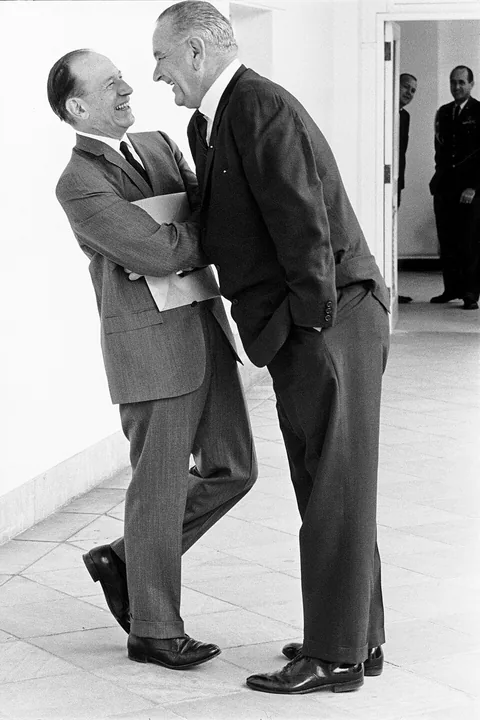
And the third tactic that Johnson employed was brokering all the deals to his advantage. Johnson made sure that as much of the Senate's information as possible ran through him. He had every committee assign a staffer to tell him what was being drafted. His aides tracked what every senator was up to, and he spent his own days in the cloakroom and in the hallways cajoling and listening to his colleagues. So he knew exactly what each senator really wanted and what he would and wouldn't give up to get it.
In any session, the Senate faces hundreds of possible bills and amendments. A senator's vote on one bill can be traded for another senator's vote on a different one, and any single bill can be amended a dozen different ways to win somebody over. So there's almost an endless combination of possible deals to be made. Johnson made sure that he was the one instigating and brokering most of these deals. As a result, he would be making sure that any deal left Johnson coming out ahead. A good example is how he got the Civil Rights Act of 195738The Civil Rights Act of 1957 — the first federal civil rights law since Reconstruction. It created the Commission on Civil Rights and a civil rights division in the Justice Department, and let the federal government go to court to protect black citizens' voting rights. passed through the Senate.
13The Civil Rights Act of 1957
Johnson passed a bill that seemingly could not satisfy North and South at once by tying it to things that had nothing to do with voting rights.
Johnson was desperate to make sure that at least some civil rights bill passed that year, even if it was weak. That's because he wanted to become president, but no Southerner with his record of consistently voting against civil rights could hope to win the Democratic presidential nomination in 1960.39The 1960 nomination — Johnson ran for the Democratic nomination, lost to Kennedy and became his running mate. The problem was there seemed to be no bill strong enough to win the Northern liberals, yet weak enough that the Southerners wouldn't filibuster it. The sticking point was who would preside over the court cases where Southern electoral officials were accused of suppressing black voters. Southern senators insisted on jury trials,40Jury trials — at issue were contempt of court cases: under the bill, a judge could punish, without a jury, an official who defied his order not to obstruct black voters. The amendment guaranteeing a jury in all such cases was introduced by Senator Joseph O'Mahoney of Wyoming; the Senate adopted it on August 2, 1957. but Northern senators were livid because in their view, this would gut the whole bill. The entire point of the law was to combat the exclusion of black citizens from the voting rolls.
But Southern states required jurors to be registered voters, and an all-white Southern jury would never convict a white registrar41Registrar — the local official who enrolled citizens on the voter rolls. In the South, registrars turned black applicants away on any pretext, for example with literacy tests and questions on interpreting the state constitution. for turning away black voters. And so any version that one side could accept, the other would reject. A less creative legislator would have backed down, but over the course of seven months, Johnson built a masterful deal that brought together wholly unrelated factions and whose byproduct included the passage of this civil rights law. Western senators got a vote on a federal dam that they had wanted for years between Idaho and Oregon.42The Hells Canyon dam — a proposed high federal dam in Hells Canyon on the Snake River, which forms the border between Idaho and Oregon. In the summer of 1957 the bill for it passed the Senate with the votes of several Southerners, but it died in the House. Midwestern Republicans who had powerful railroad unions in their state got a right to a jury trial extended to striking workers, and moderates got a clause guaranteeing that black citizens could serve on federal juries so that they could tell voters that they had created a new civil right.
ExplainerHow it ended: the 1957 act
- Even before the jury amendment, the Senate struck Part III from the Eisenhower administration's bill, which would have let the attorney general go to court to desegregate schools and protect other civil rights: only the protection of voting rights remained.
- The O'Mahoney amendment was softened in the final version: a judge could punish contempt without a jury, but if the fine exceeded $300 or the jail term 45 days, the defendant could demand a new trial before a jury.
- As agreed, the Southern senators did not filibuster. Only Strom Thurmond of South Carolina held the floor against the bill on his own, speaking for 24 hours and 18 minutes, a record that stood until 2025.
- Eisenhower signed the law on September 9, 1957. It barely changed Black voter registration in the South, but it was the first breach: the civil rights acts of 1960, 1964 and 1965 followed.
Meanwhile, the jury trial guarantee for Southern election officials stayed in, which kept the bill weak enough that Southerners agreed not to filibuster it. A dam in Idaho and protections for union workers and federal jury rules had nothing to do with voting rights in the South, at least not to anyone who lacked the inside knowledge and political creativity of Lyndon Johnson.
14Why write the lessons down
Caro's books read like novels, which makes their lessons easy to miss.
Caro's books are the best-written accounts of how political power actually works, but they are written so compellingly and with characters more vivid and stories more gripping than any novel that it's very easy to get so engrossed that you just keep turning the pages, and you never stop and ask yourself what are the lessons these stories are teaching about power. I wanted to make this video essay both so that I could think through what these lessons actually are, but also so that you would have the context necessary to watch my interview with Caro and get as much out of it as I did.
You'll be able to watch the interview tomorrow, so by the time you're listening to this, it might already be out. I hope you enjoy it.


