

How I Write
Chapters
Pixar has stayed successful for so long because everyone works in one building and each film is rebuilt in rough form again and again.
Read the chapter- After about six months at Pixar, Arndt realized the secret was both the system and the people, and he wasn't allowed to work from New York, because Steve Jobs' philosophy was that everyone had to be in the building.
- A film is roughed out seven or eight times before final animation, and each version is a beta test with an audience: if nobody laughs at a joke, you have proof it isn't funny.
- The first reels are shown to 20 or 30 people and, by the seventh or eighth screening, to everyone they can gather; a story gets three years, and failing is allowed.
- The script is split into 25 or 30 sequences, five or six per quarter; the first one finalized was Woody waking up in Bonnie's room, while the staff meeting scene took Arndt about 60 drafts.
Pixar trusts the process and gives the director the final word, and good ideas come out of shared work where nobody claims credit.
Read the chapter- Meetings would conclude "for where you are in the process, you're fine," even though Arndt spent three years in fear of being fired: Pixar did take directors off projects.
- There are no notes from executives or marketing: in a Braintrust meeting everyone just offers ideas, and the director chooses.
- When Lasseter said turning Buzz back into a Space Ranger had been done before, Arndt jokingly said "Spanish Buzz" to Andrew Stanton, who announced it to the whole room.
- A good idea can come from anywhere, claiming credit for one is a soft taboo, and a writer's ego, Arndt says, deflates fast once you see you're the one who's wrong.
Lasseter knew how to bring filmmakers back to why they were telling a story, and a bumper sticker becomes a film's North Star.
Read the chapter- When discussing a hopeless first draft, Lasseter would ask the director what inspired them and seize on a detail he loved.
- Wall-E, in Andrew Stanton's words as Perell quotes them, is "irrational love defeats life's programming," and Arndt says every scene should be measured against a line like that.
- The biggest misconception about writers, Arndt argues, is that they know from the start what they want to say, when in fact they write to figure it out.
- Little Miss Sunshine's bumper sticker is "fun is more important than winning," and Toy Story 3 is about the wisdom of letting go: sometimes the most loving thing is to let someone leave.
Ten years of reading other people's scripts taught Arndt that a good screenplay is specific and true, and a bad one is an imitation movie.
Read the chapter- Bad writing costs the most: Toy Story 3 took three years to write, and in one year, Arndt says, it would have been a mediocre film, in two a B-minus.
- Before the internet scripts were hard to find, so Arndt read them for $50 apiece, about a thousand over ten years, and wholeheartedly recommended only a handful, among them Election, which he gave to Matthew Broderick.
- Good scripts are rooted in a specific place, while bad ones take place in a generic city and a "movie world," an imitation of a genre.
- A fake story is a shallow jerk learning an obvious lesson, while a real one expresses what the writer truly believes, even at a risk.
A villain has to be convincing, and the hero often turns out to be the antidote to the flaw in their world.
Read the chapter- The villain embodies the story's negative values, like Darth Vader's violence or Gordon Gekko's greed.
- Lotso tells the toys they're trash waiting to be thrown away, harsh but essentially correct, and a good villain, Arndt says, isn't all-powerful but super convincing.
- The hero and their world are two sides of one coin: Katniss becomes the antidote to the repressive world of Panem.
- Robin of Locksley, an ordinary nobleman, is radicalized by King John's unfair taxes, and the world itself, Arndt says, created Robin Hood.
The troubles of the second and third acts grow out of the first, whose job is to seat the audience next to the hero.
Read the chapter- Billy Wilder said a third-act problem is really a first-act problem, because the two are bookends, and Arndt adds that the same goes for the second act.
- The first act is deceptive: it always entertains through novelty, but it has to set up the story's whole DNA, including the hero's long-term goal and short-term plan.
- At a bar a listener can walk away, but in a theater you get the first ten minutes to make the audience care, and they'll accept almost anything in that time, so there's no need to rush.
- You have to get the audience into the roller coaster car next to the hero, and many scripts fail by presuming sympathy for the hero.
Arndt divides stories into two poles: conflict inside the hero and conflict in the outside world.
Read the chapter- Phil Connors, a man always living in the future, gets trapped in the present, and even true love doesn't save him: the next morning she has forgotten everything.
- In a "therapy movie" all the conflict is inside the hero, as with Marlin in Finding Nemo, who overprotects his son after a trauma.
- In a "war movie," like Arndt's hypothetical story of a girl who survives Auschwitz and sets out to kill Hitler, the hero has no internal drama and the whole problem is in the outside world.
- Casablanca, in Arndt's view, sits in the middle, with both the Nazis and a flaw inside Rick.
The stakes should be raised to global ones, and there's no rush to get to the inciting incident.
Read the chapter- In an early version of Toy Story 5, Jessie climbs onto a roof and sees the blue glow of screens in every house except Bonnie's orange-lit room: a problem in one room becomes a problem for the whole world.
- Arndt calls the advice he hears about Netflix and saw on YouTube, to kick off the plot as fast as possible, terrible, because the point is to make the audience care about the hero.
- In many great films the inciting incident comes only 20 to 25 minutes in, as in Tootsie, where the actor is told he's finished and four minutes later puts on a dress and a wig.
- The charm of great stories, Arndt says, often lies in the first ten minutes, when the audience doesn't yet know what the film is about.
The more meaning a story has, the longer it's remembered, and an "insanely great ending" flips all three kinds of stakes at once.
Read the chapter- It drives Arndt crazy when people say they're "just making an entertaining movie": meaning comes from the therapy model or from a clash of two value systems.
- Little Miss Sunshine argues with a culture that sees life as a competition between winners and losers.
- Before the finale it should seem that the villain was right and the hero is defeated externally, internally and philosophically, and then it all has to flip in 45 seconds or less.
- External stakes are a binary goal in the world (blow up the bridge, kill Hitler), internal ones are love or self-respect, as in Rocky and On the Waterfront, and philosophical ones are the triumph of the underdog values.
An emotion has to be earned through restraint, and Arndt takes his best details from his own life.
Read the chapter- The deadliest thing in a script is feeling contrived: when Dwayne freaks out, Olive walks down the hill to him and says nothing.
- Gary Rydstrom, with seven Oscars, thinks "not me!" every time an envelope opens, and Arndt recited his 45-second speech for a month on his drive to Pixar.
- The bus that has to be push-started and the stuck horn come from Arndt's childhood.
- After five scripts that didn't work, he started with characters rather than plot for the first time, and halfway through called his brother: "This is it."
Writing is a form of thinking, and the meaning of your own story sometimes arrives only after the premiere.
Read the chapter- Arndt's brother, a professor of literature and philosophy, argues in The Philosophy of Writing that writing is a way to understand yourself, as it was for Marcus Aurelius and Montaigne.
- Arndt used to think you wait for an idea, and now he believes the act of writing generates it.
- He thought the Obi-Wan figure in Little Miss Sunshine was Uncle Frank, and only a year after the film came out realized it was Grandpa.
Unlike many in Hollywood, Arndt expects freedom from AI rather than disaster: films will get cheaper and directors more numerous.
Read the chapter- A low-budget film means two or three characters and one location, while Doug Liman's Killing Satoshi was shot in 20 days on a gray stage despite having 150 locations.
- Flow, an animated film made in Latvia for about three and a half million dollars, won an Oscar, while a Pixar film costs $200–250 million.
- If animation gets 99% cheaper, there will be a hundred times as many directing jobs: every story artist with an idea can make a film, and audiences are thirsty for authentic voices.
My Neighbors the Yamadas convinced Arndt that every family has a story, and Ozu and Miyazaki teach gentleness.
Read the chapter- In the summer of 2000 Arndt saw Totoro and My Neighbors the Yamadas at a Studio Ghibli retrospective and committed to writing an uncommercial family comedy.
- Almost nothing happens in Totoro's first act, yet the audience hangs on the faintest wisp of a story.
- In Late Spring the daughter wants to stay with her father and the father wants her to start her own life: competing selflessness, an inversion of the Western model of colliding selfish interests.
Arndt starts on someone else's script by asking what's at stake and then sharpens the tentpole moments where the story turns.
Read the chapter- First he asks about the external, internal and philosophical stakes: in Finding Nemo, winning back his son's love is arguably even more important than saving his life.
- It helps to ask what the worst thing could be on all three tracks and bring those worst cases together into one low point.
- The fairy-tale vocabulary of "once upon a time," "then one day," "and therefore," "so the quest began," "suddenly, without warning" and "and then there was no going back" follows the same logic as Hamlet with the ghost and the play.
- The end of the second act isn't the worst thing for the hero but the moment the stakes become "all or nothing," and a fuzzy goal like making the world a better place leaves the stakes muddy.
There are no shortcuts in the craft, and stories outlast cathedrals.
Read the chapter- The hero's journey, Arndt says, is overrated as the only template but underrated as organic logic: Luke in Star Wars has no flaw, the world does.
- Stories help us choose between value systems, for instance between being the Dude and being the Big Lebowski.
- Arndt figured on writing a script a year, fifty in all, of which five might get made and one might be good; William Goldman, he notes, had about 15 unmade scripts, and Perell saw the same at Eric Roth's house.
- Late in life Kurosawa said he was only beginning to understand movies, and Billy Wilder called audiences collectively a genius, so Arndt urges humility: the craft takes about ten years to learn.
- Stories outlast the oldest cathedrals, like the Epic of Gilgamesh, and the stories we tell about ourselves, Arndt says, define who we are.
Quotes
Why Pixar shows rough cuts to audiences
“If you write a joke and nobody laughs, you have direct proof it’s not funny.”
Michael ArndtRead from 02:19How Arndt gave Andrew Stanton "Spanish Buzz"
“I was sitting next to Andrew and I just said, ‘Spanish Buzz,’ almost as a little joke between the two of us. Then Andrew said, ‘Spanish Buzz!’ to the whole room. Everybody, all the animators, reacted, ‘Oh, I know we can make Spanish Buzz funny!’”
Michael ArndtRead from 10:06On the biggest myth about writers
“I think the biggest misconception people have about writers and storytellers is that they know what they want to say when they start. No, if you already knew, you would just sit down and write it all out. Instead, you write to figure it out.”
Michael ArndtRead from 13:05What a villain should be
“A good villain doesn’t have to be super powerful or malevolent; they must be super convincing. They need to persuade you that their worldview is correct.”
Michael ArndtRead from 22:46On Dwayne's breakdown scene in Little Miss Sunshine
“I knew Olive had to be the one to walk down the hill and convince him to get back in the van and go with them. I wrote the scene, wondering, ‘What does Olive say to Dwayne?’ Then I realized the best thing was for her to say nothing at all.”
Michael ArndtRead from 46:49How Arndt prepared his Oscar speech
“I wrote my speech, and every day for a month, as I drove into Pixar for work, I recited it over and over. When I finally got on stage, bombs could have been going off in the theater, and I would have just kept going because I had completely memorized it.”
Michael ArndtRead from 47:51What AI will do for animation
“If the cost is cut by 99%, making an animated feature $2.5 million, you create 100 times as many directing jobs. Every struggling story artist with an idea can now step up and become a director.”
Michael ArndtRead from 55:52On a screenwriter's patience
“Good storytelling is incredibly difficult and takes a long time. I wrote 100 drafts of Little Miss Sunshine before it went into production.”
Michael ArndtRead from 1:13:52
Summary
Michael Arndt, who won an Oscar for the screenplay of Little Miss Sunshine and wrote Toy Story 3, explains to David Perell why Pixar "cracked the code of storytelling": it takes both the system and the right people. A Pixar film is built in rough form seven or eight times and screened for ever-wider circles of viewers; Toy Story 3 took three years to write, and Arndt says they needed every week of it. The director has the final say, and in Braintrust meetings a good idea can come from anyone, which is how Spanish Buzz was born. John Lasseter knew how to bring writers back to why they were telling a story at all, and the heart of a film should fit on a bumper sticker: for instance, "fun is more important than winning."
From the thousand or so scripts he read as a reader, Arndt learned that a good story is rooted in a specific place and says something the writer truly believes, while a bad one is an imitation movie. A strong villain embodies the story's negative values and has to be convincing, and the hero is often the antidote to the flaw in their world. Problems in the second and third acts grow out of the first, whose job is to put the audience in the roller coaster car next to the hero, which is why Arndt considers the advice to kick off the plot as fast as possible harmful. He divides stories into "war movies" and "therapy movies," and stakes into external, internal and philosophical: in an insanely great ending, all three flip from defeat to victory in 45 seconds.
Also in the episode: stage fright before an Oscar speech, the family Volkswagen bus that made it into the film, his brother's book The Philosophy of Writing, and how you sometimes understand your own story only a year after the premiere. AI, Arndt believes, will make filmmaking dramatically cheaper and let many more artists become directors, while Japanese cinema (Takahata, Ozu, Miyazaki) teaches gentleness and "competing selflessness." His advice to beginners is patience and humility: he wrote eleven scripts before selling his first, and a hundred drafts of Little Miss Sunshine.
Mentioned
 Pixar Animation Studios00:44the studio that "cracked the code of storytelling"
- Little Miss Sunshine01:06the script that won Arndt an Oscar and a job at Pixar
 Steve Jobs01:34his philosophy: everyone works in one building
- Toy Story01:54Toy Story 3, three years of work, and the idea for Toy Story 5
Show 35 more mentionsShow fewer mentions
- WALL-E07:13a hero who can't talk; "irrational love defeats life's programming"
 Andrew Stanton08:46wrote the Toy Story 3 treatment and announced "Spanish Buzz"
 John Lasseter09:43knew how to bring a writer back to why they were telling the story
 Matthew Broderick19:03starred in Election on the advice of his assistant, Arndt
- Election19:03the script Arndt recommended to Broderick
- Star Wars21:57Darth Vader as a straightforward villain, Luke as a hero without a flaw
- Wall Street21:57Gordon Gekko: "Greed is good"
- The Hunger Games23:45Katniss as the antidote to the poisoned world of Panem
 Billy Wilder25:36"a third-act problem is really in the first act"; audiences collectively are a genius
- Groundhog Day31:47Phil Connors, trapped in the present
- Finding Nemo33:39the model "therapy movie"
- Casablanca36:21the middle ground between "war movie" and "therapy movie"
 Netflix38:24the advice to kick off the action as early as possible
- Tootsie39:53an inciting incident 20 to 25 minutes in
- Rocky44:48internal stakes: the hero wins back his self-respect
- On the Waterfront44:48"I could have been a contender"
 Gary Rydstrom47:16seven Oscars and dread of the envelope
- Volkswagen Type 248:26the Arndt family bus that made it into Little Miss Sunshine
 David Arndt50:31Arndt's brother, a professor of literature and philosophy
- Philosophy of Writing50:31writing as a form of thinking
- Killing Satoshi53:13150 locations shot on a gray stage
- Reservoir Dogs53:49a low-budget film set almost entirely in one location
- Flow55:25an Oscar on a budget of about three and a half million
- My Neighbors the Yamadas56:58the film without which there would be no Little Miss Sunshine
- My Neighbor Totoro57:53a first act in which almost nothing happens
 Isao Takahata58:15director of My Neighbors the Yamadas
 Yasujirō Ozu58:52gentle storytelling
 Hayao Miyazaki58:52gentle storytelling
- Late Spring59:59competing selflessness
 William Shakespeare1:01:04King Lear and the servant who disguises himself to stay with him
- Hamlet1:05:05the organic logic of a story: the ghost, the doubts, the play within the play
- The Big Lebowski1:10:50the Dude versus the Big Lebowski
 William Goldman1:11:53a master with about fifteen unmade scripts
 Eric Roth1:12:20many unmade scripts
 Akira Kurosawa1:13:08"only beginning to understand movies now"
Sponsors of the episode
 Alpha School15:32a private school where students finish academics in two hours a day
Transcript
01The Pixar system
Pixar has stayed successful for so long because everyone works in one building and each film is rebuilt in rough form again and again.
Michael Arndt, the Academy Award-winning screenwriter, is on the show today to teach us how to write great stories. We started the conversation talking about his time at Pixar, and I said, “Michael, you worked on movies like Toy Story 3.1Toy Story 3 (2010) — the third film in the series, directed by Lee Unkrich. Arndt's screenplay was nominated for the Oscar for Best Adapted Screenplay. What is it about the DNA of Pixar that has made them so successful for so long?” And then we talked about Little Miss Sunshine,2Little Miss Sunshine (2006) — Jonathan Dayton and Valerie Faris's comedy about the Hoover family, who drive an old VW bus from New Mexico to California for a children's beauty pageant. Arndt won the Oscar for the screenplay at the February 2007 ceremony. the movie that won him an Oscar award in 2007. This is a guy who’s read thousands of screenplays. He’s got a good sense of what makes for a bad screenplay, what makes for a good one, what’s the difference between them. He’s the script doctor,3Script doctor — a screenwriter a studio hires to rewrite or "treat" someone else's script, often without screen credit. he’s the storytelling scientist, and he’s here to teach us how to write great stories.
Tell me about Pixar. What is it like working there? Why has Pixar been so successful for so long? What makes it different?
I think Pixar truly cracked the code of storytelling. When I first arrived, I wondered what their secret sauce was: the people or the system? After about six months, I realized it’s both. You need the system in place, and you need the right people.
When I wrote Little Miss Sunshine, I was a total prickly loner. My attitude was, “Everybody shut up and leave me alone.” They hired me after reading the Little Miss Sunshine script as a sample; they didn’t even know it was being made.
My agent asked if there was any reason I couldn’t move to San Francisco if I worked at Pixar. I wanted to work for them and write, but I lived in New York. I asked if I could stay in New York, and my agent responded, “No, that’s not how they do things. You have to be in the building.”

This was part of Steve Jobs4Steve Jobs funded Pixar's spinoff from Lucasfilm in 1986 and was its majority shareholder and CEO until the studio was sold to Disney in 2006. Pixar is in Emeryville, across the bay from San Francisco; at Jobs's insistence, the studio's main building was designed around a large atrium so that employees would run into each other more often.’ philosophy, and I believe it was core to their success. You’re in this large building, making very difficult and complicated movies, but the great thing is that three or four films are always in development simultaneously, and everyone helps each other.
The core of their process is iteration: you create a rough version of the movie seven or eight times before moving to final animation. For Toy Story 3, I wrote the first draft, and we created what they call a set of reels5Reels (story reels) — a rough version of an animated film made of storyboards cut to temporary dialogue and music, which shows whether the story works long before animation begins.—a rough animatic of the movie. Based on the feedback, I wrote another draft, or sometimes ten more, before making a second set of reels.
The Pixar system is iterative: you write, direct, and edit, then repeat the process. This allows you to hyper-focus on every aspect. It’s a way to beta-test your story. You put it in front of an audience, and you can hear their reactions. If you write a joke and nobody laughs, you have direct proof it’s not funny.
So you invite people to watch the early versions of the movie?
Exactly. Their system operates in a series of concentric rings. The first set of reels, which is usually quite terrible, is shown to 20 to 30 people. You always want to preserve fresh eyes, so you invite people who have never seen the film before.
For the second screening, a few more people attend; for the third, a few more. By the seventh or eighth screening, you’re showing it to as many people as you can possibly gather.
They are extremely patient, giving you three years to develop a good story. It’s a very forgiving process where you’re allowed to fail. One of their tenets is to “fail as quickly as possible.”6"Fail fast" — a principle best known from Silicon Valley: the earlier a mistake surfaces, the cheaper it is to fix. At Pixar it was preached by director Andrew Stanton, according to studio co-founder Ed Catmull. Just get it up on its feet and don’t hesitate.
Tell me about how Pixar would break down a movie into, say, 20 to 25 different sequences.7Sequence — in film and animation, a series of scenes united by one action or location; the production of an animated film is planned and tracked by sequence.
It was interesting. Because animation is so labor-intensive, they had to break down the script into 25 or 30 different sequences. When discussing the story, you’d talk about what happens in each sequence.
The first act would typically8Three-act structure — the standard Hollywood template: setup, confrontation, resolution. In a 120-page script the first act usually runs about 30 pages, the second about 60 and the third about 30, which is why Arndt divides a film into quarters. be five or six sequences, the second quarter (what they call 2A,92A — the first half of the second act, up to the midpoint, where a turning point usually comes; the second half is 2B. up to the midpoint) would be five or six, the third quarter five or six, and the fourth quarter five or six sequences. This method provides a clear way to break down a story, ensuring you always have a specific goal. For instance, the end of sequence six leads to sequence seven, and the end of sequence seven leads to sequence eight.
However, this breakdown was primarily for production, allowing them to track which sequences were finalized and working, and which were still problematic. Films were made non-sequentially.
For example, the first scene in Toy Story 3 that was finalized for production, where they’d say, “You’re done, you don’t need a guide anymore,” was when Woody10Woody — the pull-string cowboy, Andy's favorite toy and the hero of the Toy Story series. In Toy Story 3 Andy is 17 and leaving for college. wakes up in Bonnie11Bonnie — a girl from Sunnyside Daycare; at the end of Toy Story 3 Andy gives her his toys.’s room. He tries to figure out how to get back to Andy, uses the internet to find his location, says goodbye, and then learns about Lotso.12Lotso (Lots-o'-Huggin' Bear) — the pink, strawberry-scented teddy bear who is the villain of Toy Story 3, ruling the toys of Sunnyside Daycare like a dictator. He was once lost, his owner's parents bought her a replacement, and ever since he has been convinced that children don't love their toys. That sequence was called “MapQuest.”13MapQuest — an American online maps and directions service launched in 1996; in the 2000s it was one of the most popular mapping sites.
I did about five or six drafts of that simple scene, so it was finished first. The last sequence I worked on was the staff meeting14The staff meeting — a running motif of the series: Woody gathers the toys for meetings and hands out assignments; the first one comes in the 1995 Toy Story, before Andy's birthday party. scene, which is right at the beginning of the movie. Those are the hardest scenes to write because you’re juggling so much exposition.15Exposition — information about the characters, their past and the rules of the world that the audience needs to follow the plot; the hard part is delivering it unobtrusively, without stopping the action. I did about 60 drafts of that scene.
02Trusting the process and the Braintrust
Pixar trusts the process and gives the director the final word, and good ideas come out of shared work where nobody claims credit.
How does Pixar balance the nurturing support needed for creativity with the pressure of making a Pixar movie? How do they balance that motherly support with the expectation that “this isn’t good enough,” telling you to make it great and keep going—which is more of a masculine toughness?
They trust the process; they believe the process will work. What was interesting was I remember being in story meetings where they would say, “For where you are in the process, you’re fine.” A lot of the story still wasn’t working, but we were one year into a three-year process. Based on their expectations and experience, our progress was acceptable.
There was an unhappy side to Pixar: directors getting fired off projects16Directors replaced at Pixar are well documented: in 2005 Brad Bird replaced Jan Pinkava on Ratatouille, and in 2010 Mark Andrews replaced Brenda Chapman on Brave. and being replaced. You always felt like a sword of Damocles was hanging over you. At a certain point, you needed to make something work. I lived in fear and terror for three years that I was about to get fired.
The other thing is they emphasize that storytelling is a team effort. It takes everyone. It’s not just your problem to solve; it’s our problem that we’re all trying to solve together.
What does Pixar understand about the structure of teams to make it work? It seems like a lot of group collaboration leads to a regression to the mean,17Regression to the mean — a statistical effect: after an unusually high or low result, the next one is usually closer to the average. Here it's used figuratively: collaboration smooths the brilliant down to the ordinary. but Pixar appears to be a crazy exception. We were just talking about The Beatles as a four-person team.
What is required in a good team, from what you learned at Pixar, to make people more creative rather than less?
I think the main thing is that it was non-hierarchical and democratic. You could go to an early version of Wall-E,18WALL-E (2008) — Andrew Stanton's film about a trash-compacting robot left alone on an abandoned Earth; most of its first half has almost no dialogue. which was a really difficult script to write because you have a hero who can’t talk. You have to tell the entire story visually, which is incredibly hard to do.
The main thing is that you’re investing the director with all the authority. The director isn’t getting notes from executives or producers telling them what to do, or from marketing people. The final decision truly comes down to the director.
ExplainerHow Pixar's Braintrust works
The Braintrust grew out of the habit of the five writers of the first Toy Story (John Lasseter, Andrew Stanton, Pete Docter, Lee Unkrich and Joe Ranft) of taking apart each other's scenes honestly. Ed Catmull describes its rules in Creativity, Inc.:
- every few months the group watches the current version of each film, first reels made from storyboards, then increasingly finished cuts;
- the main requirement for notes is candor: they address the story's problems, not the person making it;
- the Braintrust has no authority: the director doesn't have to accept a single suggestion and decides alone what to do with them;
- besides the regulars, people whose perspective a particular film needs are invited.
It all starts from an admission Catmull states plainly: early on, all Pixar films suck, and the Braintrust's job is to help the director turn a bad film into a good one.
Everyone else who comes into that space, when you screen the movie and watch it, is just there to help. In a good brain trust meeting,19The Braintrust — a group of Pixar's leading directors and writers who watch rough versions of films and give the director notes, which are not binding. It is described in detail in Ed Catmull's book Creativity, Inc. (2014). you can come up with a big bag full of ideas. It’s really the director’s job to pick and choose. They might say, “Okay, I like this, I don’t like this,” or “I think I’m going to make this work,” or “We’ve already tried that, I can’t make that work.”
To me, what was so great about it was this creatively democratic system where a good idea could come from anywhere. People were very open, and there wasn’t a lot of ego. There was a soft taboo about claiming credit for any one idea because it wasn’t you who came up with it; it was we who came up with it.
Can you take me into what it’s like being in a brain trust meeting? If I’m in the room, what is it like? Who’s there? What’s the general atmosphere?
I’ll give you a great example; this is my recollection of the origin of Spanish Buzz.20Spanish Buzz — in Toy Story 3 Buzz gets reset into "Spanish mode": he speaks only Spanish and dances flamenco. I wrote a first draft of the script based on a treatment21Treatment — a detailed prose account of a future film, from a few to dozens of pages, from which the script is later written. Andrew Stanton22Andrew Stanton — Pixar director and writer: a co-writer of the first Toy Story and director of Finding Nemo and WALL-E. did. The twist halfway through was that Buzz gets reset back to his original factory settings and becomes a Space Ranger again.23Space Ranger — in the first Toy Story Buzz Lightyear doesn't know he's a toy and believes he is a real Space Ranger; in Toy Story 2 the same happens with another Buzz, fresh from the store. That's why Lasseter says it's been done. That’s how I wrote the first draft.
Then there was an off-site meeting. It was literally for about three days. Everyone left Pixar and went to an inn in Napa Valley.24Napa Valley — California's wine region north of San Francisco, a favorite spot for corporate retreats. We sat in a giant conference room around a giant table. Again, there were like 25 or 30 people who had all worked on the Toy Story films, sitting there trying to help me fix my first draft of the script. You couldn’t ask for a bigger set of training wheels. All these incredibly smart people who knew these characters intimately were all trying to make something better.
My recollection about the origin of Spanish Buzz, which may be wrong but this is what I remember, was that at a certain point, John Lasseter25John Lasseter — a Pixar co-founder and director of the first Toy Story; from 2006 to 2018 chief creative officer of Pixar and Walt Disney Animation Studios. He left Disney after employees accused him of misconduct. said, “You know, we’ve done turning Buzz into a Space Ranger before. It feels like we’re just repeating ourselves. Is there something else we could do?” People just started throwing out ideas: “fast-motion Buzz,” “slow-motion Buzz,” “electrified Buzz,” or something like that.
I was sitting next to Andrew and I just said, “Spanish Buzz,” almost as a little joke between the two of us. Then Andrew said, “Spanish Buzz!” to the whole room. Everybody, all the animators, reacted, “Oh, I know we can make Spanish Buzz funny!”
It was a great example of needing one person to identify a problem that needed fixing, like John, then having one person who comes up with an idea, and another person to say, “Yes, that’s the right idea.” It’s that creative ferment, the fact that you can have half an idea and somebody else will come along and give the other half. It’s such a luxury; it’s so great.
It also teaches you humility. It truly teaches you humility because a lot of times you think you’re right, and then after ten minutes, you realize, “Oh, wait a minute. Everyone else is right, and I’m wrong.” It helps you get over that writer’s ego, that feeling writers often have that they always have to be right about things.
03Why tell this story
Lasseter knew how to bring filmmakers back to why they were telling a story, and a bumper sticker becomes a film's North Star.
So what is the core thing that John Lasseter understands about stories that more writers need to know?
John was a genius at this. If we screened an early version of something, either from Pixar or Disney Feature Animation,26Disney Feature Animation — Disney's animation studio, renamed Walt Disney Animation Studios in 2007. After buying Pixar in 2006, Disney put Pixar's leaders, Ed Catmull and John Lasseter, in charge of it as well, which is why Lasseter watched rough cuts from both studios. and it was usually a first draft, which is often terrible — all first drafts are terrible. I would walk out of those screenings thinking, “I don’t know what to say. I have no notes. There are so many problems, an infinite number of problems, and I don’t even know where to begin.” I wouldn’t know how to talk to the director or what could be done to rescue the project.
John was great about getting everybody in the room. I often didn’t even want to be there because I felt I had nothing to contribute. But John would start by asking, “Why do you want to make this movie? What was the inspiration?” Or he would pick up on a small detail. He’d say, “I love what you did with this. I love this detail you created. I love that your character does this. Tell me more about that.”
He was so good at focusing on why they wanted to tell this story, why it was important to them. He’d get to the heart of it, going back to the very beginning of the process: “Why did you decide this was a story you wanted to tell?” From that little kernel, he could coax out answers to questions like, “How can we make this more emotional? How can we make this more meaningful? How can we get the audience on board with this character?”
I think he was excellent at running meetings and getting people to open up and share. He would then connect their personal experiences — what they actually believed about the world, how we should live our lives — with what was on screen, marrying those elements together.
When I had Andrew Stanton on the show, what really stuck out was how much he was able to distill the stories he was telling. I asked him, “What is the core thing about Wall-E?”
He said, “Wall-E is all about one sentence: Irrational love defeats life’s programming.” You hear that, and you think, “That’s it!”
It sounds so simple to get down to a bumper sticker like that, but it’s actually the hardest thing to do in a story. I think the biggest misconception people have about writers and storytellers is that they know what they want to say when they start. No, if you already knew, you would just sit down and write it all out. Instead, you write to figure it out.
It’s a very helpful exercise to challenge yourself to distill everything down into a bumper sticker, because that becomes your North Star in your story. It becomes the yardstick against which you measure every scene, asking: Is this serving our North Star, or is it not? What’s the bumper sticker?
Little Miss Sunshine.
The bumper sticker is: fun is more important than winning. That’s it.
So you have the family dancing at the end.27The dance — at the end, Olive performs at the Little Miss Sunshine pageant with a routine her grandfather secretly taught her, set to Rick James's "Super Freak." The audience is horrified, the organizer demands the girl be taken off the stage, and the whole family climbs up to dance with her.
They’re not going to win. They’re going to lose, but they’ll lose in the funnest, most spectacular way possible.
What is the core lesson of Toy Story 3?
Oh, it’s the impermanence of all things. It’s letting go; the wisdom of letting go. I say in my video about Toy Story 3 that we all go through life having very close relationships. It’s your best friend forever when you’re 12 years old, your high school sweetheart, your buddies in college, the co-workers from that first crazy job you had. You form these really tight bonds of attachment with them.
Then, at a certain point, your best friend moves away, your girlfriend dumps you, you move on to a different job, and you wonder, “Was that even real?” This is what Woody faces. He and Andy were like this for 12 or 18 years, and now Andy is going off to college.
Woody thinks, “Did that just mean nothing? Am I being thrown on a scrap heap? Did all those emotions I felt with Andy, all that love I had for him, count for nothing?” Lotso asks, “If your kid loves you so much, why is he leaving?” What you realize is that as you go through life, sometimes the most loving thing you can do for someone is to let them go and move on.
That’s where the epiphany at the end comes in. Andy’s mom says, “I wish I could always be with you,” and Andy replies, “You will be, Mom.” You’re flipping the meaning of what it means to be there for someone, from the literal to the more poetic or metaphorical.
AdAlpha School
This episode is sponsored by Alpha School. When you think of school, what comes to mind? For me, it was lectures, homework, being stuck at a desk. And the worst part is that it doesn’t even work. 54% of Americansa54% of Americans — a figure from Gallup's 2020 study for the Barbara Bush Foundation, based on the international PIAAC survey: it refers to adults aged 16–74 who read below a sixth-grade level. read below a sixth-grade level. That’s over half of Americans.
We need something new, and that’s why I’m excited to have Alpha School as the flagship sponsor of How I Write. At Alpha, you go to school, you get all your academics done in only two hours per day, so that then you could spend the rest of the time learning life skills like running a business, writing a musical, giving a TEDx talk, you know, the kind of things that make you a capable and well-rounded person. And it’s working. They have the academics figured out. Alpha classes test in the top 1% nationally, and more than 90% of students say they love school. Now, I used to live in Austin, where Alpha School started, and I was consistently blown away by what was happening there.
I personally mentored a bunch of the kids, and what stuck out to me is how much their team believes in the potential of kids. Alpha’s approach and the success it’s already having is why it’s the most talked-about K–12 school in the world right now, and also where I want to send my kids to school one day. So if you want to learn more, visit go.alpha.school/howiwrite.
04A reader's thousand scripts
Ten years of reading other people's scripts taught Arndt that a good screenplay is specific and true, and a bad one is an imitation movie.
There’s nothing more expensive than bad writing and nothing cheaper than good writing.
When something is badly written, especially in movies, you’re spending $100 million to make it. If it’s badly written, it won’t perform as well, and it certainly won’t last as long. Good writing tends to last longer than bad writing.
People are often hesitant to spend money on writers or writing because the payoff can be very uneven. Sometimes you can spend a lot of money and receive a draft that isn’t any good. However, good writing is good writing, and it will last.
That’s why I appreciated Pixar so much; it was one of the few places that truly recognized this. We spent three years writing Toy Story 3, and I believe we needed every single week of that time to develop all the ideas. If we had been given only one year, we would have worked just as hard, but it would have been a bad or mediocre movie.
With two years, it would have been a B-minus movie. We genuinely needed three years to make it what it became.
You were a script reviewer. Talk about that.
I was a script reader.28Script reader — someone who reads scripts submitted to a studio, producer or agency and weeds out nearly all of them; many screenwriters started out this way. After film school,29Film school — Arndt graduated from New York University's Tisch School of the Arts, whose film program's alumni include Spike Lee and Ang Lee. I wanted to be a director. The directors I admired most wrote their own material. So I thought, “I’ll try writing for a while, then move on to directing. How hard can it be?”
To learn how to be a screenwriter, I had a challenge. This was before the internet, so finding screenplays was difficult; you couldn’t just buy them in a store. So I decided I should get a job reading screenplays.
I became a freelance script reader, earning 50 bucks a script. I would pick up a stack, read them at home, and write a page-and-a-half synopsis with a half-page of comments.30Coverage — Hollywood's name for a reader's report: a synopsis, comments and a verdict of recommend, consider or pass. Typically, it was a thumbs up, thumbs down, or somewhere in the middle.
I did that, off and on, for about 10 years, reading roughly a thousand screenplays. Only a handful of them did I wholeheartedly recommend as truly great.
While working for Matthew Broderick,31Matthew Broderick — American actor, star of WarGames and Ferris Bueller's Day Off; in The Lion King (1994) he voiced the adult Simba. I remember sitting on the couch and reading Election32Election (1999) — Alexander Payne's comedy in which Matthew Broderick plays a high school teacher and Reese Witherspoon his student Tracy Flick. Arndt was Broderick's personal assistant until the end of 1999. thinking, “Oh, wow, this is really good.” The next day, I told him, “You should read this script.” A few weeks later, he said, “That script you told me to read? I think I’m going to do it.” That was one of the few times the system worked as it was supposed to.
What was true about great scripts and great stories that the mediocre ones lacked?
Great scripts possessed two elements, a distinct feeling about them. First, good scripts felt grounded in the real world. They were located in specific places with specific characters.
A bad script would feature a generic American city and generic American characters. A good script, however, would be deeply rooted in its local location. It was about specificity.
The other realization I had was that many scripts felt like imitation movies. It seemed the writer was merely trying to create a marketable facsimile of a genre they had seen. The story was set in a “movie world,” not the real world, and consequently felt fake rather than authentic.
As a reader, and even as an audience member in a theater, you can sense when a story is real versus a fake or simulated one. The heartbreaking aspect of being a script reader is saying no to 90 or 95% of what you read.
I dealt with that survivor’s guilt by recognizing that if a writer is trying to tell a real story, you can feel it.
Can you be more concrete? What does a fake story feel like compared to a real one?
A fake story, for example, is one where you meet a hero who is a shallow jerk. He remains a shallow jerk throughout the story, with very obvious flaws.
At the end of the movie, he learns a lesson that was obvious from the start, transforming from a shallow jerk into a decent person. But the story’s meaning is merely a banal cliché.
Good writing, in contrast, involves the backstage conversations you have. It’s about expressing what you truly believe in, even if it means taking a risk.
05The villain and the hero's world
A villain has to be convincing, and the hero often turns out to be the antidote to the flaw in their world.
Speaking of the lessons you learned from reading those screenplays, what did you discover about what makes a good villain?
Not all stories require villains, but many do. I believe your villain can be the centrifugal center of your story. To me, they serve as this central point because they represent the apotheosis—the quintessence—of the negative values in your story, the very thing your hero struggles against.
For example, Darth Vader embodies violence and domination. He’s a straightforward villain. Then there’s Gordon Gekko,33Gordon Gekko — the corporate raider in Oliver Stone's Wall Street (1987), a role that won Michael Douglas an Oscar. who famously declared, “Greed is good. Greed works. Greed purifies.”34Fact-checkArndt quotes "Greed purifies," but in the film Gekko says "Greed clarifies, cuts through, and captures the essence of the evolutionary spirit" (Wall Street, 1987, the speech at the Teldar Paper shareholders' meeting).
A strong villain possesses a clear, compelling worldview. In a story, you want to present this worldview as irrefutable, even if the villain isn’t a nice person. You shouldn’t be able to argue against it.
We saw this with Lotso in Toy Story 3. At one point, he tells the other toys, “Your kid is going to grow up and leave you, and toys are just trash waiting to be thrown away.” The characters are standing over a dumpster, convinced they’ll never see Andy again. Lotso’s delivery is harsh, but he’s essentially correct.
A good villain doesn’t have to be super powerful or malevolent; they must be super convincing. They need to persuade you that their worldview is correct.
It sounds like you’re describing three key elements in a story. You have the main character, who needs to react against something to feel real and alive. That’s where the villain comes in.
But then there’s also the reaction against the world itself, correct?
Yes. I recently made a video about writing a good first act, and the biggest discovery for me—which I hope to finish in a couple of weeks—was realizing how often the hero and their world are two sides of the same coin.
Often, you introduce the world as flawed, a slightly poisoned place—perhaps by greed, racism, or some other pervasive issue. The villain then embodies the antidote35The villain — Arndt misspeaks here: it's the hero who becomes the antidote to the world's flaw, as he goes on to say with Katniss. to that flaw.
Take Katniss Everdeen,36Katniss Everdeen — the heroine of Suzanne Collins's Hunger Games trilogy (2008–2010) and its film adaptations; Arndt is one of the screenwriters of the second film, The Hunger Games: Catching Fire (2013). Panem is a dystopian state that every year forces teenagers from its subject districts to fight to the death on the televised Hunger Games. for example. You’re introduced to the repressive world of Panem. Katniss starts as a normal person. However, the inciting incident37Inciting incident — the event that knocks the hero out of their normal life and sets the plot in motion; the term was popularized by Robert McKee in Story (1997).—being drafted into the Hunger Games—sets in motion a process where she becomes the antidote, working to bring down the system or at least ignite a revolution.
It’s fascinating how, when you’re developing your story or hero, the hero often emerges as the antidote to the world’s pervasive problems.
That makes me think of Martin Luther King Jr. and Abraham Lincoln. You can’t fully understand them without understanding the context of the world that
...they were reacting to, the very injustices they fought against.
Robin Hood is another interesting figure. In classic tales, he begins as Robin of Locksley,38Robin of Locksley — in the early ballads Robin Hood is a yeoman, a free commoner. Anthony Munday made him a nobleman, the Earl of Huntingdon, in two plays of 1598, which also tied the legend to the reign of Richard I. The name Locksley stuck after Walter Scott's Ivanhoe (1819), in which Robin goes by that alias. an ordinary nobleman living contentedly in his castle. As long as Richard the Lionheart39Richard the Lionheart — King of England from 1189 to 1199. Returning from the Third Crusade in 1192, he was captured by Duke Leopold V of Austria and released in 1194 for an enormous ransom. remains King of England, all is well.
But when Richard the Lionheart goes off to the Crusades and is captured, King John takes over England,40King John — Richard's younger brother, king from 1199 (before that, Prince John). His levies and arbitrary rule provoked a barons' revolt, and in 1215 he put his seal to Magna Carta. instituting a reign of abusive and unfair taxation. This pervasive injustice radicalizes Robin Hood. He must leave his castle, live in Sherwood Forest, gather a band of radicalized thieves, and rob from the rich to give to the poor.
What’s truly interesting is that the world itself created Robin Hood. The pervasive injustice birthed that character.
06The first act and the roller coaster
The troubles of the second and third acts grow out of the first, whose job is to seat the audience next to the hero.
Tell me about the idea that if a problem arises in the second or third act, people often try to fix those acts, but the real issue frequently lies in the first act.
I’m a firm believer in that principle. Billy Wilder41Billy Wilder (1906–2002) — Hollywood director and screenwriter born in Austria-Hungary: Double Indemnity, Sunset Boulevard, Some Like It Hot, The Apartment; winner of seven Oscars. famously said, “If you have a problem in your third act, the real problem is in your first act,” because they act as bookends. I’d go even further: if you have a problem in your second act, the real issue is likely in your first. The second act merely expresses what you established initially.
If you’ve set up everything correctly by your first act break, your hero will burst forth, a shot out of a cannon. They’ll have a clear long-term goal and a clear short-term plan to achieve it, driving them seamlessly through the second act.
However, if you enter the second act asking, “What’s at stake? What am I rooting for? What is this story really about?” that’s because you haven’t properly set things up in the first act.
I repeatedly find that first acts are easy to underestimate. This is why I’m creating an entire video about it. They are inherently deceiving. First acts are almost always entertaining. As you watch a movie, you meet new characters and encounter new situations. It’s inherently engaging, constantly providing fresh information in every scene, making it automatically entertaining.
The problem is, a first act must do more than just entertain. It needs to establish the entire DNA of your story, setting up everything for the subsequent acts.
To bring this down to earth, imagine you’re at a bar with friends, having a pint and telling a story. My first thought would be, “Where is this story going to end?”
What is the pivot?
A point in the story that makes people say, “Whoa.” The beginning of that story then sets those things up.
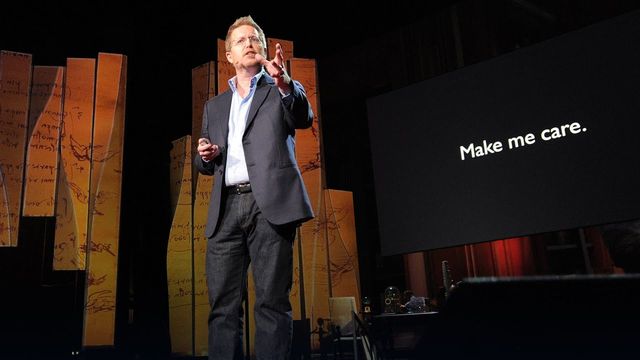
The main point, which I emphasize in the video, is that the first commandment of storytelling is to make us care.42Make us care — Andrew Stanton called "make me care" storytelling's greatest commandment in his TED talk "The Clues to a Great Story" (2012). You have to make your audience care about your lead character, and then you have to make them care about the story itself.
Imagine you’re sitting at a bar with friends. You might say, “Oh my God, I have to tell you a story about what happened to me yesterday. I was doing X, Y, and Z when I encountered problem Q, which was totally unforeseen. If I didn’t fix Q, then X or P would happen.” So, you tried to fix Q, but then unexpectedly, another crazy thing happened, and you found yourself even deeper in trouble than you were at the start. Things just kept getting worse and worse.
All you’re doing there is establishing a sympathetic character who has a problem they’re trying to fix, and then introducing all these unforeseen complications. You want to pull the thread of engagement forward with your audience, making them wonder what happens next.
Perhaps the character was just trying to go to the airport to pick up his girlfriend. That was his goal. Then he got carjacked in Brooklyn. But he still needs to meet his girlfriend and her parents, otherwise he won’t get married, and he’s screwed.
One thing you hear in bar stories that you don’t see as much in movies is when people tell you the end, or the climax, right at the beginning. For example, “This actually happened to me: I once pissed my pants on the Giant Dipper43Giant Dipper — a wooden roller coaster built in 1924 at the Santa Cruz Beach Boardwalk amusement park in California. The Giant Dipper wooden roller coaster (1924) in Santa Cruz. roller coaster in Santa Cruz.”
Brutal.
I was sitting next to a stranger at summer camp. You want to hear that story, right? You hear that all the time at a bar, but you don’t see that as much in movies. Here’s why.
In a bar, you don’t have a captive audience; they can always get up, walk away, and get a drink. The audience in a theater, however, has made a deal with you. They’re going to sit there, and you have the first 10 minutes to make them care about the story.
I believe the first 10 minutes of a screenplay are the most liberated time in your story because your main narrative hasn’t fully kicked in yet. Your audience will generally go along with almost anything you do in the initial five or ten minutes of a movie. In fact, I think it’s a mistake to start your story too quickly during this period. The real work then is to get your audience to buy into the world you’re writing and to like the character you’re introducing.
Speaking of roller coasters, can you give me your roller coaster analogy?
Yes, this is an analogy I developed as a script reader. A story is like a roller coaster. You put your lead character into the car and send them up the big hill. As it ticks upwards, you’re building narrative energy and latent emotional energy, stacking the deck with whatever the character wants and is passionate about.
When you reach the top and come over the hill, the rest of the story stretches out in front of you. That’s the first act break, when you start the descent and go through all the twists and turns of the story.
What makes this analogy work is that the first thing you must do as a storyteller is get your audience into the roller coaster car with your hero. You need them to be so connected that they’re sitting right next to the hero. This way, when you go down the big hill, or through the loops, they’re right there with them.
There’s a big difference between standing on the ground in an amusement park and watching someone else ride a roller coaster. It might be thrilling for them, but it’s not thrilling for you. You’re just watching from a distance.
Audiences automatically have a defensive barrier. They’re thinking, “I’ve seen countless movies and countless heroes. Make me like this guy.” So, you have to actively take steps. Your hero needs to do or say something that makes your audience think, “Oh my God, I love this person. This person is cool! I want to find out what happens next.”
A mistake I repeatedly saw in the scripts I read was presuming audience sympathy for the hero. Writers would think, “We all love our heroes. We wouldn’t write the story if we didn’t love this hero, right?”
As a writer, the most important thing—and this is easy to miss because you automatically love your own hero—is to find a way to make your audience sit up, take notice, and realize, “This character is different, not only from anyone I’ve met, but from any other character I’ve seen on screen.” That will significantly help get them into the roller coaster car, so they’re with your hero for the rest of the story.
07Groundhog Day, "war movies" and "therapy movies"
Arndt divides stories into two poles: conflict inside the hero and conflict in the outside world.
Who’s a hero from a story that you particularly admire? Not in the sense of personal affection, but where you feel the writer or creators of that story just absolutely nailed the character.
Phil Connors44Phil Connors — Bill Murray's character in Harold Ramis's Groundhog Day (1993): a self-absorbed Pittsburgh weatherman sent to cover the holiday in Punxsutawney, who dreams of moving to a national network. in Groundhog Day is a brilliant screenplay, a character who starts off as a shallow jerk. You like him because Bill Murray is so funny and engaging. He’s a man always living in the future.
He hates his present life, constantly thinking about moving on, perhaps to a network job. What do you do with a character like that? You trap them in the present, forcing them to live the same day over and over again.
One of the brilliant aspects of Groundhog Day is its second act problem: he’s trapped in the same day, unsure how to escape. The film never explains the rules. As an audience, you’re with him, wondering how he will get out of this, how he will resolve it.
Then, at the midpoint, he falls in love with Andie MacDowell,45Andie MacDowell played TV producer Rita in Groundhog Day; Arndt refers to the character by the actress's name. leading you to believe that true love will save the day. He works on this problem, trying to make Andie MacDowell fall in love with him. By the end of the second act, he succeeds; she loves him.
We’ve all been trained by movies to expect true love to triumph. Yet, he wakes up the next day to the same reality, and she’s forgotten everything.
Is it too far to say the lesson is that a character has to have some kind of unique characteristic? Perhaps “has to” is too strong. Instead, a character often has something about them that keeps them stuck. You push them to the wall, forcing them to confront that value or trope. Then they either need to change or lean into it; that’s the conflict.
I divide stories into two, or perhaps three, categories: the “war movie” and the “therapy movie.”
Finding Nemo is a perfect example of a “therapy movie.” In the opening prologue,46The prologue of Finding Nemo — the clownfish Marlin and his wife Coral are attacked by a barracuda: Coral and nearly all their eggs die, and a single egg survives, from which Nemo will hatch. At the start of the scene, Marlin and Coral peer into the hollow where their eggs lie.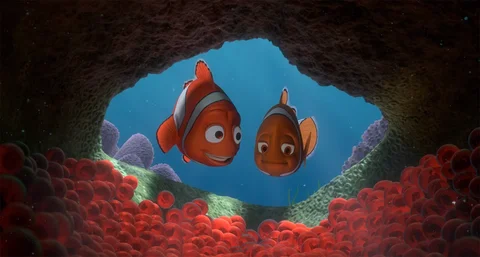 the main character suffers a trauma. Traumatized, he decides to protect his son at all costs to be a good dad. He vows, “I promise nothing bad will ever happen to you.” For that character, the worst possible thing happens: his son gets taken.
His son swims away, says, “I hate you, Dad,” and is taken. Now, the father must not only rescue his son to save his life but also win back his son’s love and respect. During that second act journey, he must confront his bias towards safety. In the third act, he has to let his son go, allowing him to be independent.
The whole movie follows Marlin’s internal drama as he deals with trauma in an unhealthy way. It’s a “therapy movie” where he learns to overcome his trauma and heal his inner wound. I call it a “therapy movie” because all the conflict in the story happens within the main character. The opposite of that...
I’ll pitch you a hypothetical story.
This is the “war movie” now.
This is the “war movie” scenario. Imagine a 12-year-old girl living in the Warsaw Ghetto. The Nazis kill everyone she knows—family, friends, everyone—then put her on a train to Auschwitz. She goes into the showers,47The showers — at Auschwitz the gas chambers were disguised as showers so that the doomed would go in without resisting. and inexplicably, she survives.
There are historical examples of a few people surviving this. Someone smuggles her out of the camp, intending to keep her safe and warm, to live out her life securely. She responds, “No. This world is so messed up. I’m going to Berlin. I’m going to find Hitler’s bunker. I’m going to kill Hitler.”
That’s a powerful motivation. You have a totally unjust world, a character who has been unjustly acted upon, and a very clear goal: to make things right. She is the antidote to whatever is poisoning the world. It’s a great second act goal because she doesn’t even know where Hitler is; he’s somewhere in Berlin.
Her goal is to go to Berlin, find his bunker, infiltrate it, and kill Hitler. That character has no internal drama. They don’t need to become a better person or fix themselves. The conflict, the problem in the story, is in the outside world. The drama is simply trying to fix what’s wrong with the world.
That’s an extreme example where the character doesn’t need to be complicated at all. All she’s doing is trying to kill Hitler, and we can all root for that. But it’s very different from Marlin in Finding Nemo, whose conflict is internal.
I’d say Casablanca represents a middle ground. You have Nazis and World War II, but Rick also has a flaw48Rick Blaine — Humphrey Bogart's character in Casablanca (1942): a cynical nightclub owner who says "I stick my neck out for nobody" and in the end gives up love to fight the Nazis. inside him that he must fix at the end.
08Stakes and a patient setup
The stakes should be raised to global ones, and there's no rush to get to the inciting incident.
If I gave you a story that lacked those external stakes, how would you coach me to add them back in?
It’s interesting how often you set up a story with a personal, external set of stakes. For example, in Toy Story 5,49Toy Story 5 came out in June 2026; the film's main antagonist is a kids' tablet called Lilypad. which I helped develop, the initial concept was that Jessie lives in Bonnie’s room,50Jessie — the toy cowgirl who first appeared in Toy Story 2 (1999); in Toy Story 3 she ends up with Bonnie along with Andy's other toys. playing with all the toys. Then a device comes in, and Bonnie stops playing with toys, only using her Lilypad. This creates a problem, but initially, it’s confined to Bonnie’s room.
Jessie goes next door, sees kids playing on a device, and wonders what they’re doing. Another discarded toy tells her, “Don’t you know? The age of toys is over. Kids don’t play with toys anymore. It’s an extinction-level event; the gadgets have taken over.”
Jessie replies, “No, I don’t believe you. I don’t believe that’s true.”
He tells her, “Go up on the roof and take a look.” She climbs onto the roof and looks down at the neighborhood. Every house has a blue glowing light, indicating a child on a device. Then she spots Bonnie’s room, which has an orange light, and Bonnie is still playing with her toys.
This moment elevates the stakes from Bonnie’s room to a global crisis. If you’re going to solve this problem, you can’t just do it for your individual hero; you have to solve it for the entire universe you’ve created.
Earlier, you mentioned an implicit contract in movies: that the audience would give you about ten minutes. Is that still true in the age of Netflix? And have streaming services changed how movies need to be made?
I’ve heard stories about Netflix, though I haven’t worked with them directly. The advice often is that you need to kick off your story with action as quickly as possible and constantly remind the audience what the movie’s about, assuming they’ll be distracted by other screens. That’s not the business I’m in; I focus on telling a good story.
I recently saw a YouTube video where someone advised getting to your inciting incident and kicking off your story as quickly as possible. I believe that’s absolutely the wrong and terrible advice, yet it’s a note I hear repeatedly: “Get your story started; set your plot in motion as quickly as possible so your audience will care.” The underlying message is to make your audience care about your hero.
Many great movies spend 20 to 25 minutes allowing the audience to learn about the hero, their world, and their desires. The inciting incident might not occur until about 25 minutes into the story. The hero might even dither before the first act break comes around page 30,51Page 30 — under the Hollywood formatting standard, one script page is roughly one minute of screen time, which is why Arndt moves freely between minutes and pages. creating a very short period between the inciting incident and the act break. This investment ensures that when the inciting incident turns the hero’s world upside down, the audience genuinely cares about what happens next.
I believe that person was mistaking creating action for truly engaging the audience with a character. Take Tootsie,52Tootsie (1982) — Sydney Pollack's comedy: an unemployed actor, Michael Dorsey (Dustin Hoffman), dresses as a woman and lands a role on a soap opera. The agent who tells him no one will hire him is played by Pollack himself. for example. The inciting incident occurs 20 to 25 minutes into the film. The character is a New York actor who doesn’t aspire to be rich or famous; he simply wants to be a working actor in New York.
So, what’s the worst possible thing for him? His agent tells him, “No one will hire you. You’re out. You’re too much of a pain in the ass. Your dream of being an actor is over, regardless of whether you want to be rich and famous.” Only four minutes later, he decides to get hired by putting on a dress and a wig, thus beginning his second act as an actor.
Many people believe you need to start your story immediately, but I think that’s a mistake. If you’re playing the long game, aiming for your story to be remembered and rewatched for years, then you must tell a truly great story.
A truly great story makes your audience care by building a world and characters with enough specificity. This ensures that when a problem is introduced—like Andy going to college—it hits the audience on a visceral level, making them deeply care about what happens to these toys. The charm and beauty of great storytelling often lies in those opening ten minutes, where the audience is unsure what the story is about or what’s going on, asking questions that aren’t immediately answered.
09Meaning and three kinds of stakes
The more meaning a story has, the longer it's remembered, and an "insanely great ending" flips all three kinds of stakes at once.
Are there other tropes, common ways of thinking in Hollywood, that...
You lob the softball across the plate, and I’m going to go for it. It drives me crazy when people say, “I’m just trying to create entertainment,” or “I’m just trying to make an entertaining movie.” I believe stories, in essence, must have some meaning. The more meaning you can put into your story, the more relevant it will be, and the more people will remember it.
There are a couple of ways you can create a meaningful story. First, there’s what we’ve called the therapy model. Here, a trauma occurs, you respond in an unhealthy way, and the rest of the story is about overcoming that unhealthy response. It’s essentially Psychoanalysis 101.
Another way to create meaning, which I discuss in my video on endings, is by establishing two competing value systems. These are usually not equally weighted. Typically, you have a dominant value system in your story and an underdog set of values.
Take Little Miss Sunshine, for instance. This is why I wanted to write it. We live in a culture that views life as a competition, where everything is divided into winners and losers. The ultimate goal is to be a winner and avoid being a loser.
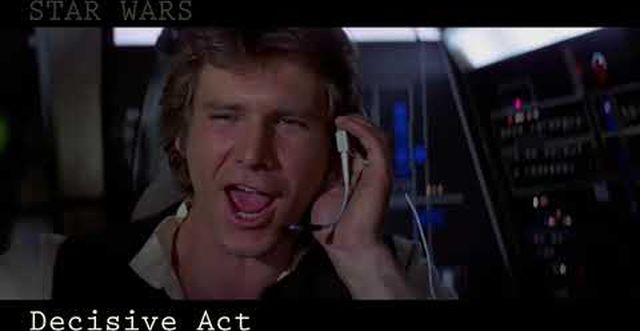
Often in a story, you’re sending two trains at each other, or rather, two competing value systems that will collide at your story’s climax. My video on endings explores this: if you want to create maximum emotion and meaning at your story’s conclusion, you want your hero to appear defeated — externally, internally, emotionally, and philosophically.
That’s a crucial element. You want it to seem like the villain was right, that “greed is good,” or “might makes right.” I always love the moment in a movie where the villain turns to the hero and says, “Listen, I’m sorry to burst your bubble. I’m not a bad guy. This is just the way the world works. Grow up.”
If you can flip things at the last moment—and it gets very complicated here—so that you transition from external, internal, and philosophical failure to external, internal, and philosophical success in 45 seconds or less, then that’s what I call an insanely great ending.53Insanely great — a favorite phrase of Steve Jobs, who used it in 1984 about the first Macintosh. "Endings: The Good, the Bad, and the Insanely Great" is the title of Arndt's video lecture on endings.
Okay, please define those: internal, external, and philosophical. Am I correct that the flip, from failure to success, should happen as concurrently as possible?
Yes. I’ll try to make this brief. Your external stakes are anything outside your hero, in the world. You might want to rob a bank, get a million dollars, or blow up a bridge—something in the outside world. The crucial thing is that it’s usually a binary, pass-fail situation. You’ll either blow up the bridge or you won’t. You’ll either get a million dollars or you won’t.
You’re either going to kill Hitler or you’re not.
You have a very clearly defined goal. To end the war, you must kill Hitler. So your long-term goal is to end the war, and your short-term plan is to find and kill him.
Internal stakes are the emotional stakes of your story. These can involve romantic love, parent-child love, or... In Rocky,54Rocky (1976) — John G. Avildsen's film written by Sylvester Stallone, who also played the lead: a down-and-out Philadelphia boxer gets a shot at the heavyweight champion. Before the fight Rocky says he only wants to go the distance and prove he isn't just another bum from the neighborhood. for example, he’s trying to win back his own self-respect. He considers himself a bum in the neighborhood. You see this in On the Waterfront55On the Waterfront (1954) — Elia Kazan's drama. Marlon Brando plays former boxer Terry Malloy; his speech with the line "I coulda been a contender" is one of the most famous in film history. too, where Terry Malloy laments, “I could have been a contender.” He’s losing his own self-respect, and in the story’s climax, he regains it.
Then there are the philosophical stakes, which many films and stories don’t articulate as clearly as they could. Often, meaning is created by pitting two competing value systems against each other. It seems as though the dominant values will prevail, and the underdog values will be wiped out. The trick of a good ending, then, is to have the underdog values ultimately prevail.
10Restraint, the Oscar and the bus
An emotion has to be earned through restraint, and Arndt takes his best details from his own life.
I’m trying to frame this question. If you want people to feel emotions—to laugh, to cry, whatever it is—what’s the line between being too desperate, becoming annoyingly sentimental, and simply trusting that the emotion will naturally emerge?
You really have to earn it.
I noticed that with Little Miss Sunshine. It’s funny in very subtle ways. I’d be laughing, but no one else was, because it’s a quiet, funny thing happening. It has a subtle humor.
It’s a tricky thing. The most deadly aspect of a bad screenplay is that it feels contrived; you know exactly where it’s going. The main thing is not to oversell the humor or the emotion. Much of it comes down to restraint.
I remember writing the scene in Little Miss Sunshine where Dwayne has his freak out.56Dwayne (Paul Dano), Olive's brother, has taken a vow of silence until he becomes a fighter pilot; on the road he learns he is colorblind and can never fly. He gets out of the van, runs down the hill, turns to his family, and shouts, “I hate you people! You’re all fucking losers! I’m not getting back in that van again! Mom, just leave me here. I don’t want to be your family anymore!”
As a writer, you paint yourself into a corner, thinking, “Oh, God, how am I going to get out of this?” I knew Olive57Olive (Abigail Breslin) — the Hoovers' younger daughter, who dreams of winning the Little Miss Sunshine pageant; Breslin was nominated for an Oscar for the role. had to be the one to walk down the hill and convince him to get back in the van and go with them. I wrote the scene, wondering, “What does Olive say to Dwayne?” Then I realized the best thing was for her to say nothing at all.
All right, you have to tell me: what is it like to win an Oscar?
It’s terrifying. You feel like if you say or do something stupid, that’s all you’ll be remembered for.
I know a guy at Pixar, Gary Rydstrom,58Gary Rydstrom — sound designer and winner of seven Oscars for sound and sound effects on Terminator 2, Jurassic Park, Titanic and Saving Private Ryan. a sound engineer who worked with Spielberg and James Cameron. He’s won seven Oscars. He told me once, “Every single time they open the envelope, I think, ‘Oh God, not me!’” Because then you have to get up on stage. I’m a writer, not an actor. I don’t want to be in front of the camera. So you’re just thinking, “Don’t mess up, don’t mess up!” the whole time you’re walking up the stage. I had really memorized my speech because I didn’t want to mess up.
When you’re nominated, they drill it into your head: you get 45 seconds,5945 seconds — the time the Academy gives a winner for an acceptance speech; when it runs out, the orchestra starts playing over the speaker. that’s it. They’ll cut you off after 45 seconds. So write down a speech and memorize it. I wrote my speech, and every day for a month, as I drove into Pixar for work, I recited it over and over. When I finally got on stage, bombs could have been going off in the theater, and I would have just kept going because I had completely memorized it.
I like the way you talk about your dad, with his spirit.
Yeah. My dad — the whole thing of pushing the bus to get it started, that came from my dad. That came from our real life. We had a VW bus60The yellow Volkswagen — in the film the bus's clutch breaks, so the family has to push-start it and jump in while it's moving; later its horn gets stuck too. The Volkswagen bus from Little Miss Sunshine at the Petersen Automotive Museum. when I was a kid, and we were all up in Maine, and the clutch broke, and somebody told my dad… And my dad was like, “I need to be at work on Monday morning.”
You can go from third to fourth without a clutch, but you need to start up in third gear. The only way to start in third gear is to push the bus. My dad would say, “Kids, get in the car!”
That’s the best part of writing: finding those things that happen to you in real life. Someone once joked that writing is taking the most painful, personal, humiliating moments of your life and turning them into money. While that’s not quite what I did, the essential insight is to take these experiences.
For example, the horn on our VW bus used to get stuck. It was very embarrassing to drive around our hometown with a stuck horn. You put all that into a movie, and people recognize it, even if they haven’t literally experienced it themselves.
As you’re writing a movie like that, did you feel like, “Wow, I really got something here,” or was it different?
It actually was exactly like that. I had written five other scripts before, and my problem was two-fold: First, I was making imitation movies, not setting those stories in the actual real world. Second, I started with plot rather than characters. Little Miss Sunshine was the first time I began with characters instead of plot.
My fear before I started writing it was that it was such a slight story, so small—just a road trip. I thought, “Oh, I’m going to write a 65-page script; it’s going to be too short.” But having that slight story allowed the characters to just talk. Once they started talking to each other, I realized it was working. I could tell it was working. About halfway through, I called my brother and told him, “This is it. I’m writing the script that’s really going to work.”
11Writing as a form of thinking
Writing is a form of thinking, and the meaning of your own story sometimes arrives only after the premiere.
What did you learn about writing from your brother? He just released a new book on the subject.
Yes, thank you for mentioning that. That was not a subtle nudge for a plug at all. I was actually thinking yesterday, as I prepared for this podcast, “I wish I had something profound to say about the act of writing itself and how it fits into one’s life.” Then it occurred to me that my brother is a professor of literature and philosophy, and he wrote a book called The Philosophy of Writing.61David Arndt — Michael's twin brother, who teaches at Saint Mary's College of California. His book Philosophy of Writing came out in 2026 from Bloomsbury Academic, with the e-book in open access.
If you look back at Marcus Aurelius62Marcus Aurelius — Stoic Roman emperor who reigned from 161 to 180. His Meditations, titled in Greek "to himself," are notes he kept for his own use, partly on military campaigns, and never meant for publication. or Montaigne,63Michel de Montaigne (1533–1592) — French philosopher whose Essays (1580) gave the genre its name: French essai means "attempt, trial." In his note to the reader Montaigne says that he himself is the subject of his book. they wrote to understand themselves. That’s the origin of Montaigne’s essays and Marcus Aurelius’s Meditations. My brother’s basic point is that writing is a form of thinking. It’s a way of reflecting on yourself, figuring out who you are and what you want to be.
He talks about the act of writing as a daily practice, a meditation on who you are and what you like. It’s an investigation into what you truly think. Reading his book changed my perspective on writing. I used to think you sit around, wait for an idea to come, and then write it down. His perspective is that the act of writing itself generates ideas and helps you figure out...
...who you are, and also helps you figure out what you’re doing. As you were talking earlier, you figure out the one-liner for the story64Logline (one-liner) — the essence of a story in a sentence or two: who the hero is, what they want and what stands in their way. while writing, but you don’t always know what you’re writing at the beginning.
At the beginning of Little Miss Sunshine, I thought the Obi-Wan figure,65Obi-Wan Kenobi — the wise Jedi mentor of Luke Skywalker in Star Wars, whose name has become shorthand for a mentor figure. the mentor, would be Uncle Frank.66Uncle Frank (Steve Carell) — a Proust scholar who moves in with his sister's family after a suicide attempt. Richard (Greg Kinnear), the father, is a would-be motivational speaker who divides the world into winners and losers. I also thought it was a competition between Grandpa and Richard, played by Greg Kinnear, and Steve Carell’s Uncle Frank. Then I realized that wasn’t it at all. Grandpa is actually the Obi-Wan Kenobi figure.67Grandpa Edwin — played by Alan Arkin, who won the Oscar for Best Supporting Actor for the role.
I only figured that out about a year after the film came out. You often don’t really know the meaning of the story you’re writing until a year or two after the movie is released, and then you think, “Oh, that’s what it means!” That was a good example of me following my gut instinct and having things inexplicably turn out well.
12AI and cheap filmmaking
Unlike many in Hollywood, Arndt expects freedom from AI rather than disaster: films will get cheaper and directors more numerous.
How will AI change storytelling?
My practical answer is this: currently, a low-budget film is circumscribed in time and space, especially space. A typical low-budget film is limited to two or three characters and one location because the budget doesn’t allow for more. Even at Pixar, I once thought, “It’s computer-generated; we can do anything!” But they explained that every location in a movie must be built, which costs money. Therefore, fewer locations mean a cheaper production. Filmmakers constantly try to limit them.
I read about Doug Liman68Doug Liman — American director of The Bourne Identity (2002), Mr. & Mrs. Smith (2005) and Edge of Tomorrow (2014).’s new film, Killing Satoshi,69Killing Satoshi — Doug Liman's film about the hunt for the creator of Bitcoin, starring Casey Affleck and Pete Davidson. There were no location shoots or sets: the actors were filmed on a stage, and the backgrounds are generated with AI. which they shot in just 20 days on what’s called a “gray stage.” Actors perform on a gray stage, and the camera captures their performance. The lighting, backgrounds, and other elements are filled in later. One reason they used this method was because the film had 150 different locations.
Making a movie with 150 practical locations would be incredibly expensive. AI will change storytelling by allowing filmmakers to hopscotch through time and space very quickly, liberating them from financial constraints. Quentin Tarantino wrote Reservoir Dogs about a group of guys in a warehouse dealing with the aftermath of a bank robbery.70Fact-checkArndt says bank robbery, but in Reservoir Dogs (1992) the heist is of a jewelry store, a diamond wholesaler (Wikipedia, "Reservoir Dogs"). I wrote Little Miss Sunshine with the first act at a dinner table and the second act in a VW bus. The budget increased in the third act, but it was essentially three locations.
Now, it’s interesting that you’ll be able to create something like Alice in Wonderland with a new location in every scene. This frees up low-budget filmmakers to do anything they want. It will allow background visual effects to be iterated and produced very quickly and cheaply.
When I talk to people from Hollywood, they seem so pessimistic and scared about AI. You’re not. What accounts for the difference? What are you seeing that Hollywood isn’t seeing?
I believe AI will significantly reduce costs. Films are now so expensive. We spend 90% of our time chasing a “green light” from financers. Many films don’t get made because they are too expensive.
Sources: Animation Magazine, Box Office Mojo, Variety on Inside Out 2 and Toy Story 5
I won’t adjudicate the legal or labor issues. However, the animated film Flow,71Flow (Straume, 2024) — a feature by Latvian director Gints Zilbalodis, winner of the 2025 Oscar for Best Animated Feature. Its budget was about €3.5 million. which won an Oscar two years ago, was made in Latvia with a budget of about three and a half million dollars. It was an unusual story about a dog and a cat on a raft in a flooded world. Pixar films, for comparison, cost $200-$250 million.
If costs can be reduced, consider the many aspiring directors at Pixar. With a $250 million movie, only one person gets to direct, and everyone else works on it. If the cost is cut by 99%, making an animated feature $2.5 million, you create 100 times as many directing jobs. Every struggling story artist72Story artist — an artist in the story department who draws storyboards for scenes. Pixar directors who came out of that department include Domee Shi (Turning Red) and Enrico Casarosa (Luca). with an idea can now step up and become a director.
Perhaps many of those films won’t be great, but audiences are thirsty for authenticity. They want to hear authentic human voices and see real people on screen. Ultimately, it will bring the cost down. Beyond legal and labor issues, if you look 5, 10, or 15 years ahead, such a dramatic reduction in filmmaking costs will lead to an abundance of films and creative freedom.
13Lessons from Japanese cinema
My Neighbors the Yamadas convinced Arndt that every family has a story, and Ozu and Miyazaki teach gentleness.
What did you learn from the movie My Neighbors the Yamadas?73My Neighbors the Yamadas (1999) — Isao Takahata's Studio Ghibli film based on Hisaichi Ishii's newspaper comic strips: short scenes from the life of an ordinary family, drawn in the style of a watercolor sketch. It was a box-office disappointment.
That’s a great question. I had the idea for Little Miss Sunshine in my head for a long time, but I hesitated to write it because it felt so uncommercial. It was an ensemble picture about a family in a child beauty pageant—the least commercial idea imaginable. If I pitched that to Warner Brothers, they would have laughed me out of the office.
I had a bunch of other ideas. I quit my job, choosing to spend a year writing. I had saved up money working as an assistant on Godzilla,74Godzilla (1998) — Roland Emmerich's film, starring Matthew Broderick, for whom Arndt worked as an assistant. which I used to fund that year of writing. I wrote a bunch of other scripts first, and when I ran out of ideas, the child beauty pageant concept was still in my head, but I was hesitating.
Then, in the summer of 2000, the Museum of Modern Art held a Studio Ghibli75Studio Ghibli — the Japanese animation studio founded in 1985 by Hayao Miyazaki, Isao Takahata and producer Toshio Suzuki. retrospective. I went and saw Totoro76My Neighbor Totoro (1988) — Hayao Miyazaki's film about two sisters who move to the countryside with their father and meet the forest spirit Totoro. In Japanese theaters it played as a double bill with Takahata's Grave of the Fireflies. for the first time. I saw a double feature of Totoro and My Neighbors the Yamadas, two of my favorite films of all time. What resonated was that My Neighbors the Yamadas is simply about a typical Japanese family. They aren’t special.
But it’s done with so much humor, warmth, and empathy that I realized every family has a story. Every family has many great, entertaining, and engaging moments. I thought, “This will be funny. I can write a family comedy about this.” And I did. I wouldn’t have done it without Isao Takahata77Isao Takahata (1935–2018) — Japanese animation director and Ghibli co-founder: Grave of the Fireflies, My Neighbors the Yamadas, The Tale of the Princess Kaguya. and My Neighbors the Yamadas.
You talk about My Neighbors the Yamadas. You talk about Late Spring.78Late Spring (1949) — Yasujirō Ozu's film: a widowed professor (Chishū Ryū) pretends he is about to remarry so that his daughter (Setsuko Hara) will agree to marry and leave him. It ends with the father alone in the empty house, peeling an apple and silently bowing his head. What should storytellers in America be learning from Japanese films?
That’s an interesting question. What’s interesting to me, and it somewhat contradicts my videos about screenwriting, which focus on hooking your audience, making things happen, fostering care, and creating propulsive story momentum, is the other side of storytelling. This is what I love about Ozu79Yasujirō Ozu (1903–1963) — Japanese director of unhurried family dramas (Late Spring, Tokyo Story), famous for a static camera placed at the eye level of a person sitting on a tatami mat. and Miyazaki: the gentleness of their narratives.
I recently rewatched the opening act of Totoro, and almost nothing happens. Two little girls move into a house in the country. They open all the shutters, see dust bunnies scurrying around,80Dust bunnies — in the film these are susuwatari ("wandering soot"), fluffy black soot sprites that live in empty houses. and meet the neighbors. In terms of actual storytelling, very little plot development occurs.
In Western storytelling, there’s often a competition of selfishness. Characters declare, “I want this, but I want that,” leading to a struggle to see who gets what they desire. It becomes an ego competition. This dynamic is present in romances or friendships, where the relationship is put at stake due to competing selfish interests.
This contrasts with a film like Late Spring. The daughter lives with her father, and at a certain point, an aunt arrives, telling the dad he’s selfish for keeping his daughter at home. While she looks after him and expresses her love, the aunt insists the daughter needs to live her own life. The aunt argues that he’s being selfish by letting her stay and that he should get her married so she can forge her own path.
He then approaches his daughter, suggesting she should get married. She replies, “No, I’m so happy here with you. I couldn’t be happier; I’m just going to stay. That’s all I want to do with my life.” She is being selfless, wanting to stay and care for him as he gets older. He, in turn, is also being selfless, insisting she needs to start her own life.
The brilliance of Late Spring lies in its ending — one of the greatest and most heartbreaking of all time. The final closing scene is incredibly quiet; it’s not a big bang.
What we learn from this is, first, that you can keep an audience hooked on just the faintest wisp of a story. Second, and often, these characters exemplify what you see in Shakespeare, too, as with Lear and Gloucester.81Fact-checkArndt says Gloucester, but in Shakespeare it's the Earl of Kent who does this: Lear banishes him for defending Cordelia, and Kent returns to the king in disguise to serve him (Shakespeare, King Lear, Act I, Scenes 1 and 4). Gloucester says, “Sir, I want to stay with you and serve you,” and Lear responds, “No, go away.” Gloucester then has to disguise himself. It’s an inversion of the Western model, where you have competing selflessness.
14The script doctor at work
Arndt starts on someone else's script by asking what's at stake and then sharpens the tentpole moments where the story turns.
How do you study a story?
I started as a script reader and read countless stories. When you encounter a story or script that doesn’t work, it’s easy to feel confused and think, “I don’t know how to make this better.”
You can also be very superficial, saying things like, “I didn’t care about your lead character” or “I lost interest.” These are all superficial critiques. What I learned to do as a script reader, and subsequently as a script doctor...
That’s good.
Yes, that’s what they’re called.
Tagline.
Michael Arndt, the script doctor.
I’m not the first to say this; people use that line all the time. When you come to me with a script, I feel like a story mechanic. I put the whole thing up on blocks, open the hood, and look at the engine.
There are a couple of key questions to ask yourself. First, what is at stake in this story? Breaking it down, I find it useful to consider not only what’s externally at stake—like blowing up the bridge on the River Kwai82The Bridge on the River Kwai (1957), directed by David Lean, and The Guns of Navarone (1961), directed by J. Lee Thompson — World War II films: the heroes of the first must blow up a railway bridge, those of the second destroy coastal guns. or taking out the guns of Navarone—but also what’s internally at stake. In Finding Nemo, it’s not just Marlin saving Nemo’s life; it’s also about winning his son’s love and respect back, which is arguably even more important.
Then, ask what’s philosophically at stake in the story. This truly helps sharpen its meaning and makes the ending more emotional and powerful. If you can identify these points of stake in your story, it greatly clarifies what your story is truly about.
You don’t have to approach it this way, but as a thought exercise to anchor your story, go to the end and ask: what is the worst possible thing that could happen across all three sets of stakes? Let’s use Finding Nemo. Externally, the worst thing that could happen is Nemo gets killed, despite Marlin’s promise to always take care of him.
Emotionally, the worst outcome is that he never wins his son’s love and respect back. He saves Nemo, but his son rejects him, saying, “You ruined my life.” Philosophically, Marlin remains an overprotective parent, never granting Nemo independence, keeping him under his thumb.
You could even have an interesting bad ending for Finding Nemo where Marlin succeeds externally in saving Nemo’s life, but fails philosophically by remaining overprotective, and thus fails emotionally by not winning his son’s love and respect. Often, one of the best ways to pinpoint what’s truly important in your story is to ask: what’s the worst possible thing that could happen externally, internally, and philosophically?
Frequently, you’re trying to make all these worst-case scenarios converge simultaneously, creating a true low moment. The magic of storytelling is then to turn everything around, moving from the worst possible situation to the best in 45 seconds or less. That’s what my video about endings covers.
Now, for the second part of your question: what else do I look at? I’m a big believer in the organic logic of storytelling, a concept screenwriter David Magee pointed out to me. He explained that in screenwriting, we have a specific vocabulary. Your opening introduces the hero and their world, establishing a stable sense of self, a stable sense of the world, and fixed expectations for the future.
The inciting incident then disrupts all of these: the future, your sense of self, and your sense of the world. Consider Hamlet. We meet him dissatisfied, feeling Denmark is a prison,83"Denmark's a prison" — Hamlet's words in his conversation with Rosencrantz and Guildenstern (Act II, Scene 2). upset his father died and his mother moved on. He wonders, “What can I do about it?”
The inciting incident is the appearance of his father’s ghost, who reveals, “I didn’t just die; I was murdered. Now you must avenge my death.” After the inciting incident, the hero often feels lost. They’re unsure whether to pursue a goal or, if so, how to achieve it.
Hamlet questions, “Maybe this is a demon tempting me. Perhaps Claudius is innocent. I need to confirm his guilt before I act, but how?” It’s when the players arrive at Elsinore Castle that Hamlet realizes his plan. His long-term goal is to avenge his father’s death. His short-term plan: stage a play reenacting the murder84The play — Hamlet calls it The Mousetrap: The Murder of Gonzago, performed by traveling players before King Claudius, his uncle and his father's murderer (Act III, Scene 2). Agatha Christie's The Mousetrap, the world's longest-running play, takes its title from it. and observe Claudius’s reaction; he’ll know then.
ExplainerThe story spine
The Story Spine was invented by improviser Kenn Adams as an exercise for actors to make up a coherent plot on the fly. In 2011 Pixar story artist Emma Coats spread it across the internet by including it in her "22 rules of storytelling." Each link is one of the tentpole moments Arndt talks about:
- Once upon a time… — the hero and their world;
- Every day… — ordinary life and fixed expectations for the future;
- But one day… — the inciting incident;
- Because of that… Because of that… — the second act as a chain of cause and effect: each step follows from the previous one rather than merely after it;
- Until finally… — the climax;
- And ever since then… — the new equilibrium.
Take Finding Nemo: once upon a time there was a clownfish, Marlin, who lost his wife and almost all his offspring; every day he fretted over his only son; but one day Nemo, defying his father, swam out to a boat and was caught by a diver; because of that Marlin set off across the ocean to Sydney; until finally he found his son and let him take his own risk, saving fish from a net; and ever since then he lets him go without fear.
The vocabulary we use in storytelling mirrors the classic language of fairy tales.85The language of fairy tales — a similar template, the Story Spine ("Once upon a time… Every day… But one day… Because of that… Until finally…"), was devised by improviser Kenn Adams; Pixar story artist Emma Coats made it famous by including it in her "22 rules of storytelling" (2011). Your opening is “Once upon a time, there was a person, a place, a daily routine, and fixed expectations for the future.” For example, “Once upon a time, a little girl lived in the French countryside. Every day she rode and fed her horse, dreaming of more. Then one day, someone or something arrived, opening up an opportunity.”
The vocabulary of fairy tales mirrors storytelling: your opening is “Once upon a time,” and “Then one day” is your inciting incident. “And therefore” marks the hero embarking upon a journey, much like Hamlet.
So the quest began.
Yes, “So the quest began” is your first act break. “Suddenly, without warning” is your midpoint; something unexpected happens. Your second act break is “And then there was no going back.”
It’s like the Death Star approaching the rebel base. They can no longer exist in equilibrium; one must survive, and the other must be destroyed. People often misunderstand the second act break. It’s not necessarily the worst possible thing happening to your hero.
Instead, the second act break forces the story’s stakes into an “all or nothing” situation. You’ll either achieve your goal—blowing up the bridge, winning the girl’s love, earning your dad’s respect—or you won’t. It’s a move “out of the frying pan, into the fire,” definitively raising the stakes. The climax is simply the resolution, and it doesn’t always have to be positive. I call it “all or nothing.”
Why do you call it that?
One of the problems in storytelling is having muddy and fuzzy stakes. For example, if your hero’s goal is simply to make the world a better place by spreading song everywhere, that’s a vague and muddy objective. There isn’t a binary pass/fail outcome.
Often, I focus on making the hero’s goal and their plan to achieve it super specific. When someone comes to me as a script doctor and asks how to improve a script, I examine all the pressure points in the story. These are the tentpole moments where the story’s direction changes.
Initially, your hero lives a life of unsteady equilibrium. Then, one day, the story’s direction changes, and your hero embarks on a quest. The direction changes again, perhaps with a midpoint reversal. I look at each of these tentpole moments to sharpen them and make them as distinct and powerful as possible. I’m a big believer in a clean trajectory from one tentpole moment to another.
15The hero's journey and advice for beginners
There are no shortcuts in the craft, and stories outlast cathedrals.
Is the hero’s journey overrated or underrated?
I’d say a little bit of both. There are countless stories and movies. A movie isn’t just an illustrated screenplay; it can be an experience and doesn’t always have to tell a story. Narrative can be a necessary evil to keep the audience engaged, but not all stories must follow that structure, nor do they all need to be a hero’s journey.86The hero's journey, or monomyth — the common pattern of hero myths described by Joseph Campbell in The Hero with a Thousand Faces (1949); Christopher Vogler popularized it in Hollywood.
I strongly believe not every hero has to be flawed. A hero can be essentially innocent, with the external world being flawed. The hero’s role is then to fix what is wrong with the world. This is evident in Star Wars; Luke is not a flawed character. The world itself is flawed, and he blows up the Death Star.
The hero’s journey is overrated if you think it’s the only type of story, but it’s underrated in terms of the power of its underlying principles, which speak to the organic logic of storytelling.
I might be wrong, but I feel that if you look at fairy tales and their vocabulary, stories are a way of thinking and making sense of our lives, especially when adjudicating meaning. They help us understand competing value systems and different visions of how we should live.
For instance, you can either be “the Dude” or “the Big Lebowski,”87The Dude and the Big Lebowski — characters in the Coen brothers' comedy The Big Lebowski (1998): an unemployed Los Angeles slacker, Jeff "the Dude" Lebowski (Jeff Bridges), is mistaken for his millionaire namesake. but you can’t be both. You have to decide: do you want to be the Big Lebowski, focused on achievement, making money, and winning respect? Or do you want to be the Dude, who floats through life, taking things as they come, but is also the kindest person in his universe precisely because he has no ambition?
Last question. I come to you and say, Michael, I want to be a writer.
We sit down, I buy you a cup of coffee. What do you tell me?
Go watch all my videos on YouTube.
I will say about your videos, if you enjoyed this and want to get really technical and in the weeds, or if you want to see charts, diagrams, and graphics, go watch Michael’s videos.
They’re all free. They’re the videos I wish I had when I started out.
The number one thing I would counsel is what I learned when I started writing. I made a commitment: if I was going to be a writer, I would probably write one screenplay a year. Assuming I’d live for 50 more years, that meant writing 50 screenplays.
When I began, I bought a book listing every major screenwriter and all their credits. What was great about that book was it showed not only their produced scripts but also their unproduced ones. It was amazing to see that someone like William Goldman,88William Goldman (1931–2018) — novelist and screenwriter, Oscar winner for Butch Cassidy and the Sundance Kid and All the President's Men; he adapted The Princess Bride from his own 1973 novel. His Hollywood memoir Adventures in the Screen Trade (1983) famously declares: "Nobody knows anything." who wrote Butch Cassidy and the Sundance Kid, All the President’s Men, and The Princess Bride—three absolute hall-of-famers—also had a list of about 15 scripts that were never made into movies.
I was at Eric Roth89Eric Roth — screenwriter, Oscar winner for Forrest Gump (1994); he also wrote The Curious Case of Benjamin Button, Dune (2021) and Killers of the Flower Moon.’s house. It was the same thing there. He wrote Benjamin Button and won the Oscar for Forrest Gump.
Forrest Gump.
I couldn’t believe how many unmade movies he had written.
The main thing is, realistically, I always thought I’d write 50 scripts in my life, and if I’m lucky, five of them would get made into movies. If I’m truly lucky, one of them would be a good movie.
This perspective is crucial. It’s similar to being a startup founder, where you might fail six out of seven times before finding success. It’s the same with screenwriting. For example, I wrote 11 scripts before selling my first one. Patience is crucial. Above all, you must be humble.
When Akira Kurosawa,90Akira Kurosawa received an honorary Oscar in 1990 from George Lucas and Steven Spielberg. In his speech he said he was a little worried, because he felt he did not yet understand cinema. who made countless incredible films, received an honorary Oscar late in his life, he famously said, “I don’t feel like I deserve this yet, because I’m only beginning to understand movies now.” If Kurosawa could be that humble about movies and storytelling, then we all should be.
As Billy Wilder once said about the audience: “Individually, they’re idiots. Collectively, they’re a genius.”91"Individually, they're idiots" — Arndt paraphrases Wilder in his own words. The line is usually quoted as: an audience is never wrong; an individual member may be an imbecile, but a thousand imbeciles together in the dark add up to critical genius. You must respect the audience’s collective genius. They are smarter than you, know more about storytelling than you, and will see through any tricks.
Good storytelling is incredibly difficult and takes a long time. I wrote 100 drafts of Little Miss Sunshine before it went into production.
My main advice is that it’s a lifelong commitment. It’s a craft you learn, like playing a musical instrument or becoming a chef. It’s a craft that typically takes about 10 years to master.
Additionally, remain humble. Storytelling is one of the most difficult yet important endeavors. Recognize that your pursuit is incredibly challenging, with many others striving for the same goal. It demands an almost masochistic level of humility, constantly asking yourself, “How can this be better? How can this be better?”
However, if you truly love stories and movies, it’s a passion worth pursuing—it certainly beats working for a living.
It’s truly amazing. Consider the Odyssey or The Epic of Gilgamesh.92The Epic of Gilgamesh — a Mesopotamian poem about the king of Uruk and one of the oldest works of literature. Sumerian poems about Gilgamesh were written down around the 21st century BC, and the standard Akkadian text on twelve tablets took shape by the end of the second millennium BC; its best copies were found in the library of the Assyrian king Ashurbanipal. Tablet XI of the Epic of Gilgamesh, with the flood story (7th century BC, British Museum). While we might know little else about those ancient cultures, their stories endure.
Their stories are the core. Stories have outlasted the oldest cathedrals. The Epic of Gilgamesh, for instance, is around 3,000 years old.
A good story lasts forever, an enduring monument. After cities are buried and pyramids have crumbled, Shakespeare will still resonate, even across the Crab Nebula.93The Crab Nebula — the remnant of a supernova observed in 1054, about 6,500 light-years away. Stories are the most enduring and important artifacts of human culture. They are how we make sense of our lives; the stories we tell about ourselves define who we are.
My brother, in his book, posits that we all live in darkness, unsure how to live or who we truly are. We grapple with fundamental questions about human nature: are we selfish or altruistic?
Stories provide a way to understand these questions. They are not ancillary to our existence; stories are our existence. They are how we make sense of ourselves in the world.
Stories are profoundly important. If you aspire to be a storyteller, I wish you well, but remember to be humble. It’s challenging; as I mentioned, I wrote 11 scripts before selling my first.
That’s excellent. It was great meeting you. Can you share details about your YouTube channel?
You can find my screenwriting videos by searching for ‘Michael Arndt screenwriting videos.’
I also have a website, Pandemonium Inc.,94Pandemonium — a word coined by John Milton in Paradise Lost (1667) for the capital of Hell, literally "place of all demons." It later came to mean "chaos, uproar." at PandemoniumInc.com. You’ll find my scripts and videos there. I’ve compiled a list of about 17 books that significantly influenced my worldview—my top recommendations for reading.
My website also features a mockup of my four-page outline, illustrating how I structure stories for any project. Additionally, you’ll find a mockup of the reader questionnaire I provide whenever I submit a script for feedback. So, beyond the videos, there are several screenwriting tools available on my website, PandemoniumInc.com.
Excellent.
Thanks, Michael. Thanks so much.


