

How I Write
Chapters
After his stroke Greene wrote The Law of the Sublime by hand, and to bring the book to life he had to live its subject himself.
Read the chapter- The book took about a hundred notebooks: Greene wrote each chapter by hand, copied it into a mirror notebook and back, dictated it through Wispr Flow, edited the printout by hand and did the final edit on the computer with one hand.
- He planned the book twenty years ago but only took it on after coming close to death, since so much of the sublime, he says, has to do with our awareness of dying.
- He could no longer travel, so he trained himself to see the sublime in everything around him, as a child does; after the stroke, sunlight and leaves really did look different to him.
- For the "cosmic sublime" he listened to composers who tried to capture the cosmos, for the "pagan" one to ancient Greek music, and for the chapter on childhood to the music of his youth.
- If a subject isn't alive in the author, Greene argues, it won't come alive on the page, as in many academic books about the sublime.
The sublime, for Greene, is an experience that takes you outside the circle of cultural conventions and hits like an electric shock.
Read the chapter- Every culture draws limits on how to think and behave, and our restless brains strain against them, which is where boredom, drugs and other escapes come from.
- The sublime is the moment you peer past conventional thinking; the book's twelve chapters are twelve such points outside the circle.
- In his chapter on the "interspecies sublime," Greene writes that empathy lets you step into an animal's world and see things through its eyes.
- J. A. Baker, author of The Peregrine, was so obsessed with a peregrine falcon that he began to move like one and once tasted the blood of a freshly killed bird.
When the world has gone dull, Greene says, defamiliarize the familiar and keep asking "what is this?"
Read the chapter- A butterfly changed Nabokov's life at seven; he became a scientist without losing a poet's rapture, because knowledge can sharpen your eyes too.
- Flowers and insects need each other, and the beauty of flowers, in Greene's view, has no clear evolutionary purpose, which is strange and wonderful.
- Defamiliarizing means changing the frame, for example by imagining a bird looking at you; that, Greene says, is how Shelley's poetry and the painting of Cézanne and Van Gogh work.
- Greene suggests that, perhaps because of epilepsy, Van Gogh's brain filtered perception less, and he saw the world as fields of vibrating energy.
- Perell points out that we've looked at a dollar bill thousands of times and still can't draw one; Greene, who practices Zen, repeats the koan "What is the mind?" and asks himself what the self is.
The daemon, the second self, brings writing to life, but it has to be tamed or it will destroy the writer.
Read the chapter- For a writer, the daemon is inspiration, the feeling of being possessed by a book; but books have deadlines, and nobody can live in that state all the time.
- Nietzsche, a respectable professor and disciple of Wagner, realized he was a very strange creature and wrote his greatest books in short bursts.
- Nietzsche and Van Gogh destroyed themselves, and Rimbaud burned out by twenty; the daemon, Greene says, is an animal you have to domesticate.
- A middle way is needed, because many writers never bring their own self into their books at all, and their work reads like anything else.
Great writers combine discipline with complete immersion in their world, and the sublime depends on how sensitive you are to the world.
Read the chapter- Flaubert would spend three days hunting for the right word and still "become" Emma Bovary; without the discipline, Greene says, the book would have had no structure.
- Rilke was Greene's youthful love; Heidegger considered the poet a philosopher, and The Notebooks of Malte Laurids Brigge fed Greene's chapter on death.
- The sublime depends on how sensitive you are to the world, and the coarse world of airports and social media dulls that sensitivity.
- Perell offers the word "porous": you are open to the world, and it vibrates inside you, as it did in Van Gogh.
Everyone grows a shell with age, but you have to resist it and keep a child's sense of wonder.
Read the chapter- Perell describes Kanye, once open and vulnerable, who now performs in a mask and no longer makes the music he used to.
- As we get older, hurts and fights make everyone defensive, and Greene says you have to struggle against it.
- Einstein kept his wonder at the compass his father gave him as a child, and the hard-edged Steve Jobs kept his awe at beautiful objects.
- In one of the book's meditations, the reader meets a child in a dream who is disappointed by who they've become: their own childhood self.
- Musk and Thiel, in Greene's words, grew up on science fiction and The Hobbit and are still living out childhood fantasies as a kind of "perverted child."
Scriabin joined a wild spirit to rigorous training, and with the mystic chord he found a new language in music.
Read the chapter- His conservatory teachers hated his compositions, and he graduated in piano, not composition.
- To earn a living Scriabin wrote crowd-pleasing pieces but, like Nietzsche, didn't feel like himself.
- Dreaming of music that would shake up ideas of reality the way relativity had, Scriabin hit a point of maximum frustration and wrote his Fifth Sonata in six days.
- The mystic chord holds consonance and dissonance at once, without the usual resolution of tension that drama is built on.
Nineteenth-century artists revolted against a new standardization, while today, Greene thinks, people know nothing but the conventions of pop culture.
Read the chapter- The conventions of mass culture were new in the 19th century, and artists revolted against them; that is how modernism was born.
- Postmodernism, Greene says, lacks that anger, because people know nothing but the conventions of pop culture.
- An era leaves its stamp even on your jeans; you can't fully escape it, but to the degree you can, you can make something new, like Nietzsche's people "out of time."
- Murail, Grisey, David Lang and Harry Partch are interesting, but in Greene's view Scriabin is still ahead of them, because he had the emotion.
A great artist has both technique and soul, and automatic writing helps you meet your daemon.
Read the chapter- Automatic writing takes pen, paper and your first thoughts with no filter; it shows the patterns of your unconscious, and in the book it is an exercise for meeting your daemon.
- Perell's friend at Juilliard splits musicians into those who sing from the heart and those who are technically strong; a great artist, Perell says, can do both.
- Story structures have resonated with people for thousands of years, and you have to master them, just not to the point where the writing loses its soul.
- Behind each paragraph of Greene's book are roughly three books he read, and in old books he can feel the author's spirit; Ruskin does that for Perell.
Money and publishers squeeze writers, so Greene tells young writers to be more reckless and write out of anger.
Read the chapter- With a $20,000 to $50,000 advance and a year to finish, there's no room for slow work; Greene admits he is lucky, since his publisher gave him seven years.
- Perell says publishers only homogenize, and Greene recalls how Brent Underwood's publisher pushed for self-help lessons in his ghost town book, although Greene had pointed him to Edward Abbey's Desert Solitaire.
- A full-time job eats your energy, so in your twenties you can live on ramen in the East Village and write what you're burning to write.
- The 48 Laws of Power grew out of anger at Hollywood; Greene says to ask yourself why the world needs your book.
You can get around the conglomerates' standardization by smuggling your message inside an entertaining form and showing the world's ugliness without preaching.
Read the chapter- Three or four publishing giants and Hollywood mergers, Greene says, turn everyone into a sausage in the sausage factory.
- He advises Perell to use an entertaining form for twenty-somethings with his own message inside.
- In the book Greene walks the reader to the Ishtar Gate and the ziggurat of ancient Babylon, and the contrast with the jumble of Los Angeles speaks for itself.
- Recalling his conversations with Santiago Calatrava, Greene argues that architecture turned ugly when buildings stopped being drawn by hand and moved to software, and writing will fall apart the same way if people forget how to write.
Zoomer anger gives Greene hope, while AI, in his view, is good only as a research tool.
Read the chapter- Young people resent the world they've been handed, which, Greene thinks, could bring a rebirth like the rebellion of the 1960s.
- Greene is thinking about publishing without a publisher himself, to control everything.
- AI is fine for finding facts, but it shouldn't write paragraphs for you; Greene tells young writers to stay away from it altogether.
- AI has no disappointments or years of depression out of which deep work grows, only digested data.
Dostoevsky is, for Greene, the most spiritual of writers: he brings characters to life and loves even his villains.
Read the chapter- In Demons, a novel about Russian nihilists, Greene sees parallels with America today.
- Kirillov, a nihilist who decides to be like a god by choosing the moment of his own death, is for Greene a character you can't forget.
- Dostoevsky loves outcasts and even villains and doesn't judge them, which Greene calls an act of grace.
- Greene read The Brothers Karamazov at sixteen and probably understood nothing, but was spellbound.
Black culture shaped Greene deeply, and Coltrane is his example of discipline that made freedom possible.
Read the chapter- When Black students from inner-city Los Angeles were bused to his junior high, their aliveness and openness thrilled him.
- He read Richard Wright, James Baldwin, Invisible Man and the biography of Malcolm X, with whom he identified more than with King.
- A talk at a church in Baltimore after The 50th Law, with live gospel, was one of the most transcendent experiences of his life.
- Coltrane spent ten years absorbing patterns like a chess player, quit heroin and with A Love Supreme, Greene's first album, let it all loose.
The true sublime, for Greene, is not sweetness but a mix of terror and exhilaration that words can't express.
Read the chapter- Perell reads Hugo: the "monstrosities of the sublime" overwhelm the banal world of habit and our little happy egotism.
- The word "sublime" has been cheapened, Greene says, but it should contain terror, grotesqueness and blood, like Scriabin's music or the night sky.
- Greene reads Jung: the sublime is a tangle of eternal chaos and a revelation that can't be put into words.
- For seven years Greene wrote about what words can't say, the point that religion, as he sees it, also tries to bring people to.
Quotes
On how Greene wrote a book after his stroke
“This is how not to write a book. Because I had a stroke, I could not type, so I had to handwrite the entire book.”
Robert GreeneRead from 00:57On why so many books feel dead
“If what you’re writing isn’t alive within you, it won’t be alive on the page; it will feel dead.”
Robert GreeneRead from 08:58On Van Gogh
“He wasn’t insane; he was actually seeing reality, and we are not.”
Robert GreeneRead from 25:51On the daemon, a writer's second self
“The daemon can be very dangerous. It’s like an animal you must domesticate within yourself and learn to use.”
Robert GreeneRead from 33:08On what writers get paid
“Most writers receive a $20,000 to $50,000 advance and must complete the book within a year to sustain themselves. Royalties are rare.”
Robert GreeneRead from 1:04:43On what publishers do to books
“I cannot recall a single writer who told me their publisher made their work more distinctive. Every writer has said their publisher homogenized their work.”
David PerellRead from 1:05:10On where The 48 Laws of Power came from
“My first book, The 48 Laws of Power, came out of deep wells of anger I had about Hollywood and the world.”
Robert GreeneRead from 1:10:00On AI writing
“AI writing is interesting, but it’s soulless. It mimics our human world, but it’s dead; it feels dead in the end.”
Robert GreeneRead from 1:23:10
Summary
Robert Greene, author of The 48 Laws of Power, comes back to David Perell's show with The Law of the Sublime, a book he conceived twenty years ago and finally wrote after a stroke. He couldn't type, so he wrote it by hand in about a hundred notebooks: each chapter was copied from one notebook to a second and back, then dictated through Wispr Flow and edited on the computer with one hand. Coming close to death is what pushed him to write it. The sublime, as Greene describes it, is any experience that takes you outside the "circle" of your culture's conventions and touches something words can't express. To write about it while barely leaving his office, he went looking for Proust's "new eyes" and chose a different kind of music for every chapter.
On craft, his main tool is defamiliarization: looking at the familiar from a strange angle, as Shelley, Cézanne and Van Gogh did, and asking "what is this?" over and over, like a Zen koan. A writer has to let in their "daemon," the second self, but also tame it: Nietzsche, Van Gogh and Rimbaud burned up, while Flaubert and Scriabin combined wildness with discipline. Perell sums this up with a friend's two kinds of musicians, the singer and the organist; a great artist can be both. Coltrane teaches the same lesson: he spent years absorbing musical patterns, quit heroin and, with A Love Supreme, took off.
On the profession: writers live under pressure from money and from publishers who sand everything down. So Greene tells young writers to be more reckless: live on ramen, write out of anger (The 48 Laws of Power grew out of his anger at Hollywood), and smuggle their message in under a corporate veneer instead of preaching. He does this himself with ancient Babylon, whose beauty shows up the ugliness of Los Angeles. AI, in his view, is good for looking things up at most, and young writers should stay away from it altogether: its prose is dead. The conversation closes with Dostoevsky and Kirillov from Demons, with Greene's debt to Black culture, and with passages from Hugo and Jung on the sublime as a mix of terror and exhilaration rather than something sweet.
Mentioned
- The 48 Laws of Power00:00Greene's first and best-known book
- The 50th Law00:00the book he wrote with 50 Cent
- The Law of the Sublime00:25the new book, written after his stroke
 Wispr Flow02:56Greene dictated the whole book through it
Show 41 more mentionsShow fewer mentions
- The Laws of Human Nature04:19the book about humans as social animals
- The 33 Strategies of War04:32the "war book," after which Greene first planned Sublime
 50 Cent04:32coauthor of The 50th Law
- Mastery04:32the book on the point of maximum frustration, with the Calatrava interview
 Marcel Proust06:25"new eyes" instead of new adventures
- The Peregrine12:48a man obsessed with a peregrine falcon
 Werner Herzog12:48The Peregrine was his favorite book
 Vladimir Nabokov15:53butterflies, poetry and science
 Percy Bysshe Shelley21:40Greene's favorite poet of the sublime
 Paul Cézanne22:20trees and apricots seen from a strange angle
 Vincent van Gogh23:21saw reality when we don't
 Friedrich Nietzsche30:02Greene's icon of the daemon
 Arthur Rimbaud33:08the genius who burned out by twenty
 Gustave Flaubert33:39discipline and becoming his characters
- Madame Bovary34:40Flaubert "became" Emma Bovary
 Rainer Maria Rilke35:33sensitivity to the world, and death
 Kanye West39:13an artist who shut himself off from the world
 Albert Einstein42:00a child's sense of wonder
 Steve Jobs42:30still a child at heart
 Elon Musk44:15childhood fantasies of space
 Peter Thiel44:15grew up on science fiction
 Alexander Scriabin44:55a wild spirit, discipline and the mystic chord
 Antoni Gaudí50:50"the mystic chord etched in stone"
 André Breton57:40the Surrealists' automatic writing
 John Ruskin1:02:51one paragraph is all it takes
 Brent Underwood1:06:17bought and restored a ghost town
- Desert Solitaire1:06:52a model of a sublime book about nature
 Santiago Calatrava1:16:59the architect who still draws by hand
- Arrival1:17:16Perell compares Calatrava's Oculus to it
 AutoCAD1:17:57the software buildings are now drawn in
 Google Search1:21:44the AI-filtered search Greene uses to look things up
 Fyodor Dostoevsky1:24:31Greene's favorite novelist
- Demons1:24:36the novel about nihilists and Kirillov
- The Brothers Karamazov1:27:50read at sixteen
 John Coltrane1:29:28discipline and freedom
- Invisible Man1:29:54one of the most beautiful books Greene has read
 Malcolm X1:29:54rebellion, anger and spirituality
 Archibald Motley1:30:53Perell's favorite painter
- A Love Supreme1:33:22Greene's first album
 Victor Hugo1:34:08the quote about the "monstrosities of the sublime"
 Carl Jung1:36:21the quote about the sublime and the inexpressible
Sponsors of the episode
- Wispr Flow02:59the podcast's sponsor: Perell mentions it in conversation, with no separate ad break
 Alpha School13:47a private school where students finish their academics in two hours a day
Transcript
01A book written by hand
After his stroke Greene wrote The Law of the Sublime by hand, and to bring the book to life he had to live its subject himself.
Robert Greene’s on the show1Robert Greene (born 1959) — American author from Los Angeles; he studied at Berkeley and graduated from the University of Wisconsin–Madison in classical studies. By his own count he went through about fifty jobs before his first book, including screenwriting in Hollywood and magazine editing. His books include The 48 Laws of Power (1998), The Art of Seduction (2001), The 33 Strategies of War (2006), The 50th Law (2009, with the rapper 50 Cent), Mastery (2012) and The Laws of Human Nature (2018). He suffered a severe stroke in 2018. Wikipedia. today, who’s famous for writing books like The 50th Law and The 48 Laws of Power. So how does he write books that so many people want to read? How has he written books that are so compelling that people literally want to steal them? Well, we talk about that in this conversation. What I admire so much about Robert, the reason I love spending time with him, is that he’s been devoted to this craft of writing for decades, and you can feel it in his presence.
He’s labored and labored, and now he’s out with a new book called Sublime.2The Law of the Sublime — Greene's eighth book, published on November 10, 2026, by Viking (Profile Books in the UK): a book about awe, the transcendent and the search for meaning, drawing on science, history, myth, nature and art, with exercises and meditations for the reader. He wrote it after having a stroke and basically being paralyzed on the right side of his body.3Fact-checkPerell says the stroke paralyzed Greene's right side. Greene himself wrote in 2018 that the stroke had temporarily taken away the use of his left arm and leg (Wikipedia, "Robert Greene (American author)," citing his post on X). And I’m telling you, this book is his magnum opus. It is a departure from the standard Robert Greene fare and into something new, into the transcendent, into the supernatural, trying to describe the indescribable. This conversation is beautiful, it’s deep, and I think you’re gonna like it.
You brought a notebook?
My process was quite crazy, and I would not recommend it for anybody. This is how not to write a book. Because I had a stroke, I could not type, so I had to handwrite the entire book.
I would use this style of notebook—I have about a hundred of them for this book. I would write the first versions of a chapter in my handwriting.
Oh, my goodness.
Can I show it on the camera?
Sure. Every page is filled. I would write the first version of a chapter, then take a second, identical notebook and rewrite it by hand. I could not skip sentences because I was trying to recreate and edit the entire thing. Sometimes paragraphs would be the same, but I still had to handwrite them again in the new notebook.
Then, I would go back to the first notebook and rewrite what was in the second. Occasionally, I would use sticky pads for editing. The process was unbelievably tedious and arduous.
At times, I could not read my own handwriting. I struggled to figure out the sequence of paragraphs. It was impossible to decipher. I doubt you will be able to read it.
I cannot decipher what is going on here. This looks like Egyptian hieroglyphics. The people who come after us will look at this and say, “What language did they speak in 2026?”
I had to devise a method to compensate for my stroke. Finally, after going back and forth between these mirror notebooks, I would transcribe it by dictating it through Wispr transcription.
Wispr Flow?4Wispr Flow — a voice dictation app from the San Francisco startup Wispr: it transcribes speech and pastes already-edited text into any app.
Wispr Flow.
They are the sponsor of the podcast.
Oh, hello, Wispr Flow.
Great product.
Yes, it is.
I was completely paid to say that, but I believe it.
It is very good. I have had a very good experience, and I truly mean that, because I actually had to use it for the entire book.
I would dictate through Wispr, then print it out on paper. I would edit the printed paper by hand, then dictate it again, and finally edit the version on the computer with one hand. You have no idea how difficult that was, but it was excruciating and exciting at the same time.
Is this the first book you wrote fully after the stroke?
You are writing Sublime, and you want to inhabit the emotion of whatever you are writing about. Now that you have had a stroke, how does that change your writing process?
I have a theory that you can tell the spirit and mood of an author by the way a book is written. Some things are so dry, boring, and academic that you can almost feel the author tuning out and viewing it from a detached distance. I have always had to be very emotional about the books I write; I must feel the spirit of what I am trying to convey almost invade and inhabit me.
For Human Nature, that meant getting into the essence of what it means to be a human being as a social animal. I had to draw on all my experiences as a child, my whole life, and all my social interactions.
I had intended to write Sublime twenty years ago; it was a project envisioned after my war book.5War book — The 33 Strategies of War (2006). "The 50 Cent project" is The 50th Law (2009), which Greene wrote with the rapper 50 Cent (Curtis Jackson); Mastery came out in 2012. However, I was derailed by the 50 Cent project, then Mastery, and so on. My original plan was to go through the Amazon jungle, swim with dolphins, and traverse the Gobi Desert, seeking sublime experiences and adventures. I wanted to write in that elevated mood.
Then, I had my stroke. Much about the sublime has to do with death and the continual nearness of death for the human animal—our consciousness of death. Suddenly, I had come so close to dying because my wife6Greene's wife — the American filmmaker Anna Biller, director of Viva (2007) and The Love Witch (2016) (Wikipedia, "Anna Biller"). saved my life. I realized this was the time to write the book.
However, it was very difficult. I could barely walk out my front door in the first few months, and I still have difficulties walking. How could I get myself in the mood to write this deeply personal book?
The sublime has always been so important to me because it is about things you cannot verbalize. We live in a world of words, language, and symbols, but there are experiences that take you beyond them, touching reality itself. Words are merely symbols, abstractions. We all have this feeling of touching something beyond the realm of words, something real.
The book was deeply emotional for me because I have always wanted to write about this. I had many sublime experiences, particularly in my 20s when I was doing a lot of drugs and traveling around the world.
But I cannot do that anymore.
You’re in your office; you can’t move. You can’t go out and see things. I had to put myself in a space where the sublime was in everything I looked at.
There’s a quote in the book, I believe from Marcel Proust, that you don’t need new experiences or adventures. What you need are new eyes.7New eyes — the popular line that real discovery lies not in seeking new landscapes but in having new eyes goes back to Proust's The Captive, the fifth volume of In Search of Lost Time: the only true voyage would be not to visit strange lands but to possess other eyes. With a new pair of eyes, you look at the world differently. You look at this house, and everything is of interest, everything is curious.
Like when you were a child, you notice the peculiar carvings on the walls. Who chose those specific birds? What meaning did they hold?
I had to continually work on myself because I was quite depressed by my physical limitations. I needed to be in the mood and truly feel the book as I was writing it.
Music played a large part in this. For each chapter, I listened to a particular kind of music because music is the essence of the sublime. Though sometimes it has lyrics, music is often pure emotion.
There’s something inherently sublime about music; birds have songs, whales have songs. It connects us to nature, to something greater than the human. Music is also likely the origin of language itself, through singing and songs.
Music played a large part because it allowed me to immerse myself. I could write about the cosmic sublime while listening to composers who attempted to capture the cosmos and the universe. For the pagan sublime, I’d listen to ancient Greek music. For a childhood chapter, I’d listen to the music from my own youth. I needed to get into the right mood and spirit.
Music was crucial, but it was more about transforming myself, working hard to feel the sublime in everything around me. As a child, you look at things for the first time, and everything interests you. Everything is exciting, curious, wondrous, and marvelous.
As an adult, you walk around, and it’s like a film playing before your eyes; everything is familiar. You don’t pay attention to anything. I wanted to recapture that feeling, to see everything sparkling with intensity.
My near-death experience brought that back to me. After my stroke, I noticed sunlight looked different, and the reflections on leaves seemed new. Everything had a glow and intensity. It would sometimes fade, and I had to consciously retrieve it, understanding it was a neurological shift from that experience.
I had to work on myself, to bring the world inside me, so I could write with vitality and bring the book to life. If what you’re writing isn’t alive within you, it won’t be alive on the page; it will feel dead.
While it won’t be entirely lifeless, since you’re a living creature, there’s an element of something I often detect in many books I read: a certain lifelessness.
Many academic books on the sublime, written by art professors and others, are often so unsublime. The writer isn’t feeling it; they’re merely reviewing theories. But the sublime isn’t about theory; it’s a transcendent experience. That’s what I had to go through to get this book written.
02What the sublime is
The sublime, for Greene, is an experience that takes you outside the circle of cultural conventions and hits like an electric shock.
Can we just define what the sublime is?
There are many ways to approach it. I like to visualize it as a circle, creating images for the books I write.
As social animals, human consciousness operates within a specific circle—a limit prescribed by our culture and society. This includes certain codes and conventions: definitions of reality, morality, virtue, and how we should think and behave. Every culture establishes such a limiting circle. Ancient Egypt had one, distinct from ours, but still a defined boundary.
Yet, human beings crave something larger, a sense of transcendence. I argue this is why it’s called the Law of the Sublime; it’s a profound, ancient need, largely stemming from our consciousness of death.
We want to go beyond that circle. We have powerful, restless brains, constantly active, yet we’re trapped within these cultural dictates of how we’re supposed to think and behave.
We become bored, restless; we resort to drugs, sex addiction, or other escapes. We become so restless that we nearly go crazy within the limits our culture imposes.
However, we can have experiences that take us outside this circle. It’s like a door: when you peer through and touch upon what lies beyond conventional thought, it’s an electric shock. It’s exciting, interesting, and mind-expanding. It exposes you to something beyond your normal perceptions, fulfilling a deep human need.
The 12 chapters of the book represent 12 distinct points outside that circle. For example, one chapter explores the “interspecies sublime,” focusing on our relationship with animals.
Normally, when you see an animal, you might not realize it possesses its own consciousness, its own way of thinking, perceiving, and living. By empathetically stepping into that animal’s world, you tap into a different way of relating to the world.
This is the immense power of human empathy, our mirror neurons,8Mirror neurons — neurons that fire both when an animal performs an action and when it watches another perform it. They were discovered in macaques in the 1990s in Giacomo Rizzolatti's lab in Parma; how much they account for empathy in humans is still debated. allowing us to inhabit another’s experience. You’re not just looking at animals as silly creatures wandering around. You’re getting inside them.
When you connect with their spirit, it changes you, delivering that electric shock I described. I include a story in the book about a man obsessed with a peregrine hawk.
He’s looking at the maps and everything.
It’s one of the greatest books; I highly recommend reading it. It was Werner Herzog9Werner Herzog (born 1942) — German filmmaker, director of Aguirre, the Wrath of God, Fitzcarraldo and Grizzly Man.’s favorite book: The Peregrine by J.A. Baker.10The Peregrine (1967) — a book by the British writer John Alec Baker (1926–1987): a diary of watching peregrine falcons around his hometown of Chelmsford, Essex, kept over ten winters. Werner Herzog put it on the required reading list for students of his film school.
Baker would look at maps, trying to imagine what the hawk saw from below. This was before drones, so he couldn’t capture it any other way. He became so obsessed with the hawk that, at moments, he transformed into it. He began to look like a hawk, with jerky head motions. He once came upon a newly killed bird, blood dripping, and tasted some of it.
It was a transcendent experience for him; it took him out of himself. He was dying at the time, suffering from rheumatoid arthritis.11Fact-checkGreene says rheumatoid arthritis. According to Wikipedia, Baker had ankylosing spondylitis, a different form of arthritis; it worsened badly from around 1970, and he died in 1987, twenty years after The Peregrine came out, of cancer, probably caused by his arthritis medication (Wikipedia, "J. A. Baker"). This is just one example, but each of the points in the book delivers a shock of realization: there is another way of thinking, another way of being in this world. That is how I would define the sublime. I could also approach it from other angles.
AdAlpha School
This episode is sponsored by Alpha School.aAlpha School — a network of private schools from Austin, Texas: students cover the core curriculum in about two hours a day with adaptive learning software and spend the rest of the day on projects. Tuition is mostly $40,000–65,000 a year. When you think of school, what comes to mind? For me, it was lectures, homework, being stuck at a desk. And the worst part is that it doesn't even work. 54% of Americans read below a sixth-grade level.b54% of Americans — a 2020 Gallup estimate based on the international PIAAC adult skills survey for 2012–2017: that share of Americans aged 16–74 read below a level roughly equivalent to sixth grade. The PIAAC authors themselves advise against mapping their levels onto school grades, and APM Research Lab, which popularized the figure, removed that comparison from its article in 2024 (Snopes, "Do More Than Half of Americans Read Below 6th-Grade Level?"; APM Research Lab). That's over half of Americans.
We need something new, and that's why I'm excited to have Alpha School as the flagship sponsor of How I Write. At Alpha, you go to school, you get all your academics done in only two hours per day, so that then you could spend the rest of the time learning life skills like running a business, writing a musical, giving a TEDxcTEDx — independently organized local events run under a TED license, with short talks in the TED format; there are school TEDx events too. talk, you know, the kind of things that make you a capable and well-rounded person. And it's working. They have the academics figured out. Alpha classes test in the top 1% nationally, and more than 90% of students say they love school. Now, I used to live in Austin, where Alpha School started, and I was consistently blown away by what was happening there.
I personally mentored a bunch of the kids, and what stuck out to me is how much their team believes in the potential of kids. Alpha's approach and the success it's already having is why it's the most talked-about K–12 school in the world right now, and also where I want to send my kids to school one day. So if you want to learn more, visit go.alpha.school/howiwrite.
03Seeing the world again
When the world has gone dull, Greene says, defamiliarize the familiar and keep asking "what is this?"
Robert, if I came to you and said, “I’m stuck. I’m stuck in my writing, stuck in my creative process. I just feel like the world has become a little dull, insipid.” I hear you, and I feel like you see life in the world, you see these flowers differently than I do. When I look at them, all I can see is how a Dutch master12Dutch masters — the painters of the Dutch Golden Age in the 17th century. The flower still life was a genre of its own then: bouquets were painted with extreme precision, down to dewdrops and insects on the petals. would draw them, super rooted in realism. But you, you see them like Monet;13Claude Monet (1840–1926) — French painter and founder of Impressionism: the movement took its name from his painting Impression, Sunrise (1872). In his last decades he painted his garden at Giverny, above all the water lilies. it’s so impressionistic, full of vibrance. How would you counsel me?
It’s not all just intuition, nor is it solely language-based. It can be based on research and understanding.
For instance, I have many stories about Nabokov14Vladimir Nabokov (1899–1977) — Russian-American novelist, author of The Gift and Lolita, and an entomologist: he studied blue butterflies and worked at Harvard's Museum of Comparative Zoology in the 1940s. He writes about his passion for butterflies, which began in childhood, in his memoir Speak, Memory. in the book. He’s one of the main writers because he’s absolutely one of my favorites. He was obsessed with butterflies.
As a child, he saw a butterfly when he was seven years old. It changed his life. He could feel its fluttering inside his heart. If you’ve ever watched a butterfly and its wings flutter, it’s a weird, nervous energy that’s so exciting; it’s like life itself.
He became so entranced by butterflies that he began to read about them, becoming a scientist. He went deep into the study of butterflies and then would observe them. It’s a mix of poetry and a way of looking at the world that’s filled with imagination and excitement. Scientists might look at a butterfly and not feel that emotion, but he studied them very deeply.
When I look at flowers, I think of the history of planet Earth. I take you through this in the book so that when you see things, you’ll have these references. Flowers erupted at a certain point in our planet’s history; there were no flowers at some point because flowers and insects need each other. They have a symbiotic relationship. You can’t have flowers without insects, and you can’t have insects without flowers, so they both emerged at about the same time.15Fact-checkGreene says flowers and insects appeared at about the same time. In fact insects are far older: the earliest insect fossils are about 400 million years old, while the oldest known fossils of flowering plants date to about 130 million years ago, in the Early Cretaceous. The first butterflies and moths lived before flowers and fed on gymnosperms (Wikipedia, "Evolution of insects"; Royal Botanical Gardens, Canada, "In search of the first flower").
When you think about Earth 500, 300 million years ago—I don’t know the exact date when flowers first emerged—you realize there could have been a world without flowers or without insects. What would that be like? It makes you think of flowers as miraculous things.
There are references, like St. Augustine16Saint Augustine (Augustine of Hippo, 354–430) — Christian theologian and philosopher, author of the Confessions and The City of God. In The City of God he writes that plants, which cannot know, seem to want to be known, offering their beauty to our senses. once wrote that flowers want to be admired. What is the point in nature of flowers being so beautiful? What’s the point of all these vibrant colors? Is there some evolutionary purpose to being more beautiful than another? I can’t really think of one. So, you almost get the idea that they’re there for us, there for consciousness, to see how beautiful and wonderful they are and to inspire us. I know that sounds irrational, but you can go there and think: why does this exist as it does?
There’s a strangeness about the beauty of flowers because there’s no clear evolutionary purpose to them. I suppose certain flowers attract certain insects, but a point is reached where you can’t rationally explain that. There’s a connection between us because we are aware and conscious; we are drawn to them, and they speak to us about something. Perhaps flowers were the origins of some of our first poetic impulses, even some of our first spiritual impulses.
When you immerse yourself and drench your brain in some of these associations, flowers then look different when viewed with your spirit, heart, and all that intensity. Looking at the world through the sublime lens adds dimensions to everything you see, but it also involves our rationality and our scientific understanding of things.
How do you go about cultivating the sublime? I think so much of what poets do is reawaken our eyes. We read poetry. What else do you do?
You have to defamiliarize yourself.17Defamiliarization (Russian ostranenie) — a concept introduced by the Russian critic Viktor Shklovsky in his essay "Art as Device" (1917): art pulls things out of automatic perception and makes us see them anew, as if for the first time.
That’s a great word.
Yes. Many writers and psychologists have discussed this idea. When you observe something, you always do so within a particular framework. This framework is typically shaped by language, your personal experiences, and your associations.
Once this framework is established, you’re no longer truly looking; instead, you’re seeing the preconceived structure your brain has created. Each time you look, you reinforce this same perception. What if you changed that frame of reference?
ExplainerHow Tolstoy defamiliarizes
In "Art as Device" (1917), Shklovsky illustrates defamiliarization above all with Tolstoy, who doesn't call a thing by its familiar name but describes it as if seeing it for the first time. In "Strider" the story is told by a gelding, to whom human property ("my horse," "my land") seems a strange invention of people. In War and Peace, Natasha, just back from the country, sees the opera as painted cardboard and people who for some reason sing while standing in the middle of the stage. And in the article "Shame," Tolstoy describes flogging without using the word, literally: what is done to a person and with what. Shklovsky's conclusion: art exists "to make one feel things, to make the stone stony." Greene's bird looking at the "strange human" is the same device.
Consider looking at a bird with a scientific, detached, 21st-century perspective. What if you shifted that perspective and imagined the bird looking at you? What does it see when it observes this strange human?
In the story I told you about the peregrine hawk, at one point, the character realizes the hawk sees him as an ugly, bipedal, pink creature, not very beautiful, and unable to fly. Shifting your perspective and seeing things from other angles allows you to break free from that familiar framework.
Defamiliarization is, in essence, what poetry accomplishes. The great Romantic poets of the early 19th century—Keats, Shelley18Percy Bysshe Shelley (1792–1822) and John Keats (1795–1821) — English Romantic poets; both died young in Italy. Shelley's "Mont Blanc" (1816) is one of the classic poems of the sublime in English.—exemplified this. Shelley is probably my favorite of all the sublime poets. He was obsessed with nature and consistently viewed it from an unusual angle, creating poetry from that unique perspective.
He applied this approach to death, the sun, birds, women, and countless other subjects. Everything he observed was seen from a strange angle, and that is what makes poetry. Poetry is all about defamiliarization.
Painting also uses defamiliarization. Cezanne’s entire movement19Paul Cézanne (1839–1906) — French Post-Impressionist painter of Mont Sainte-Victoire, still lifes with fruit and Provençal landscapes. His search for geometry in natural forms paved the way for Cubism. focused on looking at things from a completely different angle. Cezanne was obsessed with trees; they were his great love. He felt an emotional connection to them, seeing them as living beings with a spirit.
He would look at apricots in a tree and paint them as if the sun and the apricots were intimately connected, almost kissing and making them full of juice. This is not how we typically look at an apricot tree. He was approaching things from these other angles and painting them. Shelley did it with words.
It’s a unique process to visually look at things from these strange angles. That’s where painting can be so powerful: the artist is looking with different eyes, from a different angle, a different perspective.
Look at Van Gogh.20Vincent van Gogh (1853–1890) — Dutch Post-Impressionist painter. In ten years of work he produced about 2,100 works, including some 860 oil paintings, most of them in the last two years of his life.
Van Gogh.
Starry Night.21The Starry Night (1889) — Van Gogh's painting of a swirling night sky over a village, painted in the asylum at Saint-Rémy-de-Provence; it hangs in the Museum of Modern Art (MoMA) in New York. Vincent van Gogh, The Starry Night (1889), Museum of Modern Art (MoMA), New York. A cypress on the left.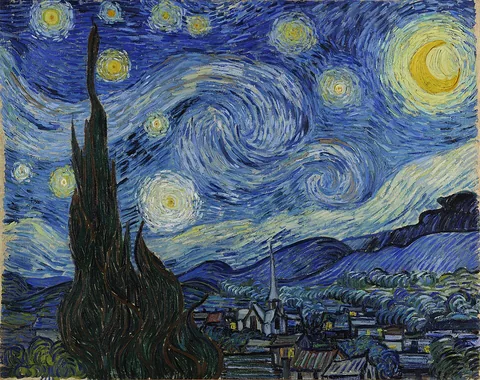 That’s exactly how the sky is. Wait, that’s not how the sky is at all, but that’s exactly how the sky is.
It is.
Which is it? I had an experience with Van Gogh where I’d been to the South of France before I looked at his work. Then, after seeing his cypress trees,22Cypresses — a constant motif for Van Gogh in 1889, when he was living in Saint-Rémy-de-Provence in the south of France: the dark, flame-like trees appear in The Starry Night and in Wheat Field with Cypresses. I went back to the South of France. Suddenly, I was seeing everything completely differently. Through his art, he pulled me out of the perceptual boxes I hadn’t even realized I was trapped in.
I discuss Van Gogh in the book alongside Cezanne, as they act as perfect bookends. They work together because they were both doing the same thing, but in very different ways. Van Gogh was more emotional, while Cezanne was almost scientific.
Van Gogh had unique brain issues, which we know about. Whether they stemmed from inhaling paint fumes or if he was epileptic, perhaps experiencing temporal lobe epilepsy,23Van Gogh's health — doctors in Arles and at the Saint-Rémy asylum believed he had epilepsy. Later theories include temporal lobe epilepsy, bipolar disorder, the effects of absinthe and lead poisoning from paint; during his attacks he is known to have tried to swallow paint and drink turpentine. his brain was wired differently. He genuinely saw things distinctively, almost like someone under the influence of drugs. This stimulates the brain.
I’m veering off into many rabbit holes, but this particular one leads to how psychedelic drugs can make you perceive the world as Van Gogh did. When you’re on substances like LSD or peyote,24Peyote — a small cactus from Mexico and the southern US containing the psychedelic mescaline, used in Native American rituals. LSD is a synthetic psychedelic first made by the Swiss chemist Albert Hofmann in 1938; he discovered its effects in 1943. which I used extensively in college, the brain’s filtering mechanism is altered. The brain typically filters your experience.
I include a story in the book about a woman who had a stroke that slowly began destroying her brain’s functions. She started seeing the world as it appears before the brain visually reconstructs it. This is called V1,25V1 — the primary visual cortex in the occipital lobe, the first cortical area to receive signals from the retina. It picks out the simplest features of an image (edges, contrast, line orientation); whole images are assembled in later visual areas. where it’s just data in pixels. The brain then processes this data, creates an image, and makes everything familiar so you don’t have to spend time figuring things out.
Drugs remove or lessen that filtering mechanism. Aldous Huxley26Aldous Huxley (1894–1963) — English writer, author of Brave New World. In the essay The Doors of Perception (1954) he described taking mescaline and suggested that the brain works as a "reducing valve" that shuts out most of what we could perceive. described it as suddenly being flooded with how things actually look. Someone like Van Gogh had this unique brain chemistry, and he was genuinely seeing the world in its true form.
The world is like that: fields of energy where nothing is ever truly the same. Our brains focus on making things stable and permanent, but nothing is stable; everything is in constant flux. Physics has confirmed this. Van Gogh was perceiving these changes, the constant impermanence of things, how they are fields of energy, and how everything is simply vibrating. He wasn’t insane; he was actually seeing reality, and we are not.
The example that comes to mind is how many times the average American has looked at a one-dollar bill—thousands of times. Yet, if you ask people to draw one, they basically can’t. This begs the question: we look at the world, but we don’t truly see it.
As writers, to write well, how do we defamiliarize ourselves with the world? How do we see it clearly and vividly, and then translate that onto the page?
The concept extends your idea of the dollar bill even further. What is a dollar bill? It’s just a green piece of manufactured paper representing an abstract quantity that only humans agree upon. What is money?
To defamiliarize yourself, you must ask a series of questions. I practice a form of Zen Buddhism,27Zen — a school of Mahayana Buddhism that took shape in China (where it is called Chan) and spread to Japan; it centers on meditation and direct insight into one's own nature rather than the study of texts. Greene has mentioned studying Zen Buddhism before (Wikipedia, "Robert Greene (American author)"). which I don’t often discuss because it’s so personal to me. It’s all about defamiliarizing yourself, looking at the world as things truly are, and asking questions. It’s entirely about asking questions.
There’s a koan:28Koan — in Zen Buddhism, a short paradoxical question or story that a student meditates on to get beyond rational thinking. “What is the mind?” I repeat that koan over and over. When you focus on your mind, you realize it’s not located in any particular place. While it’s obviously projected from the brain, it’s not inside because you perceive things outside. Yet, it’s not outside either; it’s nowhere.
Focusing on your own mind provokes these questions and makes you realize how strange it is to be conscious. As a writer, to defamiliarize yourself, you must repeatedly ask: “What is this?” You keep asking more and more questions about the true nature of things.
I applied this method to each of my chapters. For instance, I have a chapter on the “daemon,”29Daemon (Greek daimōn) — in ancient Greek thought, a deity or guardian spirit of a person. Socrates spoke of his daimonion, an inner voice that held him back from mistakes. The Latin counterpart is the genius. or the “second self” that exists within a human being—what was once called your soul. I had to ask myself, “What is the self? What do we truly perceive ourselves to be?”
We’re so intimately connected to our sense of “I,” our identity and ego, that we rarely question it. But if you do, you realize how strange it is to feel a self. As a two-year-old, I didn’t truly have a concept of self. So, when did it begin? When did I start creating it? How strange that I created it. How did I create it? Asking these questions makes things seem far less familiar.
04The daemon
The daemon, the second self, brings writing to life, but it has to be tamed or it will destroy the writer.
You’re discussing how we have almost two selves, with the daemon representing a soul-like self. When do you want that part of you to actually drive the writing and the creative process?
The daemon cannot drive the entire process because you have a book to write, a deadline, publishers, and you need to earn a living. You cannot rely solely on inspiration. For a writer, the daemon represents inspiration.
It’s a feeling of something external inhabiting you—the book and the idea possessing you, generating excitement, and bringing the work to life. However, you cannot live or write exclusively in that state.
I recount Friedrich Nietzsche’s story in the book; he’s an icon of the daemon for me. Under pressure from his family, he took a job as a university professor, earning a good income, living as a respectable academic, writing books, and becoming a disciple of Wagner.30Richard Wagner (1813–1883) — German composer of the Ring cycle and Tristan und Isolde. Nietzsche met him in 1868 and was for years a close friend of the family, but broke with him by the late 1870s and later wrote the pamphlet The Case of Wagner (1888). But he eventually realized that wasn’t who he truly was. He understood himself to be a very strange creature.31Friedrich Nietzsche (1844–1900) became a professor of classical philology at the University of Basel at 24 and grew close to Richard Wagner, but later broke with him. Illness made him give up his chair in 1879; Thus Spoke Zarathustra, Beyond Good and Evil and his other major books were written in the 1880s. His father, the pastor Carl Ludwig Nietzsche, died of a brain ailment in 1849.
Nietzsche believed his father’s mental illness ran in his family, and he always felt a touch of insanity himself. He loved music, which he felt embodied that type of intensity. When he finally discovered that second self, books exploded out of him.
He had previously written perhaps two books in eight years.32Fact-checkGreene says perhaps two books in eight years. During his Basel professorship (1869–1879), Nietzsche published The Birth of Tragedy (1872), the four Untimely Meditations (1873–1876) and Human, All Too Human (1878) (Wikipedia, "Friedrich Nietzsche"). Then, during short, intense periods, he suddenly produced his greatest works. It just poured out of him.
Van Gogh is the same way.
Yeah.
Painting after painting, a rapid explosion of work.
Yes, but they destroyed themselves.
They destroyed themselves. That’s what I was going to ask you.
As a modern writer, if you need to make a living, support a family, and provide food, you truly cannot afford to live like that.
What exactly is “that”? Is it the daemon leading you, the prolificness, or the insanity?
It means unhooking yourself from social conventions and codes. The daemon is who you truly are when you strip away all societal constructs and expectations.
As social animals, we often see ourselves only in reflection—through the eyes of other people. We internalize their judgments, whether they think we’re smart or something else, and that becomes our perceived identity. You cannot easily separate who you are from how others see you. However, this isn’t your true self.
You have a unique physiology and a unique spirit; you’re made of blood, with a heart pumping. You are not solely a social creature. The daemon is about discovering who you truly are. Van Gogh and Nietzsche both achieved this, and the realization can be explosive.
It’s difficult to organize your thoughts, stay grounded, and avoid descending into madness when you embrace such intensity. It’s simply too much.
Yet, a writer must tap into some of that. You have to infuse your work with that essence, or it will result in the ‘deadness’ I mentioned. You need to know who you are, what makes you different, and what your soul is, then bring that soul into the book. Otherwise, it won’t truly come to life.
It’s a balance, a middle way.33The Middle Way — in Buddhism, the Buddha's path between extremes, between the pursuit of pleasure and self-mortification. Greene uses the phrase loosely, for a balance between extremes. Many writers have never truly examined themselves. They don’t bring their uniqueness, their ‘blood and heart,’ or what makes them different into their books. Their work often reads like anything else ever written.
Then there are a select few who go absolutely insane. Rimbaud, the poet,34Arthur Rimbaud (1854–1891) — French poet. "The Drunken Boat," A Season in Hell and Illuminations were all written before he turned twenty-one; then he gave up literature and went off to trade in Aden and Ethiopia. is another example. At ages 18 and 19, he wrote some of the most beautiful poems ever, but then burned himself out and could not continue. The daemon can be very dangerous. It’s like an animal you must domesticate within yourself and learn to use.
05Flaubert and Rilke
Great writers combine discipline with complete immersion in their world, and the sublime depends on how sensitive you are to the world.
How does this apply to Flaubert? He famously said you should be regular and orderly in your life so that you can be violent and original in your work.35"Regular and orderly" — from Gustave Flaubert's letter to Gertrude Tennant (1876): "Be regular and orderly in your life like a bourgeois, so that you may be violent and original in your work."
Yet, in your book, you quote him saying, “It’s a wondrous thing to write, to no longer be oneself, but to inhabit all of the world one has created.”36"It's a wondrous thing to write" — from Flaubert's letter to his lover Louise Colet (December 1853), written while he was working on Madame Bovary. He goes on to describe how that day, as man and woman at once, lover and mistress, he rode through an autumn forest.
Right.
There’s a tension between those two ideas.
There is a tension, but not everything is black and white. There’s a nuance and complexity to the writing process and to life itself.
Flaubert was a creature of le mot juste,37Le mot juste (French for "the right word") — Flaubert's principle that every thought has exactly one right word and the writer's duty is to find it. He worked on Madame Bovary (1856) for about five years. the right word. He would sometimes spend three days trying to figure out the right word for a single sentence. That quote comes from his letters. In them, he reveals that he’s not just a dry person constantly looking for the precise word.
He gets very caught up in his stories. When he wrote Madame Bovary, he literally became Madame Bovary.38"Madame Bovary, c'est moi" — a line attributed to Flaubert, though it appears nowhere in his letters. He did, however, tell Hippolyte Taine that while writing Emma's poisoning he could taste arsenic in his mouth. He became the characters he wrote about. This amazing process is what makes his books so alive.
It’s like method acting.39Method acting — an approach in which actors build a role out of their own emotional experience; it grew out of Stanislavski's system and was developed in the US by Lee Strasberg at the Actors Studio in New York. Famous "Method" actors include Marlon Brando and Daniel Day-Lewis. At the same time, he’s a very careful, conscientious writer who pores over every sentence. These two aspects are not contradictory; they go together.
If he were just inhabiting Madame Emma Bovary, it wouldn’t have structure. He wouldn’t be able to make it come to life, as he’d be too completely inside her world. Because he’s inside her world, and he’s a very disciplined writer who focuses on how language can create a world, he’s able to bring the two together. That’s the dance the greatest writers go through.
What did you take from Rilke?
Rilke meant a lot to me when I was younger. I have a very youthful relationship to him. Whenever I read his work, I feel like I’m 20 again. I read Letters to a Young Poet, Sonnets to Orpheus, and the Duino Elegies back then.
All the books I have at home are from my college years, and they still have my notes in them. He represents something of the adolescence of the human spirit. He’s actually a very deep thinker, which is strange because you wouldn’t necessarily say that about a lot of poetry. However, philosophers like Heidegger considered him one of the great philosophers.40Rainer Maria Rilke (1875–1926) — Austrian poet, born in Prague, who wrote in German. The Notebooks of Malte Laurids Brigge (1910) is his only novel; the Duino Elegies and Sonnets to Orpheus came out in 1923, and Letters to a Young Poet was published posthumously in 1929. Martin Heidegger devoted the essay "What Are Poets For?" (1946) to him.
His poetry can be very enigmatic, so you have to think about it. He was also a very emotional person. I like this confluence of opposites in the human spirit. We are all contradictory. He possessed a very analytical mind and thought very deeply about things.
And in The Notebooks of Malte Laurids Brigge—I forget how to pronounce the name—he goes very deeply into our relationship with death. I used a lot of that in the last chapter about the “death sublime.”
His poetry, writing, and letters contain snippets of thought that always make me think very deeply about things and create a defamiliarizing effect. I don’t know where it comes from, because he was a very sensitive person. I have an idea in the book that I tried to express — though not as deeply as I wanted to — that the sublime is a matter of how sensitive you are to the world.
It’s like putting a photographic negative into acid and watching a picture develop. How sensitive are you? How sensitive is your chemistry, where the world develops and becomes what it is?
But we live in a very coarse world. You go to the airport, and music bombards your ears that you don’t necessarily want to hear. Things smell bland; there aren’t interesting or different kinds of scents. Everything looks ugly, it’s loud, and it’s always in your face—like brash social media. You’re no longer sensitive; you’re desensitized.
The sublime, then, is a factor of how sensitive and receptive you can be to the world, which is characteristic of many poets. When I think of Rilke, I think of someone supremely sensitive to people, animals—he was obsessed with animals—to the women he met, to everything. The world vibrated inside of him.
Yet he was also German41Fact-checkGreene calls Rilke German. He was Austrian: born in Prague, then part of Austria-Hungary, though he wrote in German (Wikipedia, "Rainer Maria Rilke"). and could be very precise and analytical about things. I love that combination of qualities. It’s about being sensitive to the world around you. Perhaps we need a new word, like “receptiveness” or “openness.”
Porous.
Porous. Permeable. You’re porous to the world; it comes into you and vibrates inside you, as it vibrated with Van Gogh. Then you express it creatively.
06The shell and the inner child
Everyone grows a shell with age, but you have to resist it and keep a child's sense of wonder.
I just saw Kanye42Kanye West (born 1977, officially Ye since 2021) — American rapper and producer. His mother, Donda West, died in 2007; a year later came the album 808s & Heartbreak, with the song "Heartless." In recent years he has often performed in masks that cover his face; "I Am a God" is on Yeezus (2013). in concert. His music has changed so much. I’m referring to the music I really love by him, the stuff he made in the 2010s.43Fact-check"Heartless," which Perell gives as an example of the 2010s Kanye he loves, came out in 2008, on 808s & Heartbreak (Wikipedia, "808s & Heartbreak"). If you look at what he was wearing back then, he sometimes wore pink polo shirts, loved his mother, and had those deep songs like “Heartless.”
“In the night I hear them talk / The coldest story ever told.” That music, about total heartbreak, moves me to tears.
Now, when I see Kanye, it’s really harsh, almost militaristic. It’s grays, blacks, and greens. He’ll say, “I am a God.” He walks into and leaves the show wearing a mask. There’s no desire to connect with the audience.
I think whatever happened, he got really hurt and basically distanced himself from the world. I don’t really like a lot of his modern music now. So, what I see is someone—and this leads into a question: Do artists and writers have to take the risk of being hurt?
With him, perhaps he was porous and open, creating something beautiful. But then the world seeped in, bringing so much pain. Now he’s retreated. By distancing himself, he seems almost unable to make the beautiful, enchanted music he used to.
I think that happens. How do you explain it? Many people, when younger, have a natural sensitivity to the world. They were children, and many hold that receptive, porous child within them.
As you get older, you encounter political fights and egos. You become defensive because you’ve been hurt, and a shell forms around you. That sensitive, porous part of you is no longer there because you want to protect yourself.
That happens to everybody; it happens to me, and it will happen to you. As you get older, you can’t help it, but you have to fight against it, or you will become...
Is “fight” the right word there? Is that what you do? Do you fight against it, or is it something else?
I meant you have to struggle against it and not give into it. One of the chapters is about returning to your childhood. Not as nostalgia, or as a golden, wonderful period, but rather experiencing the world as you did when you were a child.
Consider someone like Albert Einstein. It’s a cliche, but we all know he retained that childlike spirit. He spoke about having the same sense of wonder he experienced at three years old44Fact-checkGreene says Einstein was three. In his Autobiographical Notes (1949), Einstein himself says he was four or five, and that the needle moved by an invisible force made a "deep and lasting impression" on him. when his father gave him a compass. He marveled at how the needle moved due to invisible forces in the universe. This wonder ultimately led him to become a physicist and scientist, pondering these unseen forces.
He never lost that childlikeness, which is something we secretly venerate. Even a businessman like Steve Jobs,45Steve Jobs (1955–2011) — cofounder of Apple; he left the company in 1985, returned in 1997 and ran it until 2011. He was known for his obsession with design and a harsh, at times tyrannical, management style. who seemed hard and manipulative, was still a child at heart. Even in his fifties, he retained an awe for beautifully designed objects, for technology that looked beautiful.
You retain your adult ability to organize and create. I’ve had to do this to write a book; it was seven years of intense labor. I couldn’t just be a child playing baseball in the streets; I had to be disciplined.
However, I’ve worked very hard to keep that childhood spirit alive within me. When it’s not present, I feel dead, as if I’ve betrayed who I truly was.
The book includes meditations at the end of each chapter. One meditation involves encountering a child in a dreamlike setting. This child looks at you curiously, as if disappointed. It’s actually your childhood self looking at you, expressing disappointment in who you’ve become and how you’ve abandoned your dreams. You’ve grown hard and realistic, losing your spirit.
My childhood felt very magical, and I don’t feel truly alive when I’m divorced from it.
I’m smiling because I’m showing you a photo of a hat I saw. It reads, “Ever since I was little, I’ve wanted to maximize shareholder value.”46Maximizing shareholder value — the doctrine that a company's main purpose is to make money for its shareholders, associated with Milton Friedman and his 1970 essay "The Social Responsibility of Business Is to Increase Its Profits." The joke on the hat is that no child ever dreams of it. It’s a great hat.
But consider people like Elon Musk47Elon Musk (born 1971) — entrepreneur, founder and head of SpaceX, CEO of Tesla, founder of xAI. SpaceX's main goal, he says, is to make humanity a multiplanetary species and colonize Mars. and Peter Thiel.48Peter Thiel (born 1967) — American entrepreneur and investor, cofounder of PayPal and Palantir and founder of the venture firm Founders Fund. A Tolkien fan: Palantir is named after the seeing stones of The Lord of the Rings. They all grew up on science fiction, the weirdness of outer space travel, The Hobbit,49The Hobbit, or There and Back Again (1937) — J. R. R. Tolkien's fantasy tale, the prequel to The Lord of the Rings. and fantasy.
Futurama.50Futurama — American animated series (since 1999) by Matt Groening, creator of The Simpsons, about a pizza delivery boy frozen for a thousand years who wakes up on the eve of the year 3000.
Yes, and it’s still part of them, unfortunately, because they use it in ways we might not approve of. They still have a kind of perverted child within them. Elon Musk, for example, is focused on becoming a trillionaire,51Trillionaire — in June 2026, after the SpaceX IPO, Forbes named Musk the world's first trillionaire; the stock then fell, and in November 2026 the magazine put his fortune at $849.7 billion. but he’s also living out those childhood fantasies with his space exploration and all that.
07Scriabin and the mystic chord
Scriabin joined a wild spirit to rigorous training, and with the mystic chord he found a new language in music.
Tell me about Scriabin,52Alexander Scriabin (1872–1915) — Russian composer and pianist, author of The Poem of Ecstasy, Prometheus and ten piano sonatas. He dreamed of a synthesis of music, light and the other arts, a Mysterium that would transform the world. and how he possessed both sides: the intuitive, almost mystical ability to create music, and the analytical mind that wanted to break down why a piece of music worked.
Music is a strange thing, particularly classical music, because it’s a language. It’s a very weird, abstruse language that I can’t really understand. My wife understands it and tries to explain to me how it’s almost mathematics on mathematics. It’s very complex.
You have to study chords: the dominant chord,53Dominant — the fifth degree of a scale and the chord built on it: it creates tension that pulls toward resolution on the tonic, the scale's home note. Major and minor are the two main modes of Western music. the major, the minor, and so on. It’s a very rigid discipline. Scriabin was one of these strange people, like a Van Gogh or Nietzsche. He had a powerful, childlike spirit.
He said as a child that he wanted to make the universe sing. He wanted the sun, the trees, and the entire universe to come alive with music. But then, in the early 1890s, he went to the conservatory in Moscow. He had to learn intense discipline, despite having a wild spirit and not being a naturally disciplined person.
He disciplined himself and wrote music, but his teachers hated it because of the wildness they perceived within it. They graduated him in piano performance,54A piano diploma — Scriabin graduated from the Moscow Conservatory in 1892 with the Little Gold Medal in Vasily Safonov's piano class, but received no diploma in composition after falling out with his teacher, Anton Arensky. From 1898 to 1903 he taught piano at the conservatory himself. but not in composing, because his compositions were considered too strange.
After graduating, he needed to make a living. He had a wife and children, and while he possessed this wild spirit, he couldn’t earn money expressing it fully. So he compromised.
He began writing pieces designed to please the public. He found some success, teaching piano at the conservatory that had hired him. Yet, he was dissatisfied. Like Nietzsche, he didn’t feel like himself.
He questioned the music he was creating, feeling it wasn’t truly him. He wanted to create music and sounds that had never been heard before. In 1905, while traveling Europe, he learned about Einstein’s theory of relativity.55Theory of relativity — Einstein published special relativity in 1905 and general relativity in 1915. He declared, “I want to make music that will have the same profound effect on the brain that Einstein’s theory of relativity had—to shake up our ideas of reality.” The challenge was how to achieve that through music.
He knew he could do it, but he couldn’t figure out how. He needed to shed himself of everything he had learned. At one point, while writing his Piano Sonata Number Five, he recognized an urgent need to release a new, almost insane sound from within him. He was reaching a point of maximum frustration.
As I’ve often written in Mastery, that point of maximum frustration is when the cloud is about to burst, when something is on the verge of exploding. Suddenly, in December 1905,56Fact-checkGreene says December 1905. Scriabin wrote the Fifth Sonata in six days, December 8–14, 1907, in Lausanne (Wikipedia, "Piano Sonata No. 5 (Scriabin)"). it just exploded out of him. In the course of six days, he finished the sonata.57Fifth Sonata — Scriabin's Piano Sonata No. 5 (Op. 53), written in Lausanne in 1907, by a well-known account in six days. Those who heard it exclaimed, “I have never heard music like that!”
I encourage you to listen to this Fifth Piano Sonata. It’s one of the weirdest things you’ll ever hear—beautiful, yet also irritating and strange. It’s a mix of emotions, both what you want and what you don’t. He had discovered a new language in music and created a chord called the mystic chord.58The mystic chord, or Prometheus chord — a six-note chord built mostly on fourths (C, F-sharp, B-flat, E, A, D). Its best-known use is in Scriabin's symphonic poem Prometheus (1910). I can’t deeply explain it because I don’t know music that intimately.
I’ll put it right here in the audio.
Oh, you will?
Okay, the mystic chord.
Exactly. So people just heard it.
Okay.
People just heard it.
The idea is that traditional music is a mix of dissonance and consonance.59Consonance and dissonance — a pleasant, stable combination of notes and a harsh, tense one that, by the rules of classical harmony, has to resolve into consonance. You hear dissonant sounds that feel out of place, and then the composer resolves them into something beautiful, creating tension. That’s drama.
ExplainerWhat Scriabin did with dissonance
In classical harmony, dissonance is temporary tension: a dominant chord, especially with added notes, demands resolution to the tonic, and the ear waits for that "return home." The notes of the mystic chord (C, F-sharp, B-flat, E, A, D) can be read as exactly such a dominant chord, with a ninth, a sharp eleventh and a thirteenth. Scriabin doesn't resolve it: in his late works, above all Prometheus (1910), this chord and its transpositions become the foundation of the whole harmony in place of the tonic. A sound that by the old rules should be heading somewhere stands still and shimmers, hence the feeling of "beautiful, yet strange" that Greene describes. Scriabin also added a Luce line to the score of Prometheus for a "color organ" meant to flood the hall with colored light in step with the harmony.
You’ll hear this often in Beethoven, Mozart, and other classical composers. They create tension with something slightly ugly and discordant, then resolve it. They bring it ‘home,’60"Home" — musicians' word for returning to the tonic, the key's central note and chord: after the tension of the dominant, resolving to the tonic sounds like coming home. as it’s described in music.
This constant dialectic between consonance—something beautiful and pleasant—and dissonance, creates drama. Stage drama operates similarly. Playwrights create tension, struggle, and conflict, often unsettling the audience, then resolve it on stage. This is deeply satisfying to the human soul.
But Scriabin hated that. He resented having to adhere to it. He wanted something else—to break through to a different kind of music.
With the Mystic Chord, he created a single chord that contained both dissonance and consonance simultaneously. People who heard it didn’t know what to make of it. Was it supposed to be nice and pretty, or was it meant to be ugly? It was one sound, very weird, with an undeniable eeriness. When people listen to his music—and I do—it feels almost extraterrestrial.
08Rebelling against convention
Nineteenth-century artists revolted against a new standardization, while today, Greene thinks, people know nothing but the conventions of pop culture.
Do you believe that at certain times, there’s a portal between humanity and something larger, perhaps even outer space? You’re talking about the late 19th and early 20th century. Gaudi existed in the exact same period and did almost precisely what you’re describing, but in architecture.
I could have taken every single word and applied it to Gaudi: this frustration with the status quo, the novelty of Art Nouveau. Gaudi is the mystic chord etched in stone.61Antoni Gaudí (1852–1926) — Catalan architect, the leading figure of Barcelona's Modernisme, the local version of Art Nouveau. His best-known building is the Sagrada Família basilica in Barcelona, under construction since 1882. The vaults of Antoni Gaudí's Sagrada Família in Barcelona: the columns branch out like trees. Is there something that can happen at a certain moment in time?
Oh, you mean culturally?
Culturally.
Well, in that period, things were very conventional. They had frozen into established ways of doing things. It was the beginning of entertainment and the beginning of creation for the masses. These conventions became hard set in music, architecture, and literature.
I would say we are in a similar place right now. The difference is that back then, it was new, and people were revolting against it. Artists, poets, musicians, and architects felt disgusted because it was so new. They disliked the direction the world was taking, and they rebelled.
People are not rebelling as much right now against these conventions. Some are, and I don’t mean to overgeneralize, but that sense of “this isn’t how it should be; it should be something else” is less prevalent. The 19th century was a turning point in culture because people felt the standardization of experience more deeply than they do today.
They wanted to explore and create imagery in painting or architecture that broke free from these constraints. They created a new language. That is what defines modernity; that restless spirit of always finding a new language is what created modernism.62Modernism — movements in art and literature from the late 19th to the mid-20th century that deliberately broke with tradition in search of a new language: from Impressionism and Symbolism to Cubism, atonal music and Joyce's novels.
Postmodernism63Postmodernism — the art and thought of the second half of the 20th century that followed modernism: irony, quotation, mixing high and mass culture, distrust of "grand narratives." doesn’t have that same anger and rebelliousness in creating a new language. We are now so deeply trapped in the conventions of popular culture that people aren’t rebelling. It’s all they know. In the 19th century, they knew something else and longed to return to it.
If I’m a creative person frustrated with the state of modern creative culture—whether it’s Hollywood, where my Uber driver this morning said they make nothing but sequels and no one takes risks; or architecture, where schools produce similar architects; or writing, where we’re in an age of minimalism64Minimalism in fiction — short sentences, spare description and subtext instead of explanation; its classic practitioners are Ernest Hemingway and Raymond Carver.—what does rebellion actually look like? It’s probably not going to Hot Topic65Hot Topic — an American chain of clothing and merchandise stores for fans of rock, punk and goth culture, usually found in shopping malls. and dressing like a stereotypical rebel with tattoos.
I discuss this a bit in this book and also in Human Nature: you don’t always realize it, but you are a product of a cultural moment. You live in a certain generation, and it puts a stamp on you. It influences how you dress, how you think, and how your emotions are organized.
If you look at young people nowadays, for example — I apologize, as an older guy, I observe them wearing very baggy jeans, sometimes called “puddle pushers,” because they hit the street puddles. The current fashion trend is to not be body-conscious, to be free, and to let everything flow. The body-conscious style of ten years ago now seems somewhat dated because we’ve moved past that. I’m not criticizing at all.
You are a cultural product, a product of the times, the zeitgeist. It has put its stamp on you. To the degree that you can step outside your culture and detach yourself, you become almost like someone from outer space, like someone from the future. Nietzsche was obsessed with this idea of people “out of time”66"Out of time" — Nietzsche titled his early essays Untimely Meditations (1873–1876), and in his late books wrote that some people are born posthumously. whom you couldn’t easily categorize within their moment.
You can’t fully escape the times you live in. I am as much a product as those young people with their puddle pushers, in the way I dress and the values I hold. However, to the degree that you can step outside of it, you can cultivate some of that rebellious spirit and create something new and different.
For instance, Scriabin was immersed in late 19th, early 20th-century traditional music. He couldn’t escape that or the values of his time, but he struggled to get out of it. In that struggle, he created something new—what was then called “music of the future.” We have very interesting modern music today, and I love a lot of it. Some truly interesting things are happening. Yet, in some ways, Scriabin was still ahead of them all.
What modern music is inspiring you right now?
When I say “modern,” I’m referring to composers who are probably in their 80s now,67Fact-checkGreene says these composers are probably in their eighties. Tristan Murail is 79, and Gérard Grisey died back in 1998, at 52 (Wikipedia, "Gérard Grisey," "Tristan Murail"). like Tristan Murail and Gérard Grisey, who are French composers. There are also some Americans, such as David Lang,68Tristan Murail (born 1947) and Gérard Grisey (1946–1998) — founders of French "spectral music," which builds harmony from an analysis of a sound's overtones. David Lang (born 1957 in Los Angeles) — American composer, a cofounder of the New York collective Bang on a Can and a Pulitzer Prize winner (2008). whom I grew up with, who creates similar music.
I’m currently recording the audio version of my new book, the Sublime book, and the sound engineer is really into strange modern music. He introduced me to a guy named Harry Partch,69Harry Partch (1901–1974) — American composer who built his own instruments for music in a 43-tone scale. During the Great Depression he spent several years as a hobo. a homeless individual who created new kinds of instruments and sounds. I listened to it, and while it was very weird and I liked it, it didn’t have the impact of Scriabin.
Scriabin’s music is deeply emotional. The 19th century, and the Romantic movement,70Romanticism in music — the 19th century, from late Beethoven and Schubert to Chopin, Liszt, Wagner and Tchaikovsky: a cult of feeling, the individual and nature, expanded harmony, program music. was characterized by intense emotion, as seen even in Wagner’s work. Scriabin combined that emotion with the idea of creating something new and different. A lot of modern music strives for novelty, but it often lacks that emotional impact—that desire to overwhelm the listener with something powerful and transcendent. That’s the only thing I find somewhat missing.
09Automatic writing and singing from the heart
A great artist has both technique and soul, and automatic writing helps you meet your daemon.
Can you tell me about automatic writing? I particularly like your phrase that automatic writing can lead to the surreal associations of a dream.
Automatic writing was mostly invented by the Surrealists. It might have existed before in some other form, but they basically created and utilized the concept. I’m talking about the 1920s, with people like André Breton, Philippe Soupault,71André Breton (1896–1966) — founder and theorist of Surrealism. The Magnetic Fields (1920), by Breton and Philippe Soupault, is considered the first text produced by automatic writing; in the Manifesto of Surrealism (1924), Breton defined Surrealism as "pure psychic automatism." and a whole series of other poets and writers.
At that time, Freud72Sigmund Freud (1856–1939) — Austrian neurologist and founder of psychoanalysis; in The Interpretation of Dreams (1899, dated 1900 on the title page) he described dreams as the road to the unconscious. The Surrealists saw him as a forerunner. was incredibly popular, and the unconscious was a new concept that people were actively exploring. It’s hard for us to imagine now, but it was a revolutionary idea.
Automatic writing requires a piece of paper and a pen. While you could technically do it on a computer, it’s best done by hand. You simply write the first thoughts that come to your mind. There is a degree of organization because you’re using language. For example, “I’m sitting here with David Perell, and my mind is focusing back on some green clouds in the sky, and cows are moving through them, grazing on the clouds.”
There’s a structural element due to language and grammar, but you’re allowing everything to flow, mimicking how the brain operates with its unique associations—a pure stream of consciousness.73Stream of consciousness — a phrase coined by the psychologist William James (The Principles of Psychology, 1890), and a literary technique that renders a character's thoughts in their natural disorder; the classics are James Joyce's Ulysses and Virginia Woolf's novels. You let it out on paper without any filters or attempts to make it literature, art, or even coherent.
The Surrealists believed this was your unconscious speaking, as if it were writing through you, appearing on the page. It must have been a very exciting experience in the beginning. I’ve practiced it a few times, and it does reveal interesting things. If you analyze it afterward, you can see patterns in how your brain works. My mind, for instance, will circle around the same kinds of associations, revealing thinking patterns that are neither rational nor conscious, yet clearly present on the paper.
In my book, I present this as an exercise for the reader to explore and connect with the daemon inside them—that second self, which is your soul, your unconscious. In the conscious mind, we deal with opposites: black and white, masculine and feminine, freedom and slavery. Our minds are structured around these dichotomies.
The unconscious, however, doesn’t operate with these opposites. Everything is nebulous, floating in one unified world; it’s life itself. When you write in this manner, you touch upon that state; you feel it. Through automatic writing, you can tap into who you truly are and connect with that daemon, that second self within you. It can be profoundly illuminating. That’s how I use it in the book.
This reminded me of a friend, a professor at Juilliard,74Juilliard — the conservatory in New York, one of the world's best-known schools of music, dance and drama. who says there are two kinds of musicians. The first archetype is the singer, who truly sings from the heart but isn’t as technically proficient.
Then there’s the organist, who tends to be technically excellent but might have a lower ceiling because they haven’t learned to play from the heart in the same way. I think that’s been a through-line in this conversation: a great artist knows how to play from the heart and also understands the benefits of being technically strong.
Exactly. If you’re simply loose and undisciplined, without having learned the codes of writing or music, or all the conventions involved, your work won’t connect with anything. We are creatures who create through conventions, codes, and structure.
Plays and stories, for example, have structures that go back thousands of years. These structures resonate with us, connecting to our emotions and making us feel something. You must learn and master these conventions. You can’t just create them; you have to practice and become proficient.
However, sometimes you become so proficient that the writing loses its spirit and soul. At that point, you must re-infuse that spirit. One without the other is meaningless.
I think nowadays, many people are technically gifted but lack that “singing from the heart” quality they once had. That’s what I find missing in a lot of books. I conduct extensive research for my books; this one, for instance, was heavily researched. Every paragraph represents reading approximately three books, many of them older texts. In those older books, I can distinctly feel the writer’s spirit.
That’s exactly how I feel when I read John Ruskin.75John Ruskin (1819–1900) — English writer, art critic and thinker, author of the multivolume Modern Painters and The Stones of Venice.
It’s shocking. I almost want to fall back in my chair.
One paragraph is all it takes.
I know exactly what you mean. Flaubert is a good example. He was technically brilliant, having trained himself so deeply in writing. Yet, he possessed a very emotional, almost feminine spirit.
He was also strangely androgynous, not in appearance, but in spirit, admitting to a deep mix of the feminine and the masculine within him. Wagner was very much like that. That kind of spirit — mastering your craft while retaining openness, receptiveness, and playfulness — is what creates great art.
10Be more reckless
Money and publishers squeeze writers, so Greene tells young writers to be more reckless and write out of anger.
The problem for writers nowadays is the pressure to make a living. Life has become much more expensive. Historically, an artist didn’t have to contend with such high costs.
You could afford to write something unconventional, make a modest income, and still maintain your loft in New York or your apartment in Vienna. Now, things are so expensive, and there’s immense pressure to make money. How does a writer earn a living?
You could become a professor, but that’s often soul-sucking, leaving little time for writing and requiring work that fits the university’s ethos. Alternatively, you can try to make a living writing books. Do you know how hard that is?
It’s easy for me because I am so lucky. Most writers receive a $20,000 to $50,000 advance76Advance — money a publisher pays an author on signing, against future royalties. Until sales "earn out" the advance, the author receives no royalties. and must complete the book within a year to sustain themselves. Royalties are rare.77Royalties — the author's cut of each copy sold, a percentage of the book's price. "Royalties are rare" means most books never earn back their advance.
This pressure to write quickly and earn a living is, I believe, making writing suffer. It’s no longer an endeavor where one can simply take their time.
I cannot recall a single writer who told me their publisher made their work more distinctive. Every writer has said their publisher homogenized their work. Perhaps they improved it, but always in a specific, often conventional, direction.
They made it better, but...
...it was to have more right angles, to shave off the coarse edges. I’ve observed that in the corporate creative world, there’s significant risk aversion.
I am so blessed. Frankly, I’ve made enough money for my publisher that they leave me alone. They allowed me to write for seven years without any pressure. My editor occasionally offered comments, but I would push back, and she would ultimately agree with me.
I recognize I am in a unique, privileged position. My fellow writers do not share these same advantages.
I have a friend, Brent Underwood,78Brent Underwood — American entrepreneur and YouTuber. In 2018 he and a partner paid $1.4 million for Cerro Gordo, an abandoned mining town in the Inyo Mountains on the edge of Death Valley, and he has been restoring it ever since, documenting the work on his YouTube channel. His book about it is Ghost Town Living (2024). who bought a ghost town in California. He completely recreated it single-handedly and also runs a very famous YouTube channel. What he accomplished is an amazing story, and he’s an amazing person.
He wrote a book called Ghost Town Living, which I highly recommend, and I helped him a bit with it. However, his publisher pushed for a more practical approach, asking for self-help lessons instead of just his beautiful story.
I suggested he read Desert Solitaire by Edward Abbey.79Edward Abbey (1927–1989) — American writer. Desert Solitaire (1968), about the seasons he spent as a ranger at Arches National Monument in Utah (not New Mexico), is a classic of American nature writing. It’s a beautiful, sublime book about Abbey’s experience as a ranger in the deserts of New Mexico, or somewhere similar. It’s poetic, wild, and wonderfully weird.
Writers no longer have the luxury of producing something like Desert Solitaire. I wanted Brent’s book to reflect that same spirit, but his publisher pushed back against his desire to simply write what he wanted.
Some people can get away with it, but only if they’ve been immensely successful and generated substantial revenue for their publisher to earn that kind of leeway. If you’re a young person writing your first book, you won’t get that flexibility. It instills the belief that you must be conventional to be published.
Should more aspiring writers work full-time jobs instead of trying to make a living solely from writing?
Initially, I would hate that idea, because it mirrors my own early struggles. I wanted to be a writer. I tried journalism, which I somewhat disliked, though it instilled good discipline. Then I tried writing novels, but I couldn’t make a living.
At times I was starving, though my parents helped when things were dire. I simply couldn’t make a living; I couldn’t bridge the gap between creating what I loved and earning an income.
Working for a company, as I did in Hollywood or through my 80 other jobs,8080 other jobs — Greene has given a different figure before: by his earlier count he went through about 50 jobs before his first book, including construction worker, translator, editor at Esquire and Hollywood screenwriter (Wikipedia, "Robert Greene (American author)"). makes writing a book incredibly difficult. You come home, and your mind is consumed by the people, the pettiness, and all the day’s concerns.
You’re also tired, and your excitement for life may wane. It’s challenging to carve out time for yourself after a full-time job. Even a part-time job makes it very difficult.
When I advise aspiring writers, I encourage them to be more reckless.
More reckless?
Especially if you are young, you can live off packs of ramen in a cheap, dingy apartment. I lived like that in the East Village81East Village — a neighborhood in Lower Manhattan. In the 1970s and '80s it was poor and bohemian, full of cheap apartments, punk clubs and galleries; today it is expensive. when I first moved to New York. You can live like that in your twenties; I cannot live like that now.
You can live cheaply and write something that truly appeals to you, something that is your spirit. You might compromise a little to make it sell, but you are not listening to a publisher. You are simply writing what you want and being excited about it.
Don’t worry about being conventional. Don’t worry about what a publisher will say. If they reject it, move on. After writing one book, then another, you will eventually find your niche. If you write a truly good, interesting book that covers something new and different, it will find its audience.
Don’t be so cautious and fearful. When you are young, have a sense of adventure and a sense of anger. My first book, The 48 Laws of Power, came out of deep wells of anger I had about Hollywood and the world. Fortunately, I had a book packager82Book packager — someone who develops a book from start to finish and sells it to a publisher. Greene pitched the idea for The 48 Laws of Power to the Dutch book packager Joost Elffers, whom he met in Italy in 1995; Elffers is credited as the book's coauthor. who supported me, and if I hadn’t, I wouldn’t be here talking to you right now. A lot of people don’t have that luxury.
Bring your anger into play. Bring what is unconventional about you into play. Don’t try to be like other people, because those who stand out are unique. They have something unique to say and contribute. What is it you are trying to say? What is valuable that you want to contribute to the world?
So many books are unnecessary. I read them and wonder why they exist. They are just a waste of paper, of trees. Why does this book have to be written? I often ask young writers: What is compelling you? What is so important about this book that you need to write it?
11Sneaking in the message
You can get around the conglomerates' standardization by smuggling your message inside an entertaining form and showing the world's ugliness without preaching.
As I told you before we recorded, I am working on a TV show, and I feel angry about the current state of what we build.
That is what will make it a great show.
It angers me that the world looks the way it does. However, constantly facing rejection in this industry can be disheartening. You begin to question yourself, wondering if you are going crazy or if there truly isn’t an audience for your work.
You might even consider adding “right angles” to your vision, trying to make it fit inside the corporate structure. I’m experiencing that right now. I know I have something to say, but then you start doubting yourself.
The beauty of the world now, if any can be found, is that you can create something and release it, bypassing some of these traditional gatekeepers. Of course, the financial and budgetary considerations will be more perilous.
Standardization is being imposed by conglomerates in film, entertainment, and publishing. They own everything. There are only three or four major publishing companies now, and with mergers like Paramount and Time Warner,83The big publishers — American trade publishing is dominated by the "Big Five": Penguin Random House, HarperCollins, Simon & Schuster, Hachette and Macmillan. In October 2026 Paramount Skydance closed its $81 billion acquisition of Warner Bros. Discovery, the heir of Time Warner. it’s all becoming so standardized. To get something through, you often have to become a sausage in the sausage factory.
In your case, I don’t have much experience in film, but you must bring out that anger. You must be different and have that edge. If you do it right, you can trick the corporate people. Make it entertaining, provide visuals that excite the twenty-something demographic, and then sneak in your message. I am a big believer in sneaking in messages.
You can adopt the veneer of the corporate style — the way they segment things and push for certain “right angles” you mentioned — but you are actually tricking them. You are subtly revealing that our world is ugly.
There is the negative: the world is ugly, how awful. And there is the positive: what was once so beautiful. Let’s look at what was once beautiful. You make people aware of the contrast without preaching.
In my book, I have a chapter on history and what is sublime about it. I try to immerse you. Imagine walking through ancient Babylonia. I did extensive research for this. I take you along the pathway leading to the Ishtar Gate, a beautiful carved limestone path lined with enormous statues of growling lions.84The Ishtar Gate — Babylon's ceremonial gate, built around 575 BC under Nebuchadnezzar II and faced with blue glazed bricks showing bulls and dragons. Reliefs of striding lions lined the Processional Way leading to it. A reconstruction of the gate stands in the Pergamon Museum in Berlin. The Ishtar Gate, reconstructed from original bricks in the Pergamon Museum in Berlin: blue glaze, bulls and mušḫuššu dragons.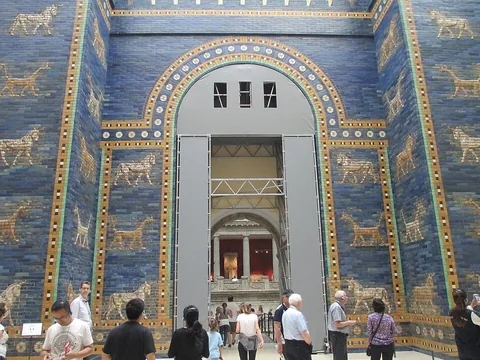
As you approach, there is the Ishtar Gate, one of the most beautiful structures in the world. Its tiles reflect the sunlight; it is enormous, fifty feet high. The thick walls of ancient Babylonia, on which they held entertainment and chariot races,85The walls of Babylon — according to Herodotus, they were so wide that a chariot drawn by four horses could turn around on top of them. would be visible. You enter the Ishtar Gate, and it is breathtakingly beautiful.
Right nearby is the famous ziggurat,86The Etemenanki ziggurat — the stepped temple of the god Marduk in Babylon, often linked to the biblical Tower of Babel. The Hanging Gardens of Babylon were one of the Seven Wonders of the World, but archaeologists have never confirmed they existed. a stepped pyramid to heaven, with priests and a unique chapel at the top. People would ascend and descend its tiers. Contrast that with our modern cities, which are so disparate. Every building looks different; it’s a cacophony of styles, some of it very ugly.
In ancient Babylonia, all the buildings were constructed from the same materials. Cities like San Francisco or Paris,87Paris's uniformity — largely the legacy of Baron Haussmann's rebuilding of the city under Napoleon III (1853–1870): wide boulevards and buildings of the same height with pale limestone facades. with their uniformity, are not boring; they are beautiful.
Beautiful.
Absolutely stunning. All the buildings were made of the same stone; their facades carved to reflect the sunlight. Each building created a spectacular pattern of light. You realize, the engineering back then—the stone bridge was...
It was amazing how they built this. In the river, you’d see strange crafts—circular boats88Circular boats — quffas: woven basket boats covered with hides or coated with bitumen. Herodotus described them on the Euphrates, and they were used in Iraq into the 20th century.—moving up and down. You’d see the Hanging Gardens of Babylonia, one of the Seven Wonders of the World—a giant structure with gardens cascading down.
At night, once the sun set, the streets filled with people. Prostitutes, male and female, engaged in wild sex. It was a very erotic place.89Sacred prostitution in Babylon is known mainly from Herodotus, who wrote that every Babylonian woman had to give herself to a stranger once in her life in the temple of the goddess Mylitta. Modern historians often consider the story an exaggeration.
The point is, if you were to go through a city now, you would be struck by its ugliness: mini-malls, trash everywhere, derelict parking lots. Here in L.A., you see a Cape Cod house next to a Spanish-style house, next to a Craftsman house90American house styles: the Cape Cod is a simple house with a steep gable roof from colonial New England; the Spanish style has white stucco walls and red tile roofs; the Craftsman is an early-20th-century style from the Arts and Crafts movement, with a low-pitched roof, wide eaves and a porch on massive columns. – it’s a complete mishmash. There’s no sense of aesthetics, no organization, or structure.
Instead of me just preaching about how ugly the world is, my idea is, “Why isn’t our world like ancient Babylonia? What happened?” I have a theory about architecture.
Right.
In Mastery, I interviewed Santiago Calatrava.91Santiago Calatrava (born 1951) — Spanish architect and engineer known for buildings and bridges that resemble skeletons and wings: the City of Arts and Sciences in Valencia, the World Trade Center Transportation Hub in New York. He is one of the contemporary masters Greene writes about in Mastery. I talked with him a lot about why the world is so ugly.
Oh, Calatrava did the Oculus,92The Oculus — the main hall of the World Trade Center Transportation Hub in New York, designed by Santiago Calatrava and opened in 2016. The hub cost nearly $4 billion, for which it drew a lot of criticism. The main hall of the Oculus, Santiago Calatrava's World Trade Center Transportation Hub in New York (2016). right?
Yes, which some people hate.
I like the Oculus. It’s quite good; it’s otherworldly.
It is.
It almost feels like you could have put it in the movie Arrival93Arrival (2016) — Denis Villeneuve's science fiction film about a linguist who learns to communicate with aliens who have landed on Earth. or something.
He’s a brilliant, wonderful man. Designing a building used to be a laborious process of working on paper and sketching things out. It was a form of art.
You saw it created through your own hand. It was very disciplined, methodical, and mathematical, yet it also had an artistic touch as you sketched out the building’s appearance and figured out the dimensions. Then, at some point, it became computerized. Now, it’s all a computer program.
AutoCAD.94AutoCAD — computer-aided design and drafting software from the American company Autodesk, sold since 1982; one of the main tools of architects and engineers.
You program it, and your building comes out. Very strange, irrational things happen. It’s not human, not made by hand, but by a computer that thinks in formulas, bits, ones, and zeros.
Sometimes you go to a hotel, and in the bathroom, the faucet is in a nonsensical location, or the sink isn’t functional. This is because it was drawn on these AutoCADs, and the designers aren’t even aware of the practical issues. The entire building is designed this way; it’s standard, a formula. The human hand isn’t truly designing these things. Yes, humans are programming them, but a step is missing – the unique, personalized touch.
I think architects are becoming like people who don’t know how to write because they depend on AI and become lazy. The art of writing will disintegrate if people can’t write anymore. Similarly, the art of architecture is disintegrating because people no longer know how to design and sketch.
What makes Calatrava and Renzo Piano95Renzo Piano (born 1937) — Italian architect who designed (with Richard Rogers) the Centre Pompidou in Paris, as well as the Shard in London; winner of the Pritzker Prize (1998). so interesting is that they don’t design by computer. They still sketch things out by hand, even though they are incredibly famous and wealthy. It’s not the entire answer, but it’s a significant reason for the brutalization and ugliness of so much modern architecture.
12AI and the next generation
Zoomer anger gives Greene hope, while AI, in his view, is good only as a research tool.
Do you feel like you’re part of the last generation of human writers?
It’s possible, but I don’t want to be grandiose. I sense anger and rebelliousness in this new generation—Zoomers96Zoomers — Generation Z, born from 1997 to 2012 by Pew Research Center's widely used definition; the first generation to grow up with smartphones and social media. or whatever you call them. There’s a major rebellion and a dislike for the world they’ve been thrown into. They feel helplessness about a programmed world not of their making, where the older generation, my generation, is monopolizing all the wealth.
That anger could be the source of a rebirth of the human spirit, much like the 1960s rebellion against the standardization of the Eisenhower years97The Eisenhower years — Dwight Eisenhower's presidency (1953–1961): postwar prosperity, the middle class moving to identical suburbs and a cult of conformity, against which the Beats and then the 1960s counterculture rebelled. in the 1950s.
Yesterday, I went up into that ghost town I was mentioning. The filmmaker, who is about 23, has that spirit. He feels, “Damn it, I’m so upset about how things are, and I want to express things to get that out.” I encounter that a lot in that generation, and it gives me a degree of hope. I didn’t suspect it as much in millennials, but I’m feeling it in this new generation. It gives me little sparkles of hope that our spirit could revive.
Writers will emerge who are sick of how everything is standardized and how publishers operate. You can self-publish a book now and do something interesting without a publisher breathing down your neck. I might even self-publish books in the future just to control everything, because publishing is becoming a very ugly business.
I sense that spirit in young people who are being spoon-fed all this crap and made to absorb it. If they don’t succumb to AI and the laziness their brains want to fall into, something beautiful could emerge. There could be some hope, and I want to believe in that. I don’t want to feel like...
...it’s hopeless. Is your advice to writers simply, “Do not use AI at all”?
I would go that far. It would be hypocritical to deny that I sometimes use Google search, which is filtered through AI.98AI in Google Search — since May 2024 Google has shown AI Overviews written by its Gemini model above search results, and in 2025 it launched a separate AI Mode with conversational answers. It’s incredibly powerful for finding abstruse information. For example, if you input “Scriabin,” it might quickly find something interesting that would otherwise take hours to locate.
So, AI is a tool, like a pen, that you can use to enrich your writing, but it should never become your writing. It shouldn’t dominate you. Don’t let it write or compose paragraphs for you. You must still do your own research. However, it can occasionally answer a factual question for you—not about how to write, but perhaps a research query, something you don’t understand about the world, or to look up a painter you mentioned. It’s a tool; don’t let it dominate you.
If I were to advise a young writer, I’d say, “Don’t even go near it. Develop your own style.” The future will belong to people who are not AI, who are still human and unique, creating something that appeals to us because we remain emotional animals who want to be moved. AI cannot do that.
AI writing is interesting, but it’s soulless. It mimics our human world, but it’s dead; it feels dead in the end. It may become very good at mimicking life in 20 years, but it will never truly live. It lacks our experiences, our rich tapestry of disappointments, years of depression, and the frustration that churns through negative emotions to create something profound. AI has none of that. It only has large language models,99Large language models (LLMs) — neural networks trained on huge amounts of text to predict the next word; they power ChatGPT, Claude and Gemini. digested information, and data.
Don’t be seduced by this. Keep embracing the hardness of writing, the resistance the material gives you, and work through it. Do not be seduced by this monster.
13Dostoevsky
Dostoevsky is, for Greene, the most spiritual of writers: he brings characters to life and loves even his villains.
I want to talk about Dostoevsky100Fyodor Dostoevsky (1821–1881) — Russian novelist, author of Crime and Punishment, The Idiot, Demons and The Brothers Karamazov. and how he understood the paradoxes of human nature.
Dostoevsky is perhaps my favorite novelist. I connect so deeply to him; he’s a writer who truly embodies what we’re discussing. I just reread one of his novels, as I’m flirting with the idea of writing some fiction. I was reading Demons, also known as The Possessed or The Devils—it has different translations.101Translations of Demons: Constance Garnett titled the novel The Possessed in 1916, David Magarshack The Devils in 1953, and Richard Pevear and Larissa Volokhonsky Demons in 1994, closest to the Russian title. It’s so weird, so beautiful, and so human.
He brings these characters to life in a way that many modern books, whose characters often seem flat, simply don’t. The characters in Demons are unforgettable. For instance, there’s a character named Kirillov. Have you read this book? It’s about the nihilists in Russia,102Nihilists — the radical youth of the 1860s who rejected religion, tradition and authority; the word was made famous by Bazarov in Turgenev's Fathers and Sons. Demons was written under the impression of the Nechayev affair, the 1869 murder of the student Ivanov by members of Sergey Nechayev's revolutionary circle. who were a starting point for the later Russian Revolution and a period when nihilism was ascendant. I draw comparisons to what’s happening in America now, and this is the source of what I want to try and write.
Kirillov is a nihilist who rationally decides to kill himself at a specific age. He develops an entire philosophy around this decision: because we don’t choose when we die, we are weak, helpless creatures. But he will be like a god because, although given life, he will decide the exact moment of his death. It’s not out of depression or heartbreak, but a rational choice made even 15 years in advance.103Alexei Kirillov — a character in Dostoevsky's Demons (1871–1872), an engineer who resolves to shoot himself to prove, by the ultimate act of self-will, that man can become God.
This character comes to life so vividly; you’ll never forget him. I’ve never forgotten Kirillov, and I can literally picture him. There’s a very violent scene involving Kirillov that’s unforgettable. How many pieces of fiction do you read like that?
Dostoevsky brings the world to life exactly as it is. He loves the marginalized in culture—the prostitutes everyone has forgotten, the criminals.104Dostoevsky's outcasts — for example, Sonya Marmeladova in Crime and Punishment, who becomes a prostitute to feed her family and saves the murderer Raskolnikov with her faith. He loves them in a Christ-like way.
I was about to say, very Christ-like.
He is a true Christian in the spirit of Christ. He believed Russia was unique105Russia was unique — Dostoevsky believed in a special Christian mission of the Russian people; in Demons the idea is voiced by Shatov, who calls the Russians the only "God-bearing" people. because it was more Christian than any other part of Europe or the Western world. He had a deep love for everyone marginalized, and he brought them to life. Even the evil characters, the villains, he imbued with a sort of love.
This universe of not judging, of bringing people and the world to life exactly as they are, is an act of grace. It’s a spiritual thing. I’m not Christian, but I can get caught up in Christianity simply by reading Dostoevsky. He’s the most spiritual writer.
I can barely explain it because I read Brothers Karamazov106The Brothers Karamazov (1879–1880) — Dostoevsky's last novel, the story of a parricide and three brothers, which includes Ivan's poem "The Grand Inquisitor." when I was sixteen. I probably didn’t understand a word of it, but I was so entranced by him. You get attracted to certain people when you’re young, and there’s a reason for it. I’m almost too emotional to explain my love of Dostoevsky.
14Coltrane and Black culture
Black culture shaped Greene deeply, and Coltrane is his example of discipline that made freedom possible.
It was right around that same time you mentioned being on a bus when a group of young Black men boarded, and you thought, “Wow, they’re so alive.” What have you taken from Black writers, from Black musicians?
I always felt that way. I remember being in junior high school in West Los Angeles at Paul Revere Junior High.107Paul Revere (1734–1818) — a hero of the American Revolution who, on the night of April 18–19, 1775, rode out of Boston to warn the militia that British troops were on the move. Many American schools bear his name. It’s a very fancy neighborhood now, like Brentwood.108Brentwood — a wealthy neighborhood on the west side of Los Angeles; Greene grew up there and in Baldwin Hills (Wikipedia, "Robert Greene (American author)").
At the time, there were no Black students in the school. Then, busing began,109Busing — a practice that spread across the US in the 1970s: students were bused to schools in other neighborhoods to overcome de facto racial segregation. and one year, our school was filled with Black students from inner-city Los Angeles. I know this might sound patronizing, but I was so excited, so happy. I loved the culture they brought, the aliveness, and even the edge.
I remember I had a friend who would make fun of me for being skinny. I loved that he could do that. Why are people so tense, so worried? They don’t smile or laugh. They’re so guarded. This guy was playful; he’d tease me, asking, “Why are you so skinny?” I loved it. I loved their culture, its aliveness, and its openness.
Then I started exploring John Coltrane, jazz, and Sly and the Family Stone.110Sly and the Family Stone — Sly Stone's San Francisco band (from 1966), one of the first in the US where Black and white musicians, men and women, played together; it mixed soul, funk and psychedelic rock ("Everyday People," "Family Affair"). I was opening myself up to this world, to American culture, at a time when people are trying to define what it means to be American. We are a melting pot. Black culture is as much a part of who we are as Americans. It’s part of who I am because it had such a significant impact on me.
I then started reading writers like Richard Wright. I didn’t read Invisible Man until about ten years ago, but it’s one of the most beautiful books I’ve ever read. I read James Baldwin and the biography of Malcolm X. I loved Malcolm X. At the time, I deeply identified with him more than with Martin Luther King,111Martin Luther King Jr. (1929–1968) — Baptist minister, leader of the civil rights movement and preacher of nonviolence, assassinated in 1968. Malcolm X, by contrast, long rejected integration and nonviolence. though I don’t know why. I simply loved his spirit of rebellion, anger, realness, and spirituality.112Richard Wright (1908–1960) — author of the novel Native Son (1940). Invisible Man (1952) was written by Ralph Ellison. James Baldwin (1924–1987) — novelist and essayist, author of Go Tell It on the Mountain. The Autobiography of Malcolm X (1965), which Greene calls a biography, was written by the Nation of Islam leader with the journalist Alex Haley.
Black culture is deeply spiritual in a way that isn’t always recognized. John Coltrane’s music, for example, is like Scriabin’s. Coltrane, and Miles Davis113Miles Davis (1926–1991) — American jazz trumpeter who studied at Juilliard as a young man. Coltrane played in his quintet and sextet in the second half of the 1950s, including on Kind of Blue (1959). too, studied classical music at a very deep level. They were masters of the mathematical components of music, yet they created things that were so wild and strange. Later John Coltrane114Late Coltrane — the free jazz of his last years (1965–1967): albums such as Ascension, Meditations and Interstellar Space, with collective improvisation free of conventional harmony and meter. produced some of the most unusual music you’ll ever hear, but it’s profoundly spiritual.
Have you seen Archibald Motley paintings?115Archibald Motley (1891–1981) — American painter from Chicago associated with the Harlem Renaissance, who painted the life of Black Chicago, above all Bronzeville. The words "Jesus Saves" appear in his Tongues (Holy Rollers) (1929), a scene of a Pentecostal church service.
No, I don’t even know who that is.
He’s the best. He painted Black culture in the 1920s and 30s. He has an amazing painting—one of my favorites in the world.
Archibald Motley.
Yes, it takes place in New Orleans, I believe, and it’s set in a church. What he captured so perfectly was the jazz culture of Black America at that time.
In this one painting, set in a church, there are only two words: “Jesus Saves.” All the people are there, listening to gospel music, swaying. You can almost look at that painting and hear the music.
When I did that book with 50 Cent...
Yeah.
It was The 50th Law. A year later, I was invited to give a talk at the AME Black Church116The African Methodist Episcopal Church (AME) — the oldest independent Black Protestant denomination in the US, founded in Philadelphia in 1816. in Baltimore—I believe it was the biggest, most important Black church there—by a reverend who was a fan of the book.
It was a complete experience: genuine gospel music and everything. So alive! Then I got up and spoke about topics from the book, and everyone was incredibly engaged.
When you speak to a general audience, people are often complaining, whiny, half-listening, or just offering polite smiles. But this was on another level. They were so alive and engaged. It was one of the most transcendent experiences of my life. I gave a talk, but the music and the atmosphere were just completely transformative.
I love what you said about John Coltrane. It really maps onto many themes of this conversation, especially how he was the epitome of an improv musician.
Yeah.
But he was obsessed with practice.
He’s an exact example of that. That’s why I compare him to Scriabin. For ten years, he learned everything about music, but he was also a heroin addict. He felt it was destroying him, leading him down the wrong path. When he quit heroin, he became a real musician, supremely disciplined.117John Coltrane (1926–1967) — American jazz saxophonist. He kicked his heroin addiction in 1957 and later called that year his spiritual awakening. A Love Supreme was recorded in December 1964 and released in 1965.
Music is like chess; it’s all about patterns of movement. A great chess player has memorized so many patterns that they can think ahead and create new ones. Bobby Fischer118Bobby Fischer (1943–2008) — American chess player, world champion from 1972 to 1975: he beat Boris Spassky in their match in Reykjavík. was a genius at that.
ExplainerHow A Love Supreme is built
Coltrane recorded the album with his quartet (McCoy Tyner on piano, Jimmy Garrison on bass and Elvin Jones on drums) in a single session on December 9, 1964, at Rudy Van Gelder's studio; Impulse! released it in early 1965. It is a suite in four parts: "Acknowledgement," "Resolution," "Pursuance" and "Psalm." In the first part, the saxophone carries the four-note bass motif through all twelve keys before the chant "a love supreme" begins. In "Psalm," Coltrane "recites" on the saxophone a devotional poem printed in the album's liner notes, one note per syllable. In the same liner notes he writes about 1957, when he got clean and experienced a spiritual awakening.
John Coltrane absorbed all these patterns: traditional music going back to medieval times, Black music, classical music—everything. Then, around 1963 or 1964, with A Love Supreme, he reached a point where he could take off and create new music no one had ever heard before. It was pure wildness.
Some people hated it, but it was like the late ‘60s; hippies and flower people suddenly discovered John Coltrane because he embodied that spirit of rebellion. He just let it all loose, yet he still had this discipline. I can’t speak highly enough of what John Coltrane’s music meant to me when I was a kid, particularly A Love Supreme, which was my first album.
15The monstrosities of the sublime
The true sublime, for Greene, is not sweetness but a mix of terror and exhilaration that words can't express.
I want to end with this quote on the sublime from Victor Hugo.
Yeah.
“The banal world of our habits, the dulled sense of life, the smug calmness of our conscience, our good taste and common sense, our little happy egotism, all this is disturbed and overwhelmed by the monstrosities of the sublime.”119Victor Hugo (1802–1885) — French writer. In his preface to the play Cromwell (1827), he called on art to join the sublime with the grotesque and the ugly.
That’s a crazy quote.
I know. I love that quote. The word “sublime” seems almost sentimental, almost sickly, doesn’t it? People say, “I had a sublime meal,” or, “That movie was sublime.” We’ve banalized the word, and it also has this kind of sweetness.
Sounds dainty.
ExplainerThe sublime in philosophy
The treatise On the Sublime, attributed to Longinus (1st century AD), was about sublimity in speech: words that don't persuade but overwhelm. In 1757, Edmund Burke's A Philosophical Enquiry into the Origin of Our Ideas of the Sublime and Beautiful separated the two: the beautiful is pleasant, proportioned and smooth, while the sublime comes from anything that inspires terror at a safe distance: an abyss, a storm, darkness, infinity, power. In the Critique of Judgment (1790), Immanuel Kant distinguished the mathematically sublime, what is too vast for the imagination, like the starry sky, from the dynamically sublime: a force of nature before which a person is physically nothing yet feels, through reason, independent of it. The Romantics, from Shelley to Caspar David Friedrich, made this feeling a central subject of art. Greene's "mix of terror and exhilaration" is a direct descendant of Burke.
It’s not dainty. It’s not fussy, old-fashioned, or quaint. Instead, it’s a mix of terror and exhilaration, of awe and fear. It creates a trembling within you that is both unsettling and illuminating.
If you don’t have the terror, the monstrosity, the grotesqueness – and Scriabin’s music embodies that – you miss the point. It’s monstrous, yet in its monstrosity, it’s incredibly beautiful, distinct, and even inhuman. That’s what I wanted to convey with the Hugo quote: the sublime isn’t a pretty, fussy little thing. It contains our guts, our soul, our blood, and it’s terrifying.
For example, when you look up at the night sky, you see its beauty. But if you truly contemplate it, you realize how small and insignificant you are. Your life means nothing compared to a billion years from now; no one will ever know who you were. The sheer vastness of it. As a child, it terrified you, and it can still induce terror. If you don’t experience that terror when gazing at the night sky, you won’t grasp the sublime feeling of eternity, the infinite nature of space.
I also included a quote from Carl Jung that’s very similar.
Do you want me to read that to you?
“Sublime, pregnant with meaning, yet chilling the blood with its strangeness. It arises from timeless depths, glamorous, daemonic, and grotesque. It bursts asunder our human standards of value and aesthetic form, a terrifying tangle of eternal chaos. On the other hand, it can be a revelation whose heights and depths are beyond our fathoming, or a vision of beauty which we can never put into words.”120The Jung quote — from Carl Jung's essay "Psychology and Literature" (1930), which appeared in English in the collection Modern Man in Search of a Soul (1933). Jung is describing the raw material of "visionary" art: a primordial experience from the depths of the psyche.
What do you make of that? As I’ve said, the strange thing about the book I just wrote is this: I spent seven years trying to write about things that cannot be expressed in words. Imagine that mission.
Jung expresses how, in the end, all these intensities – the grotesque, the beauty, the monstrosity, the dark side of human nature, the demonic, the shadow121The shadow — a concept in Jung's analytical psychology: the dark, repressed part of the personality that a person won't acknowledge in themselves and projects onto others. – boil down to moments you cannot put into words. That’s what makes it sublime. It pushes you to the limit of what our language creates. We live in a world of formulas and symbols, and we don’t realize it. You don’t realize you’re not seeing the world as it is; you’re only seeing symbols and abstractions through language.
Yet, when you step beyond language and experience that world, it’s terrifying. It’s grotesque and monstrous, but profoundly strange. That’s what religion aims to do: bring you to that point. That’s my interpretation of the Jung quote.
Robert, thank you very much.
Thank you so much for having me, David.
That was wonderful.
Okay.
Somehow even better than the first one.
Oh, really?
I think so. That was my second time having Robert Greene on the show. If you liked it, go check out the first episode we recorded together.


