

Invest Like the Best
Chapters
Rounds are moving faster than ever, and Ramtin sees the pricier second tranche not as a sign of an unhealthy market but as a necessity for capital-intensive companies.
Read the chapter- A handful of firms the founders want get preferential pricing, and the losers immediately buy into a second tranche at three to five times the price, known in Silicon Valley as the cuck tranche.
- The companies are so capital-intensive that they need the money, but they don't want to raise all of it at the low price.
- Offers go out in a rush and then get changed or pulled, which Ramtin finds reminiscent of 2021.
- Markups no longer feel good, and the largest exits in history are news for about two days.
- Companies growing 10–20x a year, Ramtin says, always have a quirk in their revenue, such as low margins, customer concentration or usage-based pricing, but margins are improving fast, and legal AI companies have room to grow by capturing what law firms spend on paralegals.
The mechanics of the market look like 2021, but the companies, Ramtin says, are far more interesting, and this may be 2019 rather than 2021.
Read the chapter- In 2021, SaaS companies with $8 million in revenue raised at billion-dollar valuations and needed about seven years to reach $100 million in ARR, while today's companies go global in 18 to 24 months.
- Round structures, deal volume and the fear of falling behind are all similar, and public market investors are again pushing aggressively into venture.
- In the last six to eight weeks Ramtin has seen more deals renegotiated after an offer than at any time since 2021.
- This may be the start of the upswing rather than the peak, Ramtin says: even relatives who were never early adopters of tech now use his portfolio companies' products daily.
Megafunds underestimated how much capital they would need, and LPs expected far more liquidity than they got, most of it tied to three or four companies.
Read the chapter- Over an 18- to 24-month window the megafunds raised two or three times, deploying about 3x faster than planned because there are more companies, prices are higher and ownership costs more.
- A fund has to choose between keeping its ownership with fewer shots on goal or keeping its shots on goal with less ownership.
- Many LPs effectively have 30–50% of their assets in three or four companies, SpaceX, Anthropic, OpenAI and Databricks, and those without that exposure have gotten almost no liquidity.
- Some funds now issue $150 million term sheets but ask to wire the money in mid-January, once they close a new fund.
Ramtin sees new ways to pay for compute, from debt funds to compute instead of cash, but founders and VCs still prefer clean equity.
Read the chapter- Patrick cites the Anthropic S-1: the company raised about $140 billion, burned about $10 billion and reached its revenue with 85% gross margins.
- General Catalyst's Customer Value Fund finances growth if every $10 million unlocks $30 million of revenue.
- Some VC firms finance companies with compute instead of cash, but it's unclear whether to provide it for one training run or in perpetuity, and how many times it can be recycled.
- Founders want clean equity deals, and VCs, who historically dislike venture debt, give them a million reasons not to take it.
Compute is still hard to get, with dozens of well-funded neolabs adding to demand, and Ramtin thinks debt is the real constraint.
Read the chapter- The largest neoclouds aren't interested in compute deals under $200 million, so Abstract routinely helps its companies find compute.
- There are now 80 or 90 neolabs that have raised $1–5 billion each, and one plans to spend a billion dollars next year on a single training run and raise another $5 billion.
- Because of benchmark-maxxing it's hard to tell how well neolabs are really doing, so investors judge them by how much money they raise.
- These build-outs need 5–10 times more debt than equity, and after the neocloud selloff, Ramtin says, that debt will get more expensive.
The goalposts for a best-case outcome have moved to a trillion dollars, and Ramtin says alpha comes from proactive bets on brilliant founders in non-obvious markets.
Read the chapter- In 2016 the best case was a $10 billion outcome, by 2021 it was $100 billion, and now it's a trillion, though Ramtin expects two or three more such companies, not forty.
- Being reactive, if you pick well, makes you a top-quartile manager, while being proactive makes you a top 5% manager, because great founders in non-obvious markets are simply early.
- Nine months ago Abstract seeded Conduit, which reads brain signals with a device worn on the head, and once brain-computer interfaces got hot, the company received 13 term sheets.
- Everyone who met Gavin Uberti of Etched thought he was brilliant, but people believed in his AI chip startup only after Sequoia valued it at $10 billion.
- Fifteen term sheets make a deal very expensive, while two or three usually mean the founder is impressive but few investors find the market interesting yet.
Backing big, proven companies is a safer bet, but Ramtin is wary that it has become consensus, since an easy strategy is rarely a good one.
Read the chapter- Offers for the same company can differ by up to 4x, and founders take offense at generous offers when they compare them with a friend's valuation.
- Investing in Stripe at $100 billion in 2021 and holding to today's $179 billion yields an 11–12% IRR, which is still better than the bottom 75% of venture.
- A record number of VC firms are passively piling into a handful of obviously great companies, and Ramtin can't think of many times an easy strategy turned out to be a good one.
Ramtin thinks investors badly underestimated model builders' need for data, and the new wealthy angels from the coming IPOs will make Silicon Valley even stronger.
Read the chapter- The data needs of model builders, Ramtin says, were dramatically underestimated and are only increasing.
- In robotics, some data sellers see data as a business for decades, while others see it as a way to finance their own model.
- Patrick notes that employees getting rich from the big IPOs will have balance sheets the size of large seed funds.
- Ramtin says that will strengthen Silicon Valley, which already has orders of magnitude more people writing personal checks of $100,000 to $1 million than anywhere else.
Abstract has grown from a seed firm into an investor at later stages too, and Ramtin's biggest regret is that its funds were always too small.
Read the chapter- Abstract has led Series B rounds in Socket, Doctronic and Dust, put about 15% of its 2023 fund into the formation round of xAI and was a big investor in Polymarket's Series B.
- In 2018 LPs criticized Ramtin for raising a $100 million seed fund that was too big, and in 2026 they praised his discipline for raising only $800 million.
- In its best deals the firm was never allocation-constrained, only capital-constrained, so it couldn't lead those rounds.
- Every Abstract fund, Ramtin says, was too small: with twice the capital, he could have kept the same return profile.
Ramtin rates the opportunity set a 10 out of 10 and froth a 6.5 to 7, and he is most bullish on companies that can keep top talent.
Read the chapter- Abstract has never found so many companies it wants to invest in, so Ramtin rates the opportunity set a 10.
- Ramtin calls 2021 a 10 for froth and today's market a 6.5 to 7, because how fast companies are growing justifies much of the froth.
- His bellwethers are NewLimit, Chai Discovery and Isomorphic in biotech, Applied Compute, prediction markets and Physical Intelligence.
- What Ramtin looks for most is a company's ability to retain the highest-quality talent.
Quotes
On the pricey tranche for funds that lost the deal
“Sometimes you get into the early tranche and other people get into the second tranche, and sometimes you're the one getting cucked. Like, I think anybody who tells you they've never gotten cucked is completely bullshit.”
Ramtin NaimiRead from 03:11On startups during the 2021 boom
“And now you look at companies today and you're like, I can't believe we even got out of bed for those types of opportunities back then.”
Ramtin NaimiRead from 07:33A fund promises a startup $150 million but asks it to wait
“Is it okay if we fund it in like mid-January, which is three months from now? And founders are like, wait a second, you need three months to fund?”
Ramtin NaimiRead from 14:40Patrick on Anthropic's IPO filing
“The most glaring stat in that thing is that they've raised 140 billion and they've spent 10 of that, and they have 132 billion on the balance sheet.”
Patrick O'ShaughnessyRead from 15:20On the new AI labs
“We met a neolab a couple weeks ago that was raising a billion dollars—I think this is their second round of financing—and they were going to spend the entire billion next year on compute for one training run.”
Ramtin NaimiRead from 21:43On the two ways to make money in venture
“And I think reactive, if you pick correctly, allows you to be a top-quartile manager. And I think being proactive allows you to be a top 5% manager. Being proactive means trying to back great founders working on markets that aren't yet obvious.”
Ramtin NaimiRead from 26:21On how investors came to believe in the AI chip startup Etched
“And it wasn't until Sequoia blessed them with a $10 billion valuation that everyone was like, oh, wait a second, now we actually believe that startups will totally run circles around the incumbents in this market.”
Ramtin NaimiRead from 28:55On the size of Abstract Ventures' funds
“Somebody asked me what's, like, the biggest mistake I've made since building Abstract, and the idea is actually we've always raised our funds too small.”
Ramtin NaimiRead from 41:54
Summary
Ramtin Naimi, founder of the seed-stage venture firm Abstract Ventures, joins Patrick for the second time, now not for the history of his firm but for a snapshot of the market on the day Anthropic's IPO filing came out. Deals are moving faster than ever: funds that lose a round immediately buy into a second tranche at three to five times the price, a tranche Silicon Valley has dubbed the "cuck tranche"; offers go out in a rush and then get changed or pulled, and in recent weeks Ramtin has seen more renegotiated terms than at any time since 2021. His key question is whether this is 2019 or 2021: the start of the upswing or its peak. He rates market froth at 6.5–7 out of 10 (2021 was a 10) and the opportunity set at 10: today's companies find product-market fit at unprecedented speed, though their revenue often hides low margins, customer concentration or "annual" revenue extrapolated from a single month.
Megafunds are deploying three times faster than planned and coming back for ever larger sums, while LP liquidity hinges almost entirely on three or four companies: SpaceX, Anthropic, OpenAI and Databricks. Some funds hand out a term sheet and promise to wire the money in three months. Compute is hard to come by: demand is driven by the hyperscalers, the frontier labs and 80 to 90 neolabs, one of which plans to spend a billion dollars on a single training run. The bottleneck, in Ramtin's view, is debt more than equity: after the neocloud selloff, debt will get more expensive.
The bar for the best possible outcome has moved from $10 billion in 2016 to $100 billion in 2021 to a trillion. Alpha, Ramtin argues, comes from proactive bets on brilliant founders who are simply early to a market, like Abstract's seed investment in the brain-computer interface company Conduit, or Gavin Uberti of Etched, whom people believed in only after Sequoia's valuation. Betting on late-stage names like Stripe and Databricks has become consensus, and an easy strategy, Ramtin notes, is rarely a good one. Over this period Abstract grew from a $100 million fund to $800 million, and Ramtin's biggest mistake is that the funds were always too small. At the end, bellwether companies: NewLimit, Chai Discovery, Isomorphic Labs, Applied Compute, prediction markets and Physical Intelligence.
Advice
Don't measure yourself against other companies' headline growth numbers: those growing 10–20x usually have a catch in their revenue, such as low margins, a couple of big customers or usage-based pricing. Compare yourself with companies like yours.
Before you rule out new kinds of financing, such as money tied to customer acquisition payback, listen to more than your VCs: they oppose debt by habit, and spending all your equity on compute isn't always the best choice.
Expect retaining your best people to be the hardest part: they'll be offered more money and equity everywhere. But investors value most the companies that attract strong people and keep them.
Mentioned
 Abstract Ventures01:42Ramtin's firm: from seed rounds to later stages
 Anthropic05:5985% gross margins and an IPO filing
 SpaceX12:28one of the three or four companies LP liquidity depends on
 OpenAI12:28another of the three or four companies whose exits, Ramtin says, LP liquidity depends on
Show 17 more mentionsShow fewer mentions
 Databricks12:28also on that list; later Patrick offers it as an easy-to-understand late-stage bet and notes that Ramtin is a large shareholder
 General Catalyst16:21the Customer Value Fund, debt financing for growth
 Elon Musk20:19predicted a die-off of neoclouds
- NVIDIA Vera Rubin20:19no one can get an allocation of Nvidia GPUs
 Conduit26:40Abstract's seed investment in a non-invasive brain-computer interface
 Neuralink27:02the implanted chip, the opposite approach
 Gavin Uberti28:14a brilliant founder whose market people were slow to believe in
 Etched28:14an AI chip startup valued at $10 billion
 Sequoia Capital28:55led Etched's round
 Stripe33:23an example of a late-stage bet
 xAI39:1715% of Abstract's 2023 fund went into its formation round
 Polymarket39:17Abstract was a big investor in its Series B
 NewLimit44:03a bellwether company in biotech
 Chai Discovery44:03another of Ramtin's biotech bellwethers
 Isomorphic Labs44:03Ramtin wonders whether it becomes the next-generation AI-native Genentech
 Applied Compute44:41pioneer of the "own your data and intelligence" idea
 Physical Intelligence44:41could become a trillion-dollar company
Sponsors of the episode
 Ramp00:00corporate cards and spend management
 Rogo00:22AI agents for bankers and investors
 WorkOS00:58single sign-on, SCIM and audit logs for selling to enterprises
 Vanta18:50automated compliance and security audits, $1,000 off
 Ridgeline19:20an AI platform for investment managers
 Colossus45:57a subscription to Colossus magazine and a private audio feed
Transcript
AdRamp, Rogo, WorkOS
Ramp is the only platform built to make your finance team leaner, faster, and better, saving businesses 5% annually on average, so you can stay focused on growth. Ramp customers grow 3.2 times faster than the average American business. Visa, Vercel, Cursor, Stripe, and 70,000 other businesses all run on Ramp. Mine does too, and so should yours. Learn more at ramp.com.
Rogo is the AI platform purpose-built for financial institutions, serving tens of thousands of bankers and investors at hundreds of leading firms worldwide.
Rogo's AI agents autonomously execute large chunks of your firm's workflows. They can screen deals, draft CIMs, run buyer outreach, and do diligence on data rooms, all with full security and compliance handled. Every action feeds Rogo Intelligence, the firm's context layer, turning years of deal experience into a secure, governed institutional memory that makes each new transaction stronger than the last. To learn more, visit rogo.com/invest.
OpenAI, Cursor, Anthropic, Perplexity, and Vercel all have something in common. They all use WorkOS.
And here's why. To achieve enterprise adoption at scale, you have to deliver on core capabilities like SSO, SCIM, RBAC, and audit logs. That's where WorkOS comes in. Instead of spending months building these mission-critical capabilities yourself, you can just use WorkOS APIs to gain all of them on day zero. That's why so many of the top AI teams you hear about already run on WorkOS. WorkOS is the fastest way to become enterprise-ready and stay focused on what matters most: your product.
Visit workos.com to get started.
01Deal pace and the "cuck tranche"
Rounds are moving faster than ever, and Ramtin sees the pricier second tranche not as a sign of an unhealthy market but as a necessity for capital-intensive companies.
One of our mutual LPs1LP (limited partners) — the investors in venture funds: university endowments, foundations, pension funds, family offices. The fund's managers are called GPs (general partners). describes you as the person from whom he learns the most per minute about what's going on in venture markets when he talks to you. And we're trying to recreate that here today and really focus on not big-picture stuff, the history of Abstract,2Abstract Ventures — a San Francisco venture firm Ramtin Naimi founded in 2016; it started out writing seed checks. et cetera, which we did the first time,3Patrick's first conversation with Ramtin was episode 435, "Building Abstract," released July 29, 2025. but really just zoom in on this moment in time. How would you describe the state of things right now, like zoomed all the way into the deal level here around San Francisco?
It's very fast-paced, insanely fast-paced, in the sense that rounds are happening quicker than ever, follow-on rounds are happening quicker than ever. There are certain companies that just get a lot of attention very early in their life cycle, and they get a lot of demand for their financing, whether it's their seed or their Series A or their Series B.4Seed, Series A, Series B — successive funding rounds for a startup: seed provides the first money to test an idea, and Series A, B, C bring ever larger sums for growth. Series D and beyond are usually considered late stage, or growth. There is a handful of firms that those founders want to raise capital from, and those guys get preferential pricing, which is really tranche number one. And there's a bunch of VC firms that lose that deal. And historically, the VC firms that lost the deal would say, okay, we'll maintain a relationship, we'll put in a small check or something to maintain that relationship, and as the thing performs, we'll do the next round.
And in 2021, you had the fast follow,5Fast follow — a new round just weeks after the previous one at a higher valuation, usually led by a fund that lost the first deal. which was a couple weeks later they would raise a 2x valuation from one of the people that lost that financing. But in this market, it's like, okay, we lost this round, but we don't want to wait for the next round. What do we need to pay to get into this financing today? And it's usually not 2x. It's usually like 3 to 4 to 5x, happening in tandem with the primary. And that's the secondary tranche, which has become known elegantly in Silicon Valley as the cuck tranche.6Cuck tranche — Silicon Valley slang, from the internet insult "cuck" (cuckold), for the second, pricier tranche of a round, taken by the funds that lost the deal.
ExplainerHow a two-tranche round works
A normal round has one price: every investor buys shares at the same valuation. A two-tranche round has two. The first tranche goes to the handful of funds the founder picked, at a favorable valuation. The funds that lost the deal come in alongside them in the second tranche, at three to five times the valuation. The company comes out ahead: the expensive second-tranche money fills out the capital it needs, and the founders are diluted less than if the whole round had gone at the first price. For the cuck tranche, the markup is the price of owning a piece of a hot company today rather than in a next round that may be pricier still.
But the thing that's interesting is these companies are so capital-intensive that they actually need that level of capital, and they don't want to raise all that in that primary tranche. So I don't think that tranching is a thing that's an unhealthy sign of the market. I think it's actually a necessity of these types of companies in the environment that we're in. Sometimes you get into the early tranche and other people get into the second tranche, and sometimes you're the one getting cucked. Like, I think anybody who tells you they've never gotten cucked is completely bullshit. Everyone's gotten cucked once or twice at least.
And anyone who says otherwise is lying to you. Things like that are happening. You're also having people running around like chickens with their heads cut off, trying to just keep up with the market, throwing out offers very, very quickly. And then you're also seeing some bad behavior where people are changing those offers quickly after the fact, or pulling those offers. A lot of things that are somewhat reminiscent of 2021 in that sense. But the other thing you're seeing is the pace at which things are moving kind of makes everyone feel like they need to do something to stay ahead of the curve.
In this market, getting markups7Markups — writing up a fund's stake in a portfolio company after it raises a new round at a higher price. The fund's returns grow only on paper: it gets cash only when it exits the company. is the bare minimum requirement to be keeping up. So to the point where markups don't even feel good anymore. Markups just feel like you're keeping pace with the state of the market. Once every three weeks, you have something happen in your portfolio that makes you feel pretty good, and you're like, okay, cool, I'm doing really, really well in this market. Then the subsequent three weeks, you see things happen to companies that you're not in, and then you're like, holy shit, I'm falling behind once again. You see the pace at which things are happening: you're seeing exits that are the largest in history happen, and then it's news for like two days, and people move on to the next thing.
So I'd say the pace at which things are happening is not unprecedented, because I think a similar pace happened in 2021. I think the pace is more healthy today because, you know, there's real value creation. These companies are doing truly amazing things. I do think the thing that's a little misleading about this market is the story behind the revenue with all these companies. You do have companies growing 10, 15, 20x year over year, but I think any company that's growing at that rate has something interesting about their revenue. It's not clear, clean, pure-play SaaS revenue,8SaaS (software as a service) — software that runs in the cloud and is sold by subscription. Classic SaaS is prized for predictable recurring revenue and high margins. 90%-plus gross margins,9Gross margin — the share of revenue left after the direct costs of the product itself; for AI companies, mostly compute and fees to model providers. annualized recurring revenue contracts.
They all have something that's either ridiculously high growth but very low margins, either low margins or negative margins; ridiculously fast growth, but really high customer concentration; or annualizing revenue because they're selling data, and whatever their revenue was last month, they multiply by 12, and that's their annualized revenue; or it's consumer-based revenue and not enterprise-based revenue; or it's usage-based revenue and not contractual revenue. So there's a lot of that. And I think that could be somewhat discouraging to founders whose companies aren't growing at that pace when they see those numbers and they think, like, oh my God, I'm completely left behind. But I think if you peel back the layers and you start looking at it, you need to actually compare your revenue growth to companies within your style of company versus the absolute top-line figures.
You have data labeling companies10Data labeling — preparing data for training models: people, often domain experts, write examples, rate model answers and caption images. The biggest companies in this market are Scale AI and Surge AI. growing at insane rates where their margins are 15 to 20%, because getting that data is expensive. You have other companies that are reliant on foundation model providers to power their products, and all of the margin goes to the foundation model companies. But the cool thing that you are seeing is that these margins are improving at really rapid clips. Anthropic's were 85% in the first half of this year, they said.11Anthropic doesn't state its gross margin in the S-1; analysts calculate it: in the first half of 2026 revenue was $16.3 billion and cost of revenue $2.4 billion, a margin of about 85%. A year earlier it was about 12%. We have companies in our portfolio that are going to grow 200 to 700% this year, but their margin profiles are going from negative 15% to positive 35%. So you're getting massive revenue growth and margin growth simultaneously. And then you have other companies that are like vertical SaaS businesses12Vertical SaaS — software for a single industry (restaurants, lawyers, clinics), as opposed to horizontal software that companies in any industry need (email, CRM, accounting). that are getting 100x revenue multiples.13Revenue multiple — a company's valuation divided by its annual revenue. The higher it is, the more future growth investors have already priced in.
And then you look at that, and people are like, well, how do you compare that to the public markets, when the SaaS multiples publicly are at 13x revenue multiples? And you look at these and you're like, well, are these actually SaaS businesses, or are these labor replacement businesses?14Labor replacement — the thesis that AI companies sell not software but work people used to do. Then their market isn't the customer's software budget but its payroll, which is what Ramtin goes on to illustrate with law firms. And then some people don't buy the labor replacement thesis, but the way you actually kind of have to believe in it is these companies are still growing 5, 7, 10x year over year, even at the massive scale they're already at. I haven't seen them actually start to replace labor yet, but the pace at which they're growing... You know, if you look at companies that sell to law firms, you look at the total amount of money that law firms spend on software every year, and you're like, oh, these companies can't be that big, actually.
But you look at how much money these law firms spend on paralegals every year, and you're like, oh, that's actually a really big number. So if these companies can capture 20% of that, the math starts to really, really work.
02How today's market resembles 2021
The mechanics of the market look like 2021, but the companies, Ramtin says, are far more interesting, and this may be 2019 rather than 2021.
If you were to compare this to 2021, which you lived through and were very active through—obviously two very euphoric, frothy-seeming markets—what are the most notable differences and similarities?
If you look back to 2021, the companies weren't that interesting when you looked at them; it's just we didn't have anything else to compare them to. You were looking at SaaS companies growing, what was it, 5x, 3x, 3x, 2x, and everyone was like, that's best in class. And you would have companies with, you know, $8 million of SaaS revenue raising at billion-dollar valuations, and they had very constrained TAMs. And you kind of had to look at these things on like a seven-year timeline to get to 100 million of ARR.15ARR (annual recurring revenue) — how much a company takes in per year from active subscriptions and contracts. The key metric for SaaS companies. And that was what venture was back then, and that was exciting. And now you look at companies today and you're like, I can't believe we even got out of bed for those types of opportunities back then.
So in terms of the round structures, the volume of deals, people feeling the need that they need to keep up with the market, it's all very similar. In 2021, there was a period of time where, if you pretty much ask every VC and even LPs about this similar situation, there's like a six-month window in 2021 where VCs were just ripping checks. And if you ask any of those VCs to look back at their portfolio for 2021 in that six-month window, a lot of them are like, yeah, we, like, grabbed our heads, being like, what were we thinking doing all of those deals? I'm not saying we're at that point in the market today; like, we could be in 2019 and not 2021.162019 or 2021 — in 2019 the market was calm, while in 2020–2021, with rates near zero, venture went through a record boom; in 2022 rates went up, valuations collapsed and many 2021 deals turned out to be overpriced. Ramtin's question is whether we're at the start of the upswing or already at its peak. But some of the things that I'm starting to see happen today—in 2021 that was, like, public market investors trying to aggressively come into venture17Public market investors (crossover funds) — hedge funds and public equity funds that also invest in private companies. In 2021 the most active was Tiger Global, which joined hundreds of rounds in a year, decided fast and paid high prices.—is very actively happening right now.
How frantically people were trying to do deals back then versus how they're trying to do them now. Some of the things we started seeing near the late end of 2021 were companies getting term sheets very, very quickly,18Term sheet — a preliminary agreement on the key terms of an investment: amount, valuation, investor rights. The final documents are signed later. and then term sheets getting pulled also very, very quickly, or renegotiated in one way or another. And in the last six, seven, eight weeks, I've probably seen a larger amount of deals get renegotiated after being offered than I have since 2021. But the thing that's most dissimilar is kind of the enthusiasm around the companies. I don't think people were investing in companies in 2021 thinking that these companies were going to be category-defining or be global-scale companies within 18 to 24 months, and that you're kind of just seeing in this market play out. You're having companies find product-market fit19Product-market fit — the point at which a product has found enough customers who really need it and demand starts to grow almost on its own. Marc Andreessen popularized the term in a 2007 essay. at a faster rate than ever.
I'm looking at companies in my portfolio that I'm using very actively, and I can't think of anything I invested in in 2021 that I was using personally. And now I'm actually starting to see how much value these things can drive. Family members that are using some of these products, that never would be early adopters of AI products or any tech products, period, and they've become integrated as parts of their daily life. So I think there's like a huge paradigm shift in terms of the technological innovation in this market, that people truly believe that if there is a window of opportunity where you can't afford to sit on the sidelines, it's in this moment in time.
03Megafunds and LP liquidity
Megafunds underestimated how much capital they would need, and LPs expected far more liquidity than they got, most of it tied to three or four companies.
Can you drill a level further down the stack, which is to the LP side and the funds that are being raised? So this money comes from funds going into these companies at record paces and amounts. VCs also have to raise money themselves from a group of LPs that have historically been the reason VC exists: endowments20Endowment — the invested capital of a university or nonprofit, whose income funds the organization. American university endowments, such as Yale's and Harvard's, are among the oldest LPs in venture funds. and foundations and things like this. And, like, at some point, it seems like what the market is doing is we're all spending so much money so quickly that the sources of capital themselves are starting to ask deeper questions.
So when a venture capital fund typically goes out to raise capital, they're raising for an 18- to 24-month-window initial deployment period. That means that's the amount of cash they want to deploy into initial checks, and then they reserve whatever they reserve for follow-on to keep financing those companies to maintain their ownership. I think in the last 18 to 24 months, the mega platform funds21Mega platforms — the largest multistage venture firms, which invest at every stage from seed to late and raise multibillion-dollar funds: for example, Andreessen Horowitz, General Catalyst, Lightspeed. that you guys hear about that are raising these record-size funds have probably raised two to three times in that same 18- to 24-month window. So, like, their deployment periods are about 3x faster than they thought they would be. Now, what's interesting about that is, when venture capital firms go out to raise, these are the guys that have their pulse on the market better than anybody. And they always raise an amount of capital that supports their portfolio construction model, which means they want X number of bets with X amount of ownership over X period of time, typically 18 to 24 months.
Every single one of the mega firms has dramatically underestimated how much capital they need to actually get that level of ownership in those companies over that window of time, which basically just means that there's a larger number of companies they want to invest in than they thought they would. The price of those companies is higher than they thought it would be. And the ownership they got in those companies—in order to get that ownership, they need to invest much more than they initially modeled out. So that's why you're seeing these guys not only come back to market sooner than they initially anticipated; they're also coming back for much larger sums of capital. So that's the most interesting thing that you're seeing in this market: LPs are kind of looking at these guys and realizing that there's two things that are happening.
They either maintain their ownership in these companies, but they end up with way fewer shots on goal,22Shots on goal — a venture metaphor from soccer and hockey: the number of companies in a portfolio. The more shots, the better the odds that a few become the big wins venture exists for. or they end up with way less ownership in these companies and end up with their same shots on goal. The shots on goal basically is your hedge against not being a great picker. You get the shots on goal that you need to have the number of winners you need to have a good venture capital fund. But if you're not getting your ownership, your upside will be capped in one way or another. And then the alternative is you're like, hey, we actually need our ownership, so we're going to just invest in fewer companies this vintage, because we have to invest more capital in the companies we want to invest in to get our ownership.
In that aspect, you just need to be a better picker, but you could still produce outsized returns, because you're getting the core positions in the companies that you want core exposure to. From an LP perspective, I think those guys were expecting dramatically more liquidity23Liquidity — here, cash LPs get back from a fund when its companies go public, get acquired or have their shares sold on the secondary market. Until then, LP returns stay on paper, and there's nothing to put into new funds. at this point in the cycle than they've actually gotten. And it's actually funny, because you look at LPs that had 35 to 50% of their exposure in venture capital, but if you actually peel that a layer back, it's not 30 to 40, 50% of their AUM in venture capital. It's 30 to 50% of their AUM in like three to four companies. And it's SpaceX, Anthropic, and OpenAI, and Databricks,24Databricks — an American data analytics and machine learning platform founded in 2013 by the creators of Apache Spark. In August 2026 it raised $5 billion at a $190 billion valuation; it hasn't gone public yet. and a number of companies like that. Those are the names that need to generate liquidity for these guys to get their exposure levels to the asset class down.
It doesn't actually have to do with all of these companies you're hearing about. There's just a few companies that really move the needle for all of these LPs. And if you're an LP that wasn't in a fund that had a lot of exposure to SpaceX, you haven't gotten any liquidity. Basically, the LPs that are going to generate meaningful liquidity are the ones that have exposure to funds that have meaningful exposure to those companies. Outside of exposure to those companies, LPs aren't getting much liquidity back at all. I think that puts the funds that don't have LPs that have exposure to those companies in a position where they're trying to actually extract new sources of capital for their companies, because a lot of the LPs are limited on cash—the traditional LPs that you and I would think about as the guys who fund the venture capital ecosystem.
Could you give an example of a fund—again, without naming it—in rough numbers, not specific, of the sort of history and the accelerated pace of deployment?
I know one fund that raised $2.5 billion and started deploying in July and told me they're going to be back in market in January. I know of another fund where my LPs told me they gave them $3 billion nine months ago, and now they're back looking for $5 billion. And they'll get it. These guys are all great managers, and they'll get the numbers they're looking for, but that's the intensity of the pace. The other thing that's really interesting about this market is not only these guys need more money quicker than they thought they needed it, but now it's actually starting to have ripple effects to the companies that are getting their term sheets, in terms of when they actually get the capital that they were committed to. So I'm seeing companies in the last eight to 12 weeks—and this is the first time I started to see this in the cycle—where the VCs are giving them term sheets and saying, hey, we want to put $150 million in your company.
Is it okay if we fund it in like mid-January, which is three months from now? And founders are like, wait a second, you need three months to fund? And they're like, no, no, no, we're good for it. And they are—all the money in our current fund is already committed to existing companies, and we're in the middle of closing a new fund, but by the time we get all those docs in and onboarded and we got our capital facility set up,25Capital facility (subscription line) — a loan to a fund backed by its LPs' commitments: the fund pays for deals immediately and calls the money from its investors later. A new fund gets one once the paperwork with all its LPs is done. it's going to be like mid-January before we fund. We had another company that got a $50 million term sheet from one VC firm, and the VC was going to do 40 out of the 50, and they said, we could wire 5 million upon closing, and we need another eight to 10 weeks to fund the remainder of our commitment.
So that's kind of interesting in terms of, like, these guys are committing deals before they even have the money to finance, and they'll get the money, but it just draws attention to the pace that these things are really getting deployed.
04Other ways to pay for compute
Ramtin sees new ways to pay for compute, from debt funds to compute instead of cash, but founders and VCs still prefer clean equity.
To step all the way back, this seems furious and unsustainable, and maybe understandable, given that it's funding the most interesting technology build-out any of us will ever see, or in human history, or whatever. But the Anthropic S-1 came out,26S-1 — an IPO registration statement filed with the US Securities and Exchange Commission. Anthropic filed on October 26, 2026, and plans to list on Nasdaq under the ticker ANT (Anthropic). According to the filing, as of June 30, 2026, the company had raised a total of $141.1 billion and held $131.7 billion in cash and short-term investments. which makes it an interesting day to be having this discussion. The most glaring stat in that thing is that they've raised 140 billion and they've spent 10 of that, and they have 132 billion on the balance sheet. That's pretty amazing, that they burned $10 billion of cash. Forget about all the future commitments and the liabilities and all these things for just a moment, but $10 billion of cash to get to the revenue numbers that they're at, with 85% gross margins, is unbelievable. Does all this make you wonder if we need some innovation in financial products?
It seems like when you boil down why everyone needs all this stuff, the answer is always just compute. It just makes me wonder: are we trying to solve a very modern problem with what's become an antiquated instrument or style, given this psychotic behavior?
Yes and no. There are no shortage of new debt vehicles to finance growth in companies. I think GC has, like, their—
Yeah, their customer value—
The Customer Value Fund,27General Catalyst's Customer Value Fund doesn't take equity in a company; it pays part of its customer acquisition costs and receives a share of the revenue from those customers up to an agreed cap. exactly. It's like, if you could prove that for every $10 million, that unlocks $30 million of revenue, we'll give you the money to finance that.
I guess that sort of makes my point, though. Like, that thing's been, from a product perspective, enormously successful. Like, they've raised tons of money. If you just think of it as a product, like, it's done really well. What I'm wondering is, do we need, like, way more things like that for each type of spending that's happening in these companies?
Lots of which is panic buying or reserving of compute ahead of anticipated demand. Some of these personal agent companies are thinking about how much money they're going to need to spend to grow to the daily active user counts28Daily active users (DAU) — how many people use a product at least once a day; the key metric for consumer products. they need.
I think there are vehicles that are emerging. There are some VC firms that are financing companies with compute as opposed to cash. And for a lot of the founders we talk to, that's actually more attractive. They're like, hey, if you bring this compute instead of cash, you guaranteed your allocation in this round, because we're going to take this money and spend it on compute regardless. So I think there are some people doing that, but then you have to go secure the compute, and you have to make sure you're getting good pricing on the compute. And then it's a little complicated in terms of: do you give them the compute in perpetuity?
Do you give them the compute for one training run?29Training run — training a model once from start to finish on a GPU cluster. For frontier models it takes weeks or months and costs hundreds of millions of dollars. How many times can you recycle that same amount of compute to actually make up for the amount of capital you have deployed? Like, can you recycle the amount of compute you have three times, two times, one time? How much of these things actually get degraded over time? I think there's a lot of complexities in that. I haven't seen much else.
Getting new capital structures to get widely adopted in Silicon Valley is complex and challenging, because VCs by default like their companies having clean equity that don't have unique covenants30Covenants — conditions in a loan or investment agreement the company must meet: keep a minimum cash balance, take on no new debt and so on. If it breaches them, it may have to repay early. that can put the company in a tricky spot if they don't think about them. I think by default, most founders are like, we just want a clean equity deal where we know what we gave away, what we got in return. GC's value creation fund is doing great now, but I think in the early couple years of it, it was a very significant, like, education process: why this is a good product, why it'd be right for you. Because founders usually, for anything capital-related, rely back on their VCs for opinions on whether this is a good capital source. And VCs historically don't like venture debt products,31Venture debt — loans to startups that already have venture backers, often with the right for the lender to buy equity. The biggest such lender was Silicon Valley Bank, until its collapse in 2023. so they give you a million reasons why you shouldn't do it.
And then I think the other side needs to give you the million reasons why you should do it, because it does make sense, because it is a new product created for this day and age of venture capital. I think there's always room for innovation on capital structures to fund a new paradigm of companies, where billions of dollars in equity capital to spend all on compute might not be the best use of equity capital.
AdVanta, Ridgeline
Vanta automates compliance so your team can spend less time on security reviews and more time getting customers. Vanta cuts audit prep by 82% and gives you instant, up-to-date proof of trust without all the manual work, so you can close deals faster and with less friction. Customers report a 526% return on investment, and more than 16,000 companies use Vanta, including Ramp, Harvey, and Snowflake. Get started with $1,000 off at vanta.com/invest.
Ridgeline is the first end-to-end system of record with embedded AI for investment management firms, running portfolio accounting, reconciliation, reporting, trading, and compliance on one unified platform. Firms are moving off legacy technology and onto Ridgeline because of how far ahead Ridgeline's AI features are compared to anything else in investment management software.
I've been hearing from a lot of investment managers about AI, and they fall roughly into two camps, with some unsure where to even start and others convinced that they can build their own order management system over a weekend. The reality is that running an investment firm will always require governance, controls, and a single source of truth for your data, and no amount of AI enthusiasm changes that requirement. Ridgeline is built on exactly that foundation, which is why I believe that the firms that come out ahead in the AI era will be the ones running on Ridgeline's unified platform. If you're serious about your firm's AI strategy, Ridgeline should be part of that conversation. And you can request a demo at ridgeline.ai.
05The GPU crunch and the neolab boom
Compute is still hard to get, with dozens of well-funded neolabs adding to demand, and Ramtin thinks debt is the real constraint.
We were just talking about the weird nature of the market, where on the one hand, you've got Elon saying there's going to be all this stranded capacity in compute, and neoclouds having quite a tough week in the markets.32On October 25, 2026, Elon Musk wrote that the 200-plus neoclouds face a guppy-like mass extinction and consolidation with few survivors, and that SpaceX would not buy neoclouds. In October alone, shares of CoreWeave, Nebius and IREN fell more than 30%, and their bonds dropped to record lows (Reuters). Neoclouds are companies that rent out GPUs for AI. And at the same time, literally nobody can seem to get generation-prior, let alone current-generation Vera Rubin33Vera Rubin — Nvidia's AI computing platform, the successor to Blackwell: Vera CPUs and Rubin GPUs. The first systems went live at cloud providers in 2026. or something, allocation from Nvidia, and the price of GPUs just looks unidirectional. It seems to me like a very bizarre moment in the market.
The thing that we're seeing in our portfolio companies is that we are routinely helping them find compute, because finding compute for them is not easy. A lot of the largest neoclouds—and we have relationships with a number of them—aren't really interested in engaging with compute deals that are like sub-$200 million in scale. And so companies that don't have that level of scale are, you know, trying to lease some capacity here, some capacity there, but those guys on a relative basis don't actually make up for the scale of this market. The people that are actually moving the needle for how much compute is necessary in this ecosystem are the hyperscalers,34Hyperscalers — the largest cloud companies with their own data center networks: Amazon (AWS), Microsoft (Azure), Google; Meta and Oracle are often included. the frontier model labs,35Frontier labs — companies building the strongest models: OpenAI, Anthropic, Google DeepMind, plus xAI and Meta. and then, you know, the companies that are private neolabs36Neolabs — new AI labs founded in recent years, as opposed to the established OpenAI, Anthropic and Google DeepMind: for example, Ilya Sutskever's Safe Superintelligence and Mira Murati's Thinking Machines Lab. raising at $1 billion-plus seed valuations, effectively. I think the only thing that limits demand for compute over time is if their compute needs from these companies diminish, or the companies that have these compute needs have a harder time raising capital.
There's a subset of companies that, you know, I know are going to continue raising because they're the best assets, and they'll have all the cash they need to buy all the compute they need. I think the most interesting segment of the market—which on a relative basis is still small compared to the hyperscalers, but if you aggregate all of them together, I don't think the scale is that small—is sort of the neolab segment, where people started looking at neolabs and there was going to be like two or three great ones, and now there's probably 80 or 90 neolabs that have raised somewhere between one to five billion dollars. And the funniest thing with them is, like, they all need to raise tons of cash. We met a neolab a couple weeks ago that was raising a billion dollars—I think this is their second round of financing—and they were going to spend the entire billion next year on compute for one training run.
And they said they would probably need to raise another 5 billion throughout next year. The tricky thing with these companies is it's very hard to underwrite how well they're doing. The funniest thing with neolabs is, like, you kind of underwrite how well they're doing based on how much money they're raising. But oftentimes they're launching things that are very impressive. Oftentimes it's hard to discern whether they're launching something that's truly impressive on a generalizable scale, or if they launch something that was specifically tuned to perform really well on benchmarks. So that's the whole benchmark-maxxing37Benchmaxxing — tuning a model to specific benchmark tests: on the leaderboards it looks strong, but in real work it turns out less impressive. concept: whether these things are truly groundbreaking and innovative, or they did something that shows really well on the benchmarks but isn't really commercializable yet.
It's not going to be commercializable for the near future. But I think there are a lot of those companies that have massive capital needs, and it'll be interesting to see if all of them continue to raise, if 50% of them continue to raise the capital they need, or if it's like 10% of them continue to raise.
Could it just be capital is the actual constraint—that if the capital markets dry up, then that will be what causes the compute story to change? That's it?
Potentially, and I think it's more on the debt side than the equity side. I think a lot of these guys that are building these things, they need debt in excess of five to 10x of the equity that they raised. Given what happened in public markets with some of the neoclouds in the past couple of weeks, I think their cost for debt is going to increase. So I think it's less about whether these companies are able to raise the equity they need to produce this compute for the demand; it's going to be more along: could they raise the debt they need at terms that make sense for, like, business viability to continue, for the show to go on.
06Trillion-dollar goalposts and proactive seed bets
The goalposts for a best-case outcome have moved to a trillion dollars, and Ramtin says alpha comes from proactive bets on brilliant founders in non-obvious markets.
What about commenting just on seed as, like, a concept? Some seed deals that get done at just crazy prices and don't really feel like seed. They're like seed risk for Series D pricing or something like this. Of course, with the promise that these new markets are bigger than ever, and everything can be a hundred-billion-dollar company now—it's part of every single pitch. How do you feel about seed, given that's where you've spent most of your career?
Every few years in Silicon Valley, the goalpost moves for what terminal outcomes can actually be. So, like, when I got started in early-stage investing in 2016, people looked at every company from the lens of: in a best-case scenario, this could be a $10 billion outcome, and priced deals accordingly. And then you started getting towards 2021, when you had Stripe and Databricks and Airbnb and DoorDash approaching $100 billion valuations.382021 valuations — in March 2021 Stripe raised at a $95 billion valuation, then the most valuable private startup in the US, and Databricks raised in August at $38 billion. Then everybody started looking at companies from the lens of: in a best-case scenario, this company can be worth $100 billion. And then they started pricing deals accordingly. Turns out the companies that were on track to be $100 billion companies in 2021, give or take two or three more, ended up being the only companies that were worth $100 billion, but every other company started getting priced as if that was the potential outcome for them.
And then now we're at a new goalpost: in a best-case scenario, this company could have a trillion-dollar outcome. And then now, between SpaceX and Anthropic and OpenAI, you have three trillion-dollar companies. My bet is there might be two to three more, and not 40 more. But now everyone's looking at companies from the lens of: in a best-case scenario, you have a trillion-dollar outcome. So, like, what is a $1 billion entry valuation in a trillion-dollar outcome scenario? So I think that's what ends up happening—that that shifts the dynamic for what these valuations happen at.
But if you look at every stage in venture, there's always opportunities to get good pricing on great companies. I think, generally speaking, the investors that don't do great in bad vintages39Vintage — the year a fund starts investing, as with wine. Venture funds are compared with others of the same vintage: the top quartile is the best 25%, the bottom quartile the worst 25%. are the investors that deploy the majority of their capital into the most obvious thing. Venture capitalists that deployed the majority of their capital into the most obvious thing in 2021 were VCs that were doing 100x-revenue-multiple SaaS deals with pretty much the entire bulk of their portfolio, and they're probably now in the bottom quartile or bottom 75% of venture capital funds for that vintage. But I think, generally speaking, if you are at the early stages, at least, if you're backing great founders working on obviously good ideas, you're going to pay sky-high market pricing, especially in frothy markets. But if you back great founders working on non-obvious ideas, that generally tends to be the best way to generate alpha40Alpha — returns above the market's: what an investor earns through skill at picking rather than from the market's overall rise. in markets like this, because if you are truly backing the best founders, they're not working on bad markets.
They're usually just early to markets. I think in venture capital, there's two ways to make returns. One is by being reactive, and the other is by being proactive. And I think reactive, if you pick correctly, allows you to be a top-quartile manager. And I think being proactive allows you to be a top 5% manager. Being proactive means trying to back great founders working on markets that aren't yet obvious.
And if the ideas aren't yet obvious, that means you're not going to get a lot of competition. You can price these deals accordingly. A couple of examples for this: we seeded a company like nine months ago called Conduit,41Conduit — a San Francisco startup founded by Rio Popper and Clem von Stengel: a non-invasive "thought-to-text" brain-computer interface, in which a headset reads brain signals and a model predicts what the person is about to type. which is working on BCI, brain-computer interfaces. Very interesting people, really interesting people. But anybody who met those founders would have told you they were brilliant. But nine months ago, nobody in the Valley really cared about BCI as a category.
But the thing that these guys are doing, which is super interesting, is: Neuralink is implanting chips42Neuralink — Elon Musk's company, founded in 2016, which develops a brain implant. The first patient received one in January 2024. Its own surgical robot inserts the electrode threads; pictured, the robot and Elon Musk at the August 2020 update event.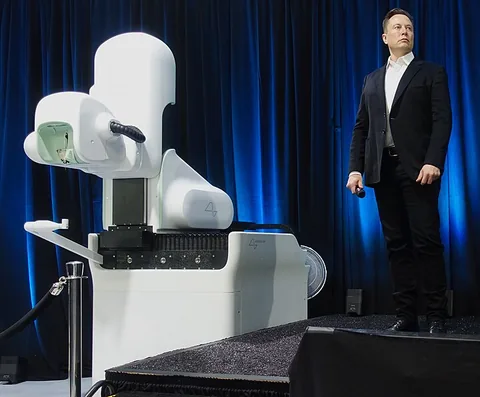 into your brain, and they get perfect readouts as a result. These guys are extracting brain information via a product you wear on top of your head. When I met Conduit, they had a small amount of human training data. And by the way, their model is showing scaling data: the more data it gets, the more accurate it gets at actually understanding your thoughts. It showed that if somebody typed their thoughts out—prior to them typing their thoughts out, their device, their software, their model basically, with 80% accuracy, understood what they were thinking. So if you read what the model thought they were thinking versus what they actually typed out, you got the same end result, but the words were different.
ExplainerImplants and headsets: two roads to a brain-computer interface
The closer the sensor sits to the neurons, the cleaner the signal. Neuralink's implant, 1,024 electrodes on 64 thin threads inserted straight into the cortex, picks up individual neurons, but it takes brain surgery, and so far only clinical-trial participants with paralysis get one. Non-invasive devices read the signal from outside, through the skull and scalp, which blur it. EEG is cheap electrodes on the head, but its accuracy is low; MEG is more precise, but it is a cabinet-sized machine in a shielded room. In 2025, Meta researchers' Brain2Qwerty model reconstructed sentences typed on a keyboard from MEG with a 32% character error rate on average and 19% for the best participants, versus 67% from EEG. Conduit's bet, as Ramtin describes it, is that accuracy will scale with data the way it does for language models.
And now they have 30,000 hours of human training data. And then in the last eight to 10 weeks in Silicon Valley, BCI became a very popular category. And as you know, Conduit raised a very large round, highly oversubscribed,43Oversubscription — investors are willing to put more into a round than the company plans to raise, so it gets to choose whose money to take. 13 term sheets, because now it's a great team working on a market that everyone cares about. If these guys succeed—and now they're going to go do a million-hour training data run—if their scaling laws hold,44Scaling laws — empirical patterns by which a model's quality improves predictably with more data, more compute and a bigger model. The whole race among AI labs rests on them. you could see a world where five, 10 years from now, you and I have a little device that we wear over our ear that understands our thoughts and communicates with our agent and can discern between actionable thoughts and non-actionable thoughts. And everything you're thinking about, your agent's just running for you in the back end; you just become the most efficient human being in the world.
And now everyone's like, wait a second, somebody could actually build a trillion-dollar-outcome company in BCI, and Conduit's latest round prices that into it. But perfect example of, you know, backing a founder who's brilliant, but on a market that people might not be that interested in at the time—but they were just early to a market, because I think smart people generally tend to understand markets well before the market starts to pay attention to them. You have a perfect example with Gavin Uberti from Etched.45Etched — a San Jose startup that makes specialized chips for running already trained AI models. Harvard students Gavin Uberti, Robert Wachen and Chris Zhu founded it in 2022; its first chip, Sohu, was designed only for transformers. Gavin met every great investor in Silicon Valley, and everybody walked away from the meeting thinking he was brilliant. I don't think there's a single VC who met Gavin that didn't think he was brilliant, but a lot of people just assumed a startup company cannot outcompete incumbents on, like, AI chip fabrication.
That's just never going to happen. And it wasn't until Sequoia blessed them with a $10 billion valuation46In July 2026 Etched raised $300 million in a Series C at a $10.3 billion valuation; Sequoia led the round. that everyone was like, oh, wait a second, now we actually believe that startups will totally run circles around the incumbents in this market. And you saw every other chip company in the market raise an astronomical valuation, because now people are like, this is now an obvious market to place bets in. But the market was obvious to these founders before it was obvious to the general market.
If I was to shrink all of that set of observations down to one metric, would it be there's, like, an ideal number of term sheets? Say Gavin's, because I know that story. It's not that he got no term sheets; he just got whatever number, handful it was. You know, he met every VC and got a small handful of term sheets from great investors. Is that the right way to think about that? Like, almost what you want is for the companies you're backing to get, like, two or three or four, and not 15 or something?
I mean, if a company gets 15 term sheets, it's going to get very, very expensive. If a company gets two to three term sheets, you're probably going to get reasonable pricing, because you have less competition, and, you know, you have a lot more of a competitive advantage, if you're a great investor, to convince that founder to take your money and get a core position in that business. I think it's more so: if a lot of people take a meeting with a company, they're generally taking it because the founder is very impressive, or they've heard great things about that founder from people in their network. Because for a company to get a large number of meetings with great investors, as you know, a lot of people need to vouch for that founder as a high-quality founder.
But if that company walks away from those meetings with a small number of conversions, it's probably not because everybody thought it was actually a bad founder or not that great of a founder. It's because people walked away thinking it wasn't that interesting of an opportunity. The default in venture, most of the time it's not that interesting of an opportunity, but in a few subset of cases, it's actually a very interesting opportunity. And most VCs, as I mentioned, are reactive and not proactive, and nobody wanted to be proactive about learning about that opportunity that this clearly very special, very intelligent person has decided it makes sense to dedicate the next decade of their career to, at a minimum, to working on something within that category.
07Is late stage the safe bet?
Backing big, proven companies is a safer bet, but Ramtin is wary that it has become consensus, since an easy strategy is rarely a good one.
If you think about the landscape today of seed versus, whatever you want to call it, early-stage A and B, versus late stage, anything else that's especially unusual to you about this period of time versus your whole history of doing this?
The valuations in this market—you really have to have, like, a really big imagination for what these companies can turn into to justify the prices you're paying for these companies. It's easy to have that imagination when you're looking at companies like the Anthropics and OpenAIs raising at trillion-dollar valuations and going public. The market has allowed you to actually expand your imagination to that point. When you look at what these deals are getting financed at, the thing that I'm seeing that is probably, in this market, reminiscent of 2021 is it's getting harder for people that actually know the market to understand what something will clear at, pricing-wise. In a somewhat normalized market, I can tell a founder, hey, I think if you go out and we get a number of term sheets and we have some leverage, we could probably get this valuation ballpark from a high-quality partner.
And I think the current place we're at in the market, I think you can get a term sheet as low as here and as high as here, and that's like a 4x difference in price. I'm not even on the money when it comes to where these things will price at, because it is so erratic that somebody might just come in and do something irrational to not lose the deal. And the irrational thing might be to pay triple what the second-highest bidder is willing to pay. And part of the reason that's happening in this market is every single founder you want to lead a financing round for has an expectation for what they want to raise a financing round at. And oftentimes it pegs off: they have a friend with a similar company with similar traction that raised at this valuation.
And the valuation that friend may have raised at, that may have been because one person paid 3x the second-highest bidder. You have these situations in this market where you'll give a founder an offer, which you think is generous, and they'll generally be offended by that offer, because they can point to an example from someone they know who was at a comparable stage that raised at like 3x or 4x the price.
Do you think, then, in this market, the most rational thing to do is go all the way to the other end of the spectrum, to the businesses where we can really investigate them? Everything you're describing feels so untethered from any underlying reality of a product, or traction of that product, anything that the business is ultimately going to get built on. It's literally just reputation and this weird multiplayer game of pricing, totally untethered. Whereas Databricks, where I think you're a big shareholder, it's just so much simpler to understand or think about an investment in Databricks from here. There are fantastic companies growing really fast that are really big. Do you think that perhaps the smarter thing to do is to go to the total other side of the spectrum, given this craziness?
I think there's probably less competition there. It's less competition. You could deploy large sums of capital into those companies and be a passive investor. I think it's probably a safe way to know that you have exposure to great companies. The main question is, if you're pricing those companies in today's environment, you need to kind of answer for yourself whether you believe it's 2019 or 2021. Because in 2021, you could have invested in Stripe at $100 billion, and Stripe was a great company.
It still is a great company, arguably one of the best. But today Stripe is $179 billion, which is great, but that's, what, like an 11, 12% IRR47IRR (internal rate of return) — the average annual return on an investment, accounting for when money went in and when it came out. over five years—which, by the way, is still better than like the bottom 75% of venture. So you can probably secure yourself a top-quartile position in the venture market by backing the best companies at the highest prices, because they are great companies, and great companies tend to continue to be great companies. They do tend to compound over time. But I do think the thing that gives me a little concern around that strategy is how consensus the approach you described has just become recently, because I've seen a record number of VC firms in the last 18 months honing in on the same idea of: there is a handful of obviously great companies that can absorb a huge amount of capital.
And as a VC, if you can demonstrate access to these names, you can raise large funds and become a passive investor with large sums of money in these companies—almost to the point where that's become a consensus strategy, of an easy way to deploy large sums of money and do well. And you might have more data on this than I do, but I can't really think of many times in history where, like, an easy strategy turned out to also be a good strategy long-term. So I think that's kind of the interesting thing about this market: if everybody believes that's an easy way to make money, it's probably not a great way to make money. But I can't think of any strategies that were considered easy money at the scale that people believe it's easy money right now.
08Data companies and the new angels
Ramtin thinks investors badly underestimated model builders' need for data, and the new wealthy angels from the coming IPOs will make Silicon Valley even stronger.
What about the data companies, where the narrative for years was, this is more like a trade than a company?48A trade — in investor-speak, a deal that profits from a temporary situation, as opposed to a company you can hold for the long term. We need to arm all these models with tons of data, but once we have the data, we're going to be good. Seems like maybe that narrative has shifted, and these things seem to be more persistent than one might have thought, or bigger than one might have thought. What do you think of the data companies?
Data companies are kind of like a conundrum to most investors, because I think the belief historically was these companies don't have long-term sustainability, because eventually the people they sell the data to will get all the data they need and not need their data anymore. But I think people have dramatically underestimated the data needs of these model builders. It seems that their data needs are only increasing, and there are certain companies that are just ahead of the curve on knowing what data they need. They can deliver the data at the quality they need it at, and they're going out and collecting that data. And some of the data is harder to collect than others, and those companies charge accordingly, and their margins are treated accordingly. I've seen two types of companies that sell data in robotics.
I just believe data is a gigantic business, and we can continue selling data for the next 10, 15, 20 years and collect tens of billions of dollars of revenue as a result of doing it. I don't think there is ever going to be an end to the data needs of these companies. And there's a subset of VCs that believe that and just want to invest in a lot of data provider companies. And then there's other companies that are selling data that are like, we believe that data is a means to an end, and that ultimately there is an end in sight to how much data we can sell and how much we can scale our business, but we believe selling the data is a really good way to finance our own research, to train our own robotics model, because we know this market better than anybody.
We know how to collect the data, and we can either go out and raise tons and tons of equity capital, which we'll do as well, but we could also finance our research by selling the data to the other model providers as well. So it's two camps, and they're both incredibly well-versed in the category, but they have two very different perspectives on what the ultimate outcome of a data-selling business actually is.
AdRamp, Vanta, Ridgeline, Rogo, WorkOS
Your finance team isn't losing money on big mistakes. It's leaking through a thousand tiny decisions nobody's watching. Ramp puts guardrails on spending before it happens: real-time limits, automatic rules, zero firefighting. Try it at ramp.com/invest.
As your business grows, Vanta scales with you, automating compliance and giving you a single source of truth for security and risk. Learn more at vanta.com/invest.
Ridgeline offers one unified platform that automates away the complexity across portfolio accounting, reconciliation, reporting, trading, compliance, and more, all at scale. Schedule a demo at ridgeline.ai.
Every investment firm is unique, and generic AI chatbots don't understand your process. Rogo is built by finance professionals. It's connected to your data, learns your process, and quickly produces client-ready outputs. Check them out at rogo.com/invest.
The best AI and software companies, from OpenAI to Cursor to Perplexity, use WorkOS to become enterprise-ready overnight, not in months. Visit workos.com to skip the unglamorous infrastructure work and focus on your product.
What do you think the impact is going to be of the newest influx of angel investors—all the people that are going to get incredibly wealthy from these big three companies, and maybe a few others, going public? Some of the balance sheets of the employees are the size of a huge angel fund or huge seed funds, even.
I think it just continues making Silicon Valley the best place in the world to start a company. I think the reason that no other ecosystem has ever taken off the way Silicon Valley has is because Silicon Valley has the largest density, by like an order of magnitude, of probably 100x or greater, of individual people running around writing $100K to $1 million personal checks off their balance sheet to help companies in the business before they're institutional. And I think that's just a unique thing you won't have anywhere else: people that'll write you a million-dollar check, and if they lose it, they don't care. It's the mentality you have here. And I think it's probably good for innovation, the more and more people you get that do that.
I do think a bunch of people making huge amounts of money off early angel investments is probably good to continue startup innovation.
09How Abstract is changing
Abstract has grown from a seed firm into an investor at later stages too, and Ramtin's biggest regret is that its funds were always too small.
I'm sure you want Abstract to keep evolving. How are you thinking about that evolution? Like, you've been kind of a pure-play seed investor for a long time and established yourself as one of the seed firms that founders come see when they want to raise money. Do you want to stay that? Do you want to evolve into more than that?
We have evolved into more than that. So I think in recent years, we've dabbled a little bit more at venture stage, which is defined as Series A through C. We've led some Series B financings in companies like Socket and companies like Doctronic or Dust.49Socket — a software supply chain security service; Abstract led its $40 million Series B in October 2024. Doctronic is an AI doctor and telehealth service: Abstract co-led its $40 million Series B with Lightspeed in March 2026. Dust is an AI agent platform for companies: Sequoia and Abstract led its $40 million Series B in 2026. Crusoe is an American company that builds AI data centers. And then we've also made some passive growth investments into companies like Crusoe. We put, I think, like 15% of our 2023 vintage fund into the formation round of xAI.50xAI — Elon Musk's AI company, founded in March 2023, maker of the Grok models. SpaceX bought it in February 2026. A formation round is the first financing when a company is created. So we were a big investor in the Series B round of Polymarket.51Polymarket — a prediction market founded by Shayne Coplan in 2020, where people trade contracts on the outcomes of elections, games and other events.
We've scaled. I think our first fund was $100 million. The latest one we just raised is $800 million. But to give you a sense of how much the market has shifted from when I went from a $100 million fund to an $800 million fund: when I was raising a $100 million seed fund, it was 2018, and I got so much shit from LPs saying that I was raising too big of a seed fund for a fund one, and that I should raise a smaller fund. And in this latest vintage, I went out for 800 million, and I got LPs commending me on my discipline for staying so small. So it's just funny that 100 million was seen as a large fund in 2018, and 800 million is seen as a small fund in 2026.
But I think if we look at some of the best deals we've invested in over the years that have produced the lion's share of the returns for our fund, in almost all of them, we were never allocation-constrained. We were capital-constrained. So I think we have a lot of data points that support that. We have very good relationships with a lot of the companies in our portfolio. We have great conviction in those companies, but historically our fund size hasn't given us the option to be a lead investor in those financings.
Having a relationship with a founder that trusts you, and knowing them early, and showing up outside of a traditional financing process, and giving them a number that they don't feel like they need to shop,52Shop — to take an offer around to other investors to see if someone will outbid it. If the first offer is generous enough, the founder has no reason to test the market. and taking enough of the round that they don't feel like they need to do much besides go ask other investors for pro rata53Pro rata — an investor's right to invest in later rounds in proportion to its stake, so as to keep it.—that's probably the most easy way for us to continue piling capital into our value-driving positions. But most managers that are building a venture capital firm or franchise at the stage that we're at, I think oftentimes they're overly fixated on what their fund looks like in the future and not fixated enough on what their current fund that they have could be. My general take is, if you deploy the capital you have as well as you possibly can, by the time you go out to raise your next fund, you'll have more optionality than you would have otherwise.
Every time we go out to raise, we basically base it off of—about six months before we go to market—what is our position in market today? How does it compare from our position in market when, you know, we raised our last fund? Do we believe that we can deploy more capital into the same quality of companies, if not greater quality of companies, than we were in the previous vintage? And if so, do we believe we can just raise a larger fund without compromising on the return profile we've created for ourselves? And if the answer is yes, then we raise a fund size that corresponds with what we believe we could actually deploy.
Somebody asked me what's, like, the biggest mistake I've made since building Abstract, and the idea is actually we've always raised our funds too small. In every single fund that we've had, I could have maintained an identical return profile with probably 2x the capital we had there. So from an LP perspective, they'd have gotten the same quality of return. From our founder perspective, we could have given them more capital. We could have been a lead investor more frequently than we were a co-investor, and that would have improved our position within those companies.
And then our name in the ecosystem as a firm that not only leads seed rounds, but also leads later-stage financings as well, if we had the ability to do so. So I think, if anything, the model is going to continue to be: do the best you can with the money you have, and then evaluate your position and raise accordingly at the next vintage.
10Three questions about the market
Ramtin rates the opportunity set a 10 out of 10 and froth a 6.5 to 7, and he is most bullish on companies that can keep top talent.
I thought it'd be fun at the end to ask the same three questions at the end of each of these. The first two are, like, one-through-10 ratings. The first rating is how exciting the opportunity set of companies—if you just think about, like, the current moment—feels to you relative to your own history. You're one of the people that has the most reps, you and your firm, just looking at companies. So opportunity set, kind of, versus history, one through 10, 10 being the highest. Frothiness, one through 10, self-explanatory.
10 is the most frothy; maybe, like, early-mid 2022542022 — the year tech stocks crashed: the Fed began raising rates sharply, the Nasdaq lost about a third of its value over the year, and venture valuations and deal counts followed it down. was like a two or something. The third question is, what do you think the bellwether companies are today? The companies—you can name one, two, three, whatever, and don't just say Anthropic—other companies that you think, if you watch them, they'll teach you a lot about what's going to happen or what is happening in the marketplace. You can answer them however.
Sure. In terms of enthusiasm around the opportunity, I'd say it's a 10 relative to my time in venture, which is coming up on 10 years now. And you see it with the subset of the market—it's not that people are funding all the best companies with huge amounts of capital. People want to fund so many companies. It's the largest number of companies we've found that we want to be investors in relative to any other vintage. In terms of opportunity set, it's a 10. In terms of frothiness, I would call 2021 a 10, and I would probably call this market a 6.5 to seven, because while the frothiness is there, there is also a lot to justify the frothiness, which I think is really interesting, because the rate at which these companies are growing and getting adoption and product-market fit is kind of unprecedented.
And that would warrant frothiness. I think if you leave out the obvious, the companies that are the IPO candidates near term, and you kind of look at what are the next generation of companies that we'd probably be looking at five years from now, those are the companies you definitely want to have exposure to in this vintage. I would put, like, NewLimit55NewLimit — a San Francisco biotech founded in 2021 with Coinbase CEO Brian Armstrong among its founders: it develops therapies that rejuvenate cells through epigenetic reprogramming. and Chai Discovery56Chai Discovery — a San Francisco AI company founded in 2024 that builds models for designing proteins and antibodies; OpenAI has backed it from the start. really high up on there, Isomorphic really high up57Isomorphic Labs — a British AI drug discovery company spun out of Google DeepMind in 2021; it is led by Demis Hassabis, a Nobel laureate for AlphaFold. on there, in terms of bio, and in terms of: can you build an AI-native next-gen Genentech?58Genentech — an American company founded in 1976, one of the world's first biotech companies; wholly owned by Roche since 2009. And the market opportunity for those companies is 500 billion to trillion-dollar outcomes, even bigger if they execute on their ambitions, and they have the best teams, the best investors, the access to the capital they need to actually pull those things off. I think those companies are super interesting.
I think the idea of owning your own data, owning your own knowledge, intelligence, is a really unique idea. And I think the company that probably pioneered that, and is the leader in the category, is Applied Compute.59Applied Compute — a startup founded in 2025 by former OpenAI researchers: it fine-tunes open models on corporations' own data so that companies own their models rather than renting someone else's. So I think it'll be really interesting to watch that as they continue to execute. I think it'll be very interesting to see how the prediction markets play out60Prediction markets — platforms where people trade contracts on the outcomes of events: elections, games, Fed decisions. The biggest are Kalshi and Polymarket; sports betting accounts for most of their volume. in a few years, but currently, I mean, the rate at which those companies are growing is insane, and they're not even AI companies; they're just true consumer businesses. I think Physical Intelligence is super interesting.61Physical Intelligence — a San Francisco startup founded in 2024 that builds general-purpose foundation models for controlling robots; its founders include Sergey Levine and Chelsea Finn. I think that could be a multi-hundred-billion-dollar, trillion-dollar company: exceptional team, a huge magnet for talent, huge ability to retain exceptional talent.
I think those are kind of the things that I always look for. In the market that you have in venture in Silicon Valley, there is no shortage of talent in Silicon Valley. But as a company, retaining the highest-quality talent is probably the single hardest thing you have to do as a company building in venture, because the best people you have at your company can get a job anywhere they want, at a higher comp and equity package than you're paying them at your company. So whenever I see companies that have a high density of that talent and ability to retain that talent, I just get extra bullish on those companies.
Fun three questions to end with. It'll be fun to compare in future episodes. Ramtin, thanks so much for doing this.
Of course, man.
If you enjoyed this episode, visit colossus.com.62Colossus — Patrick O'Shaughnessy's media company: a podcast network that grew out of Invest Like the Best, and the magazine Colossus Review. You'll find every episode of this podcast complete with hand-edited transcripts.
AdColossus, Ramp, Vanta, WorkOS, Ridgeline, Rogo
You can also subscribe to Colossus, our quarterly print, digital, and private audio publication featuring in-depth profiles of the founders, investors, and companies that we admire most. Learn more at colossus.com/subscribe.
Patrick O'Shaughnessy is the CEO of Positive Sum.aPositive Sum — Patrick O'Shaughnessy's venture firm; its portfolio includes Etched and Vanta. All opinions expressed by Patrick and podcast guests are solely their own opinions and do not reflect the opinion of Positive Sum. This podcast is for informational purposes only and should not be relied upon as a basis for investment decisions. Clients of Positive Sum may maintain positions in the securities discussed in this podcast. To learn more, visit psum.vc.
You know how small advantages compound over time? That's true in investing, and just as true in how you run your company. Your spending system is your capital allocation strategy. Ramp makes it smarter by default: better data, better decisions, better economics over time. See how at ramp.com/invest.
As your business grows, Vanta scales with you, automating compliance and giving you a single source of truth for security and risk. Learn more at vanta.com/invest.
The best AI and software companies, from OpenAI to Cursor to Perplexity, use WorkOS to become enterprise-ready overnight, not in months. Visit workos.com to skip the unglamorous infrastructure work and focus on your product.
Ridgeline is redefining asset management technology as a true partner, not just a software vendor. They've helped firms 5x in scale, enabling faster growth, smarter operations, and a competitive edge. Visit ridgelineapps.com to see what they can unlock for your firm.
Every investment firm is unique, and generic AI doesn't understand your process. Rogo does. It's an AI platform built specifically for Wall Street, connected to your data, understanding your process, and producing real outputs. Check them out at rogo.ai/invest.


