


Latent Space
Chapters
Most startups don’t, Cordova says; Linear did because its founders couldn’t yet tell what a great go-to-market team looked like.
Read the chapter- Cordova spent seven and a half years at Stripe, from early partnerships to products for startups, then ran platform and partnerships at Notion.
- If founders just can’t close every new customer themselves, she tells them to hire salespeople or a sales leader, not a COO.
- A COO helps when nobody can say what “great” looks like in a whole part of the company, or how to get there.
- Back then Linear had about 40 people, no public-company customers and nobody above 500 seats.
- Vercel and Ramp signed up and grew without ever talking to anyone at Linear.
Cordova’s work trial was the actual six-to-twelve-month go-to-market plan, and it exposed how little Linear told people about itself.
Read the chapter- Linear’s work trials are the work you would do once hired, not a made-up project.
- Marketing amounted to release emails that fewer than 10% of users subscribed to, plus one tweet, so she moved announcements into the product.
- Linear’s lone salesperson at the time now runs the whole sales team.
- Linear hired sellers who had sold to engineers and designers rather than SDRs or forward deployed engineers.
- The founders refused to outsource support, because it was often a customer’s first contact with a human.
At her first company offsite she crossed “go upmarket” off the slide: you don’t go to enterprise with one salesperson.
Read the chapter- The new goal was fast-growing companies that already had a tool: if Linear could win them, enterprise could follow in a year or two.
- Stripe, she recalls, also won new companies setting up payments long before it won switchers from competitors.
- Being 20% or 30% better won’t overcome switching costs, so the product had to be significantly better.
- Linear’s founders had hated the legacy tools when they worked at Coinbase, Airbnb and Uber.
- Anyone could start for free and bring Linear to work, and the company went after enterprise only in 2025.
An MCP server alone isn’t a business, Cordova argues; agent workflows have to live inside the product.
Read the chapter- Companies that hand all their data to outside agents through MCP won’t, in her view, build a great business.
- A year and a half after Linear’s MCP server launched, agents create more than half of new issues.
- Work created inside the app is growing too, because chat is a poor way to see a team’s work and is usually single-player.
- With Loops, Linear itself can assign an issue to a coding agent, and it counts that activity as well.
Karri Saarinen’s essay made customers ask what they were buying; Linear’s answer is a product development system with almost no manual work.
Read the chapter- Cordova calls it the innovator’s dilemma: Linear is small enough to walk away from its old category, while Google can hardly kill its own search business.
- The issue survives as a unit of work, but manually pushing it through statuses is dead.
- AI labs, nearly all of them Linear customers, and pre-AI companies like Ramp and Coinbase building internal agents asked for the change, which led to an API for agents inside Linear.
- Older companies didn’t push for any of it, but now come asking.
Linear’s sellers must know the product as well as its users, and they borrow the best workflows from customers.
Read the chapter- On recorded calls customers share their screens, and good ideas travel to the next account.
- Customers’ wish for an agent to sort incoming work became Triage Intelligence, a built-in feature rather than a separate agent.
- Reps can’t run a customer call alone until they pass training and get certified.
- Salespeople push copy updates to the website, marketers change how data is stored, and an engineer just approves the change.
Linear runs leaner teams thanks to tooling, but a human answers the customer.
Read the chapter- Linear has no SDRs because its customers would hate a qualification call, so account executives write their own outreach and go straight to the demo.
- AI drafts support replies and a human decides whether they’re good, while Cordova rejects the model where AI answers everything until a customer writes back angrily.
- Customers ask “Was this AI?” because human support replies so fast, and many call it the best support they’ve had in years.
- AI finds the best moments in a two-hour customer interview, but a person writes the story.
Solutions engineers make a migration look easy, but they don’t implement Linear for the customer.
Read the chapter- An engineer can build a ServiceNow integration or a small importer by morning to show how the switch would go.
- Linear doesn’t go into customers’ systems the way forward deployed engineers do, on the principle that it should be easy enough to integrate on your own.
- Sales helps the engineer who loves Linear win over IT, procurement or the CTO.
- One CEO moved a thousand-person company over a weekend, while another account took two years or more because its champions couldn’t convince the CTO.
Slow companies don’t decide faster, but buying gets easy when a product fits the AI budget.
Read the chapter- At some companies the AI budget, money that appeared out of nowhere, is not infinite but very high, though that is starting to change.
- Buyers sign one-year deals or pay for pilots with new AI vendors, but hesitate at three years.
- On a three-year deal with Linear the customer gets a discount and Linear gets contracted revenue, but no price increases in between.
- With 40,000 paying customers on seat pricing, Linear can’t jump to $100 million overnight, unlike a vendor with a few $30–40 million defense deals.
Outcome pricing works where the outcome is easy to count, as with Fin; Linear prices from its own costs for now.
Read the chapter- Fin’s dollar per AI-resolved ticket is easy to understand, but what auto-triaging a bug is worth depends on who you ask.
- Chat with Linear Agent is free, coding sessions cost the API provider’s published rate plus a small margin, and Loops use AI credits.
- Seat pricing stays and nothing that was free started costing money: usage charges apply only to new features.
- Features launch free with a clear notice they will be paid later, and Linear prefers to price high and cut rather than the reverse.
Linear announced its enterprise push in 2025, then chose agents over part of the enterprise roadmap, which Cordova says put it ahead of competitors.
Read the chapter- Almost everything in her original plan got done: the team, hiring, a steady launch process.
- The plan included no MCP server, no agent platform with new APIs and no partnerships with Codex, Cursor and GitHub Copilot.
- The trade-off was features for very large workspaces, such as sub-teams, multi-level workflows and cross-team roadmaps.
- While competitors were slow on agents, she says, big companies put Linear on shortlists it would otherwise have missed.
Cordova joined in 2023, in the middle of a startup downturn, and learned to change plans quickly.
Read the chapter- After the flush years of 2021 and 2022, startups were cutting costs, and Linear sold mostly to startups.
- Neither the roadmap nor the marketing message is planned more than six months out now.
- Summer 2025 didn’t slow down as usual, and launches now happen any day of the week.
Linear’s real moat, Cordova says, is its team, not design or speed.
Read the chapter- Linear will delay a launch rather than ship something sloppy, but cuts scope where it makes sense.
- The best model changes overnight, and a company nobody had heard of two months ago raises at $10 billion.
- Hiring a hundred reps at once was never the plan: companies Linear’s size have nearly twice its headcount, and slow growth built trust between engineering and sales.
Cordova brought Stripe’s headcount ratio to Linear and left behind its habit of always looking for someone better.
Read the chapter- Stripe decided engineering, product, design and data had to stay above 40% of headcount, so if sales wanted more people, it had to help hire engineers.
- Linear has no hard rule, but Cordova built a headcount spreadsheet in her first weeks and tracks the functional mix.
- A company on the rise can always hire someone two levels up, but Cordova would rather promote the people she has.
- In three and a half years she has never had an escalation over a poor support experience.
Venture gave Cordova breadth, but she prefers execution inside a company.
Read the chapter- She left Notion once she had hired her way out of the roles she wasn’t hired for, which was the company building she loved.
- Before product-market fit the job is to back the right people and get out of the way, and her experience matters afterward.
- Everyone’s money is the same, so investors sell experience, pattern recognition or a great Rolodex.
- Venture taught her what data board members want and what help to ask them for.
Quotes
Why “a bit better” isn’t enough
“I don't think you can be, like, 20% better, 30% better, and get people to switch because there's a switching cost involved.”
Cristina CordovaRead from 16:07Why people open your product
“I think you have to bring the agentic workflows into your tools and you have to make them better than the tools that people would be using externally to interoperate with your system. Otherwise, there's no reason for people to go into your tool.”
Cristina CordovaRead from 20:10What died with issue tracking
“Yes, the unit of the issue still exists. But we probably shouldn't have a world where people are, like, manually tracking work.”
Cristina CordovaRead from 24:01AI in support
“I would much rather have AI like draft an answer, to the specific question based on the knowledge that, you know, it has coming in. And then a human can decide like, is that a good answer or not?”
Cristina CordovaRead from 37:48On speed
“You just don't have the same time to like plan a message, plan a strategy, like execute it perfectly as you used to, like, in the old world.”
Cristina CordovaRead from 1:01:34Why sales should recruit engineers
“If sales wants to hire more people, have sales help us hire engineers so that sales can then hire more people.”
Cristina CordovaRead from 1:09:53On Linear’s support
“I've literally never in three and a half years gotten an escalation because someone had a poor experience with our support team.”
Cristina CordovaRead from 1:14:33On investors
“Closed mouths don't get fed. So if you don't ask for things, they're not gonna give them to you.”
Cristina CordovaRead from 1:21:36
Summary
Linear COO Cristina Cordova explains how a company with a single salesperson got to $100 million in ARR. Three weeks into the job she struck “go upmarket to enterprise” off the company goals: Linear first had to learn to pry growing companies away from incumbents, and only went after enterprises in 2025, when an unplanned MCP server, agent platform and coding-agent partnerships pushed part of the enterprise roadmap aside.
Agents now create more than half of Linear’s issues, yet people keep coming back to the app to see the whole picture, and Cordova argues that a company content to be a database for other people’s agents will lose. She also covers why Linear has no SDRs, why AI drafts support replies but humans send them, how to price AI features, and why engineering should never fall below 40% of headcount.
Advice
Don’t hire a COO just because you can’t keep up with sales: hire salespeople or a sales leader. A COO makes sense when you can’t say what “great” looks like in a whole part of the company.
Set goals your team can reach today and serve the customers you can serve incredibly well: their reference calls will land the next, bigger ones.
To get a customer to rip out a working tool, you have to be significantly better, not 20% or 30% better: switching has a cost.
Don’t settle for being a database for other people’s agents: build agent workflows into your own product so people have a reason to come in.
Decide what kind of company you want to be and watch your functional mix; if engineering and product should drive it, keep them above 40% of headcount.
Before you hire a new boss above a strong employee, give that person the chance to grow with the company.
Tell your investors and board members exactly what help you need: closed mouths don’t get fed.
Mentioned
 Linear00:51Cordova explains how the company grew from a startup issue tracker into a product development system built around agents.
 Notion00:55Cordova ran platform and partnerships there, and liked hiring for other people’s roles best of all.
 Stripe00:55Cordova spent seven and a half years there and brought back the 40% engineering rule.
 Vercel03:32Cordova’s example of a customer that signed up and grew without ever talking to sales.
Show 17 more mentionsShow fewer mentions
 Ramp03:32Cordova’s example of a customer that came in without sales, and later of a company building its own agents, the reason Linear built an agent API.
 Coinbase16:07Co-founder Jori Lallo worked there; later Cordova cites Coinbase as a company building its own agents.
 Airbnb16:07Karri Saarinen worked there; Cordova says the founders’ experience with legacy trackers is what drew them to the market.
 Model Context Protocol20:10Cordova argues an MCP server alone isn’t a business: a company that becomes a database for other people’s agents will lose.
 Google24:01Cordova cites its dilemma: an AI answer above the results could pull attention from the ads.
- The Innovator's Dilemma24:01Cordova uses the idea to explain why small Linear can abandon its old category more easily than Google can abandon search.
 Gong29:40Linear records sales calls in it to learn from customers’ workflows.
 GitHub31:52Cordova contrasts GitHub Issues, intimidating for non-engineers, with Linear.
 GPT-6 Astra40:41Chatha notes that this model already writes well, after Cordova says Linear generally dislikes AI prose.
 ServiceNow41:45A solutions engineer built a demo integration with it overnight for a prospect.
 Fin50:20Cordova holds up its per-resolution price as the model of outcome-based pricing.
 Anthropic52:34Its models, like OpenAI’s, can be chosen for a coding session in Linear.
- OpenAI52:34Its models and harness can be chosen for a coding session in Linear.
 Codex57:08One of the unplanned partnerships of 2025; Linear Agent now writes code through Codex too.
 Cursor57:08Linear built its integration with the AI code editor in 2025, at the expense of some enterprise features.
 GitHub Copilot57:08GitHub’s coding agent, integrated in 2025; Copilot’s cloud agent for Linear became generally available in July 2026.
 Uber1:09:53Cordova’s example of a company that needs a large operations team, unlike Linear.
Transcript
01When a company actually needs a COO
Most startups don’t, Cordova says; Linear did because its founders couldn’t yet tell what a great go-to-market team looked like.
Cristina Cordova,1Cristina Cordova has been Linear’s COO since 2023. She joined Stripe as its 28th employee and first partnerships hire (Shopify, Squarespace, Apple), ran platform and partnerships at Notion, and then, as a partner at First Round, invested in more than 50 startups (First Round Review). you're the COO of Linear.2Linear was founded in 2019 by Karri Saarinen (now CEO), Tuomas Artman and Jori Lallo, who had worked at Airbnb, Uber and Coinbase. An employee tender in August 2026 valued it at $2.5 billion, double the price of its June 2025 Series C (Linear). Could you introduce yourself?
Yeah. So I'm Cristina. I've been at Linear for about three and a half years now. Joined as COO, and I'm still COO today. Prior to Linear, I spent time at Notion leading our platform,3Cordova joined Notion in 2020, when it had about 40 people, and ran its public API, partnerships and self-serve growth. so the build out of our APIs, and then our partnerships and self serve growth initiatives as well. And then before that, I was at Stripe for seven and a half years. And there, I led a lot of our early partnerships and go to market, and then moved over to the product side and built out some new products for early stage companies. So I've been probably anywhere from like the product side of a company and like managing engineers all the way to, managing, you know, the business side of a company as well, which has been really fun.
So why did Linear hire a COO at, like, 40 employees? Is that, like, odd or is that pretty normal?
I mean, I generally don't believe every company needs a COO. Right? Like, when I talk to founders and they're like, hey, like, I think I found product market fit.4Cordova comes back to the term later: she says she has always joined companies right after they found product-market fit, the phrase Marc Andreessen popularized in 2007. Like, how do we start to scale, like, the business side of the company? I am often, I feel like, cautioning against maybe hiring someone like me. So I think for every company, it's a little bit different. I think you have to really understand as, like, a founder, like, what are the things you need and what are the things you're looking for and the people that you bring on to the team. Often early on, it's just like I need someone to, like, sell something. Right? We have expanded beyond the capability of the founder CEO to sell every net new customer. Right? So there, I generally talk about, well, you should hire folks in sales. Maybe hire a sales leader to build out a team. Right? But if you're not exactly sure what you're looking for in, like, marketing or operations or other parts of the company, then it may very well not make sense to hire someone like me. You know, I think with the Linear founders, you know, they were incredibly focused on, like, design and engineering and product. And I think they had a really great, you know, kind of combination of skills between the three of them. But as we were starting to scale the business side of the company, they didn't necessarily look at, like, the next salesperson that we hired and said, I know exactly what we're looking for here, and I know whether or not sales is performing really well. Right? So if you don't look at different parts of your company and say like, okay, I know what great is, and I feel like I have a good sense of, like, how to get to great, it can sometimes be helpful to hire someone like me or, like, a functional leader, like, when it comes time to do that.
Yeah. So, like, what did the business look like at that point? Like, can you talk about, like, what revenue they were at? Or
Yeah. We were probably... I wanna say, you know, we had some large customers, but no, like, public company customers. Probably no customer above, I wanna say, like, maybe 500 seats5Linear’s cheapest paid plan is $10 per user per month billed annually, so 500 seats come to roughly $60,000 a year (Linear). or something like that. So I would say, like, we mostly tapped out at, like, mid market.6Besides the usual SMB, mid-market and enterprise tiers, Linear runs a growth segment: fast-scaling startups, the customers Cordova chose to go after first. And we were probably best well known for being a great product for startups, but not necessarily a great product for other companies at that time. You know, and I think at that point in time, we were we're doing well with like a product led growth model where most people were using our product because they signed up self serve. And then grew with us over time. So companies like Vercel7Vercel, the web hosting platform behind Next.js, and Ramp are Cordova’s textbook cases of product-led growth: both grew from startups into large businesses and use Linear without ever having talked to its sales team. and Ramp8Ramp, the corporate card and spend management company, switched to Linear in October 2019, the year both companies were founded, and has since grown to 1,600 people (Linear). and many other customers like that, you know, really never talked to a human being at Linear. Signed up for the product, started using it, and then started scaling, which was great. Like, you know the product can do a lot of work on its own. But it was also start... Like, time to start selling to, you know, the company that is not even gonna put, like, a lick of data into your service without, you know, signing a contract and doing a pilot and surveying their team on, you know, what tool they're using before and what... You know, what tool is this and what's better. Right? So that was a very different kind of motion for the company to start scaling to larger companies. And that was, like, pretty much my objective. And we've at least 10xed, I think, since I joined. So...
And you joined, like, four years ago?
Three... Almost three and a half years ago.
02A work trial with a real brief
Cordova’s work trial was the actual six-to-twelve-month go-to-market plan, and it exposed how little Linear told people about itself.
Oh, okay. So I think the Linear founders have talked about this. I think you have as well that, like, before you join Linear, you always do a, like, a trial period?9Every Linear hire, from engineers to executives, ends with a paid work trial: two to five days on a real project with the team. In 2023 the company said the practice had helped it grow past 50 people with 96% retention (Linear).
So did you also have to do a trial period?
I did.
Okay. So, yeah. Like, what was that like?
Yeah. I mean, I think my project was quite simple. It was something like, you know, come up with the go to market plan for Linear, you know, with a bounded time period, like, for the next six to twelve months or something like that. Right? And I think the good thing about that is that, you know, that is the job. Like... Right? So you're not giving someone some, like, fictional project that's not really, like, representative of, like, what they would do when they join the company. It's like a real, project. And that would, you know, effectively be my job in joining the company. So you know, if they didn't like the outcomes that I produced as part of that project, they probably, you know, shouldn't hire me. So I think it was a really good way of saying, like, I have some ideas of what the company can do better, but also I wanna, like, get feedback from the people who are on the ground. Like, you know, we had a salesperson on our team. We had someone doing customer success. We had some people doing support and, you know, one or two folks doing marketing. Right? So kind of getting their perspectives on different parts of the business and, like, where I should focus and where where to prioritize.
And then making sure that, like, the company was also bought in on, like, that vision for the world, was I think really helpful for me. And then when I actually started at the company, it was almost like I have this little blueprint for, you know, what my job should be and what I should accomplish.
Can you talk about, like, what was in that plan?
Think a lot of it was like brand and marketing oriented. So like, you know, things around like making Linear inevitable in a lot of ways. So, you know, either you're already on Linear or you should be like planning your move to Linear effectively. And most companies that we wanna acquire should be, you know, in, you know, one world or the other. So a lot of that was around, you know, driving the brand, building storytelling, I think increasing awareness for the company because I think we were we were well known, but I would say in like particular niches, not really outside of
Yeah.
So it's like, you know, we were doing marketing, but like the only marketing that we were doing was like sending out emails if we, had a change log of something new that we released.10Linear’s changelog is a page on its site with an illustrated post about new features almost every week (Linear). Cordova found that fewer than 10% of users got it by email. And it turns out that, like, less than 10% of users, like, subscribed to emails. So most people didn't necessarily know even just, the new features we were shipping, which was interesting. And then we would, like, send a tweet.
Okay. Like, from from the founders' accounts or, like, from the company account?
And then and then, you know, the founders would reshare and, you know, they have their own, like, pretty strong, like, social presence as well. But, you know, that was like the extent of it, really. Like, so, you know, a lot of it was just thinking about, okay, like, how are we telling a more holistic story in a better way? And then how are we actually reaching the people that we wanna be reaching? It turns out that, like, actually a lot of our users are, like, in the app, you know, day to day. And so, like, why are we not just, like, giving them notifications about, like, what's changing within the product, like, within the place they're already at every day. Right? So, you know, just thinking about things that could be great ways to market to existing users or market to, like, net new customers that also didn't feel like off with the brand. Right? So I spent a lot of time on that. A lot of it was also just like growing the sales team. You know, I think a lot of early stage companies, especially that are like engineering driven, like product led growth oriented are like, you know, the product should sell itself. And then everyone realizes like, well, that gets you to a certain point. And then when you want to, like, grow faster, right, you also need to start thinking about, reaching people in different ways. And not everyone buys products self serve. And especially when you're choosing a system that's like so core to like your product development process, which we are. A lot of companies are not going to make that decision without like building trust with human beings. And, you know, when I was doing my work trial, we had, one person on sales. Right?
That was nice.
So it was just like, you know, there's there's only so much you could do with, like, one person.
Right? And were they, like, an experienced salesperson?
Yeah. He's actually our sales leader today.
Okay. Cool.
ExplainerThe roles in a B2B sales team
Linear grew product-led: people signed up on their own, tried it free and brought it to their teams. Selling to companies that run a pilot and a procurement process takes a sales team, which classically splits into roles. An SDR (sales development representative) cold-emails prospects and runs the first, qualifying call: is there a need and a budget? An AE (account executive) owns the deal through signature. A solutions engineer answers technical questions and builds demos. Customer success makes sure a signed customer actually adopts the product and renews. Linear skips the SDR step entirely: its AEs write their own outreach and go straight to a demo.
So leads our entire sales team. So he's great. But, you know, at the time, I would say this wasn't really on him. It was more on the company. It's just like, how do we actually think we wanna grow this team? Right? You can grow a sales team in lots of ways. You can have like lots of SDRs. We don't have any SDRs. You can have forward deployed engineers11Cordova sets her solutions engineers apart from forward deployed engineers, who work on site inside a customer’s systems to fit the product to its needs. Palantir pioneered the model; in 2025–2026 OpenAI, Anthropic and many AI startups adopted it. now. That's very popular. Right? We actually don't do, forward deployed engineering. We have solutions engineers, which I, you know, I think is distinct and somewhat different. But we added those later. We really...
And that's part of the sales org?
Yeah. We really optimized our team at the beginning for hiring AEs who had experience, like, selling technical products. Because we knew, like, if you had sold to a designer, if you had sold to an engineer before, we wouldn't necessarily have to teach you how to do that. And I think selling to someone who's like very discerning, doesn't wanna see your fancy slides, just wants to get into a demo you know, is very different from selling to like a person in, I don't know, people ops or, you know, something else. So, looking for people with that, like, very explicit experience and then making sure that we could, like, onboard them and train them and get them, like, really competent in the product itself. Because that's required to build trust with our customer. Right? So just figuring out, like, what's different about this company and what's going to be different about hiring or scaling, you know. And also, like, what's the way that the founders wanna do it and, like, can we do that? So support is an interesting example. When I was interviewing, the founders were very clear that, like, they did not wanna outsource support. And I've never worked at a company that didn't outsource support. So that was like...
Yeah. Thought Stripe does it internally. Right?
No. They outsource.
Oh, okay. Interesting.
Unless something's changed since I was there. But, you know, they have internal folks who work on support too. But they do outsource. So, you know, I think for us, that was something that we really wanted to maintain because we really cared about, like, delivering a high quality experience, delivering a fast experience, and knowing that for a long time, we didn't have a sales team. Right? So because we didn't have that, we knew that your first touch point, often, if you wanna talk to a human being, was going to be support. So the support better be good. Right? And so we've still been able to figure out how to scale the team today into, like, a global team that does not outsource at all. So, you know, we'll see what the future brings. You know, never say never on any of these things. But you know, are certain ways that we wanna do things and we probably wanna do them for like as long as possible, as long as long as it's like feasible for the business and makes sense.
03Crossing enterprise off the list
At her first company offsite she crossed “go upmarket” off the slide: you don’t go to enterprise with one salesperson.
Yeah. So when you first joined, like, I guess I've never been in a sales role, but like do you have to say, okay, we're starting with startups and we can't just immediately go to, like, big enterprises and start selling them? We have to, like, kinda go step by step. So, like, did you have to go, oh, we have to first get, like, medium sized businesses, and then at some point, we'll go enterprise? Like, how does that work?
Yeah. So when I joined Linear, I think we had, like, three goals, like, three company level goals. And I think one of them was, like, move up market to enterprise. And then we had, like, a company off-site three weeks after I joined. And I, like, got up in front of the whole company, which was, like, I don't know, 35, 40 people at the time. And, like, I showed the slide of the three goals, and I, like, crossed the, like, one that says we're gonna go after enterprises out. Because I was like, we have one person. We have literally one person on sales. Like, you know, you're not going upmarket to enterprise with one person. Like, you know, so you have to think about, like, what are you capable of doing? What do you need to, like, learn in order to get there? And then do actually have the resources to, like, accomplish that goal? Right? And, you know, I don't think we had any of those things at that period of time. Right? We had companies that we had primarily won because they had scaled into being like a growth stage business or like a mid market business effectively. But we hadn't done a lot of like acquiring net new, like mid market companies at that point. So I changed that goal to say like, no, we're gonna go after like companies in the growth segment. And that's gonna be our goal. And if we can win a lot of companies who are in the growth segment, who already have, like, a tool, that does in some ways what we do, and we have to go in and we have to convince them to, like, rip that out and replace it with Linear, then if we're able to do that, that gives me the confidence to say that, you know, in a year or in two years, we're gonna be able to go after enterprises.
But like, I don't have confidence in that now, so why would I set that as a goal for the team? So completely agree. It's like really about setting those baby steps and making sure that, like, you're doing well with companies that you can serve today incredibly well. So that those companies, when they're doing like, you know, they're getting, like, the reference calls12Reference calls are a standard step in an enterprise deal: before signing, the buyer asks the vendor for current customers of similar size and quizzes them about the product and support. That is why happy growth-stage customers became Linear's ticket into enterprise. from the larger companies being, hey. Like, do you like Linear, and has your experience been good? They're saying, like, really positive things. And that helps us land, like, the net new customer. And, like, it worked very similarly when I was at Stripe. Like, we did not win a lot of, like, net new companies that were switching over from a competitor for a long time. We did a great job, like, winning every net new business that was created. So, like, a startup that's implementing payments for the first time.13That was Stripe's path from 2011: a developer-friendly API let a startup start taking payments in an evening, so new companies picked it first. Winning large customers away from legacy processors came much later. Wikipedia And then we kind of started to win companies who were switching over. And some of that stuff just takes time. It's very... Like, it's very different to sell a product where you have to rip technology out that already exists and replace it than just to sell something that's, like, nice and shiny and new on top of, like, an existing set of systems.
Yeah. So knowing that I was in, like, a very similar position in this role, it was important that, like, I just oriented the team around, like, what I felt was like a solvable problem. And then only in 2025... So that was 2023. Only in 2025 did I, you know, go up in front of a company and say like, we're going after enterprise this year. Right?
Oh, wow.
And that was when we started our enterprise sales segment and built out that team. So...
Okay. You guys are going like medium sized businesses. And so you are getting everyone to basically like... Because most people... Most companies have an issue tracker. Right?
Or some kind of... So you have to try to like rip them away from them. So yeah. Like how do you convince them to say, oh yeah, we're using x y z product. It works for us. But, yeah, like, you know, pitch me, basically. And Why should I switch it?
The early days, it was about being, like, significantly better than what the alternative solutions were. Right? I don't think you can be, like, 20% better, 30% better, and get people to switch because there's a switching cost involved.14Linear works to lower that cost itself: the product has built-in importers for Jira, Asana, Shortcut and GitHub Issues, plus a dedicated Jira migration guide with sync during the transition. Linear Right? So I think you have to figure out how you articulate how your product is better than what is already, like, serving the market reasonably well. Reasonably well enough to... That they have like a lot of companies that are using their product. Right? But the good thing about the space that we were entering, and I think one of the reasons why like the Linear founders chose this space were because they were all users of those legacy tools15Chief among those legacy tools is Atlassian’s Jira (2002), which can be configured for almost any process and is notorious for it. Linear was built from day one as the fast, opinionated alternative; TechCrunch routinely calls it an “Atlassian rival” (TechCrunch). right, when they were working at, like, Coinbase and Airbnb and Uber. And so they knew, like, no one liked these tools.
Yeah. Right? And when they were getting rolled out, like, at their companies, they were like, oh, no. Like, you know, the fun time is going away. We have to start using these tools. Right? So, in a lot of ways, it really helped that they had this, like, knowledge and existing awareness of, like, the feeling that came with the competitors in our space and could figure out how to build a product that got people really excited, like, to manage their work. Right? Which is presumably not something that you would expect. So a lot of the emphasis in what we built early on was in like design and UX. Right? Make it a product that people want to be in every day and have to use. The hard part about that is that people have to like try it before they get it. Right? Versus, like, seeing a couple slides in a sales deck and being like, okay. Like, I get it. Right? So one of the things that we did, I think, very well strategically was just having a product that anyone could start using. So, you know, a free product initially, that once you hit certain limits in terms of usage, you would have to start paying for.16Linear’s free plan today allows unlimited members but caps you at two teams and 250 issues (Linear). So a lot of people who started to use Linear for their company, actually were just playing around with it for their own purposes for free and got a sense of like how usable it was and how much easier it would be to utilize the product compared to competitors. So we started very much there. And I think that worked well for a period of time. Now our approach in terms of like how we sell Linear is very different. We're typically talking to companies about the sea change in the space that has happened over the last year and a half, two years in terms of like, you know, your entire, like, product development process has been upended. The way that you build products has completely changed.
And it doesn't make sense anymore to live in a world where you are... Like, you have, like, a manual way of saying, like, oh, like, I found a bug. Oh, I'm going to, like, report that bug into my issue tracker. Oh, I'm going to label it and assign it to this other person. And then that person is going to fix it and, you know, add a status update and then close it and then, like, notify the customer. And every step in that path is, like, completely manual. That's just... It doesn't make any sense for the world that we live in now. And you talk to most companies and they're like, yes. I completely agree. And so we've really oriented the company in the last year and a half around agents and agents performing a lot of the parts of the workflow that are effectively not product development. Like everything I described in that whole chain is like, that's not you building products. And so if you can make Linear a really great tool for agentic workflows, then the individual engineer or the individual PM or designer who's using Linear can ultimately be spending more of their time building products and less time like manually moving around work in a system to prove that they are adding value to a company.
04Agents create more than half of all issues
An MCP server alone isn’t a business, Cordova argues; agent workflows have to live inside the product.
Yeah. That's really interesting because it seems like the pitch early on was the user experience. Right? And now now it seems like the humans are not going to be interacting with the with the UI.
I actually think that a lot of companies right now are feeling like it's gonna be okay to just be like a database and, you know, have an MCP server17MCP (Model Context Protocol) is the open standard Anthropic introduced in November 2024 that lets assistants like Claude, ChatGPT or Cursor read a service’s data and act in it. Cordova’s worry is that a company whose work all happens through someone else’s chat window becomes a mere database. and, you know, give all of their data away to agents and have the agents like interoperate with them and think that like that's going to be a great business model. And I don't think that's going to be a great business model ultimately. I think you have to bring the agentic workflows into your tools and you have to make them better than the tools that people would be using externally to interoperate with your system. Otherwise, there's no reason for people to go into your tool. Right? And so for us, you know, the metric that we're typically looking at and we've seen like a lot of change here where, you know, we launched our MCP server in 2025. I think we were basically the first company in our space to do it.18Fact-checkOverstated: Linear opened its remote MCP server on May 1, 2025, as one of Claude’s first ten integrations, but direct rivals Atlassian (Jira) and Asana launched theirs the same day (Anthropic). And now, over 50% of issues created on Linear are created by agents in just like a year and a half.19Close to Linear’s own data: in the week of August 3, 2026, agents and MCP clients created 2.44 million issues versus 2.48 million from people and integrations, nearly half. Two years earlier AI created fewer than one issue in a thousand (Linear).
Source: Linear, “AI usage patterns in software teams”; excludes imported issues
Yeah. The work is created in an entirely different way than it was before. You know? So that kind of illustrates how much has changed in a pretty short period of time. And then when we look at how many users are coming to the app and integrating or creating issues within the app itself, that's also going up significantly. Right? So sometimes people believe that like, oh, I'm just I'm just using MCP server for everything now. But like you are also going back to the app and you're interacting with it because you need to visualize things. And often, like, a chat interface isn't the best way to visualize all the work that a team is doing. It's not great for collaboration because it's typically, like, single player only. And so I think for us, as long as, like, you know, the MCP usage line and the app usage line are kind of going up into the right together it proves that, you know, we have both a great UX that's great for humans and also great for agents. Right? And that's like our goal, I think, as a product, that you can be great at both of those things. And, you know, it doesn't mean that like now that agents exist, you, like, don't have to care about the interface.
And app usage is measured by just, like, number of people using it? Because, like, I'm I'm assuming also, like, your customer base is just growing. Right? So how do you
Work created in the application. So, you know, our, like, unit of work, like, smallest unit of work is the issue. Right? So if you just look at, like, work created, like, that's like a human going into the app, like our mobile app, our desktop app, you know, our web app, all of those places, and creating work. Right? If you look at how the work is like moving through the pipeline in a way, like getting assigned to an agent, sometimes that's done manually by a human. You know, sometimes an agent does it.
But assign... Like delegates to another agent. Right?
Yeah. Often, we're now part of the workflow. Right? You can use a feature we have called Loops20An example of Linear’s own agent doing the work. Loops, launched on July 20, 2026, let you describe a job in plain language and have Linear Agent run it on a schedule or in response to an event, for instance triaging incoming issues, researching a root cause and handing it to a coding agent (Linear). that will, like, automatically, assign an agent to a given issue and have the agent start, like, coding against it, for so in a lot of cases, it's like an agent is doing the work, but it's a Linear agent. Right? Which we also wanna see. Right? So we have to look at, like, multiple different factors. But it's generally like app sessions that we're looking at in terms of trying to understand activity.
05“Issue tracking is dead”: what Linear sells now
Karri Saarinen’s essay made customers ask what they were buying; Linear’s answer is a product development system with almost no manual work.
Yeah. So I guess that leads me to like Karri writing this blog post21“Issue tracking is dead” is a manifesto by Linear CEO and co-founder Karri Saarinen, published on March 24, 2026, the same day Linear Agent launched. Trackers, he writes, were built for a handoff model in which a PM scoped work and engineers picked it up later; with agents the issue remains but the ceremony around it loses its point (Linear). like issue tracking is dead. So I'm assuming you were in the middle of selling some contracts when he wrote that. So how do you explain to your customers that like, hey, our entire business was issue tracking before and now our CEO just wrote this blog post. Like how do you explain that to them and how did that transition happen?
Yeah. Well, I think the great thing about our business is that we're not, like, so big to, like, kill ourselves. Right? Like, it's probably really hard if you're Google to, like, kill the search business. Right? And put, an AI, you know, box at the top of every search result,22Google did exactly that: AI Overviews started appearing above US search results in May 2024 (Google), and publishers have complained about lost clicks ever since. and maybe no one's gonna look at the ads. Right? So your entire business is upended. And so, you know, I think that's a little bit of the like innovator's dilemma23Cordova is borrowing from Clayton Christensen’s 1997 book The Innovator’s Dilemma: market leaders lose to newcomers because embracing a new technology would undercut their own profitable business. Linear, she argues, is small enough to sidestep the trap. challenge that a lot of tools that were, like, pre AI have, and we were certainly one of those companies that was pre AI. And so for us, like, the great thing is that it's like, okay. You know, we see that the world is going in this direction, and you can either, like, lean into it with the plan that you build the best product for the new era rather than trying to, like, hold on to an era that, like, is probably not going to exist in a few years. Right? So, you know, if the workflow that I talked about with, like, you know, this like manual intervention by humans at every step of the of the process is not going to be the work that we live in. Like, you look at Linear now and like, yes, the unit of the issue still exists. But we probably shouldn't have a world where people are, like, manually tracking work. So, like, that's what's dead. Right? So in a lot of cases, when we were talking to various customers as this, you know, blog post came out, most of our customers were like, yeah. Tracking is dead. And by the way, like, what are you guys? What am I buying? Right?
And so it's much more oriented around, you know, now being like a product development system. Right? We want you to focus on building better products, and we are going to build a system that enables you to do so with very little manual work. So it's also about, you know, saying, like, we're gonna create a new category. And like, yes, we will, you know, in a lot of ways still play in the old category, but we are also driving the vast majority of our resources as a team into this new category of things like agent orchestration, managing work in a way where you don't necessarily have to be doing a lot of manual, you know, taking tasks through a system, and that you're operating far more agentically, both, like, within Linear and also outside of Linear.
So I guess, like, that transition or, I guess, that blog post, were you blindsided by that? Like, Karri writing that or, like, you as well?
No. No. We were all... We were all on the same page.
So were you seeing like were you seeing your customers were asking for that? Or was it that you wanted to push your customers that way?
I think some of our customers were asking for I mean, Linear is used by the vast majority of all the frontier AI labs,24OpenAI is one example: it switched to Linear in November 2023 and grew to 3,000 users on it (Linear); in April 2026 it published Symphony, an open spec that turns a Linear board into a control plane for Codex agents, with an agent for every open issue (OpenAI). as an example. You know, the vast majority of top AI companies already use Linear. So if you look at, like, that customer set, so, you know, this kind of, like, net new generation of, like, companies that started after Linear. Many of those companies were saying, you know, this is the way that we're going. Right? And we want Linear to move in that direction. Otherwise, it's not gonna be the right product for us. Right? And then at the same time, we also saw with companies that were also like pre AI. So examples of this might be companies like, Ramp or Coinbase25Since November 2025 Ramp has handed most of its code to Inspect, a coding agent it built in-house; Linear says it now writes three of every four pull requests Ramp merges, drawing on six years of specs, customer requests and roadmaps kept in Linear (Linear). where, you know, they existed before all of this and decided that they were going to invest their own internal teams to build like internal agents to do work with them. Right? And so we were like, hey, we actually need an API that enables you to create agents within Linear.
So if you're one of these companies that, you know, it's almost pre AI but on the bleeding edge of AI still, and you're creating your own like bespoke agent to help manage various different types of work or code internally and you wanna own the proprietary data that's associated with that, we wanna build the API so that you can deeply integrate Linear with those tools. Right? And like there wasn't a system or a set of APIs that any of our competitors had at the time for that.26True of its main rival: Linear opened its agent platform in May 2025, while Atlassian only let teams assign Jira work items to agents, GitHub Copilot among them, in February 2026, as an open beta. Business Wire So again, just like being first to build a lot of these new ways of interacting with Linear, you know, formats of agent workflows, and then building agents directly into Linear as well. I think we're all very new for us, and some customers were asking us for them. And I would say a lot of customers weren't. But I can tell you that now a lot of them are very happy that we have a lot of these features. Because not every company is on like the bleeding edge of the way that product development is changing.
I guess that's what I was trying to get at is like, would you... I... I'm assuming because you were trying to go more like enterprise, a lot of them were those like legacy type companies. Right?
Yes. And not the kinds of companies that are really pushing us in this direction. But now those are the companies that are reaching out to us and saying like, hey, a lot of the way that we're doing things has changed and the systems that we use to build products should be changing just as rapidly as like the landscape of coding agents as an example. And if you feel like your underlying toolset hasn't really changed, hasn't really evolved in this new world, then you should probably think about changing your toolset. Right?
06What sales learns from customers
Linear’s sellers must know the product as well as its users, and they borrow the best workflows from customers.
When you start like building these new features, how do you teach your customers how to use those features? How did you guys do that?
Yes. Yes. So... One, I would say, you know, again, we really emphasize with, you know, functions like sales and customer success that they understand the product very deeply. And we really try to get our sales and success teams to like share learnings with each other. So, you know, a lot of our calls are recorded with Gong27Where reps pick up other customers' tricks: Gong records and transcribes sales calls and uses AI to analyze them: topics, objections, how the deal went. as an example. And often, our own customers will be like, you know, screen sharing their workflows with us. And then we get to take that as like a learning to say, you know, here's how this company is doing it. Really interesting. Maybe I can take that to like another customer. Right? So there's both the, like, learning from your customers, which... I mean, when you have customers who are builders, you should always think about, like, how you're going to learn from them versus purely just how you're going to teach them. Right?
It's nice to have, like, AI Labs as customers.
Exactly. Exactly. And then you're taking those learnings and you're saying, how do I package this up for a user that is maybe not at that point yet? Right? And then, you know, for example, we had customers who were like, oh, yeah. Like, wouldn't it be great if, you know, there was like an agent that existed that would like triage everything for me? Because like, no. Nobody wants to like groom their backlog.28Backlog grooming, which the Scrum Guide now calls backlog refinement, is the recurring chore of clarifying, estimating, ranking and pruning future work, usually a product manager's job. Triage Intelligence takes part of it off their plate. Scrum Guide Right? Like, what a task that feels so outdated. Right? And so, you know, we built a a feature called Triage Intelligence,29Triage Intelligence grew out of customers asking for an agent to sort incoming work. It looks for related issues, applies team rules and suggests labels, an assignee and a team for each new request (Linear).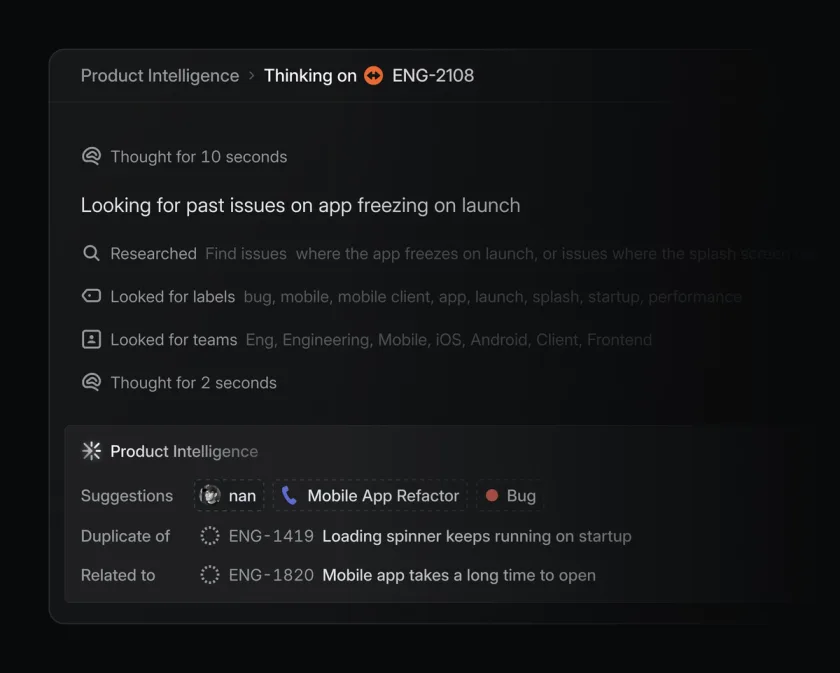 which effectively enables, anything that comes into your triage workflow, bug reports, feature requests, etcetera, to be, like, automatically labeled, assigned, put on the right team's queue. And like, you, as a human, do not have to do anything for that to take place. Right? So it's like, you don't need to, like, build an agent for this. We can just do it for you. Right? So not everything necessarily needs to be an agent. It can just be part of the product. Right? So it's both taught us, you know, certainly how to teach the next customer, like, how to do things better. But it's also helped us incorporate that into the product itself.
Yeah. And then it becomes far more, you know, easy for a person on our team to sell.
So how does that work if... Like, how do you teach salespeople how to use, like, engineering tools?
Oh, well, the great thing about Linear is that, like, anyone can use it. Like, you know, if I think about, like, GitHub issues or something, when I go into GitHub, I'm like, oh. Like, as, you know, someone who's not an engineer, like, oh, I'm gonna mess something up. Like, I don't belong here. Right? But I think the great thing about what we do is that that's not true. Like, we try to create a product that's, like, incredibly usable and, like, well designed, not just for engineers, but really for anyone. Right? And so now increasingly, we're getting rolled out across, like, you know, wall to wall within organizations. So, you know, teams like sales and ops and, like, anyone who wants to, like, know what's on the product road map or, like, be an input into what's on the product road map is using our product. And it's very usable for them too. Right? So I think that makes things far easier just because it's just... It's not scary as, like, a system or a tool. And our salespeople, you know, have learned that. It just... In being at the company, we do a lot, as you can imagine, in Linear. So you need to know how to use it just to be at the company generally. And then again, a a lot of it is in great, like, training of your people. And I think we've invested a lot in enablement. You effectively have to go through, like, various coursework effectively in order to be certified to even sell Linear and get on a call solo with the customer. So we really require that, like, our sales reps understand a lot about the product. And, you know, maybe the most, like, complex engineering workflow would probably be, like, our code reviews product30Linear’s in-app code review is Diffs, launched in May 2026: you can review a pull request from its issue, iterate on it with agents and ship it without going to GitHub (Linear). and or, like, our GitHub integration. Like, those can be somewhat complicated often because you have to set GitHub and have like a demo GitHub workspace and a demo Linear workspace to make sure that they all work together. That can be a little bit more complex.
But, you know, most of that is, you know, in relying on another tool and an integration workflow with it. But I think the great thing is like now we have like salespeople on our team shipping like copy edits to the website. And we have marketers on my team who are, you know, deciding like, oh, we wanna change like how we store this data so that we have like a better sense of like what this revenue operation system does. And, you know, things like that are like now accessible to everyone. And an engineer on our team just has to like review that change and you know, approve it. And I think it's also making, like, just Linear the product and what we do far more accessible to them too. But, yeah, it takes time
07No SDRs and no AI autoresponders
Linear runs leaner teams thanks to tooling, but a human answers the customer.
Yeah. Like with anything. So are your... Like, is your team composition changing? Because now you're having, like, different teams, like, push copy updates to the website that maybe normally wouldn't have done that. And maybe, like, are you seeing, like, customer team compositions are changing because of maybe, like, how they're using Linear or just, like just agentic development, like, in general?
Yeah. I mean, I think one of the things that people are talking about a lot today are... Is effectively how teams are changing in that they're remaining smaller, flatter, etcetera. I feel like I've been a lot of companies that, like, aim to work that way for a period of time, and then they just like grow out of it. And and it changes. I think luckily, like, as a lot of these developments in our space were happening, like, Linear was already operating that way and I think has continued to operate that way. A lot of which, you know, can be due to AI. But I think as an example, you know, other teams do this differently. I think we've never had SDRs as an example. And I think that that comes from a belief that like a salesperson should be able to like write an outbound email. Like, I don't see why. Like...
So what do SDRs normally do?
Typically, they're, like, either doing outbound to new prospective customers and trying to get them in the pipeline or they're qualifying those customers as they come in. So they'll do, like, the first call. But unfortunately, that first call is very, like, not useful to the customer because, you know, the rep is just being like, so how big are you? And, like, how much money do you think you might be able to pay us?31This is lead qualification, checking whether a prospect is worth a rep's time. The classic BANT framework, usually credited to IBM, screens for budget, authority, need and timeline. Linear skips the separate qualifying call and goes straight to a demo. Built In Right? And again, like, our customer would hate to be on that call. They're like, why are you asking me questions? You are supposed to give me a demo.
Yeah. Right? Like, why am I wasting thirty minutes of my time on this call just to get to a person who can give me a demo? Right? So, you know, we don't have that function because I don't think it works well for our customers. But also because you can create systems and tooling and automations that make it easier for an AE to do outbound to a customer. Right? That feels like custom and useful. Right? And is able to like ultimately get to some point of engagement. Right? So, you know, that's one maybe difference between us and other companies. I think we've I think we've also opted to think about areas of the business where we can have like fewer employees. Right? And what can you optimize with like tooling? So our customer experience team is like a great example. So, you know, what are the tools that we can use to automatically draft replies to customers that write into us.
Do you not see that like having LLMs write stuff to customers like produce slop? Like AI slop? Like, how do you how do you fix that?
Yeah. I mean, the CX team, like, humans are the quality check on that. Right? So we do not have AI send mass. Like, they... Like, a lot of companies. And other companies can do this, and that's totally fine. Right? No no shame to other people. But a lot of other companies will say, hey, like, a 100% of questions that come into our support team are going to be, like, answered by an LLM first.32The best-known case is Klarna: in February 2024 it said its AI assistant handled two-thirds of support chats, the work of 700 agents; in May 2025 CEO Sebastian Siemiatkowski admitted quality had suffered and the company resumed hiring humans (Entrepreneur).
Yeah. And only if that customer writes back angrily, right, will a human come in and be like, oh, sorry about that. Like, let me give you a real answer. Right? And we just don't believe in that model. Right? So I would much rather have AI like draft an answer, to the specific question based on the knowledge that, you know, it has coming in. And then a human can decide like, is that a good answer or not? But very often it's like, gosh, this would have taken, three sentences. And instead, I have, like, three paragraphs of, you know, a reply that ultimately is, not the most helpful. Right? And we get so much feedback on support where people were like... Are almost like either was this AI because your response was so fast. And we just... You know, our our team's really fast. So people think it's AI because it came to them so quickly. And then the second being like, wow. This is like the first good interaction I've had with like a support team in a long time. And that's kinda sad, you know, for like other tools and products out there. But, you know, for us, it's one of the things that like we give a lot of kudos to our team for that because it like sets a brand impression. Sometimes early in a customer's life cycle and sometimes, you know, they've been with us for years and are writing in for the first time and it gets them really, you know, feeling confident they they made the right decision. Right? So I think you can use these tools. They're tools. I don't believe in, like, blindly using these tools in a way that makes your... Like, compromises your brand and ultimately makes your team feel like it's... Like almost less useful or less knowledgeable because it's relying on a tool to have all the knowledge that, like, a human should have.
Yeah. So you... Did you mention, like, downsizing the customer experience team? So...
Not downsizing. But I don't think we've ramped it as much as we would have without it, right? So I think some of these tools are are very helpful for enabling us to, like, not always have to grow teams linearly with, like how how fast the business is growing. Right? And, you know, I think on, like, other parts of the business, like marketing and other areas where it's like, oh, okay. We can do interviews with customers for customer stories. And, you know, we can have an AI tool, like, transcribe this interview, pull out like some of the most compelling pieces, but like we still have a human write the story. Right? So just deciding like where you're going to decide to use it, like we don't like the way that a lot of AI writing feels. So, you know, we've been like... Well, like, use it to help us, you know, find the interesting parts of, like, two hours that we spent with a customer. But in a lot of ways for it to feel like how we want Linear to feel, which is like, you know, custom and handcrafted. Like, you know, we shouldn't use those tools for certain kinds of things.
At least until they get better.
So... Astra33Chatha’s aside to Cordova’s complaint about AI prose: GPT-6 Astra, OpenAI’s flagship released on September 3, 2026, writes rather well in his experience. is pretty good at writing, I've noticed recently.
08Solutions engineers and the internal champion
Solutions engineers make a migration look easy, but they don’t implement Linear for the customer.
Yeah. But anyway, how does... Like, how does sales engineers fit into your team... Into the sales team?
Yeah. So we have what we call solutions engineers
Oh, sorry.
That are effectively the same thing. They are kind of like partners to our enterprise account execs and probably like the upper end of our growth segment. And so they're spending a lot of time with sales as a customer has like really deep workflow questions. Or they're thinking about, you know, hey, I integrate with like this tool over here with it like a very custom API integration. How would I move that to Linear? Right? So you're asking someone who has like a deeper technical question. Right? Or how would I perform a migration of 30,000 people from, like, in a legacy tool to Linear? Right? And so, you know, a solutions engineer can come in with a technical mindset. Like, all of, you know, these folks can
And the person they're talking to is an engineer presumably?
Yes. Yes. Almost always. And so, you know, that person has very detailed questions. And sometimes the people on our team are building like full end to end demos of like, oh, you wanted to see how we would integrate with ServiceNow?34A typical enterprise ask: ServiceNow is the platform big companies use for IT tickets, HR and other internal workflows, so any new tool has to plug into it. Like, I actually built this ServiceNow integration overnight. And like, let me show it to you. So it also makes a lot of these like transitions that customers are going through like, you know, very easy because they start to see like, wow. Like, it is possible to do these things like very quickly. Like migrating isn't that hard. Right? Because like, you know, this engineer just built this like, you know, quick importer, you know, in a day. Right?
Yeah. So sometimes we're we're helping customers along in the journey. We're typically not, like, going into their systems with access to their systems in a forward deployed engineering type of way, to, like, implement Linear. And I think a lot of that is like a philosophical belief. Like, we believe Linear should be easy enough for someone to integrate. And, you know, we have competitors that have, you know, admins where their entire job is just managing that tool.35A dig at Jira, where administering the tool is a career of its own, complete with Atlassian’s own exams and certifications (Atlassian). And they are dedicated tool people within companies. And, again, I think that works fine for products that are like almost infinitely customizable. Right? But Linear is not that. Right? We tend to be far more of a purpose built tool. So we have, you know, pretty clear ways of doing things within Linear, but I also think that makes things far easier for agents to understand. Right? A lot of people are coming to Linear from other tools where, like, you know, bug as a label for this one team means something, and for another team means something else. And you can do that because bunch of different teams can work in, like, completely different ways, but it means that, like, the data is very difficult to discern. And so, you know, we're finding that with our system, it's just far easier for, like, agents to read and understand and work with as a result of some of these things. So I think the combination of, like, having that and then having, like, a technical counterpart to a salesperson... And often, like, our salespeople are working with people who are, like, you know, we have, a champion in the company,36A champion is the person inside a prospect who wants the product and sells it internally; finding one is a step in the popular MEDDIC deal-qualification framework. and they're saying, like, Linear is amazing, but I can't convince, like, this other person. Can you help me? Right? You know, the IT person or the procurement person or, you know, someone else who's often not in the tool day to day. Right? So maybe doesn't understand the challenges. And our salespeople are basically like advocates for that person and are like, okay. What can I do to help you sell internally? Right? And, you know, engineers are often not used to being like, need to sell other people within my company about this tool. Right? So that's like a learned skill that we can often help with. And we find our salespeople are in, you know, kind of interesting positions, helping advocate for Linear through other people.
Just curious, like, how long does it... Like, do you have a rule of thumb for how long it takes for, like, a case like that to, you know, get that customer to actually buy? Like, when, you know, they have to go to, I don't know, someone who has decision making authority? Like the champion. Sorry.
Yeah. I mean, I think sometimes a decision can start from like one person. We've seen this. And then they get the buy in of the CEO, and the CEO just makes a top down decision. And it's like, we're moving to Linear over the weekend. Like, get used to it or get out. You know? And it's very, like, you know, dictatorial around, like, the decision that's being made. And those decisions can happen, like, in a month. Right?
And those are, like, smaller companies I'm
If you get... I mean, that... We had that happen at a 1,000 person company. So, you know, again, it's just like if you have a CEO who is like, you know, I'm less of that type of person. Like, if I think my team should use a tool, I'll be like, why don't you all evaluate it and decide for yourselves? Right? Other companies work in very different ways. Right? So, you know, you have to think about, like, the politics of given organization, and every organization is inherently political in some shape or form. And then, you know, how do you ultimately, like, work this decision into a favorable way, you know for your business. But, you know, then we'll see, like, companies. We had one company that probably took two years, two and a half years or something. Like... And it wasn't that they were in the sales pipeline the whole time. It was like, they came in, oh, we couldn't convince the CTO. Like, and then they, you know, come in again, like, nine months later.
It's... Using it in the company?
Yeah. Then a different person comes in, like, nine months later, and it's like, I think we can convince the CTO now. Right? And then, you know, and it and it just takes, like, a really long time to finally get them to, like, approve and, like, make the decision. Sometimes it's budget. It's like, oh, we've already set the budget for this year. And if this is gonna require more spend, well, that's gonna be a 2028 decision. Right? Some companies operate like that.
09AI budgets and three-year contracts
Slow companies don’t decide faster, but buying gets easy when a product fits the AI budget.
Are you saying that like they're now operating like a lot faster because of the way like things are changing so fast now or not really still? Maybe like these more legacy companies?
Yeah. I don't think they are operating any faster, honestly. At least with decisions like this. I would say for a lot of these companies, the things that... The thing that's helping them move faster is that like AI tools have effectively been like unblocked. Right? So if they believe that... The engineering team in particular believes that like this tool is going to make them better and it fits in like the AI budget.37a16z’s 2025 survey of about 100 enterprise CIOs captured both the windfall and the shift Cordova describes: innovation budgets funded a quarter of LLM spending in 2024 but only 7% in 2025, with the rest moving into regular IT and business-unit line items (a16z). For some companies, you know, that is maybe not infinite, but it is very high. Whatever that budget is. And it was like, you know, add on budget that kind of had to come out of nowhere. Right? I think that's going to change. It's starting to change for companies. But in a lot of ways, if you can like fit your company into that AI budget, then you are unlocking kind of budget that previously didn't exist. Right? And so that makes it far easier, I think, for companies to make a decision because like, oh, there is budget. We found... We've magically found budget that didn't previously exist before. Know?
Okay. So you think like a lot of this like AI companies are, you know, getting to a $100,000,000 of revenue within like three months?38Fact-checkOverstated: the fastest known runs are about eight months from launch to $100 million in ARR, claimed by Sweden’s Lovable in July 2025 and by Emergent in February 2026 (Tech.eu; YourStory). That's because of this basically. It's a lot of companies that previously didn't have budget for like experimenting with new tools. They're just kinda like, oh my god, our company's gonna die if we don't try any of these tools. So like, let's just experiment. And then, you know, at some point maybe a year from now, two years from now, that's gonna stop. Like they're experimenting right now and then, you know, they're gonna figure out what actually works, what doesn't.
I think I think a lot of companies are experimenting. And, you know, you're signing like one year deals maybe with companies or you're signing like pilot agreements with companies that have costs associated with them still. But you're not signing like a three year deal with a company because you're like, I don't know if I'm gonna like this. You know, in two years, like, things are changing so rapidly.
Is it normal for a company to sign a three year deal?
If you're trusted like, we sometimes sign very long term deals for that reason. It has trade offs. Right? Like, we can't move up our prices in that three year period of time unless you have, like, step ups built in to the agreement.39Step-ups, or price escalators, are price increases written into a multiyear contract in advance, typically a few percent a year. Without one, Linear collects the same amount for three years even if its list prices rise. But you know that you have that committed revenue. Right? So, you know, like... And for the business, the same is true. They feel like maybe they're getting a discount for, you know, three years that they wouldn't have otherwise been getting. But but I would say like to the example you had, I mean, I think a lot of those businesses are are very concentrated in the customers that they have. Right? So it's very different, I think, to be like a business like Linear that is, you know, 40,000 paying customers. Right? And like, historically, up until June was like an entirely seat based business. Right? Much harder to, like, grow revenue to, like, from zero to a 100 million overnight.40It took Linear seven years. As of August 26, 2026, the company said it had passed $100 million in ARR, had more than 40,000 paying companies, and net revenue retention of 177%: customers from a year earlier now pay 1.77 times as much (Linear). Right?
And then, you know, you see companies where, I don't know, you sell to, the defense industry or you sell to, like, gigantic law firms41Harvey, the AI assistant for lawyers, is one example: in August 2025, three years after its founding, it announced $100 million in ARR and said 42% of the AmLaw 100 used it (Artificial Lawyer). or, you know, something like that. And, you know, you sign a few deals that are, like, 30 to $40,000,000 in ARR. And then, okay. Great. We got to a 100,000,000 ARR. Right? So, you know, certain kinds of businesses do have, like, more of that profile.
10How to charge for AI features
Outcome pricing works where the outcome is easy to count, as with Fin; Linear prices from its own costs for now.
So you're usage based now?
We have some features that are usage based in terms of how we charge for them.
Yeah. So how do you how do you convince your customers that that's that's a good idea to go from, like, seat based to usage based? Is that hard to convince them?
ExplainerSeats, usage, outcomes
Seat-based pricing charges a flat monthly fee per user; until June 2026 that was all of Linear. Usage-based pricing scales with volume, such as requests, tokens or minutes, the way clouds and model APIs bill. Outcome-based pricing charges only for finished work, like Fin’s fee per conversation it resolves without a human. Seats are a bad fit for AI features from the vendor’s side: one user can run an agent for hours, and the cost of serving different customers can differ by orders of magnitude. So Linear kept seats for the core product and sells its expensive features, coding sessions and Loops, against prepaid AI credits.
Yeah. I mean, I would say, like, a lot of companies that are in, you know, the SaaS world are are certainly moving to usage based pricing. I think everyone would love for there to be like... Almost like the Intercom Fin42Fin, Intercom’s AI support agent, now costs $0.99 per outcome, a conversation resolved without a human (Fin). In September 2026 Salesforce closed its roughly $3.6 billion acquisition of Intercom, which had by then renamed itself Fin (Salesforce). model that existed for a long period of time where... Which was like, oh, if AI responds to your support ticket, like, you know, that costs a dollar. And you're like, is every support ticket that gets replied to, like, worth a dollar? Like, okay. Great. Like, right? So you're you're pricing on, like, the outcome that you drive. Right? I think it's a lot harder for other types of businesses to be like, okay. So what is automatically triaging this bug to the right team worth?
Yeah. Right? Maybe to every company, that's a little different. Maybe you believe, oh, that's the PM's job. Like, they they should be, like, you know, triaging bugs into the right queue, right, to the right person. And, you know, maybe another company says, well, I'd want my PM to spend their time talking to customers and, you know, building the product roadmap and doing other things instead. So I think there can sometimes be a debate in functions that are not very clearly outcome oriented, how you charge for usage based pricing. So I would love for there to be a world where, like, there's some kind of, like, outcome based model that makes sense for our world. I don't know that there is. So, you know, for now, we're mostly charging, you know, based off of like costs that we incur to run our services. And in some cases, those costs can be, you know, pretty high. If you're running like a coding session in Linear or if you're doing things like, you know, run through my entire backlog and tell me what I should work on next. You know? You could have a very large backlog of a lot of things. Right? So, you know, those kinds of even just like chat questions to the agent can be like more expensive. We've decided to make certain things free. So like, you know, Linear agent chat conversations free,43Linear Agent, opened to all teams on March 24, 2026, knows a team’s issues, plans and code, answers questions and takes actions; chat with it is included in every plan (Linear). and we think we can continue to drive down the costs for that over time.
You guys are using like open source models for that?
Right now, we're using frontier.
Okay. Even for the chat.
Even for the chat. And, you know, TBD what the future holds there. And then beyond that, when you have a coding session44Coding sessions launched on June 11, 2026: assigned an issue, Linear Agent writes the code with Claude Code or Codex (Linear). Per Linear’s docs, sessions draw on AI credits, with model tokens billed at the provider’s published rates with no markup plus sandbox runtime; a Loop run without a coding session typically costs $0.07–0.20 (Linear). in Linear, you can choose between like right now, OpenAI or Anthropic, models and harnesses.45Users pick not just a model but the scaffolding around it: a harness is the software that gives a model tools, files and a terminal and runs the agent loop, Codex at OpenAI and Claude Code at Anthropic. And the user ultimately gets to decide there and we charge basically by saying, like, here's what we were charged from the API. Here's the published rate and we charge like a little bit on top of that. And that's it. So making it very clear and transparent for most users. And then for products like Loops, we have an AI credits model as well for that feature. So, you know, for everything else, it's a little different. The vast majority of our AI features are just like baked into Linear and you don't have to pay extra for them. So...
How do you, like, how do you go about going to your customer and saying, hey, previously you guys were doing seat based pricing and now we're gonna do this?
Yeah. I mean, I think it helps that, like, the seat based pricing isn't going away. Right? Like, so you're still paying for the core service, and we are not charging for things that were previously otherwise free.
Right? So it's it's very different, I think, when you go to a customer and you're like, So, like, what was free is now paid and usage based.
Are, like, new features, basically.
Yeah. Exactly. So sometimes we'll have a feature that's in a beta period, and we don't exactly know what it's going to cost or how to charge for it with usage based pricing because like, you know, you can, for example, run a very expensive Linear agent query and you can run a very inexpensive one. Right?
Yeah. So charging based purely off of like, you know, $1 per per query, like, wouldn't make sense in that world. Right? So sometimes you just need to let customers, like, play with a new product to determine, like, what it's going to cost and what the best pricing model is. So typically, what we'll do is we'll have, a feature that's in beta, and we'll say, hey, this is an AI feature in beta. You know, we expect that we will charge for this in the future. But right now, it's free. Like, feel free to use it. See if you get value out of it. Give us feedback. And then we're... When we're ready to charge for it, we will let you know and give you notice. And I think that's worked generally, like, pretty well for us so far. And, you know, just trying to make sure that we're very clear with our customers. Sometimes, you know, we can have a six month beta period and then five months later, you're like, oh, I totally forgot that this was free. And in beta, I'm gonna be charged for it, and I'm disappointed. Right? It's hard... You know, there's nothing we could have done other than, you know, I don't know, warning banners in our product like, you are using a free feature that will soon be paid. There's only so much you can do about that. But I think just trying to, like, be open and honest with your customers that, we don't know what the business model is for this. Like, we know we're going to charge for it because it's expense... It's an expensive product to serve to you. But we are going to try and, be as transparent as possible. And, you know, we hope you trust us. Right? And hopefully, like, every time one of these things happens, you are building more trust over time. I'll also say we tend to bias towards making things like more expensive at the start and then decreasing costs rather than like making things really cheap and then being like, oops. Like, actually, we can't solve... Like, serve this product for that cheap. Right? So just being like conservative in that way and where we are, like, able to lower cost for customers so that we get more adoption, we will.
11What agents pushed out of the 2025 plan
Linear announced its enterprise push in 2025, then chose agents over part of the enterprise roadmap, which Cordova says put it ahead of competitors.
Yeah. So you mentioned earlier that, like, when you came in, you had this, like, six, twelve month, like, go to market plan. Did you basically follow that go to market plan, like, to a tee, or did you have to change it along the way? And then how did that change back in 2025 when you guys started building the new agents features?
Yeah. I think I probably did every... I mean, I haven't looked at it in a while. But I think I probably did everything, you know, for the most part, at least certainly at this point. Maybe I didn't do it all in the six to twelve month period that I thought I would. But a lot of it was like team building, hiring, you know, starting to think about launches, like product launches in a much more robust way. Like, you don't just, like, ship something and, like, move on to the next feature. You have to, like, continuously educate and market products over time. So we think a lot of those things we've, like, adopted into, like, new motions and ways of doing things for the team. And, you know, we certainly... And we went from, like, no sales team almost to it being a very large percentage of the company now. So so, you know, I think a lot of those things have, like, ultimately, you know, shipped and gotten out the door. And what was the second part of your question?
It was like, how did you have to change that go to market strategy back in 2025 when, like, the agents features came out?
Yeah. I think a lot of it was just, you know, sometimes, I think from a go to market perspective, you have a you have a long term road map. Right? And, you know, a lot of those things at the time were like enterprise features and other things to kind of help us go up market. And that was also... 2025 was a year where we said we were going after enterprise. Right? And then we saw everything that was happening in this space, and we're like, oh, we've gotta build an MCP server. Oh, we've gotta build an agents platform with a whole new set of APIs.46Linear for Agents launched in May 2025, making agents workspace members you can assign issues to and @mention, starting with Devin, Codegen and ChatPRD (Linear). GitHub Copilot’s cloud agent for Linear became generally available in July 2026 (GitHub). So anyone can build an agent into Linear. Oh, we've gotta build partnerships with like Codex and Cursor, and GitHub Copilot.47The timeline: the Cursor integration, which lets you assign a Linear issue to Cursor's background agent, shipped on August 21, 2025, and OpenAI's Codex agent followed on December 4 (Linear; Linear). So all of these agents are in Linear. And we did all of those things, but none of those things were planned. Like, we did not know we were going to do any of those things at the beginning of 2025. So that doesn't mean we did all of that and everything else that we planned for. It meant that, like, a bunch of the enterprise stuff that we planned for, you know, didn't get done. So
Meaning, like, there were, like, certain customers you were trying to go after? Or
Like certain features that we wanted to build for, you know, workspaces that were of a certain size that would, like, you know, help us scale to like larger and larger organizations. And, you know, again, a lot of those things didn't get done. But I looked at it and I said, well, do we wanna be like behind all of this new stuff or do we wanna be like really racing ahead of where we think we should be? I think we chose to say like, no. We're gonna race ahead. And I think I also believed that if we did that and we did it well, that it would also win us new enterprise customers, just not in the way that we thought we would win them.
Yeah. Right? It wasn't gonna be about, you know, building, like, sub teams and multilayer, like, work streams, like roadmaps that work across multiple different teams, which you might want if you're a large organization. Right? No. It was more about, you know, building these things that make Linear work really well with agents. And, you know, because we built that and our competitors, you know, waited a long time to do the same thing, I think we got ahead in a way that we wouldn't have otherwise. And a lot of enterprises put Linear on the list to be considered that wouldn't have otherwise.
12Advice to herself: relax and stay close to customers
Cordova joined in 2023, in the middle of a startup downturn, and learned to change plans quickly.
If you could go back to when you first started at Linear, knowing what you know now, like, what what would you tell yourself? Or what do you wish you knew?
I feel like I probably go back and be like, you know, calm down. It'll all be fine. Like, it's probably what I would say. And what I mean by that, what that's, like, really alluding to is when I joined Linear in 2023, the startup market was not doing well. Right?
GPT had just come out.48Basil means ChatGPT, released on November 30, 2022; GPT-4 followed on March 14, 2023, shortly before Cordova joined Linear.
Source: Crunchbase, 2022 year-end report (2021) and 2023 year-end report (2022–2023)
You had all these companies, yeah, in, like, 2021 and 2022 that raised these, like, gigantic funding rounds and were doing really well, you know, as we were kind of coming out of COVID. And then in 2023, like, it was the great, like, startup culling. Like, companies couldn't really get funded. A lot of companies were, like, cutting costs, like dramatically, trying to consolidate spend. So in that world, it, you know, it was like much harder to grow, especially when in 2023, we were focused on startups. And then like growth stage companies a little bit. Right? So, you know, I think in a lot of ways, sometimes you enter into a space in like a market that's hard.
Right? Luckily, it was hard for everybody else too. So, you know, it wasn't like, you know, it was, you know, disproportionate in a way. But, you know, it did, like, affect the business. And, you know, you're trying to figure out ways to grow without that natural growth where you would have otherwise gotten. And then I think similarly with, like, all of the agentic development and the way that things have changed. Like, you have to have a similar approach of saying, like, like trust in, like, engineering and product and design to build the products that they would wanna see in the world. And we will build a business model around whatever that is. Right? And it's not our job to exactly predict the future. And I think now we like, you know, we have a product roadmap that goes out max like six months because, you know, who knows how things are going to change. Right? And I think that really helps to say, okay. We're gonna create a story for, like, how the world is right now.
And we can expect that that story is gonna last for, like, six months from like a marketing perspective. And then it's probably going to evolve and change. And we shouldn't be afraid of being like, oh, no. We had this billboard that was like supposed to go up that had this other message, and maybe that message isn't right anymore. And it's like, yeah. You gotta just like move and change. And, you know, it's all gonna be okay. Right? But, like, you just don't have the same time to like plan a message, plan a strategy, like execute it perfectly as you used to, like, in the old world. So I think this new world, like, ultimately rewards speed and operating in a very different way. So, like, stay close to your customers. Focus would be like what I would go back.
Do you think this is like a temporary moment in time, or this is just the way that it's going to be now? Like, things are just gonna continue changing, like, super, super fast.
Yeah. I think it's the way that it's going to be. I mean, I said this about the summer of 2025, where normally, like, in Linear's business, summer slows down because your customers go on vacation. They don't buy things. They don't enter into, like, new procurement processes. Right? And so I was expecting, like, what it was like in 2024 to be like it wasn't 2025. And I was like, this is not this is not that. We are we are going full throttle. It used to be that companies, like, wouldn't launch products or, like, have conferences in the summer or, like, do any of these things. And now it's like, no. I'm... We're just gonna get up on, like, a stream and, like, launch something right now with, like, a week's notice.
Yeah. Right? And it used to matter that you, like, shouldn't launch on Fridays and shouldn't launch on Mondays. Now, who cares? You can launch on Saturday. Doesn't really matter. So just like all of those rules, I would say, like, have gone out the window because there's so much launching and so much happening. And I don't see that changing for a while until there's like a consolidation moment in AI.
13Moats, quality and slow hiring
Linear’s real moat, Cordova says, is its team, not design or speed.
Yeah. Also, like, everyone always talks about what's your moat? What's your moat like as a business? What would you say maybe the moat of Linear was like when you first started out and maybe like what it is now?
Probably great design, great UX. I would say now that it actually probably was, like, great team. And now it... I'm like, great team.
I would say speed maybe, would you say?
Yeah. In a way. Just I mean, I think in a in a... It's hard because I think for a... Like, we care so much about quality. We are often the company that will, like, delay a launch to get to, like, a certain level of quality. So we are not the flat... Fastest, but it also means we're not, like, the sloppiest in a way. So we're hitting that fine line, basically. But, like, compared to, like, legacy companies. Like, yeah, we're fast. Right? But, like, you know, it's all a spectrum. Right? So I think in a lot of ways, like, for who we're competing against, you know, there's, like, the right trade off between, like, quality and speed. And for every company, that's different. Right? I think we're higher, like, on the quality end, but still try to be fast and, like, cut scope, like, where it makes sense. But I think, like, I think a lot of the moats in business, like, have kind of, like, crumbled away. And the reality is that you just need to have a team that, like, has a really good sense, a really good pulse of like what's coming, what's changing, and you are investing in your team and your people to be able to figure it out. Because, you know, yesterday, this model is the best. Tomorrow, this other model is the best. Like, a company you hadn't heard of, like, two months ago is now raising at $10,000,000,000.49Mira Murati’s Thinking Machines Lab is one such story: founded in February 2025, it raised $2 billion at a $12 billion valuation that July, with no product or revenue yet (TechCrunch). Like, so everything can change.
Which means, like, we should all be very paranoid in a lot of ways because like, you know, the business that you had is not necessarily going to be, you know, the business that you have in the future. But I think what people are investing in is like a team and a way of doing things that is the future no matter what the future holds.
Yeah. I always find that question to startups is like dumb. It's like you're a startup because you're trying to beat incumbents. Like they have maybe a moat, like looking back, but if you like you don't have a moat when you just start a business. Right? It doesn't make any sense. Anyway, earlier you also mentioned that like you guys were kinda like going stepwise where you were, you know, selling the startups and then you were like, oh, we can't just immediately go sell to, like, giant enterprises. We only had, like, one salesperson. Why not then just hire, you know, a 100 salespeople and just go straight for those?
It just... It wouldn't be the Linear philosophy or way of doing things. Right? I think we've always operated with the, like, do more with less. Like, we would be a company with, like, if you look at most companies that are stage and revenue, they have teams that are almost double the size in terms of headcount.50If anything, that's modest: with more than $100 million in revenue and about 170 people, Linear brings in roughly $590,000 per employee a year. SaaS Capital's 2025 survey puts the median for private SaaS companies at about $130,000, though it runs higher at Linear's scale. SaaS Capital And I think we are able to do a lot more with less. That also means that we can be a lot more nimble than other companies because you're not moving this, like, gigantic ship whenever you need to change direction. But I don't think we would have done well with, like, having a sales team that was bigger than, like, the entire company. You know? So, you know, I think at the beginning, I think... And this was true when I was at Stripe too. Like, there was this impression of salespeople that I think for a lot of tech companies can be pretty negative. Right? It's like, oh, like, who are these people? These, like, car salesman coming in to, like, sell our product. I never thought about it that way. We don't think about it that way at Linear, but that was like maybe the impression of salespeople maybe of like, you know, tech in the early 2010s. You know? I view it very differently because I do believe that like sales has a lot of power to help inflect a business that requires human interaction and persuasion. And I would say that, like, for us, you know, doing it small and steady built the kind of trust that was required in different parts of the organization.
So like engineering really trusts sales. Like when our sales team is like having trouble in a particular segment and, you know, gets on calls with, like, PMs on our team and things like that. Like, there's a lot of trust in that salesperson really understanding the need of the customer, what they're asking for, sometimes even helping solution when necessary. I don't think he would have done that. Like, we would have been able to do that particularly well by hiring a ton of people really quickly. And again, a lot of startups take that approach, but I think they have probably more of like a hire fast, fire fast type of mentality. And I think with hiring, you know, we do work trials. Like, what signal does that send to you? That signal sends to you. Like, we like to, take our time and really understand if someone's a good fit. We want to get them into the, problem scope that Linear operates in and test to see, like, that their great experience somewhere else is going to translate well into our company. You know? So I think it's like a philosophy difference and, you know, every company does things differently. And I would say a lot of the great companies, you know, in the world do things their own way for a reason.
14Forty percent engineering, and promoting from within
Cordova brought Stripe’s headcount ratio to Linear and left behind its habit of always looking for someone better.
Yeah. Do you guys take inspiration from any other companies?
I mean, I spent seven and a half years at Stripe. And certainly, there are things I take inspiration from. I'll give an example. What... Because we were talking about hiring. You know, at a certain point, we were hiring, like, business people at Stripe faster than we were hiring, like, engineers and product folks and designers. And, you know, the founders were like, this has to come to a stop. Right? And it's like, well, you know, what kind of, you know, ratio would you like? Right? So you then take a step back and you're like, yeah. What what do we want this company to be? If we want this company to be like an engineering and product driven company, probably at least like 40% of the company should be like engineering product design, data, etcetera. And so we basically were like, okay. That's the, like, watermark. And, like, we can't
It was just like an arbitrary number. Like
It was 40%. 40%. And it was like, we can't go under that number. So if sales wants to hire more people, have sales help us hire engineers so that sales can then hire more people. Right? And I think, like, yes, it's an arbitrary number, but I think it's important for you to understand, like, how do you want your company to be constructed? Right? Like, there are a lot of companies like... And Uber that are, like, heavy on operations, but that's because they're moving like humans and things. Right? We're a very different kind of company. We're like a software business. Right? And for us, we don't necessarily have to have, like, an operations component of the business that is, like, that huge because we're not dealing with those kinds situations. So like understand your business really well, understand what you want to be, and then figure out what model makes sense for you. So like, we don't have like that hard and fast rule at Linear of like 40%, but like I watch that number. I like created a headcount spreadsheet. Was, like, one of the first things I did. Like, put everyone into their categories of, like, what function they're in, like, calculated the percentage, and, like, you know, I watch it.
And I'm, like, we really need to, like, step up our game on, like, engineering recruiting. It is always going to be harder to hire engineers than it's going to be to hire salespeople. And so, like, what are we going to do to like make that easier for us? So a lot of it is just like the philosophy and what you want to be. And knowing that I've been at companies that like, you know, wanna do things the same way, but also, you know, for example, don't wanna outsource support or, you know, wanna treat different aspects of the product in a different way. And I think that's the challenge. There are a lot of things that like I get to bring with me from like my previous experience. And then at the same time, there are a lot of things that I wanna do in a new way that I haven't seen anyone else do.
Yeah. I was gonna ask that next. Like, were there like certain things that you specifically did not wanna bring over from like Stripe or Notion? Maybe one example.
I think I think Stripe did so well as a company that I think in a lot of ways when, you know, you're a 140, $160,000,000,00051Cordova is citing Stripe’s recent valuations: a February 2026 tender offer valued it at $159 billion (The Irish Times). While she worked there it went from $20 billion (2018) to $35 billion (early 2020). company and you're like on that rise, sometimes you believe you can always hire better than what you have today. So you have a leader in a given function that's doing well. And sometimes your first reaction to that could be like, well, it's because the business is doing well, not because that person necessarily is that great.
And it's It's like, oh, I'm at Google. I helped increase revenue by, you know, $20,000,000,000.
Exactly. But what did you really do? Right? And so sometimes it goes really well. Is it, you know, because of that person or is it because the business was going really well? And then if the company is doing so well that you can attract really high quality talent. Right? So someone like two levels above that person, and then a year later, you're able to attract a person who's two levels above that person. And... Right? You're kind of always going to be seeking, like, someone better than who you have in seat because you can. And I think, like, for a lot of companies, like, being able to say, like, I've said this to our founders. I'm like, we can get someone better. Like, we're a good company. Company that people want to work for and then are excited about. Like, we don't have to settle. Right? And I think that's, like, great. And then at the same time, sometimes you also have to, like, really recognize, like, the great people that you have. And I think for Stripe, it took a longer time to, like, come around to that. Like, Stripe's been having a lot of, like, boomerangs. Like, you know, people left the company because maybe they, you know, weren't on the rise, you know, in the way that they wanted to be. And then, you know, came back and are doing like amazingly well. And I think sometimes I would like to look back on my time at Linear and say like the right people were, like, promoted and excelled. And we didn't hire above them unless the company needed to. Right? Unless we needed to get to that a different stage. We needed something that that person didn't have. And not just because, like, we weren't willing to let them try to, like, be better than they are, to, like, scale at that next stage. Because, you know, in running startups, this is true of founders. Like, you don't... Like, almost no founder who has a lot of success has, like, done it exactly before. Right? And that's probably going to be true of a lot of the early team. Like, they're leaders at the company, but they've never scaled a support team to like 200 people or 500 people or whatever. That doesn't mean that they can't. Right? Just like it doesn't mean that that founder can't be a great founder at a thousand people and also a great founder at like 50 people. And so, like, I just fundamentally believe that like people can grow and scale, and that you should like reward that over time.
And, you know, I have some time... Like different parts of of the company, like, I'm like, I don't know if they always believe that. I think... And I think a lot has changed since then, for what it's worth. But maybe that's one thing. On support, that would be the other thing. I think it's incredibly difficult to scale support to that degree. And I think that we emphasize a higher level of quality than I've seen in vast majority of support organizations I've operated in. And so it's something that we care about. We're willing to pay more for it. And we believe it's like the right thing to do by our customers. And I love that I've literally never in three and a half years gotten an escalation because someone had a poor experience with our support team. So that's like a company that like I see and I love to be part of. You know, and that's not true for every other company I've worked for.
15From investing back to operating
Venture gave Cordova breadth, but she prefers execution inside a company.
So, okay, you were at Stripe, then you went to Notion for a little bit, and then you became an investor.52Cordova was a partner at First Round Capital, the San Francisco seed fund that was an early backer of Uber and Square, investing in fintech, SaaS and developer tools (First Round Review). Yes. Why did you make that transition to becoming an investor?
Yeah. When I was at Notion, I enjoyed my job, but the parts that I enjoyed were almost the parts that I wasn't really hired to do. So I joined around maybe 40 people or so, and we were, you know, we were scaling. We didn't have like a single recruiter. We didn't have a head of people. We didn't have anyone working on growth. So, you know, what did I do? I, like, raised my hand and was like, I'll help hire our head of people. Like, I'll help hire our first recruiter. I'll find our first product manager and, like, hire them. And I did all of those things, and then I kind of, like, hired my way out of, like, jobs that I had. Right? And then got to a point where I was like, wait. I'm, like, back at the job. I was, like, actually hired to do. Like, I don't really
Which was what?
Like, head of platform and partnerships. And I was like, I'm not really excited about this job anymore. Like, I was having more fun doing all that other stuff that I wasn't really hired to do. But it's just like, it's company building. Right?
And at the time, I was just like, I I think I need a new role at like a different company. And I don't know what that role exactly looks like. Right? And so I thought that venture might be a great way to kind of get the breadth that I was looking for, really, by spending time with, like, a bunch of different kinds of companies in different spaces. And, you know, I think for me, it's it's it's very different being an investor than, like, coming into a company and actually doing the work. It's really, like, different to, like, advise a company like, oh, you should go spend more time with your customers. And you, you know, should think about this business model or, you know
And you were doing early stage? Or
Early stage. And a lot of the early stage stuff is like you're investing like pre product market fit. And like, I don't know anything about your market. Like, you sell to like, I don't know, procurement leaders or like construction workers or like, you know, you have to be in that to really understand. And I actually felt like I was more helpful when companies had that product market fit. If I think about every single company I've ever joined, it like just was finding like product market fit, and then I joined. And then I can be a lot more helpful and like build out the business. But, you know, I think for pre product market fit, a lot of it's just like investing in the right people and like getting out of the way. And being supportive and helpful with intros and things like that. But what I... Like, I actually really love execution. Being inside a company and, like, helping get stuff done. And I think I'm kind of known as a person who will, like, run through walls to get things done even, you know, if that might rub people the wrong way in certain larger organizations. But, you know, for a startup, it works really well. And so that’s worked for me.
Are there certain things that you noticed, like being an operator made you a better investor at? And then also vice versa, like what did you learn from being an investor that made you better at, you know, your current role at at Linear?
I think I was speaking from, like, a place of, like, knowledge and truth. And I think a lot of investors have, like, never worked at a startup before. And there's nothing wrong with that. You can be an amazing... They're amazing investors who've never worked at a startup before, and it doesn't matter. Like, you invest in the right people. And, again, let them do their thing. And, you know, as long as you invest in the right people, that strategy works. Right? But, you know, I think also doing VC is sales. Like, you are selling money. And every other investor, like, has money to sell too. Right? So you're kind of selling the same product in some ways, but you are trying to sell yourself. Right? And, like, you are trying to differentiate yourself as a product beyond the money to that founder. And I found it much easier as someone who had, like, been operating at some great companies to be able to go to a founder and say, like, I can credibly help your business. Than maybe other investors could.
What would be, like, the pitch for an investor who's never worked at a company? It'd be, like, oh, I have a lot of intros. I've already invested in a lot of like really cool companies. Is that like kinda their selling point?
I think a lot of it is like sometimes like pattern matching. Right? Like I've been on the boards of these great companies and I've seen success from zero to, you know, a 100 or whatever. It may have been several times over. And, you know, maybe I can tell you when it's time to do x or when it's time to do y because I've pattern matched my way here. I, you know, in a lot of cases, you work with certain investors and they have, like, a very large Rolodex. They know lots of great people at great companies and you know, can introduce you to people who are more knowledgeable than they are in certain areas. So, you know, often investors will come to me and be like, can you help this founder who's thinking about building a sales team you know, from zero? And, well, I can tell you about building it from one. You know? And, you know, because they know me, you know, that's like an access point that helps the founder. Right? So I think for every investor, it's like it's like something different. But, you know, what I take back now as, like, an investor, you know, going back into working at a company is, like, just having more of that understanding when I'm, like, in a board meeting, you know, of, like, what are the investors thinking? Like, oh, right. I was an investor. Like, I have a sense of, like, what they're thinking and what data they wanna see and what are the metrics that they care about. And if we're thinking about raising, like, a new round, like, what are my expectations for their help? If we need more customers, what are my expectations for, like, their introductions? And I have a better sense of, like, what I should be getting out of that person as an investor or board member or something like that. And I think that's, yeah, again, like helpful to the company in a lot of ways.
Yeah. I guess you're COO, so you have to, like, interface with investors a lot.
Yeah. And, you know, we work with some great investors and, you know, are very helpful and have referred people. But, you know, in a lot of situations, like, closed mouths don't get fed. So if you don't ask for things, they're not gonna give them to you. So...
So Linear doesn't have any other c suite other than the founders and you?
Why is that?
It's a good question. I mean, I think, again, we operated this way at Stripe for a very long time. So again, I take a bias towards it. But I think it's been true actually, for a lot of companies. Like, you might have, like, one executive who's, like, hired in on the business side who who has this title or something similar. And I would say at the beginning, a a lot of it is just, you know, my role is kind of a catchall for like a really small company for like lots of different functions and things over time. But I expect that to change. I don't think that's going to be like the way it is forever. You know, if we build out like the right team, you know, the right leadership in the right places, like people will earn that level of title. And I think for us right now, because we still feel so small, like we're about a 170 people, in a lot of ways, we wanna remain pretty flat rather than, like, adding a lot of layers when we are still pretty small.
Yeah. And, I think that's been helpful for us so far. But that doesn't mean that we haven't, like, promoted people and given people more responsibility, more ownership, more scope. But we tend to focus on things like, you know, head of titles for, like, wide areas of ownership.
Yeah. I mean, that's all I had. Is there, like, any... Anything else that, you know, you wanted to talk about?
No. No. This was a great conversation. I feel like we went into a lot of different areas of a business. So thanks. You had great questions.
Yeah. Thank you.


